Morales

Evo Morales defiant after new Bolivia arrest warrant | News

Bolivia’s former president is being investigated ‘for armed uprising’ against the state, among other things.

A court in Bolivia has issued an arrest warrant for former President Evo Morales.

The Santa Cruz district prosecutor’s office said Morales is being investigated for “armed uprising against the security and sovereignty of the state, terrorism and attacks on the safety of means of transport”.

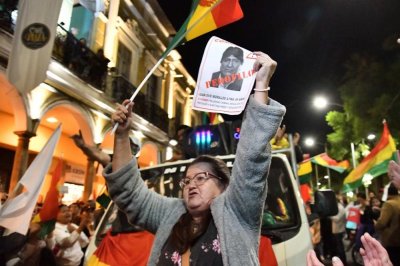
Morales backed protests in June by farmers and truckers against an economic crisis, rising living costs and conservative President Rodrigo Paz’s austerity plans.

“They will not intimidate us,” he responded to the charges in a post on X.

Morales said the government was going after him “to conceal the true drama Bolivia is experiencing: a deep economic and social crisis…a model that has abandoned the people and protects corruption”.

Demonstrators stand amid tear gas as they protest against President Rodrigo Paz's government amid an ongoing economic and fuel crisis in El Alto, Bolivia, May 16, 2026. [Claudia Morales]
Demonstrators stand amid tear gas as they protest against President Rodrigo Paz’s government amid an ongoing economic and fuel crisis in El Alto, Bolivia, May 16, 2026 [Claudia Morales/Reuters]

Morales, Bolivia’s first Indigenous president, rose from poverty to serve three terms as president, one of Latin America’s longest-serving leaders.

He was in office from 2006 until his fraught 2019 ouster, when he was forced to resign after elections tainted by claims of fraud.

Initially refusing to leave power, he eventually had to go, casting a shadow over nearly 14 years of economic progress and poverty reduction mixed with accusations of political heavy-handedness.

He went into exile in Mexico and later, Argentina, returning a year later after his political ally Luis Arce won the presidency.

In late 2024, allegations surfaced against him of trafficking a minor and statutory rape of a 15-year-old girl who became pregnant.

By early 2025, Morales’s supporters cut off roads and paralysed the country in protest against the charges, which he rejected. He has also refused to appear at court hearings.

As the unrest over Bolivia’s economic crisis was brewing in May, Morales was found in contempt of court, and a renewed warrant for his arrest on the rape charges was issued.

His supporters threatened to “throw the country into turmoil” if he was arrested, at a time when protests had shut down roads and forced the government to airlift food to some areas.

After Paz declared a state of emergency in June and the protests slowed, the latest investigation began, triggered by a criminal complaint over Morales’s involvement with the demonstrations.

The complaint, filed by the civic group Comit pro Santa Cruz and later picked up by the Interior Ministry, alleges that Morales’s supporters “caused a shortage of food, fuel and medicine” by blocking transport in the country for 53 days.

The charges filed on Wednesday were outlined in a document published by local media, according to German wire service DPA.

The order instructs police to detain Morales and bring him to the special anticorruption unit.

“We will continue fighting alongside the people, as we have always done, with the conviction that Bolivia deserves a different path: one of dignity, sovereignty, social justice, and the recovery of hope for all,” said Morales responding to the latest charges.
Source link

Ex-Bolivian President Evo Morales accuses U.S. of fueling unrest

Citizens from various sectors in at least five regional capitals across Bolivia took to the streets Thursday to demand an end to the roadblocks organized by peasant unions and groups aligned with former Bolivian President Evo Morales, who are calling for the resignation of the Bolivian President Rodrigo Paz. Photo by Jorge Abrego/EPA

May 22 (UPI) — Former Bolivian President Evo Morales accused the United States of backing the government of President Rodrigo Paz and attempting to criminalize the protests shaking Bolivia.

“The United States does not defend democracy or respect international law. It finances right-wing coups. It invades countries and steals their natural resources,” Morales wrote in a message Thursday on X.

Officials from the Bolivian identified Morales as the main instigator behind the wave of protests and road blockades demanding the president’s resignation.

The historic leader of the Movement Toward Socialism party, who is entrenched in the coca-growing Chapare region, was declared in contempt by a Bolivian court this month after failing to appear at a hearing linked to a human trafficking case.

The former president was responding to a message published by Secretary of State Marco Rubio on X in which Rubiol said the United States would not allow “criminals and drug traffickers” to overthrow democratically elected governments in the hemisphere.

Morales called the remarks “a lie” and accused Washington of supporting the 2019 ouster to gain control of Bolivia’s lithium reserves.

“The United States supported the coup by the gringo against the Indigenous man in 2019 in order to seize our lithium,” he said.

In another message published on X, Morales also questioned Paz’s political legitimacy by claiming he was born in Spain, and he accused the president of “criminalizing” and “repressing” Indigenous people, farmers and students participating in the protests.

“Because he is a foreigner, he surely hates Bolivians. He criminalizes, persecutes and represses Indigenous people. He thinks and acts like an imperialist, neoliberal and neocolonial ruler,” Morales wrote.

In an interview this week with La Octava Radio Nacional, Morales called for early elections within 90 days to “pacify Bolivia,” arguing the country is facing a governance crisis.

Morales’ remarks came as Bolivia entered its third week of protests, road blockades and demonstrations led by unions, farming organizations and Indigenous groups rejecting the government’s economic reforms and denouncing fuel shortages, inflation and economic deterioration, according to reports by Bolivian media outlets La Razón and Los Tiempos.

The crisis has also begun to affect the healthcare system. Bolivia’s Health Ministry said at least four people died in recent days because they were unable to receive medical treatment or be transferred in time to healthcare centers due to road blockades and unrest in different parts of the country.

Among the victims was a 12-year-old boy, who died while being transported in an ambulance after the vehicle was unable to pass through blocked roads.

“We are calling for a humanitarian corridor,” the ministry said, according to reports by Infobae.

The Bolivian Highway Administration reported Friday that 51 road blockades were active across seven of the country’s nine departments, most of them concentrated in the highland region, including the departments of La Paz, Oruro and Cochabamba.


Source link

Bolivian court: Arrest Evo Morales for skipping human trafficking trial

Former Bolivian President Evo Morales attends a public event in Chimore, Bolivia, in Feburary. Morales reappeared at the event in his political stronghold in the center of the country a little more than a month of not being seen publicly and amid differing reports about his health and whereabouts. File Photo by A/Jorge Abrego/EPA

May 11 (UPI) — A criminal court in the Bolivian city of Tarija declared former President Evo Morales in contempt after he failed to appear for trial on charges related to the alleged trafficking of a minor.

The hearing, scheduled for Monday, was expected to begin the final stage of a case investigating Morales’ alleged relationship with a 15-year-old girl in 2015, from which a child was allegedly born.

The contempt ruling triggered measures intended to ensure the appearance of the former leader of the ruling Movement for Socialism, or MAS.

Authorities issued an arrest warrant authorizing security forces to detain Morales anywhere in the country and prevent him from leaving Bolivia. The court also ordered freezing his bank accounts and precautionary registration of his assets.

Prosecutors said they gathered more than 170 pieces of evidence in the case, which were expected to be presented during the trial.

After Morales and his legal team failed to appear in court, the judge applied Bolivian law that prohibits criminal trials in absentia.

“Because the accused failed to appear and did not legally justify his absence, this court issues a contempt ruling,” the judge said, according to Bolivian newspaper El Deber.

The trial will remain suspended until Morales is arrested or voluntarily appears before the court.

Morales’ defense team argued the case already had been addressed and resolved in 2020, adding the former president should not face prosecution again. His lawyers also claimed “there is no victim” and describe the charges as politically motivated, according to Chilean news outlet Emol.

Attorney Nelson Cox, a member of Morales’ legal team, said insufficient security guarantees existed to transport the former president from the Chapare region of Cochabamba. He also described the case as a “political fabrication” intended to block Morales from running for office again, according to Bolivian broadcaster Unitel.

Prosecutors and lawyers representing the alleged victim criticized interruption of the trial.

“It is a mockery of the victims and the judicial system. The evidence is overwhelming and the accused must answer for his actions before the law,” the regional prosecutor’s office said.

Since October 2024, Morales has remained in the Chapare region, his main political stronghold, where he is protected by thousands of supporters and self-defense groups.

At that time, police were unable to execute an earlier arrest order after Morales supporters blocked roads for 24 days to prevent officers from entering the area where he remains sheltered.

The government of President Rodrigo Paz announced Tuesday it would seek information from U.S. judicial authorities to investigate Morales’ alleged links to drug trafficking networks. Bolivian authorities are seeking to participate as a “victim” in ongoing U.S. legal proceedings to gain access to evidence.

One of the most significant cases involves former anti-drug chief Maximiliano Dávila, who was extradited to the United States in December 2024 and sentenced in March to 25 years in prison for conspiracy to import cocaine.

Morales has argued that Dávila’s extradition is part of an effort to pressure him into testifying against the former president in exchange for legal benefits.

Source link