money

Roivant anticipates $950M Moderna payment in July as it outlines 2H 2026 mosliciguat and IMVT-1402 readouts (NASDAQ:ROIV)

Earnings Call Insights: Roivant Sciences Ltd. (ROIV) Q4 2025

Management View

  • CEO Matthew Gline said the quarter included “the preliminary open-label period data from the 1402 study in D2T RA” and a “planned spotlight… on mosliciguat,” alongside “some smaller updates on the brepocitinib program.”

Seeking Alpha’s Disclaimer: This article was automatically generated by an AI tool based on content available on the Seeking Alpha website, and has not been curated or reviewed by humans. Due to inherent limitations in using AI-based tools, the accuracy, completeness, or timeliness of such articles cannot be guaranteed. This article is intended for informational purposes only. Seeking Alpha does not take account of your objectives or your financial situation and does not offer any personalized investment advice. Seeking Alpha is not a licensed securities dealer, broker or US investment adviser or investment bank.

Source link

Tjx lifts FY2027 outlook to $63.2B-$63.7B sales and $5.08-$5.15 EPS following Q1 outperformance (NYSE:TJX)

Earnings Call Insights: The TJX Companies (TJX) Q1 fiscal 2027

Management View

  • “First quarter sales, profitability and earnings per share were all well above our expectations… Overall comp sales were up an outstanding 6%… With our above planned first quarter sales, we are raising

Seeking Alpha’s Disclaimer: This article was automatically generated by an AI tool based on content available on the Seeking Alpha website, and has not been curated or reviewed by humans. Due to inherent limitations in using AI-based tools, the accuracy, completeness, or timeliness of such articles cannot be guaranteed. This article is intended for informational purposes only. Seeking Alpha does not take account of your objectives or your financial situation and does not offer any personalized investment advice. Seeking Alpha is not a licensed securities dealer, broker or US investment adviser or investment bank.

Source link

Republicans mull dropping $1-billion security money request for the White House and Trump’s ballroom

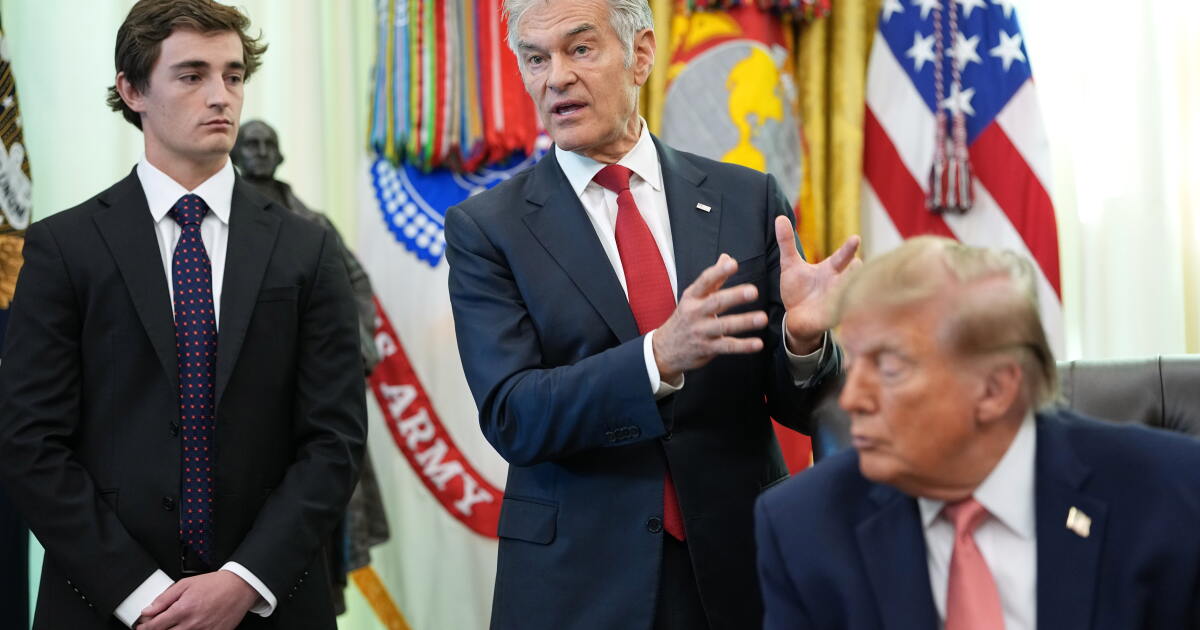
Republican senators are considering dropping a proposal for $1 billion in security money for the White House complex and President Trump’s ballroom after it has failed to win enough party support on Capitol Hill.

Pressured by the White House, Republicans have tried to add the money to a roughly $70-billion bill to restore funding to U.S. Immigration and Customs Enforcement and the Border Patrol. But the security proposal has met with backlash from some GOP lawmakers who are questioning the cost and the lack of detail from the White House and U.S. Secret Service about how the taxpayer dollars would be used.

Sen. John Kennedy (R-La.) said Wednesday that the bill was “back to square one” without the security money because “the votes are not there.”

Sen. Thom Tillis (R-N.C.) said the effort to add the security package to the bill was a “bad idea” and he does not think there is enough backing to pass it, even if it were reduced.

The text of the bill has not yet been released. But Senate Majority Leader John Thune (R-S.D.) acknowledged “ongoing vote issues” as leaders try to measure Republican support, as well as “ongoing parliamentarian issues” as they try to figure out what will be allowed in the bill under the chamber’s rules.

The wrangling comes as Democrats have criticized Republicans for trying to fund Trump’s ballroom when voters are concerned about basic affordability issues — and as some GOP lawmakers have grown increasingly frustrated with Trump. Several have spoken out against the administration’s $1.8-billion settlement fund designed to compensate Trump’s allies, and many were upset by the president’s endorsement Tuesday of Texas Atty. Gen. Ken Paxton in the party primary runoff next week against Sen. John Cornyn.

“There’s always a consequence with taking on United States senators,” Thune said. Trump “obviously has his favorites and people he wants to endorse and that’s his prerogative. But what we have to deal with up here is moving the agenda, and obviously that can become slightly more complicated.”

Republican opposition blocks Secret Service request

Under the Secret Service request, about $220 million would pay for security improvements related to the ballroom. The rest would go for a new screening center for visitors, training and other security measures.

Tillis said the bill should not have included the other security improvements “because it’s just giving everybody the ‘billion-dollar ballroom.’”

“They need to explain to me why we need this,” Tillis said, noting that Trump had originally said private money would cover the project.

Several other Republicans in the House and Senate have questioned the request, and senators left a briefing with the director of the Secret Service last week saying they needed a lot more information.

People “can’t afford groceries and gasoline and healthcare, and we’re going to do a billion dollars for a ballroom?” asked Louisiana Sen. Bill Cassidy (R-La.), who lost reelection in the GOP primary on Saturday after Trump endorsed one of his opponents.

Sen. Jim Justice (R-W.Va.) said he is supportive of the security money and thinks it is necessary to protect the president. But he acknowledged that the optics are not very good for Republicans, and that they have not communicated about it well.

“We’ve got people out there who are worried about how in the world they’re going to have enough gas to get home,” Justice said.

Tensions rise between Senate and White House

As Republicans challenged parts of his agenda, Trump unloaded on the Senate in a social media post.

He urged Republicans to fire the Senate parliamentarian, Elizabeth MacDonough, who said over the weekend that parts of the $1-billion security proposal cannot remain in the ICE and Border Patrol bill. Trump renewed his long-standing calls for the Senate to pass the SAVE Act, a Republican bill that would require all voters to prove U.S. citizenship, and to end the Senate filibuster.

“Republicans play a very soft game compared to the Dumocrats,” he wrote. “It is their single biggest disadvantage in politics.”

Trump said Democrats would eliminate the filibuster “on the First Day” if they ever get full power in Washington again and that Republicans need to “get smart and tough” or “you’ll all be looking for a job much sooner than you thought possible!”

Republicans have been loyal to Trump on most issues, but they have resisted his repeated calls — even in his first term — to kill the filibuster, which triggers a 60-vote threshold in the Senate.

Hanging over the growing GOP rift is Trump’s surprise endorsement of Paxton. That intervention has Republican senators privately fuming that it could cost them their majority in November as they view the incumbent, Cornyn, as the better candidate in the November general election.

Democrats test Republicans on settlement fund

As Republicans move forward on the immigration enforcement legislation, Senate Democratic leader Chuck Schumer of New York said Democrats plan to force a vote on Trump’s proposed settlement fund.

Democrats have an opening because Republicans are trying to pass the immigration enforcement bill through a complicated budget process that requires a long series of amendment votes. Democrats are considering multiple amendments potentially to block that new fund outright or to ban any payments to Trump supporters who harmed law enforcement officers in the Jan. 6, 2021, attack on the Capitol.

Those amendments, along with others, could pass as a growing number of Republicans speak out against the fund and other parts of Trump’s agenda.

Thune said he was “not a big fan” of the new fund, which the administration announced as a part of a settlement that resolves the president’s lawsuit against the IRS over the leak of his tax returns. Cassidy called it a “slush fund” and said “you can’t just make up things.”

Tillis said he thinks it is a “real risk” that some of the rioters charged — and later pardoned by Trump — in the Jan. 6 attack could get compensation through the fund. He said that would be “absurd.”

On Wednesday, two police officers who helped defend the Capitol in the 2021 assault sued to block the payouts. Acting Atty. Gen. Todd Blanche, a personal attorney for Trump before joining the Department of Justice in Trump’s second term, would not rule out the possibility that rioters who assaulted police on Jan. 6 would be eligible for compensation when he testified in a Senate hearing this week.

Jalonick, Freking and Cappelletti write for the Associated Press.

Source link

World’s Best Islamic Financial Institutions 2026

Global Finance’s World’s Best IFI winners outperformed the sector in 2025, emphasizing innovation and AI adoption. But new Mideast conflicts pose new challenges.

Islamic financial institutions (IFIs) modestly improved their performance in 2025, recording an average Return on Average Assets of 2% and a 12% increase in total assets. This compares to 1.9% and 9%, respectively, in the prior year. The winners of Global Finance’s World’s Best Islamic Financial Institutions Awards all achieved above-average profitability and growth.

Digitalization and AI remain strong areas of focus and investment as IFIs seek to drive customer growth, increase financing assets and deposits, and strengthen their competitiveness against conventional banks. Retail banking remains the main pillar of most Islamic banks, but IFIs are strengthening their commercial banking delivery as well. Corporate finance, capital markets, and wealth management activities are also becoming increasingly important to the sector.

A relatively low cost of funds contributes to Islamic banks’ positive margins. The biggest of the group, which dominate their domestic markets, continue to outperform their rivals, reflecting funding advantages and cost efficiencies. 

The winners of Global Finance’s 2026 World’s Best Islamic Financial Institutions Awards have also distinguished themselves as innovative by introducing new Islamic banking products, consolidating their market share, improving service quality, and achieving good financial results. Collectively, they have shown themselves to be well managed with clear strategies. Like all Middle Eastern banks, however, they face a more challenging road ahead due to the new conflicts in the region, particularly the Iran war that’s disrupted the Persian Gulf.

This year’s top winner, Kuwait Finance House (KFH), enjoyed asset growth of 17% last year, to $139 billion, helping the bank maintain its position as the second-largest Islamic institution globally. KFH has the most diverse geographical reach of any IFI, with operations throughout the Middle East, Europe, and Asia. It has advanced its digital transformation by shifting from basic digitization to value-driven technology adoption.

Meanwhile, Boubyan Bank claimed Global Finance’s inaugural award as Most Innovative Islamic Bank. The bank stands apart for its innovation, technology-driven strategy, and strong commitment to offering financial solutions that enhance the customer experience. Boubyan made significant progress last year in embedding AI into services offered through its app.

Emirates Islamic Bank (EIB) took home the  Best Islamic Financial Institution in The Middle East. The bank notched 19% growth in net profit last year, to $910 million, driven by robust balance-sheet growth. Lending grew 26% over both retail and corporate banking. Supported by a sophisticated digital offering, EIB has seen its franchise strengthen through a wide range of Shariah-compliant pro-duct offerings.

Meet the Winners

Islamic Finance
GLOBAL WINNERS
Islamic Finance, Country Winners
REGIONAL AND COUNTRY WINNERS

Source link

World’s Best Islamic Financial Institutions 2026: Country and Territory Winners

Home Awards Award Winners World’s Best Islamic Financial Institutions 2026: Country and Territory Winners

In 2026, Islamic financial institutions continue to demonstrate resilience, innovation, and regional impact.

Across the Middle East, Asia, and beyond, leaders are balancing robust growth with Shariah-compliant practices, setting new standards in both domestic and cross-border markets.

Institutions are harnessing digital transformation to deliver more efficient, accessible, and customer-focused banking, from mobile apps and AI-powered services to fully digitized payment and investment platforms. Their portfolios span retail, corporate, and wealth banking, while many are pioneering new products in sukuk, digital savings, and Shariah-compliant investment solutions.

Regional leaders are also championing financial inclusion, SME support, and sustainable initiatives, reflecting a commitment to both community development and responsible growth. Across markets, the combination of innovative technology, solid performance, and ethical finance is positioning these institutions as benchmarks of excellence in the global Islamic finance landscape.

Regional Winners

Bilal Parvaiz
Bilal Parvaiz, CEO

Asia-Pacific

SCS is a leading Islamic financial institution throughout Asia and particularly in Malaysia, Pakistan, Brunei, Singapore, and Indonesia, providing innovative solutions for Shariah-compliant financial needs. With the support of parent Standard Chartered Bank, it also provides access to the global banking and financial markets. SCS is active across corporate and investment banking, trade finance, wealth management, and retail and private banking as well as the sukuk market.


Farid Al Mulla
Farid Al Mulla, CEO

Middle East

EIB had a banner year in 2025, reporting net profit up 19% at 3.3 billion UAE dirhams ($899 billion), driven by robust balance-sheet growth and higher recoveries. Financing growth was 26% over the retail and corporate banking segments. Total income in retail banking and wealth management increased 14%, driven by increased customer liabilities and Islamic financing growth. Total income from corporate and institutional banking increased 15%. Supported by a sophisticated digital offering, EIB’s franchise has strengthened across a broad menu of Shariah-compliant products.

Country and Territory Winners

table visualization

Bahrain

Part of the KFH Group, KFH Bahrain continued to develop its domestic franchise last year; to focus more closely on the local Islamic market, it sold its stake in Oman’s Ahlibank. A signal achievement in 2025 was the successful, $400 billion Additional Tier 1 Sukuk offering, the largest of its kind ever in Kuwait. Also last year, KFH Bahrain launched the KFH Gold Account, Bahrain’s first digital gold investment and savings account. KFH’s MyHassad Savings Scheme is now the island kingdom’s largest prize-based savings product, with a record-breaking deposit portfolio of $675 million following 17% growth last year. The bank also completed its fully digitized Liquidity Management Solution in 2025.

Brunei Darussalam

Bank Islam Brunei Darussalam is the dominant bank in Islamic finance in Brunei Darussalam, with assets of $8.3 billion covering a range of Islamic SME and consumer financing products.

Egypt

A leading performer in Egypt’s Islamic banking sector, ADIB Egypt reported assets of $7.3 billion last year, up by 42% in US dollar terms, thanks to growing market share as net profit grew 25% to $256 million. ADIB Egypt offers retail and corporate banking services together with investment banking, leasing, asset management, and microfinance.

Indonesia

Indonesia’s first Islamic bank, founded in 1991, Bank Muamalat today holds total assets of $4 billion. It provides a comprehensive range of Shariah-compliant financial services and has pioneered many Islamic banking products in Indonesia.

Jordan

IIAB takes the title as 2026 Best IFI for Jordan thanks to a strong performance in 2025, significant digital progress, and a widening business reach. Growth was in double figures and assets now total some $6 billion. IIAB holds a 22% market share of Islamic assets in the kingdom. IIAB serves individuals, SMEs and large corporates, in addition to financing large projects. It has been an initiator of multiple domestic SME enablers, including the Kafalah Scheme, Jordan’s first Shariah-compliant finance guarantee scheme, and jointly organized the first Islamic funds mobilization with the Central Bank of Jordan, the Arab Fund, the World Bank, and other regional players.

IIAB’s digital banking services include a high-end mobile app that includes digital onboarding, seamless access to most of IIAB’s banking services, personal finance management, and third-party services via the bank’s ecosystem. IIAB is also an active AI adopter, embedding it at the core of its digital transformation to enhance customer experience, operational efficiency, and Shariah-complaint innovation.

Kuwait

Kuwait’s second-largest bank, KFH now controls over 60% of domestic Islamic banking assets and is by far the kingdom’s largest Islamic institution. It holds a 30% share of conventional and Islamic banking assets. Domestically, KFH dominates the Islamic financing and deposit market—and, in turn, has a strong presence in the overall banking sector for both deposits and financing/loans—as well as a strong positions in retail, private, and corporate banking.

Malaysia

Maybank Islamic, Malaysia’s flagship Islamic institution, is innovative, well managed, and over the long term, has recorded impressive performance. It is often first in introducing innovative Shariah-compliant financial products. In its home country, the bank controls around 30% of Islamic assets, but its activities extend across other Asian markets as well, making it the largest Islamic bank outside the Middle East and fifth-largest globally with $90 billion in assets. It also holds a prominent position in the global sukuk market. Maybank’s financial metrics are solid, with a strong capital base and good returns.

Morocco

Umnia Bank was Morocco’s first Islamic bank, established in 2017.  Shareholders include Qatar International Islamic Bank, CIH Bank (Credit Immobilier et Hotelier), and Caisse de Dépôt et de Gestion (CDG). Unmia operates the country’s largest Islamic banking network and is its largest by total assets, with around 50% market share in financings and 40% in deposits. Its main areas of financing are automobiles, real estate, and equipment finance.

Oman

With $5.2 billion in assets at the end of last year, Bank Nizwa is Oman’s seventh-largest bank, with a focus on innovation that has helped broaden its reach in its home market. Oman’s first digital Islamic bank, it remains focused on digital expansion.

Reinforcing its commitment to leveraging strategic partnerships, Bank Nizwa launched the Tranna app last year in collaboration with Zappit, a financial technology company. The app is designed for expatriates living and working in Oman, enabling instant transfers to six countries: India, Sri Lanka, Pakistan, Nepal, the Philippines, and Bangladesh. Also last year, Bank Nizwa launched its Electronic Mandate (E-Mandate) for Direct Debit service that streamlines recurring transactions and enhances the overall banking experience for corporate and retail customers.

Pakistan

Meezan Pakistan had a strong 2025, launching several new products. Totall deposits increase by 28% to $17.2 billion, aided by a large branch and ATM network and solid digital infrastructure.

Meezan continued to strengthen its digital offerings via WhatsApp Banking, a simple, secure, and accessible transactions channel, and its highly rated mobile app, which is recognized for its simplicity, speed, and reliability. The app expanded its user base 40% to over 4.3 million while financial transactions increased 40% to 553 million.

The bank offers one of the industry’s most comprehensive portfolios of debit cards, supported by advanced payment technologies including NFC-enabled payments, chip and PIN security, mobile-based contactless transactions, and 3D secure e-commerce payments.

Qatar

The emirate’s largest Islamic bank and its second-largest bank overall, QIB enjoys a strong franchise and market position, when ranked by total banking assets. QIB reported 2025 net profit of $1.3 billion as total assets reached $61 billion, as total assets rose to 10% to $61 billion, QIB is also active in the Islamic capital markets, including sukuk-related activities, structured financing, and transaction execution. QIB has significant government backing, with the Qatar Investment Authority its largest shareholder.

Saudi Arabia

Al Rajhi Bank is the world’s largest Islamic financial institution and Saudi Arabia’s flagship Islamic bank with $278 billion in total assets and $6.6 billion in net profit at the end of last year. It operates a strong retail banking network in its home market, particularly measured by deposits and income. It ranks first in banking transactions with 1 billion per month and first in remittances for the Middle East by payment value. Al Rajhi has 20.6 million customers in Saudi Arabia and the leading market share in deposits at 22.6%.  Financial metrics are good, particularly capital ratios with total CAR at 21.9% at the end of 2025 and ROAA of 2.4%.

Sri Lanka

Al-Adalah, Commercial Bank of Ceylon’s Islamic banking window, offers a diverse portfolio of innovative Shariah-compliant products. Assets grew 67% last year as the financing portfolio doubled. The bank also made a strategic pivot in 2025 toward SME financing and sustainable energy projects.

Turkey

KTKB is KFH’s Turkish subsidiary. The largest Islamic bank in Turkey and one of the country’s top 10 banks, its business model has proved resilient amid a challenging operating environment. Commanding a 34% market share in Turkish Islamic banking, it also operates an Islamic bank in Germany under the name KT Bank AG as well as a Bahrain office that serves as a bridge between Turkey and the Gulf Cooperation Council states.

United Arab Emirates

EIB’s market position grew significantly in 2025 as assets increased 30% to $39.7 billion and deposits grew 33%, bolstered by a strong balance sheet and strong capital and liquidity position. The third-largest Islamic bank in the UAE, EIB has been improving its digital infrastructure and increasing its AI utilization. It has expanded its wealth management services and products, becoming the first Islamic bank in the UAE to launch a Shariah-compliant digital wealth offering and equity trading via mobile banking app.

Source link

Stock futures edge higher ahead of Nvidia earnings (SPX:)

May 20, 2026, 4:27 AM ETS&P 500 Futures (SPX), INDU, US100:IND, , , , , , , , , , , , , , , , By: Sinchita Mitra, SA News Editor

Wall Street street sign in Manhattan financial district

Alexey_Fedoren

Stock index futures edged higher Wednesday as traders awaited Nvidia’s (NVDA) quarterly results.

S&P 500 futures (SPX) rose 0.23% to 7,370.50, while Nasdaq 100 futures (US100:IND) gained 0.25% to 28,890.31. Dow futures (INDU) ticked up 0.02% to 49,371.81.

Nvidia is

Source link

EU approves trade deal with the US despite uncertainty in transatlantic relations

Published on Updated

Diplomats and MEPs reached an agreement late on Tuesday to implement the contentious EU-US agreement, which eliminates duties on most US industrial goods imported into Europe.


ADVERTISEMENT


ADVERTISEMENT

The negotiations concluded two weeks after US President Donald Trump threatened to impose 25% tariffs on EU cars if Europeans did not implement the agreement — clinched by Trump and European Commission President Ursula von der Leyen in Turnberry, Scotland, last summer — by 4 July.

The so-called “Turnberry Agreement,” criticised by MEPs as unbalanced, raises US tariffs on EU goods to as much as 15%.

“The EU and the United States share the world’s largest and most integrated economic relationship. Maintaining a stable, predictable and balanced transatlantic partnership is in the interest of both sides,” Cyprus trade Minister Michael Damianos said, adding: “Today, the European Union delivers on its commitments.”

MEPs had kept the deal frozen for several weeks following Trump’s threats over Greenland earlier this year. They also suspended it after the US adopted new tariffs following a Supreme Court ruling that declared illegal the tariffs imposed by the White House since Trump’s return to power.

Demanding clarity from the Americans, EU lawmakers finally agreed to enter into negotiations with the EU Cyprus presidency — representing EU member states — after the Commission assured them that the US would honour its side of the agreement and cap its tariffs at 15%, as agreed.

Fragile EU-US relations

However, EU-US relations remain fragile and there is concern in Brussels that the US administration could still use tariffs to put political pressure on the EU if the bloc does not comply with the White House’s demands on other issues.

Trump’s threats over EU cars two weeks ago also targeted Germany, whose Chancellor Friedrich Merz has criticised the war in Iran launched by the Americans alongside Israel.

Trump has repeatedly called on European countries to deploy ships to help secure the Strait of Hormuz, a move Europeans have been reluctant to make.

Many disagreements also continue to strain EU–US relations over Ukraine — including the recent US extension of a sanctions waiver allowing purchases of Russian oil — and over NATO, which Trump has repeatedly threatened to leave.

On Tuesday night, MEPs tried to secure the deal by attaching conditions, risking US anger with additional provisions to which Washington had not agreed.

Under the Turnberry Agreement, the EU also committed to investing $600 billion across strategic sectors in the United States through 2028 and to purchasing $750 billion worth of US energy.

Source link

Post-Maduro Economic Management Leaves Structural Flaws Untouched

Optimism has been the name of the game since Operation Absolute Resolve took Maduro out. Such optimism doesn’t just come from Venezuelans, where polls showed support for the intervention, but also from the investment community, which has flocked into the country to assess all kinds of opportunities. Since then, oil revenues have increased, driven not just by output increments but also by favourable price tailwinds and sanctions relief, which meant the reintroduction of Venezuelan crude into the global market. Today, Venezuela is the second largest source of imported crude in the United States, something unthinkable five months ago.

The petro dollars haven’t come in by themselves. A mechanism was designed so American officials could control how and where those funds would be deployed in order to avoid the disappearance of half of all oil revenues, as was the case under the previous administration. Additionally, licenses were granted to the BCV, new laws were passed for the hydrocarbon and mining sectors, with new MoUs being signed with international energy companies. Even macroeconomic data sets have been released for the first time in over a decade. So much appears to have changed that even multilaterals (chiefly the IMF) reemerged as crucial partners for a potential debt restructuring and stabilization program. Optimism is granted and the illusion of recovery does not come without merit, given the changes the country has experienced in less than five months.

However, that mirage breaks against the harsh reality on the ground and macroeconomic indicators that tell a different story. A year-to-date inflation of 90%, a 70% depreciation of the official exchange rate, and a widening gap between multiple dollar rates that continues to punish businesses and individuals alike. Meanwhile, the Bolívar printing press is working overtime while BCV reserves remain flat, deepening macroeconomic uncertainty and destroying what little credibility the institution still retained.

The almighty bond market will need far more than an Instagram post to bite the bait. Sovereign creditors respond to numbers, rules, and enforceability. Venezuela remains deeply deficient on those fronts.

None of this reflects an economy that is stabilizing, despite the interim authorities having a golden opportunity to do so. Instead, it reflects a government trying to politically manage deterioration without implementing the reforms necessary to stop it. 

The current model is not designed to solve the crisis but to preserve political control while generating just enough liquidity, oil revenue, and international flexibility to postpone its inevitable collapse. The interim authorities continue to rely on the same mechanisms that created the disaster in the first place with an unsustainable monetary expansion, exchange-rate distortions, opaque fiscal management, and complete control over all institutions. So while oil revenues and external prospects may have improved, the underlying structure of the economy remains unchanged. 

Refusing to address the obvious

A country benefiting from stronger revenues should be rebuilding reserve buffers and restoring institutional confidence, and prioritizing the reconstruction of the essential services. Instead, every dollar is consumed by a State that remains just too large, too inefficient, and politically unwilling to reform. The central bank continues injecting Bolívares into an economy where there is effectively no confidence that the currency can preserve value over time, nor in the institutional capacity to sustain credible long-term policy.

This lack of confidence is central to understanding our persistent inflation problem. It is not solely driven by the irresponsible monetary expansion but by high money velocity resulting from the complete lack of credibility in our currency. As soon as businesses and individuals receive Bolívars, they rush to buy dollars, inventory, or any asset capable of preserving value, accelerating velocity and pushing inflation into a spiral. This is not speculation; it is rational economic behavior in response to the collapse of trust in the Bolívar. Without restoring that confidence, inflation will remain entrenched.

The foreign exchange market remains one of the clearest indicators of the country’s fragility. As the gap between the official and parallel rate distort prices throughout the economy. The widening gap between the official and parallel exchange rates distorts prices across the economy, leaving businesses struggling to establish stable cost structures or expansion plans. International investors also face enormous uncertainty regarding how those multiple rates affect their ability to move capital in and out of the country. Meanwhile, the BCV continues wasting precious dollar inflows trying to defend an artificial exchange rate that is fundamentally unsustainable. 

Without institutional legitimacy, no restructuring effort or investment cycle will prove durable or beneficial for the country.

Addressing these distortions may still be too politically costly for Rodriguez. Closing the gap would require a fiscal discipline alien to chavismo, while also dismantling one of the most important corruption mechanisms for rewarding insiders. 

The solution appears straightforward: transition toward a system in which dollar-auction pricing is transparent and the USD is allowed to float. Furthermore, the government should let the dollars circulate freely, letting businesses and individuals use the greenback for both transactions and contract setting. While alleviating the economic distortions, this will also contribute to slowing the velocity, and keeping inflation under control. Venezuela should pursue this approach while keeping the Bolívar alive so it can gradually recover credibility through discipline and a coherent fiscal and monetary framework. 

Yet the changes necessary to stabilize the economy are the same changes that would reduce the government’s discretionary control over the economy. As previously argued, setting an independent board in the likes of Petroleos de Venezuela or the Venezuelan Central Bank would threaten the political hegemony of the interim authorities across all institutions.

What sound debt restructuring implies

The next collision with reality, where fundamental flaws will be hard to conceal, lies in the newly announced debt restructuring process. Interim authorities are about to face the almighty bond market which will need far more than an Instagram post to bite the bait. Sovereign creditors respond to numbers, rules, and enforceability. And on those fronts, Venezuela remains deeply deficient.

Venezuela’s total debt is estimated at $200 billion or about 200% of GDP. Despite Venezuela receiving a license to be able to hire Centerview, one of the most prestigious boutique firms in the market, any meaningful and fair progress would be impossible without a coherent macroeconomic plan bound by institutional legitimacy and backed by multilateral oversight, particularly from the IMF.

For Venezuela to avoid setting itself up for failure through a restructuring process that could hinder its financial capacity to grow sustainably, the Fund becomes an indispensable partner. The IMF would need to conduct an assessment of the country’s current financial stance via an Article IV consultation that hasn’t been conducted since Chavez withdrew from the organization. This assessment would be a key piece in understanding Venezuela’s repayment capacity and debt sustainability, setting the base from where to negotiate towards an agreeable debt haircut, tenor, and coupon.

Nothing will come out of the great opportunity created by the January events if there is no fundamental change over the who and hows of economic management.

An IMF-backed restructuring would eventually demand fiscal transparency, monetary discipline, reserve accumulation, independent oversight, and credible institutional reforms. Additionally, creditors will call for legal certainty and enforceable agreements that provide confidence that rules will not arbitrarily change once capital enters the country, or years later when investors seek to exit . To provide such guarantees, Venezuela would need a legitimate political and legal framework capable of signing long-term agreements recognized both domestically and internationally 

Without institutional legitimacy, no restructuring effort or investment cycle will prove durable or beneficial for the country. Proceeding without these elements would leave the country exposed to holdout creditors and future arbitration battles. The cornerstone for avoiding that is a credible electoral timeline that renews and legitimizes the National Assembly and executive power.

Yet that process is also set to collide with the interim authorities’ apparent intention to manipulate political timing in their favor. The current leadership wants the benefits of the stability phase brought in by oil revenue, sanctions relief, and fresh capital without surrendering the mechanisms of control that produced the crisis in the first place.

That formula is destined to fail. The authorities are neither serious enough nor committed to making the necessary reforms. In the meantime, we can keep going over the distortion caused by the exchange rate, what new law is being proposed or the deceiving debt announcement from last week. But nothing will come out of the great opportunity created by the January events if there is no fundamental change over the who and hows of economic management.


Source link

SEC’s Proposed Semiannual Reporting Rule Meets Resistance

Receiving less frequent finanical information worries investors of all stripes.

Investors do not like the U.S. Securities and Exchange Commission’s (SEC) week-old proposed rule on semiannual financial reporting. They really don’t like it.

A vast majority, 92%, of comment letters received by the SEC regarding the proposed rule opposed it. Only 6% favored the rule’s adoption, while 2% simply wanted additional details regarding how the rule would operate.

The proposed rule, a pet project of the Trump administration, is likely to be implemented, according to experts.

“There is a strong indication it will happen,” David Bartz, partner and co-head of capital markets and securities regulation at law firm K&L Gates, told Global Finance. “The administration has been looking into this. It’s something that SEC Chairman[Paul] Atkins has been a big proponent of. I think that it’s highly unlikely that it will become an official rule.”

Pros and Cons

The current proposal would permit public companies to elect semiannual reporting instead of the standard quarterly reporting. The SEC estimates that companies incur an average of $330,000 in compliance costs for three Form 10-Q quarterly reports. Alternatively, submitting one Form 10-S semiannual filing costs around $198,000. Savings could come from external professional fees, auditor reviews, data tagging costs, and investor engagement costs, according to a K&L Gates blog post.

The most common concern cited by the rule commentators, however, is a decrease in the amount of available financial information investors receive. This would lead to greater reliance on interim guidance, reduce the chance of finding corporate malfeasance, increase market volatility, and require the revamping of investment and trading strategies.

Material Disclosures

In markets that already have semiannual financial reporting, like the EU and Australia, companies must release material information promptly unless there is a specific business case not to, such as entering merger negotiations or procuring a contract that has not been finalized, said Marc Steinberg, the Radford Professor of Law at Southern Methodist University’s Dedman School of Law.

In the U.S. market, there is no duty to disclose unless it is required under Form 8-K, which must be filed within four business days, or if the company has already spoken about the matter, he added. Information that does not rise to the level of an 8-K disclosure, like the loss of a major contract, can be held until the next quarterly report.

“With some companies going to a semiannual report, it means a company could keep the news of a loss of a major contract embargoed for over six months, which is clearly material to investors,” said Steinberg.

The chance that the SEC will change the rule is slim, according to Bartz. “It’s been floated for several months now, so I think it has probably been pretty well vetted. There will probably be minimal changes to the rule once it’s officially approved.”

Next Step

Once the rule’s comment period ends on July 6, the staff of the SEC’s Division of Corporate Finance will review the comments before drafting a proposal, which will work its way up through various offices before it is presented to the Commission for review and a vote, said Steinberg.

Source link

Tom Steyer shatters self-funding record in California governor’s race

Billionaire Tom Steyer, a leading Democratic candidate for California governor, as of Monday has donated a record-shattering $192.4 million of his personal wealth to his campaign in the lead-up to the June 2 primary.

The cash infusion dwarfs the money raised by all his Democratic and Republican challengers combined, and has fueled a torrent of political ads and a campaign infrastructure that’s kept him near the top of the opinion polls.

But Californians have dismissed rich candidates in the past, especially those who use their own fortunes to appeal to a largely middle- and working-class electorate struggling with day-to-day expenses in the notoriously costly state.

Steyer hopes to avoid the fate of former EBay CEO Meg Whitman, former Hewlett-Packard chief Carly Fiorina, banking and oil heir Michael Huffington and former Northwest Airlines co-chairman Al Checchi, none of whom were able to turn their riches into successful gubernatorial or senate campaigns in California over the last three decades.

Darry Sragow, a veteran Democratic strategist who managed Checchi’s unsuccessful 1998 bid for governor that set a self-funding record, said voters have long been skeptical of the motivation of rich people who run for office.

“Their basic reaction is, this person is incredibly successful, has made obscene amounts of money, could do anything they want to do in the world. Why would they want to run for office? Why would they want to represent me? What’s in it for them?” Sragow said. “And voters just go, ‘You’re just doing this for sport.’ … because they’re bored and they have big egos and they want something to do. That is the fundamental challenge for a self-funding candidate.”

Sragow said Steyer could benefit from his sustained involvement and financial support of climate change policy and other Democratic priorities, in addition to his immense spending in a race that lacks a clear front-runner less than three weeks before the primary.

Steyer said his and his wife’s decades-long work and funding of progressive causes sets him apart from previous wealthy self-funding candidates.

“I’m completely different from those people,” Steyer said in an interview on Friday. “I’ve been working full time on behalf of Californians for 14 years, and I was involved before that. You know, those people … never did anything but the private sector.”

He pointed to his and wife Kat Taylor’s work on ballot measures that took on the tobacco and oil industries, protected environmental laws and taxed out-of-state corporations to fund schools. They also backed successful efforts providing free breakfast and lunch for every California schoolchild, registering 1.2 million voters in the state, and supporting the state’s largest provider of services for immigrants, Steyer said.

We didn’t just fall off the turnip truck. We didn’t just decide in our boardroom [that] we’re smarter than everybody else, they should listen to us.,” Steyer said. “We have been working within this system as private citizens for really a long time, and that’s the truth.”

Steyer said his background is completely different from the people who thought they would bring a business accounting method to state government, a belief he called “super juvenile.”

The hedge-fund founder turned environmental warrior has spent nearly $1 billion on his political pursuits. In addition to the $192.4 million Steyer has spent to date on his gubernatorial bid, he spent nearly $342 million on his unsuccessful 2020 presidential bid, $325 million on national Democratic candidates and causes, $67.4 million on state efforts and nearly $13.5 million backing a successful California gerrymandering ballot measure last year that was widely viewed as a precursor to his gubernatorial bid, according to state and federal fundraising disclosures and Open Secrets, a nonpartisan group that tracks electoral finances.

Californians watching television cannot escape his ads during local newscasts, sitcoms and niche programming such as the Puppy Bowl (the Animal Planet show that airs on Super Bowl Sunday).

Voters are being inundated with glossy multi-page mailers touting Steyer’s environmental record, his work taking on corporations and President Trump, and his campaign promises to build 1 million new affordable homes in four years, cut electric bills by 25% and enact single-payer healthcare.

Recently placing second in Real Clear Politics’ average of recent polls, Steyer is now third behind Republican Steve Hilton, a former conservative commentator and political strategist, and Democrat Xavier Becerra, a longtime elected official who most recently served as President Biden’s Health and Human Services secretary.

Steyer’s Democratic rivals argue that he is trying to buy the election with money his hedge fund made investing in fossil fuels, private prisons currently housing ICE detainees and other industries that are anathema to liberal voters. Only after making money from those ventures did he come out and oppose them, his challengers say.

Steyer “is a billionaire who got rich off polluters and ICE prisons and is now using that money to fund this election,” former Orange County Rep. Katie Porter said during an April debate.

Steyer responded that corporations such as Chevron and PG&E are spending heavily to defeat him because he is the sole candidate who would not be beholden to them.

“‘I’m the only person in this race that the corporate special interests are spending money against, and they’re spending tens of millions of dollars. And the reason that’s true is because I said I will only put the interest of working Californians first,” he told reporters last month in Sacramento. “They’re worried that I mean it, and I do.”

Steyer said the idea that the money funding his campaign is from controversial investments is “absurd.”

“That is such a bunch of bull, that that’s where my money comes from,” he said in the interview. “My money came from long-term investing over 27 years. It did not come from a couple of investments out of thousands that were there for a very short time and were, in terms of the actual money, irrelevant.”

Additionally, endorsements by influential left-leaning organizations — including actor/climate change activist Jane Fonda’s political action committee, the California Nurses Assn. and the Natural Resources Defense Council’s Action Fund — could assure voters who may be skeptical of his past.

He has donated millions to environmental groups and individuals who have endorsed him. Their goals align with Steyer’s long-term commitment to environmental causes. But he was accused of trying to use his money to win endorsements in Iowa and South Carolina during his 2020 presidential bid. He has also recently come under fire that social media influencers who were touting his gubernatorial candidacy did not disclose that Steyer was paying them.

In the 2010 governor’s race, Whitman spent $144 million of her wealth on an unsuccessful campaign, which set a record for statewide campaign spending in the nation until Democrat J.B. Pritzker broke it in 2018 by donating roughly $171.5 million of his fortune to his successful bid to be elected governor of Illinois.

Adjusted for inflation, Whitman’s spending would be nearly $220 million today. But she spent the money in a lengthy primary and general election, while Steyer is still weeks away from the primary and will almost certainly contribute more money before the June 2 primary and if he advances to the November election. Steyer declined to say how much he plans to spend on his bid.

Steyer’s outsized spending in a state that is home to many of the nation’s most expensive media markets could break the unsuccessful streak of wealthy Californians trying to win the state’s top offices, according to political experts.

“Steyer is outspending his opponents by far more than any other self-funded candidate in California,” said Dan Schnur, a longtime politics professor at USC, UC Berkeley and Pepperdine University. “It’s not a question of his message but rather the magnitude of his spending.”

However, Schnur added that the unsettled nature of the race reflects Democratic voters’ “built-in” resistance to supporting a billionaire who became wealthy because of investments that contradict their morals.

Veteran GOP strategist Rob Stutzman, a top adviser to Whitman during her 2010 campaign, said he didn’t think voters’ primary concern would be Steyer’s self-funding, but the money could make a difference.

“It’s not just that Steyer has self-funded to this amazing number,” Stutzman said. “There’s really nobody [else] that’s even spending enough money, arguably, to be successful.”

Steyer’s net worth is estimated at $2.4 billion by Forbes.

In 1986, Steyer founded Farallon Capital, once one of the largest hedge funds in the world. He sold his stake in it in 2012, saying he didn’t want to be associated with investments that did not align with his values.

“There’s a reason I walked away from that business and walked away from a ton of money, because I felt like that is not the life I want,” Steyer told San Francisco voters in March.

Though Steyer has repeatedly expressed regret about Farallon’s investments, his Democratic rivals argue that this is a convenient stance while Steyer benefits from the largess that Farallon created for him. He is using his money to not only tout his record and build a robust campaign operation, but to slash at competitors who present a threat to his candidacy.

Steyer has unleashed a blistering attack ad campaign against Becerra, who was once mired in the single digits and surged in the polls after former Rep. Eric Swalwell (D-Dublin) dropped out of the race in April after being accused of sexual misconduct and assault.

Ads on television and social media accuse Becerra of being inconsistent about his position on single-payer healthcare and about what he knew about a federal corruption scandal that ensnared a former top campaign strategist for stealing funds from a dormant Becerra campaign account.

Steyer recently sent voters a mailer that castigates Becerra for taking campaign contributions from oil, tobacco and utility companies, and his handling of unaccompanied migrant children when he was HHS secretary.

“Xavier Becerra was supposed to keep immigrant kids safe, but thousands were lost, trafficked, or exploited,” the mailer says. “Becerra failed to protect children and they paid the price. What price will California pay when he fails us?”

On April 27 on the social media platform X, Steyer also called on Becerra to return a $39,200 contribution from Chevron.

Becerra responded with an ad that highlighted California’s natural beauty, from the coastline to the desert to the redwoods, as a respite from the deluge of Steyer ads.

“Take a break from all those Tom Steyer ads. Enjoy,” reads the introduction to the ad.

When Swalwell was still in the race, and topping the field of Democratic candidates, Steyer questioned the then-congressman’s eligibility to run for governor because of residency concerns, as well as his attendance record in Congress. Steyer ran ads saying that Swalwell skipped more than two-thirds of congressional votes while in office.

Rich politicians have won prominent elected offices, including financial executive Jon Corzine, who spent more than $100 million of his money on campaigns for New Jersey senator and governor. In California, self-funders have won lower offices, including Lt. Gov. Eleni Kounalakis, who dropped out of the 2026 gubernatorial race and is now running for state treasurer; Richard Riordan in his 1993 Los Angeles mayoral bid; and Rep. Gil Cisneros, Rep. Sara Jacobs and former Rep. Jane Harman in their congressional races.

Steyer has never been elected to public office. The two times he has jumped into a race, there was a familiar pattern.

In last year’s state campaign about redrawing California’s congressional districts to counter Trump’s efforts to do so in GOP-led states, Steyer spent significantly in support of the effort led by Gov. Gavin Newsom. However, he did not donate to the official campaign backing Proposition 50. Instead, he spent his money featuring himself in ads that were widely viewed as a way to raise his visibility among voters before a gubernatorial bid.

In 2019, Steyer spent $8.5 million airing nearly 19,000 ads calling for Trump’s impeachment, according to the Wesleyan Media Project. That was on top of several million dollars he spent on ads that featured himself, leading Trump to call him “unhinged” and a “wacko” in 2017.

That year, when asked by The Times whether his financial support for Trump’s impeachment was laying the groundwork for a future political bid, Steyer demurred.

“One of the things that is now true in American politics — it is reflected in that question — is there is no sense that people might try and do something for its own purpose,” he said. “Throughout American history, people have chosen to do the right thing ’cause they felt like it was important.”

A year and a half later, Steyer launched his presidential campaign. Facing similar questions about the source of his wealth and poor showings in early Democratic primaries, he dropped out in February of 2020.

Times staff writer Nicole Nixon in Sacramento contributed to this report.

Source link

BSIC Sénégal: Bridging Innovation and Financial Inclusion in Africa

Global Finance: Please describe BSIC Group and why the Sénégal subsidiary is important to its African strategy.

Sami Gargouri: BSIC Group, or the Banque Sahélo-Saharienne pour l’Investissement et le Commerce, is a pan-African public bank established in 1999 as a key institution of the Community of Sahel-Saharan States (CEN-SAD). Headquartered in Tripoli, Libya, it is owned by the governments of 14 African nations, including Libya (majority stakeholder), Senegal, Cóte d’Ivoire, Gambia, Benin, Burkina Faso, Mali, Chad, Guinea Conakry, Togo,  Central African Republic (CAR), Niger, Sudan, Ghana, and 2 representative offices in Morocco and Tunisia, with a focus on mobilizing public and private financial resources to drive economic and social development, combat poverty, and boost intra-regional trade across the Sahel-Sahara zone. Operating as both a commercial and investment bank, BSIC offers services ranging from loans and asset management (BSIC Capital) to trade financing, supporting SMEs, agro-industry, and cross-border commerce. Its strategy emphasizes regional integration, financial inclusion, and innovation to foster growth in underserved areas, aligning with CEN-SAD’s goals of poverty alleviation and economic unity.

The Senegal subsidiary, BSIC Sénégal SA, is pivotal to this African strategy due to its location in a stable, dynamic West African economy with strong a entrepreneurial ecosystemand high mobile money penetration. Launched in Dakar, it serves over 50,000 clients through a network of branches in key areas like Thiès, Mbour, Saint Louis, Touba and Kaolack, channeling resources into local sectors such as agriculture, SMEs, and exports directly supporting BSIC’s mission of intra-regional trade. As a bridge between French- and English-speaking Africa, BSIC Sénégal enhances the group’s diversification, gains market share in Senegal’s competitive banking sector (aiming for top rankings), and tests scalable innovations that can be rolled out group-wide, amplifying BSIC’s role as a pan-African development engine.

GF: How has BSIC Sénégal become an innovation hub for the group?

SG: BSIC Sénégal has evolved into an innovation hub for the BSIC Group by leveraging customer insights, a test-and-learn approach, and cross-functional collaboration to pioneer digital solutions tailored to West Africa’s mobile-first economy. Since its establishment, the subsidiary has prioritized digitalization, drawing from direct feedback from SMEs and merchants during meetings to address pain points like payment delays and limited access to diverse transaction channels. This led to the creation of a dedicated project management office involving departments such as Marketing, IT, Risk, Compliance, Legal, and Logistics, alongside fintech partners for seamless API integrations—enabling rapid prototyping and deployment of products like the SMART TPE in November 2023.

BSIC Sénégal has positioned itself as a dynamic player, launching innovative offers that combine digital tools with client-centric design, such as enhanced Visa cards, a dealing room for economic operators, and mobile payment expansions resulting in market share gains and improved client experiences. Its pilot-to-scale model, starting with select merchants before group-wide rollout, has made it a testing ground for group initiatives. This approach fosters financial inclusion, serves as a model for other subsidiaries in digital transformation and SME support, and solidifies Sénégal’s role in BSIC’s pan-African innovation ecosystem.

GF: What is SMART TPE and how is it part of the BSIC Group’s digital transformation?

SG: SMART TPE (Smart Terminal de Paiement Électronique) is an innovative electronic payment terminal launched by BSIC Sénégal in November 2023, designed to enhance financial inclusion and merchant efficiency in mobile money-dominant markets. It transforms traditional card-based POS terminals into versatile devices that offer customers dual payment options: bank card or mobile money via operators like Orange Money or Wave. When a customer selects mobile money, the terminal displays operator choices and generates a QR code for instant scanning and transaction completion – ensuring funds deposit directly into the merchant’s BSIC account within the same day, bypassing multi-day delays from direct operator payouts. This first-of-its-kind integration on existing POS disrupts the status quo by empowering merchants with better cash management, reduced commissions, and diversified payment channels. It leverages fintech APIs for quick, secure development – ultimately boosting sales by 30-50% in pilots and simplifying user experiences for both merchants and non-banked customers.

As a cornerstone of BSIC Group’s digital transformation, SMART TPE exemplifies the group’s shift toward tech-driven inclusion, born from customer needs and deployed via a collaborative pilot involving IT, monetics, and fintech. It supports BSIC’s broader strategy of digitalizing services across subsidiaries – enhancing API ecosystems, combating fraud, and scaling mobile solutions regionally—to make banking more accessible, efficient, and aligned with Africa’s fintech boom, while advancing goals of poverty reduction and economic growth.

Source link

George Noble backs energy, gold miners as bond markets enter ‘dangerous’ territory (CL1:COM:Commodity)

stack of shiny gold bars 3d illustration

monsitj/iStock via Getty Images

Veteran investor George Noble said investors should avoid long-dated bonds and instead focus on energy, commodities, and gold miners as rising deficits, sticky inflation, and higher yields reshape markets.

(George Noble, in collaboration with Seeking Alpha, will host the

Source link

Greek stocks vs. Nasdaq 100: Which market won in the last 5 years?

On the morning of 29 June 2015, Greeks woke up to find their banks closed.


ADVERTISEMENT


ADVERTISEMENT

ATMs were limited to €60 a day. The Athens Stock Exchange did not open for trading.

Capital controls, the kind associated with crisis-era emerging markets rather than members of a developed-economy currency union, had arrived.

Five years earlier, in April and June 2010, Standard & Poor’s and Moody’s had cut Greek sovereign debt to junk, the first eurozone member to lose investment grade.

By February 2016 the Athex Composite had bottomed at 516.7 points, a fall of more than 90% from its October 2007 high of 5,334.5. The FTSE Athex Banks index, the country’s lenders, had collapsed by 99.6%.

Greek equities had ceased to function as an asset class.

They had become an obituary.

A decade on, the obituary needs rewriting. The Athens Composite Index has returned roughly 146% over the past five years on a total-return basis.

The Nasdaq 100, riding the artificial intelligence supercycle that has dominated global equity narratives, returned 116% over the same window. The S&P 500 delivered only about half of Greece’s gains, while European large-cap equities – tracked by the Euro STOXX 50 – achieved barely one-third.

This is the story of how Europe’s cautionary tale became one of the best turnaround trades of the modern era.

Greek stocks beat Nasdaq 100 over 5 years: Here is why

To understand the rally, start with the lenders. National Bank of Greece, Eurobank, Piraeus Bank and Alpha Bank carried the heaviest load through the crisis decade.

By late 2016 their combined non-performing loan ratio peaked near 47%, the worst in the European Union. For perspective, most other troubled European banking systems peaked at between 5% and 8%.

Greek lenders were not facing a credit problem. They were carrying a depression on their balance sheets.

The clean-up unfolded in two stages.

The Hellenic Asset Protection Scheme, known as Hercules, allowed the banks to securitise and offload roughly €57bn of bad loans through state-backed guarantees on the senior tranches.

The second leg was the slower work of organic profitability: stabilising deposits, restructuring cost bases, restoring net interest margins.

From bailout to bull market: The Athens turnaround

Combined net profits of the four largest Greek banks reached close to €5bn in 2025.

Shareholder payouts followed suit. Piraeus, Eurobank and Alpha Bank distributed around 55% of earnings, while National Bank of Greece pushed its total payout ratio to 86%, supported by aggressive buybacks.

Konstantinos Hatzidakis, then Greece’s minister of economy and finance, captured the moment in the IMF’s Finance & Development journal in June 2025.

“We have cleaned up bank balance sheets and curbed nonperforming loans. This major milestone has enabled lenders to regain their essential role in financing the real economy,” he wrote.

Hatzidakis pointed to rising deposits, stronger capital buffers and what he described as “a tangible vote of confidence” in the system: the successful sale of the Hellenic Financial Stability Fund’s bank stakes to long-term foreign investors.

“The Greek economy,” he added, “has consistently outperformed expectations, often by a significant margin.”

The quiet engine behind Greece’s economic miracle

The fiscal side of the recovery has received far less attention, but it has been equally important.

In a paper published by the IMF last week, economists Andrew Okello, Stoyan Markov and Chenghong Wang described the transformation of Greece’s tax administration as “one of the quiet engines behind Greece’s broader economic recovery”.

They divided the reform process into three overlapping stages.

The first, between 2010 and 2012, focused on stabilising government revenues under Troika supervision. One of the earliest breakthroughs came via VAT digitalisation: only 65% of registered taxpayers filed VAT returns on time in 2010, compared with 96% by 2014.

The second stage, between 2013 and 2017, centred on institution-building. Greece consolidated 288 local tax offices into 119 and established the Independent Authority for Public Revenue under a landmark 2016 law.

By 2017, the authority had become operational with its own budget and independently selected management board. During that period, the tax-to-GDP ratio rose from 25.8% to 27.6%.

The third stage, from 2018 onwards, introduced real-time electronic invoicing, point-of-sale connectivity and digital analytics systems. VAT revenues climbed from 7.1% of GDP in 2010 to around 9.5% in 2025.

Overall, Greece’s tax-to-GDP ratio rose from 20.5% in 2009 to roughly 28% in 2025.

The result has been a dramatic fiscal turnaround.

Greece recorded a primary surplus close to 5% of GDP in both 2024 and 2025, making it one of only a handful of EU countries running a fiscal surplus at all.

Meanwhile, sovereign spreads over German bunds — which once exceeded 30 percentage points during the peak of the crisis — have returned to levels last seen before the 2008 financial crisis.

According to the IMF’s March 2026 Article IV statement, Greece’s public debt-to-GDP ratio fell by around 10 percentage points in 2025 alone, reaching roughly 145%, down from a peak near 210% in 2020.

The IMF estimates the cumulative decline at roughly 65 percentage points from the pandemic-era peak.

Credit-rating agencies eventually followed. Scope Ratings restored Greece to investment grade in August 2023, followed by DBRS later that year, S&P in October 2023 and Fitch in December 2023.

Moody’s — the final holdout among the major agencies — upgraded Greece to Baa3 in March 2025 and reaffirmed the rating in April 2026.

For the first time in more than a decade, every major ratings agency now classifies Greek sovereign debt as investment grade.

Cheap when nobody wanted to look

The third pillar of the rally was valuation.

Greek equities entered the recovery period trading at discounts that became increasingly difficult to justify once balance sheets stabilised.

Even after the surge, Eurobank Equities estimates Greek banks are trading at roughly 9 times expected 2026 earnings and 1.4 times tangible book value — still more than 20% below European peers.

UBS estimates the sector’s average 2027 price-to-earnings ratio – a key measure of how cheaply or expensively stocks trade relative to expected profits – at 8.4x, compared with 9.5x for European banks overall. For comparison, US equities currently trade at more than 20 times forward 12-month earnings.

Over the past five years, shares of National Bank of Greece and Piraeus Bank have each surged by roughly 500%. Yet despite the extraordinary rally, both lenders still trade at single-digit earnings multiples.

The most structural financial change arrived last.

On 24 November 2025, Euronext completed its acquisition of the Athens Stock Exchange after roughly 74% shareholder acceptance of the all-share offer.

Greek stocks now sits inside Europe’s largest equity listing venue, alongside more than 1,800 listed companies.

The mechanical consequence is a broader pool of natural buyers. International index funds tracking pan-European benchmarks now hold Greek names automatically.

MSCI – the world’s largest index provider – is reviewing Greece for a potential upgrade to Developed Market status, effective September 2026 if approved, which would shift the country out of the small bucket of emerging-market money still chasing it and into the much larger pool of developed-market index allocations.

JP Morgan has forecast a 16% return for the MSCI Greece index in 2026.

Inside the sector, the maturing is showing up in mergers and acquisitions. In May 2026 Eurobank agreed to acquire 80% of Eurolife FFH Life Insurance for around €813m, a deal expected to lift group fee income by roughly 12%.

National Bank of Greece signed a Memorandum of Understanding with Allianz on a 30% stake in Allianz Hellas, with the partnership projected to add 4% to earnings per share.

The Optima offer for Euroxx underscores the same dynamic.

Greek financials are no longer just rebuilding. They are consolidating.

A decade later, Greece looks different

None of this means Greece is insulated from external shocks.

The IMF warned in March 2026 that the outlook remains “clouded by the conflict in the Middle East”. Tourism still accounts for roughly 21% of Greek GDP, leaving the economy vulnerable to geopolitical disruptions.

The Recovery and Resilience Facility — which has underpinned much of the country’s recent investment boom — is also due to wind down in August 2026.

Inflation remains elevated, running at 3.1% year-on-year in February 2026.

Hatzidakis himself acknowledged the remaining weaknesses in his June 2025 essay: investment still trails the EU average, productivity remains below European peers, and female labour-force participation is still among the lowest in the bloc.

Piraeus chief executive Christos Megalou told analysts during the bank’s first-quarter earnings call that a prolonged period of elevated energy prices could slow Greek GDP growth to between 1.5% and 1.6%, albeit still above the EU average.

Still, Greece stands as one of the clearest examples in modern financial history of how a country pushed to the edge of sovereign default managed to engineer a broad-based recovery through fiscal repair, banking-sector restructuring and institutional reform.

Ten years ago, Greek debt was rated junk, banks were shut and the stock market had lost more than 90% of its value.

Today, the sovereign carries investment-grade ratings across the board and the Athens Composite Index has achieved something few thought possible five years ago: it has outperformed the Nasdaq 100.

Whether the next five years will deliver the same kind of returns remains uncertain.

But for the first time in a generation, Greece is no longer a symbol of financial collapse. It is increasingly becoming a case study in recovery.

Source link

Agilysys projects $365M-$370M FY2027 revenue with 24% adjusted EBITDA margin while positioning the Marriott PMS rollout as a multiyear driver (NASDAQ:AGYS)

Earnings Call Insights: Agilysys, Inc. (AGYS) Q4 fiscal 2026

Management View

  • “Fiscal 2026 Q4 was an excellent overall business quarter for Agilysys, including with respect to sales, revenue and profitability, each of which set a new quarter record.” (CEO, President & Director Ramesh Srinivasan)

Seeking Alpha’s Disclaimer: This article was automatically generated by an AI tool based on content available on the Seeking Alpha website, and has not been curated or reviewed by humans. Due to inherent limitations in using AI-based tools, the accuracy, completeness, or timeliness of such articles cannot be guaranteed. This article is intended for informational purposes only. Seeking Alpha does not take account of your objectives or your financial situation and does not offer any personalized investment advice. Seeking Alpha is not a licensed securities dealer, broker or US investment adviser or investment bank.

Source link