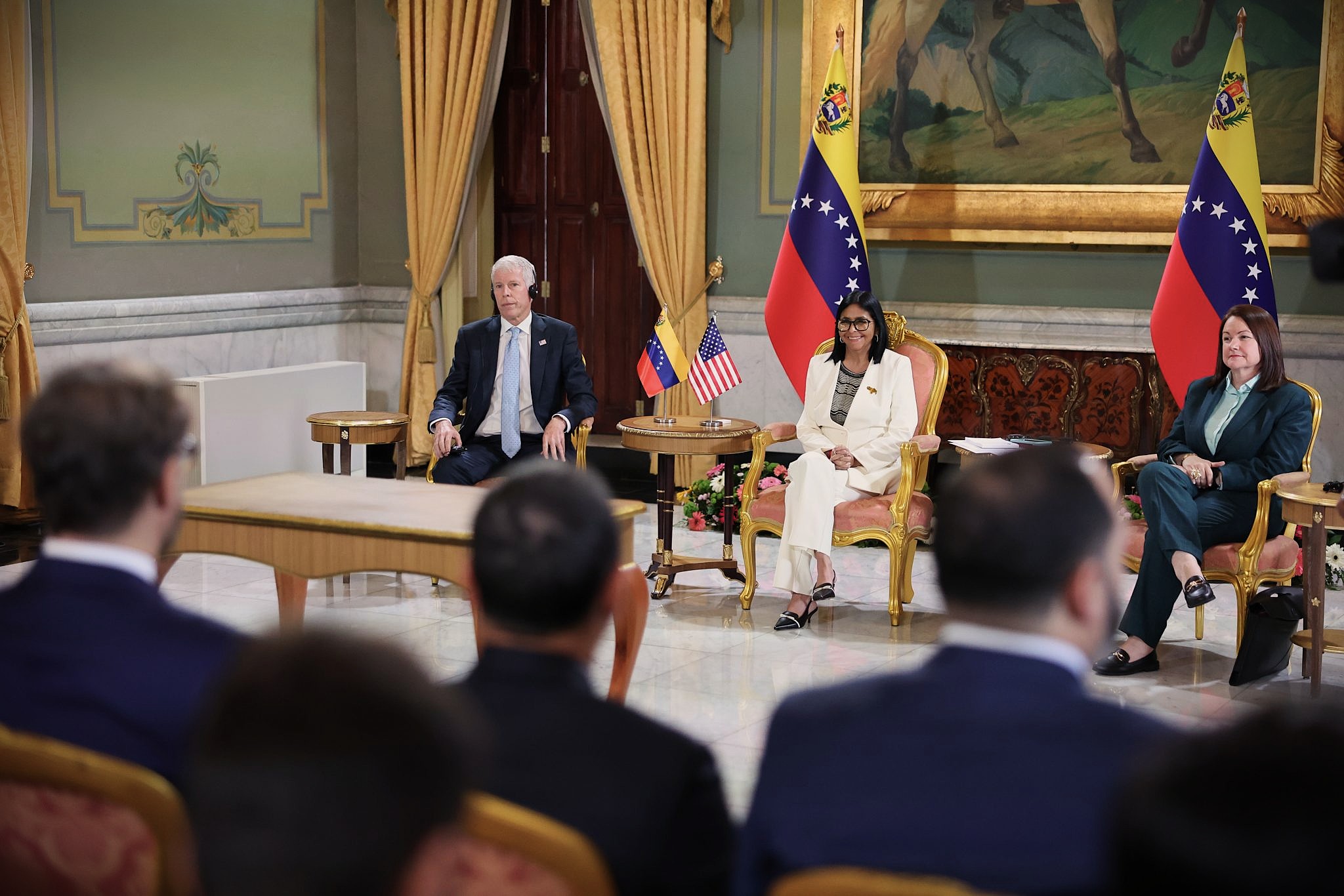
September 2: Chris Wright, Delcy Rodríguez and Paula Henao at the contract-signing ceremony for new deals with Chevron, Eni, and GE Vernova.
The lights could come back on in Maracaibo without Venezuelans gaining the capacity to change their government. More unsettlingly, restoring power to their homes could help keep those governing them in place.
This is the possibility taking shape in Venezuela. Chavismo’s relationship with Washington has changed under the pressure of American intervention; new investment could improve services while giving both the government and its foreign partners a growing interest in preserving the arrangement that delivers those improvements.
The issue goes beyond whether chavismo has abandoned its ideology: the infrastructure sustaining its power is being rebuilt around different relationships. Democratic demands now confront a governing system whose continuity may serve interests extending well beyond Venezuela.
A different foundation for continuity
Maduro remained after July 28, 2024, but maintaining control of the State could not repair the gap between holding office and having a credible electoral mandate. When US forces captured him in January 2026, that legitimacy deficit shaped the international response. Although there were international condemnations of the operation, opposing the use of force and defending Maduro’s right to govern were different positions. Some governments rejected his claim to the presidency while still questioning the intervention.
Nevertheless, Maduro’s removal left much of the chavista governing apparatus in place. Under Delcy Rodríguez, that apparatus faces a powerful external actor that can influence its room to manoeuvre. Pragmatism is therefore more than an ideological preference: cooperation with Washington has become a condition of political survival.
Tension arises when immediate commercial stability becomes tied to particular officeholders and agreements whose terms a democratic government might review.
For Washington, the authorities in Caracas can authorize contracts and implement agreements. For those authorities, cooperation offers resources and international acceptance. Their interests are different, but they can converge around continuity.
That convergence is acquiring a material basis. On October 17, Rodríguez announced expectations of almost $76 billion in oil investment over five years. These are anticipated investments, rather than money already spent. As contracts, payments and operations develop, however, businesses may become increasingly dependent on the officials and arrangements enabling them.
This does not make democracy incompatible with American investment. Accountable institutions could offer stronger guarantees over time. Tension arises when immediate commercial stability becomes tied to particular officeholders and agreements whose terms a democratic government might review. Political change can then appear as a risk to be postponed.
What changes behind the light switch
In my earlier article on infrastructure after the earthquakes, I argued that relationships, trust and coordination are as necessary to a response as machinery. Electricity works the same way. A power station depends on engineers, maintenance routines, payments and decisions about where resources go.
In my sociotechnical research, a cultural infrastructure framework helps distinguish three connected levels. The first is what people experience. The second is how work is organized to provide it. The third concerns who has authority, whose expertise counts and what makes their decisions acceptable or open to challenge.
During Maduro’s presidency, the drought of 2016 and the blackouts of 2019 exposed failures across all three. Households lost electricity. Behind the outages were maintenance problems, fuel shortages and the loss of experienced staff. An assessment by the Inter-American Development Bank also identified weak planning and the absence of independent regulation. Repairing machinery could not, by itself, correct the arrangements allowing the system to deteriorate.
Venezuelans may receive better electricity without gaining a meaningful say in how the system operates.
Under Delcy, the third level has changed profoundly. Washington now helps shape the conditions for reconstruction, and international suppliers offer access to equipment and expertise. The US Department of Energy describes an agreement with GE Vernova to modernize the grid and expand generation over several years.
That shift could enable changes in the second level, from procurement and contractor payments to maintenance and staffing. Those changes could eventually improve the first level, with fewer outages and more reliable services. However, Reuters reported in May that suppliers still faced uncertainty over payments, project priorities and authorizations. Announcements do not remove accumulated failures.
The important distinction is that changing who authorizes recovery does not necessarily give citizens more authority over it. The third level can be extensively reorganized between governments and companies while remaining closed to the people who depend on the service.
Whose stability, and for how long?
Electricity makes the resulting tension concrete. An oil producer needs reliable power. A household needs it too. Investment serving production could benefit both, but shared need does not ensure equal influence over which installations are repaired first or which communities wait.
If those priorities are negotiated mainly between officials and investors, Venezuelans may receive better electricity without gaining a meaningful say in how the system operates. Successful repairs could strengthen the government’s public standing while making commercial partners more invested in its continuity.
The different timescales matter. As I argued in “Venezuela Isn’t Transitioning. It’s Operating,” daily life follows immediate needs while political change moves on another timetable. A repaired installation may reduce outages before the wider network has dependable maintenance. Sustaining improvements requires organizational capacity. Establishing public accountability requires political decisions that neither repairs nor foreign investment can make automatically.
Venezuelans should not have to choose between functioning services and political rights. Nor should investors have to depend on indefinite chavista rule for contracts to be secure.
Meanwhile, every contract and operational dependency can make the emerging arrangement harder to alter. A process presented as temporary stabilization could acquire beneficiaries with reasons to prolong it. Recovery would then help rebuild the foundations of chavista power before the question of democratic authority is settled.
That is why an electoral timetable matters alongside investment commitments. US-backed talks involving Dinorah Figuera continue while María Corina Machado remains outside the process and no firm election date has been established. The practical question is whether citizens acquire enforceable rights to scrutinize and replace their government while economic arrangements are being consolidated.
Reliable electricity would be a real improvement, but Venezuelans should not have to choose between functioning services and political rights. Nor should investors have to depend on indefinite chavista rule for contracts to be secure.
Chavismo’s pragmatism is rebuilding the relationships through which it can survive. Whether that reconstruction also serves democracy depends on who can challenge its terms. The lights coming back on may show that the system works better; the decisive political test is whether Venezuelans can change the people running it.
More than $351 million in political donations has been poured into a high-stakes contest about a proposed wealth tax on the November ballot, making it one of the most costly campaigns in California history.
About 90% of the money is being spent to defeat a statewide initiative to impose a new tax on the assets of billionaires, a multifaceted opposition effort bankrolled primarily by ultra-rich Californians being targeted by a measure that supporters call an economic reckoning.
The billionaire tax, Proposition 40, would levy a one-time, 5% tax on many assets of California billionaires who lived in the state as of Jan. 1.
Millions of dollars continue to flow into the campaigns of three intertwined ballot initiatives at the center of the debate: Proposition 40, and Propositions 41 and Proposition 42, which would neuter the Proposition 40 through strategic, esoteric tax law changes.
“The pro-40 campaign picked a fight and then came to that fight with a butter knife against a nuclear arsenal,” said GOP strategist Rob Stutzman, who is not involved in any of the wealth-tax-related ballot measures. “Because they’re so well funded, in today’s multifaceted media world, they are able to show up everywhere from network TV to inside video games. That is a very, very large advantage few campaigns ever get to have.”
But, Stutzman warned, money does not guarantee a win.
In the most expensive ballot measure fights in California history, $463 million was spent on two gambling proposals 2022. The initiatives pitted some of California’s most successful Native American tribes with gaming interests against gambling corporations, including online sports gaming companies DraftKings and FanDuel. Both side’s measure failed.
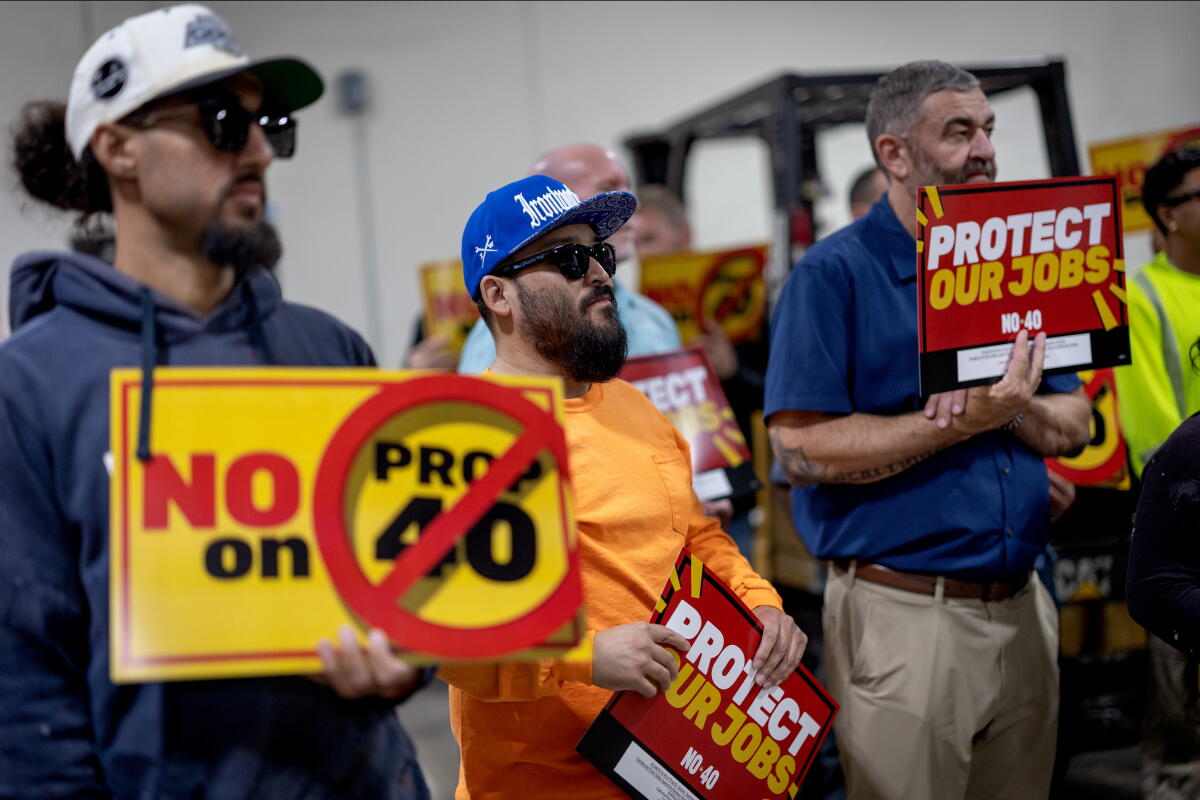
People attend a rally against Proposition 40 at the Iron Workers Apprenticeship Training Center on Oct. 5 in La Palma.
(Eric Thayer/Los Angeles Times)
The tax measure was crafted by Service Employees International Union-United Healthcare Workers West in response to federal healthcare funding cuts signed by President Trump last year that are expected to reduce California’s healthcare budget by $100 billion, burdening the state’s most vulnerable residents.
“Trump’s ‘Big Beautiful Bill’ slashes healthcare funding, with major coverage cuts scheduled to hit after the midterms,” said Suzanne Jimenez, the union’s chief of staff. “More than 3 million Californians could lose their health insurance. Hospitals and emergency rooms face closure. Patients will die unnecessarily when the care they need is no longer there. Proposition 40 is an emergency response to that looming disaster.”
The proposition’s supporters raised $34.3 million, nearly all of it from Jimenez’s union.
The two other measures, Propositions 41 and 42, would nullify the billionaire tax if either receives more votes.
Proposition 41 supporters say the measure aims to cut wasteful government spending by requiring audits for new state special taxes and would bar new state taxes that exempt their revenue from a state spending limit. Backers of Proposition 42 argue it would prohibit new taxes on retirement holdings, individually owned assets and other forms of personal savings.
Advocates for the billionaire tax say both are well-financed smokescreens to undercut Proposition 40.
Opposition campaigns to the wealth tax as well as the two countermeasures have received enormous donations from several of the state’s billionaires. But Building a Better California, the main funder of efforts to defeat the wealth tax, noted that its allies included Democratic and Republican politicians, prominent labor groups and business leaders.
“It’s rare for such a broad coalition to unite around any single cause in California, but it reflects the potentially devastating impact of this measure on healthcare, education, and our state’s economy,” the group said in a statement.
Among the largest donors opposing the wealth tax are billionaires Sergey Brin, a co-founder of Google who has donated more than $100 million to anti-wealth-tax efforts, and former Google leader Eric Schmidt and venture capitalist L. John Doerr, who each kicked in $40 million.
Brin, Schmidt and Doerr did not respond to requests for comment.
US tech entrepreneur Sergey Brin and Gerelyn Gilbert-Soto arrive for the 2026 Met Gala celebrating “Costume Art” at the Metropolitan Museum of Art in New York in May.
(ANGELA WEISS/AFP via Getty Images)
The spending disparity also reflects a divide among Democrats and their allies, many of whom support wealth taxes, but argue that the way Proposition 40 was written is disastrous to California’s volatile budget, which is dependent on the state’s wealthiest residents.
Jodi Hicks, chief executive and president of Planned Parenthood Affiliates of California, said that while her organization would support a nationwide or a California wealth tax, their primary concerns are about 40’s impacts on the state budget and healthcare in the state.
“We are opposed to this particular proposal because we think it does more harm than good,” she said, adding that after what her organization “faced last year having to scramble for dollars because of [federal funding cuts] we are committed to work with the stakeholders facing cuts and not harming the budget and finding revenue in a smart way.”
The cash imbalance between supporters and opponents of the billionaire tax is vast. Those opposed to the measure raised $316.7 million, while proponents raised nearly $34.3 million.
The Fair Games Coalition, made up of community leaders, labor organizations and advocates, announce the launch of the Overpaid CEO Tax Initiative in front of the Tesla Diner in West Hollywood in January.
(Genaro Molina/Los Angeles Times)
The supporters of the wealth tax spent nearly all of their money gathering signatures to place the measure on the ballot. They had $1.6 million on hand as of Oct. 17.
Now, as voters cast ballots, their campaign appears reliant on public events and media coverage, such as of Sen. Bernie Sanders’ (I-Vt.) recent rally in support of Proposition 40 in downtown Los Angeles.
“What you are showing people from coast to coast and all over is that, yes, we can take on the greed of the oligarchs,” he said, calling it the most important ballot measure in the country. “Yes, we can create an economy and a government that works for all of us, not just the 1 percent.”
Facebook creator and Meta chief Mark Zuckerberg was among the California billionaires Sanders name-checked in his remarks. After Zuckerberg told company leaders that he planned to leave the state to avoid his control over the company substantially reduced by being forced to sell enough of his stock in the social media giant to pay the proposed levy, the company on Wednesday announced the creation of a new, non-voting type of stock that would allow Zuckerberg to sell enough shares to pay the proposed tax while retaining his voting power in exchange for him agreeing to remain in the state for eight years.
Meta CEO Mark Zuckerberg listens as President Trump speaks to reporters at the White House on Sept. 29.
(Jacquelyn Martin / Ap Photo/jacquelyn Martin)
The pro-wealth-tax campaign is sending voters emails and texts and has an online presence.
“Remember: it’s not enough to vote YES on 40. You also need to vote NO on 41 + 42,” read an email sent to voters on Tuesday. “Don’t be fooled: Props 41 and 42 are billionaire-funded initiatives designed specifically to undermine Prop 40, the California Billionaire Tax.”
Meanwhile, the anti-40 and pro-42 campaigns are inundating voters on television, streaming services, in mailboxes, through online influencers and even in digital video games such as Sim City.
Jimenez said voters will see through the blizzard of campaign messaging.
“The billionaires think voters are stupid. They think they can bury the facts under millions of dollars in advertising and disguise Prop. 42 … as protection for ordinary taxpayers,” she said. “Their spending also makes our case for us. When billionaires can afford to spend millions a day protecting their fortunes, voters can see that billionaires have plenty of money to spare.”
Sheri Sadler, a veteran Democratic media buyer, questioned how much voters were hearing about the rationale for the proposed billionaire tax.
“The yes side is severely lacking in getting their message through while the no side is dipping into different kinds of pockets,” she said.
Jessica Levinson, an election law professor at Loyola Law School, said that beyond voter confusion about the competing ballot measures, it is certain to face legal challenges, notably about the retroactive nature of the tax, which would apply to any billionaire who lived in California as of Jan. 1. She described that as “the biggest legal pressure point.”
“It’s kind of a mess,” she said.
Times staff writer Gabrielle LaMarr LeMee contributed to this report.
“During the third quarter, WSFS’ performance continued to demonstrate the strength of our franchise and diverse business model.” (Executive VP & CFO David Burg)
“Results included a core EPS
Seeking Alpha’s Disclaimer:This article was automatically generated by an AI tool based on content available on the Seeking Alpha website, and has not been curated or reviewed by humans. Due to inherent limitations in using AI-based tools, the accuracy, completeness, or timeliness of such articles cannot be guaranteed. This article is intended for informational purposes only. Seeking Alpha does not take account of your objectives or your financial situation and does not offer any personalized investment advice. Seeking Alpha is not a licensed securities dealer, broker or US investment adviser or investment bank.
In February, after getting served with subpoenas in a federal criminal investigation, the billionaire sports mogul Mark Walter’s insurance companies abruptly stopped lending to him.
But within weeks, new loans started rolling in from a different source: a financial firm whose owners include his business protege, basketball legend Earvin “Magic” Johnson.
Amistad Financial Group, a holding company that counts Johnson as a board member and minority shareholder, loaned about $1.26 billion to Walter’s companies between March and June of this year, according to a Bloomberg News review of business records and a person with knowledge of the activity who asked not to be identified discussing sensitive matters. Another $1.06 billion went to intermediaries that routinely serve as conduits for loans to Walter.
The combined $2.31 billion of lending, which hasn’t been reported previously, highlights the way Walter relies on debt to fund his business empire, and Amistad’s role. Even before this year, the firm’s insurance units had provided billions of dollars of loans to Walter affiliates, filings show. It also acted as an intermediary to help him tap loans from his own insurers, Bloomberg reported previously – transactions that are now part of the federal investigation.
Walter himself owns a single-digit voting stake in Amistad but doesn’t control it, participate in its management or sit on its board, according to a person familiar with its operations.
Representatives for Walter’s TWG Global holding company and for Johnson did not respond to messages seeking comment.
A former point guard who led the Los Angeles Lakers to five National Basketball Association championships, Johnson has described Walter as a business mentor. They have done deals with each other for more than a decade, including Johnson’s participation in the Walter-led purchase of the Los Angeles Dodgers baseball team. Johnson doesn’t serve on Amistad’s three-person executive committee, and it’s unclear whether he was involved in or aware of the lending decisions. Some of Amistad’s insurance units are led by Eric Holoman, Johnson’s former business manager.
The federal investigation, being pursued in parallel by the U.S. Department of Justice and the Securities and Exchange Commission, focuses on Walter’s insurance companies’ failure to disclose that more than $20 billion of loans on their books went to his other businesses.
The recent lending came from two Amistad subsidiaries, Equitrust Life Insurance Co. and Heritage Life Insurance Co. It’s unclear whether Amistad executives were aware of the investigation when the loans were made. Walter’s insurers disclosed the subpoena in a regulatory filing on June 26, but the filing did not get much attention until Bloomberg News reported on it in July. Information about lending activity after June 30 won’t be disclosed until next month.
Walter is now scrambling to reduce debts to his own insurance companies, Delaware Life Insurance Co. and Clear Spring Life and Annuity Co., in part to assuage concerns from ratings agencies about the scale of affiliated lending. He has agreed to sell the Lakers at a $12.5 billion valuation to free up cash and proposed a $6.5 billion debt swap with Delaware Life. This week, the insurer said it had regulatory approval to proceed with part of that, swapping $3.8 billion.
Because he doesn’t legally control Amistad, Walter is under no such pressure to reduce his reliance on its money.
His ties to Amistad are deep. Its official corporate address is the Chicago office suite that houses Walter’s family office. Walter’s financial firm, Guggenheim Partners, serves as an investment manager for both Equitrust and Heritage Life.
Walter’s brother-in-law serves as president of Heritage Life. Walter used to control Equitrust when it was owned by Guggenheim. He sold it to Johnson in 2015, and Johnson sold it to Amistad last year.
Recipients of the new Amistad loans include a company through which Walter holds his stake in used-car seller Carvana Co., and another containing his interest in the Billie Jean King Cup, the women’s tennis competition that he has backed since 2023. The destination for most of the money wasn’t clear from regulatory filings.
New LLCs
The federal investigations revolve around how Walter’s insurers came to lend so much money to his other businesses without disclosing the arrangement to their regulator, the Delaware Department of Insurance, as required. As of the end of last year, the amount of money they had invested in affiliates was $24 billion, or about 45% of the companies’ total invested assets.
Much of the money was routed to loans for newly created limited liability companies with no public profile. These LLCs were created by Amistad and other intermediaries, which in turn sent the money back to Walter.
In January and early February of this year, that lending arrangement continued, with Delaware Life loaning $730 million to newly formed LLCs that then sent the money to Walter’s other businesses, regulatory filings show. That stopped after the U.S. Attorney’s Office in Manhattan sent the grand jury subpoenas.
But in March, Amistad’s Equitrust sent $500 million to 10 LLCs. These borrowers had been formed days earlier by Federico Hermida, a Miami-based executive at ABS Capital Co., a longtime business partner of Walter’s that has often served as an intermediary in deals between Walter and his insurers. In June, Amistad’s Heritage Life sent $303 million to a subset of the Hermida borrowers. A representative of ABS declined to comment.
Heritage Life also sent about $253 million to LLCs set up by two other intermediaries that Walter has used for loans in the past: the real estate firm Bradford Allen and Hudson Trading, both based in Chicago. Representatives of Bradford Allen didn’t respond to requests for comment, and Hudson Trading declined to comment.
The remaining $1.3 billion of loans were made to companies that are known to be part of Walter’s business empire, or that were formed by a Walter employee, or were confirmed by the person with knowledge of the matter.
Most of the loans carried interest rates of 8 percent or more, and were due to mature in September or earlier. The insurers won’t have to disclose whether those loans were repaid, extended or replaced with new debt until they file their next quarterly financial reports next month.
Despite the borrowing from Amistad, Walter had not significantly reduced his debt to his own insurance companies by June 30, the date of the most recent regulatory filings. After climbing from $24 billion to $25 billion through March, the amount of affiliated investments dropped to about $24 billion as of June.
Earnings Call Insights: First Hawaiian (FHB) Q3 2026
Management view
“I’ll start by providing an update on the acquisition. … we’re making good progress obtaining the necessary regulatory and shareholder approvals… Integration planning is going well, and we continue to expect to close this
Seeking Alpha’s Disclaimer:This article was automatically generated by an AI tool based on content available on the Seeking Alpha website, and has not been curated or reviewed by humans. Due to inherent limitations in using AI-based tools, the accuracy, completeness, or timeliness of such articles cannot be guaranteed. This article is intended for informational purposes only. Seeking Alpha does not take account of your objectives or your financial situation and does not offer any personalized investment advice. Seeking Alpha is not a licensed securities dealer, broker or US investment adviser or investment bank.
Earnings Call Insights: Vitec Software Group AB (VITBF) Q3 2026
Management View
CEO Olle Backman framed Q3 as steady execution, saying, “the highlights for the quarter, of course, continued to grow at 15% in total sales” and adding that “EBITDA also up 15%” while “cash EBIT… was up 13%.”
Seeking Alpha’s Disclaimer:This article was automatically generated by an AI tool based on content available on the Seeking Alpha website, and has not been curated or reviewed by humans. Due to inherent limitations in using AI-based tools, the accuracy, completeness, or timeliness of such articles cannot be guaranteed. This article is intended for informational purposes only. Seeking Alpha does not take account of your objectives or your financial situation and does not offer any personalized investment advice. Seeking Alpha is not a licensed securities dealer, broker or US investment adviser or investment bank.
Like the rest of the sector and other industries heavily dependent on fuel, Norwegian Cruise Line Holdings (NCLH) faces pressure on its bottom line that will be only partially offset by higher passenger spending.
Etsy (ETSY) will no longer allow sellers to list AI-generated functional guides, such as patterns and recipes, on its marketplace and set clearer rules around AI use on its platform.
Listings for functional guides must also show a real result
As Latin America turns to the dollar, development capital tests its reach.
This article appears in the October issue of Global Finance Magazine.
Whether dollarization works has been debated for decades, and in late summer it landed in Venezuela. Steve Hanke, known as the “Money Doctor” for advising governments on dollarization in Eastern Europe, Asia, and Latin America, told multiple media outlets that he had been hired as a special adviser to a Venezuelan official to explore dollarizing the bolivar.
If it converted to the dollar, Venezuela would join several Latin American countries that have done so. Panama has used the dollar as legal tender since 1904. Ecuador has used the dollar since 2000; El Salvador converted in 2001. Although Argentina has not dollarized, there is evidence that President Javier Milei has accelerated its de facto shift to the dollar. Less examined is which organizations are investing in dollarization—and whether that capital is doing something dollarization alone can’t.
For CFOs with projects, suppliers, or growth aspirations in dollarized countries—or those moving that way—the balance sheet is the best way to assess the role of development capital. A currency conversion can affect hedging costs, discount rates for capital projects, and the timeline for moving cash. But the money now supporting these transitions or future moves to dollarization, including billions in US development-finance capital, political risk insurance, sovereign debt refinancing, and project loans, carries its own track record worth mulling over before using “dollarized” as shorthand for “de-risked.”
Where Development Capital Lands
The International Development Finance Corp.’s (DFC) Latin American strategy is more than writing large checks. Its CEO Ben Black calls the strategy “economic statecraft”—capital deployed to counter Beijing. “You don’t want to compete against state capitalism with more money from the government,” Black said at a March forum. “You want to create capital structures that bring in private capital.” In Ecuador, where the U.S. dollar is legal tender, the agency’s 2021 framework was linked to a proposed, broader $3.5 billion financing structure. It combined up to $2.8 billion of potential DFC-backed project financing with roughly $700 million from commercial banks, intended to help Ecuador refinance China-related liabilities.
The agency’s completed transactions are more varied. DFC made a $150 million direct loan to expand Ecuador’s Puerto Bolívar port. It also provided political-risk insurance of more than $656 million for the 2023 Galápagos debt conversion and $1 billion for the country’s 2024 Amazon Biocorridor conversion. The latter helped refinance about $1.53 billion of Ecuadorian international bonds. For CFOs looking through a balance sheet lens, Puerto Bolívar is a DFC loan asset. The two larger headline amounts are insurance commitments that could help attract third-party capital.
In Argentina, where dollars are widely used but not the official currency, DFC’s financing is smaller and tied to resource development. The agency approved $4.07 million for early-stage work at Argentina Potash Corp.’s El Ceibo potash project earlier this year. The company expects more dollars to follow. “The US$4.07 million DFC funding is expected to be matched dollar-for-dollar by strategic investors, resulting in total Phase 1 funding of US$8.15 million,” according to a company statement.
Leading Risk vs. Following Money
The Argentina Potash deal points up a divide over where development finance has the most impact: taking risks that private capital won’t or reinforcing markets where private capital is already willing to go. DFC and its defenders argue that the capital leads: the agency takes on risk private investors won’t touch and proves out a sector or structure until commercial capital is comfortable following. Another group argues DFC capital mostly follows. Its development dollars tend to land in the safest, most liquid corners of an economy, such as banks, infrastructure and assets that would likely have attracted private capital anyway.
The harder, riskier investments that dollarization was supposed to encourage still go unfunded. If development capital leads, it’s doing something dollarization alone can’t. It is building the risk tolerance and track record that pulls in private money on its own. If it mostly follows private capital, DFC funding may simply be competing for the safest returns, while the risks that keep money out of harder-to-finance sectors remain.
That’s the view of Byron Villacis Cruz, a University of Oregon sociologist and former head of Ecuador’s national statistics institute, who has studied Ecuador’s dollarization. He said DFC-linked capital has gone toward “traditional banks that … have a lot of liquidity and coverage and stability by itself” rather than higher-risk, higher-need sectors.
“I don’t see investments that are truly analyzing the real opportunities of profit and development in the country,” he said. “That’s kind of like going where the money is versus leading the money.” He also cautions that dollarization solved currency volatility in Ecuador without touching the risks investors cite—regulatory whiplash, contract enforcement and political interference. Foreign investment after 2000 flowed overwhelmingly into oil, he noted, driven by commodity prices, not the new monetary regime.
Casey Halloran has a different view: his tourism and real estate development company, Namu Travel Group in Costa Rica, borrows from the Inter-American Development Bank specifically to relend to small suppliers—boutique hotels and tour operators across the region—that banks often consider too risky to touch. Over the years, Halloran estimates his business has lent about $15 million since first obtaining IDB financing. He’s convinced development capital leads, saying, “Somebody has to go first.”
Weld Royal is a contributing writer based in the U.S.
SpaceX (SPCX) aims to secure a minimum of 80,000 cell sites across the U.S., and it’s in talks with at least one major cellular infrastructure company to reach that goal, Bloomberg News reported.
The agreements would solidify the rocket and satellite
Earnings Call Insights: Enova International (ENVA) Q3 2026
Management View
“We’re pleased to report another quarter of healthy growth in credit as originations, receivables, revenue and adjusted EPS all grew 25% or more year-over-year,” said CEO Steven Cunningham. “Originations growth was strong across both consumer
Seeking Alpha’s Disclaimer:This article was automatically generated by an AI tool based on content available on the Seeking Alpha website, and has not been curated or reviewed by humans. Due to inherent limitations in using AI-based tools, the accuracy, completeness, or timeliness of such articles cannot be guaranteed. This article is intended for informational purposes only. Seeking Alpha does not take account of your objectives or your financial situation and does not offer any personalized investment advice. Seeking Alpha is not a licensed securities dealer, broker or US investment adviser or investment bank.
“Q3 was another quarter of strong, consistent performance for AppFolio.” (President, CEO & Chairman Shane Trigg) “Revenue reached $296 million, a 19% year-over-year increase.” (President, CEO & Chairman Trigg) “Non-GAAP operating income was 27.3% of revenue and GAAP operating income was 19.4% of revenue.” (President, CEO & Chairman Trigg) “Units on platform
Seeking Alpha’s Disclaimer:This article was automatically generated by an AI tool based on content available on the Seeking Alpha website, and has not been curated or reviewed by humans. Due to inherent limitations in using AI-based tools, the accuracy, completeness, or timeliness of such articles cannot be guaranteed. This article is intended for informational purposes only. Seeking Alpha does not take account of your objectives or your financial situation and does not offer any personalized investment advice. Seeking Alpha is not a licensed securities dealer, broker or US investment adviser or investment bank.
“Overall, it was a solid quarter. Organic growth accelerated to 7%… Orders were up 16% year-over-year, with growth in all 5 segments. Book-to-bill was 1.03 for the quarter. Our backlog is up 35% versus this time last year… Adjusted
Seeking Alpha’s Disclaimer:This article was automatically generated by an AI tool based on content available on the Seeking Alpha website, and has not been curated or reviewed by humans. Due to inherent limitations in using AI-based tools, the accuracy, completeness, or timeliness of such articles cannot be guaranteed. This article is intended for informational purposes only. Seeking Alpha does not take account of your objectives or your financial situation and does not offer any personalized investment advice. Seeking Alpha is not a licensed securities dealer, broker or US investment adviser or investment bank.