G20 finance ministers, central bankers gather amid fallout from Iran war | Business and Economy News
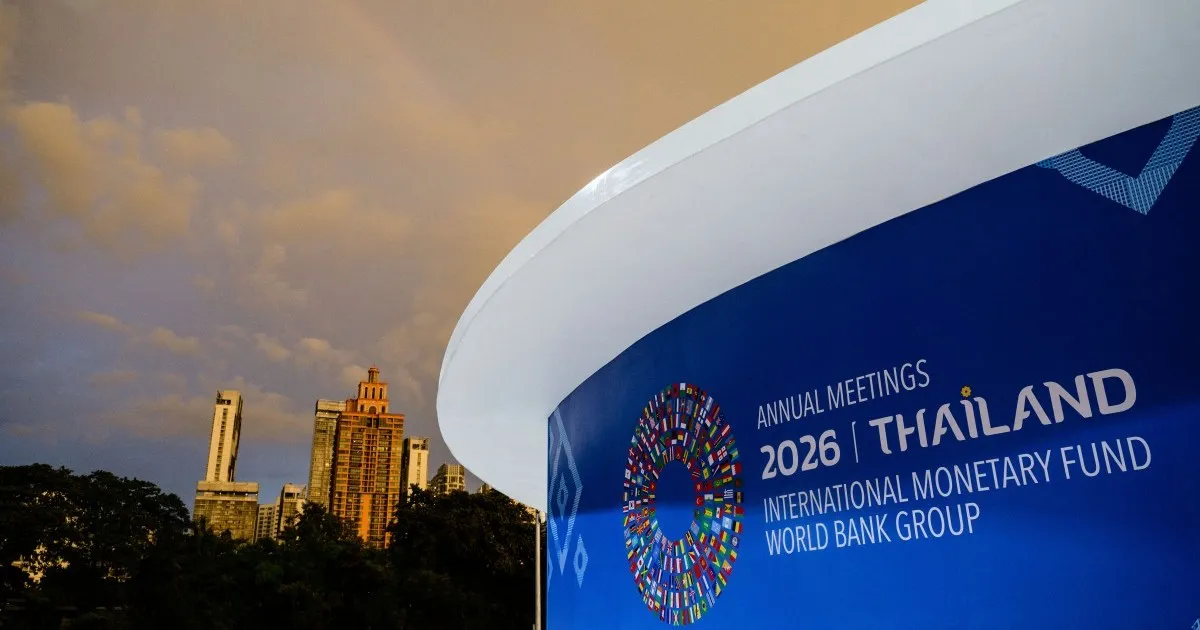
The G20 finance ministers and central bank governors are gathering in Bangkok, Thailand, on Thursday amid an uncertain global outlook shaped by the US-Israel war on Iran.
The meetings are being held in conjunction with the annual meetings of the International Monetary Fund (IMF) and the World Bank, taking place in the Thai capital from October 12 to October 18.
Recommended Stories
list of 4 itemsend of list
Here are some of the key details about the meetings:
What are the G20, the IMF and the World Bank?
The G20 is an economic forum comprising 19 large economies, including the United States, China, the United Kingdom, Australia, Brazil, India, Japan, Indonesia and Saudi Arabia, as well as the European Union and the African Union.
The grouping has an annually rotating presidency, currently held by the US.
Together, the G20 countries account for about 85 percent of global gross domestic product (GDP) and three-quarters of global trade.
The G20 was established in 1999 as a forum for finance ministers and central bank governors to address shared economic concerns in the wake of the Asian Financial Crisis, before expanding into a broader forum for national leaders.
The IMF, based in Washington, DC, is an international financial institution that promotes international cooperation on monetary policy, trade and economic growth.
Its membership includes all but a handful of the world’s sovereign states, including North Korea, Cuba, the Vatican City and Monaco.
The World Bank, also based in Washington, DC, primarily serves as a provider of loans and grants to developing countries. It has 189 member countries.
The IMF and the World Bank were created at the 1944 Bretton Woods conference in the US, convened by the Allied Powers to establish the contours of the post-World War II international financial order.
Who will be attending the meetings?
Most finance ministers and central bank governors of the G20 will be in Bangkok, along with IMF Managing Director Kristalina Georgieva and World Bank Group President Ajay Banga.
US Treasury Secretary Scott Bessent will be a notable absence from the gatherings, as the top economic official of the world’s biggest economy and G20 chair.
US officials have cited “domestic engagements” for Bessent’s decision to skip the events, at which Washington will be represented by Deputy Secretary Francis Brooke and Undersecretary for International Affairs Erin Browne.
The G20 meeting, one of several gatherings of the group’s finance ministers each year, will help shape the agenda for the headline leaders’ summit in Miami, Florida, taking place on December 14-15.
What is on the agenda?
The economic fallout from the US-Israel war on Iran is expected to dominate discussions.
Attacks across the Middle East have upended economic activity across the region, while disruption to shipping in the Strait of Hormuz has driven a surge in energy prices worldwide.
Crude oil prices have exceeded $100 a barrel for much of the past eight months, placing a strain on government coffers and household budgets, particularly in the Gulf region and the rest of Asia.
In advance of the meeting, Australia’s Treasurer Jim Chalmers MP said he would use the discussions to call for an end to the conflicts in the Middle East and the reopening of the Strait of Hormuz “because that’s what the global economy desperately needs”.
“The war in the Middle East is having a devastating economic impact and is pushing up fuel prices, inflation and interest rates around the world,” Chalmers said in a statement.
Other issues likely to feature on the agenda include the ballooning debt levels of many countries, which exceed 100 percent of GDP in the US, Canada, Japan, Italy and France.
In a speech on Wednesday, Georgieva warned that mounting debt posed a threat to the global economy and that there was no “magic” formula that would allow governments to avoid tax hikes or spending cuts.
G20 members will also bring more specific individual concerns to the table based on their economic and geopolitical priorities.
The US, for example, has repeatedly expressed concern about “global imbalances”, a veiled reference to China’s state-driven industrial model that has allowed Chinese exporters to flood overseas markets with cheap goods.
US President Donald Trump has long claimed that China’s large trade surplus, which stood at a cumulative $938bn in September, proves that international trade is stacked against US manufacturers.
In a statement addressed to the IMF on Wednesday, Bessent called for action to address mismatched trade balances.
“This especially includes strengthening its analysis and engagement on the role non-market policies and practices and exchange rates play in driving external imbalances,” Bessent said.
“Policymakers around the world are having difficult discussions about how to sustain market-based systems amid distortionary policies from some economies that skew competition and hurt employment.”
Divisions and competing interests cloud the prospects for coordination, however.
At the last meeting of G20 finance ministers in Asheville, North Carolina, US, held on August 31 and September 1, member countries failed to issue a joint communique after China objected to language to do with trade.