mike madrid

What Becerra’s historic win says about Latino political power in California

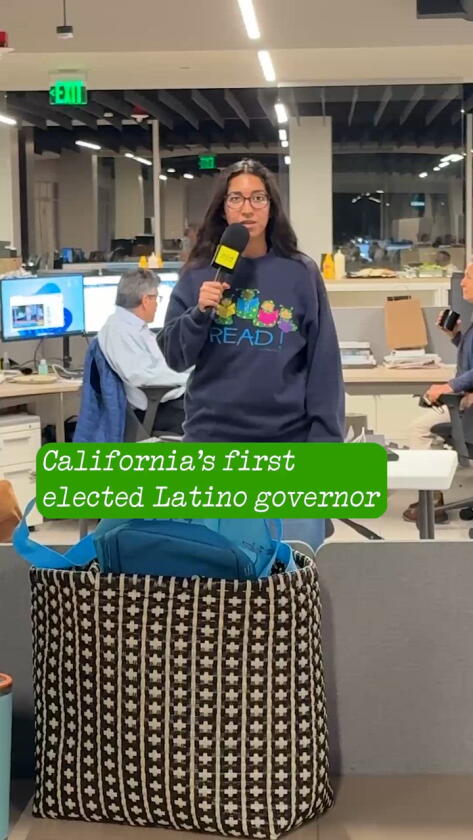
Mike Madrid was prepping to interview Xavier Becerra on Olvera Street last month when the immensity of the moment hit him.

That morning, Becerra held a rally for his gubernatorial campaign in the birthplace of Los Angeles alongside California Assembly Speaker Robert Rivas and the leader of the state Senate, Monique Limón, that doubled as a referendum on where Latinos stood politically.

Never before have Latinos occupied the top spots in both chambers of the Legislature and the governor’s mansion simultaneously, Rivas told the cheering crowd. Becerra reminded the audience that the moment was fraught for Latinos, though. Federal agents were still detaining undocumented immigrants across the state, and Latino residents — the state’s largest ethnic group at 41% — were suffering under the crushing cost of food, gas and housing.

“[Latinos] are here, we are present and we will fight,” Becerra said. “But right now, our fight is to get the vote out, to make sure everyone understands that our power lies in our vote.”

Governor candidate Xavier Becerra.

Gubernatorial candidate Xavier Becerra purchases an agua fresca from Taqueria Vista Hermosa in Mercado La Paloma on June 9.

(Ronaldo Bolaños / Los Angeles Times)

Madrid, a longtime political commentator and strategist, had set up his recording equipment at the Pico House, formerly a historic hotel named after the last Mexican governor of California. He recalled how Pio Pico, who helped found the California Republican Party but ended up dying destitute, opened the structure in 1870 as a testament to what Latinos had contributed to their state. But they would eventually be seen as a relic of the bygone days when Mexicans ruled — days that gringos imagined would never return.

The symbolism of a Becerra victory would be “kind of a big deal,” Madrid said, representing a back to the future opportunity for an ethnic group that ruled California until the United States won the Mexican-American War, then was relegated to political irrelevance for over a century before finally being at the doorstep of the governor’s mansion again. Becerra would become California’s first Latino governor in modern times and the second since Romualdo Pacheco served for 10 months in 1875.

Now that the race has been called, Becerra’s victory signifies how much Latinos have advanced since Pico’s days. But it’s also anticlimactic.

As California’s Latino population grew and their political power eventually did too, the days when such a victory would have been an inspiring surprise are long gone. Becerra is now just one of many Latino political captains who steer the Golden State.

Xavier Becerra with Roy Kuroyawagi.

Xavier Becerra, right, fist bumps with Roy Kuroyawagi, owner of Japangeles, during a tour of businesses in Little Tokyo on Aug. 18.

(Genaro Molina / Los Angeles Times)

California Supreme Court Chief Justice Patricia Guerrero became the first Latina to occupy that role when Gov. Gavin Newsom appointed her in 2023. The state’s senior U.S. senator, Alex Padilla, is the son of Mexican immigrants who settled in the San Fernando Valley. Rep. Pete Aguilar, a fourth-generation Mexican American from Redlands, is the third most powerful Democrat in Congress as the head of the party’s House caucus. Lorena Gonzalez, daughter of a Mexican immigrant father and white mother, leads the California Labor Federation, a longtime kingmaker in state politics.

And now, with Becerra at the helm, they will have to govern at a precarious moment, inheriting a state with existential problems affecting everyone, everywhere.

Droughts, El Niño, an eroding coast and the year-round threat of wildfires, much of it accelerated by climate change. Stagnant population growth that threatens to shrink the number of congressional seats. A presidential administration that keeps fighting California in federal court and has attempted to block the votes of 20,000 Californians it alleges are noncitizens. A restive population that Madrid predicts won’t let Becerra bask in his historic win.

“This is what you’ve always wanted. Here’s the keys to the car,” he cracked. “You’re responsible for it now. Who you’re going to blame if things don’t get better — Trump?”

Jody Agius Vallejo, associate director of USC’s Equity Research Institute, said she hopes that California’s new caretakers remember the struggles of getting to the summit — that they represent the dreams and battles of generations of politicians, voters and activists — as they embark on whatever’s next.

“You use these narratives [of Latino personal and collective struggle] to get elected,” she said. “Use them to understand what people need, and govern for them.”

1

Patricia Guerrero, left, is sworn-in to the California Supreme Court in 2022 by Gov. Gavin Newsom.

2

Sen. Alex Padilla, D-Calif., questions Attorney General Pam Bondi.

3

Rep. Pete Aguilar, D-Calif., speaks at a Democratic Steering and Policy Committee hearing in 2026.

4

Lorena Gonzalez, President and Chief Officer of the California Labor Federation.

1. Patricia Guerrero, left, is sworn-in to the California Supreme Court in 2022 by Gov. Gavin Newsom. (Nathaniel Levine / The Sacramento Bee via Associated Press) 2. Sen. Alex Padilla, D-Calif., questions Attorney General Pam Bondi as she testifies before a Senate Judiciary Committee in 2025. (Jose Luis Magana / Associated Press) 3. Rep. Pete Aguilar, D-Calif., speaks at a Democratic Steering and Policy Committee hearing in 2026. (Allison Robbert / Associated Press) 4. Lorena Gonzalez at podium with California Attorney General Rob Bonta during a news conference in Los Angeles in 2024. (Damian Dovarganes / Associated Press)

Many voters were already shrugging about the significance of Becerra’s likely victory — especially Latinos. Only 45% of Latino voters in California felt “proud” about the prospect of a Latino governor, according to a Berkeley IGS poll released last week.

Those results aren’t surprising to Lena Gonzalez, a Long Beach-area state senator who chairs California’s Latino Legislative Caucus. She praised Becerra’s victory as the culmination of decades of political organizing. But voters care more about results than identity, she said — something the Latino political class has been slow to realize.

“People will say, ‘OK, that’s great [he’s Latino], but how are you fighting back?’” she said. “I just think we need to lead now and not advertise we’re Latinos.”

 Xavier Becerra waves goodbye after his visit to Hoover St. Elementary School

Los Angeles mayoral candidate Xavier Becerra waves goodbye after a visit to Hoover St. Elementary School in March 2001.

(Kim D. Johnson / Associated Press)

Becerra has long been a poster child for Latino political firsts, representing L.A.’s Eastside in the state Assembly and Congress for 27 years before Gov. Jerry Brown appointed him to be California’s first Latino attorney general in 2017. Three years later, Becerra became the country’s first Latino Health and Human Services secretary under President Biden.

Becerra has rarely highlighted his latinidad while never shying away from his background as the child of Mexican immigrants. He told Madrid at the end of their interview at the Pico House that Californians should be prouder of his working class roots than his ethnicity.

Some have complained that Becerra is an unworthy, boring torchbearer for Latinos — not dynamic enough to meet a moment where many hoped for a firebrand. But in many ways, his style is a callback to the past.

When Latino politicians first began winning local and state legislative elections in the decades after World War II, they “were constantly about, ‘How do I mobilize the Latino vote without alienating the white vote, and how do I get support from the establishment which is white?’” said Fernando Guerra, director of the Center for the Study of Los Angeles at Loyola Marymount University and a longtime chronicler of California politics.

Latinos were the majority of the population in some areas during that era, but politicians couldn’t rely solely on them to win, because they still didn’t represent a majority of voters. That changed by the late 1980s, as immigration brought millions of Latinos to California.

Civil rights activists successfully sued cities and counties to draw district lines making it easier for Latinos to vote for Latino candidates. Local activists registered new voters by selling them a future where people like them would be leaders, not tokens. Pioneers like Richard Alatorre and Gloria Molina subsequently created political machines, which helped Becerra get his start.

Antonio Villaraigosa and Karen Bass

Mayoral candidate Antonio Villaraigosa, center, and Assemblywoman Karen Bass, left, dance to gospel music sung by the McCoy Memorial Baptist choir during an endorsement celebration in 2005.

(Stefano Paltera / For The Times)

That set the stage for politicians who “didn’t need the external validation anymore” of white voters or power brokers, Guerra said. “They could now say, ‘I am a Latino candidate with a Latino agenda, because I represent a Latino district.’”

By 1996, two years after the anti-immigrant Proposition 187 galvanized Latino activism, a record number of newly registered Latino voters in Orange County helped Loretta Sanchez upset longtime Republican Rep. Bob Dornan, the first welt of purple in a famously red county. That same year, Cruz Bustamante became the first Latino Assembly speaker, then lieutenant governor — the first Latino elected to statewide office in California since Pacheco ascended to the same position in the 1870s. In 2005, Antonio Villaraigosa was elected mayor of Los Angeles, sparking national headlines as the first Latino to occupy that position in modern times.

The Latino political firsts kept coming over the next 20 years, now reaching a pinnacle with Becerra’s win. Guerra said that “incremental” approach made Latinos mainstream to the point where the novelty of another milestone quickly wore off.

“Do you want a transformative moment? Absolutely,” he said. “But those come few and far in between. Incremental comes every two years.”

Xavier Becerra takes a selfie with supporters.

Democratic gubernatorial candidate Xavier Becerra takes a selfie with supporters after a campaign stop on May 21 at the Wende Museum in Culver City.

(Gina Ferazzi / Los Angeles Times)

Becerra started his campaign for governor far behind in the polls, surging after Rep. Eric Swalwell dropped out due to sexual assault allegations. Becerra’s campaign leaned into his milquetoast persona and crowned him Tío Xavier — Uncle Xavier — to market him as a non-threatening moderate who happened to be Latino.

Madrid, a lifelong Republican, voted for Becerra because of GOP candidate Steve Hilton’s refusal to denounce MAGA. He also thinks Becerra can “resurrect a healthy economy for the working class” — something he accuses Democrats of “abandon[ing] for a generation.” The “burden” is on California’s Latino leaders to show they can serve not just their own community but everyone, he said.

On Monday, Becerra mingled with eaters at Homegirl Cafe in Chinatown, looking anodyne in a white shirt, wire-framed glasses and tan khakis as supporters asked for selfies or a hug.

Half-hearted shouts of “¡Sí se puede!” gave way to authentically boisterous chants of “Be-ce-rra!”

The heavy favorite for governor took questions in the packed dining room and didn’t flinch when I asked him to reflect on the fact that Latinos will head every branch of California government if he wins.

“We’re all fortunate when a state like California gives all of us opportunities to be in position of authority,” Becerra replied.

He nodded at Los Angeles Mayor Karen Bass, who stood by his side.

“But we gotta do it right,” he said. “And it’s on me to be a good governor — not to be a good Latino governor, but to be a good governor.”

Source link

Latino voters will decide these 5 key midterm races on election day

In just 11 days, millions of Americans will head to the polls to vote on key local races and decide the fate of Congress.

Perhaps no voting bloc will be more crucial in swinging the balance of power than Latinos.

In 2024, after decades of reliably supporting Democrats, the electorate of roughly 36.2 million people (about 15% of all total voters) shifted massively to the right and supported Donald Trump at previously never-before-seen rates. After the election, armchair pundits and paid professionals proclaimed that Ronald Reagan had been right all along. Latinos were Republican. They just needed to realize it.

It didn’t take long for that narrative to start crumbling. A year after Trump’s reelection, Latinos in California helped pass Proposition 50, which allowed Democrats to redraw the state’s congressional map in their favor to counter a successful effort by Texas Republicans to do the same — coincidentally, the Texas gerrymander was at least partially motivated by said gains with Latino voters.

Latinos also helped Democrats pick up governorships in Virginia and New Jersey in 2025 — with two-thirds of their votes going for Abigail Spanberger and Mikie Sherrill, respectively.

Whatever gains Republicans made with Latino voters appear to have vanished. Recent polls show the demographic to be experiencing buyers’ remorse, citing the increased cost of living, the Trump administration’s heavy-handed immigration enforcement tactics, involvement in wars abroad and a stagnating economy as reasons for the disillusionment.

President Trump’s approval rating among Latinos dipped to 27% in an early October NBC News survey. That same poll found that Democrats have a 24-point lead on whom Latino voters want to see in control of Congress.

But don’t expect this whiplash back to the left to be permanent.

“It’s not a realignment, it’s a de-alignment,” said Mike Madrid, a former Republican political consultant and author of “The Latino Century: How America’s Largest Minority Is Transforming Democracy.”

“Latinos are completely moving away from both parties and that’s what’s created this dramatic swing of 25 points towards Trump in four years and then massive swings back.”

So how will the Latino vote shake out in two weeks? Below are five races we are keeping tabs on.

L.A. mayoral race

You don’t need to go outside the city limits to find proof that Latino voters aren’t political ideologues.

During the 2022 mayoral primary, billionaire Rick Caruso won the largest share of the Latino vote (34%). A few months later, Karen Bass became mayor, winning 51% of the Latino vote.

Bass once again won the Latino vote during the 2026 primaries, carrying 35 Latino-majority neighborhoods in the June 2 election — compared with seven for her current challenger, Councilmember Nithya Raman.

Four months, much campaigning and the botched response to a massive warehouse fire in heavily Latino Boyle Heights later, Raman — a democratic socialist — now has a 24-point lead among Latino voters, according to an October Berkeley IGS/L.A. Times poll.

Notably, 34% of Latinos remain undecided heading into the Nov. 3 election.

“Latinos are about a third of the voters in L.A.,” Fernando Guerra, a professor of political science and Chicana/o studies at Loyola Marymount University, told The Times this month. “While they show preferences, they are not deeply committed to either candidate, so they are the quintessential swing voters who decide late.”

Will the embattled incumbent keep her job, or will Los Angeles become the next big city to elect a mayor backed by the Democratic Socialists of America? Latino Angelenos will decide.

California 22nd district

Will Democrats’ Proposition 50 redistricting gambit pay off? Voters of this newly reconfigured Central Valley district populated by blue-collar and agrarian Latinos will decide.

Republican David Valadao is the incumbent and is being challenged by activist and educator Randy Villegas. In 2024, voters in the district backed failed Republican Senate candidate Steve Garvey.

Political forecasts have Villegas — a progressive populist — with a narrow lead over the incumbent.

Part of his appeal, Madrid said, was his messaging.

“[His message is] the establishment’s not working and that institutions aren’t working,” Madrid said. “It’s a much more populist message. I don’t believe this is ideological one bit.”

Colorado 8th district

It doesn’t get more battleground than this congressional district located in the Denver suburbs. It is the center of Latino voting power in Colorado — Latinos account for 40% of the total electorate. .

The incumbent is Republican Gabe Evans and Trump carried the purple district by less than two percentage points.

Evans currently has a slight lead over Democratic candidate Manny Rutinel, an attorney and economist. Rutinel’s messaging has focused on the rising cost of living and the Republicans’ immigration policies.

It could get him elected. A local survey found that 56% of Latino voters in Colorado approve of Democrats in Congress, while 39% said they do not approve.

Florida 27th district

Will disassociating from Trump help this Republican incumbent keep her job?

Journalist-turned-Congress member María Elvira Salazar, a Cuban American, made headlines in September after releasing a political ad calling out the president’s immigration enforcement, alleging that Trump, who carried the majority Latino district by 15 points in 2024, had betrayed her constituents.

Elvira Salazar currently holds a narrow lead over her Democratic rival Elliott Rodriguez, who is also Cuban American.

“She’s trying to show distance and trying to show an independent streak,” Madrid said of the three-term incumbent. “She’s trying to say, ‘I’m not that.’ And you can’t do that on the economy as a Republican, because that changes all the time. What you can do as a Latino in a Latino district … is say your policies have gone too far.”

Texas

Okay, I’ll admit that I’m cheating with this one. But there’s just so much going on in Texas that it deserves its own section. The Lone Star State is ground zero for this supposed great political de-alignment.

In 2025, at the behest of Trump, Texas Republicans undertook an unprecedented mid-decade congressional redistricting in hopes of gerrymandering a map that would give the party an advantage in the 2026 midterm elections. They factored in the historic gains with Latino voters.

“They drew those districts based on what they thought were the 2024 numbers,” said Matt Barreto, a professor of political science and Chicana/o & Central American studies at UCLA. “And now those 2024 numbers are evaporating.”

The plan appears to be backfiring spectacularly, at least in south Texas.

Trump won Texas’ 15th congressional district in 2020 and 2024, and in 2022 the majority Latino electorate voted for Republican Monica De La Cruz. But polls now show that Democratic candidate and singer-turned-politician Bobby Pulido has a seven-point lead. Pulido, who bills himself as a moderate, has focused his messaging on affordability and the rising cost of living.

A similar situation is taking place in the Latino-dense 34th and 35th districts, where Republicans Eric Flores and Carlos De La Cruz, respectively, are hoping to take advantage of the redrawn Republican-friendly boundaries to flip those seats red. Both face uphill battles as polls show them neck-and-neck with their Democratic opponents.

“You now have these two districts, Texas 9th and 35th, that are 51% Latino, but now Latinos are telling us they have lost confidence in the Republican Party,” Barreto said. “What we’re seeing is very strong evidence that Latinos are shifting back even more so against Trump and Republicans because they did not deliver on any of their promises from 2024.”

In the statewide Senate and gubernatorial races, Democrats are feeling hopeful. Democratic challenger James Talarico currently has a slight lead on his Republican opponent Ken Paxton. Among Latinos, that lead was clocked at a whopping 30 points in an October Fox News survey.

But what has been Talarico’s key to connecting with Latino voters?

“He’s turning away from race and ethnic-based politics to class consciousness,” Madrid said. “[He’s acknowledged] that Latinos have had their futures taken away from them.”

The seminary student and educator has also been critical of his own party — calling it out for ineptitude, leaving voters behind — and arguing that anti-establishment messaging is enticing to Latinos who have been spurned by both major parties.

If Texas gets its first Democratic senator since 1993, it’ll be thanks to the Latino vote.

Texas Latinos’ faith in the ruling party is so low that even the state’s governor, Republican powerhouse Greg Abbott, finds himself in a tight race with Democratic challenger Gina Hinojosa. Roughly 56% of Latinos were in favor of Hinojosa over the incumbent, an October poll found.

“Latinos are the only voters voting rationally in a broken system,” Madrid said. “We’re shifting by 25 points. If you don’t pay attention to our priority issues, we’ll vote you out, that’s how the system was designed.”

Latinos appear to be swinging back to the left, but Democrats shouldn’t take those gains for granted, Madrid said.

“The Democratic Party has done nothing to win these voters back. They’re just not Republicans,” Madrid said. “And for the moment, that’s good enough.”

Two red roses coming out of a blue manilla folder

(Jackie Rivera / For The Times; Martina Ibáñez-Baldor / Los Angeles Times)

Join De Los for a Día de Muertos event at Hollywood Forever

Dia de los Muertos at Hollywood Forever

Dia de los Muertos at Hollywood Forever

(Diana Ramirez / De Los)

This Saturday, join De Los at Hollywood Forever Cemetery to celebrate Día de Muertos. We’ll have an altar set up from noon to 8 p.m. where visitors can write ofrendas that will be displayed throughout the event.

There will also be a photo booth run by Las Fotos Project on site from 2 to 6 p.m.

This is an all-ages event and will feature performances by música Mexicana act DannyLux, soul singer Trish Toledo, psychedelic cumbia group Tropa Magica and indie rock band Los Shadows.

Registration and event information can be found here.

If you’re looking for more places to partake in Día de Muertos festivities this year, check out De Los’ list of 50 ways to celebrate the holiday throughout Southern California.

Stories we read this week that we think you should read

Unless otherwise noted, stories below were published by the Los Angeles Times.

Politics and immigration

Arts and entertainment

Southern California

Source link