midterm

US midterms 2026: What polls reveal about Democratic, Republican voters | US Midterm Elections 2026 News

Americans will vote in the US midterm elections on Tuesday, with the economy, the cost of living, and immigration among the top issues. While Democrats and Republicans share concerns about the rising cost of living, recent surveys suggest differences in how they view the economy, President Donald Trump, and other key issues.

In an NBC poll released on Sunday, 75 percent of respondents said they were dissatisfied with the state of the US economy, and 51 percent said they were dissatisfied with their personal financial situation.

Recommended Stories

list of 3 itemsend of list

Other surveys conducted in October also offer a look into how voters from both parties felt about their finances and which issues mattered most.

Here is what we know:

What issues matter most to Democrats and Republicans?

The economy is the main concern for US voters, but Democrats and Republicans vary on the importance of issues like healthcare, immigration, and crime.

A Pew Research Centre survey, conducted between September 28 and October 4, suggested that 84 percent of registered voters considered the economy very important to their midterm vote. It was the top issue for 82 percent of respondents who prefer Republican candidates, and 88 percent for those who back Democrats.

However, the two groups differed on other issues.

About 85 percent of Democratic Party supporters considered the future of democracy very important, compared with 69 percent of Republicans. Healthcare was a priority for 82 percent of Democrats, compared with 53 percent of Republicans.

Republican supporters were more concerned about immigration, with 72 percent saying it was very important, compared with 53 percent of Democrats.

Violent crime was also more important to Republican supporters, at 64 percent, compared with 37 percent Democrats.

A KFF survey, conducted by the Kaiser Family Foundation, an independent nonprofit, from September 16 to 21, suggested 42 percent of registered voter respondents trusted Democrats more to handle healthcare costs, compared with 22 percent who trusted Republicans.

On the cost of living, 39 percent trusted Democrats more, while 25 percent preferred Republicans.

What grade do Democrats and Republicans give Trump’s second term?

Views of President Trump and his economic policies remain divided along party lines.

In the Pew Research Centre survey, 91 percent of Democratic respondents and those who leaned Democratic believed Trump’s economic policies had made things worse.

Among Republican supporters, 39 percent said his policies had improved the economy, 35 percent said they made conditions worse, and 25 percent said they had little effect.

In the November 1 NBC News poll, 40 percent of registered-voter respondents approved of Trump’s overall job performance, compared with 60 percent who disapproved.

How do Democrats and Republicans feel about the economy?

Americans are concerned about rising costs, but Democrats are more likely than Republicans to express negative feelings about economic conditions.

In an October Pew Research survey, 36 percent of Republicans rated the US economy as excellent or good, compared with just 9 percent of Democrats or Democrat-leaning voters.

However, the majority in both groups expressed concern about the cost of essential goods and services.

According to PEW, 82 percent of Democrats and Democratic leaners were concerned about food and consumer prices, compared with 62 percent of Republicans and Republican leaners.

Healthcare costs concerned 80 percent of Democrats and 57 percent of Republicans, while petrol and energy prices worried 81 percent of Democrats and 65 percent of Republicans.

A Fox News poll released on October 14 also had 74 percent of registered voter respondents rating the economy negatively, and 60 percent identified the cost of living as their biggest economic concern.

The November 1 NBC News poll found that 53 percent of Republican respondents were dissatisfied with the state of the economy.

The Pew Research Center also found that abortion and gun policy were less central to Democratic respondents in comparison with 2022. Among Republican voters, education policy and energy policy were less important than they were four years ago.

Are Americans satisfied with their financial situation?

In the NBC poll, 51 percent of registered voters were dissatisfied with their personal financial situation, compared with 49 percent who were satisfied.

It was the first time in 30 years of NBC polling that dissatisfaction with personal finances outweighed satisfaction.

In an NPR/PBS News/Marist poll on October 19-20, 38 percent of likely voters said their finances had gotten worse over the past year, 44 percent said they had remained about the same, and 15 percent said they had improved.

A total of 51 percent of Democratic likely voters said their finances had deteriorated, compared with 21 percent of Republicans.

In a Reuters/Ipsos survey conducted from September 30 to October 5, 71 percent of Democrats and 57 percent of Republicans said their incomes had not kept pace with rising prices.

Eric Ham, a former Democratic congressional staffer and Senate national security adviser, said that Trump’s global tariffs and the US-Israel war on Iran had added to the financial pressure on American households.

“Americans are paying more not just in terms of self-inflicted wounds that President Donald Trump implemented through tariffs, but also if you look at this war of choice,” Ham told Al Jazeera.

Are Democrats or Republicans more enthusiastic about voting?

Democratic voters reported higher enthusiasm about participating in the elections.

In the Marist poll, 91 percent of likely Democratic voters were enthusiastic or very enthusiastic, compared with 86 percent of Republicans and 76 percent of Independents.

John Fury, a former Republican congressional staffer, said the final days of campaigning were focused on turnout.

“This is not a persuasion election. This is a get-out-the base election,” Fury said.

In a KFF survey, Democratic candidate supporters were 25 percentage points more likely than Republican supporters to describe themselves as “more motivated” than usual to vote (63 percent versus 38 percent).

The November 1 NBC News poll also reported high interest in the elections, with 70 percent of registered voters rating their interest at nine or 10 on a 10-point scale.

Who are Americans planning to vote for?

Surveys conducted in the final weeks before the election suggested voters preferred Democratic candidates or Democratic control of Congress over Republicans.

An NBC poll conducted on October 28-30 and published on November 1 suggested that 52 percent of registered voters preferred Democratic control of Congress compared with 45 percent who preferred Republican control.

Similarly, the Reuters/Ipsos poll conducted from October 22 to October 26 suggested that 53 percent of likely voters would vote for or lean towards the Democratic candidates in their district, compared with 44 percent who supported Republicans.

These surveys measure voting sentiment, but they do not reflect the results of the individual races.

Source link

Trump asks Supreme Court to block 20,000 California ballots before midterms | US Midterm Elections 2026 News

California says the move to block ballots from suspected noncitizens could disenfranchise eligible voters.

The administration of United States President Donald Trump has asked the Supreme Court to stop California from counting mail-in ballots from more than 20,000 voters it claims are not US citizens.

The emergency request, filed on Monday, just one day before the midterm elections, is the latest development in a legal battle between the administration and California, a Democratic stronghold and the most populous US state.

California says the move could disenfranchise thousands of eligible voters.

The Department of Justice wants California to set aside ballots from voters on a list compiled by the Department of Homeland Security until after their citizenship status is confirmed.

But California says the list is unreliable and could include thousands of US citizens.

Voting has been under way since early October, and state officials say it would be nearly impossible to separate the ballots in question.

Last week, a federal judge rejected the administration’s request, raising concerns about the reliability of the data on the list.

“If the executive can discount votes and threaten an ongoing election due to unproven allegations, then our democracy is in danger,” Judge David Carter wrote.

The administration has turned to the Supreme Court after a federal appeals court also rejected the request on Friday.

The dispute comes as Republicans fight to retain control of Congress in Tuesday’s elections.

Trump has repeatedly made false claims about widespread voter fraud, but studies and state audits have shown that ineligible voting, including by noncitizens, is rare.

Source link

A campaign season of surprises peaks with Tuesday’s midterms

An acutely contentious and historically expensive midterm campaign barrels to a finish Monday, on the eve of elections that will set the nation’s course for the remaining half of President Trump’s second term.

Republicans are bracing for a backlash from voters as Democrats prepare for gains — but the magnitude of any “blue wave,” and whether it could sweep not only the U.S. House but also the Senate into Democratic control, will be the key question as Americans finish casting ballots Tuesday.

Early voting had already seen strong turnout, including among influence blocs such as Latino and Black voters. Candidates spent the weekend crisscrossing their states and pulling in surrogates to make a final push for voters still on the fence.

Capping a turbulent first half of Trump’s second term, the campaign has been defined by affordability and economic issues that have created headwinds for Republicans and spurred a possible turn toward Democrats by voters. And as Trump has pushed the limits of executive power, the midterms could act as a consequential check on his presidential reach.

In recent polls, voters have consistently put Democrats several points ahead on the generic ballot and given a historically low approval rating to Trump.

Eyes are now on Senate control, as an unexpected competitiveness by Democrats in a handful of red states has put the majority into play. It would require a “massive” wave for Democrats, but the fact that it is a possibility at all reflects an “extraordinary situation,” said Thaddeus Kousser, a UC San Diego political science professor.

With seven toss-up seats, tough math for Democrats and tough polling for Republicans, the outcome is far from certain. There may not be a large difference between the Democrats eking out enough seats for the majority or Republicans succeeding at holding it, said Charles Franklin, director of the Marquette Law School Poll.

“Just a little bit better night for the Democrats, and they pick up quite a number of these very close seats,” Franklin said. “Just a little bit better night for the Republicans, and Democrats fall slightly short in several of these competitive seats.”

The outcome in competitive races will not only set the dynamic between Trump and Congress for the next two years, but also hold signs for the 2028 presidential campaign. Both parties are closely watching how well Democrats can do in red states, how Republicans perform in Michigan and how far to the left Trump-voting districts swing.

The party out of power typically wins House control in midterm elections. This year, fatigue with Trump — fueled by the war in Iran, immigration policy, tariffs and other issues — merged with concern about prices, housing and AI issues to drive that movement toward the minority party, analysts said.

“This is an opportunity for the American people to try to put some brakes on the government,” said Todd Belt, a professor of political management at George Washington University.

The midterms are designed to function as a potential check on every presidency, said Christopher Warshaw, a Georgetown University public policy professor.

“The reason we have a democracy is in part because the out party does well in midterm elections,” Warshaw said. “That function of midterms is really important regardless of who’s in power.”

In many races, the quality of individual candidates also is poised to be a deciding factor, including in Texas, where Republican Atty. Gen. Ken Paxton has struggled to gain traction, and in Maine, where Democrat Troy Jackson has labored to confront Republican Sen. Susan Collins’ staying power.

The campaign has held significant twists, among them the unexpected death of Republican Sen. Lindsey Graham of South Carolina; the dropping out of Democrat Graham Platner from Maine’s Senate race; and the questions about the alleged involvement of operatives aligned with Democrat Mary Peltola’s campaign in the presence of a spoiler candidate on the Alaska ballot.

And Trump gambled on a largely dismissive approach toward voters’ affordability concerns; in recent days, he has also drawn attention with off-script comments at his rallies about Republican candidates’ rear ends and for lashing out at a reporter who questioned why he had canceled his final two rallies, which Trump later rescheduled.

Voter turnout could also have a significant effect on results; both parties have worked to reach independent voters while turning out their bases.

Across the country, nonpartisan groups are holding last-minute voting events, encouraging people to fill out their ballots. A hotline run by a nonprofit coalition organized by the Lawyers’ Committee for Civil Rights Under Law is receiving hundreds of calls a day about how to vote.

Brandon Waithe, 42, an Air Force veteran who has organized get-out-the-vote events through Project HALO, a voting initiative, said he hoped to help raise turnout.

He hosted a line dancing event in a Cleveland public plaza last month aimed at reminding people to vote — and to “tie some positive emotion to the act of voting,” he said.

“It’s like, ‘Ah, cool, all right, voting’s not so bad,’” Waithe said. “There’s no pressure. … We’re not telling you which party to vote for or which candidate. We’re just like, ‘Thank you for participating in voting.’”

The speed with which results are known Tuesday will partly depend on how large a blue wave might occur. The House majority could become clear Tuesday night, but the margin could take a little more time with swing races in slower-counting states such as California and Pennsylvania.

If the Senate majority comes down to Maine or Alaska and if those races are very close, the outcome will probably take some days to verify, Kousser said.

“What I’ve been telling people is you’re going to have to buckle up and wait,” he said.

And, of course, one of the few certainties of an election is that no one knows exactly what will happen. The electorate is volatile, said Sonoma State University political science professor David McCuan, and there are always wild cards.

“There will be a surprise on election night,” McCuan said.

Source link

US midterms: 1 day to go – Democrats rally around El-Sayed amid attacks | US Midterm Elections 2026 News

With one day to go before the United States midterm elections, campaigning has reached a fever pitch with Democratic and Republican leaders pulling out all the stops to mobilise voters.

Democrats are hoping to flip control of both chambers of Congress, which is currently controlled by US President Donald Trump’s Republican Party.

Recommended Stories

list of 3 itemsend of list

All 435 seats in the House of Representatives and 35 of the Senate’s 100 seats are up for grabs on Tuesday. Voting will also be held to elect governors in 36 of the 50 US states.

With the cost-of-living crisis, exacerbated by the US-Israel war on Iran, becoming one of the key talking points of these elections, here’s where things stand as of Monday:

What’s happened on the campaign trail in the past 24 hours?

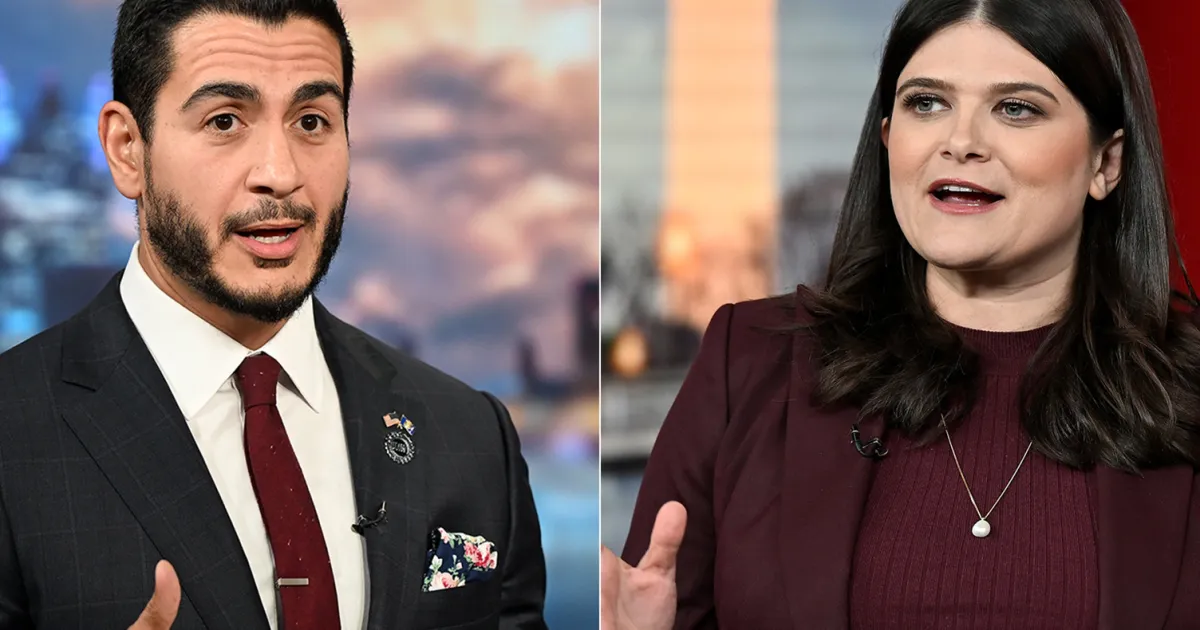
In a dramatic political development on Sunday, Democratic Congresswoman Haley Stevens threw her support behind Republican Senate candidate Mike Rogers over her own party’s nominee, Abdul El-Sayed, in Michigan – one of the most closely watched races of the US midterm elections. Stevens had lost Michigan’s Democratic Senate primary in August to El-Sayed.

Her announcement followed weeks of tension with El-Sayed over US support to Israel, which has been accused of committing genocide in Gaza. El-Sayed has opposed military support to Israel, arguing that Prime Minister Benjamin Netanyahu pushed the US into the Iran war. Stevens has accused El-Sayed of anti-Semitism for his criticism of Israeli actions in Gaza.

El-Sayed said a vote for his rival Rogers “is going to be a vote for Donald Trump” as his campaign reportedly saw a fundraising surge after Stevens crossed party lines.

Democratic leaders have rallied behind El-Sayed, who has faced Islamophobic attacks during the campaign.

The chairman of the Democratic Party in Michigan criticised Stevens. “She does not speak for that larger community,” Curtis Hertel said in an interview with CNN.

The leader of the Democrats in the Senate, Chuck Schumer, slammed Stevens over her endorsement of the Republican candidate.

“This is a despicable betrayal from Representative Stevens,” he posted on X.

“Senate Democrats are united in our support for Abdul El-Sayed, because we know he will fight for the economic interests of working families in Michigan, unlike Mike Rogers, who is a tool of Donald Trump and billionaire donors.”

Meanwhile, the advocacy group Michigan Jews for Democracy has backed El-Sayed.

“Haley Stevens does not speak for Michigan’s Jewish community,” it said in a statement, which rejected her “attempt to divide our community” two days before the election.

While Democrats have been angered by Stevens’s action, Trump celebrated her decision.

During a rally in Iowa later on Sunday, the US president said he would “love” it if Stevens joined the Republican Party. “Haley said what few people are willing to say,” Trump added. “It’s a thing called bravery.”

The question now is whether Stevens’s endorsement could persuade some of her supporters to back Rogers or discourage them from voting altogether.

Polling suggested El-Sayed has largely consolidated Democratic support, according to the Reuters news agency.

Judge dismisses Trump’s Alaska election lawsuit

Meanwhile, a ⁠federal ⁠judge has thrown out a Trump administration ⁠lawsuit seeking to block Alaska from ⁠certifying a loss by Republican Senator Dan Sullivan. The administration has argued that a rival on the ballot with the same name could change the outcome.

Sullivan pledged to accept the election outcome, days after the US Department of Justice filed a lawsuit seeking to decertify the results of the Senate race if he loses.

“I’m going to accept the election results,” Sullivan, an ally of Trump, told CNN on Sunday.

Alaska’s Senate race is one of seven key toss-up races that will likely decide whether Republicans keep their majority in the upper chamber of the US Congress.

How many Americans have already voted?

This year, out of about 210 million registered voters, 54.5 million had voted early as of 10am US East Coast time (15:00 GMT) on Sunday, according to a University of Florida analysis. This includes 30 million in-person votes and 24 million mail-in ballots.

In the 2022 midterm elections, 46 million people voted early.

Early voting enthusiasm has been higher among Democrats this year with more than 11 million registered Democrats having voted early, compared with about 8 million registered Republicans, according to the university’s analysis.

Early voting has particularly surged in the state of Texas, a key battleground, where more than 7.7 million people have voted early.

According to an Associated Press polling analysis, in South Carolina, where Trump won by nearly 18 percentage points in 2024, early voting has surged 83 percent compared with the same point in 2022. The state has open races for governor and US Senate this year.

Kansas, Michigan and Maine have also seen a surge in early voting.

Early turnout figures, however, don’t show which candidates voters have chosen or what the final results will be.

Source link

How the president’s party has fared in every US midterm election since 1946 | US Midterm Elections 2026 News

On Tuesday, Americans head to the polls for the United States midterm elections, held halfway through a president’s four-year term. Voters will choose all 435 members of the US House of Representatives and 35 of the Senate’s 100 seats. The voting will decide which party controls Congress for the next two years.

Although the president’s name won’t appear on the ballot, the vote is widely seen as a verdict on the presidency, and the president’s party almost always pays the price.

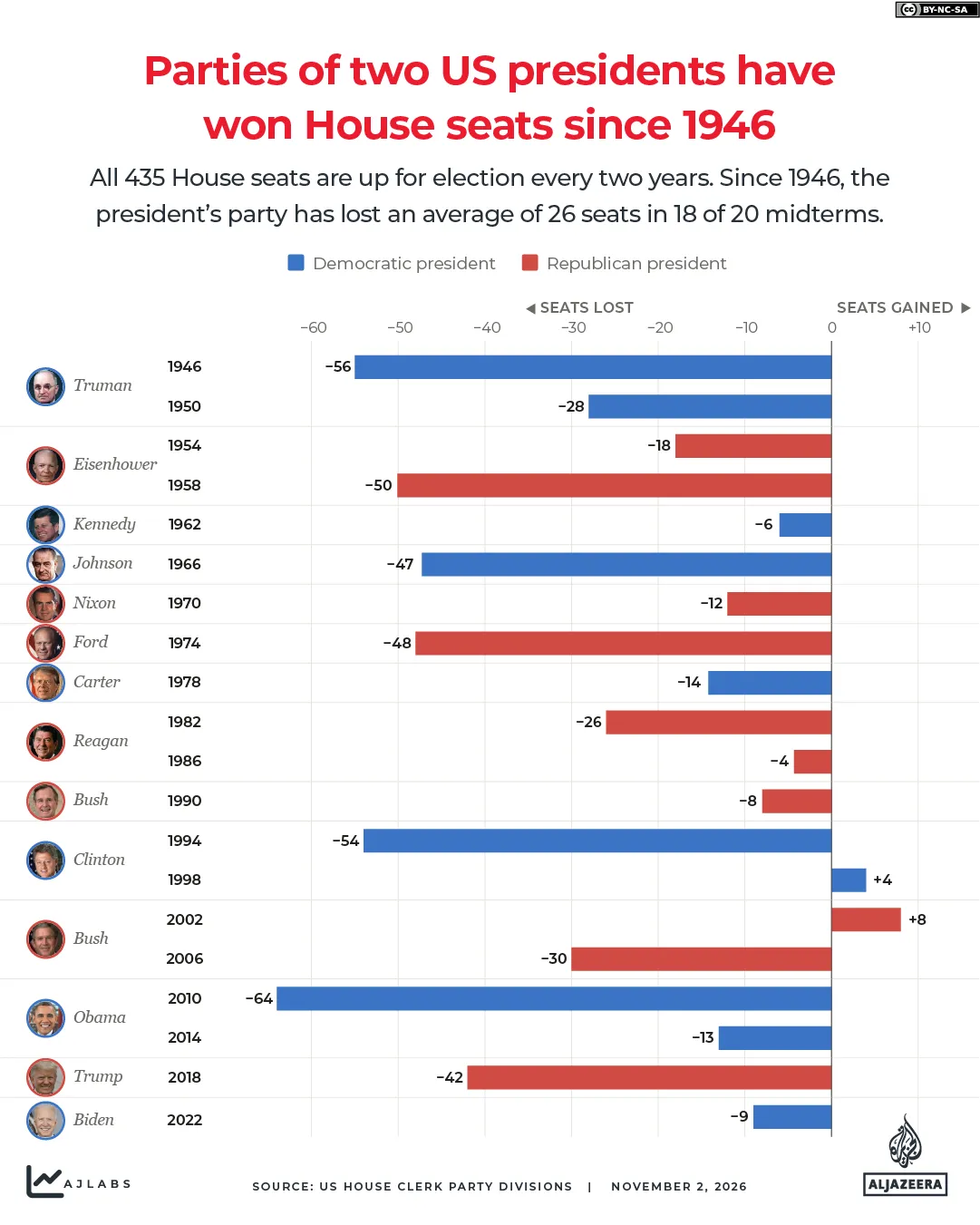
In 18 of the 20 midterms held from 1946 to 2022, voters took House seats away from the party in control of the White House. The average loss was 26 seats. Only Bill Clinton’s Democrats in 1998 and George W Bush’s Republicans in 2002 bucked the trend.

Political scientists call this the “presidential penalty”, or the “midterm penalty”. The president’s party tends to lose seats simply because it holds power as voters use the midterms to put a check on the White House.

The House: 18 losses in 20 midterms

The chart below shows how many House seats the president’s party has won or lost in each midterm since 1946 from Harry S Truman to Joe Biden.

INTERACTIVE - US midterm elections Two presidents have wonHouse seats since 1946-1793603566
(Al Jazeera)

Democratic presidents have suffered the biggest midterm defeats since 1946. On average, their party has lost about 29 House seats in a midterm, compared with about 23 under Republican presidents.

The largest loss came in 2010, two years after Barack Obama became the first African American elected president, when Democrats lost 64 House seats and Republicans took control of the chamber. The Democrats under Truman lost 56 seats in 1946, and under Clinton, they lost 54 in 1994, each time losing control of the House.

The worst Republican defeats came under Dwight D Eisenhower when the party lost 50 seats in 1958 and Gerald Ford when it lost 48 in 1974. Donald Trump’s first midterm in 2018 cost Republicans 42 seats and control of the House.

Big losses often cost the president’s party its majority. In seven of the 20 midterms since 1946 (1946, 1954, 1994, 2006, 2010, 2018 and 2022), the House changed hands.

The Senate: 13 losses in 20 midterms

The president’s party has lost Senate seats in 13 of the 20 midterms since 1946 but lost control of the chamber in only six: 1946, 1954, 1986, 1994, 2006 and 2014.

Unlike the House of Representatives, where every seat is up for election every two years, only about a third of the Senate’s 100 seats are contested in each cycle because senators serve six-year terms and their elections are staggered. That means which states are voting can matter as much as the national mood.

Eisenhower’s Republicans suffered the biggest Senate loss in the period, giving up 13 seats in 1958. Truman’s Democrats lost 12 in 1946, and Obama’s Democrats lost nine in 2014, handing control of the chamber to Republicans.

At times, the two chambers have moved in opposite directions. In 1982, Ronald Reagan’s Republicans lost 26 House seats but gained one in the Senate. In 2018, Trump’s Republicans lost the House but added a Senate seat, and in 2022, Biden’s Democrats lost the House while gaining one seat in the Senate.

These split results show that a backlash against the president does not land evenly across Congress. A party can hold its ground on a favourable Senate map while losing competitive House districts.

INTERACTIVE - US midterm elections Six presidents have wonSenate seats since 1946-1793603568
(Al Jazeera)

What does it mean to lose the House or Senate?

Losing seats and losing control are not the same thing. Lyndon Johnson’s Democrats lost 47 House seats in 1966 but kept their majority. Twenty years later, Reagan’s Republicans lost only four House seats but lost the Senate after an eight-seat setback.

Control of the chambers decides who sets the agenda and passes legislation. A bill must pass both chambers before it reaches the president for his approval or veto, so an opposition majority in either can block the president’s plans.

A House majority can also mean a party is able to launch investigations and impeach a president while a Senate majority can reject the president’s nominees, including federal judges, who serve for life.

This year, Democrats need to gain three seats to win the House and four to win the Senate. A 50-50 split in the Senate would leave Republicans in control because Vice President JD Vance may cast tie-breaking votes.

INTERACTIVE - US midterm elections results-1793605059
(Al Jazeera)

Source link

Write-In Ralph: South Carolina Republicans challenge Trump’s Senate pick | US Midterm Elections 2026 News

Charleston, South Carolina – Avery Milton thought he was a die-hard supporter of US President Donald Trump. The 28-year-old South Carolina native had voted for Trump in the past three elections and believed in his promise to put America first. But ahead of the midterm elections, the president has left him feeling betrayed.

“He stabbed us in the back during his second term,” Milton told Al Jazeera.

Recommended Stories

list of 3 itemsend of list

Milton’s disillusionment is not isolated. He said many people close to him share this frustration, particularly younger conservatives around his age who are starting families and entering the workforce. Trump launching a war on Iran, after campaigning on a promise to avoid new wars, was a particular breaking point.

Now, Milton is helping lead a grassroots effort to write in Republican Congressman Ralph Norman for the US Senate, rather than support the party nominee, Senator Darline Graham, who has Trump’s endorsement.

A write-in candidate is someone whose name does not appear on the ballot but can still be chosen by voters who write it in themselves. The option is often used to indicate dissatisfaction with the official candidates, but rarely leads to a victory. One of those rare victories happened in 2010, when Senator Lisa Murkowski of Alaska won after launching a write-in campaign, having lost her Republican primary that year.

In the 2022 South Carolina Senate race, write-in votes accounted for just 0.1 percent of all votes cast.

Despite the president’s endorsement, Graham has struggled to unite conservatives behind her, potentially giving Democratic challenger Annie Andrews an opening in a state that has not elected a Democrat to the US Senate since 1998.

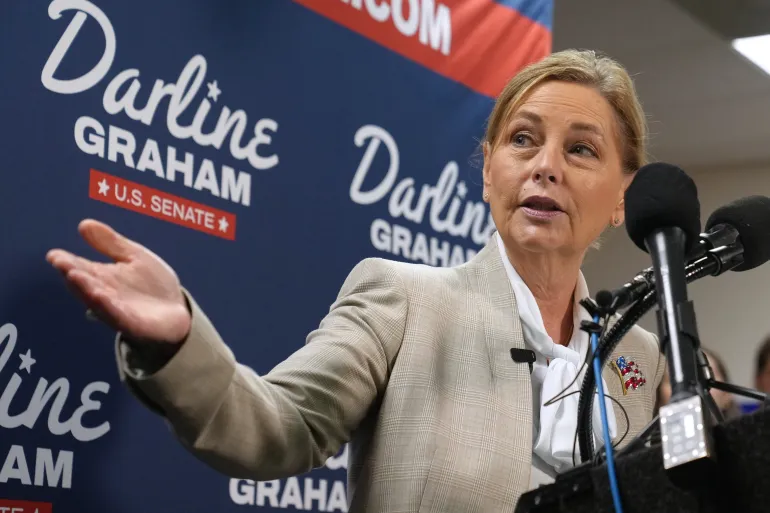
FILE - Sen. Darline Graham, R-S.C., gestures during a news conference, Aug. 24, 2026, in Columbia, S.C. (AP Photo/Meg Kinnard, File)
Senator Darline Graham speaks at a news conference on August 24, 2026, in Columbia, South Carolina [Meg Kinnard/AP]

Darline’s unlikely path to Republican Senate candidate

After the sudden death of Republican US Senator Lindsey Graham on July 11, his younger sister, Darline, was appointed to serve out the remainder of his term.

Her appointment followed a tradition of family members succeeding deceased lawmakers, most commonly their spouses. But she made history as the first sibling appointed to fill a Senate vacancy.

Graham initially described the role as an opportunity to finish her brother’s work during the remaining months of his term. But days later, Trump urged her to run for a full six-year term, posting “RUN, DARLINE, RUN!” on Truth Social and promising his “complete and total endorsement” if she entered the race. Three days later, Graham announced on Fox News that she would run.

For some Republicans, the transition from temporary appointment to a full-term campaign happened too quickly. Milton said he felt the appointment had effectively “installed” a candidate.

Graham went on to defeat Republican Ralph Norman in the state’s August primary elections.

Norman, who represents South Carolina’s fifth congressional district, has repeatedly declined to campaign alongside Graham since losing the primary. He has made clear that his support for Graham is limited.

“You have to earn the vote. She hasn’t done that,” he told The Wall Street Journal. “The campaign has been about trying to prop up a candidate.”

The tensions have been particularly pronounced in Upstate South Carolina, where Norman has considerable support. Milton said Graham has done little to reach voters there during the campaign, aside from private dinners and appearances alongside Trump.

“She [Graham] never tried to reach out to everyday people here Upstate. And that spoke volumes about how this South Carolina GOP establishment feels about the grassroots conservatives. They just really don’t care,” Milton said.

Frustrated by what he saw as a failure to represent grassroots conservatives, Milton helped launch the Write-In Ralph movement, building a website and giving the campaign a public platform.

Milton said he and other supporters wanted a senator who would think independently, rather than simply fall in line with party leadership.

“We don’t necessarily want somebody that’s a rubber stamp for everything,” he said, adding that he wanted someone willing to “think of all the sides of an issue and policy”.

U.S. Rep. Ralph Norman, R-S.C., left, looks on as Sen. Darline Graham, R-S.C., speaks during a special GOP Senate runoff debate to replace the late Sen. Lindsey Graham, R-S.C., on Tuesday, Aug. 18, 2026, in Newberry, S.C. (AP Photo/Meg Kinnard)
US Representative Ralph Norman, left, looks on as Senator Darline Graham speaks during a special Republican Senate run-off debate to replace late Senator Lindsey Graham, on August 18, 2026 [Meg Kinnard/AP]

South Carolina’s independents

A sizeable group of South Carolina voters does not identify with either major party.

While the state does not register voters by party, a New York Times/Siena poll conducted in October suggested that 30 percent of likely voters identified as independents. Among those voters, Democratic Senate candidate Andrews led Graham by 20 percentage points.

The findings point to a potential blind spot for Republicans seeking to consolidate support around Trump’s Make America Great Again (MAGA) coalition.

John Connolly, a 77-year-old retiree who lives in South Carolina’s Lowcountry, is one example of a voter whose political allegiances have shifted over time. He sees Graham’s appointment as part of a political culture that rewards loyalty over experience.

“I see her as nothing more than a puppet,” he told Al Jazeera. “To nod her head yes whenever she’s told to.”

Leila Ali, a regional campaign adviser who has spent more than a decade working with grassroots organisations across the US South, said political strategists often underestimate the diversity of the Southern electorate.

“The biggest thing that people get wrong is that they think the Southern vote is this monolith,” she told Al Jazeera.

Ali pointed to South Carolina’s early voting figures as evidence of that engagement. Nearly 950,000 early votes have been cast in the state, according to the state’s Election Commission, setting a new record for early voting in a midterm election.

An increasingly close Senate race

The stakes of this race have become increasingly apparent as the November 3 election approaches.

Despite Trump winning South Carolina by nearly 18 percentage points in 2024, he has made two trips to South Carolina in three months to campaign for Graham – an extraordinary show of presidential attention.

And polling suggests the race is far more competitive than Republicans might have expected. The October New York Times/Siena College poll had Graham and Democratic challenger Annie Andrews tied at 48 percent among likely voters.

South Carolina Democratic Senate candidate Dr. Annie Andrews speaks to supporters during a campaign stop Thursday, Oct. 29, 2026, in Columbia, S.C. (AP Photo/Sam Wolfe)
South Carolina Democratic Senate candidate Annie Andrews speaks to supporters during a campaign stop on October 29, 2026, in Columbia, South Carolina [Sam Wolfe/AP]

For Democrats, this division offers a rare opening in a deep-red state where the party has struggled to compete.

Even with the race tightening, Republicans like Milton are willing to risk a Democratic victory by writing in Ralph Norman on their ballot. And if Graham loses, Milton says the blame should not fall on the write-in effort.

“They’re going to try to point the finger on this Write-in Ralph movement,” he said. “But I just want to make something very clear: that would assume that our votes would have gone to Darline anyway, and that’s just not the case.”

Source link

US midterms: What to know about independent voters and candidates | US Midterm Elections 2026 News

As Americans head to the polls on Tuesday in the much-anticipated midterms, the record number of voters identifying as independent could prove decisive for control of the US Congress and state legislatures.

Nearly half of US voters – as many as 117 million adults – now identify as politically independent, with the two major parties, Democrats and Republicans, jockeying for their votes.

Recommended Stories

list of 4 itemsend of list

At the same time, independent or third-party candidates win few federal or state seats. The Democratic and Republican parties have dominated US politics, from state legislatures to the US Congress and the presidency, for generations.

“The whole [electoral] system is built to frustrate the independence of voters,” says Rick Bennett, the former Republican Party chair in Maine, where he is running to become only the third independent governor in the state’s history.

Bennett’s candidacy runs headlong into one of the most stubborn contradictions in US politics: While millions of eligible voters reject Republican and Democratic labels, far fewer will cast their ballots for independent candidates.

“For decades, candidates outside the Democratic and Republican parties have struggled to achieve [a high] level of support,” political scientist AJ Simmons said. “[But] 2026 is shaping up to be one of the strongest election cycles for independent candidates in recent memory.”

Who are independents and how will they vote?

According to the Pew Research Center’s annual National Public Opinion Reference Survey, 44 percent of US adults identify as politically independent. This is in contrast to 29 percent who identify as Democrat and 28 percent as Republican.

But there is a caveat: Most self-described independents still gravitate towards one of the major parties. Independents who express absolutely no partisan leaning make up only about 7-10 percent of the total electorate.

These “true” independents are sought after by candidates because they are persuadable, the core of the coveted so-called swing vote in a deeply divided and partisan electorate and political system.

In the 2026 midterm elections, 52 percent of likely independent voters are supporting Democrats, while 39 percent back Republicans, polling firm Marist suggests.

Frustration with President Donald Trump is permeating the midterm electoral landscape, with independent respondents more than three times as likely to say their vote is mainly against the president, and 28 percent saying they are voting for “change”.

Why does the US have a two-party system?

The US does not legally restrict elections to two parties, and many local officials are not party-affiliated.

But for more powerful federal and statewide seats like Tuesday’s House of Representatives and Senate races, the winner-take-all electoral system and single-member congressional districts work against outsiders and can discourage voters from backing them.

Even substantial support for a minor party is rarely concentrated enough in one district to win a congressional seat.

Voters, too, can unknowingly reinforce the system.

Polling trends and data further suggest that voters who identify as or prefer an independent will often instead back a Republican or Democrat they see as more politically viable. Voters are also reluctant to support “spoilers”, who may peel away votes from one of the two major-party candidates.

Why do third parties struggle to win US elections?

Bernard Tamas, a political scientist at Valdosta State University who studies third parties, said that although laws are often blamed for keeping third-party candidates off the ballot, “there is very little evidence that legal barriers are undermining these candidates”.

The real barrier, he says, is money.

A total of $14.8bn was spent on federal elections during the 2024 presidential cycle, and the 2026 midterms are projected to surpass that, reaching up to $11.6bn in political advertisement spending alone.

The Democratic National Committee (DNC), which heads the Democratic Party, raised nearly $252.3m during the 2026 midterm campaign cycle while the Republican National Committee (RNC) took in about $341m.

Unlike other democracies, the US “offers virtually no public support” or funding to political parties and does not set limits on campaign spending”, Tamas said. Independent candidates “raise very little money” and are less well known by voters.

Why don’t more Americans vote independent?

Lesley Shedd, a Republican strategist, told Al Jazeera that the surge in voters identifying as independents obscures their support for one of the two major parties.

“When somebody says they are independent, they really are a Republican or Democrat but they maybe don’t agree with the party on absolutely every issue,” Shedd said. “Or they [just] don’t want to feel as though they are part of the culture of the swamp of [Washington] DC.”

The real test for independent candidates is persuading Americans to vote for them, not just a “protest vote” against the system. And voters are reluctant to cast a “wasted” ballot, Simmons said, given the most competitive candidates are Democrats or Republicans.

There are efforts to support independent candidates. The Independent Leadership Council, launched in July by former Democrat-turned-independent Senator Joe Manchin, provides donors and campaign resources for independent congressional candidates. The project has raised more than $10m.

But the longer-term test, analysts maintain, is whether independent candidates can be viable across multiple races and election cycles.

Will third-party candidates influence the 2026 midterms?

There is currently one independent in the US House and two in the US Senate. None holds a state governor seat.

Bennett, the independent Maine candidate, is one of just 11 independent or third-party candidates vying for gubernatorial or US Senate seats whom Simmons expects to surpass the 5 percent vote threshold often used to gauge electoral viability.

Additionally, Simmons sees several ways independent congressional hopefuls could throw the midterm map into disarray, mainly in two key states: Nebraska and Montana.

He identified Nebraska’s independent Senate candidate Dan Osborn, a 51-year-old Navy veteran, as the “most likely alternative candidate to win” across the country, given the race has been deemed a toss-up by RealClearPolling, an election analysis website.

The Nebraska Democratic Party chose not to field a replacement nominee after its candidate withdrew, leaving Osborn as the principal challenger to Republican Pete Ricketts.

In Montana, Simmons sees another opening for an independent, though the race is complicated by the possibility of an unpredictable “spoiler” effect.

Seth Bodnar, a former University of Montana president and Army veteran, is running against Republican Kurt Alme for the US Senate seat. He is being backed by the Independent Leadership Council, which is also supporting California Congressman Kevin Kiley, who left the Republican Party to seek re-election as an independent.

Democratic US Senate candidate Alani Bankhead could siphon off support from the same centre-left and anti-Republican pool of voters that Bodnar draws from, risking a three-way vote and potentially leaving the Republican to collect the spoils.

“Montana is the second most likely,” Simmons said, adding that “if that were to happen, the Republican Party would be having an extraordinarily bad night”.

In Idaho and South Dakota, independent candidates are not forecast to win, but they are expected to make Republicans pay for treating those seats as safe, diverting money, campaign time and attention to races Republicans may have otherwise taken for granted.

The greatest impact of independents may be the pressure they have historically brought to bear on the major parties to “implement a new policy or govern more effectively”, Simmons said.

Source link

Trump leans into Islamophobia and conspiracy in last-ditch campaign rallies | US Midterm Elections 2026 News

Trump attacks Muslim politicians Abdul El-Sayed and Ilhan Omar in his two last rallies on the campaign trail.

United States President Donald Trump has doubled down on Islamophobic rhetoric and conspiracy theories about the Democratic Party at campaign events in Iowa and Kansas, days before the US votes in crucial midterm elections that will decide who controls Congress during Trump’s last two years as president.

The president repeated his claim that Abdul El-Sayed, a Democratic US Senate hopeful from Michigan, is a “jihadist” at both rallies on Sunday, and joked that if he gets elected, the Senate will have to install metal detectors to scan him before he enters the building.

Recommended Stories

list of 3 itemsend of list

“We’ll have a hundred senators, and most of them will go directly [into the Senate]… We’re gonna have to get a special metal detector for Abdul,” Trump said, drawing laughter from the crowd.

He also repeated unfounded claims that El-Sayed is a member of the transnational Muslim Brotherhood, branches of which the US has deemed foreign “terrorist” organisations.

At both events, Trump repeatedly urged his supporters to make sure they go out and vote, asking them to “pretend I’m on the ballot”, as he sought to energise Republican voters ahead of what polling suggests could be a bruising election for the party.

The two rallies were cancelled last week but were suddenly rescheduled. They will be Trump’s final travelling events before the election.

Both speeches were interrupted multiple times by hecklers.

In Iowa, the president said he would “love” Democratic Representative Haley Stevens, who lost to Abdul El-Sayed in the primaries, to switch parties, after she endorsed El-Sayed’s Republican opponent, Mike Rogers.

At both rallies, he took aim at US Representative for Minnesota Ilhan Omar, whom Trump claims, without evidence, was previously married to her brother and had children with him.

In Kansas, Trump attacked the Democratic Senate hopeful Adam Hamilton, a church pastor, for his support for trans rights, and called him a “stiff” who reads his sermons from teleprompters.

The US-Israel war on Iran, the cost of living, immigration, perceived media bias against him, and the administration of former President Joe Biden also featured heavily in Trump’s two speeches.

Two critical races

While Iowa and Kansas are represented mostly by Republican lawmakers, polling suggests Democrats could flip both states.

Kansas has five federal congressional seats up for election in the midterms: one Senate seat and all four House seats. The state last elected a Democratic senator in 1932.

In Iowa, the Senate race is too close to call, but polling suggests that two Iowan state representative seats up for grabs are leaning Democrat.

The US will vote in the midterm elections on November 3.

Supporters watch US President Donald Trump speaks at a midterm campaign rally at Five Flags Center in Dubuque, Iowa on November 1, 2026. (Photo by Brendan SMIALOWSKI / AFP)
Supporters watch US President Donald Trump speak at a midterm campaign rally at Five Flags Center in Dubuque, Iowa, on November 1, 2026 [Brendan Smialowski/AFP]

Source link

Democrat Haley Stevens heckled as she backs El-Sayed rival | US Midterm Elections 2026

US Democrat Haley Stevens from Michigan was heckled as a ‘traitor’, after endorsing Republican Mike Rogers in the US Senate contest against her party’s candidate Abdul El-Sayed. Stevens lost to El-Sayed in the Democratic primary contest.

Source link

Carney signals progress on Canada-US trade deal talks as midterms loom | US Midterm Elections 2026 News

Canadian PM Carney announces progress in Canada-US trade deal talks ahead of US midterm elections on November 3.

Canadian Prime Minister Mark Carney has announced progress towards a future trade deal with the United States, which could help ease tensions between the two North American neighbours.

The Sunday announcement came just two days before the November 3 US midterm elections, which will determine control of the US Congress.

Recommended Stories

list of 4 itemsend of list

“Good conversation with US President Donald Trump on the future of Canada-U.S. trade,” Carney posted on X on Sunday.

Ties between Ottawa and Washington have been strained by an escalating trade war, with Canada and the US imposing billions of dollars in tariffs on each other’s goods in recent months.

“Teams from both countries will be working in the coming weeks to deliver that outcome,” Carney said. “This builds on recent constructive discussions on the outlines of a mutually beneficial trade deal.”

In his second term, Trump has upended global trade by imposing tariffs on many of the US’s allies, including Canada – one of the US’s biggest trading partners.

In August, high-level trade talks between Ottawa and Washington broke down, and Trump imposed a 50 percent levy on $20bn of Canadian goods, or 5.5 percent of its exports. Canada responded with equivalent tariffs on US steel, dairy, appliances, farm equipment, pulp and paper, and electronics.

Trump said last week that he expected a new trade agreement with Canada to be reached “pretty soon”, but offered no details.

The trade tensions with Canada have become an issue in the midterm elections, particularly in Michigan and Maine, where Republican candidates have faced pressure over tariffs that have hurt local businesses.

Canada has sought to diversify its trade options and recently welcomed a European Union offer to become an “associate member”.

Carney praised the proposal’s ambition, describing his goal as a “unique alliance” rather than conventional EU membership.

Source link

How will the Iran war shape the outcome of the US midterm vote? | US Midterm Elections 2026 News

The conflict has become a central issue ahead of Tuesday’s polls.

The war on Iran has emerged as a major campaign issue in the United States midterm elections.

Voters are preparing to cast their ballots on Tuesday, November 3, and for many, the effects of the Iran conflict at home are top of mind.

Fuel prices have skyrocketed, driving up the prices of other goods, too.

Polls suggest many Democrats – and Republicans – say this conflict was not worth the consequences.

So will the election shift the Senate and House of Representatives in Democrats’ favour? And what would that mean for the rest of President Donald Trump’s time in the White House?

Presenter: Mohammed Jamjoom

Guests:

Hassan Ahmadian – Associate professor at the University of Tehran and deputy director of the Middle East Scientific and Strategic Studies Center

Patrick Mara – Chairman of the Washington, DC Republican Party

James Butler – Democratic Party strategist

Source link

Duel in Arizona desert tests Trump’s effect on midterm vote

Michael Falk was heading into the Pima County branch library to drop off his ballot when he stopped to discuss Tuesday’s midterm election.

Pima County, in south-central Arizona, is home to one of the most competitive congressional races in the country. Falk, a 66-year-old retiree and political independent, was casting his vote for the Democrat, JoAnna Mendoza, even though he hardly knows a thing about her.

But Falk knows — and loathes — a good deal about President Trump.

“From the very beginning, when he stepped on the political stage, he made it quite clear to the people who were silenced for a long time, the bigots of the United States, he gave them a voice, and he told those people, ‘It’s OK for you to think the way that you do.’

“And then that just took off like wildfire,” Falk said, sweeping his arm like a moving wall of flame, “and that’s why we have all these laws that are against brown people and illegal people.”

Gregory Corron confessed he’s not too familiar with Mendoza’s opponent, the Republican incumbent Juan Ciscomani.

But Corron, a 67-year-old computer programmer, voted for Trump three times and believes the president is moving the country in the right direction.

A man in a white cap and t-shirt standing in front of a tan stucco wall

Gregory Corron likes the way things have gone under Trump and wants him to continue unimpeded by a Democrat-run Congress.

(Cassidy Araiza / For The Times)

“I think, for instance, exposing fraud is a big thing. Technology is taking off. I’m totally excited about that,” said Corron, who was killing time at a strip mall in Oro Valley while the tires on his Lexus were being replaced. “I think the economy is strong. The stock market is doing well. Employment is doing well.”

For that reason, Corron cast his ballot for Ciscomani, fearful of what might happen if Democrats take control of Congress. “The reforms that Trump started,” Corron said, “need to continue.”

Mendoza and Ciscomani have assaulted the voters of southern Arizona for months, overwhelming their senses and curdling the airwaves with a ceaseless barrage of acrid advertising. Together, the two rivals and their allies have spent tens of millions of dollars on the contest, which both parties have made a top priority.

And yet, to a large degree, Mendoza and Ciscomani are mere stand-ins, their candidacies serving as little more than proxies for the president and his opposition.

Laura Lentner, another Oro Valley resident, allowed as how Ciscomani has done some good things. He is not, the Democrat said, a bad man.

“But his continued support of Trump negates it all for me,” said the 73-year-old retired dental hygienist. It’s about time, Lentner suggested, Republican lawmakers stand up and “stop being afraid of [Trump] and his constituents.”

Arizona’s 6th Congressional District is anchored in eastern Tucson and its suburbs, sprawling north toward Phoenix, east to New Mexico and south all the way to the U.S.-Mexico border. The arid landscape is creased with rugged mountain ranges, cleaved by scenic canyons and filled with vast stretches of open space interrupted by midsize cities and small towns that spring like oases from the desert floor.

In recent years, the terrain has been some of the hardest-fought political turf in the nation.

Joe Biden carried the district in 2020 by less than a percentage point. Four years later, Trump flipped it by the same tiny margin.

Ciscomani, bidding for a third term, has won two nail-biters. He’s facing a fresh opponent in Mendoza, a Marine veteran and former congressional staffer.

The district has a significant Latino population — Ciscomani and Mendoza are Mexican American — and a sizable number of seniors, veterans and military personnel. Mendoza has leaned into her Navy and Marine Corps service. “Battle Tested. Ready To Lead,” her billboards declare, including one near the Ft. Huachuca Army base. (His signs tout “Veterans For Ciscomani.”)

Mendoza has attacked the incumbent as a “spineless” tool of Trump, putting the president front and center in her avalanche of advertising. Ciscomani’s incessant ads tout his bipartisanship — he hails from the establishment wing of the Republican Party — and portray Mendoza as a tool of the unhinged left.

In that way their campaigns distill the push-pull of this midterm election, which, like every one before, amounts to a referendum on the occupant of the Oval Office.

For Trump supporters, that means explaining away vexations like inflation and the war with Iran, twin anchors dragging down the president and fellow Republicans.

Higher costs, Trump voters said, are a hangover from Biden’s time in office, a needed sacrifice or an inconvenience that will pass. Echoing the president, they said the record-breaking cost of gas was a trade-off — and a good one — to keep Iran from building a nuclear weapon.

“I wish gas prices were lower,” said Susan Summers, a Republican who stopped to chat while grocery shopping in Vail. The old railroad town has become a destination for retirees like Summers, 74, a former administrator at Cal State San Bernardino, and for commuters who don’t mind the roughly 25-mile drive to Tucson.

But, Summers went on, she’s willing to accept higher gas prices “because I think it was important to stop a fanatical regime from acquiring nuclear weapons that would actually threaten us in the longer range. Once there is some kind of resolution … prices will come down somewhat and it will make life easier for a lot of people.”

Merilyn Prentice, 78, is another refugee from the state next door. She moved to Benson (population 5,500) from Southern California after a career in nursing. She praised Trump for demonstrating a resolve that other presidents lacked.

“They’re terrorist supporters, and we have terrorist cells in this country,” Prentice said of Iran. “No one wants to talk about that. None of the other presidents wanted to touch it.”

A desert landscape with a sign pointing voters to a ballot dropoff center at a public library

An early voting center and ballot drop-off location at the public library in Marana, Ariz.

(Cassidy Araiza / For The Times)

If backers of the president often seemed defensive — justifying, rationalizing, urging patience — Trump critics were seething.

In Sierra Vista, Ann Nichols, 72 and a Democratic-leaning independent, could scarcely get the words out fast enough as she cataloged her outrage.

“Let’s not forget how the tariffs have wrecked the economy,” she said, “how the war that [Israeli Prime Minister Benjamin] Netanyahu tricked Trump into declaring on Iran has wrecked the economy, driven up gas prices, and the rampant corruption in the government, and how the Environmental Protection Agency might as well be known as the Environmental Pollution Agency, and the attempt to wreck the Education Department, and we’ve got a twit who knows nothing about medicine in charge of medicine.”

Nichols paused to adjust her N95 mask. She spent decades as a medical librarian at the Ft. Huachuca Army base.

Her vote for Mendoza, Nichols said, was a vote to leash Trump and start undoing some of the damage he’s inflicted over the last two years.

For all that passion, however, it would be wrong to assume a blue wave — should one come Tuesday — means there’s great regard or overflowing affection for Democrats.

Clayton Surratt, 63, a retired actor and screenwriter, was passing out boxes of groceries — veggies, protein, a loaf of bread — at the food bank in Vail when he paused to share his unhappiness with both Trump and the Democratic Party.

“I think our current government thrives and lives on cruelty,” he said as a steady stream of cars pulled up for delivery. “It upsets me to see our world, our leaders, acting in ways that we would punish an 8-year-old at school if they behave that way.”

At the same time, Surratt said, he’s not sure what Democrats stand for, beyond opposition to Trump.

Adam Thompson, a Democratic-leaning independent, was blunter still. “I don’t like either party,” he said. The 39-year-old lives in Tanque Verde and travels throughout south-central Arizona, delivering soda and snack foods to major retailers. He’s particularly upset these days with Trump.

Why, Thompson asked, are so much time and resources being devoted to matters overseas?

“We need to take care of the people here,” Thompson said. “The war in Iran, the war in the Middle East is not helping me put food on my table. I work my ass off. But at the end of the day, I have to pay that price because … we’re so busy fighting wars for other people.”

The big question is how many discouraged Trump voters sit the election out. Their level of apathy and absenteeism will spell the difference between a good and a great night for Democrats.

Alex Lagerberg, a 35-year-old tattoo artist and libertarian, is a three-time Trump voter. He was initially attracted by his seeming authenticity and background as a New York real estate developer. “He was a good option because he was not a politician,” Lagerberg said outside a mercado in Casa Grande. But, he continued, it turns out that Trump’s supposed entrepreneurial prowess wasn’t all Lagerberg thought it was, or that Trump purported it to be.

“Treating the country like a business was a good thing for a little bit, but it really hasn’t helped,” Lagerberg said. “We haven’t seen much change.”

He’s not particularly motivated to vote, Lagerberg said, or decide between Ciscomani and Mendoza, especially with the two heaving so much mud at each other.

A man in bright blue shirt with a tattoo sleeve standing in front of a tan wall

Alex Lagerberg is disappointed in Trump and not very motivated to vote on Tuesday.

(Cassidy Araiza / For The Times)

Rick, who declined to give his last name because he doesn’t want to be hassled for his opinion, has made up his mind. He’s done voting — forever.

The 67-year-old retired government worker, a right-leaning libertarian, soured on politics and politicians long ago. “Democrat, Republican,” he said, “it’s all the same thing.”

He voted for Trump in 2024, giving the political system one last shot. And now? Trump promised “no new wars. What do we have?” Rick asked. “New wars. Taxes are still too high. And Medicare? Medicare sucks.” So no, he said, he’s not bothering with the election.

As he left Vail’s thrift shop, steamed about Trump, Mendoza, Ciscomani and the whole lot, Rick clutched his purchase, a compilation of Ray Price’s greatest hits. One song by the country singer seemed to sum up Rick’s attitude: “You Done Me Wrong.”

He’s not alone.

Source link

A potential Democratic wave looms over Trump. Where does MAGA go after the midterms?

The specter of a Democratic wave on Tuesday and retreat of Republican power has quietly sparked conversations within GOP circles about President Trump’s eventual exit from the political stage — and the future of a party that has revolved around him for the past decade.

Heading into the vote, Trump faces the lowest job approval ratings of his career. Factions of the Republican Party long loyal to his brand are beginning to break ranks. Candidates who have aligned themselves most closely to the president are among the most imperiled. From the shores of Lake Ontario to rural Kansas, signs point to a voter coalition under strain, as Republicans grappling with a troubled economy question the party’s direction.

Recent polls show that 67% of Trump’s 2024 voters approve of his job performance, down from 95% early in his second term. The steepest drops are among younger voters and Latino support, according to a Pew Research Center poll.

While a majority of Republicans still want to see the next leader of the party follow Trump on most issues, a third want to see the next GOP presidential nominee take a different approach, according to a New York Times/Siena poll in May.

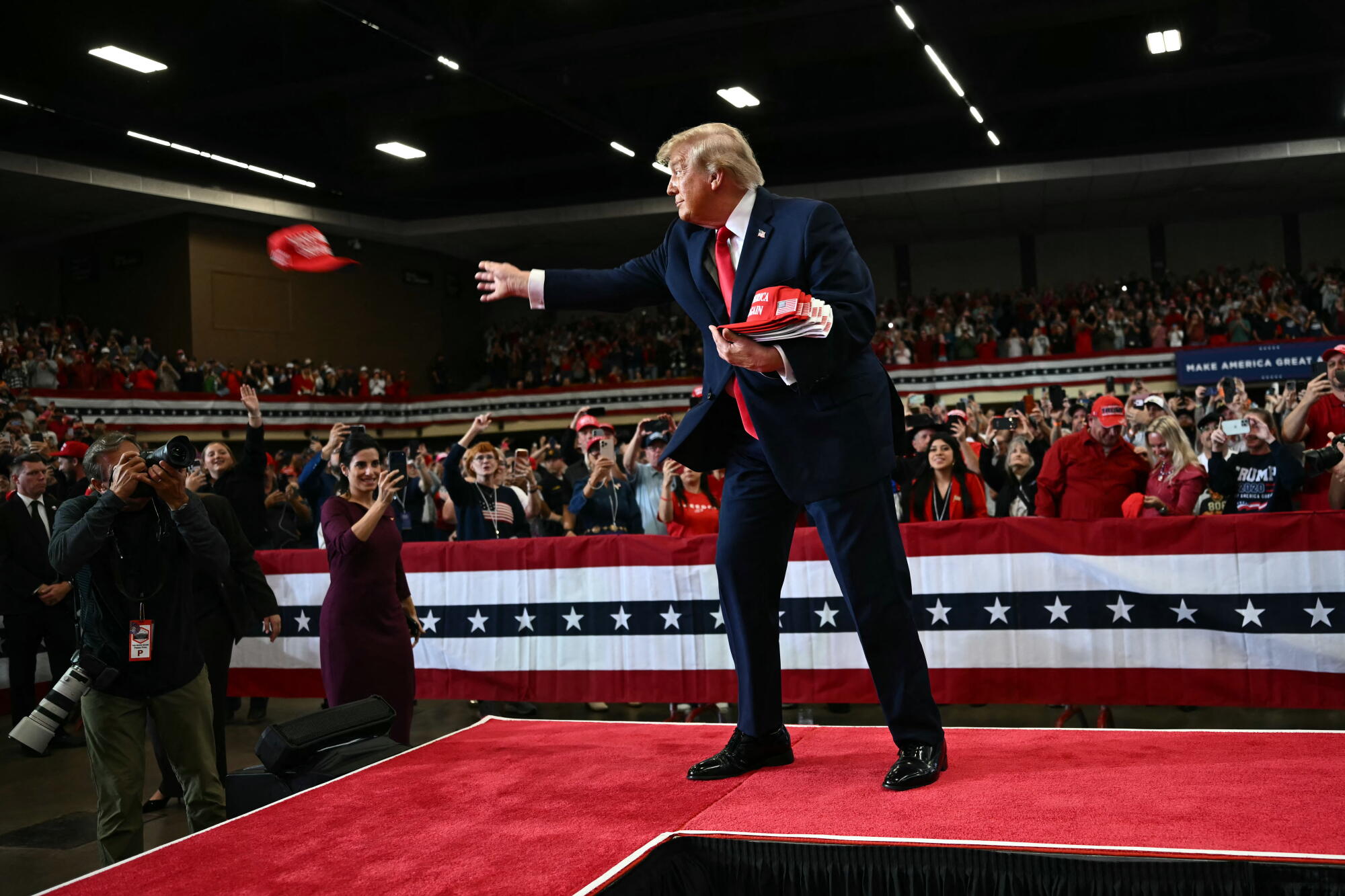
President Trump throws MAGA hats to supporters.

President Trump throws MAGA hats to supporters during a midterm campaign rally at Lubbock Memorial Civic Center in Lubbock, Texas, on Oct. 27.

(Kent Nishimura / AFP via Getty Images)

Marc Short, who served as Trump’s first White House director for legislative affairs, said that Republicans were “essentially in triage mode” entering the midterms, citing “inflation challenges” and an “avalanche of corruption stories.” Bryan Lanza, a former communications director for Trump, expressed concern last week that Republican enthusiasm has reached such lows that races in Mississippi and Texas are genuine toss-ups.

The Republican reckoning tests a party infrastructure reshaped around the president since his insurgent rise in 2015 transformed the GOP.

At the top of the party, warning signs of a splintering coalition have not changed the view that Trump still maintains the grip on the GOP’s future — and that any future decisions should take that into account.

“I think he’ll help decide who the next president is going to be,” Republican National Committee Chairman Joe Gruters said. “I think he’ll be super involved with not only the party but the process, and I welcome that as the chairman.”

Gruters called Trump “the single most important person in the Republican Party” and said he doubts the movement will reshape itself into a different kind of coalition based on the outcome of Tuesday’s election.

“I think it will continue to be Trump’s movement for as long as he’s alive,” he said. “It will be Trump’s movement.”

Others in Trump’s inner circle are making the same bet. His team is still staking Trump’s movement on the same thing that has defined it in the past: Trump himself.

“We’ve been with him for 10 years,” the official said. “Do you think he’s going away after the next two? No.”

What comes after that, the official wouldn’t say.

A person wears a sequined jacket that reads "Trump: Make American Great Again."

A person wears a sequined jacket as President Trump speaks on stage during an election rally on Oct. 9 at the Oncenter in Syracuse, N.Y.

(Alex Wong / Getty Images)

“Everyone wants to jump ahead and ask what 2028 looks like and what does beyond look like,” the official said. “I think the really smart thing about the president, and he’s even admitted it about himself, he’s always focused on the now, and he just works his a— off at the task at hand.”

The question of who inherits the movement is already taking shape, but Trump has avoided saying much when asked who he thinks should be the heir apparent.

Asked in the Oval Office last month whether he would endorse Vice President JD Vance — who had said a day earlier that he expected Trump’s backing if he decides to run for president in 2028 — Trump called Vance a “very talented person” and a “very good person,” but would not commit.

“I don’t think we’ve ever talked about it,” Trump said. “It’s early, very early right now. We have to get through the midterms.”

A New York Times/Siena poll released last week found that Republican primary voters favor Vance or Secretary of State Marco Rubio to be the party’s next nominee. Underscoring Trump’s grip on the party, the poll found, 8% said they want it to be Trump, who cannot run because of term limits.

The challenge for Republicans in the future will be to figure out a way to capture the MAGA base without isolating themselves from more mainstream Republican voters, said a GOP lobbyist with ties to Trump speaking on condition of anonymity to speak candidly.

“I think it would be foolish to ignore the MAGA base for any future candidate,” the lobbyist said. “The movement can evolve, but you need those voters to come out and vote.”

People wait in front of a "Make America Great Again" sign.

People wait for President Trump to arrive at a political rally at Freeman Coliseum in San Antonio on Oct. 7.

(Sam Owens / San Antonio Express-News via Getty Images)

Mike Madrid, a longtime Republican political strategist and co-founder of the Lincoln Project, which staunchly opposes Trump, argued that the future of the GOP will be influenced more by right-wing media personalities than policy because Trump consciously upended the party’s ideology over the last decade.

“The Republican Party is far, far more likely to balkanize than split along ideological lines because there is no ideological glue holding the GOP together anymore,” he said. “That’s gone.”

Madrid doubts Trump will change course even if Republicans suffer big losses on Tuesday night.

“Donald Trump is not going to adjust. He’s not capable of that. He never has. He never will,” Madrid said. “It doesn’t even occur to him. And even if it did, he wouldn’t know how to do it.”

If Democrats win a majority in Congress, history shows that it can be an opening for a president to pivot.

“What often happens in the last two years [of a term] is presidents bounce back,” said Christopher Warshaw, a Georgetown University public policy professor.

Presidents who “lose control of Congress and get shellacked in the midterms” often pivot to the political center, and tell voters “we’re going to try a new approach,” Warshaw said.

"MAGA" merchandise is for sale as supporters listen to President Trump.

“MAGA” merchandise is for sale as supporters listen to President Trump speak at a midterm campaign rally at Guardian Centers of Georgia in Perry, Ga., on Oct. 24.

(Brendan Smialowski / AFP via Getty Images)

President Clinton did that after Republicans swept Congress in 1994, Warshaw said. President Biden did not after the 2022 midterms, a choice Warshaw said probably hurt Democrats in 2024, when Trump was elected. If Democrats win on Tuesday, Trump has signaled that he would be open to working with them to get things done.

“I hope that won’t be the case, but if it is, that has happened before with many presidents,” he told reporters. “You have strong veto and you end up working out deals.”

However Trump might deal with a divided Washington, the coalition he built is unlikely to dissipate when he leaves office, said Lynn Vavreck, a political science professor at UCLA.

“They want to build a very specific kind of world,” Vavreck said. “Those desires are not going to go away next Wednesday, or in 2028.”

Times staff writer Justine McDaniel contributed to this report.

Source link

Legal filing questions Trump’s claims of non-citizen voting in California | US Midterm Elections 2026 News

A new court filing has cast further doubt on the accuracy of a list of “likely non-citizen” voters that the administration of United States President Donald Trump sent to the state of California ahead of the midterm elections.

On Saturday, the Coalition for Humane Immigrant Rights (CHIRLA), an advocacy group, submitted an analysis to the court conducted by two data scientists from the University of California, Los Angeles (UCLA).

Recommended Stories

list of 3 itemsend of list

It found that more than four in every 10 names on the list were not on California’s voter rolls.

It also found that thousands of potentially eligible US citizens were incorrectly identified as ineligible to vote.

The Trump administration’s list, delivered to California in early October, had suggested that as many as 20,930 “likely non-citizens” were registered on the state’s voter rolls.

That list has formed the basis of a lawsuit, filed on October 15, that calls on California to sequester any ballots sent to those “likely non-citizens”, preventing them from being tallied as part of voting results.

The lawsuit is unfolding in the final days before Tuesday’s pivotal midterm elections, which will decide which party controls the US Congress, as well as key state and local offices.

Trump has expressed fear that, if his Republican Party loses its majorities in the two chambers of Congress, he could be impeached.

The Republican leader also has a track record of spreading false information about elections, including that his defeat in the 2020 presidential race was the result of a “rigged” vote.

He has often targeted California in his criticism. The state – the most populous in the country – is considered a longtime left-wing stronghold. It will elect 52 seats to the 435-member House of Representatives in Tuesday’s elections.

Already, Trump has accused California of “cheating” in its June 2 primary elections, after several Republican candidates underperformed, including Los Angeles mayoral hopeful Spencer Pratt.

Under the US Constitution’s Elections Clause, election administration falls solely to the states, though Congress may pass regulations governing voting.

Critics, including California’s Democratic Governor Gavin Newsom, have cited that fact in their rebuttal to Trump’s lawsuit.

All 50 states already prohibit non-citizen voting in federal elections and undertake measures to prevent voter fraud, which is considered exceedingly rare.

Other states that have received similar lists of “likely non-citizen” voters have also found significant errors in the Trump administration’s accounting. Nevada, for example, found that none of the names included on that list were non-citizen voters.

Such errors have raised concerns that eligible citizens would see their votes denied if the Trump administration wins its California lawsuit.

Still, the Trump administration has threatened state officials with prosecution over the potential for non-citizen voting.

It has also vigorously pursued its lawsuit through federal court. On Friday, the 9th Circuit Court of Appeals in San Francisco rejected the complaint a second time, determining it unconstitutional.

“We decline the United States’s invitation to contravene the Elections Clause by undermining the Constitution’s plain text,” the court majority wrote in its ruling.

In Saturday’s court filing, the data scientists from UCLA’s Voting Rights Project found that 8,880 names on the list were not listed anywhere in California’s current voter files, a proportion of 42 percent.

Many other names on the list were either confirmed as US citizens or may correspond to US citizens.

“This review proves, at least as a preponderance of the evidence, that demands of election officials under criminal and civil threats, endangers the voting rights of plaintiff CHIRLA’s members and clients,” the filing said.

It was co-signed by the Democratic candidate to succeed Newsom as governor, Xavier Becerra.

Source link

How to watch the data behind 2026 midterm election calls

As voters cast their ballots in the much anticipated midterms on Tuesday, TV networks will give their viewers a closer look at how the election sausage is made.

As usual, anchors and analysts will be at their network news desks when votes are counted to determine whether the Democrats can take the House and the Senate from Republicans for the final two years of President Trump’s second term, along with gubernatorial races across the country.

But TV news organizations are rolling out additional tools and options for viewers who want a more granular look at how the vote is counted and winners are declared, responding to a heightened interest in national politics and a demand for greater transparency in an age of media distrust.

“In the last few years, as we’ve seen incredibly close elections with higher turnout and tight political divides, people are understandably looking for more transparent ways to understand how and why elections turn out the way they do,” said Jennifer Agiesta, CNN’s vice president of election and data reporting innovation.

Chuck Todd, the former NBC News political director and “Meet the Press” moderator who was among the first analysts to do deeper dives into voting data on TV, compared the increased appetite to how viewers watch sporting events. Tighter races pull in more eyeballs, especially at a time when the electorate is deeply divided over Trump’s actions and polices.

“Do people sit and watch and want more things when things are blowouts, or do people want more information when it’s decided by a nose hair?” Todd said. “You can’t discount that this is a generation of political competitiveness that feels existential.”

Todd noted that in the 21st century, the House, Senate or White House has changed hands in 11 out of 13 elections, while all but one of the seven presidential contests have been won by less than five percentage points.

While NBC News is delivering an unprecedented 13 hours of midterm coverage to its affiliates, data junkies can see analyst Steve Kornacki’s real-time number crunching at the county and precinct level on the “Kornacki Cam” stream, available on YouTube and and the network’s streaming platform. Kornacki drew millions of viewers online with his big board and trademark khakis throughout the primary season, when he streamed on nights the network was not on the air. This time around, the network will turn to him throughout the night for a broader look at the results, but he’ll be streaming continuously for those who need an immediate numbers fix.

“I’m hoping they will live stream on the phone and the broadcast on TV,” Kornacki said in a recent interview. “They can be complementary.”

Kornacki will have plenty of company in this election cycle. While CBS News chief political correspondent Ed O’Keefe has the assignment of breaking down the numbers on TV, the network is also serving up a live stream of “The Nerd Show,” with Anthony Salvanto, the network’s director of elections and surveys, and Caitlin Huey-Burns, a CBS News congressional correspondent. They will provide a continuous deep dive into the numbers as they come in.

Nexstar’s cable news channel NewsNation will have a camera fixed on the analysts from Decision Desk HQ, the upstart company that provides voting data to media outlets and corporations.

“You are going to hear my voice about the data, what we’re seeing, not seeing, why we think we can make a projection or why we need to hold off,” said Scott Tranter, Decision Desk HQ’s director of data science. “Sometimes we get data that may look good, but it may not be enough [to call a race]. So you kind of get that back and forth, that ebb and flow.”

Subscribers to Nexstar’s digital political site The Hill will be able to see voting data at the same time as the Decision Desk HQ team, which was the first to call the race for President Trump in 2024.

Todd is among the growing number of independent journalists who have launched their own programs on streaming platforms. He will host a live stream on election night with veteran Washington pundit Chris Cillizza through their Noosphere platform, which will also have full access to Decision Desk HQ data. Todd and Cillizza are partners with Decision Desk HQ on the special, which will be developed into a daily program in 2027.

CNN is also offering its digital users more advanced voting analysis though a new tool called Sightline. Sightline will provide the data the network uses to determine the outcome of races, showing the outstanding vote total, geography, vote method and comparisons with past elections. Viewers can see the information before CNN chief national correspondent John King presents the results on the network’s Magic Wall.

Fox News anchor Bill Hemmer will deliver results and vote counts on an augmented reality set. But users of the Fox News app will have an AI-powered function that provides instant access to the network’s reporting on any contest.

“The idea is to really offer a personalized experience for the users of the national picture or their state or race that they want to look at specifically,” said Doug Rohrbeck, executive vice president of Washington News & Politics for Fox News Media. “The folks who log on can ask about specific races, voting trends, candidates, when polls close and a grid of the balance of power as it’s populating.”

The major networks each have their own decision desk where statisticians, political scientists and analysts pore over vote counts, historical trends and polling to determine a winner. They are typically insulated from the anchors and pundits during coverage, but occasionally show up on the air when necessary.

Showing the work carries its own risk. Early returns can swing sharply as mail-in and election day ballots are counted at different times, and those shifts have been seized on as evidence that something is amiss. Fox News had to put its decision desk chief Arnon Mishkin on camera in 2020 when the network’s viewers and the Trump White House were angered over its early but accurate projection that Joe Biden won Arizona in the presidential election.

NBC News is betting on openness. The network aired a lengthy segment on the Thursday’s edition of “Today” to explain how its decision desk operates and comes up with its election night projections.

“The audience wants to know the work behind the calls and they really want to understand it,” said Rebecca Blumenstein, president-editorial for NBC News. “By showing that work, we feel that it’s a really important part of building trust.”

Another element driving interest is online prediction markets, where users can wager on election results — and the betting companies are now paying for some of the coverage. Kalshi is a sponsor of CBS News’ coverage and of Todd’s election night stream. DraftKings is sponsoring election coverage on CBS’ owned television stations, including KCBS in Los Angeles.

It could take days to determine which party has the majority in the House and Senate. But Kornacki said there will be a strong indicator in the 7 p.m. Eastern hour when results come in from Kentucky’s 6th Congressional District, where both parties are competing for an open seat held by Rep. Andy Barr, a Republican who is running for Senate. Trump has won the district by 15 points or more in each of his three presidential runs.

“It’s an early test,” Kornacki said. “If the Democrats were able to win that or be really close, that’s a sign they’re having the kind of night that they’re kind of dreaming of.”

Source link

Michigan Muslims helped elect Trump. Now their faith is under fire | US Midterm Elections 2026

Michigan’s Muslim voters helped Donald Trump win in 2024. Now, Abdul El-Sayed is running to become the US’ first Muslim senator, his faith and loyalty are under attack. Al Jazeera’s Mikail Malik spoke to Muslim Americans in Dearborn.

Source link

Can Democrats win the US Senate? 10 key midterm races to watch | US Midterm Elections 2026 News

Democrats need a net gain of at least four seats in November’s midterm elections to take control of the United States Senate from Republicans, as voter discontent with President Donald Trump, the Iran war, and rising prices heighten the races in once-safe Republican states.

Republicans currently hold a 53-47 majority, and a Democratic takeover seemed highly unlikely at the start of the year – before the US launched its war on Iran.

Recommended Stories

list of 4 itemsend of list

Here are the key races that could decide the control of the Senate:

Alaska

Republican Senator Dan Sullivan is seeking re-election against Democratic former US Representative Mary Peltola and an independent candidate who shares Sullivan’s name.

Alaska uses ranked-choice voting, allowing voters to rank candidates in order of preference. Four candidates are on the ballot, including Sullivan, Peltola and another Dan Sullivan, a candidate Republicans accuse Democrats of recruiting deliberately to confuse voters.

“It was a scheme. It was election fraud. Total election fraud,” Trump said. Peltola has rejected the accusations, saying the dispute is distracting from voters’ concerns.

“I feel like this is yet another diversion from the issue that Alaskans want to talk about, which is affordability,” she explained.

Peltola has raised $33m in October, compared with nearly $14m for Sullivan. Republicans have also spent more on the race, $42m compared with $38m by Democrats.

Trump won Alaska by 13 points in 2024, but recent opinion polls suggest Peltola narrowly leading over Sullivan.

Iowa

Iowa has been a Republican stronghold in recent elections, with Trump winning the state by 13 points in 2024. But his declining popularity, trade tariffs and the Iran war have put Republicans on the defence in Iowa.

The state’s agricultural economy has been hit hard by trade tariffs as well as rising fuel and fertiliser costs as a result of the strained oil supplies amid the Iran war.

Republican US Senator Joni Ernst’s decision not to seek re-election has left an open-seat contest between Republican US Representative Ashley Hinson and Democratic state Representative Josh Turek, a two-time Paralympic gold medallist.

Republican Hinson has called for an “immediate end” to the Iran war and said Iowans should not have to pay higher fuel or grocery prices as a result of it. However, according to Politifact, Hinson has voted against six resolutions seeking to end US involvement in the Iran war.

Turek has outraised Hinson $20m to $14m, but recent polls show Hinson with a narrow lead.

(COMBO) This combination of pictures created on October 30, 2026 shows (L/R) Iowa Democratic candidate for US Senate Josh Turek in Des Moines, Iowa, on June 2, 2026 and Iowa Republican Senate candidate, US Reprensentative Ashley Hinson in West Des Moines, Iowa, on October 9, 2026.
Iowa Democratic candidate for US Senate Josh Turek in Des Moines, and Iowa Republican Senate candidate, US Representative Ashley Hinson in West Des Moines [AFP]


Kansas

Kansas has not elected a Democrat to the Senate since 1932, but rising farming costs, opposition to Trump’s immigration crackdown and discontent over the Iran war have made this year’s race unexpectedly competitive.

Trump won the state by 16 percentage points in 2024.

Republican Senator Roger Marshall is facing Democrat Adam Hamilton, the founding pastor of a Methodist megachurch.

The race has drawn attention from Republican leaders, with both Trump and Vice President JD Vance campaigning in the state.

Agriculture is central to Kansas’s economy, and farmers have struggled with rising diesel and fertiliser prices as a result of the Iran war. Many have also expressed frustration with Trump’s tariffs.

Republican Senator Roger Marshall, right, and Democratic nominee for US Senate Adam Hamilton participate in a debate at WDAF TV in Kansas City
Republican Senator Roger Marshall, right, and Democratic nominee for US Senate Adam Hamilton participate in a debate at WDAF TV in Kansas City [Charlie Riedel/AP]

Immigration has become another major issue. Immigration and Customs Enforcement (ICE) raids in southwest Kansas have disrupted businesses. Even Republican Marshall has criticised aspects of the agency’s operations in his state.

Democrat Hamilton has outraised Marshall, $14m to $6m. Democratic groups have also outspent Republicans in Kansas, $28m to $22m.

Recent polls show Hamilton narrowly ahead.

Maine

Maine is one of the Democrats’ biggest opportunities to gain a Senate seat, as Republican Senator Susan Collins faces a close re-election battle in a state which voted against Donald Trump in 2024.

Collins faces Democrat Troy Jackson, a former Maine Senate president who entered the race in July after the party’s original nominee, Graham Platner, withdrew following sexual assault allegations, which he denied.

Collins has sought to distance herself from Trump, acknowledging during a debate earlier this month that she was not the president’s favourite senator and that he would not be campaigning in Maine.

She was among the Republicans who voted to convict Trump following his impeachment over the January 6, 2021, attack on the US Capitol.

Democrats say Collins only votes against Trump when it doesn’t matter, however. Democrats also hope voters will hold her accountable for helping confirm Brett Kavanaugh to the US Supreme Court, which led to the overturning of a federal right to abortion.

This combination of photos shows Senator Susan Collins, R-Maine, on September 24, 2026, in Washington, left, and her challenger for Maine’s Senate seat, Democratic candidate Troy Jackson on July 16, 2026
This combination of photos shows Senator Susan Collins, R-Maine, on September 24, 2026, in Washington, left, and her challenger for Maine’s Senate seat, Democratic candidate Troy Jackson on July 16, 2026 [Mariam Zuhaib, Robert F Bukaty/AP]

Jackson has faced criticism over his treatment of women, including his refusal to apologise for telling Collins to “shut up” during a debate.

Jackson has outraised Collins, bringing in about $26.9m compared with $25.2m through mid-October. Republican groups have also outspent Democrats, $76m to $40m.

Recent polls show a close race.

North Carolina

Republicans appear to have conceded North Carolina, where even Trump has suggested the Democrats will win. At a campaign rally last week in Greenville, Trump told supporters it was “crazy” that former Governor Roy Cooper, a Democrat, was going to be their next senator.

Trump won North Carolina by 3 points in 2024, but Republican Senator Thom Tillis’ retirement made this year’s Senate race an open contest.

Trump recruited former Republican National Committee Chairman Michael Whatley to succeed Tillis, but he has been unable to compete with Cooper’s fundraising, and Republican allies who invested heavily in holding North Carolina ‌have begun shifting their focus ⁠to other states.

Affordability has dominated the campaign as farmers struggle with rising diesel and energy costs amid the Iran war.

In eastern North Carolina, Kelly Spivey, who runs a community food pantry, told Al Jazeera that rising prices are forcing families to make difficult choices.

“They’re trying to decide if they’re going to pay for their medicine or they’re going to buy food or they’re going to pay for day care so they can actually go to work,” she said.

Whatley, meanwhile, has closely aligned himself with Trump, who told supporters at a campaign rally: “I just want you to go out and pretend I’m on the ticket because essentially I am.”

Cooper has raised $50m and has $9m in the bank. Whatley has raised $14m and has just $900,000 on hand through mid-October. Recent polls have Cooper leading by double digits.

At left, Michael Whatley speaks June 18, 2024, in Newtown, and at right, North Carolina Governor Roy Cooper, on October 5, 2024, in Charlotte [AP]

Ohio

Democrat Sherrod Brown, who has longstanding ties to labour unions and working-class communities, is seeking to win back voters in the industrial Rust Belt state.

Brown faces US Senator Jon Husted, who was appointed to the Senate to replace US Vice President JD Vance when Vance left the Senate for the White House.

The cost of living has become a major campaign issue.

(COMBO) This combination of pictures created on October 30, 2026 shows (L/R) Ohio Democratic candidate for US Senate Sherrod Brown in Warren, Ohio on September 26, 2026 and US Senator Jon Husted, Republican from Ohio, in Cincinnati, Ohio, on October 24, 2026.
This combination of pictures created on October 30, 2026 shows (L/R) Ohio Democratic candidate for US Senate Sherrod Brown in Warren, Ohio, on September 26, 2026 and US Senator Jon Husted, Republican from Ohio, in Cincinnati, Ohio, on October 24, 2026 [AFP]

The winner of the special election will be on the ballot again in 2028 for a full six-year term.

Republican and Democratic outside groups have each spent nine figures on the race, with Republicans investing $232m and Democrats pouring in $118m.

Brown has more than tripled Husted’s fundraising through October 14, bringing in $68m to Husted’s nearly $20m. Recent polls show Brown leading by three to five points.

Texas

No Democrat has won statewide in Texas since 1994.

James Talarico, a state representative, could break the streak.

Talarico faces Republican Attorney General Ken Paxton.

Trump won Texas by nearly 14 points in 2024. Yet Republican outside groups have already spent $300m to hold the seat after run-off voters nominated the scandal-plagued Paxton over ⁠incumbent Republican US Senator John Cornyn.

Trump endorsed Paxton even though Cornyn was widely believed to have an easier path to victory.

Leaked audio has exposed daylight between Trump and Paxton, who privately told donors that the president’s midterm convention hurt his campaign.

Democratic groups have spent $76m on this race. But Talarico’s campaign has outraised Paxton’s by $110m and reported $9.6m more in its campaign coffers as of September 30.

Musk has given $158m to a Republican super PAC to invest in Paxton’s race. Recent polls show Talarico narrowly leading or tied.

INTERACTIVE_US MIDTERMS_GFX 2026_SENATE

Georgia

Georgia was initially seen as one of the Republicans’ main opportunities to gain a Senate seat after Trump won the state by 2 percentage points in 2024. But Republican US Representative Mike Collins has struggled to gain traction against Democratic US Senator Jon Ossoff, a potential 2028 presidential candidate.

Ossoff has ⁠outraised Collins by nearly $126m up to October 14 and began mid-October with $15.1m in his war chest, compared with Collins’ $1.1m.

Polls have consistently shown Ossoff leading, and Democrats narrowly lead Republicans in outside spending, $19m to $17.9m.

(COMBO) This combination of pictures created on October 30, 2026 shows (L/R) US Senator Jon Ossoff, Democrat from Georgia, in Atlanta, Georgia, on October 13, 2026 and US Representative Mike Collins, Republican from Georgia, in Perry, Goergia, on October 24, 2026.
This combination of pictures created on October 30, 2026 shows (L/R) US Senator Jon Ossoff, Democrat from Georgia, in Atlanta, Georgia, on October 13, 2026 [AFP]

Michigan

Republicans are more hopeful about flipping an open seat in Michigan, especially after the Democratic establishment failed to get its pick nominated.

Progressive outsider Abdul El-Sayed narrowly defeated centrist US Representative Haley Stevens during the primary, putting him on a collision course with Republican Mike Rogers, a former US representative, in what could be the tightest race for a Democratic-held Senate seat this year.

Michigan, a key battleground state which Trump won in 2024, has been hit by tariffs affecting trade with neighbouring Canada and rising living costs, making the economy a central issue in the campaign.

The race has also attracted heavy spending from outside groups. A pro-Israel super PAC has spent at least $493,000 opposing El-Sayed, after spending $30m in an unsuccessful effort to prevent him from winning the Democratic nomination. The group could spend as much as $9m more during the general election.

El-Sayed raised $45m up to September, more than double Rogers’s nearly $21m.

Republican groups have spent $136m on the race, compared with about $70m by Democrats.

Most recent polls show El-Sayed narrowly ahead.

New Hampshire

Democrats are defending an open Senate seat in New Hampshire after Senator Jeanne Shaheen announced her retirement, giving Republicans an opportunity to compete in a state Kamala Harris won by nearly three percentage points in 2024.

Democratic US Representative Chris Pappas faces former Republican Senator John Sununu, who is seeking a return to Washington nearly two decades after losing his seat to Shaheen in 2008.

Sununu comes from one of New Hampshire’s best-known political families. His brother, Chris Sununu, served as governor until 2025.

Pappas has a substantial fundraising advantage, raising $24m compared with Sununu’s $6m.

Republican outside groups have also outspent Democrats, $37m to $20m, as both parties compete for the open seat.

Recent polls have consistently shown Pappas leading Sununu by five to eight percentage points.

Source link

Fake polls expose vulnerabilities in US elections ahead of midterms | US Midterm Elections 2026 News

Fabricated political polling has forced its way into the spotlight during the midterm election period in the United States.

Revelations that a small number of fraudulent firms have released fictitious results – some of which were picked up by news outlets and polling trackers – have raised concerns about how easily false information can acquire credibility.

Recommended Stories

list of 3 itemsend of list

Those datasets can be used to cast doubt on the electoral process. And when bad actors are unmasked, their existence can be leveraged to undermine voter confidence in election information overall.

The latest example occurred earlier this month, when Wedgewood Polls released a statement on social media admitting its statistics about a bevy of battleground states – like Texas, Ohio, Michigan, Kansas and Maine – were fake.

Wedgewood described its work as “an experimental project” designed to highlight the “vulnerabilities, lack of oversight and overall low barrier to entry” in the US polling industry.

“Having previously worked in the polling and research sector, we watched as the public’s trust in polling eroded alongside a rise in unverified, low-quality methodology,” the firm said in a statement posted to its social media account, which has now been deleted.

It justified its false data as a test to see how easy it would be for fabricated polling to gain traction among voters and the media.

“The short answer: Far too easy,” Wedgewood said.

But Wedgewood’s admission came after its surveys had already circulated through the political information ecosystem, reaching prominent media outlets like The New York Times.

The incident was the second such scandal in the 2026 election cycle, following the exposure of another operation, Median Strategies, which acknowledged in August it had also faked results as a “short-term social experiment”.

In an increasingly polarised US political environment, the incidents have roiled a polling industry – and a public – struggling to adapt to an ever-changing information landscape.

How fake polls gained credibility

Wedgewood, which launched in June, published surveys covering competitive races across several states. Its results attracted attention from political campaigns, commentators and organisations that compile polling data.

The New York Times said its polling tracker had listed 15 Wedgewood surveys between June and October. The newspaper subsequently removed them.

In the wake of the scandal, it explained that the firm had answered questions about its personnel, methodology and funding before its results were included.

While the Times said Wedgewood’s surveys were not incorporated into the newspaper’s own presidential approval or national congressional polling averages, the case revealed a vulnerability in the process by which polling information becomes established as credible.

Polling aggregators help journalists and voters make sense of a crowded field of surveys by collecting results from multiple research organisations. Their value depends partly on their ability to distinguish reliable research from poorly conducted or fraudulent work.

Wedgewood’s success in passing some of those checks suggests that transparency on paper is not necessarily proof that research has been conducted as claimed.

According to FiftyPlusOne, a polling and forecasting website that investigated the firm, inconsistencies in the raw data and the technical identifiers associated with survey responses helped raise suspicions about its authenticity.

The investigation prompted Wedgewood to acknowledge that most of its results were fabricated.

Though Wedgewood has denied trying to mislead the public, some pollsters are not convinced, suggesting the group could was up to something more nefarious.

“We were investigating Wedgewood for faking their data,” said data journalist G Elliott Morris, who was involved in FiftyPlusOne’s probe. “They are trying to cover up for their fraud with the ‘we were doing a social experiment’ excuse.”

How fake polling has impacted elections

The consequences of fake polling extend far beyond the polling industry.

Mallory McMorrow, who ran unsuccessfully in Michigan’s Democratic Senate primary, has argued that a Wedgewood survey showing her support in the single digits damaged her campaign.

McMorrow said the poll left her volunteers demoralised, and journalists repeatedly contacted her to ask whether she should abandon the race.

Donations, she added, also evaporated, with Democratic supporters looking to other campaigns to invest.

Michigan State Sen. Mallory McMorrow, D-Royal Oak, foreground, a candidate for the U.S. Senate, stands with supporters during the Michigan Democratic Party State Endorsement Convention, Sunday, April 19, 2026, in Detroit. (AP Photo/Jose Juarez)
Michigan State Senator Mallory McMorrow, a former candidate for the US Senate, stands with supporters in Detroit on April 19 [Jose Juarez/AP Photo]

In a social media post, McMorrow described the poll from Wedgewood – and another from the firm Mitchell Research and Communications – as a “one-two punch” that “killed her campaign”. She suspended her Senate bid in July.

“By that point, we took a risk and we spend our money. We put our ads up. They were working. But the damage was done. And I was drowned out by outside spending and the narrative that we had completely collapsed,” she wrote.

Experts say McMorrow’s account illustrates a broader problem: Even when a poll does not accurately measure public opinion, its findings can still influence the decisions of people who believe it does.

Why it matters

The Wedgewood controversy demonstrates how fraudulent data can become ammunition in an already polarised political environment.

Researchers at the University of Washington’s Center for an Informed Public tracked how discussion of Wedgewood’s admission spread across social media.

Initially, much of the conversation was concentrated among polling experts and people who followed election data. But the story subsequently gained traction among influential political commentators and partisan accounts.

Some posts focused on the fact that prominent outlets and polling aggregators had listed Wedgewood’s results. Others used the revelation to question polling more broadly, particularly surveys suggesting that Democrats were competitive in closely contested races.

The researchers found the controversy became intertwined with claims that polling was systematically misleading voters or understating support for particular political parties.

“Within 24 hours, the right-wing media ecosystem had succeeded in drawing attention to the story and setting some of the most salient frames: that poll numbers around the midterms, especially poll numbers favoring Democrats, cannot be trusted,” the Center for an Informed Public wrote in its analysis.

President Donald Trump, who has regularly made false claims about US election integrity, seized on the revelations to criticise the Times for including Wedgewood’s surveys in its polling tracker.

“The New York Times got caught,” Trump wrote in a Truth Social post. “Everything about The Failing New York Times is ‘ARTIFICIAL’.”

He also suggested the Wedgewood case would help his $15bn defamation suit against the Times.

“Our powerful Lawsuit against them is getting stronger and stronger everyday,” he added.

What can be done?

No laws exist in the US that criminalise fake polls outright.

Some advocacy groups and law scholars have argued that the publication of fake polls constitute commodities and wire fraud, warranting federal prosecution.

“Deterring this sort of fraud before it can happen – and raising awareness of it – is vital,” Tyler Yeargain wrote for the Missouri Law Review in 2020.

He argued that enforcement of election-related laws against fake pollsters has “not been fully utilized”.

“Prosecution would serve a strong federal interest,” he wrote. “The interest at stake is weightier than concerns over how fake polls can shade the accuracy of an academic endeavor in prediction markets. It is instead to deter other wrongdoers, the sort who would weaponize fake polls to manipulate elections.”

Brendan Carr, the head of the Federal Communication Commission (FCC), which regulates broadcasts in the US, said there has been “a significant surge” in fake polls during the 2026 midterms, urging networks not to amplify them. Otherwise, Carr said, they could lose their licence to operate.

President Donald Trump listens as Federal Communications Commission chairman Brendan Carr speaks at a campaign rally at the Curtis D. Menard Memorial Sports Center, Tuesday, Oct. 13, 2026, in Wasilla, Alaska. (AP Photo/Lindsey Wasson)
President Donald Trump listens as Federal Communications Commission Chairman Brendan Carr speaks at a campaign rally in Wasilla, Alaska [File: Lindsey Wasson/AP Photo]

“Broadcasters are prohibited by the terms of their federal licenses from engaging in News Distortion or promoting Broadcast Hoaxes,” Carr wrote on social media. “It is important that broadcasters comply with their public interest obligations.”

But the FCC’s sole Democratic commissioner, Anna Gomez, disagreed with Carr’s assessment.

“Pollsters who intentionally mislead the public should answer for it, but broadcasters who report publicly available polling data should never be punished when a poll is wrong,” she wrote on X. “FCC rules on news distortion or hoaxes do not apply to a station that reports this data in good faith.”

Without a clear legal remedy against fake polls, experts argue the onus is placed on media outlets and voters themselves to evaluate the quality of the election data they see.

Mark Baldassare, the survey director of the Public Policy Institute of California (PPIC), said there are ways to quickly spot which surveys are real – and which are not.

“Look for transparency,” Baldassare told PPIC’s Stephanie Barton in an interview. “A credible survey will list its mission, the purpose of its polling, and its sponsors or funders.”

“A poll guided by partisan groups or campaigns that is publicly released may have a message to relay to the public.”

Source link

US appeals court again rejects Trump bid to set aside California ballots | US Midterm Elections 2026 News

For the second time in less than a week, a United States appeals court has rejected a petition from the administration of President Donald Trump to set aside 20,000 ballots in California over concerns about non-citizen voting.

The decision came down on Friday, with less than four days until the November 3 midterm elections.

Recommended Stories

list of 3 itemsend of list

The 9th Circuit Court of Appeals ruled that Trump’s request would violate the US Constitution and risk disenfranchising eligible voters.

“The consequence of the United States’s request is not merely ballot segregation, but ultimately both the cancellation of the ballot and the removal of voters from the voting rolls,” the majority wrote in its ruling.

Judges Mark Bennett and Gabriel Sanchez – appointed by Trump and his Democratic predecessor Joe Biden, respectively – formed the majority.

A third judge, Trump appointee Patrick Bumatay, issued a dissent, saying the administration’s petition was a “reasonable request”.

The Trump administration has claimed that nearly 20,000 “likely non-citizens” received mail-in ballots to vote in California’s midterm elections on November 3. It sued the state on October 15 to prevent those ballots from being counted.

But the accuracy of the Trump administration’s list has been called into doubt, as have its claims of widespread non-citizen voting.

Election fraud in the US is extremely rare. So is non-citizen voting, despite Trump’s assertion earlier this year that as many as 278,000 foreign nationals across the country were registered to vote.

Like California, states such as Nevada and Washington have also received lists of alleged non-citizen voters, but officials there have found the documents largely inaccurate.

In Nevada, for instance, state authorities issued a statement in September saying the Trump administration had erroneously identified citizens as non-citizens on its list. Not a single name was correct, according to the statement.

California, a Democratic stronghold, will elect 52 members of the House of Representatives, one of Congress’s two chambers, on November 3.

The state has long been Trump’s target for criticism, with the president accusing its Democratic leadership of “cheating” in elections.

But California officials, including Governor Gavin Newsom, have countered that the Trump administration is seeking to meddle in the state’s elections to sow voter distrust and undermine the results.

“This is a sad, desperate attempt by Trump to use his politicized Justice Department to try to suppress California voters,” Newsom said in a news release after the October 15 lawsuit.

Non-citizen voting in federal elections is against the law in all 50 US states, including California.

The Constitution’s Elections Clause also grants states exclusive authority to administer elections, though it does allow for Congress to pass regulations concerning voting procedures.

The Trump administration initially sent California its list of 20,000 “likely non-citizens” on October 12, barely three weeks before the midterm election.

California officials refused the administration’s demand to set aside the 20,000 ballots, requesting proof that the names on the list were indeed foreign nationals. According to the California government, no such evidence has been provided.

The Trump administration last week charged 28 foreign nationals in California with election-related infractions, but some of the accused told the Los Angeles Times they had never registered to vote.

The newspaper’s reporting suggested some of the non-citizen defendants shared the same name as eligible voters.

As the October 15 lawsuit navigated the court system earlier this month, the Trump administration sought an emergency ruling from the 9th Circuit Court to suspend the 20,000 ballots.

But the appeals court rejected the petition on Monday, saying the Trump administration had not given lower courts adequate time to weigh the matter.

A lower court ultimately ruled against the Trump administration on Wednesday, and the administration again appealed to the 9th Circuit Court.

In its majority decision, the appeals court framed the Trump administration’s lawsuit as an attempt to violate the Constitution’s Elections Clause.

“We decline the United States’s invitation to contravene the Elections Clause by undermining the Constitution’s plain text,” the majority wrote.

The majority also wrote that it had “major concerns” that granting the Trump administration’s request would “harm the public interest by risking the disenfranchisement of eligible voters and putting the entire tabulation process in jeopardy”.

Source link

US midterms: 4 days to go – What the polls say as Trump cancels two rallies | US Midterm Elections 2026 News

With four days to go before the United States midterm elections, Democrats are leading in national polls as both parties make their final push for votes.

Meanwhile, a legal dispute threatens to delay the Senate result in Alaska, and President Donald Trump has cancelled two weekend rallies in favour of campaigning by phone.

Recommended Stories

list of 3 itemsend of list

Here’s what you need to know.

What do the latest US midterm polls say?

Democrats lead Republicans by 51.4 percent to 43.2 percent, according to RealClearPolling, with a difference of 8.2 percentage points.

Charles Franklin, professor of law and public policy and director of the Marquette Law School Poll in the US, said Trump’s declining approval ratings and economic concerns are alarming Republicans.

The latest Marquette Law School poll, conducted in Wisconsin from October 14 to October 22 and released on October 28, put Trump’s approval rating at 37 percent and disapproval at 61 percent.

Only 16 percent of respondents said they were better off financially than a year ago, while 42 percent said they were worse off and another 42 percent said things were about the same.

“Democrats are more enthusiastic and more certain they will vote,” Franklin told Al Jazeera.

“That is giving Democrats an important edge, and reflects Republican disappointment in current national conditions,” he added.

In Arizona, where voters are experiencing increasing living expenses, a retiree told Al Jazeera that the cost of groceries had become a major concern.

“We’re retired, and every time we go to the grocery store, it makes me wonder what the heck is going on,” the voter said.

In Texas, Democrat James Talarico is polling at 49 percent against Republican Ken Paxton’s 43 percent, according to a CNN survey released on Thursday. In Michigan, the same pollster found Democrat Abdul El-Sayed ahead of Republican Mike Rogers, 49 percent to 42 percent.

However, Franklin warned: “Polls are not perfect predictions of outcomes.

“We could see those close races go either way, either due to polling errors or due to voters moving just a little more in one direction or the other.”

In Alaska, however, there is also a complication: a legal dispute that could delay the result of a Senate race.

What is happening in Alaska’s Senate race?

The battle for Alaska’s seat could continue in court after ballots close on November 3. The dispute centres on two candidates named Dan Sullivan: the incumbent Republican senator and an independent candidate with the same name, who is also registered as a Republican.

Trump has accused Democrats of recruiting an independent candidate to confuse voters and take support away from the Republican senator.

“It was a scheme. It was an election fraud. Total election fraud,” Trump said.

The Justice Department has taken legal action over the dispute, while Democrat Mary Peltola denied the accusations.

“I feel like this is yet another diversion from the issue that Alaskans want to talk about, which is affordability,” she said.

Al Jazeera’s US correspondent Alan Fisher said the dispute could have consequences beyond Alaska if the Senate’s control depends on the result.

“If this becomes the key seat in the battle for the Senate, we might not actually know who has control there for several days, maybe even weeks after November 3,” Fisher said.

What has happened on the campaign trail in the past 24 hours?

Trump travelled to South Carolina to campaign for Republican senator Darline Graham – sister of the late Lindsey Graham – who is running against Annie Andrews in a closely contested race.

In Rock Hill, Trump encouraged voters to cast their ballots and cautioned his supporters not to take the election outcome for granted. About Graham, Trump said that she was in the lead but that he still had to campaign there. “In politics you never know, right? So you got to get out and vote.”

He also addressed his supporters directly and asked the crowd to pretend that he was on the ballot.

“And I am on the ballot because all of these things that we’ve done, all of these incredible successes that we have,” he added.

US President Donald Trump points his finger at a midterm election campaign rally for incumbent US Senator Darline Graham (R-SC) at an event center in Rock Hill, South Carolina, US, October 29, 2026. REUTERS/Jonathan Ernst TPX IMAGES OF THE DAY
US President Donald Trump points his finger at a midterm election campaign rally for incumbent US Senator Darline Graham at a campaign event in Rock Hill, South Carolina, US, on October 29, 2026 [Jonathan Ernst/Reuters]

In Texas, Vice President JD Vance attended a rally in Weatherford, near Dallas, alongside Republican Senate candidate Ken Paxton, as Republicans called on supporters to vote.

“Texas ain’t surrendering. Texas is not becoming California. It’s going to stay Texas, ain’t that right?” Vance told supporters.

Well-known Democrats have also joined the campaign trail.

On Wednesday, former President Barack Obama gave a speech in Georgia supporting Senator Jon Ossoff, criticising Trump’s management of the economy and his approach to the war with Iran.

When Al Jazeera asked about Obama’s visit, Ossoff’s Republican opponent, Mike Collins, said it showed “the desperation of Jon Ossoff because he knows he’s losing”.

“If he was winning so big, he wouldn’t have brought anybody in,” Collins said.

Democrats also campaigned in Texas and Georgia on Thursday.

In Dallas, Senate candidate James Talarico held a rally as part of his final campaign tour, while former Vice President Kamala Harris joined Ossoff at Clark Atlanta University, urging young people to vote.

Harris also campaigned in Macon, Georgia, where she criticised the Trump administration over rising living costs.

“We have a moment now to turn pain into purpose,” Harris told Democratic volunteers. Harris also urged supporters to participate in local and statewide contests.

Later, at Clark Atlanta University, she asked students to stay engaged.

“Don’t overlook those races, because those are the folks who make decisions about your life every day,” she said.

What happens next on the US midterms campaign trail?

Trump has cancelled weekend scheduled appearances in Kansas and Iowa, replacing them with telephone rallies across nearly 20 states in the final days before Tuesday’s elections.

Trump had been set to appear in Salina, Kansas, on Saturday and Dubuque, Iowa, on Sunday.

Republican National Committee Chairman Joe Gruters said the change would allow Trump to reach more voters than he could with in-person appearances.

“Voters across the country want to hear from President Trump before Election Day, and this 72-hour sprint will be a huge boost in the closing days,” Gruters said.

Asked about the cancellations on Thursday, Trump questioned the need to travel to Kansas, where Republican Senator Roger Marshall is facing Democrat Adam Hamilton.

“I don’t feel I have to go to Kansas,” Trump said.

When a Reuters reporter asked whether the decision had anything to do with fatigue from travelling, Trump rejected the suggestion. “I feel perfect,” he said, before insulting the reporter.

Trump is still scheduled to hold a rally at the Ocean Center in Daytona Beach, Florida, on Friday at 23:00 GMT.

At the same time, Harris is due to address the Fulton County Democratic Party’s Fulton Forward dinner in Atlanta, Georgia.

Vance had also planned a news conference with the White House Task Force to Eliminate Fraud in St Cloud, Minnesota, on Friday, but the visit was cancelled on Thursday. No reason was immediately given.

Source link

Trump administration renews bid to block Alaska election results | US Midterm Elections 2026 News

The updated lawsuit cites a new report that Democratic operatives recruited a competitor to confuse voters and unseat a Republican incumbent.

The United States Department of Justice has filed a revised lawsuit seeking to decertify the results of a Senate race in the state of Alaska if Republican incumbent Dan S Sullivan loses narrowly.

The updated lawsuit on Thursday comes just days before the November 3 midterm election, which will determine control of Congress.

Recommended Stories

list of 3 itemsend of list

The complaint accuses Democrats of trying to confuse voters by placing a candidate with the same name as Sullivan on the ballot.

Alaska’s Senate race is one of seven key toss-ups that will likely decide whether Republicans keep their majority in Congress’s upper chamber.

Democratic challenger Mary Peltola is seeking to unseat Sullivan, a Republican ally of US President Donald Trump.

But a New York Times report on Wednesday alleged that members of Peltola’s campaign helped recruit a retired teacher, Dan J Sullivan Jr, to run for the Senate seat as a spoiler candidate, designed to draw votes away from the incumbent.

The Times report prompted a renewed legal push under the Trump administration to bar Alaska from certifying its election results, should Senator Sullivan lose.

The Department of Justice issued 40 subpoenas and document preservation requests as part of the revised complaint, the Reuters news agency reported.

Alaska Governor Mike Dunleavy also ordered a criminal investigation into the allegations. Peltola’s campaign has denied involvement in Dan J Sullivan Jr’s bid for the Senate.

Prosecutors, however, have accused the Democrat and her allies of playing partisan tricks – and undermining voters as a result.

“They orchestrated his sham campaign for the purpose of misleading Alaskan voters and getting Peltola elected,” Justice Department lawyers wrote in their amended complaint.

But the Justice Department’s lawsuit has raised concerns about election integrity and federal meddling.

Under the US Constitution, election administration falls to the states, not the presidency.

In June, Alaska’s Supreme Court ruled that Dan J Sullivan Jr could compete in the midterms, and the state’s election office has already taken steps to reduce confusion between the two Sullivans.

Recruiting candidates to split an opponent’s vote – a practice known as ballot stacking – is also generally considered to be legal and has been used by both parties in Alaska.

Critics have been sceptical of the Justice Department’s bid to pause the certification of Alaska’s Senate results if Senator Sullivan does not win re-election, noting it would be impossible to divine voter intent based on the final tally alone.

Justin Levitt, a former Department of Justice official under President Joe Biden, also questioned what legal authority the federal government had to get involved in the case.

“I don’t know what they’re putting out subpoenas to investigate because I don’t know what federal violations are implicated that DOJ would have jurisdiction over,” Levitt told the Associated Press news agency.

“Sure makes it seem like the point of the investigation is to become the story.”

Democrats and Republicans are locked in tight races nationwide that will determine which party holds a majority in the US Senate for the remainder of Trump’s second term in office.

Republicans currently hold a slim majority in the legislature’s upper chamber, with 53 out of 100 seats.

Democratic candidates are hoping to win seats by capitalising on Trump’s deep unpopularity and frustration over the cost-of-living crisis.

Trump has suggested he may not accept the midterm results if his party loses its majorities in Congress, and he has pushed false claims of widespread voter fraud.

The Justice Department has also attempted to challenge the voting process in several states, including California.

Source link