US president seeks to underscore Latin American military operation, as Iran war causes midterm affordability threat.
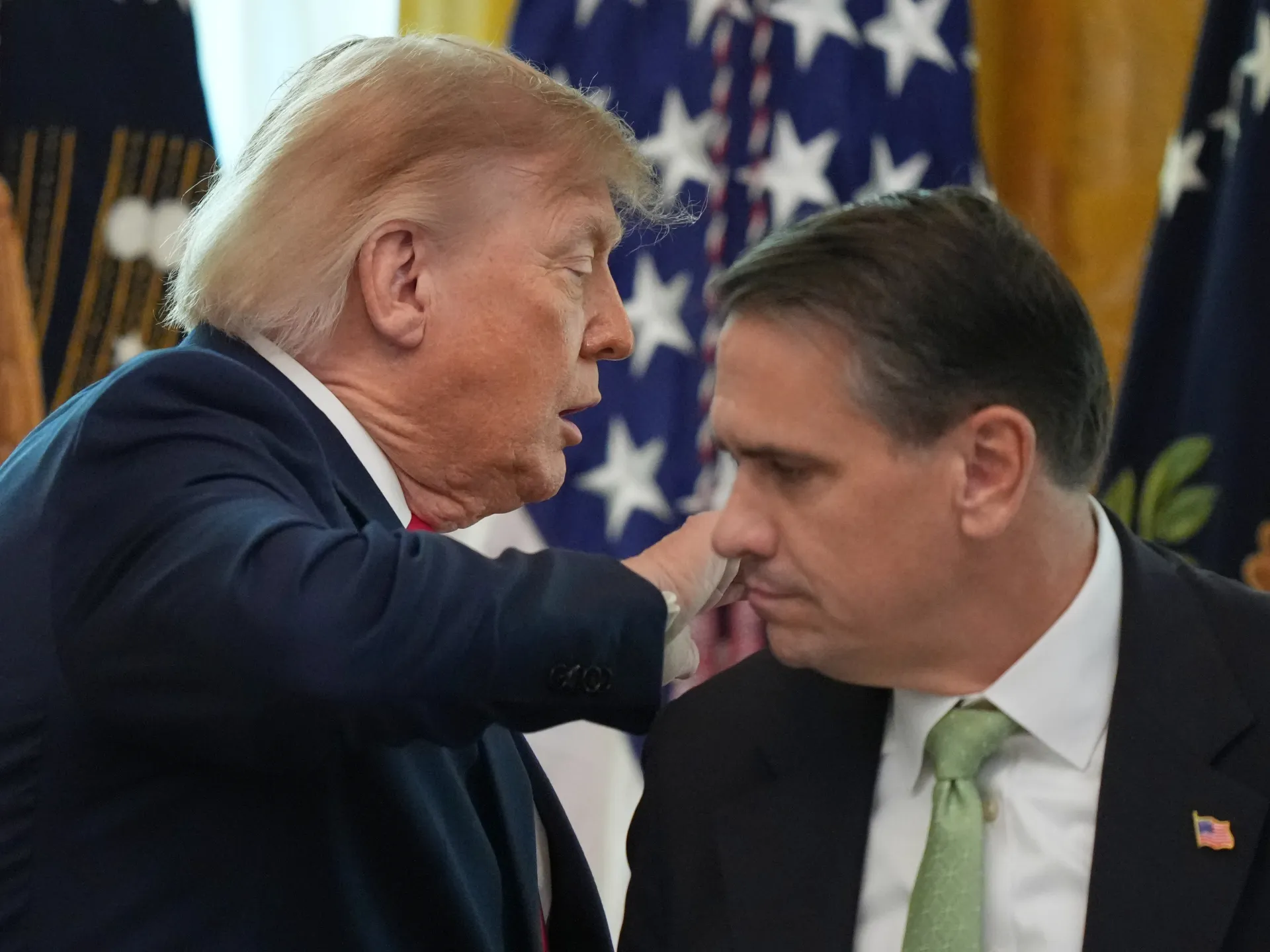
United States President Donald Trump has featured a ship he said is carrying Venezuelan oil during a visit to Texas, where he will hold two rallies one after the other in the hopes of boosting Republican chances in a make-or-break Senate race.
Speaking at Corpus Christi on Tuesday on his fourth trip to the state this campaign season, Trump pointed to a ship in the distance.
Recommended Stories
list of 3 itemsend of list
“It’s got 1 million barrels of oil on it from Venezuela,” he said, adding the cargo was “thanks to our big victory in our recent war with Venezuela”.
The emphasis on the oil comes as US consumers have wrestled with high fossil fuel prices amid the US-Israel war with Iran, a key issue in the upcoming midterm elections.
“We’re celebrating the greatest oil victory in history,” Trump said.
It was not immediately clear under what pretext the oil had been shipped or whether the details Trump gave were correct. The US had received crude oil shipments from Venezuela before the US abduction of Venezuelan leader Nicolas Maduro on January 3, but those transfers have increased this year.
In August, the Trump administration announced a deal giving the Pentagon a 35 percent stake in North America Blue Energy Partners, a new company overseeing 65 billion barrels of proven oil reserves. The White House said in September that the first shipment from the deal would likely hit US reserves in November, although experts have cast doubt on whether the deal will have any short-term impact.
Speaking to reporters earlier in the day, Trump referred to the shipment as a “gift” from Venezuela. The country’s interim leader, Delcy Rodriguez, has not commented on the specific shipment.
At the rally, Trump also floated making Venezuela the “51st state”.
Key race
Trump’s frequent visits to Texas underscore the state’s significance for Republicans.
Trump endorsed Attorney General Ken Paxton in the Republican primary over incumbent Senator John Cornyn. The scandal-ridden Paxton now faces a punishing contest against Democrat James Talarico, a Presbyterian seminarian.
Polls have regularly shown Talarico leading Paxton, although that lead has largely remained within the margin of error. A RealClearPolitics average of polls had Talarico leading Paxton by 1.7 points.
Talarico’s victory would mark a sea change in a state that has not elected a Democrat to statewide office since 1994.
It would also represent a major rebuke to Trump, whose Republican Party is fighting to maintain its narrow control of the Senate. Democrats are widely projected to take control of the US House of Representatives in the November 3 vote.
Talarico has used the final stretch of the race to focus on years of corruption allegations against Paxton, while drawing a contrast to voters’ affordability concerns.
“Ken Paxton represents everything that’s wrong with this broken, corrupt system,” he said during an event in Houston last week.
Paxton has sought to portray Talarico as too “radical” for Texas, saying his policies would hurt a state known for its pro-business policies.
Trump and other administration officials, notably Vice President JD Vance, have regularly focused on cultural issues, distorting Talarico’s past comments on transgender rights and border security.
Speaking in Corpus Christi, Trump repeated those attacks and urged his supporters to vote as if he were on the ballot.
“If you go out, and if you all vote, we win in a landslide,” Trump said.
Iran, Iraq, Afghanistan. Why does the US keep going to war, and can voters stop it?
The United States is once again at war in the Middle East, and most Americans say it isn’t worth the cost.
Al Jazeera’s Josh Rushing asks why the US keeps fighting: oil, a $2.4 trillion defence industry, lobbyists or a political system that rarely holds anyone to account?
Retired General Mark Kimmitt and journalist Spencer Ackerman debate why, and whether voters can end the forever wars.
Contributors:
Mark Kimmitt – Retired US Army brigadier general and former assistant secretary of state for political-military affairs
Spencer Ackerman – Journalist, author and writer of the Forever Wars newsletter
United States Health Secretary Robert F Kennedy Jr has sparked uproar with comments he has made denying Arab contributions to mathematics, science and literature.
In a high-voltage rant on Monday, the US health secretary said, “There’s five hundred million Arabs in the world. And yet they don’t produce science. They don’t win the Nobel Prize. They don’t win the Fields Prize. They don’t win the Wolf Prize. They don’t produce literature.”
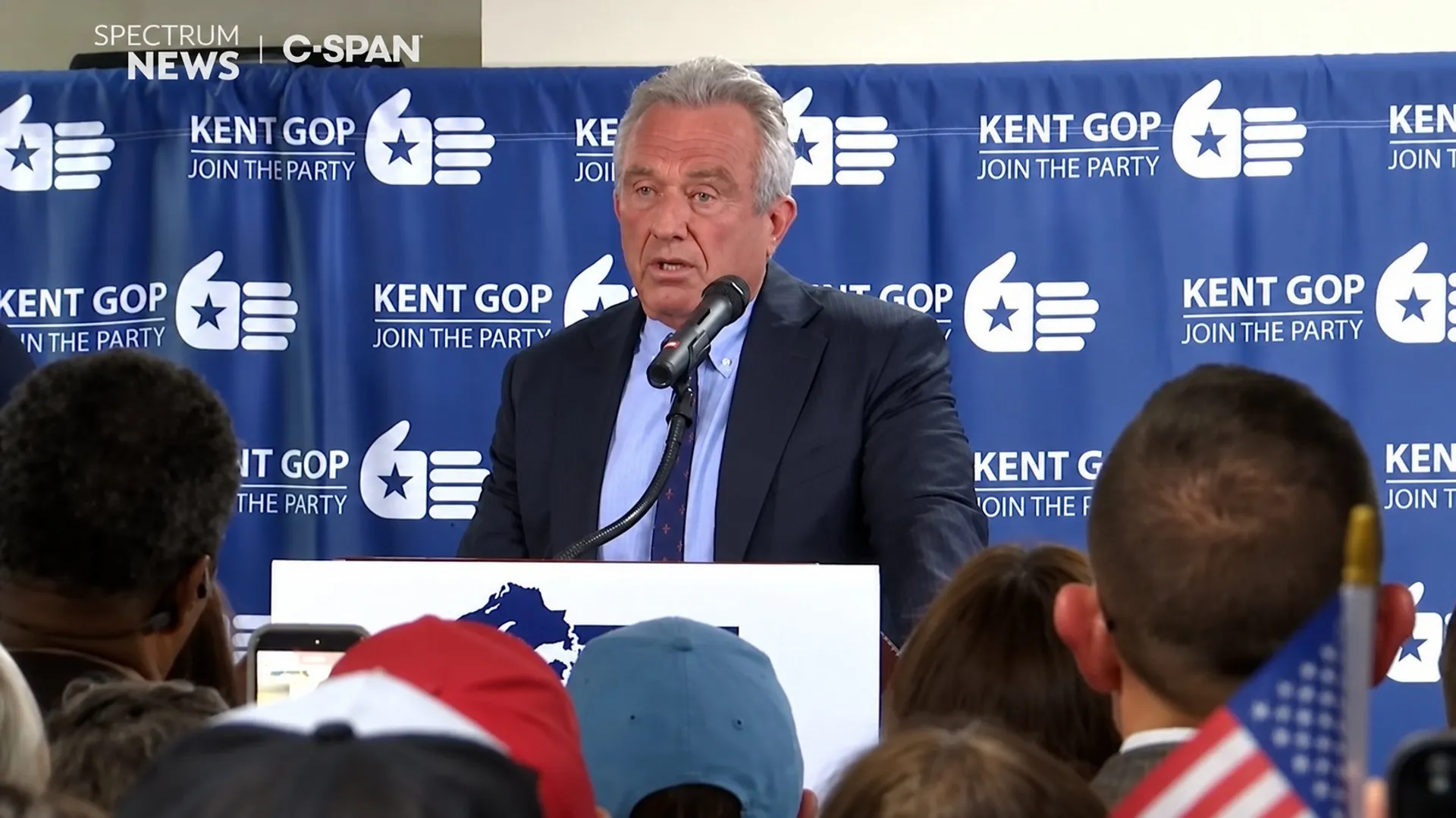
RFK Jr, who has been involved in anti-vaccine campaigns and has promoted a debunked theory linking vaccines to autism, made the comments during a US election campaign event in Grand Rapids, Michigan while supporting Republican nominee Mike Rogers, who is up against Arab-American Democrat nominee Abdul El-Sayed, in a tightly contested battle for Michigan’s Senate seat in next week’s midterm elections.
Critics said the comments were racist, Islamophobic and factually inaccurate, pointing to modern and historic Arab innovation in multiple fields.
Here’s how Arabs have made vital contributions to the human understanding of maths, science and literature through the centuries.
Arab contributions to maths, science and humanities
The period known as the Islamic Golden Age, from around 750 AD to 1258 AD, produced many key Arab contributions to medicine at a time when Europe was said to be in its Dark Ages. During this time, Arabic was the language of science and scholarship.
1st-4th centuries: The numerals 0-9, which originated in ancient India, were adopted by Arab mathematicians who spread them across the world. They displaced Roman numerals as a more advanced number system in mathematics.
8th century: Arab and Persian mathematicians were studying the ancient Indian concept of zero in mathematics in Baghdad, long before the Europeans. The number zero was crucial to the development of mathematics – but was absent from widely used Roman numerals in Europe.
813-833: The Arab mathematician Muḥammad ibn Musa al-Khwarizmi – one of those studying the number 0 – is often referred to as the “father of algebra” as he was the first to treat the method as a separate mathematical discipline in his work, Al-Jabr. This method provided the first linear and quadratic equations, still used as a core part of mathematical study today.
965-1040: Ibn al-Haytham, known as the “father of modern optics”, explained the role that light entering the eye plays in human vision. He was born in Basra in Iraq, but spent most of his working life in Cairo attending to noble families.
936-1013: Abu al-Qasim al-Zahrawi, called “the father of modern surgery”, was considered the greatest surgeon in the Middle Ages. He wrote a 30-volume encyclopaedia detailing medical practices and designed and illustrated many surgical instruments. Born in Azahara, in Andalusia, he was known as Abulcasis in Europe.
9th century: Fatima al-Fihri founded the University of al-Qarawiyyin in Fez, Morocco. It is often cited as the oldest continually operating university.
1213-1288: Ibn al-Nafis described pulmonary circulation – the process by which blood passes through the lungs – several centuries before Europeans understood it. He wrote more than 110 volumes of work on surgery, ophthalmology and philosophy while working as a chief physician in Egypt.
915-965: Abu al-Tayyib al-Mutanabbi, regarded as the greatest poet in the Arabic language, was Yemeni and grew up immersed in Bedouin Arabic culture. He wrote in classical Arabic and many of his verses became sayings used in everyday Arabic.
1100-1165: Muhammad al-Idrisi was a geographer known for making the Tabula Rogeriana, one of the most accurate and detailed medieval world maps, and a high point of Islamic geography. He was born in Ceuta in Morocco.
A view of a sign reading ‘The Norwegian Nobel Committee’ inside the Norwegian Nobel Institute in Oslo, Norway, October 6, 2023 [File: Tom Little/Reuters]
Prize-winning Arabs
In more modern times, RFK Jr’s assertion that Arabs do not win Nobel prizes for science and literature is very far from the truth. Here are some of the highlights:
1960: Nobel Prize for Medicine
Peter Medawar won the Nobel Prize for Medicine for work on for work on acquired immune tolerance, which underpins organ transplantation. He was born in Brazil to a Lebanese father.
1966: The Fields Medal
Michael Atiyah won the Fields Medal, the most prestigious award for mathematics, in 1966. He was born in London to a Lebanese father and Scottish mother. Educated in Egypt, he spent much of his childhood in Cairo and Khartoum.
1988: Nobel Prize for Literature
Egyptian Naguib Mahfouz won the Nobel Prize in Literature for his body of work, including the Cairo Trilogy, which the Swedish Academy said formed “an Arabic narrative art that applies to all mankind”. He is still the only winner of the prize who wrote in Arabic.
1990: Nobel Prize for Chemistry
Elias James Corey won the Nobel Prize for Chemistry for developing retrosynthetic analysis. He is an American of Lebanese descent.
1993: Wolf Prize for Chemistry
Egyptian Ahmed Zewail won the Wolf Prize for Chemistry. The Wolf Prize is an international award which has been presented to living scientists and artists every year in Israel by the Wolf Foundation since 1978.
1999: Nobel Prize for Chemistry
Zewail also won the Nobel Prize for Chemistry for pioneering femtochemistry, which is the study of chemical reactions on extremely short timescales. He also won the Wolf Prize in Chemistry in 1993.
2005: Nobel Peace Prize
Egyptian scientist Mohamed ElBaradei shared his Nobel Prize with the International Atomic Energy Agency, which he led.
2018: Wolf Prize for Chemistry
Omar M Yaghi, born in Jordan to a Palestinian refugee family, won the Wolf Prize in Chemistry in 2018 for work on metal-organic frameworks. He shared the prize with Japan’s Makoto Fujita. The Palestinian Campaign for the Academic and Cultural Boycott of Israel (PACBI) condemned his acceptance of the award because the prize is awarded by an Israeli foundation.
2023: Nobel Prize for Chemistry
Moungi Bawendi won the Nobel Prize for Chemistry for the discovery and synthesis of quantum dots. He was born in France to a Tunisian father, but based in the US.
2025: Nobel Prize for Chemistry
Yaghi also won the Nobel Prize for Chemistry for developing metal-organic frameworks. These are crystalline materials with large internal cavities that can capture and store gases, harvest water from air, and trap pollutants. He shared the prize with Susumu Kitagawa from Japan and Richard Robson from Australia.
In a post on X, vaccine scientist Peter Hotez of the Texas Medical Center weighed in on historical Arab scholarship, saying, “It was the Arab scientists of the Middle Ages who kept Aristotle, Hippocrates, Galen alive to hand it down in the Renaissance.”
Broadcaster Mehdi Hasan described RFK Jr’s comments as “racist” and, in a post on X, wrote: “One of the men who won the Nobel Prize for Chemistry last year was a Palestinian-American, Omar Yaghi.”
The Council on American-Islamic Relations called for the US health secretary to be removed. It said: “To stand on a public stage as a sitting US cabinet official and dehumanise half a billion people – and millions of Muslim and Christian Arab Americans – with fabricated, white supremacist talking points is utterly disqualifying for public office. His sweeping erasure of Arab contributions to humanity is not only maliciously false, but it also fans the flames of anti-Arab and anti-Muslim hate at a time when communities are already vulnerable to bigoted attacks from other public officials nationwide.”
The Democratic candidate for the US Senate has been the subject of Islamophobic attacks from Trump.
Published On 26 Oct 202626 Oct 2026
Detroit, Michigan – Democratic Senate candidate Abdul El-Sayed has dismissed United States President Donald Trump’s anti-Muslim attacks against him, saying that they are an attempt to move the attention away from the president’s own record.
At a news conference in Detroit on Monday, El-Sayed said Trump is trying to distract from issues that matter to Americans – including petrol prices and the war on Iran – by accusing the Democratic candidate of being a “jihadist”.
Recommended Stories
list of 3 itemsend of list
El-Sayed called the attacks “deflections and deceptions based on no evidence”.
“They have nothing to say about solving the problems in your life. They’re not talking about you,” the Democratic candidate said of Republicans.
“They’re not talking about your gas or your groceries … They’re not talking about clean air or clean water. They’re not talking about any of the things that the government is actually supposed to solve. Why? Because Donald Trump has created those problems.”
At a rally in Michigan on Sunday, Trump unleashed repeated baseless claims against El-Sayed, accusing the Democrat of wanting to impose “Sharia law” on the country.
“He would be the only senator that will have to go through a metal detector before he’s allowed to go into the Senate,” Trump said. “I want him to have a metal detector.”
El-Sayed laughed off the suggestion that he may personally be a physical threat to Congress. “He knows I got those Wolverine claws,” he said, a reference to the sports teams of his alma mater, the University of Michigan.
The progressive Democrat and former public health official is locked in a close race with former Republican Congressman Mike Rogers, a contest that could decide the Senate majority for the next two years.
Rogers has made unfounded allegations linking El-Sayed to the Muslim Brotherhood, Hamas and Hezbollah a central point of his campaign.
On Monday, El-Sayed said most Americans reject such attacks.
“There are always a few small people who want to make America small like that. You see them; they’re very loud, and they bark,” El-Sayed said.
“The vast majority of folks in this state believe in a big America. They’re open-minded. They’re big-hearted. And the story of America is those who believe in big America, overcoming the deception, the distraction, the sad attempts of the small-minded to make us small.”
He added that “Michiganders are a lot bigger than that”.
El-Sayed also addressed Trump’s statements mocking his name and misrepresenting it as “Mohamed”.
“My name and my faith are not the reason you can’t afford your gas – not the reason you can’t afford your groceries, not the reason you can’t pay your rent, your mortgage, not the reason you can’t see a doctor,” he said.
Judge questions the Trump administration’s efforts to exert greater influence over elections process ahead of upcoming midterm vote.
Published On 26 Oct 202626 Oct 2026
A United States appeals court has expressed doubt over the Department of Justice’s lawsuit against California, which seeks to force the state to throw out mail-in ballots it has deemed likely to go to non-citizens.
Circuit Judge Mark Bennett said on Sunday that the three-judge panel would issue a decision as soon as possible, following a rare weekend oral argument.
Recommended Stories
list of 3 itemsend of list
But Bennett, an appointee of Republican President Donald Trump, voiced concern that the lawsuit would not hold up to scrutiny.
He pointed to the Elections Clause in the US Constitution, which allows states — not the federal government — to administer elections.
“It seems to me that you want us to issue an injunction that is entirely inconsistent with the law that the California legislature has adopted pursuant to the Elections Clause,” Bennett told Justice Department lawyer Matthew Donnelly. “How can we do that?”
The case is part of a larger effort under the right-wing Trump administration to crack down on alleged non-citizen voting ahead of the crucial November 3 midterm elections.
On October 15, less than three weeks before the midterm races, the Justice Department issued a complaint targeting California, a left-wing stronghold.
It asked the federal court system to set aside thousands of mail-in ballots that the government says were sent to “likely non-citizens”.
The lawsuit indicates the Trump administration sent California officials a list of 20,000 names it believes are not eligible to vote, based on citizenship.
Trump has often pushed the discredited claim that the Democratic Party is benefiting from widespread voting by non-citizens.
California has long been one of the targets for his election misinformation.
Earlier this year, Trump denounced the state’s primaries after right-wing candidates like Los Angeles mayoral hopeful Spencer Pratt felt short of his expectations.
“There’s BIG cheating by the Dumocrats in California,” he wrote on social media at the time.
He then announced that the state would be under investigation from the US attorney’s office.
Trump’s efforts have caused alarm, with critics accusing him of seeking to dampen voter turnout through intimidation and confusion.
The midterms will decide which party controls the US Congress, as well as key state and local positions.
Polls, however, predict steep odds for Republican candidates, given Trump’s souring approval ratings and dissatisfaction with issues like the cost of living and the US-Israeli war against Iran.
Voting rights advocates have warned that the Trump administration has not publicly revealed how it has compiled its list of non-citizen voters, and whistleblower reports have cast doubt on the accuracy of such lists.
In response to the October 15 lawsuit, California has countered that it has strong safeguards to prevent non-citizens from voting.
It also said that the Justice Department’s claims are based on dubious data.
“This is a sad, desperate attempt by Trump to use his politicized Justice Department to try to suppress California voters just three weeks before Election Day,” California Governor Gavin Newsom said in a statement earlier this month.
“We will continue to carry out free and fair elections in the Golden State — and call out this authoritarian as he tries every play in the dictator’s playbook.”
United States Attorney General Todd Blanche has defended the Department of Justice’s decision to sue to prevent the certification of a Republican loss in Alaska’s tight Senate race.
On Sunday, Blanche did a tour of the morning political shows in the US, making stops at CNN’s State of the Union TV programme and CBS’s Face the Nation.
Recommended Stories
list of 3 itemsend of list
In each appearance, he faced pointed questions about the legality of the Justice Department’s efforts, responding, in some cases, with open frustration.
“ Why is this controversial?” Blanche asked CNN host Dana Bash at one point. He proceeded to accuse one of the candidates in the Senate race of intentionally trying to confuse voters.
“We’re going to try to create a situation where that can be remedied,” he said. “That shouldn’t be something that is causing this shock and horror.”
But the Justice Department’s lawsuit, filed on October 22, has been the subject of bipartisan criticism.
Many have accused the administration of President Donald Trump of laying the groundwork to block a Democratic win in the race. Trump himself claimed to have authorised the lawsuit.
“I’m the one who said do it,” he told reporters on Friday.
Inside the Alaska Senate race
During the midterm elections on November 3, citizens in Alaska will be asked to vote in one of the closest Senate races in the country, one which will help decide whether Republicans maintain their majority in the chamber.
Senator Dan S Sullivan, the Republican incumbent, is seeking to defend his seat in the Senate. But he faces fierce competition from former US Representative Mary Peltola, a Democrat.
Also in the running is another candidate named Dan J Sullivan, a former Forest Service employee.
The second Sullivan’s decision to also run has raised concerns that he is a spoiler candidate, whose presence on the ballot is designed to draw votes away from the incumbent.
But the Forest Service worker has denied any such intent. Such allegations, he said, are “entirely false”.
“I am not a registered Democrat, and I have had no conversations whatsoever with the Peltola campaign about my candidacy,” the second Sullivan wrote in a letter to Alaska’s lieutenant governor before the state’s primaries.
“I have considered running for political office for over a decade. I made the decision to formally run for the United States Senate in the upcoming primary election because Senator Sullivan has routinely failed the people of Alaska, and they deserve a better representative. It is my right to do so.”
Four candidates advanced to the final round of voting after Alaska’s August primaries. They included Peltola and both Sullivans. The two men are running as Republicans.
A controversial lawsuit
The Department of Justice has argued that its lawsuit — filed less than two weeks before the midterm elections — is necessary “to protect the integrity” of the election.
Any result in the Senate race, it argues, would be “tainted by the inclusion on the ballot of Daniel J Sullivan”.
The department has therefore called on the US district court in Alaska to issue an order declaring the race’s certification “unlawful” and barring the state from “allowing such a certification to occur”.
Under the US Constitution, only states have the power to administer elections, though Congress has the right to pass regulations concerning federal votes.
It is highly unusual for a presidential administration to inject itself into issues of state election certification — and experts say such a move is likely to be deemed illegal.
Already, in June, Alaska’s Supreme Court ruled that both Sullivans could compete in the Senate race. The state’s Division of Elections has also taken steps to reduce voter confusion.
The November 3 ballot, for instance, will list Dan S Sullivan as the incumbent and as a “registered Republican”.
Dan J Sullivan, meanwhile, will have the suffix “Jr” added to his name, and his party affiliation will be left blank, despite the candidate identifying as Republican.
But in Sunday’s TV appearances, Blanche — who leads the Department of Justice and formerly served as Trump’s personal lawyer — argued that merely having two Sullivans on the ballot is a recipe for confusion.
“It is wrong,” Blanche told CNN. “Putting aside whether we’re going to win or lose in the courts, putting aside what the Alaskan Supreme Court has done, in our system we should not have a candidate who has to worry about another candidate being on the ballot for no other reason than to confuse voters.”
Blanche also denied any impropriety in Trump saying he ordered the lawsuit.
“He’s supposed to make sure that everything in this country is running right, including elections,” Blanche said.
The race for the Senate
Historically, the Department of Justice has embraced a norm of judicial independence, though critics have accused the Trump administration of wielding its prosecutorial powers for political gain.
Bash, the CNN host, raised some of those concerns, pointing to Trump’s comments accusing Democrats of cheating, as well as his history of election denialism.
The president has long denied his loss in the 2020 presidential race, and his supporters sought to block the certification of that election, notably by storming the US Capitol on January 6, 2021.
When Bash pointed to that incident, Blanche chided her: “Oh, you’ve got to stop it with that.”
“Why are you yelling at me?” Bash responded, as the two talked over each other.
“You are not being a real person. Come on, man,” Blanche continued. “That is crazy.”
He also denied that Trump was setting the stage for a contested election if the Democrat Peltola were to win. Instead, he framed the lawsuit as setting the stage for further investigations into any eventual results.
“The relief that we’re seeking — which, again, isn’t to determine who the senator is, it’s not to try to overturn something the state is going to do — it’s just to make sure that the ballots that come in are kept in a way that may allow a court to investigate further,” Blanche said.
Speaking to CBS, Blanche also dodged a question about whether Trump personally asked him to file the lawsuit.
“I will never, ever, ever talk about communications that I have with the president of the United States. I never have, and I never will,” Blanche said.
The race to control the US Senate is expected to be a nail-biter, with the Republicans holding a slim majority at present: They have 53 seats in the 100-member chamber.
Only a third of the Senate’s seats — 35 in total — will be up for grabs in the midterm races, though, as terms in the chamber last six years and are staggered across different election years.
Trump’s Republican Party is projected to face an uphill battle to protect its congressional majorities, amid backlash against the rising cost of living and Trump’s own withering poll numbers.
Roughly seven Senate elections are considered toss-ups, including the Alaska race.
In early October, The New York Times and Siena College released a poll finding Peltola leading the incumbent Sullivan by nearly seven percentage points, one of the widest margins of any of the toss-up states.
In late August, United States President Donald Trump announced a 90-day pause on certain beef tariffs, making beef cheaper to import, particularly from Brazil.
That decision was framed as a way to bring down prices for consumers, but it landed as a betrayal for many US ranchers, who were getting ready to take their cattle to market.
Recommended Stories
list of 4 itemsend of list
It is too soon to tell how the decision will ultimately affect grocery prices, but the impact on ranchers was immediate: prices at cattle auctions plummeted, temporarily lowering ranchers’ profits. The United States Cattlemen’s Association, the National Cattlemen’s Beef Association and the Farm Bureau, all member organisations that represent ranchers, opposed the decision.
Rural Republican members of Congress also distanced themselves, but it is not yet clear how ranchers will vote in the midterms — or whether those votes will decide races.
Chad Basinger, a rancher in Pretty Prairie, Kansas, is sceptical that the imports will have a significant impact.
“I know there’s people that have said, ‘Well I’m just gonna vote for the other party’ or ‘I’m not gonna vote’ or ‘This administration’s really let me down’. So yes, there will be people that swing the other way in the midterms. But overall I don’t think it’ll be that much,” Basinger said.
Ranchers will also be weighing the administration’s other actions, Basinger said, such as the $8bn in farm relief announced in Kansas on October 19.
Basinger’s House of Representatives district in Kansas is expected to remain safely Republican in the midterms. But Kansas faces an unexpectedly tight Senate race and ranchers in House districts elsewhere may find themselves closer to the political fray: potential swing districts in Montana, Iowa, Texas and Colorado are all in cattle country.
Still, it is unlikely that ranchers alone will decide elections: ranchers — along with farmers more broadly — represent a shrinking percentage of rural voters and a smaller voting bloc in practice than in the public imagination.
America’s cattle herd is near its smallest size since 1951 and the number of ranchers has declined alongside the number of livestock. Observers worry that ongoing uncertainty fuelled by tariffs, fuel prices and drought may cause the ranching population to shrink further.
David Anderson, an agricultural economist at Texas A&M University who advises ranchers, said that high prices this year should have given ranchers the confidence to invest in the future and expand their herds. Making imports cheaper, however, may have helped nudge ranchers in the opposite direction.
“It really works against the market signal to expand and produce more domestically,” Anderson said. “That got a lot of people pretty angry.”
Tariff changes add volatility
This is not the first time that Trump’s tariffs have impacted cattle supplies. Last year, the president added a 50 percent tariff on Brazil, a key trade partner for beef, raising the cost of importing Brazilian lean beef, which is often mixed with fatty US beef to make hamburger patties, a staple in most homes.
In February, Trump allowed more tariff-free beef imports from Argentina. In August, he did the same for Brazil and Paraguay.
Both tariff changes led to swift price swings in cattle futures markets, which are often volatile in response to the news cycle.
Cattle prices also moved this year in response to more fundamental drivers of supply and demand: plant closures by meatpackers, labour shortages late last month related to ICE actions at Kansas packing plants, the second-largest in the country, and the reopening of the southern border after a closure due to New World screwworm disease.
Big picture, the shrinking US cattle herd has less to do with short-term price changes and more to do with drought cycles, which are growing more intense as warming temperatures increase evaporation.
Still, tariff changes add uncertainty. “This has been a hot topic for the last six weeks,” said Anderson. “It just adds a little more uncertainty or volatility — or worries or stress.”
This year, extra price volatility as many ranchers prepared to sell meant ranchers faced lower profits and more risk.
Basinger says that for many established ranchers, the tariff announcement was frustrating, but not existential.
“People are upset. They have a right to be upset. But they’re not going to change their strategy,” he said. For most ranchers, Basinger said, the imports would not be the biggest factor shaping decisions about their herds this year.
Where price volatility may matter more, Basinger said, is for the next generation. Most of today’s ranchers are eyeing retirement. Their heirs must decide whether to make a go of ranching or sell their family’s land. Other aspiring ranchers are also watching the industry.
“If you’re seeing your dad not make money, or somebody else not make money…it’s not easy work!” Basinger said. “It has to be very enticing for somebody to want to jump in and be like, ‘I’m gonna be a rancher and go break ice in the middle of winter when it’s cold and I could be inside’.”
Record revenue and record costs
This year, low US cattle supplies meant that ranchers commanded record-high cattle prices, despite added imports and other market shifts.
But high revenue doesn’t always mean huge profits: Many ranchers operate at a loss for years in a row. Then, they rely on a few good years to pay down debts or expand their herds.
This year, profits were lower than hoped, because ranchers also faced high costs.
Interest rates on loans are high and the war with Iran meant ranchers paid extra for fuel and fertiliser. A drought across much of America’s ranchland meant they paid more for feed.
In states such as Kansas and Nebraska, ranchers also faced destructive wildfires and aid groups like Farm Rescue coordinated hay donations.
Still, Basinger said, ranchers who raise cows and calves generally did well this year. In Kansas, he is seeing ranchers use profits to make repairs and upgrades. He said this year’s high cattle prices have been helping. “But it needs to help for a little longer to give them more of an edge,” he said.
More of an edge might mean, for example, enough money for bigger purchases, like buying land from a neighbouring ranch to make room for a growing herd.
Rangeland, however, is increasingly expensive. When it is up for sale, outside investors can often pay more than ranchers, which can mean less land for cattle. That’s just one more pressure shrinking the US herd decade after decade.
Ranchers had hoped that 2026 would be a turnaround year. So far, however, “we really don’t have much evidence of herd expansion,” Anderson said.
Former US president says Trump ‘chose to make a series of bad decisions’, highlighting the US-Israel war on Iran.
Published On 25 Oct 202625 Oct 2026
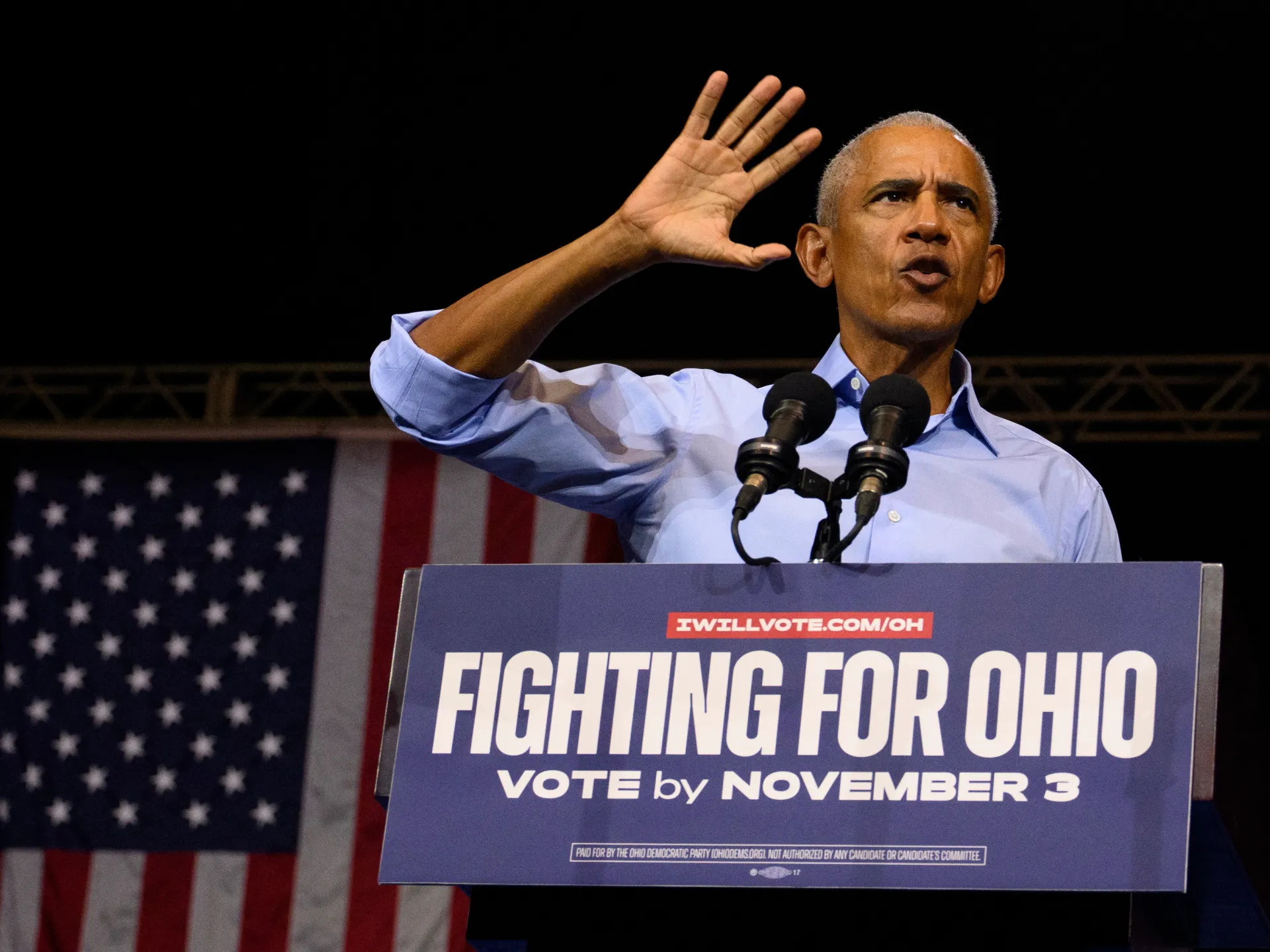
Former United States President Barack Obama has criticised the “cruelty and corruption” during President Donald Trump’s second term.
Obama slammed Trump’s foreign policies on Saturday during a midterm election campaign rally in Ohio to support the state’s Democratic candidates.
Recommended Stories
list of 3 itemsend of list
“The current president chose to make a series of bad decisions,” the 65-year-old Democrat said. “Most importantly, he decided to start an unnecessary war that nobody asked for,” he added, referring to the US-Israel war on Iran.
Obama urged Ohioans to vote against the Republican administration, saying: “After two years of chaos and cruelty and corruption and incompetence, the likes of which we have not seen in the modern era, you get a chance to say, ‘Enough is enough’.”
Heated Ohio races
The former president also addressed the recent controversy in Ohio’s gubernatorial race surrounding an attack advertisement by Republican candidate Vivek Ramaswamy against Democrat Amy Acton.
“In recent days, we’ve seen there is no line he will not cross, no low he will not sink to,” Obama said of Ramaswamy. “I don’t know what’s happened where the standards of behaviour are so low that somebody could run an ad like that.”
In the advertisement, Donna Arthur, Acton’s mother, disputes her daughter’s account of a childhood involving homelessness and sexual abuse by her stepfather, urging Ohioans not to vote for her.
Acton says she has not seen her mother since 1978. Acton’s brother has supported her account of being sexually abused by her stepfather when she was a child. The stepfather, who died in 2004, was charged with rape.
Obama backed Acton, saying that she has “spoken movingly about her painful childhood and all she’s experienced: abuse, neglect and homelessness.”
The former president shared the rally stage with Acton and Ohio’s former Democratic senator, Sherrod Brown, who will attempt a comeback against incumbent Republican Senator Jon Husted.
Polls give Democrats a slight lead in both Ohio races, but results are expected to be close.
Two years after United States voters delivered a stunning rebuke of the country’s Democratic Party by electing Republican President Donald Trump to a second nonconsecutive term, some of the party’s midterm candidates are reassessing stances on a host of hot-button issues.
Whether they have dialled it back on issues like transgender rights or ramped up efforts to oppose Israel’s genocidal war on Gaza, Democrats in some of the toughest midterm battleground races are responding to voter concerns – or even breaking outright with party leadership.
Those shifts have resonated with some voters, while others have been alienated as the party tries to find its footing in Trump’s second term and wrestle away control of both houses of Congress from Republicans.
But in the time since Trump defeated former Vice President Kamala Harris in 2024, Democratic divisions have only grown deeper. Establishment and self-described moderates within the party have struggled to hold back a rising tide of progressive populism as voters increasingly demand stronger, bolder policies.
That movement, powered by groups like the Democratic Socialists of America, has forced a reckoning over what it means to be a Democrat in Trump’s second term, leading to significant differences among candidates on policies that often depend on where they are running.
Here’s how – and why – the party has shifted:
Democrats’ shifting views on Israel
The most notable shift among Democrats has, arguably, been on Israel.
Three years after Israel launched its genocidal war in Gaza and killed more than 74,000 Palestinians following Hamas’s October 7, 2023, attacks, polls have suggested that Americans hold increasingly negative views on Israeli military actions.
A Pew Research Center survey conducted earlier this year suggested that 60 percent of US adults had an unfavourable opinion of Israel. That number is significantly higher – 80 percent – among US Democrats.
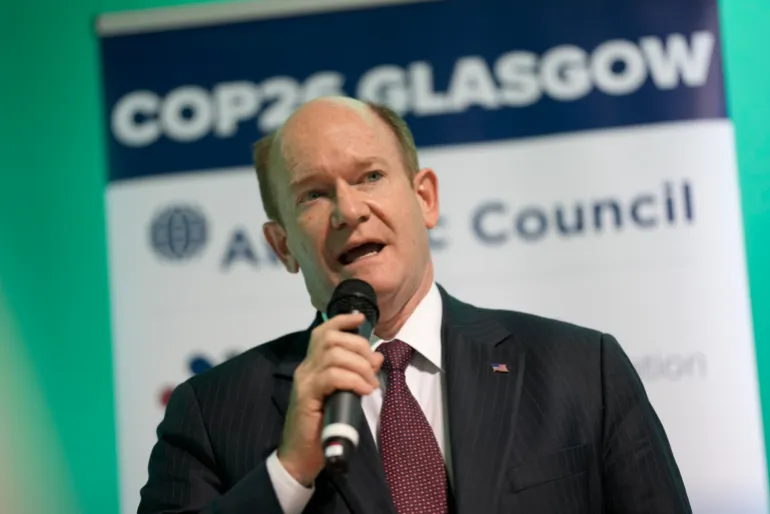
In response, some longtime Democratic supporters of Israel – including Senator Chris Coons, who is likely to chair the Senate Foreign Relations Committee if Democrats retake control of the Senate next month – have shifted, as voters, especially younger ones, demand greater accountability from the US ally.
US Democratic Senator Chris Coons of Delaware speaks at the COP26 UN Climate Summit in Glasgow, Scotland [Alastair Grant/AP Photo]
The moderate Delaware Democrat told Politico in an interview this month that he wants a “thorough reexamination” of the US-Israeli relationship and is even willing to impose sanctions on Israel’s prime minister, Benjamin Netanyahu.
It is a marked change in tone after Harris rejected calls to feature a Palestinian American speaker at the 2024 Democratic National Convention in Chicago.
Earlier this year, 40 Democratic senators voted in support of a motion that disapproved proposed military sales to Israel. Only seven Democratic senators voted with Republicans to block it.
But as a new Congress may include even more progressive voices demanding the US rethink its relationship with Israel, those calls would likely be met with stiff resistance from some in the Democratic leadership, including Senate Minority Leader Chuck Schumer.
The New York Democrat, who would likely become majority leader if Democrats retake the Senate, has said that the US “commitment to Israel’s security and defense must be ironclad”.
Have Democrats changed their positions on transgender rights?
Following years of attacks from Republicans, Democrats in tightly contested US House or Senate races have downplayed – or outright dismissed – support for the transgender community, mostly when it comes to the participation of transgender students in school sports.
In Ohio, Democratic Representative Marcy Kaptur ran an advertisement featuring her saying, “Boys should not play in girls’ sports”. And in North Carolina, Representative Don Davis released a television commercial in which the Democrat says there “should always be a safe and fair space for women and girls in sports”.
Next door in South Carolina, Democratic Senate candidate Annie Andrews, a doctor, said in a newly released advertisement that she opposes “biological men playing in women’s sports”.
Trump’s return to the White House was fuelled, in part, by a now-famous advertisement in the 2024 campaign that highlighted Harris’s support for transgender Americans.
“Kamala is for they/them,” a narrator said in the advertisement, referring to gender neutral pronouns used by some in the transgender and nonbinary community. “President Trump is for you.”
But the reassessment of transgender rights after the commercial’s airing is not taking place in every part of the party.
On Thursday at a “Students vs Billionaires” town hall in Portland, Maine, Representative Alexandria Ocasio-Cortez addressed concerns from a transgender college student who told the New York progressive that they felt “abandoned” by Democrats.
“They’re wrong”, Ocasio-Cortez said about some members of her party. “First and foremost, I want to just let you know how shameful and sorry I am that there are people out there that scare so easily after an election”.
The congresswoman added, “The moment you compromise the rights of a trans person in America, you compromise the rights of every citizen.”
What has changed on immigration and border security?
During former US President Joe Biden’s term, Democrats encountered near-daily attacks from Republicans on the country’s immigration system.
US Customs and Border Protection (CBP) recorded more than 8 million encounters at the US-Mexico border between 2021 and 2025, fuelling concerns among some voters that the Biden administration had ignored the issue.
In Texas’s closely watched Senate race, candidate James Talarico has positioned himself as a “border security Democrat”, advocating for stronger border enforcement and comprehensive immigration reform.
Third Way, a US-based organisation that pushes for moderate policies, said stances like Talarico’s resonate better with voters because they have taken a proactive, rather than a reactionary approach.
Democratic US Senate candidate James Talarico speaks at a campaign rally in Galveston, Texas, on Thursday [Mark Felix/AFP]
“I remember very clearly when Harris came out and spoke at the DNC in 2024; she… said we need order at the border and to have a strong immigration system”, Third Way’s senior political adviser, Lucas Holtz, told Al Jazeera.
“The problem is, after that, the Harris campaign really did not stick with that line in the sand… They stopped taking a stand on these issues, and more voters thought that she was too far to the left.”
“[Talarico] is making the case in a lot of his ads that the Biden administration failed on securing the border… It’s putting Republicans on their back foot in some of these races.”
But among progressives, Trump’s response to the nation’s immigration issue has also prompted a strong swing to the left.
After several high-profile incidents earlier this year – including federal immigration agents in Minneapolis, Minnesota, shooting dead US citizens Renee Good and Alex Pretti – calls to abolish, or drastically overhaul, US Immigration and Customs Enforcement (ICE) have gained momentum.
Left-leaning political groups and politicians have united behind a message of “abolish ICE”, which would dismantle the federal agency and end its enforcement authority.
Do Democrats support Medicare for All?
As cost-of-living issues remain paramount for voters, Democrats of all stripes have coalesced behind the need for more government intervention in the country’s healthcare system.
But how exactly the party addresses rising medical costs remains up for debate.
Some progressives, including Michigan Democratic Senate candidate Abdul El-Sayed, have championed policies like Medicare for All, which would expand the nation’s federal health insurance programme for seniors so all US citizens would be guaranteed healthcare.
US Senate Democratic candidate Abdul El-Sayed gestures to supporters during a campaign rally in Dearborn, Michigan [Rebecca Cook/Reuters]
Others running in more conservative states, like Andrews, have called for the return of Affordable Care Act subsidies that lapsed during Trump’s second term, as well as limits on health insurance companies’ profits.
Polling released by the independent health organisation KFF suggested that 66 percent of US adults now support Medicare for All, a 13-point increase from October 2020.
“Everybody’s going to have their own approach to this, but by and large, all Democrats want to move to a universal healthcare system in the best way possible”, Holtz said.
“We’re in agreement that we need to do better than what the Trump administration has done.”
Americans vote in the same elections, but the distance of a few streets or ZIP codes can drastically change a person’s opportunities in life.
From housing and healthcare to job opportunities, Al Jazeera’s Mohammad Qasem looks at what those inequalities reveal as Republicans and Democrats fight for control of Congress.
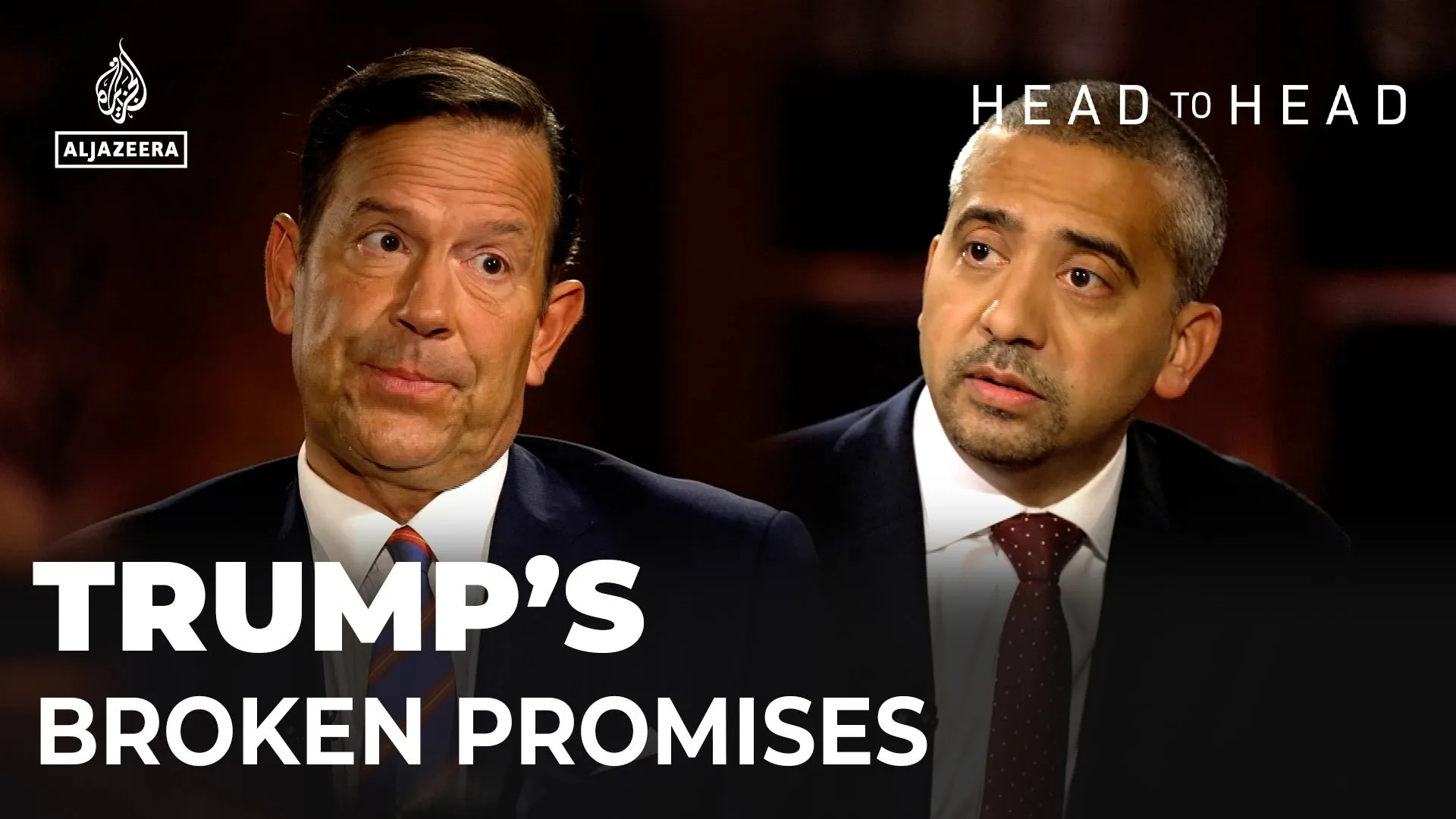
Mehdi Hasan debates ex-Trump adviser Steve Cortes on the economy, Trump’s immigration policies and Islamophobia.
With the US midterm elections approaching, the balance of power in Congress is at stake, and the outcome could shape the legacy of President Donald Trump’s second term. As Republicans face growing voter dissatisfaction, Trump’s record has become a central battleground in the fight to control Congress.
Trump faces mounting challenges, including low approval ratings, an unpopular war in Iran, high inflation and petrol prices, economic uncertainty surrounding his tariff policies, and widespread backlash over his immigration crackdown.
How does Trump’s second term measure up against the promises he made on the campaign trail?
In this interview, Mehdi Hasan goes head-to-head with Steve Cortes, a former Trump campaign adviser, who defends the president’s second-term agenda, including his economic and immigration policies, and Islamophobic rhetoric.
Joining the discussion:
Olivia Troye – Former homeland security and counterterrorism adviser to Vice President Mike Pence Mike Nellis – Democratic strategist and former senior adviser to Vice President Kamala Harris Rob Arlett – Former Trump campaign chair and political commentator
It didn’t take long for that narrative to start crumbling. A year after Trump’s reelection, Latinos in California helped pass Proposition 50, which allowed Democrats to redraw the state’s congressional map in their favor to counter a successful effort by Texas Republicans to do the same — coincidentally, the Texas gerrymander was at least partially motivated by said gains with Latino voters.
Latinos also helped Democrats pick up governorships in Virginia and New Jersey in 2025 — with two-thirds of their votes going for Abigail Spanberger and Mikie Sherrill, respectively.
Whatever gains Republicans made with Latino voters appear to have vanished. Recent polls show the demographic to be experiencing buyers’ remorse, citing the increased cost of living, the Trump administration’s heavy-handed immigration enforcement tactics, involvement in wars abroad and a stagnating economy as reasons for the disillusionment.
President Trump’s approval rating among Latinos dipped to 27% in an early October NBC News survey. That same poll found that Democrats have a 24-point lead on whom Latino voters want to see in control of Congress.
But don’t expect this whiplash back to the left to be permanent.
“Latinos are completely moving away from both parties and that’s what’s created this dramatic swing of 25 points towards Trump in four years and then massive swings back.”
So how will the Latino vote shake out in two weeks? Below are five races we are keeping tabs on.
L.A. mayoral race
You don’t need to go outside the city limits to find proof that Latino voters aren’t political ideologues.
Bass once again won the Latino vote during the 2026 primaries, carrying 35 Latino-majority neighborhoods in the June 2 election — compared with seven for her current challenger, Councilmember Nithya Raman.
Notably, 34% of Latinos remain undecided heading into the Nov. 3 election.
“Latinos are about a third of the voters in L.A.,” Fernando Guerra, a professor of political science and Chicana/o studies at Loyola Marymount University, told The Times this month. “While they show preferences, they are not deeply committed to either candidate, so they are the quintessential swing voters who decide late.”
Will the embattled incumbent keep her job, or will Los Angeles become the next big city to elect a mayor backed by the Democratic Socialists of America? Latino Angelenos will decide.
California 22nd district
Will Democrats’ Proposition 50 redistricting gambit pay off? Voters of this newly reconfigured Central Valley district populated by blue-collar and agrarian Latinos will decide.
Republican David Valadao is the incumbent and is being challenged by activist and educator Randy Villegas. In 2024, voters in the district backed failed Republican Senate candidate Steve Garvey.
Political forecasts have Villegas — a progressive populist — with a narrow lead over the incumbent.
Part of his appeal, Madrid said, was his messaging.
“[His message is] the establishment’s not working and that institutions aren’t working,” Madrid said. “It’s a much more populist message. I don’t believe this is ideological one bit.”
Colorado 8th district
It doesn’t get more battleground than this congressional district located in the Denver suburbs. It is the center of Latino voting power in Colorado — Latinos account for 40% of the total electorate. .
The incumbent is Republican Gabe Evans and Trump carried the purple district by less than two percentage points.
Evans currently has a slight lead over Democratic candidate Manny Rutinel, an attorney and economist. Rutinel’s messaging has focused on the rising cost of living and the Republicans’ immigration policies.
It could get him elected. A local survey found that 56% of Latino voters in Colorado approve of Democrats in Congress, while 39% said they do not approve.
Florida 27th district
Will disassociating from Trump help this Republican incumbent keep her job?
Journalist-turned-Congress member María Elvira Salazar, a Cuban American, made headlines in September after releasing a political ad calling out the president’s immigration enforcement, alleging that Trump, who carried the majority Latino district by 15 points in 2024, had betrayed her constituents.
Elvira Salazar currently holds a narrow lead over her Democratic rival Elliott Rodriguez, who is also Cuban American.
“She’s trying to show distance and trying to show an independent streak,” Madrid said of the three-term incumbent. “She’s trying to say, ‘I’m not that.’ And you can’t do that on the economy as a Republican, because that changes all the time. What you can do as a Latino in a Latino district … is say your policies have gone too far.”
Texas
Okay, I’ll admit that I’m cheating with this one. But there’s just so much going on in Texas that it deserves its own section. The Lone Star State is ground zero for this supposed great political de-alignment.
In 2025, at the behest of Trump, Texas Republicans undertook an unprecedented mid-decade congressional redistricting in hopes of gerrymandering a map that would give the party an advantage in the 2026 midterm elections. They factored in the historic gains with Latino voters.
“They drew those districts based on what they thought were the 2024 numbers,” said Matt Barreto, a professor of political science and Chicana/o & Central American studies at UCLA. “And now those 2024 numbers are evaporating.”
The plan appears to be backfiring spectacularly, at least in south Texas.
Trump won Texas’ 15th congressional district in 2020 and 2024, and in 2022 the majority Latino electorate voted for Republican Monica De La Cruz. But polls now show that Democratic candidate and singer-turned-politician Bobby Pulido has a seven-point lead. Pulido, who bills himself as a moderate, has focused his messaging on affordability and the rising cost of living.
A similar situation is taking place in the Latino-dense 34th and 35th districts, where Republicans Eric Flores and Carlos De La Cruz, respectively, are hoping to take advantage of the redrawn Republican-friendly boundaries to flip those seats red. Both face uphill battles as polls show them neck-and-neck with their Democratic opponents.
“You now have these two districts, Texas 9th and 35th, that are 51% Latino, but now Latinos are telling us they have lost confidence in the Republican Party,” Barreto said. “What we’re seeing is very strong evidence that Latinos are shifting back even more so against Trump and Republicans because they did not deliver on any of their promises from 2024.”
In the statewide Senate and gubernatorial races, Democrats are feeling hopeful. Democratic challenger James Talarico currently has a slight lead on his Republican opponent Ken Paxton. Among Latinos, that lead was clocked at a whopping 30 points in an October Fox News survey.
But what has been Talarico’s key to connecting with Latino voters?
“He’s turning away from race and ethnic-based politics to class consciousness,” Madrid said. “[He’s acknowledged] that Latinos have had their futures taken away from them.”
The seminary student and educator has also been critical of his own party — calling it out for ineptitude, leaving voters behind — and arguing that anti-establishment messaging is enticing to Latinos who have been spurned by both major parties.
If Texas gets its first Democratic senator since 1993, it’ll be thanks to the Latino vote.
Texas Latinos’ faith in the ruling party is so low that even the state’s governor, Republican powerhouse Greg Abbott, finds himself in a tight race with Democratic challenger Gina Hinojosa. Roughly 56% of Latinos were in favor of Hinojosa over the incumbent, an October poll found.
“Latinos are the only voters voting rationally in a broken system,” Madrid said. “We’re shifting by 25 points. If you don’t pay attention to our priority issues, we’ll vote you out, that’s how the system was designed.”
Latinos appear to be swinging back to the left, but Democrats shouldn’t take those gains for granted, Madrid said.
“The Democratic Party has done nothing to win these voters back. They’re just not Republicans,” Madrid said. “And for the moment, that’s good enough.”
(Jackie Rivera / For The Times; Martina Ibáñez-Baldor / Los Angeles Times)
Join De Los for a Día de Muertos event at Hollywood Forever
Dia de los Muertos at Hollywood Forever
(Diana Ramirez / De Los)
This Saturday, join De Los at Hollywood Forever Cemetery to celebrate Día de Muertos. We’ll have an altar set up from noon to 8 p.m. where visitors can write ofrendas that will be displayed throughout the event.
There will also be a photo booth run by Las Fotos Project on site from 2 to 6 p.m.
This is an all-ages event and will feature performances by música Mexicana act DannyLux, soul singer Trish Toledo, psychedelic cumbia group Tropa Magica and indie rock band Los Shadows.
Registration and event information can be found here.
Lawyers for two accused officials say Department of Justice seeking to revive scandal before midterm vote.
Published On 23 Oct 202623 Oct 2026
Two former Federal Bureau of Investigation (FBI) agents have been charged in connection with a 2020 probe into a laptop belonging to former President Joe Biden’s son, Hunter Biden.
The former officials, Nikki Floris and Bradley Benavides, were charged with lying to Congress. They made their first court appearance in Washington, DC, on Friday.
Recommended Stories
list of 3 itemsend of list
Lawyers for the officials accused the Department of Justice of filing the charges to revive the salacious saga just days before the November 3 midterm vote, in which Republicans face an uphill battle against Democrats to maintain control of Congress.
A lawyer for Floris said she “served our nation as a dedicated FBI intelligence officer for nearly 20 years”, while accusing the Justice Department of building its case on hearsay.
“Yet today, the DOJ [Justice Department] has accused her falsely of a crime on the say-so of politicians, not on the facts,” the statement said.
“It’s no coincidence the government is filing these nonsense charges now, years later, on the eve of an election.”
Floris and Benavides had overseen the Foreign Intelligence Task Force (FITF) at the FBI when Hunter Biden’s laptop was found. The pair testified to Congress that the unit, which focuses on foreign interference in US elections, was not involved in the laptop investigation.
In a criminal complaint, federal prosecutors alleged the statements contradicted messages sent during the same period.
While launched by Trump during his first term, the FITF was heavily targeted by Republicans under former US President Joe Biden. They charged the unit was politically biased and used to cover up information about Biden’s laptop.
The unit was disbanded when Trump took office for the second time in January 2025.
Scandalous saga
The existence of the laptop became known in October of 2020, just weeks before Biden and Trump faced off in a presidential election.
Its strange origins, having been dropped off at a Delaware computer repair shop and apparently abandoned by Hunter Biden, prompted suspicion. Its contents were first reported on by the New York Post, based on information provided to Trump lawyer Rudy Giuliani.
Several former intelligence officials warned that the laptop had the hallmarks of a Russian disinformation campaign. However, the FBI later seized and verified that the laptop and its contents, including messages related to the younger Biden’s foreign business ties and explicit photos of his drug use, were authentic.
The laptop was later used to back federal gun and tax evasion charges against Hunter Biden, although no wrongdoing related to his business ties or connection with his father was found.
Trump FBI Director Kash Patel has pledged to investigate the agency’s conduct throughout Biden’s presidency. Critics have accused him of flagrant politicalisation.
“Lying to Congress by senior FBI officials strikes at the heart of our system. No one is above the law,” Patel said in a statement posted on X.
The Justice Department has historically sought to avoid public and overt investigative acts in the direct lead-up to an election that involve candidates or that risk influencing an outcome.
But officials in the last two weeks have made a series of bold moves in cases with political undertones, including a search of Democratic Representative Ilhan Omar’s house in an immigration fraud investigation.
The department also unsealed a corruption indictment on Thursday against powerful Democratic Virginia state Senator L Louise Lucas.
Trump advises the Republican gubernatorial candidate to keep running the controversial advertisement.
Published On 23 Oct 202623 Oct 2026
US President Donald Trump has backed Republican Vivek Ramaswamy amid controversy over an attack advertisement by the Ohio gubernatorial candidate against his Democratic rival.
Trump said in a social media post on Thursday that Ramaswamy should keep running the advertisement that features Democratic candidate Amy Acton’s estranged mother.
Recommended Stories
list of 3 itemsend of list
In the advertisement, Donna Arthur, Acton’s mother, disputes her daughter’s account of a childhood involving homelessness and sexual abuse by her stepfather, urging Ohioans not to vote for her.
Acton says she has not seen her mother since 1978. Acton’s brother has supported her account of being sexually abused by her stepfather when she was a child. The stepfather, who died in 2004, was charged with rape.
“Anybody whose mother spoke about a daughter in that way would normally lead to the daughter being precluded from serving in office,” Trump said.
The US president also attacked Republican Ohio Governor Mike DeWine, who advised Ramaswamy to take down the advertisement, labelling him “disloyal” to the Republican party.
‘It’s wrong’
At a gathering with reporters at the Ohio Statehouse, DeWine recalled the painful experiences of rape victims he dealt with as a county prosecutor and state attorney general.
“It’s wrong to run this ad,” he said. “And, even at this late time – my wife, Fran, saw the advertisement just run this morning on TV – I would just urge the Ramaswamy campaign to take this down.”
Acton’s brother, Philip Stearns, called the advertisement a “desperate, disgusting attack”, while Acton campaign spokesperson Addie Bullock called Ramaswamy’s decision to promote it “both despicable and entirely predictable”.
Vice President JD Vance, campaigning on Wednesday with Ramaswamy and US Senator Jon Husted, an Ohio Republican, had brushed aside the blowback.
Vance, a former senator from Ohio, expressed disgust with Republicans “whining” about the advertisement as low and in poor taste.
Ramaswamy’s campaign said it was spending $4m to promote the advertisement.
Opinion polls suggest Acton is narrowly leading Ramaswamy in a tight race to replace the term-limited DeWine.
Homeland Security targets nine states in a push to identify voting fraud, a move critics denounce as tantamount to voter intimidation.
Published On 22 Oct 202622 Oct 2026
A United States federal judge has ordered the Department of Homeland Security (DHS) to halt operations aimed at finding non-citizen voters in nine states ahead of the midterm elections.
The ruling by US District Court Judge Araceli Martinez-Olguin said the investigations likely violate a provision of the Voting Rights Act that prohibits voter intimidation. She further said the DHS may have relied on flawed data in its investigations.
Recommended Stories
list of 3 itemsend of list
That leads to “an objectively reasonable fear of law enforcement entanglements that intimidates citizens from urging or aiding others in exercising their right to vote”, she wrote.
The order applies to federal efforts targeting California, Connecticut, Georgia, Missouri, Nevada, New York, Pennsylvania, Washington and Wisconsin.
The DHS has publicised what it has described as a push to identify individuals who have committed voter fraud, with some local offices posting photos of agents knocking on the doors of suspects.
The operations come as the administration of US President Donald Trump has sought to highlight instances of voter fraud ahead of the November 3 midterm vote.
While there are recorded instances of fraud in every election cycle, such isolated cases remain exceedingly rare.
There has been no evidence to indicate that non-citizen voters have influenced the outcome of any election at any level in the country.
In a statement following Thursday’s ruling, the DHS maintained that its investigations were aimed at “removing aliens who vote and dilute the votes of US citizens”.
“We have no plans to question or investigate people we believe to be US citizens,” it said.
In their lawsuit challenging the DHS’s efforts, the California Nurses Association and National Nurses United, along with the Voto Latino Foundation, San Francisco and Santa Clara County, said that some US citizens felt they were wrongly identified and questioned as part of the investigations.
A lawyer representing the groups said it was “clear from the start that DHS built its lists on bad data, never checked how often it was wrong, and recklessly sent agents to people’s homes weeks before an election”.
Benjamin Farley, the supervisory counsel for democracy defense at the National Immigration Law Center, said the ruling sent a strong message about voter intimidation ahead of the midterm vote.
“Yesterday’s decision is a clear rebuke of the government’s efforts to scare voters away from the polls this November and a reminder that all US citizens – regardless of color, place of birth, or the nationality of their family members – have the right to participate in American elections free of intimidation,” he said.
“No armed federal agent is going to stop us from casting our vote.”
Neil Bush says that he will vote for Democrat James Talarico due to reservations about Republican candidate Ken Paxton.
Published On 22 Oct 202622 Oct 2026
Neil Bush, brother of former Republican President George W Bush, has said that he voted for the Democratic candidate James Talarico in a crucial race for the United States Senate.
In a social media post on Tuesday, Bush said he voted for Talarico due to concerns about the Republican candidate, Texas Attorney General Ken Paxton.
Recommended Stories
list of 3 itemsend of list
Talarico and Paxton are in a tight race for Texas’s open Senate seat. Democrats are hoping to seize control of the 100-member Senate in the November 3 midterm elections, when 35 seats will be on the ballot.
Bush’s endorsement of Talarico is the latest sign of division among Texas Republicans.
Bush comes from a prominent Republican family: not only was his brother a president, but his father, the late George HW Bush, was too.
“My concerns about his judgment and conduct are hardly mine alone,” Bush wrote. “He was impeached by the Republican-controlled Texas House, although subsequently acquitted by the Texas Senate.”
To explain his decision, Bush pointed to Paxton’s divisive track record, including efforts to support President Donald Trump’s false claims about the 2020 presidential election.
“I have been deeply troubled by Paxton’s conduct as Texas Attorney General, particularly his decision to challenge the results of the 2020 presidential election in other states in an effort to help Donald Trump remain in power,” Bush said.
“I believe that effort was an affront to our democratic institutions and the peaceful transfer of power.”
His brother, the former president, has largely receded from political life and has declined to endorse candidates in recent elections. Before serving in the White House from 2001 to 2009, George W Bush was governor of Texas.
But George W Bush’s daughter Barbara Bush has also shown her support for Talarico by donating to a political action committee backing his campaign.
Texas has long been considered a Republican stronghold, and Democrats have not won a Senate race in the state since 1988.
But polls show Talarico locked in a close race with Paxton, who defeated incumbent Senator John Cornyn in the Republican Party’s primary run-off on May 26.
In a statement, Trump criticised Cornyn as “not supportive of [him] when times were tough”, while praising Paxton as a “MAGA Warrior”.
Some Republicans have expressed frustration over Trump’s intervention on Paxton’s behalf, given the vulnerabilities posed by his state impeachment and other scandals.
A Marist poll released on October 14 found Talarico winning 47 percent of the vote compared to 45 percent for Paxton.
WASHINGTON — President Trump’s latest embrace of Russian President Vladimir Putin is deepening alarm in Washington and among America’s allies that the White House pressure campaign could leave Ukraine vulnerable as Moscow advances.
Trump’s push to end the war, which has raged since 2022, comes on the cusp of a midterm election that could give Democrats partial or full control of Congress, expanding their oversight powers, and as polls show more than two-thirds of Americans disapprove of the president’s handling of foreign policy and support Kyiv’s fight against Russian aggression.
On Monday, Trump dismissed Russia’s ongoing assault on its neighbor, telling reporters that “they haven’t been doing much,” even as Russian forces bombed a park in Kharkiv that day, killing a mother and her 14-month-old child in her stroller.
Two days later, in St. Petersburg, Trump’s special envoy, Steve Witkoff, described Putin as a “humanitarian,” despite his invasion unleashing Europe’s deadliest conflict since World War II.
“You talk so much about my president, President Trump, being a humanitarian. You are a humanitarian also, sir,” Witkoff said after securing the release of a detained U.S. citizen from the Kremlin. At least two other Americans, both from Los Angeles, remain wrongfully detained by Russia. “I salute you, and I commend you,” he added.
Rep. Don Bacon (R-Neb.) described Witkoff’s remarks as “another embarrassment” after a steady stream of entreaties to Moscow from the Trump administration.
The diplomatic push follows Trump’s decision two weeks ago to import Russian diesel, a move that could bolster Moscow’s war effort and violate U.S. law. Days later, after Ukrainian President Volodymyr Zelensky publicly condemned the move, Trump ally Elon Musk reportedly throttled the speed of Starshield, a military-grade satellite internet service from Starlink that Kyiv relies on to defend itself against Russian attacks.
The Trump administration failed to provide Kyiv with intelligence warnings of incoming ballistic missile strikes, blaming the weather. The president waived sanctions on Russia that were passed just months earlier with overwhelming bipartisan support in the aftermath of the death of Sen. Lindsey Graham, a Trump ally and Ukraine supporter. And Trump declined to approve the transfer of interceptor missiles to Ukraine — more defensive weaponry used to protect the country from Russian strikes that have increasingly targeted civilian areas.
The developments have raised fresh questions over whether Trump has exceeded his legal authority in reshaping U.S. policy on Ukraine.
Russian diesel imports could violate a 2022 federal ban, the Ending Importation of Russian Oil Act, and throttling Starshield, withholding intelligence and delaying missile transfers could breach contractual or statutory obligations set forth by Congress — all potential subjects of investigation for a willing Congress.
And Trump’s push comes at a moment of political peril, as he faces the prospect of a Democratic-led legislature and a Republican Party ready to move beyond his lame-duck presidency.
But freedom from political obligation could also allow Trump to pursue his agenda without the needs for coalitions or popular support.
The prospect of an unchecked Trump has stoked fears on Capitol Hill that the White House could abandon Kyiv altogether.
Nine senators from both parties have asked the Pentagon’s inspector general to investigate the Starlink episode, while lawmakers across the aisle have condemned the speed restrictions. And should they take power after the midterms, Democrats are also weighing whether to make Defense Secretary Pete Hegseth’s resignation a condition of further defense funding, citing his criticism of Ukraine, according to a report in the newspaper the Hill.
“Congress will unequivocally reaffirm that Ukraine is an indispensable ally to the United States, that Russia is a self-declared enemy of the United States, and that the United States will 100% support and defend the people of Ukraine in their fight for their own freedom against this brutal, illegal, and unprovoked Russian invasion,” said Rep. Brian Fitzpatrick (R-Pa.).
“The United States must provide any and all defensive equipment that Ukraine needs to defend itself,” Fitzpatrick added. “Anyone who attempts to limit the use of Starshield for Ukraine will be fully investigated and will be held fully accountable, to include public congressional oversight hearings.”
Marco Rubio, the president’s secretary of State and national security advisor, was initially silent on Trump’s moves. But he ultimately defended them when confronted by reporters on a recent visit to Central Asia.
“We’re no longer going to be defensive about this topic,” Rubio said. “If it were not for the assistance of the United States, including under the Trump administration, there would be no Ukraine right now. Ukraine, as a sovereign state, would not exist.”
Still, Rep. Michael R. Turner (R-Ohio), a former chair of the House Intelligence Committee, said Sunday that Rubio’s explanation of Ukraine’s loss of Starlink access was “absolutely not” sufficient.
“This is something where there needs to be an investigation, there needs to be a congressional investigation,” Turner told CBS. “Lives are at risk, and lives are lost over these things.”
Trump has told reporters in recent days that his goal remains to secure a peace deal that ends the world’s deadliest conflict since World War II. But Mitt Romney, a former GOP senator from Utah and the Republican presidential nominee in 2012, dismissed Trump’s arguments as a break from U.S. values.
“Churchill could have shortened WW2 by years if he had just ‘done a deal’ with Hitler,” Romney wrote on social media. “George Washington could have done a deal to end the American Revolution.”
Zelensky “is in good company,” he added.
Europe, too, is preparing for a new confrontation with the Trump administration over the defense of Ukraine.
Germany’s chancellor rejected Trump’s approach, saying of Europe, “We are the firewall.” And the European diplomatic service responded with derision to Trump’s waiver of sanctions.
“When Russia escalates aggression against Ukraine,” the European Union’s diplomatic service said in a statement, “Europe responds with more pressure on the aggressor.”
Trump has floated a trilateral summit with Putin and Chinese President Xi Jinping in Shenzhen, China, next month, fueling European fears that he could strike a deal on Ukraine without Kyiv at the table.
The Russians and Ukrainians agreed this week in principle to begin peace talks at a technical level moderated by the United States. No timeline or framework has been set for the talks.
In an interview on Fox News, Zelensky said that he was prepared to agree to a peace deal that froze the existing battle lines, ceding nearly a quarter of Ukrainian land to Russian control. Over the last year, Russia has demanded that Kyiv also relinquish land in the Donbas region that it has failed to conquer through military means.
“Right now, we have to freeze. And I think this is a real way to end this war. We call this ceasefire,” Zelensky said. “This is minimum what we need from Russia today.”
“The most important is peace, and secure peace,” he added, “not to be afraid that occupation will come back, aggression will come back, killing will come back.”
What role will the Latino vote have in the upcoming midterm elections?
In the latest episode of “The De Los Podcast,” hosts and Times editors Fidel Martinez and Suzy Exposito welcome Times columnist Gustavo Arellano to dissect the increasingly important electorate, one that will help decide races locally and at the national level.
Long considered a reliable vote for the Democratic Party, Latinos shifted rightward in 2024.
“The Republican Party has always known — going back to the days of [President Dwight D.] Eisenhower — that there is something there in this demographic as it starts getting bigger,” Arellano said.
Arellano documented the history of Democratic support among California Latinos, highlighting the passage of 1994’s California Proposition 187 — which prohibited undocumented immigrants from using the state’s public services including non-emergency healthcare and education resources — as a turning point.
“It turned a whole generation of Latinos into voting Democrat, but it also showed the Republican Party that anti-immigrant politics work,” he said. “The problem with the Democratic Party in California for basically the next 30 years is all they would do is say, ‘You as a Latino should never vote Republican because they did 187.’”
A Pew Research Center study showed that in the 2024 presidential election, a slight majority of Latinos voted for former Vice President Kamala Harris — but they also voted for President Trump at a much higher rate than they did in 2020.
Trump garnered 48% of the Latino vote compared with Harris’ 51% share and significantly jumped past the 36% clip he received in the 2020 presidential election. The study’s results reveal that the initial 2024 exit polls actually underestimated Latinos’ Trump support, with the Republican candidate tracking at 46% of the Latino vote on election day.
Arellano contributed this shift in voting pattern to a lack of effective messaging from Democrats and widespread material hardships among Latinos.
“[You now have] an entire generation who have grown up and life has been harder for them because they are working-class folks,” he said. “And they’re saying, ‘The Republicans are racist? Well, life hasn’t improved for me as a Democrat, let me just take my chance with the racist.’”
But recent polling shows Latinos might have buyers’ remorse. The community cited increased cost of living, immigration tactics, involvement in wars across the world and a struggling economy as reasons for retreating from Republican leadership. Trump’s approval rating among Latinos dipped to 27% in an early October NBC News study. That same poll found that Democrats have a 24-point lead on whom Latino voters want to see in control of Congress.
“The Republican Party was given this extraordinary gift of the Latino vote, and what did they do? They blew it,” Arellano said.
He spotlighted Texas as a prime of example of how Republicans squandered their grip on Latino voters. The demographic voted heavily in favor of Trump in 2024, even in the long-Democratic borderland region of the state.
“Texas [Republicans] gerrymandered their state because they thought, “We have now this permanent Latino shift to our party, so let’s make these districts even more Latino because they’re going to vote Republican,’” Arellano said. “And now Latinos are running away [from the Republican Party] hard.”
Across the country, Latinos have also soured on the Republican Party due to the public display that Immigration and Customs Enforcement officers have put on in recent years, Arellano noted.
“To see people dragged and beaten … that weighs on you,” he said. “On top of that, the economy sucks, we’re in a stupid war, this president is increasingly saying crazy things … and now this immigration stuff. So [people are wondering] what good is it to be with [Trump] now.”
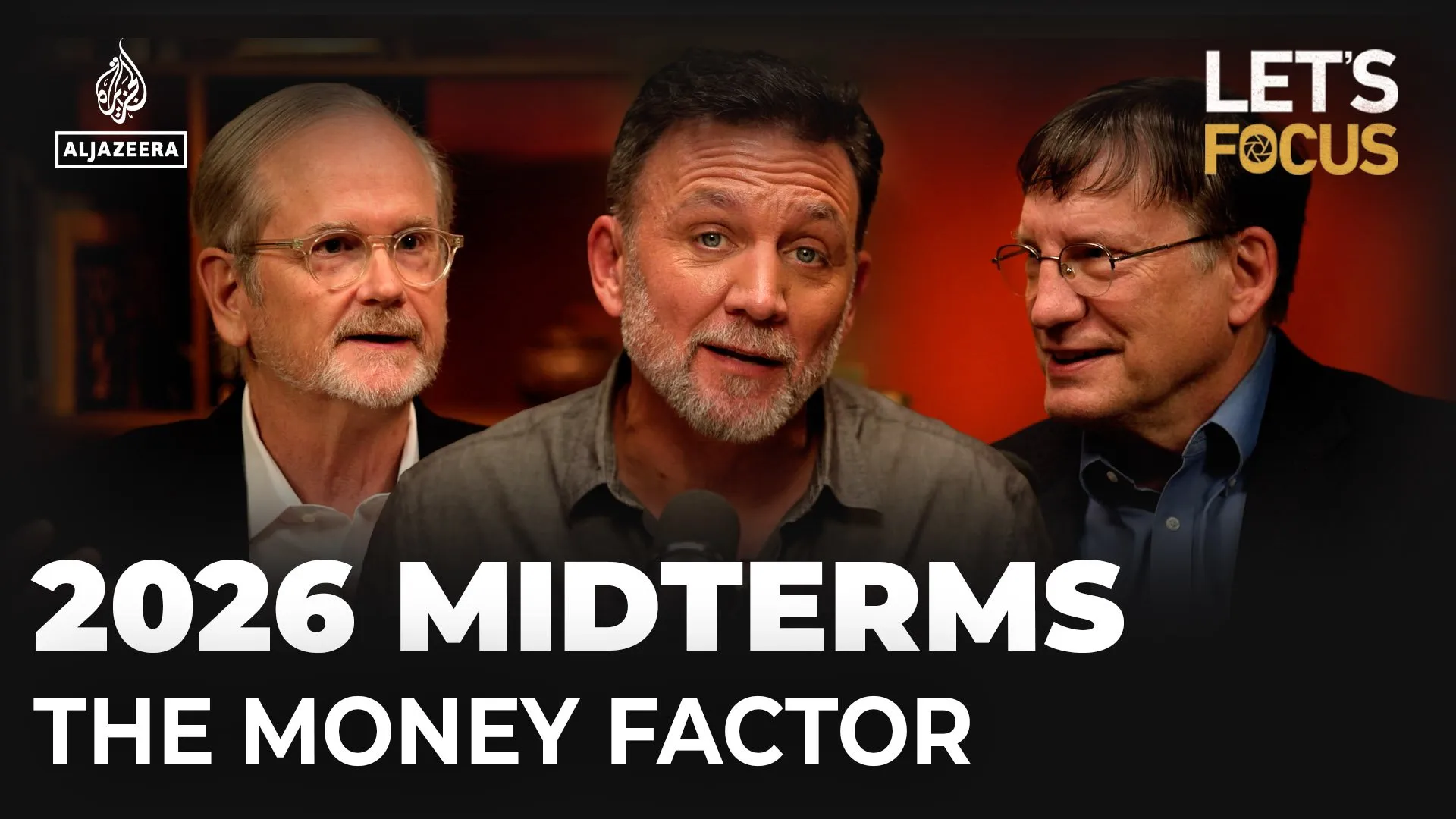
Who pays for US elections and what do they get? Josh Rushing asks Lawrence Lessig and Bradley Smith.
The 2026 midterm elections are on track to be the most expensive in the history of the United States, with a record $11.6bn in political advertisements alone. Independent expenditure-only political action committees, or super PACs, dark money and billionaire donors now shape who runs and who wins, yet voters of both parties say money has too much power.
Josh Rushing asks two leading experts who is paying, what they are buying and whether the system can change.
Contributors: Lawrence Lessig – Professor of law and leadership, Harvard Law School Bradley Smith – Professor of law, Capital University
Vice President JD Vance declined Monday to endorse Israeli Prime Minister Benjamin Netanyahu for reelection a day after President Trump endorsed the embattled Israeli leader.
“The president has the most influential endorsement in American or international political history,” Vance said during an interview with journalist Mark Halperin.
“I endorse American candidates, and that’s where I’m focused on the midterms,” Vance said, while traveling Monday to campaign for Republican Senate nominee Michael Whatley of North Carolina. “So, I’m not getting involved in Israeli elections.”
Vance has campaigned for a foreign leader — then-Hungarian Prime Minister Viktor Orban, last spring before the right-wing leader’s party lost that country’s parliamentary election.
Vance’s deference to Trump on Netanyahu comes at an extraordinarily sensitive time for Jewish Americans and the U.S. alliance with Israel. Concerns about antisemitism have surged across the political spectrum ahead of the midterm elections.
Republicans have been eager to portray Democrats, notably Michigan Democratic Senate nominee Abdul El-Sayed, as hostile toward Jews and Israel, while they deal with their own internal schisms.
Vance has faced skepticism from Jewish Republicans about his commitment to Jewish Americans and the U.S. alliance with Israel.
Last month, Vance spoke privately in Las Vegas to the Republican Jewish Coalition, a leading GOP group committed to advocating for a strong U.S. relationship with Israel and against antisemitism.
Vance left a positive impression on his RJC audience while stopping short of disavowing influential conservative podcast host Tucker Carlson.
Vance has faced general questions about his association with Carlson, a former Fox News host who faced backlash last year for interviewing antisemite Nick Fuentes on his podcast.
In June, Vance sharply criticized members of Israel’s government for opposing Trump’s efforts to resolve the war with Iran.
In July, Vance said elements of the Israeli government had tried to influence American sentiment to derail negotiations.
“There are some people within their system that we know beyond a shadow of a doubt are manipulating and trying to change American public opinion to keep the war going on indefinitely,” Vance said during an appearance on Joe Rogan’s podcast.