Middle

‘United States of the Middle East?’: Trump posts US flag covering Iran | US-Israel war on Iran News

Latest Truth Social post comes amid ‘delicate diplomacy’, expert says, as US and Iran indicate progress in talks.

Washington, DC – President Donald Trump has posted a photo of the United States flag covering the map of Iran, with the question: “United States of the Middle East?”

The post on Truth Social on Saturday represented another potentially incendiary message from Trump amid ongoing negotiations for a more lasting ceasefire in the US-Israeli war with Iran, experts said.

Recommended Stories

list of 3 itemsend of list

It carries the potential to roil both regional allies and foes alike given Washington’s past intervention in the Middle East, most notably during the US invasion of Iraq from 2003 to 2011, as well as the Trump administration’s push to increase its influence abroad.

The sentiment also appears to run counter to the Trump administration’s repeated statements that it is not seeking a prolonged occupation of Iran. The US has maintained it is not seeking outright regime change in its war, which it launched alongside Israel on February 28, but that it would welcome such change as a byproduct of the military campaign.

Even for a president known for outlandish social media posts and conflicting messaging on the war, the post could have implications for ongoing negotiations aimed at a more lasting ceasefire, according to Vali Nasr, professor of international affairs and Middle East studies at Johns Hopkins University.

He pointed to Trump’s threat in early April that an “entire civilisation will die” if Iran did not agree to a deal at the time. Hours later, both sides agreed to a pause in fighting.

That pause has held since, save for a handful of flare-ups, with the US continuing to blockade Iranian ports and Tehran effectively closing the Strait of Hormuz.

“First he declared he wanted to eradicate Iran’s civilisation now he is declaring that he wants to turn Iran into an American property,” Nasr wrote on X.

“It is this kind of grotesque behaviour that undermines diplomacy and unites Iranians in defence of their country,” he added. “In the middle of delicate diplomacy he casts doubts on America’s true intentions.”

The White House did not immediately respond to a request for comment.

Fragile negotiations continue

On Saturday, both US and Iranian officials indicated a new deal may be within reach.

Trump told CBS News both sides were “getting a lot closer”. US Secretary of State Marco Rubio said an update could be coming shortly, the broadcaster reported.

Iranian Foreign Ministry spokesperson Esmaeil Baghaei said the two sides were “currently working to finalise” a memorandum of understanding, and that “the opinions have been converging”.

Still, there have been no official announcements related to key sticking points in the standoff, including the future of Iran’s nuclear programme, the fate of its highly enriched uranium stockpile, and its future influence over the Strait of Hormuz.

Trump regularly uses his Truth Social account, which he launched after being briefly banned from Twitter, now X, in the wake of the 2020 election, to make major announcements, attack political enemies, and post AI-generated images and videos.

The foreign policy of his second term has been defined by efforts to grow US influence abroad, particularly in the Americas. That has included the military abduction of Venezuelan leader Nicolas Maduro, continued threats against Cuba, and vows to take control of Greenland, the semi-autonomous Danish territory in the North Atlantic.

The Trump administration has adopted the term the Donroe Doctrine, a reference to the 1823 Monroe Doctrine, which sought to diminish European influence in the Western Hemisphere.

On Saturday, Trump also posted an image of his face peering over a mountain range in Greenland.

“Hello, Greenland!” it said.

Source link

A-10 Warthog’s New Aerial Refueling Probe Is Now Operational In The Middle East

Recently published imagery confirms that the A-10C attack jet is now operating in the Middle East with its new refueling probe fitted, something that has been achieved remarkably fast. As we reported at the time, the Warthog’s probe-type aerial refueling capability was first demonstrated in early April, and the adaptation comes as the jet cruises into the twilight of its career after it got a small reprieve from final retirement.

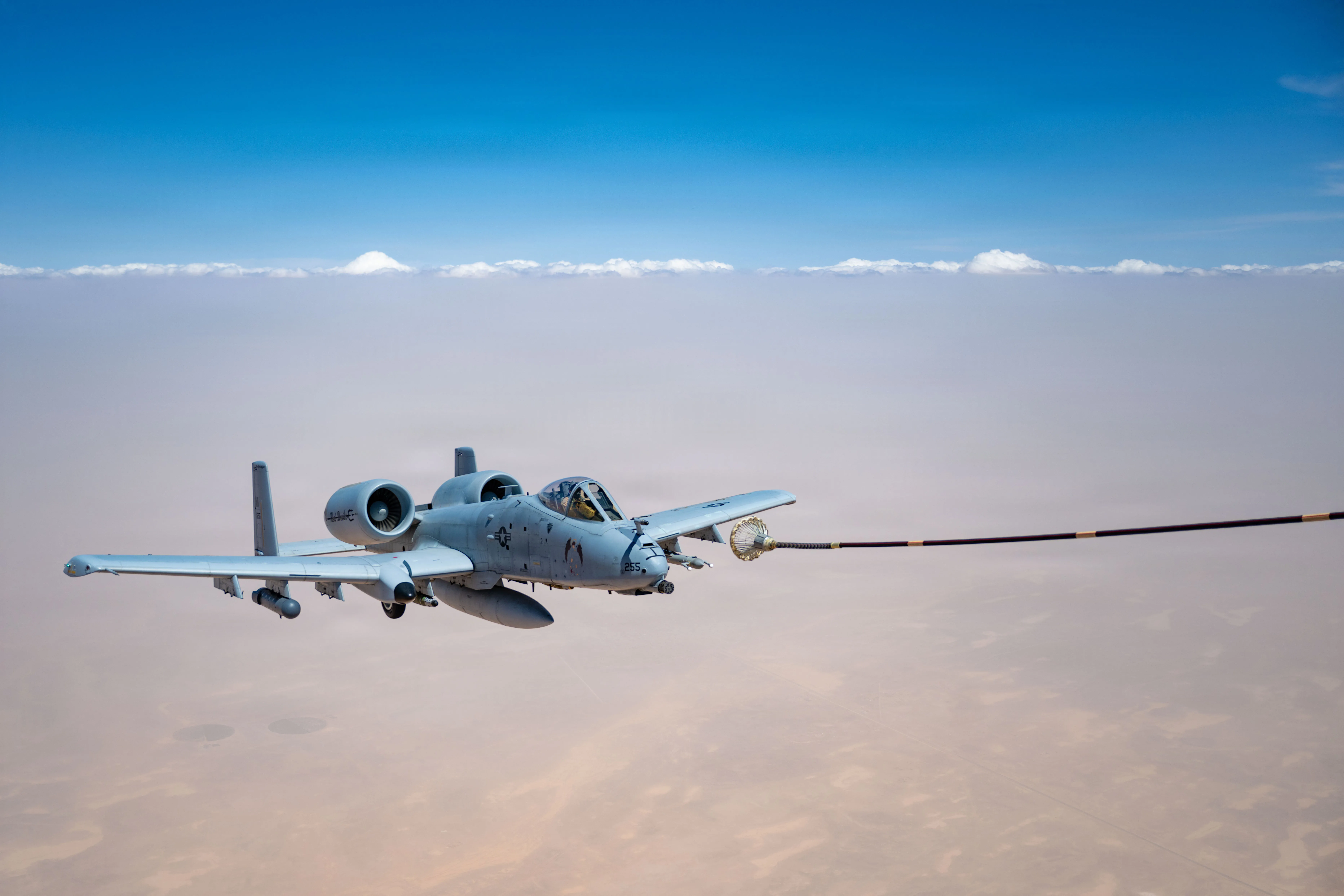
The U.S. Air Force has released images showing an A-10C using its Probe Refueling Adapter to take on fuel from an HC-130J Combat King II earlier this month, somewhere in the U.S. Central Command (CENTCOM) area of responsibility. The Warthogs in question belong to the 107th Fighter Squadron from Selfridge Air National Guard Base, Michigan, which deployed to the Middle East in early April.

A U.S. Air Force A-10C Thunderbolt II aircraft approaches an HC-130J Combat King II aircraft for aerial refueling in the U.S. Central Command area of responsibility, May 9, 2026. (U.S. Air Force photo)
A U.S. Air Force A-10C Thunderbolt II aircraft approaches an HC-130J Combat King II aircraft for aerial refueling in the U.S. Central Command area of responsibility, May 9, 2026. U.S. Air Force photo
Two U.S. Air Force A-10C Thunderbolt II aircraft approach an HC-130J Combat King II aircraft for aerial refueling in the U.S. Central Command area of responsibility, May 9, 2026. (U.S. Air Force photo)
Two A-10Cs approach an HC-130J Combat King II for aerial refueling in the U.S. Central Command area of responsibility, May 9, 2026. U.S. Air Force photo

As we discussed in the past, the Probe Refueling Adapter could be of significant importance to the A-10 and the wider Air Force, during a future fight in the Pacific. Clearly, however, it is equally applicable to ongoing operations in the CENTCOM theater.

Indeed, the Air Force previously confirmed that the Probe Refueling Adapter effort was in response to an urgent combatant command requirement.

Adding the Probe Refueling Adapter is also relatively straightforward, since it makes use of the existing air refueling receptacle on the nose of the A-10. In turn, this means that the A-10 loses its regular nose-mounted receptacle.

An A-10C receives fuel from a KC-135 via its nose-mounted receptacle over an undisclosed location within the U.S. Central Command area of responsibility. U.S. Air Force photo by Airman 1st Class Travis Knauss

As of April, the non-probe-equipped A-10 was only able to refuel from the KC-135, since the KC-10 had been retired, and the KC-46 was not yet certified to refuel the Warthog. This last issue is due to a long-running “stiff boom” problem, which runs the risk of damaging the receiving aircraft. The addition of the probe also means that the A-10s can now refuel from KC-46s too, which have a built in hose and drogue system, as well as a boom.

However, the A-10 can now take on fuel from Air Force HC-130s and MC-130s, or even Marine Corps KC-130s, as well as KC-130Js from other operators. Initial tests of the Probe Refueling Adapter involved an HC-130J from the 418th Flight Test Squadron.

These refuelers can operate from shorter runways and can offload fuel at very low altitudes, something the KC-135 is not able to do. Pairing the A-10 with these kinds of tankers, which can routinely operate from shorter fields and do so with far more flexibility, provides expanded aerial refueling flexibility for mission planners.

A U.S. Air Force loadmaster watches an A-10C Thunderbolt II aircraft approach his HC-130J Combat King II aircraft before conducting aerial refueling in the U.S. Central Command area of responsibility, May 9, 2026. (U.S. Air Force photo)
A U.S. Air Force loadmaster watches an A-10C approach his HC-130J before conducting aerial refueling in the U.S. Central Command area of responsibility, May 9, 2026. U.S. Air Force photo

Working with the HC-130 and MC-130 is especially relevant for the A-10, bearing in mind its combat search and rescue ‘Sandy’ mission. This involves the jets providing escort and close air support for special operations helicopters working to retrieve personnel from highly contested territory. A-10s have flown this very mission over Iran. Already, HC-130s and MC-130s provide fuel to rotary-wing aircraft during these kinds of operations, and a probe-equipped A-10 would provide extended endurance and range in such scenarios.

The Probe Refueling Adapter also comes with a degree of flexibility. The Air Force describes it as “a field-configurable solution designed for installation by operational flight line personnel.”

“Units can install or remove the adapter in a matter of hours, allowing aircraft to be reconfigured between boom and probe refueling capability based on mission requirements,” the service says.

A U.S. Air Force pilot watches an A-10C Thunderbolt II aircraft approach his HC-130J Combat King II aircraft while flying before conducting aerial refueling in the U.S. Central Command area of responsibility, May 9, 2026. (U.S. Air Force photo)
A U.S. Air Force pilot watches an A-10C approach his HC-130J before conducting aerial refueling in the U.S. Central Command area of responsibility, May 9, 2026. U.S. Air Force photo
A U.S. Air Force A-10C Thunderbolt II aircraft flies in the U.S. Central Command area of responsibility, May 9, 2026. (U.S. Air Force photo)
A head-on view of a probe-equipped A-10C in the U.S. Central Command area of responsibility, May 9, 2026. U.S. Air Force photo

It is also notable that the Air Force imagery shows that the A-10s in CENTCOM are now also using the Angry Kitten electronic warfare pod.

The Angry Kitten had previously been test flown on the A-10, but had not been seen in an operational context. The store is also used operationally by Air Force F-16s and HC-130s and Navy F/A-18E/Fs. Angry Kitten was originally developed to replicate hostile electronic warfare threats during testing and training, as part of a cooperative effort between the Air Force and the Navy, but was so effective that it was adapted to operational use.

Using advanced Digital Radio Frequency Memory (DRFM) technology, Angry Kitten detects and ‘captures’ radio frequency (RF) signals. Those signals are then manipulated and retransmitted. For example, RF signals from an enemy air defense radar can be recorded and sent back in a way that creates false or otherwise confusing tracks. The same data can also be used for broader intelligence-gathering purposes. You can read more about the capabilities of the pod here.

A U.S. Air Force A-10C Thunderbolt II aircraft approaches an HC-130J Combat King II aircraft for aerial refueling in the U.S. Central Command area of responsibility, May 9, 2026. (U.S. Air Force photo)
Close-up of the Angry Kitten pod under the left wing of a U.S. Air Force A-10C in the U.S. Central Command area of responsibility. U.S. Air Force photo

As well as the Angry Kitten pod, the A-10C seen in the accompanying imagery carries a Litening targeting pod and a pair of 500-pound-series Joint Direct Attack Munitions (JDAM).

Returning to the Probe Refueling Adapter, the A-10 is now putting it through its paces in an operational context in the Middle East.

But as we have discussed in the past, equipping A-10s and other combat jets with probes makes a good deal of sense for Pacific contingencies, too. They could also be operated alongside smaller tactical tankers, which could also play a very important role in that kind of conflict.

A U.S. Air Force A-10C Thunderbolt II aircraft refuels from an HC-130J Combat King II aircraft in the U.S. Central Command area of responsibility, May 9, 2026. (U.S. Air Force photo)
Close-up of a U.S. Air Force A-10C as it refuels from an HC-130J Combat King II aircraft in the U.S. Central Command area of responsibility, May 9, 2026. U.S. Air Force photo

Simply put, the receptacle and boom mode of aerial refueling is optimized for plugging in at higher altitudes, for maximum efficiency and safety. However, in the Pacific, combat operations are likely to require fighters to take off with heavy loads from short runways, potentially battle-damaged ones, then immediately hook up to a tanker. Lower-level refueling using a probe is much more appropriate here and, indeed, is entirely in line with the Air Force’s Agile Combat Employment (ACE) strategy. This envisages fighters hopping from one austere forward airfield to another, keeping them close to the action, but farther away from the enemy’s strikes. Such airfields can also be accessed by standard C-130 transports, which can also help support tactical jets with spares, weapons, crews, etc.

There is also the fact that higher-level aerial refueling puts the tanker and receiver at higher risk of detection and engagement by the enemy. Aerial refueling assets, in particular, will be among the highest-priority targets for China in any confrontation in the Pacific. Indeed, there is a whole Chinese development thread focused on air defenses to engage aircraft like these, and other critical force-multipliers. Having refueling operations and tankers operate at a lower altitude puts them below the radar horizon, providing another layer of survivability, especially when working from islands closer to major target areas.

Three U.S. Air Force A-10C Thunderbolt II aircraft fly in formation after aerial refueling from an HC-130J Combat King II aircraft in the U.S. Central Command area of responsibility, May 9, 2026. (U.S. Air Force photo)
Three U.S. Air Force A-10Cs fly in formation after aerial refueling from an HC-130J in the U.S. Central Command area of responsibility, May 9, 2026. U.S. Air Force photo

While the A-10 continues to evolve, the Air Force is still committed to its plans to retire the type for good before the end of the decade. For the time being, however, the Warthog is still in demand in combat theaters.

If the Probe Refueling Adapter concept could be extended to fighters like the F-16 and F-15, and potentially even future versions of the F-35A, these aircraft could rely more heavily on C-130 tankers, which are, at least in some cases, better suited to the ACE concept. Meanwhile, the larger KC-46s and KC-135s could operate somewhat further from the battlespace, including dragging tactical aircraft to and from the theater of operations, as well as supporting bombers and transports.

For some time now, the Air Force has also been looking at the possibility of acquiring the kinds of tankers that would be better suited to the kinds of mission likely to be encountered in the Pacific theater, albeit retaining the boom and receptacle method.

Now that the Probe Refueling Adapter is being proven in a combat theater, its success there could help keep the A-10 relevant throughout the last few years of its service, and perhaps even longer.

Contact the author: thomas@thewarzone.com

Thomas is a defense writer and editor with over 20 years of experience covering military aerospace topics and conflicts. He’s written a number of books, edited many more, and has contributed to many of the world’s leading aviation publications. Before joining The War Zone in 2020, he was the editor of AirForces Monthly.


Source link

After the Iran War: Seven Dynamics That Will Define the New Middle East

Every major war in the Middle East has left the region permanently altered in ways that nobody fully anticipated at the time. The 1948 Arab-Israeli war created a refugee crisis whose consequences are still being negotiated seventy-eight years later. The 1979 Islamic Revolution in Iran reorganized the entire regional security architecture around a new fault line that nobody had planned for. The 2003 US invasion of Iraq created a vacuum that Iran filled faster and more effectively than anyone in Washington had anticipated, reshaping the balance of power across the Levant in ways that took a decade to fully understand.

The 2026 Iran war belongs in that category. Not because the outcome is clear, it is not, and the ceasefire that is currently holding is fragile enough that anyone claiming certainty about what comes next is not paying close enough attention. But because the war has already crossed several thresholds that cannot be uncrossed, set several precedents that will shape behavior for years, and broken several assumptions that the regional order was quietly depending on without anyone fully acknowledging it.

Here are seven dynamics that will define the Middle East that emerges from this war, whenever the shooting finally stops for good.

1.      Iran Survives, But the Rules It Played By Are Gone

The Tehran regime is still standing. That matters, and it is worth saying plainly before anything else, because a significant part of the war’s logic, the publicly unstated part, was the hope that Operation Epic Fury would produce regime collapse or at minimum regime change. It did not. The Islamic Republic absorbed the largest US-Israeli military campaign in the region’s modern history, lost its Supreme Leader, saw its nuclear facilities damaged and its military degraded, and is still there.

What has changed is the calculation the regime makes about its own survival. Iran’s leadership watched the same sequence of events that every other government in the region watched: a country that was in active nuclear negotiations got bombed twice during those negotiations. The deterrence lesson available from that sequence is not subtle. Iran’s longstanding policy of maintaining a threshold nuclear capability, staying close to the bomb without building one, using ambiguity as leverage has been tested and found insufficient. The regime that emerges from this war is going to look at that record and draw conclusions about what kind of deterrence actually works. North Korea tested a weapon and got personal summits with an American president. Iran negotiated in good faith and got bombed. Those two data points are now sitting side by side in every serious strategic conversation happening in Tehran.

The regime will also be more paranoid domestically. The war followed the January 2026 protests in which security forces killed at least 30,000 people. A weakened regime with depleted military resources and a traumatized population is not a stable combination. The survival instinct will dominate everything else in the near term, including any serious diplomatic engagement, which is part of why the Islamabad nuclear talks failed and why any future negotiations will start from an even lower baseline of trust than the ones that preceded the war.

2.      The Gulf Has Been Permanently Unsettled

The Gulf Cooperation Council states did not start this war. They absorbed it anyway. Bahrain depleted 87% of its Patriot interceptor stocks. Kuwait and the UAE spent roughly 75% of theirs. Saudi Arabia’s critical east-west pipeline was struck directly. Abu Dhabi’s main gas complex caught fire. Fujairah’s oil refinery burned. More than 60 combined drone and missile attacks hit Kuwait and the UAE in a single day during the Project Freedom escalation. The Gulf’s carefully constructed image as a zone of stability, safety, and economic transformation, the image that had attracted trillions in foreign investment and tens of millions of expatriate workers, was shattered in a way that will take years to rebuild, if it can be rebuilt at all.

The Middle East Council on Global Affairs described the war as having “irreversibly shaken” the region’s image, exposing deep-seated fragility beneath the facade of the Gulf’s rapid economic transformation. The word “irreversibly” is doing real work in that sentence. Previous crises, the 1990 Iraqi invasion of Kuwait, the 2019 Aramco attacks, were absorbed and the narrative of Gulf stability recovered relatively quickly. This war lasted over seventy days, struck civilian infrastructure repeatedly, disrupted food supplies across countries that import the vast majority of their calories, and demonstrated that the bilateral security relationships with Washington that Gulf states had invested so heavily in did not prevent them from becoming targets.

The UAE’s decision to leave OPEC on May 1 is one visible expression of the strategic rethink underway. The Gulf states are going to emerge from this war less willing to subordinate their security architecture to any single patron and more interested in building the kind of integrated regional defense capacity that would give them options Washington cannot or will not provide. The differences among the six GCC states will make a NATO-style collective defense treaty unlikely, but closer integration is no longer aspirational. It is a necessity that the war has made impossible to defer.

3.      The Normalization Project Is Frozen

Before February 28, the Abraham Accords logic seemed to be holding. The UAE, Bahrain, Sudan, and Morocco had normalized relations with Israel. Saudi Arabia was the prize, and the conversations about a potential Saudi-Israeli normalization — in exchange for a US defense pact and civilian nuclear cooperation — were genuinely advanced. The underlying premise was that Arab publics had moved far enough past the Palestinian cause that their governments could afford to formalize what was already functionally a security alignment.

The Iran war destroyed that premise in full view of everyone. Arab public opinion, which was already running at 87% opposition to normalization in the Arab Opinion Index before the war, has hardened further after watching Israel conduct sustained bombing campaigns across Lebanon, Gaza, and Iran simultaneously over more than seventy days. For many Arab observers, the war is not an isolated conflict. It is the latest chapter in a broader Israeli military dominance project that encompasses Gaza, the West Bank, Lebanon, and now Iran, enabled throughout by American military and diplomatic support.

Any Arab leader who signs a normalization deal with Israel in the current environment faces a domestic political cost that no US security guarantee or economic package can fully offset. The Saudi normalization conversation is not dead permanently, the strategic logic that made it attractive for Riyadh has not entirely disappeared but it is frozen for long enough that the entire US regional architecture that depended on it as a centerpiece needs to be rethought. Washington’s ability to build a US-Israel-Gulf security framework against Iran was the strategic bet the war was supposed to vindicate. The war has made that framework harder to assemble, not easier.

4.      The US-Israel Relationship Has a New Fracture

American support for Israel has been the most durable constant in US Middle East policy across administrations since 1948. It has survived Israeli settlement expansion, military operations in Gaza that generated international condemnation, and political disputes that have occasionally grown heated. The 2026 Iran war has introduced a new variable into that relationship that previous strains did not: the growing belief among a significant portion of the American public that Israel drew the United States into a war it did not want and cannot easily end.

More than 60% of Americans disapprove of the Iran war. Trump’s approval ratings sank to record lows partly on the back of rising energy prices and cost of living impacts that are directly attributable to the Hormuz closure. The war’s unpopularity has given political traction to positions that were previously confined to the progressive wing of the Democratic Party: conditioning military assistance on specific Israeli behavior, demanding accountability for civilian casualties in Lebanon and Iran, and subjecting the strategic value of the bilateral relationship to the kind of cost-benefit scrutiny it has historically been shielded from.

None of this means the alliance is breaking. It is not. But the domestic political foundation that made unconditional US support for Israel possible regardless of what Israel did has developed a crack that the Iran war has widened. Future US administrations will face a political environment in which the Israel relationship is a genuine electoral liability in ways it simply was not before, and Israeli policymakers who have operated on the assumption that US support is structurally guaranteed regardless of circumstances will need to update that assumption.

5.      China Emerged as the Indispensable Power

Beijing did not fire a shot. It did not spend significant diplomatic capital publicly. It did not take on any formal mediation role. What it did was position itself, with considerable patience and skill, as the actor that both Washington and Tehran needed more than either wanted to admit, and then collect the diplomatic credit when the ceasefire materialized.

China helped bring Iran to the Islamabad table, according to Trump’s own public statements. Wang Yi hosted Iranian Foreign Minister Araghchi in Beijing days before the Trump-Xi summit, called for Hormuz to reopen, and generated the impression of Chinese diplomatic activism at exactly the moment when Washington needed Beijing’s cooperation and was prepared to pay for it. China invoked its blocking rule against US sanctions on Chinese refiners buying Iranian crude — the first time that tool had ever been used — demonstrating that it had economic instruments available to defend its interests that it had not previously deployed. And it arrived at the Beijing summit as the power that had something Trump badly needed, which is a considerably stronger negotiating position than the one it occupied at Busan in October.

The 2023 Saudi-Iran normalization deal established China as a capable Middle East diplomatic actor. The 2026 Iran war established it as an indispensable one. The distinction matters. Capable means you can play a role when conditions are right. Indispensable means the outcome changes if you are not involved. Beijing has crossed that threshold, and it has done so without making any of the military commitments, incurring any of the costs, or absorbing any of the domestic political blowback that Washington’s Middle East involvement routinely generates.

6.      The Nuclear Domino Is Now Spinning

Iran was bombed twice during active nuclear negotiations. That sequence of events is now permanently part of the strategic record, and every government that has been quietly calculating its own nuclear options has updated its spreadsheet accordingly.

Saudi Arabia has been the most explicit. Mohammed bin Salman said before the war that if Iran developed a nuclear weapon, Saudi Arabia would pursue one too. The war has moved that conversation from hypothetical to urgent. Riyadh has been building civilian nuclear infrastructure with American assistance and insisting on retaining enrichment rights in any cooperation agreement. The Islamabad talks’ collapse on the nuclear issue, Iran refusing to permanently renounce enrichment in exchange for promises from a government that had bombed it twice during negotiations, has removed any expectation that a clean nonproliferation settlement is achievable in the near term.

Turkey, South Korea, and Japan are all running versions of the same calculation at different registers. The Iran war gave each of them new data points. US Pacific munitions were depleted to feed the Iran campaign. THAAD components were pulled from South Korea. US allies in Asia were publicly rebuked for declining to join the coalition. The message received in Seoul, Tokyo, and Ankara was not the one Washington intended to send, and the conclusions being drawn in those capitals about the reliability of American security guarantees will shape nuclear policy decisions that play out over the next decade.

The nonproliferation architecture was already under serious strain before February 28. The Iran war has accelerated the deterioration of a regime that depended on the belief that non-nuclear states were better off without weapons than with them. That belief is harder to sustain after a country was bombed during the negotiations designed to preserve it.

7.      The Gulf’s Self-Image Is Broken, and Rebuilding It Will Take a Generation

There is a dimension of what the Iran war changed that resists purely strategic analysis, and it is worth naming directly. The Gulf states spent the past two decades building a narrative about themselves: modern, open, economically dynamic, safely removed from the instability that characterized other parts of the Middle East. Dubai and Abu Dhabi positioned themselves as global hubs. Riyadh launched Vision 2030. Doha hosted the World Cup. The region was selling itself as a destination, not a danger zone.

The war shattered that narrative in ways that will outlast the ceasefire. The conflict was described by one analyst as marking the “end of the narrative” that the Gulf is a permanently safe destination for expatriates, immigrants, and tourists. The psychological impact on the tens of millions of people who live and work in the Gulf, who sheltered from missile alerts, watched refineries burn, and scrambled to find formula and medicine during the food import disruption, is not something that press releases about ceasefire agreements can quickly undo.

Foreign investment into Gulf real estate and infrastructure had been tracking the region’s stability narrative for years. That narrative is now complicated by the demonstrated reality that the Gulf can be struck repeatedly during a regional conflict in ways that its air defenses cannot fully absorb. Rebuilding the confidence that underwrites that investment will require not just a ceasefire but a durable regional security architecture that the current situation is nowhere near producing.

The Middle East that emerges from the 2026 Iran war will be defined by the space between what was promised and what was delivered; by US security guarantees that did not prevent the Gulf from being struck, by Israeli military operations whose strategic gains remain unclear, by an Iranian regime that survived when the operational logic suggested it might not, by a ceasefire that is holding without resolving anything, and by a regional order that has been disrupted deeply enough that the shape of what replaces it is genuinely unknown.

That uncertainty is not a failure of analysis, but it is the honest description of where the region actually is.

Source link

The assault on a French nun and the forgotten story of Palestinian Christians – Middle East Monitor

The video is horrifying, though it is the kind of horror now synonymous with the behavior of Israel, its military, its armed settlers, and society that has been conditioned to see the ‘other’ as subhuman.

Yet, this was not the typical viral video that emerges almost daily from occupied Palestine. The victim, this time, was not a Palestinian. She was an elderly French nun.  

On May 1, footage surfaced from Jerusalem showing a 36-year-old Israeli man running behind a French nun—a researcher at the French School of Biblical and Archaeological Research—and shoving her violently to the ground. 

In a chilling display of cruelty, the assailant did not simply hit and run. He walked away a few paces, then returned to the fallen woman to kick her repeatedly and mercilessly as she lay helpless.  

What was most astonishing was the sense of normalcy that followed. The assailant remained on the scene, conversing with another man who appeared entirely unperturbed by what should have been a devastating event in any other context. 

The video briefly imposed itself on the mainstream media scene, garnering perfunctory condemnations. Many explained the event as part of the larger landscape of Israeli violence, highlighting the ongoing genocide in Gaza as the most obvious example of this unchecked aggression.

But even the context of general violence does not fully explain why a French nun was targeted. She is not dark-skinned, she is European, she is Christian, and she holds no historical or territorial claims that would typically trigger the ‘security’ paranoia of the Zionist state. 

READ: Latin Patriarchate of Jerusalem files complaint over Israeli occupiers’ encroachments on church-owned lands in West Bank

Still, the incident was anything but ‘isolated,’ despite the rush by Israeli officials to label it a ‘shameful’ exception. To the contrary, the nun was attacked specifically because she is Christian. 

This raises the question: why? 

To answer this, we must acknowledge how Palestinian Christians have been systematically written out of the history of their own land.  

Palestinian Christians are not merely present in the land; they are among the most historically rooted communities in Palestine. They are anything but ‘foreigners’ or ‘bystanders’ caught in a supposed religious conflict between Jews and Muslims. 

In fact, the Christian Arab presence in Palestine predates the Islamic era by centuries. They are the descendants of historic tribes who shaped the region’s identity long before the advent of modern political labels.  

The marginalization of Palestinian Christians is a relatively new phenomenon, deeply linked to Western colonialism. For centuries, European powers used the pretense of ‘protecting’ Christian communities to justify their own imperial interventions. 

Consequently, this framed the native Christian not as a sovereign Arab with agency, but as a ward of the West—a narrative that effectively stripped them of their indigenous status and alienated them from their own national fabric in the eyes of the world.

Zionism added a lethal layer to this erasure. It has often projected itself as a ‘protector’ of Christians to avoid raising the ire of its Western backers. 

In reality, Palestinian Christians have been subjected to the same policies of ethnic cleansing, racism, and military occupation as their Muslim brothers and sisters. How else can we explain the catastrophic dwindling of the Christian population? 

Before the 1948 Nakba, Palestinian Christians made up roughly 12% of the population. Today, that number has plummeted to a mere 1%. During the Nakba alone, tens of thousands were expelled from their homes in West Jerusalem, Haifa, and Jaffa, their properties looted and their communities dismantled.  

A quick look at the map of Jerusalem and Bethlehem today tells the story of an ongoing erasure. Jerusalem is being systematically emptied of its native population, both Christian and Muslim. Christian properties and houses of worship are restricted, and the ‘Little Town’ of Bethlehem has been swallowed by a ring of illegal settlements and an 8-meter-high Apartheid Wall that has transformed the birthplace of Christ into an open-air prison. 

Yet, despite this, we rarely hear about the struggle for survival of Palestinian Christians. Instead, the world occasionally glimpses ‘incidents’—like the common habit of Jewish extremists spitting on foreign pilgrims and clergy in Jerusalem. This behavior has become so normalized that Israeli ministers, such as Itamar Ben-Gvir, have previously defended the act as an “ancient custom” that should not be criminalized.  

The reason the Palestinian Christian story is rarely told is that it fails to factor neatly into the convenient narratives used by Western governments. They are keen on presenting the ‘conflict’ as a Jewish state fighting for its identity against a monolithic ‘Islamic’ threat. Israel is heavily invested in this same ‘Clash of Civilizations’ trope, positioning itself as the vanguard of “Western civilization” against Arab extremism.

READ: Israeli army demolishes Christian monastery, nuns’ school in southern Lebanon

But some Palestinians—Muslim and Christian alike—are, to a lesser degree, also guilty of falling into this trap. The former often frame the Palestinian resistance as an exclusively Muslim struggle; meanwhile, some Christians participate in the very discourse that led to their marginalization in the first place. 

The Gaza genocide, however, has proven this logic not only erroneous but unsustainable. Throughout the slaughter, Israel has destroyed over 800 mosques, but it has not spared the Christian sanctuaries. 

On October 19, 2023, an Israeli airstrike targeted a building within the compound of the Church of Saint Porphyrius—one of the oldest churches in the world. 

In that massacre, 18 Palestinian Christians were killed, their blood mixing with the dust of a sanctuary that had stood for 1,600 years. It was a devastating reminder that the Israeli missile does not distinguish between a mosque and a church, nor between the blood of a Muslim and a Christian. 

The story of the French nun is worth every bit of the attention it received, as is the targeting of pilgrims. But as the headlines move on, we must remember that Palestinian Christians endure a suffering that is collective and rooted in the very soil of Palestine. They are now an endangered community, and Israel is the culprit. Without them, Palestine is not the same. 

The Palestinian homeland is only whole when it is the cradle of religious coexistence, and Palestinian Christians sit at the very heart of that history, dating back two millennia. Their survival is not a ‘minority issue’—it is the survival of Palestine itself.  

OPINION: Subjects of empire: Breaking the cycle of Arab dependency on US elections

The views expressed in this article belong to the author and do not necessarily reflect the editorial policy of Middle East Monitor.

Source link

Is Mohammad Bin Salman a Zionist?  – Middle East Monitor

Last week, a prominent Saudi Sheikh, Mohammed Al-Issa, visited the Auschwitz concentration camp in Poland to commemorate the 75th anniversary of its liberation, which signalled the end of the Nazi Holocaust. Although dozens of Muslim scholars have visited the site, where about one million Jews were killed during World War Two, according to the Auschwitz Memorial Centre’s press office, Al-Issa is the most senior Muslim religious leader to do so.

Visiting Auschwitz is not a problem for a Muslim; Islam orders Muslims to reject unjustified killing of any human being, no matter what their faith is. Al-Issa is a senior ally of Saudi Crown Prince Mohammad bin Salman (MBS), who apparently cares little for the sanctity of human life, though, and the visit to Auschwitz has very definite political connotations beyond any Islamic context.

By sending Al-Issa to the camp, Bin Salman wanted to show his support for Israel, which exploits the Holocaust for geopolitical colonial purposes. “The Israeli government decided that it alone was permitted to mark the 75th anniversary of the Allied liberation of Auschwitz [in modern day Poland] in 1945,” wrote journalist Richard Silverstein recently when he commented on the gathering of world leaders in Jerusalem for Benjamin Netanyahu’s Holocaust event.

READ: Next up, a Saudi embassy in Jerusalem 

Bin Salman uses Al Issa for such purposes, as if to demonstrate his own Zionist credentials. For example, the head of the Makkah-based Muslim World League is leading rapprochement efforts with Evangelical Christians who are, in the US at least, firm Zionists in their backing for the state of Israel. Al-Issa has called for a Muslim-Christian-Jewish interfaith delegation to travel to Jerusalem in what would, in effect, be a Zionist troika.

Zionism is not a religion, and there are many non-Jewish Zionists who desire or support the establishment of a Jewish state in occupied Palestine. The definition of Zionism does not mention the religion of its supporters, and Israeli writer Sheri Oz, is just one author who insists that non-Jews can be Zionists.

Mohammad Bin Salman and Netanyahu - Cartoon [Tasnimnews.com/Wikipedia]

Mohammad Bin Salman and Netanyahu – Cartoon [Tasnimnews.com/Wikipedia]

We should not be shocked, therefore, to see a Zionist Muslim leader in these trying times. It is reasonable to say that Bin Salman’s grandfather and father were Zionists, as close friends of Zionist leaders. Logic suggests that Bin Salman comes from a Zionist dynasty.

This has been evident from his close relationship with Zionists and positive approaches to the Israeli occupation and establishment of a Jewish state in Palestine, calling it “[the Jews’] ancestral homeland”. This means that he has no issue with the ethnic cleansing of almost 800,000 Palestinians in 1948, during which thousands were killed and their homes demolished in order to establish the Zionist state of Israel.

“The ‘Jewish state’ claim is how Zionism has tried to mask its intrinsic Apartheid, under the veil of a supposed ‘self-determination of the Jewish people’,” wrote Israeli blogger Jonathan Ofir in Mondoweiss in 2018, “and for the Palestinians it has meant their dispossession.”

As the de facto ruler of Saudi Arabia, Crown Prince Bin Salman has imprisoned dozens of Palestinians, including representatives of Hamas. In doing so he is serving Israel’s interests. Moreover, he has blamed the Palestinians for not making peace with the occupation state. Bin Salman “excoriated the Palestinians for missing key opportunities,” wrote Danial Benjamin in Moment magazine. He pointed out that the prince’s father, King Salman, has played the role of counterweight by saying that Saudi Arabia “permanently stands by Palestine and its people’s right to an independent state with occupied East Jerusalem as its capital.”

UN expert: Saudi crown prince behind hack on Amazon CEO 

Israeli journalist Barak Ravid of Israel’s Channel 13 News reported Bin Salman as saying: “In the last several decades the Palestinian leadership has missed one opportunity after the other and rejected all the peace proposals it was given. It is about time the Palestinians take the proposals and agree to come to the negotiations table or shut up and stop complaining.” This is reminiscent of the words of the late Israeli Foreign Minister Abba Eban, one of the Zionist founders of Israel, that the Palestinians “never miss an opportunity to miss an opportunity.”

Bin Salman’s Zionism is also very clear in his bold support for US President Donald Trump’s deal of the century, which achieves Zionist goals in Palestine at the expense of Palestinian rights. He participated in the Bahrain conference, the forum where the economic side of the US deal was announced, where he gave “cover to several other Arab countries to attend the event and infuriated the Palestinians.”

U.S. President Donald Trump looks over at Crown Prince of Saudi Arabia Mohammad bin Salman al-Saud as they line up for the family photo during the opening day of Argentina G20 Leaders' Summit 2018 at Costa Salguero on 30 November 2018 in Buenos Aires, Argentina. [Daniel Jayo/Getty Images]

US President Donald Trump looks over at Crown Prince of Saudi Arabia Mohammad bin Salman al-Saud as they line up for the family photo during the opening day of Argentina G20 Leaders’ Summit 2018 at Costa Salguero on 30 November 2018 in Buenos Aires, Argentina [Daniel Jayo/Getty Images]

While discussing the issue of the current Saudi support for Israeli policies and practices in Palestine with a credible Palestinian official last week, he told me that the Palestinians had contacted the Brazilian President Jair Bolsonaro to ask him not to relocate his country’s embassy to Jerusalem. “The Saudis have been putting pressure on us in order to relocate our embassy to Jerusalem,” replied the Brazilian leader. What more evidence of Mohammad Bin Salman’s Zionism do we need?

The founder of Friends of Zion Museum is American Evangelical Christian Mike Evans. He said, after visiting a number of the Gulf States, that, “The leaders [there] are more pro-Israel than a lot of Jews.” This was a specific reference to Saudi Arabia’s Crown Prince, and his counterpart in the UAE, Mohammed Bin Zayed.

“All versions of Zionism lead to the same reactionary end of unbridled expansionism and continued settler colonial genocide of [the] Palestinian people,” Israeli-American writer and photographer Yoav Litvin wrote for Al Jazeera. We may well see an Israeli Embassy opened in Riyadh in the near future, and a Saudi Embassy in Tel Aviv or, more likely, Jerusalem. Is Mohammad Bin Salman a Zionist? There’s no doubt about it.

The views expressed in this article belong to the author and do not necessarily reflect the editorial policy of Middle East Monitor.

Source link

UK lawmaker calls for expulsion of Israel ambassador – Middle East Monitor

A British lawmaker has called for economic and military isolation of Israel to bring it to “some form of negotiated settlement”, and suggested the Israeli ambassador to the UK should face expulsion, Anadolu Agency reports.

Independent MP, John McDonnell, recalled the crippling situation in the Gaza Strip that has been exacerbated during harsh winter conditions.

“We’ve witnessed over the Christmas period when we’re celebrating with our families, the scenes of children starving and freezing to death as a result of Israeli actions,” he said.

Speaking in the House of Commons on Tuesday, McDonnell said that the only solution that they have had in the past is a “total isolation of a country”, economically and militarily, to prevent them performing war crimes in the way Israel has.

“I think this Government could take a leading role in that isolation of Israel to bring it some form of negotiated settlement,” he noted.

Also touching on Israeli Ambassador to UK Tzipi Hotovely’s controversial remarks and stance, including advocating “Greater Israel”.

READ: Qatar condemns Israeli map claiming ‘historical territorial rights’ over Palestine, Lebanon, Jordan, Syria

“We have an Israeli ambassador who’s an advocate of Greater Israel, refuses to recognise the Palestinian state, defies all the UN resolutions that have been passed about how we can secure that peace, and she still remains in this country. Why aren’t we expelling the Israeli ambassador,” he asked.

Hotovely has sparked anger on multiple occasions since a Hamas attack on 7 October, 2023, with controversial remarks such as claiming there is no humanitarian crisis in Gaza and saying Israel is not bombing civilians in Gaza.

‘There is disagreement between British, Israeli governments’

In response, Hamish Falconer, Minister for the Middle East, said: “It is tempting to think that, if only we had representatives more to our tastes politically, then things would be easier.”

He added: “There is a disagreement between the British and Israeli governments about the conduct of the war in Gaza and the humanitarian implications that flow from it.”

Falconer went on to say that they will continue to make that disagreement clear through all channels, both through the Israeli ambassador and directly to the Israeli government, and will continue to talk to the Israeli government about these issues.

On Wednesday, Labour Party MP for Coventry South, Zarah Sultana, expressed support to McDonnell for expelling the Israeli ambassador.

“I agree with @johnmcdonnellMP: Expel the Israeli Ambassador NOW,” she wrote on X.

The Israeli army has continued a genocidal war on the enclave that has killed nearly 46,000 people, mostly women and children, since 7 October, 2023, despite a UN Security Council resolution calling for an immediate ceasefire.

In November 2024, the International Criminal Court issued arrest warrants for Israeli Prime Minister, Benjamin Netanyahu and his former Defence Minister, Yoav Gallant, for war crimes and crimes against humanity in Gaza.

Israel also faces a genocide case at the International Court of Justice for its war on the enclave.

READ: Human rights group calls on ICC prosecutor for investigation into PA crimes in West Bank

Source link

Pakistan announces shooting down 77 Israeli-made Indian drones – Middle East Monitor

Pakistan announced on Friday that it had shot down 77 Israeli-made attack drones launched by India, in the latest escalation between the two sides following exchanged attacks.

This was announced by Military spokesman Ahmed Sharif Chaudhry during a press conference addressing developments in the military situation in the region, according to the local newspaper Dawn.

Chaudhry confirmed that the death toll from Indian attacks had risen to 33, while the number of injured had reached 62. He accused India of “deliberate attacks and targeting civilian areas.”

Responding to Indian allegations that Pakistani aircraft had been shot down or that Pakistan had carried out attacks inside India, Chaudhry said, “India should present the wreckage of at least one aircraft if its claims are credible.”

He revealed that the Pakistani army had not lost any of its people in the clashes between the two countries, despite the casualties among its ranks.

READ: US President Trump claims India, Pakistan have fought over Kashmir for 1,500 years

Chaudhry sent a message to India, saying, “If you enjoy our response, we will meet your requests at a time, place, and means of our choosing.”

He continued, “We are prepared for all eventualities. If they decide to continue escalation, let them know that we are the ones who will finish what they started.”

On Thursday, Indian media reported that Pakistan had carried out strikes targeting ammunition depots on the Indian side of Jammu and Kashmir. The Pakistani Foreign Ministry later denied this, asserting that allegations of attacks in the Pathankot and Srinagar areas were “baseless.”

It is worth noting that on 6 May, India launched missile strikes targeting what it described as ‘terrorist hideouts” inside Pakistani territory, in retaliation for a deadly attack on 22 April in the Pahalgam district that killed 26 people.

According to New Delhi, its strikes targeted nine militant sites, while Islamabad said the strikes hit six civilian sites, killing 33 people and wounding 62 others.

Pakistan also announced that it shot down 5 Indian warplanes during the attack, a claim that has yet to be confirmed by Indian authorities.

OPINION: The Indo-Pak war: recklessness and diversion in the service of pharaohs 

Source link

Iran signals demand for comprehensive deal with US as talks test fragile Middle East truce

Iran has said it will only accept a fair and comprehensive agreement in ongoing negotiations with the United States, as talks continue alongside a fragile ceasefire in the Middle East conflict. Foreign Minister Abbas Araqchi made the remarks following discussions with Wang Yi in Beijing.

At the same time, Donald Trump has pointed to what he described as significant progress, announcing a temporary pause in US naval operations linked to the Strait of Hormuz to support negotiations. The strait remains largely restricted, disrupting global oil flows and contributing to an ongoing energy crisis.

What does Iran mean by a comprehensive agreement
The key question is what Iran is asking for. A comprehensive agreement suggests Tehran wants more than a temporary ceasefire. It likely includes guarantees on sovereignty, relief from military pressure, and recognition of its rights under international agreements such as nuclear development for peaceful purposes.

This position indicates Iran is negotiating for long term security and political legitimacy rather than short term concessions.

What is the United States offering in response
The United States appears to be using a mix of pressure and incentives. Military actions and blockades continue, but the pause in naval escort operations signals willingness to de escalate if progress is made.

Statements from US officials show a firm stance on preventing Iran from controlling key shipping routes, while still leaving room for diplomacy. This creates a dual track approach of negotiation backed by force.

Why is the Strait of Hormuz central to the talks
The Strait of Hormuz is critical because it carries a significant share of global oil supply. Its disruption has already triggered sharp movements in energy markets and raised concerns about global economic stability.

Control over this route gives Iran strategic leverage, while reopening it safely is a priority for the United States and global markets. This makes the strait a core bargaining point in negotiations.

Implications for global markets and politics
The negotiations are directly influencing oil prices, currency markets, and investor sentiment. Even signals of progress have led to falling oil prices and improved market confidence.

Politically, the situation affects domestic dynamics in the United States, where rising energy costs are a concern ahead of elections. It also shapes regional power balances across the Middle East.

Analysis what are the possible outcomes
There are three main paths forward. First, a comprehensive agreement could stabilise the region, reopen energy routes, and reduce global economic pressure. Second, prolonged negotiations without resolution could keep markets volatile and maintain the current fragile ceasefire. Third, a breakdown in talks could lead to renewed escalation, further disrupting oil supply and increasing geopolitical risk.

The most realistic short term outcome appears to be continued negotiations with limited de escalation steps. A full agreement will likely require compromises on both security concerns and economic demands.

With information from Reuters.

Source link

Palestinian National Popular Action Committee condemns Israel abduction of flotilla activists – Middle East Monitor

The Palestinian National Popular Action Committee have today issued a press statement strongly condemning the Israeli abduction of activists Saif Abu Khashk and Thiago Ávila in international waters near the island of Crete. “This act of maritime piracy,” the Committee said, “is part of a continuing pattern of violations of all international norms and laws.”  The statement said Israel’s cross-border lawlessness comes as no surprise from an occupation that systematically disregards international law. “We hold all those complicit in these crimes, including those who remain silent, fully responsible.” 

It added; “While we hold the occupation fully accountable for the safety of Saif and Thiago, we urgently call on the Governments of Spain and Brazil to intervene immediately to secure their safety and ensure their prompt release.”

The Committee expressed its appreciation and esteem to the two activists, Saif and Thiago, as well as to all participants in the “Sumud Flotilla” who confronted the occupation’s arrogance and piracy with their unarmed presence and firm determination. “These sacrifices reaffirm that the struggle for freedom and justice will continue,” it concluded.

READ: Israeli court extends detention of 2 Gaza-bound flotilla volunteers

Source link

Trump slams CNN, New York Times over coverage of Iran war – Middle East Monitor

US President Donald Trump on Thursday sharply criticized The New York Times and CNN over their coverage of the US-Israeli war on Iran, describing CNN as “stupid” and claiming the newspaper’s reporting was “seditious,” Anadolu reports.

Trump said he had “militarily decapitated” Iran, speaking to reporters at an Oval Office event where he signed an executive order aimed at expanding workers’ access to retirement savings, while also criticizing Democratic efforts to limit his war powers.

“And every day, I read about how well they’re doing militarily,” he said. “They’ve got nothing left, they’re done. And yet I read in The New York Times, I see on stupid CNN — which I only watch because you have to watch a little bit of the enemy.”

READ: Pentagon says Iran still has part of naval fleet despite Trump claims

Trump also said coverage by the two outlets implied that Iran is “winning the war,” criticizing their reporting on the war.

“If you read The New York Times — it’s actually seditious, in my opinion,” he said. “You read some of these columnists, but it all starts with the top. It’s a terrible thing.”

He said he did not “care, and everybody knows the facts. We are decimating the country.”

Earlier, the New York Times editorial board suggested that the US military is “losing its edge” in the Iran war, arguing that tactical gains have not translated into overall victory and may weaken Washington’s position.

READ: American journalist Tucker Carlson feels ‘betrayed,’ criticizes Trump on Iran war: Report

Source link

UN experts warn Gaza reconstruction cannot succeed without ending occupation – Middle East Monitor

UN experts said Wednesday that reconstruction in the Gaza Strip cannot succeed without ending Israel’s occupation and ensuring rebuilding efforts are rooted in human rights and Palestinian self-determination, Anadolu reports.

“The occupation must end, and the dispossession and discrimination against Palestinians must stop if rebuilding is to have any real chance of success,” the experts said in a statement.

Citing the Gaza Rapid Damage and Needs Assessment, they said more than 371,000 housing units have been destroyed or damaged, 1.9 million people displaced, and over 60% of the population remains homeless, with reconstruction needs estimated at more than $71 billion.

“The data confirms a pattern of structural discrimination that reconstruction efforts must urgently correct rather than reproduce,” they said, warning that women, persons with disabilities and older people face disproportionate hardship.

The experts said reconstruction must be inclusive, participatory, transparent and accountable, with Palestinians shaping decisions in line with their right to self-determination under international law.

READ: Former US official accuses Israel of genocide in Gaza, says Washington is complicit

They raised questions about governance of the process, saying the assessment does not address who would oversee reconstruction or whether the proposed “Board of Peace” by US President Donald Trump is consistent with international law.

The experts are also concerned that the assessment does not sufficiently embed human rights principles, warning that an emphasis on financial needs and infrastructure could reduce housing to mere shelter provision rather than ensuring dignity, security and long-term sustainability.

They said reconstruction could become “a race for profits” without safeguards protecting vulnerable groups.

“Reconstruction is not only about rebuilding structures – it is about restoring rights, dignity and equality,” they said.

They urged states and donors to place human rights at the center of Gaza’s reconstruction, warning failure to do so “risks entrenching injustice and prolonging the suffering of Palestinians for generations.”

READ: Israeli court extends detention of Gaza hospital director Abu Safiya ‘without charges’

Source link

‘Enchanting’ seaside village with ‘giant’s tooth’ in the middle of the beach

Discover a charming coastal village where ancient legends meet family-friendly beaches, featuring the mysterious Carreg Bica – the legendary giant’s tooth rock on its pristine shores

Genuinely Welsh and largely untouched, this thinly populated village is perfectly nestled between dramatic cliffs, creating a breathtaking landscape steeped in mythical legend.

Llangrannog is a charming little village in every sense, yet its beaches remain as stunning as ever, divided by a towering cliff. Cilborth Beach and Llangrannog Beach sit side by side, and at low tide it’s a simple stroll between the two.

The rock positioned in the centre of the beach has a peculiar shape and seems a rather strange place to have emerged from the ground. But this is no ordinary rock – it is more famously known as Carreg Bica, meaning Bica’s rock.

Legend has it that this mysterious rock once belonged to a giant named Bica, who resided nearby in Ceredigion. As the story goes, he suffered from an agonisingly painful toothache and was ultimately left with no option but to wrench his tooth out.

He tore it from his mouth and flung it onto the sand, where it has remained for countless ages, captured in photographs throughout history. It serves as a charming local landmark, and at low tide it can be spotted from both beaches.

Best holiday cottage deals in Wales

This article contains affiliate links, we will receive a commission on any sales we generate from it. Learn more
Sykes Cottages

From £35 per night

Sykes Cottages

See the deals

Wales is renowned for its stunning mountains, picturesque coastline and rich Celtic history. Sykes has a wide and varied collection of holiday cottages, houses and apartments across the country. Prices start from £35 per night with current deals.

Yet Llangrannog has far more to offer than just its legendary rock, with its beaches providing a natural playground for children and families alike to discover and explore.

As the tide rolls in, it not only reveals a longer stretch of sand but also uncovers a wealth of rock pools, where visitors can hunt for crabs, winkles and limpets.

One visitor described it as a “great day out”, writing on TripAdvisor: “Gorgeous cove with a sandy beach and excellent division for those with dogs. Parked in the top FREE car park and a 15 min walk down. Fabulous cafe with homemade ice cream right on the shore.”

Another shared: “What a find and dog-friendly too! An amazing beach and a real gem. A few good well-priced cafes and a lovely pub all right on the beach.

“Didn’t do park and ride as was able to park by the beach (had to pay, but worth the money, especially as it has an elderly relative, so easy access). Would highly recommend for all ages.”

It’s important to note, however, that numerous reviewers on the platform have lodged serious complaints about the beachside car park.

Many claim to have been “scammed”, receiving parking fines of £100 which have “spoilt” what is otherwise an apparently stunning location.

To sidestep this issue, seeking alternative public parking would be advisable, or better still, there’s a coastal path stretching along the entire area, connecting other nearby beaches to those in Llangrannog village.

For instance, by beginning your day at Tresaith Beach, you can weave a peaceful coastal walk into your plans to reach this spectacular cove while avoiding the reported car park mayhem.

Upon arrival, Llangrannog Beach offers several places to grab an ice cream, enjoy a refreshing drink or have a bite to eat. The Beach Hut, Tafell and The Ship are amongst the establishments tucked along this charming stretch of the stunning coastline.

Source link