Middle East

Has Trump’s trade strategy lost leverage? | Business and Economy

A Supreme Court setback on tariffs challenges Trump’s protectionist trade strategy.

Tariffs: The most beautiful word in the dictionary, as Donald Trump says, or unlawful?
The Supreme Court has ruled that the president cannot use emergency powers to impose them.
It’s a significant check on his power and a major setback to his second-term agenda.
But despite the ruling, Trump has already found new ways to keep his trade barriers in place.
Tariffs remain central to his economic policy, both to boost US manufacturing and generate revenue.
The court may have disarmed one of Trump’s trade weapons, but the turn towards protectionism is far from over.

Source link

Video: Palestinians in Gaza overcome hardships to celebrate Ramadan | Religion

NewsFeed

Ahmed Abu Naji is one of millions of Palestinians in Gaza who are clinging onto the traditions of Ramadan, despite the destruction from Israel’s war. Many are breaking their fast amid the rubble of their homes – and some have their iftar meals in graveyards as they mourn loved ones.

Source link

Ramadan in Iraq’s Mosul: Living traditions between past and present | Religion

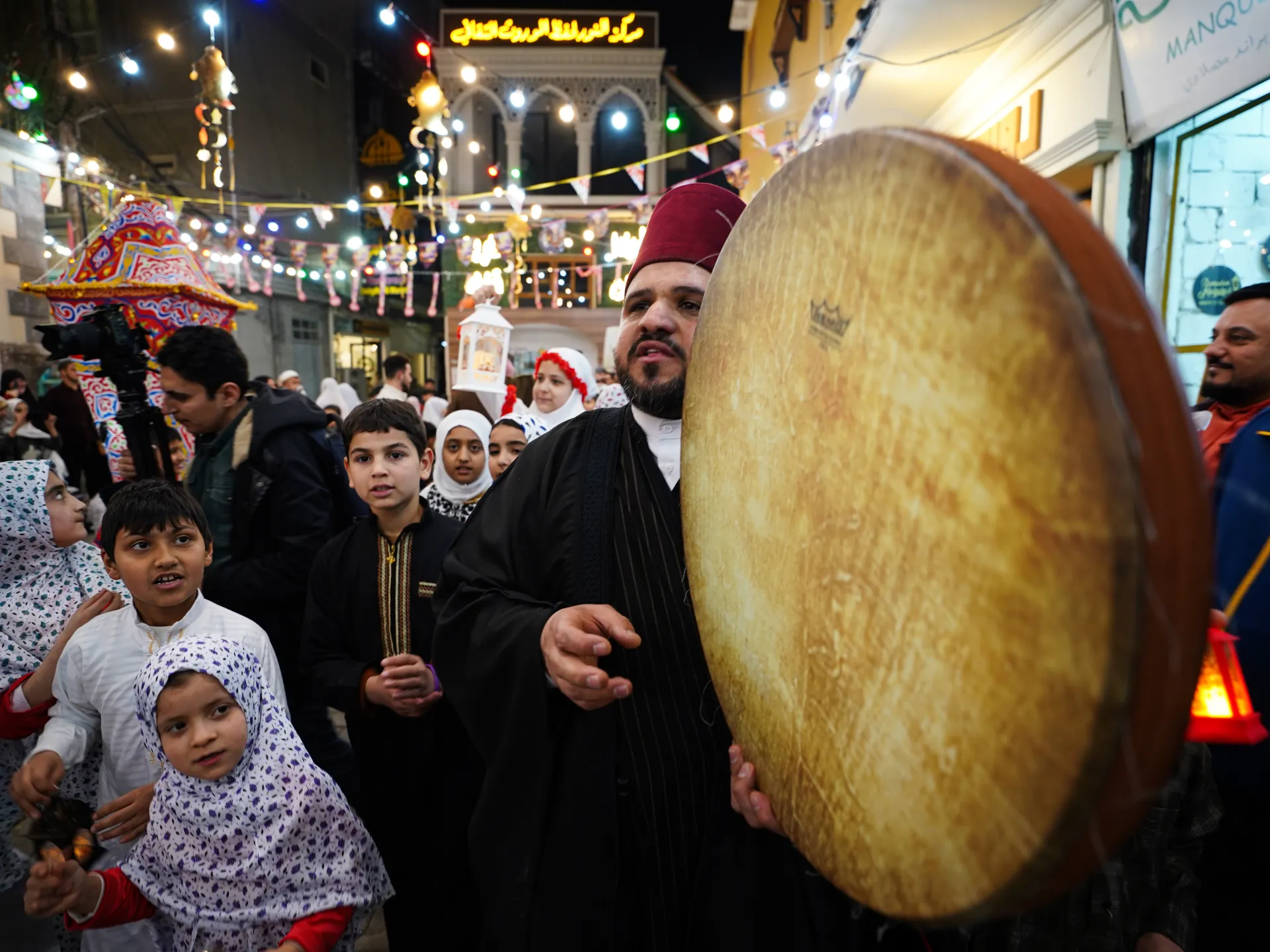
As the Muslim holy month of Ramadan began last week, the Iraqi city of Mosul regained its spiritual and cultural vibrancy, with religious rituals blending with cultural activities that reflect the city’s heritage, identity and collective memory after years of war and devastation.

On the first night of Ramadan, immediately after the Maghrib call to prayer, the chant “Majina ya Majina”, a traditional Ramadan song, echoes through the old neighbourhoods. Children in traditional clothing roam the streets singing Ramadan songs, in a scene that revives longstanding customs.

“This gathering of children revives Mosuli and Iraqi heritage and teaches them the values of sharing and celebrating the holy month,” said Yasser Goyani, 31, a member of the Bytna Foundation for Culture, Arts and Heritage

Tarawih prayers, performed at night during Ramadan, have also returned to the Grand al-Nuri Mosque and its iconic leaning minaret, al-Hadba, for the first time in nearly nine years, just before the bombing of the mosque in 2017 by ISIL (ISIS) fighters at the peak of an Iraqi government campaign against the group that had taken control of the city.

“I feel great joy performing prayers again in the mosque after its restoration and reopening, which reflects its spiritual and historical importance,” adds Goyani.

The traditional storyteller, or hakawati, has also re-emerged during Ramadan evenings, recounting stories from Mosul’s past.

“The hakawati represents a link between the past and the present. We narrate stories about how life in Mosul used to be, especially during the holy month of Ramadan. Despite technological development, people still love returning to their old memories,” explained Abeer al-Ghanem, 52, who plays the storyteller.

Meanwhile, the musaharati – the traditional predawn caller who wakes people up for a small meal to help them cope with the daylong fast – still walks through neighbourhoods in the Old City of Mosul before dawn.

Ghufran Thamer, 34, who performs the role, says, “The musaharati reminds people of authentic Ramadan rituals and keeps the nights of Ramadan alive, despite the changes in modern life.”

Traditional games remain a key part of the Ramadan atmosphere.

“We have been playing the siniya game since the 1980s. It is closely associated with Ramadan and creates a warm and joyful atmosphere among participants during the nights,” said Fahad Mohammed Kashmoula, 55.

Mosul’s markets, particularly the historic Bab al-Saray, come alive during Ramadan as residents flock to buy seasonal staples. Dates are especially in demand, providing a quick source of energy for those fasting. Khalil Mahmoud, 65, who has been selling dates in Bab al-Saray for nearly 40 years, says date sales increase significantly during Ramadan, especially in this market.

“Dates are highly sought after by those fasting, because they help compensate for the sugar lost during the day,” he said

Raisin juice, another Ramadan drink, is also popular across the city.

“The juice is prepared from high-quality raisins and fresh mint from the mountains of Kurdistan. The raisins are soaked, strained, crushed and strained again before being poured into bags for sale. Shops become crowded as people seek to replenish their energy after fasting,” said Hussein Muwaffaq, a raisin juice maker.

Alongside religious and cultural activities, the city also sees growing humanitarian initiatives during Ramadan, including paying off the debts of people in need, distributing food baskets, setting up free iftar meals, and promoting the values of social solidarity.

Source link

Sun-soaked country just four hours from UK is 2026’s top trending destination for Brits

A popular sun-drenched and culturally rich country has topped the poll as the place to book for Brits heading on holiday this year – but have you been?

As Brits look towards booking some summer sunshine, the UK’s top trending destination has been revealed – and it’s a sun-drenched country steeped in history just a four-hour plane ride away.

Tour operator Riviera Travel has compared bookings for January and February 2026 to last year’s and discovered the fastest-growing destination has had a 310% increase in demand.

The figures show travellers are increasingly looking beyond typical European destinations and spreading their net to the Middle East and even as far as Southeast Asia. The location with the biggest surge in demand for 2026 is Egypt.

In addition to Egypt’s mostly dry weather that sports lots of sunshine and very little rain, as one of the world’s oldest civilisations, the country has a wealth of unparalleled history.

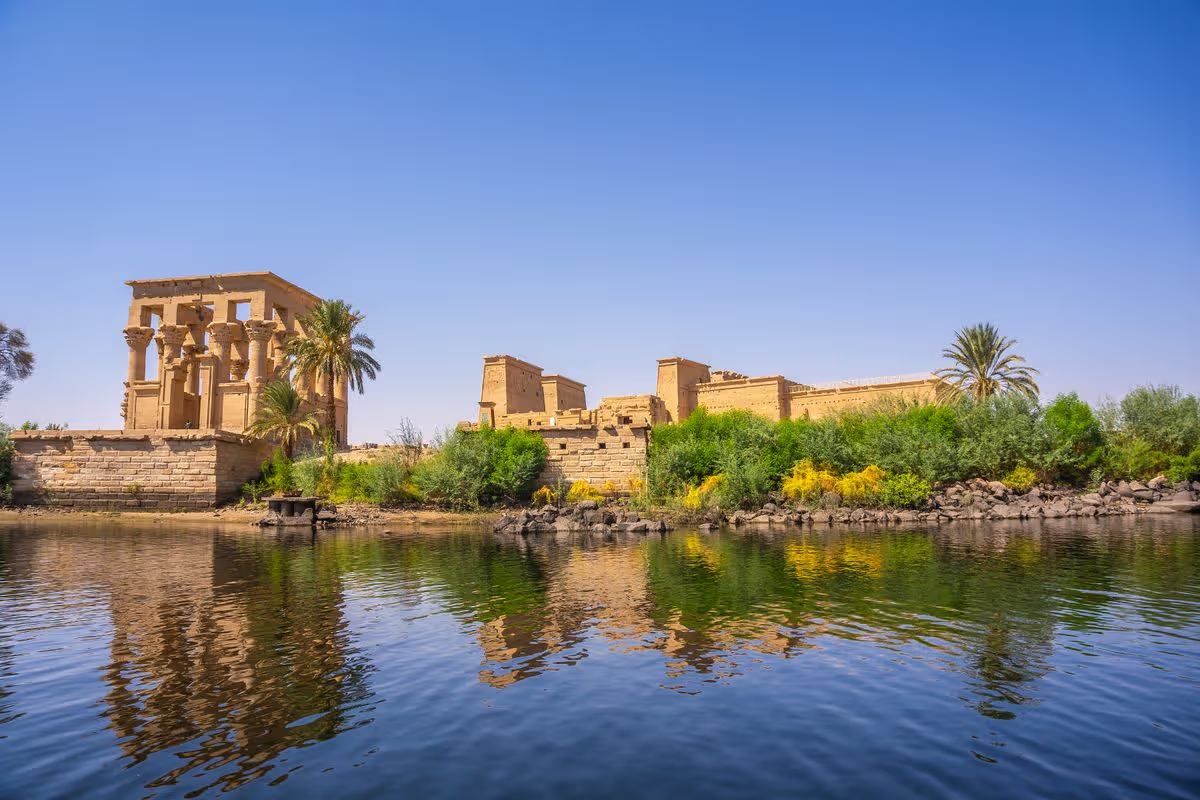
The Ancient Egyptian civilisation – with a history spanning close to 3,000 years – left a compelling legacy in the many monuments that have stood the test of time. From the mighty pyramids to the impressive temples, sacred chambers, and treasure-filled tombs, there is an abundance of world-famous attractions for travellers to visit.

Many people take the opportunity to cruise down the world-famous Nile while holidaying in Egypt and Will Sarson, travel expert at Riviera Travel, explained why that was proving so popular for holiday makers in 2026.

He said: “Egypt’s 310% surge in interest reflects the timeless draw of the Nile, where travelling by river offers a uniquely immersive way to experience one of the world’s oldest civilisations. Ancient temples, riverside villages and fertile banks unfold gradually, creating a powerful sense of continuity between past and present.

“Time along the Nile allows for deep exploration of monumental sites such as Luxor, Karnak and the Valley of the Kings, balanced with quieter moments watching daily life along the water. The experience feels both awe-inspiring and surprisingly intimate, with history never far from view.”

The best time to visit the country is between October and April when the daytime temperatures are comfortable, and the nighttime temperatures are cool. The coolest month is January and the hottest are from June to August.

For those wanting to experience some sand and sea as well as some culture, Egypt’s beaches offer something for every kind of traveller. From the snorkel-friendly water in Hurghada and Sharm El Sheikh to the wildlife-rich bays of Marsa Alam, Egypt’s Red Sea coast lines up some of the country’s best beaches.

Those deciding to visit and stay in one place often travel to the tourist-friendly region of Sharm El Sheikh or Hurghada, which offer a wide array of child-friendly attractions and hotels.

The Mirror’s Jess Phillips was recently blown away by a visit to Egypt. “I genuinely feel as though I discovered one of Egypt’s best-kept secrets after jetting off from London Gatwick on a direct TUI flight to Marsa Alam International – the country’s first privately owned and operated international airport, which opened in 2003,” she wrote.

“Marsa Alam is a burgeoning coastal resort catering to tourists from around the world. The area is still actively developing – though that definitely doesn’t mean it’s lacking in things to do – and offers the best of both worlds: incredible beaches, perfect blue water, and the more traditional Egyptian desert experiences.”

Check out her full story here.

Source link

India’s Modi tells Israel’s Knesset: ‘No cause justifies killing civilians’ | Narendra Modi News

Indian Prime Minister Narendra Modi defended Israel’s devastating war on Gaza, saying it stands by the country “with full conviction” – despite accusations of genocide against the Palestinian people.

Modi gave a speech to the Knesset, or parliament, on Wednesday, on the first day of his two-day visit and received a standing ovation as he stressed India’s enduring support for Israel.

Recommended Stories

list of 4 itemsend of list

It was the first time an Indian leader addressed the Knesset.

“India stands with Israel firmly, with full conviction, in this moment and beyond,” said Modi, condemning the October 7, 2023, attack by Hamas-led fighters as “barbaric”, adding “no cause can justify the murder of civilians”.

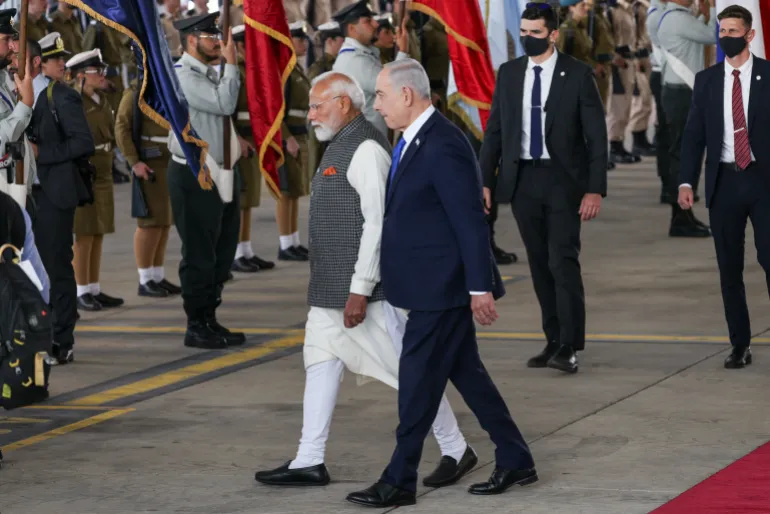
India’s leader was earlier greeted by Israeli Prime Minister Benjamin Netanyahu at Ben Gurion International Airport, where a welcoming ceremony was held.

In his own Knesset speech, Netanyahu thanked India for “standing by” Israel in the wake of October 7, and said the two nations shared “common interests”. He described Modi as “more than a friend, a brother”.

Modi said New Delhi expressed “strong support” for the Gaza peace initiative approved by the UN Security Council in November. It “offers a pathway”, he said, adding India believes “it holds the promise of a just and durable peace for all the people of the region”.

‘Trusted partners’

The Indian leader said the two countries are “trusted partners” and this “contributes to global stability and prosperity”.

He described their relations as “vital” for trade and security, and hailed “synergy” on artificial intelligence, quantum technology, and other topics.

“We are committed to further consolidating this relationship across many sectors,” he added.

Modi’s first trip to Israel was in 2017 after relations between the two countries warmed following his election in 2014. Netanyahu also visited India in 2018.

Haaretz newspaper journalist Gideon Levy told Al Jazeera that Modi’s visit cannot be underestimated.

“India is a highly important country and [Modi] showing himself … in these times when public opinion in India is very critical about Israel is a step that cannot be underestimated,” said Levy.

He pointed to similarities between Netanyahu and Modi, saying both are “nationalist, populist in a way, quite conservative, and hawkish. Both countries carry also some stains, Kashmir, Palestine, the West Bank”.

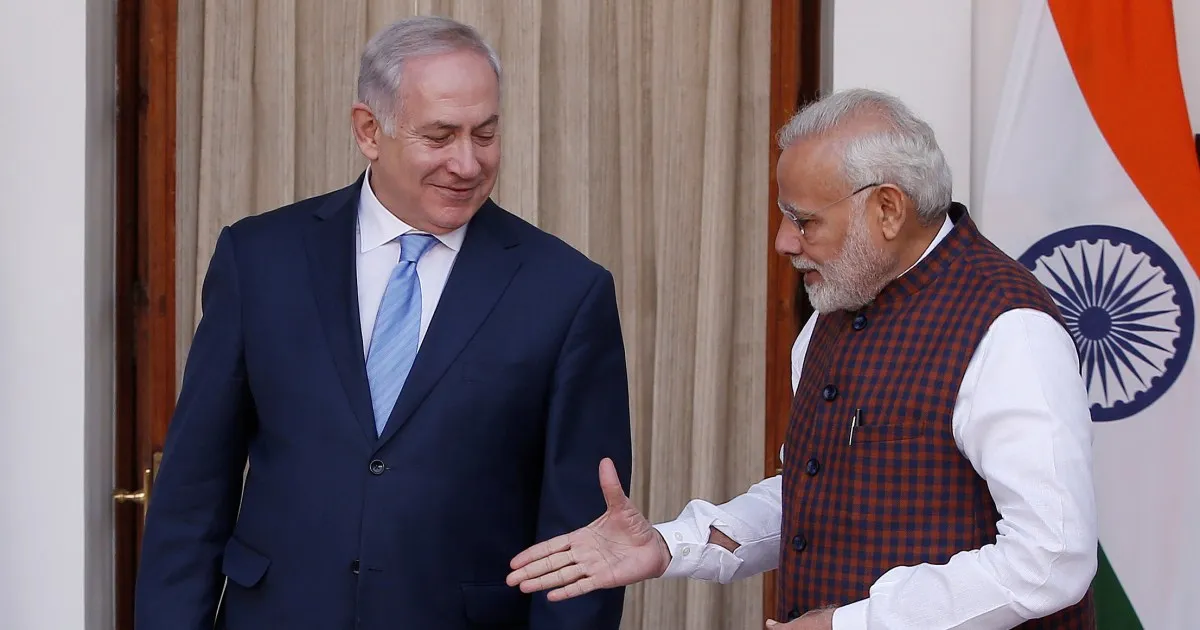
India's Prime Minister Narendra Modi and Israel's Prime Minister Benjamin Netanyahu attend a welcome ceremony upon Modi's arrival at Ben Gurion International Airport in Lod, near Tel Aviv, Israel February 25, 2026. REUTERS/Shir Torem
Modi and Netanyahu attend a welcome ceremony at Ben Gurion International Airport [Shir Torem/Reuters]

Israel’s largest arms buyer

In September 2025, India and Israel signed the Bilateral Investment Treaty to expand trade during far-right Israeli Finance Minister Bezalel Smotrich’s visit to India.

India is Israel’s largest arms buyer, spending $20.5bn on Israeli weapons between 2020 and 2024. In 2024, trade between the two, largely based on defence and security, stood at $3.9bn.

Modi has received criticism for his support for Israel during its genocide of Palestinians in Gaza, which has killed at least 72,073 people and wounded 171,756. At least 615 of those deaths occurred during the “ceasefire” agreed between Israel and Hamas last October.

Last week, India was one of the more than 100 countries condemning Israel’s recent moves to expand its control of the occupied West Bank and move towards annexation.

Imran Masood, a parliamentarian for India’s Congress party, urged Modi to address Gaza during his visit, saying, “if there is any morality then he should talk about death of children in Gaza”, ANI news agency reported.

“India’s stand is clear … that it supports Palestine,” said Masood.

Marian Alexander Baby, leader of the Communist Party of India, said Modi’s embrace of Israel is “a betrayal of India’s anti-colonial legacy and our long-standing position in support of the right to self determination of the Palestinian people, reaffirmed by UN resolutions that India has co-sponsored and voted for”.

Modi continues his visit to Israel on Thursday.

Source link

Palestinian filmmaker showcases the beauty of pre-war Gaza | Newsfeed

NewsFeed

Palestinian journalist Yousef Al Helou documented Gaza and its people in the summer of 2023, months before the start of Israel’s genocidal war. His film, ‘Phoenix of Gaza’, stands as a testament to Palestinian resilience and has become a tribute to people that were later killed.

Source link

Will Ethiopia be part of Israel’s ‘hexagon’ alliance rivalling its enemies? | Politics News

Days after Israeli Prime Minister Benjamin Netanyahu proposed forging a network of allied nations, including in the Middle East and Africa, to stand against what he called “radical” adversaries, the country’s president is on an official visit to key ally, Ethiopia.

It is not yet known which Arab and African countries will form part of Netanyahu’s hypothetical “hexagon of alliances”, which he said on Sunday will include Israel, India, Greece, Cyprus and others to stand against their enemies in the Middle East. Chief among those enemies is presumably Iran and its network of resistance groups from Hezbollah in Lebanon to the Houthis of Yemen.

Recommended Stories

list of 3 itemsend of list

Analysts doubt Israel could secure enough influence over nation-states to form a formal security pact.

However, the country is deepening its ongoing charm offensive in Africa, which it began during the genocide in Gaza, as its reputation suffered a decline on the continent, with the African Union (AU) releasing multiple statements condemning Israeli attacks on Palestinian civilians.

In a rare visit, Israeli President Isaac Herzog arrived in Ethiopia on Tuesday. The last presidential trip to the East African country took place in 2018.

“The relationship between our peoples is woven deep into the pages of history and human tradition,” Herzog said in a statement upon his arrival. “At the heart of the story of both our nations lies a clear common thread – the ability to join hands, unite resources of spirit and substance, to innovate, develop, and grow for the benefit of all.”

Herzog, on Wednesday, met with Prime Minister Abiy Ahmed who said the two leaders talked about “ways to improve collaboration in areas of mutual interest,” without revealing further details.

But beneath the surface, observers say the visit also represents a battle for influence over Addis Ababa, which has received similar high-level delegations from Turkiye and Saudi Arabia in recent days.

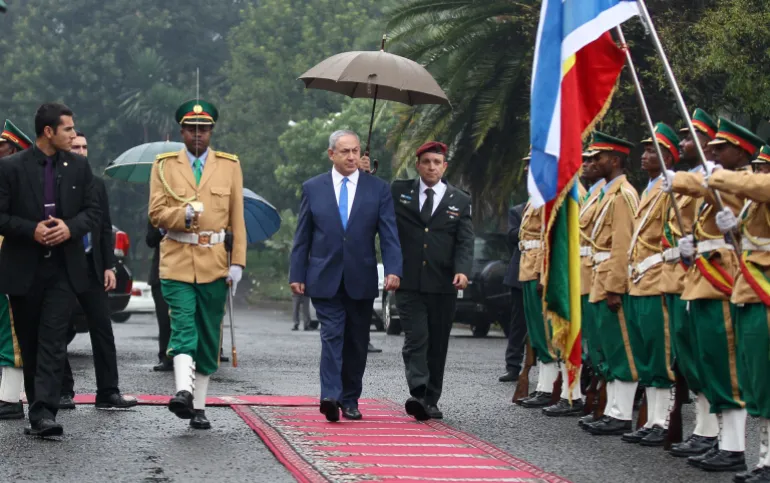
Netanhahu
Israeli Prime Minister Benjamin Netanyahu inspecting a guard of honour at the National Palace during his State visit to Ethiopia in 2016 [File: Tiksa Negeri/Reuters]

Shared ties and shared anger

Ethiopia and Israel are bound by several links, from shared histories of their people to shared scrutiny over recent political moves in the Horn of Africa that have angered several of the region’s influential nations.

Both countries maintain friendly ties largely due to the Beta Israel community, or Ethiopian Jews, who hail from northern Tigray and Amhara. Historically, Ethiopian Jews suffered religious persecution, and after Israel’s formation, it sought their emigration under its Law of Return policy. Between the late 1970s and mid-1990s, tens of thousands of Ethiopian Jews were covertly transported to Israel – during a time when several African countries, including Ethiopia, had cut off ties with Israel over the 1973 Yom Kippur War and its invasion of Egypt. On the cusp of a civil war in Ethiopia in 1991, Mossad, Israel’s spy agency, launched a daring operation that airlifted 14,000 Ethiopians over the course of just two days.

About 160,000 Ethiopian Jews now live in Israel. Many within the community have struggled to integrate and have complained of discrimination and racism. In 2019, tens of thousands of Ethiopian Jews flooded the streets in protest across Israeli cities after a 19-year-old of Ethiopian origin was shot dead by the police.

Ethiopia-Israel state relations have, meanwhile, remained steady. In 2016, when Netanyahu visited the country in his first prime ministerial visit – Addis Ababa became one of the first African countries to voice support for Israel’s long-sought observer status at the AU. Fierce opposition from South Africa, Algeria and other countries supporting Palestine delayed the process until 2021. Later, in 2023, the AU confirmed it had withdrawn the status.

Mashav, Israel’s aid agency, has, in the past decade, provided aid to Ethiopia in the form of agriculture and water cooperation projects, although Addis Ababa receives much more significant funding from wealthier partners like China. When Israel sponsored several African journalists on media trips to the country last year, Ethiopia was among the countries it invited journalists from.

More recently, both countries are bound by their support for Somaliland, which Somalia claims as part of its territory and which Israel sees as critical to its own national security, Hargeisa-based analyst Moustafa Ahmad told Al Jazeera.

In December, Israel recognised Somaliland’s statehood, becoming the first country to do so. Months before, there were unconfirmed talks about plans to move displaced Palestinians to Somaliland or to South Sudan, another key Israeli ally in the region. Analysts speculate that countries like South Sudan and the United Arab Emirates, another close friend of Israel, may also recognise Somaliland.

Israel’s focus on the Horn of Africa intensified after a late 2024 report from a United Nations expert panel, which found that the Somalia-based armed group, al-Shabab, was actively collaborating with Yemen’s Houthis. Where the Houthis were providing weapons and drone training, al-Shabab was, in return, granting access to a smuggling corridor stretching along the Somali coast and connecting to the Gulf of Aden, where Iranian weapons could be smuggled into Yemen.

The move to recognise Somaliland was therefore meant to disrupt that cooperation by stationing an Israeli naval base in the region, analysts note.

“It’s part of their calculations even if they haven’t said it publicly,” Ahmad said.

Several countries, as well as the AU, have pushed back on Israel’s recognition of Somaliland, calling it a violation of Somalia’s sovereignty. In Somaliland, however, many have celebrated the move.

Turkish President Tayyip Erdogan poses with Somali President Hassan Sheikh Mohamud and Ethiopian Prime Minister Abiy Ahmed following a press conference in Ankara, Turkey, December 11, 2024. Murat Kula/Presidential Press Office/Handout via REUTERS ATTENTION EDITORS - THIS PICTURE WAS PROVIDED BY A THIRD PARTY. NO RESALES. NO ARCHIVES.
Turkish President Recep Tayyip Erdogan holds hands with Somali President Hassan Sheikh Mohamud and Ethiopian Prime Minister Abiy Ahmed, left, following a media conference in Ankara, on December 11, 2024 [File: Murat Kula/Presidential Press Office/Handout via Reuters]

Addis Ababa under pressure

While neither Israel nor Ethiopia has provided details of topics on the agenda during Herzog’s visit, Somaliland is likely at the top of the list.

Addis Ababa had in 2024 enraged its neighbours after it signed a controversial port deal with Hargeisa that would allow it access to the sea, reportedly in exchange for a future recognition of Somaliland. Although massive and rapidly industrialising, Ethiopia is landlocked, having lost its sea access after Eritrea seceded in 1993. Prime Minister Abiy has often said sea access is critical for his country.

The fall-out between Ethiopia and Somalia was so severe that analysts sounded the alarm over possible armed conflict between the two neighbours until Turkiye, a key development partner for Mogadishu, stepped in to smooth things over by pressuring Addis Ababa to coordinate with Mogadishu instead.

It is likely, analysts say, that Israel is now hoping to push Ethiopia further towards recognising Somaliland, which boasts a 850km (528-mile) coastline. In Hargeisa, many are disappointed after more countries failed to follow Israel’s steps, Ahmad said.

Addis Ababa, though, might not appreciate further pressure at the moment as it faces increasing regional isolation on several fronts.

One key reason is the controversial Grand Ethiopian Renaissance Dam (GERD), which Egypt and Sudan say is blocking the water supply they need for irrigation.

A source of national pride for Ethiopians, the dam was funded almost entirely through citizens’ donations and government funds. Israeli engineers participated in the project, and Israel reportedly sold weapons to Ethiopia to protect the dam amid tensions with its neighbours, although the Israeli government denies this.

At the same time, Addis Ababa is also facing tensions with Eritrea, which has moved closer to Somalia and Egypt. Both countries have historically feuded, and recently, tensions have again risen over the 2020 Tigray War and Abiy’s repeated statements about his country needing access to the sea.

“Addis Ababa is cautious of making a decision that will cement its regional isolation at this time [because] it is clearly hedging among various actors seeking to influence the Horn of Africa and Red Sea region,” Ahmad said.

Pressure is also mounting on Addis Ababa from countries eager to keep the status quo.

On Sunday, Turkiye’s President Recep Tayyip Erdogan visited Ethiopia and said in his speech: “I would like to emphasise that Israel’s recognition of Somaliland does not benefit Somaliland or the Horn of Africa.”

His statement drew a backlash from Hargeisa, which called it “unacceptable interference” aimed at wrecking relations between Somaliland and its partners.

Meanwhile, Saudi Arabia, which is embroiled in an ongoing rift with the United Arab Emirates over how to deal with the conflict in Yemen, also intervened in the fray in February. Vice Minister of Foreign Affairs Waleed Elkhereiji was in Addis Ababa this week to discuss “regional peace”, just two weeks after Foreign Minister Prince Faisal bin Farhan Al Saud arrived in the city for talks with Abiy.

So far, it is unclear if Riyadh has recorded any success in influencing Addis Ababa.

How Israel will fare in that regard is also still unclear.

Source link

Senegal prime minister decries Morocco’s jailing of fans after AFCON final | Africa Cup of Nations News

Morocco sentenced 18 Senegalese football fans last Thursday following disturbances at the Africa Cup of Nations final.

Senegal’s Prime Minister Ousmane Sonko has followed his country’s football association in denouncing Morocco’s jailing of 18 Senegalese fans following January’s Africa Cup of Nations (AFCON) final in Rabat.

The Teranga Lions supporters were arrested during the final in the Moroccan capital, which was controversially suspended as the Senegal players left the pitch in protest against the late award of a penalty to the host nation.

Recommended Stories

list of 4 itemsend of list

Fans, in response, attempted to enter the field of play during the match on January 19, leading to the arrest of 18 people who were later charged with hooliganism and violence against security officials.

Prison sentences were handed out last Thursday to them, ranging from three months to one year, along with fines of up to 5,000 dirhams ($545).

“It seems this matter goes beyond the realm of sport and that is regrettable,” Sonko told the Senegalese parliament on Tuesday.

“For two countries that call each other friends, like Morocco and Senegal, things should not have gone this far.”

The 18 fans have denied any wrongdoing but have not appealed the sentence. Senegal, however, will seek a royal pardon from Morocco’s King Mohammed VI.

“If they do not, we have agreements that bind us and allow us to request that the supporters serve their sentences in their own country,” Sonko added.

The Senegal Football Association had immediately spoken out at the time of the sentences, describing them as “incomprehensibly harsh”.

“Clashes occur in numerous stadiums around the world, including every weekend in Morocco, without resulting in such sanctions,” Bacary Cisse, the president of the FSF’s communications committee, said.

“The treatment of these supporters therefore appears disproportionate.”

Defence lawyer for the 18, Patrick Kabou, had said on February 6 that they were still “waiting to learn the charges”.

He added that some had chosen to go on hunger strike against their detention and treatment.

In response to the sentencing, Kabou echoed the “incomprehensible” sentiment, saying his clients were “victims”.

Senegal were the eventual winners of the final after the match resumed following the players’ protest, securing a 1-0 win in extra time.

Source link

India’s Modi visits Israel: What’s on the agenda, and why it matters | International Trade News

Indian Prime Minister Narendra Modi will begin a two-day visit to Israel on Wednesday. Modi’s first trip to Israel was in 2017, when he was the first Indian leader to ever visit the country.

India was among the countries that opposed the creation of Israel in 1948, and for decades was one of the most forceful non-Arab critics of Israel’s policies towards Palestinians. It only established diplomatic ties with Israel in 1992, but since 2014, when Modi came to power, relations between the two countries have flourished.

Here is more about what is on the agenda for Modi’s visit, and why it is significant.

Who will Modi meet, and what will they talk about?

Modi is expected to land at the Ben Gurion international airport outside Tel Aviv at 12:45pm local time (10:45 GMT).

Israeli Prime Minister Benjamin Netanyahu is expected to welcome Modi at the airport, as he did during the Indian premier’s 2017 visit. The two leaders are scheduled to hold talks shortly after.

Then, at 4:30pm (14:30 GMT), Modi is scheduled to address the Knesset, the Israeli parliament, in Jerusalem. He then returns to Tel Aviv for the night.

On the morning of February 26, Modi is scheduled to visit the Yad Vashem museum, a memorial to Holocaust victims, before meeting Israeli President Isaac Herzog. Modi and Netanyahu will then meet again and oversee the signing of agreements between the two countries, before Modi departs Israel in the afternoon.

Overall, Modi and Netanyahu aim to use this visit to bolster strategic economic and defence agreements between India and Israel, officials from both sides have said.

“We don’t compete, we rather complement each other,” JP Singh, India’s ambassador to Israel, told state broadcaster All India Radio on Monday, speaking of relations with Israel. “Israel is really good at innovation, science and technology. Therefore, there will be a lot of discussion on AI, cybersecurity and quantum.”

The two countries signed a new Bilateral Investment Treaty in September last year, replacing the 1996 investment treaty, to provide “certainty and protection” to investors from both countries. They are also aiming to upgrade existing bilateral security agreements at this meeting.

In a video posted on the Israeli Embassy’s social media channels on Monday, Israel’s ambassador to India, Reuven Azar, said: “Our economic partnership is gaining real momentum. We signed a bilateral investment treaty, and we are moving forward to sign a free trade agreement, hopefully this year.”

Azar said that Israel wants to encourage Indian infrastructure companies to come to Israel to build and invest in the country.

He added: “We will deepen our defence relationship by updating our security agreements.”

In an X post of his own on Sunday, Netanyahu wrote that he is looking forward to greeting Modi in Jerusalem.

“We are partners in innovation, security, and a shared strategic vision. Together, we are building an axis of nations committed to stability and progress,” he wrote.

“From AI to regional cooperation, our partnership continues to reach new heights,” Netanyahu added.

How are India-Israel relations?

Relations between India and Israel have improved exponentially over the years. While still under British rule in the 1920s and 1930s, India strongly identified with the Palestinian struggle for independence.

In 1917, the United Kingdom signed the Balfour Declaration, promising Jews who had been displaced from Europe due to Adolf Hitler’s oppression a homeland in the British Mandate in Palestine. This was opposed by many nations, including India, which was fighting British colonialism at the time.

“Palestine belongs to the Arabs in the same sense that England belongs to the English, or France to the French,” Mahatma Gandhi, India’s most prominent freedom fighter who is revered as the father of the nation, wrote in an article in his weekly newspaper Harijan on November 26, 1938.

India was among the nations opposed to the creation of Israel in 1948. In 1949, India also voted against Israel’s UN membership. While it recognised Israel as a state in 1950, it was not until 1992 that the two formalised diplomatic relations, and economic relations gradually grew over the following two decades.

Since Modi became India’s leader in 2014, there has been a major shift in the relationship between India and Israel. Nine years ago, Modi was the first Indian prime minister ever to visit Israel.

India is currently Israel’s second-largest trading partner in Asia, after China. According to India’s Ministry of External Affairs, trade jumped from $200m in 1992 to $6.5bn in 2024.

India’s main exports to Israel include pearls, precious stones, automotive diesel, chemicals, machinery, and electrical equipment; imports include petroleum, chemical machinery and transport equipment.

Azad Essa, a senior reporter at Middle East Eye and author of the 2023 book Hostile Homelands: The New Alliance Between India and Israel, told Al Jazeera that Modi’s visit to Israel shows how far India’s relations with Israel have evolved over the past decade.

“Whereas a partnership existed, it was a lot more limited prior to Modi. [New] Delhi has now emerged as Israel’s strongest non-Western ally, so much so that it is now considered a ‘special relationship’, rooted in strategic cooperation and ideological convergence,” Essa said.

“This visit will be Netanyahu’s opportunity to offer appreciation to Modi, and will be used by him to show Israelis that he is a well-respected and popular leader in the Global South.”

Under Modi, India has become Israel’s top arms customer. And in 2024, during Israel’s genocidal war on Gaza, Indian arms firms supplied Israel with rockets and explosives, according to an Al Jazeera investigation.

Modi’s Hindu nationalist Bharatiya Janata Party (BJP) envisions India as a Hindu homeland, echoing Israel’s self-image as a Jewish state. Both India and Israel frame “Islamic terrorism” as a key threat, a label critics say is used to justify wider anti-Muslim policies.

“The alliance between India and Israel is not just about weapon sales or trade. It is about India’s open embrace of authoritarianism and militarism in building a supremacist state in Israel’s image,” Essa said.

“It is also a story about how security, nationalism and democratic language can be used to justify and normalise increasingly illiberal policies, and this has implications for democracies everywhere.”

Why is this visit significant?

Modi’s visit comes at a time of rising and complex geopolitical tensions in and around the Middle East.

Despite the warm relations between the two countries in recent decades, Modi’s trip comes just a week after India joined more than 100 countries in condemning Israel’s de facto expansion in the occupied West Bank. New Delhi signed the statement on February 18 – a day later than most – after initially appearing hesitant.

This week, Netanyahu claimed that he plans to form a new regional bloc of countries, which he termed a “hexagon” alliance, to stand against “radical” Sunni and Shia-majority nations.

On Sunday, Netanyahu said this alliance would include Israel, India, Greece and Cyprus, along with other unnamed Arab, African and Asian states. None of these governments has officially endorsed this plan, including India.

Analysts said Modi’s visit will be viewed by many as an endorsement of Israeli policies, however.

“The timing of the visit is notable because it comes at a time when Netanyahu has lost immense credibility around the world, and to have the leader of the world’s so-called largest democracy visiting Israel and showing affection to Netanyahu, who has a warrant in his name from the International Criminal Court, is a ringing endorsement of him and Israel’s policies,” Essa said.

Modi’s visit also comes at a time of heightened tensions between Iran and the United States.

India and Iran have long had a cooperative relationship. After Modi visited Iran in 2016, the two countries signed a major deal, allowing India to develop the strategically located port of Chabahar on Iran’s southeastern coast. However, after the US imposed additional sanctions on Iran last year and threatened to penalise all countries that do business with Tehran, India has reportedly started moving out of Chabahar.

In June 2025, India did not join the Shanghai Cooperation Organisation’s (SCO’s) condemnation of Israel’s attacks on Iran during the 12-day war between Iran and Israel. However, it did join a later condemnation by the BRICS grouping of major emerging economies of the Israeli and US attacks on Iran.

The US, which has been applying its own pressure on India over the past year in retaliation for its purchase of Russian oil, is building up a vast array of military assets in the Arabian Sea, close to Iran, as President Donald Trump increases pressure on Iran to agree to a deal over its nuclear programme and stock of ballistic missiles.

Trump said last Friday that he was considering a limited strike on Iran if Tehran does not reach a deal with the US. “I guess I can say I am considering that,” he told reporters.

Iran has said it is seeking a diplomatic solution, but will defend itself if Washington resorts to military action.

Israel will likely be a front-line participant in any escalation that might follow from US strikes or Iranian retaliation, analysts say.

Source link

US to provide consular services in illegal Israeli settlement | Occupied West Bank News

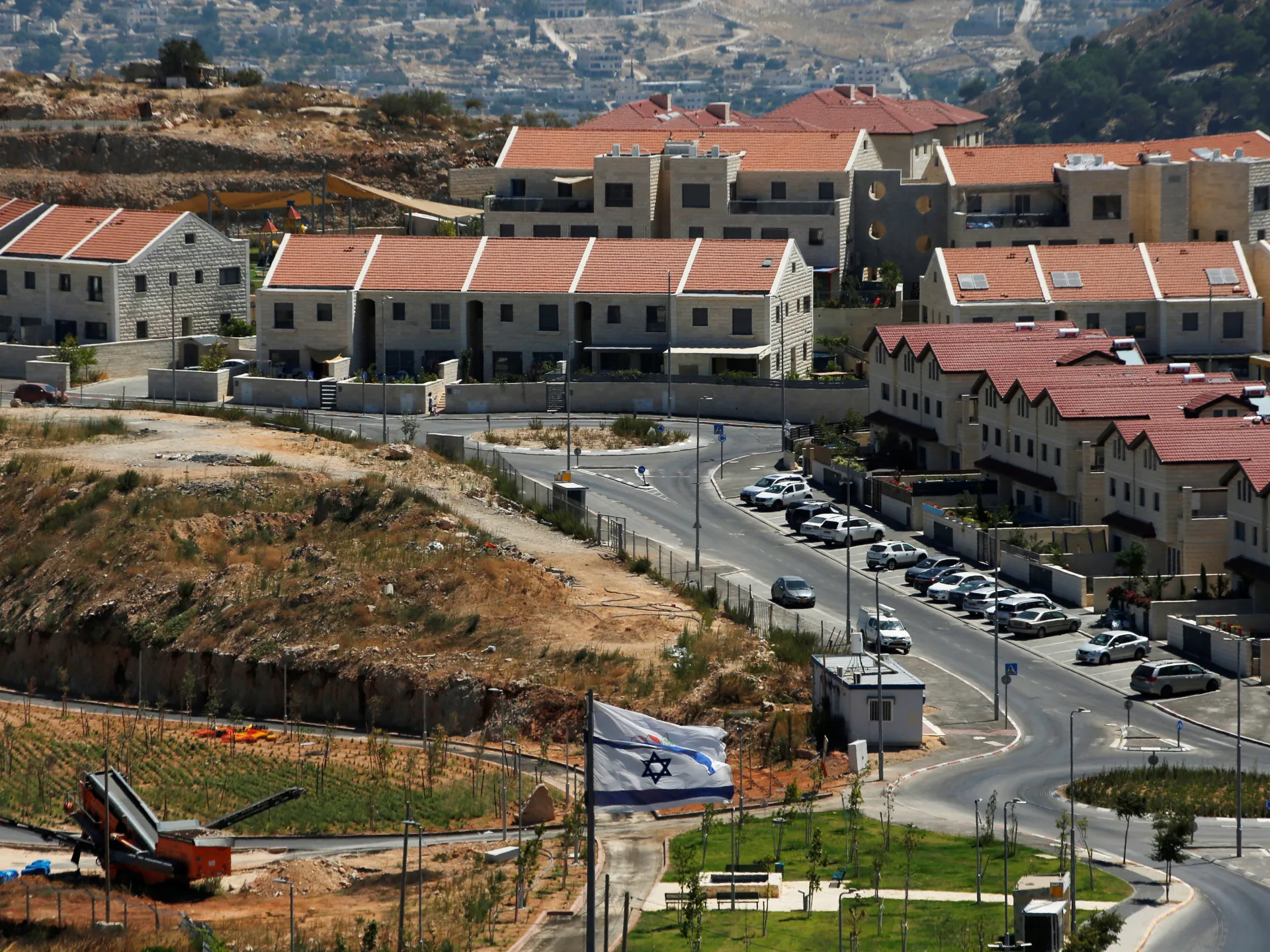
US embassy services will be available in the illegal West Bank settlement of Efrat, starting on February 27.

The United States has announced it will soon provide in-person passport services at an illegal Israeli settlement in the occupied West Bank.

The US Embassy in Jerusalem said it would start providing the service for Efrat, located between the Palestinian towns of Bethlehem and Hebron, on February 27.

Recommended Stories

list of 4 itemsend of list

It will be the first time the US has “provided consular services to a settlement in the West Bank”, according to a US embassy spokesperson quoted by the Reuters news agency.

The embassy said it would plan similar on-site services in the Palestinian city of Ramallah, the illegal Israeli settlement of Beitar Illit near Bethlehem, and in cities within Israel, such ⁠as Haifa.

The US currently offers passport and consular services at its embassy in West Jerusalem as well ⁠as at a Tel Aviv branch office.

Israeli settlements in the occupied West Bank, home to 3 million Palestinians who seek the territory as part of a future state, are illegal under international law.

Nevertheless, far-right Israeli politicians have openly called for Israel to increase settlement expansion, or even annex the Palestinian territory.

This month, Prime Minister Benjamin Netanyahu’s right-wing government approved measures to expand control over the occupied West Bank and claim large tracts of Palestinian territory as Israeli “state property”.

The move was roundly condemned by more than 80 United Nations member countries.

Much of the West Bank is already under Israeli military control, with limited Palestinian self-government in some areas run by the Western-backed Palestinian Authority.

According to the International Court of Justice, about 465,000 Israeli settlers live in the occupied Palestinian territory, spread across some 300 illegal settlements and outposts.

Among them are an estimated tens of thousands of dual US-Israeli nationals. The Efrat settlement is home to many American immigrants.

US President Donald Trump, a staunch supporter of Israel, has said he opposes Israeli annexation of the occupied West Bank. But his administration has ‌not taken any steps to curb Israel’s expanding settlement presence.

In addition to advancing settlements, Israeli forces regularly carry out violent raids, demolitions, and arrests in the occupied West Bank, where attacks by Israeli settlers against Palestinians have also intensified, often under the protection of Israeli soldiers.

In January alone, at least 694 Palestinians were driven from their homes in the West Bank because of Israeli settler violence and harassment, the highest number since Israel’s genocidal war on Gaza erupted in October 2023, according to the United Nations.

Source link

Yemen’s ‘Mogadishu’: Somali refugees face poverty, instability in Aden | Refugees News

Aden, Yemen – Lying on the outskirts of Yemen’s interim capital, Aden, al-Basateen district starts where the paved roads end, stretching into narrow, sandy alleyways. It reveals a decades-old refugee story in which Arabic blends with Somali and the faces harbour memories of a different place, across the sea.

Residents know the area by several names, including “Yemen’s Mogadishu” and “the Somalis’ neighbourhood” – a reference to the demographic shift it has seen since the 1990s, when civil war in Somalia pushed thousands of families across the Gulf of Aden in search of safety.

Recommended Stories

list of 3 itemsend of list

Today, local sources estimate the district’s population at more than 40,000, with people of Somali origin making up the majority. They live in harsh conditions where economic vulnerability overlaps with an unresolved legal status.

Some arrived as children holding the hands of relatives, while others were born in Aden and have known no other home. But they all share one thing in common: the refugee label stamped on their official documents.

Harsh living conditions

As dawn breaks, dozens of men gather at the entrances of the area’s main streets, waiting to be picked up to do a day’s work in construction or manual labour. Many depend on this fragile pattern of employment to put food on the table.

Residents say the lack of regular work has become the defining feature of life in al-Basateen, as extreme poverty spreads and humanitarian aid declines.

Ashour Hassan, a resident in his mid-30s, waiting at a main road junction for someone to hire him to wash a car, told Al Jazeera that he earns between 3,000 and 4,000 Yemeni rials a day (less than $3). That amount is not enough to cover the needs of his family, which lives in a single room in a neighbourhood lacking basic services, surrounded by dirt roads and piles of rubbish.

In a voice mixed with fatigue and despair, Ashour summed up life in al-Basateen: “We live day to day. If we find work, we eat. If we don’t, we wait without food until tomorrow.”

Families in al-Basateen typically rely on both men and women to be breadwinners.

Some women work cleaning homes, while others run small businesses, such as selling bread and traditional foods that blend Yemeni and Somali flavours, and which become especially popular during the Muslim fasting month of Ramadan.

Many children also find themselves pushed into work despite their age. One of the main jobs for children involves sifting through waste for materials they can sell, such as plastic or scrap metal, to help support their families.

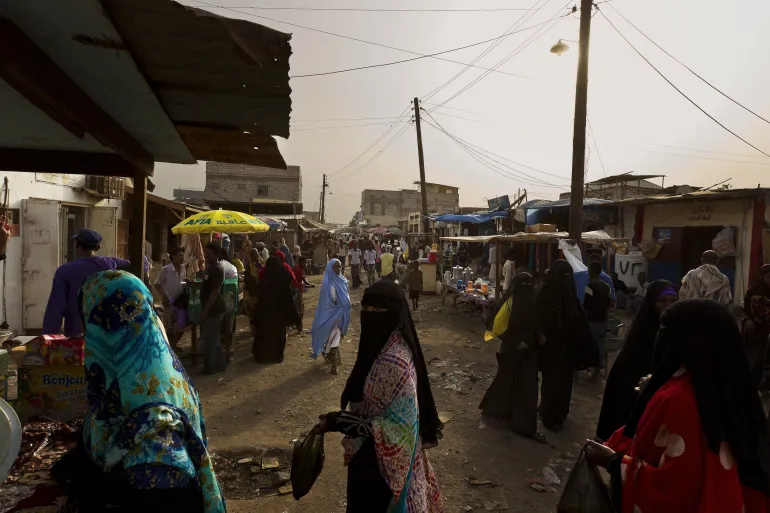
ADEN, YEMEN - AUGUST 2010: Busy market scenes in the Al-Basateen urban refugee area, Aden, Yemen, August 11, 2010. Many of these people are part of the 80 000 refugees who arrive in Yemen on an annual basis from the failed state of Somalia. The Al-Basateen urban refugee area houses more than 40 000 people, most of whom are refugees. (Photo by Brent Stirton/Reportage by Getty Images)
Roads in al-Basateen are typically unpaved, with residents often sheltering in haphazard structures [Brent Stirton/Getty Images]

Little sense of belonging

Poverty is clearly visible in al-Basateen’s architecture and appearance, with tightly packed homes, some made of metal sheets and consisting of only one or two rooms, separated by dirt roads covered in rubbish.

But that is not the only burden weighing on al-Basateen’s Somali residents. A deeper feeling of what many here call “suspended belonging” hangs over them, with the first generation of refugees still carrying memories of a distant homeland and speaking its language, while the second and third generations know only Aden and speak Arabic in the local dialect, with Somalia only known through family stories.

Fatima Jame embodies this paradox. A mother of four, she was born in Aden to Somali parents. She told Al Jazeera: “We know no country other than Yemen. We studied here and got married here, but we do not have Yemeni identity, and in front of the law, we are still refugees.”

Fatima lives with her family in a modest two-room home. Her husband works as a porter in one of the city’s markets, while she helps support the family by preparing and selling traditional foods. Even so, she says their combined income “barely covers rent and food” because of the high cost of living and few job opportunities.

A bleak reality

Conditions in Yemen were never the best for migrants and refugees, but they have significantly worsened since a civil war began in 2014 between the Iranian-backed Houthis and the central government in Sanaa, in Yemen’s north.

The violence from that war, along with declining aid and shrinking job opportunities have increased pressure on both host communities and refugees.

The United Nations Office for the Coordination of Humanitarian Affairs says that funding for support programmes in Yemen in 2025 met only 25 percent of the country’s actual needs, directly affecting the lives of thousands of families. Residents of al-Basateen say the aid they used to receive has sharply declined, and in many cases has stopped altogether.

Youssef Mohammed, 53, says he was one of the first Somali arrivals to the district in the 1990s, and now supports a family of seven.

“[We] have not received any support from organisations for years,” Youssef said, adding that some families “chose to return to Somalia rather than stay and die of hunger here”.

He believes the crisis affects everyone in Yemen, “but [that] the refugee remains the weakest link.”

Despite the bleak picture, a few have managed to improve their material conditions through education or by opening small businesses that have helped stimulate the local economy. But they remain an exception, and the flow of refugees continues.

Yemen is the poorest country in the Arabian Peninsula, but is also the region’s only signatory to the 1951 Refugee Convention, and therefore allows foreign arrivals to apply for asylum or refugee status. According to the United Nations refugee agency, Yemen hosted more than 61,000 asylum seekers and refugees as of July 2025, the vast majority from Somalia and Ethiopia.

Arrivals in recent years have typically travelled to Yemen via boats, with many planning to use Yemen as a transit point before moving on to richer countries like Saudi Arabia.

Hussein Adel is one of those recent arrivals. He is 30, but leans on a crutch on a street corner in al-Basateen.

Hussein arrived in Aden only a few months ago, having made the dangerous journey on a small boat carrying African migrants.

He told Al Jazeera that he fled death and hunger, only to find himself facing a harsher reality. Hussein shelters on the rooftop of a relative’s home and spends his days searching the city for occasional work. His leg injury, he said, was caused by Omani border guards who shot him while he was crossing into Yemen.

As evening falls, the noise in al-Basateen’s alleyways quiets down. Men lean against the walls of worn-out homes, and children chase a ball through narrow passages barely wide enough for their dreams.

On the surface, life looks normal – like any working-class neighbourhood in a city exhausted by crises. But here, in “Yemen’s Mogadishu”, there is an extra trauma – the sense of a lack of belonging, the memory of refugees fleeing danger and poverty at home, and a lack of stability that will not go away.

Source link

Iran cannot defeat US military might, but it can still win | Opinions

Last week, American diplomats and their Iranian counterparts sat down in Geneva for yet another round of talks mediated by Oman. The outcome seemed unclear. While the Iranians said “good progress” had been made, the Americans claimed there was “a little progress”. Meanwhile, United States President Donald Trump threatened once again to strike Iran.

In recent weeks, there has been a heavy US military build-up in the Middle East in preparation for what many observers see as an imminent attack. In this context, it may be apt to question whether the current negotiations are not simply a tactic to buy time to better prepare for the inevitable.

In the face of US military might, some have suggested that Iran’s only option is negotiating an agreement with the US, however unfair it may be. While Iranian military capabilities stand no chance against an army with the world’s biggest budget, accepting capitulation through a debilitating deal that may be broken again by Washington may not necessarily be Tehran’s only choice.

There is another way in which Iran can stand up to US bullying and win.

The fate of past negotiations

The ongoing US-Iran talks cannot be viewed in isolation. For Iran, any diplomatic engagement with the US is overshadowed by the legacy of the Joint Comprehensive Plan of Action (JCPOA).

Signed by the US, China, Russia, France, the United Kingdom, Germany, the European Union and Iran in 2015, the agreement provided sanctions relief in exchange for full transparency of the Iranian nuclear programme. Tehran accepted the deal even though it had some unfair provisions, including some US sanctions remaining in place.

Nevertheless, it fulfilled its obligations – a fact that was repeatedly verified by the International Atomic Energy Agency.

In return, however, the US as a signatory did not uphold its end of the deal. In 2018, Trump unilaterally withdrew from the JCPOA and reimposed maximum pressure sanctions aimed at crippling Iran’s economy.

It was a stark reminder that American promises are nonbinding. As a leader who has shown no regard for the interests of American allies in pursuit of an “America first” policy, Trump could hardly be expected to respect the interests of American adversaries.

However, even if a Democratic president had been in the White House, there would not have been any guarantee that the JCPOA would have remained in place. In the US’s polarised political climate, an American president’s signature is only valid until the next election.

For the US, negotiations can also be little more than a facade intended to lull adversaries into a false sense of security. Last year, just as US and Iranian representatives were scheduled to meet in Oman for another round of talks, Israel, a key American ally, launched a massive military campaign against Iran.

While the US denied direct involvement, it acknowledged having received prior notice. Given the close ties between the two countries, this prior knowledge strongly implied that the US had given Israel tacit approval for the air attacks.

Today, Iran is engaging in negotiations with the US again, and it is being pressured to accept an even more unfair deal. Should it back down and submit to US demands, then Trump – who preys on perceived weakness – would simply move the goalpost. Demands would shift from Iran’s nuclear programme today to its ballistic missiles tomorrow and regime change the day after.

The special US relationship with Israel means that Washington is fundamentally hostile to an Iranian government that sees the Israeli state as an enemy. Consequently, Trump’s goal is not to reach a durable agreement but to ensure that Iran can never fully comply with his demands, thereby justifying a permanent campaign of maximum pressure and hostility.

In this context and given its recent experience, it would be foolish for Iran to rely on US promises and negotiated agreements.

Leverage through strong regional ties

The current US-Iran standoff is a high-stakes game in which an all-out war is a likely outcome. While the US could achieve an initial victory through overwhelming military superiority, it could also get bogged down fighting a protracted counterinsurgency in Iran’s mountainous terrain.

Conversely, while Iran could eventually repel an American invasion – just as its Afghan neighbours did – the country would be reduced to rubble in the process.

That does not mean Iran should back down. The Greenland crisis and the China-US trade war have demonstrated that Trump’s propensity for sabre-rattling is tempered by his aversion to losses. Even though the EU and China are far more powerful than Iran, a clear show of resolve could compel Trump to retreat.

And Tehran does not have to be alone in its defiance. In its neighbourhood, there are other big players who recognise that another disastrous war led by the US is not in their interests. Iran can and should leverage the regional desire for stability.

For years, Iran pursued a policy of confrontation in the region until it realised that carving out a sphere of influence was actually exacerbating its security dilemma. This recognition ultimately led to the historic normalisation of relations with Saudi Arabia in 2023 – a breakthrough facilitated by China, Oman and Iraq – which in turn set in motion a broader detente with other Arab countries.

Three years later, that decision is yielding dividends. Notably, Saudi Arabia, Oman, Turkiye and Qatar are lobbying Trump to exercise restraint. Building on this neighbourly diplomacy and investing in developing regional stability and a security architecture could help stave off another major US war in the region.

The most important path to peace – and the only means of countering American gunboat diplomacy – does not lie in matching American military might, a contest Iran is destined to lose, but in establishing good relations with its neighbours and accepting regional stability as part of its national security.

The views expressed in this article are the author’s own and do not necessarily reflect Al Jazeera’s editorial stance.

Source link

Army helicopter crashes into Iran market, killing 2 pilots and 2 merchants | Military News

The incident in Isfahan province follows crash of fighter jet in Hamadan province less than a week ago.

Tehran, Iran – Two military pilots and two merchants have been killed after an army helicopter crashed into a fruit market in central Iran.

The crash on Tuesday morning occurred in Dorcheh, a town in Isfahan province, where the army has a major airbase, according to state media, which said the cause was likely a technical fault in the aircraft.

Recommended Stories

list of 3 itemsend of list

Footage broadcast by state media from the scene of the crash showed the wreckage and emergency responders putting out the fire.

The Army Aviation Training Centre, in a statement, identified the killed soldiers as Colonel Hamed Sarvazad, the pilot; and his co-pilot, Major Mojtaba Kiani.

Two people working at their booths in the market were also reportedly killed on the scene after the helicopter crashed and caught fire.

The army centre said the cause of the crash is under investigation. The local judiciary chief, Asadollah Jafari, said he had also opened a case and dispatched investigators.

The crash comes less than a week after an Iranian Air Force fighter jet, reportedly an old United States-built F-4 model, crashed during a late-night training mission in the western province of Hamadan.

State media reported that one of the pilots was killed, but the other survived after successfully ejecting. The cause of that crash is under investigation, but state media said it was likely caused by a technical fault, as well.

Iran has been largely unable to upgrade its ageing fleet of aircraft, both military and civilian, as a result of decades-long sanctions imposed by the US and its allies.

Iran has purchased a number of fighter and training aircraft from Russia, and has been seeking to buy advanced Su-35 jets, but they have yet to be delivered by Moscow.

The crash of the helicopter took place amid rising tensions between the US and Iran before a new round of nuclear talks, which are set to take place in Geneva, Switzerland, on Thursday.

Iranian officials have warned that the country will not “bow down” to US pressure as Washington bolsters its military presence in the region.

In recent weeks, the US military has amassed hundreds of advanced fighter aircraft, both in military bases and on two aircraft carrier strike groups, as it threatens to strike Iran if it fails to reach a deal on its nuclear and missile programmes.

Tehran has rejected negotiations about its missiles, but has said an agreement may be possible to ensure it will never possess a nuclear weapon.

Source link

Nearly 20 countries slam Israel’s ‘de facto annexation’ drive in West Bank | Occupied West Bank News

Joint statement says Israeli land grab is ‘deliberate and direct attack’ on the viability of a Palestinian state.

Foreign ministers of 19 countries, including Turkiye, Qatar, France and Brazil, have signed a joint statement condemning Israel’s moves to unlawfully extend and consolidate its control over Palestinian land.

The statement issued late Monday by the Turkish Ministry of Foreign Affairs described Israel’s plans to begin land registration in the occupied West Bank, which will sanction the seizure of land from Palestinians who cannot prove ownership, as “de facto annexation”.

Recommended Stories

list of 4 itemsend of list

“Changes are wide-ranging, reclassifying Palestinian land as so-called Israeli ‘state land’, accelerating illegal ⁠settlement activity, and further entrenching Israeli administration,” said the joint statement, also signed by Saudi ‌Arabia and Egypt, as well as the heads of the Arab League and Organisation of Islamic Cooperation.

Israel’s plans, signed on February 15, will see registration introduced across Area C, which makes up about 60 percent of the West Bank’s territory, according to the illegal settlement monitoring organisation, Peace Now.

The joint statement warned Israel’s moves could permanently alter the “legal and administrative status” of territory that is largely under Israeli military control, with limited Palestinian self-rule, but which would constitute part of a future Palestinian state.

“Such actions are a deliberate and direct attack on the viability of the Palestinian State and the implementation of the two-State Solution,” the statement said, rejecting measures altering “the demographic composition, character and status of the Palestinian Territory occupied since 1967, including East Jerusalem”.

INTERACTIVE - Displacemnt across the occupied West Bank -west bank - February 17, 2026 copy-1771321245

Signatories also called on Israel to end settler violence against Palestinians, pledging to take “concrete steps, in accordance with international law, to counter the expansion of illegal settlements in Palestinian territory and policies and threats of forcible displacement and annexation”.

The foreign ministers stressed that Israeli settlements constitute “a flagrant violation of international law”, including previous United Nations Security Council resolutions and the 2024 Advisory Opinion of the International Court of Justice (ICJ).

The landmark ICJ ruling stated that Israel’s “abuse of its status as the occupying power” rendered its “presence in the occupied Palestinian territory unlawful”.

According to the ICJ, approximately 465,000 Israeli settlers live in the occupied West Bank, spread across some 300 settlements and outposts, which are illegal under international law.

INTERACTIVE - Settler attacks across theoccupied West Bank (2024-2025)-west bank - October 14, 2025-1771321248

Earlier this month, UN Secretary-General Antonio Guterres warned that Israel’s land registration plan could lead to the “dispossession of Palestinians of their property and risks expanding Israeli control over land in the area”.

Signatories of the statement urged Israel to immediately release withheld tax revenues owed to the Palestinian Authority in accordance with the 1994 Paris Protocol.

They also stressed the importance of preserving the historic and legal status quo in Jerusalem and its holy sites, particularly during the holy month of Ramadan.

Source link

Lebanon’s tax hikes draw anger from economically frustrated public | Features News

Beirut, Lebanon – Anger in Lebanon is growing after the government of Prime Minister Nawaf Salam announced increases in petrol taxes and value-added taxes (VATs) last week.

The rises in what economists and analysts have called “regressive” taxes led to two protests on February 17 and an array of criticism against the government, including from media and voices that had previously been friendly to Salam’s reformist administration.

Recommended Stories

list of 3 itemsend of list

“The government lost its mind,” Megaphone News, an independent, progressive news outlet published on a social media account in response to Salam’s government announcing a 300,000 Lebanese pound ($3.35) price increase on 20 litres (about 5.3 gallons) of petrol or gasoline and a one percent increase from 11 to 12 percent on VAT – a consumption tax charged on goods and services at each stage of production.

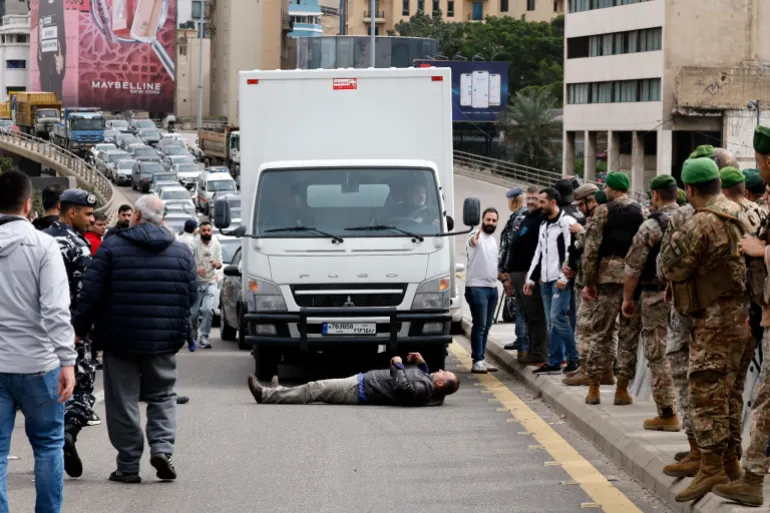
epa12749352 A taxi driver lies on the ground in front of a truck as taxi drivers block a main road with their vehicles during a protest in Beirut, Lebanon, on 17 February 2026. Taxi drivers blocked the Ring Highway with their vehicles to protest against the increased taxes and gasoline prices approved by the Cabinet during its meeting on 16 February. EPA/WAEL HAMZEH
A taxi driver lies on the ground in front of a truck as taxi drivers block a main road with their vehicles during a protest in Beirut, Lebanon, on February 17, 2026 [File: Wael Hamzeh/EPA]

On the morning of February 17, a handful of taxi drivers blocked the Ring Bridge in downtown Beirut to protest the rise in taxes. Later that evening, in Riad al-Solh Square, around 50 or so protesters gathered to express their discontent with the government’s decision.

“You have no housing, you have no loans, you have no safety, I mean, you live here in a prison, brother,” one angry protester told Lebanese television station Al Jadeed from the Ring Bridge protest.

His comments represent the frustration felt by many Lebanese – that the tax increases are yet another indignity the population must live through, including near-daily Israeli attacks and violations of the 2024 ceasefire, collapsing buildings in the north, and an ongoing economic crisis since 2019.

Salam doubles down

The last time a tax spike sent Lebanese people to the streets was in 2019. Anger in Lebanon had boiled after decades of economic and political mismanagement by the government. Then, as the country’s economy started collapsing, the government tried to implement a series of taxes, including on WhatsApp calls.

The response was widespread protests that collapsed the government, led at the time by then-Prime Minister Saad al-Hariri. But they failed to dislodge the wider sectarian system that many activists and experts say plagues Lebanon and prevents reform.

Last week’s protests were on a far smaller scale than 2019, however.

Then, protesters forced the government to walk back the taxes. But Salam, the prime minister, defended the tax hike on Friday. The government’s argument is that the taxes are necessary to pay salaries and pensions for state employees and retirees.

“We had to find a quick source to fund the raises,” he said. “These are exceptional measures… but the government wants to reform the tax system, not just impose new taxes.”

Salam also said that his government inherited a “very difficult” financial situation and promised that he would rebuild trust between the state and the people by working to establish a fair tax system.

Lebanon’s Finance Minister Yassine Jaber said the fuel price increase would take effect immediately, but that VAT increases would need parliament’s approval.

“More than 50 per cent of the budget today is allocated to salaries, and it was necessary to take steps to secure the funds,” he said.

VAT is a regressive tax

But not everyone agreed with the decision, including some ministers themselves. The right-wing Lebanese Forces bloc – which is part of the government coalition – voiced objection to the tax increase, calling for a study of the impacts.

Analysts, meanwhile, were heavily critical of the tax increase. They said that the rise of petrol prices and VAT would punish the country’s most vulnerable and would further widen the gap between rich and poor in Lebanon.

“The people who are most affected by value-added taxes are usually the poorest of the poor and the most vulnerable, given the type of their consumption, which is mostly filled of the goods and the services that are affected by taxation, and whereby the proportion of the taxation is significant,” Farah al-Shami, senior fellow and programme director for Social Protection at the Arab Reform Initiative, told Al Jazeera. “VAT is by nature the most regressive type of taxation. Studies have shown that it affects the full supply chain, meaning everything that goes into the production, for example, of a certain good is affected.”

A price increase at every step of the supply chain means that prices compound to end up being more expensive for consumers.

In 2019, decades of government mismanagement of the economy ended in the collapse of the banking sector and the depreciation of the Lebanese pound by over 90 percent. Before 2019, $1 was equivalent to 1,500 Lebanese pounds, whereas now $1 is valued at nearly 89,500 Lebanese pounds.

Many lost their life savings with the currency freefall. Banks quickly shut their doors and limited withdrawals. More than six years later, many Lebanese have not recovered, nor has the economy.

Scandalous undertaxing

The high cost of living is a regular talking point among Lebanese, particularly in the capital, Beirut. Many are struggling to make ends meet and rely on the $5.8bn in remittances from family or contacts abroad (these are 2024 figures).

With so many struggling, a tax increase that impacts the entire population is a recipe for anger. And analysts said that if the government is in need of tax revenue, there are plenty of undertaxed sources to draw from.

“Property in Lebanon remains scandalously undertaxed,” Dania Arayssi, a senior analyst at New Lines Institute for Strategy and Policy Luxury, told Al Jazeera. “Real estate in Beirut — some of the most expensive per square metre in the region — generates a fraction of the public revenue it could and should. Capital gains on property are minimal. Wealth held in land and assets is effectively sheltered. Similarly, luxury goods face no meaningful additional burden.”

Fouad Debs, a lawyer and member of the Depositors Union, a group founded after the 2019 banking crisis to protect the rights of depositors, said the decision went against the government’s stated goals of reform.

“All of this is to keep the [current] system intact and save the banks, instead of having them also pay the taxes that they should pay,” Debs said.

Source link

BBC criticised for nixing ‘Free Palestine’ tribute from BAFTA coverage | Israel-Palestine conflict News

Part of award-winning filmmaker Akinola Davies Jr’s speech in which he says ‘Free Palestine’ was not aired.

The BBC is facing backlash for editing out a section of its coverage of the British Academy Film Awards (BAFTAs) in which prize-winning filmmaker Akinola Davies Jr says, “Free Palestine”, even while a racial slur remained audible in the same programme.

Davies Jr, who was awarded outstanding debut by a British writer, director or producer for his film My Father’s Shadow, ended his acceptance speech on Sunday with words of solidarity to “those under occupation, dictatorship, persecution and those experiencing genocide”.

“To those watching at home, archive your loved ones, archive your stories yesterday, today and forever. For Nigeria, for London, Congo, Sudan, Free Palestine,” he said.

The remarks were absent when the British Broadcasting Corporation (BBC) aired the event on a two-hour delay, prompting accusations of censorship from some viewers and advocacy groups.

Rights group Amnesty International’s United Kingdom chapter described the move to cut the speech as “shameful”.

“Thank you Akinola Davies Jr for using your platform to speak out for the rights of migrants and people facing and fleeing from persecution and mass atrocities – from the Congo to Sudan to Palestine,” said Amnesty UK.

The controversy was further amplified after a racial slur was heard during a separate segment of the broadcast. The offensive language was shouted by someone in the audience while Michael B Jordan and Delroy Lindo read out an award for best visual effects.

The event’s host Alan Cumming had earlier informed the audience that one attendee was John Davidson, who advocates for people with Tourette syndrome, a motor disorder that sometimes causes quick repetitive movements or sounds, including inappropriate language.

The broadcaster apologised for not omitting the outburst when airing the event. It said it would remove it from the version of the broadcast available on its streaming service

“Some viewers may have heard strong and offensive language during the Bafta Film Awards,” said the BBC statement. “This arose from involuntary verbal tics associated with Tourette syndrome, and as explained during the ceremony it was not intentional.”

When contacted by Al Jazeera English, the broadcaster declined to comment further on its editorial decisions regarding the BAFTA Awards, including the removal of Akinola Davies Jr’s “Free Palestine” remarks.

The BBC has previously faced criticism for coverage related to Israel and Gaza.

In June last year, the BBC opted not to broadcast a documentary it commissioned about medical workers in Gaza due to what it described as “partiality” issues, a decision more than 100 of the broadcaster’s own journalists petitioned against.

The BBC was also previously accused of editing out pro-Palestinian displays during its coverage of the 2023 BAFTA Awards, including several appeals for a ceasefire in war-battered Gaza.

Source link

Are the US and Iran moving closer to war? | Donald Trump

Diplomacy continues despite the significant United States military build-up.

More talks are planned for Thursday between Iran and the United States, which is mobilising its largest military force since the invasion of Iraq more than two decades ago.

Amid mixed messages from US President Donald Trump, Tehran says it wants talks, but is ready for war, too.

So, where do both sides stand?

Presenter: James Bays

Guests:

Jamal Abdi – President of the National Iranian American Council

Hassan Ahmadian – Associate professor at the University of Tehran

Richard Weitz – Senior fellow at the NATO Defense College

Source link

Israeli settlers deface, set fire to West Bank mosque during Ramadan | Israel-Palestine conflict News

Attack on Nablus-area mosque is latest in surge of Israeli settler and military violence targeting Palestinians.

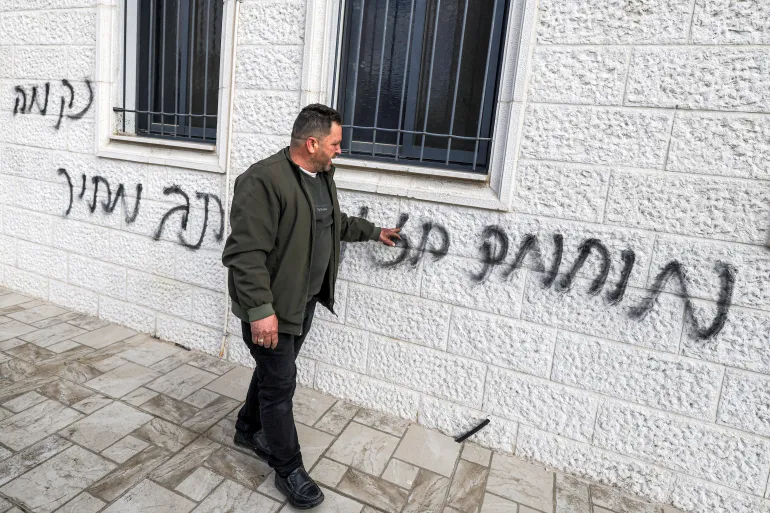
Israeli settlers have defaced and set fire to a mosque in the occupied West Bank during the Muslim holy month of Ramadan, marking the latest incident in a wave of Israeli violence against Palestinians in the territory.

The Wafa news agency reported on Monday that settlers graffitied racist slogans on the walls of Abu Bakr as-Siddiq Mosque, located between the towns of Sarra and Tal, near Nablus in the north of the West Bank.

Recommended Stories

list of 3 itemsend of list

Worshippers arriving for the day’s first prayers found the damage and a smouldering fire that spewed black smoke across the mosque’s entrance and stained the ornate doorway, The Associated Press reported.

“I was shocked when I opened the door,” Munir Ramdan, who lives nearby, told the news agency. “The fire had been burning here in the area, the glass was broken here and the door was broken.”

Ramdan told AP that security camera footage showed two people walking towards the mosque carrying gasoline or petrol and a can of spray paint, and running away a few minutes later.

The attackers spray-painted graffiti denigrating the Prophet Muhammad, as well as the words “revenge” and “price tag” – a term used to describe attacks by Israeli settlers against Palestinians and their property.

A man inspects offensive Hebrew graffiti on the walls outside the Abu Bakr al-Siddiq Mosque in the village of Tell, west of Nablus in the occupied West Bank, on February 23, 2026 following a reported attack by Israeli settlers.
A man inspects Hebrew graffiti on the walls outside the Abu Bakr as-Siddiq Mosque after the attack [AFP]

The assault comes amid a wave of intensified Israeli settler and military violence across the West Bank in the shadow of Israel’s genocidal war against Palestinians in the nearby Gaza Strip.

At least 1,094 Palestinians have been killed by Israeli troops and settlers in the West Bank since the Gaza war began in October 2023, according to the latest United Nations figures.

Last week, the UN Human Rights Council warned in a new report (PDF) that Israeli policies in the West Bank – including “the systematic unlawful use of force by Israeli security forces” and unlawful demolitions of Palestinian homes – aim to uproot Palestinian communities.

“These violations, together with pervasive and growing settler violence committed with impunity, are fundamental to the coercive environment that induces forced displacement and forcible transfer, which is a war crime,” the report said.

It added that these policies are aimed at “altering the character, status and demographic composition of the occupied West Bank, raising serious concerns of ethnic cleansing”.

Back in the West Bank village of Tal on Monday, resident Salem Ishtayeh told AP that the Israeli settlers’ assault on the local mosque was “directed especially” at Palestinians who are fasting during Ramadan.

“So they like to provoke you with words. It’s not that they are attacking you personally, they are attacking your religion, the Islamic faith,” Ishtayeh said.

A Palestinian man, holding Misbaha prayer beads, inspects the debris at a mosque, which Palestinians say was damaged by Israeli settlers, in West Bank village of Surra, near Nablus in the Israeli-occupied West Bank, February 23, 2026. REUTERS/Mohamad Torokman TPX IMAGES OF THE DAY
A Palestinian man inspects the debris at the mosque that was attacked by Israeli settlers [Mohamad Torokman/Reuters]

According to the Palestinian Authority’s Ministry of Religious Affairs, settlers vandalised or attacked 45 mosques in the West Bank last year.

The Israeli military and police said they responded to the latest incident and were searching for suspects.

But human rights groups say the Israeli authorities have allowed the settlers to operate with total impunity in their attacks against Palestinians.

Israeli organisation B’Tselem has accused Israel of actively aiding the settlers’ violence “as part of a strategy to cement the takeover of Palestinian land”.

The UN also warned last year that settler attacks were being carried out “with the acquiescence, support, and in some cases participation, of Israeli security forces”.

Source link

What is Christian Zionism, the pro-Israel ideology invoked by US ambassador | Israel-Palestine conflict News

United States Ambassador to Israel Mike Huckabee has faced condemnation from Arab and Muslim countries after suggesting Israel has a biblical right to much of the Middle East.

In an interview with prominent right-wing American commentator Tucker Carlson, Huckabee suggested that Israel has a God-given right to land stretching from the Euphrates River to the Nile, which would encompass Lebanon, Syria, Jordan and parts of Saudi Arabia.

Recommended Stories

list of 3 itemsend of list

It would be fine if they took it all,” he said, arguing that the geographical borders of Israel are rooted in the Bible, a belief shared by Christian Zionists.

The US diplomat, a self-professed Christian Zionist and staunch supporter of Israel, later walked back his comments, calling them “somewhat hyperbolic” and adding that Israel is not seeking expansion but has a right to security within its current borders.

But were his comments indeed hyperbolic in the Christian Zionist worldview? Or is that precisely what he and his fellow proponents of the ideology believe?

How did Christian Zionism begin, and what are its tenets?

In 1878, William Blackstone, a student of the prominent American evangelist Dwight Moody and a believer in the biblical restoration of Israel, published a book titled Jesus Is Coming. The best-selling work popularised among Americans a belief held by some Christian leaders: that God had given the land of Israel to the Jewish people.

This conviction, often taken from a Protestant evangelical perspective, draws on the ancient biblical idea that, nearly four millennia ago, God promised the land to the Jews, who would rule it until the return of Jesus to Jerusalem for the rapture. According to this theology, Christians will be saved upon Christ’s return while non-Christians who do not convert will face damnation.

The most commonly quoted Bible verse relating to this covenant is Genesis 12:3, in which God tells Abraham: “I will bless those who bless you and I will curse those who curse you and in you all the families of the earth will be blessed,” according to the Religion Media Centre.

According to ChristianZionism.org, a website run by professors, pastors and leaders of church-related organisations, four themes can be found in Christian Zionist thought: One, the founding of today’s nation-state of Israel in 1948 marked the final human era and signals an end of times. Two, the ongoing conflict in the Middle East is a part of God’s plan with a great and final war preceding the second coming of Christ. Three, God’s covenant with Israel is eternal and unconditional. And four, failing to support Israel’s political dominance today will incur divine judgement.

Writer and historian David Swift said that although many Christians – evangelical or otherwise – supported the creation of Israel before 1948, they cannot be called Christian Zionists in the modern parlance.

“This is because Christian Zionism essentially fuses religious belief with a military, strategic and even economic programme,” Swift told Al Jazeera.

“Specifically, Christian Zionism is not just the belief that the biblical land of Israel is the ordained country of the Jewish people but that it is in America’s strategic, military and economic interest to support the expansion of Israel.”

Fathi Nimer, a policy fellow at Al-Shabaka: The Palestinian Policy Network, described the movement as one that “translates into absolute unquestioning support for the Israeli regime”.

He described hearing a podcast about a Christian Zionist woman visiting Bethlehem who, after seeing the separation wall, Israeli soldiers and the harsh conditions in Palestinian refugee camps, remarked: “I feel bad for them, but scripture is scripture.”

“‘Scripture is scripture’ – that overrides everything,” Nimer told Al Jazeera.

“That’s why it’s such a powerful tool for brainwashing.”

How many American Christian Zionists are there?

According to author and academic Tristan Sturm, the largest population of Christian Zionists is in the US, and it numbers more than 30 million. Most are affiliated with evangelical churches in the southeast and south-central regions, often referred to as the “Bible Belt”.

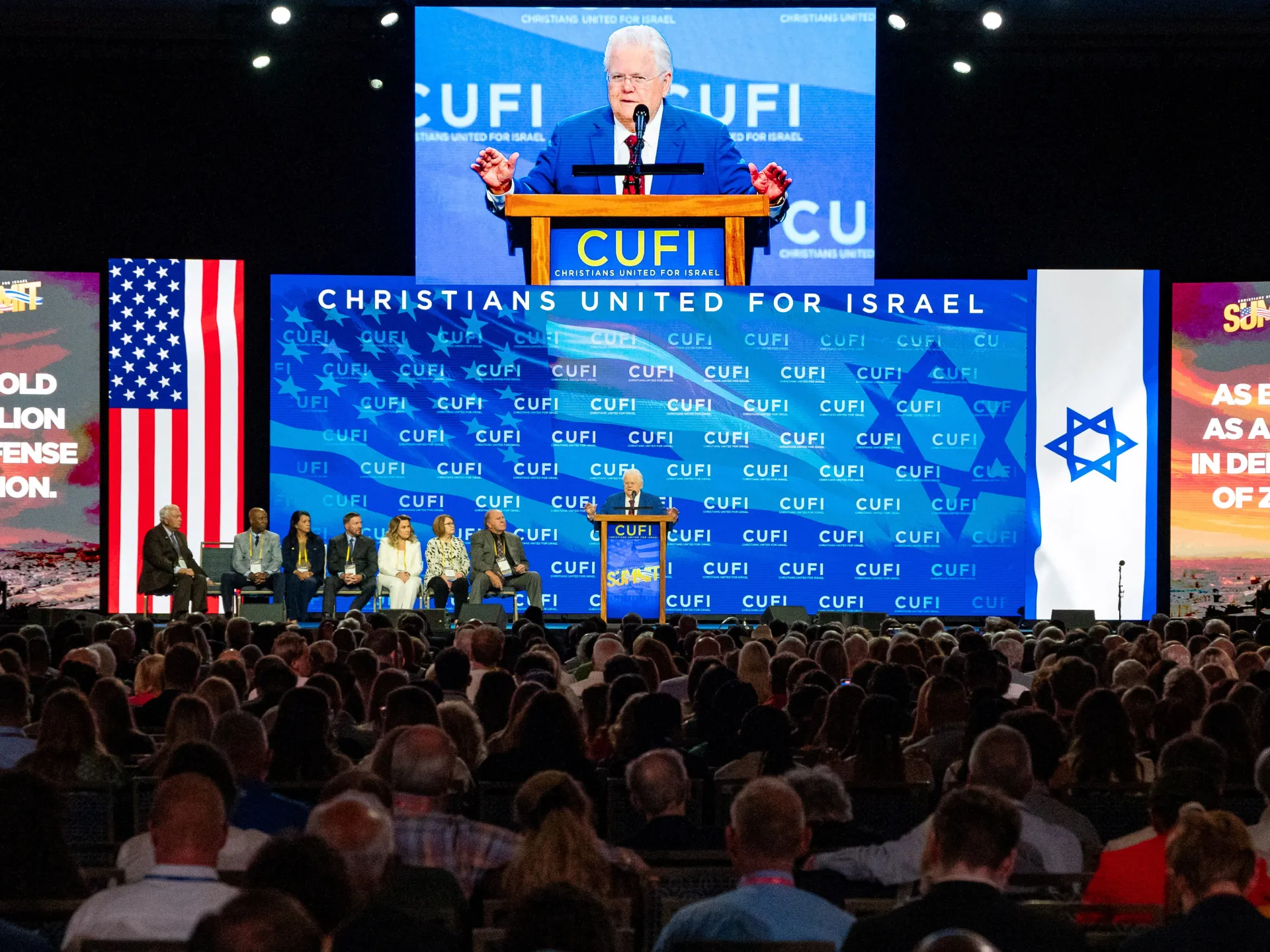
The biggest organisation is Christians United for Israel, which itself boasts 10 million members, Nimer said.

“They are overwhelmingly conservative Republicans, found mostly in the Bible Belt, but also other places in the United States, and they form one of the most formidable voting blocs in the Republican Party,” he said.

Swift stated that only a few million from this group, however, are “fully signed up to the political, military and religious aspects of Christian Zionism”.

What impact do Christian Zionists have on US policy?

Nimer argued that Christian Zionists are “deeply intertwined” with American politics. “A lot of the major donors to the Republican Party and also the Democratic Party are Christian Zionists,” Nimer said.

According to the analyst, Christian Zionists are a cornerstone of Israeli lobbying groups, ranging from the American Israel Public Affairs Committee (AIPAC) to the Anti-Defamation League, “that work to spread the Israeli narrative” in American society.

Meanwhile, a lot of members of the US Congress are “openly” Christian Zionist, Nimer said.

“[Politicians like] Mike Huckabee, … they reached the highest echelons of the state. And they bring these beliefs into their politics, into their policies,” the analyst said.

US foreign policy on Israel is, therefore, heavily influenced and shaped around the underlying biblical premise that the Jewish people are divinely destined to be restored to Palestine, he argued.

“When it comes to Palestine and the region in general, as you see right now with the [potential] war in Iran, they’re saying that the ballistic missile programme is now on the table,” Nimer said.

“It has nothing to do with the nuclear deal, … but the idea is that Israel must be able to maintain its superiority over every country in the region, and that’s a decree by God because if Israel prospers, then that’s another step towards the end of the world.”

Christian Zionist groups have also backed Israel’s illegal settlement project in the occupied West Bank and other measures that they see as reinforcing Israeli Jewish sovereignty.

Furthermore, for two decades, organisations such as HaYovel have been bringing in hundreds of American Christian volunteers to work in Israeli settlement agricultural projects, especially during the genocidal war on Gaza, when Jewish Israelis were called for military duty. Many also strongly endorsed US President Donald Trump’s moving of the US embassy from Tel Aviv to Jerusalem in 2017.

Swift, however, said Christian Zionists have played only a minor role in shaping US support for Israel and their influence is waning.

He argued that while Christian Zionism is integrated with a “broader neoconservative foreign policy agenda” also tied to the “US defence industry and broader military-industrial complex”, the group does not have much influence in American politics, and, in fact, it is declining.

Traditionally, US government support for Israel was driven by Cold War considerations and by pressure from the Jewish community within the US and lobbying groups like AIPAC. What played less of a role was support for Israel from evangelical Christians and the smaller community of Christian Zionists, Swift said.

“The US president is finally de facto abandoning the previous theoretical support for a two-state solution – although not for Christian Zionist reasons. When Trump talks of ethnically cleansing Gaza and turning it into a beach resort, he uses the language of real estate, not the Old Testament,” the historian said.

According to the analysts, very representative.

“It is pretty representative: Christian Zionists derive their understanding of the proper borders of Israel from the same place as people like [Israeli National Security Minister] Itamar Ben-Gvir and [Israeli Finance Minister] Bezalel Smotrich: the Old Testament. Therefore, they think Israel should expand to include all of the territory of ‘biblical Israel’,” Swift said, referring to the far-right Israeli cabinet members who have worked to expand and protect Israeli settlements and outposts in the occupied West Bank, which are illegal under international law.

Nimer said Huckabee’s statement is also not something that can be criticised within the Christian Zionist community.

“You’re not allowed to criticise that because it’s like you’re criticising prophecy and you’re criticising God and the return of Jesus,” he said.

Huckabee’s comments, therefore, come as no surprise despite infringing upon the sovereignty of US allies in the Middle East, Nimer said.

On Monday, Smotrich said Israel would eventually occupy the Gaza Strip and establish a Jewish settlement there despite a “ceasefire” that went into effect in October.

“We are giving US President Donald Trump the opportunity to do it in his own way. If he does not succeed in eliminating Hamas, the Israeli army will get international legitimacy and American support to do it,” he said in statements to Israeli radio.

How do Jewish Israelis view Christian Zionists?

Mimi Kirk, the director of the Institute for the Study of Christian Zionism and the associate director of Georgetown University’s Center for Contemporary Arab Studies, writes that “despite the matter of their supposed end-of-times demise according to this view, Jewish Israeli leaders have embraced the money and influence on US foreign policy that Christian Zionists offer,” especially as its adherents include top officials from the first Trump administration, including former Vice President Mike Pence and Secretary of State Mike Pompeo.

Nimer said it’s a rather “cynical relationship”, given that the Christian Zionist worldview, which sees all non-Christians going to hell, is “anti-Semitic to the bone”.

“But they support Israel, so it’s fine,” the policy analyst said.

“They care about what they can get out of them right now as the biggest support base in the West currently.”

Israel is further banking on this support because it is quickly losing its “progressive facade” of a “liberal democracy” with “all these progressive rights”, Nimer added.

“This has completely faded over the last few decades, and especially since the genocide in Gaza, this has become completely unacceptable.”

How do Christians in Palestine view Christian Zionists?

Palestinian Christians have long voiced concern that the Christian Zionist position threatens their existence, further entrenching Israel’s occupation while marginalising their community and undermining the historic churches of the Holy Land.

Just last month, the Patriarchs and Heads of the Churches in Jerusalem said activities by local individuals advancing “damaging ideologies, such as Christian Zionism” “mislead the public, sow confusion, and harm the unity of our flock”.

The Christian leaders warned that these efforts could undermine the Christian presence not only in the Holy Land but across the wider Middle East.

The statement came amid growing concern among Palestinian Christians that Israel’s policies – including land confiscation, settlement expansion and pressure on church property – are accelerating the erosion of one of the world’s oldest Christian communities.

Are there critiques of Christian Zionism among other Christians?

Criticism of Christian Zionists from within Christianity is abundant.

In the US, the Institute for the Study of Christian Zionism was created to critique and combat the movement through liberation theology, seeking justice for Palestinians and a resolution to the ongoing conflict.

Swift pointed out that many of the world’s most Catholic countries, from Ireland to those in South America and Southern Europe, “tend to be quite pro-Palestinian”.

Meanwhile, Palestinian Christian scholars “have written very detailed theological critiques of Christian Zionism”, Nimer said, as have pastors from other parts of the Global South.

A prize awarded by the Nelson Mandela Foundation last year was explicitly aimed at initiatives working against Christian Zionism, and a conference next month in Turkiye is being organised to combat the ideology, Nimer said.

“The world is waking up to how insidious this ideology is and how it creeps into societies and makes it impossible to have any kind of solidarity with Palestinians as long as they believe it,” he said.
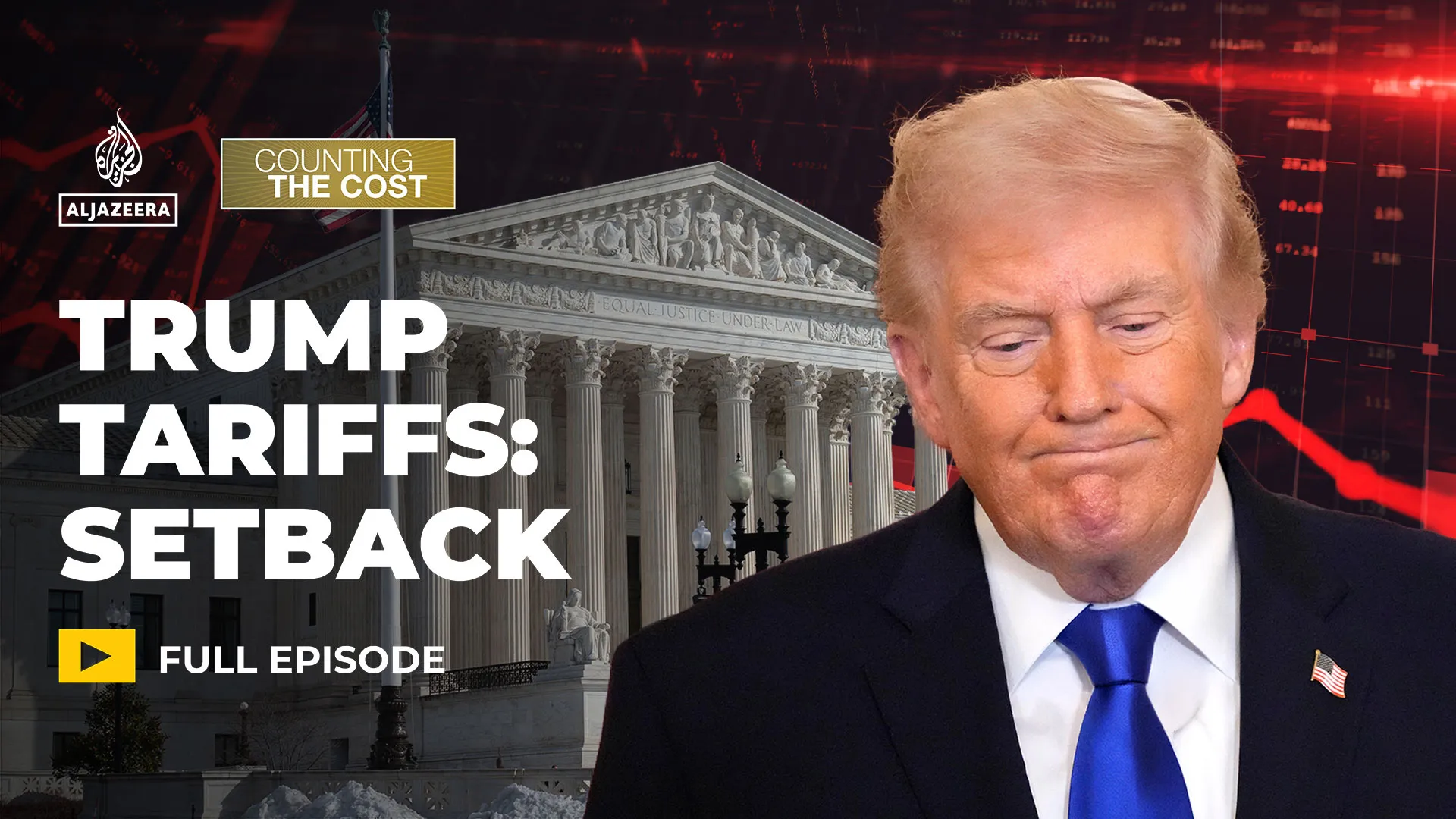
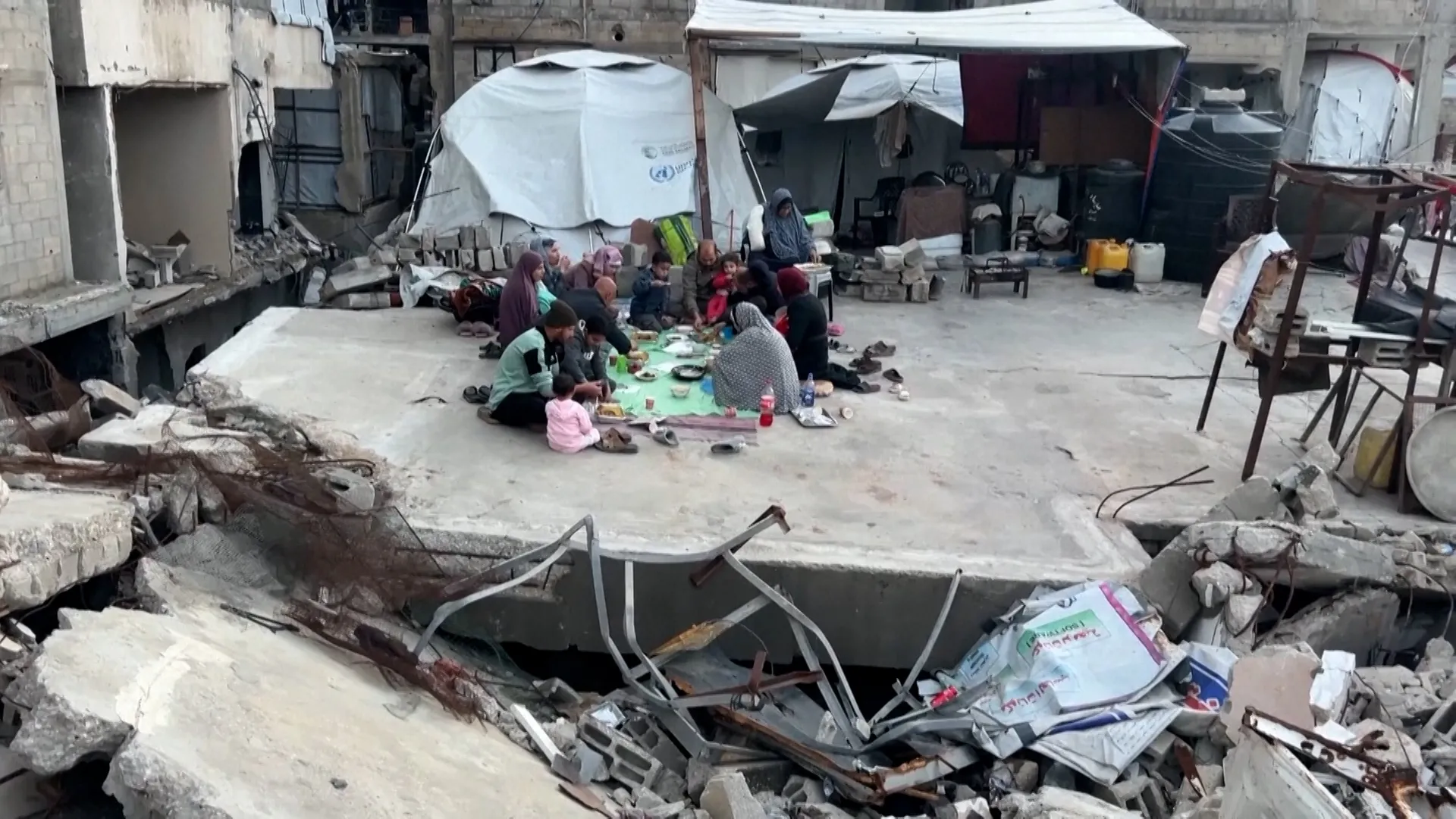
Source link

Iran says ready for talks but will defend itself against US aggression | News

Remarks from Ministry of Foreign Affairs come after Trump says he is considering an attack if a nuclear deal is not reached.

As a new round of talks between the United States and Iran is scheduled to take place in Geneva, Tehran has reiterated that it wants to find a diplomatic solution with the US on its nuclear programme but will defend itself if Washington resorts to military action.

Iran’s Ministry of Foreign Affairs spokesman Esmaeil Baghaei said on Monday that any US attack, including limited strikes, would be considered an “act of aggression” that would precipitate a response after US President Donald Trump said he was considering a limited strike on Iran.

Recommended Stories

list of 4 itemsend of list

“An act of aggression would be regarded as an act of aggression. Period. And any state would react to an act of aggression as part of its inherent right of self-defence ferociously, so that’s what we would do,” Baghaei said during a media briefing.

Trump said on Friday that he was considering a limited strike if Tehran did not reach a deal with the US. “I guess I can say I am considering that,” he said in reply to a question from a reporter.

On Sunday, ⁠Iranian President Masoud Pezeshkian said nuclear talks with the US have produced “encouraging signals” but warned that Tehran is prepared for any scenario in advance of another round of negotiations set for Thursday.

“Iran is committed to peace and stability in the region,” Pezeshkian wrote on X.

The two countries concluded a second round of indirect talks in Switzerland on Tuesday under Omani mediation against the backdrop of the largest US military build-up in the region since the 2003 Iraq war. They resumed talks in Oman this month.

A third round of indirect talks is scheduled for Thursday in Geneva, but the US has yet to confirm. Oman said on Sunday that the talks are set “with a positive push to go the extra mile towards finalising the deal”.

Iranian Foreign Minister Abbas Araghchi has been leading the negotiations for Iran while the US is represented by envoy Steve Witkoff and Trump’s son-in-law Jared Kushner.

‘Iranians had never capitulated’

Baghaei dismissed any claim that a temporary agreement had been reached with Washington, adding that speculation on the nuclear talks is not uncommon.

“We do not confirm any of the speculation. The details of any negotiation process are discussed in the negotiating room. The speculation raised about an interim agreement has no basis.”

Al Jazeera’s Tohid Asadi, reporting from Tehran, said there was a “mixture of optimism and pessimism” in Iran’s capital.

“Let’s call it a pragmatically calibrated cautiousness that we see when it comes to Iran’s statements over the past few weeks, specifically following the major military build-up by the Americans in the region,” he said.

He said Iran is considering both scenarios “on the basis of readiness for diplomatic engagement on the one hand and regional confrontation on the other hand”.

The Trump administration said it has been intensifying its build-up of an array of military assets in the Middle East during the talks with Iran. In an interview with the Fox News TV channel on Sunday, Witkoff said Trump was wondering why Iran has not “capitulated” in the face of the military deployment.

Baghaei on Monday stressed that Iranians had never capitulated at any point in their history.

“This is not the first time we have encountered contradictory claims,” the Foreign Ministry spokesman said.

“We leave the judgement to the discerning people of Iran and the country’s political elites to decide about Iran’s negotiating approach and, in turn, the negotiating approach of the United States,” he added.

“No negotiation that begins with an imposed burden and prejudgement will naturally reach a result,” the official said.

He also stressed that Iran’s positions on its nuclear programme and sanctions relief are clear-cut.

“Any negotiation process requires joint action, and there is hope for results if there is goodwill and seriousness on both sides,” Baghaei said.

Source link