Mayor

Mainstream California Democrats survived election night, but their brand remains challenged

When Nithya Raman stepped up to a podium on the night of L.A.’s mayoral primary election, she thanked her supporters for standing up to the “powerful interests” who spent millions of dollars trying to “preserve this city’s broken and unjust status quo.”

“At a time when so many people have written Los Angeles off or have lost hope in the future of this incredible city,” the democratic socialist L.A. mayoral hopeful said, “you are proof that Angelenos are hungry for change.”

But as election results rolled in, the movement for change was underwhelming, or at least divided. Incumbent Mayor Karen Bass was in the lead, advancing to the November runoff. That left Raman locked in a battle for a second spot with Republican former reality TV star Spencer Pratt.

Bass is one of several high-profile establishment Democrats to emerge on top. In California’s gubernatorial race, centrist Xavier Becerra, a veteran of the Biden Cabinet, advanced to the runoff after being challenged from the left by billionaire green activist Tom Steyer and Democratic former U.S. Rep. Katie Porter. Steyer is now behind Steve Hilton, a Republican, and battling to make the runoff.

Still reeling from the rise of Donald Trump, Democrats in California and beyond are struggling to figure out the future direction of the party.

Some progressives, inspired by Zohran Mamdani’s New York mayoral victory, saw 2026 as an opportunity to move the city further left. But the results have been mixed in key races, with veteran Democrats like Bass and Becerra eking out leads even as polls show dissatisfaction with status quo politics in California.

“This was supposed to be a change revolution, but voters clearly said no to the revolution,” said Sara Sadhwani, a politics professor at Pomona College. “Voters want change,” she noted, “but it doesn’t appear right now that there has been an appetite for a major shift in the ideology of the city or the state.”

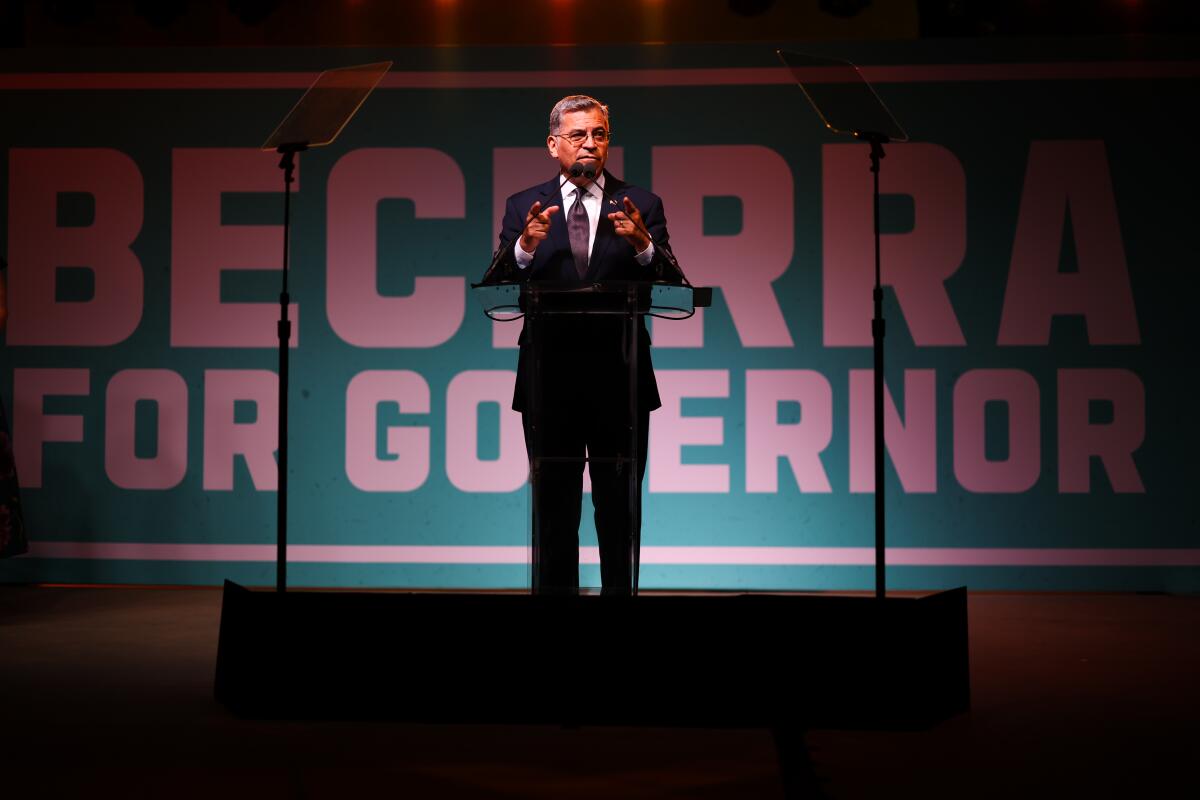
Xavier Becerra speaks during an election night event with Becerra for Governor on a large sign behind him.

Xavier Becerra speaks during an election night event in downtown Los Angeles on Tuesday.

(Eric Thayer/Los Angeles Times)

Becerra emerged as the Democratic favorite late in the election and won support from many establishment party leaders. Pundits said after a wild primary that included the implosion of Democratic U.S. Rep. Eric Swalwell’s campaign amid sex assault allegations, Becerra emerged as a “safe” choice.

Some opponents attacked his moderate views and his willingness to accept campaign donations from big oil companies like Chevron. But that did not stop his rise.

Bass was also beset with challenges, being an incumbent in a city beset with problems.

For her, election night marked a “victory with an asterisk,” Sadhwani said, noting that Bass is first incumbent L.A. mayor in more than two decades to face a runoff. “It would be wrong for Karen Bass to think that this victory … is a ringing endorsement of the work she is currently doing.”

The results underscore Bass’ unpopularity as an incumbent, garnering just 35% of the vote so far. If Raman can catch up and eventually surpass Pratt in the vote count, she could pose a considerable challenge to Bass as more young voters come to the polls in November.

Mike Bonin, a former L.A. City Council member who leads the Pat Brown Institute for Public Affairs at Cal State L.A., said if Bass exceeded expectations it was because they were very low.

“Coming in first in a runoff isn’t a huge victory for an incumbent mayor,” he said. “Two-thirds of the city did not vote for her. That’s not a position of strength.”

James Adams, a political science professor at UC Davis, said that Becerra and Bass coming through indicates the centrist Democratic candidates were in a stronger short-term position than their rivals. But problems loom ahead, he said, as the longtime Democratic establishment that’s been governing California for the last 15 years failed to make notable progress in solving problems with affordable housing, homelessness, public transportation and education.

“I think the Democrats’ prospects are very bright in 2026 given the California Republicans’ dysfunctionality and a complete backlash against Donald Trump,” Adams said. “But I have much bigger concerns about the California Democrats long term, because it seems to me they’re setting a record for most consecutive years of failing to fix the state’s problems while getting reelected anyway.”

Democrats in California, he said, were suffering from being in power too long.

“Whenever one party gets into a long-term, dominant position, usually because the other party is just in the midst of self-destructing … the whole thing ends in tears, because the party that is in a dominant position, they don’t have to be that good.”

As the vote count continues in the mayor’s race, democratic socialists in Los Angeles already have some wins down-ballot.

“We are gaining momentum,” said Leslie Chang, a co-chair of the 5,000-member L.A. chapter of the Democratic Socialists of America, a decentralized anti-capitalist group that advocates for rental protections and defunding the police. Over the last six years, Angelenos have elected four DSA-backed City Council members and a DSA-recommended city controller.

The DSA did not officially endorse Raman, because she entered the race after the group had issued endorsements and another DSA candidate was also running for mayor. However, three of the six DSA-backed candidates for citywide office were projected to win outright.

DSA Councilmembers Hugo Soto-Martinez and Eunisses Hernandez were reelected by such large margins they avoided runoffs. In the city attorney’s race, DSA-endorsed Marissa Roy was in the lead and the mainstream Democratic incumbent became the first city attorney ousted in a primary in nearly a century. City Controller Kenneth Mejia, a progressive anti-establishment candidate who is not a DSA member but an ally of the group, led by nearly 20 percentage points.

When Chang knocked on doors, she said, some voters asked: “Well, what’s the difference between Nithya and Karen Bass?”

A few voters told her that after reviewing Bass’ and Raman’s websites, they found their platforms similar. Chang was surprised. She thought Raman articulated a clear and novel strategy for how to get L.A. out of the housing crisis, but she said some on the left took issue with her working with housing developers to reduce red tape.

Neel Sannappa, chair of the California Democratic Party’s progressive caucus, said Raman was stymied by getting into the race late and having only a few months to campaign. It also didn’t help that a more left-wing challenger, Rae Huang, already had some momentum — not enough to win, but enough to split the left.

“Nithya does represent something real and growing in Los Angeles,” Sannappa said. “There is a hunger for more progressive, left-leaning candidates that want to make sure that we’re investing in people and not so much investing in just police … and being able to build things that are new and innovative.”

Supporters watch election results come in on their phones during Nithya Raman's election night party

Supporters watch election results come in on their phones during Nithya Raman’s election night party at Boomtown Brewery on Tuesday.

(Gina Ferazzi/Los Angeles Times)

Some have criticized Raman’s coalition-building, noting she was not endorsed by her fellow DSA-backed City Council members. Others said the MIT and Harvard graduate, who has been a councilmember for six years, performed tepidly in a May televised debate and suffered from Pratt’s attempts to tie her to the establishment.

“If you’re a part of the institution, which she is,” Sadhwani said, “then you can’t exactly claim that you’re going to bring massive change.”

Sadhwani said that California’s left, in contrast to New York’s, appears to have a charisma deficit. While Pratt and Hilton had an advantage with their television backgrounds, they also spoke “in plain terms about the real problems that the state faces.”

Part of Bass’ success can also be attributed to assembling a coalition that included the L.A. County Federation of Labor, the L.A. police officers union, the L.A. County Democratic Party and immigrant rights groups.

In the mayoral race, Sadhwani said, “the dominant political coalition still has power, money, the organization.”

“If you can garner the support of the unions, then having a broader message, maybe it’s less important,” she said. “You don’t have to work quite so hard, because the unions have the base machine.”

People with pro-Bass signs attend Mayor Bass' election party for the California 2026 primaries at a hotel.

People attend Mayor Bass’ election party for the California 2026 primaries at the LINE Hotel on Tuesday.

(Carlin Stiehl/For The Times)

Yusef Robb, a longtime Democratic strategist who is an advisor to Bass, attributed the mayor’s lead to her campaign’s success in building a broad coalition and communicating across the political spectrum. Most voters, he said, tend to think less about ideology — and whether a Democrat was mainstream or DSA-supported — than candidates’ positions on bread and butter issues.

“Mayor’s races are first and foremost about what people see outside of their front doors, when they walk their kids to school, when they drive to work,” he said. “At the end of the day, the voters look at the field and say, ‘OK, who do I trust to keep my kids from having to skip around a tent on the way to school?’ ‘Who can I trust to hire more officers?’ … and ‘Who can I trust to fight back against ICE in court through executive action and even in the streets?’ And that’s Karen Bass.”

For Democrats in this robustly blue state, part of the challenge in figuring a path forward is that every candidate — even those already in power — pitches themselves as a bona fide progressive against the status quo.

“We have led a grassroots campaign because we want to bring change to our city,” Bass said on election night. “And that’s what we’ve been doing, and that’s what we’re going to continue to do.”

Raman also tried to tout herself as a change candidate. Articulating her platform in broad strokes rather than bread-and-butter detail, Raman said she wanted L.A. to be a place “where government actually functions and delivers every day on this city’s beautiful bighearted values, where we stand up against ICE, where we show up for our gay and trans siblings.”

But as she talked of neighborhoods “full of trees and shade … and people and good food,” she seemed low-key and equivocal. Her message was a far cry from the pressing one U.S. Sen. Bernie Sanders (I-Vt.) put forward in his presidential campaigns, highlighting the millions of Americans working for “starvation wages” and a young single mother in Nevada struggling on $10.45 an hour.

Ultimately, the fight between Bass and Raman, as a struggle between mainstream and progressive Democrats, is complicated by the fact that Bass came up through the progressive wing of the Democratic Party, founding the grassroots Community Coalition in South L.A. in the 1990s.

Campaign worker Khai Dombroe prepares balloons before Nithya Raman's election night party.

Campaign worker Khai Dombroe prepares balloons before Nithya Raman’s election night party.

(Gina Ferazzi/Los Angeles Times)

And even though Raman is a DSA member, she has tacked to the center during the campaign, distancing herself from past calls to defund the police by saying she did not want the LAPD to lose more officers.

While Raman and Bass have much in common, the most significant difference between them is on homelessness, Sannappa said. Even though Bass comes from a political tradition of not wanting to criminalize the unhoused, he said, she understood her voters include people wanting to move homeless people off the streets.

“Brass tacks is that we need people that are going to be willing to fight for mental health services,” Sannappa said.

“I think Nithya more so represents the direction where the Democratic Party is going to have to go.”

As L.A. becomes less affordable and homeownership becomes out of reach for many Angelenos, young renters have become a rising political constituency — a shift that many say will likely propel the city leftward.

Bonin said he expected the next new rising Democratic coalition in L.A. to be a labor-renter coalition. He cited Councilmember Soto-Martinez, a renter and union organizer, as probably the best avatar of that.

But as the middle-class splinters along generational lines, other political experts warn that many ordinary Angelenos feel increasingly shut out of L.A. politics.

“Once upon a time the Democratic Party was the party of the working class, and today it has become the party of the educated elites,” Sadhwani said. “Perhaps one of the gifts that Donald Trump has given to Democrats is to force them to contend with the everyday issues of voters, which they seem to have distanced themselves from.”

As many Angelenos feel worse off now than four years ago, Chang said Bass was not directly responsible for every problem. Still, she said, she could have done more to move the city in the right direction.

Delaying the wage boost tied to the 2028 Olympics, she said, was a move that failed working people at a time when many are struggling to make ends meet.

“My fear, of course, is people pivot away from corporate Democrats and they choose the MAGA Republican, because that is the most visible fight,” Chang said. “Or because they think, ‘Oh, well, a democratic socialist running on the Democratic Party line, this is just more of the same status quo.’ ”

Source link

2026 primary election results: Here’s how your neighborhood voted for Los Angeles mayor

In the race for Los Angeles mayor, incumbent Karen Bass secured a place on the November ballot. But who will challenge her is yet to be determined, as votes are still being tallied.

With 62% of the expected vote counted, reality television personality Spencer Pratt sits in second place and City Councilmember Nithya Raman trails in third. Although Pratt has declared victory, the Associated Press, which estimates the expected votes in, has not called the race.

This story is based on a snapshot of precinct-level results provided by the L.A. County registrar on Wednesday. The Times analyzed the 525,326 votes processed so far. This story will be updated when winners are finalized in early July by the secretary of state.

This map shows the margin and density of votes by precinct. Areas where a candidate leads by a wide margin, such as Brentwood for Pratt, appear darker on the map. More densely populated neighborhoods — such as Bass strongholds in Baldwin Hills and Hyde Park — appear in brighter colors. As of Wednesday, an estimated 710,000 ballots were yet to be counted, according to L.A. County officials.

The preliminary results show narrow margins among precincts on the Eastside, with some precincts showing an almost 30% split across the top 3 candidates.

Bass retained a strong lead in precincts across South L.A. compared with her 2022 race against Rick Caruso. Pratt has garnered heavy support from his neighbors in Pacific Palisades, as well as precincts in Bel-Air and Shadow Hills.

Raman, who represents Los Feliz, Hollywood Hills, Sherman Oaks and Encino on the city council, has so far underperformed in her home 4th District. She led in 12 of the 66 precincts, particularly in parts of Los Feliz. A few precincts in East Hollywood swung heavily for Pratt; but Bass led much of CD-4.

To win the race outright, Bass needs to secure at least 50% of the vote. She currently holds 35% of the vote and a five-point lead over Pratt. A Berkeley IGS poll released last week found that Bass and Raman would likely defeat Pratt by double digits in the event of a runoff.

Mail-in ballots with a June 2 postmark will be accepted by county election officials through Tuesday.

Source link

If Pratt holds off Raman, the L.A. mayor’s race could be a holy war

L.A. Mayor Karen Bass made what sounded like a victory speech Tuesday night.

Councilmember Nithya Raman made what sounded almost like a concession speech.

And former reality TV star Spencer Pratt relayed a message from the heavens.

“Well, obviously God wanted five more months of me exposing all the failures of our mayor, so it’s gonna be a fun ride,” Pratt said. “I hope she’s ready.”

Assuming Pratt holds on to one of the two spots in the Nov. 3 general election as the final votes are tallied in the next few days, the smart money will be on Bass, for reasons I’ll get into in a moment.

But the supreme being and patron of all pontiffs has to be considered a wild card. This is the first time, to my knowledge, that an incumbent mayor in the City of Angels would be running against a challenger whose campaign manager is God Almighty.

So here we go. We could be in for one of the more remarkable electoral adventures in city history, with a complete novice and MAGA conservative going up against a liberal career politician in a deep-blue city and state full of people who are tired of hearing excuses from Democrats. (If Raman ends up ousting Pratt, my apologies for jumping to conclusions. But it’s not my fault. The devil made me do it.)

If you intend to follow closely, as of course you should, maybe you can help me count the number of times Pratt plays the faith card. I went to St. Peter Martyr School and attended the church by the same name, and I don’t recall ever hearing a nun or a priest drop God’s name as often as Pratt does.

In fact, I just watched a clip of Pratt talking to Fox News TV host and Donald Trump disciple Kayleigh McEnany, and over the course of 1 minute and 52 seconds, he mentioned God or Jesus 10 times.

“Thankfully, I married an angel who was very connected with Jesus and has brought me to the light,” Pratt said of his wife and former reality TV co-star Heidi Montag. “It’s been very empowering to just pray and just be on his path and just say, ‘God, if you want me to save these animals, save these humans and protect my city, just keep putting me in the place where I can do that.’”

Is he running for mayor or cardinal?

Look, I totally respect your average true believer. But I’m not entirely comfortable with a mayor who might be sitting around City Hall waiting for signs and smoke signals rather than knowing what to do on his own.

God has a lot on his plate. He might be busy multiplying fishes and loaves so people don’t go hungry thanks to the president’s tariffs and warmongering. Is he going to rush to answer a prayer for guidance about underfunded parks or broken sidewalks in Los Angeles?

How did we get here, you ask?

Well, Pratt is an AI creation, in a way. A composite of sorts. You combine the forces of social media, political rebellion, second-rate celebrity obsession and the Peter Principle, and here’s a little Trump puppet walking around L.A. like he’s the chosen one.

Add to that the very real essence of his appeal to some voters:

Los Angeles has problems. Big problems that don’t get fixed quickly enough or at all, and Pratt represents the angry voter who wants to know why City Hall can’t do better and where all the money went. He’s absolutely right when he says we shouldn’t have people living on the streets, using drugs on the streets and dying on the streets.

But if Pratt is in the general election rather than Raman, we’re in for a national media circus rather than a summit on solutions. Raman is well-versed on matters of relevance and could have pushed back against Bass in substantive, detailed ways. On the other hand, as Pratt has fairly argued, Raman headed City Council’s homelessness committee, so isn’t she partly to blame for the failures she tried to pin on Bass?

As for Pratt’s policy chops, he has not responded to my offers of a get-together. Absent that, and given his careful avoidance of local reporters who know their stuff, I read his platform on his campaign website and I can tell you that while he touches on many of the right issues — public safety, fiscal integrity, homelessness — attention to detail and depth of knowledge are not God-given strengths.

Maybe Pratt can actually deliver on his promise of a “treatment-led recovery model that addresses mental illness and addiction as the primary drivers of chronic homelessness.” But that would require an act of God (which I suppose is possible given their relationship), because those matters are primarily under the direction of the county, not the city.

This is the main problem here. Bass was beatable, and could have been pushed by a serious challenger to do better.

In the last election, Rick Caruso gave her a scare. That was partly because he had some depth on the issues, he was a successful businessman and philanthropist, he had served on the police commission and the water and power board, he had built relationships across the city and, along with his family, he had poured time and millions of dollars into underserved communities.

In this election, it looks as though Bass could get lucky and face off against a guy who lost his house in the Palisades fire, saw a few homeless encampments through his car window, and decided he wanted to be mayor. Some might have questioned his hubris, but only before learning that he was on a mission from God.

If you’re keeping count, that’s nine mentions of God so far in this column.

One more for the tie, with an eye toward five more months of campaign fodder.

Thank you, God.

steve.lopez@latimes.com
Source link

In deep blue California, frustration with Democratic status quo fuels governor, L.A. mayor race

As primary voters head to the polls Tuesday to determine which candidates will face off in November to become California’s governor and Los Angeles’ mayor, both races are wide open, with a new crop of candidates challenging the Democratic status quo.

For Democrats, little clear consensus has emerged so far on who should lead the city and state into the future.

In California’s crowded gubernatorial race, Democrats have struggled in recent months to settle on a candidate to succeed term-limited Gov. Gavin Newsom.

After former Rep. Eric Swalwell suspended his campaign in April amid allegations of sexual misconduct, Xavier Becerra, a former Biden cabinet member, inched ahead by positioning himself as the safe, experienced Democratic candidate. Another Democrat, billionaire climate activist Tom Steyer, and Republican Steve Hilton, a former Fox News commentator, trail close behind.

In L.A., experience seems to be as much a liability as an advantage.

Mayor Karen Bass finds herself in the extraordinary position, as an incumbent, of fighting to make the runoff as she is assailed from the left and the right. The latest UC Berkeley-L.A. Times poll shows Bass leading with just 26% of the vote, one point ahead of City Councilmember Nithya Raman, a wonkish Democratic socialist, and four points ahead of Republican Spencer Pratt, a former reality TV star.

“There’s a clear sense of frustration with the Democratic Party,” said Sara Sadhwani, a professor of politics at Pomona College. The reason a wave of conservative outsiders like Pratt and Hilton are doing so well in such a solidly liberal city and state, Sadhwani said, is that they’re more willing to spell out the challenges that L.A. and California face.

“Democrats tend to be very concerned about not upsetting one coalition or another, so it’s politics as usual with many of the Democratic candidates,” Sadhwani said. “Spencer Pratt has blown a hole in that by just naming the problems that everyday residents and voters are seeing and feeling on the ground.”

On homelessness, many Angelenos are frustrated Bass hasn’t significantly moved the needle.

“We can point to facts and figures that might suggest that things have changed,” Sadhwani said. “But when you walk down the streets of Los Angeles, it doesn’t feel like it, so she hasn’t passed the field test. That’s the problem.”

A growing segment of Angelenos also chafe at the city’s high cost of living. And many are angry about the Bass administration’s lack of preparation and response to the 2025 Palisades fire.

“The Democrats have to account for those challenges,” Sadhwani said. “They have been in power for all of this time.”

California, of course, remains a Democratic stronghold, and polls show state voters are overwhelmingly opposed to President Trump. His second-term agenda — including a sweeping immigration crackdown, tariffs and the war in Iran — only seems to have cemented California’s status as a resistance state.

But after so many years of Democratic dominance, in Sacramento and at Los Angeles City Hall, leaders have to answer for voter frustrations.

The top two vote-getters in California’s nonpartisan primaries will advance to theNovember runoff, unless one candidate manages to pick up more than 50% of the vote.

Republicans have turned out at higher rates than Democrats in early voting. Paul Mitchell, vice president of the Sacramento-based bipartisan firm Political Data Inc., said that older Democrats who reliably turn in their ballots were slower to vote this year, likely because two Republicans were on the gubernatorial ballot and the Democratic field was fractured.

“That has caused them to dive into a lot more strategic voting,” Mitchell said, noting many seemed to be waiting to cast their ballots for the Democrat who looks to have the best chance of moving on to November.

For the GOP, getting a candidate on the November ballot for governor means more than just demonstrating Republicans are players in California. A GOP candidate would bring out more Republicans to vote in the general election, raising the party’s prospects of winning down-ballot races and passing a GOP-led ballot initiative on voter ID.

For Democrats, the midterm races offer the party its first major chance to chart a new path for the future.

As polls show Trump cratering in popularity, Democrats in California and beyond are struggling a year and a half after Kamala Harris’ bruising 2024 defeat to agree on what went wrong.

The Democratic National Committee’s long-awaited autopsy of that election — which said Harris “wrote off rural America,” wrongly assumed identity politics would win over voters of color and failed to develop “defined or consistent” strategy against Trump — has only generated more hand-wringing.

“There is not a clear vision, there is not a clear policy agenda, and the Donald Trump presidency upended the policy world as we knew it,” Sadhwani said. “It’s unclear how any Democrat, including any of the individuals in these two races, is going to navigate the waters into the future. One thing is for certain: We aren’t going back. So, which of these candidates is going to lead us into an uncertain future?”

Referendum on Bass

In L.A., the election is a referendum on Bass, who pledged in 2022 to solve homelessness, cut crime and make the city more affordable.

“How has L.A. changed in four years?” said Christian Grose, a professor of political science and public policy at USC. “The Bass campaign is saying it has changed for the better and she still needs more time. All the other candidates, from very different perspectives, are saying that it’s much worse than it was four years ago, and it’s time for new leadership.”

Bass told The Times she plans to win in November by demonstrating her administration’s progress in clearing homeless encampments and accelerating the building of affordable housing. She has also noted that data shows homicides in the city are at their lowest since 1966.

Challenging Bass from the left is Raman, who was elected in 2020 as the first DSA-backed L.A. City Council member. Pitching herself as the viable progressive in the race, Raman has accused Bass of not doing enough to make the city affordable and critiqued Bass’ spending on Inside Safe, her program to move unhoused people into stable housing. Although Raman presents herself as an outsider, she is a former Bass ally who has chaired the council’s Housing and Homelessness Committee for more than three years.

“She’s absolutely a part of the establishment,” Sadhwani said. “She’s been in City Hall longer than Karen Bass.”

As Raman tacked to the center during the campaign to appeal to more moderates and distanced herself from past calls to defund the police, she alienated some DSA members who complained they didn’t know what she stood for. Her three fellow DSA City Council members endorsed Bass.

Pratt is challenging Bass and the entire Democratic status quo.

A former star of “The Hills” who lost his home in the Palisades fire, he has surprised many political observers with his success assailing the city’s handling of the 2025 firestorms. He has called unhoused people drug-addled “zombies” and argued that L.A.’s housing crisis requires heavy-handed policing.

Pratt has raised vastly more campaign contributions than Bass and Raman. He has also generated national online buzz by waging an aggressive social media campaign and inspiring supporters to post a stream of viral AI election campaign ads.

Still, most political experts agree that Bass has the most viable path to victory, starting with a solid base of Black voters and a large share of Latino voters, plus support from powerful unions.

“Under normal circumstances, or at least under historic circumstances, that would be plenty to get her over the finish line,“ said Jim Newton, executive director of UCLA Blueprint magazine and a former political journalist for The Times. “What’s problematic for her is that there are people who are angry with her.”

A reset in California

Newsom has emerged in recent years as the national face of Democratic resistance to Trump, bolstering California’s status through a barrage of lawsuits and all-caps trolling against Trump.

Whatever candidate replaces Newsom, things are going to be different.

The emerging front-runner, Becerra, is a safe-bet career politician who has served as California attorney general and U.S. secretary of Health and Human Services. Asked recently why he had climbed in the polls, Bercerra said he thought voters wanted experience, not “glitz and sizzle.”

He has pledged to issue executive orders declaring California’s housing shortage a state of emergency and directing state agencies to maintain coverage for every Californian affected by federal or Medi-Cal cuts. He also touts his record, as the state’s attorney general, of suing Trump 122 times.

Steyer, a hedge-fund billionaire, calls himself “the most progressive candidate on the ballot.” He has pledged to build one million affordable homes, make the wealthy pay more taxes, and defend the environment — stances that are certain to unsettle Sacramento lobbyists and test the limits of California’s progressivism. But his past investments in coal plants and ICE prisons raise questions for some voters.

“His wealth is in one way his Achilles heel in the election,” Grose said. “Voters think of him as a billionaire more than progressive.”

Republicans seem to have rallied around Hilton — a British immigrant and former top strategist forconservative prime minister David Cameron — who has secured Trump’s backing and is campaigning on the message that California is a failed state in need of radical reform.

Hilton has pledged to cut government spending, make housing more affordable and bring gas prices down. But to achieve some of his goals he would scale back public services and environmental regulations and ramp up domestic production of oil and natural gas — strategies that many Californians might hesitate to get behind.

Whichever candidates make it to the runoff, the California Democratic Party will face questions about its strategy and vision. Less than two months ago, the party chair had urged Becerra to drop out of the race to make way for Swalwell.

“Clearly, the party itself has lost its way in California,” Sadhwani said. “I would not be surprised if the California Democratic Party looks for new leadership after this election.”

Can a Republican win?

Because the top two spots in each contest are up for grabs, elections experts warn that the vote results may not be known for days.

If Republicans make it to the runoff, they face steep odds of being elected in November in a state where Democratic registered voters outnumber Republicans by more than 20 percentage points.

Rob Stutzman, a GOP strategist, said neither Hilton nor Pratt was likely to win. But if they made the runoff they could have a huge impact on the political environment by advancing “grievance issues that really put up a spotlight on what I call the blue state incompetence.”

Of all the candidates, Mitchell said, Pratt as an outsider adept at Instagram and TikTok has the greatest opportunity to create a new surge electorate. But he’s also going after the hardest voters to get to turn out: disaffected voters who are upset at the system.

Pratt had more retweets and viral videos than any other candidate, Mitchell said. “But that doesn’t buy him the vote of the disaffected DoorDash driver who believes that the system is broken, and who hasn’t voted in the last five elections.”

If Republicans don’t make it past the primary, Mitchell said, Democrats would likely hit the reset button.

“Pratt running has kind of obfuscated the differences between Raman and Bass,” Mitchell said. “It’s like a WWE match versus a chess match. I think Raman versus Bass would be more of a strategic and nuanced election than Spencer Pratt trying to hit Karen Bass over the head with a chair.”

Source link

Live Election 2026 primary results, updates: who won Los Angeles mayor, city council, LAUSD

Elections in the city of Los Angeles include mayor, City Council, three ballot measures and Los Angeles Unified School District board seats and, if you live in the city, you’ve maybe seen an ad about them.

The high-profile competition between incumbent Mayor Karen Bass, City Councilmember Nithya Raman and conservative reality star Spencer Pratt has been tumultuous. And that is to say nothing of Rae Huang, Adam Miller and the nine others contenders.

With leaked files, millions in campaign fundraising donated by a candidate’s mother, and a multi-campaign effort by L.A.’s chapter of Democratic Socialists of America, the race for mayor isn’t the only one making headlines this primary.

A candidate can win by getting a majority of the vote. If no one receives 50% + 1 vote, the top two advance to the November election.

Mayor

The Associated Press, which surveys the numbers posted by local election officials and projects the winner using vote returns and other data, will call a winner (or a runoff) for L.A. mayor.

City Council

Back to top

Officers

Back to top

Ballot measures

Back to top

Los Angeles Unified School District

Back to top

Source link

Bass, Raman or Pratt? Three L.A. residents explain who got their vote for mayor

As the voters deliver their ballots to neighborhood drop-off sites and others wait to vote in person Tuesday, Times reporters fanned out across the city to ask residents whom they planned to support for mayor.

Here is a sample of what voters said about their preferred candidate.

‘The other choices were not worth my vote’

Steven Travers
57
Glassell Park
Self-employed

Voter Steven Travers told The Times that he didn’t feel like there were many options for him in the mayoral election this year, except for the incumbent Karen Bass.

Shopping at Vons in Echo Park, Travers said, “Just what I’ve seen of her, and you know, the way she speaks, she seems to be OK.”

“I guess she’s done an OK job since she’s been the mayor,” Travers said. “The people she’s running against, I mean, there’s really nobody else that I think I would want to be in that position.”

This decision to vote for Bass, despite the wide field of options, came down to how she had handled homelessness in the city and Travers’ neighborhood of Glassell Park, where there had been homelessness issues “for a period of time.”

The issue, Travers said, has been lessened and “certain areas things are getting a little bit cleaned up. And I’m assuming that she’s, you know, part of that whole thing.”

Travers also said that “anybody involved in politics in Los Angeles” seems to always talk about homelessness “more than anything else” and that Bass “seems to be trying to maybe do something about it.”

Simply put, “The other choices were not worth my vote,” Travers said.

Looking for a more humane L.A.

Zorah Archie-Winston
22
View Park
Recent USC graduate

Zorah Archie-Winston said that she’s probably voting for Nithya Raman for mayor.

“If I had to choose, like, right now, I think I’m leaning more towards Raman,” Archie-Winston said.

One of the main reasons for that, she said, is Raman’s personality and the humanity she brings to the table.

The 22-year-old View Park resident said that the unhoused population is something she feels very passionately about, and she believes Raman shares that.

“We could have, like, a lot more of a compassionate view on the unhoused population and those adjacent,” Archie-Winston said.

She said she’s been following along with Raman’s journey on the L.A. City Council and looks forward to seeing what the candidate could do as mayor, especially for tenancy rights.

“I think there are a lot of resources and things that are really inaccessible to those who are struggling to live in L.A. for one reason or another, and I think that’s something Raman will be able to help with,” Archie-Winston said.

‘He might be our only saving grace’

Ann Raljevich
66
Westchester
Medical biller

Ann Raljevich, a 66-year-old medical biller, says Spencer Pratt could be the city’s hero in the mayoral race.

“I think he might be our only saving grace,” said Raljevich, of Westchester.

Under the city’s current leadership, Raljevich tells The Times, she said she hasn’t seen change in the city. She said she still sees the same unkempt streets, drug addicts around town and high sales taxes.

“Being in the medical field — the drugs bring on the schizophrenia and bring on all the other things, and I mean, I see it when I drive in and out of town,” Raljevich said. “I see it everywhere.”

Raljevich said she also admired that Pratt was from Southern California and graduated from USC.

She said the fact that he hasn’t directly declared a political party affiliation shows that he doesn’t care what people think and is just here to do the job.

“He never really came out to say whether he’s a Republican or a Democrat,” Raljevich said. “He’s just for the people.”

Source link

What’s on the ballot in the 2026 election in California?

The June 2026 election has been dominated by a down-to-the-wire governor’s race that has been filled with drama, scandal and much national attention.

A large group of Democrats are vying to replace Gov. Gavin Newsom in this very blue state. But the candidates have — until recently — struggled to generate wide excitement, and it’s far from clear who will win. On the Republican side, commentator Steve Hilton has benefited from the divided Democrats (and a Trump endorsement) to remain near the top of the pack in polls.

But the governor’s race is far from the only vital decision voters will make.

Los Angeles residents will vote for mayor in a race that is far from certain. And there are numerous state, county, local and judicial candidates to choose from.

Here is a breakdown:

When is the election?

The election is Tuesday, but early voting has already been already under way.

You can find your polling place here or by calling (800) 345-8683. All polling locations are open on election day from 7 a.m. to 8 p.m.

Once it’s cast, you can track your ballot here.

An illustration of an arrow flowing into a ballot drop box

(Photo illustration by Nicole Vas / Los Angeles Times; Francine Orr / Los Angeles Times)

What are the big statewide races?

Let’s start with the race for governor, of course. With Newsom term-limited, Democrats and Republicans are competing for California’s open gubernatorial seat in what could reshape the state’s political landscape. Democrats went in hoping for easy sailing, but a wide field and no superstar name has left the race something of a tossup, though Xavier Becerra has been rising in recent polls. On the Republican side, Hilton continues to poll strongly.

There is a possibility California could make history: The state has never has elected a woman as governor, and only once has a person of color held the office.

But there are many down-ballot statewide races as well,

photo illustration of Los Angeles City Hall with a ballot in the background

(Photo illustration by Nicole Vas / Los Angeles Times; Mark J. Terrill / Associated Press)

What are the big L.A. races?

The L.A. mayor’s race is grabbing all the attention. Polls show the leading candidates are Mayor Karen Bass, City Councilmember Nithya Raman and community activist and former reality TV personality Spencer Pratt. Those same polls show Bass has struggled in the aftermath of the 2025 firestorms, a big issue for Pratt. Another major topic is affordability, which Raman has taken up.

But there are several other competitive races plus ballot measures.

What are the big L.A. County races?

These contests don’t get the attention of the mayor’s and governor’s races, but L.A. County voters have a lot of choices to make.

What’s left?

Source link

L.A. mayoral hopefuls Bass, Pratt and Raman make final primary push

The leading candidates for mayor fanned out across Los Angeles this weekend to make their final cases to voters ahead of Tuesday’s hotly contested primary election.

An energized Mayor Karen Bass galvanized crowds of labor union workers sporting union merch Saturday. “Four more years!” crowds chanted as a slew of local and state Democratic heavyweights joined the incumbent.

City Councilmember Nithya Raman spent the day dashing between local restaurants and bars in an old-school yellow Scout convertible to meet with business owners and her supporters.

Meanwhile, former reality TV personality Spencer Pratt hosted a block party in Baldwin Village with barbecue food, free merch and American-flag lawn chairs — although he spent much of the event off to the side, listening to the concerns of Black residents.

Recent polls have placed Pratt and Raman within striking distance of Bass, who had enjoyed a comfortable lead for much of the campaign. A recent survey, co-sponsored by The Times, had Bass at 26%, Raman at 25% and Pratt at 22% — with a roughly 3% margin of error in either direction and 10% of voters undecided.

The top two candidates in Tuesday’s jungle primary will advance to a November runoff, unless one candidate manages to garner over 50% of the vote.

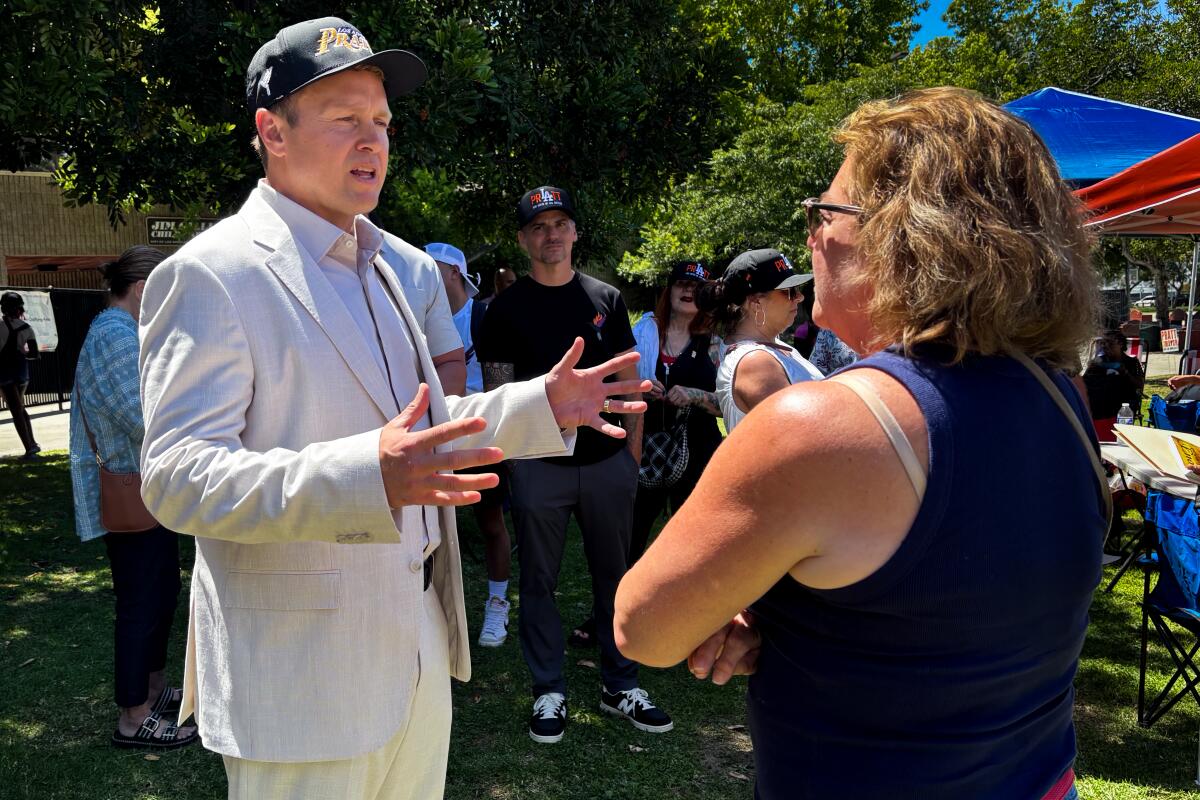
Spencer Pratt, in a beige suit, speaks to a woman at an outdoor event.

Mayoral candidate Spencer Pratt speaks with Diane Waterhouse, a caregiver and Westchester native, about homelessness and drug addiction at a campaign event Saturday in Baldwin Village. “We just talk about it like, ‘oh it’s Skid Row, that’s just where the drug addicts are.’ No, there’s communities, there’s kids, there’s people that work there, businesses,” Pratt said.

(Noah Haggerty / Los Angeles Times)

“I believe God moves mountains; I believe that you can get that 51% on that Tuesday,” Diane Waterhouse, a 60-year-old caregiver, told Pratt at his Baldwin Village event.

On the lawn of Jim Gilliam Park on Saturday, supporters from across the city chanted Pratt’s name, took selfies in front of black campaign vans with his hummingbird logo and ate cookies decorated with his face as kids raced around on scooters and played with the handful of dogs attending.

But Pratt — who had spent the morning at the West Los Angeles Animal Shelter speaking with animal welfare advocates — headed toward the nearby recreation center to talk with residents away from the cameras.

“Most people that come here and want our vote — we give y’all our vote; we’re still living like this. Nothing changes,” Erica Helon, a 40-year-old bus driver, told Pratt in one of the most tense moments of the event.

Pratt, wearing a beige suit and a hat with his name stylized like the L.A. Lakers logo, emphasized he was in South Los Angeles to listen and wasn’t even asking residents for their votes. He pulled Helon aside and gave her his personal phone number so they could talk more.

“I’m here because I want to be a voice for the community,” he said at one point. “I’m here because I don’t know what I don’t know.”

Helon, who is still undecided, left the event open-minded on Pratt.

“I would love to see what he’s going to do for this city,” she said.

Nithya Raman stands in a group photograph with others

Los Angeles mayoral candidate Nithya Raman joins a group photograph during a campaign stop Sunday with SevaSphere volunteers after preparing meals for people experiencing homelessness at Oaks Kitchens.

(Kayla Bartkowski / Los Angeles Times)

Raman, who has made publishing detailed policy plans a staple of her campaign, spent Saturday meeting with local restaurant owners after recently dropping a policy plan for small businesses.

Around sunset, the yellow convertible pulled up to Lowboy Bar, an Echo Park staple. Raman, sporting a Japanese Dodgers hat and a rainbow City Council fanny pack, joined campaign staff for drinks at tables covered in “Nithya Raman for Mayor” pins.

A few young Angelenos, starting out their nights in trendy getups, recognized Raman and stopped by to chat and take pictures.

“I’ve lived in L.A. for 12 years. It’s a very, very important city to me,” said Ryan Bergeron, a 35-year-old who works in marketing and does art on the side.

Bergeron, who is on the Echo Park neighborhood council, hopes Los Angeles can serve as a “beacon in an otherwise scary time in the country” as it tackles affordability, the housing crisis and sustainability issues.

As for Raman, “I’ve seen her as a councilmember and been really proud of that,” Bergeron said. When she announced her candidacy for mayor, “It felt like everything really clicked.”

Mayor Karen Bass wears a red apron and stands next to Monica Rodriguez.

Mayor Karen Bass and Councilmember Monica Rodriguez attend the Los Angeles Democratic Party and Avance Democratic Club Carne Asada Tour, a community event held Saturday at the Yosemite Recreation Center. Avanceis one of the country’s largest Latino Democratic clubs.

(Karla Gachet / For The Times)

Bass, conversely, wound down after a day of union rallies by eating tacos at the Yosemite Recreation Center’s picnic tables in Eagle Rock with several local politicians, including Councilmember Monica Rodriguez and county Democratic Party Chair Mark Ramos.

California Atty. Gen. Rob Bonta and L.A. County Sheriff Robert Luna had joined Bass earlier in the day. Although Luna missed out on the picnic, he still enjoyed several tacos in his car.

Come Sunday, Raman, wearing jeans and a chartreuse cardigan, was greeting bike riders at a Sawtelle coffee shop and speaking to a phone bank group at UCLA.

“It is absolutely essential to making sure that our little campaign, without all the political machine behind us, without MAGA millions behind us, that our vision of Los Angeles still manages to get out to the people, and your work today is an essential part of that,” Raman told a group of United Auto Workers-represented graduate students from multiple nearby universities.

She had several other appearances scheduled for the rest of the day, including lunch with a group of Korean American Democrats in Koreatown, Encinofest, a block party in Silver Lake and a visit to Boyle Heights.

“There seems to be increasing awareness about the race and excitement about the issues,” Raman told The Times. “It’s been really exciting to see people engaging and feeling positive about the city’s future.”

About two dozen students spoke to potential voters associated with UAW and urged them to mark Raman’s name on their ballots by Tuesday.

Stephanie Wert, a 30-year-old psychology graduate student at UCLA and head steward for UAW, said the phone bank could determine whether Raman’s campaign would survive the week.

“This vote is going to be decided on the margins, and so I think we could really make the difference that pushes her to the runoff,” Wert said.

Bass peeked around the back doors of a supporter’s Venice home Sunday afternoon to cheers from several dozen supporters at an intimate event. Speaking over small snack plates and beverages, many said they saw real improvements in the homeless populations around their neighborhood during Bass’ tenure as mayor.

Tatiana Barhar, a Venice resident for over 30 years, said she saw in real-time an “extreme” homelessness problem get better during Bass’ term, thanks to her Inside Safe program. “I want to support her,” she said. “I think there’s a lot more she can do.”

Bass spoke of 1960s-level crime rates, thousands of unhoused people pulled off the street into housing and efforts to build up Hollywood during her time as mayor. “We got a lot to do,” Bass said. “We have such a bright future in the nation’s second-largest city, and I hope that you will continue to be there with me as we win.”

Pratt’s moves on Sunday remained more elusive. His campaign emphasized he was hoping to have intimate moments with L.A. communities, instead of a media and influencer frenzy like some of his previous, more widely publicized events.

One of those more intimate moments was a community event in a Latino neighborhood near downtown L.A. on Sunday morning. Pratt had spent Thursday in New York for some national media interviews to “get the message to as many people as possible.”

Source link

Newark mayor imposes curfew at Delaney Hall immigration detention centre | Protests News

Ras Baraka, the mayor of Newark in New Jersey, has imposed a curfew on the area surrounding Delaney Hall, the immigration detention centre that has become a flashpoint in the debate over United States President Donald Trump’s mass deportation drive.

The Sunday morning announcement came amid a flare-up in tensions outside the detention centre, which is run by the private contractor GEO Group, as part of a 15-year deal with Immigration and Customs Enforcement (ICE).

Recommended Stories

list of 3 itemsend of list

“Due to the escalating situation at Delaney Hall and the increasing need for police intervention, immediate action is required to protect public safety,” Baraka wrote in a statement.

“Multiple individuals have already been arrested and found in possession of weapons, underscoring the seriousness of the threat.”

As part of the curfew, movement will be restricted within half a mile (0.8km) of the detention centre between the hours of 9pm and 6am US Eastern time (1:00 to 10:00 GMT).

A nearby road, Doremus Avenue, will also be closed to pedestrians and vehicles that cannot verify their need to be in the area.

Since the reopening of Delaney Hall as an immigration detention facility last year, it has been the site of confrontations between law enforcement and protesters, including Mayor Baraka himself.

The month of May has seen more than a week of daily protests outside Delaney Hall, after lawyers for the detainees at Delaney Hall announced a hunger strike was unfolding inside.

Detainees have denounced the living conditions to human rights groups, reporting expired food, a lack of medical care and abuse at the hands of authorities.

The Trump administration has justified its mass deportation campaign as an effort to rid the US of “the worst of the worst”, framing undocumented immigrants as a criminal threat.

But critics point out that many of those detained have no criminal record, and some who do have only been cited for minor offences.

The Transactional Records Access Clearinghouse, a data-tracking service from Syracuse University, found that, as of April, roughly 71 percent of those in ICE detention had no criminal conviction.

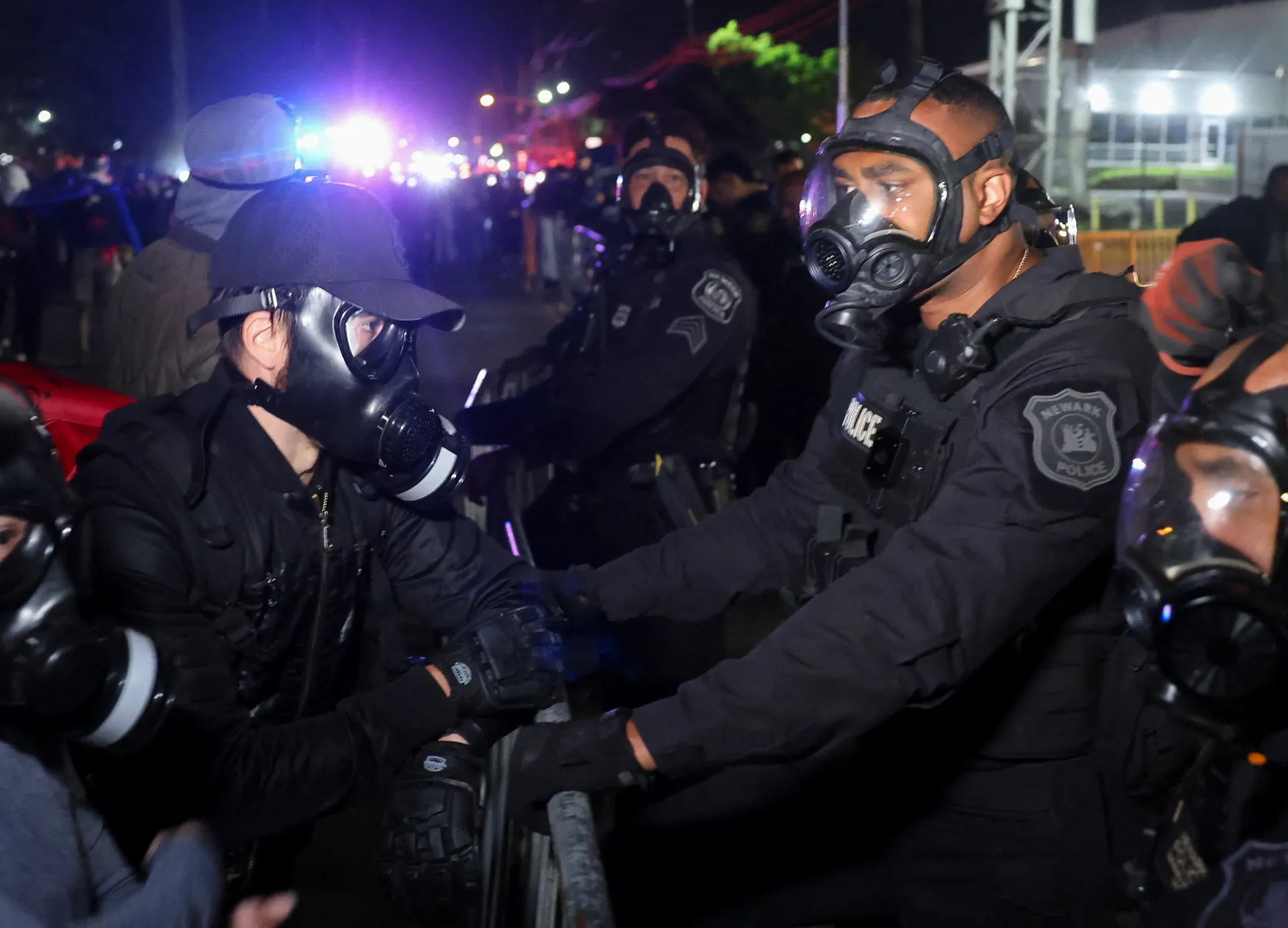
To show solidarity with the hunger strike, protesters have been gathering outside Delaney Hall, locking arms to form human chains and creating barricades to prevent access.

But that has led to tense confrontations with law enforcement, who have used batons and pepper spray to try to clear roads to the facility.

Governor Mikie Sherrill called for the establishment of designated protest zones, to mitigate the likelihood of conflict between officers and demonstrators.

But clashes have continued. Overnight on Wednesday, six protesters were arrested.

Politicians themselves have encountered tense interactions at Delaney Hall.

A year ago, one protest resulted in trespassing charges against Mayor Baraka and assault charges against US Representative LaMonica McIver, after a disagreement over which officials could enter the facility for an inspection.

While the charges against Baraka were dropped, McIver continues to face legal proceedings. She has denied the charges and called the prosecution politically motivated.

“One year ago, the Trump administration threw baseless charges against me for conducting oversight to protect immigrants at Delaney Hall,” McIver wrote on social media on Saturday.

“Have they tried to silence me? Yes. Have the stakes risen? Yes. Am I backing down from speaking up for you? Never.”

This past week, Governor Sherrill was also denied access to the facility. She has since issued a statement calling for Delaney Hall to be shut down.

At a news conference on Saturday, she blamed “national extremist groups” for arriving from out of state and escalating tensions. She added that the current precautions were designed to protect the safety of peaceful protesters.

“I urge those protesting outside of Delaney Hall to bring the temperature down, so we can focus on the detainees and their families,” Sherrill said.

She suggested that the actions of state and local officials would help head off any expanded ICE operations in New Jersey.

“I will not give ICE a pretext to expand operations at Delaney Hall or across our state. I will not put lives at risk,” she said. “I’m grateful to the vast majority of protesters who have assembled peacefully and raised their voices about Delaney Hall’s conditions.”

Source link

L.A. city attorney’s role could be weakened under charter reform proposal

In a few days, Los Angeles voters will be casting ballots for city attorney — and in a few months, they could be voting to sharply diminish the city attorney’s authority.

The city’s Charter Reform Commission has proposed splitting the city attorney’s office into two parts — an elected city prosecutor, charged with handling criminal misdemeanors, and a mayor-appointed and City Council-confirmed city attorney who would represent the city in civil cases and advise the mayor, city council and city departments.

The City Council is reviewing the recommendation as part of sweeping changes to city government, including expanding the council from 15 to 25 seats, which could go before voters in the Nov. 3 general election.

The proposed changes to the city attorney’ office, however, come in the midst of a heated primary campaign, where incumbent Hydee Feldstein Soto is up against three challengers, including a state deputy attorney general and a deputy district attorney.

Both of those challengers say plans to bifurcate the city attorney’s office are rooted in longstanding conflicts between Feldstein Soto and the City Council.

Council members have expressed frustration over her handling of rising costs from an outside law firm, where the payout amount has grown to nearly $7.5 million — with some attorneys billing the city roughly $1,300 an hour.

And last year, City Council took a 12-0 vote to direct Feldstein Soto to withdraw an effort to halt a federal judge’s order prohibiting LAPD officers from targeting journalists with crowd control weapons.

“When I first heard about this idea, I thought it was probably the greatest indictment of the current city attorney that I’ve heard yet,” said John McKinney, a Los Angeles County deputy district attorney who is running for city attorney in Tuesday’s primary.

McKinney opposes the bifurcation, saying it will cause overlap and confusion. “If she was doing a good job … we wouldn’t even be having this discussion,” he said.

Marissa Roy, another candidate in the race, hasn’t taken a position on bifurcation but said Feldstein Soto’s actions triggered the proposed change.

“The only reason that bifurcation, or splitting the city attorney’s office, is even going to be going before voters is because we’ve had an incumbent city attorney who has gone so rogue to politicize the role,” said Roy, a deputy state attorney general.

Roy said accused Feldstein Soto of inappropriately blocking an affordable housing project in Venice. And in her office’s role of drafting ordinance language, Roy said, Feldstein Soto has returned to city council ordinance language that isn’t “faithful to the intent of the drafter.”

Feldstein Soto said the proposal to bifurcate the office has nothing to do with her performance.

“This issue comes up every single time charter reform comes up,” Feldstein Soto said. “To me this is all political opportunism.”

Feldstein Soto has opposed the split, and former city attorneys have also come out against it, saying an appointed position threatens the independence of the city attorney’s office, takes away from voters the right to elect a city attorney and could cost taxpayers money in order to split the office.

In a March letter to the Charter Reform Commission, Feldstein Soto said an attorney “serving at the pleasure” of the mayor and city council would face an “innate, human pressure to harmonize legal advice with the political goals of the appointing officials.”

“I have been able to provide honest, accurate legal advice to the Mayor, City Council, Controller and departments — even when that advice is unwelcome — precisely because I am an independently elected officeholder with an ultimate duty to the public,” she wrote. “An appointed City Attorney, serving at the pleasure of the Mayor and City Council, faces enormous political pressure on all of these issues, behind closed doors, cloaked in privilege without an independent voice.”

Burt Pines, a former city attorney who served from 1973 to 1981, deeply opposes the bifurcation proposal, citing the threat to independence as the largest issue at stake. As city attorney, he said, he was empowered to tell city officials when a proposed action was unlawful and refuse to support it.

“You want to be able to call the shots as you see them, true to the law,” Pines said in an interview.

Advocates say other cities have bifurcated offices, and splitting it could reduce conflict and provide a clear delineation of roles.

After consulting with experts and good governance groups, the commission agreed the benefits of bifurcation outweighed the negatives, and it passed unanimously by the commission.

“It was easy to get consensus on this,” said Raymond Meza, chair of the commission. The commission’s proposal calls for the city attorney to be nominated by the mayor, and confirmed by the City Council.

In its report, the commission said that “the current structure creates conflicts when the same office advises the city and prosecutes cases. Separation provides clearer roles, reduces conflicts, and allows each function to be performed effectively.”

Other cities have different models for the city attorney’s office: Long Beach has a similar model with bifurcated duties, while New York City has legal representation split up several ways. The San Francisco City Attorney provides legal representation for the city and county of San Francisco, and the San Francisco District Attorney’s Office handles criminal cases in the city and county.

Mike Bonin, executive director of the Pat Brown Institute, said he has seen the question of splitting the office come up with at least three different city attorneys to varying degrees.

“Given that the city attorney is an elected position, there’s always going to be somebody who doesn’t like them,” Bonin, a former city council member, said. “You need to divorce the question from the occupant and focus on the role — the charter is not about a particular person, the charter is about the function of the office.”

Source link

Poll shows Bass, Raman and Pratt in tight race for mayor

Karen Bass, Nithya Raman and Spencer Pratt are locked in a tight battle for Los Angeles mayor, according to a poll released Thursday, with incumbent Bass holding what pollsters called a statistically insignificant lead ahead of Tuesday’s primary.

Bass had 26% support from likely voters, followed by City Councilmember Raman with 25% support, according to the poll by the UC Berkeley Institute of Governmental Studies, which was co-sponsored by The Times.

Pratt, the former reality TV personality making his first bid for elected office, had support from 22% of the likely voters surveyed.

Up until this latest poll, Bass had enjoyed a substantial lead over her challengers, with analysts predicting she would garner enough votes to make a Nov. 3 runoff with either Raman or Pratt. The latest survey suggests any of the three could advance.

“You’ve got three very different candidates, each with very different constituencies, all within the margin of error. It’s going to boil down to turnout,” said Mark DiCamillo, the director of Berkeley IGS polls.

The poll also showed that in a head-to-head runoff between Bass and Raman, the councilmember would lead, 32% to 28%, among the city’s registered voters, but in this scenario, a quarter of likely voters say they would choose neither or would not vote, and 15% were undecided.

The survey of 1,913 registered voters — 1,351 of whom are considered likely voters — is the largest sample of any public poll released in advance of the election. It was conducted between May 19 and 24. The poll has a margin of error of around 3% in either direction.

Just 10% of voters were still undecided, the poll found, down from 26% when the last survey by Berkeley IGS was conducted March 9-15.

Mayoral candidate Spencer Pratt at a campaign block party in South Los Angeles last week.

Mayoral candidate Spencer Pratt at a campaign block party in South Los Angeles last week.

(Robert Gauthier / Los Angeles Times)

Since then, Pratt and Raman have made steady gains while support for Bass has nearly flatlined.

The March poll had Bass with support from 25% of likely voters, followed by Raman with 17% and Pratt with 14%. Since then, Bass has gained just 1 percentage point, while support for Raman and Pratt jumped by 8 percentage points each.

There are 14 candidates running for mayor in Tuesday’s primary and all were listed in the Berkeley IGS poll, but Bass, Raman and Pratt have consistently led in polling. They’ve also raised the most money in campaign contributions. The latest campaign finance reports, filed last week, showed Pratt with $3.26 million in contributions through May 16, followed by Bass with $3.13 million.

Raman reported a total of more than $931,000 through the May 16 filing period, of which $60,000 came in the form of a loan from Raman to her own campaign. She also received the maximum amount of matching funds available in the race, $1.25 million.

Leftist candidate Rae Huang was favored by 9% of the likely voters surveyed, up 1 percentage point from March, while tech entrepreneur Adam Miller dropped from 6% to 5%, despite infusing his campaign with $4 million of his own money after the first poll.

The major issues in the race have included the city’s approach to homelessness, housing affordability and public safety.

Pratt, whose home burned in the Palisades fire, has blamed Bass for failing to prepare for the conflagration and for her postfire response. Raman has criticized Bass’ Inside Safe program for the unhoused, saying its high cost isn’t sustainable.

Bass has deemed Raman an ineffective City Council member who struggles to build alliances on the legislative body, and has said Pratt does not have a clue about how to run a city like Los Angeles.

Although Pratt now appears to have a chance at making the runoff, the poll showed he would face a steeper climb in potential November runoff scenarios with Bass or Raman. Pratt, a Republican who has been labeled “Trumpian” by Raman, is competing in a city where GOP registration is less than 15%.

“Pratt is an unusual candidate and is generating a lot of enthusiasm in the primary, but he trails by double digits to Raman and Bass in a runoff,” DiCamillo said.

In a showdown between Bass and Pratt, the incumbent mayor was ahead, 47% to 29%, among the city’s registered voters, with 12% undecided and 12% choosing neither or saying they would not vote.

Raman also led Pratt in a potential runoff, 45% to 28%, with 16% undecided and 11% choosing neither or saying they would not vote.

Pratt has repeatedly pointed out that the mayor’s race is nonpartisan. Even so, President Trump said last week that he hopes Pratt does well and that he heard Pratt was “a big MAGA person.”

Trump’s unpopularity in Los Angeles could lessen Pratt’s appeal to Democrats, according to a poll by Cygnal, a national polling group that has worked for Republican candidates.

Los Angeles mayoral candidate Nithya Raman walks down Olvera Street

Los Angeles mayoral candidate Nithya Raman walks down Olvera Street alongside Olvera Street business owners on May 19 in Los Angeles.

(Ronaldo Bolaños / Los Angeles Times)

There’s been just one debate featuring all three of the leading candidates, during which Raman asserted that Bass and Pratt were working to ensure that she would be knocked out in the primary, which Bass and Pratt disputed.

The debate was followed by a huge influx of campaign contributions to Pratt, who also was polling in second in an Emerson College poll earlier this month.

Raman’s strong showing in Thursday’s poll shows she is very much in the race despite assertions by Bass’ campaign and Pratt’s campaign that she is faltering after a lackluster debate performance.

The poll shows Bass and Pratt with high unfavorability ratings. Bass was considered unfavorably by 57% of likely voters, up 1 percentage point from the March survey. Pratt’s unfavorable rating in the current poll was also 57% — up dramatically from the 28% unfavorable rating in the previous poll, although in that poll, 55% of likely voters had no opinion of him.

In the May poll, Pratt was rated favorably by 25% of likely voters, and Bass by 35%.

The poll found that 40% of likely voters rated Raman favorably, with 35% viewing her unfavorably.

Source link

News Analysis: Uncertainty, frustration define messy midterm battles for mayor, governor and Congress

With little more than a week left until primary voters winnow the candidates for Los Angeles mayor, California governor and Congress, there remains a palpable sense of political uncertainty among the electorate — attributable to a lack of clear front-runners, redrawn political maps, messy party infighting and competing voter frustration with both President Trump and the state’s Democratic establishment.

In a state where Democrats hold a substantial advantage among registered voters and Trump lost in 2024 by more than 20 percentage points, MAGA-aligned Republicans are nonetheless competing on a message of ineptitude from longtime liberal leaders to address the state’s most intractable problems. Even some Democrats have railed against the status quo.

With Trump’s grip on the Republican base intact despite abysmal overall approval ratings, many Republican candidates have courted his approval — and been hammered for it by their Democratic opponents.

But those same Democrats have found it harder to explain why their own party should continue to lead the state despite allowing its affordability, housing and homelessness crises to take root and persist — taking little responsibility while swiping at each other for having failed to find solutions sooner.

All that party infighting — present before every primary, but at a fever pitch now — comes against a backdrop of broader voter unease about the war in Iran, volatile oil and gas prices, and the burgeoning threat of AI to the American workforce.

Republican voters are being warned of a blue wave in November giving Democrats control of Congress and grinding Trump’s agenda to a halt. Democratic voters are being warned of Trump administration efforts to undermine local and state elections, and of control of Congress unfairly slipping from reach thanks to further Republican redistricting following a U.S. Supreme Court decision undermining the Voting Rights Act and its protections for majority-Black districts across the South.

Many California voters — some already shaken or burned by former Rep. Eric Swalwell dropping from the gubernatorial race amid sexual assault and rape allegations last month — appear hesitant to cast ballots early, despite warnings that the Trump administration may try to discount those mailed at the last minute.

“Voters don’t want to make a mistake. They’re not absolutely certain,” said Rob Stutzman, a Republican consultant in California. “It’s just not real clear where to land.”

James Adams, a political science professor at UC Davis who studies elections and public opinion, said California Democrats this cycle “have a candidate problem and they have a message problem,” in that they are trying to convince voters to back them “not because they offer exciting ideas or inspiring leadership, but because their Republican opponents are even worse.”

And that message — offered as they gerrymander California in a race to the bottom with Republicans nationally — isn’t cutting it, Adams said.

“People are alienated from our current politics not because Americans are cynical, but because people recognize that they deserve better.”

Outsider shakes up L.A. mayor’s race

Amid entrenched homelessness, affordability concerns and lingering anger over the bungled response to last year’s wildfires, the L.A. mayor’s race was “supposed to be a referendum” on embattled Mayor Karen Bass, Stutzman said.

And yet, Bass remains in the lead, and many voters remain confused about which way to turn away from her — if at all.

Bass has won the endorsement of three council members who are members of the Democratic Socialists of America, despite City Councilmember Nithya Raman, an ally who’d previously endorsed Bass and is a member of the DSA herself, entering the race to her left.

Unable to consolidate support from the city’s progressive flank, Raman is now running neck and neck for a second-place finish and a chance to face Bass in the November runoff with former reality TV personality Spencer Pratt, who has remained in contention in ultra-liberal L.A. despite pushing a MAGA-aligned message to Bass’ right.

Pratt, who did not respond to a request for comment, lost his Pacific Palisades home in the fires and has won over many frustrated city residents with his anti-establishment message and cheeky AI videos — including one casting him as Batman, taking on a corrupt Democratic bourgeoisie.

Pratt, a registered Republican, has tried to dance around politics in the race, calling his campaign a “nonpartisan” one and comparing himself to President Obama politically. But he is backed by many Republicans, has echoed Trump’s rhetoric around restoring “common sense” and a “Golden Age” to L.A., and recently responded to Trump saying that he’d heard Pratt “is a big MAGA person” — and Raman posting the quote to X — with a meme of himself shrugging.

Fernando Guerra, founding director of the Center for the Study of Los Angeles at Loyola Marymount University, said he’s glad city voters have choices this race, because they clearly aren’t happy. He said Angelenos are less optimistic today than ever before and are deeply frustrated with “this same liberal Democratic regime from Bradley to Bass over 50 years” — a reference to former Mayor Tom Bradley, who first took office in 1973.

Voters are clearly tired of that regime, which has succumbed to “policy paralysis” in the name of “inclusion” and trying to please everyone, Guerra said — but not so much that they will consider going MAGA for Pratt.

“People say, ‘Yeah, Democrats have really f—d it up, but there’s no way we’re going to [back] Republicans. Look what they’ve done to the nation.’”

Others aren’t so sure. In its voter guide, the progressive group LA Forward wrote that the “most important thing” in the June 2 primary is to block Pratt — whom it called a “right-wing reality TV buffoon” — from advancing, and the best way to do so is to vote for Raman.

“We would much rather see a Bass/Raman runoff, with no chance of Pratt becoming mayor, than a Pratt/Bass runoff where a Pratt win would be a real possibility — plunging LA into a Trumpian mayoral nightmare,” the group wrote.

An unsettled gubernatorial contest

In the gubernatorial race, none of the many Democratic candidates has been able to consolidate a sizable lead, creating a lingering apprehension that Republicans could somehow eke out a stunning upset in the biggest of blue states.

That’s in part thanks to leading Democratic candidate Xavier Becerra, the former California attorney general and U.S. Health secretary under President Biden, being dogged by insinuations, including from fellow Democrats, that he was somehow complicit in a scheme by underlings to steal from his campaign coffers, despite prosecutors in the case — which resulted in his former chief of staff pleading guilty — never alleging wrongdoing on his part.

It’s also thanks in part to the fact that the leading progressive, Tom Steyer, is a billionaire who has bought his way into contention with nearly $200 million of his own money — in an election cycle in which progressive voters nationwide are decrying billionaires as the clearest symbol of all that is wrong with the nation’s lopsided economy.

“This kind of weird self-loathing rationale of why he’s the right guy to take on billionaires because he is one? You can’t build a Mamdani movement around that,” said Stutzman, referring to New York City Mayor Zohran Mamdani, who shot to power on a democratic socialist platform last year.

The Democrats have also struggled to combat the criticism — leveraged time and again by their Republican competitors — that their party has failed for years to solve California’s most substantial problems, and deserves to be ousted from power.

Republican Steve Hilton and Democrat Xavier Becerra speak during a break in the April 28 gubernatorial debate.

Republican Steve Hilton and Democrat Xavier Becerra speak during a break in the April 28 gubernatorial debate.

(Eric Thayer / Los Angeles Times)

Former Fox News commentator Steve Hilton has hammered that message in ads and on the debate stage, lambasting the Democratic establishment for pushing so much unnecessary regulation that it has chased out business and investment and made everything from gas to housing to groceries more expensive for average residents.

He has blamed Democrats for California’s high rates of poverty and unemployment, its high cost of living and high taxes, its record homelessness and its poor public school results.

In an interview, Hilton said he understands that California voters may not like Trump — who endorsed him — and may have conflicting beliefs about federal and international policy, but that California’s biggest problems have “nothing to do with President Trump.”

“Voters need to decide on what direction they want to take in terms of the policies that affect their daily lives in California,” he said, and those are “devised and enacted within California by our politicians here in Sacramento.”

He also said it’s no surprise that some of his Democratic rivals have also acknowledged that the Democratic establishment has been a failure, because “if you pretend otherwise, you show that you’re just completely out of touch with public opinion.”

Rusty Hicks, chair of the California Democratic Party, said “every campaign is entitled to run the race that they believe matches their story,” even if that means questioning the party’s past performance. But he also said polling hasn’t shown that message to be an effective one, and he’s confident that voters will show their ongoing trust in the party at the polls.

Redistricting, sniping and name-calling

The decision by California voters last November to pass Proposition 50 and allow the state’s Democratic leaders to redraw the state’s congressional maps to favor Democratic candidates in a handful of additional districts — part of a wider redistricting war sparked by Trump — has intensified the primary races in those areas.

As an example, longtime incumbent Reps. Ken Calvert (R-Corona) and Young Kim (R-Anaheim Hills) are now competing to represent the same redrawn swath of Orange, Riverside and San Bernardino counties, and have bitterly attacked one another. Kim has called Calvert a “swampy,” “sleazy” and “corrupt” politician guilty of “sabotaging President Trump’s agenda.” Calvert has called Kim a “RINO,” or Republican In Name Only, and a “Trump-hating liberal.”

Democrats have also sniped at each other, including in the race to replace retiring Rep. Darrell Issa (R-Bonsall) in his redrawn district in San Diego and Riverside counties — where Trump also holds an outsize presence.

Rep. Young Kim and Rep. Ken Calvert are opponents in a heated race in a newly redrawn congressional district.

Rep. Young Kim and Rep. Ken Calvert are opponents in a heated race in a newly redrawn congressional district.

(Associated Press)

Stutzman said it will be interesting to see how those primaries play out, but also how Democrats there and in other races perform in November — when Democrats are expected to perform well nationally given Trump’s lousy ratings, but Democrats in California could underperform thanks to statewide frustration with affordability, housing and homelessness here.

“People are like, ‘Eh, you know, yeah, Trump — but there’s some problems here,’” Stutzman said.

Hicks said he expects California voters to not only elect another Democratic governor, but to “push back on a Trump administration and congressional Republicans and Republicans around the country that have sought to rig the game in their favor,” including by “ensuring that we fulfill the promise of Proposition 50 by winning congressional seats and retaking the House of Representatives.”

He said the current political moment “can feel like a pressure cooker,” but Californians will “continue to adapt and overcome and be resilient, just as they always have been.”

Source link

L.A. mayoral hopeful Spencer Pratt is making a big splash, but can he swim?

Spencer Pratt, please give me a call.

We should talk.

You say you want to be mayor of Los Angeles, but do you really?

I know that being a candidate has rescued you from anonymity after your career in reality TV went off a cliff. You’ve got CEOs backing you, and fans raving, and you’ve managed to milk social media attention.

But at some point you might have to answer questions from the reporters you’ve been avoiding.

And if you win, you’re going to have to drive to City Hall five, six, seven days a week, and I don’t know if you saw my column a few weeks ago, but the fountain on the south lawn hasn’t worked in about 60 years. If you get elected, you better put a wrench in your lunch box, because nobody has figured out how to fix it.

So that’s the reality, pretty much. And the unions will want what they want, and the socialists on the City Council will be lying in wait, especially after President Trump blew you a cross-country air kiss and certified your MAGA credentials.

More than 30,000 people are waiting for their broken sidewalks to get fixed (I’m not exaggerating) but there’s no money, and if you hire several thousand more police officers as you’ve pledged, the city would be bankrupt for the next decade or so and you’d need to take out a loan to buy a doughnut.

So call me, like I say, because I think there’s still time to change your mind.

If you choose to proceed, and if you actually win, it might feel like you’re in a sequel to that reality show you did called “I’m a Celebrity … Get Me Out of Here,” and you may end up praying the show gets canceled. The mayor’s hours are long, and everywhere you go, someone will want you to fix this problem or that, and as you wander the halls of power you’ll think back on your campaign pledges and hear the constant echo of a line from H.L. Mencken:

“For every complex problem there is an answer that is clear, simple, and wrong.”

Can I confess something?

I’m feeling guilty about all of this.

Not to sound presumptuous, but I feel partly responsible for the fact that you’re in contention for the job.

Like you, I’ve been calling out issues with the management of L.A., and I’ve been doing it for years. But I had the good sense not to run for mayor.

Why’s that?

Because unlike you, I know the fixes aren’t as easy as we’d like them to be.

When Karen Bass was running the first time, I had a long talk with her about her homelessness plan, among other things. At the end of the day, she asked for my input.

I reminded her that as much as people would like for the city’s top elected official to immediately clear the streets, a mayor is limited by shared power with the City Council.

By drug epidemics and untreated mental illness that are largely under county authority.

By uncertain funding from the nation’s capital.

By global forces that transformed the economy and created staggering levels of inequality that are made all the worse by the high cost of housing.

Bass was aware of all that, but said that having worked in Sacramento and D.C., and having built relationships with county supervisors, she’d be able to build better systems and get better outcomes.

So how has she done?

Not great. And then there’s the fire.

As I’ve said before, leaving the country despite forecasts of elevated wildfire risk was probably the worst mistake of her political career.

I don’t need to remind you of that. Having lost your house in the Palisades, you know that Bass badly underreacted, then stumbled on the rebuilding, and then had a hand in downplaying the Fire Department’s failure to adequately deploy and extinguish the fire that became an inferno.

To summarize, she’s left herself wide open to a challenge.

And she probably can’t believe how lucky she is that you might be her November competition, if the two of you bounce out Councilmember Nithya Raman and the other candidates in the June 2 primary.

I don’t hold it against you that you haven’t worked in government or politics before. These days, a lot of voters prefer outsiders. But it might have helped if you’d done something of purpose at some point in your life, like run a successful business or volunteer at a food bank. Were you junior high class president, or were you in the Boy Scouts? Anything could help.

Not that being the boyfriend and later the husband of someone on an MTV reality show called “The Hills,” which chronicled the work of a woman who went from “Laguna Beach: The Real Orange County” to an internship at Teen Vogue, can’t prepare a young man for statesmanship.

In this culture, you could ride that all the way to the White House.

But the flimsy resume could explain, Spencer, why you’ve been taking so many social media-fueled potshots at Bass without offering anything of substance.

Let’s arrest drug zombies.

OK, then what?

I’d advise you to study the primer by my colleagues Doug Smith and Andrew Khouri on what you can and can’t do about homelessness as a mayor in L.A. Clearly, you’ve got a lot of boning up to do. In fact, I’m reminded of a line by a Philadelphia columnist years ago, when he said of a politician who wasn’t up to the job: He’s been standing in shallow water for so long, he doesn’t realize he can’t swim.

If I were you, I’d consider the fact that President Trump made the mistake of promising easy fixes. He was going to deliver a massive infrastructure program. He was going to deliver healthcare reform that was better and cheaper for everyone. He was going to lower consumer prices on Day One, and here we are, with millions of people wondering how they’re going to pay their bills while Trump rigs it so he doesn’t have to pay the IRS.

All that being said, I’m glad you decided to run, because elected officials need constant reminders that their jobs are not secure, even when the challengers are way in over their heads. I’d almost like to see you win, because that’s one reality show I’d be sure to watch.

And I say this despite the fact that you once told your talk show buddy Alex Jones — who insisted that 9/11 was an inside job and that the Sandy Hook massacre of 20 children was a hoax — that melting ice caps are overrated. Or, as you explained it to Jones, “we’ve all seen footage of the polar bears swimming to new pieces of ice.”

When the general election rolls around, and the ice begins to break, will you know how to swim?

steve.lopez@latimes.com

Source link

Mayor cuts limited World Cup tickets for New Yorkers to $50 after furore | World Cup 2026 News

Pricing for 2026 World Cup has been under heavy scrutiny, including in New York where city mayor cuts limited tickets.

Some lucky New York City residents will soon get a chance to snag cheap seats to this summer’s high-priced World Cup.

Mayor Zohran Mamdani announced on Thursday that 1,000 tickets costing $50 will be made available to city residents of the city of more than 8 million for the world’s most watched sporting event.

Recommended Stories

list of 4 itemsend of list

“To put that into perspective, that is five lattes in New York City,” Mamdani quipped from a bar in Harlem’s Little Senegal neighbourhood, alongside US men’s national team star Timothy Weah.
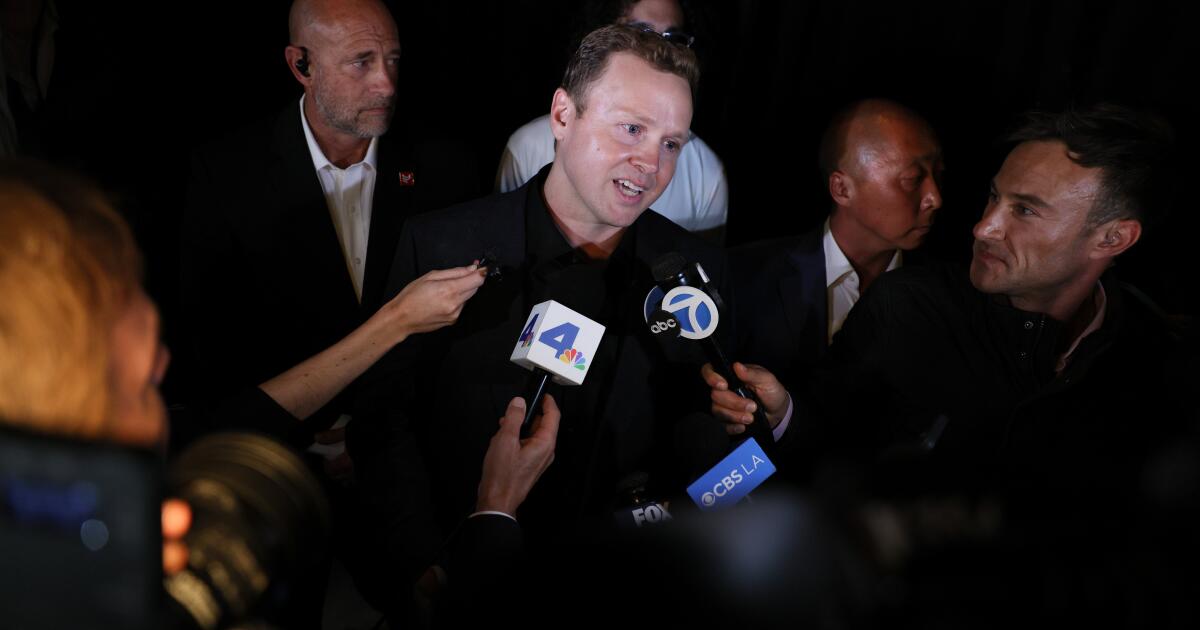

The tickets will be available for seven of the eight games played at the 82,000-seat MetLife Stadium in New Jersey, across the river from Manhattan. The lone exception is the high demand July 19 final, where some seats are costing nearly $33,000.

The tickets will also include free round-trip bus transportation to the stadium and will be distributed via a lottery starting May 25.

With persistent concerns about the sky-high costs for tickets to the games, Mamdani said the city ensure the ones they distribute go to New York City residents and are not resold on the secondary market.

He said the tickets will be non-transferable, with a “variety of ways” used by city officials to verify residency. They will only be handed out directly to fans as they board buses on game day.

“We are making sure that working people will not be priced out of the game that they helped to create,” Mamdani said.

The Democrat, who took office in January, said the effort underscores how his administration is not simply focused on making everyday things like housing and groceries more affordable.

“It extends to making it possible for every New Yorker to take part in the things that make us human,” he said.

During his campaign, Mamdani called on FIFA, football’s global governing body, to make it cheaper for New Yorkers to go to games by setting aside 15% of tickets at discounted prices. He had launched a petition calling on FIFA to reverse its plan to set ticket prices based on demand.

The $50 tickets don’t come directly from FIFA, but from those allotted to New York and New Jersey’s joint host committee for the games, according to the mayor’s office.

Previously, FIFA had made some $60 tickets available for every game at the tournament in North America following backlash over exorbitant prices.

Those reduced price tickets, though, went to the national federations of the teams playing, with the federations deciding how to distribute them to loyal fans who have attended previous games at home and away.

Besides the final, the home stadium for both the NFL’s New York Giants and New York Jets is set to host five group World Cup matches and two knockout stage games. Group stage matches for former winners Brazil, France, Germany and England, along with other nations, begin on June 13.

Source link

Immigration authorities detain former Kansas mayor who voted illegally

The former mayor of a conservative Kansas town was taken into custody by immigration authorities after acknowledging last year that he had voted in elections despite not being a U.S. citizen.

Joe Ceballos, who was born in Mexico and is a legal permanent U.S. resident, was detained Wednesday during a meeting at a U.S. Immigration and Customs Enforcement office in Wichita, Kan., according to his attorney, Jess Hoeme. He said Ceballos now fears he could be deported.

The 55-year-old resigned as mayor of Coldwater in December while facing state charges over voting as a noncitizen. While seeking citizenship in 2025, Ceballos admitted during an interview that he had voted, not knowing that green card holders don’t qualify, Hoeme said.

Ceballos was charged with voting illegally but pleaded guilty in April to misdemeanors in a deal with the Kansas attorney general. His case has drawn attention from the Trump administration and inspired supporters in his community, some of whom held signs reading “We Support Mayor Joe” and “ICE Out” as Ceballos walked into the federal building in Wichita.

“Let Joe go!” the crowd yelled.

“Thinking what could happen — it’s just kind of crazy,” Ceballos told reporters. “Obviously nervous. I don’t know what’s going to happen. I don’t know where they’re going to take me and what I can and can’t do inside there.”

An email seeking comment from the Department of Homeland Security was not immediately returned.

Trump and other Republicans have been warning of the dangers of noncitizens voting in elections since the beginning of the 2024 presidential election. Research, even by Republican election officials, show the problem is rare.

This year, Trump has been pushing Republicans in Congress to pass the SAVE Act, which among other things would require documented proof of U.S. citizenship to register and vote.

The administration also has significantly upgraded a program within Homeland Security that checks citizenship. At least 25 states, most of them controlled by Republicans, have used that system to check their voter rolls.

Ceballos was brought to the U.S. from Mexico by family when he was 4 years old. Hoeme said lawyers would next try to get an immigration judge to release him on bond.

He said Ceballos, at age 18, was encouraged to register to vote on the spot during a school field trip to the Comanche County courthouse. Ceballos has previously said in interviews with reporters that he voted for Republicans.

He was twice elected mayor of Coldwater, population 700, and also served on the city council. Ceballos won a new term in November but resigned after state Atty. Gen. Kris Kobach charged him with voting without being qualified and election perjury.

Kobach’s office, however, reached a deal with Ceballos. He pleaded guilty to disorderly election conduct, which Hoeme described as a misdemeanor similar to disturbing the peace.

“He has not been convicted of any kind of voter fraud. It should not have impacted his immigration status,” Hoeme said. “The Trump administration and ICE have doubled down on nonsense that he is a criminal.”

Ceballos has been a popular figure in Coldwater, where an advertisement in the Western Star newspaper encouraged people to support him.

“He’s kind of got to live the American dream, to come from absolutely nothing and build up — I don’t know about wealth — but to build up a business and have a job and be a productive part of society,” longtime friend Ryan Swayze told Wichita station KAKE-TV.

White writes for the Associated Press.

Source link

Was the mayor a spy? L.A. suburb wonders about depth of Chinese plot

As Eileen Wang and her supporters tell it, the former Arcadia mayor was led astray by a man she trusted and loved.

After chasing her political ambitions in the San Gabriel Valley suburb, Wang, 58, won a City Council seat in 2022 with the help of a campaign advisor who was also her romantic partner. Two years later, he was charged by federal authorities with secretly working on behalf of the Chinese government.

Wang, a naturalized U.S. citizen, distanced herself from her ex and remained in office, becoming mayor earlier this year. The scandal had mostly quieted — until Monday, on the eve of President Trump’s planned trip to Beijing, when a plea deal was unsealed revealing Wang’s own murky role as an agent for China.

A man walks past an empty space where a photograph of former Arcadia Mayor Eileen Wang hung between other photos on a wall.

A man walks past an empty space where a photograph of former Mayor Eileen Wang was removed in the lobby of Arcadia City Hall.

(Genaro Molina/Los Angeles Times)

Now, Wang has become a national political talking point, with critics painting her as a calculating foreign agent who sought to infiltrate the American government and undermine democracy.

Katie Miller, wife of top Trump advisor Stephen Miller, blasted Wang on social media site X as a “spy.”

“This is pure China trying to influence U.S. politics and U.S. elections,” Katie Miller said on Fox News.

Back home, some of Wang’s former colleagues in local government say they repeatedly tried to raise alarms about her.

“There were red flags everywhere,” said Sharon Kwan, an Arcadia city council member and former mayor.

Wang admitted in her plea agreement to posting and editing web content at the request of the Chinese government — without disclosing her ties to U.S. authorities, as the law requires. She ran afoul of the Foreign Agents Registration Act, or FARA, a federal statute that experts said has seen ramped up enforcement over the last decade, particularly in cases involving China.

But those familiar with the law — and international espionage — said it does not appear that Wang was engaged in spycraft as it is commonly understood.

Dennis Wilder, a former senior U.S. intelligence official and professor at Georgetown University, said that, in the CIA, Wang would be referred to as “an agent of influence.”

“She’s not a spy in the Jason Bourne sense,” Wilder said, referring to the fictional American agent. “She’s not out there recruiting sources and that sort of thing. That’s not the role that they want for her. But they see this other role as extremely important.”

A man exits Arcadia City Hall

A man exits Arcadia City Hall on Tuesday.

(Christina House/Los Angeles Times)

A run for city council

Wang moved to the U.S. around 30 years ago, in part, she told The Times in 2024, because she wanted “freedom for speech, freedom [for] thinking.”

Her mother was a Chinese medicine and acupuncture doctor and her father was a physician in Sichuan province before working at USC, she said. Authorities have not detailed how she immigrated or her path to citizenship. She landed in Arcadia, she said, lured by what the school district in the affluent city of 54,000 could offer her two young boys.

She ran an after-school program and was involved in some community organizations, but said she did not move in political circles until shortly before her 2022 run for city council. She switched her party affiliation from Republican to Democrat, which, she said, spoke more to the needs of voters in her district, where many share her Chinese roots.

“I walk about 140 days,” she said of her campaign, adding that she hit every door in her district five times. “I never stop.”

Yaoning “Mike” Sun, Wang’s former fiance, managed her campaign.

Arcadia City Councilmember Sharon Kwan

Arcadia City Councilmember Sharon Kwan stands outside the front entrance of the San Gabriel Valley suburb’s City Hall. “This is not something where we can just dismiss and pretend nothing happened,” said Kwan regarding the case against ex-mayor Eileen Wang.

(Genaro Molina/Los Angeles Times)

Kwan, who was elected to the city council at the same time, recalled Sun as a constant presence at city meetings and events, “always with the camera.”

“Always recording, always promoting her,” Kwan said. “She was like a celebrity to him.”

Two years after Wang took office, in December 2024, federal authorities arrested Sun on suspicion of acting as an illegal agent of China.

Prosecutors accused Sun in a criminal complaint of working with another man to cultivate Wang as a political asset for the People’s Republic of China or PRC. Federal prosecutors in Los Angeles identified the other man as John Chen, describing him in a sentencing memorandum as “a high-level member of the PRC intelligence apparatus,” who had “met personally” with Chinese President Xi Jinping.

Chen instructed Sun to submit reports on Wang, referred to throughout the complaint as “Individual 1,” to Chinese officials, including one the federal complaint said they referred to as the “Big Boss.” A draft of the report allegedly included a request for $80,000 to “support pro-PRC activities in the United States.” Sun was also told to tout Wang’s relationship with an unnamed U.S. congressperson, the complaint said.

Both men eventually pleaded guilty to working as unregistered agents of China, with Sun sentenced this year to four years in prison. Chen was sentenced to 20 months.

Wang spoke with Chen on the day she was elected and three more times over the next few months, according to the complaint in Sun’s case.

“You are doing a good job, I hope you can continue the good work, make Chinese people proud,” Chen told Wang, in a conversation on Jan. 23, 2023, according to the complaint in Sun’s case.

Chen and Sun also coordinated a trip to China in 2023 for Wang to meet with “leadership,” which would include stops in six different places, according to the complaint. It’s unclear whom Wang met with on the trip.

The fallout

After Sun’s arrest, Wang denied to several people that they had been engaged to marry. She said during a council meeting that their relationship ended in spring 2024.

Jolene Cadenbach, a pastor in Arcadia, said Wang confided in her that “she had been lied to” by Sun.

“I think he did a con job on her,” Cadenbach said.

The recent plea agreement gave the wrong impression about Wang, the pastor said.

“It made her sound like she was some kind of spy and it wasn’t like that at all,” she said. Wang was only following Sun’s orders, she added: “He told her to put up this site, she did it. She didn’t really investigate it.”

In a statement, Wang’s lawyers said she “apologizes and is sorry for the mistakes she has made in her personal life.” They said “she genuinely loves this city and is devoted to the people and the community within it,” but “her trust and love for apparently the wrong person… ultimately led her astray.”

Longtime Arcadia resident Sonia Martin sits on the porch of her home.

Arcadia resident Sonia Martin sits on the porch of her home. Martin said she had long expressed concerns about the city’s former mayor, Eileen Wang.

(Genaro Molina/Los Angeles Times)

After Sun was charged in 2024, Sonia Martin and other Arcadia residents showed up at council meetings carrying protest signs. Martin said she expected Wang to be pushed out. Instead, she said, most council members appeared to unite behind Wang.

“They wanted to have this feeling of, like, everything’s great here. We’re all warm. Look at us, it’s kumbaya,” Martin said.

Kwan said she repeatedly tried to bring up the concerns of constituents to her fellow council members but was brushed off.

“Everybody was just so silent,” Kwan said. “This is not something where we can just dismiss and pretend nothing happened.”

The job of mayor rotates among Arcadia City Council members, and when it was Kwan’s turn last April, she warned during her swearing-in speech that constituents “must remain vigilant against influence of foreign governments, including efforts by the Chinese Communist Party, that may seek to shape local policy for the interests that do not align with our residents.”

Since Wang’s plea agreement became public, some have scoffed at the notion that Chinese spies would establish an outpost in Arcadia, or that the web posts she made before becoming mayor amounted to any sort of meaningful propaganda campaign.

But according to Sun’s plea agreement, local office was just the start. Prosecutors said Sun’s 2023 report for Chinese officials boasted that “during the 2022 U.S. midterm elections, I orchestrated and organized my team to win the election for city council.” He called Wang a “new political star.”

Wilder, the former U.S. intelligence official, said that sounded like a familiar strategy.

“Maybe she would end up in Congress some day or at the state government level. They invest in these folks hoping they move up the political food chain,” the Georgetown professor said. “That is part of the Chinese long game.”

‘San Gabriel Valley deserves better’

In her plea agreement, Wang admitted that from late 2020 through at least 2022, she worked with Sun to run a website called U.S. News Center that branded itself as a news source for Chinese Americans.

Wang and Sun “executed directives” from Chinese government officials, posting requested articles and reporting back with screenshots showing how many people viewed the stories, the agreement says.

Prosecutors also say Wang edited articles at the request of officials and shared information showing the reach of the posts.

“Thank you leader,” she wrote on Aug. 20, 2021, after being complimented for a post that was viewed more than 15,000 times, according to the plea agreement.

Wang never disclosed that the Chinese government had directed her to post the content, according to court documents.

That sort of low-level violation of the law is not supposed to trigger federal charges unless, according to a February 2025 memo by then-Atty. Gen. Pam Bondi to Justice Department prosecutors, the case involved “conduct similar to more traditional espionage.” The Trump administration has pursued other high-profile foreign agent cases recently, with prosecutors winning a conviction Wednesday of a man charged with running a covert police station in Manhattan and keeping tabs on political dissidents.

When news broke of the charges and plea deal involving Wang, current and former city officials said they were not surprised.

A wall of photographs of former Arcadia mayors inside Arcadia City Hall.

A wall of photographs of former Arcadia mayors hang inside Arcadia City Hall. Eileen Wang is shown second from left on the bottom row. Wang admitted in court filings this week to working as an unregistered agent for China.

(Genaro Molina/Los Angeles Times)

“The warning signs around Eileen Wang were public for more than a year before this plea, agreement, and too many people in positions of influence defended and supported her,” April Verlato, a former mayor of Arcadia, said in a statement. “Our electeds should have represented what was best for the community and held her accountable. The San Gabriel Valley deserves better.”

Paul Cheng, mayor pro tem of Arcadia, said the council didn’t move earlier to oust Wang because a majority of its members wanted to let the federal investigation run its course.

“The public always says, ‘Why didn’t you investigate her when her boyfriend was arrested? Why didn’t you do something?’” he said.

Pedestrians walk along a sidewalk

Pedestrians walk along a sidewalk next to Huntington Drive in downtown Arcadia on Wednesday.

(Genaro Molina/Los Angeles Times)

But, he emphasized, “council members are not federal investigators.”

“We are not supposed to get involved,” said Cheng, an attorney. “It would make the situation 10 times worse.”

Cheng spoke highly of Wang, painting her as a committed civil servant with a passion for veterans, first responders and diversifying the businesses on Baldwin Avenue, the city’s main corridor.

“She probably attended the most events compared to all of us,” he said. “People have tried getting me to say she’s a horrible person, but I can only say what I saw, which was I thought she did a good job on council.”

Source link

Arcadia mayor, accused of being Chinese foreign agent, strikes plea deal

Eileen Wang, an Arcadia city leader facing charges of acting as an illegal foreign agent of China, resigned Monday after reaching an agreement to resolve the federal case.

Wang, who served as mayor of the San Gabriel Valley suburb, entered into a plea agreement with prosecutors over charges that she acted under the control of the People’s Republic of China to promote propaganda in the U.S. between 2020 and 2022, according to court filings.

Wang, who was previously elected to the City Council in November 2022, stepped down as mayor on Monday hours after the plea agreement was unsealed. Arcadia officials and Wang’s attorneys said the conduct described by federal authorities occurred before Wang was elected.

Wang appeared in federal court in downtown Los Angeles during a brief hearing Monday, where a judge instructed her lawyers to set a date when she would formally enter a guilty plea.

The maximum sentence for the charge is 10 years in prison.

Dressed in a blue suit jacket and skirt and accompanied by four lawyers, Wang listened to the proceeding through a Mandarin interpreter. She sniffled throughout the hearing, wiping at her eyes and her nose with her hand and a tissue.

The magistrate judge ordered a $25,000 bond and for her to surrender all of her passports and travel documents. Assistant U.S. Attorney Amanda B. Elbogen asked that the judge order Wang to refrain from any communication with the Chinese government, including consular officials in the U.S.

“Individuals in our country who covertly do the bidding of foreign governments undermine our democracy,” said First Assistant U.S. Attorney Bill Essayli in a statement Monday. “This plea agreement is the latest success in our determination to defend the homeland against China’s efforts to corrupt our institutions.”

In a statement, Wang’s attorneys, Brian A. Sun and Jason Liang, said “she apologizes and is sorry for the mistakes she has made in her personal life.”

“Her love and devotion for the Arcadia community have not changed and did not waver. She asks for the community’s understanding and continued support,” her attorneys said.

The city of Arcadia’s website said Wang was “vacating her position” and the process of selecting someone to step in as mayor would begin at the next City Council meeting.

“We understand this news raises serious concerns, and we want to be direct with our community about what we know and where we stand,” City Manager Dominic Lazzaretto said in a statement. “The allegations at the center of this case, that a foreign government sought to exert influence over a local elected official, are deeply troubling. We take them seriously.”

From late 2020 through at least 2022, Wang worked with Yaoning “Mike” Sun, her former fiance, to run a website called U.S. News Center that branded itself as a news source for Chinese Americans, according to the plea agreement unsealed Monday. Both Wang and Sun “executed directives” from Chinese government officials, posting requested articles and reporting back with screenshots showing how many people viewed the stories, the agreement says.

On June 10, 2021, the agreement says, Wang received a message from a government official about “China’s Stance on the Xinjiang Issue,” which included a link to a letter to the editor in the Los Angeles Times from the consul general of the People’s Republic of China in Los Angeles. The consul general had been responding to a Times editorial supporting a boycott of products made with cotton produced in the Xinjiang region of China.

At the time, news reports were highlighting the Chinese government‘s campaign of incarceration, persecution and “reeducation” of Uyghurs in the Xinjiang province.

“There is no genocide in Xinjiang; there is no such thing as ‘forced labor’ in any production activity, including cotton production. Spreading such rumor is to defame China, destroy Xinjiang’s safety and stability,” read the message from the Chinese government official, according to the plea agreement.

Minutes after receiving the link, Wang posted the article on her website and responded to the Chinese government official with a link to the article on her website, according to the court filing.

“So fast, thank you everyone,” the government official responded, the court records show.

Prosecutors also say Wang edited articles at the request of officials and shared information showing the reach of the posts.

“Thank you leader,” she wrote on Aug. 20, 2021, after being complimented for a post that was viewed more than 15,000 times, according to the plea agreement.

Wang never disclosed that the Chinese government had directed her to post the content, according to court documents.

Wang’s attorneys stressed in their statement “that the conduct underlying the information and the agreement with the government relates solely to Ms. Wang’s personal life — i.e., a media platform that she once operated with someone whom she believed to be her fiancé — and not to her conduct as an elected public official.”

Prosecutors charged Sun, a resident of Chino Hills, in December 2024 with conspiracy and acting as an illegal agent of a foreign government. Wang said her relationship with Sun ended in the spring of 2024.

Sun had also served as campaign manager for her City Council campaign to lead Arcadia, a landing spot for many Chinese and Taiwanese immigrants. Prosecutors accused Sun and his Chinese government contacts of cultivating Wang in hopes that she would rise in politics and help them strengthen China’s influence in California.

“We broke up the fiance relationship,” Wang told the City Council after he was charged. “We keep the friendship.”

Sun was sentenced in February to four years in federal prison after pleading guilty in October 2025 to one count of acting as an illegal agent of a foreign government.

Sun worked as an illegal agent for the People’s Republic of China, submitting reports to high-level government officials about work he was doing on the government’s behalf, according to a federal sentencing memorandum. This activity included combating Falun Gong, a spiritual practice banned in China, and supporters of Taiwanese independence. Sun also was accused of monitoring the then-president of Taiwan during her April 2023 trip to the U.S.

Facing calls for her resignation on the heels of her former fiance’s indictment, Wang vowed at the time not to step away from the council, emphasizing that she was “not responsible for the action of others.”

Wang said in a 2024 interview that she moved to Southern California from China 30 years ago. Her mother was a Chinese medicine and acupuncture doctor and her father was a physician in Sichuan province before working at USC, she said.

Wang appeared as usual at last week’s city council meeting, shepherding along discussions on street paving, the upcoming budget and a potential e-bike ordinance. Lazzaretto, the city manager, said in his statement that the city has conducted an internal review related to the charges and found no wrongdoing.

“We can confirm that no City finances, staff, or decision-making processes were involved,” Lazzaretto said in a statement. “We have found no actions that require reconsideration or that are invalidated as a result of these developments.”

Clara Harter contributed to this report.

Source link