Hayley Williams is speaking out days after her ex-husband, Chad Gilbert, the founding guitarist of pop-punk band New Found Glory, died at 45 following a battle with cancer.
Williams posted the statement on her Instagram Stories on Wednesday, writing that she hasn’t known what to say or “if it’s appropriate” but that she wants to address her former husband’s death because “life is made of the paths we cross and the reasons we cross them are infinite.”
“Chad is indeed a legend in the scene and my time connected to him taught me a lot,” she wrote. “He introduced me to people that continue to shape my life in beautiful ways, and to music and culture that has made life a lot richer.
“There isn’t much that hasn’t already been said about what he contributed to the musical world a lot of us grew up in. His influence and attitude guided the genre forward. His passion for fostering the community was inspiring and sticks with me.
“I will forever be grateful that from him I gained a deeper understanding and a reverence for the community and the culture of hardcore.”
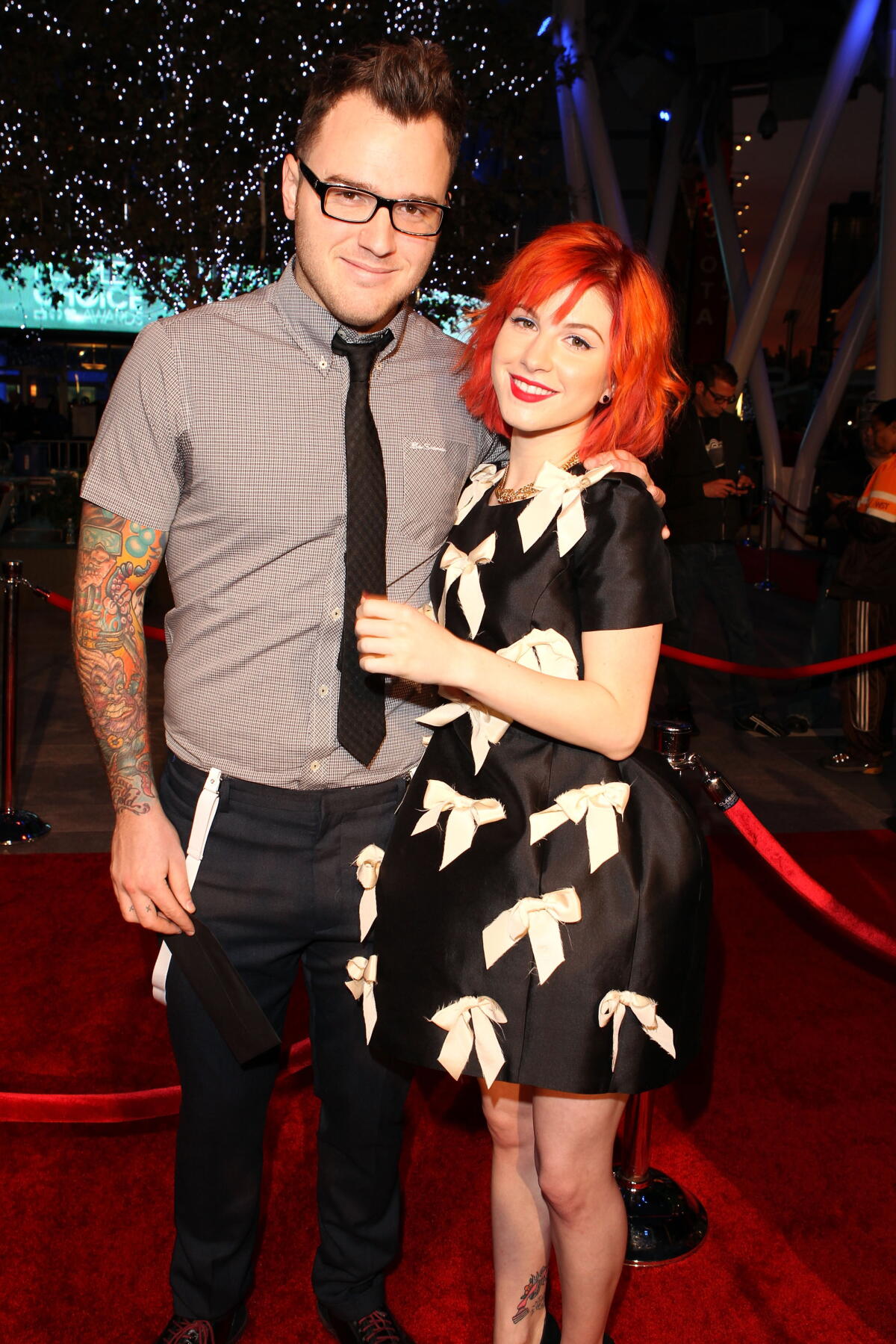
Musician Chad Gilbert of New Found Glory and singer Hayley Williams of Paramore arrive at the 2010 People’s Choice Awards.
(Christopher Polk / Getty Images for PCA)
Williams concluded her statement by sending her love and sympathies to Gilbert’s family, friends and his New Found Glory bandmates Jordan Pundik, Cyrus Bolooki and Ian Grushka.
Gilbert died Sunday morning “peacefully in his sleep,” the band and his wife, musician Lisa Cimorelli, announced on social media. No cause of death was given, but the musician had been candid about his battle with cancer in recent years.
“He left this world surrounded by friends and family and took his final breaths with his wife and mother by his side, just as he wished,” the joint statement posted Sunday to Instagram read.
Williams and Gilbert were married in February 2016 after nearly a decade of dating but split the following year in July 2017, saying at the time that marriage wasn’t for the faint of heart.
Gilbert later married Cimorelli in October 2020, and the two welcomed a daughter, Lily, in 2021.
Nneka Ogwumike answered the same question she’s been facing for almost two months.
Why now? Why leave the WNBA when she still leads the Sparks in scoring and rebounding, has played a central role in helping the league negotiate a transformative new collective bargaining agreement and returned to the city where her pro career began?
Ogwumike is at peace with her decision. And when she steps onto the court in a Sparks jersey for the last time Thursday, she will do it without regrets.
“I’m mostly grateful,” Ogwumike said. “I haven’t really been thinking much else besides just being grateful for the opportunity to have had a 15-year career in the WNBA and also to finish in a Sparks jersey.”
There is a lot for which to be grateful.
Ogwumike entered the WNBA as the No. 1 overall pick of the Sparks in 2012. Now, 15 seasons later, she is leaving the league as one of its most accomplished players — and as the most prolific scorer in Sparks history.
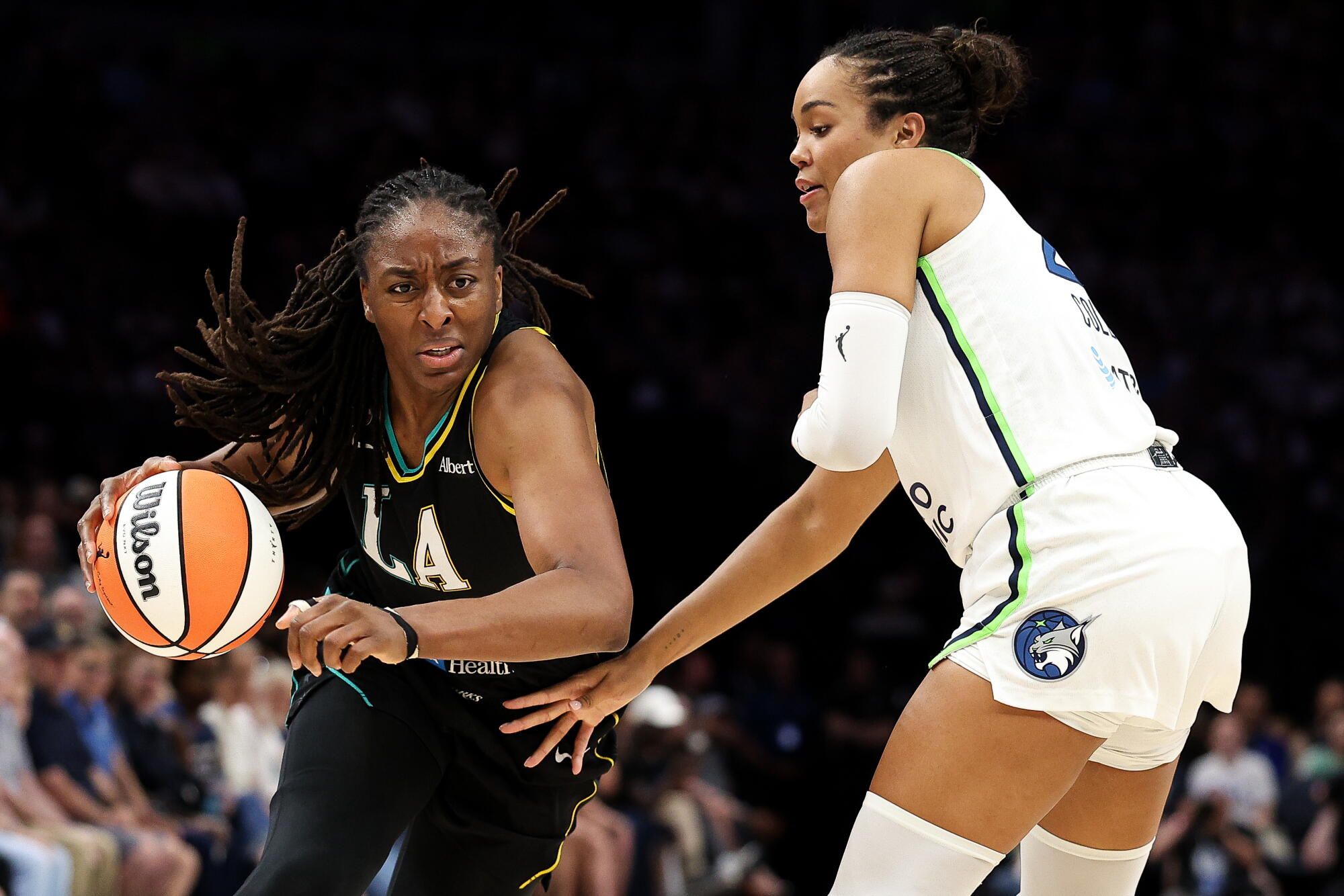
Sparks forward Nneka Ogwumike, left, tries to drive past Lynx forward Napheesa Collier during a game in Minneapolis.
(Matt Krohn / Getty Images)
“It feels freeing,” Ogwumike said of her decision to retire. “It feels like there’s a level of autonomy that I’m able to have, and I’m very happy about that.”
The numbers only begin to tell the story.
Ogwumike was rookie of the year after averaging 14 points and 7.5 rebounds per game. Four years later, she produced the best season of her career, averaging 19.7 points per game, winning MVP and leading the Sparks to their third WNBA championship.
She spent 12 seasons with the Sparks before leaving for Seattle, then returned to Los Angeles this season to finish her career.
Along the way, she established herself among the most productive players in league history. Ogwumike will finish her career fourth all-time in scoring with 8,013 points, behind Diana Taurasi, Tina Charles and DeWanna Bonner. She is third all-time in rebounds with 3,571 and third in steals with 716.
And on July 17, she added one more piece of history to the résumé, passing Lisa Leslie to become the Sparks’ all-time leading scorer.
Sisters Chiney, left, and Nneka Ogwumike pose for a photo at the Bird’s Eye View After Party during WNBA All-Star weekend.
(Daniel Boczarski / Getty Images for Vox Media)
“This is where it all started [for me],” Ogwumike said. “So very happy to be able to share this time, both the beginning and the end of my career in L.A., and I had a majority of my career playing for this organization, so it really does mean a lot to be able to finish in it as well.”
The return, however, did not unfold quite the way Ogwumike or the Sparks had envisioned.
Los Angeles entered the season with playoff expectations after bringing Ogwumike back, signing Erica Wheeler and trading for Ariel Atkins. The Sparks had not made the postseason since 2020, and the hope was that Ogwumike’s return could help change that.
Instead, the season became a struggle. The Sparks will finish 10 games out of a playoff spot, leaving Ogwumike’s final games less about a postseason push and more about what she could leave behind.
“The season is not at all what I expected, but it doesn’t mean that I can’t come out here to do my job and try and be great, and be great as a result,” Ogwumike said. “And as always, playing with my teammates as well.”
That has meant spending time with the young players who will carry the Sparks forward after she is gone.
Sparks coach Lynne Roberts and Nneka Ogwumike talk on the sideline during a win over the Indiana Fever in July.
(Katelyn Mulcahy / Getty Images)
Ogwumike has particularly focused on Cameron Brink, the young forward who represents a significant part of the organization’s future.
“I think right now I’m really spending a lot of my time trying to pour into Cam as well,” Ogwumike told reporters this week. “I really do think that she’s the future of the league. … I’m happy to be able to leave whatever I can before I throw my feet up.”
It is a fitting final role for a player whose career has stretched across generations of the WNBA.
“She’s poured into me since I got into the league,” Dream forward Angel Reese said in August. “Kind of like one of my first vets, always being there for me, always texting me, and also really like educating me on the things that were going on, knowing that it was a big CBA coming up.”
Her final contribution might not be something that appears in a box score. It might be what she passes on.
“She’ll be missed,” said Valkyries forward Gabby Williams, who played with Ogwumike in Seattle the previous two seasons. “As a friend, but also as a fan. I’ll miss watching her in the W.”
Williams knows what Ogwumike’s career has meant to the league, but she also understands what comes next.
“I’m really happy for her,” Williams said. “Happy she gets to take that next step. I know what it means to her. I’m glad her last year was pivotal for the CBA and she’ll always have her name written on that.”
Ogwumike, though, isn’t spending much time looking backward.
She hasn’t thought about what her final moments in the WNBA will feel like, only the gratefulness she feels to have had her 15-year career.
“I haven’t,” Ogwumike said when asked if she has thought about her last moments in the league. “Still just focused on playing.”
Welcome back to the Times of Troy newsletter, where we’ve reached a critical fork in the road for the Lincoln Riley era.
The soft part of the schedule is behind USC. Oregon awaits next Saturday. The time is now for Riley and USC, just like the billboards around L.A. have been insisting for months.
That this moment arrives after Saturday’s uninspiring escape from Rutgers only amplifies the pressure on USC’s coach. Against arguably the worst team in the Big Ten, the Trojans were once again plagued by many of the same road woes that Riley has failed for four years to solve. USC’s defense, now on its third coordinator under Riley, was largely a disaster. Even the offense, with another Heisman Trophy candidate at quarterback, looked clunky and out of sync.
Fight on! Are you a true Trojans fan?
Get our Times of Troy newsletter for USC insights, news and much more — exclusive to L.A. Times subscribers. Free Members receive a partial preview of each edition.
By continuing, you agree to our Terms of Service, which include arbitration and a class action waiver. You agree that we and our third-party vendors may collect and use your information, including through cookies, pixels and similar technologies, for the purposes set forth in our Privacy Policy such as personalizing your experience and ads.
Now, Riley is out of time to iron out these issues. Because there is no more important game for USC this season than next Saturday. Outside of the 2022 Pac-12 title game, which went quite poorly for him, I’d argue it’s the most important game of Riley’s entire tenure to date.
Riley has yet to beat Oregon as USC’s coach, while Dan Lanning and the Ducks have run circles around the Trojans, on and off the field, during the four-plus years they’ve both been coaching out West. Oregon may have never won a national title, but has been to the College Football Playoff in three out of those four years. USC has never been to the Playoff. The two teams have become legitimate rivals over that time. But in two meetings with Oregon under Riley, there’s never been any doubt about who’s the better team.
For a brief moment, early in this season, it seemed like that might be shifting. Oregon was stunned by Oklahoma State, just two weeks ago, leading to real questions about whether the Ducks are the Playoff contender they were made out to be.
That loss, though, actually ratcheted up the importance for Riley. With Oregon appearing this vulnerable, there are no excuses for USC or its coach if they don’t win this game. No matter the situation that Riley inherited, the Trojans should have what it takes, by Year 5, to compete with Oregon. Full stop.
That’s the standard that USC was expecting in shelling out over $11 million per year to its football coach. But in four-plus seasons under Riley, the Trojans have just six wins against ranked opponents and have consistently blown their biggest games.
Think, for a moment, of Riley’s biggest win at USC. Are you having a hard time conjuring it? That’s because of the six ranked teams that USC has beaten under Riley, all of them finished with four losses that season.
Clay Helton had three top-five wins at USC through his first 18 games as head coach. Meanwhile, in almost five years and 57 games, I’d argue Riley still doesn’t have a single great win.
He can change that Saturday. But if Riley can’t lead USC past Oregon now, after all this time, who’s to say he ever will?
“House of Troy”: Chapter 1 drops Sept. 22
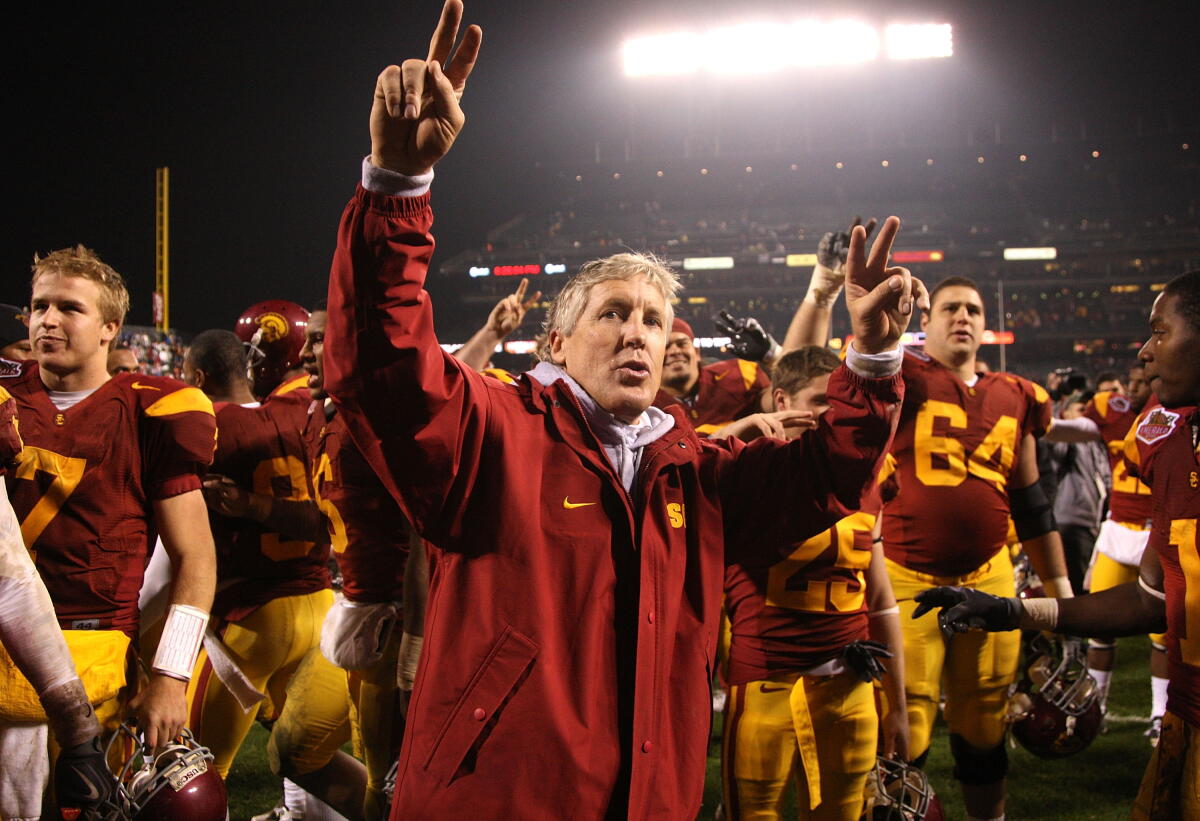
Pete Carroll when he was coaching USC.
(Getty Images)
Twenty five years ago, USC’s football program was in a bad spot.
The Trojans hadn’t been relevant in over a decade, and Paul Hackett had just been fired as head coach. USC needed a new direction. But its search for Hackett’s replacement was going poorly. Two coaches — from Oregon and Oregon State, no less — had already turned them down. That’s when Daryl Gross, the USC official in charge of the search, turned his attention to a twice-failed NFL coach.
Pete Carroll.
His hire would turn out to be a seminal moment in the history of Trojan football. But that was not how folks saw it at the time.
“There’s legendary stories of fax machines just blowing up and paper after paper coming through,” said Rocky Seto, who was a grad assistant at the time. “People weren’t happy.”
Bill Plaschke, The Times columnist, wrote a column at the time ripping the hire. Carroll himself called Plaschke after that, begging for a shot.
“All he kept saying,” Plaschke said, “was just gimme a chance.”
Well, it turned out OK for Carroll and the Trojans. They won back-to-back national titles and nearly won a third during his tenure as coach.
It’s what came after that, as USC tried to cling on to the Carroll era, that’s the subject of a new narrative podcast series from LA Times and LA Times Studios, House of Troy. Starting with Carroll’s hire a quarter-century ago, we’ll walk you through how USC rose to college football prominence and how it all came crashing down once Carroll left.
The first chapter of House of Troy drops on Sept. 22, with new episodes coming every week after that. Before then, be sure to subscribe wherever you get your podcasts.
King Miller runs past Rutgers defensive lineman Farell Gnago in the first half.
(Adam Hunger / AP)
—King Miller is the clear RB1 at the moment. USC may view Miller and Waymond Jordan as starting running backs, but there’s no doubting who has taken the reins at the top of that rotation. Both are averaging over five yards per carry. But Miller has at least 15 carries in all four games, while Jordan hasn’t eclipsed 11. Personally, I’m a bit surprised by that divide given how great Jordan looked before his injury last season. It makes me wonder if he’s all the way back from his ankle surgeries.
—The receiver rotation is still up in the air right now. With Trent Mosley out indefinitely, USC opened the game with Kayden Dixon-Wyatt, Corey Simms and Zacharyus Williams as its top three wideouts. Dixon-Wyatt is deservedly locked in that spot, while Simms balled it in his 20 snaps, catching four passes for 72 yards despite missing some time during the game due to injury. Hines ended up playing more snaps, but had a key drop on third down that we’d be talking much more about if USC hadn’t gone for it and converted on fourth. Williams played in the slot, but had just one catch. The real mystery here is Terrell Anderson, who was dressed and not on the injury report, but didn’t play a single snap on offense. Anderson was viewed, at one point, as a key contributor, so it’s not clear what happened.
—Kaylon Miller replaced Hayden Treter as the starting left guard. The move was a bit unexpected, given how Treter played through three games. Treter still played 28 snaps to Miller’s 40 against Rutgers, but with a very good Oregon defensive line on tap, the offensive line will be tested next week unlike it has all season. Miller has always had the respect of offensive line coach Zach Hanson. We’ll know at the start of the game next week whom he trusts the most in that spot.
—USC isn’t built to withstand injuries in the secondary. No unit on the entire roster has more doubts about its depth, and against Rutgers, USC had to test that depth more than it would like. Top corner Jontez Williams only played 22 snaps, while slot corner Alex Graham only played 15. Kennedy Urlacher and Rock Hill took their places, and while they did a fine job, the ripple effects of one injury on the position could be significant. Behind those players are a lot of question marks. So USC better hope that they’re all healthy heading into Oregon.
—USC men’s hoops will play four Big Ten road games in 10 days to start 2027. Which, on its face, seems patently insane. But after a screwy start to the Big Ten schedule a year ago, coach Eric Musselman actually asked for a slate exactly like this. The reason? His team doesn’t have to travel back and forth twice to the East Coast. In this case, they will have to travel from Bloomington, Ind. to College Park, Md. But that’s much more doable than an extra 10 hours of flying.
This week, in 2006 …
After hosting College Gameday and beating No. 19 Nebraska at home, USC opens its Pac-10 season on the road with a dominant defensive performance at Arizona, winning 20-3.
Led by new inside linebacker Rey Maualuga, the Trojans didn’t allow a single point until the fourth quarter. The offense, meanwhile, finally found a running back to lean on. With Reggie Bush and LenDale White both off to the NFL and USC still waiting for someone to step up in their place, Emmanuel Moody heeded the call. He rushed for 130 yards and a score as the Trojans stood pat at No. 3 in the AP poll.
Polling the people
We asked, “After three comfortable wins in the non-conference schedule, do you feel better about the Trojans’ trajectory than you did at the start of the season?”
After 1,523 votes:
Nothing has changed, 47.4% Yes, I feel better, 45.8% No, I feel worse, 6.8%
Olympic sports spotlight
A brutal start to the season isn’t getting much better in Big Ten play for USC’s women’s soccer team. After starting the conference slate by being shut out, 5-0, by Michigan State, USC was shut out again by Purdue, 2-0, and then managed a tie against Oregon, 1-1.
The Trojans have scored one or fewer goals in seven of their nine matches this season and are 0-5-2 in those scenarios. They need to produce more offense — and stat.
What I’m watching this week
Domhnall Gleeson as Ned in “The Paper.”
(Aaron Epstein/Peacock)
It tends to take at least a season for a sitcom to really find its rhythm, and so far, that’s been the case for “The Paper,” the spinoff of The Office which dropped its second season on Peacock recently. The first season got the journalism right, but the narrative was a bit clunky, as it sorted out who of its characters should be leading the way.
Fortunately, it seems like they’ve figured it out. Especially in the case of Domnhall Gleeson’s lead editor character, Ned Sampson, who I find far more likable in Season 2.
That concludes today’s newsletter. If you have any feedback, ideas for improvement or things you’d like to see, email me at ryan.kartje@latimes.com, and follow me on X at @Ryan_Kartje. To get this newsletter in your inbox, click here.
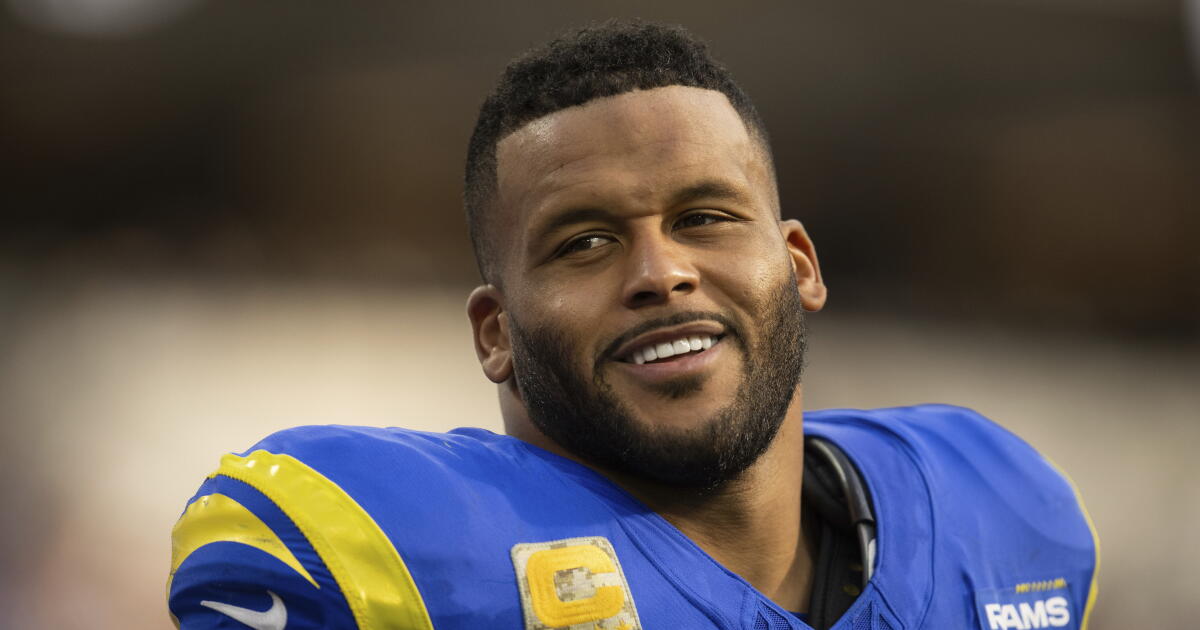
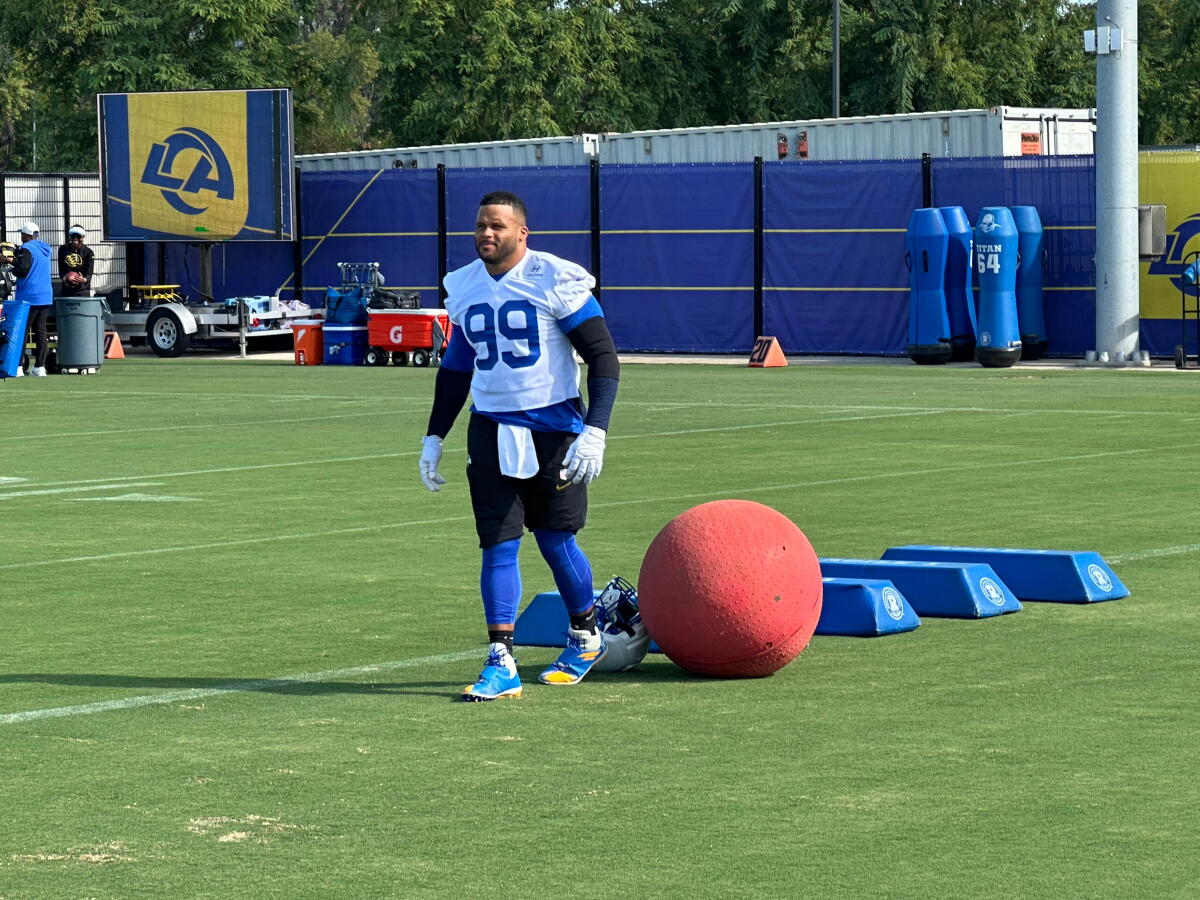
Aaron Donald said Friday that he planned to make his season debut for the Rams against the New York Giants on Monday night, but star receiver Puka Nacua’s status is more hazy because of a hip injury.
Donald, 35, rejoined the Rams after ending a two-year retirement. The three-time NFL defensive player of the year did not travel to Australia for the season-opening defeat by the San Francisco 49ers, but he has participated in several 11-on-11 drills this week.
Asked if he would play on Monday, Donald said, “That’s the plan.”
Donald’s plan? Or the Rams’?
“I think that’s all of our plan,” he said. “We have a conversation, we figure it out.”
Donald said he felt as if he had never been away.
“Kind of getting in the groove of things, understanding everything a lot better out there playing a lot more free, a lot more loose and looking more like myself to me,” he said.
Nacua, who was sidelined for a few weeks during the preseason because of a psoas injury, caught five passes for 74 yards against the 49ers and practiced on Thursday. The psoas is involved in hip movement, so it is not clear whether Nacua’s absence was caused by the same injury or a new one.
Nacua was scheduled to speak with reporters on Friday, but did not do so because he did not practice. Coach Sean McVay is scheduled to speak with reporters on Saturday.
Regardless, the Rams are expected to get a boost from Donald, an eight-time All-Pro.
Edge rusher Byron Young played with Donald as a rookie in 2023. Now he will be playing alongside him again.
While Purdue is not projected to be a Big Ten juggernaut this season, UCLA coach Bob Chesney and his team expect to be challenged during their first game against Big Ten competition on Saturday at the Rose Bowl.
The Boilermakers’ defensive line features five high-impact players that are at least 6-foot-3, and a nose tackle who weighs in at 301 pounds and anchors a defensive front that ranks second in the Big Ten with 17 tackles for loss.
“They’re talented in who they’re as individual players, there are some game-wreckers in there,” Chesney said. “They are as vertical as can be, they jump out of their stances, they’re jumping snap counts and they’re violent. They pose a giant problem, and we are not going to be able to push them around, and we are not going to be able to find ourselves in a spot where they tire. This is going to be a battle on the inside throughout the entire course of that game.”
While UCLA’s ground attack has dominated through the first two games of the season — rushing for 277 yards and six touchdowns against California and 214 yards and four scores against San Diego State — it might be harder for the Bruins’ running backs to have their way against the Purdue defense.
Purdue held both Indiana State‘s and Wake Forest’s starting running backs to less than four yards per carry, and has conceded just two rushing touchdowns to those starters this season.
“There’s some things that I think Purdue does a really good job defensively, in terms of getting off the ball,” said UCLA offensive coordinator Dean Kennedy. “They have got a lot of length. They’re a very, very big team, it will probably be one of the biggest teams we will face, so we have to be prepared for that.”
However, the Boilermakers have struggled to stop quarterbacks on the run — allowing Indiana State’s Elijah Owens and Wake Forest‘s Gio Lopez to combine for 118 rushing yards and two touchdowns — giving Bruins senior quarterback Nico Iamaleava the opportunity to rely on his legs.
While Iamaleava should have wide receivers Landon Ellis and Brian Rowe Jr. back to full strength, fortifying the aerial attack, the signal-caller will be without Mikey Matthews, after the slot receiver went down with a lower-body injury against San Diego State.
“There’s a fine line. Understanding what the coverage is doing, when is it time to take off and go,” Kennedy said. “If you are going through your read, from a clock standpoint, and it’s not there, it’s a great time to take off and go. It’s our job as an offense to create explosives, whether it’s him taking off or it’s him creating a scramble drill. We look at scramble drills, that we have to create explosives, and that’s something we have to do a better job of.”
Defensively, the “Bruin Bullies” will be tasked with stopping running back Fame Ijeboi, who has run for 201 yards and four touchdowns on 5.3 yards per carry this season. Chesney said that Ijeboi has a “Wayne Knight” feeling to him, where he plays low to the ground, displays proficient body balance and leg drive, allowing him to be influential in the passing game and break tackles.
While UCLA has already faced formidable rushers in Cal’s Adam Mohammed and San Diego State’s Lucky Sutton, Ijeboi could be the most impactful yet. And no one knows that more than Bruin defensive coordinator Colin Hitschler, who went to the same high school as the Boilermaker running back.
“It’s been fun to watch his growth, following him through high school, and watching him earn those scholarships and opportunities,” Hitschler said. “Those first two games, he jumped off the tape. He’s got great potential and he’s going to go a long way. We have to do a good job putting a physical shoulder on him and knocking him down because he’ll run through contact and does a great job of finding the edges.”
If Ijeboi is unable to get it going, it will have to be up to Purdue quarterback Ryan Browne to generate offense.
While the signal-caller struggled last season — throwing nine touchdowns with 10 interceptions — Browne has looked like a new player in 2026, passing for 646 yards and four touchdowns.
Browne has benefited from the addition of two premier slot receivers in Florida Atlantic transfer Asaad Waseem and Iowa State transfer Xavier Townsend. They have combined for 25 receptions, 277 yards and one score.
“What makes them unique is there are a lot of them,” Hitschler said. “When you have 10 personnel and that many receivers that can catch the ball, it can create mismatches, and we play a lot of man, so who’s going to fold first?” Hitschler said. “Are we going to be able to man them up or are we having to play more zone? Those are questions that will play out as the game dictates by who’s winning the one-on-one matchups. It’s the chess match that always happens in any game.”
The Bruins’ defense will look to force turnovers, but that is no easy feat as the Boilermakers have yet to turn the ball over this season.
CINCINNATI — The Dodgers celebrated clinching a postseason berth with a champagne toast. Simple. Restrained. Leaving room for larger celebrations to come.
“The message was, ‘We haven’t come close to playing our best baseball yet,’” manager Dave Roberts said after the Dodgers’ 4-1 win over the Reds on Monday. “And here we are with 12 games left, getting a ticket to the postseason. And that says a lot about this entire organization. And just to finish strong.”
It marked the Dodgers’ 14th straight playoff berth, tying a record set by the Atlanta Braves from 1991 to 2005.
“It’s different than anything I’ve experienced, for sure,” Tarik Skubal said of the understated celebration. “But I think it just speaks to the people in this room and what they expect out of this team. That was cool. A little toast and move on. Forget it happened. We’ve got more to accomplish.”
Most teams don ski goggles to celebrate with champagne and beer showers. The Dodgers will save the messier celebration for clinching the division. Their win over the Reds (70-80) trimmed that magic number to three.
It was fitting that Skubal, the Dodgers’ big trade-deadline acquisition, was on the mound for the clincher. He’s progressively improved in his eight starts with the Dodgers. And on Monday, he breezed through seven shutout innings, allowing just four baserunners (three singles and a walk).
“I think a lot of the struggles have been me versus me,” Skubal said. “Thinking too much out there, not competing the way I know how to compete. Just thinking too much about pitch selection at times and trying to be too fine and not challenging guys.”
He has grown more comfortable with the pitching coaches and his catchers, and it has brought out a better version of him. Skubal seems to be peaking at the right time — just as Roberts hoped for the team as a whole.
Even after clinching the division likely this week, the Dodgers (91-59) will be playing for seeding, aiming for at least a first-round bye.
“It’s always helpful in the sense of giving your guys a break to reset,” Roberts said. “But given all the tax and where our guys are health-wise, to get that week would be huge. So we’ve still got to play well to finish out the season to get to that point.”
The position-player group has been hit the hardest down the stretch.
Designated hitter Shohei Ohtani (right biceps and left knee), center fielder Andy Pages (left hand fracture) and backup catcher Dalton Rushing (sprained right elbow) are on the IL. First baseman Freddie Freeman was out of the lineup Monday managing right knee soreness, and second baseman Miguel Rojas was playing through shoulder soreness after aggravating a longstanding partial tear in a labrum.
“You’ve got to give credit to the front office,” said Teoscar Hernández, who hit a two-run homer Monday. “They put together a really good team, [a] deep team that has a little bit of too much of everything. A lot of pitchers, a lot of position players here, players that can play all over the field. We’re one of the oldest teams. We know [injuries] are going to happen throughout the season. So, we’ve just gotta be ready, and the team has to be ready, and everybody else.”
Here are more specific injury updates provided by Roberts:
— Ohtani is set to hit off a tee Tuesday. Up until this point, he’s been working out, lifting and undergoing treatment.
— Pages hit softer balls Monday and will advance to hitting baseballs in the cage Tuesday. “He’s trending really well,” Roberts said.
— Freeman is expected to return to the lineup Tuesday, but Roberts will continue to keep a close eye on him. “Where we’re at in the season, an IL is not an option in the sense of — I personally don’t think we have a better option,” Roberts said. “So I don’t think it needs to be 10 days. But could it be more than one? That’s a fair question. And I’ve got to talk to the training staff, Freddie, and ultimately make that decision. But I don’t think IL would make sense at all.”
— Rojas did not receive a cortisone injection as he had initially predicted when he hurt his shoulder Sunday. But he said it’s still a possibility as he manages pain in his shoulder. The Reds have left-handed starters scheduled for two of the four games, making Rojas’ right-handed bat valuable.
“Right now it’s front of mind, it’s not great,” Roberts said of the Dodgers’ injury situation. “But I will say this: Once you get to October, athletes have a magical way of feeling better. It happens every single year, where there’s that extra adrenaline that athletes get when you get to the postseason.”
For Orville Peck, the best Sundays are basically all the same. And they are pretty similar to every other day of the week too. The masked country singer (and now actor) got sober three years ago and has figured out a routine that helps him stay clear-minded and present with the people in his life whom he cares about.
In Sunday Funday, L.A. people give us a play-by-play of their ideal Sunday around town. Find ideas and inspiration on where to go, what to eat and how to enjoy life on the weekends.
“If I don’t keep up that routine, especially on a day like a Sunday, it quickly falls into no day feeling fun,” he says. “[The routine], which to some people is like, ‘Oh God, that looks like hell,’ is fun for me because it is fun for me to show up for myself.”
Peck’s latest album, “Mule,” which details his sobriety journey, is out Friday. That same day, he’s headlining the Hollywood Bowl, one of his favorite venues in the city.
Peck currently lives in the Hollywood Hills and has been in Los Angeles, on and off, for 18 years. “It’s definitely home to me,” he says. “I met my partner there. I’ve had some of the most important moments of my life in Los Angeles. I will always love this city.”
It’s also particularly conducive to his new lifestyle. “There’s a ton of other crazy people going to the gym and swimming and going to [12-step] meetings every single day,” Peck says. “So I’m in appropriately obsessive company for sure.”
This interview has been lightly edited and condensed for length and clarity.
5 a.m.: Early to rise
I wake up painfully early. I’ve been doing that since I was a toddler. I used to hold my mother’s eyelids open in the morning to get her to wake up.
When I wake up, the first thing I will do is meditation. I do transcendental meditation. I find every other form of meditation impossible. I’ll do TM for 20 minutes. My partner started doing it and I saw how much he was benefiting from it, so I decided to go and take the course and just loved it.
And then I’m an avid journaler, so I usually journal for probably about half an hour in the morning.
7 a.m.: Caffeination and hydration
I will make a very large iced coffee. I’m not snobbish about coffee, I’ll drink whatever.
I also fill up a massively obnoxious water bottle that has times on it that I carry everywhere. It looks like performative hydration, but it’s literally because if I don’t challenge myself to drink water, I just won’t drink water at all. It’s basically to shame myself into drinking water.
8 a.m.: Pool time, Part 1
I get to a public pool and I do laps. I grew up in South Africa and you’re forced to play every sport known to mankind. I always excelled at swimming, so it’s the one thing I still love to do. I just started up [again] within the last year.
I work out a lot, but when I’m at the gym, I don’t do any cardio. I’m never going to be on a treadmill or anything like that. Swimming feels like a fun way to keep me engaged.
10 a.m.: Meal prep
Then I go meet back up at home with my partner. We’ll go take our dog for a walk or we’ll go to a farmers market to get some produce for the week.
Then we’ll go grocery shopping because I love to cook. I will go to whatever is easiest. I’ll frequent a Gelson’s or a Ralphs or a Whole Foods. If I’m going to Whole Foods, I’m not doing regular grocery shopping. I want brands. I like a Coca-Cola.
I’d say I’m cooking usually about five or six nights a week. I’m very organized — I’m a Capricorn, if you can’t tell. I usually have a whole menu of what I’m going to do for the week, so I’ll get everything I need for that.
I will read a recipe or see a recipe I like, and then I will just freestyle it. I used to work in restaurants, so I feel pretty confident about it. But in terms of the style [of cooking], I’m best at recipes that take a long time, so anything that requires lengthy flavor building, like stews or curries.
Noon: Pool time, Part 2
Back at the house, we’ll have some lunch, something easy by the pool. So more swimming.
2 p.m.: Gym time
I’ll work out either at the house or go out to the gym. I’ve been sticking with a weight training routine for a couple of years now, but I try to evolve the exercises all the time because I get bored really easily.
Sometimes I work with a trainer. I filmed “Street Fighter” last year in Australia, so I did a ton of different training and martial arts training for months. It opened up my horizons to a lot of different forms of working out that I just didn’t know before. I’ve got a pretty big encyclopedia to pull from at this point.
4 p.m.: Recovery
I’ll usually head to a 12-step meeting, I’ll either catch one online or try to find one in person because there’s a lot around L.A.
6 p.m.: Not cooking tonight
On the weekend is where we will typically order in or eat out, maybe with some friends. Some places I love to order in from are the Sisters Cafe, which is Vietnamese, and Jon and Vinny’s.
9 p.m.: Early to bed
Both my partner and I are 80 years old at heart. We always have grand plans about watching a movie or whatever, and then we’re both inevitably snoring by 10 p.m. at the latest.
I used to live my life like a psycho maniac doing everything unhealthy. It definitely didn’t involve going to 12-step meetings and swimming laps at seven in the morning. It was whatever the opposite of that is.
When I went through the first two years of my sobriety, I went through a lot of trial and error in terms of overdoing it with things like therapy and mindfulness, and then also underdoing it as well. It took me a couple of years to really find what are the things that make me feel good about myself, make me feel grounded, make me feel accountable, and still feel like I’m living a happy life and not just white-knuckling 12 hours of, essentially, therapy every day. So I’ve found the things that really work for me.
There’s days where I will totally not do every one of those things. There’s days where I’m too lazy to go swimming and there are days where I’m like, “I don’t want to go to the gym.” I’m not militant about it. The other thing I’ve learned is to be easy with myself.
At age 14, Glen Walsh started surfing because of a crush. He was a boogie boarder until the object of his adoration told him, “What are you riding that for? You should be surfing. Get a surfboard.” So, he did. “I was terrible at it, but I kept going. I was super persistent.”
That resilience proved useful. As a gay teenager in Santa Monica, Walsh was often called slurs on the Venice Pier. “You think you’re like a unicorn — a weirdo,” he says. He felt at odds with the local surf community. To Walsh, surfing was “super straight, very hypermasculine, very intimidating.” Yet his love of the ocean — and sure, crush-worthy surfers — kept him returning to the water. “I wanted to be around them, and surf with them,” he says.
When Instagram launched in 2010, Walsh began posting one of his early loves — only this time, it was morning surf conditions. Every morning, before surfers paddled out, the longtime Venice resident described swells, winds and surf conditions to his followers, becoming for some the town’s trusted surf chronicler.
A “Surf Swim” sign greets beachgoers at Venice Beach — a stretch of coast where daily surf reports and grassroots organizing have helped break down traditional surf stereotypes.
(Christina House / Los Angeles Times)
His videos combined informative dispatches with the laid-back vibe of surfer ASMR. “Light offshore wind. Clean, glassy barrels,” he declares softly to the camera as gray waves break behind him. “Lumpy close-out with hollow barrels with low tide, fam.”
At first, the account functioned like a group chat for local surfers. “Friends were asking me how the waves were, and I was texting them. I figured I’d jump on Instagram and start doing it for them,” says Walsh, who has been a Venice resident for 15 years.
What began as a practical update for a handful of friends eventually attracted followers in London, Berlin and Tokyo — people who checked in daily to see whether the surf was firing in Venice Beach. The account has amassed over 10,000 followers, inspiring imitator accounts. “Now it’s just for everybody,” says Walsh. “I built a community around the surf reports. It really blew me away. I didn’t realize that people were so interested.”
His surf reports have made him an unofficial mayor of Venice surf culture, getting recognized at the beach town’s local hangouts like Hinano Cafe and the Cow’s End. “People stop me and tell me they love my surf reports. They don’t even surf, but they see it every day,” says Walsh. “I always tell people I’m very popular between Washington Boulevard, Lincoln Boulevard and Rose Avenue.” His nickname around town is Glenice Venice.
However, the real triumph wasn’t becoming recognizable around Venice — it was finding other queer surfers, something that felt elusive in Walsh’s youth in Southern California. “I had met a lot of other surfers from all over the world and built a queer community of surfers here in L.A.,” says Walsh. “It was pretty awesome.”
Walsh saw an opportunity to use his surf report to not only report on the condition of the ocean — which is especially unpredictable during our current El Niño cycles — but to also create a burgeoning queer space in the Venice surf scene. “I could set up a community-based surf report for everybody, and the fact that I happen to be queer made it a little more unique,” he says. He began to connect with gay surfers, organizing trips with them and building lasting friendships. “It was just a lot of fun, building a little team.”
Later, Walsh became a co-producer and music supervisor of a movie about homophobia in surfing titled “Out in the Line-Up” that premiered at film festivals across the world in cities such as New York, San Francisco and Sydney, Australia. “The movie kind of spoke for itself. It was a worldwide issue — homophobia in surfing.” Since then, Walsh has served on panels about queer people in the surf world. Last June, the film had a 10th anniversary screening in Venice, hosted by the Venice Surfing Assn. “At some point, I brought some diversity to this culture. I put my name on it,” he says.
In recent years, others have joined Walsh’s efforts to create a burgeoning queer surf scene at Venice Beach. In 2020, Shelly Guidera relocated to Venice and noticed that there wasn’t a strong queer presence in surfing. “My friend and I were maybe the only queer people some of these surfers had ever seen,” she says. Shortly after, Guidera started Dream Team Surf, a collective for queer surfers to meet up and build camaraderie.
Its mission is simple. “It’s all of us looking out for each other,” Guidera says. “ Having a team of people makes the experience that much more enriching and safe.”
Surfers ride the waves near the Venice Pier, where Glen Walsh does his daily surf reports.
(Eric Thayer / Los Angeles Times)
Early on, Guidera was inspired by Walsh’s uplifting presence in the Venice surf scene. “This person is respected in the community for what he brings, which is knowledge and insight and fun and flair,” says Guidera. In turn, Walsh has championed Dream Team Surf.
In January 2025, Dream Team Surf hosted a Pride beach party with a banner that read: “Trans bodies belong on the beach.” In some San Diego area beaches, Guidera says, queer representation can still feel like an anomaly. “It’s so funny because it’s like these people have maybe never seen a woman in a bathing suit with hairy legs,” she says. “I’m like, ‘Oh my God, it’s not that deep.’”
Guidera is certified in surf therapy, taking courses through Groundswell Community Project, a surf therapy program that uses surf to promote holistic healing. The mental health benefits of surfing are lifelong, Guidera explains. “Growing up as a swimmer, surfing was a form of play and wellness,” she says. “It eased the brakes on competition and the structure within competitive swimming.”
Group photo of Dream Team Surf, which hosted a Pride beach party.
(Sara Werner)
Even if you don’t shred waves, being in the ocean can promote healing. “To give people access to the ocean that is in and of itself a form of wellness,” she says. “There’s a level of surrender and humility that comes with surfing and that comes with being in nature. … You have to be so present in such a way that makes you a stronger person.”
Like Guidera, Walsh also works as a surf instructor with a similar goal to instill confidence in his students. “I was teaching a lot of people to surf, mostly women who didn’t want a straight man to teach them how to surf because it feels vulnerable enough,” says Walsh. “I try to break down the stereotypes and have a little fun with them and let them become a kid again.”
When done correctly, he argues, surfing can invite expansiveness. “I love seeing people out there. Feel the fear and do it anyway,” says Walsh. “And creating a lifestyle around it — going to different beaches — and meeting friends.”
Poorna Jagannathan has played everything from a ruthless gangster (“Deli Boys”) to an overbearing immigrant mom (“Never Have I Ever”). Now with HBO’s “Lanterns,” she adds an all-powerful galactic android to her acting resume.
Her character’s identity was a secret for much of HBO’s DC Comics series until a reveal in Episode 4 that a rancher’s trophy wife, Zoe Macon (Jagannathan), was, in fact, the deadly Manhunter. Then another great surprise rocked the “Lanterns” universe Sunday when in Episode 5, she is killed by Lantern trainee, John Stewart (Aaron Pierre).
“She is dead, for sure. Maybe …” teases Jagannathan, who had to take a crash course in Green Lantern lore before assuming the role in the eight-episode series from showrunner and co-creator Chris Mundy (“Hell on Wheels,” “True Detective,” “Ozark”).
Jagannathan’s character belongs to an ancient, shape-shifting race created by the Guardians of the Universe as the galaxy’s first police force, but they’ve since gone rogue and are now out to eliminate the human race. Green lanterns are interstellar peacekeepers who wear rings that give them extraordinary powers. When veteran Lantern Hal Jordan (Kyle Chandler) and his mentee Stewart are tasked with solving a murder in rural Nebraska, they trip upon a great mystery that included ferreting out which resident in the small town of Rushville is the Manhunter.
The series has been lauded for elevating the superhero genre while presenting as a gritty crime drama. In this edited conversation, Jagannathan explains the demise of the Manhunter, how she morphed into a comic book villain for the role and what it’s like to feel all powerful at this stage in her career.
John Stewart (Aaron Pierre) and Zoe Macon (Poorna Jagannathan) in a scene from Episode 5 of “Lanterns.”
(HBO)
How much did you know about the DC universe before taking on this role?
I didn’t understand a lot of this world, but I did grow up on Wonder Woman. I twirled my way into my teens. So at least there’s that. It’s such a huge property, so there’s a lot to learn. But I realized that there’s a lot of similarities between Lucky (the gangster she played in “Deli Boys”) and Zoe. Lucky was originally written for a man. So with “Lanterns,” when I was first reading the script, I just kept looking at the cast of characters and thinking who might it be? I just expected a man would be playing the Maneater.
Maneater?
I mean Manhunter. I kept messing up and saying that when we started working on the show, too. It’s the name of an old Hall & Oates song. [Jagannathan hums, “She’s a man eater… .”]
Explain who or what a Manhunter is.
Manhunters were created by the galaxy as part of a police force, and then they went rogue. They were created to enforce justice, but it was a very particular kind of justice. There was no gray in the Manhunter. No emotion. It was either right or wrong, and they would eliminate what was wrong. But then they started feeling things.
The guardians saw it was an operation that went wrong so they closed it down. She [Zoe] is a sole survivor. She runs away to a place where she adapts quickly to the creatures around her, and learns how to feel. So she’s this feeling machine that battles against her own programming, but at the end of the day she can’t help her programming. When there’s a conflict, she resolves it by killing half the population.
Jagannathan on her character in “Lanterns”: “She’s a sole survivor. She runs away to a place where she adapts quickly to the creatures around her, and learns how to feel.”
(Christina House / Los Angeles Times)
Manhunters morph to fit in with the population around them, but the skin your character chooses is that of a brown Indian woman. She does not look like anyone else in the small, predominantly white town of Rushville. Her explanation of why she made that decision — to essentially not fit in — is really powerful. Can you recall what she said?
I remember that monologue. [John Stewart] asks, “Why did you choose this skin?” I say, “Power.” “How do you conquer a civilization and a people?” You come to it from the outside. “How do you learn about things from the outside?” In your world, you don’t want obstacles, but in my world, I need those obstacles to get a higher vantage point, to see a deeper purpose.
The absolute outsiderness is a relatable point. I did ask Chris about it and he basically said that as an Indian woman in Nebraska, you’re an outsider. You’re already alien. People are not going to ask you a lot of questions. You’re not going to be part of any power structure. So she just is an anomaly, and there’s no more questions around it.
Did you know Zoe would turn out to be the Manhunter when you first auditioned for the role?
No. The scenes that I got were the one at the bar where I’m picking up Stewart, and the scene right before I die, which is [when we’re] in bed and I’m trying to get him to leave. Like “You gotta go or you’ll die!” They didn’t indicate she was extraterrestrial in anyway. There was no E.T. flair to [the dialogue]. It was so grounded that it was easy to inhabit this character. I’m happy because if I had had even an inkling she was the Manhunter, I might have brought an alien touch to the scene. But I couldn’t quite figure out her place in the story. Definitely not during the audition, and definitely not till I read the last [scene].
Your first big breakthrough on American television was in 2016’s “The Night Of.” That was 10 years ago. Now you’re landing all these powerful, commanding and sometimes villainous roles.
I’m telling you, it’s like I couldn’t have imagined a future like this. If you’d asked me back then what kind of role do you want, I’d have no idea. Between Zoe and Lucky, they’re my two favorite TV baddies. Then Nalini (the overbearing mom in “Never Have I Ever”) and Salma (who has an affair with the title character in “Ramy”). All these characters are very strong women.
What is it that you channel to embrace these powerful roles?
The second I turned 50, I just felt an inexplicable comfort in my own skin that I never felt before. A belonging in my own skin. That translates into belonging in different spaces where I could have been uncomfortable in before, so it’s a great time to inhabit these characters. Before I would have really s— myself with a character like Lucky or Zoe, but now it feels a lot more accessible.
1
2
1.Jagannathan as Aunt Lucky in Hulu’s “Deli Boys.”(James Washington/Disney)2.Maitreyi Ramakrishnan as Devi, left, and Jagannathan as Nalini in Netflix’s “Never Have I Ever.”(Isabella B. Vosmikova/Netflix)
Do you see similarities between the characters you’ve played over the past few years?
They’re untethered, powerful women. They will do anything to keep their power. Their north star is power over anything else. Usually with female characters, everything always hearkens back to the family. Zoe is older. She is confident. She weaponizes her femininity right away, and she’s unafraid. She does it with nonchalance. She appears to not give a [damn].
All villains and warriors have an Achilles’ heel, and for female roles in particular, it’s usually sacrificing themselves to protect their family. Family is their kryptonite.
But a character like Zoe is willing to destroy everything, including her family, to keep power. She’s untethered from love and responsibility. You always expect a very masculine force to come in with this kind of power, and the fact that it never does with “Lanterns” is so unique.
You spoke on a “Lanterns” panel at San Diego Comic–Con? Describe the experience.
The [people who come in costume] are better humans than I am. To go somewhere and have your entire family dressed in Spider-Man regalia, roaming the streets of San Diego. It’s a manifestation of pure, unbridled passion from youth then passed down through generations. I wish I too had a passion like that.
“The second I turned 50, I just felt an inexplicable comfort in my own skin that I never felt before,” Jagannathan says. “That translates into belonging in different spaces where I could have been uncomfortable in before, so it’s a great time to inhabit these characters.”
(Christina House / Los Angeles Times)
Were you terrified somebody would ask you a complicated question …
… about Green Lantern?
Yes.
I had to be really upfront and honest and explain that I know so little. It’s Aaron [Pierre] who is really into comic books. He really got into this world. I did speak to a Green Lantern expert as part of the preparation for the role. I do remember him telling me how special John Stewart was in the universe. One of the first introductions of a Black superhero [in mainstream comics] was in Green Lantern, so it holds a very sacred space in comic book history.
Can you talk about your forthcoming Apple TV drama series, “Nocturne.”
It comes out Oct. 30, and it’s basically like if “Silence of the Lambs” was a documentary on Florence Nightingale. That makes it seem so tame, but it’s so, so frightening. The serial killer genre is new for me. I read the book [it’s based on] and had to install a security system in my home. I couldn’t sleep anymore! It’s with Stephen Graham, Liev Schreiber and Zazie Beetz. I play an overworked FBI agent who was brought in to help solve a crime that [law enforcement] initially tried to deal with internally and they messed it up. So they decided they decided to bring in the big guns.
You said earlier that Zoe is an outsider. Did you consider yourself an outsider, too?
Growing up, we moved around a lot. I was literally changing languages every three years. I needed to adapt quickly to whoever was around me, and it often came at the expense of never really knowing myself. You just had to quickly read the society. The language. The gestures. You had to decode quickly in order to fit in.
Even as an adult, I was not fully settled into a point of view until my 40s. That was maybe the allure of acting — getting to show a little bit of my insides through acting. It’s finding out who you might be.
DELANO, Calif. — The rows of candies and nuts at the Guadalajara Meat Market — tamarindo con chile, seasoned pistachios, spicy paletas — sat mostly untouched as customers filtered through this carniceria in the late afternoon heat.
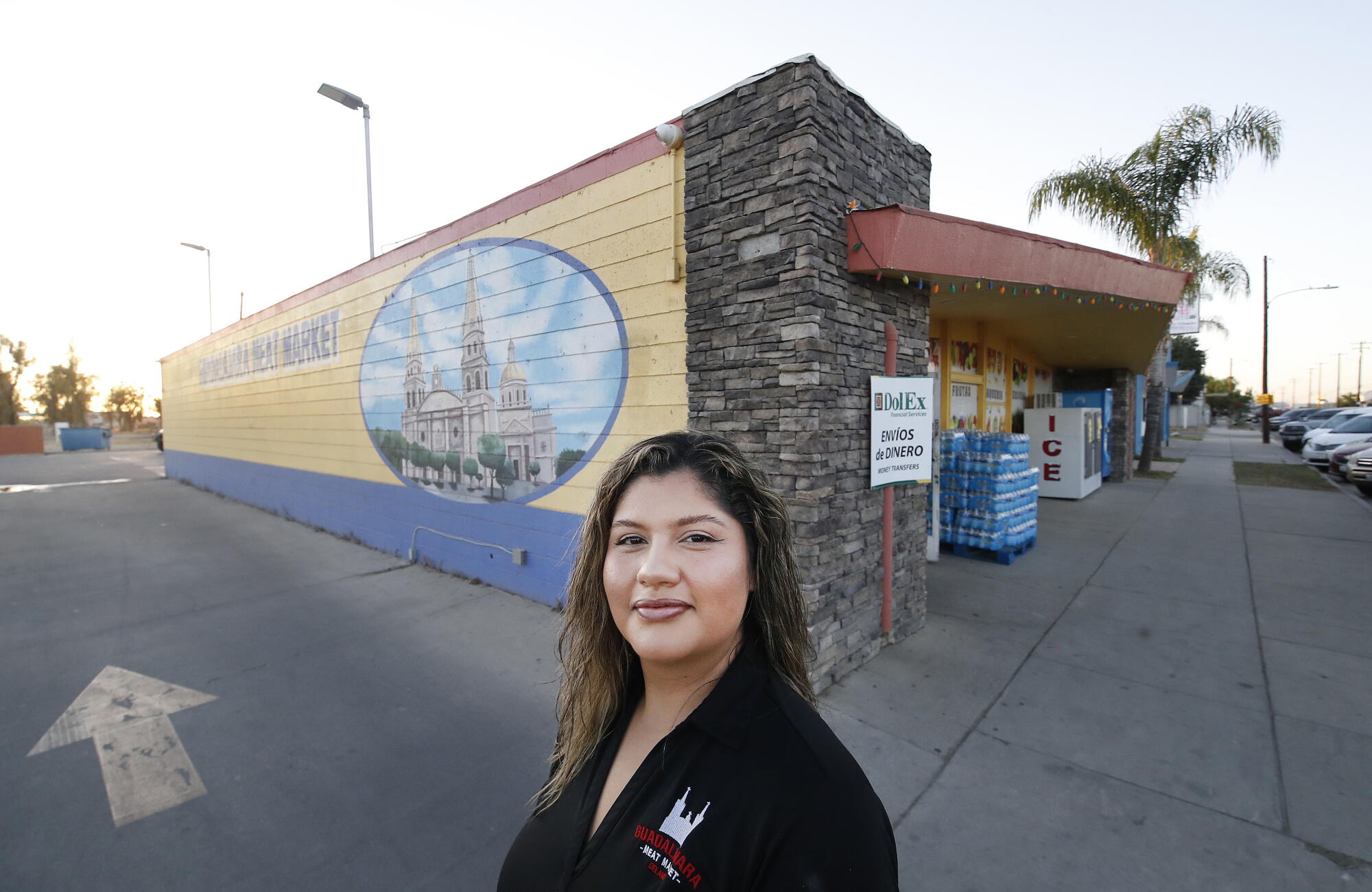
“You see a lot of people consuming the minimum, what they need to get by through the week,” said owner Carina Murillo, 31, as she checked out customers on a recent weekday. “Instead of buying six items, they’re buying three items.”
While customers bypass extras, like the snacks at the front counter, Murillo’s costs have gone up. Imported goods from Mexico and Canada have become more difficult to source and sometimes carry tariffs, she said. Transportation fees have risen as diesel prices respond to the war in Iran. The market’s insurance costs have risen by about a third. All of it has forced Murillo to increase prices.
“You see a lot of people consuming the minimum,” says Carina Murillo, owner of Guadalajara Meat Market. “Instead of buying six items, they’re buying three items.”
As the area struggles, Murillo, a college graduate who years ago felt motivated enough to door-knock for political causes, is among those who have become disillusioned. Those in Washington, she said, don’t understand the lives of the working people who keep the country running.
There have been “years where I feel completely overpowered to the point where I’m not motivated to take part,” said Murillo, who didn’t vote in 2024 but plans to do so in November. “That’s what happens when you feel discouraged or like nothing’s going to change.”
The economic strife plaguing Americans is clear in this rural, majority-Latino Central Valley congressional district, home to the state’smost competitive House race, the closely watched contest between Republican Rep. David Valadao and Democrat Randy Villegas.
Democrats hope the national economic angst will translate into big turnout in the midterm elections, but some in this region worry that years of financial struggle may depress voters’ desire to participate rather than motivate them.
Rep. David Valadao (R-Hanford) presides over a congressional hearing in March. The Republican is in a race against Democrat Randy Villegas that is considered a toss-up.
(Allison Robbert / Associated Press)
And Republicans, who rely on their party turnout beating that of Democrats in rural areas, also face the risk that frustration with the current political climate could dampen enthusiasm.
“Before they can think about Valadao, before Trump or Gavin Newsom or who’s going to run, families are concerned with the immediate: paying the rent, having the food on the table,” said Eliseo Gamiño, who heads the Central Valley Leadership Round Table, a coalition of Latino community leaders and elected officials. “You can’t be thinking about voting when your kids are hungry.”
Few voters who spoke to The Times in this swing district were decided on which party to support in November — or whether to vote at all. Such undecided voters will likely decide the election outcome, and persuading them is the key challenge for both parties as November nears.
Alexa Lopez sweeps up at closing time on a slower than usual Friday that saw one dress sold at Christina’s Fashion in Delano.
In a district that is the third-youngest in population in the country, the simmering uncertainty among Gen Z and millennial voters in particular could affect turnout or results.
Thirty-one percent of its voting-age population is 29 or younger, according to the Tufts University research center CIRCLE, which tracks youth civic engagement, making it among the top swath of House races in which young people could swing the outcome.
California’s swingiest district
The 22nd District, carved from the state’s agricultural epicenter, is one of fewer than two dozen toss-up races nationwide that will likely determine which party controls the U.S. House in the second half of President Trump’s current term. It is also among several high-stakes races nationwide that will test progressive candidates.
Valadao’s seat has long been considered a vulnerable one; Democrats added about 100,000 Fresno residents to the district under Proposition 50’s new map in a bid to help their chances. The boundaries include swaths of Kern, Kings and Tulare counties, along with a very small piece of Madera County.
“It’s going to be crucial in an area that is more purple, more bipartisan, where it’s very clear it can go either way … that these candidates make an effort to get those voters on their team,” said Brittany Martinez, a California-based Republican strategist.
Valadao, 49, who comes from a dairy farming family, is well known in the district and has repeatedly secured victory in close races, retaking the seat in 2020 after losing it in 2018’s blue wave. He saw a close race in 2022, then won by nearly seven percentage points in 2024, outperforming Trump.
His biggest vulnerability this time around may be his vote for the One Big Beautiful Bill Act, which included steep cuts to Medicaid. Local hospitals are bracing for funding cuts, though a carve-out may keep many valley residents from losing coverage. The district has the highest proportion of Medi-Cal recipients of any in the state, with 67% of residents enrolled as of 2025, according to the California Health Care Foundation.
Valadao spent part of the August recess touring the Central Valley for private meetings with local entities including a hospital, a housing program, a sawmill and a school district, and held a telephone town hall last week. Democrats have criticized him for not holding face-to-face voter events, including public town halls.
Democratic candidate Randy Villegas chats with residents during an August town hall in Hanford.
Villegas, 31, a professor and school board member who was endorsed by Sen. Bernie Sanders (I-Vt.) and is aligned with the Working Families Party, bested a Democrat backed by the party’s House campaign arm to win the nomination.
Villegas has banked on a more public-facing approach to win over swing voters — recently handing out popsicles from a pushcart he wheeled around a Labor Day event in Bakersfield, for instance — a strategy his campaign calls “going everywhere.” Republicans have criticized his record as too far left for the moderate district.
Both candidates have attempted to lean away from partisan narratives. Valadao rarely mentions Trump on social media and did not attend the president’s Republican convention in Dallas last week; Villegas has worked to frame the progressive issues he champions as an effort to help Central Valley voters rather than an ideology.
Trump carried the district as drawn now by less than 2 percentage points in 2024. Since then, residents say they have felt squeezed by housing, gas and grocery prices. The war in Iranhas pinched Central Valley farmers — already struggling withwater supply and other issues — by driving up fertilizer prices.
Ailyn Flores, center, picks up balloons for a party at Big Delano Discount store.
Tyler Stidham, 28, and her husband recently moved back to Lemoore from San José with their 1-year-old in order to live with family because they could no longer afford their own place.
“Rent got too high and having a family is expensive,” she said as the couple waited for their order from a food truck at the Hanford farmers market on a recent Thursday evening. They have cut out family trips and started meal-planning and budgeting to save money.
Stidham said she is planning to vote and hoping government leaders can make life more affordable. Her husband recalled a favorable impression of Valadao after once meeting him. Stidham isn’t sure who she’ll be casting her vote for.
“I haven’t done my research [yet],” she said.
Young voters said they felt frustrated waiting for a better economy that has yet to materialize.
“I feel like the government is playing in our face. I feel like everything is a show,” said Emma Woodward, 23, of Hanford.
The Sierra movie theater has closed down in Delano, Calif.
(Gary Kazanjian / For The Times)
A store manager at a coffee chain, Woodward bought a house last year to avoid throwing money at increasingly high rent payments, but it has been “hard to survive.” She got a roommate to help with costs, but the two of them sometimes find themselves using food drives for groceries. She has cut out “fun spending,” including concerts and travel.
Woodward said she wanted to vote in order to send the message to Congress that the economy needs improvement. She, too, wanted to research the candidates further; she leaned toward Villegas but was not yet convinced.
‘Whatever happens happens’
Valadao and Villegas must also battle to reach apathetic voters — those who may sit the election out or who are fed up with both parties. In one indication of voter fatigue, local organizers have found it a challenge to register new voters this year.
Dresses on display at Christina’s Fashion store after closing time on a quiet Friday night in Delano, Calif.
People who are unregistered often express mistrust in the government and the feeling that “nothing’s going to change,” said Biviana Camacho, 23, civic engagement program manager for Loud for Tomorrow, a youth organizing group based in Delano that runs voter registration events.
“A lot of folks have been in survival mode for such a long time,” she added, as the group worked on planning a fall event series on a recent afternoon. Their goal: 20 to 25 new registrations per event.
The group’s head of membership, Rosanai Paniagua, 28, agreed. “Here, there’s not a lot of hope because people haven’t seen what good policy could do for them,” she said. “A lot of apathy, for sure, because change hasn’t really happened here.”
Marco Estrada, 20, taking a break outside the Main Street barbershop where he works in Delano, said he wasn’t sure he could imagine anything Congress could do for him. He’s never voted and doesn’t plan to in November. His two co-workers said the same.
“Whatever happens happens,” Estrada said.
Valeria Valdez, a College of the Sequoias freshman, said she was planning to vote in her first election and said the government should help lower gas prices. The 18-year-old wasn’t sure, though, whether she would make a decision in the House race.
“It feels pretty far away from me, to be honest,” she said. “I just want to do what I can for our community and not focus on how corrupt the government is.”
That sentiment is part of what Villegas is aiming to target as he meets voters.
“It’s easy to feel cynical and apathetic in a moment where so many things seem stacked against us,” Villegas said in an interview. “But I tell people that … their vote and their voices do matter, otherwise we wouldn’t have billionaires and corporations spending millions of dollars trying to influence these election outcomes.”
A spokesperson for Valadao did not respond to a request for comment. Valadao said on a Washington Sun podcast in January that he “absolutely” worries about Republican voter enthusiasm, but noted it was a problem on both sides of the aisle. Earlier this month, he conveyed confidence about his race.
“I’ve won in these types of races. I can win again,” he told the Associated Press. “I think we should be fine.”
Inside Murillo’s market, business picked up as 5 o’clock neared. Murillo rang up tortillas, cuts of meat, and three-liter Mexican soda bottles. She advised a customer about treating a bug bite, helped a man wire money and cajoled a city worker about getting a sidewalk repair.
Congress should “definitely” be helping communities like hers, she said. She plans to research her voting options so she can participate in November. But trusting political candidates, she mused, can feel like a risk for voters.
“Whether they execute what they promise or not,” she said, “that’s shown with time.”
Boxer Fernando Vargas Jr. was arrested on suspicion of DUI following a multi-vehicle collision at a Universal Studios Hollywood parking lot, according to law enforcement and multiple media outlets.
California Highway Patrol responded to the incident on Thursday after receiving a call at 7:51 p.m.
CHP confirmed to The Times that one arrest was made at the scene for “suspicion of DUI.” No other injuries were reported at the scene.
Reports by KTLA confirmed that the 29-year-old was the individual arrested after officers observed “signs of alcohol impairment from Vargas” and conducted a DUI investigation.
Officers took him to the CHP Central Los Angeles Area office. The case will be submitted to the Los Angeles city attorney’s office for possible charges.
Hours before the arrest, Vargas posted a video to Instagram of himself and a woman inside a vehicle, who appeared to be in the passenger seat, TMZ reported.
The super welterweight boxer is the oldest son of two-time middleweight world champion Fernando Vargas. The famed Mexican American fighter from Oxnard — who at one point was the youngest U.S. national amateur champion — also faced legal troubles of his own for his role in a 1999 assault case.
Since fighting his first professional match in 2020, Vargas Jr. himself has built a steady record in the ring with 15 knockouts in 17 wins. His last bout was during the Canelo Alvarez-Terence Crawford card in September 2025, where he lost to Irish boxer Callum Walsh.
Imagine Paris in the 1920s, only it’s Los Feliz today — the Figaro Bistro patio humming with literary gossip from mercurial poets through clouds of cigarette smoke. It’s a proposition that Sammy Ginsberg is willing to explore.
A longtime writer and former high school English teacher, Ginsberg found writer gatherings to be inaccessible — either too large in scope or too exclusive. Luckily, Vermont and Hillhurst avenues are just right. The Los Feliz Writer Festival was born.
“Los Feliz is super artsy and filled with writers. It’s fun to organize one in the neighborhood,” says Ginsberg.
Ginsberg is weary of the well-trodden conversations about the New York literary scene, steeped in endless mythology. We may not have the New Yorker or the Paris Review, but we have each other: “There are 40 million people who live in L.A. County. I’m like, ‘We don’t need New York. We have people.’ ”
Willa Lane writes in a notebook at the closing Los Feliz Writers Festival event that featured journaling and meditation in Barnsdall Art Park.
(Samahra Litte )
That scrappy DIY quality can make Los Angeles’ literary community feel mysterious, even to the people living in it. A San Fernando Valley native, Ginsberg knows there’s plenty happening around the city — you just have to know where to look.
“There’s a lot of things going on, but you have to be in the know,” she says. “It’s happening in someone’s living room because it costs so much money to book a venue.”
In late August, Ginsberg organized the second annual Los Feliz Writer Festival, a sprawling collection of readings, workshops, parties and other literary miscellany. “Last year we did it, and it went really well,” she says. “This year, it’s even bigger and crazier and magical.”
The festival is, in some ways, an extension of the community Ginsberg has been quietly building all year. Since October, she’s hosted a weekly “Shut Up & Write” at Los Feliz watering hole the Big Bar at Alcove. “We have dinner and then write next to each other quietly,” says Ginsberg. “You can see each other every week, and it’s a natural, slow way to get to know people.”
The Los Feliz Writer Festival kicked off with Poets Are the New Popstars, a reading-meets-house-party at a private home in Los Feliz. Over the course of the festival’s 13 events, writers could attend personal essay workshops, receive tarot readings, and celebrate the 100th birthdays of Frank O’Hara, Allen Ginsberg and Harper Lee at East Hollywood bar Tabula Rasa. “I made these limited-edition official after-party zines with a poem and quote from the authors,” says Ginsberg.
Alex Moreno reads from her poetry collection “Sticky Time” at Poets Are the New Popstars.
(Toby Shapiro)
Ginsberg imagines the literary scene as a collaborative project. “For me, this is kind of like hipster ‘Dungeons & Dragons.’ I’m playing with my friends,” she says of the festival, which she plans to organize annually. In the future, the festival hopes to include more diverse voices. “In the second year, we’re trying to open up the conversation,” she says. “We, too, believe that L.A. is for everyone and want it to be a writers festival for everyone.”
Christina Catherine Martinez, a critic, writer and comedian, has a more pointed take on the Los Angeles literary world.
“A lot of parties and readings, but not a lot of bylines,” she muses. “Substack IRL but still gunning for the traditional publishing deal — kind of an old world is dying, a new world is not yet born.”
Yet, Martinez welcomes the proliferation of readings that have emerged throughout the city. “I love that there are so many readings,” she says. “Fifteen years ago the only time I mingled with other writers was at the yearly Artforum dinner, when the lit scene was barnacled to the art scene.”
This fall, Los Angeles will host an eclectic mix of literary events, from readings by acclaimed novelists to intimate gatherings for emerging writers and readers. For those looking to immerse themselves in the city’s burgeoning literary scene, here are 16 readings and literary events taking place across Los Angeles.
It will mark the ninth Super Bowl in the Los Angeles area across three venues: the Coliseum (two), Rose Bowl (five) and SoFi (two). But in some ways, all those previous games were a drumroll leading up to this one — Super Bowl LXI, in a futuristic $5-billion stadium, absent the lingering restrictions of a pandemic.
“Super Bowl LVI was an amazing experience, but it was still on that tail end of COVID, and it was not everything that this Super Bowl LXI could be,” said Peter O’Reilly, NFL executive vice president of club business, international and league events.
“We didn’t do a Super Bowl Opening Night — it was virtual — and there were a lot of things we were still adjusting. … It was absolutely spectacular during the weekend and on game day, but I do think this Super Bowl gives us all the chance to do it full-on, in the way an L.A. Super Bowl can and should be.”
In the weeks leading up to the first Super Bowl at SoFi, there were misguided rumblings that the game might be moved to Dallas, because the NFL had secured that city as a backup. But those type of contingency plans are in place for every Super Bowl, and the game was not in serious peril of being moved. Still, there was a cloud of public doubt lingering over the event.
“Those rumors created a lot of havoc and uncertainty in our market,” said Kathy Schloessman, chief executive of the Los Angeles Super Bowl Host Committee for both games. “It was hard to get the excitement going because people didn’t know if the city was open or closed. I almost hate to say it because I don’t want to jinx anything, but this is our first normal Super Bowl planning.”
Super Bowls can take over a city. Look at the games played in New Orleans, Indianapolis or Houston. Seemingly every resident was aware the game was happening. But in some of the bigger cities — New York, Los Angeles, Miami — there aren’t reminders everywhere you turn.
Something that might offset that this season is ESPN is broadcasting the game for the first time, and has been hyping it ever since the most recent Super Bowl ended.
“It’s a year of the Super Bowl for them that ends in Los Angeles,” O’Reilly said. “That feels natural and poetic. I can’t say enough good things about the way they’ve embraced it.”
South side view of the field at SoFi Stadium.
(Sam Farmer / Los Angeles Times)
Disney is the parent company of ESPN, and likewise has embraced the game, which feels like a true confluence of the sports and entertainment industries.
“When I think about L.A. and brands coming together — Disney, SoFi Stadium, the Rams — I think it takes advantage of what the NFL had always hoped when bringing a Los Angeles team back,” Rams president Kevin Demoff said. “SoFi Stadium is that marriage of the NFL and entertainment.”
Whether they play in the game or not, the Rams are intimately connected to this Super Bowl, as they are the host team. That means they have a degree of financial responsibility to make good on the commitments made to the NFL when Los Angeles was awarded the game. They also are allotted more tickets to the game than the other franchises not hosting (or playing in) the event.
Although the Chargers were co-hosts for the first Super Bowl at SoFi, they opted not to host this one. According to a Chargers spokesman, they chose to cede the stage to Rams owner Stan Kroenke, whose vision they credit for the stadium and Hollywood Park development, but will make a “significant seven-figure financial commitment” to the host committee in the run-up to the game.
Part of Kroenke’s vision in moving the Rams and building the stadium and surrounding campus was to shift the center of gravity of the sporting world to Los Angeles. It’s worth noting that SoFi was a central location of the World Cup — the first U.S. goal was scored there — and will play host to swimming events in the 2028 Olympic Games.
“[SoFi] is now established as one of the world’s greatest sporting stages, which the Super Bowl helped put on the map the first time,” Demoff said. “But now it’s in the middle of this global run.”
It isn’t just the Super Bowl. SoFi will also play host to the NFL’s first-ever Thanksgiving Eve game — Rams versus Green Bay Packers — on Netflix.
“If you’re looking at the arc — not as a Super Bowl but how the NFL wanted to come back to Los Angeles — you have Disney, a longstanding, old-school entertainment partner,” Demoff said. “And then you have this element of streaming and new media and where the NFL is heading. It’s a really interesting juxtaposition.”
One could say that I’ve been waiting my whole life for this moment.
It’s a musical event some might have thought unlikely or impossible — but to me, it wasn’t a matter of if Beyoncé would ever release a collaboration with Selena but when. And on Thursday night, with the release of the special anniversary edition of Beyoncé’s sophomore album, “B’Day,” it finally happened.
Alongside an expanded track list that includes remastered versions of the 2006 album’s original songs, plus new remixes and collaborations, there’s “Irreemplazable (Como La Flor),” a mashup of Beyoncé’s first Spanish-language release and one of Selena’s most beloved hits.
In her tragic absence, Selena’s estate gave a rare blessing to Beyoncé for the collaboration. A press release for the album noted that this “resounding approval” from the Quintanilla family “made it possible for this timely and meaningful duet.”
“Two women from Texas. Two unmistakable and irreplaceable voices that broke down and continue to break down barriers,” read the statement.
But not everyone was happy about the remix. Some fans viewed the collaboration cynically, criticizing it as a way for Beyoncé to capitalize on Selena’s legacy, or to court more Latino fans. Some voiced their dissatisfaction under a post from Selena’s husband, Chris Pérez, on Instagram — but he was quick to shut them down.
“Shout out to Beyoncé for showing respect to an ICON,” wrote Perez on Instagram. “In my opinion, nobody will ever, CAN ever, top Selena’s performance. But, dammit … can’t you just appreciate that another iconic/amazing artist chose to highlight Selena in this way?”
For those who need reminding: This isn’t Beyoncé’s first foray into Spanish-language music — and it’s not even her first tribute to Selena.
Long before Beyoncé reached superstardom, she was a girl from Houston who grew up listening to Selena on the radio. In 2007, she credited the “Queen of Tejano” with inspiring her to release “Irreemplazable,” a Spanish-language companion album to “B’Day.”
Working alongside Cuban American composer Rudy Pérez, the songs on that record were workshopped to retain the spirit of their English lyrics without being word-for-word translations: the catchy “To the left, to the left” refrain in “Irreplaceable” became “Ya lo ves, ya lo ves / Te olvidé, te olvidé” (“Now you see, now you see/I forgot you).”
Like Selena, Beyoncé learned to sing in Spanish phonetically, and in a 2007 MTV Tr3s documentary on the making of the album, you can see her angling toward perfection as Pérez and a friend corrected her pronunciation. Some of the lyrics she was tasked with delivering were tongue-twisters, even for native Spanish speakers. Try saying “Tú creías que eras imprescindible” five times fast and in key.
“I spent a lot of time on it making sure it was perfect because I didn’t want to disrespect the language, because it’s so beautiful,” Beyoncé told People en Español that year.
At the time, Beyoncé wasn’t the only major American artist making waves in Latin music. The pop landscape was undergoing a massive shift, thanks to the work of such crossover sensations as Daddy Yankee, Don Omar, and Shakira — and artists in the States were eager to tap into the burgeoning Latino market.
And while that was certainly a part of Beyoncé’s calculus when plotting “Irreemplazable,” she has a personal attachment to Spanish music. “A lot of my family, a lot of my friends who I grew up with speak Spanish, I grew up in Texas,” she said in the MTV doc. “I just have so much respect for the culture, and I really relate to it.”
“The heart and rhythm of the music and the drums and the spiciness,” she added, in her People interview, “it all reminds me of Creole, which is my heritage, and where I come from.”
While Beyoncé’s early solo releases were built on R&B, she demonstrated a curiosity for global sounds like reggae, Latin and Arabic music. Selena’s background was in Tejano, yet she was heavily influenced by heavy-hitters in pop, disco and R&B — namely Jody Watley, Janet Jackson and Donna Summer.
The two share a similar cultural background, one forged by migration, changing borders and centuries of history. And, as second- and third-generation Texans, Beyoncé and Selena were both able to take their heritage and interpret it, while also melding it with the melting pot of influences they were surrounded by.
Twenty years after the release of “B’Day,” Beyoncé has had the luxury of growing and maturing as an artist. She’s delivered masterful musical dissertations that challenge rigid ideas of “genre” and reemphasized the Black origins of traditions like country, rock and Americana.
Selena didn’t have the benefit of time; but in the years since her death, her music has been kept alive, replayed, reinterpreted, and remixed, so that new generations continue to celebrate her Tejano roots. With “Irremplazable (Como La Flor),” Selena and Beyoncé’s artistry gets to coexist.
It’s a blending of their worlds and voices — the merging of two songs empowering women to move on from their heartbreak, as well as a union of two artists who are so different, but so very much alike.
The San Francisco 49ers already are on the ground in Melbourne, Australia.
Both teams are preparing for their Sept. 10 opener at Melbourne Cricket Ground.
The Rams will depart late Tuesday night, arrive in Melbourne about 16 hours later on Thursday and play Friday (5:30 p.m. PDT Thursday).
Rams coach Sean McVay is aware that if his Super Bowl-favorite team plays well and wins, his travel strategy will be hailed as smart. If the Rams lose, it could be ridiculed.
McVay said Friday that the postgame review will be “circumstantial based on what happens,” and that the Rams make decisions based on what they feel is in the best interest of the players.
“I understand the narratives,” McVay said, adding, “That’s just part of the nature, but what you have to do is be able to separate the actual result for what is actually sound in terms of your process.
“I’m comfortable with that. That’s the world that we live in. … That’s kind of the price of doing business.”
The Rams employed a similar travel strategy last season, when they remained in Baltimore after playing the Ravens, and then traveled to London to play the Jacksonville Jaguars. The Rams arrived the day before the game, and then routed the Jaguars.
The flight to Australia is much longer, but McVay said that “staying in our rhythm and routine” was deemed best by a collective that includes Reggie Scott, the Rams’ senior vice-president for sports medicine and performance.
“The thinking in its simplest form is what do we deem the best for our football players and for them to try and be at their best,” McVay said. “There’s different approaches and theories, but I do have a lot of trust in our group and we’ll see. Hopefully, it works out.”
This will be the first NFL game in Australia, a potential boon for a league eager to expand its global footprint.
“What we try to do is focus on the things we can control,” McVay said, “and then just really abide by clear parameters that guys can follow so that it’s seamless and then they feel as fresh as possible.
“Easier said than done. But when you have the right people, it’s served us well over the years.”
Aaron Donald’s status undecided
Rams defensive tackle Aaron Donald walks on the practice field on Aug. 30.
(Greg Beacham / Associated Press)
Aaron Donald rejoined the Rams last week, but the three-time NFL defensive player of the year, who retired in 2023, has yet to go through a full 11-on-11 practice.
Can he play against the 49ers?
“Don’t have that sense quite yet,” McVay said, adding, “This week will be a big week for him in terms of how he feels, and then we’ll just kind of take it a day at a time and see where he’s at.
“If he feels good enough to go — great. If not, I’ve got a lot of confidence in the other guys that will be ready to step up if that’s the case.”
Share via
Future Hall of Fame defensive lineman Aaron Donald officially came out of retirement Sunday to rejoin the Rams for their Super Bowl title push.
Kobie Turner, Braden Fiske, Poona Ford and Tyler Davis are among the interior linemen who have taken reps since training camp began in July.
Last Sunday, after agreeing to terms with the Rams, Donald said he did not want to be given anything — he wanted to earn his role.
“Ain’t rushing,” he said of his timeline, adding, “Just continue to stack them days and see where we at.”
Donald, 35, is playing on a one-year contract that includes $10 million in base salary, and per-game roster bonuses that could total $10 million, according to Overthecap.com. The deal also includes incentives that could make it worth $30 million.
With four void years added, the salary-cap hit for this season is $5.8 million and $17.9 million next season, according to the website.
Defensive end Myles Garrett, who has been sidelined for a few weeks because of a knee issue, and receiver Puka Nacua (groin) are “making really good progress,” McVay said.
On the Rams’ depth chart, Stetson Bennett is listed as quarterback Matthew Stafford’s backup with rookie Ty Simpson third.
“I look at it as a 2a, 2b,” McVay said. “We’ll see how we approach the game.”
Good vibes weren’t invented in Marin County. But reading “Morning in Marin,” David Perlis’ history of the place and its outsize cultural influence for much of the 20th century, you get the sense it served as America’s leading countercultural way station.
Book Review
Morning in Marin
By David Perlis Heyday Books: 384 pages, $35
If you buy books linked on our site, The Times may earn a commission from Bookshop.org, whose fees support independent bookstores.
Hosts of spiritual-minded sorts called it home: Alan Watts popularized Zen Buddhism in the ’60s, alongside poets Gary Snyder and Kenneth Rexroth. Francis Ford Coppola decamped there to write his script for “The Godfather,” and it’s where his compatriot George Lucas conjured up the “Star Wars” universe. (The cuddly Ewoks in “Return of the Jedi” were named after the region’s Miwok tribe.) Jack Kerouac sought enlightenment there; his compatriot Neal Cassady was imprisoned there, in San Quentin. It was the Grateful Dead’s retreat, Robin Williams’ launchpad, and the solid ground upon which Philip K. Dick questioned reality.
Why all these people, in this place, at that time? Perlis, an artist, radio host and Marin native, doesn’t strive for sociological or demographic explanations. His strategy is to sinuously move from moment to moment, artist to artist, as if in one continuous tracking shot, pausing only for a moment to catch some of the interesting characters he spots along the way. Over there, film critic Pauline Kael; and there, poet and sitcom star Suzanne Somers; and look, there’s bar-band singer Hugh Cregg, who’ll eventually use the stage name Huey Lewis.
Author David Perlis
(Jordan Blackman)
Still, Perlis breaks the flow just enough to offer a few reasons why the region became America’s affluent bohemia. It is, of course, gobstoppingly gorgeous, with Mount Tamalpais, Stinson Beach, Point Reyes and Bolinas practically designed to be edenic retreats. (Fairfax, he writes, is “ribboned with waterfalls, tufted with moss.”) Its isolation made it a counterculture haven for those looking to avoid San Francisco’s bustle: Gay poet Elsa Gidlow made her home there in the 1940s, among the first of many misfit pioneers. Wreckage from the 1906 earthquake was used to build the first “arks,” houseboats in Sausalito, providing a quirky infrastructure. Add some slow-growth initiatives, and you get artsy scrimping arrivistes; add LSD, legal until 1966, and you have a party.
So by the late ’60s, Marin had become a haven for a particular type: creative, interested in Eastern spirituality and profoundly disinterested in social convention (not to mention conspicuously white). Perlis’ portrait of the county at the height of the decade suggests a region that had escaped — or at least refused to look at — the worst of America’s turmoil. “Despite atomic bombs, rampant racism, political violence, and the war in Vietnam and Marin, there is hope, a sincere, emphatic belief, in an imminent inner revolution,” he writes. “When Zen, acid, or whatever your trip is, opens enough minds that people can outgrow this absurd, unwinnable conflict with nature and themselves.”
Perlis writes that with a slight smirk — of course nobody outgrew the conflict. Sure, a lot of people made a mint on the dream of transcendence: The Grateful Dead became a premier touring act, Lucas taught the country the ways of the Force and Sausalito’s Record Plant became the studio of choice for Sly Stone, Fleetwood Mac and more. But in the process, Marin became a kind of parody of itself, satirized by the writer Cyra McFadden in her 1977 novel, “The Serial.” In a world of what Perlis calls “swimmable wealth,” enlightenment sure looked a lot like narcissism in caftans. “I have no idea how I manage to do it,” Dick muses about his productivity at one point, prompting Perlis to bluntly break into the narrative: “I do. Drugs.”
Perlis could have gone further than that. One of the peculiarities of the Marin cultural scene, at least in Perlis’ reckoning, is that it hardly seems like a scene at all. Otis Redding and Frank Herbert and Linda Ronstadt and Anne Lamott and Shel Silverstein and Van Morrison all had little in common and interacted even less; if Marin was an incubator, it’s one where every egg hatched a different, brand-new species. Communal activity seemed relegated to the checkout aisles where locals kibbitzed over “The Serial,” or druggy extravaganzas that would in time claim Dick and various Dead members and associates as victims.
The irony, as the region stumbled into the ’80s, is that between its wealth and carefully cultivated isolation, Marin came to exemplify the ethos of conformist America: every man for himself. The actor Peter Coyote resisted: “When a Buddhist is thinking about shooting out traffic lights, it’s time to leave,” he quips. Others dug in: Huey Lewis and the News climbed the charts with a song titled “Hip to Be Square,” though to his credit, he explains to Perlis that it was meant to be a song about the difficulty of reconciling affluence and bohemian values. The man knows where he lives.
Perlis’ book isn’t a dismissal of Marin’s cultural moment, or even really a critique of it: His story is more something to be wondered at, like fog rolling over Mount Tamalpais. And Perlis’ storytelling skills make it seem like good fun as he pingpongs from artist to artist, each somehow inventing a meaningful, or at least recognizable, cultural touchstone. Marin gave us New Age music and Pablo Cruise; it also gave us Jim Carroll’s indelible punk classic, “People Who Died.” But one of the things to wonder at amid the good vibes is whether a different, more coherent, more sober scene would have been more meaningful, more enduring.
A regular contributor to The Times, Athitakis is a writer in Arizona and the author of “The New Midwest.”
“I think that comes from a lot of people who don’t follow our program, most of those who have never stepped foot in the Coliseum,” Riley said. “The reality is, during my years here, attendance has gone up every single year. As has our play in the Coliseum, including running the table last year in front of a lot of epic atmospheres. And I expect that to happen again this year.”
Average attendance for USC football games at the Coliseum actually dropped from the 2024 to the 2025 season, from an average of 71,571 to 67,783. But the 2025 season also featured fewer marquee home matchups, plus one game soaked by heavy rain (Iowa), and it was still the second-best average attendance of Riley’s four seasons as coach.
Saturday, though, marked the smallest home crowd at USC since late in the 2018 season, when the Trojans had their worst finish for the program in a quarter century, under former coach Clay Helton.
Much of that was due to the scorching heat throughout the Southland, which reached a heat index about 100 at the Coliseum on Saturday. It was so hot and humid that Lee Feaster, a native Texas and the father of freshman wideout Boobie Feaster, said on Tuesday that his wife passed out during the game and still had blisters.
But the attendance announced by USC — 51,144 — admittedly felt generous.
Attendance was that low just once under Helton, for a 38-35 loss to Arizona State, the weekend before Halloween in 2018. But average attendance plummeted after the 2017 season as fan sentiment turned on Helton. For the rest of Helton’s tenure, from 2018 to the start of 2021, USC reached the 60,000-fan mark just four times.
Empty swaths of Coliseum bleachers hadn’t been as much of a concern for Riley, who had never fallen below the 60,000-fan mark at home until Saturday. But as photos of the poor attendance circulated on social media during the weekend, USC chose to release a statement responding to the online derision.
“We understand the factors that impacted Saturday’s attendance,” the statement read. “We have high expectations and a premier home schedule this season, and we know the competitive advantage an electric Coliseum atmosphere can provide our program. We thank our fans who showed up Saturday and look forward to seeing increased attendance the rest of the season.”
The response, though, only poured gasoline on a viral fire.
By Monday, the conversation had crossed over from critical posts on social media to Riley’s coaching peers roasting USC, starting with his alma mater.
“Not to take any shots because I have a lot of respect for USC and Lincoln Riley, but man it’s really awesome to be playing Lubbock, Texas, in front of 60,000,” Texas Tech coach Joey McGuire said. “And it’s going to be warm. It’s going to be every bit as warm as it was Saturday. The great thing is we’ve got some really tough people in West Texas that love their football. They’re gonna show up no matter what the weather’s like. There’s not going to be any excuses of why they’re not here for us.”
A fan covers takes cover under a poster during USC’s season opener against San José State Saturday at the Coliseum.
(Ronaldo Bolanos/Los Angeles Times)
New California coach Tosh Lupoi piled on some more Tuesday.
“To turn on the TV, to see that environment in Los Angeles, that’s disheartening to see,” Lupoi said in Berkeley. “I can guarantee you, that’s a completely different environment here.”
USC should have a much more temperate environment to play on Friday, when it kicks off against Fresno State at 6 p.m. at the Coliseum. And Riley knows the world will be watching closely, to see how many seats are filled for the Trojans’ second game.
“This is USC, right?” Riley said. “People are going to pay attention. People are going to have an opinion. It’s part of being a blueblood school.”
Legislation that would have helped wildfire victims receive compensation more quickly, but that utilities said didn’t do enough to reduce their financial risks, died in Sacramento on Tuesday after the Assembly declined to vote on it.
The failure of Senate Bill 492 disappointed wildfire victims and lawmakers who had negotiated the language in a last-minute deal with Gov. Gavin Newsom.
“It is unfortunate that SB 492 was not given a vote,” said Senate President Pro Tempore Monique Limon (D-Santa Barbara). “Thousands of survivors made their voices clear — they needed reform to ensure the next wildfire does not continue to cause the mental and financial stress that recent disasters have placed on Californians.”
The bill’s failure was a win for the state’s three biggest for-profit utilities. Lawmakers say they will now continue working on reforms that Newsom had been pushing for, including limiting how much utilities have to pay for fires sparked by their equipment.
Share prices of Edison International and Pacific Gas & Electric had plummeted Monday after their investors learned that SB 492 did not include transferring more of the cost of utility-sparked fires to property insurers, a measure Newsom had proposed.
Insurers had warned the proposal could raise premiums by as much as 50%.
On Tuesday, with the failure of SB 492, the two companies’ stock recovered. Edison’s share price climbed nearly 9% to close at $58.80. PG&E’s shares rose 6% to $14.06.
The top executives of the two companies had written to legislative leaders Monday, calling on them to do more. The executives said their companies needed additional protection from wildfire costs because utility investors faced higher financial risks from such disasters in California than in other states.
“Faced with those risks, investors demand a higher return or invest elsewhere,” they wrote.
The companies had asked Newsom to strengthen a framework that he and lawmakers created in 2019 to protect utilities from bankruptcy after their equipment ignites a catastrophic fire.
With the help of those protections, even though investigators found Edison’s equipment sparked last year’s deadly Eaton fire, the company’s profit in 2025 soared by more than 200% — from $1.3 billion in 2024 to $4.5 billion
Some wildfire victims and consumer groups said Tuesday they were angry that lawmakers had backed away from the bill.
“If Wall Street does not trust Edison and PG&E to stop causing catastrophic fires, California should not solve that problem with another bailout,” said Joy Chen, executive director of Every Fire Survivor’s Network, and Jamie Court, president of Consumer Watchdog, in a statement. “Edison and PG&E should solve it by stopping the fires.”
The three utilities have caused at least seven of California’s 20 most destructive fires, according to the California Department of Forestry and Fire Protection.
Assembly Speaker Robert Rivas (D-Hollister) told reporters Tuesday that the final proposal had “some half measures” and “Californians expect a lot more than half measures.”
He said that Newsom didn’t ask him to abandon the bill.
“We’re going to tackle this issue in the best interest of our state, of residents, but certainly wildfire victims that expect a lot more from us,” Rivas said.
Newsom’s office declined to say Tuesday whether the governor would call a special session this year to debate the issue.
“The reforms in this bill, while important, did not address the underlying structural problems driving this crisis, as the initial market reaction this week demonstrates,” Newsom said in a statement. “Simply put, this measure did not meet the gravity of this moment. The only solution is to return to fix the entire problem, not part of it.”
Assemblymember Cottie Petrie-Norris (D-Irvine) said that the Legislature plans to hold a series of hearings this fall on how to deal with wildfire costs.
She acknowledged the rushed process of the last-minute proposal.
“It should come as no surprise to anybody that sometimes when policies get written at 6 a.m. perhaps we can do better,” Petrie-Norris said.
Democratic state Sen. Ben Allen, who represents the Pacific Palisades fire zone, said that he would have voted for the bill if it had cleared the Assembly.
“This bill package had a lot of good in it,” Allen said, adding that he understands “why a lot of colleagues felt as though it didn’t go far enough.”
The three utilities had been lobbying Newsom and lawmakers to further shield them and their shareholders from wildfire liabilities ever since last year’s Eaton fire.
Government fire investigators said the fire, which killed 19 people and destroyed thousands of homes in Altadena, was caused by electrical arcing on Edison’s out-of-service transmission line in Eaton Canyon. Edison kept the line in place despite not using it since 1971.
More than 11,000 households have filed suit against the utility, claiming it acted negligently, which the company denies.
Jared Freid remembers the moment he found his true calling in comedy.
Oddly it came after he’d already found success with his debut Netflix special “37 & Single” in 2023, which allowed him to live the stand-up dream of making it to a big streamer. But then that moment passed and the Boston-bred comic was once again starting from square one scrounging for joke ideas. That’s when he decided to dig up an old story he’d told on stage about his dad body-shaming him during a family outing in Delrey Beach, Fla.
“We’re sitting at the beach, and my dad asked me how much I weighed, and I was so mad about it,” Freid remembers. Seething at his dad for poking at his body insecurities, the comedian dealt with his emotions like any good millennial — by podcasting about it. Venting the story that took only about a minute to tell on a microphone led to more fights with his aging boomer parents soon after when they heard the episode.
Share via
Jared Freid sits down with LA Times Entertainment Editor Nate Jackson to discuss his new Netflix hour, “The Family Plan,” which turns a beach blowup with his dad into a sharply observed, big-hearted look at boomer-millennial family warfare and reconciliation.
Scrolling back through that memory, Freid said something clicked when he thought about the alarmingly close relationship millennials still have with their parents in adulthood including still being on the family cellphone plan. “I can pay my own cellphone bill, but I’m still on their family plan,” he said. “That says something about the millennial/boomer relationship, in my opinion. We’re weirdly attached to our parents, and in a way that no other generations were tied like that, like not mushed together.”
Extending his one-minute bit into a full hour in his new Netflix special “The Family Plan” (out on Tuesday) took two and a half years of dedication polishing the story and seeing it start to resonate on tour at shows around the world. It also required him understanding that what underlies the struggles between millennials and their parents is how shockingly alike they are despite being constantly annoyed by each other. Freid now says his goal is to be a family-friendly comedian for families that usually aren’t friendly with each other but can easily agree on that fact while they laugh at jokes about themselves.
This interview was edited for length and clarity.
Your new one-hour special was inspired by a one-minute story you’ve told about a fight with your dad at the beach. You tapped into something really universal with the strife between boomer parents and their millennial children — a real tug of war for power that’s happening in a lot of people’s lives right now.
Totally, I and I feel it, especially because we can talk back to [our boomer parents] in a respectful way. We can have debates. You’re finding out your parents are just people too. I started telling people on my podcast, “Bring your parents.” This special is to be enjoyed with your family. You’d see a guy with his dad [at one of my shows], point at him and go “[Jared’s] talking about you!” That made me feel so good. I did it in Canada, Australia, New Zealand, Europe, I did it everywhere, and it was always just unbelievable how much people related to it and now it’s how I want to do comedy. This is who I am. This special means so much to me. It’s been a fight to get it out. I wanted it on a platform like Netflix because I want parents to watch it with their kids. It’s hard enough to get your parents on your Netflix account. Imagine getting them to watch a special on YouTube? They’re not going to do it. So I need this to be in a place where boomers and millennials can share it with each other and enjoy it together.
As an adult, what’s been the most interesting thing about seeing what things you picked up from your parents despite constantly arguing with them?
We’re exactly the same. We’re so alike that that’s probably why my dad’s asking me how much I weigh at the beach because I also look like him. It’s almost like an argument with yourself. I’m a version of him, and he’s a version of me. I have a lot of empathy for my parents. I’m 41, no kids, never married. They had to grow up while having a kid. I can’t understand that.
Right now there’s a lot of talk about divorcing your parents going around. I also can’t understand that for a second, because it’s not in my nature. For so many of the things that I go through in my life and feel frustrated by, [my parents] are, they’re my conscience a lot of times. Like when I wonder whether I should go right or left, I hear my mom in my head like, “You’re gonna go right? Why would you go right? You always go right. You’re lazy.” I hear them. I feel like I understand them more now, being older.
From selling life insurance in New York to headlining global tours and hit podcasts, Freid has built a devoted, largely female fan base that treats his stand-up like family therapy.
(Christina House / Los Angeles Times)
Every generation has their obstacles, and we’re constantly looking at each saying “Oh, you have it easy, no you have it easy!” But in your special, it kind of comes out that there’s obstacles for every group.
Totally. I don’t do comedy to make anyone feel bad. I do it to make people laugh and enjoy. And like it was cool to see a family would come to me to take a picture afterwards, and then the parents would be like, “We’re the boomers you’re making fun of.” I’m making fun of them, but I’m also making fun of ourselves [as millennials]. And I think it strikes a balance between the two because it does show that I love my family. I love how I grew up. I love that you know the people in my life. That doesn’t mean you can’t be totally angered by them.
Where did you cut your teeth in comedy?
I started in New York. I was selling life insurance and annuities in New York, and I was writing funny emails to friends. Any time we were on the same group email, Gmail, or G Chat it was always “what did we do last weekend, and what are we going to do this weekend?” And then you just make fun of each other. Anytime someone would write back “Oh my God, I’m dying at my desk. That made me laugh so hard,” I was like, “That that feels like drugs. How do I get that?” I started doing open mics, and I kind of treated it like grad school. I did improv, sketch, and storytelling. I took all these classes, and just to see what I liked, because I just wanted to be funny for my friends. Plus I could go to open mics at night, so you could add that in and feel forward momentum.
Being a millennial comedian right now seems very much like being stuck between two worlds of having the old model of success in comedy you learned from your idols and then you have people who are younger than you who are blowing up just by like posting a random video.
What you’re saying is completely right. Like we’d look up to these guys like Colin Quinn on his show “Tough Crowd,” that’s the table I wanted to sit at, and I wanted to hang out with those guys and bust each other’s chops, that’s what comedy is. I always could see myself at that table, but I also understood that table is kind of earned. You don’t just get to it because you’re funny. When I started, you could count the comedians on one hand that could do theaters, without being on a TV show. You know, there was like Brian Regan, Kathleen Madigan, Jim Gaffigan. These people weren’t on TV, but they had their audience, so it was very different to be a stand-up. Earthquake is in that group. Then you look at the sitcom people who get to do stand-up because they were on a sitcom, like you know Seinfeld and you know Ray Romano, and these are great stand-ups.
A millennial comic wedged between club legends and viral upstarts, Freid uses candid stories and crowd work to bridge generational divides — including in L.A.’s intimate, under-the-radar comedy rooms.
(Christina House / Los Angeles Times)
How did podcasting allow you to grow your career in a different way?
I thought “well, I’m listening to these podcasts. I should start a podcast.” And I was downloading podcasts in 15-minute increments to my iPod Nano. I love talk radio. I grew up on WEI in Boston. I love sports, I like sports talk, I like high energy shows. At that time, I thought everyone had one, but now I look like I started early. I can do a podcast where I can speak directly to people who might want to come to my shows. I didn’t even think of ads. I wasn’t thinking of that stuff. I was just [thinking] I can talk right to someone who likes what I do, and I would team up with these websites… I was trying to do this internet stuff, understanding there was power there. I was caught between two worlds, working on my stand-up as kind of my nighttime job, and then doing these podcasts and contributing wherever I could as a daytime job.
When you started working with Betches Media through podcasting on shows like “U Up?” [with platform co-founder Jordana Abraham] it opened up a lane for you to suddenly grow a female audience in a way that seemed natural despite being out of the ordinary for most straight male comedians. What’s that been like to grow that type of audience?
It’s weirdly gratifying. It’s not what I was like angling towards. I think if I was angling towards a female audience as a stand-up, it wouldn’t work. I think that it would be a lie. I’m so happy with it. I feel really thankful because you know the [founders of] Betches [Abraham, Aleen Dreksler and Samantha Fishbein] they’re my sisters. The audience is family like when they come to shows I know them, you know, that’s like a beautiful thing and I think especially in the world of stand-up where all you hear about is like the Manosphere and the Rogan types, and a lot of stand-up comedy is men dragging a girlfriend to someone they think is funny because they get an ego puff out of showing a woman who they know is to be funny. And my shows are very different. It’s women bringing their boyfriends, women who now bring their husbands, couples coming together, and I love it.
Lastly, what cellphone family plan are you and your parents currently on?
Oh, we’re on T-Mobile. I’m getting kicked off by my dad currently.
Because you’re too famous?
Yeah, he’s like it’s getting embarrassing for him. I could pay for it myself. I just like, now I got to go to the store, I gotta go do it. It’s annoying.
Anyone wondering what look fashion-forward tennis star Naomi Osaka would sport at the U.S. Open this year received “The Answer” on Monday night at Flushing Meadows in New York.
That is, her look was very much inspired by basketball icon Allen Iverson, complete with cornrows, a headband and arm sleeves.
After her 7-6 (6), 7-6 (3) first-round victory over Anastasia Zakharova, Osaka said she decided to pay homage to the Naismith Basketball Hall of Famer and his signature style after her apparel sponsor chose basketball as its U.S. Open theme.
“It’s my, I guess, my tribute to Iverson. I really like him a lot,” Osaka said during an on-court interview. “I mean, Nike said basketball, so I said, ‘OK, you want basketball, I’ll give you basketball.’”
Osaka took the court wearing a long, hooded gown — possibly inspired by Iverson’s hoodies and baggy clothes from back in the day — with newspaper clippings about her attached to it. She first took off the hood to reveal her hair and headband, then removed the gown to play in a black tank top and metallic tennis skirt.
Naomi Osaka arrives to compete against Anastasia Zakharova during the first round of the U.S. Open on Monday in New York.
(Adam Hunger / Ap Photo/adam Hunger)
Naomi Osaka reacts to winning the first set against Anastasia Zakharova on Monday at the U.S. Open.
(Adam Hunger / Associated Press)
The two-time U.S. Open champion also gave a nod to the 11-time NBA All-Star during her media day news conference Saturday by wearing a T-shirt that featured the longtime Philadelphia 76ers star’s 1999 Slam magazine cover.
“For me, he’s a trailblazer,” Osaka said when asked about the shirt. “He’s also someone that I look up to a lot, because he’s done a lot in fashion, whether it’s on purpose or not, but he’s shifted the way that NBA players dress. And I also think the whole conversation around clothes in sports, and also just expressing yourself through style, I feel like he’s someone that I look up to in that regard.”
Philadelphia 76ers’ Allen Iverson plays against the Boston Celtics pn March 8, 2006.
(Winslow Townson / Associated Press)
With his hair, tattoos, jewelry and clothes, Iverson gained his reputation as an NBA fashion trailblazer during his playing career from 1996-2010 — so much so that in 2005, when then-commissioner David Stern instituted a stricter dress code for players arriving to games, many felt it was in response to Iverson’s look.
“I took the ass whooping for it, but the dress code thing I actually was just — I was 21,” Iverson said on “The Breakfast Club” last year. “Where am I going after the game? I’m going to the club. Before that, they were used to dudes wearing suits, and I was like, damn. I’ve never worn a suit growing up — going to church or to a funeral was the only time I put on a suit … and the courtroom. I never wore a suit to the gym to play, to the park.”
On Saturday, Osaka said she had never communicated with Iverson — “but hopefully he’ll see this,” she added.
Turns out, he did. Iverson posted a photo of Osaka in the shirt featuring his image and a clip of her comments about him Monday on Instagram.
“Wow, what a honor!!” Iverson wrote. “BIG FAN can’t wait to meet you. @naomiosaka”