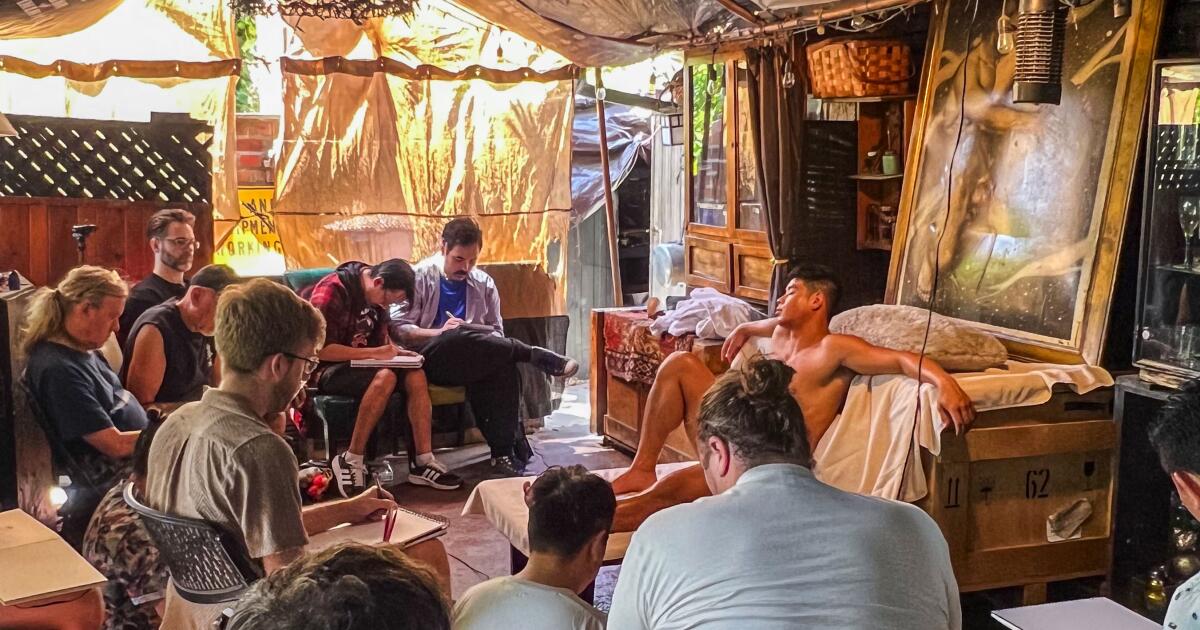
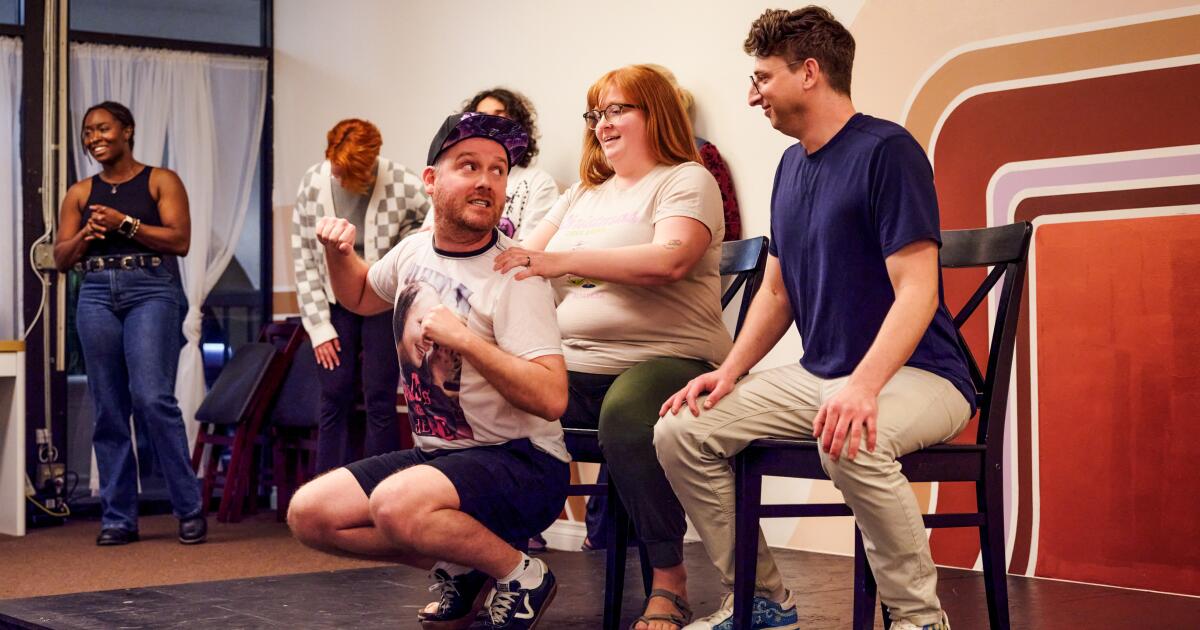
Buckle in because the training wheels are OFF for this improv drop-in. So Much Improv, created and led by comic Joe Fahey, focuses on getting in your reps by doing back-to-back improvised scenes. Classes are held at Kingsley Studios, which can be difficult to spot. The two-level complex is located right in front of a liquor store, and the studio is on the second floor behind gated doors. The studio looks like a cute living room, with a couch against one wall and plants across another.
The class size tends to be small (my class included five people), but that allows more time to improvise per person. The class is mostly regulars, so there is already a good rapport between Fahey and the students. That means he can give more specific feedback. After completing other beginner courses, this one felt the scariest, but I leaned in. After a few reps, I felt more confident in my ability to improvise and develop tactics to work with my scene partner. By implementing his feedback, I was able to fine-tune my improv skills.
This class is perfect for those who want more practice. The type of reps can differ each class, but the week I went centered on UCB auditions (it was that time of year). Since the class is small, you get a more catered experience.
Best for: Back-to-back practice on intermediate or advanced drills Cost: $20 Time commitment: Two hours Parking: Street parking Pro tip: Bring water because you will be talking a lot, and something caffeinated to beat the late-night crash for this evening class that requires your full attention.
Los Angeles, United States – Draped with a US flag, Alex Saldivar could hardly contain his broad smile as he exited the stadium after the United States beat Paraguay 4-1.
Not only did his team win their World Cup opener, they did so on home soil – and the 23-year-old got to witness it.
Recommended Stories
list of 3 itemsend of list
“This is a dream come true, a serious dream come true. I don’t know what to say,” Saldivar said, as he swayed from side to side, alternating his standing foot.
His excitement sums up the historic day for US football.
Tens of thousands of fans had descended on SoFi Stadium, putting on an eccentric display of oversized hats and US flag-themed outfits.
White and red striped dungarees, blue and white hair, star-spangled trousers, painted faces and Uncle Sam suits – supporters represented their country’s colours in every possible way.
Ryan Schellhous, who came to Los Angeles from San Jose in northern California, was dressed literally from head to toe in US flag colours, including a mask that only showed his eyes.
He told Al Jazeera it was great to have the World Cup in the US.
“There’s a lot of excitement for soccer in America right now, and this is great,” Schellhous said, adding that he expected Team USA to go deep in the tournament if players perform to the best of their ability.
USA fans ahead of the World Cup game against Paraguay in Los Angeles, on June 12, 2026 [Al Jazeera/Ali Harb]
For many fans, the World Cup is offering a rare opportunity to experience football at its best. And they are cherishing the moment.
Michele Churchill, who travelled from Virginia with her three children to attend the opening match, called it a “bucket list” event.
Churchill also had a bold prediction for the US team’s fortunes at the tournament.
“They’re going to win. They’re going to take the cup,” she told Al Jazeera.
Law enforcement
Fans started streaming into the stadium four hours before the game. One was dressed in a Gulf-style thobe with a US flag as a headscarf. Another was in an outfit resembling George Washington, the first president of the US.
Despite concerns about logistics and organisation, everything went largely smoothly with armies of staff and volunteers ensuring safety and orderliness.
An alphabet soup of law enforcement agencies was present.
The Transportation Security Administration staffed entrances to oversee the airport-style security checkpoints. Agents from the Drug Enforcement Administration, Bureau of Alcohol, Tobacco, Firearms and Explosives, and Department of Homeland Security were also at the scene.
On the local level, heavily armed agents from the Los Angeles County Sheriff’s Department were also deployed around the stadium, as were Inglewood Police officers.
Many agents were accompanied by police dogs. Before crowds started to arrive, some had their canine companions pose for a photo next to the oversized World Cup ball outside the stadium.
Reports that President Donald Trump may attend the first game ultimately did not materialise to the apparent relief of many fans in mostly liberal Los Angeles.
Inside the stadium, it was celebrities – the likes of Tom Cruise and David Beckham – who got the cheers from the crowd.
USA fans are seen outside Los Angeles Stadium ahead of the Paraguay match at the World Cup 2026 [Al Jazeera/Ali Harb]
Stadium atmosphere
It took a while for the stadium to fill out.
About an hour from kickoff, during the first part of the opening ceremony, which featured several rappers, including Future and Rema, the venue was still almost half-empty and the crowd was quiet.
But coinciding with Katy Perry taking the stage before the first whistle, the stadium started to come to life, and chants of “USA, USA” grew louder.
It was really forward Christian Pulisic who electrified the crowd with his first-half display, running straight at his markers and producing dangerous crosses or shots.
The once faint chants turned into deafening roars when the US scored their first, courtesy of a Paraguayan own goal in the seventh minute.
The distinct screams of goal celebrations would ring out three more times for Team USA at the stadium, with Folarin Balogun finding the net twice and Giovanni Reyna scoring a gorgeous curler from the edge of the box to wrap up the game.
A stadium announcer said more than 70,000 people were in attendance.
“We have a full house,” he said to the cheers of the crowd.
But the announcement did not pass the eye test.
Many seats throughout the stadium remained empty, especially in the most expensive sections overlooking the middle of the field.
It is possible that organisers FIFA did sell every seat but resellers struggled to offload some tickets.
The bottom line – ticket prices and Trump’s travel policies may be dampening the buzz around the World Cup, but the tournament is still delivering what football promises: happiness, excitement and a sense of togetherness.
President Bush returns from Africa, where he justifiably touted the success of his AIDS relief initiative, to face a battle with Congress over that laudable program. Bush wants to nearly double funding, to $30 billion over the next five years, for the President’s Emergency Plan for AIDS Relief; the House wants to spend $50 billion and expand the program to fight malaria and tuberculosis. But that $20-billion dispute probably won’t generate as much heat as the provision in the bill, written by the late Rep. Tom Lantos (D-Burlingame), killing the requirement that one-third of all funds spent on AIDS prevention go to programs that promote abstinence until marriage. The State Department and some House Republicans oppose the bill, which is now spearheaded by Rep. Howard L. Berman (D-Valley Village) and is slated to be considered by a House committee next week.
The religious right has begun whipping up the hysteria, calling the Lantos bill the “Pro-Aborts Emergency Plan for Abstinence Reduction.” In fact, the bill would do nothing to alter the long-standing ban on U.S. funding for abortion. What it would do is increase the availability of contraception for poor African women — and that is desperately overdue.
Religious groups are fixated on the need to stop HIV transmission through premarital and extramarital sex, but what’s killing African women by the millions is https:///unprotected sex with their husbands. Yet the United States spends more on promoting abstinence and fidelity programs ($198 million in fiscal 2007) than on promoting condom use ($147 million in 2007). Roughly 10 million African girls under the age of 18 are married each year, many to older men who seek HIV-free brides. To those wedded to HIV-positive men, marriage often means a death sentence. They have little power to control their husbands’ condom use or extramarital behavior; they are more likely than young men to contract HIV; and those who know they’re infected and do not want to bear children often have no access to contraception.
By providing life-saving drugs to HIV-positive pregnant women, the president’s program claims to have prevented 157,000 infants from becoming infected. This is a huge accomplishment. What the U.S. funding hasn’t done is reduce unwanted pregnancies. In a clinic in Uganda where pregnant HIV-positive women were receiving anti-retroviral treatment, 93% reported that their pregnancies were unintended. It’s no surprise that many HIV-positive women do not wish to bear children whom they might infect with the virus or leave orphaned. It’s cruel to deny contraception to such poor and sick women should they desire it. And as a public health matter, it’s far cheaper to prevent unwanted pregnancies than to prevent mother-child HIV transmission. Yet U.S. funding for family planning has flat-lined.
Although some U.S. religious conservatives find contraception objectionable, most Americans do not. Congress should take note and expand funding for family-planning programs to help the HIV-positive girls and women.
David Hockney, the innovative and prolific British artist who arrived in Los Angeles in 1964, soon celebrating its sun-drenched life and landscapes in colorful, wildly popular paintings, has died.
He was 88.
Calling himself “an English Los Angeleno,” Hockney immortalized the city’s sparkling swimming pools, palm trees and beautiful young men, then went on to experiment with intricate photo collages, portrait suites, painted and filmed images of Yorkshire landscapes, iPad drawings and more.
Since his Pop Art paintings in the early ‘60s at London’s Royal College of Art, Hockney was rarely out of the limelight and, more important, rarely out of fresh ideas for how to draw, paint, film, print, photograph or otherwise express his creativity. The David Hockney Foundation owns more than 8,000 of his works, including about 200 sketchbooks, more than 230 self-portraits, opera designs and portraits of family and friends.
Hockney loved Hollywood — the people and the place — and liked to say he was brought up in England and Hollywood because of the time he spent at the movies. His peroxide blonde hair reportedly was inspired when he was a student and saw Clairol TV ads claiming “blondes have more fun.” But it was his interest in everything from Elvis Presley to the Hubble Space Telescope and his sense of humor that set him apart. Time Magazine art critic Robert Hughes once called him “the Cole Porter of modern art.”
He was open about being gay, even when homosexuality was outlawed in Britain. His early love affair with artist Peter Schlesinger, a younger man he met when teaching a summer drawing class at UCLA in 1966, inspired Hockney’s monumental 1972 painting “Portrait of an Artist (Pool with Two Figures),” a centerpiece of Jack Hazan’s 1974 film “A Bigger Splash.” The painting’s 2018 auction at Christie’s drew a record $90 million for a living artist.
He was a dedicated reader and student of art, paying homage in his work to Picasso and Cubism as well as to Monet, Matisse, Van Gogh and Cezanne. A lover of opera, he often had it playing loudly in the studio and enjoyed taking visitors on curated car trips through the Hollywood Hills or Malibu while listening to Wagner. He designed sets for major companies in Los Angeles, Chicago, New York, London and elsewhere over the years, and some of his set models were later shown in museums.
David Hockney’s work “Gregory in the Pool (Paper Pool 4)” is part of his solo exhibition “David Hockney: Perspective Should Be Reversed” at the Palm Springs Art Museum in Palm Springs. (Courtesy of the Palm Springs Art Museum)
(Courtesy of the Palm Springs Art Museum)
His solo shows drew enormous crowds to the Los Angeles County Museum of Art as early as 1988. In 2017 a major retrospective of his work, keyed to his 80th birthday, was presented at New York’s Metropolitan Museum of Art, Paris’ Centre Pompidou and London’s Tate Modern. Chronicling Hockney’s arrival as an important artist in the “ravishing” Met retrospective, the New Yorker writer Andrea K. Scott called it “a revelation.” It was, she wrote, “a retort to all the eye-rollers,” including herself, who dismissed his work “as, at best, a guilty pleasure.”
In 2012 he received the coveted Order of Merit, which Queen Elizabeth II presented to him at Buckingham Palace.
David Hockney was born the fourth of five children to a working-class family in Bradford, Yorkshire, on July 9, 1937. He has said he started “making marks on paper” at 8 and received private painting lessons before moving on to Bradford School of Art in 1953. The first painting he sold was a portrait of his father in 1955. He attended the Royal College of Art in London from 1959 until his graduation in 1962 and received the school’s Gold Medal.
After college he did not slack off, noted his biographer Christopher Simon Sykes. In his 2014 book, “Hockney: The Biography,” Sykes pointed out that the artist’s first flat had a chest of drawers near the bed on which he had painted, in large capital letters, the words “get up and work immediately.”
David Hockney in 2017.
(Catherine Opie, Courtesy of Regen Projects, Los Angeles and Lehmann Maupin, New York, Hong Kong and Seoul.)
Hockney lived by that command for the rest of his life, turning out canvas after canvas, photo after photo. In the ‘80s came his extraordinary multi-image photographic collages of friends including writer Christopher Isherwood and artist Don Bachardy and such landmarks as the Brooklyn Bridge, Grand Canyon and Pearblossom Highway.
“The Polaroids started oddly enough when I’d just finished a long period of work in the theater, which is of course playing with perspective and illusion,” he once told The Times. “People say, ‘You are a painter, and photography is a sideline.’ But nothing is a sideline for me.”
That included his continuing fascination with technology. The artist’s long career swept in artworks made not only on cameras and canvases, but on such things as fax machines and photocopiers. Hockney liked to experiment, whether it was with state-of-the-art printing devices or centuries old painting techniques. He went several times to a show of portraits by Jean Auguste Dominique Ingres at London’s National Gallery in 1999 and was greatly taken with the photographic’ quality of Ingres’ 19th century drawings. Certain that Ingres had used something optical to achieve that quality, Hockney bought himself a camera lucida, a small device that works like a prism. He then applied Ingres’ methods–as Hockney imagined them–to his own portraits of friends and family, and in 2001, he published “Secret Knowledge,” exploring his theories on early artistic uses of optical devices.
His death was confirmed by the Associated Press and New York Times.
I wanted to know more the moment I read “Sister Elsie Peak” on an old map.
I discovered the name while researching trails around Mt. Lukens, the highest peak in Los Angeles proper. Looking at the peak’s location on a historical map of L.A. County’s mountains, I noticed that it was previously named for a woman I’d never heard of.
Few of Southern California’s mountain peaks are named after women, so Sister Elsie Peak stuck with me. Who was she? And why was her mountain renamed to instead honor local leader Theodore Lukens?
In this edition of The Wild, our weekly outdoors newsletter, I will take you with me on my arduous journey to find the origins of the first known name for Mt. Lukens. Over the past week, I enlisted help from multiple librarians, map experts and one gracious historian (who you’ll meet later). We all scoured newspaper archives and history books, catching the fever of curiosity that seems to consume anyone who tries to find out who Sister Elsie was.
You are reading The Wild newsletter
Sign up to get expert tips on the best of Southern California’s beaches, trails, parks, deserts, forests and mountains in your inbox every Thursday
By continuing, you agree to our Terms of Service, which include arbitration and a class action waiver. You agree that we and our third-party vendors may collect and use your information, including through cookies, pixels and similar technologies, for the purposes set forth in our Privacy Policy such as personalizing your experience and ads.
What we collectively found was this: Sister Elsie was most likely not a real person, and her legend was most widely shared in the early 20th century by a local landowner who was known to embellish, including claiming that Josephine Peak near Mt. Lukens was named after his daughter. (It wasn’t.)
There appears to be no record anywhere — in newspapers, in history books, in Catholic Church records — as to the existence of a Sister Elsie or, as you’ll learn more about below, an alleged orphanage, ranch or school that she ran in the Tujunga area for Indigenous children or the broader Indigenous community.
In that same vein, I want to call something out before we begin: Stories about the relationships between colonizers and Indigenous peoples often get romanticized (see: Thanksgiving), with storytellers and early historians intentionally leaving out any details of forced assimilation or the American genocide. I cannot report anything concrete about how Sister Elsie actually treated Indigenous people in large part because I don’t believe she was real.
The sunset as viewed from a trail near Mt. Lukens in the San Gabriel Mountains.
(Jaclyn Cosgrove / Los Angeles Times)
OK, I’ve held you in suspense long enough. Let’s jump into everything under the actual sun that I could find about Sister Elsie Peak.
To begin my reporting, I contacted Times editorial library director Cary Schneider, who is always eager to help me with prospective stories (i.e. highly specific internet rabbit holes I’ve fallen down).
Cary found what might be the earliest mention in a local newspaper: A story in the Monrovia Daily News on April 23, 1910, in which a writer mentions a new trail leading to Sister Elsie Peak, but tragically gives no details of its namesake.
Next, we jump 20 years into the future when The Times and the Pasadena Star-News covered the dedication of Sister Elsie’s Well in Tujunga. Both publications described the well in their stories on April 28, 1930, as named after “the Catholic nun” who ran a school for Indigenous children “in the days of the Spanish missions.” The Times called her a “pioneer nun and teacher.”
Multiple radio towers and other infrastructure sit at the top of Mt. Lukens, as seen on a 2022 hike there.
(Jaclyn Cosgrove / Los Angeles Times)
The dedication occurred on the land of Philip Begue, a crucial character to understand in the Sister Elsie legend, as he’s believed to have either spread or made up the story, according to a local historian. Begue’s family bought land around Tujunga and La Crescenta in 1882, and later, Begue was an early pioneer and one of the first forest rangers in what would later become Angeles National Forest.
Throughout the late 1920s and 1930s, Begue seemed set on sharing the story of Sister Elsie. In 1934, he told the Pasadena Star-News that the sister “ministered to the sick and needy” Indigenous people.
A Times story on Sept. 29, 1935, announced a barbecue fundraiser for a local Catholic institution at the “old Basque rancho” owned by Begue. “The ranch on Honolulu avenue was famous in early days when Los Angeles was a pueblo and Sister Elsie had a children’s home where the ranch now stands.” The Begue family planned to cook “hundreds of pounds of meat for the affair.”
Times columnist Harry Carr offered in his column, the Lancer, a completely different take. Carr wrote on April 3, 1935, that Sister Elsie Peak was named “for a nun who lost her life trying to walk from San Fernando to San Gabriel.” No, he doesn’t provide a source for where he learned that information. Trust me: I too shook my fist at the sky.
The last rays of sun blanket across Mt. Lukens, as seen from Dunsmore Canyon in Deukmejian Wilderness Park near Glendale.
(Jaclyn Cosgrove / Los Angeles Times)
I would be remiss to mention that the oldest reference to a “Sister Elsie” in The Times’ archives appears to be an 1889 story about — buckle up — a psychic medium in Azusa. For a brief and beautiful moment, Cary and I hoped Sister Elsie Peak would turn out to be named after Elsie Wheeler, a spiritualist medium whose own story relates to an astrological tool. Alas, the peak was named before she was born (which doesn’t work unless she was a really good psychic). That said, a peak named after a mythical nun and a clairvoyant feels arguably appropriate for the highest point in L.A.
Cary also discovered one of my favorite facts about the Sister Elsie legend — that it was turned into a play titled “Sister Elsie in Tujunga.” It was written by Frances Muir Pomeroy, superintendent of summer school at Our Lady of Lourdes Catholic Church. It was said to be about “the experiences of Sister Elsie when she conducted an orphanage here many years ago,” according to a 1938 Times story.
There are other references to Sister Elsie in The Times’ archives over the next several decades, but nothing that gives concrete evidence that she actually existed.
Cary advised me to contact the Los Angeles Public Library. Librarian Kelly C. Wallace, who specializes in California history, quickly got back to me.
Knowing that Cary had already scoured The Times’ archives, Wallace sifted through the agency’s Los Angeles Area Historical Newspapers database, which contains the Los Angeles Daily Star (1870-1879), the Los Angeles Evening Post-Record (1896-1936) and the Los Angeles Star (1851-1871), along with community newspapers such as the Eagle Rock Sentinel and the Highland Park Herald. She found little there.
The trail through Stone Canyon to reach Mt. Lukens.
(Mary Forgione / Los Angeles Times)
This is especially puzzling if Sister Elsie did exist because, before the advent of television, newspapers reported seemingly everything that we now post on social media — detailed trip reports, the attendees of parties, birth announcements, and even basic road repairs.
Wallace did discover a few interesting tidbits in books, but curiously nothing before 1930.
The earliest reference that Wallace found was in the 1938 book “History of La Crescenta-La Canada Valleys” by Grace J. Oberbeck. She spoke to Begue, who spun quite the yarn:
“On El Rancho de las Hermanas, the ranch of the sisters, a group of nuns who had an orphanage not far distant, kept a herd of cows which was looked after by” local Indigenous people “who supplied milk to the school whenever needed. Sister Elsie was the much loved nun in charge of” the Indigenous dairy workers, “and her name was given to the well. Almost directly north from here towers a high peak of the Sierra Madre range and this bears the name of Sister Elsie Peak.”
Legendary outdoors writer and historian John W. Robinson, Wallace found, told the Sister Elsie story in his 1977 book “The San Gabriels,” but followed it up with a correction in his 1983 tome, “The San Gabriels II”: “The derivation of Mt. Lukens’ original name, Sister Elsie Peak, is clouded in uncertainty. Exhaustive research into Catholic Church records fails to find any evidence of a nun named Sister Elsie nor an orphanage named El Rancho de Dos Hermanas.”
You’re telling me, John!
Wallace also found an entirely different story about Sister Elsie on page 47 of “The San Fernando Valley” by Jackson Mayers, published in 1976.
“Sister Elsie, a Sister of Charity, came to Tujunga from Los Angeles between 1850 and 1875 to work with” Indigenous people “at a school and orphanage. Near Haines Canyon was Sister Elsie’s well; Sister Elsie’s Peak was named, it is said, because when troubled she would gain strength by raising her eyes to that eminence, one whose top she was to be buried. Others held that two nuns on their way from Mission San Fernando to Mission San Gabriel lost their way in Tujunga and died atop the peak.”
There is tragically no footnote on the page, so I have no idea who Mayers’ source was.
I hoped that finding out when Sister Elsie Peak was named would help, but that also proved to be a dead end.
Local historian Mike Lawler, former president of the Historical Society of the Crescenta Valley, told Realtor Sharon Hales in a 2016 interview that cartographer George M. Wheeler and his team named the mountaintop Sister Elsie Peak during their survey of California in the late 1800s.
“We don’t know why he named it Sister Elsie Peak,” Lawler said. “The reasons why he named everything are lost to history. They were destroyed in the 1906 San Francisco earthquake.”
This led me to contact the staff at the David Rumsey Map Center at Stanford University Library, as its collections are vast, and I hoped maybe they’d somehow find half a charred page of notes with Sister Elsie’s biography scrawled in quill pen.
Instead, Kristina Larsen, the center’s associate curator, came up short, finding only that a misspelling, “Sister Else Pk” was on the 1881 land classification map from Wheeler.
Evan Thornberry, the center’s head and curator, unearthed “Vignettes of California Catholicism,” a 1988 book by Monsignor Francis J. Weber, longtime archivist for the Archdiocese of Los Angeles at the San Fernando Mission.
Weber conducted an exhaustive search for the existence of Sister Elsie and found no proof of any existence of Sister Elsie or a Catholic orphanage in the Tujunga area at the time.
Weber offered my favorite suggestion for why no one can find any hint of Sister Elsie’s existence: “Maybe the good Sister was kidnapped by Martians!”
If so, I hope someone there takes better care to protect knowledge regarding the names of that planet’s mountains.
You’d think I’d give up here, right?
Instead, I contacted historian Kristine Gunnell, who wrote “Daughters of Charity: Women, Religious Mission and Hospital Care in Los Angeles, 1856-1927” (Vincentian Studies Institute).
I hoped Gunnell would have an answer, as Sister Elsie was said to be in the Sisters of Charity, an American version of the Daughters of Charity, a group that was founded in France in the 1600s with an aim of serving low-income and sick people.
The Daughters group eventually inspired American Catholic women to serve in a similar way, first forming the Sisters of Charity until the groups essentially merged. In the 1850s, as more people moved to the American West, a bishop in the L.A. area requested that Daughters of Charity come to L.A., Gunnell said.
But, there’s no Sister Elsie referenced in Gunnell’s book.
Gunnell said after hearing from me, she contacted a history professor from DePaul University who is compiling a database about all the Daughters of Charity who served in California. He found no one referred to as “Sister Elsie” between 1850 and 1900.
A 1931 news story references that Sister Elsie treated Indigenous children diagnosed with typhoid fever.
Tujunga “was only a day’s wagon ride from Los Angeles, and if these Tongva were Catholic or had Catholic connections, the sisters may have considered their request,” Gunnell wrote to me. “I was hoping that I’d be able to find a record of the typhoid outbreak in Tujunga in the 1860s or 1870s and cross reference it with the Daughters’ records. It’s a good story, and the sisters likely would’ve reported it if it’s true. However, I can’t isolate a specific outbreak.”
Later, Gunnell and I hopped on a Zoom call to commiserate.
With all of our research before us, we reached the same conclusion: A Catholic sister could have feasibly traveled to Tujunga at the request of a bishop to help Indigenous people, but currently there is no record of a woman known as Sister Elsie who did so. There’s no record of much of anything told in the Sister Elsie story. It seems, instead, to have been an urban legend of its time.
At least for now.
Hikers in Elysian Park.
(Dania Maxwell / Los Angeles Times)
3 things to do
1. Reach for the rainbow in L.A. One Down Dog, an L.A. yoga and fitness studio, will host a Pride hike from 10:30 a.m. to noon Saturday in Elysian Park. Guests will hike a loop trail through the park. For more details, register at eventbrite.com.
2. Marvel at mollusks in Malibu The Wishtoyo Chumash Foundation will host a tidepooling event from 8 a.m. to 1 p.m. June 19 near the Wishtoyo Chumash Village (33904 Pacific Coast Highway) in Malibu. Guests will learn about Wishtoyo Village, which is typically not open to the public. All experience levels welcome. Learn more at the foundation’s Instagram page.
3. Learn along the L.A. River in Downey The California Native Plant Society and Friends of the L.A. River will host a guided bike ride along the L.A. River. Naturalist Cris Sarabia will teach participants about local ecology during the ride. Binoculars will be provided. Guests should bring safety gear and water. Learn more at the group’s Instagram page. Register at folar.org.
The must-read
Burn damage to the Torrey pine grove at Santa Rosa Island.
(Kayla Bartkowski / Los Angeles Times)
The length of time that it will take for Santa Rosa Island to recover after a blaze scorched about one-third of the island remains unclear, Times staff writer Grace Toohey wrote after a recent visit to the island. The fire, which grew to 18,379 acres, is now fully contained. Firefighters faced vicious winds and, at times, 30-foot flames. “They held the line, and we have them to thank for saving housing, saving the island, saving the history of the Santa Rosa Island,” said Ethan McKinley, superintendent of Channel Islands National Park. The island has long been a respite for hikers and backpackers, including Times staff writer Lila Seidman, who shared her experiences on the island and her grief that came in the wake of the blaze. “Now fear clouds the memories: Does the rugged, magical place of my mind’s eye still exist?” Seidman wrote.
Happy adventuring,
P.S.
I have a flurry of good California animal news to share. First, three mule deer were the first animals to walk over California’s first wildlife crossing over State Route 97 in Siskiyou County. Second, scientists have feared that the population of endangered steelhead trout in the Santa Monica Mountains were killed in massive debris flows after the Palisades fire. However, researchers recently spotted the fish — and their babies — in Topanga Creek. And finally, the California Department of Fish and Wildlife shared earlier this week that five orphaned black bear cubs that were rehabilitated and released into northern California in November successfully hibernated through the winter and returned to the landscape this spring healthy and active, according to recent data reviewed by the agency’s scientists.
For more insider tips on Southern California’s beaches, trails and parks, check out past editions of The Wild. And to view this newsletter in your browser, click here.
The first film by Canadian filmmaker David Cronenberg to be shot partly in the U.S. is, perhaps not surprisingly, a freaky satire of Hollywood. Its take on fame has only grown more accurate in the years since its premiere in 2014. Julianne Moore, Mia Wasikowska and Robert Pattinson star in a demented tale of family, celebrity, ambition, ego and limousines. Funny and perverse, the film captures the uncanny cocktail of mean-spirited malignancy, self-obsessed delusion and just plain obliviousness that runs rampant around town. Presented by the screening series Mezzanine and the local literary magazine the Big One, the evening will be introduced by the film’s screenwriter, Bruce Wagner, a longtime chronicler of Los Angeles.
“Maps to the Stars” is playing June 14 at Brain Dead Studios. Tickets here.
TOP Gun: Maverick actor James Handy has been stabbed to death with his girlfriend’s son telling cops in a 911 call: “I just killed the man”.
The 81-year-old, who also starred in Logan and Jumanji, was found unconscious with multiple stab wounds to his chest on his front yard.
Sign up for the Showbiz newsletter
Thank you!
James Handy, pictured in TV series NYPD Blue, has been stabbed to deathCredit: GettySurveillance footage from outside the home caught an unknown man walking past around the time of the stabbingCredit: FOX 11
Authorities rushed to the scene in Tarzana, Los Angeles on Wednesday morning at around 9.30am after receiving a chilling 911 call.
Police revealed a voice at the end of the line said: “I am the son of man, I just killed the man of sin.”
Officials rushed to James’ home on Erwin Street and raced him to hospital where he was pronounced dead.
Some time later, 44-year-old Michael Gledhill – the son of James’ partner – waved down officers as they searched near the home.
James, pictured in TV show X files, was found with multiple stab wounds outside his homeCredit: Channel 4Police swarmed round James’ home early on Wednesday morning after receiving a chilling 911 callCredit: ABC7Police are continuing to investigate the deathCredit: ABC 7The actor (far left) also starred in Arachnophobia in 1990Credit: Alamy
Gledhill confessed to carrying out the fatal attack and said he was the one who phoned the police, according to the Los Angeles Police Department.
Gledhill was arrested for murder and taken to Van Nuys Jail with his bail set at $2,000,000.
The LAPD statement said: “Detectives believe this is an isolated incident and there appears to be no danger to the public at this time.”
A motive for the attack remains unclear.
Most read in Entertainment
James (far right) in NYPD BlueCredit: GettyJames (center) had a major role in 1986’s Popeye DoyleCredit: Alamy
Neighbors have claimed Gledhill and James were overheard arguing overnight.
The star’s talent agent, Pam Ellis-Evenas, paid tribute saying: “With great sadness I can confirm that the gentleman who was attacked and killed on Wednesday in Tarzana was the actor James Handy.”
James’ career spanned almost five decades with his most recent major role being in Tom Cruise’s Hollywood sequel Top Gun: Maverick in 2022.
He played the role of bartender Jimmy.
Another memorable role for James came in 2017 superhero flick Logan as he played the doctor who treated lead man Hugh Jackman.
James also starred in 1995 cult classic Jumanji alongside Robin Williams, Bonnie Hunt and Kirsten Dunst.
His career featured several TV credits such as the role of Arthur Devlin in eight episodes of Alias and recurring stints on Melrose Place and NYPD Blue.
In the race for Los Angeles mayor, incumbent Karen Bass secured a place on the November ballot. But who will challenge her is yet to be determined, as votes are still being tallied.
With 62% of the expected vote counted, reality television personality Spencer Pratt sits in second place and City Councilmember Nithya Raman trails in third. Although Pratt has declared victory, the Associated Press, which estimates the expected votes in, has not called the race.
This story is based on a snapshot of precinct-level results provided by the L.A. County registrar on Wednesday. The Times analyzed the 525,326 votes processed so far. This story will be updated when winners are finalized in early July by the secretary of state.
This map shows the margin and density of votes by precinct. Areas where a candidate leads by a wide margin, such as Brentwood for Pratt, appear darker on the map. More densely populated neighborhoods — such as Bass strongholds in Baldwin Hills and Hyde Park — appear in brighter colors. As of Wednesday, an estimated 710,000 ballots were yet to be counted, according to L.A. County officials.
More votes per square feet
The preliminary results show narrow margins among precincts on the Eastside, with some precincts showing an almost 30% split across the top 3 candidates.
Bass retained a strong lead in precincts across South L.A. compared with her 2022 race against Rick Caruso. Pratt has garnered heavy support from his neighbors in Pacific Palisades, as well as precincts in Bel-Air and Shadow Hills.
Raman, who represents Los Feliz, Hollywood Hills, Sherman Oaks and Encino on the city council, has so far underperformed in her home 4th District. She led in 12 of the 66 precincts, particularly in parts of Los Feliz. A few precincts in East Hollywood swung heavily for Pratt; but Bass led much of CD-4.
Karen Bass
Percentage of votes
Bass had strong support in South L.A.
Spencer Pratt
Pratt won half the vote in wealthy Pacific Palisades and Bel-Air precincts
Nithya Raman
Raman underperformed in much of her own council district
To win the race outright, Bass needs to secure at least 50% of the vote. She currently holds 35% of the vote and a five-point lead over Pratt. A Berkeley IGS poll released last week found that Bass and Raman would likely defeat Pratt by double digits in the event of a runoff.
Mail-in ballots with a June 2 postmark will be accepted by county election officials through Tuesday.
I was alone in the forest in my favorite place for the first time in years, so I did the only logical next right thing. I lay down.
There I was, sprawled next to Millard Canyon Falls, listening as the water roaring down the cliff and cool air whooshed past my face. I gained a new perspective when I gazed at an upside-down waterfall. What’s the point of hiking if we don’t play around?
In today’s edition of The Wild, our weekly outdoors newsletter, I provide you with three great hikes where rivers and waterfalls are still flowing. It’s essential information as we head into summer and temperatures start to rise.
You are reading The Wild newsletter
Sign up to get expert tips on the best of Southern California’s beaches, trails, parks, deserts, forests and mountains in your inbox every Thursday
By continuing, you agree to our Terms of Service, which include arbitration and a class action waiver. You agree that we and our third-party vendors may collect and use your information, including through cookies, pixels and similar technologies, for the purposes set forth in our Privacy Policy such as personalizing your experience and ads.
If you were to force me to choose my favorite hike, I would stubbornly refuse to pick just one, but my list would include these three.
That’s why I really want to urge you, my dear Wild reader, to treat these places with the reverence they deserve. That includes:
Refreshing your memory on the seven “Leave No Trace” principles.
Packing a small trash bag in which you can store empty food wrappers, toilet paper and garbage you spot along the way.
Observing wildlife from a distance, including California newts, which you shouldn’t pick up because it’s rude and, more important, because they can secrete a neurotoxin through their skin that can be lethal to humans.
OK, let’s talk about where your next favorite hike will be!
Millard Canyon Falls in Angeles National Forest.
(Jaclyn Cosgrove / Los Angeles Times)
1. Millard Canyon Falls
Distance: 3.3 to 4.3 miles (see below) Elevation gained: About 900 to 1,100 feet Difficulty: Moderate Dogs allowed? Yes Accessible alternative: Paved segment of Gabrielino Trail from Windsor Boulevard
This 3.3- to 4.3-mile hike to Millard Canyon Falls will take you through lush hillsides and beneath the shade of coast live oaks and bigleaf maples as you walk alongside, and sometimes through, Millard Creek. Your journey ends at Millard Canyon Falls, a gorgeous 50(ish)-foot waterfall that gushes past massive boulders perched at the top of the cascade.
This hike is usually much shorter (about 1.5 miles), but a road closure in place since the Eaton fire lengthened it. I will explain more about the closure later. It is important to note, though, that Chaney Trail is the name of the roadway and an actual trail, both of which you’ll take on this hike.
To begin your hike, you can either parallel park nearNuccio’s Nurseries, taking care to obey all parking signage, or if those spots are all taken, park nearby and order a rideshare to drop you at the trailhead. I had cell reception with Verizon here, so it should be possible to order a ride back to your vehicle.
Millard Creek in Angeles National Forest.
(Jaclyn Cosgrove / Los Angeles Times)
From here, you have two options for reaching the Millard Canyon Falls trailhead.
1. Follow Chaney Trail road for about 1.66 miles to the Millard Canyon Falls trailhead. This route will be exposed, so you’ll need to start early if you choose this option.
2. Walk about half a third of a mile north from Nuccio’s, and then, near a bend in the road, you’ll take the Chaney Trail, a winding dirt path that I was delighted to find is in great shape. (Shout out to Restoration Legacy Crew, a volunteer trail maintenance group, for its amazing work in the Millard Canyon area!)
That trail is a bit overgrown in a few spots, so you’ll want to wear pants (or take the road). Additionally, make sure to lightly stomp before heading into overgrown areas, as this helps alert any snakes snoozing in the shade of your presence.
The view from the ground looking up at Millard Canyon Falls.
(Jaclyn Cosgrove / Los Angeles Times)
You’ll take Chaney Trail for about half a mile, pausing to catch your breath and take in the increasingly great views of the San Gabriel Valley. You will next cross over Mt. Lowe Motorway to take the Sunset Ridge Trail down. (See map for greater detail.)
You will boogie down a few switchbacks for 0.7 miles, enjoying shade provided by bay laurels and sumac trees, listening to the sweet songs of canyon wrens and spotted towhees. (That’s who was singing to me, anyway!)
You will reach the Millard Canyon campground, which is closed for overnight camping but does feature a few nice picnic tables shaded by massive coast live oaks. With the creek flowing nearby, I wouldn’t blame you if you stopped and had a little snack here.
Millard Campground in Angeles National Forest. It is closed because of damage from the Eaton fire.
(Jaclyn Cosgrove / Los Angeles Times)
That said, you have finally made it to the Millard Canyon Falls trailhead! Just northwest of the campground, you’ll find a little arrow pointing you northward onto the trail. From here, you will gain minimal elevation, and can actually just frolic. It is about half a mile to the waterfall.
As I mentioned, this trail is usually shorter and easier to access, as there’s a large parking lot near the trailhead and more parking along the roadway.
The roadway Chaney Trail was slated to reopen at the end of April. I frequently checked Los Angeles County Public Works’ road closure website, as I had planned to write about Millard Canyon once the road reopened. But when I checked the website, I saw that the reopening had been moved to the end of August. Huh?
I asked the public information officers at county Public Works about it and was told: “We are currently coordinating with our on-call emergency contractor to complete guardrail repairs on Chaney Trail, just north of the gate. Construction is anticipated to begin in July and be completed by the end of August, weather and field conditions permitting.”
Clockwise from top left: prickly phlox, golden yarrow, cliff aster and a type of larkspur. Center: A little bird on a dried out plant.
(Jaclyn Cosgrove / Los Angeles Times)
I passed a shiny new guardrail just north of the gate when I was hiking there earlier this week. I asked the agency whether there was some other guard rail missing. No, my friends. “The community raised concerns about the roadway narrowing included in this project, and we will be reconstructing the guardrail to address those concerns,” a spokesperson told me via email.
And now ends the saga of the Chaney Trail guardrail.
As for Millard Canyon, I will admit, it quite possibly is my favorite frontcountry natural areas. I was reminded of this fact when I visited this week. Although the road closure adds some steep mileage to reach the canyon, it’s worth it to me. I will be back. I hope to see you there!
The Fish Canyon Narrows near Castaic.
(Jaclyn Cosgrove / Los Angeles Times)
2. Fish Canyon to Fish Canyon Narrows
Distance: About 5.5 miles Elevation gained: About 400 feet Difficulty: Moderate Dogs allowed? Yes Accessible alternative:San Francisquito Creek Trail
To reach the Fish Canyon Narrows, you will take the Fish Canyon Trail (called Forest Route 6N32 or the Warm Springs Fish Canyon Truck Trail on some maps) on a 5.5(ish)-mile out-and-back journey. You will ascend into narrowing walls of sandstone, granite and conglomerate. A healthy stream flows throughout the canyon, giving you ample opportunity to cool off or have a picnic in a naturally occurring sound bath (which, when you’re lucky, will include a tree frog).
A quick note: This is the most rugged (read: least curated) of the three adventures mentioned in this list. There is no trail signage, and you’re in a less popular corner of Angeles National Forest. You might be entirely alone, especially if you hike this on a weekday. You should plan accordingly. Or skip it if I’ve already freaked you out. (I do this out of love!)
To begin, you’ll park on the road’s shoulder, and head east through a gate. Follow the roadway north and then south as it curves toward a dirt path. Follow the exposed dirt path northeast. You’ll trudge through multiple water crossings and be blessed with the occasional shade of sycamore trees.
The narrows are often cooler than the rest of the area. The first portion of this hike has little to no shade, so make sure to wear plenty of sun protection.
And if you leave the trail but aren’t ready to go home, head over to the swim beach at Castaic Lake. And if you’re not tired, there’s always the Cali Splash Park, a massive inflatable floating park. That’s a full day of adventure!
A hiker lies near the creek along the Icehouse Canyon Trail.
(Brian van der Brug / Los Angeles Times)
3. Icehouse Canyon Trail to Icehouse Saddle
Distance: Around 7 miles Elevation gained: 2,600 feet Difficulty: Challenging Dogs allowed? Yes Accessible alternative:West Fork National Scenic Bikeway
Icehouse Canyon Trail to Icehouse Saddle is a 7(ish)-mile trek that runs mostly parallel to the gorgeous and crystal clear Icehouse Creek, which often features several short waterfalls as the water rockets down the mountainside.
As they trek through the canyon shaded by bigleaf maple, California incense-cedar and bigcone Douglas-fir, hikers might spot wildflowers including orange-yellow western wallflowers, light purple Grinnell’s Beardtongue and red western columbine.
Icehouse Canyon is popular on weekends and is best visited on a weekday if you can swing it. You’ll need either a $5 Adventure Pass, an annual America the Beautiful pass or other federal public lands pass to park.
To begin your hike, you’ll park at or near the trailhead — in the parking lot if it’s your lucky day. Otherwise, you’ll park along the roadside, taking good care to read signage and not block anyone’s driveway. Once while walking to the trailhead, I was greeted by a local dog whose collar informed me that he was allowed to meander about and knew how to get back home. I love small mountain towns.
After you park — and remember to display your pass, as forest service workers do ticket vehicles without them — you’ll head east to the trailhead.
A visitor cools down in the creek at Icehouse Canyon.
(Jaclyn Cosgrove / Los Angeles Times)
Immediately upon entering the canyon, you’ll be greeted with stunning beauty. Try not to become too distracted by the pools of water surrounded by large boulders. (No one will know if you skip the hike and just take a dip.)
About a mile into your hike, you’ll come to a crossroad where the Chapman Trail and Icehouse Canyon Trail intersect. Continue east on the Icehouse Canyon Trail. A mile farther, you’ll start the switchback portion of the trail, where you’ll gain about 1,200 feet in 1.5 miles. It’s a beautiful suffer fest.
Icehouse Saddle will offer you incredible views of the San Gabriel Mountains and Mojave Desert. You’ll likely meet other hikers here who are planning to continue their journeys to one of several peaks reachable from the saddle, including to popular spots like Cucamonga and Ontario peaks.
Hikers meander past boulders and large pine trees.
(Brian van der Brug / Los Angeles Times)
It can be quite windy at Icehouse Saddle, so if you’re planning to have your lunch here (which I’ve done many times), consider packing a windbreaker.
The Times has been writing about hiking in Icehouse Canyon for more than 100 years, as city dwellers have long been drawn to its beauty. A July 1926 article about Icehouse Canyon started with a headline declaring, “Here’s a nice cool trip” in all caps.
“It is a trip which one will want to take more than once when its lure has gotten into the blood,” an unnamed Times journalist wrote.
May we all be so lucky to return again and again.
3 things to do
Docent Susan Hopkins leads a Pride Month hike during a previous year’s celebrations.
(L.A. County Department of Parks and Recreation)
1. Celebrate Pride across L.A. County The L.A. County Department of Parks and Recreation will host several events celebrating LGBTQ+ Pride throughout June. Almost 60 county parks are hosting events, including from 5 to 7 p.m. Thursday at Dalton Park in Azusa; from 5 to 7 p.m. Thursday at Dr. Richard H. Rioux Park in Stevenson Ranch; and from noon to 2 p.m. Saturday at Crescenta Valley Community Regional Park in La Crescenta. For a list of all events, visit parks.lacounty.gov.
2. Walk for peace in L.A. Los Angeles meditation nonprofit InsightLA will lead a free 12-mile Walk for Peace from 9 a.m. to 3 p.m. Saturday. The walk will start at Hollywood Forever Cemetery and end with community picnic at Tongva Park in Santa Monica. Register at insightla.org.
3. Repair trails in remote forest near L.A. The Lowelifes Respectable Citizens’ Club, a volunteer trail maintenance group, needs volunteers on Saturday and Sunday to help restore an overgrown segment of the Gabrielino Trail in Angeles National Forest. Volunteers will either ride gravel bikes down a 5.5-mile dirt road or hike in. Previous trail work experience not required. Register by emailing trailwork@lowelifesrcc.org.
The must-read
The aedes aegypti mosquito, called the “yellow fever mosquito,” is well-known for spreading nasty illnesses like its namesake and dengue fever.
(Sameer Neamah Mahdi / Associated Press)
Here’s a sentence I didn’t expect to write this year (or ever): Google would like to release up to 64 million sterilized male mosquitoes in California and Florida to help combat mosquito-borne illnesses such dengue, Zika, chikungunya and yellow fever. “Google says it can harness technology to optimize a concept that’s been around for decades, but hasn’t worked at a large enough scale with mosquitoes to rein in disease,” Times staff writer Lila Seidman reported. The project is called Debug —although Google could have gone with WiFly.
I’ll see myself out.
Happy adventuring,
P.S.
You’re sitting there thinking about your weekend, wondering, “Is there anywhere I could go dressed as a shark?” Why, yes, there is! The Cabrillo Marine Aquarium and Cosplay for Science will co-host the Science Entertainment Aquarium Convention from 9 a.m. to 4 p.m. Saturday at the aquarium (3720 Stephen M. White Drive in San Pedro). SeaCon 2026 will feature a beach cleanup, a fictional marine biology panel and a cosplay contest, along with much more. Learn more at the aquarium’s Instagram page. Have a jaw-some time!
For more insider tips on Southern California’s beaches, trails and parks, check out past editions of The Wild. And to view this newsletter in your browser, click here.
To apply the existing cannabis business tax to unlicensed cannabis businesses.
Los Angeles Measure TC
To apply the transient occupancy tax to online and other travel companies.
Los Angeles Measure TT
To increase the transient occupancy tax to fund general city services.
Bell Measure BB
To establish a sales tax to fund city services such as emergency services, prevent crime, maintain streets and after-school and anti-gang programs.
Bell Gardens Measure BG
To raise sales tax to fund city services such as police and emergency response, street repairs, park maintainence and youth and senior programs.
Beverly Hills City Treasurer
Beverly Hills City Council
Carson Measure FW
To allow the sale of “safe and sane” fireworks from up to 12 permitted temporary stands within the city around Fourth of July.
Commerce Measure PC
To enact a sales tax to fund police services, 911, youth and senior programs, library services, parks, streets and infrastructure.
Compton City Council, District 2
Compton City Council, District 3
Covina City Council, District 1
Covina City Council, District 3
Covina City Council, District 5
Covina Measure CC
To enact a sales tax to fund emergency services, clean up encampments, address homelessness, improve parks, repair streets and provide senior and youth programs.
Gardena Measure GG
To enact a sales tax to fund city services such as emergency response, hiring police officers, keeping parks clean, repairing streets and maintaining after-school and senior services.
Inglewood Measure I
To repeal the city’s ban on the public’s use of “safe and sane” fireworks, permit their sale under a regulated framework and establish rules and penalties for violations.
La Cañada Flintridge City Council
La Puente Measure LP
To raise the sales tax to fund public safety, street and sidewalk maintenance, park maintenance, youth and senior programs and other services.
Lakewood City Council, District 2
Lomita Measure LW
To enact a sales tax to fund services such as emergency response, property crime prevention, maintain parks, repair streets and sewers, maintain gang prevention efforts and address homelessness.
Long Beach City Council, District 1
Long Beach City Council, District 3
Long Beach City Council, District 5
Long Beach City Council, District 7
Long Beach City Council, District 9
Monterey Park Measure NDC
To prohibit data centers in the city.
Palos Verdes Estates Measure PF
To extend the parcel tax for 10 years to fund emergency services and prepare for wildfires.
Pasadena City Council, District 3
Pasadena City Council, District 5
Pasadena City Council, District 7
Pasadena Glen Community Services District Measure B
To enact an special parcel tax to maintain and improve roads and culverts within the district.
Pomona City Council, District 2
Pomona City Council, District 3
Pomona City Council, District 5
Pomona Measure Z
To restructure funding for the Pomona Children and Youth Fund using city sales tax rather than the general fund.
San Fernando City Council
San Marino Measure S
To enact a transaction and use tax to fund street and infrastructure repairs, improve public safety, provide youth and senior programs and library and parks maintenance.
Sierra Madre Measure GL
To increase the city’s spending limit to fund general governmental services for four years.
The Times’ results pages reveal how Californians voted for governor, U.S. House seats and in local city, school board and ballot measure races.
Every registered voter in the state receives a ballot by mail. Polls close at 8 p.m. on June 2, and mailed ballots need to be postmarked on or before that day. Winners may not be known on election night due to the high volume of mail-in ballots arriving after election day.
The vote counts on these pages update periodically as results are reported by the Associated Press and the L.A. County registrar. On election day, those results include in-person voting as well as any mail-in ballots already received. In the days and weeks following, votes will be reported approximately once a day, as they are processed by county registrars. Voters can track their own cast ballot here.
The Associated Press surveys the numbers posted by local election officials. The AP projects the winner for all statewide and federal races using vote returns and other data. A race may be called before all expected votes are in. Results can change as more ballots are counted.
These pages will update until the secretary of state certifies results on July 10.
Los Angeles City Atty. Hydee Feldstein Soto lagged behind her two well-funded challengers based on early returns Tuesday night. But her incumbent colleague, City Controller Kenneth Mejia, appeared to be faring better in his bid to stay in office, holding a double-digit lead over finance executive Zach Sokoloff.
Progressive Marissa Roy led the field vying to serve as Los Angeles’ top lawyer in the first batch of returns surfacing around 8:20 p.m.
L.A. County Deputy Dist. Atty. John McKinney sat in second, while Feldstein Soto was positioned third. The top two finishers will advance to November’s general election. It could be days before the outcome of the race is clear. Mail-in ballots with a Tuesday postmark will be accepted by county election officials for another week.
With only two candidates running, the controller’s race will be decided this month and will not go to a runoff in November.
The city attorney’s race transformed suddenly this spring after the Los Angeles Police Department’s largest union broke with Feldstein Soto and backed McKinney. Independent expenditure campaigns have thrown $3 million behind McKinney in recent weeks, with much of that money coming from a political action committee controlled by Airbnb.
Feldstein Soto sued the rental giant for violating price gouging laws in the wake of the Palisades fire last year and has openly questioned whether McKinney would shy from aggressive litigation against Airbnb if elected.
“Special interests have gotten really accustomed to special treatment at City Hall. They get special treatment all the time,” Feldstein Soto said in a recent interview, suggesting that both McKinney and Roy had been compromised by outside spending. Independent expenditure campaigns supporting Roy also received roughly $725,000.
McKinney told The Times that if elected, he would “absolutely” sue Airbnb if necessary.
A representative for Feldstein Soto’s campaign declined to comment on the early returns late Tuesday night.
The three leading candidates often sounded like they were campaigning for different jobs.
Roy said she would run the city attorney’s office as L.A.’s “largest public interest law firm,” focusing on tenants’ rights, wage theft and other issues affecting working-class Angelenos. A deputy attorney general in the California Department of Justice, she also vowed to sue the Trump administration, linking arms with the attorney general’s office and other city attorneys in aggressive litigation to curb what many Californians see as targeted abuses of power.
McKinney talked more like he was running for city prosecutor, leaning heavily on his experience winning high-profile felony trials in the downtown courthouse. He said he would improve the way the city attorney prosecutes gun crimes and animal abusers. Despite his lack of experience as a civil litigator, McKinney also said he could bring down the city’s litigation costs, which exploded under Feldstein Soto.
“While all votes have not yet been fully counted, we feel optimistic about qualifying for the General Election in November. People want political courage. They want leadership,” McKinney said in a statement Tuesday night. “What is already clear, is that this election has been shaped by the pressing and undeniable concerns of the people of Los Angeles.”
She said she improved public safety by repairing her office’s relationship with the LAPD and filed more misdemeanors than her predecessor. Although legal costs surged, Feldstein Soto said she did her best to mitigate damage on a number of difficult cases she inherited when taking office in 2022. The rise of so-called “nuclear verdicts” in civil claims reflects a nationwide trend rather than a fault of her leadership, she said.
Feldstein Soto was endorsed by Mayor Karen Bass and U.S. Sen. Adam Schiff (D-Calif.). Roy had the support of the L.A. County Democratic Party, the city chapter of the Democratic Socialists of America and U.S. Sen. Bernie Sanders (I-Vt.). In addition to the police union, McKinney was backed by his boss, L.A. County Dist. Atty. Nathan Hochman.
The city controller’s race, normally a fairly sleepy affair, has turned into the second-highest-spending race in the city.
Mejia, 35, known for his two corgis that he often features on billboards across Los Angeles, sought to retain his seat as the city’s accountant and auditor.
His only challenger was Sokoloff, a senior vice president for asset management at Hackman Capital Partners. Sokoloff, 37, alleged Mejia did not properly utilize the controller’s office to run audits on city departments and failed to keep up the auditing pace of his predecessor.
Sokoloff’s mother, Sheryl, has spent $7.5 million on independent expenditures in the race, mostly on attack ads and mailers against Mejia. Often, the ads point to allegations that Mejia in 2023 fostered a toxic workplace and made inappropriate sexual remarks to female subordinates.
A woman who identified herself as Sheryl Sokoloff hung up on a Times reporter last week when asked about the race expenditures.
Mejia said Sokoloff’s mother — married to Jonathan Sokoloff, managing partner of private equity firm Leonard Green & Partners — was trying to bankroll the seat for her son.
Mejia has long run on accountability and transparency for the city’s budget and made public-facing databases across dozens of topics on the controller’s website in his first term.
A licensed certified public accountant, Mejia is a member of the Green Party and does not accept endorsements from political parties or politicians. He was endorsed by the Los Angeles Daily News and multiple labor unions, including the United Teachers of Los Angeles and United Auto Workers.
Sokoloff, a Democrat, was endorsed by multiple former controllers, notable Democrats — including Schiff — and the L.A. County Democratic Party, along with other business advocacy groups.
Elections in the city of Los Angeles include mayor, City Council, three ballot measures and Los Angeles Unified School District board seats and, if you live in the city, you’ve maybe seen an ad about them.
The high-profile competition between incumbent Mayor Karen Bass, City Councilmember Nithya Raman and conservative reality star Spencer Pratt has been tumultuous. And that is to say nothing of Rae Huang, Adam Miller and the nine others contenders.
A candidate can win by getting a majority of the vote. If no one receives 50% + 1 vote, the top two advance to the November election.
twitter
facebook
envelope
angle-double-right
angle-down
angle-up
long-arrow-right
Jump to:
Mayor
The Associated Press, which surveys the numbers posted by local election officials and projects the winner using vote returns and other data, will call a winner (or a runoff) for L.A. mayor.
Egg tarts are the only food obsession I held as a child that never waned in adulthood. They served as a primary motivator as a toddler. Clean my room? Finish my homework? Dan tat, the egg tarts found on dim sum carts, were always the answer.
I grew up eating Hong Kong-style egg tarts, with pale, glossy tops and nests of either crumbly, cookie-adjacent shortcrust or flaky pastry. They were usually cold, and the filling more like firm Jell-O than custard. Still, I was hooked. When someone brought a box of warm Macau tarts to a mahjong gathering at my grandmother’s house in the early ‘90s, I crushed out on the palm-sized pastry like it was the latest single from Boyz II Men.
While the Hong Kong tarts can be traced to custard tarts from the United Kingdom, Macau tarts are descendants of Portuguese pastéis de nata (until 1999, Macau was a Portuguese colony). Dozens of layers of crisp pastry cradle a crème brûlée-adjacent filling with a glistening top blistered in a scorching hot oven. The shell crackles and the custard trembles, for a confluence of textures that’s addictive and almost maddening. If I’m going to eat a tart, it might as well be three.
When Nata’s Pastries opened in a Sherman Oaks strip mall more than 20 years ago, it was the only Portuguese bakery in the city. Now, you can find Macau tarts and pastéis de nata at restaurants and bakeries all over Los Angeles. The following are seven places that should jump-start your own egg tart obsession.
Daniel Patterson, the chef behind San Francisco’s Coi, who once helmed Alta Adams alongside chef Keith Corbin, has opened a new tasting restaurant in Hollywood, alongside his wife and former music journalist and producer Sarah Lewitinn. Jacaranda challenges stereotypes of stuffy or restrained fine dining restaurants with a Gen X playlist, casual service and lively conversations among guests. This approach, as Patterson told reporter Stephanie Breijo, better reflects the ethos of Los Angeles, where your next great meal is just as likely to come from a street vendor as it is from a 10-course dinner. The restaurant holds only one seating per night, to allow diners the opportunity to linger as you would at a friend’s dinner party, as well as a multi-course lunch on Sunday.
Yes, voting centers will be open across Los Angeles this week. And no, you don’t have to cast your ballot by mail.
With days left before the June 2 primary, President Trump made a round of misleading claims about the electoral process, this time falsely suggesting that the city was holding elections only by mail.
Trump’s comments came Saturday during an appearance on Fox News when he was asked by host Lara Trump — the president’s daughter-in-law — about his predictions for the upcoming primary.
“You know, they don’t have voting booths; everything’s by mail,” Trump responded. “I don’t think a Republican can win in California unless you pass the Save America Act — then they’re gonna have to show proof of citizenship, they’re going to have to get rid of mail-in voting.”
The L.A. County registrar-recorder moved to set the record straight in a tweet posted Sunday morning that read “MISINFORMATION ALERT.”
MISINFORMATION ALERT: There are 646 Vote Centers open in Los Angeles County — all with multiple voting booths, open today and tomorrow 10AM to 7PM & Tuesday (Election Day) 7AM to 8PM. https://t.co/suHN4efyXJ…. In-person options available in all elections. /@FoxNews@WhiteHousehttps://t.co/vH4VAGfdp9
— Los Angeles County Registrar-Recorder/County Clerk (@LACountyRRCC) May 31, 2026
Noting that in-person voting was in fact allowed, the agency announced that it had 646 vote centers across the county — each with multiple voting booths. The centers will be open from 10 a.m. to 7 p.m. on Monday and Tuesday, the agency said in the posting, while tagging Fox News and the White House.
A map of polling locations featured on the agency’s website shows that there are dozens of voter centers available countywide. Mobile vote centers also were made available at various sites in the county. Mobile voting runs for the 10 days before election day and will not be available on June 2, according to the county registrar-recorder.
As of Friday morning, 333,000 mail-in votes had been cast in the June 2 primary for Los Angeles mayor, city attorney, city controller and eight of the 15 City Council seats. This was up from 321,000 at the same time in 2022, according to registrar-recorder.
Registered voters already should have received a ballot in the mail. Those who choose to vote in person can take their mail-in ballot to a vote center and ask to vote in person instead. Residents who haven’t yet registered to vote can still do so by requesting a conditional voter registration application at any voter center and filling out their ballot as they normally would.
Recent polling suggests that, ahead of Tuesday’s primary, incumbent Los Angeles Mayor Karen Bass has what pollsters deem a statistically insignificant lead in her bid for reelection as the city’s top executive. Bass is locked in a tight race with councilmember and former ally Nithya Raman and Spencer Pratt.
Trump has signaled his support for Pratt but hasn’t formally endorsed the former reality TV star and registered Republican. Former Trump advisor Steve Bannon said the president hadn’t done so out of the fear it would hurt Pratt’s chances in Democrat-dominant Los Angeles.
In 2020, during the outbreak of the COVID-19 pandemic, Gov. Gavin Newsom took the unprecedented step of issuing a statewide order for voting by mail for that year’s election in what he described as a necessary step to limit the virus’ spread.
A handful of rural counties had no in-person voting locations that March.
In 1979, the state eliminated the need for an excuse to receive an absentee ballot, and an option to choose permanent absentee voting was created in 2002. In the decades since, Californians have embraced the flexibility that voting away from a polling place offers. In nearly every statewide election since 2008, the majority of votes have not been cast at a traditional polling place.
Fourteen more counties — including Orange, Sacramento and Santa Clara — have adopted the state Voter’s Choice Act, an optional state law that requires them to mail every voter a ballot and to replace traditional neighborhood polling places with multipurpose vote centers. Those in-person locations offer multiple election services for up to 10 days before election day.
Los Angeles, the 15th county to adopt the new state law, was initially given special permission by the Legislature to implement it without mailing every voter a ballot.
Trump has for years repeated baseless claims that the 2020 election was stolen and that undocumented immigrants were swaying elections by voting illegally.
In light of these claims, Trump and some Republicans have pushed for new restrictions on voters. A federal proposal known as the Save America Act — which would require Americans to prove they are U.S. citizens before they register to vote and to show identification at the polls, among other things — cleared the U.S. House but stalled out in the Senate.
In November, California voters will weigh in on a similarly contentious ballot measure pushed by Republicans that would require all voters in future elections to show identification every time they vote in person or provide a special PIN when submitting mail-in ballots.
Under current state law, Californians are required to provide identification when registering to vote and must swear under penalty of perjury, a felony, that they are eligible to vote and are U.S. citizens. They are not required to show or provide identification when casting a ballot in person or by mail.
If passed, the California ballot measure would require voters to present government-issued identification, such as a state driver’s license, every time they vote. Voters mailing ballots would be required to write a four-digit number, essentially a PIN, on their ballot envelopes matching the one generated when they registered to vote.
Critics of California’s voter ID initiative, including many legal scholars, say the ballot measure addresses a problem that does not exist.
In May, a federal judge handed Trump a victory by declining to halt the president’s executive order creating a federal list of eligible voters and then directed the U.S. Postal Service to deliver mail ballots only to those on the list. Observers say the decision opens the door for potential sweeping changes in how American elections are run shortly before this year’s midterm elections.
* Re “Play Fair With the Protesters,” editorial, July 25: Once again, The Times has positioned itself so that no matter what happens during protests at the Democratic National Convention it can place the blame on the LAPD. First, you want the protesters to be allowed in areas which invite security problems. Then you issue the caveat that “the city should of course be prepared to act decisively and appropriately if things get out of hand.”
No doubt there are people planning to protest on behalf of positions in which they strongly believe. However, many of those who will take to the streets are simply professional “activists” who caused the chaos during the WTO meeting in Seattle. If the police, with due reason, rough up a few of these types, The Times stands ready to shout “brutality.”
ROSS BARRETT
Los Angeles
*
Re “Public Won’t Get Convention Party,” July 24: Ben Austin, LA Convention 2000’s communications director, says that he can’t find a site in Los Angeles ready, willing or able to host a celebration open to the public (read voters!). I can appreciate his problem, what with a budget of only $150,000, compared to the $1.5 million budgeted for a press party.
Still, I should think that several publicly owned venues would suffice. The first that comes to mind is Griffith Park. There are several locations just within the park, including Greek Theater. There is also the Los Angeles Memorial Coliseum. I know it’s not big enough for Al Davis or anyone else in the NFL, but Al Gore could use an extra 60,000 happy campers. But maybe the Democrats aren’t so much the party of the people anymore. Maybe it’s time to look more carefully at the Greens.
ANDREW CARRILLO
Venice
*
Mayor Richard Riordan and the LAPD are making false charges of violence against those of us who want to protest outside the Democratic National Convention next month. Why? Because they don’t want you to hear about the important issues that have compelled people to protest. Riordan doesn’t want me to march peacefully with thousands of my fellow teachers and ask, “Why does this city have $4 million to give to the bloated DNC budget when they haven’t built a new high school in the last 30 years?”
Riordan reported “sadly” that Al Gore will not have access to his choice of ritzy downtown hotels during the convention because people want to organize protests downtown. But millions of working Angelenos have no access to health care. When was the last time Riordan felt sad about that? He’s afraid of thousands of people marching peacefully and asking these questions, because neither he, nor the Democrats, nor the Republicans have any answers. But we will be there. We will ask those questions. And we will come up with our own answers.
Seemingly at every single turn, a hiker blazed past me, ignoring any semblance of trail etiquette.
A house party near the mouth of the canyon blared music that reverberated throughout the hillsides, blocking any chance to hear birdsong. Although I’m nonbinary, I felt my gender rapidly evolving into grumpy old man.
“The privilege of living here,” I grumbled to myself. “Never hiking on Memorial Day ever again.”
Then, I realized just how much my own attitude was ruining what could otherwise be a beautiful day outdoors. I paused, took a few deep breaths and made myself look at the flowers, take in the smile of a passing hiker, and say a few things I felt grateful for. This gentle reframing saved the day.
You are reading The Wild newsletter
Sign up to get expert tips on the best of Southern California’s beaches, trails, parks, deserts, forests and mountains in your inbox every Thursday
By continuing, you agree to our Terms of Service, which include arbitration and a class action waiver. You agree that we and our third-party vendors may collect and use your information, including through cookies, pixels and similar technologies, for the purposes set forth in our Privacy Policy such as personalizing your experience and ads.
It was my first time hiking around Santa Ynez Canyon, and I laughed at myself for expecting serenity on Memorial Day, when seemingly half of L.A. heads to the beach and mountains for a quick escape. I had high expectations for the canyon’s Los Leones Trail. Several friends and colleagues had told me how beautiful it was. But those expectations were what put me in such a bad head space at the start of my hike.
I share this experience because I want to remind us all how lucky we are to live in a place where we can hike near the Pacific Ocean and then go swim and bounce in its waves.
In this edition of The Wild, our weekly outdoors newsletter, I will share three great hikes near some of the best (and cleanest!) beaches in Los Angeles County.
I chose trails near beaches that made our “15 best beaches in L.A. County” list this year, including two that feature tide pools. (Don’t know what a tide pool is? Check out my guide on how to explore them!)
A few quick things to remember:
Plan for hotter temperatures as summer creeps up: 🥵 Make sure to pack more water than you typically need, especially on hikes with minimal shade.
Bring your sun protection: Lately, I’ve been using my hiking umbrella that I reviewed for last year’s holiday gift guide. Its silver top deflects heat while its black underside traps harmful UV rays.
Leave no trace: Please refresh your memory of the seven “Leave No Trace” principles, including being mindful of how loud you’re talking and not playing music audibly from your phone or a speaker.
Tell someone where you’re going: Complete this form (or something like it) and leave a copy with a friend or family member, and another on your car’s dash. This will better ensure rescuers can find you, should an emergency occur.
OK, now that we’ve covered some essential safety measures, let’s dive into this week’s hikes. Soon, you could gaze upon a stretch of coastline from one of these hikes, only to go swimming later in the day at the same spot!
A popular lookout spot near the Los Leones Trail in the Santa Monica Mountains.
(Jaclyn Cosgrove / Los Angeles Times)
1. Los Leones Trail to Parker Mesa Overlook
Distance: About 7.4 miles out and back Elevation gain: About 1,500 feet Difficulty: Moderately challenging Dogs allowed? No Accessible alternative: Will Rogers State Park’s Inspiration Loop Trail Beach to visit nearby: Will Rogers State Beach at Temescal Canyon
This 7.4-mile out-and-back journey in the Santa Monica Mountains starts with taking the Los Leones Trail about 1.3 miles up before joining with East Topanga Fire Road for a steep 2.4-mile trek to the Parker Mesa Overlook.
To begin your hike, you’ll park in or around the Los Leones trailhead near Topanga State Park. Hopefully, you’ll snag a spot in the small lot near the trailhead. This reporter did not get that lucky, but I did find there was plenty of street parking, although it adds a little mileage to the trip.
There are flush toilets and water fountains near the trailhead, which always feels like a luxury. And even just from the restrooms, you can already see the deep blue ocean, a visual hint of what’s to come.
A large swath of the L.A. County coastline is visible from the East Topanga Fire Road.
(Jaclyn Cosgrove / Los Angeles Times)
You’ll find the trailhead marked by a wood and rock archway with a “Los Leones Canyon” sign. From here, you’ll hike north along steep rocky stretches. Poles and shoes with good traction are essential. I saw multiple hikers fall without them.
Immediately upon entering, it’s easy to see where last year’s Palisades fire charred several trees along the hillside. There is a little bit of mustard popping up, but it’s not overtaking the California sagebrush and other native plants just yet. I was pleased to see wildflowers still blooming in this canyon, including bush monkey flower, cardinal catchfly and just a bit of canyon sunflower. There were also several sumac and Southern California black walnut trees.
Watch out for roots and rocks along the Los Leones Trail, as I noticed several that could easily catch the feet of tired hikers headed down.
From left: Douglas nightshade, bush monkey flower, and canyon sunflower.
(Jaclyn Cosgrove / Los Angeles Times)
As mentioned, there was a loud house party at one of the houses down the canyon. Once I turned a corner about half a mile in, I could finally hear nature’s music over the All-American Rejects.
At just under 1.3 miles, you’ll find the Los Leones Trail meeting with East Topanga Fire Road (called the Paseo Miramar Trail on some maps). There’s an optional side quest here where you can take the fire road south to an overlook spot with a tree prominent on its bare hilltop.
Otherwise, you’ll take the East Topanga Fire Road northwest for about 1.8 miles before turning south to walk just over half a mile to the Parker Mesa Overlook. Along the way, you’ll find several spots to pause and take in the views.
To the east, you will see the wood frames of dozens of houses being rebuilt after the Palisades fire. It offers a sobering perspective on the long journey to getting one’s house back after wildfire.
I could also see downtown L.A., the Santa Monica Pier, the Palos Verdes Peninsula, sailboats and maybe some dolphins. (If you want to learn how to spot whales and dolphins from the trail, check out my tips on how to do just that!)
As hikers ascend the East Topanga Fire Road, the views of the Pacific Ocean grow only more expansive and panoramic.
(Jaclyn Cosgrove / Los Angeles Times)
As I left the trail, I noticed the house party had ended, as had my bad mood.
The short trails around White Point Preserve meander through coastal prairie and coast sage scrub.
(Jaclyn Cosgrove / Los Angeles Times)
2. Vista Trail & Grasslands Loop Trail
Distance: From 1.6 to 2.2 miles Elevation gain: About 250 feet Difficulty: Easy, but does include hills Dogs allowed? Yes, but not on beach Accessible alternative: Paths around the White Point Nature Education Center and some portions of the Grassland Loop Beach to visit nearby: White Point/Royal Palms Beach
This gentle 1.6-mile trek through White Point Nature Preserve in San Pedro combines two trails: Grasslands Loop Trail (0.8 miles) and the Vista Trail (0.8 miles). You’ll experience a coastal prairie, a rare habitat that used to cover an estimated 36 square miles, “extending north-south from the crest of the Ballona Bluffs to Palos Verdes and inland from the lee of the El Segundo sand dunes for three to six miles,” according to research compiled by the Urban Wildlands Group.
The White Point Nature Preserve, a 102-acre expanse, also houses a nature education center that’s open weekends from 10 a.m. to 3:30 p.m. The preserve’s trails are open daily from dawn to dusk.
Maggie May, canine hiking companion of Wild writer Jaclyn Cosgrove, trots along the trail past native plants in the White Point Preserve.
(Jaclyn Cosgrove / Los Angeles Times)
The preserve was previously owned by the U.S. military and was a Nike missile site, a Cold War-era missile defense system. The Palos Verdes Peninsula Land Conservancy now manages the L.A. city-owned property, regularly hosting volunteer opportunities to continue the conservancy’s efforts to restore the preserve’s native plant system that was destroyed by human activities.
After your hike, you can head just west of the preserve to White Point/Royal Palms Beach, which Times contributor Jenna Belhumeur wrote in our beach guide offers “some of the most diverse tide pools in Southern California.”
To begin your hike, you’ll park either in a large dirt lot at the preserve or along the street. Then, it’s choose your own adventure. If you’d like to do both loops (see map), you could head west from the parking lot, briefly walking on the Grassland Loop before joining the Vista Trail. Take the Vista Trail clockwise as it wraps around the preserve.
Catalina Island is often visible from White Point Preserve.
(Jaclyn Cosgrove / Los Angeles Times)
At the top of Vista Trail, the conservancy notes that: “Catalina Island is often visible less than 20 miles away. On the northeast portion of the trail are two gun emplacements built in 1942 as part of the US coastal defense system, each housing a 16-inch gun.” It was a clear enough day when I hiked the trail that I thought I saw a dolphin jump in the nearby water!
You can head from the Vista Trail and join back up with the Grasslands Trail to take its full loop around, too. There is also a nice path around the nature center with several educational signs about the local culture, flora and fauna.
The White Point Nature Education Center in San Pedro.
(Jaclyn Cosgrove / Los Angeles Times)
I visited the preserve on a weekday and found it to be somewhat meditative, especially when I realized there was a labyrinth near the nature center. The loudest sound was the crunching of my feet as I headed down the path, my trusted hiking dog Maggie May at my side.
The Nicholas Flat Trail in the Santa Monica Mountains, as seen last May.
(Jaclyn Cosgrove / Los Angeles Times)
3. The Willow Creek Trail to Nicholas Flat Loop
Distance: 1.8 miles (with an option to extend) Elevation gain: About 575 feet (more if you extend) Difficulty: Moderate Dogs allowed? No Accessible alternative: Nicholas Flat ADA Trail Beach to visit nearby: Leo Carrillo State Beach
The Willow Creek Trail to Nicholas Flat Loop is a 1.8-mile jaunt through coastal sage scrub at Leo Carrillo State Park that quickly rewards hikers with breathtaking ocean views.
You start near the park’s campground and take the Willow Creek Trail about 0.7 miles northeast before it jags to the west. There, you will find a sign for an ocean vista lookout point, which I recommend as long as body and spirit allow. It’s steep but does provide panoramic views of the mountains and coastline.
From here, you can either take the Nicholas Flat Trail back down to the parking lot, or you can continue on another section of the Nicholas Flat trail that takes you north and eventually to a quaint stock pond in the Nicholas Flat Natural Preserve.
The hike to the stock pond is about 2.3 miles with about 1,100 feet of elevation gained. Round trip, it will add up to 4.6 miles to your hike, depending on whether you incorporate other trails in the preserve into your hike. I’ve found this stretch of the hike to be uncrowded and serene, albeit challenging on the way up.
What I love about this hike is, it’s a buffet serving up some of the best features of the Santa Monica Mountains hikes: great views of the ocean, gorgeous wildflowers and lots of lizards and birds skirting here and there along the trail.
Over the past two weeks, users on iNaturalist have documented golden yarrow, cliff aster, Blochman’s dudleya, Plummer’s mariposa lily and other native plants still with blooms. You might be able to catch wildflowers, too, if you hike it soon!
3 things to do
Volunteers are needed to help at one of the native plant nurseries that the Santa Monica Mountains Fund manages.
(Christina Jimenez, SAMO Fund)
1. Free plants of weeds in Thousand Oaks The Santa Monica Mountains Fund needs volunteers from 9 a.m. to 2 p.m. Saturday at its Rancho Sierra Vista nursery to process cuttings, transplant seeds and tend to more than 50,000 plants being grown for local restoration. Volunteers who give at least two hours of their time will be thanked with three native plants. Participants should wear outdoor working attire and bring a reusable water bottle and sun protection. Register at eventbrite.com.
2. Learn about mobility justice in L.A. BikeLA, Los Angeles Walks and the Willowbrook Inclusion Network will host a soft launch gathering of a new community space from 3 to 5 p.m. Sunday at the Willowbrook/Rosa Parks Station. Guests can visit local vendors, including artists and small businesses, and see a portrait exhibit honoring mobility justice leaders. Learn more at the groups’ Instagram pages.
3. Celebrate the planet in Santa Ana OC Habitats, a Santa Ana-based conservation nonprofit, will host the “Earth for Everyone” festival from 12:30 to 3:30 p.m. Saturday at 1505 E. 17th Street in Santa Ana. Several local groups, including Bolsa Chica Conservancy, California Native Plants Society’s Orange County chapter and Orange County Coastkeeper, will be in attendance. Guests can play games, listen to live music, win prizes and more. Register at eventbrite.com.
The must-read
A view of the “Texas Dip” on Borrego Springs Road, near where San Diego Gas and Electric has proposed running miles of high voltage power lines and structures through a long stretch of the Anza-Borrego State Park.
(Robert Gauthier/Los Angeles Times)
One of my favorite sounds while I’m out hiking is the strange, discomforting buzz that comes from large transmission towers often found in our mountains. Just kidding! That’s one of many reasons that environmentalists are puzzled as to why San Diego Gas & Electric has proposed a 140-mile transmission line that would cut right through Anza-Borrego Desert State Park — again. As Times staff writer Hayley Smith reported, experts say the project would disrupt habitat for the park’s 1,500 plant and animal species, including bighorn sheep who already face the U.S. border wall as a migratory barrier. In 2008, a project was proposed along a similar route through the park, “but it was rejected by the California Public Utilities Commission as ‘environmentally unacceptable and infeasible’ because it would result in more than 50 significant and unavoidable impacts to the park,’” Smith wrote. It remains unclear what, if anything, has changed since then.
Happy adventuring,
P.S.
The Santa Rosa Island Fire has been devastating for many of us in the outdoors community to witness. The fire started May 15 and burned more than 18,000 acres of the island’s southeastern end. Santa Rosa is the second largest island in California at about 53,000 acres. It is a special place for many reasons, including its Torrey pines, island foxes, lizards, spotted skunks and several rare birds. Do you have any memories from hiking or camping on Santa Rosa Island that you’d like to share? Please either reply to this newsletter if you received it in your inbox, or if reading from the Times website, email me at jaclyn.cosgrove@latimes.com. We might use your responses in an upcoming article or newsletter. Thank you for sharing what makes this place special!
For more insider tips on Southern California’s beaches, trails and parks, check out past editions of The Wild. And to view this newsletter in your browser, click here.
Isabelle R. Gunning is a professor of law at Southwestern University of Law
One year and four months ago, Jeremy Strohmeyer followed little 7-year-old Sherrice Iverson into a casino ladies’ room. His friend, David Cash, followed after them. There, Strohmeyer kidnapped, sexually assaulted and strangled Sherrice to death while Cash, according to his own testimony, watched the assault begin and then left without notifying authorities. Strohmeyer pleaded guilty to all the crimes, facing a lifetime in prison, and Cash remains at UC Berkeley. The disparate legal treatment of two young men who both appear so morally culpable has raised a lot passions, causing even a noted criminal defense attorney, Strohmeyer’s own Leslie Abramson, to call angrily for some retribution against Cash.
So why hasn’t Cash been charged? Many in the African American community believe that the whole case is about race. South-Central activists were highly critical of the Nevada district attorney’s willingness to accept a plea offer from Strohmeyer, wondering if the prosecution wouldn’t have been more eager to seek the death penalty through a trial if the victim were white and wealthy. Maybe. As a former public defender, it seems to me that the deal was typical when a defendant faces a real possibility of the death penalty. Moreover, as an opponent of the death penalty, I agree with Sherrice’s father when he said, “Killing that boy won’t bring my baby back.”
But when it comes to Cash, I wonder. This is not Mississippi in 1963. There is no great racist plot. Indeed, the public unease and outrage against Cash is a multiracial affair with blacks and browns, whites and reds, yellows and “mixeds” all horrified by his actions and indifference. But is there a subtle, perhaps unconscious combination of racial and class privilege causing the authorities to balk at charging a young middle-class white man with a bright future at an elite public university? Would they be so hesitant if he were darker hued, had no high school degree and had the uncertain economic future that too many young, poor black and brown men face?
It is said that neither Nevada nor California can charge Cash because neither state has a “good Samaritan” law–and they should.
I disagree with the pundits who oppose such laws with concerns that range from the infrequency with which Vermont uses its law to the suggestion that these laws turn “us into informants on each other.” It doesn’t matter if the new law is rarely used. Ideally, we hope that all criminal laws will rarely need to be used. What matters is that we believe that the moral obligation to help under certain circumstances is important. If so, then we should have a law for whenever it is needed. And these laws have less to do with us becoming informants on each other and everything to do with what we should already be doing for each other: helping each other out in times of need, regardless of our differences, because we are all part of a community.
But what about the laws we already have? Both states have laws that make accessories to a crime guilty of a crime. An accessory is the crime of knowing a felony offense has been committed and helping the perpetrator avoid arrest or trial. Several Nevada attorneys have suggested that Cash could be charged as an accessory for two reasons: If Cash saw the sexual assault and lied about it, that would be interference with the state’s ability to prosecute, or if Cash told friends, as he did, to keep quiet when they recognized Strohmeyer and Cash in the televised casino surveillance tape that, too, would hinder Strohmeyer’s arrest and prosecution. These attorneys are right. And their examples are bolstered by the fact that when Cash’s father told Cash that the two of them would have to go to the police, Cash’s first move was to call Strohmeyer and tell him, “Do whatever you’re going to do, but do it now.” It was a warning designed to help Strohmeyer avoid arrest or trial.
Frankly, as new information is revealed, the case against Cash grows stronger. While Cash swore under oath that he only witnessed the young girl struggling with Strohmeyer, Cash consistently told friends that he watched Strohmeyer molest the half-naked, terrified Sherrice. It was then, according to Cash’s former roommate, that Cash asked Strohmeyer that stomach-turning question “Was she aroused?” not after Strohmeyer left the bathroom and said that he’d killed Sherrice as Cash claims now.
If instead of ineffectually trying to stop his friend and leaving while “fear[ing] the worst,” Cash, in fact, encouraged his friend’s sick, deadly assault, Cash sounds more like an aider and abettor–beyond an accessory and as guilty as the principal. Surely, Sherrice’s hopes must have died when, in the last moments of her life, she saw her sole avenue of escape blocked by the head of the man in the next stall chatting with her assailant while she was tortured. One wonders whether Cash didn’t wait outside the bathroom door to act as a lookout for Strohmeyer. Moreover, this uglier version of Cash’s acts is evidence that he may have lied. The fact that he lied is more than perjury or inhibiting a police investigation or even protecting Strohmeyer. The lies are also about the specifics of what Cash himself saw and did and reflect his own consciousness of guilt.
If the Nevada authorities can look at all this and find no crime, it’s important to note that the California authorities could also charge Cash. Although the main crime, Sherrice’s murder, occurred in Nevada, many of the accessory acts–intimidating witnesses, lying to authorities, warning Strohmeyer–occurred in California. So the Nevada and the California authorities can do what justice demands.
Many of Cash’s fellow students are morally outraged and have taken action accordingly; the student council wanted to throw him out of school. Both the Nevada and California authorities ought to reexamine Cash’s immoral and illegal behavior and also act accordingly.
People don’t come to White Point/Royal Palms Beach for a lazy day of sunbathing, they come here to explore. At low tide, the rocky shoreline is a maze of crater-like formations and tide pools where visitors crouch over searching for life. During my visit, two men poking around with fishing rods excitedly showed me a small octopus they had spotted in one of the crevices. It’s no wonder: White Point offers some of the most diverse tide pools in Southern California.
If you park in the upper parking and playground area, the experience starts to feel special before even reaching the water. Brass plaques placed throughout the bluff describe the area’s rich history, while dramatic, panoramic views of the rugged cliffs and stony coastline unfold below. From there, it’s about a 10-minute walk downhill to the beach itself. The rocky shore is not ideal for swimming, but scuba divers come to experience the underwater hot springs.
During a recent visit, construction equipment occupied one end of the beach due to work on a sewage line, though the lifeguard on duty assured me that treated wastewater is released about three miles offshore, where deep ocean currents disperse it before it can affect water quality at the coast.
Best for: dramatic views, tide-pooling, scuba diving, fishing
Bathrooms: Yes (additional portable toilets also available at bottom of hill)
Parking: Lot immediately after entrance (10 minutes downhill walk to beach) is free weekdays, $8 on weekends; there’s another lot right by the beach, which is $6 after 9 a.m. on weekdays, $8 on weekends
Dog-friendly: Leashed dogs are permitted on the paved trails beyond the rocks
ADA-accessible: ADA parking, but no wheelchair available due to the rocks
What’s nearby: The nearby White Point Nature Preserve offers 102 acres of coastal habitat and hiking trails. There isn’t much in terms of food or drink in this area, so bring sustenance and make use of the picnic tables on the beach’s upper bluff portion.
Los Angeles is getting another pro women’s volleyball team.
Major League Volleyball announced it will expand to L.A. in 2027, adding another team to the growing professional volleyball market.
The team will be co-owned by billionaire Dr. Patrick Soon-Shiong, who also owns the Los Angeles Times and is a minority owner of the Lakers. He will operate the team alongside Ben Priest, a former investor of MLV’s Omaha Supernovas, one of the league’s first teams.
Sportico reported the duo are paying an expansion fee around $15 million-$20 million to join the five-year-old operation.
The L.A. team will be the 11th franchise in MLV, which merged with the Pro Volleyball Federation before last season to consolidate the competition. However, League One Volleyball, known as LOVB, is still operating and has nine teams, including one joining the L.A. market in 2027.
MLV will also expand to Northern California, Minnesota and Washington D.C. in 2027.
Soon-Shiong joins a contingent of billionaire investors in MLV. Several NBA, NHL and MLS owners have ownership stakes in teams across the startup.
“From my perspective, this is really a feeling like when the Lakers started many, many decades ago,” Soon-Shiong told Sportico. “The opportunity in women’s sports is growing, and Los Angeles is obviously a very important market.”
The two volleyball leagues have vastly different models. MLV is looking to establish itself in the fabric of the pro sports markets like other leagues, while LOVB has ties to youth volleyball clubs and feeder teams.
MLV and PVF merged after sharing a similar vision and joining forces to avoid cannibalizing the market. LOVB has teams in or projected to be in six markets. MLV lost its San Diego franchise, which ceased operations after the 2026 season.
The two volleyball teams coming to L.A. will join the WNBA’s Sparks and NWSL’s Angel City FC as local pro women’s sports teams. Los Angeles also has a team in the upstart Women’s Pro Baseball League, but it will play the entire 2026 season in Springfield, Ill.
WASHINGTON — Green Party presidential hopeful Ralph Nader said that Native American activist Winona LaDuke will again be his vice presidential running mate.
LaDuke, 40, is a Harvard graduate from the White Earth Indian Reservation in Minnesota. A farmer and author, she started the White Earth Land Recovery Project 10 years ago and is known for her work recovering lands taken from Minnesota’s Objibway tribe.