It wasn’t too good to be true, but it was too good to remain true.
World Cup fans still reeling from FIFA’s pricey water policy change have a new gripe: Soccer’s governing body is demanding payment from about 60 people who secured tickets for free because of a glitch on the FIFA website during checkout.
FIFA confirmed the mistake with a swift response, issuing a statement that said pay up or stay home:
“The tickets requested by these fans remain reserved, and the affected fans have been invited to complete payment of the correct amount. FIFA regrets the error and any inconvenience caused.”
What, did anyone think a governing body denying fans free water in the summer heat would allow 60 souls into stadiums without paying admission? Even when FIFA admitted its mistake?
One week before matches begin in 16 North American venues, including SoFi Stadium that will be referred to during the tournament as Los Angeles Stadium, FIFA reversed its policy that allowed refillable plastic bottles when temperatures were high enough to justify it.
Now, no plastic water bottles are allowed except the ones sold in the stadium. Last summer during the Club World Cup, bottled water at FIFA venues fetched $4 to $6.
Coca-Cola products will be sold at all World Cup venues, including Dasani water. In a statement to the Athletic on Thursday night, FIFA skirted questions about whether it was influenced by commercial priorities.
“The decision to prohibit capped water bottles is based on a number of factors related to safety and security, including mitigating risks to players and spectators, ensuring a safe and efficient ingress experience for all attendees, and the presence of additional heat mitigation and alternative hydration strategies at FIFA World Cup 2026 stadiums,” the statement read.
Toronto Mayor Olivia Chow questioned FIFA’s motive.
“Why do you need to buy a water bottle when you can just carry your water in? It is cheaper that way and it is good for the environment,” Chow told CTV News. “It is outrageous. They are just trying to make more money. They are already making billions of dollars. Stop it.”
Chow’s ire likely grew upon learning that the group-stage matches the 60 people who now must pay for tickets FIFA mistakenly provided them are all in Toronto.
Complaints have mushroomed for months about World Cup ticket price fluctuations caused by sophisticated algorithms that can dramatically increase costs based on demand. Prices adjust in real time, increasing when interest surges.
The attorneys general of New Jersey and New York a week ago launched an investigation into World Cup ticket sales following reports that fans were misled about the locations of seats they purchased.
The attorneys general sent subpoenas to FIFA, requesting details about ticketing practices for eight World Cup matches hosted in New Jersey, including the World Cup final.
FIFA has about $6.14 billion in total assets and $3 billion in cash reserves.
The organization has defended its steep ticket prices, saying they reflect standard practices for major global sporting and entertainment events.
“If you think of McDonald’s or Nike, they’re trying to please consumers because they know the consumers can go someplace else,” Kuper said. “There’s only one World Cup, so FIFA is a monopoly purveyor. It’s more like one man running the cash box.”
Parking will be another opportunity to generate revenue. A spot nearly two miles from SoFi Stadium will cost $300 for the U.S. opener against Paraguay next week.
From Sam Farmer: Nelly Korda’s bid for a U.S. Women’s Open title began Thursday with a foot fault.
The No. 1-ranked player opened her round at Riviera wearing a pair of golf shoes provided to her by LeBron James, Nike Victory Pro 4s with white uppers, gold swooshes, red-and-navy details and an American flag pin on the laces.
Snazzy as they looked, the shoes were a little loose fitting for Korda, who swapped them for a more familiar pair after she played the first six holes at one over par. She never really found her groove and finished the opening round with a two-over-par 73.
“Just hit it really poorly off the tee,” said Korda, who immediately headed to the practice range after meeting with the media following her round. “Found myself in a lot of trouble on the wrong side of a lot of these pins. I just felt like I was kind of just grinding to make safe pars. It wasn’t a great day. I hit it really good Monday through Wednesday, so I have honestly no idea where this came from.”
For others, Riviera — playing host to the major championship for the first time — was as comfortable as an old shoe.
In the long shadows of the afternoon sun, Jennifer Kupcho finished her round of 66 to claim the first-round lead. Her round started with three consecutive birdies. According to Elias Sports Bureau, it marked the first time in her career she made birdie or better three consecutive holes.
Korea’s Sei Young Kim finished just behind Kupcho with a 67, making back-to-back birdies on the 10th and 11th holes, then three in a row on Nos. 6, 7 and 8.
Get the latest on L.A.’s teams in the daily Sports Report newsletter.
By continuing, you agree to our Terms of Service, which include arbitration and a class action waiver. You agree that we and our third-party vendors may collect and use your information, including through cookies, pixels and similar technologies, for the purposes set forth in our Privacy Policy such as personalizing your experience and ads.
Dodgers lose on walk-off homer
From Maddie Lee: Dodgers third baseman Max Muncy appeared to escape serious injury Thursday, despite being involved in a violent collision during a 3-2 loss to the Arizona Diamondbacks at Chase Field on Thursday.
Although Muncy left the game after colliding hard with Arizona first baseman Ildemaro Vargas, Dodgers manager Dave Roberts said he thinks Muncy will be available over the weekend. Muncy won’t play Friday against the Angels, but that was already the plan.
“The head got banged up a little bit,” Muncy said after the game, a cut on the brim of his nose still visible. “I think it was my glasses, maybe, that cut my nose. I’m not entirely sure. And then as I was on the ground, just had shortness of breath. Once I was able to kind of get my breath back, then I was able to get off the field.”
From Thuc Nhi Nguyen: The list of politicians grew daily. Major stars from his talent agency joined the chorus calling for Casey Wasserman to resign as the chairman of LA28 after emails the mogul exchanged with Ghislaine Maxwell were revealed in the Epstein files in February.
But four months after the controversy appeared to threaten his position leading the effort for L.A.’s first Olympic Games since 1984, Wasserman said he never saw it the same way.
“No and yes,” Wasserman said matter of factly Thursday when asked if he considered stepping down as chairman of LA28 and whether he has spoken with Mayor Karen Bass since she was one of several local politicians to call for his resignation.
When asked about the nature of any discussions he’s had with Bass, Wasserman said he speaks with the mayor weekly if not more frequently.
“Our conversations are between us,” Wasserman said in his first public comments in months. “They continue to be thoughtful and productive with a completely shared vision on delivering the greatest Games for the city and our community.”
From Jose de Jesus Ortiz: As USC baseball coach Andy Stankiewicz noted the next additions that will be made to USC’s refurbished baseball stadium, he paused Monday night as a train rumbled loudly behind Blue Bell Park.
Stankiewicz, 61, smirked at the fitting metaphor after the Trojans clinched their first NCAA super regional berth in 21 years. He, after all, has rebuilt the USC program over his four seasons as head coach.
“Now we have a beautiful stadium,” he said of Dedeaux Field. “We’re going to have a beautiful clubhouse next year, batting cages and all that.”
As Stankiewicz attempted to utter another sentence, the train’s ear-piercing horn sounded.
“That’s appropriate because we tell people the train’s moving,” Stankiewicz said. “Now we have a train honking its whistle. The train’s moving. We’re certainly excited to see where we’re going.”
The Trojans are definitely going places these days thanks to many players who believed in Stankiewicz’s vision despite knowing their on-campus stadium would be under construction for at least two seasons.
1870 — Ed Brown becomes the first Black jockey to win the Belmont Stakes, with Kingfisher.
1927 — The United States wins the first Ryder Cup golf tournament by beating Britain 9½-2½.
1932 — Faireno, ridden by Tommy Malley, wins the Belmont Stakes by 1½ lengths over Osculator. Burgoo King, the Kentucky Derby and Preakness winner, doesn’t race.
1966 — Ameroid, ridden by Bill Boland, wins the Belmont Stakes by 2½ lengths over Buffle. Kauai King, the Kentucky Derby and Preakness winner, finishes fourth.
1974 — NFL grants franchise to Seattle Seahawks.
1984 — 1960 champion Arnold Palmer fails to qualify for the US Open Golf Championship for the first time in 32 years.
1987 — Danny Harris defeats Edwin Moses in the 400 hurdles at a meet in Madrid, ending the longest winning streak in track and field. Moses, had won 122 consecutive races dating to Aug. 26, 1977.
1988 — West Germany’s Steffi Graf beats 17-year-old Natalia Zvereva of the Soviet Union in 32 minutes with a 6-0, 6-0 victory to win the French Open for the second straight year.
1990 — Penn State is voted into the Big Ten. The school becomes the 11th member of the league and first addition to the Midwest-based conference since Michigan State in 1949.
1994 — Haile Gebrselassie becomes the first Ethiopian to set a world track record with a time of 12:56.96 in the men’s 5,000 meters at Hengelo, Netherlands.
1998 — Harut Karapetyan of the Galaxy scores three goals in five minutes for the fastest hat trick in MLS history in an 8-1 rout of the Dallas Burn. The seven-goal margin sets an MLS record.
2005 — Justine Henin-Hardenne beats a rattled and fumbling Mary Pierce 6-1, 6-1 to win the French Open, capping a comeback from a blood virus with her fourth Grand Slam title and her second at Roland Garros.
2005 — Eddie Castro sets a North American record for most wins by a jockey in one day at one track, winning nine races on the 13-race card at Miami’s Calder Race Course.
2008 — The Detroit Red Wings win the Stanley Cup for the fourth time in 11 seasons with a 3-2 victory over the Pittsburgh Penguins in Game 6 .
2011 — Li Na becomes the first Chinese — man or woman — to win a Grand Slam singles title. She beats Francesca Schiavone 6-4, 7-6 (0) in the French Open final for her fifth career title and first on clay.
2016 — Garbine Muguruza wins her first Grand Slam title by beating defending champion Serena Williams 7-5, 6-4 at the French Open, denying the American her record-equaling 22nd major trophy.
Compiled by the Associated Press
This day in baseball history
1940 — The Pirates beat the Boston Bees 14-2 in the first night game at Pittsburgh’s Forbes Field.
1940 — The St. Louis Cardinals play their first night game at Sportsman’s Park, defeating the Brooklyn Dodgers 10-1.
1951 — Pittsburgh’s Gus Bell hit for the cycle to lead the Pirates to a 12-4 victory over the Phillies at Philadelphia.
1964 — Sandy Koufax pitched his third no-hitter, striking out 12, as the Dodgers beat the Phillies 3-0 in Philadelphia.
1968 — Don Drysdale of the Dodgers blanked the Pirates 5-0 for his sixth straight shutout en route to a record 58 2/3 scoreless innings.
1972 — A major league record eight shutouts were pitched in 16 major league games: five in the American League, three in the National League. The Oakland Athletics swept a pair from the Baltimore Orioles by identical 2-0 scores.
1974 — The game between the Cleveland Indians and the Texas Rangers at Cleveland’s Municipal Stadium was forfeited to Texas. Umpire Nestor Chylak had problems with fans all night on 10-cent beer night. The crowd got out of control when Cleveland tied the score 5-5 in the bottom of the ninth.
1989 — Toronto beats Boston 13-11 in 12 innings after trailing 10-0 after six innings. Red Sox starter Mike Smithson threw six scoreless innings before leaving in the seventh because of a foot blister. The Jays then scored two in the seventh, four in the eighth and five in the ninth and two more in the 11th on Junior Felix’s home run. It was the biggest lead the Red Sox have blown and their 12th consecutive loss to the Blue Jays at Fenway Park.
1990 — Ramon Martinez struck out 18 and pitched a three-hitter, sending the Dodgers past the Atlanta Braves 6-0.
1996 — Pamela Davis pitched one inning of scoreless relief and got the win in a minor league exhibition game. She is believed to be the first woman to pitch for a major league farm club under the current minor league system. The 21-year-old right-hander pitched for the Jacksonville Suns, a double-A affiliate of the Detroit Tigers, against the Australian Olympic team.
2000 — Esteban Yan of the Tampa Bay Devil Rays becomes the 77th major league player to hit a home run in his first at bat, but just the fourth American League pitcher and the first since the Angels’ Don Rose in 1972, the year before the designated hitter rule took the bat out of AL pitchers’ hands.
2005 — Rafael Palmeiro and Melvin Mora each hit grand slams to help Baltimore rally for a 14-7 win over Detroit.
2007 — Mark Ellis hit for the cycle and Eric Chavez had a two-out homer in the 11th inning to lift Oakland to a 5-4 win over Boston.
2009 — Randy Johnson became the 24th major league pitcher to win 300 games by leading San Francisco to a 5-1 victory over the Washington Nationals in the first game of a doubleheader.
2012 — Angels manager Mike Scioscia became the ninth manager in AL history to manage 2,000 games with one club. The Mariners beat the Angels 8-6.
2018 — In a doubleheader with the Detroit Tigers, New York Yankees OF Aaron Judge sets a record by striking out eight times.
2019 — San Francisco Giant Manager Bruce Bochy wins his 1,000th game as the manager of the Giants with a 9-3 victory over the New York Mets.
2022 — The rule preventing position players from pitching in a close game is invoked for the first time when Crew chief C.B. Bucknor objects to Dodgers manager Dave Roberts calling on utility player Zach McKinstry to pitch the ninth inning gainst the Mets with his team trailing, 9-4. The rule, adopted before the 2020 season but not implemented until this year due to the upheavals caused by the coronavirus pandemic, states that a team cannot use a position player on the mound unless there is a difference of six or more runs between the two teams. Roberts is thus forced to use a real pitcher, Evan Phillips, to pitch the final inning.
Compiled by the Associated Press
Until next time…
That concludes today’s newsletter. If you have any feedback, ideas for improvement or things you’d like to see, email me at houston.mitchell@latimes.com. To get this newsletter in your inbox, click here.
This is San Diego’s backyard, a condensed, flatter version of Griffith Park, but with more historic buildings, more museums and a zoo with a global following. If you’re a Balboa Park rookie, start with the San Diego Zoo, which may take your entire day. (Admission: $68-$74 per adult, $58-$64 per child age 3-11.) If you’ve already done that, well, it’s lucky for you that the zoo is less than 10% of Balboa Park’s 1,200 acres, and the park’s other institutions have been growing and changing.
The park’s emblematic 1914 Botanical Building is open again after major reconstruction that ended in late 2024. The Mingei International Museum, which focuses on global folk art, won Michelin praise in 2023 for its eclectic restaurant, Artifact at Mingei (which serves lunch Tuesday through Sunday, dinner Thursday and Friday).
The park’s museums and other institutions cover art (fine, folk, contemporary and photographic), natural history, anthropology, flight, model railroading and all the imagined worlds that come with Comic-Con (which opened its museum here in 2021).
The Old Globe theater complex includes three stages. The big lily pond between the promenade and the Botanical Building may be the most wholesome over-the-counter tranquilizer in town. The Centro Cultural de la Raza, housed in an enormous former water tank, covers Chicano, Latin and Indigenous culture. The park’s Japanese Friendship Garden & Museum fills 12 acres with greenery, koi ponds and bonsai displays.
If you’re planning to hit several museums over a couple of days, look into a park Explorer Pass, which might save you money.
About parking: In January, after years of free parking, the city imposed a fee system charging non-residents $10-$16 per day and residents slightly less. San Diegans rose in outrage, and in late May city officials announced a plan to end the parking fees by Jan. 1, 2027.
Los Angeles police are investigating the fatal stabbing of actor James Handy, who officials said was killed by his girlfriend’s son Wednesday at a home in Tarzana. The suspect was apprehended after he made a bizarre 911 call.
On Thursday, authorities identified the 81-year-old stabbing victim as the actor, who appeared in the films “Logan,” “Jumanji,” “Top Gun: Maverick” and “Arachnophobia.”
Representatives for the actor confirmed the news to The Times.
On Wednesday morning around 9:30 a.m., West Valley area patrol officers responded to an emergency call in a residential neighborhood of Tarzana. The 911 caller stated, “I am the son of man. I just killed the man of sin.”
When police arrived, they found Handy in the front yard of the Erwin Street home, unconscious and suffering from a stab wound to his chest. According to law enforcement, Handy was taken to a local hospital by paramedics, where he was pronounced dead.
A news release said that Michael Gledhill, the man suspected of stabbing Handy, flagged down officers who were responding to the incident and told them he was the one they were looking for.
Gledhill, 44, lives at the Erwin Street home with his mother, who police said was in a relationship with Handy.
Detectives said they believed this was an isolated incident and there appeared to be no danger to the public at this time.
Gledhill was arrested and transported to Van Nuys Jail, where he was booked on suspicion of murder. His bail was set at $2 million.
Handy has more than 150 acting credits to his name and had acted across television and film since the 1970s. Most recently, he played a bartender alongside Jennifer Connelly in the 2022 sequel “Top Gun: Maverick.” In 2017, he played opposite Hugh Jackman in “Logan” as a doctor who pleads with Wolverine to heal up.
In 2021, he portrayed Father MacGuffin in the comedy “Senior Entourage.” The film’s director, Brian Connors, posted on Facebook last year that Handy was one of the “finest character actors I know.”
Handy also acted in numerous television crime dramas, including “Alias,” “Criminal Minds,” “NCIS: Los Angeles,” “Rizzoli & Isles,” “CSI: NY,” “Cold Case” and more.
The police are asking anyone with additional information about this incident to contact the Robbery-Homicide Division, Valley Section, Dets. Simonyan or Lopez, at (818) 374-9550.
Los Angeles police are investigating the fatal stabbing of actor James Handy, who officials said was killed by his girlfriend’s son Wednesday at a home in Tarzana. The suspect was apprehended after he made a bizarre 911 call.
On Thursday, authorities identified the 81-year-old stabbing victim as the actor, who appeared in films “Logan,” “Jumanji,” “Top Gun: Maverick” and “Arachnophobia.”
Representatives for the actor confirmed the news to The Times.
On Wednesday morning around 9:30 a.m., West Valley area patrol officers responded to an emergency call in a residential neighborhood of Tarzana. The 911 caller stated, “I am the son of man, I just killed the man of sin.”
When police arrived, they found Handy in the front yard of the Erwin Street home, unconscious and suffering from a stab wound to his chest. According to law enforcement, Handy was taken to a local hospital by paramedics, where he was pronounced dead.
A news release said that Michael Gledhill, the man suspected of stabbing Handy, flagged down officers who were responding to the incident and told them he was the the one they were looking for.
Gledhill, 44, lives at the Erwin Street home with his mother, who police said was in a relationship with Handy.
Detectives said they believed this was an isolated incident and there appeared to be no danger to the public at this time.
Gledhill was arrested and transported to Van Nuys Jail, where he was booked on murder charges. His bail was set at $2 million.
The police are asking anyone with additional information about this incident to contact the Robbery-Homicide Division, Valley Section, Dets. Simonyan or Lopez, at (818) 374-9550.
I was alone in the forest in my favorite place for the first time in years, so I did the only logical next right thing. I lay down.
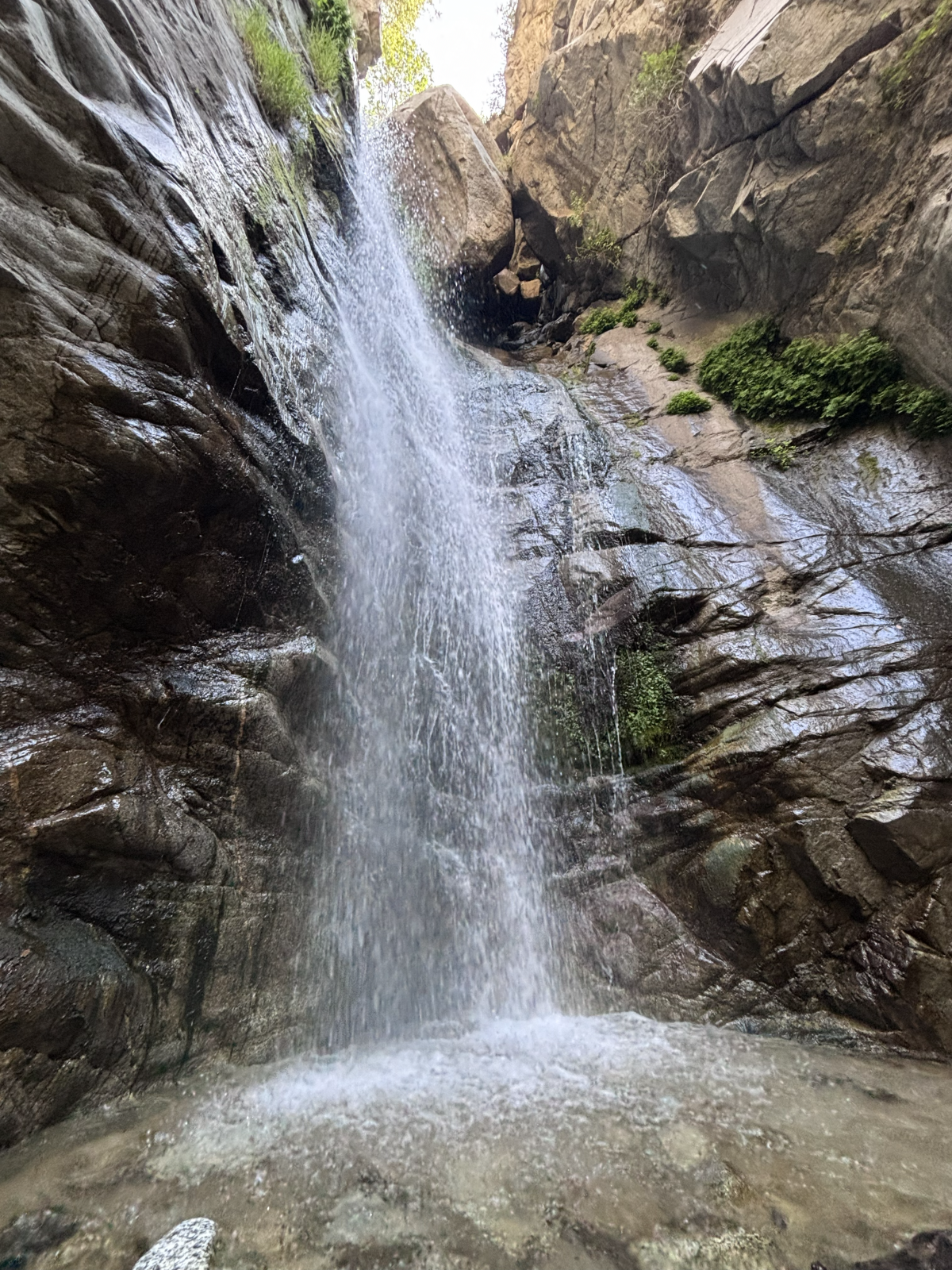
There I was, sprawled next to Millard Canyon Falls, listening as the water roaring down the cliff and cool air whooshed past my face. I gained a new perspective when I gazed at an upside-down waterfall. What’s the point of hiking if we don’t play around?
In today’s edition of The Wild, our weekly outdoors newsletter, I provide you with three great hikes where rivers and waterfalls are still flowing. It’s essential information as we head into summer and temperatures start to rise.
You are reading The Wild newsletter
Sign up to get expert tips on the best of Southern California’s beaches, trails, parks, deserts, forests and mountains in your inbox every Thursday
By continuing, you agree to our Terms of Service, which include arbitration and a class action waiver. You agree that we and our third-party vendors may collect and use your information, including through cookies, pixels and similar technologies, for the purposes set forth in our Privacy Policy such as personalizing your experience and ads.
If you were to force me to choose my favorite hike, I would stubbornly refuse to pick just one, but my list would include these three.
That’s why I really want to urge you, my dear Wild reader, to treat these places with the reverence they deserve. That includes:
Refreshing your memory on the seven “Leave No Trace” principles.
Packing a small trash bag in which you can store empty food wrappers, toilet paper and garbage you spot along the way.
Observing wildlife from a distance, including California newts, which you shouldn’t pick up because it’s rude and, more important, because they can secrete a neurotoxin through their skin that can be lethal to humans.
OK, let’s talk about where your next favorite hike will be!
Millard Canyon Falls in Angeles National Forest.
(Jaclyn Cosgrove / Los Angeles Times)
1. Millard Canyon Falls
Distance: 3.3 to 4.3 miles (see below) Elevation gained: About 900 to 1,100 feet Difficulty: Moderate Dogs allowed? Yes Accessible alternative: Paved segment of Gabrielino Trail from Windsor Boulevard
This 3.3- to 4.3-mile hike to Millard Canyon Falls will take you through lush hillsides and beneath the shade of coast live oaks and bigleaf maples as you walk alongside, and sometimes through, Millard Creek. Your journey ends at Millard Canyon Falls, a gorgeous 50(ish)-foot waterfall that gushes past massive boulders perched at the top of the cascade.
This hike is usually much shorter (about 1.5 miles), but a road closure in place since the Eaton fire lengthened it. I will explain more about the closure later. It is important to note, though, that Chaney Trail is the name of the roadway and an actual trail, both of which you’ll take on this hike.
To begin your hike, you can either parallel park nearNuccio’s Nurseries, taking care to obey all parking signage, or if those spots are all taken, park nearby and order a rideshare to drop you at the trailhead. I had cell reception with Verizon here, so it should be possible to order a ride back to your vehicle.
Millard Creek in Angeles National Forest.
(Jaclyn Cosgrove / Los Angeles Times)
From here, you have two options for reaching the Millard Canyon Falls trailhead.
1. Follow Chaney Trail road for about 1.66 miles to the Millard Canyon Falls trailhead. This route will be exposed, so you’ll need to start early if you choose this option.
2. Walk about half a third of a mile north from Nuccio’s, and then, near a bend in the road, you’ll take the Chaney Trail, a winding dirt path that I was delighted to find is in great shape. (Shout out to Restoration Legacy Crew, a volunteer trail maintenance group, for its amazing work in the Millard Canyon area!)
That trail is a bit overgrown in a few spots, so you’ll want to wear pants (or take the road). Additionally, make sure to lightly stomp before heading into overgrown areas, as this helps alert any snakes snoozing in the shade of your presence.
The view from the ground looking up at Millard Canyon Falls.
(Jaclyn Cosgrove / Los Angeles Times)
You’ll take Chaney Trail for about half a mile, pausing to catch your breath and take in the increasingly great views of the San Gabriel Valley. You will next cross over Mt. Lowe Motorway to take the Sunset Ridge Trail down. (See map for greater detail.)
You will boogie down a few switchbacks for 0.7 miles, enjoying shade provided by bay laurels and sumac trees, listening to the sweet songs of canyon wrens and spotted towhees. (That’s who was singing to me, anyway!)
You will reach the Millard Canyon campground, which is closed for overnight camping but does feature a few nice picnic tables shaded by massive coast live oaks. With the creek flowing nearby, I wouldn’t blame you if you stopped and had a little snack here.
Millard Campground in Angeles National Forest. It is closed because of damage from the Eaton fire.
(Jaclyn Cosgrove / Los Angeles Times)
That said, you have finally made it to the Millard Canyon Falls trailhead! Just northwest of the campground, you’ll find a little arrow pointing you northward onto the trail. From here, you will gain minimal elevation, and can actually just frolic. It is about half a mile to the waterfall.
As I mentioned, this trail is usually shorter and easier to access, as there’s a large parking lot near the trailhead and more parking along the roadway.
The roadway Chaney Trail was slated to reopen at the end of April. I frequently checked Los Angeles County Public Works’ road closure website, as I had planned to write about Millard Canyon once the road reopened. But when I checked the website, I saw that the reopening had been moved to the end of August. Huh?
I asked the public information officers at county Public Works about it and was told: “We are currently coordinating with our on-call emergency contractor to complete guardrail repairs on Chaney Trail, just north of the gate. Construction is anticipated to begin in July and be completed by the end of August, weather and field conditions permitting.”
Clockwise from top left: prickly phlox, golden yarrow, cliff aster and a type of larkspur. Center: A little bird on a dried out plant.
(Jaclyn Cosgrove / Los Angeles Times)
I passed a shiny new guardrail just north of the gate when I was hiking there earlier this week. I asked the agency whether there was some other guard rail missing. No, my friends. “The community raised concerns about the roadway narrowing included in this project, and we will be reconstructing the guardrail to address those concerns,” a spokesperson told me via email.
And now ends the saga of the Chaney Trail guardrail.
As for Millard Canyon, I will admit, it quite possibly is my favorite frontcountry natural areas. I was reminded of this fact when I visited this week. Although the road closure adds some steep mileage to reach the canyon, it’s worth it to me. I will be back. I hope to see you there!
The Fish Canyon Narrows near Castaic.
(Jaclyn Cosgrove / Los Angeles Times)
2. Fish Canyon to Fish Canyon Narrows
Distance: About 5.5 miles Elevation gained: About 400 feet Difficulty: Moderate Dogs allowed? Yes Accessible alternative:San Francisquito Creek Trail
To reach the Fish Canyon Narrows, you will take the Fish Canyon Trail (called Forest Route 6N32 or the Warm Springs Fish Canyon Truck Trail on some maps) on a 5.5(ish)-mile out-and-back journey. You will ascend into narrowing walls of sandstone, granite and conglomerate. A healthy stream flows throughout the canyon, giving you ample opportunity to cool off or have a picnic in a naturally occurring sound bath (which, when you’re lucky, will include a tree frog).
A quick note: This is the most rugged (read: least curated) of the three adventures mentioned in this list. There is no trail signage, and you’re in a less popular corner of Angeles National Forest. You might be entirely alone, especially if you hike this on a weekday. You should plan accordingly. Or skip it if I’ve already freaked you out. (I do this out of love!)
To begin, you’ll park on the road’s shoulder, and head east through a gate. Follow the roadway north and then south as it curves toward a dirt path. Follow the exposed dirt path northeast. You’ll trudge through multiple water crossings and be blessed with the occasional shade of sycamore trees.
The narrows are often cooler than the rest of the area. The first portion of this hike has little to no shade, so make sure to wear plenty of sun protection.
And if you leave the trail but aren’t ready to go home, head over to the swim beach at Castaic Lake. And if you’re not tired, there’s always the Cali Splash Park, a massive inflatable floating park. That’s a full day of adventure!
A hiker lies near the creek along the Icehouse Canyon Trail.
(Brian van der Brug / Los Angeles Times)
3. Icehouse Canyon Trail to Icehouse Saddle
Distance: Around 7 miles Elevation gained: 2,600 feet Difficulty: Challenging Dogs allowed? Yes Accessible alternative:West Fork National Scenic Bikeway
Icehouse Canyon Trail to Icehouse Saddle is a 7(ish)-mile trek that runs mostly parallel to the gorgeous and crystal clear Icehouse Creek, which often features several short waterfalls as the water rockets down the mountainside.
As they trek through the canyon shaded by bigleaf maple, California incense-cedar and bigcone Douglas-fir, hikers might spot wildflowers including orange-yellow western wallflowers, light purple Grinnell’s Beardtongue and red western columbine.
Icehouse Canyon is popular on weekends and is best visited on a weekday if you can swing it. You’ll need either a $5 Adventure Pass, an annual America the Beautiful pass or other federal public lands pass to park.
To begin your hike, you’ll park at or near the trailhead — in the parking lot if it’s your lucky day. Otherwise, you’ll park along the roadside, taking good care to read signage and not block anyone’s driveway. Once while walking to the trailhead, I was greeted by a local dog whose collar informed me that he was allowed to meander about and knew how to get back home. I love small mountain towns.
After you park — and remember to display your pass, as forest service workers do ticket vehicles without them — you’ll head east to the trailhead.
A visitor cools down in the creek at Icehouse Canyon.
(Jaclyn Cosgrove / Los Angeles Times)
Immediately upon entering the canyon, you’ll be greeted with stunning beauty. Try not to become too distracted by the pools of water surrounded by large boulders. (No one will know if you skip the hike and just take a dip.)
About a mile into your hike, you’ll come to a crossroad where the Chapman Trail and Icehouse Canyon Trail intersect. Continue east on the Icehouse Canyon Trail. A mile farther, you’ll start the switchback portion of the trail, where you’ll gain about 1,200 feet in 1.5 miles. It’s a beautiful suffer fest.
Icehouse Saddle will offer you incredible views of the San Gabriel Mountains and Mojave Desert. You’ll likely meet other hikers here who are planning to continue their journeys to one of several peaks reachable from the saddle, including to popular spots like Cucamonga and Ontario peaks.
Hikers meander past boulders and large pine trees.
(Brian van der Brug / Los Angeles Times)
It can be quite windy at Icehouse Saddle, so if you’re planning to have your lunch here (which I’ve done many times), consider packing a windbreaker.
The Times has been writing about hiking in Icehouse Canyon for more than 100 years, as city dwellers have long been drawn to its beauty. A July 1926 article about Icehouse Canyon started with a headline declaring, “Here’s a nice cool trip” in all caps.
“It is a trip which one will want to take more than once when its lure has gotten into the blood,” an unnamed Times journalist wrote.
May we all be so lucky to return again and again.
3 things to do
Docent Susan Hopkins leads a Pride Month hike during a previous year’s celebrations.
(L.A. County Department of Parks and Recreation)
1. Celebrate Pride across L.A. County The L.A. County Department of Parks and Recreation will host several events celebrating LGBTQ+ Pride throughout June. Almost 60 county parks are hosting events, including from 5 to 7 p.m. Thursday at Dalton Park in Azusa; from 5 to 7 p.m. Thursday at Dr. Richard H. Rioux Park in Stevenson Ranch; and from noon to 2 p.m. Saturday at Crescenta Valley Community Regional Park in La Crescenta. For a list of all events, visit parks.lacounty.gov.
2. Walk for peace in L.A. Los Angeles meditation nonprofit InsightLA will lead a free 12-mile Walk for Peace from 9 a.m. to 3 p.m. Saturday. The walk will start at Hollywood Forever Cemetery and end with community picnic at Tongva Park in Santa Monica. Register at insightla.org.
3. Repair trails in remote forest near L.A. The Lowelifes Respectable Citizens’ Club, a volunteer trail maintenance group, needs volunteers on Saturday and Sunday to help restore an overgrown segment of the Gabrielino Trail in Angeles National Forest. Volunteers will either ride gravel bikes down a 5.5-mile dirt road or hike in. Previous trail work experience not required. Register by emailing trailwork@lowelifesrcc.org.
The must-read
The aedes aegypti mosquito, called the “yellow fever mosquito,” is well-known for spreading nasty illnesses like its namesake and dengue fever.
(Sameer Neamah Mahdi / Associated Press)
Here’s a sentence I didn’t expect to write this year (or ever): Google would like to release up to 64 million sterilized male mosquitoes in California and Florida to help combat mosquito-borne illnesses such dengue, Zika, chikungunya and yellow fever. “Google says it can harness technology to optimize a concept that’s been around for decades, but hasn’t worked at a large enough scale with mosquitoes to rein in disease,” Times staff writer Lila Seidman reported. The project is called Debug —although Google could have gone with WiFly.
I’ll see myself out.
Happy adventuring,
P.S.
You’re sitting there thinking about your weekend, wondering, “Is there anywhere I could go dressed as a shark?” Why, yes, there is! The Cabrillo Marine Aquarium and Cosplay for Science will co-host the Science Entertainment Aquarium Convention from 9 a.m. to 4 p.m. Saturday at the aquarium (3720 Stephen M. White Drive in San Pedro). SeaCon 2026 will feature a beach cleanup, a fictional marine biology panel and a cosplay contest, along with much more. Learn more at the aquarium’s Instagram page. Have a jaw-some time!
For more insider tips on Southern California’s beaches, trails and parks, check out past editions of The Wild. And to view this newsletter in your browser, click here.
To the surprise of few, President Trump has once again claimed without evidence that Democrats are somehow cheating to win California’s primary elections — writing on social media late Wednesday that federal prosecutors in Los Angeles are investigating the matter.
“The Dumocrats are at it again! They are trying to STEAL THE GOVERNOR OF CALIFORNIA PRIMARY, AND THE MAYOR OF LOS ANGELES, PRIMARY, AWAY FROM TWO GREAT REPUBLICAN CANDIDATES. Here we go with the very late and massive numbers of MAIL IN BALLOTS,” Trump posted to his social media platform Truth Social.
“There’s BIG cheating by the Dumocrats in California. Votes are all tied up. May not be in for weeks. Under investigation by the U.S. Attorney’s Office in Los Angeles,” he wrote in a second post. “Why the vote counting DELAY???”
A spokesperson for the U.S. attorney’s office in Los Angeles — run by Trump loyalist First Assistant U.S. Atty. Bill Essayli — declined to comment Thursday morning on Trump’s claims of an investigation.
California Secretary of State Shirley Weber’s office also did not immediately respond to a request for comment.
Gov. Gavin Newsom’s office responded directly to Trump late Wednesday with its own social media post, writing, “Trump is lying about California again — time to take the phone away from grandpa and put him to sleep.”
On Thursday morning, Newsom’s office wrote that there “is a lot of misinformation floating around about California’s election — including from the President,” and recommended people watch a CNN video about California’s election process. It concluded that delays in vote counting in the state are essentially a result of state leaders deciding that providing voters with “last minute options” for casting ballots is more important than a quick count.
“And yes, for the record: we wish the votes were counted faster, too,” Newsom’s office wrote — a nod to the fact that the issue isn’t new.
In an email, Brandon Richards, Newsom’s deputy director for rapid response, said Trump’s claims are part of “a tinfoil hat level conspiracy theory that has been debunked repeatedly.”
The president’s claims of cheating were predicted before the election by both elections experts and Democratic leaders in California, who dismissed them in advance as more baseless bluster from a president beset by low approval ratings.
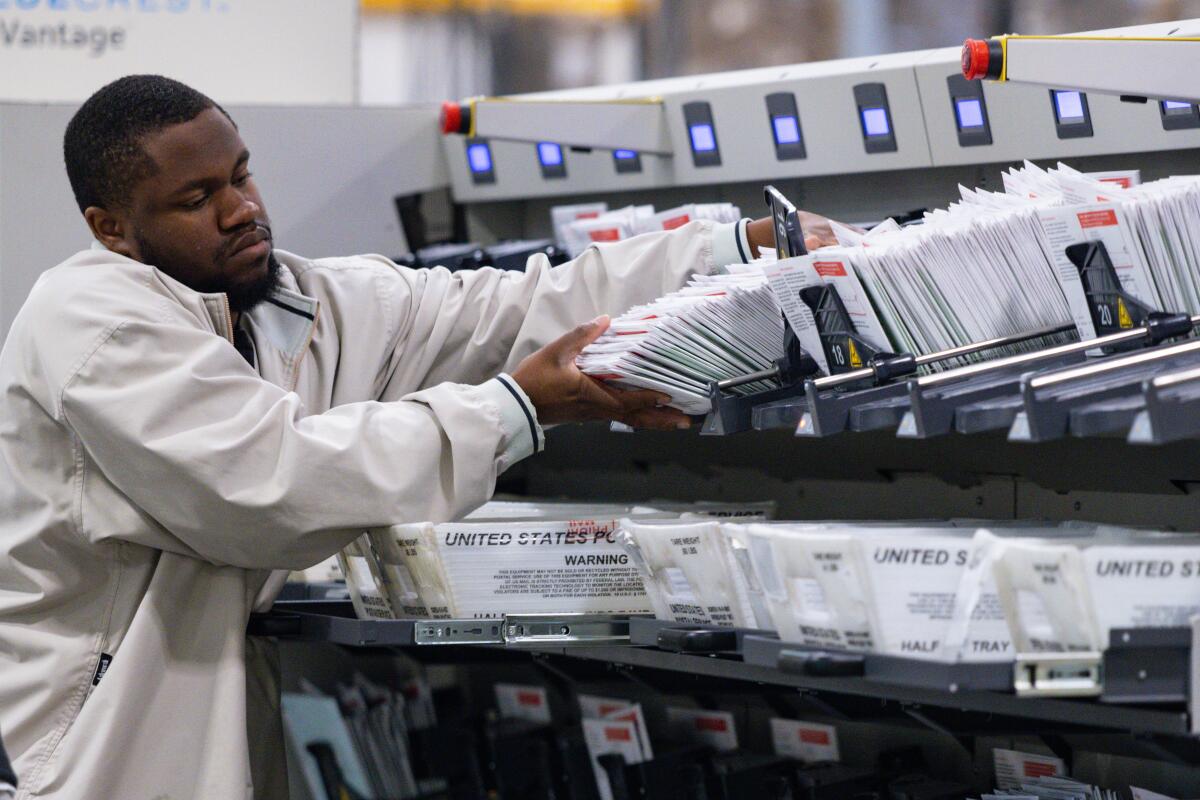
A worker puts ballots in a counting machine at the Los Angeles County Ballot Processing Center on Wednesdayin City of Industry.
(Kayla Bartkowski/Los Angeles Times)
Those same experts and Democratic leaders acknowledge that California’s system for counting votes takes a long time and should be quickened, but stress that is not because of anything nefarious. Rather, it is because California allows voters to cast ballots by mail up until election day — and then has to count those ballots, which can number in the millions and are subject to manual signature verification.
Trump has long dismissed such explanations. An election denier since he first entered politics more than a decade ago, Trump has pushed skepticism about elections he and his party lose time and again since — most notably when he claimed, again without evidence, that the 2020 election he lost to Joe Biden was stolen.
Trump even challenged Biden’s victory in court, but his claims were rejected completely because neither he nor his attorneys could produce any evidence substantiating them.
He has combined his tactic of targeting undocumented immigrants for political gain with his skepticism of election integrity by claiming, again without evidence, that such immigrants somehow vote in large numbers, particularly in big blue states such as California, despite experts saying there is no evidence of that.
He has alleged that mail ballots — such as those used by the majority of California voters — are a particularly rich source of voter fraud, despite again having no basis for the claim and it being disputed by experts.
A consistent feature of his election fraud claims is that they arise and target races only when Republicans lose or lose ground.
And, he has tried to use the power of his administration to make sweeping changes to election laws to bar mail ballots and require strict voter ID and proof of citizenship measures, despite the control of elections and their rules being constitutionally given to the states.
Those efforts have prompted a wave of litigation between the Trump administration and California and other blue states, with multiple cases pending in the courts over voter ID, proof of citizenship, mail balloting and the role that the U.S. Postal Service may be allowed to play in processing such ballots.
Trump’s latest remarks came as additional vote counting on Wednesday narrowed the advantage of Republican Steve Hilton over his Democratic challengers in the California governor’s race and closed the gap in the L.A. mayoral race between the MAGA-aligned candidate Spencer Pratt, currently running second, and City Councilmember Nithya Raman, who is running third.
The trend was anticipated. Elections experts warned before vote counting began of the potential for a “red mirage,” wherein earlier voting among Republicans and late voting among Democrats — many of whom were unsure of whom to vote for in the two high-profile races — would create an early illusion of Republican victories despite large volumes of liberal votes from major population centers still to be counted.
It is a trend that has played out repeatedly in past elections, and one that does not come as a surprise to careful elections watchers.
Elections officials in California knew such claims were going to be made, as they’ve been made in the past. Some local elections officials made a point of preparing their staffs for baseless claims of election fraud in advance of this year’s primaries. State officials made repeated efforts to explain the reasons why California elections take time, precisely to undercut claims amid counting that the delays were the result of fraud.
But those claims have come regardless, and not just from Trump.
Above an X post Wednesday suggesting Pratt was losing ground to Raman as more counts came in, Florida Gov. Ron DeSantis wrote, “California keeps dumping votes. Odds are shifting because the vote dumps always seem to go one way. Count until you get the result you want?”
Above another X post Wednesday noting that the California count would take time, Katie Miller, a former Trump administration official and conservative podcaster married to Trump’s top advisor Stephen Miller, wrote, “The Democrats are about to steal the LA mayoral race once again using mail-in voting.”
Both of the posts that DeSantis and Miller were responding to were from Polymarket, a prediction market where people can bet on the outcomes of political races, pop culture events and a slew of other subjects.
Such emerging financial markets, which process billions of dollars in bets, are causing rising concerns about political meddling for profit — including by campaign staffers and other individuals with insider knowledge of polling and other campaign information, or by politicians and their operatives, whose public remarks about politics can swing those markets.
From Maddie Lee: Shohei Ohtani needed just one well-spotted fastball to Corbin Carroll to get out of the only real jam of his start against the Diamondbacks on Wednesday.
Ohtani zipped it in at knee level, and Carroll drilled it into the ground, right to second baseman Alex Freeland. As the Dodgers defense turned a quick double play, Ohtani pumped his fist.
With that, he wrapped up the pitching half of one of his best two-way performances of the season.
With Shohei, every run is a premium,” manager Dave Roberts said after the Dodgers’ 7-0 win Wednesday. “He’s literally trying to throw a shutout every time out there, where I don’t know that every starter has that mindset.”
Ohtani only allowed three base runners (two hits and a walk), while reaching base himself five times (three hits and two walks). With six scoreless innings pitched, Ohtani improved his ERA to 0.74, the third-lowest ERA any pitcher has recorded in his first 10 starts of the season (excluding openers) since the earned run became an official stat in 1913, according to MLB.com.
He came in behind only Jacob deGrom in 2021 (0.56) and Juan Marichal in 1966 (0.59). Not to mention, at the same time, Ohtani the hitter has a National League-leading .420 on-base percentage. At the time of his third hit Wednesday, he became one of 15 qualified hitters in MLB with a batting average over .300.
Get the latest on L.A.’s teams in the daily Sports Report newsletter.
By continuing, you agree to our Terms of Service, which include arbitration and a class action waiver. You agree that we and our third-party vendors may collect and use your information, including through cookies, pixels and similar technologies, for the purposes set forth in our Privacy Policy such as personalizing your experience and ads.
Angels rout the Rockies
Wade Meckler and Nick Madrigal each had four of the Angels’ 16 hits, Walbert Ureña pitched six solid innings and the Angels beat the Colorado Rockies 11-4 on Wednesday night.
Meckler is batting .389 (14 for 36) with two homers and 10 RBIs since he was recalled from double-A on May 22.
Vaughn Grissom added a homer and three RBIs, and Oswald Peraza had two hits and two RBIs to help the Angels — who tied their season high with the 16 hits — avoid a three-game sweep.
From Sam Farmer: Reaching the summit is a dream. But staying there? That’s an altogether different challenge.
Maja Stark has a special appreciation for that now, a year after winning the U.S. Women’s Open at Erin Hills and feeling the hefty weight of expectation that came along with it.
For her, the aftermath of that victory brought heightened anxiety, and searing criticism from outsiders when the Swedish pro’s play took a dip.
“You get comments and stuff saying, ‘What happened? You just won a major; why do you suck all of a sudden?‘” Stark said at the Chevron Championship in April. “That does take some energy and just makes you focus on the wrong things. Then I got even more stressed and anxious.”
That career-shaping pressure will be on display again this week when the USGA brings the U.S. Women’s Open to Riviera Country Club for the first time, merging the game’s most prestigious women’s championship with a historic venue celebrating its centennial year. The tournament takes place Thursday through Sunday.
1870 — Ed Brown becomes the first Black jockey to win the Belmont Stakes, with Kingfisher.
1927 — The United States wins the first Ryder Cup golf tournament by beating Britain 9½-2½.
1932 — Faireno, ridden by Tommy Malley, wins the Belmont Stakes by 1½ lengths over Osculator. Burgoo King, the Kentucky Derby and Preakness winner, doesn’t race.
1966 — Ameroid, ridden by Bill Boland, wins the Belmont Stakes by 2½ lengths over Buffle. Kauai King, the Kentucky Derby and Preakness winner, finishes fourth.
1974 — NFL grants franchise to Seattle Seahawks.
1984 — 1960 champion Arnold Palmer fails to qualify for the US Open Golf Championship for the first time in 32 years.
1987 — Danny Harris defeats Edwin Moses in the 400 hurdles at a meet in Madrid, ending the longest winning streak in track and field. Moses, had won 122 consecutive races dating to Aug. 26, 1977.
1988 — West Germany’s Steffi Graf beats 17-year-old Natalia Zvereva of the Soviet Union in 32 minutes with a 6-0, 6-0 victory to win the French Open for the second straight year.
1990 — Penn State is voted into the Big Ten. The school becomes the 11th member of the league and first addition to the Midwest-based conference since Michigan State in 1949.
1994 — Haile Gebrselassie becomes the first Ethiopian to set a world track record with a time of 12:56.96 in the men’s 5,000 meters at Hengelo, Netherlands.
1998 — Harut Karapetyan of the Galaxy scores three goals in five minutes for the fastest hat trick in MLS history in an 8-1 rout of the Dallas Burn. The seven-goal margin sets an MLS record.
2005 — Justine Henin-Hardenne beats a rattled and fumbling Mary Pierce 6-1, 6-1 to win the French Open, capping a comeback from a blood virus with her fourth Grand Slam title and her second at Roland Garros.
2005 — Eddie Castro sets a North American record for most wins by a jockey in one day at one track, winning nine races on the 13-race card at Miami’s Calder Race Course.
2008 — The Detroit Red Wings win the Stanley Cup for the fourth time in 11 seasons with a 3-2 victory over the Pittsburgh Penguins in Game 6 .
2011 — Li Na becomes the first Chinese — man or woman — to win a Grand Slam singles title. She beats Francesca Schiavone 6-4, 7-6 (0) in the French Open final for her fifth career title and first on clay.
2016 — Garbine Muguruza wins her first Grand Slam title by beating defending champion Serena Williams 7-5, 6-4 at the French Open, denying the American her record-equaling 22nd major trophy.
Compiled by the Associated Press
This day in baseball history
1940 — The Pirates beat the Boston Bees 14-2 in the first night game at Pittsburgh’s Forbes Field.
1940 — The St. Louis Cardinals play their first night game at Sportsman’s Park, defeating the Brooklyn Dodgers 10-1.
1951 — Pittsburgh’s Gus Bell hit for the cycle to lead the Pirates to a 12-4 victory over the Phillies at Philadelphia.
1964 — Sandy Koufax pitched his third no-hitter, striking out 12, as the Dodgers beat the Phillies 3-0 in Philadelphia.
1968 — Don Drysdale of the Dodgers blanked the Pirates 5-0 for his sixth straight shutout en route to a record 58 2/3 scoreless innings.
1972 — A major league record eight shutouts were pitched in 16 major league games: five in the American League, three in the National League. The Oakland Athletics swept a pair from the Baltimore Orioles by identical 2-0 scores.
1974 — The game between the Cleveland Indians and the Texas Rangers at Cleveland’s Municipal Stadium was forfeited to Texas. Umpire Nestor Chylak had problems with fans all night on 10-cent beer night. The crowd got out of control when Cleveland tied the score 5-5 in the bottom of the ninth.
1989 — Toronto beats Boston 13-11 in 12 innings after trailing 10-0 after six innings. Red Sox starter Mike Smithson threw six scoreless innings before leaving in the seventh because of a foot blister. The Jays then scored two in the seventh, four in the eighth and five in the ninth and two more in the 11th on Junior Felix’s home run. It was the biggest lead the Red Sox have blown and their 12th consecutive loss to the Blue Jays at Fenway Park.
1990 — Ramon Martinez struck out 18 and pitched a three-hitter, sending the Dodgers past the Atlanta Braves 6-0.
1996 — Pamela Davis pitched one inning of scoreless relief and got the win in a minor league exhibition game. She is believed to be the first woman to pitch for a major league farm club under the current minor league system. The 21-year-old right-hander pitched for the Jacksonville Suns, a double-A affiliate of the Detroit Tigers, against the Australian Olympic team.
2000 — Esteban Yan of the Tampa Bay Devil Rays becomes the 77th major league player to hit a home run in his first at bat, but just the fourth American League pitcher and the first since the Angels’ Don Rose in 1972, the year before the designated hitter rule took the bat out of AL pitchers’ hands.
2005 — Rafael Palmeiro and Melvin Mora each hit grand slams to help Baltimore rally for a 14-7 win over Detroit.
2007 — Mark Ellis hit for the cycle and Eric Chavez had a two-out homer in the 11th inning to lift Oakland to a 5-4 win over Boston.
2009 — Randy Johnson became the 24th major league pitcher to win 300 games by leading San Francisco to a 5-1 victory over the Washington Nationals in the first game of a doubleheader.
2012 — Angels manager Mike Scioscia became the ninth manager in AL history to manage 2,000 games with one club. The Mariners beat the Angels 8-6.
2018 — In a doubleheader with the Detroit Tigers, New York Yankees OF Aaron Judge sets a record by striking out eight times.
2019 — San Francisco Giant Manager Bruce Bochy wins his 1,000th game as the manager of the Giants with a 9-3 victory over the New York Mets.
2022 — The rule preventing position players from pitching in a close game is invoked for the first time when Crew chief C.B. Bucknor objects to Dodgers manager Dave Roberts calling on utility player Zach McKinstry to pitch the ninth inning gainst the Mets with his team trailing, 9-4. The rule, adopted before the 2020 season but not implemented until this year due to the upheavals caused by the coronavirus pandemic, states that a team cannot use a position player on the mound unless there is a difference of six or more runs between the two teams. Roberts is thus forced to use a real pitcher, Evan Phillips, to pitch the final inning.
Compiled by the Associated Press
Until next time…
That concludes today’s newsletter. If you have any feedback, ideas for improvement or things you’d like to see, email me at houston.mitchell@latimes.com. To get this newsletter in your inbox, click here.
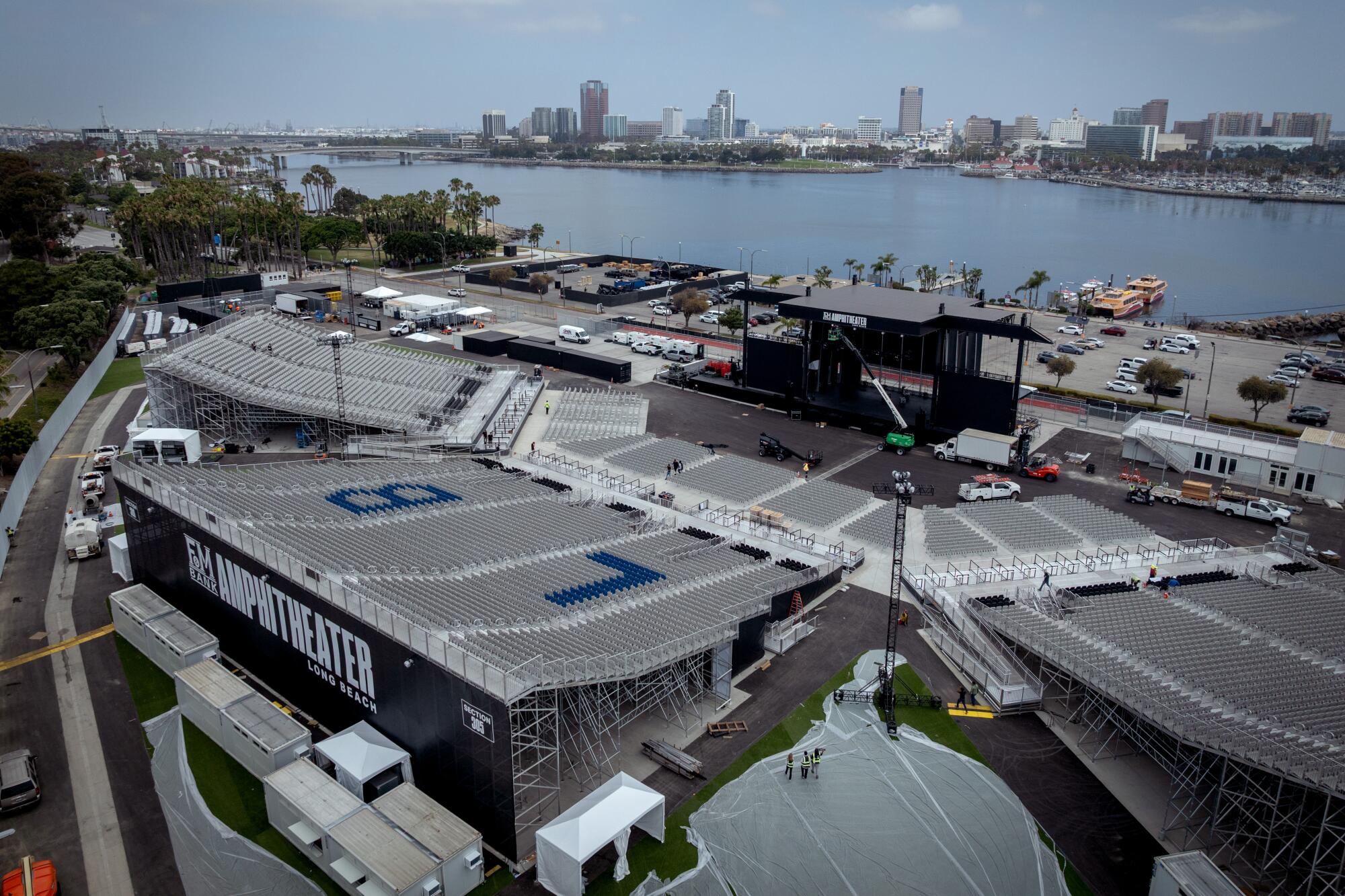
A waterfront amphitheater roughly twice the size of the Greek Theatre and two-thirds the size of the Hollywood Bowl is set to open this week in Long Beach — and there’s a lot riding on its success.
City leaders hope F&M Bank Amphitheater of Long Beach, located next to the famed Queen Mary, will supplant declining revenues from oil extraction and lead to an uptick in tourism. Concert promoters, meanwhile, see it as filling an important gap in Southern California’s music venue market.
The temporary amphitheater, which has a maximum capacity of 11,000, is meant to be a precursor to a permanent “Long Beach Bowl,” which is being pitched as the largest waterfront venue on the West Coast. The site opens June 6 with a performance by native son Snoop Dogg, and is expected to last for up to 10 years.
The new amphitheater represents a years-long dream of Mayor Rex Richardson, who began championing an outdoor performance venue on the waterfront in 2023. Soon after the closure of Irvine’s FivePoint Amphitheatre in October of that year, he accelerated those plans by proposing this facility. The general feeling was that Irvine’s loss could be Long Beach’s gain.
“This will be a place where memories are made, where music brings people together and where our city shows up on the big stage,” he said during a January groundbreaking. “The amphitheater represents direction to invest in our city’s future, to embrace our creative economy [and] to shape how people experience Long Beach for generations to come.”
Good vibes by the water is the driving energy behind the temporary venue.
(Eric Thayer / Los Angeles Times)
While Los Angeles and Orange County have no shortage of cavernous indoor arenas, the region has recently lacked a proper “summer shed” capable of hosting many national amphitheater tours, said Nick Storch, head of global artist development for booking agency Independent Artist Group. Those tours typically play venues larger than the Greek, Irvine’s Great Park Live or Costa Mesa’s fairgrounds-adjacent Pacific Amphitheatre, but smaller than the Hollywood Bowl.
Such tours, Storch said, are of “massive” importance to the concert industry. “With amphitheaters, it’s not just the music — it’s the experience of being outside and watching a concert, getting a bite to eat with your friends and all those kinds of things,” said Storch, whose agency’s clients Motley Crue and Five Finger Death Punch will perform at the F&M Bank Amphitheater in September.
“FivePoint was a great venue to help artists that are in that in-between stage, and not fully ready for arenas,” he said. “Long Beach having an amphitheater is going to grow the market again.”
Amphitheaters are also crucial to veteran artists with established fan bases. The long-running hard rock band Tesla — who also will perform at the F&M Bank Amphitheater in September — has not played a show in Los Angeles or Orange counties since the closure of FivePoint, which hosted the group twice.
Brian Wheat, the band’s bassist and manager, said he’s excited the new venue will help change that. “Sheds are great in the summertime, and outdoor summer gigs always create a great atmosphere for both bands and fans,” he said.
Much like the F&M Bank Amphitheater, FivePoint Amphitheatre was designed to serve as a temporary venue following the closure of Irvine Meadows Amphitheatre, which operated from 1981 to 2016. (From 2000 to 2014, it was known as Verizon Wireless Amphitheater.)
At 11,000 seats, the amphitheater is roughly two-thirds the size of the Hollywood Bowl. Its permanent replacement will be “architecturally iconic,” said Mayor Rex Richardson, while this temporary version is likened to a “summer shed.”
(Eric Thayer / Los Angeles Times)
From its opening in October 2017 until its closure, FivePoint hosted nearly 500 concerts, including artists such as KISS, Dave Matthews Band, Charlie Puth, Morgan Wallen and Luke Combs.
Venue operator Live Nation — which manages more than 300 facilities across the country — initially hoped to build a permanent amphitheater nearby, but scrapped those plans in 2023 after the Irvine City Council ended negotiations. Soon after, Live Nation announced the venue would shutter.
After learning of Live Nation’s fallout with Irvine, Richardson and members of his economic development team attended the final FivePoint concert, a performance by the Zac Brown Band, to “explore the feasibility if we were to do the same thing.”
Three months later, Richardson announced plans to build a temporary amphitheater in Long Beach to bridge the gap until a permanent facility — which he envisions as an “architecturally iconic and significant” waterfront venue akin to San Diego’s Rady Shell at Jacobs Park — can be permitted, financed and constructed.
The site’s location is central to its appeal, said Dan Hoffend, executive vice president of North American venues for Legends Global, the operator for F&M Bank Amphitheater. “If you sit in the very top row — what you would consider the worst seat in the house — it’s a spectacular view,” he said. “The Queen Mary is sitting there in all its glory. You’re looking across the harbor. What would be perceived as the worst seat is actually the best seat because you see it all.”
Long Beach Mayor Rex Richardson, left, and amphitheater general manager Tra Jones sit in the stands. Even from the nosebleeds, you still have a view of the waterfront at the F&M Bank Amphitheater.
(Eric Thayer / Los Angeles Times)
Tra Jones, general manager of the new amphitheater and a Long Beach native, said he’s striving to make it feel less stopgap and utilitarian than FivePoint.
“It doesn’t have a temporary feel at all,” he said. “We looked at all our surroundings and said, ‘What does this look like from a stylistic point of view?’ We leaned into the port/SteelCraft vibe — a very cool industrial look. When you walk in, you’re experiencing a vibe. That’s what we want to resonate with concertgoers coming here.”
The word “vibe” also pops up frequently in conversation with Richardson. Under his watch, Long Beach recently started branding itself as “Vibe City,” which he said is an attempt to encapsulate the charm of L.A. County’s second-largest city, and the state’s seventh-largest.
“Long Beach is special, but it’s hard to explain why if you haven’t been here,” he said. “Because you have to experience it for yourself, the best way to describe it is that it’s a vibe.”
Still, Richardson is aware that vibes can only go so far. During an April meeting with residents of downtown Long Beach, attendees were more interested in discussing homelessness and a recent uptick in traffic fatalities than how a new concert venue might add to the city’s cultural cachet. Some downtown residents have circulated a petition regarding noise-related concerns.
“The job of the mayor is to meet the needs of your residents today — keeping a roof over your head, making sure it’s safe to walk down the street, making sure you have access to amenities and services in your community — but also to think about the future,” he said.
That means finding a way to offset revenues from oil extraction, which currently finance many municipal services, and are projected to drop from more than $50 million annually to around $21 million by 2035. According to Richardson, the new amphitheater — managed by Legends Global, but owned by the city — will help cover that shortfall. The venue is projected to be profitable within five years and generate nearly $29 million in revenue by 2036.
Oil revenues, which pay for city services, are projected to drop by more than half. The amphitheater is being pitched as a budget gap solution.
(Eric Thayer / Los Angeles Times)
“We were fortunate that revenue from oil provided a lot of our services and built our beautiful waterfront, but as California moves away from oil production, we have to plan a more sustainable future by investing in what we know will be here in the long haul,” Richardson said. “In order to do that, we have to invest in arts and culture and tourism.”
Richardson is betting on music at a time when other cities — including Los Angeles — are doubling down on sports, warehousing or data centers. The amphitheater is also meant to remind the world of the city’s impact on pop culture.
From War to Warren G and Sublime to Snoop, Long Beach has a rich musical history. The city hosted the first concerts by the Beach Boys and No Doubt, while Rock & Roll Hall of Famers Elvis Presley, the Eagles and Iron Maiden all graced the stage of the Long Beach Arena.
While that venue currently holds more conventions than concerts, Long Beach has hosted notable outdoor music festivals in recent years, including Warped Tour, Day Trip and Dreamstate. Richardson believes the success of those events helped prove the city’s viability as a concert destination.
“This is the first step toward a legacy of leaving our city in a more economically resilient position,” Richardson said. “At every big turn in our city’s economy, we’ve leaned on arts as a way forward, and this is no different.”
Even the bleacher seats represent Long Beach pride at F&M Amphitheater.
Here in L.A., you can find plenty of yoga studios that are only a short walk from the beach. But Sol Seek Yoga — The Loft is the only one where, when your instructor tells you to “extend your feet towards the ocean,” you might actually wonder if you’ll get your toes wet.
Perched just above the Strand in downtown Manhattan Beach, this cozy studio has sliding doors that open up to a full, unobstructed view of the pier, beach and ocean only a few hundred yards away. The sound of sea waves infuses the room with nature’s original white noise, adding a sense of marine tranquility to every class.
“Because of our proximity to the ocean, we’re very connected to nature,” says owner Justin Randolph. “To be able to hear the waves and connect to that rhythm, especially during corpse pose — it’s a little slice of calm.”
In fact, calm is something of a specialty at this studio, which focuses less on high-intensity aerobic classes than on restorative, therapeutic methods. Soothing Yin classes are offered nearly every day, and Chair Yoga sessions are tailored for students who are nursing injuries — or just prefer a slower, deeper practice.
To keep your visit stress-free, it’s best to plan in advance for the challenges of beachfront parking. If you’re lucky, you might be able to snag a nearby metered space or a spot in one of the lower pier lots. Otherwise, your safest bet is the large parking structure at Metlox Plaza, about five minutes away by foot.
Single class: $30 New student offer: $59 for 21 days of unlimited in-studio, outdoor and livestream classes Unlimited monthly membership: $149
Making a rib stop on the way to a game and then eating your barbecue inside your car — or, better, on the hood of your car if you don’t want sauce-stained seats — has been a classic move since the days the Lakers used to play at the Forum in Inglewood. Lately, however, it’s getting harder to find old-school L.A. barbecue — the wood-smoked ribs and links and small ends that have long powered this city. Luckily, Inglewood is home to two outposts from the first family of L.A. barbecue: Woody’s (see separate entry), started by the late Woodrow “Woody” Phillips and Phillips Bar-B-Que from Woody’s cousin Foster Phillips, who still inspires younger pitmasters. Where Woody’s has patio seating, Phillips, in traditional barbecue style, is a take-out-only shop with a tightly packed parking lot off Centinela Avenue. It’s the only location that remains after the 2024 closure of Phillips’ Crenshaw spot. Recently, I stopped in for pork ribs so tender the meat easily came free from the bone; small ends, a meaty cut Phillips helped popularize; plus sides of greens and an especially cheesy macaroni and cheese. If you order your rib sauce hot, it may not be as spicy as it was in the old days, but it still has the sweet taste of nostalgia.
A huge, waning moon glimmered over Los Angeles on election night, a metaphor for a trend that emerged in early returns.
The city’s political establishment seemed to be on the retreat in favor of populist insurgents from both the left and the right.
Mayor Karen Bass held a cushy lead in her bid for a second term, and the Associated Press declared that she had made it into the November runoff election. But the underwhelming amount of support she got thus far showed that many voters in a super-blue city didn’t have enough confidence in a Democratic stalwart to return her to office. Instead, many chose self-proclaimed upstarts from opposite ends of the political spectrum: Republican reality TV star Spencer Pratt and democratic socialist City Councilmember Nithya Raman.
Raman launched her campaign at the last moment, just weeks after endorsing her longtime ally Bass, figuring that enough Angelenos were tired of the incumbent and would join her message of change from inside City Hall.
Raman’s instincts were half right. Voters did want change. But they didn’t view her as a challenge to the status quo — to many, she is the status quo.
The mayoral hopeful didn’t articulate a platform that radically departed from Bass’, and voter antipathy to her muddled messaging showed: she ended the night in third place. If the current results hold, Bass would face Pratt in the runoff.
At Raman’s election-night party at Boomtown Brewery on the outskirts of Little Tokyo, I saw why her chances of becoming L.A.’s next mayor were slim from the start. The gathering felt like happy hour at a Silver Lake bar: far whiter than the city overall, with few Latinos. Her address to a packed house was a grab bag of platitudes mixed with a broadside against MAGA, which is a political nothing in L.A. politics. It was an uninspiring cri de coeur and reflective of a campaign that wasn’t apocalyptic enough for those, such as Pratt’s people, who want radical change, while offering nothing new for Bass supporters.
Yet Raman still insisted she had unlocked something transformative.
“Together, we built something extraordinary,” she said to cheers. “And it gives me so much inspiration to be a part of it, a movement powered not by cynicism or political insiders, but by ordinary people who still believe Los Angeles is worth fighting for.”
Raman then went on the dance floor to greet well-wishers, pumping her fist while a DJ blasted Daft Punk’s “Lose Yourself to Dance.”
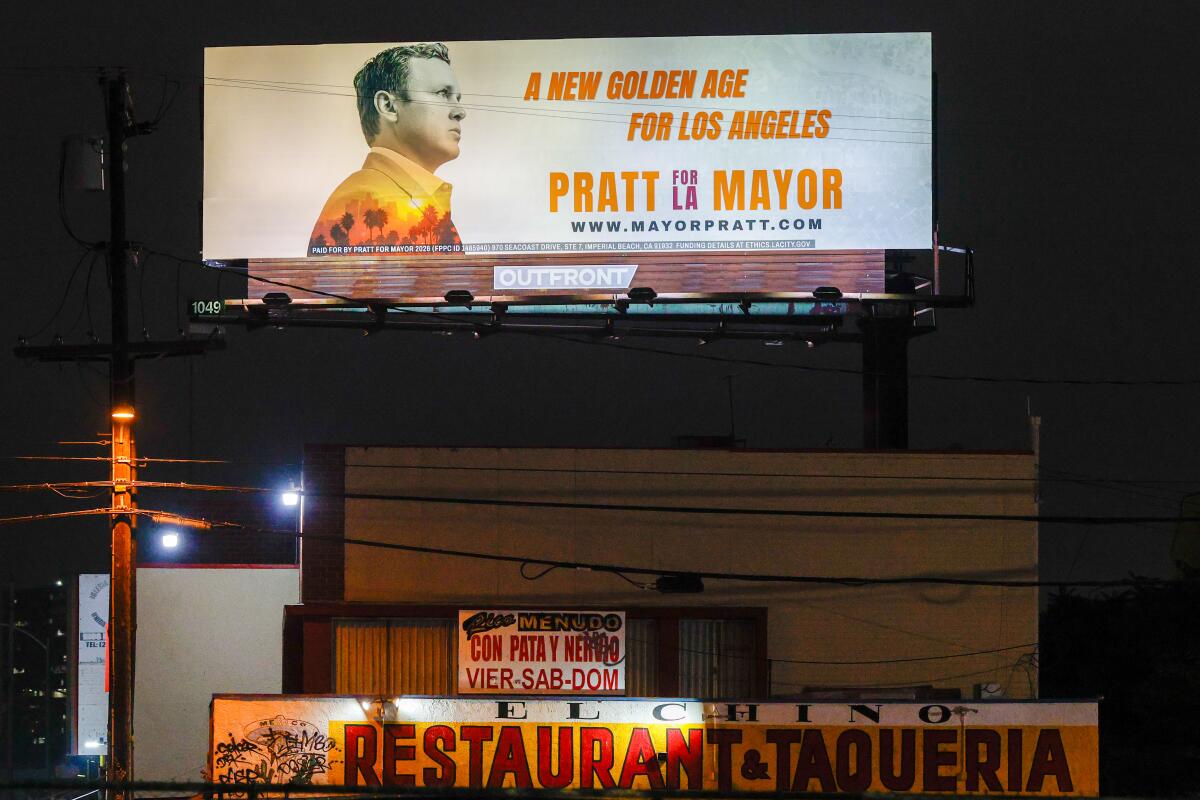
A billboard for L.A. mayoral candidate Spencer Pratt near MacArthur Park on June 2, 2026.
(Ronaldo Bolanos / Los Angeles Times)
Across town in West Los Angeles, Pratt reveled in his second-place position, enjoying a Mexican dinner with friends and family. It was a peaceful conclusion to a spring of fulminations against Bass (“Karen Basura”), nonprofits, homeless people (“zombies”) and anything that reeked of Democratic pieties, even as the Republican swore he was campaigning for all ideologies in a nonpartisan race.
Long dismissed as a has-been joke, Pratt correctly judged that Angelenos are angry and don’t want to be polite about it anymore. He and his supporters will take his unlikely rise as a mandate to double down against liberal L.A.
But if Pratt, who lost his house in the Palisades fire, does move on to the general election and is serious about winning, he needs to learn from the political revolution successfully pursued by his polar opposites, the local chapter of the Democratic Socialists of America.
Six years ago this spring, L.A.’s political establishment wrote off DSA-LA as wokoso upstarts in their long-shot quest to get a political novice named Nithya Raman elected to the city council. Even as Raman and three other DSA members joined the council, skeptics dismissed them and their progressive policies as anomalies that didn’t reflect how Angelenos actually wanted the city to work.
Tuesday night, four of the six DSA-endorsed candidates in L.A. city elections were in first place by large margins and another was comfortably in second, reflecting DSA’s multicultural, citywide reach. In a telling sign of its newfound king-making status, the local chapter declined to endorse Raman or any other mayoral candidate. Without that powerful backing, their trailblazer, along with DSA member Rae Huang, withered on their L.A. revolutionary vine.
Councilmember Hugo Soto-Martínez and L.A. Unified school board member Rocío Rivas looked to be coasting to outright victories. Marissa Roy was on her way to a runoff that would exclude the incumbent city attorney, Hydee Feldstein Soto, who was a distant third in the early returns. In District 9, where Curren Price is terming out, Estuardo Mazariegos stood comfortably in second place and looked to headed to a runoff against a fellow Latino candidate in a race that will see South Los Angeles elect its first non-Black council member in 63 years.
The most surprising outcome involved Councilmember Eunisses Hernandez, who became a punching bag, along with Bass, for people who thought L.A. had transformed into a hellhole. So-called dark money groups, which don’t have to reveal where their funding comes from, poured hundreds of thousands of dollars into negative mailers. Opponents vying for her seat cast federal raids against drug dealers and gangs in the MacArthur Park area as an indictment of her leadership, berating her during debates and on social media.
Even Hernandez’s supporters were fretting about what might happen on election night. But by the time I arrived at her raucous soirée in Highland Park, early returns showed her way ahead of the field and perhaps avoiding a runoff.
“It’s reassuring to see [DSA’s success],” she said as jubilant supporters lined up beside her to get tattoos — real ink, not temporary — of hummingbirds, her campaign’s logo. “That means people see us. That means people want more.”
Hernandez pointed to her fellow DSA member, New York City Mayor Zohran Mamdani.
“What happened with DSA over there didn’t happen overnight,” she said. “In L.A., we’re getting there.”
A table filled with campaign buttons for Council Memer Hugo Soto-Martinez, who ran for reelection this year and is expected to win outright.
But anyone who wants to win in Los Angeles needs to realize that antiestablishment sentiment is in the air.
At the same time, I would remind the victorious populists to look up in the sky and remember their Shakespeare.
“O, swear not by the moon, th’ inconstant moon / That monthly changes in her circle orb / Lest that thy love prove likewise variable,” Juliet warned Romeo.
Politics, like la luna, waxes and wanes whether we like it or not, and anyone who bets on a permanent transformation at City Hall will probably lose.
Angelenos have declared that they want dramatic change. But how will they feel in November?
L.A. Mayor Karen Bass made what sounded like a victory speech Tuesday night.
Councilmember Nithya Raman made what sounded almost like a concession speech.
And former reality TV star Spencer Pratt relayed a message from the heavens.
“Well, obviously God wanted five more months of me exposing all the failures of our mayor, so it’s gonna be a fun ride,” Pratt said. “I hope she’s ready.”
Assuming Pratt holds on to one of the two spots in the Nov. 3 general election as the final votes are tallied in the next few days, the smart money will be on Bass, for reasons I’ll get into in a moment.
But the supreme being and patron of all pontiffs has to be considered a wild card. This is the first time, to my knowledge, that an incumbent mayor in the City of Angels would be running against a challenger whose campaign manager is God Almighty.
So here we go. We could be in for one of the more remarkable electoral adventures in city history, with a complete novice and MAGA conservative going up against a liberal career politician in a deep-blue city and state full of people who are tired of hearing excuses from Democrats. (If Raman ends up ousting Pratt, my apologies for jumping to conclusions. But it’s not my fault. The devil made me do it.)
If you intend to follow closely, as of course you should, maybe you can help me count the number of times Pratt plays the faith card. I went to St. Peter Martyr School and attended the church by the same name, and I don’t recall ever hearing a nun or a priest drop God’s name as often as Pratt does.
In fact, I just watched a clip of Pratt talking to Fox News TV host and Donald Trump disciple Kayleigh McEnany, and over the course of 1 minute and 52 seconds, he mentioned God or Jesus 10 times.
“Thankfully, I married an angel who was very connected with Jesus and has brought me to the light,” Pratt said of his wife and former reality TV co-star Heidi Montag. “It’s been very empowering to just pray and just be on his path and just say, ‘God, if you want me to save these animals, save these humans and protect my city, just keep putting me in the place where I can do that.’”
Is he running for mayor or cardinal?
Look, I totally respect your average true believer. But I’m not entirely comfortable with a mayor who might be sitting around City Hall waiting for signs and smoke signals rather than knowing what to do on his own.
God has a lot on his plate. He might be busy multiplying fishes and loaves so people don’t go hungry thanks to the president’s tariffs and warmongering. Is he going to rush to answer a prayer for guidance about underfunded parks or broken sidewalks in Los Angeles?
How did we get here, you ask?
Well, Pratt is an AI creation, in a way. A composite of sorts. You combine the forces of social media, political rebellion, second-rate celebrity obsession and the Peter Principle, and here’s a little Trump puppet walking around L.A. like he’s the chosen one.
Add to that the very real essence of his appeal to some voters:
Los Angeles has problems. Big problems that don’t get fixed quickly enough or at all, and Pratt represents the angry voter who wants to know why City Hall can’t do better and where all the money went. He’s absolutely right when he says we shouldn’t have people living on the streets, using drugs on the streets and dying on the streets.
But if Pratt is in the general election rather than Raman, we’re in for a national media circus rather than a summit on solutions. Raman is well-versed on matters of relevance and could have pushed back against Bass in substantive, detailed ways. On the other hand, as Pratt has fairly argued, Raman headed City Council’s homelessness committee, so isn’t she partly to blame for the failures she tried to pin on Bass?
As for Pratt’s policy chops, he has not responded to my offers of a get-together. Absent that, and given his careful avoidance of local reporters who know their stuff, I read his platform on his campaign website and I can tell you that while he touches on many of the right issues — public safety, fiscal integrity, homelessness — attention to detail and depth of knowledge are not God-given strengths.
Maybe Pratt can actually deliver on his promise of a “treatment-led recovery model that addresses mental illness and addiction as the primary drivers of chronic homelessness.” But that would require an act of God (which I suppose is possible given their relationship), because those matters are primarily under the direction of the county, not the city.
This is the main problem here. Bass was beatable, and could have been pushed by a serious challenger to do better.
In the last election, Rick Caruso gave her a scare. That was partly because he had some depth on the issues, he was a successful businessman and philanthropist, he had served on the police commission and the water and power board, he had built relationships across the city and, along with his family, he had poured time and millions of dollars into underserved communities.
In this election, it looks as though Bass could get lucky and face off against a guy who lost his house in the Palisades fire, saw a few homeless encampments through his car window, and decided he wanted to be mayor. Some might have questioned his hubris, but only before learning that he was on a mission from God.
If you’re keeping count, that’s nine mentions of God so far in this column.
One more for the tie, with an eye toward five more months of campaign fodder.
First-timers visiting the 35,000-square-foot Mercado La Paloma, take heed: The line likely trailing out the door and into the parking lot is specifically for Holbox, the most decorated and popular among the market’s seven food vendors. Chef Gilberto Cetina’s mariscos creations are revolutionary in their freshness and jigsaw-intricate flavors. Tuna tostada, scallop aguachile, coctel mixto and smoked kanpachi taco number among must-try dishes. Other wonderful options in the mercado await without the Holbox queues. Begin at Komal, where Fátima Juárez’s quesadillas and tacos, as beautiful as they are delicious, showcase the earthy-fragrant masa she crafts daily from heirloom corn varieties, and Chichén Itzá, where the Cetina family serves lush, orange-scented cochinita pibil and other specialties from the Yucatán. The mercado is such a vital sanctuary for the city that fellow critic Jenn Harris and I ranked it number one on our recent guide to the 101 Best Restaurants in Los Angeles.
Los Angeles County prosecutors are reviewing two sex assault cases against Sean “Diddy” Combs that stem from allegations made by a Florida music producer last year, law enforcement officials and the alleged victim said Wednesday.
Investigators from the Los Angeles Police Department and the Los Angeles County Sheriff’s Department presented the cases to prosecutors in January 2026, according to a statement from the district attorney’s office.
A spokesman for the district attorney’s office declined to say when the alleged incidents occurred or explain why it has taken nearly nine months to make a charging decision.
Combs — who rose to fame as a hip-hop mogul in the 1990s as the face of Bad Boy Records — has gone through a years-long public downfall following myriad allegations of domestic violence and sex abuse. In July, a New York jury convicted him of transporting prostitutes across state lines for drug-fueled bacchanals referred to as “freak offs.”
He was sentenced to four years in federal prison and remains incarcerated at a minimum-security prison in New Jersey.
Combs’ reputation and business began to publicly unravel in 2023 after federal authorities raided his homes, and a leaked video showed him beating his ex-girlfriend, Casandra “Cassie” Ventura, at a Los Angeles hotel.
TMZ first reported on the D.A.’s office’s decision to review the L.A. allegations. A spokesman for Combs declined to comment.
In November, The Times reported that the Sheriff’s Department was investigating Combs on suspicion of a sex assault that happened in East L.A.
Jonathan Hay — a Florida-based music producer who was working with Combs on a project to remix songs written by deceased rap legend Notorious B.I.G., also known as Christopher Wallace — said Wednesday that he is the alleged victim in the cases under review by the district attorney.
Hay told several media outlets in 2025 that he was the “John Doe” from a civil lawsuit filed last July that accused Combs of sex assault in 2020 and 2021. Hay first reported the assaults to police in Largo, Fla., he has said.
According to the suit, Hay, Combs and others were at a Los Angeles warehouse that stored some of Wallace’s possessions in 2020 when Combs “provided drugs to everyone present” and subsequently began masturbating in front of Hay.
Combs “started watching porn on his cell phone, grabbed one of Biggie’s shirts off a rack, and began to masturbate with it in front of the plaintiff,” the suit alleges. In a separate incident in March 2021, Hay alleged Combs forced him to perform oral sex, according to the suit.
“I have an overwhelming feeling of hope as we are knocking on the door of criminal justice,” Hay wrote in an email to The Times on Wednesday. “I am beyond grateful that both the LASD and LAPD investigated this case thoroughly for many months and submitted it to the District Attorney.”
Combs’ civil attorney Jonathan Davis has previously denied Hay’s allegations.
“Let me make it absolutely clear, Mr. Combs categorically denies as false and defamatory all claims that he sexually abused anyone,” Davis said in a statement last year. “He looks forward to vindicating himself in court, where such matters are decided — and not in the media — based on admissible, material evidence, not rank speculation and unsubstantiated allegations.”
Times staff writer Richard Winton contributed to this report.
As election officials continued tallying ballots Wednesday, Republican Steve Hilton and Democrat Xavier Becerra continued to lead in the unsettled race to replace termed-out Gov. Gavin Newsom, with billionaire Democrat Tom Steyer hoping for a surge in late-arriving votes to push him into one of the top-two spots to advance to the November general election.
Hilton, a British immigrant and former Fox News commentator, told reporters outside the state Capitol in Sacramento Wednesday morning that he was “very encouraged” by the latest results, though he stopped short of declaring victory.
“It does look as if change is coming to California, and that is good news for everyone, every small business, every working family, everyone who wants to see our state set back on track,” he said.
Becerra and Steyer did not hold public events as of Wednesday afternoon.
Election data analyst Paul Mitchell said it would be nearly mathematically impossible for Steyer to close the gap.
“As we start to get more data, the runway is going to get shorter and shorter,” he said.
He said Steyer, to finish in the top two in the primary, would have to get about 30% of the remaining uncounted votes while Becerra would need to be limited to 15%. The self-funded billionaire has “a very high hill to overcome, and the challenge gets steeper and steeper as we get more data from the counties,” Mitchell said.
“Here in Hollywood’s hometown, we love a good underdog story,” Becerra told cheering supporters at his election night party at La Plaza de Cultura y Artes in downtown Los Angeles.
Becerra spoke about his Mexican immigrant parents and becoming the first in his family to attend college. Though a longtime California politician, Becerra said that his campaign for governor was outspent and that he faced calls to drop out of the race.
“The underdog stayed in the fight,” he said. “Like my parents, I never gave up. … Never stopped believing in the beacon-light goodness of California and thankfully, neither did you.”
His campaign manager, Heather Hargreaves, wrote in a letter to supporters Wednesday that “we’re going to give democracy time to work. County election officials are still counting ballots and don’t expect to know how many people voted in total until” Thursday, when officials are required to report the estimated number ballots left to process.
Billionaires “do everything they can to hoard their wealth and avoid paying taxes, and we see corporations continue to rig the system for themselves — raising your prices to juice their profits. Screw that,” Steyer said at his election watch party at the Regency Ballroom in San Francisco.
Other candidates in the race included Republican Riverside County Sheriff Chad Bianco and Democrats including former Rep. Katie Porter, San José Mayor Matt Mahan, former Los Angeles Mayor Antonio Villaraigosa and state Supt. of Public Instruction Tony Thurmond.
Villaraigosa, Mahan and Porter conceded the race Tuesday night.
California’s 2026 race for governor started slow but ended with a flourish, including the demise of a scandal-ridden Democratic favorite, the anointing of a Republican by Trump and Becerra’s unexpected rise from the depths of the candidate field.
Unlike gubernatorial elections in the last quarter of a century, this year’s race lacked a clear crowd-pleasing front-runner able to win over voters, such as movie star Arnold Schwarzenegger or Jerry Brown, a sage of the California electorate and scion of a storied political family. But it unfolded at a time when the state’s residents are overwhelmed by high housing costs, steep gas prices and overall unaffordability that threatens the “California dream” that once drew millions of people to the state.
“Normal people are not living and breathing politics on a daily basis,” said Tim Rosales, a strategist who ran Republican John Cox’s unsuccessful 2018 gubernatorial campaign. In today’s information-saturated environment, Rosales said, the race and its roster of “extremely milquetoast candidates” didn’t break through until the Swalwell scandal grabbed voters’ attention.
The 2026 gubernatorial primary has been one of the most unpredictable and expensive in decades and a race that was shaped early on by a number of heavyweight Democrats staying on the sidelines.
Though supporters urged them to run, former Vice President Kamala Harris, Sen. Alex Padilla and Atty. Gen. Rob Bonta passed on the race. It was in a state of limbo for months last year as Harris, one of the state’s most high-profile politicians, weighed whether to jump in.
“I don’t ever recall a playing field that looks like this one. Usually there’s a clear front-runner,” said veteran Democratic strategist Darry Sragow. “It’s easy to say that it reflects a lack of talent [but] that’s absolutely not true. Almost any of the candidates running could make a good governor.”
Still, candidates struggled for months to break through to voters.
In February, polls showed the crowded field of Democrats splitting liberal voters and opening a statistical possibility that the party would be boxed out of November under California’s open, top-two primary, which places all candidates on the same ballot. Only the first- and second-place finishers in the primary advance to the general election, regardless of their party affiliation.
Just when Swalwell appeared on the cusp of becoming the Democratic front-runner the San Francisco Chronicle and CNN published allegations that he sexually assaulted a former staffer and acted inappropriately with other women. Swalwell suspended his campaign.
It was Becerra who benefited the most. In less than two months, he vaulted from polling in the low single digits to the top of the field of candidates, according to surveys conducted by UC Berkeley’s Institute of Governmental Studies that were co-sponsored by the Los Angeles Times.
“Becerra caught lightning in a bottle,” Rosales said. “It could have easily gone to any of the other candidates,” but many had baggage. Videos of Porter losing her temper hurt her image, the source of Steyer’s wealth and his unbridled campaign spending weighed on voters’ minds, and Villaraigosa and Mahan were “more centrist than what most Democrats wanted, and so Xavier Becerra was really the safe choice,” Rosales said.
Before Democratic voters began to narrow down their choices, Trump endorsed Hilton in early April. It helped the former Fox News host break away from Bianco, his main GOP rival.
In the days before the primary election, the race solidified into a three-way contest involving Becerra, Steyer and Hilton.
Steyer stepped up his fight in the remaining days, seeking to squeeze into one of the top two spots by battering Becerra in ads and at campaign rallies as a politician propped up by corporate special interests.
“We cannot afford to have a governor who’s been bought off by Big Oil. Period,” he said at a Sunday rally in Los Angeles.
Corporations, along with labor unions and interest groups including the California Assn. of Realtors, had spent more than $18.7 million to boost Becerra, according to the election spending tracker California Target Book. Many of the same groups also gave money to a committee intended to attack Steyer.
As the election neared, Becerra sharpened his attacks against Steyer, calling the billionaire a “liar” and accusing him of trying to buy the election.
“We are not going to let a billionaire or Trump’s handpicked candidate take over this state,” he said during a Sunday rally in Long Beach.
If Becerra faces off with Hilton in November he’ll have a distinct advantage. Democratic voters outnumber Republicans nearly 2 to 1 in left-leaning California.
Winning the general election would make the 68-year-old Becerra the first elected Latino governor of California. At roughly 40% of the state’s population, Latinos are California’s largest ethnic group but have not been represented in the governor’s mansion since 1875, when then-Lt. Gov. Romualdo Pacheco was elevated to fill a 10-month vacancy.
Times staff writers Iris Kwok, Susanne Rust, Andrew Khouri and Christopher Goffard contributed to this report.
Steve Baik, who coached Chino Hills to an unbeaten basketball season in 2016 led by brothers Lonzo, LiAngelo and LaMelo Ball, is returning to high school basketball. Calabasas announced on Wednesday he will be its new basketball coach.
Baik, who left Chino Hills and then guided Fairfax to a City Section Open Division championship in 2019, has long been considered an outstanding coach. He recently has been living and helping develop high school and youth players in Tennessee. He will replace veteran coach Jon Palarz, who retired from coaching.
“He reached out to me,” Calabasas athletic director Thomas Cassidy said. “He’s in the process of moving back. In talking to him, he had a lot of respect for coach Palarz and felt it was a good place to come back and build a program and have success. He blew us away. I was hoping we could work it out. We were able to put it together.”
Now the question is whether LaVar Ball, the father of the Ball brothers who Baik worked with at Chino Hills in sometimes much-publicized ways, will make an appearance in the Calabasas gym.
Los Angeles’ music industry, in recent years, has generally supported progressive causes. But as the primaries for the city’s mayoral race and California‘s governorship wrapped up Tuesday, some music executives and performers have supported and donated large amounts to Spencer Pratt, the right-leaning activist and reality TV star running for mayor.
According to data from the Los Angeles City Ethics Commission, Pratt’s supporters include two members of the record industry’s most powerful family who donated the maximum amount allowed by law.
Pratt is a registered Republican whose heated rhetoric about homeless “zombies” and AI-created advertisements have rankled progressives and delighted conservatives. He has received support from President Trump, who told reporters that “I’d like to see him do well. He’s a character. I don’t know him, I assume he probably supports me… I heard he’s a big MAGA person.”
In response, Pratt told TMZ that “Everybody wants me to succeed because L.A. is the most important city in the country. The only support I need is from moms that wanna feel safe in Los Angeles. I’m laser-focused on that.”
Universal Music Group is home to some of music’s most outspoken progressives, including Olivia Rodrigo and Billie Eilish, whose brother and collaborator Finneas O’Connell donated $250 to the progressive mayoral candidate Nithya Raman on May 6.
Earlier this year, UMG’s chairman and chief executive Lucian Grainge presented Rodrigo with the company’s Universal Music Group x REVERB Amplifier Award, which advocates for “social and environmental nonprofit campaigns through the cultural power of music,” according to a release.
On May 9, Grainge (listed as a resident of Pacific Palisades, where Pratt lost his home in the 2025 fires) maxed out with an $1,800 donation to Pratt’s campaign, as previously reported in The Times. A representative for UMG did not immediately return a request for comment on Grainge’s donation.
He’s not the only Pratt donor in the family.
Grainge’s son Elliot ascended through the record industry with his 10k Projects label, and now heads UMG’s competitor Atlantic Records. Vocal progressives like Cardi B, the Marías and Charli XCX are some of the label’s most high-profile acts.
On May 8, Elliot Grainge also gave $1,800 to Pratt‘s campaign. A representative for Atlantic did not immediately return a request for comment.
Last month, the record producer and composing titan David Foster and his wife, singer Katharine McPhee, performed at a fundraiser for Pratt where they crooned a version of Tina Turner’s hit “The Best” to the mayoral hopeful. “Spencer, you’re simply the best. Better than all the rest. Better than Karen Bass and Nithya Raman,” McPhee sang.
At Warner Music, Gabz Landman, the senior vice president for A&R at Warner Chappell, its powerful music publishing wing, who has worked with Dua Lipa, Laufey and Amy Allen, gave $105.24 to Pratt on Feb. 4. Through a Warner Music representative, Landman said the donation was for merchandise given to a friend, and was not intended as support for Pratt’s campaign.
The superstar EDM producer and DJ Kaskade has left supportive messages on Pratt’s social media, commenting on one of the candidate’s posts that “At this point, who is buying in to Bass’s fairytale narrative?! I am still shocked she hasn’t resigned!” The DJ and producer Diplo also left a supportive comment — a prayer-hands emoji and “please” — on one of Pratt’s social media posts. Records do not show any personal donations to Pratt’s campaign from either artist.
Public records do not show any donations to Pratt’s campaign from live-industry executives atop firms like Live Nation, AEG or Goldenvoice.
Brooke McCree, a 22-year-old recent UCLA graduate, is the first to admit she’s been going to the movies a lot less.
Back when Regency operated the local Village and Bruin theaters in Westwood Village, she would often take advantage of the student discount and see as many movies as possible. But in the two years since the theaters closed, she said moviegoing for many UCLA students has become inaccessible.
“At UCLA, it’s been rough because I’ll have to walk really far or take the bus [to the movies]. There’s nothing really nearby,” said McCree, who recalled fond memories of seeing movies like “Madame Web” and a “Hunger Games” prequel in a dense crowd of excited college students. “I was pretty devastated when it initially closed.”
There is still hope for the Village Theatre, which recently received a breath of new life thanks to some of Hollywood’s biggest names.
The event was reportedly the first of a limited number of premieres and screenings planned for this summer to support a 12-month renovation set to begin this fall.
A representative for Reitman declined to comment on the plans.
Nissan GT-R NISMO sports cars are seen outside the Fox Westwood Village Theatre, promoting the “Gran Turismo” movie in 2023.
(AaronP / Bauer-Griffin / GC Images )
The $25-million restoration, which organizers previously told The Times would be completed next year, includes plans for a restaurant, bar, gallery and a multipurpose space in the lobby for filmmakers and hosting premiere-related events.
Last year, the coalition of directors announced that American Cinematheque would operate the theater, hosting special screenings of new releases and repertory titles and conversations with filmmakers. The film non-profit already runs Santa Monica’s Aero Theatre and co-programs both the Egyptian Theatre in Hollywood and the Los Feliz 3.
Historically, the neighborhood has been a tricky market for businesses, said Jonathan Kuntz, a former lecturer at the UCLA School of Theater, Film and Television. He worked in the area for nearly 40 years and saw much turnover among local businesses due to high rents and inadequate parking.
“We’ve had some great things, like bookstores and eateries that have flourished sometimes for a decade or two, but it faded out,” Kuntz said. “[The theater] will certainly help Westwood if it is a success.”
For that to happen, Kuntz said, 1400-seat theater will need to screen a regular supply of films to a diverse customer base, including nearby students that have long been among its most frequent customers.
Many current UCLA students are already eagerly anticipating the theater’s reopening, said Ingrid Fan, a senior at the university majoring in public affairs.
“It’s been a bummer to have it closed for so long,” said Fan. “My friends and I always talk about how we just wish it opened sooner.”
While the theater’s renovation timeline won’t be complete before she graduates, she’s certain that other students will make good use of it when it reopens.
“Westwood is a college town, and we are always looking for a new source of community. It’s a space a lot of students would definitely flock to,” Fan said.
Broxton Avenue in Westwood Village during one of UCLA’s First Thursdays community events.
(Myung J. Chun / Los Angeles Times)
A historic movie hub
The university and its surrounding village, including the theater, were developed simultaneously throughout the 1920s and 1930s. Designed by Percy P. Lewis, the Westwood Village Theatre originally opened as a part of the Fox Theatres chain in 1931.
Despite launching during the Great Depression, the Westwood Village Theatre had a prime location working in its favor.
Westwood was imagined as a satellite town in West L.A. that would eventually support the growing UCLA campus. The neighborhood became known as the third major movie theater hub, behind downtown and Hollywood. In the 1920s, when the Chinese and the Egyptian theaters opened on Hollywood Boulevard, Westwood was next in line as a booming premiere destination.
“It was much more convenient to those folks than going to downtown Los Angeles, or even to Hollywood,” Kuntz said.
This was an era of moviegoing when premieres were essential to a movie’s box office success, drawing substantial marketing opportunities. The volume of films being produced at the time made it necessary to have multiple premiere-ready theaters around L.A., Kuntz said.
A “Terminator” poster is unveiled at the world premiere of “Terminator 3: Rise of the Machines” in 2003.
(Robert Mora / Getty Images)
Over its 95-year history, the venue has been remodeled a handful of times, including in the 1950s when television became a mainstream medium. Soon, multiplexes emerged, which put the Westwood Village location at a disadvantage. To this day, the theater can only show one film at a time.
In the 1970s, the venue joined the Mann Theatres chain, and in 1988, it was designated a historic cultural monument.
The ticket booth at the Regency Bruin theater in Westwood Village all boarded up, as seen on the afternoon of Nov. 3, 2020.
(Carolina A. Miranda / Los Angeles Times)
Regency continued to operate the two locations until its lease ended in 2024. Although the group of Hollywood directors was quick to bid on the Village (the Bruin was not included in the deal), the theater has remained closed since then, with the exception of the recent Billie Eilish premiere.
“A lot of people in Hollywood want to preserve at least some of what made classic Hollywood successful, like the big screen experience,” Kuntz said. “These folks are the ones who could afford to buy a movie house or two, program it and keep that tradition alive.”
L.A. Times staff writers Josh Rottenberg and Meg James contributed to this report.
Los Angeles City Councilmember Traci Park opened up a commanding lead over public interest attorney Faizah Malik in the race to represent the city’s coastal neighborhoods, according to early election returns Tuesday night.
Park has been a close ally of the police and fire unions in the city, calling for more cops and firefighters. Malik has been endorsed by the Democratic Socialists of America and also is backed by the Los Angeles County Federation of Labor and Unite Here Local 11, which represents hotel and airport workers.
L.A. City Council candidate Faizah Malik, left, and incumbent Traci Park.
(Eric Thayer and Francine Orr / Los Angeles Times)
Park reported raising $1.3 million in campaign contributions, according to the latest campaign finance reports filed with the city, compared with about $540,000 for Malik.
Park said she felt good about the early returns.
“It confirms that we have been right on the priorities and the results have spoken for themselves,” she said. “I have been writing a comeback story for the Westside for the last three years, and I’m super excited to finish it.”
In a speech to supporters at the Lincoln, a bar on the Westside, Malik remained upbeat.
“This campaign has demonstrated that we can chart a new course for a sustainable future and we can lead the way here on the Westside,” Malik said.
Los Angeles voters cast ballots for eight of the 15 City Council seats in Tuesday’s election, including races in two districts where the incumbents are leaving because of term limits.
In races with more than two candidates, the top two vote-getters will compete in a Nov. 3 runoff unless a candidate gets a majority vote in the primary.
Jose Ugarte was leading Estuardo Mazariegos in the field of six candidates in the District 9 race held by termed-out Councilmember Curren Price.
District 9 candidates Jose Ugarte, left and Estuardo Mazariegos.
(Genaro Molina / Los Angeles Times)
Ugarte is a former deputy chief of staff for Price, and Mazariegos is co-director of the Alliance of Californians for Community Empowerment Los Angeles and is backed by the Democratic Socialists of America.
Mazariegos said he felt confident he would make it into the Nov. 3 runoff against Ugarte.
“I feel a sense of relief and accomplishment,” he said.
The other candidates in the race were trailing Ugarte and Mazariegos in early returns. They are Elmer Roldan, executive director of Communities in Schools of Los Angeles; Martha Sánchez, a therapist; Jorge Nuño, an entrepreneur; and Jorge Hernandez Rosas, an educator.
The district includes the Convention Center, USC and communities along the Harbor Freeway.
In the San Fernando Valley’s District 3, Tim Gaspar and Barri Worth Girvan were leading the field of three candidates vying for the seat being vacated by Bob Blumenfield.
Christopher “C.R.” Celona, left, Barri Worth Girvan, center, and Tim Gaspar are running for L.A. City Council District 3.
(Stephanie Lorens, Yauma Olstead and Tim Sullens)
Gaspar is the founder of an insurance company, and Worth Girvan is a district director for Los Angeles County Supervisor Lindsey Horvath.
Worth Girvan said she was confident she would face Gaspar in a runoff in November.
“[The campaign] has been about ensuring the West Valley gets its fair share of resources,” Worth Girvan said.
In a statement, Gaspar said he was feeling “incredibly optimistic” about the coalition of business owners and community leaders he built during his campaign.
“They are showing they want a fresh perspective in City Hall,” he said.
The third candidate, tech entrepreneur Christopher Robert “C.R.” Celona, trailed behind.
In District 13, Councilmember Hugo Soto-Martínez was leading three challengers — Dylan Kendall, who runs Grow Hollywood, an economic development corporation; Rich Sarian, vice president of strategic initiatives for downtown’s South Park Social District; and Colter Carlisle, vice president of the East Hollywood Neighborhood Council.
City Council District 13 candidates, clockwise from top left: Councilmember Hugo Soto-Martinez; Colter Carlisle; Rich Sarian; and Dylan Kendall.
(Los Angeles Times)
Soto-Martínez also was backed by the Los Angeles chapter of the Democratic Socialists of America for the district that includes Atwater Village, Glassell Park, Elysian Valley, Echo Park, Silver Lake and Hollywood and East Hollywood.
Soto-Martínez said in a statement he was feeling optimistic about the early returns.
In District 1, which covers Highland Park in the northeast to University Park in the southwest, Councilmember Eunisses Hernandez was leading a pack of four challengers in the race, according to early returns.
Maria Lou Calanche, executive director of the nonprofit Expanded Learning Alliance, trailed Hernandez, according to early returns. They were followed by Raul Claros, chief executive of UNO Partners; Nelson Grande, president of Grande Enterprises; and Sylvia Robledo, who worked as an aide to several elected L.A. officials and who has fallen into last place.
Hernandez was grateful for the support that put her far ahead on the first night of results.
“I just feel reassured that all these fights we’ve been taking on for the last 3½ years have been worth it and people have been watching,” Hernandez said.
In other races, Councilmember Tim McOsker had a wide lead over Green Party member Jordan Rivers for the 15th District seat, which includes Harbor City, San Pedro, Watts and Wilmington. But the incumbent said while the early returns were encouraging, it was too early to declare victory before 9:30 p.m.
“I’ll be back in City Hall early tomorrow morning to get back to work,” McOsker said from his campaign party at the Dalmatian-American Club in San Pedro.
His campaign, he said, was focused on moving forward projects “past the point of no return” to make real change in the district that encompasses Watts, Wilmington, Harbor Gateway, Harbor City and San Pedro.
In the 5th District, which includes Bel-Air, Westwood, Cheviot Hills and Hancock Park, Councilmember Katy Yaroslavsky declared victory in her race around 9 p.m. after early ballots pushed her far ahead of the two challengers.
“Across the spectrum, people are looking for lights to be fixed and sidewalks to be usable,” she said.
In the north San Fernando Valley’s 7th District, Monica Rodriguez was running unopposed.
Los Angeles City Atty. Hydee Feldstein Soto lagged behind her two well-funded challengers based on early returns Tuesday night. But her incumbent colleague, City Controller Kenneth Mejia, appeared to be faring better in his bid to stay in office, holding a double-digit lead over finance executive Zach Sokoloff.
Progressive Marissa Roy led the field vying to serve as Los Angeles’ top lawyer in the first batch of returns surfacing around 8:20 p.m.
L.A. County Deputy Dist. Atty. John McKinney sat in second, while Feldstein Soto was positioned third. The top two finishers will advance to November’s general election. It could be days before the outcome of the race is clear. Mail-in ballots with a Tuesday postmark will be accepted by county election officials for another week.
With only two candidates running, the controller’s race will be decided this month and will not go to a runoff in November.
The city attorney’s race transformed suddenly this spring after the Los Angeles Police Department’s largest union broke with Feldstein Soto and backed McKinney. Independent expenditure campaigns have thrown $3 million behind McKinney in recent weeks, with much of that money coming from a political action committee controlled by Airbnb.
Feldstein Soto sued the rental giant for violating price gouging laws in the wake of the Palisades fire last year and has openly questioned whether McKinney would shy from aggressive litigation against Airbnb if elected.
“Special interests have gotten really accustomed to special treatment at City Hall. They get special treatment all the time,” Feldstein Soto said in a recent interview, suggesting that both McKinney and Roy had been compromised by outside spending. Independent expenditure campaigns supporting Roy also received roughly $725,000.
McKinney told The Times that if elected, he would “absolutely” sue Airbnb if necessary.
A representative for Feldstein Soto’s campaign declined to comment on the early returns late Tuesday night.
The three leading candidates often sounded like they were campaigning for different jobs.
Roy said she would run the city attorney’s office as L.A.’s “largest public interest law firm,” focusing on tenants’ rights, wage theft and other issues affecting working-class Angelenos. A deputy attorney general in the California Department of Justice, she also vowed to sue the Trump administration, linking arms with the attorney general’s office and other city attorneys in aggressive litigation to curb what many Californians see as targeted abuses of power.
McKinney talked more like he was running for city prosecutor, leaning heavily on his experience winning high-profile felony trials in the downtown courthouse. He said he would improve the way the city attorney prosecutes gun crimes and animal abusers. Despite his lack of experience as a civil litigator, McKinney also said he could bring down the city’s litigation costs, which exploded under Feldstein Soto.
“While all votes have not yet been fully counted, we feel optimistic about qualifying for the General Election in November. People want political courage. They want leadership,” McKinney said in a statement Tuesday night. “What is already clear, is that this election has been shaped by the pressing and undeniable concerns of the people of Los Angeles.”
She said she improved public safety by repairing her office’s relationship with the LAPD and filed more misdemeanors than her predecessor. Although legal costs surged, Feldstein Soto said she did her best to mitigate damage on a number of difficult cases she inherited when taking office in 2022. The rise of so-called “nuclear verdicts” in civil claims reflects a nationwide trend rather than a fault of her leadership, she said.
Feldstein Soto was endorsed by Mayor Karen Bass and U.S. Sen. Adam Schiff (D-Calif.). Roy had the support of the L.A. County Democratic Party, the city chapter of the Democratic Socialists of America and U.S. Sen. Bernie Sanders (I-Vt.). In addition to the police union, McKinney was backed by his boss, L.A. County Dist. Atty. Nathan Hochman.
The city controller’s race, normally a fairly sleepy affair, has turned into the second-highest-spending race in the city.
Mejia, 35, known for his two corgis that he often features on billboards across Los Angeles, sought to retain his seat as the city’s accountant and auditor.
His only challenger was Sokoloff, a senior vice president for asset management at Hackman Capital Partners. Sokoloff, 37, alleged Mejia did not properly utilize the controller’s office to run audits on city departments and failed to keep up the auditing pace of his predecessor.
Sokoloff’s mother, Sheryl, has spent $7.5 million on independent expenditures in the race, mostly on attack ads and mailers against Mejia. Often, the ads point to allegations that Mejia in 2023 fostered a toxic workplace and made inappropriate sexual remarks to female subordinates.
A woman who identified herself as Sheryl Sokoloff hung up on a Times reporter last week when asked about the race expenditures.
Mejia said Sokoloff’s mother — married to Jonathan Sokoloff, managing partner of private equity firm Leonard Green & Partners — was trying to bankroll the seat for her son.
Mejia has long run on accountability and transparency for the city’s budget and made public-facing databases across dozens of topics on the controller’s website in his first term.
A licensed certified public accountant, Mejia is a member of the Green Party and does not accept endorsements from political parties or politicians. He was endorsed by the Los Angeles Daily News and multiple labor unions, including the United Teachers of Los Angeles and United Auto Workers.
Sokoloff, a Democrat, was endorsed by multiple former controllers, notable Democrats — including Schiff — and the L.A. County Democratic Party, along with other business advocacy groups.
Los Angeles County’s half-cent sales tax to fund healthcare services was trailing Tuesday, with early returns showing a majority of voters rejecting the measure.
The tax — a half-penny of every dollar spent in the county — is meant to prop up local hospitals and clinics that are hemorrhaging funding after recent federal cuts.
The sales tax, which needs a simple majority to pass, would take effect Oct. 1 and last five years. Officials say it would pull in $1 billion annually to help plug the budget holes hitting local hospitals and clinics.
L.A. County health officials anticipate the One Big Beautiful Bill Act, signed into law by President Trump last summer, will slash more than $2 billion from the county’s health services budget within the next three years. Due to eligibility changes, the county will no longer be able to get reimbursements for many Californians who have lost Medi-Cal.
The measure was championed by a coalition of healthcare advocates called Restore Healthcare for Angelenos who warned that mass layoffs and emergency room closures could be imminent if new funding didn’t come fast. The Department of Public Health recently closed seven clinics — a grim sign, supporters said, of service cuts to come.
Voters haven’t rejected a sales tax hike since 2012, when a transportation measure fell just short with 66.1% support. It needed 66.7% to pass.
A majority of county supervisors had supported the new tax proposal, voting 4 to 1 this February to put it on the ballot. But the measure faced significant opposition from local cities, with opponents arguing the sales tax hike would unfairly burden the poorest county residents and encourage people to spend their dollars across the county line.
Supervisor Kathryn Barger, the board’s lone opponent of the tax, said she was concerned it was a “general” tax, meaning the money wouldn’t be earmarked for healthcare costs. Instead, she argued, politicians would have final say over how the money gets spent.
The supervisors have created a plan for spending the tax money, with the largest chunk of the money meant to cover the costs for patients without insurance. The measure also asked voters to sign off on a nine-member oversight committee.
The county currently has a base sales tax rate of 9.75%, and cities impose local taxes on top of that.