Pope Leo XIV describes capital punishment as an ‘attack on the inviolability and dignity of the person’ in post on X.
Published On 10 Oct 202610 Oct 2026
Pope Leo XIV has declared that the death penalty is “inadmissible” while his home country, the United States, announces plans to livestream an execution by firing squad.
Marking World Day Against the Death Penalty on Saturday, the pope reiterated the Catholic Church’s teaching on capital punishment, writing on X that it was “inadmissible because it is an attack on the inviolability and dignity of the person”.
Recommended Stories
list of 2 itemsend of list
“The common good can be safeguarded and the requirements of justice can be met without recourse to capital punishment,” his post said.
“Effective systems of detention have been developed that protect citizens while at the same time do not completely deprive those who are guilty of the possibility of redemption,” added the leader of the Catholic Church.
The American Pope’s comments come days after US Secretary of Defense Pete Hegseth said on Thursday that the firing squad execution of Nidal Malik Hasan on December 3 will be livestreamed.
Hasan was convicted of killing 13 people and wounding 32 others in a shooting at the Fort Hood military base in 2009.
Pope Leo did not specifically refer to the planned execution, or last month’s botched execution attempt on Christa Pike, who survived two doses of the lethal injection in Tennessee.
But his post came hours after his top deputy, Cardinal Pietro Parolin, the Vatican secretary of state, told Vatican News that the plan to livestream Hasan’s execution was “unacceptable”.
It was Leo’s predecessor, Pope Francis, in 2018 who first amended official Catholic teaching to declare capital punishment “inadmissible” in all circumstances.
Previously, the Catechism of the Catholic Church, the official compendium of church teaching, said the church did not exclude recourse to capital punishment “if this is the only possible way of effectively defending human lives against the unjust aggressor.”
The planned livestream of Hasan’s execution has sparked outrage across the US political divide. Republican representative Austin Scott said he supported executing Hassan but that “livestreaming executions is what Jihadists do. America is better than that.”
Senator Mark Kelly, a Democrat on the Senate Armed Services Committee, said Hasan should “face justice”, but that public executions are “the kind of thing that Iran and the Taliban do. Is this who we want to be associated with?”
On Thursday, a Pentagon official confirmed the plans, but on Friday, Vice President JD Vance, who is a practising Catholic, expressed doubt on whether the livestream would be going ahead, telling reporters that if it is, “I’m not going to be watching it.”
In confirming his plans to live-stream Fort Hood mass shooter Nidal Malik Hasan’s military execution by firing squad on Dec. 3, Defense Secretary Pete Hegseth called it a “no brainer” punishment for a “radical Islamist terror attack” on U.S. service members.
“We’ll make sure that people are able to watch it, that it’s public, because people need to understand [that] there are serious consequences for these types of things,” Hegseth said in an interview with the Real America’s Voice network.
Others across the country and around the world — Democrats and Republicans, human rights experts, legal scholars and military and religious leaders — condemned it as a barbaric throwback to an era when executions were cast as entertainment, and as the world’s leading democracy adopting a form of punishment carried out in modern times only by authoritarian regimes and terrorist organizations.
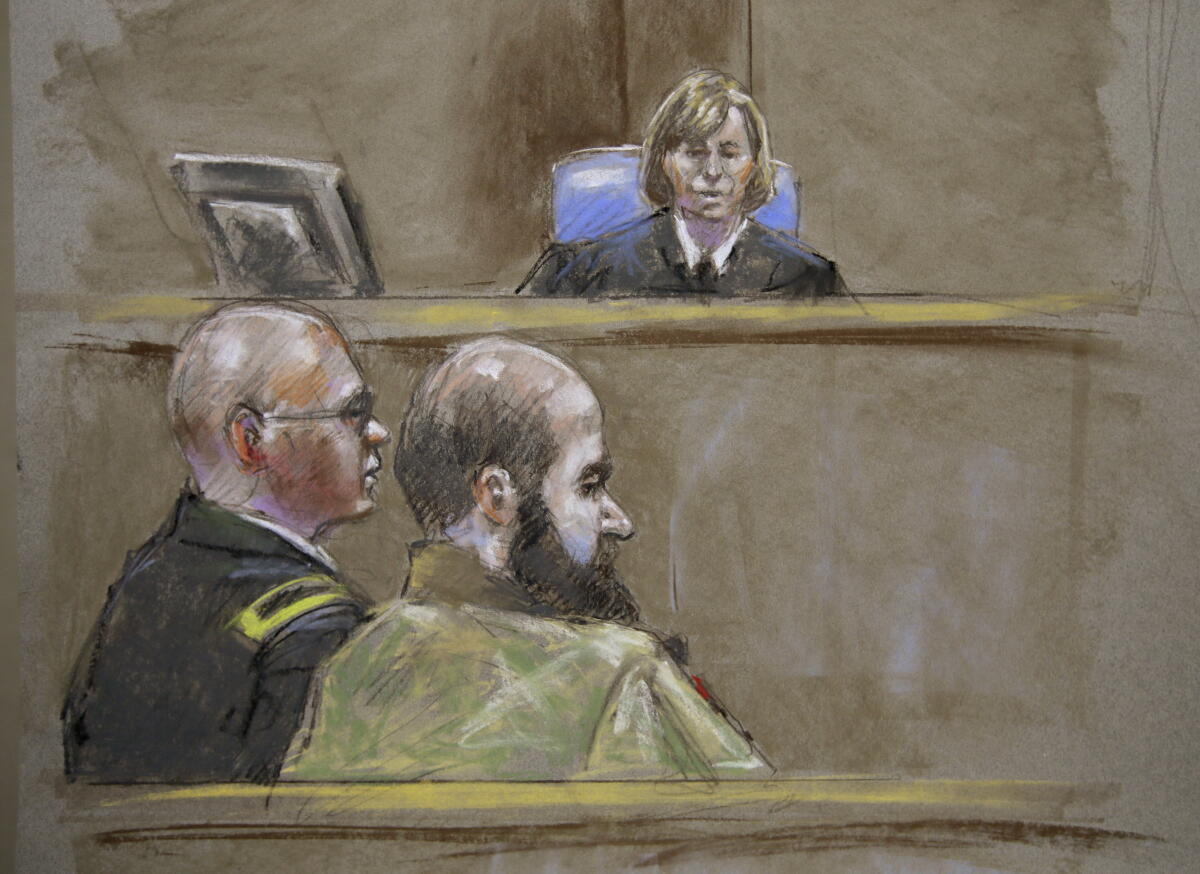
Nidal Malik Hasan is shown in a courtroom sketch in 2013.
(Brigitte Woosley / Associated Press)
“Hasan should face the death penalty, but making his execution public and streaming it? Beyond disgusting,” Sen. Thom Tillis (R-N.C.) wrote on X. “Public executions are what oppressive dictatorships like Iran and Afghanistan do. It should not be happening in America.”
“I absolutely support the sentence of death, but live-streaming executions is what jihadists do. America is better than that,” Rep. Austin Scott (R-Ga.) wrote.
The United Nations’ High Commissioner for Human Rights said that “the livestreaming of an execution is tantamount to a public execution and would breach the absolute prohibition of torture.” The head of the U.S. Conference of Catholic Bishops said it would “further undermine the moral fabric of our nation and be a blight on the conscience of its people.”
Matthew Robinson, a criminal justice professor at Appalachian State University and author of a book on U.S. capital punishment titled “Death Nation,” said he was “appalled” by the plans. “It strikes me as meant to be entertaining.” He said the last military execution was in 1961, and the last by firing squad was in 1945.
Soldiers hold a candlelight vigil at Fort Hood, Texas, in 2009, one day after Nidal Malik Hasan shot and killed 13 people.
(LM Otero / Associated Press)
Hasan was an Army psychiatrist and major who in 2009 entered a medical building on the Texas military base with a laser-sighted handgun, shouted “Allahu akbar” — Arabic for “God is great!” — and opened fire, killing 13 people and injuring 32 others. He has since spoken of being a “martyr” if executed.
President Trump, an outspoken proponent of the death penalty for years but also a past critic of public executions in places like Iran, has signed off on Hasan’s execution but not addressed Hegseth’s plans. The White House did not respond to a request for comment.
Vice President JD Vance, who is Catholic, said Friday that people should remember that Hasan “brutally murdered a lot of innocent people.” But he also said he would not watch a live-stream of the execution, and expressed doubt that is “actually going to happen.”
On his first day in office this term, Trump issued an executive order requiring federal agencies to restore the death penalty to prominence. In April, the U.S. Department of Justice announced it had taken steps to do so, including by “expanding the protocol” to include firing squads.
Five states currently allow firing squads to carry out executions: Idaho, Mississippi, Oklahoma, South Carolina and Utah. The U.S. Supreme Court has repeatedly turned down appeals contending such executions amount to “cruel and unusual punishment,” which is barred under U.S. law. South Carolina executed three men by firing squad last year.
When the Supreme Court last year rejected an Alabama inmate’s request to be killed by firing squad rather than with nitrogen hypoxia, liberal Justice Sonia Sotomayor — joined by fellow liberal Justices Elena Kagan and Ketanji Brown Jackson — dissented, writing, “Boyd asks for the barest form of mercy: to die by firing squad, which would kill him in seconds, rather than by a torturous suffocation lasting up to four minutes. The Constitution would grant him that grace.”
Kathleen Walter prays outside the Nashville, Tenn., prison where Christa Pike was set to be executed.
(George Walker IV / Associated Press)
Last week, a Tennessee inmate named Christa Pike survived what was meant to be a lethal injection of the barbiturate pentobarbital. Other states have also struggled with executions by lethal injection in recent years.
Much of the criticism of Hegseth’s plan for Hasan has centered not on the method of killing, but on the live-streaming of it.
Robin M. Maher, executive director of the Death Penalty Information Center, said the center has “no record of any execution being live streamed,” and is “not aware of any regulation or precedent for a military execution to be live streamed on the internet or otherwise made widely available to the public.”
Fox News commentator Howard Kurtz wrote: “I’m sensing revulsion on the left and right, not so much for killing a death row prisoner — although firing squad seems extreme in the modern age — but for the Pentagon to live-stream it, turning this into a horrifying TV show to entertain the masses. Is this America?”
Daniel LaChance, an associate history professor at Emory University and author of the book “Executing Freedom: The Cultural Life of Capital Punishment in the United States,” said the last public execution in the U.S. occurred in 1936, when a Black man convicted of rape was hanged in Kentucky — which still allowed public executions after most states had abandoned the practice.
That execution was “by all accounts a grotesque carnival” and “sort of like a gladiatorial contest brought to life in the 20th Century, where the crowd was surly, shouting,” LaChance said. “It was a debacle.”
That the Trump administration is seeking to turn capital punishment into a public spectacle once more, LaChance said, is out of line with decades of thinking on the issue, but in line with Trump’s own ethos about crime and punishment.
“His whole brand is this kind of populist, anti-elitism. And when executions moved into the bowels of prisons in the early 20th century, they were really becoming bureaucratic affairs, run by experts, carried out in front of a small group of professionals and clergy,” LaChance said. “It was a denial of the public’s right to see a punishment that was carried out in their name, in part because there were elites who thought that the public couldn’t handle this kind of spectacle, that they were misbehaving, that it would generate more disorder when an execution is designed to do the exact opposite: to generate order.”
President Trump points to fans to as he walks to the stage at a political rally Wednesday in San Antonio.
(San Antonio Express-News via Getty Images)
Trump clearly thinks he is pushing back against elitism and expertise and giving people what they want, LaChance said, though the question many scholars have is whether doing so will “increase people’s bloodthirst” or force them to recoil — and ultimate decrease support for such punishments.
Eugene Fidell, who teaches military justice at Yale Law School, said Trump has publicly mused about killing people by firing squad for years, so Hegseth’s plans to use a firing squad should not be surprising. However, the decision to live-stream the killing is clearly a source of “dismay” for many. “Even people who are resigned to the death penalty, who don’t have religious or other scruples about the death penalty, have real heartburn over this,” he said.
Fidell said “brutality” has become an “operating principle” for the Trump administration broadly, from its decision to host an Ultimate Fighting tournament at the White House to its immigration tactics across the country to, now, it’s plans to live-stream an execution — which Fidell said has “nothing to do” with deterring future crime.
“There’s a pathology going on here that is so out of keeping with the dignity that ought to characterize the taking of a life as a result of a legal process,” he said.
Robinson, of Appalachian State, said a student of his Friday morning asked what would happen when children tune in to watch the execution, which Robinson said he believes they will do, as if it’s a video game. He said the idea was appalling — and not just to him.
“I imagine the rest of the world, the civilized world, will see this and have the same response that I did,” he said. “They’ll respond with shock.”
Times staff writer David G. Savage contributed to this report.
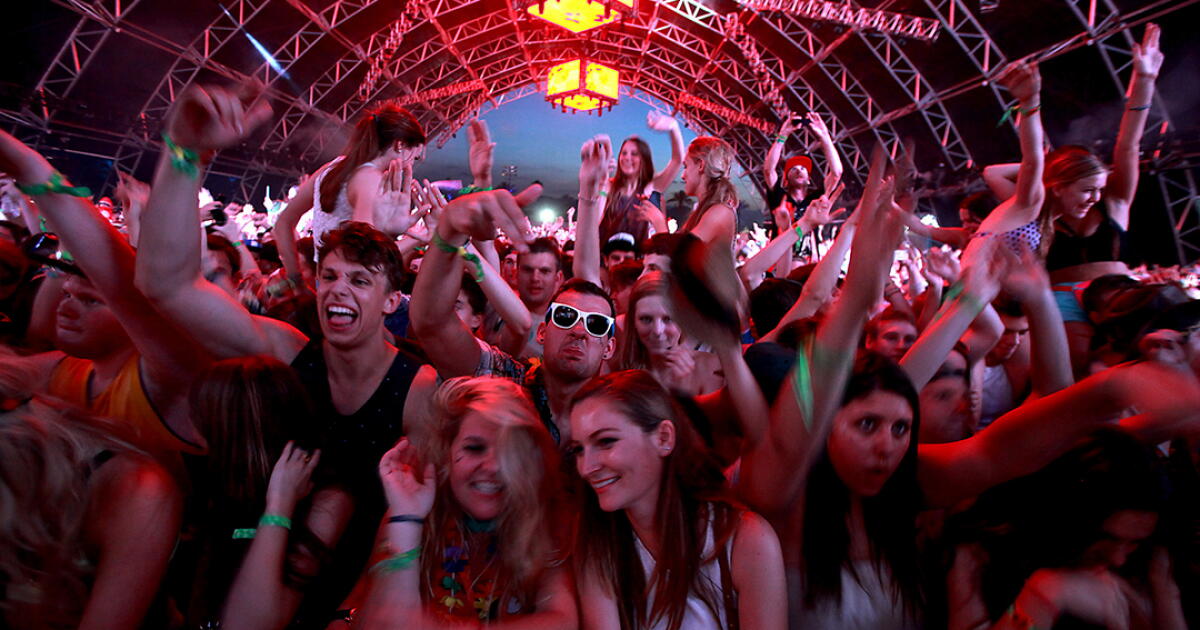
The tech giant in San Bruno, Calif., has renewed its partnership with festival promoter Goldenvoice, keeping exclusive livestream rights to the three-day desert festival through 2030. The next edition, in April 2027, will mark 15 years of Coachella on YouTube.
“We’re excited to bring the energy of the desert to millions of music fans around the world,” Neal Mohan, YouTube’s chief executive officer, said at its Made On YouTube event in New York City on Wednesday morning.
This year’s Coachella, headlined by Sabrina Carpenter, Justin Bieber and Karol G, drew the most concurrent viewers in the history of Coachella on YouTube, according to the company. Bieber, who was discovered on YouTube, even included a nostalgic homage to the platform into his set.
Over the years, the livestream has become an essential part of the Coachella experience, especially for fans who can’t make it to the desert. What started as a single feed has evolved into live coverage of every stage across both weekends.
Beyond Coachella, YouTube doubled down on livestreaming during its presentation, unveiling a slew of new live and AI-powered tools. In August, more than 600 million logged-in viewers watched live content on the platform each day on average, according to YouTube. The new live features include a new co-hosting function in which two creators can appear on the same stream together, and a live auto-dubbing tool that automatically translates speech in real time. Several of the updates are slated to roll out in early 2027.
“Whether it’s a music festival or a creator’s livestream, fandom is no longer a spectator sport,” added Mohan. “Just look at the sheer scale of the live communities we’re seeing today.”
YouTube isn’t the only streamer leaning into live. Netflix has spent the last few years buliding out its own live business, which now includes NFL and MLB games.