Anticipation. Rumors. Anxiously scanning the horizon, hoping that a brilliant force will leave the masses forever changed. Yes, a new Steven Spielberg movie about close encounters with extraterrestrials is landing — and misses the mark.
“Disclosure Day” is a story of truth and feared consequences. A personality-free cybersecurity expert, Daniel (Josh O’Connor), is on the run with evidence of little gray men arriving on our planet to a rude reception. The aliens are kind. Our species is barbaric. Wittily bruising us with that fact, Spielberg opens with a POV of a wrestler kicking the audience in the face. Welcome to Earth.
Elsewhere in America, a weathergirl named Margaret (Emily Blunt) breezes into her Kansas City studio, babbling up until the minute the news camera turns on, a bravura sequence that channels her restlessness, the station’s tempo and the film’s alarm that this ditz has just this morning been stricken with preternatural powers. (The cinematography and editing are by Janusz Kaminski and Sarah Broshar.) Locally, Margaret is known for announcing hailstorms with a sexy shimmy. Suddenly, she’s fluent in Russian, Korean and telepathy. Although she and her boyfriend, Jackson (Wyatt Russell), are a bad match, she’s giving everyone else life advice like an intergalactic Dear Abby.
When Margaret starts spouting alien-ese — spasms of gutteral clicks — on live TV, she and Jackson rush to the hospital for a brain scan followed by several suspicious men who claim to be with the FBI. Russell’s befuddled Jackson is as useless as a traffic cone but Blunt’s Margaret is a gas before the movie makes her go all glassy-eyed and solemn. Yet, the movie is less inspired by why she was chosen or how she feels about it than in dragging us back in time to the moment when it happened, which isn’t that interesting except for its resemblance to a Disney princess having a psychotic break. The CG animals and aliens look stiff, other than a nifty close-up of an eyeball. (Later, I did like how one alien appears to be wearing sportswear.)
Chasing both Daniel and Margaret around the Midwest is a deep-state company called Wardex that wants to steal back the proof in Daniel’s backpack, a heap of hard drives with footage of 70-plus years of extraterrestrial visitations. It’s a treat to see Spielberg enjoying staging this conspiratorial gossip in different film stocks, from the black-and-white noir of 1947 Roswell to the clinical security-camera look of today. Whatever Wardex does on a day-to-day basis is unclear (we just see video screens and lab equipment). But it acts all-powerful, seeming to know more about outer-space tech than its overseers at the Department of Defense.
The script is by David Koepp of the paranoid thriller “Black Bag” and Spielberg’s 2005 version of “War of the Worlds,” yet, this plot strand about private enterprise isn’t science fiction. Last year, in the unrelated UFO documentary “The Age of Disclosure,” current Secretary of State Marco Rubio admitted that companies have a stronger institutional memory of “exotic materials” than any presidential administration: “The people in government who know where it came from originally — they’re long gone and their successors have no idea that it was there at all.” To add nationalistic insult to injury, the head of Wardex isn’t even American. He’s a Brit played by Colin Firth.
If anything, “Disclosure Day” isn’t paranoid enough. Clutching a mysterious tool the shape of a mouse coffin, Firth’s villain tracks Daniel’s location by mentally transplanting himself into another person’s body, changing the color of their pupils to his own icy blue. His gadget also makes his targets super sweaty. This laborious alien tactic leads to a few fun scenes but frankly feels old-fashioned when the omnipresent surveillance that Spielberg himself warned about nearly 25 years ago in “Minority Report” is now here with recording devices constantly tracking our faces, voices and movements just so we don’t have to dial phones, fetch sandwiches or talk to human drivers. Although his movie urged us against this 24/7 spyware future, we have since embraced the convenience.
I bring this up because “Disclosure Day’s” driving question is how humanity will react to life-altering information. (Not that the plot has much momentum — too many scenes end with the belief that ducking 10 feet out of view makes you invisible, with an antagonist simply giving up.) Daniel insists on total honesty: “People have a right to know the truth,” he says. His girlfriend Jane (Eve Hewson) doubts 8 billion people can handle his alien revelations. A Catholic, she’s alarmed that extraterrestrial intelligence could replace the concept of God, naively claiming that “religion holds society together.” Since when?
There’s some wan comedy in an early scene where these new-ish lovers debate the ethics of secrecy while revealing the skeletons they’ve been hiding from each other. Both have pasts you wouldn’t put on a Tinder profile. The script is glancingly empathetic to Jane’s moral turmoil but like Daniel, the film has made up its mind before the movie started. Narratively and logistically, Daniel’s whistleblowing escape limps along with a lack of suspense. Wardex doesn’t even bother to preemptively discredit Daniel in the public’s eye, which, given the two sentences of backstory we know about his character, would be easy.
Nattering in the background are broadcasts about the impending threat of global war at the hands of the United States, Russia and North Korea. Given that scary possibility, the risk that Daniel’s reveal could tip over the world order doesn’t seem that bad. Honestly, I’m dubious of the film’s certainty that folks even have the bandwidth to care about such news, let alone agree on what they’re seeing. The serious journalism Margaret aspires to do is splintering under our distrust of who controls the megaphones. Last month’s infodump of an Armed Forces report listing 209 sightings of unidentified objects was announced with a presidential tweet that “the people can decide for themselves.” I didn’t bother to click. Did you?
Getting information about these space invaders out leaves no time for taking the marvel of their existence in. Decades after Spielberg unveiled his signature shot — a face amazed at wonders we can’t see — he seems wearied by his awareness that today’s moment of revelation would look like a person staring down at their phone. When lens flares continually beam right at the screen, the whole movie feels like enlightenment under duress.
Where are the aliens from and why are they here? Who knows. “Disclosure Day” speeds around frantically, talking constantly and explaining little. Back in 1977, Spielberg’s “Close Encounters of the Third Kind” was a popcorn masterpiece of withheld information. Its quiet assurance that experts had a handle on flying saucers and a plan to meet them felt comforting. Here, Colman Domingo’s renegade intelligence operative also refuses to tell anyone anything, but all the unspoken beats just feel like plot holes. Mostly, his character builds what looks like a Hollywood set to reveal a truth he already suspects. That’s what Spielberg is doing too, but a film needs a sense of curiosity.
Instead, the wows come from good stagings of ordinary action: a car crash, a gripped crucifix, a hideout crowded with jostling, thrumming musical instruments. There’s a great train-track crossing sequence that’s also a vicious callback to Richard Dreyfuss’ epiphany in “Close Encounters.” Yet, I wanted to see more of the old Spielberg, the one who expressed awe in moments of silence rather than relentless motion.
That Spielberg has come full circle to his lifelong obsession with the sky had me convinced that this might be a secret sequel to “Close Encounters” beyond the droll joke that both Dreyfuss’ Roy and Blunt’s Margaret are shacked up with unsupportive blonds. They do share a universe; you’ll see a glimpse of what could pass for an outtake from Devils Tower, a.k.a. Mashed Potato Mountain, on one of Daniel’s hard drives. Still, I left underwhelmed. I didn’t need Dreyfuss to step off a spaceship gangplank and say, “I’m back.” I just needed “Disclosure Day” to have the same spark of intelligent life.
‘Disclosure Day’
Rated: PG-13, for action/violence, some bloody images and strong language
It was built by locals to be able to cross a huge river
The bridge is held together by six ropes.(Image: Traveling/Getty)
There are thousands upon thousands of bridges across the world, yet one has the unwelcome title of being the most dangerous. Not all bridges are created equally when it comes to safety.
Often called the “most dangerous” in the world, the Hussaini Suspension Bridge in Pakistan is known for its high winds. Despite the title, the bridge remains a masterpiece of local engineering and has become a magnet for thrill seekers.
It was built in 1968 by local villagers of Hassaini and Zarabad using only raw materials. The 635-foot-long bridge is made of wooden planks and steel cables, held together by six main ropes that span its length.
The Hussaini Suspension Bridge was designed to provide a lifeline to transport goods and livestock across the Hunza River. Following a devastating landslide in 2010, the bridge was reconstructed.
Between the wooden planks of the bridge are larger spaces designed to resist the wobbly vibrations caused by the wind. Travel Magazine Conde Nast Traveller named the bridge as among the most dangerous in the world in 2013.
While it was built for local access, it has become popular with tourists. To visit and cross the bridge, tourists must wear life jackets.
Tragically, in July 2022, a student from Sindh reportedly died from drowning after falling from the bridge. It was sealed off while an investigation was under way, and later renovations were carried out.
Safety upgrades were implemented, including replacing the old, rotting and uneven wooden boards. The local community and authorities also worked together to tighten the steel cables.
Many tourists are still braving the crossing and have shared their experiences on TripAdvisor. One said: “What a thrilling bridge! People who have mental strength and not afraid of heights should give a try on this bridge! It’s a dare!”
Another added: “The journey to reach the bridge itself is an adventure, with winding roads and breath-taking landscapes that set the stage for the thrill to come.”
Someone else commented: “About 400 steps from one end to the other end of the bridge.
“The bridge is secure and safe. However, precautions should be taken when crossing the bridge as it is still a risk of falling accidentally. Give it a try!”
However, a fourth wrote: “Firstly, I refused to cross that bridge, but now I literally repent my decision. Looks dangerous , definitely not for people with fragile hearts like me , but its damn daring.”
Ali Louis Bourzgui scored an upset win for performance by an actor in a featured role in a musical for originating the role of David in the musical adaptation of the cult vampire horror film, “The Lost Boys.”
As viewers scrambled to keep their score cards straight — André De Shields was favored to take the trophy for his work in “Cats: The Jellicle Ball” — the 26-year-old Bourzgui went on to deliver the night’s most impassioned, and pointedly political speech.
He began by noting that, “Vampires represent those who have shunned their own humanity in order to achieve a non-existent sense of superiority. The billionaires will never find happiness from their money. The colonizers will never find fulfillment from the land and lives they steal. The fascists will never find meaning from their conformity, not in this lifetime or eternity.”
Through the cheers of an invigorated audience, Bourzgui went on to talk about how “theater is one of the last places people can come to worship the power of true collective human presence.”
At its best, he said, theater helps us see ourselves in a stranger’s story.
“This is dedicated to the beautiful tapestry of immigrant families who make this country really special. May you one day not have to audition for the empathy that should be freely given by this country that benefits from your beauty, for the queer and trans communities who will exist, no matter what people in power try to take away from them.”
Bourzgui, whose father immigrated to America from Morocco, went on to pay tribute to Palestine and his own Arab heritage.
“For the people of Palestine, who deserve a free life, a full life without occupation, for Arabs and their makers and artists, may we continue to tell our stories and show our faces. Our humanity becomes undeniable, and our families can no longer be written off as merely collateral damage, may they know the beauty of our kisses upon his cheek and the romance of a language rooted in passion for love and life itself.”
He wrapped up this speech with a plea for love and empathy.
“If there’s one thing we can learn from vampires, it’s that life is short, but that’s it’s a gift. Find beauty in the ephemeral and gratitude in what is not promised, and always invest in the people that want to see you blossom into your truest self, and hold that space for them in return.”
EXCLUSIVE: Scott Mills was axed from the BBC earlier this year after new evidence came to light about a historical alleged sexual offences – but this might not be the end of the former radio DJ
Scott Mills is set to sue the BBC for unfair dismissal(Image: Jeff Spicer/Getty Images)
Axed star Scott Mills has seen a flurry of support this week as his husband Sam Vaughan returned to Instagram to mark their two-year anniversary.
In his first post since the DJ’s shock sacking, Sam posted a sweet picture of him and his husband from their wedding day, captioning the post with a white heart emoji and the words “2 years.”
Stars including Zoe Ball, Rylan Clark and Sara Cox reacted to the post, with former colleauge Zoe writing: “Love you,” in the comments, followed by four red heart emoji’s. Rylan and Sarah also posted hearts in the comments section.
It comes as the Mirror exclusively revealed that Scott is set to sue the BBC for unfair dismissal after his surprise sacking. The DJ has enlisted top lawyers to lodge a case against the BBC. It’s understood he will claim that he disclosed the full details of the cop probe – including the accuser’s age – to BBC Radio 1 bosses at the time.
Content cannot be displayed without consent
The BBC has previously said that they knew about the investigation but that “new information” came to light which sources claim was the fact the accuser was under 16. But it’s understood Mills will argue that this was all raised at the time to Radio 1. A source said: “It’s going to get very messy indeed.”
Mills was interviewed by police in 2018 under caution after being accused of serious sexual offences against a boy under the age of 16. A full file was sent to the CPS, who said there was not enough evidence to charge him.
In April, Mills released a statement through his lawyers claiming he had been the subject of “rumour and speculation” since his sacking and that he had “co-operated fully” with the police investigation into the allegations.
As Scott gears up for a battle with the Beeb and his partner returns to social media, questions have been raised on when the DJ could make a career return. “I think Scott Mills’ route back into the spotlight will depend on whether the public see his departure as a temporary setback or as a sign that his broadcasting career has reached a crossroads,” Mayah Riaz, a PR to the stars, tells the Mirror.
“Historically, we have seen that established presenters who have a strong personal brands and years of goodwill behind them are often afforded a second act. This is especially true when they have built up a loyal audience and have industry support over many years,” she said.
The expert noted the significance of the public show of support towards Scott’s husband Sam as it highlights that the star still has a network of influential friends and colleagues who are willing to publicly stand by him. She said this can help “soften the narrative” and “remind people of the affection that exists for a personality.”
The DJ has lost a number of gigs since being axed by the BBC, including podcast roles on Race Across the World and Pop Top 10 with Rylan Clark. Mills was also dropped as a patron of children’s cancer charity Neuroblastoma UK and “stepped back” from his role as an ambassador for the MS Society UK.
His regular panto work, which reportedly made him £600,000 in the last three years, has also been cut. Imagine Theatre, which got Scott involved in Jack And The Beanstalk shows, said there are no plans to work with the presenter for the 2026/2027 season. It said the decision was taken before he was fired by the BBC.
If Scott was to make a comeback, Mayah suggests it won’t be through a “grand relaunch”. Instead, it could be through a project that reminds his audience why they connected with him in the first place.
She explained: “Talent and familiarity remain powerful currencies in broadcasting. It goes without saying that authenticity will be key. The public are increasingly sceptical of overly polished comeback campaigns and media-managed statements.”
Mayah says the public respond “far more positively to resilience, humility and genuine passion for the work” and the biggest mistake Scott Mills could make is to come across “desperate to reclaim the spotlight”. She added: “The strongest celebrity comebacks are those that give people something new to talk about.”
Mills previously issued a statement via lawyers thanking his well-wishers. He said: “I wish to thank from the bottom of my heart all those who have reached out to me with kindness, my former colleagues, and my beloved listeners, who I greatly miss.”
On the police probe, he said: “The recent announcement that I am no longer contracted to the BBC has led to the publication of rumour and speculation. In response to this the Metropolitan Police has made a statement, which I confirm relates to me.
“An allegation was made against me in 2016 of a historic sexual offence, which was the subject of a police investigation in which I fully co-operated and responded to in 2018.” He added: “Since the investigation related to an allegation that dates back nearly 30 years and the police investigation was closed seven years ago, I hope that the public and the media will understand and respect my wish not to make any further public comment on this matter.”
If you buy books linked on our site, The Times may earn a commission from Bookshop.org, whose fees support independent bookstores.
At the recent glitzy PEN America Literary Gala at the Natural History Museum in New York City the evening’s MC, B.J. Novak, declared that the crowd was there to celebrate more than just freedom of speech — they were there for “literary glamour.”
“Writing is glamorous,” he declared. “Reading is glamorous.”
For Novak, bestselling novelist Ann Patchett — who has also worked tirelessly on behalf of independent booksellers and in support of her fellow writers, and was one of the event’s honored guests — epitomizes that allure. “I think it’s great that Ann Patchett is a smoke show. She doesn’t have to be,” he quipped. “It’s just cool that she is.”
With “Whistler,” Patchett’s 10th novel, she definitively proves that the “smoke show” moniker, if at all relevant, is icing on the cake. This exquisite writer has once again delivered an incandescent work of fiction — sweet, but never sentimental, infinitely wise and suffused with love. It’s also an ode to New York City itself.
“Whistler” is narrated by protagonist Daphne Fuller, a 54-year-old English teacher married to Jonathan, a restlessly retired doctor and hospital administrator who dotes on his wife and whom he regards as “extraordinary.” When we first encounter the couple, they’re roaming the Metropolitan Museum of Art — which, one gets the sense, they know by heart. As Daphne ponders the sculpture “Two Horses,” by Charles Ray, Jonathan spots an elderly stranger eyeing his wife, casting glances in her direction. The stranger follows them from room to room fixated on Daphne. Jonathan’s curiosity is piqued, and he slips away from his wife’s side to get to the bottom of why they’re being followed — which is revealed to be the novel’s inciting incident.
Turns out that stranger is no stranger at all. He is Eddie Triplett, a long-lost stepfather whose divorce from Daphne’s mother, Abigail, remains an unhealed wound. Running into Eddie now for the first time in more than four decades, Daphne is startled by the rush of emotion she feels: “I hadn’t known there was something in me to break,” she reflects, “but there it was and break it did. I stepped into an open crack in time and fell backwards.”
Eddie, as it happens, is but one of Daphne and her sister, Leda’s, three dads. By the time Abigail marries her third husband, mild-mannered Lucas, and the couple go on to have three sons, Daphne has grown a protective shell. These facts are narrated with detachment by the protagonist herself. As she and Eddie gently unspool their memories and together fill in the blanks, their bond deepens. The “falling backwards” Daphne experiences in Eddie’s company — traversing time — soothes, softens and delights her.
As the novel unfolds, what becomes ever clearer is that Daphne and her author are undeniably similar, though Patchett has observed: “I am normally careful to make sure there is a big wall between my life and my fiction.” In “Whistler,” she throws that caution to the wind. Easter eggs are scattered throughout. Like Daphne, Patchett is married to an older man — also a doctor — whom she adores. She too had three dads, as she chronicled in a 2020 New Yorker piece aptly titled “My Three Fathers.” Patchett and her heroine also appear to share this enviable trait: They navigate life with grace, generosity and utter competence. IRL, Patchett returns emails on the day she receives them, is an outspoken advocate for free expression, is generally renowned for her good deeds. She’s also widely known for her many devoted friendships, though she doesn’t suffer fools. You’d want to be her ride or die. As you would … Daphne’s.
In an interview 10 years ago, Patchett observed that it wasn’t until she read a piece by Jonathan Franzen, “in which he insisted that the novelist had to do what scares him most, and for him, that had been writing about his family,” that she considered following that path in her fiction. “I thought ‘oh nothing would scare me more. I would happily ride down the Amazon in a canoe and deal with snakes’ ” (as she did for “State of Wonder”) “ ‘than face my family.’ ” In 2016 she wrote “Commonwealth,” which drew on her personal experience of divorce and dysfunction, themes she revisits in “Whistler.” But in “Whistler,” it’s as if Patchett herself is in the reader’s ear. (And, by the way, should you pick up the audio version of the book, she narrates and is literally in your ear.)
Patchett has said she had an ulterior motive for writing “Whistler.” She’d been in the midst of writing a different book, a novel about a Wyoming rancher and her horse, Whistler, but it wasn’t clicking. As she pressed on over the better part of a year, a second idea came to her “like a fever dream.” She immediately filed away the messy work-in-progress and began writing a fictional ode to a cherished friend, former publishing executive Jim Fox, to whom “Whistler” is dedicated. Fox had died two years before, on his 85th birthday, and Patchett was still grieving. Her aim, with “Whistler,” she has said, is to put down on paper how much they loved each other. Fox is reborn as Eddie Triplett in the book, a charming and erudite book editor who radiates joie de vivre and is among the loves of his stepdaughter Daphne’s life.
Patchett’s literary style isn’t of the show-offy variety packed with dazzling sentences and edge-of-your-seat cliffhangers. The drama is quiet. Her words accrue and gain power through their spareness and clarity, and a level of character development that forges an easy intimacy with the reader. There’s also a sly wit and sagacity that have become Patchett signatures, honed to perfection in “Whistler,” whether wrestling with the legacy of family trauma, or the human struggle to accept the transitory nature of it all. Or, as Patchett’s mother once admonished after the failure of her daughter’s first marriage: “Stop trying to make everything permanent. It doesn’t work.”
While Patchett has clearly drawn on actual events and individuals to produce this luminous work, she exhibits the expert novelist’s knack for following a plot where the imagination takes it. I don’t recommend consuming “Whistler” in one enormous gulp. I dipped in and out, savoring scenes, reflecting on them, occasionally shedding a tear. In other words, I didn’t want it to end.
Haber is a writer, editor and publishing strategist and co-founder of the Ink Book Club on Substack. She was director of Oprah’s Book Club and books editor for O, the Oprah Magazine.
Zverev had long been dubbed the best player of his generation to have never won a Grand Slam after a string of near misses – including three defeats in major finals.
At the US Open in 2020, he lost the final despite being two sets up against Dominic Thiem and having served for the championship at 5-3 in the final set.
Zverev then led Carlos Alcaraz by two sets to one in the 2024 French Open final but it was the Spaniard who ended up lifting his first Coupe des Mousquetaires.
At the Australian Open in 2025, he was outclassed in a merciless performance by Jannik Sinner that left Zverev saying he felt mentally “empty” a few months later.
“Last year was one of the most difficult moments in my tennis career,” Zverev said.
“This year is one of the happiest moments. It’s a very different feeling right now.”
It seemed like the pressure of a Grand Slam final might prove too much for a fourth time when 24-year-old Cobolli, who had twice fought back from a set down, forced a deciding fifth set.
But Zverev, who has struggled with his emotions on court in the past, held his nerve to end his major final curse.
After falling flat on his back in celebration, Zverev dedicated his victory to his team, which includes his father and brother.
“We have been through injury, heartbreaks, losses. We have been losers at times in the most important moments,” Zverev said.
“At the end of the day, we are Grand Slam champions now and that is what counts.
“I was laying on this court with an injury that I didn’t know if I will ever come back from. All of those memories, they’re not wiped out,” he said.
“They’re still with me but this one will beat all of them.”
Venezuelan communities have wrested several festivities away from the Church. (Venezuelanalysis)
Black amber, all painted, white foam… The rain sings, summer is over. White foam… May flower.
“Flor de Mayo”, Otilio Galíndez
The Chakana path, It is up and down, inside and out…
Water is synonymous with life, and rain is perhaps the metaphor through which Mother Earth conveys the importance of preserving, nurturing, and multiplying life on this planet. For the peoples of the South, May is a turning point. It brings the rainfall, and thus abundance is renewed. The wet season begins in these torrid regions of exuberant contrasts and excessive beauty. Everything sprouts, blooms, and matures.
In May, the night sky in the South allows us to behold the zenith of a constellation that holds immense value in the ancestral worldview of our peoples: the Southern Cross. This fixed constellation consists of Alpha Crucis, Gamma Crucis, Beta Crucis, Delta Crucis, and a fifth star, Epsilon Crucis, which, although not part of the main points, serves to distinguish it from the “False Cross.”
Our Andean ancestry, which exerts a deep influence on all the Indigenous peoples of Abya Yala, identifies this constellation by the name Chakana, which can be translated as a ladder or bridge between the earthly and spiritual worlds. It means complementarity, harmony, and purpose, as well as a path for returning to the core. The Chakana is the organizational center of the Andean world and its entire sphere of influence, which is why it is the focus of numerous and diverse rituals, ceremonies, offerings, and festivals throughout these territories.
From the moment of their arrival, the Spanish conquistadors were struck by the symbolic power, veneration, and cultural identity of the peoples of Abya Yala with the Chakana. This is why they suppressed all traditional knowledge and ritual symbols, imposing their Eurocentric worldview in the clearest demonstration of colonial epistemicide. Temples, codices, and sages were demolished, burned, tortured, and martyred in the name of Christianity, which came to replace the Southern Cross, a symbol of knowledge and life, with the Catholic Cross, as a condensed symbol of pain, domination, sacrifice, death, and the promise of resurrection.
In Venezuela, a series of daytime and nighttime ritual activities persist, drawing young people and adults alike, in cities and rural areas alike. Afro-Venezuelan peoples especially cherish these traditions. The celebrations of the Cruz de Mayo, San Isidro, San Pascual Bailón, Corpus Christi, San Antonio, San Juan, and San Pedro, among others, escape the Catholic liturgical calendar that continues to try to assimilate them. They are celebrations framed within those exuberant contrasts of excessive beauty that cause everything to sprout, bloom, and mature. These are the days in which the Venezuelan people celebrate the cycle of life and for which they have created music, dances, drinks, foods, costumes, and poetry that have transcended both the Catholic Church and its Inquisition as well as civil and military power, in a testament to the most committed re-existence.
Lighting the altar candles
Wakes (“velorios”) are community gatherings organized to honor the deceased, a saint, the Virgin Mary, the Baby Jesus, or the Cross. These gatherings are held to fulfill a vow or out of devotion, and they feature prayers, drinks, food, poetry, singing, and dancing.
The velorio is a popular tradition that goes beyond the institutional framework of the Catholic Church. In fact, as early as the Synodal Constitutions of the Bishopric of Venezuela and Santiago de León de Caracas of 1687, published by Bishop Diego de Baños y Sotomayor, these activities, which “attract large crowds” and in which “many indecencies and offenses against God are committed,” were prohibited under penalty of “Major Excommunication.” Certainly, the Church seized on these practices of profane worship of the madero (the wood) to imbue them with Christian meaning.
At the center of the velorio dedicated to the Cruz de Mayo (“May Cross”) stands an altar with a main cross and two smaller ones. These are crosses without the image of Christ, “dressed” with cloth, paper, and multicolored flowers. The altar and its surroundings are also decorated in harmony with the crosses, and the offerings of candles, fruits, food, and drinks are arranged in such a way as to celebrate the abundance of a countryside that turns green again at this time of year.
The church’s calendar states that May 3 marks the celebration of “The Finding of the Cross.” Therefore, on the night of May 2, vigils begin in all the eastern states, as well as in Guárico, Lara, Cojedes, Aragua, Yaracuy, Carabobo, Barinas, Apure, Portuguesa, Miranda, Falcón, and in the city of Caracas. People give thanks for health and the fertility of the land. In the central coastal region, where Afro-Venezuelan communities are present, sirenas and fulías are sung. In the llanos, three-voice tonos are performed. In the east, the rhythms include galerones, malagueñas, fulías, jotas, and punto y llanto. The decimistas (poets) make offerings in a circular formation and vie for the spotlight as the musicians and singers perform.
Cantos a la Cruz de Mayo | Live session | Venezuela Un Solo Pueblo
Dancing up and down in a cross
The Dancing Devils of Corpus Christi dance by forming a cross on the ground, to which they add new crosses with every turn, spiral, backward step, and leap. Each movement has a specific meaning and timing because the goal is to maintain order between the upper and lower realms, between complementary forces that must harmonize. Or, put more simply, to ensure that good prevails over evil.
The Incarnation of Christ in the Eucharist is a movable feast that occurs nine Thursdays after Holy Thursday. There are references to its celebration dating back to the third century in the Roman Empire. In 1350, it began to be celebrated in Barcelona with processions that reenacted the Devil’s defeat by the power of the Cross. In Venezuela –specifically in Ocumare de La Costa –there is evidence of Dancing Devils dating back to 1621, and although masked devils were present in many places, this practice survived only in the central region as a magical-religious ritual in the states of Aragua, Carabobo, Cojedes, Guárico, Miranda, and La Guaira.
The people, embodying the Devil, do not view the Evil One as a figure but as a concept. He is simply a force opposed to God. A revelrous, playful, and imperfect being. However, the promesero, dressed in colorful pants and a shirt, wearing masks of different sizes, shapes, and shades, which bear no resemblance to the European portrayal of the devil, protects himself with prayers, scapulars, bells, whips, and crosses that he carries as part of his attire. But his greatest protection is the insistent sign of the Cross he traces with the movements of his foot and the hand holding a maraca.
The cuatro or the caja (snare drum) are the instruments that accompany this celebration, depending on the community. Only in the town of Chuao are both used, though at different times. There is no singing, and the rhythms are performed with different beats that vary in intensity and speed. There are eleven Afro-Venezuelan lay brotherhoods or cofradías recognized as Intangible Cultural Heritage of Humanity by UNESCO, and each has a distinct musical identity linked to its spiritual environment.
Diablos danzantes de Corpus Christi
Beating the drums
Pipas, quitiplás, culos ‘e puya, minas, curbatas, cumacos, and maracas are the essential instruments with which the Venezuelan people celebrate the arrival of San Juan (John the Baptist), the most popular Catholic festival in seventeenth-century Spain that was brought over to preserve the identity of the conquistadors while simultaneously subjugating the Indigenous peoples and later the kidnapped and enslaved African peoples. Coinciding with the second cocoa harvest in these territories, the birth of John the Baptist, exactly six months after Jesus, became the figure of greatest devotion on the major slave-owning plantations along our country’s northern coast.
San Juan is regarded by the people as a saint who charges for his miracles. He’s drinker of aguardiente, a dancer, and a reveler, which is why there is both a popular celebration and an institutional, Catholic one. It must be remembered that Black people were barred from entering the church until well into the nineteenth century. Today, depending on the town and the priest, drums may or may not be allowed inside the church. In any case, the popular celebration of San Juan involves dancing, singing, drumming, drinks, and food –all meant to reclaim a freedom that was historically limited to an extreme. For this reason, it was a celebration that was persecuted and punished with excommunication during the colonial period, as we saw in the above mentioned Synodal Constitutions.
The San Juan festival cycle begins on June 1 with the “Repique de San Juan.” Families, communities, and various organizations meet in advance to plan and assign responsibilities. It is a colorful celebration reflected in the participants’ attire, flags, and scarves. Women’s participation is essential, particularly in the singing that takes place during the sirenas, the sangueo, and the golpes. These songs accompany the individual dancing of those carrying the flags and the saint in the sangueo, which is part of a group dance, but also the dancing of individual couples and, to a lesser extent, of linked couples.
The songs to San Juan are, above all, responsorial, alternating between soloist and choir, often improvised. Each drum has its own “tonada” or way of singing it, and in each locality, even if the same drum is used, the way of playing it and the style of singing this or that beat may vary. They follow the African tradition of three-drum ensembles –interdependent and complementary –where polyrhythm is enhanced by the timbral qualities of each drum, with the lowest-pitched one taking the “lead,” providing the beats and embellishments. “The Saint is in the drum,” it is said, affirming the enduring relevance of the worldview of the Indigenous peoples of West Africa.
Fiestas en Honor a San Juan Bautista, Choroni Venezuela
¡Arriba negro!
With this call, a singer signals to his partner that it is their turn to sing, because in the bella, the galerón, and the seis figureao, consecutive duets of singers in two different voices (a third apart) take turns. Meanwhile, in the yiyivamos, the juruminga, the perrendenga, and the poco a poco, one singer improvises verses and a chorus responds. The so-called Sones de Negros are made up of seven songs. However, it all begins with La Salve, a solemn song in which permission and a blessing are sought from the saint to begin the dance; once this is finished, the battle ensues, sung in two-part harmony and “danced” by two men with traditional stick-fighting.
The dance in the bella and galerón consists of male-female couples who participate one after another in a free-form manner. The seis figureao features a choreographed dance by three couples performing intricate, intertwined movements and turns. In the yiyivamos, juruminga, perrendenga, and poco a poco, independent couples dance, executing figures and movements as directed by the singer. San Antonio presides over an altar beautifully adorned with flowers, fruits, candles, clubs, crosses, bread, and other foods. Musicians and singers stand facing the altar, and each time the dancers enter the circle, they bow to the saint as a sign of respect and gratitude.
The Baile de Negros or Sones de Negros may have originated in the vicinity of El Tocuyo, in the fertile valley irrigated by the Tocuyo river, where the sugarcane-producing slave plantations were located. Its characteristic sound comes from an ensemble of stringed instruments related to the Baroque and Renaissance guitar, known as the cinco, medio cinco, requinto, and cuatro. The master or most experienced player plays the cinco. The timbral variety of the instruments and the ornamentation of the requinto give this instrumental ensemble an unmistakable texture.
In front of the saint stands the Tamunango or Tambor de Negro, a fundamental instrument constructed from a long, hollowed-out log, sized so that one musician can sit on it and play with their hands on its single head, while another strikes the wooden body with the drumsticks. The rest of the musicians are arranged around this instrument. A double-headed drum, a tambourine, and maracas complete this celebration, which is most popular in the states of Lara, Falcón, Yaracuy, and Portuguesa. Throughout June, with a focus on the 13th, these communities organize this traditional dance in homes, squares, streets, and fields -a celebration that cannot end without a sancocho (wood fire, community-prepared stew) soup) and a glass of cocuy de penca (agave-derived drink).
Siete Sones – Sones de Negros (Tamunangue)
Stomp on the boss!
The San Pedro festival is perhaps one of the most complex. Certainly, it is part of the cycle of life celebrations, featuring music, dance, food, and drink specially prepared as an offering to the saint. But as a kind of narrative that highlights Peter’s benevolence, there is the story of the enslaved María Ignacia, who, desperate over her daughter Rosa Ignacia’s illness, offered the deity an annual celebration. Once the miracle was fulfilled, María Ignacia danced until the last day of her life, and on her deathbed asked her husband to keep the promise. That is why a man in drag, carrying a rag doll in his arms, reenacts today the promise that María Ignacia’s husband made to his wife.
The cuatro and maracas are the accompanying instruments, and there may be many of them providing harmonic and rhythmic support to a soloist, which are answered by a chorus from the audience. The latter either joins in or simply watches this parranda as it winds its way through the streets of Guatire and Guarenas (outskirts of Caracas), starting from the church and making strategic stops at the homes of the revelers, the headquarters of the cofradías, and other points of interest.
Although there is no dramatized performance, during the procession there are characters in costume with carefully assigned roles, performing specific actions to convey the story of the miracle that was granted.
It is a distinctly joyful celebration. In the lyrics, music, and dance, there is a feeling of gratitude for favors received. This festive nature does not mean a loss of conscience. The Parranda de San Pedro carries a very powerful symbolic weight that recalls the use of irony and theatrics as a tool of clandestine insurgency, allowing people to denounce oppression and express their own identity as human dignity. When they sing: “With the cotiza [sandal], stomp the earth / turn it to dust without mercy…” and suddenly switch earth (“terrón”) for “boss” (“patrón”), it becomes perfectly clear what they are talking about.
La parranda de San Pedro de Guarenas y Guatire
The candles remain lit in the collective memory altar and the music continues to sound. After following the path of the Southern Cross and the beats of existence, the Chakana route has another stop. In the upcoming delivery of this column, we will go deep into the heart of these festivities in their wonderful displays of cyclicity, complementarity, and interconnectedness.
Fabiola José is a Venezuelan singer. She has performed in countries across South America, Africa, Europe, and Asia. Her singles and albums are available on all digital platforms. She hosted and produced “Cantante y Sonante” for Radio Nacional de Venezuela. In 2018–2019, she created a series of videos for social media, published on her YouTube channel #HechoEnCasa. She holds a bachelor’s degree in Music from IUDEM, Caracas (2005); specialized under Maestro Tom Krause in Spain (2007); and an M.A. in Arts and Cultures of the South from UNEARTE, Venezuela (2020).
Fidel Barbarito is a Venezuelan musician and researcher, with a bachelor’s and master’s degrees in music and history, respectively. He teaches in the undergraduate and graduate programs at the National Experimental University of the Arts (UNEARTE). Together with Fabiola José, he promotes several musical projects aimed at disseminating traditional folk repertoires, integrating them with contemporary compositions inspired by these sounds. Joropo llanero. Parranda de reexistencia is one of his published essays.
The views expressed in this article are the authors’ own and do not necessarily reflect those of the Venezuelanalysis editorial staff.
Last summer, James Tronstein of Harvard-Westlake was struggling at the plate. Then came shocking news before his senior year: He didn’t make the list of 40 finalists for the U18 national baseball team despite winning gold medals for the U15 team.
“He was pressing,” coach Jared Halpert said. “He had really good at-bats but wasn’t getting results. Credit goes to his maturity, ‘How do I get better?’”
His mental adjustment on how to react to failure, combined with a conditioning program that led him to lose 10 pounds and become faster and stronger, created a spring environment sending him into rarefied air.
The 6-foot, 170-pounder batted .531 with 52 hits and 10 home runs while making the transition from center fielder to shortstop. Everyone associated with the program now calls him the best hitter in school history.
For an individual performance that separated him from all others, Tronstein has been selected The Times’ player of the year for the 2026 season. The Vanderbilt commit and possible high draft pick has been a four-year varsity starter. He also was named the Gatorade state player of the year.
One of the lessons Tronstein said he learned is that “baseball is a game of failure. How am I going to handle that and set myself up for success?”
“He started evaluating situations,” Halpert said.
He also became a vocal leader, having been taken under the wings by former stars Bryce Rainer, Tommy Bridges and Miguel Villegas. His fire during games and his support of teammates came through loud and clear
He credited Halpert for teaching him about baseball and life.
“Coach Halpert has a huge impact on my life,” Tronstein said. “He’s made me into the man I am today.”
Tronstein helped Harvard-Westlake win the Mission League title and reach the Southern Section Division 1 semifinals before losing 3-1 to eventual champion St. John Bosco.
Coronation Street legend Amanda Barrie, who starred as Alma Baldwin on the ITV soap, is convinced bosses would’ve sacked her had her sexuality been made public at the time
22:50, 06 Jun 2026Updated 22:50, 06 Jun 2026
Amanda Barrie is convinced that Coronation Street bosses would’ve sacked her if she came out as bisexual (Image: PA)
Amanda Barrie is convinced she would have been axed from Coronation Street had producers found out about her sexuality. The actress, 90, starred as Alma Halliwell on the ITV soap from 1988 until 2001 and the character became known for her marriage to Mike Baldwin (Johnny Briggs) and ran the local café with Gail Tilsey (Helen Worth) before it was taken over by Roy Cropper.
In real life, Amanda was married to actor Robin Hunter from 1967 until the mid-1980s and she went on to tie the knot with crime novelist and former Mirror journalist Hilary Bonner in 2014, having chosen to come out as bisexual in her 2002 memoir It’s Not A Rehearsal, which she released shortly after quitting the soap.
Now, Amanda, has insisted that whilst the programme now has an influx of gay and lesbian characters, she had to keep her sexuality a secret and is now sure that, had she been open and honest about it, she would have been written out thanks to the attitudes that were in place in society at that time.
She said: “Not thought, I KNOW I would have been [fired], taking into account the climate at the time. Things are so different now. Corrie’s like Canal Street in Manchester these days.
“The people I was close to always knew about me and the relationships throughout my life. Being at the age I am, I still remember when gay men were absolutely crucified for being the way they were. “
Amanda, whose Corrie alter-ego Alma was memorably killed off following a battle with cancer, noted that these days it is “so much easier” for people like Christine McGuinness, who was rumoured to have been dating Nicola Adams after splitting from Paddy McGuinness, to discuss their sexuality publicly.
Now, the former Bad Girls star is just hopeful that eventually, society will arrive at a place where the announcement of one’s sexuality is not even necessary and it ends up being an “unimportant” factor in one’s personality.
Speaking to The Sun, she added: “I believe in the freedom to do and be exactly as you wish in life. To live in your own way. I dream of a day when people’s sexuality is regarded as so unimportant that no one even bothers to remark on whether somebody is gay or straight. “It’s probably a pipedream, but I still like to dream it.”
Amanda, whose stellar showbiz career also includes appearances in other TV favourites like Casualty, Amandaland, and Benidorm and has also seen her become a pantomime favourite, previously spoke of the surprise reaction she got from the public when she did eventually decide to go public about her sexuality.
During an appearance on Good Morning Britain towards the end of last year, she explained: “I expected to be stoned in the street, I got a lot of hugs. What was I in such a state about? Because it was just ‘Oh, I see, oh…'” before adding:
“You automatically revert to the way you’d always behave, lurking about with your head down editing your life is what you do. You change they, he, she, all that editing…”
Anyone who has been a new parent knows it’s not easy to do on your own — it really does take a village. And in the latest season of “The Four Seasons,” which returned to Netflix last week, Ginny, played by Erika Henningsen, finds her village as she navigates single parenthood after the sudden death of Nick, played by Steve Carell. While that may sound gloomy — no, terrifying — the comedy series created by Tina Fey, Lang Fisher and Tracey Wigfield keeps the laughs coming, whether they involve the central friend group spreading Nick’s ashes — morbid, I know, but I promise you’ll laugh — a malfunctioning breast pump or making friends with someone who loves to dig really big holes in the sand at the beach. Henningsen dropped by Guest Spot to talk about her character and what she hopes comes next if the show gets a third season.
And if you breeze through the second season’s eight episodes, there’s plenty else to watch this weekend. For more laughs, Mindy Kaling’s latest comedy series, “Not Suitable for Work,” premiered this week with three episodes. The TV creator spoke to Times TV writer Yvonne Villarreal about how the series touches on the heightened feelings Kaling experienced living in New York in her 20s, trying to break into comedy writing. But if you are looking for the complete opposite, the first two episodes of the newest iteration of “Cape Fear” are out today on Apple TV (you may remember the 1991 film version directed by Martin Scorsese and starring Robert De Niro, or even the 1962 version starring Robert Mitchum). The series, which inserts some modern elements and twists, stars Javier Bardem as the villainous Max Cady and Amy Adams as lawyer Anna Bowden, who our television critic says “is low-key forceful as his primary opponent.”
You are reading Screen Gab newsletter
Sign up to get recommendations for the TV shows and streaming movies you can’t miss, plus exclusive interviews with the talent behind your favorite titles, in your inbox every Friday
By continuing, you agree to our Terms of Service, which include arbitration and a class action waiver. You agree that we and our third-party vendors may collect and use your information, including through cookies, pixels and similar technologies, for the purposes set forth in our Privacy Policy such as personalizing your experience and ads.
Also in this week’s Screen Gab, our critics recommend a web short that will give you some background on “Backrooms,” as well as a horror film with a similar vibe, and a new nature documentary series. — Maira Garcia
Turn on
Recommendations from the film and TV experts at The Times
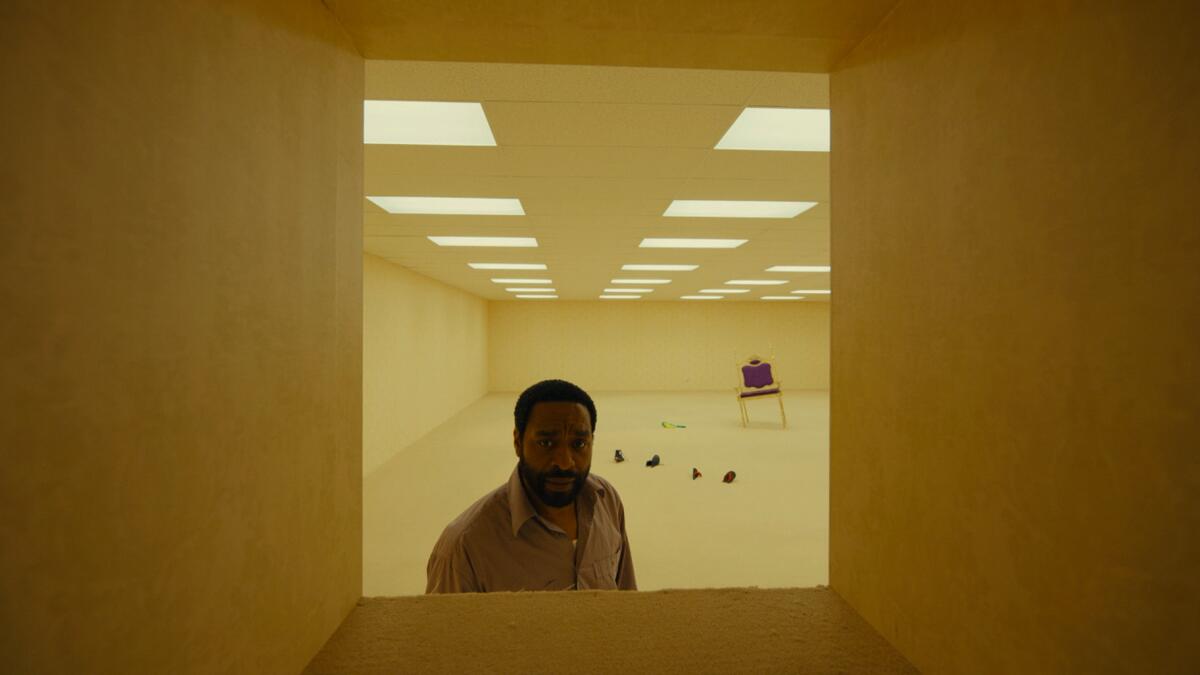
Chiwetel Ejiofor in “Backrooms,” which was inspired by Kane Parson’s surrealist web videos.
Last weekend, 20-year-old Kane Parsons became the youngest filmmaker to hit No. 1 at the box office with “Backrooms,” a surrealistic experiment about a furniture salesman (Chiwetel Ejiofor) drawn into a maze of humdrum office space. Peek into the movie’s lore on Parsons’ YouTube channel where his eight and a half minute short, “Presentation,” hints at why Mark Duplass was running around in a lab coat. Or let the feature stand as its own work and watch Simon Glassman’s “Buffet Infinity” instead. Told through snippets of local TV commercials, this morbidly hilarious horror tale is like plopping down on one of the backroom’s couches to channel surf. The bland muzak and cinematography are spot-on, as are the familiar breeds of low-budget pitchmen: the car salesman, the personal injury lawyer, the housewife. But once two neighboring restaurateurs duel over the rights to a special sauce — and one gets defamed and disappeared — these escalating, tense ads reveal a town under siege. Things have gotta be bad when the pawn broker starts rapping about his vast selection of knives. — Amy Nicholson
A pilosaurs in NBC’s “Surviving Earth.”
(NBC)
“Surviving Earth” (NBC, Peacock)
If computer animation is good for anything, it is its ability to bring prehistoric creatures to convincing conjectural life. From Willis O’Brien‘s stop-motion dinosaurs in “The Lost World,” to “Jurassic Park,” to the BBC’s “Walking With Dinosaurs,” we are ever glad to take that trip backward, in increasingly sharp detail. “Surviving Earth,” an eight-part nature documentary cum disaster movie cum action film, adds a thematic twist: extinction. With titles like “When the Earth Burned,” “When the Seas Died” and “When the Forests Collapsed,” it is, on the one hand, a dark tour through a long history of climate crises and population collapse; on the other, per its title, its relatively cheering theme is that life, generally speaking, can handle whatever the planet (or stray asteroid) throws at it. (Humans are not left off the hook; the two episodes out for review each conclude with a visit to our destructive modern world.) As in many nature films, the animals are framed in cute or suspenseful stories that largely involve family and community; territory and travel; and looking for food and not being food. (The more adorable the animal, the more likely it is to escape uneaten, and some of those baby dinos are precious.) It premieres Thursday at 8 p.m. on NBC, and new episodes air weekly, followed by a rebroadcast of “The Americas,” the network’s earlier present-day nature series, and stream on Peacock the next day. — Robert Lloyd
Guest spot
A weekly chat with actors, writers, directors and more about what they’re working on — and what they’re watching
Kerri Kenney-Silver as Anne and Erika Henningsen as Ginny in Season 2 of “The Four Seasons.”
(Emily V. Aragones/Netflix)
What if you found out you were pregnant? And then your partner died suddenly. Oh, and he hadn’t divorced his wife yet, so there’s no money to support yourself and a new baby. For some people, it would be enough to cause a meltdown and an existential crisis. But in Season 2 of “The Four Seasons,” Ginny takes it all in stride. The character, played by actor Erika Henningsen, forges ahead, has the baby — fathered by the now-deceased Nick — and ends up getting help from the most unexpected person: Anne, her partner’s ex.
The comedy series once again follows the close-knit friend group consisting of Jack (Will Forte) and Kate (Tina Fey), Danny (Colman Domingo) and Claude (Marco Calvani), and the new odd couple, Anne (Kerri Kenney-Silver) and Ginny. This season, they take trips to the Catskills, the Jersey Shore and Italy as they try to navigate grief following Nick’s death, supporting Ginny despite the awkwardness of her situation with Anne, and an international move by Danny and Claude after they decide not to have a child.
Henningsen discussed Ginny’s arc this season and how she connects with Anne, who finds purpose in caring for baby Gino (or Eugene, depending on whom you ask), and what it was like juggling multiple projects along with filming “The Four Seasons.” — M.G.
At the end of the first season of “The Four Seasons,” viewers were hit with a big surprise: Ginny is pregnant. And in Season 2, we see her further along and eventually with a baby. What was it like to play Ginny at this stage in her life, navigating single motherhood? Did you look to anyone for inspiration?
I feel like Ginny’s character arc in this season was a tightrope walk that our writers executed flawlessly. Because, let’s be honest, the situation between Anne and Ginny is a bit bizarre. To quote our show, “there is no Beyoncé song” for what to do when your recently deceased ex-husband’s pregnant girlfriend shows up on the group hiking trip! What myself and the writers really tried to highlight, especially in those early spring episodes, is how scared Ginny feels to be entering motherhood without a partner by her side and how that fear and grief become the dominating force behind her actions. She’s just scrambling for some semblance of confidence and security, to feel like she’s going to be “ready” when the baby arrives. But, as any real mom can attest, there is no ‘“ready” when it comes to a baby. You just take it one day at a time and figure it out as you go. I love that Ginny has that realization toward the middle of the season. She may not be the perfect mom to Gino, but she’s his mom, and getting to play the beach scene where Ginny takes one tiny bold step, alone, into motherhood was super special. In terms of inspiration, I was constantly texting two friends of mine who had just had babies for ways to walk, ways to lay down, ways to stretch, etc. Also, our incredible hair department head, JT Franchuk (shoutout, JT!), was on set with me every day, and I was lucky to have her as a confidant and sounding board as she was seven months pregnant when we began shooting Season 2.
You share many great scenes with Kerri Kenney-Silver, who becomes a surrogate mother to Ginny and grandmother to her baby, despite the history between them. How did you two navigate this dynamic, and what was it like working together?
Kerri Kenney-Silver is truly the greatest scene partner an actor could have for a litany of reasons. Kerri comes from an improv background but is also a technical wordsmith. She’s constantly throwing out new line readings and physical comedy to bounce off of, but is also deeply respectful of the words Tina Fey and company have crafted, so she’s equal parts anchor to a scene as well as a playmate. Kerri and I never tried to nail down one exact “right” way to play a scene. We were constantly adjusting the levers with each take, digging into one another versus backing off, casually throwing away a sentimental line versus staring into one another’s eyes. What we did agree on was to never judge these two characters. Some people might look at our character’s choices as debilitating or selfish, but we both found that Anne and Ginny deeply needed and wanted to be there for one another. In their own little “odd couple” way, they were choosing one another to get through the next tenuous, unknown chapter of life. Oh, and working with Kerri? As I’ve said, “if you’re gonna lose a Steve Carrell, just wait til you gain a Kerri-Kenney Silver.” She is obviously so talented, but also one of the warmest and most welcoming humans I have worked with. And she makes me snort-laugh on a regular basis.
You came up in theater and originated the role of Cady Heron in the Broadway production of “Mean Girls,” based on the film by Fey. You were on Broadway in “Just in Time” last year, too. What has it been like to balance your stage work with your TV work lately?
Honestly? It’s been a lot! I say that with 98% gratitude and 2% “so tired when is vacation?” exhaustion. Last year, I was doing press for “The Four Seasons” while opening a brand-new original Broadway show, while also recording Season 3 of the hit animated series I currently star in, “Hazbin Hotel” [Prime Video]. My days were spent doing interviews in the morning, rushing to Circle in the Square theater for “Just in Time” preview rehearsals in the afternoon, recording episodes of “Hazbin Hotel” on my dinner break, all before heading back to the theater for an 8 p.m. curtain. I remember there was one night I did a SAG panel with Tina, Kerry and Marco on 55th and Broadway that ended at 7:45, and I was in pincurls and fake eyelashes, ready to go onstage opposite Jonathan Groff at 8:15. It is definitely a balancing act, and one I would not be able to navigate without my team and my husband. Nonetheless, I wouldn’t have it any other way. I love how each discipline has started to inform the other: I’ve taken my spontaneity in the voice-over booth onto set, I’ve taken my trust in stillness in front of the camera onto the stage, and I’ve taken my discipline doing eight shows a week into everything. Getting to dip a toe into multiple pools of the entertainment industry is, I think, the only way my brain wants to operate.
If “The Four Seasons” gets a third season, where would you like to see Ginny go?
In a perfect world? I’d love if Danny/Claude planned a fabulous trip to a gay destination like Mykonos that the rest of the group somehow gloms onto. I remember visiting Fire Island for the first time a few summers ago at Tina’s recommendation and loving it so much. I texted her that I never wanted to leave and she basically wrote back, “Yup. Always follow the gays.” So, maybe we will do exactly that in Season 3. Also, on a very specific Ginny note, I will hopefully have a toddler in Season 3 as opposed to a baby (our babies on set were under 6 months old so they definitely fell into the “handle with care” category!), and my dream is to be able to hold one the way Diane Keaton holds her toddler in “Baby Boom.” It’s a perfect moment of physical comedy, and I aspire to re-create it.
What have you watched recently that you are recommending to everyone you know?
“Beef” Season 2 and the recent Rafael Nadal documentary, “Rafa.” Both Netflix. What can I say? I’m loyal. The entire cast in “Beef” is spectacular, and I love the genre-bending the showrunner weaves throughout. You never quite know where you stand, but the twists feel earned and character-driven as opposed to gimmicky. There’s one quasi-bottle episode set in an ER that felt perfectly surreal, claustrophobic and exactly what it feels like to be in the ER on bad health insurance (speaking from 21-year-old experience). “Rafa” is just … no words. I love a sports doc (“The Last Dance” [Netflix], “Prefontaine” [VOD], “The Endless Summer” [Tubi] — you name it), probably because, in my heart of hearts, I just want to be an athlete.
What’s your go-to comfort watch, the movie or TV show you go back to again and again?
I will never tire of watching “The Parent Trap” [Disney+]. It’s perfect. Chessy is a queer icon, Meredith Blake is the “villain” but also get that vineyard honey, one of Lindsay Lohan’s best performances, and what I wouldn’t give to have an ounce of the class that was Natasha Richardson. Every scene is perfect, there’s not a single “skip” on the soundtrack. Also a flawless Maggie Wheeler cameo! Nancy Jane Meyers: You outdid yourself.
BOSTON — A federal judge on Friday struck down a Trump administration policy enacted after the shooting of two National Guard members that made it harder for immigrants from dozens of countries to stay and enter the U.S.
In a ruling harshly criticizing the administration, U.S. District Chief Judge John McConnell Jr. said the policy “threw the lives of countless immigrants living in the United States into indeterminate legal limbo,” and he accused the U.S. Citizenship and Immigration Services of ignoring the law.
“In enacting its latest immigration policies, USCIS: claims statutory and regulatory authority that it does not possess; makes decisions without the reasoned explanations that it must provide; acts without regard for the reliance interests of applicants that it must consider; and justifies its actions with pretextual concerns of ‘national security’ that mask anti-immigrant sentiments that it is forbidden from letting influence its decision-making,” he wrote. “In legal terms that means USCIS’s actions are contrary to law and arbitrary and capricious.”
A spokesperson for the Department of Homeland Security did not immediately respond to a request for comment.
The policies enacted after the National Guard shooting last year meant that immigrants from 39 African, Asian, Latin American and Middle Eastern countries have been “categorically barred” from receiving final decisions on, among other things, their asylum, work permit, green card and citizenship applications.
“This ruling reaffirms a basic principle: the federal government cannot shut down lawful immigration pathways or discriminate against people based on where they come from,” said Skye Perryman, president and CEO of Democracy Forward, which represented the plaintiffs in the case. “These unlawful policies caused enormous harm to families, workers, asylum-seekers, and communities across the country who were left in limbo, unable to work, access protections, or move forward with their lives.”
The policies apply to U.S. Citizenship and Immigration Services, which approves applications for immigrants to work and become citizens. The agency, which is within the Homeland Security Department, often grants asylum, but only for those already in the United States when they apply. Immigration judges grant asylum to those who are stopped at the border; the ruling does not affect them, and neither do the policies that sparked the lawsuit.
It is part of an ongoing effort by the administration to tighten U.S. entry standards for travel and immigration, in what critics say unfairly prevents travel for people from a broad range of countries. The administration suggested it would expand the restrictions after the arrest of an Afghan national suspect in the shooting of two National Guard troops over Thanksgiving weekend.
In its motion to dismiss, which the court denied, the government argued that Congress gave the executive branch broad authority over immigration policy, including “the entry of aliens into the United States as well as discretion within the statutory scheme to confer as well as withdraw various discretionary benefits.”
“This case rests on a remarkable premise: that a federal court should prevent an agency from issuing the very policy guidance that provides government personnel with the guardrails necessary to ensure consistent, non-arbitrary, and individualized decisionmaking consistent with federal law,” the government wrote in its brief.
Immigration groups celebrated the ruling.
“This ruling sets a powerful precedent that the administration cannot ignore the law as laid down by Congress and cannot arbitrarily bar immigration benefits on the basis of national origin by fiat,” said Jamal Abdi, president at the National Iranian American Council. “Fortunately, this is still a nation of laws, and those who uphold America’s values have recourse to challenge and push back on such discriminatory, arbitrary policies.”
Shawn VanDiver, a Navy veteran who heads a coalition that supports Afghan resettlement efforts called #AfghanEvac, said the ruling was a “significant victory for the rule of law and for thousands of Afghan allies and other immigrants who followed every requirement asked of them.”
“Just this week in Dallas and Fort Worth, we met people who feared losing jobs because delayed work permit renewals threatened their livelihoods, families who postponed education, travel, and homeownership because they did not know when their cases would be resolved, and future Americans who had expected to become citizens only to see their applications stall without explanation,” VanDiver said.
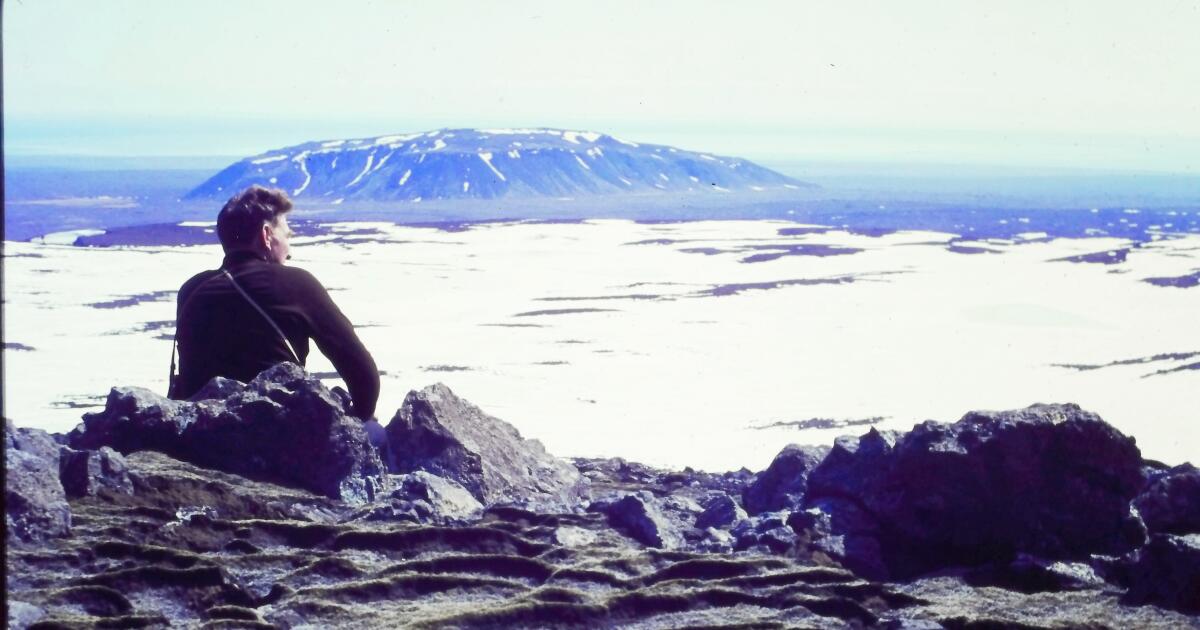
Glaciers aren’t stationary. Immense and imposing, formed through the downward trajectory of water from mountains as it collects and freezes, they have always moved. Now, however, they’re leaving. The demise of glaciers is a fact inherent in all the bad news about the effects of climate change on what once seemed permanent. But for Icelanders, whose connection to glaciers is ancient and mythic, our human epoch has become an extended hospice for the landscape of their lives.
Somehow, though, Sara Dosa’s documentary on this matter, “Time and Water,” avoids playing like a funeral in waiting. Built around Icelandic writer Andri Snær Magnason’s voiced lamentations on a vanishing frozen world, along with archival footage of his family, it’s no simple howl of grief, even when it takes us to a publicly held memorial in 2019 for Iceland’s Ok glacier, the first such “death” diagnosis in the country’s history. Rather, Dosa’s film is a meditation on change — both the kind that we accept with a heavy heart and something more general. “Time and Water” is a curiously vibrant elegy, teeming with appreciation for the intimate majesty that is all life, generational and geologic.
Dosa has finessed this emotional-meets-elemental space before in her Academy Award-nominated 2022 documentary “Fire of Love,” about married volcanologists Katia and Maurice Krafft. That was a wonderfully eccentric romance forged in molten lava. Here, she’s in a collaboration of sorts with her subjects, both human and elemental. Magnason’s opening narration over spectacular footage of glaciers — up close and from far away — gently informs us that we’re watching a time capsule, one where the bonds of family and environment are intertwined.
We learn how Iceland’s glaciers, essentially rivers of varying pace, begat their unique ecosystems, but also how they provided the breathtaking terrain upon which Magnason’s grandparents Hulda and Árni fell in love. (Grandma Hulda was the first woman to fly in Iceland, itself a very cool fact.) The onset of dementia in Árni spurs his grandson to consider what’s lost when the markers of memory depart. “Time and Water” touches on the epic verse called rimurs, passed down via chanted song by Icelandic women, their descriptive, sorrowful tales like dispatches from previous ages.
“Tone poem” is an overused term in cinema, but the humbling “Time and Water,” graced with a playful, atmospheric Dan Deacon score, earns that distinction. Naturally, it helps that you can never tire of all the air-crisped glacier imagery, captured digitally and in 16mm. Folded into the cozy slide-show vibe of Magnason’s home videos and the carefully chosen archival footage, the movie plays like a scrapbook portrait in which home just happens to boast the grandest of backyards.
How much longer will Icelanders enjoy it? The glaciers are predicted to be gone within 200 years. That’s an eternity or a drip, depending on whose survival we’re talking about. Still, “Time and Water” collapses the notion that we are somehow separate from these ancient, essential formations: an encouraging hello to the future from inside a sobering goodbye.
‘Time and Water’
In English and Icelandic, with subtitles
Rated: PG, for some thematic elements, smoking and brief language
Running time: 1 hour, 33 minutes
Playing: Opens Friday, June 5 at Laemmle Royal and Laemmle Glendale
Opposition leader and dozens of other defendants handed lengthy prison terms for ‘forming a terrorist alliance’.
Published On 3 Jun 20263 Jun 2026
A Tunisian court has handed down sentences ranging from 10 years to life imprisonment against opposition leader Rached Ghannouchi and dozens of other defendants in the so-called “secret apparatus” case involving the Ennahdha party.
The Tunis Court of First Instance on Tuesday sentenced Ghannouchi, the leader of Ennahdha and a former parliamentary speaker, to life in prison plus 30 years on terrorism-related charges, reported Tunis Afrique Presse, Tunisia’s official news agency.
Recommended Stories
list of 4 itemsend of list
Eleven other defendants, including Ali Laarayedh, an adviser to former Tunisian Prime Minister Ali Laarayedh, were handed life sentences in addition to prison terms of up to 96 years, Tunis Afrique Presse reported.
Thirteen others were handed prison terms of between 10 and 48 years, according to the news agency.
The court found Ghannouchi and the other defendants guilty of “forming a terrorist alliance” and other crimes, including “placing skills and expertise at the disposal of a terrorist alliance and of persons linked to terrorist crimes”, according to Tunis Afrique Presse.
The court ordered all defendants to be placed under administrative monitoring for five years.
Authorities opened the case against Ghannouchi and his co-defendants in early 2022 following a complaint by the public prosecutor’s office and lawyers for the families of leftist politicians Chokri Belaid and Mohamed Brahmi, vocal Ennahdha critics who were assassinated in 2013.
Lawyers representing Belaid and Brahmi’s families accused what they called Ennahda’s “secret apparatus” of involvement in the assassinations, as well as “conducting espionage and infiltrating state institutions”.
Ennahdha denied the allegations, describing them as “politically motivated”.
The public prosecutor’s office at the Ariana Court of First Instance initially took up the case, before handing it over to the judicial counterterrorism unit in 2023.
In April, Ennahdha said Ghannouchi had been urgently transferred from prison to hospital after a sharp deterioration in his health and called for his immediate release.
The opposition National Salvation Front also called for Ghannouchi’s release, citing his deteriorating health.
Tunisian security forces arrested Ghannouchi at his home during a Ramadan gathering in 2023, before a court of first instance ordered his imprisonment on charges of making statements that “incite chaos and disobedience”.
On April 15, a court sentenced Ghannouchi and three other Ennahdha leaders to 20 years in prison in what came to be known as the “Ramadan soirée case”.
Tunisian authorities have denied accusations that Ghannouchi and the other detainees are being held on political grounds.
Nick Pasqual, an actor who appeared in “How I Met Your Mother,” has been sentenced to 32 years to life for the attempted murder of his estranged girlfriend, L.A.-based makeup artist Allie Shehorn.
Following a jury trial, Pasqual was also convicted of counts of injuring a spouse or partner, first-degree burglary and rape, according to court documents. During the trial, Shehorn had visible scars on her hands and neck when she testified, per ABC.
The incident occurred in May 2024, when Pasqual repeatedly stabbed Shehorn in her Shadow Hills home. Prosecutors said that the actor broke into Shehorn’s home just before 4:30 a.m. on May 23, attacked her with a knife and fled California.
Days before the attack, Shehorn had filed a restraining order against Pasqual, detailing acts of sexual and physical assault. While the judge approved the order, it was unclear whether Pasqual had been served prior to the stabbing.
Christine White, Shehorn’s friend and roommate, discovered the makeup artist lying in a pool of blood and called emergency services. Friends believe Shehorn was stabbed more than 20 times. Following the attack, Shehorn underwent emergency surgery and spent days in intensive care.
Pasqual was ultimately stopped by authorities at a border checkpoint in Sierra Blanca, Texas, and extradited to Los Angeles.
The former couple met on the set of Zack Snyder’s film “Rebel Moon,” where Pasqual worked as a background actor and Shehorn worked as a makeup artist.
Last week, Shehorn sued the actor for sexual battery, assault and negligence, among other counts, according to a lawsuit submitted in Los Angeles County Superior Court.
The 17-page complaint echoes details about the May 2024 stabbing that led to Pasqual’s arrest two years ago and his attempted murder conviction.
Staff writer Alexandra Del Rosario and former staff writer Nathan Solis contributed to this report.
Mindy Kaling was in her early 30s when the first TV series she created, “The Mindy Project,” made its debut and set in motion her attempt at forging an identity as a prolific multi-hyphenate after “The Office,” where she was a writer and cast member for eight seasons. But if you ask her to reflect on that time of her life, she says, it’s a bit of a blur.
As she explained recently, “I remember it, but not all that distinctly. It was such a grind — waking up at 6 a.m. to be on camera, wrapping late. And I did that for 117 episodes.”
But ask her about her 20s, when she was living in New York City and trying to figure out how she could break into the industry as a comedy writer? “I remember incredibly vividly,” she says. “I’m like, did I feel things more intensely back then? I’m not sure. But that period of time … there was just so many highs and lows. And it felt cinematic to me.”
So she made a TV show about it.
Premiering Tuesday with three episodes, “Not Suitable for Work” follows five ambitious 20-somethings living in Manhattan who are navigating the early stages of their careers while trying to have a semblance of a life and the heightened emotions they experience during this period. Kaling calls it the third chapter in her semi-autobiographical TV trilogy, which includes “Never Have I Ever,” about a first-generation Indian American teenager coping with her father’s death while trying to be popular (or at least not super uncool), and “The Sex Lives of College Girls,” about four young women who dorm together and boldly maneuver their new, uninhibited lives on campus.
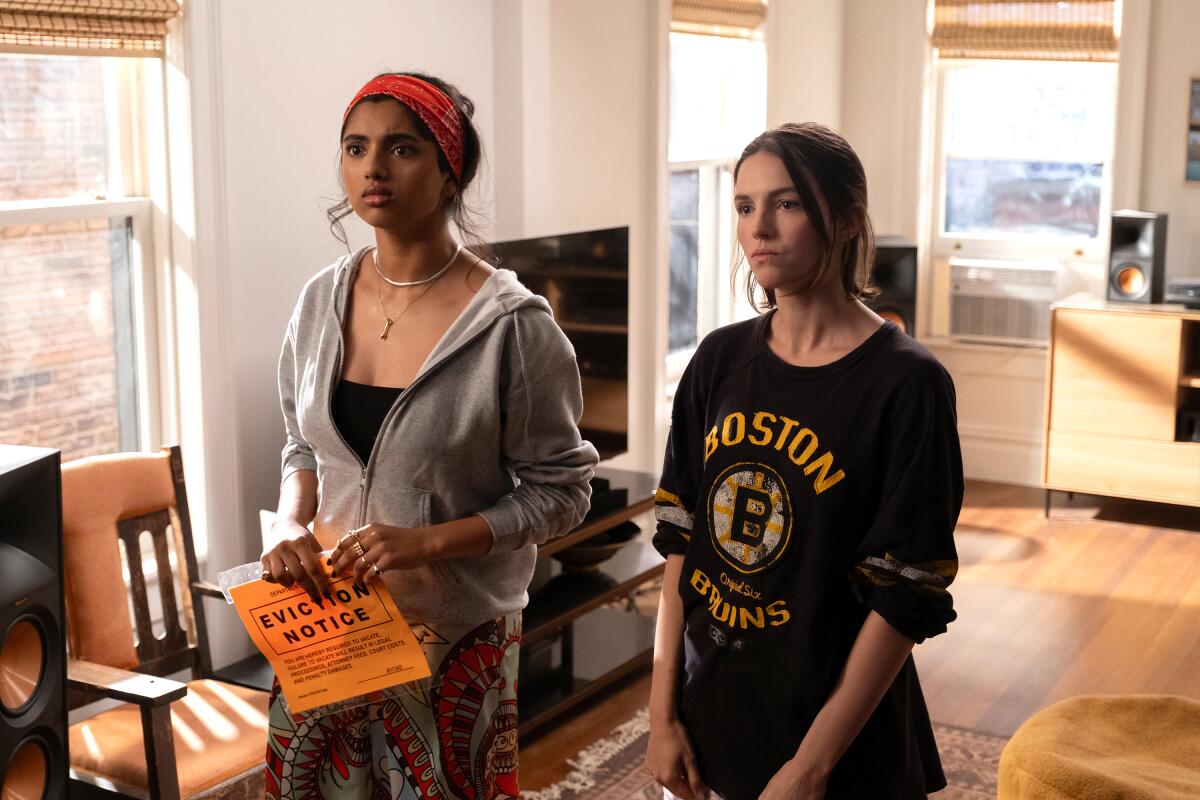
In the new Hulu series, viewers are introduced to AJ Pascarelli (Ella Hunt), a hard-working and disciplined young woman who moves to town to start a high-pressure finance job, and her roommate Abhinaya “Abby” Chilukuri (Avantika), a savvy and fashion-obsessed assistant to a celebrity stylist. They live across the hall from Josh Teitelbaum (Jack Martin), an idealistic nepo baby of a media titan — he’ll lean into his privilege when it suits him while also trying to distance himself from it — with ambitions of making it in journalism. His two roommates are Kel Washington (Nicholas Duvernay), an insecure but earnest med student who would rather be acting, and Davis Beau Bradley Barrett III (Will Angus), a high-energy, bumbling financial analyst who works at the same corporate firm as AJ and is an undercover hopeless romantic. As one might expect, there are some messy entanglements within and outside the group.
1
2
1.Abby (Avantika), left, and AJ (Ella Hunt) move in together.2.Across the hall live Davis (Will Angus), left, Josh (Jack Martin) and Kel (Nicholas Duvernay).(Gwen Capistran / Disney)
“I hope that young people will respond to the show, “ Kaling says. “We did so much research in it because at a certain point it is funny — I’m in my 40s, and I am often like, ‘I wonder if young people are suspicious about why I’m so obsessed with writing shows about young people.’”
So, why is she?
“Because I find it almost impossible to reflect on the current time I’m in,” she says. “It would be too painful to be too introspective about the time that I’m in. I need a real sense of distance to look back on it, especially since having kids. Once you have kids, it triggers these memories of your own childhood.”
Over video call from New York City, Kaling reflected on the series and her early years of trying to make it. These are edited excerpts from the conversation.
How did you land on the professions that your characters would be pursuing and what did you want to say about ambition at this stage of life?
I love people who have big wants, and sometimes the audience is like, “Maybe you want the wrong thing” and they [the characters] don’t quite know that yet. I love writing about the underdog. And with their particular professions, they’re all things that I had some interest in researching. I’ve always been fascinated by investment bankers. I went to Dartmouth, so I have a lot of friends who went into that, and I swear I’ve had my friends explain their job so many times to me, and I still didn’t totally understand it. We were lucky; a very famous investment bank very generously offered to let me come for a day and meet with young bankers. I also … write about the children of immigrants. I’m very, very interested in that story, and so we got to research what it’s like being the child of Nigerian immigrants. But every single character has a journey, or there’s an aspect of them that I feel like I really relate to, and that is in almost all my shows.
What was it like observing young people in the investment banking world?
They were wary — because they’re smart — of someone from Hollywood coming in to document what they were doing and asking questions. It helped that a lot of the guys liked “The Office” and a lot of the women liked “The Mindy Project” and “Sex Lives of College Girls” because they’re all kind of young. I think that made them trust me a little bit more. For the AJ and Davis characters, so much of what I researched when I was there fed into their plot line … almost all the characters have a boss they fear and idolize, and the way that first-year bankers feel about their managing directors is not dissimilar to the way I felt about Greg Daniels when I started at “The Office.” And the hours are actually not dissimilar.
There’s a moment early on where Jay Ellis’ character, Bill, who is a managing director at this fictional investment banking firm, is asked about work-life balance. I’m curious how you thought about that at the start of your career versus now.
I didn’t care at all about anything except my job for 16 years. It was my entire personality and purpose. When I was in my 20s, the only thing that mattered was being a good comedy writer and succeeding, and one day maybe being able to create my own shows. There was no balance. I didn’t want balance. I wanted to live and breathe comedy writing for my entire life. I hated the weekends, actually. And who wouldn’t? I was a friendless transplant in Los Angeles and I just wanted to get back to working at “The Office.” Every year I was there, I got more ambitious and I wanted to go off and create my own show and have a bigger part as an actor and everything.
It wasn’t until after I did that on “The Mindy Project” … that I just felt like, “OK, I get this. I want to now try being a mom.” Once I had my daughter, Katherine [at 37], it wasn’t that the balance changed, it was my first real, legitimate interest outside of work — that I cared about more than work.
“When I was in my 20s, the only thing that mattered was being a good comedy writer and succeeding, and one day maybe being able to create my own shows,” Kaling says. “There was no balance. I didn’t want balance.”
(Ebru Yildiz / For The Times)
After college, you moved to Brooklyn with two Dartmouth friends to pursue a career in comedy. You eventually got a full-time job as a production assistant on “Crossing Over with John Edward,” a program where people would receive psychic readings. Tell me about that time in your life.
I remember feeling like I had no access and that I didn’t have any place to put my ambition. It was so far away from anything I wanted to do — scripted comedy and reality television could not be further apart. It was a fascinating time because there were such highs and lows. There was the excitement of new crushes and having fun in a new city with two friends, but there was also the crushing disappointment of feeling like I was never gonna make it. I didn’t even have a path forward to making it, but I was lucky, because I lived with my two best friends. We would go to open mic nights, and we would go to restaurant week and see how the rich people in Manhattan were living. We would take the subway uptown to Central Park and walk along Fifth Avenue and like look at these amazing homes and just dream what it was like to be like a wealthy New Yorker who could buy everything that they read about on DailyCandy — now I’m really dating myself here, back when DailyCandy was a thing. But that’s what it was like, I just I felt a lot of extreme emotions.
How did you approach that job?
My boss was a producer and would approach the families and get their information, and then we would have to do research on them, but it was mostly because they would do a little clip package on the different families. I had to get them to sign releases to be on the show and get photographs of their deceased [loved ones] and them. I actually thought it was pretty interesting work. It just had nothing to do with comedy writing, and that job was not clearly going to lead anywhere toward comedy writing, and I came to New York because of “Saturday Night Live.” When I was working there is when my friend Brenda [Withers] … and I started writing this play “Matt & Ben” [a satirical play that imagines the story of Matt Damon and Ben Affleck before “Good Will Hunting” made them famous] in the time we had off. We started writing it, then I got that job as a PA, then the show went up at the Fringe Festival, and then it was going to go off off Broadway, and when it went off-off-Broadway, and I had a steady income, that’s when I quit my job there. I was only at “Crossing Over” for three or so months.
Greg Daniels attended a performance of “Matt & Ben” and it’s what led to you getting on “The Office” at 24.What was that first meeting like?
Back then, because the internet was so different, when I looked up Greg, besides his credits, you couldn’t find a lot of biographical information about him, or even a photo. I don’t think I even knew what he looked like. When I met him, I don’t think I had seen the British “Office” yet; I wasn’t cool. At that time, I had put so much pressure on this job. I only had two interviews — it was this and there was a show that ended up getting canceled while I was waiting to meet the showrunner. It was a pilot called “Nevermind Nirvana,” about an Indian man who married a white woman, and Ajay Sahgal was the writer. I was like, “Oh my God, if anyone is going to get hired to work on the show, it has to be me.” I was pretty excited about that meeting, but when I was sitting in the waiting room at the production offices to meet with Ajay, they told them they weren’t going to pick up the pilot, so I never even got to meet him, and they just told me I could leave.
I’d only had that interview, and then I met with Greg. This is my memory: it was a high-rise building in Century City, in the offices of “King of the Hill,” so there was a lot of like “King of the Hill” cutouts and stuff there. And he’s just a very thoughtful, quiet guy who doesn’t push conversation … I’m someone who’s pathologically chatty, and so talking to Greg, who is completely fine with there being pauses in conversation, and is just a confident grown-up, it was incredibly intimidating. I was very stressed out in our meeting, but I also was blown away by him.
That first season, you were also the only female writer on staff and the youngest —
B.J.[Novak] is a month younger than me. I want to correct that because he’ll read this and go, “Hey … !”
How did that play into how you felt in the room?
I haven’t really ever had imposter syndrome. And this is my probably my personality defect — I felt that even if I hadn’t seen anyone like me in these roles, that I was just going to be the first one, and I was going to work really hard and prove it to them. The staff was super competitive, but they were smart feminist guys. It was hierarchical and stressful, but it was not because of my fellow writers, except that I wanted to impress them. I felt nervous because I wanted to be contributing, but I don’t know why — I just loved the pilot so much that Greg had made, and I loved these characters, and this world — I was like, I can’t possibly lose my job, I love it too much. Which is probably really stupid, I didn’t ever think there’s a possibility that I could get fired here.
Phyllis (Phyllis Smith), Kelly (Mindy Kaling), Dwight (Rainn Wilson) and Michael (Steve Carell) in a scene from Season 2 of “The Office.”
(Paul Drinkwater / NBCUniversal via Getty Images)
We see how AJ wants to impress the boss and takes on more than she can chew and screws up some data before a big presentation. What was that first big mistake or misstep that you made in those early years that you still think about?
I remember Season 2 — because I just wanted to prove to Greg and to the cast and to the director, the cinematographer, and everyone that I was super invested — we were shooting “The Dundies” [episode]. I was an actor on the show as well, but I wasn’t acting in this scene, but it was my episode [that I wrote], and in between takes, John [Krasinski, who played Jim Halpert] and Jenna [Fischer, who played Pam Beesly] were just on set, and I remember going up to them and being like, “Guys, that take was so great!” And I walked away. Greg came up to me and was like, “You know, we really should let just the director talk to the cast between takes.” Greg, he’s my mentor, but he definitely, over the course of the eight years I lived there, had corrected me many times, as he should have, but that was one of the first times. I remember I was so embarrassed, but I didn’t understand it’s not the role of a story editor to be giving feedback to the cast between takes on a show.
The bosses on the show all have different styles and expectations that may seem demanding or annoying on the surface. How do they reflect where you’re at now?
No one trains you on how to be a good boss. And bad bosses are so prevalent. The entire premise of “The Office” hinges on this funny concept that terrible bosses exist. It wasn’t until I was on “The Mindy Project” that I was the employer for the first time. Every single year of that show, it was a battle getting a new season. One of the challenges of being a good boss is being able to put aside those personal, professional battles you’re fighting … but then also realizing that you’re a mentor to other people, and you have to start thinking about things that you never thought you needed to — overtime, maternity leave, respect in the workplace, the things that make the workplace enjoyable for everyone else who’s there working for you. And it’s not like that comes naturally.
The double blessing of having a good boss, which I did in Greg Daniels and Howard Klein [an executive producer on “The Office”], is that they modeled that for me. Even though I could not be more different than Greg. Even to this day, I’m realizing I have all the unique challenges of being a single mom, being the creator of these shows with crews and casts, but then also being able to be empathetic for all the people that work for me and making sure I make time to listen to them when they want to talk to me about an issue that they’re having; it’s a continual challenge that I’m hoping I’m getting better and better at [managing].
When Bill is asked about work-life balance, he’s also asked if he has inspirational words to impart. It’s very much about overworking and being productive. How do you tackle the question today?
I used to say “you have to write your own part.” And everyone would get annoyed because they’re like, “I’m not a writer.” I’ve had to really think about the question so I could be helpful. We all want a linear path to success. And if my career has taught me anything, it’s that the linear path just was not how I got my job. You know when you go on Google Maps and it shows you all the different paths — the fastest, one path with the toll road and one path that’s going to take seven minutes longer. I’ve only ever taken the one that’s seven minutes longer, or the toll; it’s never been the easy way. The sooner I got used to that, the better.
Before I let you go, in the show, one of the celebrity clients Abby is dealing with is Austin Blanchett, Cate Blanchett’s fictional nephew. Was it always going to be Cate? What other celebs were in the running?
It was Cate Blanchett’s nephew before we had Harry Richardson. When I worked on “Ocean’s Eight,” one of the biggest surprises on it was that Cate Blanchett was incredibly funny and did not take herself seriously at all. I suspect if anyone was going to think it was funny that in this fictional world of the show she had this useless nepo nephew that she had to help get jobs, it would be Cate. I hope she doesn’t sue me. I think she would think it was funny.
52-year-old Ryan McFarland killed six of his family members and later took his own life when confronted by the police in Muscatine in the US state of Iowa.
Arthur B. Laffer, professor, businessman and possible candidate for next year’s Republican nomination for the U.S. Senate from California, speeds down the freeway in his telephone-equipped BMW 733i, sipping a can of Diet Pepsi and reflecting on his life in the fast lane.
The impatient energizer of the nationwide tax-cut movement–a tenured professor at age 28, chief economist of the White House Office of Management and Budget at 29–has long prided himself on his ability to keep several balls in the air at once. But he acknowledges that his high-speed juggling act can sometimes get him in trouble.
“When you move very fast, you rustle the fields,” said Laffer, whose choirboy looks belie his 44 years. “You cause a commotion. Without meaning to, you create squalls.”
Controversial Figure
As a result, his life has been marked by controversy as well as achievement. Squalls spawned by Laffer’s frenetic pace have cost him a marriage and two college professorships.
Most recently, the designer of the Laffer Curve–which illustrates his disputed theory that cutting taxes can actually increase government revenues while a tax hike might reduce them–relinquished his post at USC’s School of Business Administration last September after a bitter dispute with the school’s dean. Toward the end, Laffer, who by all accounts is an excellent teacher, and the dean, Jack D. Steele, refused to even speak to each other.
USC blames Laffer’s schedule for the rupture. “With all his outside affairs, he was spreading himself too thin,” said Cornelius J. Pings, USC’s provost and senior vice president for academic affairs. “He just wasn’t meeting his obligations on campus.”
He Disputes View
Steele confirmed that Laffer’s extracurricular activities were a problem, although Laffer disputed that view.
As if to prove that he can run his $2.7-million-a-year economic consulting business and explore the possibility of seeking public office and advise President Reagan and teach, Laffer recently joined the faculty of Pepperdine University’s School of Business and Management. It was a step down in the academic world, though in many ways he and his new employer are well matched.
Pepperdine, founded in 1937 by a conservative auto-parts magnate, shares Laffer’s passion for the free enterprise system and his knack for self-promotion. Indeed, Pepperdine recently ran advertisements picturing “the renowned originator of the Laffer Curve” in the Wall Street Journal and The Times.
Although Laffer’s economic views mesh well with those of the Church of Christ-affiliated school, he is no fan of Pepperdine’s strait-laced social scene. Drinking is banned on campus and chapel attendance is mandatory.
Laffer, on the other hand, maintains an extensive cellar of German and California wines at his Rolling Hills Estates home. And, though raised as a Presbyterian, he doesn’t attend church–and says he won’t start should he decide to run for office.
About the only concession the plump professor has made to the image makers while testing the political waters has been to shed 15 pounds by substituting Very Vanilla Sego, a diet drink (“Yuk–I hate it!”), for his beloved sushi. Currently weighing in at 175, the 5-foot, 7-inch Laffer figures he has another 15 or 20 pounds to go.
Although considering a run for the Senate, Laffer is openly contemptuous of Congress. “If you look at congressmen and senators,” he tells audiences across the state, “you see a group who invariably prefer complex error over simple truth.” It is his biggest applause line. “If you ever saw what those guys actually did for a living, you’d recognize their banality and you’d throw them out of office.”
Six Children
Laffer’s personal life is as packed with activity as his professional one. Besides Traci, the 25-year-old second wife he fondly calls “my Valley girl” (she grew up in Ontario), the Laffer clan includes six children ranging in age from 6 months to 20 years, 15 rabbits, 10 parrots, 4 macaws, 3 tortoises, 2 horses, a Jack Russell terrier and a Norwegian blue fox. Laffer, an amateur biologist who once considered forsaking economics for a career in biology, manages to find time for all of them.
The menagerie used to be bigger. Fern, a pet weasel, drowned in the Laffers’ swimming pool, though her place in family folklore is secure. Laffer cackles when he remembers the time his daughter, Rachel, then 6, tossed the wriggling creature onto First Lady Nancy Reagan’s lap at a 1980 dinner party.
“I don’t think I’ve ever come so close to heart stoppage,” said Laffer, who at the time was trying to sell his supply-side theories to presidential candidate Ronald Reagan. “Everyone held their breath waiting to see how she’d react, but Mrs. Reagan was quite the lady about it.”
Unconventional Ideas
The economist revels in his new and unconventional ideas. He would reward elected officials and the head of the Federal Reserve Board with big bonuses when the economy booms and slash their salaries during recessions. He would wipe out the capital gains tax. He would amend the Constitution to provide for national referenda. And he would give $15,000, tax free, to the top 5% of scorers on the Scholastic Aptitude Test.
“Can you imagine if all of a sudden you could get out of the ghetto by studying instead of by playing basketball?” Laffer asked. “If you play basketball 16 hours a day, you become a great basketball player. If we could get these kids to study 16 hours a day, they’d become great students.”
Such schemes have won Laffer the friendship of “new ideas” Democrat Sen. Gary Hart of Colorado and the grudging admiration of some fellow economists. “Whatever you think of Laffer’s ideas, at least he thinks,” said Lester C. Thurow, a liberal professor of management and economics at Massachusetts Institute of Technology whose views often differ from Laffer’s.
Some say Laffer’s boyish looks and small stature could prove a liability should he decide to seek office. Characteristically, Laffer employs humor to disarm the size issue. In speeches, he invariably mentions flat-tax advocate Sen. Bill Bradley (D-N.J.), the former New York Knicks basketball star. Then, in his best Joan Rivers delivery, he adds: “It’s disgusting how tall he is.”
Penchant for One-Liners
Indeed, Laffer’s penchant for jokes and one-liners (sample: “The British pound is so weak that they’ve started calling it the ounce”) have led some to question his seriousness. Samuel Armacost, president and chief executive officer of BankAmerica Corp., recently quipped that a speech by Laffer “isn’t economics–it’s entertainment.” Laffer says he uses humor to make complex subjects palatable.
Although he is a polished speaker, Laffer appears to be reining in his glib, shoot-from-the-hip style. He disavows a 1981 comment embracing “the freedom to smoke pot if we want to.” Laffer acknowledged having made the remark, but said: “I think I was probably showing off at the time–trying to show you don’t have to be a conservative on all issues to favor tax cuts.”
Other Laffer views reflect his coming of age as an undergraduate at Yale and a graduate student at Stanford during the turbulent ‘60s. He staunchly opposes the draft, contending that Vietnam-era draft resisters were the spiritual ancestors of today’s anti-tax movement. “The draft is a specific tax on your body,” Laffer said.
Still, Laffer rarely wanders from economic matters in his speeches and articles. He strongly supports the concept of a flat tax, predicting that some sort of bill equalizing personal-income tax rates will emerge from Congress this year.
‘Enterprise Zones’
Another Laffer idea that has been picked up and championed by the Reagan Administration is the establishment of inner-city “enterprise zones.” Corporations locating factories in such zones would get big tax breaks and relief from minimum-wage and other regulations. The economist argues that setting up such zones would break the cycle of poverty and dependency in urban ghettos.
Despite Laffer’s emphasis on economics, mainstream economists and even conservative allies question the quality of his scholarship. “He really wasn’t interested in the life of a scholar,” said George Stigler, a professor at the University of Chicago’s Graduate School of Business, where Laffer held his first teaching job. “Doing painstaking, detailed work wasn’t his game. He went for quick and glamorous results.”
It was a trauma at Chicago, Laffer said, that turned him away from academia and pointed him toward the business and public policy arenas. In 1971, some colleagues at Chicago accused Laffer, who hadn’t yet earned his Ph.D. from Stanford, of misleading a faculty committee that had earlier promoted him to full professor.
Laffer quickly finished up his Stanford doctoral dissertation and got the degree. “It was just a question of dotting the i’s and crossing the t’s,” Laffer said, explaining that he never finished in the first place because he got swept away by his other commitments. A university committee headed by Stigler investigated the matter and found Laffer guilty of nothing worse than “carelessness,” Stigler says.
Career at a Standstill
Nonetheless, as Laffer tells it, lingering suspicion from the incident “put a stop to my career.” For the next five years, he didn’t get a raise at Chicago and academic journals shunned his articles. Suddenly, the boy wonder was a pariah. “So what do you do?” Laffer asked, “sit there and commit suicide? No, you find new avenues of expression.”
It was during this period that Laffer in 1974 sketched his now-famous curve for former journalist Jude Wanniski and an aide to President Gerald R. Ford on a cocktail napkin in a Washington restaurant. “He just scribbled it out,” Wanniski recalled, “and I thought it was a useful device for getting the message across.” The message (see chart) was a simple one: that cutting taxes could actually result in an increase in government revenues by creating incentives for people to work harder and save and invest more.
The curve didn’t gain notoriety until 1978, when Wanniski included it in his book “The Way the World Works: How Economies Fail and Succeed.” “At first,” Wanniski said, “Art was embarrassed by the name Laffer Curve–until he started to make a lot of money off it.”
Indeed, Laffer has used his high visibility to build his consulting company, A. B. Laffer Associates, into a multimillion-dollar enterprise with 20 full-time and 15 part-time employees. The firm has about 300 corporate clients who pay between $6,000 and $8,000 a year for Laffer’s economic analyses; special contracts added another $200,000 to the firm’s 1984 revenues, and about 85 speaking engagements by Laffer himself yielded $433,000.
Two Homes
Business profits and Laffer’s Pepperdine salary afford the family a comfortable life style in their antique-filled Rolling Hills Estates home and a 17-acre mountaintop retreat in Rancho Santa Fe. Such wealth is nothing new for Laffer; his late father was chairman of the board of Gould Inc., the big electronics concern, and young Arthur attended private day school in a prosperous Cleveland suburb before going on to Yale.
Despite Laffer’s commercial success, the jury is still out on his celebrated curve. Donald W. Kiefer, an economist with the Congressional Research Service, calls it “an overly simplistic approach which ignores complex economic relationships.” Critics say that the huge budget deficits that followed the Laffer-supported Kemp-Roth bill that reduced personal income taxes by 25% underscore the shortcomings of Laffer’s theory.
Laffer, on the other hand, blames delays in the tax cuts and increased government spending for the deficits. Besides, he argues, this year’s $200-billion deficit is neither “a crisis” nor “a panic situation” given the U.S. economy’s underlying vigor. Like Reagan (and unlike most economists), he believes that economic growth eventually will take care of the problem. Laffer gets to promote his economic views at periodic meetings of the President’s Economic Policy Advisory Board, of which he is a member.
Moved to California
In 1976, with his academic career going nowhere, Laffer gave up on Chicago and moved to USC. In California, he became a key supporter of 1978’s landmark real-estate tax-cutting initiative, Proposition 13. A year later, his first marriage broke up, the victim of Laffer’s four-day-a-week travel schedule. “I came home from a business trip and the kids told me my wife had been gone for three days,” Laffer recalled.
He met Traci Laffer when she was a political science major at USC moonlighting as a secretary to Dean Steele. The pair hit it off when they realized they shared a love for exotic birds. Laffer proposed to her in Paris and they were married in 1982 in an elaborate Beverly Hills wedding attended by 800 friends.
“I got a package deal,” Traci Laffer said, referring to the four children from Laffer’s previous marriage and the large collection of animals.
Laffer still travels frequently, often sleeping on “red eye” flights to the East Coast, doing his business and flying home that day. “He has this idea that you can, in effect, live two lives by cramming as much as possible into your finite number of years on Earth,” said Wanniski, who now operates his own competing economics consulting firm.
None of Laffer’s friends expect him to slow down anytime soon.
MISBEHAVING Brits could be slapped with a permanent flight ban under new Labour rules.
Labour Ministers are currently looking at establishing a blacklist to stop abusive behaviour towards cabin crew and disruption to travel.
Sign up for the Travel newsletter
Thank you!
The UK government is looking at introducing new rules that could ban unruly passengers from flyingCredit: Alamy
This includes considering how information about drunk and abusive passengers could be shared between airlines.
Currently, if you misbehave on a flight you can be banned by the airline you are travelling with – but other airlines would not know this.
If the new rules were to go ahead, it would mean that public officials could keep information about passengers, including a history of any bad behaviour during flights.
In an airport setting, public officials would likely include police, border force officers and immigration officers.
The official would then warn an airline if the passenger was trying to check in with them.
Then, the airline could decide whether or not they want the passenger travelling with them.
The new system would be compliant with data protection rules, so no new legislation would need to be created for the rules to be introduced.
Having said this, data protection rules don’t allow airlines to share information about travellers, hence the need for a public official.
It comes as a the number of drunken incident on flights have risen in recent years, including one earlier this month on an easyJet flightCredit: Alamy
It comes as the number of drunken and violent incidents on planes has risen in recent years.
Earlier this month, a drunk woman believed to be British lunged at another passenger, causing chaos on an easyJet flight.
A government source said: “Everyone should be able to enjoy a pint at the airport, but anti-social behaviour on flights is totally unacceptable.
“It threatens the safety of passengers and crew, and disrupts hard-earned holidays.
“There are already tough laws in place to deal with offences committed on flights, but we are exploring with industry how we can better address this issue, ensuring we crack down on people who persistently cause chaos.
“Everyone should be able to fly without fuss.”
Tim Alderslade, Chief Executive of industry body Airlines UK, said: “UK airlines have a zero-tolerance approach to disruptive behaviour.
“Additional measures for the most serious cases of disruption, including the creation of a national ban list, are an important next step in ensuring a tiny minority of passengers cannot disrupt air travel for the majority.
In a recent YouGov survey of 5,000 adults, 37 per cent said they supported the proposal for new rulesCredit: Alamy
“We welcome the government’s support for further action and will work closely with ministers on delivering the right solutions.”
According to LBC, Phil Ward, Chief Operations Officer of Jet2, also said the airline would support new rules of sharing passenger information between airlines.
He said: “The creation of a national database will mean that, as well as being banned from flying with us, disruptive passengers can also be banned from flying with other UK airlines.”
In a recent YouGov survey of 5,000 adults, 37 per cent said they supported the proposal for new rules, with 38 per cent saying they somewhat supported it.
Only 11 per cent opposed.
Being drunk on a flight is a criminal offence and can lead to a fine of up to £5,000 and two years in prison.
A meeting will be held later this month where industry leaders will discuss the plans.
The Sun’s Head of Travel shares her thoughts
LISA Minot, The Sun’s Head of Travel, shares her thoughts:
Plans to blacklist drunk and abusive passengers on a nationwide database can’t come soon enough.
Onboard incidents have skyrocketed in recent years and a full ban on those found guilty across all airlines would be the kind of punishment that would have real consequences.
At the moment, while one airline can ban a passenger for life, data protection means other airlines are not alerted.
Having seen the chaos a drunken passenger can wreak myself on a flight from Cape Verde back to the UK anything that will show disruptive passengers there are real consequences is a good move.
Ryanair boss Michael O’Leary has repeatedly called for a ban on passengers drinking in departure lounges but why should the vast, innocent majority pay for the sins of a tiny minority?
This proposal is a much more sensible way of ensuring planes are not turned into battlegrounds without punishing the law-abiding passengers.
I come from a family of priests and devoted Catholics. Catholicism is the blood in my veins. My father was not a disciplinarian, but if you lived under his roof you went to church. Saturday evening or Sunday morning, didn’t matter, you went. My four siblings and I were not miscreants, but we drank beer and sneaked out, and I was once cited for stealing liquor. I can’t recall my father ever yelling at me for anything other than missing Mass.
My great-uncle Dan was a diocesan priest at St. Charles Borromeo in Drexel Hill, Pa. Dan was a fire-and-brimstone hard-liner. Every Thursday we’d gather as a family for a roast beef dinner at my grandmother’s house. Dan would drink Manhattans — plenty — and if someone expressed a view of God contrary to his own, he’d say, “It’s awfully hot down there.” “There” meant hell. My uncle Ed, my mother’s eldest brother, was an Augustinian. Patient, compassionate, inclusive, Ed’s God was very different from Dan’s. While discussing God, Ed would quote Michael Himes, “There is nothing we can do to make God not love us,” and the Trappist monk Thomas Merton, “Mercy, within Mercy, within Mercy.”
Sports was in my family too — basketball, specifically — and I came to view Dan and Ed as head and assistant coach, respectively. The head coach shouting harsh critiques from the sideline, the assistant coach there to put his arm around you when you made it, crestfallen and ashamed, back to the bench. I loved them both, but I aligned with Ed’s view of God. Dan passed away a decade ago. Ed has since left the priesthood and married a kind and patient woman named Kathy. Over the years, Ed’s views on God have changed drastically. We meet for dinner once a month to talk about life and faith, and it was during one of our conversations that “Task” was born.
Mark Ruffalo in “Task.”
(Peter Kramer / HBO)
Tom Brandis, played by the singular Mark Ruffalo, is a former priest-turned-FBI agent who has lost his faith. Everything he held as truth in his life has come crashing down in the wake of a family tragedy. Tom believes he was called by God to adopt two children, Emily and Ethan. Adopting these children has resulted in the death of his wife, Susan. Matricide. What kind of God allows that? I have struggled with my Catholic faith over the years, but nothing has perplexed me more than the idea of suffering. The poet Archibald MacLeish wrote, “If God is God, He is not good / If God is good, He is not God.” The message is clear: If God is God, the author of everything, then He created evil and suffering and therefore cannot be good.
In “Task,” I wanted to explore a crisis of faith with honesty and without easy answers, because that is exactly how I have found my own faith journey — arduous and circuitous. I believe in God, but I find that belief tested daily. Faith and religion are separable. Tom’s journey in “Task” is a journey of faith. In the fifth episode, Tom is kidnapped by the criminal Robbie Prendergast, played by the brilliant Tom Pelphrey. During a long and tense car ride to the Poconos, Robbie tells Tom that he doesn’t believe in God. Never has. God is an idea conjured to make life bearable. “There’s nothing after this life,” Robbie says. Tom doesn’t argue. His own beliefs have veered in that direction. The car pulls into a secluded, wooded area. Facing death, Tom suddenly wants to call his son, Ethan, and forgive him. Robbie doesn’t allow it. Instead, he walks Tom to the edge of the woods, tells him he’s a decent man, and sets him free. Because Robbie has his own plan: to sacrifice his life in the hopes of providing a better one for his family. It’s through Robbie’s act of mercy that Tom regains faith. He believes in goodness again.
Brad Ingelsby.
(Ian Spanier / For The Times)
In the final episode, Tom finds himself taking care of a young and suddenly parentless boy, Sam. Sam reminds him of his own son, Ethan. Sam wants to live with Tom. And Tom desperately wants Sam to stay with him. But Tom also recognizes that Sam would be better served in the care of a young family capable of meeting his needs. Sam shouldn’t be stuck with an old man like him. Tom lets Sam go; he believes the boy will be taken care of. That is Tom’s act of faith.
When Ed and I met for dinner last month, we talked about how his idea of God has changed over the years. He no longer sees God as a bearded white man tallying our sins and waiting to judge us in heaven. He thought God was everywhere, all the time. The love that exists between people. He thought he could feel God right then, among us at the table as we laughed. We talked about Camp Mystic. The young girls swept away. Why, God?They were there to serve You. We didn’t have any answers. We never do. But the food and wine were good, and we talked about great-uncle Dan, about how he was so different from us but how much we loved him anyway, and how, when he drank Manhattans — plenty — he could turn harsh and opinionated, but it didn’t matter because he loved God. He loved Him with his whole heart, and we thought about the unimpeachable dignity of that and what an amazing gift it would be — to believe and never doubt.
This article contains spoilers for the series finale of “Hacks.”
After five seasons and (thus far) 12 Emmys, “Hacks” has come to an end. The story of how Deborah Vance (Jean Smart), a 70-something comedian of the Joan Rivers type, and Ava Daniels (Hannah Einbinder), a prickly 20-something comedy writer, came together to resurrect both their careers was a roller coaster ride of intergenerational judgment, wins, setbacks, ruthless behavior, personal growth, power reclamation and much general hilarity.
Deborah sees Ava as entitled and self-righteous, Ava sees Deborah as washed-up and boring. Eventually, of course, they realize they are kindred spirits who do their best work together.
In Season 5, Deborah attempts yet another comeback. Having walked off her late-night show rather than fire Ava in Season 4, she is determined to rewrite her premature obituary by playing Madison Square Garden. When that too is snatched away, she pivots (with much difficulty and hilarity, including a show-stopping monologue by Laurie Metcalf’s tour manager Weed) to Central Park, where she is finally allowed a moment of glory, basking in the adulation of applauding thousands.
But that is not the end of “Hacks.” In the final episode, Deborah reveals she has cancer and rather than undergo treatment, she is choosing to “go out on top” with the aid of a Zurich clinic. She asks Ava to accompany her, after they take a girls trip to Paris. After an emotional meltdown, Ava agrees, hoping to persuade Deborah to change her mind. She does, but only after Deborah realizes that she cannot bear to walk away from the jokes she could write about dying. And so the show ends, with the two women walking arm in arm, first in Paris and then in Las Vegas, working on Deborah Vance’s final show.
Here, Times TV and culture critics Robert Lloyd and Mary McNamara discuss the ending, and legacy, of “Hacks.”
Deborah, left, decides she doesn’t want to get treatment for cancer despite Ava’s protests. Deborah changes her mind when she realizes she could write jokes about dying.
(HBO Max)
Mary McNamara: Hey there, Robert; are you as devastated as I am that we have no more “Hacks” to look forward to? The only solace I can find is the news that creators Lucia Aniello, Paul W. Downs and Jen Statsky are planning to release a DVD box set of the series. And the possibility that there could be a movie sequel — I for one want to see Deborah Vance’s death tour, especially since you know she’ll beat the odds and survive.
Seriously, though, sad as I am to contemplate life without “Hacks,” I am equally thrilled that the show so thoroughly stuck its landing. Finales are always a crap shoot and I appreciated how this season managed to show growth and cosmic justice while never tipping into treacle. I love that everyone ended on a win — including Marty! (Christopher McDonald) — and I didn’t even mind that suddenly Deborah had cancer (what?), was choosing assisted suicide (double what?) or that we were whisked to Paris (sure, I guess, why not?) because it made just enough narrative sense to set up Deborah’s decision to live because she just couldn’t leave good material on the table. “I may not have 30 years, but I do have one more hour,” may be the best line from a TV finale ever.
It is too easy to think of people like Deborah as clawing back their careers for fame, validation or money rather than a deep and essential love of their art. Having Deborah decide to prolong her life with chemo because she could not resist mining this final seam of comedic gold was a coup de grace.
What did you think?
Robert Lloyd: Hail, Mary. Reviewing the first-season finale, I wrote that the series was at heart a romantic comedy. And though many timely points were made along the way about artificial intelligence, the fate of late-night television and the awfulness of rich jerks who control media companies — Deborah’s Madison Square Garden show was undermined by the network head she named on national television in her resignation speech — the show asserted itself as a love story once again in the end. Where earlier seasons had depended on creating friction between Deborah and Ava, this one was mostly of concord, their only real clash being Deborah’s decision, introduced late in the season, to end her life (in a clean, posh way); her climactic change of heart spared us a medical tearjerker, but, believe me, I shed plenty of tears along the way. Unlike most seasons of “Hacks,” the fifth and final was orchestrated very much as a feel-good experience — “Ted Lasso” has nothing on it. A fairy tale, almost, as you point out, full of fairy-tale endings and plot points that were as good as magic. It could be contrived and improbable and old-fashioned in its triumphs snatched from the jaws of defeat, and I completely loved it.
Deborah Vance (Jean Smart) didn’t get the Madison Square Garden show she imagined, but she did get one at Central Park.
(HBO Max)
McNamara: The series had a lot to say about a lot of things (including vengeful power brokers/network executives) that feel particularly pointed now. But I deeply appreciated that while underlining the real obstacles Deborah and Ava faced, the writers showcased and explored how the bad choices each women had made, and defended, also contributed to their situations. Obviously having the great Jean Smart in the driver’s seat helped a lot — she revealed the woman beneath the diva even in Deborah’s most outrageous actions. The writers did not shy away from calling attention to the blatant sexism female comedians faced (and continue to face) or how the “woke” women of Ava’s generation are often able to see that kind of injustice more clearly.
It was, as you say, more rom-com than morality play, and rom-coms are often based on discovering that the differences that initially divide are too often based on, well, to put it in its original form, pride and prejudice. So while there was some hilarious and spot-on commentary about intergenerational miscommunication, there was also a clear message of how important it is for people with vastly different experiences to listen to, and learn from each other, which also feels incredibly important at this moment in time, especially given the show’s essential, and deeply human, respect for creative work. What motivated Deborah and Ava, and virtually every character in “Hacks” — agent Jimmy (Downs), his assistant Kayla (Megan Stalter) and later Randi (Robby Hoffman); Deborah’s staff, including Marcus (Carl Clemons Hopkins), Damien (Mark Indelicato) and Josefina (Rose Abdoo) — was a belief in the importance, and difficulty, of the creative process. It’s something that is rarely, if ever, the work of a single individual — as Deborah finally acknowledges at the opening of the Diva casino. Or as Laurie Metcalf’s Weed makes clear in her hilarious monologue before the Central Park gig.
1
2
1.Creativity isn’t the work of a single individual: Damien (Mark Indelicato), Marcus (Carl Clemons-Hopkins) and Deborah (Jean Smart) at work on the casino.(HBO Max)2.Deborah’s crew at her Central Park show.(HBO Max)
Lloyd: In a way Deborah’s speech summed up what we’d already been seeing through an especially generous season that served as “Hacks’” tribute to itself and its people. It was a party to which most every significant and many minor characters were invited, including Metcalf and McDonald; Luenell as comedian Miss Loretta; Poppy Liu as Deborah’s personal blackjack dealer, Kiki; Jane Adams as Ava’s mother, Nina; J. Smith-Cameron as Deborah’s estranged sister, Kathy; and Kaitlin Olson as Deborah’s daughter, DJ, who finally got her mom to partner with her on “The Amazing Race” and was allowed to sell her detachable earrings on QVC.
Gifts were distributed widely, including a previously unseen interview with Deborah’s late husband and co-star, Frank (Peter Strauss), giving her credit for their success — credit he had previously accepted for himself — and thus removing a giant thorn that drove the early plot. These kind-hearted acts of closure were performed both for the benefit of these very real, made-up people, and for We the Viewers, who have made them our family. Declarations, or at least demonstrations of love, were abundant, not merely between Deborah and Ava, with the characters acting as our proxies, feeling what we want them to feel, and what we feel for them ourselves. (There are moments this year when Einbinder — whose brilliance Smart could seem to outshine, but who was never less than an equal partner — absolutely killed me, just in the tender way she gazed upon Deborah.) That’s why it’s so hard to let go of a show like this, even when we know it’s time to say goodbye. You can only stretch an arc so far before it breaks.
McNamara: You’re right, of course. But I still want to see the “Hacks” movie.
In Deborah Levy’s new novel “My Year in Paris With Gertrude Stein,” the celebrated British author turns her keen observational and critical eye toward Stein, a writer that Levy feels has been criminally redacted from the canon of modernist masters that emerged at the turn of the 20th century. “My Year in Paris With Gertrude Stein,” however, is anything but a dry-as-dust revisionist treatise.
Levy couches her thoughts on Stein’s life and work within the story of three women in contemporary Paris, including Levy’s fictive avatar as the narrator, grappling with her own notions of identity as she writes about Stein and her partner Alice B. Toklas. I spoke with Levy about Stein, Toklas and Picasso.
You’re reading Book Club
An exclusive look at what we’re reading, book club events and our latest author interviews.
By continuing, you agree to our Terms of Service, which include arbitration and a class action waiver. You agree that we and our third-party vendors may collect and use your information, including through cookies, pixels and similar technologies, for the purposes set forth in our Privacy Policy such as personalizing your experience and ads.
✍️ Author Chat
Have you always had an abiding interest in Gertrude Stein?
She has always been lurking there for a number of reasons. When I was studying modernist literature, I was pointed to all the usual suspects — T.S. Eliot, Ezra Pound, Beckett, Joyce. But no one ever pointed to Gertrude Stein. She was absent in Britain, anyway. I’m not sure it’s the same in America.
I feel like in America she certainly is not frequently cited among that pantheon of modernist writers that you just mentioned.
I thought her most commercial work, “The Autobiography of Alice B. Toklas,” was quite enchanting. But when you start to dig into her other writing, you find this mixture of very obtuse, very violent work, and some brilliant work.
You write in the book that you sometimes don’t understand Stein, but this doesn’t diminish your enjoyment of her work.
The thing about avant-garde writers is that they either crash or they triumph. For readers, it’s either someone popping a vein at the new and strange, or someone over-praising the work. And I thought, well I’m allowed to have mixed emotions about Stein’s writing. Sometimes she is totally brilliant, and sometimes less so.
Author Deborah Levy
(Sheila Burnett)
You also celebrate Stein and Toklas’ fierce individuality, which runs counter to the usual narratives about female authors during this time.
Well, female writers are supposed to suffer or commit suicide. And the glorious thing about Stein and Alice is that the art of living was very important to them. Travel, conversation, or driving around. This really appeals to me. You know, Stein would have a roast chicken leg in one hand and one hand on the steering wheel, with the dogs in the back.
I feel like Stein’s legacy as a writer has been occluded by her renown as a collector of the greatest modern art of the century, most notably Picasso before he became Picasso. She is remembered more for collecting others’ art than for her own art.
If you’re going to collect this bold, daring art of your own time, and you’re buying it cheap, because it’s being mocked, you have to know how to defend it. Stein wasn’t an art historian. She studied psychology with William James and then studied medicine at Johns Hopkins. Through her conversations with Picasso and others, she really began to acquire the apparatus to defend the work, and that fascinated me.
You write that Stein wanted to kill the 19th century with her work by dismantling and then reassembling language.
She was going to write through continuous present tense. She got rid of commas so she could hurtle through time and make her thoughts move forward. No question marks, because it was self-evident to her when someone was asking a question in her writing. She really was a pioneer.
Her prose reads like Beckett’s, decades before his novels were published.
The critic Roland Barthes wrote that all writing has some kind of behavior. A lot of avant-garde writing behaves like Stein, but she wasn’t imitating any other thing. She made something new for her century.
(This Q&A was edited for length and clarity.)
📰 The Week(s) in Books
Book jacket for “Marilyn and Her Books: The Literary Life of Marilyn Monroe” by Gail Crowther
(Los Angeles Times illustration; book jacket from Galley Books)
Marilyn Monroe was an avid reader who traveled with her treasured library of books wherever she lived. Yet, the stubborn image of Monroe as a literary dilettante remains. Now Gail Crowther has written “Marilyn and Her Books” which sets out to debunk that misconception of the screen legend. Crowther’s sharp account is both the story of Monroe’s library and “what we’ve projected upon Monroe when we’re asked to consider that she had one,” writes Mark Athitakis.
As Cuba struggles with a faltering economy and President Trump’s saber-rattling overtures, Ada Ferrer’s timely new memoir “Keeper of My Kin” “argues that the grand narratives of exile and revolution are, at their core, made up of private reckonings with irretrievable consequences,” writes Mariella Rudi.
When Eagle Rock’s Read Books was threatened with a massive rent hike from its landlord, co-owners Jeremy and Debbie Kaplan rallied the community around the fight for tenant’s rights and started an activist organization called Save North East Los Angeles Shops. “Commercial landlords [have] unbelievably unrealistic expectations of rent, and a small business can only sell a T-shirt or a hamburger or a service for what the market will bear,” neighborhood preservationist Aaron Peskin told Emily St. Martin.
Finally, Swan Huntley found a novel way to put off writing her next book: She hiked to every Erewhon store in Los Angeles.
📖 Bookstore Faves
A Good Used Book’s beautiful interior
(A Good Used Book)
Jenny Yang and Chris Capizzi started A Good Used Book in 2017 by selling secondhand titles at local flea markets and the Grand Central Market downtown. Seven years later, after a brief COVID blowback, the pair opened their own storefront in Historic Filipinotown. Now, A Good Used Book has blossomed into a vital community space featuring a vast selection of previously loved books across all genres. The store also hosts pop-up markets on the weekends, with more events scheduled in the coming year. I spoke with Capizzi about his store.
Who are your customers?
Our customer base is pretty broad. We’re selective about the books we carry, but we want anyone to be able to find themselves somewhere in the shop, whether you’re just getting back into reading or you’re the kind of person who already has strong opinions about translations. And we try not to take ourselves too seriously, so even though we may have critical theory, we also have “Choose Your Own Adventure.”
How do you pick inventory? Is there any emphasis on any particular genres that might be popular?
We definitely do the work to find books, but honestly a lot of the time the books seem to find us. In terms of what we carry, we focus mostly on classic, modern and contemporary fiction, but we love genre fiction too, like sci-fi, crime and horror. And a big part of what makes the store feel like us are our nonfiction and culture sections — humanities, sciences, film, music, fashion and design. Anything for that curious person who just wants to go a little deeper.
I know the store is about much more than books. Can you tell me about some of the other community events you guys organize?
During the week we’re all about the books. Every Sunday we host the Every Sunday Funday Market that features two food pop-ups out front, one savory and one sweet, and four or five local vendors and artists inside. We rotate vendors selling and making ceramics, jewelry, Japanese retro radios, soaps and candles, zines and prints, and even Persian perfumes. And we always have drinks going out of our vintage Coleman cooler, too. It’s a lot of things happening at once, but it adds up to a pretty easy, fun Sunday afternoon.
Spencer Pratt is a showboat, a loudmouth, a troll and a self-proclaimed villain who seems willing to say anything in his quest to be the next mayor of Los Angeles.
Little wonder that his critics rolled their eyes when the former reality television star told CNN host Elex Michaelson a few weeks ago that his campaign role model is Jesus Christ, because “he was a politician.” How on earth did Pratt — a man who tosses insults with the ease of someone spitting loogies — come off boasting that his political hero was the Prince of Peace?
But anyone who ridicules the exchange as a blasphemous moment by a deluded wannabe isn’t paying attention — which is exactly the error that has allowed Pratt to storm L.A. politics. He isn’t running on an explicitly Christian message — that would be risky in a city with large Jewish, Catholic and secular constituencies. But the proud born-again evangelical is channeling the zeal of an old-fashioned tent revival, even if some of his rhetoric falls far outside the bounds of the Good Book.
In his recent memoir, Pratt recounted his conversion — actor Stephen Baldwin baptized him in a river during the 2009 season of the reality show “I’m a Celebrity, Get Me Out of Here.” Before that, his Christianity had consisted of wearing a black diamond cross necklace he described as “thirty grand of Jesus bling” bought from a Beverly Hills boutique. Pratt credits his faith with providing direction at a low moment in his life, as he embraced Jesus with such fervor that a pastor told him to stop joining altar calls so much during church services — once was enough.
“I needed the receipt stamped weekly,” Pratt wrote, “like a parking validation, just to make sure it stuck.”
Seventeen years later, he’s still seeking that affirmation.
The memoir comes off as a millennial version of “The Confessions of St. Augustine” — perhaps the most famous literary example of someone who saw their wreck of a life not as a series of mistakes to apologize for but as necessary failures on the road to grace. That’s why Pratt and his followers don’t see his sketchy past as a disqualifier, but rather his biggest strength. Only someone who says he was reborn in the inferno of the Palisades fire could possess the clarity and willpower needed to bring salvation to an accursed land, they argue.
In another era, Pratt would have been a welcome edition to the roster of bombastic Southern California preachers a la Aimee Semple McPherson, Chuck Smith and Gene Scott, as well as radio titans such as George Putnam and John Kobylt. His claims that only he can deliver us from damnation and that we need to repent of City Hall’s status quo at the ballot box are nothing less than a modern-day gospel to his followers. Pratt feels the pulse of L.A.’s civic malaise far better than Mayor Karen Bass or another of his opponents, City Councilmember Nithya Raman. Like any good pastor, he knows how to distill that discontent into soundbites and stories.
That’s why the self-designated “Pratt Daddy” has cast this moment in L.A. history as a modern-day Armageddon, urging voters to wage war against apostates and usher in a Second Coming, lest the city continue its supposed descent into hell. He admits in his memoir to holding “epiphanies and apocalyptic visions” in equal measure — no wonder he told a Canadian podcaster in March that life for him is a “spiritual battlefield” where “however I can be to stop evil at this point feels like a purpose.”
Spencer Pratt is shown on a television while journalists work during the 2026 Los Angeles mayoral debate at Skirball Cultural Center on May 6.
(Jason Armond / Los Angeles Times)
Far from me to criticize someone’s faith. But I urge Pratt to reacquaint himself with the words of the messiah in whose path he professes to follow. Humility, frugality, turning the other cheek — it’s what Jesus taught and what Pratt has long rejected.
Instead of offering compassion or viable initiatives, Pratt consistently calls the unhoused “zombies,” “vagrants,” “drug addicts” and “bums,” with a particular fixation on the naked ones. He vowed to ABC 7 recently that he would push people off L.A.’s streets and onto federal land — like herding stray wildlife. The mayoral hopeful added that “scam homeless nonprofits” exacerbate homelessness, which must have been news to Scripture-based organizations such as the Los Angeles Catholic Worker, Union Rescue Mission and the Salvation Army, which have been trying to help homeless people since before Pratt was born.
“These people, when I unplug them … they’re all going to Seattle, where the mayor will welcome them,” Pratt proclaimed.
Jesus would not only roll out the welcome mat for homeless people — he would embrace them.
Spencer, what New Testament book says that your crude campaign against the most destitute among us is holy?
Christ never looked down on itinerants, famously saying, “The Son of man hath not where to lay his head.” In the Book of Mark, when Jesus sent his disciples out into the world, he told them to bring no food or money, because good people would take care of them.
“And if any place will not welcome you or listen to you, leave that place and shake the dust off your feet as a testimony against them,” Jesus said.
Christ did do some name calling, but his ire was directed at the powerful, the braggarts, the hypocrites — the Pratts of his time. The Nazarene saved his kindest words for the meek, the poor, the peacemakers — who are sorely lacking in Pratt’s caravan of disaffected liberals, Trumpers and the wealthy. Christ didn’t offer counsel to the comfortable but to outcasts — lepers, prostitutes, people possessed by demons or afflicted with disease — whose modern-day contemporaries live on our streets and whom Pratt World blames for all of L.A.’s ills.
Jesus especially embraced outsiders — the Canaanite woman he initially compared to a dog because she sought help for her daughter, the Samaritan lady at the well, the Roman centurion in the Book of Matthew of whom Jesus proclaimed, “I have not found so great faith” anywhere in Israel. Pratt would have rounded up all of them in donkey carts and dumped them in Babylon, if he had been around back then.
I understand how frustrating it is to see homeless encampments in neighborhoods and to deal with unhoused people who disrupt one’s day, as my wife does at her restaurant in Santa Ana. But whenever annoyance gets the better of me, I remember what Jesus told his followers: “Inasmuch as ye have done it unto one of the least of these my brethren, ye have done it unto me,” warning that he would keep this in mind on Judgment Day.
Those who didn’t take his advice? “Depart from me, ye cursed,” Christ thundered, “into everlasting fire, prepared for the devil and his angels.”
Christianity — and good society — calls for us to look to our better angels, not to demonize others, as Pratt regularly does. He knows this too.
“When the whole world hates you,” Pratt wrote, “it’s comforting to think at least the big guy upstairs has your back, so long as you repent.”
But repentance means admitting you’ve done wrong. Instead, Pratt is doubling down on his anti-homelessness nastiness as more and more people join his crusade.
Let’s see how many Angelenos embrace this false prophet on election day.