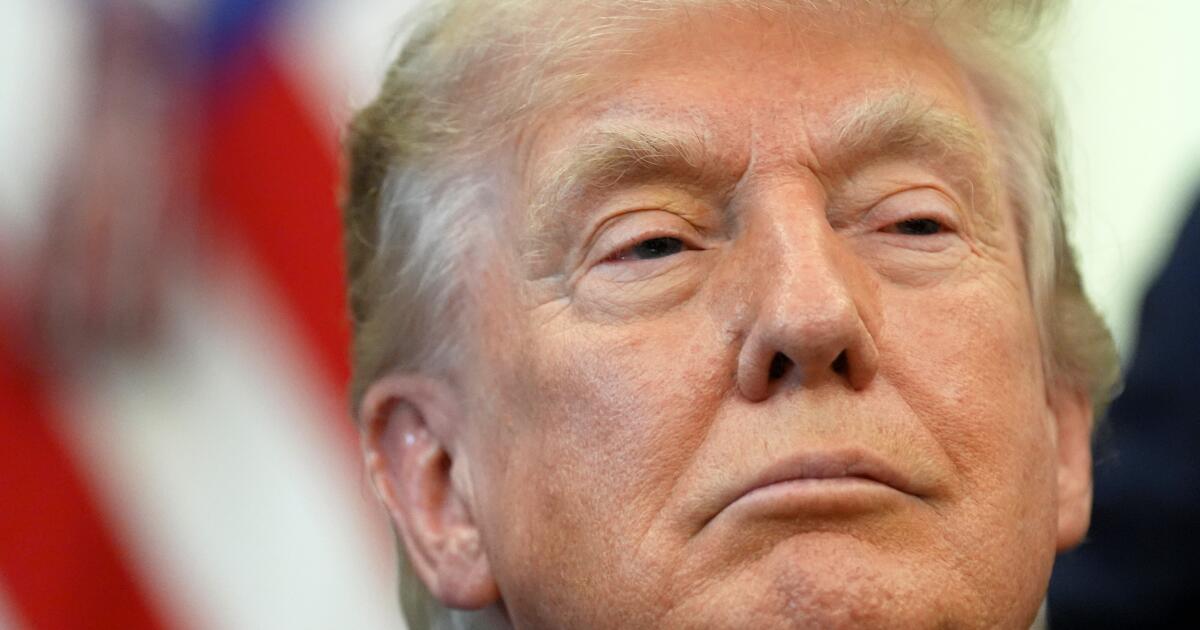
WASHINGTON — President Trump said Friday that a “swift and lethal kinetic” U.S. strike has killed Hector Rusthenford Guerrero Flores, whom he called “the infamous leader” of the Tren de Aragua gang.
Tren de Aragua has been labeled by the United States as a terrorist organization. Guerrero Flores was charged in a New York federal court with racketeering conspiracy and other crimes, including lending support to terrorists in crimes that stretched more than a decade, authorities announced in December.
Defense Secretary Pete Hegseth posted on X that the strike occurred earlier in the week on a Tren de Aragua compound in Venezuela.
U.S. Atty. Jay Clayton alleged at the time that the gang is responsible for countless acts of violence, extortion and drug trafficking in North America, South America and Europe. Trump nominated Clayton on Thursday to be director of national intelligence.
The U.S. State Department had offered rewards of up to $5 million for information leading to Guerrero Flores’ arrest.
In a post on his social media site, Trump wrote, “Tren de Aragua terrorists no longer have safe haven in Venezuela or anywhere else and, under my leadership, we will find these vicious murderers and drug lords anytime, anyplace, and send them to the depths of hell where they belong.” Trump’s post referred to Guerrero Flores by his alias, Niño Guerrero.
Hegseth said, “The operation underscores the shared U.S. and Venezuelan commitment to take the fight to narco-terrorists and deny them any safe haven in our hemisphere.”
Venezuela’s ministry of communications did not immediately respond to a request for comment on the operation.
Trump has taken a series of extraordinary actions against the gang, including a series of strikes on small boats his administration has accused of smuggling drugs to the U.S.. At least 207 people have been killed in boat strikes by the U.S. military in the eastern Pacific Ocean and Caribbean Sea since the Trump administration began the campaign in early September.
Independent investigations, by the Associated Press and others, have raised questions about the boat passengers’ alleged connection to drug trafficking. And, in any case, many legal experts say the boat attacks amount to extrajudicial killings in violation of international law.
Trump and administration officials have consistently blamed Tren de Aragua for being at the root of the violence and illicit drug dealing that plague some U.S. cities. The president spent months repeating the claim — contradicted by a declassified U.S. intelligence assessment — that Tren de Aragua had operated under Venezuelan President Nicolás Maduro’s control. The U.S. invaded Venezuela and seized Maduro in January to face U.S. drug charges.
Tren de Aragua originated more than a decade ago at an infamously lawless prison in Venezuela’s central state of Aragua. The gang has expanded in recent years as millions of Venezuelans migrated to other Latin American countries or the U.S. in search of better living conditions.
Guerrero Flores returned to the prison in Aragua on murder and other convictions in 2013, when Venezuela’s crisis began and corruption, mismanagement and a drop in crude prices wrecked the oil-dependent economy. Guerrero Flores and a few other inmates saw a profitable opportunity as the government neglected prisons.
They assumed control and administration of the prison, establishing a system that controlled the entire inmate population through force and extortion. Over time, they transformed the lockup into a sort of city that included a zoo, baseball field, casino and restaurants. Guerrero Flores had his own lavish suite.
The size of the gang is unclear. Countries with large populations of Venezuelan migrants, including Peru and Colombia, have accused the group of being behind a spree of violence in the region. Still, unlike other criminal organizations from Colombia, Brazil and Central America, Tren de Aragua has no large-scale involvement in smuggling cocaine across international borders, according to InSight Crime, a think tank that tracks crime across Latin America.
In Venezuela, gang leaders have long been known to participate in various illegal activities, including illicit gold mining.
Weissert writes for the Associated Press. AP writer Regina Garcia Cano in Mexico City contributed to this report.
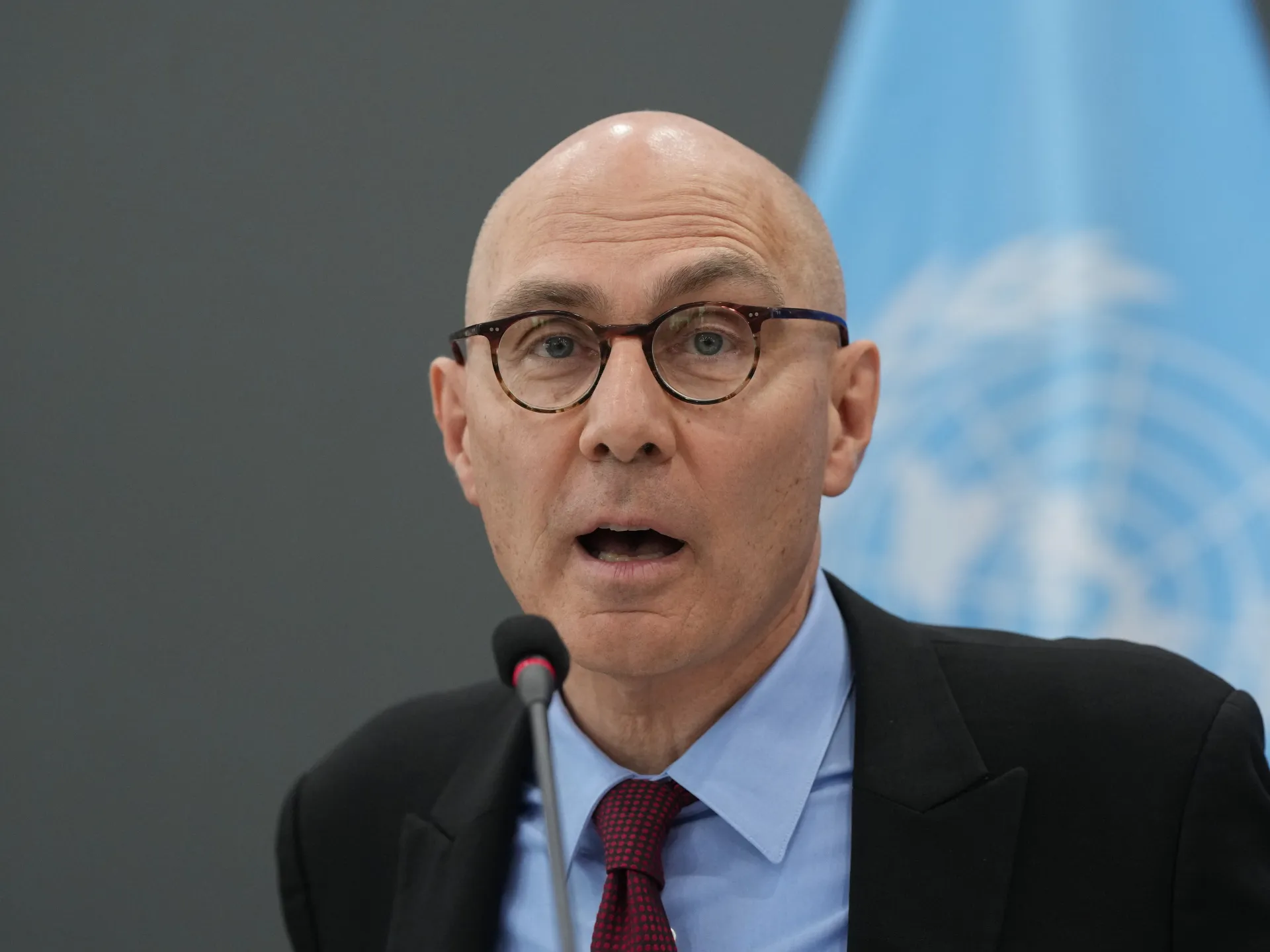
Volker Turk, the high commissioner for human rights at the United Nations, has issued some of his harshest criticism yet of the recent sanctions the United States has imposed on Cuba.
On Monday, Turk drew a line between the increasing restrictions on the Cuban economy and reports of heightened death rates, particularly among children.
Recommended Stories
list of 3 itemsend of list
“The fuel restrictions imposed since early 2026 and recent tightening of extraterritorial sanctions, taken together, are directly harming Cubans, especially the most vulnerable,” Turk said in a statement.
“Children are dying because doctors lack access to essential medical supplies and medicines. This is unacceptable.”
Such “severe sanctions”, he added, run contrary to the “basic principles of international human rights law”. He called for them to be “lifted immediately”.
Turk’s comments are a direct response to the suite of actions taken under US President Donald Trump to tighten pressure on Cuba, a Caribbean island that has already weathered a decades-long US trade embargo.
Starting in January, the Trump administration moved to cut off Cuba’s foreign oil supply, a linchpin for its ageing energy grid.
First, it severed supplies of oil and funds from Venezuela. Then, on January 29, Trump issued an executive order declaring Cuba to be an “unusual and extraordinary threat” to US national security. As such, he said, any country that supplied it with oil would be subject to steep tariffs.
In the months since, the Trump administration has continued to layer sanctions on Cuba. In May, for instance, penalties were announced against Cuba’s Interior Ministry, its National Police and its Directorate of Intelligence.
Those were followed this month by sanctions targeting Cuba’s president, Miguel Diaz-Canel, as well as members of his family.
The sanctions are designed to penalise those “responsible for repression” in Cuba, an island whose communist government has been accused of stifling dissent, as well as imprisoning and torturing activists.
Turk on Monday acknowledged Cuba’s human rights record and called on the country to “release all those arbitrarily detained”.
But he also pointed to the mounting death toll associated with the US sanctions, which have isolated the island country from much of the world.
The sanctions freeze any US-based assets the target may have, but they also prohibit entities from conducting business with the sanctioned parties. That can result in difficulties accessing global financial systems and other international platforms.
The de facto oil blockade has also resulted in the increasing frequency of power outages, and essential services like public transportation and medical care have faced reductions. Turk pointed to those downstream effects in his remarks.
“Cuba faces increasing isolation,” he said. “Companies are leaving. Fewer airlines fly to the country. It is almost disconnected from international payment systems.”
Turk’s office has also highlighted the human costs of the sanctions. According to the statistics it cited, infant death rates have doubled, reaching 9.9 for every 1,000 births. The survival rate for childhood cancer, meanwhile, has declined from 85 to 65 percent.
In March, the Cuban government also warned of medical needs going unanswered as a result of the energy shortage. It estimated that there was a backlog of 96,387 people awaiting surgery, 11,193 of whom were minors.
It also underscored that 16,000 patients needed radiotherapy, and another 2,888 required dialysis, two treatments that depend on steady electrical supplies.
Turk’s remarks also pointed to the risks posed by the Atlantic hurricane season and other natural disasters. Within hours of his remarks, western Cuba was rattled by a powerful 6.1-magnitude earthquake. Summer heat alone could cost lives, he explained.
“Rising summer temperatures risk increasing the spread of vector borne and waterborne diseases,” Turk said.
“The hurricane season further increases exposure. This creates a perfect storm for social and economic deterioration and suffering for the Cuban people.”
Trump has repeatedly suggested that he is considering military action in Cuba to remove its leadership after the US-Israel war on Iran reaches an end.
Since January, only one Russian oil tanker has been allowed to reach the island, leaving its foreign fuel supplies largely depleted.
Cuban President Miguel Diaz-Canel was slapped with sanctions by the United States on Thursday as Washington continued to ratchet up pressure of the island nation’s communist government. File Photo by Ley Royero/EPA-EFE
June 4 (UPI) — The United States on Thursday leveled sanctions against Cuban Miguel Díaz-Canel, members of former President Raul Castro‘s family, the Cuban military and other organizations as it continued a crackdown on the country’s communist government.
Secretary of State Marco Rubio announced the measures against Diaz-Canel the others in a statement, asserting they are being targeted because they “fund the [Cuban] regime and its efforts to mobilize its radical revolutionary movements in the United States and around the world.”
The Cuban president, Rubio said, poses a threat to U.S. national security, while the Ministry of the Revolutionary Armed Forces of Cuba, with its “many majority holdings and subsidiaries,” is also now “considered blocked.”
Other organizations newly added to the sanctions list are the Cuban Institute of Friendship with the Peoples, or ICAP, Amistur Cuba S.A., Committees for the Defense of the Revolution and Minera La Victoria S.A.
The individuals sanctioned include Alejandro Castro Espin, the former head of the Cuban intelligence services and the son of Raul Castro, and Raul Alejandro Castro Calis, Castro Espin’s son.
“For decades, Cuba has been the world capital for radical left-wing terrorism,” Rubio asserted. “The regime in Havana has recruited, trained and backed violent Marxist and ‘third-worldist’ movements across our hemisphere and beyond.
“Today, we are targeting the network that enables and funds Cuba’s subversive and radical operations.”
In a stated response, Diaz-Canel said the latest sanctions are “illegitimate” and are “aimed at reinforcing the blockade measures and the scenario of conflict between Cuba and the United States.
“This political blindness is added to the coercive measures applied in recent weeks against our country, designed to harm the Cuban people,” he added. “The aggressiveness and perversity of the Yankee government will clash with our determination to confront the worst scenarios and resist the imperialist onslaught.”
The newly issued sanctions are the latest in a series of moves designed to ratchet up pressure on the Cuban government.
The Trump administration has set a Friday deadline for foreign companies to sever ties with GAESA, the business conglomerate run by Cuba’s Armed Forces, sparking a mass exodus of tourism-related businesses from the island nation.
Meanwhile, Cuba is struggling with the effects of a January 2026 executive order issued by U.S. President Donald Trump imposing a fuel blockade against the nation on national security grounds.
The move has resulted in shortages of electricity, fuel, medicine and medical supplies across Cuba, according to the U.N. Office for the Coordination of Humanitarian Affairs and the World Health Organization, which says emergency care, blood banks, laboratories, immunization programs and maternal and child health services have all been “severely disrupted.”
Opposition leader and dozens of other defendants handed lengthy prison terms for ‘forming a terrorist alliance’.
Published On 3 Jun 20263 Jun 2026
A Tunisian court has handed down sentences ranging from 10 years to life imprisonment against opposition leader Rached Ghannouchi and dozens of other defendants in the so-called “secret apparatus” case involving the Ennahdha party.
The Tunis Court of First Instance on Tuesday sentenced Ghannouchi, the leader of Ennahdha and a former parliamentary speaker, to life in prison plus 30 years on terrorism-related charges, reported Tunis Afrique Presse, Tunisia’s official news agency.
Recommended Stories
list of 4 itemsend of list
Eleven other defendants, including Ali Laarayedh, an adviser to former Tunisian Prime Minister Ali Laarayedh, were handed life sentences in addition to prison terms of up to 96 years, Tunis Afrique Presse reported.
Thirteen others were handed prison terms of between 10 and 48 years, according to the news agency.
The court found Ghannouchi and the other defendants guilty of “forming a terrorist alliance” and other crimes, including “placing skills and expertise at the disposal of a terrorist alliance and of persons linked to terrorist crimes”, according to Tunis Afrique Presse.
The court ordered all defendants to be placed under administrative monitoring for five years.
Authorities opened the case against Ghannouchi and his co-defendants in early 2022 following a complaint by the public prosecutor’s office and lawyers for the families of leftist politicians Chokri Belaid and Mohamed Brahmi, vocal Ennahdha critics who were assassinated in 2013.
Lawyers representing Belaid and Brahmi’s families accused what they called Ennahda’s “secret apparatus” of involvement in the assassinations, as well as “conducting espionage and infiltrating state institutions”.
Ennahdha denied the allegations, describing them as “politically motivated”.
The public prosecutor’s office at the Ariana Court of First Instance initially took up the case, before handing it over to the judicial counterterrorism unit in 2023.
In April, Ennahdha said Ghannouchi had been urgently transferred from prison to hospital after a sharp deterioration in his health and called for his immediate release.
The opposition National Salvation Front also called for Ghannouchi’s release, citing his deteriorating health.
Tunisian security forces arrested Ghannouchi at his home during a Ramadan gathering in 2023, before a court of first instance ordered his imprisonment on charges of making statements that “incite chaos and disobedience”.
On April 15, a court sentenced Ghannouchi and three other Ennahdha leaders to 20 years in prison in what came to be known as the “Ramadan soirée case”.
Tunisian authorities have denied accusations that Ghannouchi and the other detainees are being held on political grounds.
India says it will continue engaging with Myanmar after Prime Minister Narendra Modi spoke with Min Aung Hlaing, the leader of the country’s military government, in New Delhi.
Indian Foreign Secretary Vikram Misri told reporters on Monday that India’s policy is “not intended to be a commentary on the internal political arrangements” in Myanmar and that New Delhi believes engagement is the best way forward.
Recommended Stories
list of 3 itemsend of list
Western nations have sought to isolate Myanmar’s military rulers since they overthrew the elected government of Aung San Suu Kyi in a 2021 coup that triggered a crackdown on opponents and a brutal civil war.
The conflict began when the country’s army leader, Min Aung Hlaing, ousted the government and detained civilian leaders, including Nobel Peace Prize laureate Aung San Suu Kyi.
Some critics and human rights groups have said Min Aung Hlaing’s visit to India risks lending legitimacy to the military-backed government.
“We have always proceeded on the principle that sustained dialogue is what is important,” Misri said, adding that isolating Myanmar would be counterproductive.
“History has shown that disengagement doesn’t give us any results that are better than engagement.”
The visit is Min Aung Hlaing’s first to India since he was sworn in as president in April following an election that critics say was designed to cement his hold on power. His last visit to India was in 2019, when he served as Myanmar’s military chief.
He arrived in India on Saturday, first in the eastern state of Bihar, with a visit to the Buddhist pilgrimage site of Bodh Gaya, where believers say that the Buddha attained enlightenment.
India shares a 1,643-kilometre (1,020-mile) border with Myanmar and a maritime boundary in the Bay of Bengal.
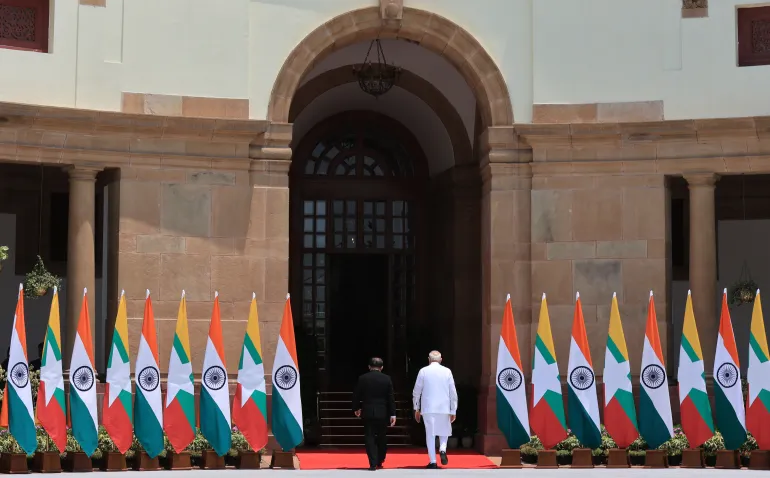
Narendra Modi (right) with Min Aung Hlaing (left) prior to their meeting at Hyderabad House in New Delhi [Rajat Gupta/EPA]
Strategic partnership
Myanmar is also strategically important to India’s security interests. The two countries have cooperated on border security and intelligence sharing to combat armed rebel groups.
Modi and Min Aung Hlaing did not address the media after their meeting, as usually occurs after most bilateral talks involving visiting heads of state or government in New Delhi.
But Misri said the two leaders discussed trade, defence and security cooperation, border management, and regional issues, with talks also focusing on expanding economic and technology ties. He said both sides agreed to deepen collaboration across sectors, including trade, energy and critical minerals, and to accelerate major connectivity projects.
Min Aung Hlaing is expected to hold talks with business representatives during his five-day visit, and will travel to the financial hub, Mumbai.
Bilateral trade was $1.95bn in 2025-2026, according to New Delhi.
The leaders also discussed cooperation against cybercrime and human trafficking, issues that have affected thousands of Indians lured to scam centres in the region.
Misri said India and Myanmar have worked together to rescue more than 2,400 Indian nationals over the past 18 months.
Resistance groups formed after the 2021 coup have captured swaths of Myanmar. Others sought out and fought under the leadership of ethnic armies in exchange for training and weapons with which to fight the military.
These resistance groups, known as the People’s Defence Force (PDF), nominally operate under the leadership of the National Unity Government (NUG), a shadow government formed by Myanmar lawmakers removed by the military coup.
Zin Mar Aung, the foreign minister of the NUG, wrote a letter to Subrahmanyam Jaishankar, the minister of external affairs for India, on May 28, expressing concern about the visit.
“Since the military coup of 2021, which overturned the democratic will of the people, Myanmar has endured prolonged conflict, instability, and immense humanitarian suffering,” she said.
“India has long championed democratic governance, the rule of law, and regional stability. We therefore urge the Government of India to weigh carefully the broader implications of formal engagement that may normalise or legitimise military rule in Myanmar.”
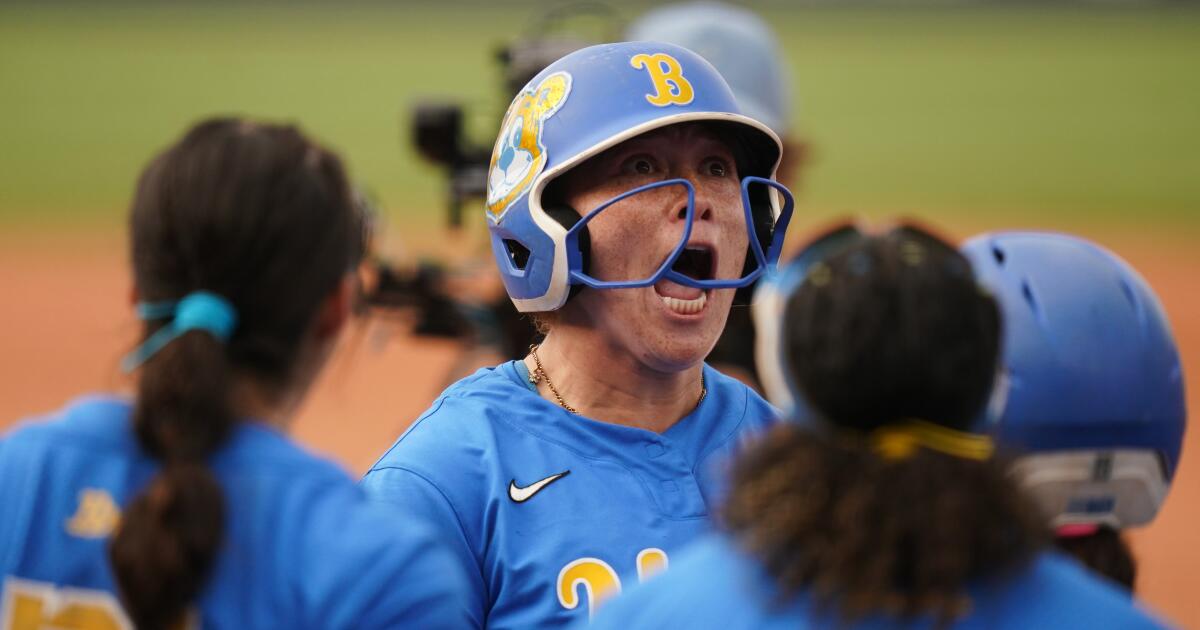
OKLAHOMA CITY — UCLA, facing elimination in the Women’s College World Series on Friday night, erupted for nine runs in the second inning against Arkansas and rolled to an 11-0 win in five innings that ended the Razorbacks’ first appearance on college softball’s biggest stage.
The Bruins (53-9) got home runs in the inning from Aleena Garcia, Soo-Jin Berry and Megan Grant — her 42nd of the season and the 91st of her career, a program record. Kaniya Bragg homered to right field in the top of the fifth to make it 11-0.
The Razorbacks (47-13) were limited to three hits in five innings by UCLA starter Taylor Tinsley.
UCLA will play another elimination game at 4 p.m. PT Sunday when the Bruins face either Texas Tech, the defending national runner-up, or Tennessee.
Arkansas starter Payton Burnham didn’t last long against UCLA’s powerful lineup.
Garcia homered to lead off the second. Burnham hit Bragg with a pitch, Alexis Ramirez singled, and Berry launched a homer to left field to make it 4-0.
Saylor Timmerman replaced Burnham and walked Jolyna Lamar and Rylee Slimp before Grant crushed a 260-foot no-doubter that hit a metal fence beyond the wall in left-center field.
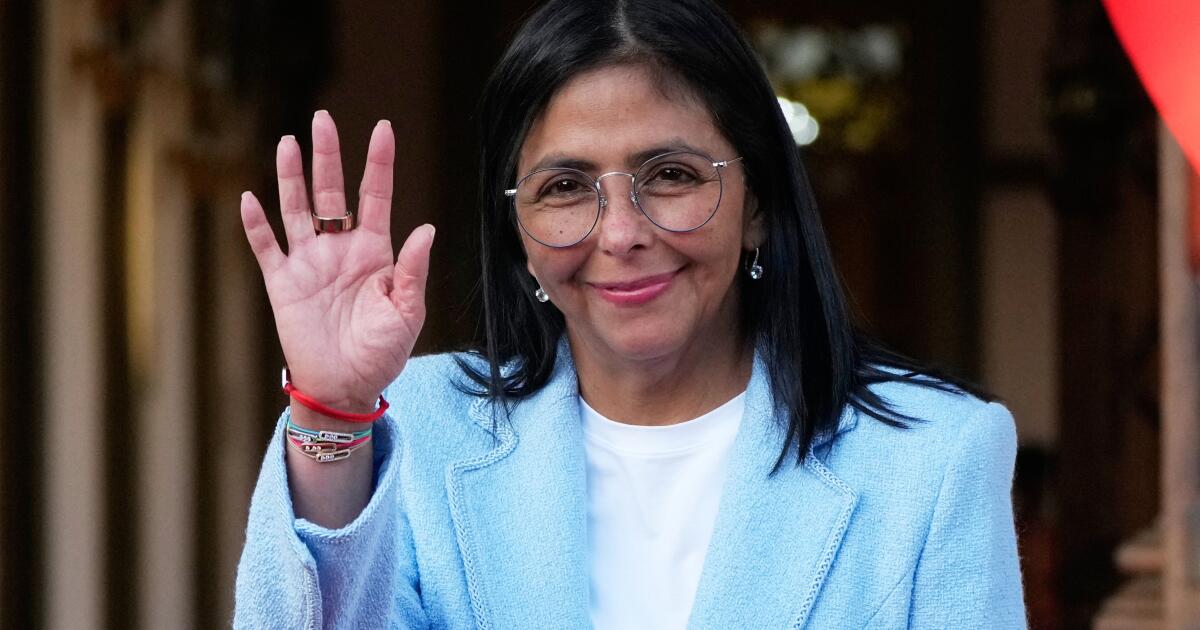
MIAMI — The Trump administration has quietly instructed federal prosecutors in Miami to avoid pursuing criminal investigations into Venezuela’s acting President Delcy Rodríguez, a longtime target of the U.S. Drug Enforcement Administration, according to current and former U.S. law enforcement officials, in the latest sign of warming relations between the White House and the oil-rich nation.
It’s unclear whether prosecutors had implicated Rodríguez in any crimes or whether investigators were moving toward an indictment. A Justice Department spokesperson said in an email “there was never an investigation into her to shut down.”
But DEA records obtained by the Associated Press earlier this year show she consistently surfaced on the radar of federal law enforcement dating to at least 2018, though she has never been criminally charged in the U.S. like several other senior Venezuelan officials.
The directive to pause scrutiny into Rodríguez was meant to avoid upsetting the administration’s efforts to stabilize Venezuela after the capture of her predecessor, Nicolás Maduro, among other reasons, a current official said. It was not clear whether the White House, which deferred comment to the Justice Department, was involved in the decision.
“Everybody has been told to stand down,” one of the former officials said.
The former officials, who had been briefed on the development, as well as the current official all spoke to the Associated Press on condition of anonymity because they were not authorized to publicly discuss internal deliberations.
Rodríguez, a U.S. attorney representing her and the Venezuelan Communications Ministry didn’t respond to requests for comment.
The move eases pressure on Rodriguez
Removing the threat of potential indictment, even temporarily, eases pressure on Rodríguez as the Trump administration seeks to work with the acting leader to stabilize Venezuela after Maduro’s ouster and open the country to U.S. investment.
President Trump praised Rodríguez as a “terrific person” shortly after the U.S. military took Maduro and his wife to New York to face federal narcotics charges. Both have pleaded not guilty.
In recent months, the U.S. has lifted sanctions against Rodríguez and recognized her as Venezuela’s sole head of state, allowing her to re-establish ties with western banks and more freely work with U.S. investors seeking to tap into the world’s largest petroleum reserves. As ties between the two governments have deepened, some have held out the Venezuelan playbook — characterized by oil blockades, indictments of top leaders and threats of military intervention — as a model to drive regime change from within as the U.S. pressures other longtime adversaries in Iran and Cuba.
Rodríguez and her brother, Jorge Rodríguez, the head of the National Assembly, were hit with U.S. sanctions during Trump’s first term for their role in undermining Venezuelan democracy and cementing Maduro’s authoritarian rule.
Rodríguez “is doing a great job,” Trump wrote on social media in early March. “The Oil is beginning to flow, and the professionalism and dedication between both Countries is a very nice thing to see!”
In recent months, Rodríguez has hosted ceremonies with a steady stream of American oilmen, some of them partaking in high-profile delegations led by U.S. Energy Secretary Chris Wright and Secretary of the Interior Doug Burgum.
Election talk deferred amid Trump’s praise
Missing in all the mutual backslapping is any talk of elections, even as Rodríguez last month blew through a 90-day limit set by Venezuela’s high court to fill Maduro’s position on a temporary basis.
“I don’t know,” she responded in English when a visiting U.S. journalist earlier this month shouted out a question about her time frame for holding elections. “Some time.”
Sen. Jeanne Shaheen of New Hampshire, the top Democrat on the Senate Foreign Relations Committee, has demanded the administration explain its favorable treatment of Rodríguez, calling her a “central figure in Nicolás Maduro’s repressive regime.”
“Sanctions have been lifted on Ms. Rodríguez without any indication that she has taken concrete and meaningful actions to restore democratic order,” Sheehan, joined by Sen. Elizabeth Warren of Massachusetts, wrote in a letter to Secretary of State Marco Rubio and Secretary of Treasury Scott Bessent last week.
Rick de la Torre, a former CIA chief of station in Caracas, said that the decision to shield Rodríguez fits well with the Trump administration’s foreign policy goals in Venezuela.
“She’s a lifelong Marxist and was a senior leader of one of the world’s most corrupt regimes but the U.S. is providing her with breathing space and carrots to lay the foundation for democracy and U.S. investment,” said de la Torre, the CEO of Tower Strategy, which advises companies on Venezuela.
“There’s a shelf life to her utility, however. At some point she will face justice,” he added.
Rodríguez has been on DEA’s radar since 2018
The DEA had amassed a detailed intelligence file on Rodríguez dating to at least 2018, and has received allegations about her ranging from drug trafficking to gold smuggling, the AP reported earlier this year. One confidential informant told the DEA in early 2021 that Rodríguez was using hotels in the Caribbean resort of Isla Margarita “as a front to launder money,” the records show.
Her name has surfaced in nearly a dozen DEA investigations — several of which remained ongoing as recently as this year — involving field offices from Paraguay and Ecuador to Phoenix and New York. She had even been linked to Maduro’s alleged bag man, Alex Saab, whom U.S. authorities first arrested in 2020 on money-laundering charges, the records show.
Rodríguez deported Saab this month as part of a purge of insider businessmen who are accused of having enriched themselves through corrupt dealings with Maduro.
It’s unclear in which Miami investigations Rodríguez’s name surfaced. Two of the former officials said Rodríguez has also come up in meetings with investigators in Tampa, Fla., tasked last year by former Atty. Gen. Pam Bondi with looking into financial crimes in Venezuela.
At the time, Rodríguez was serving as Maduro’s vice president. Justice Department policy requires the attorney general to personally approve the charging of any foreign head of state, who are normally immune from prosecution under international and U.S. law.
Halting high-profile criminal probes of foreign leaders
The pausing of the investigations into Rodríguez comes as the Trump administration has similarly tapped the brakes on ongoing federal investigations into another prominent Latin American leftist, Colombian President Gustavo Petro.
The DEA had also designated Petro a “priority target” over alleged ties to drug traffickers that had been probed for months by federal prosecutors. The New York Times reported in March that U.S. officials recently assured the Colombian government Petro does not face charges in those cases.
Duncan Levin, a former prosecutor who worked for the U.S. attorney’s office in Brooklyn, said it would be “deeply troubling” for law enforcement to be “told to stand down from a legitimate investigation for political or transactional reasons.”
“The White House cannot use criminal enforcement as a diplomatic light switch,” Levin told AP. “DOJ decisions are supposed to be based on law, evidence, policy and public safety — not on whether a foreign official is useful to the administration at a given moment.”
Goodman, Richer and Mustian write for the Associated Press. Richer reported from Washington and Mustian from New York. AP Writer Regina Garcia Cano in Mexico City contributed to this report.
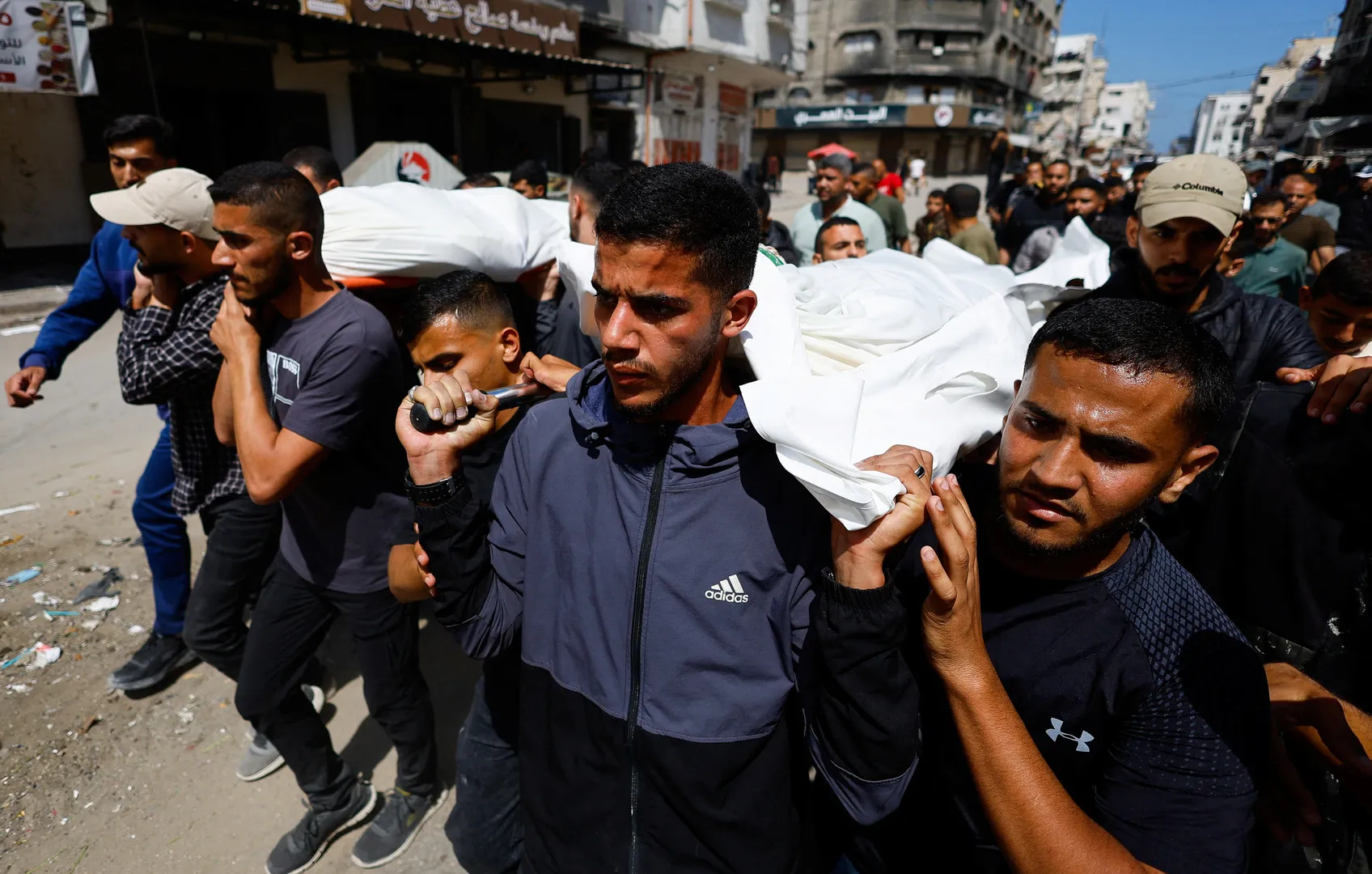
A funeral has been held for Mohammed Odeh, believed to be the leader of Hamas’s military wing, who Israel said was killed in a strike on a busy area in Gaza City on Tuesday. Odeh’s family has reportedly confirmed his death, despite no official comment from Hamas.
May 27 (UPI) — The Israeli Defense Force said Wednesday that it has killed Mohammed Odeh, a senior commander in Hamas‘ military, during a strike in northern Gaza.
An airstrike in Gaza City hit a residential building Tuesday and also killed at least three Palestinians while injuring dozens more. It struck the upper three floors of the al-Kayali building above a busy shopping area in the center of the city.
The IDF claims the residential building was used by Odeh as a hideout.
The area of the strike was busy as shoppers prepared for Eid al-Adha, a Muslim holiday that began on Wednesday.
“The commander of Hamas terror [organization’s] military arm number 4 in Gaza was eliminated yesterday and sent to meet his partners in the depths of hell,” Israel Katz, Israeli Defense Minister, posted on social media.
The IDF said it had been tracking Odeh for months leading to the airstrike.
More than 900 Palestinians have been killed in Gaza since Israel and Palestine reached a ceasefire agreement enacted on Oct. 11. The Gaza Ministry of Health reports that 72,803 Palestinians have been killed in the war since Oct. 7, 2023.
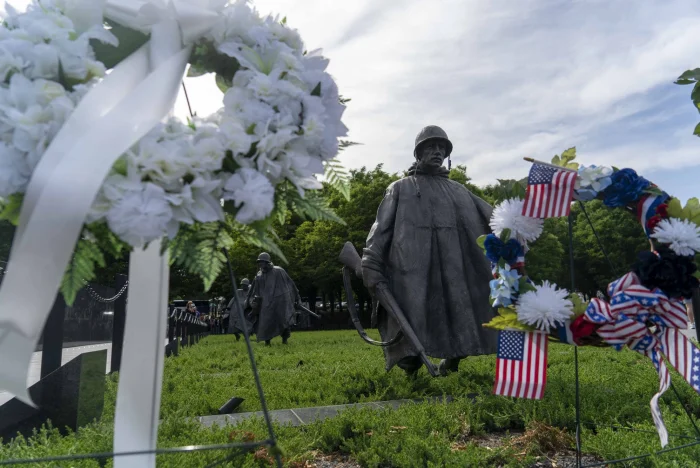
Wreathes are seen amongst the statues at the Korean War Veterans Memorial during Memorial Day weekend in Washington on May 27, 2023. Memorial Day, which honors U.S. military personnel who died while in service, is held on the last Monday of May. Photo by Bonnie Cash/UPI | License Photo
PALM SPRINGS — Barry Manilow steers a golf cart to the end of a long driveway, pulls to a stop and flings a plush toy goose across a manicured lawn to the delight of his two Labrador retrievers.
“OK, where we doing this?” the 82-year-old singer asks about our interview. Dressed in a khaki shirt and slim-fitting rust-colored trousers, he’s got the look of a man prepared to undertake some très chic brush clearance; in reality, he’s motored down here merely to answer questions about his fabulous life and career.
Manilow and his husband and longtime manager, Garry Kief, moved to this sprawling desert estate from Los Angeles in the late 1990s. “We kept coming out, and it’s so beautiful that eventually we said, ‘Screw it — let’s just stay,’” he says. By then, Manilow had long since established himself as one of music’s premier showmen, with a Grammy Award, 11 Top 10 hits and a storied 15-night run at L.A.’s Greek Theatre under his belt.
So you might’ve taken Palm Springs as a sign that he was ready to slow down. Instead, he launched a residency at the Las Vegas Hilton in 2005 that eventually surpassed the length of Elvis Presley’s show there; in 2006, he released “The Greatest Songs of the Fifties,” which went platinum and spawned a series of successful follow-up albums.
Last month, Sabrina Carpenter interpolated a bit of Manilow’s iconic “Copacabana (At the Copa)” into her headlining set at Coachella just days before he was honored by the American Advertising Federation for his work writing commercial jingles. The range of those achievements said something about his blend of music-nerd craft and pop-star razzle-dazzle.
“Barry loves music as much as anyone I’ve ever known,” says Bette Midler, who hired Manilow as her pianist for the name-making gig she played at New York’s Continental Baths in the early 1970s. Performing, Midler adds, “isn’t a job with him — it’s a vocation, a calling.”
Yet now that calling faces a threat. In December, Manilow announced that he’d been diagnosed with lung cancer and that surgery would require him to postpone a number of concert dates; five months later, he has yet to return to the stage — the longest break, COVID-19 aside, he can remember taking in decades.
Fortunately for Manilow, he has a new album, “What a Time,” with which to occupy himself. Due June 5, it consists mostly of original material — his first such LP in nearly 15 years — though it opens with a sumptuous rendition of Peter Allen and Dean Pitchford’s “Once Before I Go.” Manilow notes proudly that the song, which was produced by Kenneth “Babyface” Edmonds, recently made Billboard’s adult contemporary chart, extending his run on that tally beyond the half-century mark.
Barry Manilow performs in Beverly Hills in 2025.
(Gina Ferazzi / Los Angeles Times)
Still, performing is clearly on his mind as he leads me into a tile-roofed gym equipped with weights, a treadmill and a massage table. Manilow has been working out here every morning, he says, to regain the strength needed for his show; he’s got Vegas dates on the books for July but admits he’s unsure whether they’ll happen or not. We settle into two leather club chairs, his dogs Jake and Abby at his feet.
“Please be brilliant,” he tells me. “Don’t be boring.”
What are you doing on a day you’re not working? Working.
I see. Since the surgery, I can’t go on the road. Ninety minutes of screaming in tune, which is what I do for a living — I’m not up for that yet. I will be, but it’s taking a long time to get my voice back. They warned me that I’d have to learn to breathe again. So these days, I get up, I go to my piano and I try to be creative. Before I know it, the afternoon’s over.
Was the diagnosis a shock? Imagine your doctor saying, “You’ve got lung cancer.”
Fair enough. I’ll tell you the story. I have terrible hips — bursitis and everything — and they hurt so bad that I thought maybe I broke a bone or something. So I asked my wonderful family doctor, I said, “Can you just do one of those MRIs and see?” Now, before that, I’d had two bad bouts of bronchitis, one after the next. Have you ever had bronchitis?
I have. It stinks. So I asked him if he could check my hip, and he told the guys that were doing it, “Why don’t you check his lungs?” And I think he might have saved my life because they found a big black thing in my chest. One doctor said it was probably remnants of the bronchitis, the other doctor said it could be cancer. I voted for the bronchitis. But they went back in to see and it was a cancerous tumor.
How’d you react? When they told me, I was on the road, and I just went back to sound check. What else could I do? I never thought cancer would get me — it wasn’t in the cards. They wanted to get rid of it as soon as possible, so we made a deal: I’d finish the couple of weeks of shows that I had, then I’d go to the hospital and they’d remove it. It was supposed to be a no-brainer — it hadn’t spread yet, thank goodness. But then my AFib kicked in and acid reflux kicked in and pneumonia kicked in. They rushed me to the ICU for seven days.
Barry Manilow with Dionne Warwick in Los Angeles in 1985.
(Paul Harris / Getty Images)
Sorry to be morbid, but were you close to death? They said at one point — I didn’t hear them say this but I heard that they did say it — “We don’t want to lose him.” It’s all a total blur now. When they finally brought me back to my lovely room at the Eisenhower [medical center], I weighed 128 pounds.
How long you figure it had been since you weighed 128 pounds? I don’t remember ever being 128.
You said you never thought cancer would get you. Why? I’m too busy. Pretty stupid. What I realized is that I’ve always been the leader — leader of the band, leader of an audience — but I wasn’t the leader of this one. That was a big lesson for me. I had to rely on everybody else. Nurses, doctors, friends — you should see some of the notes people have sent.
What’s it been like to be offstage for so long? Agony. Make an album, go on the road, come back, make an album, go on the road — that’s what my life’s been for years. And I like it. Now I just have to get better and do what the doctors are telling me. It’s the only way out.
Well, there’s one other way. I’m not ready to croak. But I wasn’t ready to stop performing either, and it just went like that [snaps fingers]. The day before surgery, people are screaming, standing ovation, band sounds great. Next day I’m packing to go to the hospital.
Are you working with a vocal coach? Yep. But I get winded just walking down the hallway. I turn on my old records and sing along, and three songs in I’m like [pants].
Could you do a show where you skip the uptempos? No “It’s a Miracle” or “Copacabana”? I’m trying ballads too — my ballads end big.
Are you allowed to smoke or drink? I stopped smoking many, many years ago. I vape but hardly — I just like holding it. I was a great smoker. Brooklyn in the ’50s? Please. I started smoking when I was 9. I got up to three packs of Pall Mall non-filters a day, and it never bothered me — never had any problem breathing. I was just a skinny piano player who smoked. That’s who I am. That’s who I was.
Before he was a skinny piano player, he was a skinny accordion player.
Manilow grew up poor in Brooklyn, the only son of a Jewish mother and an Irish father who split up right after he was born. As a kid he entertained his mom and his maternal grandparents by squeezing out the Jewish folk song “Hava Nagila”; later, his stepfather brought home records by Gerry Mulligan and Judy Garland that opened his mind to jazz and pop.
He says today that he never saw himself as a performer — he wanted to write, arrange, produce. His first success came with jingles for brands like State Farm — “Like a Good Neighbor” is his handiwork — and Band-Aid.
“My ideas were good for pop music because of the commercials,” he says. “The rules are pretty much the same — you need to grab the listener as soon as possible. For a commercial, you’ve got about five seconds. For a pop song, you’ve got 10.”
In 1971, Manilow got the job with Midler and ended up working on her million-selling debut, “The Divine Miss M,” which led to a deal of Manilow’s own with Clive Davis’ Arista Records. Despite Manilow’s insistence that he was a behind-the-scenes guy, he scored a No. 1 hit out of the box with the plaintive “Mandy,” then quickly followed that with another chart-topper, “I Write the Songs” — a pop-philosophical epic, as nobody’s tired of pointing out ever since, that Manilow didn’t actually write.
Barry Manilow at home in Palm Springs.
(Christina House / Los Angeles Times)
Bruce Johnston, who wrote “I Write the Songs” — and won a Grammy for song of the year thanks to Manilow’s recording — says the key to Manilow’s performance is that “he’s never too cool for school.” A Beach Boy for six decades until he retired from the band this year, Johnston adds that Manilow’s rendition of the song, which was also cut by Captain & Tennille and David Cassidy, “is the only one I care about, honestly. He really grabbed it — he’s just as real as he could be.”
After several more Manilow hits — “Tryin’ to Get the Feeling Again,” “Weekend in New England,” “Looks Like We Made It” — Davis asked the singer to produce a would-be comeback album by his latest Arista signing, Dionne Warwick. Warwick’s initial reaction to that idea: “Really?” she says with a laugh. “Did Barry Manilow really know anything about Dionne Warwick? As it turned out, he knew quite a bit,” adds Warwick, who recalls turning up for their first session to discover that Manilow had laid every one of her albums on his piano. “He was letting me know: I know you,” she says.
“Dionne,” the album they made together, went on to win a pair of Grammys and spun off silky hit singles including “Deja Vu” and “I’ll Never Love This Way Again” that reinvigorated Warwick’s career and helped solidify Manilow’s standing as a kind of soft-rock auteur.
Which isn’t to say that rock’s intelligentsia ever viewed him kindly. Though his best music finds an emotional truth in over-the-top theatrics, critics routinely dismissed Manilow as a lightweight or a schlockmeister; even now, he seems an unlikely candidate for the Rock & Roll Hall of Fame, where he’s been eligible for induction for decades.
Manilow, who entered the Songwriters Hall of Fame in 2002, insists the slights don’t bother him. “I’ve never been one of the guys,” he says. We’ve been talking for a while, and because of the bursitis, perhaps, he’s hoisted one of his legs over the arm of his chair. “I don’t think about awards and parties and stuff like that. I’m very lucky — I live in the most gorgeous place I’ve ever seen and I have the most wonderful partner that you can imagine. I’m grateful he’s chosen to share his life with me. We’ve been together for over 46 years, and we still laugh and we still love each other. That’s the greatest award I’ll ever get.”
Manilow and Kief married in 2014; the singer came out as gay three years later. (Manilow was briefly married to his high school girlfriend, Susan Deixler, in the mid-1960s.) Has he found that the world looks at him differently since he came out?
“It was a non-event. Nobody gave a s—,” he says. “They all knew. I never really hid it, but in the ’70s and ’80s, that would have killed the career, and I didn’t want to do that. So I just never talked about it.” He smiles.
“Garry and I are just two guys that live in a house on a hill with two dogs that we love.”
Like many of Manilow’s hits, “Once Before I Go” was Davis’ idea.
Allen, the late Australian entertainer portrayed by Hugh Jackman in Broadway’s Tony-winning “The Boy From Oz,” had played the tune for Manilow in the early ’80s. “And I loved it,” Manilow says now. “But I was too young to sing a song like that — that song needs age to be able to pull it off honestly.”
Davis first suggested that Manilow perform it in his set at the post-pandemic We Love NYC concert that Davis put on in Central Park in 2021. After the show, which was called off due to weather as Manilow sang “Can’t Smile Without You,” Davis repeatedly advised the singer to record it.
Clive Davis, left, with Barry Manilow at an Arista Records party in Los Angeles in 1989.
(Lester Cohen / Getty Images)
“I don’t know, he had a bug up his ass,” Manilow says. “He loved it, and he loved it for me. And I’m not even on his record label anymore — he’s just a friend at this point. But he was right once again.”
Given the cancer diagnosis, did Manilow worry that fans might interpret the song — a teary goodbye from a well-wishing lover — as a more permanent farewell?
“Not one time has anybody said, ‘Is he talking about dying?’”
You wouldn’t necessarily call “What a Time” a concept album, though many of the songs ponder the ways memory and history can shape a romance. Manilow knows he’s regarded as a singles act but says that putting together LPs is what he’s always enjoyed best. His favorite is 1984’s jazzy “2:00 AM Paradise Cafe,” on which he collaborated with Mulligan, Sarah Vaughan and Mel Tormé.
“That was one where the critics who’d been killing me, they didn’t know I was capable of doing something like that,” he says. “But frankly, I’d been surprised that I was capable of doing the pop stuff.”
You made records of hits from the ’50s, ’60s, ’70s and ’80s. Why’d you stop before “The Greatest Songs of the Nineties”? Were there songs in the ’90s?
Barry. Didn’t it start to go downhill?
I can think of a handful of classics by Whitney Houston alone. You can’t touch those. I’m a good arranger, but you can’t top those records. Maybe four of those albums was enough. I was ready to go back to writing.
You’ve said the problem with modern pop is that there’s no melody anymore. That’s what I miss. Clive’s been pushing me to do “The Great New American Songbook.”
Like he did with Johnny Mathis a few years ago. So I’ve been studying the Top 20. The one I like is Lady Gaga and Bruno Mars.
“Die With a Smile.” Love that. But the way they’re writing songs these days is not the way I know how to write songs. They don’t do a verse, a chorus, a bridge, a chorus, a big ending. To me, when I listen, the songs feel like run-on sentences.
Barry Manilow with his dog Abby.
(Christina House / Los Angeles Times)
I was trying to think of artists older than you who are still performing. Name me one.
You’re invoking the widely held assumption that he lip syncs. I loved Frankie Valli and the Four Seasons. Who didn’t?
Would you ever lip sync? I’m terrible at it. I try now and again.
Do you find it morally objectionable? Depends on the artist. I like being in the moment, not knowing what’s gonna happen in the next bar or at the ending. It’s exciting to me to see if I can make those high notes.
Would not being able to make them mean it’s time to hang it up? Well, what’s happening right now, I’m on the verge. But I’m getting stronger, so maybe I don’t have to hang it up yet. I look fantastic, but I’m a hundred years old, right? I don’t know how that happened, by the way — I don’t get Botox or anything.
You’ve had no work done? No! I must say: There was one time when we lived in L.A. that I did do a facelift. But after that it’s just been a little here, a little there.
Wait, I asked you — “Work” is like a facelift, and I only had one of those. The rest of it — I see something falling down, sure, I’ll do that. I’m as vain as anybody else. One of my old friends, his mother said, “I always knew he was talented, but when did he get so handsome?”
FinVolution Group (FINV) has announced a new share repurchase program, effective from May 30, 2026, that allows the company to buy back up to $150 million in shares, including American Depositary Shares (ADSs), from May 30, 2026, to May 29, 2028.
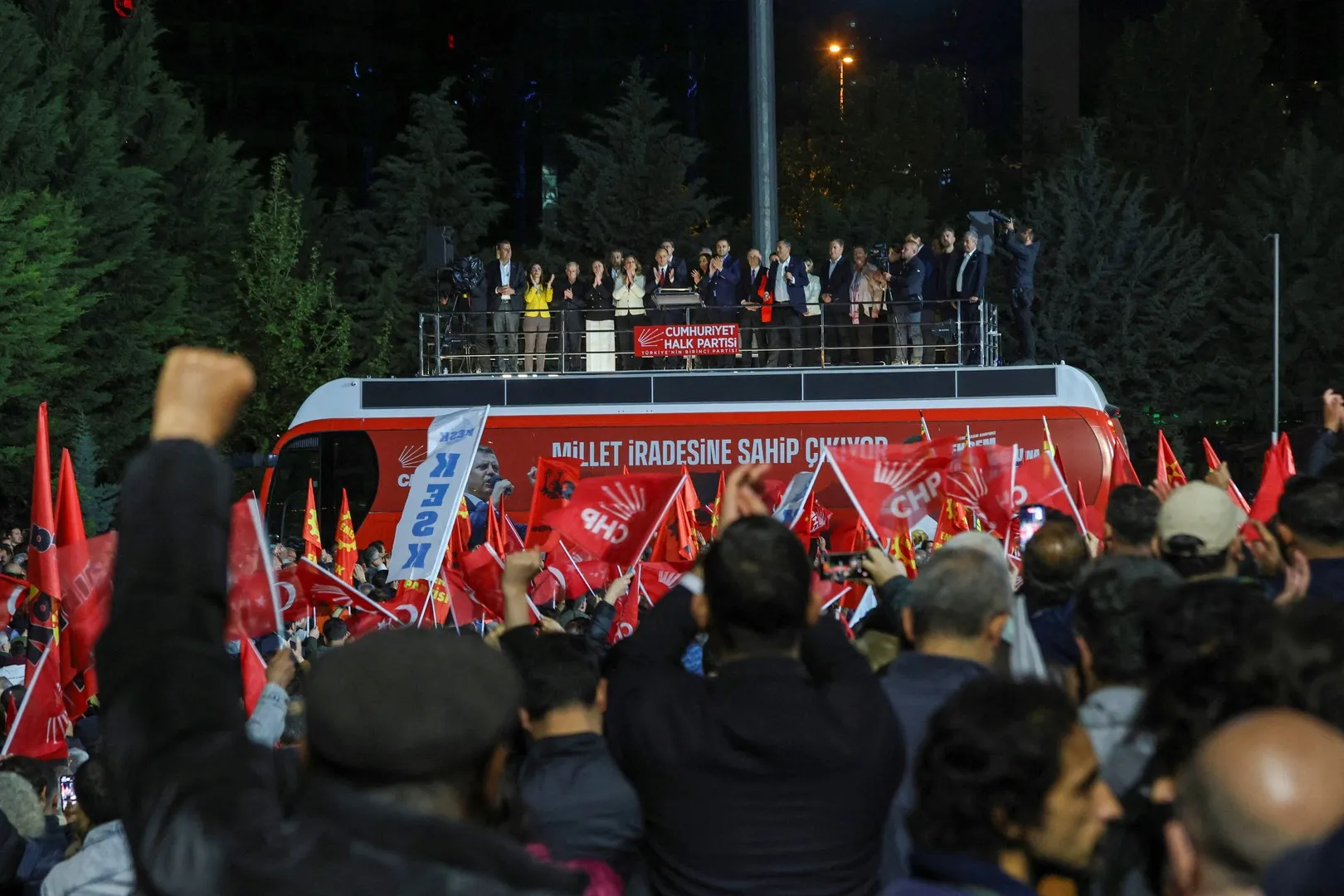
Turkiye’s main opposition leader Ozgur Ozel has vowed not to leave party headquarters after a court ruling removed him from power. Speaking to supporters in Ankara, Ozel accused judges and prosecutors of carrying out a coup attempt against his party.