
last decade

Christmas came early with Dem midterm wins. Time to put up the tree.

Is it too early to put up the Christmas tree?

I get it. We’re barely into November. You haven’t put away the Halloween décor yet, even though you finished eating all the leftover candy (even those off-brand Whoppers) days ago.

But for many of us, the most wonderful time of the year arrived early, on Nov. 3, with the midterm election rebuke of corruption, unnecessary wars, cruelty, racism, misogyny, taxpayer-funded vanity projects, and the soaring cost of just about everything.

Democrats flipped the House, the Senate, governorships and state houses in areas that were once as red as the stiff holiday dress mom forced you to wear to the school pageant.

And I did wear that dress, even though I’m an Ali. Muslims can be just as secular as any other faith. My dad, an Iraqi Shiite, bought a live tree every year. My mom, an Anglo Cali girl who was raised Protestant, taught him — and her kids — how to string the lights, space out the ornaments and delicately hang the tinsel rather than throw it on in clumps (chucking it was way more fun, of course).

Supporters of Democratic Senate candidate James Talarico cheer as they watch midterm election returns come in.

Supporters of Texas Democratic Senate candidate James Talarico cheer as they watch midterm election returns come in.

(Chip Somodevilla / Getty Images)

Christmas equaled happiness. It still does.

I’m the weirdo who listens to Christmas music year-round, particularly when times get tough. Suffice to say that over the last decade, there’s been a lot of yuletide listening in July, or May, or whenever it felt like the implosion of democracy and the rise of something much darker was too much to handle without the buoyant cheer of Gene Autry’s “Rudolph the Red-Nosed Reindeer” or the soothing calm of Burl Ives “Silent Night.”

They got me through a lot: The Muslim ban. Brett Kavanaugh’s SCOTUS hearing. The abortion ban. Gutting the Voting Rights Act. January 6th. Gaza. DOGE. Bombing a school in Iran. ICE sweeps, deportations and killings. The stupid ballroom. The stupid Melania documentary.

Vince Guaraldi’s “Skating” didn’t do much to stop the Big Lie or expose the contents of the Epstein Files, but it did offer a small dose of joy when there was little to be found.

There are others out there like me, who’ve let it slip that they were listening to the London Philharmonic’s “Carol of the Bells” deep into summer because they needed to. It was paramount to their mental health.

The irony is that over the years, angry readers and trolls have accused me of wanting to “cancel Christmas” because my writing, or mere existence, challenged their idea of what American faith is, or should be. As if there was only one, and everyone practiced it.

If only I’d sent them back a musical Christmas card. The tune would be Booker T. & the M.G.’s jaunty version of “Jingle Bells.” The message: “Peace on earth, good will toward men, women, and non-binary.”

Why do the best comebacks always arrive after the fact?

Before anyone takes offense, I’m wholly aware there is a much deeper meaning behind the holiday, and I respect that. My warm and fuzzy feelings for the C9 incandescent bulb and my Mr. Christmas magnetized skating rink are just that, feelings. They come in handy when a safe harbor is needed.

For example: Defense Secretary Pete Hegseth announces that the government plans to livestream an execution. Seek refuge in Johnny Mathis’ “Calypso Noel.”

Let’s get back to the tree.

Our 7.5-foot Vickerman White Spruce with 750 multicolored LED bulbs with an easy to assemble, snap-in trunk has been up the day after Thanksgiving every year since 2016, when President Trump won his first term, and my first assignment as a critic was to cover his inauguration. Like “Mame,” I just needed a little Christmas! Right that very minute!

To be fair, he had yet to prove himself. But there were clues to how bad things might get should he win: He initially declined to disavow an endorsement from former Ku Klux Klan leader David Duke. He boasted on a hot mic about sexually assaulting women. He refused to publicly release his tax returns, as if there was something to hide.

With each passing year of MAGA toxicity, I kept the tree up a little longer and made Valentine’s Day a reasonable cut-off date.

My reasons are different for wanting to put the tree up now, well before Thanksgiving, let alone Christmas. It’s not about bringing me joy, but about reflecting how good it feels now that the country stands a chance of repairing the damage from a decade of Trumpism. MAGA is falling. Hegseth is headed toward impeachment. Tesla has ended production of the Cybertruck.

Cue the music. Plug in the tree. It’s never too early to celebrate.
Source link

Why you should drive Highway 120 this fall

This road trip continues a series exploring California’s overlooked scenic highways, inspired in part by artist Earl Thollander’s 1971“Back Roads of California,” whose sketches and travel notes celebrated a slower way of traveling. After tracing Highway 127 along the edge of Death Valley and State Route 78 through the badlands of Anza Borrego, the journey now shifts to the north.

If you’ve ever found yourself driving along Highway 395, chances are good you’ve been craning your head west toward the Range of Light, staring at the formidable granite peaks of the Sierra Nevada.

I wouldn’t blame you.

The escarpment rises precipitously from the sagebrush-covered valley floor, climbing through pinyon and juniper woodlands into thick pine forests. Deep, twisted canyons cut into the mountainsides, their channels lined with aspen, before the forests give way to the exposed granite slopes and summits rising above 14,000 feet.

While I’ve spent countless days wandering that high country, camping in its meadows and watching shooting stars rip across the sky, I’ve spent the last decade driving up the 395 with my eyes fixed to the east. Here, the Sierra Nevada gives way to the sand-colored mountains and salty lakes of the Basin and Range, the arid region writer Mary Austin called the “country of lost borders.”

Much of this vast landscape is public land managed by the Bureau of Land Management, some of the least understood and most threatened public lands in the West. These are places I’ve traversed, documented and obsessed over for years, culminating in my book “The Enduring Wild.”

A view of Adobe Valley on River Spring Road off of Highway 120.

A view of Adobe Valley on River Spring Road off of Highway 120.

(Josh Jackson)

There are many routes that can take you east from the 395 and deep into the parched heart of these landscapes, but there is one route that stands above the rest. It’s what locals call Mono Mills Road and what road warriors nicknamed the “roller coaster highway” for its stomach-lifting undulations.

Welcome to State Route 120 East.

With the highway typically closing for the winter in December, there’s still time to experience this remarkable stretch of road before the snow arrives. The 45-mile route begins a few miles south of Lee Vining, where big sagebrush and rubber rabbitbrush paint the early miles in olive green and mustard yellow, a rich palette against the muted gravelly slopes of the Mono-Inyo Craters, a 25-mile-long volcanic chain of young rhyolite lava domes.

Soon, the highway cuts through miles of gray and white volcanic pumice and ash, creating a lunar-like landscape that manages to confuse the visual senses. Almost nothing grows here except the resilient Jeffrey pine, with its deep taproot and remarkably low metabolic demand. Each tree stands alone, as if carefully placed on the landscape. You can’t help but pull over and wander through the scratch-and-sniff trees, their bark releasing the scent of vanilla and butterscotch.

Ever present to the south, Mono Lake dominates the view from the highway. Its waters are part of the ancestral homeland of the Kootzaduka’a, whose name, meaning “brine fly eaters,” reflects their longstanding relationship with the lake and its ecology. My favorite time to visit is in late summer and fall, when migratory birds converge on the lake to feast on its abundant brine shrimp and alkali flies. For Wilson’s phalaropes, Mono Lake is often their last chance to fatten up before flying nonstop to South America.

Sagehen Summit offered spectacular views of fall foliage.

Sagehen Summit offered spectacular views of fall foliage.

(Josh Jackson)

Wild horses roam.

Wild horses roam.

(Josh Jackson)

In “Roughing It,” Mark Twain describes his visit to the lake, where he found “nothing but solitude, ashes, and heartbreaking silence.” For him, the area was “little graced with the picturesque.” You will still find solitude, but I doubt you’ll share Twain’s myopic opinion of beauty.

Twain wasn’t the last to overlook the value of Mono Lake. In 1941, the Los Angeles Department of Water and Power began diverting water from streams that feed the lake, sending it to the City of Angels via its controversial aqueduct. After just four decades, the lake had dropped nearly 50 feet, doubled in salinity and shrunk to half its original volume.

Without the formation of the Mono Lake Committee in 1978 by a group of upstart citizens, the lake might well have suffered the fate of Owens Lake, which had been drained decades earlier by the same Los Angeles aqueduct, leaving behind an eerily dry and dusty salt flat. A landmark 1994 decision curtailed LADWP water diversions, but three decades later, the lake remains roughly 10 feet below its state-established target elevation.

“We saved the lake from destruction,” Bartshé Miller, policy director for the Mono Lake Committee, told me by phone. “But we haven’t gotten the patient out of the hospital yet.” For those who want to help protect the lake, Miller suggests signing up for the committee’s newsletter to learn more about ongoing conservation efforts and ways to get involved.

Back on the highway, the road climbs steadily, surpassing 8,000 feet near mile 15. This is where Sagehen Meadows Road, a well-maintained gravel route, turns south. The 4-mile detour toward Sagehen Summit is worth your effort. In late September, the aspens covering the summit turn from green to amber gold, transforming the mountainside into an astonishing display of autumn color.

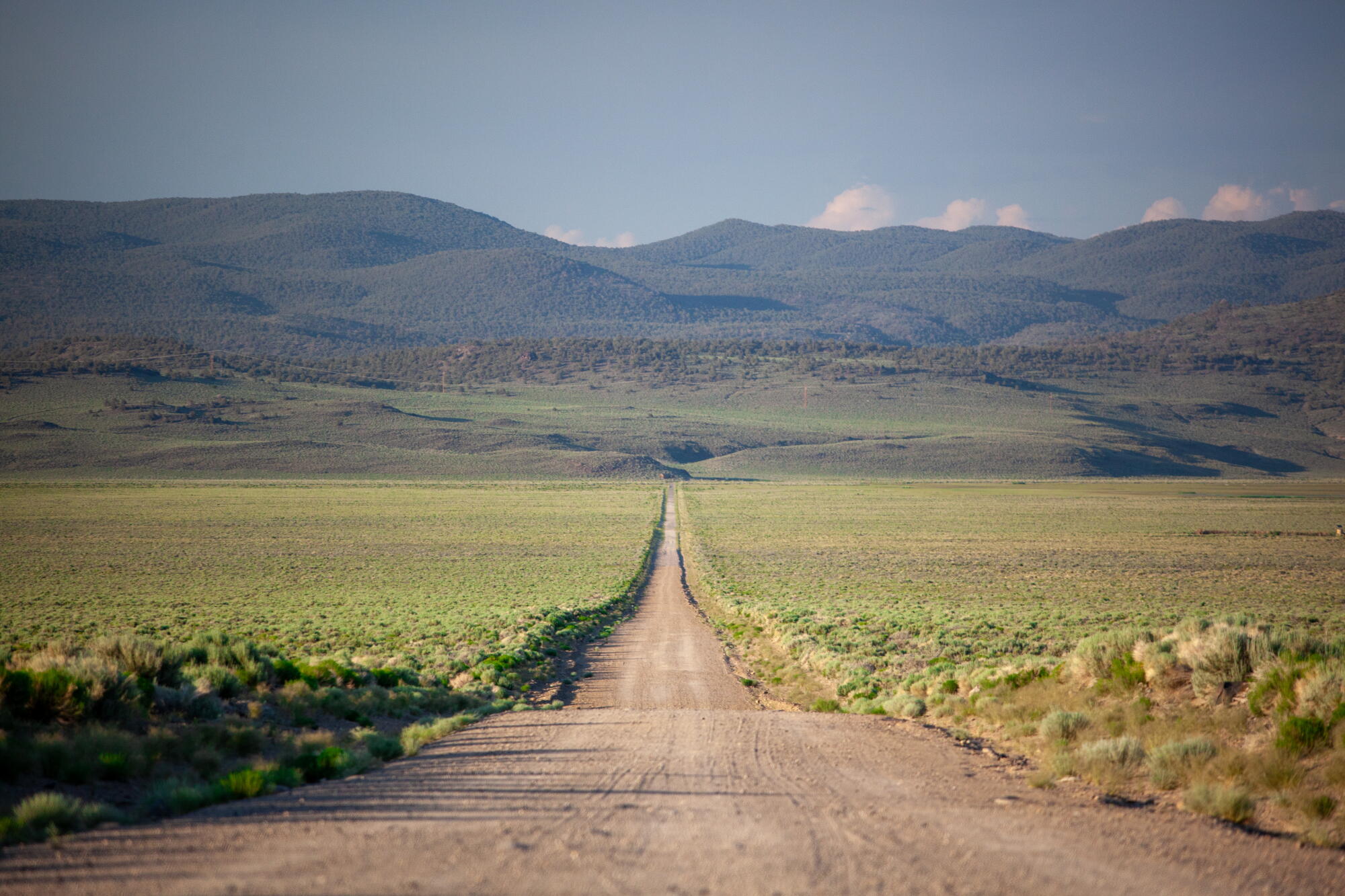
The sun kisses the mountains beyond in Adobe Valley.

The sun kisses the mountains beyond in Adobe Valley.

(Josh Jackson)

Near the halfway point of the journey, another short dirt road leads to the BLM-managed Granite Mountain Wilderness, dominated by an 8,920-foot peak that resembles a stack of boulders glued together in the shape of a pyramid. With no trails on the mountain, reaching the top requires 1,800 feet of climbing. One sweltering July morning, two friends and I made the trek. We switchbacked up steep sandy pitches, scrambled over sections of class 3 granite, and reached the peak in the early afternoon. The summit register revealed roughly 40 names scribbled over the past decade, or what amounts to three or four people annually. Unbelievably, someone had already been there earlier that day, like a ghost we had neither seen nor heard nor felt. One of my companions added his name to the register and then wrote “sage for days.”

A few miles later, the highway earns its nickname as it quickly rises and falls over a succession of short hills that run through Adobe Valley. Between the crimson mesas rising above the flats, hidden lakes and springs, and the pronghorn and wild horses that roam the open country, this is my favorite place to venture off the highway and set up a camp chair. I would trade you a hundred Yosemite Valleys for the solitude and subtle beauty offered here at dusk, as the sun sets over the Glass Mountains and the sky turns mauve.

Forty-five miles after it began, the journey through volcanoes, salt lakes, pine forests, aspens and a valley that stretches across the horizon comes to an end at a lonely intersection with U.S. Route 6, which, improbably, runs all the way to Provincetown, Mass. I’ve made this drive a dozen times, and it’s the quiet and open spaces that always bring me back. The Sierra will always rightly command attention. But there’s an entire world waiting for those willing to turn east.

The route: State Route 120 East, between Highway 395 to U.S. Route 6

Distance: 45 miles (one way)

Drive time: 1.5 hours straight through; allow a full day for stops

Best time to go: With an average elevation of roughly 7,000 feet, the road is usually closed from December until late spring, when snowmobiles are the only way in (in 2023, the road didn’t open until July 1). You can find up to date Highway 120 closures on Caltrans website.

Fuel:

  • Lee Vining (Mile 0)
  • Benton (Mile 45)

Food/coffee:

Camping:

Lodging:

  • El Mono Motel: Charming, family-run boutique lodging and coffee house.
  • The Inn at Benton Hot Springs: Rustic elegance in a tranquil surrounding, the perfect spot to get away from it all and to relax and rejuvenate in the historic hot springs.
  • Lake View Lodge: Cozy lodge with basic amenities and a cafe.

Hike/Explore/Learn:

Notes:

  • These lands are the very definition of a landscape that requires all of us to “pack out what we pack in.” The only pit toilets are found at the South Tufa Interpretive Trail near mile 5.
  • Dispersed camping is allowed on BLM land and in the National Forest around Sagehen Summit. There are dozens of gravel roads skirting the area where you can pull off the highway and park/camp for the night (please look for spaces that have previously been occupied). Many of these side roads are 2WD friendly, but please exercise caution!
  • Check fire restrictions and get permits here
  • Connectivity: Cell service is dependable along the route.
  • Wildlife: Watch for pronghorn and wild horses.
    Viewpoint off of Highway 120.

Source link