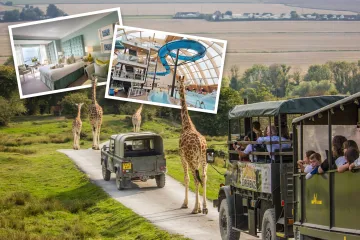
land

The UK’s first PAW Patrol land to open in just weeks at top theme park with four new rides

THE highly anticipated World of PAW Patrol has announced when it will open – and you don’t have to wait long.

The pup-tastic themed-land will open at Chessington World of Adventures with four new rides and a new play attraction on May 3.

PAW Patrol World will open on May 3, 2026Credit: Chessington World of Adventures
Zuma’s Hovercraft Adventure will be the UK’s first ‘Drifter’ rideCredit: Chessington World of Adventures

The new £15million attraction was first announced in April last year and will welcome guests over the early May bank holiday weekend.

It will be be the UK’s first and only PAW Patrol-themed land designed specifically for preschool-age children.

Inside will be new rides and meet and greets with the beloved pups Rubble, Skye, Rocky, Everest and Marshall.

Fans of the show will recognise the new land as it looks like the fictional Adventure Bay.

SIGHT SEA

£9.50 holidaymakers’ favourite Skegness activities… away from the beach


BEACHY KEEN

Sun readers’ favourite family attractions in Lincolnshire’s seaside resorts

It’s all centred around Lookout Tower which is also part of ‘Chase’s Mountain Mission’ ride – the attraction’s entry-level rollercoaster for littler kids.

Another of the new rides is Skye’s Helicopter Heroes where riders can climb aboard Skye’s helicopter and take to the skies.

Zuma’s Hovercraft Adventure will be the UK’s first ‘Drifter’ ride – visitors can hop onto their own hovercraft.

Kids will feel like they’re skidding across the water from Adventure Bay to Seal Island.

There’s also Marshall’s Firetruck Rescue, guests can climb aboard a firetruck and ‘rock and roll’ through the streets of Adventure Bay.

There will be themed playscapes too including Rubble and Rocky’s Play Zone.

At Rubble and Rocky’s playzone, kids can get their hands dirty at the construction zone.

Then children can head to Rocky’s Recycle Yard to crawl and climb through a maze of repurposed parts.

Another will be The Flounder Boat Play where little explorers can help Captain Turbot on a high-seas adventure.

Children will be available to meet their favourite characters in the parkCredit: Chessington World of Adventures

The themed-land will also have a cafe, a picnic space and a shop where visitors can pick up PAW Patrol merch.

Chessington World of Adventure’s Vice President, Nick Bevan said: “We can’t wait for families from across the world to experience the magic of PAW Patrol here at Chessington World of Adventures.”

Chessington already has hotel rooms based on the TV show – each room sleeps up to two adults and three children. 

PAW Patrol hotel stays start from £155 for a family of four, including bed and breakfast.

Hotel stays include early ride access into Chessington, a ‘Pup Pass’ Meet and Greet fast track pass, and a Reserve & Ride one-shot pass.

You can book a day ticket to Chessington from £34 – if booked in advance.

The seven great UK seaside towns with beachfront theme parks – and you can stay with Hols from £9.50.

And nine of the best theme parks with something new in 2026 from multi-million lands to epic thrill rides.

The PAW Patrol themed-land will be the first of its kind in the the UKCredit: Chessington World of Adventures

Source link

Sparks excited to land versatile Ta’Niya Latson late in WNBA draft

The Sparks might have gotten the steal of the WNBA draft.

The team didn’t have a pick until the No. 21 overall slot in the second round, but the Sparks still ended up with South Carolina guard Ta’Niya Latson.

“She can shoot it, she can get to the basket, she’s great in transition,” Sparks coach Lynne Roberts said. “That’s something we really needed. We’re excited about her defense. She’s really good on ball, but you know, she’s a winner and we’re just excited. It’s hard as a rookie, especially at that point guard spot, to adapt. But I’m expecting her to be a great addition to our squad.”

Latson led the nation in scoring with 25.4 points per game for Florida State during the 2024-25 season before transferring to South Carolina, where she scored 14.1 points and shot a career-high 48.6% from the floor this season for the national championship game runner-up Gamecocks.

After averaging 21 or more points per game during the last three seasons at Florida State, Latson went to South Carolina coach Dawn Staley’s team to learn to share the ball and play strong defense.

Latson took a career-low 10.3 shots per game but shot a career best field-goal percentage.

“She took on a different role in terms of, that team had two other first-round draft picks from that roster playing with that South Carolina team,” Roberts said. “And so we watched her closely. Our draft model and everything had her a lot higher than 20. And so we were excited that she was still there.”

Latson fills a direct need for the Sparks, who even after signing veteran Erica Wheeler this week still lacked some guard depth off the bench.

South Carolina guard Ta'Niya Latson drives to the basket in front of Southern California guard Kara Dunn on Nov. 15.

South Carolina guard Ta’Niya Latson drives to the basket in front of USC guard Kara Dunn at Crypto.com Arena on Nov. 15.

(Gina Ferazzi / Los Angeles Times)

“Having vets like Kelsey Plum and Erica Wheeler around a young guard like that is a tremendous opportunity for her,” Sparks general manager Raegan Pebley said. “She’ll soak up everything that they have to teach her. …. This is a great offense for her to excel in and to be great in and shine. So I think the table is set for Latson, I think, to have some success in her rookie year.”

The Sparks later selected Chance Gray from Ohio State with the No. 24 pick. That pick was acquired from Seattle in the Plum trade last year. Gray averaged 14.7 points in 35 games for the Buckeyes while shooting 45.3% from the field and 40.5% from three-point range.

In the third round, the Sparks took Amelia Hassett at No. 35 overall from Kentucky. Hassett is a stretch center who shot 36.1% from three on 7.6 attempts per game. She averaged 10.5 points and 5.3 rebounds per game with the Wildcats.

The Sparks are pushing to contend for a playoff spot this season after bringing back veteran forward Nneka Ogwumike and guards Ariel Atkins and Wheeler to build one of their deepest rosters in years.

Latson has a chance to get some playing time, while Gray could challenge for an end-of-the-bench spot and Hassett has a niche that could get her minutes in the league.

“We want to have sustained success,” Roberts said. “We want to win championships, and this isn’t a slow roll, like we want to do it. And so you have to have that balance of youth and experience, and I think our roster has nailed that.”

Source link

Sid Krofft dead: ‘H.R. Pufnstuf,’ ‘Land of the Lost’ co-creator dies

TV producer Sid Krofft, the puppeteer and co-mastermind behind fantastical 1970s Saturday morning television shows like “H.R. Pufnstuf” and “Land of the Lost,” has died. He was 96.

Krofft died in his sleep on Friday at the home of his friend and business partner Kelly Killian, she announced on Instagram. His youngest brother and business partner, Marty Krofft, died in 2023.

“I loved Sid with my whole heart. The last six years of my life were devoted to him, and his to me,” Killian wrote. “In that time, he taught me more than I could ever put into words — about the art of Hollywood, the magic of the stage, and the depth and complexity of human nature. I wish so very much that I had more time with him.”

“Sid Krofft was an icon who did what he loved most until the very end — being out in public with his legions of fans,” his publicist Adam Fenton said in a statement. “Sid never slowed down, attending his final show where it all began just last November in his home state of Rhode Island. Sid was a beacon of light and will be greatly missed.”

Sid co-created 1960s and ’70s children’s TV shows that featured colorful and quirky characters like Weenie the Genie, Horatio J. HooDoo and Cha-Ka the ape-boy. Together, he and Marty produced through their production company, Sid & Marty Krofft Pictures, popular series, including their television debut and cult hit, “H.R. Pufnstuf.”

“H.R. Pufnstuf,” a combination of live-action and puppetry that Sid once referred to as “our first baby,” follows the adventures of a young boy, a talking flute and a 6-foot-tall dragon. That was the start of a television enterprise. The brothers went on to create more (mostly short-lived) shows, including “Lidsville,” about a teenage boy who falls into the top hat of a magician. He finds himself in the titular Lidsville, a land of living hats.

Other shows included “The Bugaloos,” about four teenage musicians with wings and antennae, “Electra Woman and Dyna Girl,” which follows the adventures of a superhero and her sidekick, and “Pryor’s Place,” a live-action children’s show starring comedian Richard Pryor.

The Krofft puppets frequently made cameos on other well-known shows during the 1970s and ’80s.

Most recently, the beloved character H.R. Pufnstuf appeared in the brothers’ 2016 Nick Jr. show, “Mutt & Stuff,” about an animatronic dog at a canine school.

The brothers also produced other beloved shows such as “Sigmund and the Sea Monsters,” “Land of the Lost,” “D.C. Follies” and the prime-time variety shows “Donny and Marie” and “Barbara Mandrell and the Mandrell Sisters.”

Sid and Marty Krofft stand behind four life-size puppets.

Sid, left, and brother Marty Krofft pose with some of the life-size puppets created for their syndicated series “D.C. Follies” in Los Angeles in 1987.

(Reed Saxon / Associated Press)

Because the shows often featured eccentric and larger-than-life characters, Sid once told The Times that people were convinced the ideas came from using psychedelics. But he insisted the concepts were born during his daily runs along the Los Angeles coastline.

“I’m a runner, and I thought of them during my runs on the beach at Santa Monica,” Sid said. “That’s where they came from.”

While the 1970s were the defining decade for the Krofft brothers, they got their start as puppeteers decades prior.

In a long-standing rumor, Sid and Marty were said to be fifth-generation puppeteers. In an interview with The Times, Sid confessed that the whole thing was a lie concocted by a publicist in the 1940s. Their father, Peter Krofft, was a clock salesman and joined Sid when he was on tour as a teenager.

Sid was born July 30, 1929, in Montreal. The brothers immigrated to New York City from Canada with their father. Sid started working as a professional puppeteer at age 10. By the time he was 15, he had joined the Ringling Bros. and Barnum & Bailey Circus as “the world’s youngest puppeteer.” By his late 20s, he was working as the opening act for big industry figures like the Andrews Sisters, Judy Garland and Cyd Charisse. That’s around the time he hired his brother — who was seven years younger and a salesman — as his assistant.

“I desperately needed an assistant and saw this as a great opportunity to bring out my brother Marty,” Sid said of his youngest brother. “That single moment in my life is what started our long-running career together.”

They later created cabaret-inspired “Les Poupées de Paris,” which opened in 1961 at the Gilded Rafters in the San Fernando Valley, then played at Hollywood’s P.J.’s. It toured the country throughout the ’60s.

While Sid was the creative force behind their projects, Marty was the brains behind the business operation.

Sid Krofft, in a baseball cap and striped blue collared shirt, sits on the back of his brown leather couch at his home.

Sid Krofft sits for portraits at his home in Los Angeles in 2021.

(Brian van der Brug / Los Angeles Times)

Sid wrote a tribute to his brother for The Times after his death.

“Marty and I were oil and vinegar,” he wrote. “We worked in different ways, but if you shook us up, we were a great dressing.”

The brothers’ relationship was publicly known to be rocky at times. “It’s not easy for two brothers to work together,” Marty told The Times.

Their shows were low budget; shot on sets that were once thought to be outdated by the 1980s. But the brothers maintained the rights to their creative properties, and some of their most popular stories had revivals or remakes.

In 2009, Universal Pictures adapted “Land of the Lost” into a $100-million box-office flop about the tales of a family stranded in a dinosaur-ridden jungle.

In 2018, the brothers were honored with a lifetime achievement award at the Daytime Emmys, and in 2020, they received stars on the Hollywood Walk of Fame. In 2021, Kroff resurfaced in the public eye with an Instagram Live show called “Sundays With Sid.” Marty created his own YouTube series soon after called “Mondays With Marty.”


Source link

Arroyos & Foothills Conservancy wants to protect land from development

Over the last year, activists have organized droves of people across the United States to protest and petition Congress over concerns that the Trump administration will sell off our most beloved outdoor spaces.

We’ve worried about general threats to public lands, such as whether the 700,000-acre Angeles National Forest or the 150,000-acre Santa Monica Mountains National Recreation Area will remain pristine protected landscapes. We’ve also seen specific examples of what activists have cautioned could happen: a large mining operation that could open just outside Joshua Tree National Park and a large housing development proposed at the border of Yosemite National Park.

And although that attention is more than warranted, for those of us living around Los Angeles, it’s crucial that we not miss a similar, quieter battle being fought locally by nonprofits and public agencies. Here in L.A., our wildlands are often protected parcel by parcel.

A dark brown bear appears to be smiling at the camera as it walks along a dry creek bed.

A bear meanders through the Rubio Canyon Preserve.

(Johanna Turner)

It’s a time-consuming, expensive and rewarding job that the Arroyos & Foothills Conservancy has been performing for, as of Friday, when the group celebrates its anniversary, 25 years.

I spoke with conservancy leaders about their vision to create an expansive corridor for wildlife moving among our mountain ranges. This would help combat climate change locally, make hillsides more fire resistant and ensure biodiversity among our local animals.

You are reading The Wild newsletter

Sign up to get expert tips on the best of Southern California’s beaches, trails, parks, deserts, forests and mountains in your inbox every Thursday

The Arroyos & Foothills Conservancy started with four neighbors — Altadena residents Nancy Steele, Astrid Ellersieck, Diane Walters and Lori Paul — who organized against a housing development that ultimately was constructed.

“They were unsuccessful in preventing the project, but they realized that working together, they could be powerful,” said Barbara Goto, the conservancy’s director of operations.

The group first launched the Altadena Foothills Conservancy with the hyperlocal focus of protecting the neighboring hillsides and canyons from development. Over the next seven years, the organization’s vision expanded to include the foothills of the San Gabriel Mountains, and it started operating under its current name.

The organization has saved more than 140 acres from development since its founding. To identify ideal properties, they’ve used wildlife cameras, mapping software and other available data.

A Pacific tree frog (Pseudacris cadaverina) male, calling with extended throat, at Rubio Canyon.

A Pacific tree frog (Pseudacris cadaverina) male, calling with extended throat, at Rubio Canyon.

(Althea Edwards)

The process to purchase those properties is often long and arduous. Conservancy staff must persuade a property owner to sell at fair-market price — a stipulation when the conservancy uses state funding to buy property. The owner must also be patient enough to wait for the conservancy to cobble together grants to buy the land.

After buying the land, the conservancy establishes a “friends” group — like Friends of Rubio — comprised of volunteers who yank invasive plants, reestablish trails (if applicable) and rebuild or restore passageways to make the property as appealing to animals as possible.

And it works.

The 41-acre Rubio Canyon Preserve, which sits about four miles northwest of Eaton Canyon, is regularly frequented by bears, mountain lions and deer passing to and from Angeles National Forest and the foothill landscape.

Two gray foxes with their mouths open at each other as one stands above on a log.

Two gray foxes appear to play together in Millard Canyon.

(Denis Callet)

At the conservancy’s Rosemont Preserve, volunteers have essentially removed all invasive castor bean, arundo (which clogs streams) and tree tobacco, which crowd out native plants and harm the landscape. It’s no surprise that the conservancy has documented 10 different mountain lions over the last nine years there (even though the preserve is surrounded on multiple sides by neighborhoods).

When the conservancy staff invited me to visit one of their preserves, I was eager and skeptical. I grew up in rural America, where my family’s 300-acre goat ranch was considered small. I’ve met ranchers who own essentially entire counties of land, especially around the Oklahoma-Texas Panhandle.

I had a bias going into this story. I assumed you needed big swaths of property to really make a difference. I realized how wrong I was when I visited the conservancy’s Cottonwood Canyon in Pasadena.

It is only 11 acres, but it is one of the most significant properties the conservancy has acquired. But that wasn’t immediately obvious.

A coyote with large ears walks toward a camera through a forested area.

A coyote trudges through the Rosemont Preserve.

(Denis Callet)

As John Howell, the conservancy’s chief executive, and Tim Martinez, the organization’s land manager, led me through the preserve, shaded by massive oak trees, they explained that a local educator had reached out to let the organization know that the property, which had been owned by the same family since 1885, would be up for sale.

The organization soon realized a few key details about the land. For one, it has a small-but-mighty spring that flows year-round into the Arroyo Seco. It is one of only two known year-round water sources for wildlife in the region, they said, a significant resource given how drought can dry up much of the nearby rivers and creeks.

But Cottonwood’s importance grew much larger when a staffer at the California Department of Fish and Wildlife pointed out during a visit to the property, Goto said, that the land could serve as a vital piece in a wildlife corridor puzzle. The land sits between the Hahamongna Watershed Park in La Cañada Flintridge to its east and the San Rafael Hills and Verdugo Mountains to its west.

“They’re like, ‘These are natural open spaces that need to be connected — these natural open spaces are large enough to support wildlife populations,’” Goto said. “So that is when our mission changed.”

A yellow bird with feathers that look almost furry with its beak wide open is perched on a branch.

A lesser goldfinch sings a little tune at Sycamore Canyon Preserve.

(TJ Hastings)

The organization has since pushed for the creation of the Hahamongna to Tujunga Wildlife Corridor, a 20-mile stretch that would link the San Gabriel Mountains at Hahamongna Watershed Park to the San Gabriels at Big Tujunga Wash for wildlife passage through the San Rafael Hills and the Verdugo Mountains. (For a great visual, visit arroyosfoothills.org.)

This type of effort helps ensure that, for example, mountain lions don’t end up like the famous Griffith Park mountain lion P-22, surrounded by roadways and unable to safely look for a mate, or worse.

“P-41 was the resident cougar in the Verdugos and was there for 10 years with Nikita, and they sired two sets of two cubs,” Howell said. “And [with] the first set, one died on the 134 [Freeway] and the second one died on the 210 [Freeway]. And the second set were found emaciated under a car in Burbank, and they had to be saved.”

A mountain lion with big beautiful eyes looks over at the flashing camera.

A mountain lion crosses through Millard Canyon.

(Johanna Turner)

One challenge the conservancy faces in building out the Hahamongna to Tujunga Wildlife Corridor, Goto said, is how state funding is allocated. It is coincidentally similar to my own bias going into this piece.

Goto said that, as incredible as California’s “30×30” goal is — to conserve 30% of California’s lands and coastal waters by 2030 — “it makes it very difficult to get funding for small parcels.”

Much of the money to buy public lands comes from bond measures, and although L.A. County arguably has one of the biggest voting blocks that passed those measures, a substantial amount of bond money goes to buy property in Northern California, where large plots are more ample, Goto said.

“It’s when we’re working on these wildlife corridors that don’t necessarily have water and are much smaller, that’s where it really gets difficult,” Goto said.

And sometimes all that’s needed is a parcel of land.

A brown deer gets close to the camera lens.

A curious deer at Cottonwood Canyon Preserve.

(Arroyos & Foothills Conservancy)

A wiggly line break

3 things to do

a wide shallow river in a concrete channel with plants growing throughout.

The L.A. River bike trail near Griffith Park.

(Los Angeles Times)

1. Mosey on down the river in Elysian Valley, a.k.a. Frogtown
L.A. Climate Week has organized an L.A. River Crawl from noon to 5 p.m. Saturday in Frogtown. Several local organizations and businesses will be open along the route, offering live music, poetry, food pop-ups and family-friendly activities about climate change and ecology. To learn more, visit laclimateweek.com.

2. Gaze at the stars in San Diego
San Diego County Parks will host the Festival of the Night Sky and Nocturnal Creatures from 5 to 10 p.m. Saturday at the Los Peñasquitos Ranch House (12122 Canyonside Park Drive) in San Diego. This free all-ages event will include birdwatching, stargazing via telescopes and a night hike where participants will try to spot scorpions, crickets and bats. Visitors are encouraged to bring binoculars, flashlights, jackets, drinks and snacks. Learn more at the agency’s Instagram page.

3. Journal with genuine curiosity in L.A.
The L.A. City Department of Recreation and Parks will host a guided walk with nature journaling from 9 to 11 a.m. Sunday at Griffith Park. A guide will take hikers on a short walk before the group pauses to capture what they’ve noticed in journals. Some materials will be provided, but guests are encouraged to bring what supplies they have. Register at eventbrite.com.

A wiggly line break

The must-read

Two people in winter gear trek over heaps of snow.

A professional guide with Times reporter Jack Dolan, right, set off near Donner Pass trailhead on a route taken by a backcountry ski group struck by an avalanche north of Tahoe on Feb. 17.

(Danny Kern / For The Times)

After hearing news of the deadliest avalanche in California history, many of us wondered how such a thing could happen given our access to weather data even in the most remote places. Times staff writer Jack Dolan retraced the steps of a guided backcountry ski trip where 13 people, including nine who died, were buried in snow during an intense blizzard. “Deep in a wooded ravine, bathed in warm sunlight, we knelt behind the makeshift memorial of flowers and looked up the slope that sent tons of snow barreling down,” Dolan wrote. “All we could see was a slight rise and a healthy forest of full-grown pine trees.”

There are no right words to say to capture the magnitude of heartache around this tragedy. The search for answers is one step in a long grieving process.

Happy adventuring,

Jaclyn Cosgrove's signature

P.S.

Valentine continues her quest for love, folks! The wolf who made history earlier this year when she entered Los Angeles County in search of a mate has made history for a second time. “The 3-year-old female with black fur entered Inyo County around 7 a.m. Sunday about 20 miles south of Mt. Whitney,” Times staff writer Lila Seidman wrote. “She became the first documented wolf to set paws in the Eastern Sierra county in more than a century, according to state wildlife officials.” It’s only been two months, meaning Valentine and her future mate could still qualify for a canine version of “90 Day Fiancé”!

For more insider tips on Southern California’s beaches, trails and parks, check out past editions of The Wild. And to view this newsletter in your browser, click here.


Source link

Bruce Springsteen at the Forum: ‘This is a tour that we never planned’

As the time approached 10:30 Tuesday night — nearly three hours after Bruce Springsteen had marched onstage at Inglewood’s Kia Forum alongside 18 of his musical comrades — the 76-year-old rock legend told the crowd he hadn’t intended to be there.

“This is a tour that we never planned,” he said. “The E Street Band is here with you tonight because we need to feel your hope and your strength. And we want to bring some hope and bring some strength for you.”

It wasn’t impossible to believe him.

After a two-year trek that finally wrapped last summer amid the release of a massive box set and a splashy Hollywood biopic, Springsteen might’ve been expected to spend 2026 counting his money and his accolades. Yet the way he tells it, the actions of a “corrupt, incompetent, racist, reckless and treasonous” president and his administration spurred him back into action.

“If you’re feeling helpless, if you’re feeling hopeless, if you’re feeling betrayed, if you’re feeling frustrated, if you’re feeling angry — I mean, I know I’ve been,” he said.

Tuesday's show was the first of two this week at the Forum.

Tuesday’s show was the first of two this week at the Forum.

(Allen J. Schaben / Los Angeles Times)

Thus the hastily arranged Land of Hope & Dreams tour: two months of U.S. concert dates that began last week in Minneapolis, where federal immigration agents killed two American citizens in January, and will wrap May 27 with a stadium show in Washington, D.C.

“The White House — this White House — is destroying the American idea,” Springsteen proclaimed during Tuesday’s gig, the first of two this week at the Forum.

Before we get to the performance itself, let’s acknowledge that the Boss is sticking his neck out here. Sure, he’s protected by his wealth and his celebrity; sure, he’s preaching to the choir in every city he and the E Street Band visit.

But what other musician on Springsteen’s level is speaking out the way he is right now?

On Tuesday, he introduced “Streets of Minneapolis” — a brand-new protest song in which he mentions both Alex Pretti and Renée Good by name — with a vividly detailed monologue about the circumstances of their deaths. Then he led his players through a fervent rendition of the driving folk-rock tune.

“It’s our blood and bones / And these whistles and phones / Against Miller and Noem’s f— lies,” Springsteen sang — one lyric that might’ve inspired President Trump this month to urge his followers to boycott the singer, whom he compared in a social media post to a “dried up prune who has suffered greatly from the work of a really bad plastic surgeon.” (In truth, Springsteen probably enjoyed that.)

Bruce Springsteen and the E Street Band

Bruce Springsteen and the E Street Band

(Allen J. Schaben / Los Angeles Times)

Whatever the risks of his speechifying, you had to admire — here in our age of political infotainment — the natural finesse with which Springsteen threaded his prepared rhetoric into Tuesday’s set. He knew just when to have the E Streeters vamp so he could talk about NATO and USAID; he knew when it was wiser to lead the audience in a chant of “ICE out.”

Indeed, as much as he was speaking his mind, Springsteen was providing his fans with an opportunity to work out their own anxieties in rowdy singalong versions of classics like “Born in the U.S.A.,” “No Surrender,” “The Promised Land” and “Out in the Street.”

If the concert’s animating impulse was outrage, the prevailing emotion was joy, even — or especially — when the music was at its most pointed, as in covers of Edwin Starr’s “War” and “Clampdown” by the Clash.

With an extra E Street member in Rage Against the Machine’s Tom Morello, Springsteen made “Badlands” and “Death to My Hometown” shimmer and stomp; “Murder Incorporated” was a gritty soul-rock rave-up, while “Youngstown” got a scabrous guitar solo by Nils Lofgren that reminded you of his other gig in Neil Young’s Crazy Horse. (Springsteen’s wife, Patti Scialfa, who said in 2024 that she has cancer, wasn’t part of the band Tuesday.)

About halfway through the show, Springsteen sang “American Skin (41 Shots),” the early-2000s song about racialized police violence he wrote after Amadou Diallo’s killing by four NYPD officers; he followed that with “Long Walk Home,” which he described as “a prayer for our country.”

Bruce Springsteen

Bruce Springsteen

(Allen J. Schaben / Los Angeles Times)

Played back to back, the songs made you think of how little agreement we’ve come to over the last quarter-century about who gets to be called an American. The identity is always under attack, and it’s always being defended.

Anyone but a Bruce stan would admit that Springsteen leaned a little hard on recent stuff here: “House of a Thousand Guitars,” “My City of Ruins,” “Wrecking Ball” and the like.

Yet as with his speechmaking, he can still read a room. “It’s gotta be done,” he said with a grin as the band revved up “Hungry Heart,” one of a handful of old pop hits he did that broke from the evening’s topical throughline.

Near the end — in an encore that went bang-bang-bang with “Born to Run” into “Bobby Jean” into “Dancing in the Dark” — Springsteen, his shirt drenched with sweat, took a seat onstage and thanked members of the Immigrant Defenders Law Center for attending the show. (Also in the house Tuesday: Henry Winkler.)

Then he offered one final homily before closing with Bob Dylan’s “Chimes of Freedom.”

“These are hard times, but we’ll make it through,” he said. “We’re the Americans. What do they say? Americans do the right thing after they’ve tried everything else.” He shook his head as though he were running through a mental inventory.

“F—!”

Source link

UK’s best theme park’s £12million Viking-themed land to open next month

PAULTONS Park has revealed when their huge new Viking-themed land will be opening and you won’t have to wait long.

The theme park – named the best in the UK by Tripadvisor and eighth best in the world – has splashed out a huge £12million on the new themed area.

Paulton Park’s Valgard: Realm of the Vikings is opening next monthCredit: Paultons Park
Three new rides will be coming to the landCredit: Not known, clear with picture desk
A themed playground is part of the plans tooCredit: Paultons Park

Called Valgard: Realm of the Vikings, it will have the theme park’s first inverting rollercoaster.

Drakon will not only be the most thrilling ride at Paultons Park, but will see riders climb a huge vertical hill before they twist and fly through the air upside down.

There will also be the swinging ride Vild Swing, going 12metres in the air, while the bobsled Cobra coaster is being reinvented as Raven.

The parks biggest investment to date, it will open to the public on May 16.

TOP RATED

I went to the No.1 destination for 2026 – it has white beaches and £7 attractions


RIDE & REPEAT

UK’s best value theme park launches two visits for the price of one

Also in the park will be a themed Feasting Hall restaurant as well as Viking inspired playground.

Back in 2024 they even teased another ride could open in Valgard next year, which would be water-themed – although little else is known about it at the moment.

And last year, Paultons Park won 10 awards at the UK Theme Park Awards, including Theme Park of the year.

It is also known for being home to the famous Peppa Pig World, as well as the Ghostly Manor ride which opened last year.

The Sun’s Head of Travel (Digital) Caroline McGuire recently raved about the park.

She said: “On the kids’ favourite rides, such as the Velociraptor and Cat-O-Pillar coasters, we were able to fit in about three rounds in 15 minutes.

“Ghostly Manor even won Best New Attraction at this year’s UK Theme Park awards, one of ten gongs Paultons bagged that I’ve have to agree with thanks to a number of key factors.

“These include the short queues, incredible customer service (employees all cheerful), the cleanliness (bathrooms spotless) and the attention to detail and the fact that they don’t charge for parking, unlike several other big theme parks.

“we spent the entire weekend outside, grinning from ear to ear. And we were blown away, in the good sense.”

The new Viking land isn’t the only exciting new opening in the UK.

Chessington is opening its new £15million PAW Patrol Land this spring.

And a £50million Minecraft land is also set to open at Chessington, and will be the first of its kind in the world.

Alton Towers has opened its new Bluey The Ride: Here Come The Grannies! at CBeebies Land already as well.

Here are some other openings to be excited about both in the UK and Europe this year.

The Viking theme will also be at the land’s restaurant as wellCredit: Supplied
The £12million new world is the park’s biggest investmentCredit: Paultons Park

Source link

Tribes in Montana lose millions after USDA kills farm grants

Kim Paul, executive director of the Piikani Lodge Health Institute, a nonprofit on the Blackfeet Reservation that promotes health and well-being, saw the email notification flash across her computer screen as she was working late one day recently.

It was the U.S. Department of Agriculture saying a nearly $9-million grant contract with Piikani Lodge had been terminated.

“The U.S. Department of Agriculture has determined that awards under this program involved discriminatory preferences based on Diversity, Equity and Inclusion and wasteful spending that did little to further lawful agricultural land purchases,” the USDA wrote.

Paul was stunned. Piikani Lodge had planned to use the grant to improve operations for Native and non-Native farmers and ranchers in the Montana region. The nonprofit had already separately acquired 600 acres on the Blackfeet Reservation and planned to use the USDA funds to build a training hub for food producers and support about 300 farmers and ranchers in Glacier and Pondera counties.

Paul said she became short of breath when she saw the email. She dreaded sharing the news with her team.

“It was horror,” she said. “The horror of losing stability for our community.”

Funded through the Biden-era American Rescue Plan Act of 2021, the Increasing Land, Capital and Market Access Program was designed to support “underserved” farmers and ranchers. It awarded about $300 million to 50 grantees in 2023. Forty-nine of those grants were terminated last month.

At least two additional projects in Montana were affected by the cancellations: a Chippewa Cree Tribe project to purchase land and train young farmers and ranchers how to manage it; and one run by South Dakota-based Four Bands Community Fund that would have trained and financially supported at least 25 low-income agricultural producers in North Dakota, South Dakota, Wyoming and Montana.

Montana-based awardees called the terminations “devastating.” They also say the grant cancellations were based on a false presumption that tribal initiatives fall under the Diversity, Equity and Inclusion — DEI — rubric, and that USDA claims of wasteful spending are baseless.

Asked for comment, a USDA spokesperson said in a statement Thursday that the agency “has worked to clean up the mess left for us by the last Administration. To no surprise, a peek behind the curtain of this Biden-era program revealed the egregious misuse of taxpayer dollars.”

Piikani Lodge Health Institute leaders say they will have to restructure budgets and reconfigure staffing to keep some semblance of their project going. The Chippewa Cree Tribal project may be halted altogether. Four Bands Community Fund did not respond to an interview request by publication deadline. Awardees say the terminations hinder economic progress, not just in their communities but across the state.

Montana projects targeted

The Chippewa Cree Tribe in north central Montana was awarded a grant of nearly $6 million for a land acquisition project.

Chippewa Cree planning director Neal Rosette said the tribe planned to purchase agricultural land on and around the reservation and train prospective farmers and ranchers how to manage it.

Though reservation land can be used for farming and ranching, Rosette said, land prices can keep people from entering the industry. The Rocky Boy’s Reservation is home to almost 3,400 people, about 35% of whom live below the poverty line, according to U.S. census data. The median household income on the reservation is $49,550, almost $26,000 less than the state average.

“We are trying to give opportunities to our young folks to make a living,” Rosette said.

Rosette said people working on the project had been trying to close on a 320-acre reservation property for months. The land costs about $400,000, but, according to Rosette, the tribe has received only about $50,000 of the nearly $6-million grant since 2023. The tribe, he said, asked USDA repeatedly to release the funds, but received minimal communication from the agency.

“They drug their feet, drug their feet, and then finally they pulled the rug out from under us,” he said.

Rosette has written many grants for the tribe in the past. He said receiving the termination letter from USDA marked “the first time I’ve ever got to the point where I felt like crying.”

“It’s so, so, so cruel,” he said. “It’s the worst feeling in the world. It was devastating for everybody. We were so proud of this project. We were so happy that we were finally going to be able to recover some lands for the benefit of our young people. And now it’s gone.”

Micaela Young, development director at Piikani Lodge Health Institute, said the canceled grant will delay construction on the community training center on the Blackfeet Reservation.

The Piikani Lodge project included building an industrial community kitchen where agricultural producers could prepare and process products such as jam and jerky.

In its termination letter to Piikani Lodge, the USDA cited a “$20,000 allocation for a [barbecue] smoker” as an example of funding for items “outside the program’s mission of increasing land access.” The USDA has also mentioned a “$20,000 [barbecue] smoker” in statements to other media outlets as an example of “inappropriate spending.”

Paul said the characterization is hurtful.

“We did all this work, we spent so many years on this,” she said. “To say this was built on fraud? It’s a travesty. This was going to be five years of jobs for our people. Can you imagine the economic development that would come from that?”

‘’DEI’ is the new buzzword’

Paul and Rosette both took issue with the USDA’s assertion that programs benefiting tribes fall into the category of DEI. It’s well established in federal law that tribal citizenship is a political classification, not a racial one.

In a May 2025 memorandum, Secretary of Agriculture Brooke Rollins acknowledged the distinction, writing that “the Department’s unique government-to-government relationship” with tribes and their members “are legally distinct from policy-based Diversity, Equity and Inclusion programs.”

“We are a sovereign nation,” Rosette said of the Chippewa Cree Tribe. “We have a political relationship with this government.”

Democratic state Sen. Jonathan Windy Boy, a citizen of the Chippewa Cree Tribe who is running for Congress in Montana’s eastern district, called the agriculture department’s DEI reasoning “ludicrous.”

“‘DEI’ is the new buzzword in D.C.,” he said. “Why isn’t our delegation protecting the sovereign status of the tribes? The bottom line is we don’t have representation in D.C.”

Asked for comment on the grant terminations, a spokesperson for the incumbent in the eastern district, Rep. Troy Downing, said his “office is aware of the rescinded grants and welcomes input from community members regarding their impact.” A spokesperson for Sen. Steve Daines (R-Mont.) said the senator “is looking into the grant cancellations and will always work to support Montana’s tribal communities.”

Sen. Tim Sheehy and Rep. Ryan Zinke, both Republicans, did not respond to requests for comment.

Walter Schweitzer, president of the Montana Farmers Union, said that as land, livestock and equipment prices increase, and as more farms are purchased by corporate entities, it becomes increasingly hard for young people to enter the agriculture industry.

“The average age of a farmer or rancher is somewhere around 60,” he said. “We need to encourage and incentivize any way we can to get young people involved in agriculture. And having diversity in who gets into agriculture is a positive thing because they bring a diverse set of ideas.”

Young, of Piikani Lodge Health Institute, said agricultural producers living on tribal land also face unique challenges. A patchwork of historical and sometimes conflicting federal policies have congealed over the course of more than a century into an unwieldy system of property ownership on reservations. Banks have not learned to effectively navigate the legal, bureaucratic and financial peculiarities of that system, making it difficult for prospective producers to access the capital necessary to enter the agricultural industry. Tribes, Young said, are also often located far from markets where they could sell their products.

“These kinds of projects that bring capital into Native communities can really help revitalize their main streets, increase public safety, there’s the opioid crisis, the suicide crisis in tribal communities, and people are really looking for hope,” Young said. “People are looking for jobs. Families need that income. So this kind of work really does lift up our Native communities to strengthen the overall state.”

What’s next?

Piikani Lodge leaders said they plan to file an appeal through the National Appeals Division, which reports directly to the secretary of agriculture, before the 30-day deadline.

Andrew Berger, director of agriculture and climate adaptation at Piikani Lodge, said the organization is drafting a petition urging restoration of the funds.

“We’re still wrapping our heads around this,” he said. “[The grant] supported salaries and internships and all kinds of things. So we need to fill those gaps with other funding.”

Rosette isn’t sure whether the Chippewa Cree Tribe will file an appeal, which he noted requires time and resources. He said the tribe plans to ask the USDA to reconsider its decision.

“Whether they will listen?” he said. “Who knows?”

This story was originally published by Montana Free Press and distributed through a partnership with the Associated Press.

Source link

Trump speech on Iran war and recent remarks on oil, NATO, daycare costs land with a thud

President Trump’s meandering speech on the Iran war late Wednesday — in which he paired promises of a swift exit with new threats of escalated bombing and denied responsibility for the Strait of Hormuz — did little to assuage U.S. allies and world markets concerned about the conflict’s ongoing disruptions to the global oil supply.

Stocks dropped after markets opened Thursday and oil prices soared, with the price of U.S. crude oil jumping more than 10%, to above $110.

In the wake of the speech, diplomats from more than 40 nations — not including the U.S. — met to strategize on how to lift Iran’s continued stranglehold on the strait, the vital oil corridor that the U.S.-Israeli war drove Iran to restrict but which Trump on Wednesday said wasn’t his problem.

Iranian officials remained unbowed, asserting the U.S. and Israel “know nothing” of its remaining capabilities, that “not a single life will be spared” if either attempts a ground incursion into its territory, and that “every last” Iranian would become a soldier if necessary.

“Iranians don’t just talk about defending their country. They bleed for it,” Iranian parliament Speaker Mohammad Qalibaf, a pugilistic figure and one of Iran’s most prominent wartime voices, wrote on X. “You come for our home… you’re gonna meet the whole family. Locked, loaded, and standing tall. Bring it on.”

Meanwhile, remarks Trump made earlier Wednesday about leaving NATO elicited subtle rebukes from both international and domestic allies, including French President Emmanuel Macron and Senate Majority Leader John Thune (R-S.D.), while the president’s comments about the U.S. not being able to focus on social services like Medicare or other domestic needs such as child care as it wages its foreign war sparked outrage at home.

Far from a call for a unified push to end the war alongside allies, Trump’s speech — his first formal address to the nation since the war began a month ago — further isolated the U.S. and the Trump administration on the global stage.

Trump firmly asserted in his speech that reopening the Strait of Hormuz to oil tanker traffic was not the responsibility of the U.S., despite it causing the war, because it receives less oil from the corridor than other nations.

“The countries of the world that do receive oil through the Hormuz Strait must take care of that passage. They must cherish it. They must grab it and cherish it. They could do it easily. We will be helpful, but they should take the lead in protecting the oil that they so desperately depend on,” Trump said.

“To those countries that can’t get fuel, many of which refuse to get involved in the decapitation of Iran — we had to do it ourselves — I have a suggestion: No. 1, buy oil from the United States of America. We have plenty. We have so much,” Trump continued. “And No. 2, build up some delayed courage.”

He said those nations should have been better assisting the U.S. in its war effort already, but should now “go to the strait and just take it, protect it, use it for yourselves.”

“Iran has been essentially decimated,” he said. “The hard part is done, so it should be easy.”

Trump has consistently downplayed the threat Iran continues to pose in the region. And securing the strait — which runs along Iran’s mountainous coast, full of strategic locations from which Iranian forces can threaten ship traffic — is not an easy task, as was acknowledged by the foreign diplomats meeting to solve the issue without the U.S. on Thursday.

“We have seen Iran hijack an international shipping route to hold the global economy hostage,” said U.K. Foreign Secretary Yvette Cooper.

Meanwhile, Macron, speaking in South Korea, said the U.S. “can hardly complain afterward that they are not being supported in an operation they chose to undertake alone.”

Macron also slammed Trump’s criticism of NATO, which Trump called a “paper tiger” in remarks prior to his speech Wednesday.

“If you cast doubt on your commitment every day, you erode its very substance,” Macron said.

Trump for weeks has suggested that NATO allies who declined to join the U.S. war had failed to live up to their treaty obligations, and that remaining in the alliance may not be worth it for the U.S., though he made no mention of NATO in his Wednesday evening speech.

Trump has no power to unilaterally withdraw the U.S. from NATO. That power sits with Congress — where Trump’s own allies downplayed the idea.

“We got an awful lot of people who think that NATO is a very critical, incredibly successful post-World War II alliance,” Thune said. “I think in the world today, you need allies.”

Trump’s formal speech appeared to be geared in part toward his allies at home, including his MAGA base, where frustrations with the war have mounted among the cohort of Trump supporters who’d championed his “America First” message and campaign promises to extricate the U.S. from foreign entanglements, not start new ones.

Trump said he has promised since his first foray into politics in 2015 that he would never let Iran develop a nuclear weapon. He told Americans listening that the war “is a true investment in your children, and your grandchildren’s future,” because it was making the world safer.

However, Trump exacerbated frustrations over the war’s distraction from domestic priorities with separate comments he made earlier on Wednesday at a private Easter luncheon, video of which the White House posted online and then deleted.

In those remarks, Trump said U.S. military needs had to take priority over social services and other major costs for Americans, such as child care, which maybe states could pay for by increasing taxes.

“It’s not possible for us to take care of daycare, Medicaid, Medicare, all these individual things,” Trump said. “They can do it on a state basis. You can’t do it on a federal. We have to take care of one thing: military protection. We have to guard the country.”

The president’s political opponents leaped on the remarks as out of touch.

“Trump says we can pay for war in Iran but can’t afford childcare,” Rep. Ro Khanna (D-Fremont) wrote on X, before asserting that the billions of dollars the U.S. has spent in Iran could have been used to offset Americans’ daycare costs.

White House Press Secretary Karoline Leavitt, in response, accused Democrats and the media of taking Trump’s remarks “out of context,” and claiming he was only talking about “stopping the scams” and rooting out fraud in such programs.

Democrats also took broader swipes at Trump’s framing of the war.

“Donald Trump’s month-long war with Iran has come at a big cost to taxpayers and has tragically taken the lives of 13 American service members. He dragged our country into a conflict that rattled markets, drove up gas prices, squeezed working families, and further destabilized the Middle East,” Sen. Alex Padilla (D-Calif.) wrote on X. “With his poll numbers falling to record lows, Trump is now trying to cut and run with little to show for it. He started this unauthorized war with no clear or consistent justification and the consequences of his choices won’t disappear when he walks away.”

United Nations Secretary-General António Guterres on Thursday said the war was “inflicting immense human suffering and already triggering devastating economic consequences,” and called directly on the U.S. and Israel to end it. He also called on Iran to “stop attacking their neighbors” and “respect navigational rights and freedoms along critical maritime routes, including the Strait of Hormuz.”

“Conflicts do not end on their own,” Guterres said. “They end when leaders choose dialogue over destruction.”

In addition to defending NATO, Macron and other French politicians on Thursday were also reacting to Trump mocking Macron in his remarks Wednesday. He mimicked a French accent while accusing Macron of only wanting to aid the U.S. war effort once the battle had been “won” and referenced a moment last year when Brigitte Macron was caught on video pushing her husband’s face, which he said was them joking with each other.

“There is too much talk, and it’s all over the place,” Macron said, according to French newspaper Le Monde. “We all need stability, calm, a return to peace — this isn’t a show!”

Yaël Braun-Pivet, president of France’s lower house of parliament, told the French broadcaster franceinfo that the Iran war is “having consequences for the lives of millions of people, people are dying on the battlefield, and we have a president who is laughing, who is mocking others.”

Times staff writer Nabih Bulos in Beirut contributed to this report.

Source link

By the 50th anniversary of Land Day, Palestinians lose most of their land | Features

It was a devastating experience for Abdul Rahman Azzam, 65, to recently cut down the olive trees he had planted decades ago on his land south of Jenin in the occupied West Bank, following an Israeli decision to confiscate it for the construction of a road for an illegal Israeli settlement.

The land slated for confiscation last December spans more than 513 dunams (51.3 hectares), 450 of which belong to the village of al-Fandaqumiya alone, with the remainder belonging to neighbouring towns such as Silat ad-Dhahr and al-Attarra.

Recommended Stories

list of 4 itemsend of list

As Palestinians commemorate the 50th anniversary of Land Day this year, the challenges of illegal Israeli settlement expansions, land confiscations, and restrictions on access to their land, particularly in Area C, persist.

Meanwhile, Israeli government leaders continue to declare that the annexation plan is a fait accompli.

Land Day commemorates the events of March 30, 1976, when Israeli authorities announced the confiscation of vast tracts of Palestinian land in the Galilee region.

In response, widespread strikes and demonstrations were organised in several towns and villages, which were met with force, resulting in the deaths of six Palestinians and the injury and arrest of hundreds.

Since then, this day has become a national symbol, embodying the connection of the Palestinians to their land and the rejection of its confiscation.

Twice taken

Since childhood, Azzam had worked alongside his father, grandfather, and uncles, planting and ploughing the land with olive trees.

He developed a deep connection to it, which he continued to work on until 2002, when the illegal Israeli settlement of Tarsala and the Sanur military base were established on it, and he and his family were barred from accessing it.

Following the 2005 disengagement plan, the Israeli army withdrew from the camp and the settlement of Tarsala. Azzam and other landowners returned to their land, and their joy was indescribable.

However, after the recent Israeli decision, the Palestinian landowners were denied access to their land, which is now entirely under Israeli military control.

West Bank Land Day
Palestinian land being bulldozed in the occupied West Bank town of Ein Yabrud [Mohammed Turkman/Al Jazeera]

“Suddenly, we found the land number in the official newspaper along with a confiscation order for the construction of a road connecting the settlements of Homesh and Tarsala, to which the settlers had returned after the 2005 withdrawal. We saw the Israeli army had already begun bulldozing the land,” Azzam told Al Jazeera.

To prevent the Israeli army from cutting down his olive trees during the bulldozing, Azzam went to his land and cut them down himself. He wept as he did so. He then noticed that all the other landowners had done the same, fearing for their trees.

“It’s easier for us to cut them down ourselves than for the army or settlers to do it. This is our land, and our trees are like our children; we cherish them and treat them with kindness because we toiled to cultivate and care for them,” he added.

Confiscation in several ways

The Oslo Accords, signed between Israel and the Palestine Liberation Organization in 1993, divided the West Bank into three categories: Area A, under full Palestinian control, comprising approximately 18 percent of the West Bank; Area B, under joint Palestinian and Israeli control, comprising 22 percent; and Area C, under full Israeli control, comprising 60 percent.

Since October 2023, Israel has been issuing confiscation orders for Palestinian lands in Area C at an accelerated pace in the West Bank, in preparation for implementing its annexation plan, which Palestinians believe is already being carried out on the ground without a formal declaration.

According to data from the Palestinian Authority’s Commission Against the Wall and Settlements, Israel seized 5,572 dunams of Palestinian land in 2025 through 94 confiscation orders for military purposes, in addition to three expropriation orders and four declarations of state land.

These orders were not isolated or circumstantial, but rather geographically distributed to serve the expansion of settlements, secure their borders, and construct settlement roads that further fragment Palestinian land and sever its natural contiguity, as it said.

Concurrently, Israel allocated 16,733 dunams of previously confiscated land for settler grazing, a move that reveals a dangerous escalation in the tools of control, according to the commission’s annual report.

In another report, the commission stated that between October 2023 and October 2025, Israel confiscated 55,000 dunams of land, including 20,000 dunams under the pretext of modifying the boundaries of nature reserves, and 26,000 dunams through 14 declarations of “state land” in the cities of Jerusalem, Nablus, Ramallah, Bethlehem and Qalqilya.

A total of 1,756 dunams were confiscated through 108 orders for military purposes, aimed at establishing military towers, security roads, and buffer zones around settlements.

However, it has become increasingly apparent that many land seizures are carried out without official military orders. Soldiers or settlers prevent Palestinian landowners from accessing their land, leaving them surprised to find it seized without any prior notification.

"The attached photos are by Mohammed Turkman. The photos of the land being bulldozed were taken on Wednesday, and the man standing is Mohammed Fouad, whose land was cleared without warning in the town of Ein Yabrud to make way for a settler road (I interviewed him in the article).
Mohammed Fouad’s land was cleared without warning in the town of Ein Yabrud to make way for a road to an illegal Israeli settlement [Mohammed Turkman/Al Jazeera]

Mohammed Fouad, 56, was surprised on Wednesday to find an Israeli army bulldozer razing his land in the town of Ein Yabrud, east of Ramallah.

He went to the nearest point to the land and watched as the bulldozer removed trees, seemingly clearing a road for settlers.

“My land is 15 dunams … and is only 1km from the Beit El settlement, which is built on land north of Ramallah. I fear this bulldozing is a prelude to its annexation to the settlement, especially since it’s classified as Area C,” Fouad told Al Jazeera.

He was not notified of any decision regarding the confiscation of his land. A farmer who was nearby informed him of it. When he tried to inquire with the armed men accompanying the bulldozer, they told him they were from the Israeli army and intelligence services and expelled him from his land.

“I’ve always cared for this land, and now I’m watching it being bulldozed right before my eyes, unable to reach it. It’s as if they’re forcing me to leave. But I’ll try to reach it every day,” Fouad said bitterly.

Land confiscation procedures have been facilitated by several Israeli policies over the past two years to complete the annexation plan.

Raed Muqadi, a researcher at the Land Research Centre, told Al Jazeera that settlers have resorted to fencing off Palestinian lands to seize them, especially in the Jordan Valley.

This has affected thousands of dunams in the occupied West Bank that were used as pastures or agricultural land. Because of the fencing, Palestinians are prevented from entering or using it.

“The Israeli Knesset also recently approved what is called lifting the ban on data concerning landowners in the West Bank, which makes it easier for settlers to seize land and allows them to purchase it, even in Area A, with the help of settlement associations,” he explained.

Actual expulsion

The tragedy is not limited to land confiscation and seizure in the West Bank, but extends to the expulsion of entire Palestinian communities from their homes under the weight of attacks.

Qusay Abu Naim, 23, a resident of the Bedouin community of al-Khalail in the village of al-Mughayyir, east of Ramallah, told us that he and all other residents were forced to leave in February due to the intensity of settler attacks on the residents, some of whom were injured.

On February 21, Israeli settlers attacked the community intermittently, assaulting men, women, and children, resulting in injuries to an entire family of four, including two children. The Israeli army then joined the attack after the settlers filed a complaint that the Palestinians had resisted them. The soldiers opened fire, wounding the children, aged 12 and 13, further.

“This incident was the last straw. We decided to leave because the attacks were almost constant. When we returned from the hospital to dismantle our homes, we were shocked to find that the settlers had destroyed them and vandalised their contents,” Abu Naim explained.

The attacks against this community began in December 2024, intending to seize the lands of al-Mughayyir. The settlers deliberately targeted women, beating them and stealing sheep to force the residents to leave.

“Because of the numerous attacks, we sought help from international solidarity activists, but that didn’t stop the settlers. The activists were attacked several times in 2024 and 2025. Among the attacks, settlers broke my brother’s arm so severely that he needed a metal plate to repair the fracture. While he was receiving treatment, the Israeli army arrested him, even though he was the victim. He is currently being held in administrative detention without charge,” Abu Naim added.

In addition to the attacks, the homes of this community were repeatedly robbed by armed settlers. They would break into the houses and steal food from refrigerators, terrorising women and children.

The residents of the community were forced to leave for neighbouring villages, including Deir Jarir and areas within al-Mughayyir itself, but they still remember the years when they lived there in their communities, amid a beautiful Bedouin life, the images of which remain with them to this day, and they lament leaving it.

“Of course, it is now forbidden for any Palestinian to access the al-Khalail community area, which is under the control of settlers and the Israeli army. We left it, but the land will return to its original owners,” he concluded.

According to the Office for the Coordination of Humanitarian Affairs (OCHA), at least 4,765 Palestinians were displaced from 97 locations between January 2023 and mid-February 2026 due to settler violence.

Most of those displaced were from Bedouin and herding communities in Area C. At the beginning of this year alone, 600 people were forced to leave a single Bedouin village, Ras Ein al-Auja, in the Jordan Valley.

According to the United Nations Development Programme (UNDP), the number of Palestinian Bedouins in the West Bank is approximately 40,000. Most Bedouins are originally from the Naqab Desert, from which they were forcibly displaced or fled during the 1948 Arab-Israeli War, following further displacement after 1967, and then throughout the 1980s, they have continued to face waves of expulsion to this day.

Source link

The Yorkshire family holiday with Land Rover experiences and 900-year-old castles that keep the kids happy

IT’S difficult to improve on looking out over the stunning Yorkshire Dales.

Unless, of course, you’re sitting in an outdoor hot tub, drink in hand, looking out at over 1,000 acres of pure idyllic scenery.

Richard Moriarty and his two sons pose next to a grey Land Rover.
The Sun’s Richard Moriarty and his boys with the Land RoverCredit: Supplied
Narrowboats moored on Skipton Canal with reflections of trees and buildings.
Skipton waterside is so prettyCredit: Alamy

Half-term breaks can be difficult. Like most, we want sun but can’t necessarily afford it. So we loaded up the car with walking boots, big coats and footballs.

We left Manchester and, to the delight of our boys, who hate long journeys, travelled exactly one hour and ten minutes to Skipton.

The town’s castle is a must-see, so we headed there and wandered around the 900-year-old medieval building, threatening to lock the kids in the dungeon.

Given its location on the high street, we easily found a cafe, had some lunch and fuelled up on sweets at a pick-and-mix shop.

WAIL OF A TIME

I drove Irish Route 66 with deserted golden beaches and pirate-like islands


TEMPTED?

Tiny ‘Bali of Europe’ town with stunning beaches, €3 cocktails and £20 flights

Lemon sherbets tucked in our pockets, we wandered up a path to Skipton Woods, a lovely 45-minute stroll along the River Aire.

A historical building, sweets and a family walk completed, we jumped back into the car and 15 minutes later checked into the Coniston Hotel & Spa.

Our family suite was spacious and well-equipped, with two Z-beds for the boys in a connecting room.

But the jewel in the crown was the balcony and its view over the hotel’s 1,000 acres.

After logging onto the wifi, we left the kids in the room and walked to the adults-only Nadarra Spa, spending a couple of hours swimming, sweating and swigging as sheep trotted around a neighbouring field.

The spa is well-equipped with a 15-metre pool, three saunas, a bubble pool and two piping hot infinity pools. When we visited it was 4C outside, so once you’re in the outdoor pools, you’re unlikely to get back out, especially if the staff keep topping up your glass.

But with dinner booked, we dragged ourselves back to the room to get ready before going for a drink in Macleod’s Bar.

We then went to The View restaurant, where we demolished steak supplied by a local butcher.

The next day, we took advantage of the family swim (9am-10am), then had a leisurely walk around the hotel estate, taking in the lake and the endless fields before navigating a field full of bemused sheep.

After lunch, while my wife enjoyed a Sothys Organics Face And Body Ritual, the boys and I took part in a Land Rover Young Off-Roader Experience.

The next hour was great fun as both kids drove a Land Rover Discovery up and down some very big hills and into almost a metre of water, under the watchful eye of a calm instructor.

For the last night, we enjoyed lovely crab and chicken dishes washed down with Yorkshire tea.

So we didn’t get the sun, and we might still have sheep droppings on our boots, but we did have a lovely couple of days in Yorkshire.

GO: NORTH YORKSHIRE

STAYING THERE: A Deluxe Family Suite at the Coniston Hotel & Spa, Coniston Cold, Skipton, is from £325 per night, B&B, based on two adults and two children.

See theconistonhotel.com.

OUT & ABOUT: The Land Rover Young Off-Roader Experience is £160 per hour.

A Sothys Organics Face and Body Ritual at Nadarra Spa is £105 for 60 minutes.

Source link

European theme park with ‘barely any ride queues’ to open huge new land with water flume and rides

A GERMAN theme park is being completely transformed by a famous French theme park.

Parc Astérix in northern France, which is inspired by the iconic comic series of the same name, is taking over a destination in Germany.

Belantis Park in Germany which is being rebrand to Astérix Park Germany will open a new land this yearCredit: Alamy
The first parts of the transformation will open this year with a new land called Idefix’ AdventureCredit: Belantis Park

Currently known as Belantis Park, located near major cities including Dresden and Berlin, the theme park will be completely rebranded by 2031.

And work has already begun with the first new land opening at the theme park this spring.

The new land called Idefix’ Adventure Land will be for families with children and is themed around Idefix the dog from the Astérix universe.

There will be four new attractions and while they are yet to be announced, renders of the land show a small flume-style ride, a drop tower, a wagon ride and a spinning chair ride.

Read more on travel inspo

BUNNY WELL SPENT

Cheapest Easter days out whatever the weather & FREE kids activities


GO ON

All the little-known websites for cheap or FREE tickets to gigs, theatre & festivals

And there are some reports that they will include the ‘Aerobix Flying Machine’, ‘Driving school Frischling’, ‘Idefix’s River Journey’ and ‘Soapbox derby’.

Renders also reveal a large adventure playground with climbing frames and slides.

There will also be a new restaurant, souvenir shop and character meet and greets.

The new land is the first part of the theme park’s transition into the Astérix and Obélix universe, with the park being completely rebranded Astérix Park Germany by 2031.

The next part of the transition – an expansion phase – is set for 2027, which includes a new family rollercoaster that will begin to be built this year.

Once fully complete, the theme park hopes to attract up to 900,000 visitors each year.

In the meantime, the park officially reopens for this year on March 28, however, the new land will not open then.

For those visiting the theme park before the new land opens, they can get a discount on another ticket if they want to return to see the new land.

Filip De Witte, Managing Director of Belantis, said: “At Belantis, we aim to create experiences where the whole family can enjoy thrilling adventures together.

“This year, we’ve lowered our admission prices to make it even easier for families to visit.

The new land will feature four rides and open in springCredit: Belantis Park
From the renders of what the land will look like, there will be a log flume includedCredit: Belantis Park

“At the same time, we’re expanding our offerings – from a new season pass and the Belantis app to a brand-new themed area opening later in the season.”

The park also has a new show called ‘Why do spiders spin webs?’ which is both educational and entertaining.

There’s also ‘Pirates on the Loose!’, which has been refreshed to include more music, show-fighting moments and interactions that mean audience members can train as a pirate or even discover a hidden treasure chest.

Existing rides include looping rollercoaster, a bobsled coaster and Fluch des Pharao which is a water ride inside a pyramid.

One recent visitor even noted: “There was hardly any queues when we got there, we went on a Sunday, the only time there was queues was in the evening from about 3-5pm.”

Tickets to the park cost €29 (£25.13) per person.

In other theme park news, here are nine of the best theme parks with something new in 2026 from multi-million lands to epic thrill rides.

Plus, a new £50million Minecraft theme park land is set to open in the UK and it will be the first in the world.

The theme park will be full rebranded by 2031Credit: Alamy

Source link

Don’t want to miss Antelope Valley poppy bloom? Now there’s a forecast

Imagine waking up early, eager to peep dazzling carpets of brilliant orange flowers at the Antelope Valley California Poppy Reserve. Instagram posts promised a spectacle.

You drive to the reserve north of Los Angeles, but the rolling hills aren’t alive with color.

Bummer. The bloom is over.

Thanks to AI, and a local scientist, such disappointment may soon be a thing of the past.

This year, Steve Klosterman, a biologist who works on natural climate solutions, launched a “wildflower forecast,” powered by a deep-learning model, satellite imagery and weather data.

In a sense, Klosterman, of Santa Monica, developed the tool to meet his own need.

Last spring, the Midwest transplant was hankering to see some wildflowers. He assumed there was some online resource that offered predictions or leveraged satellite images.

“Surely, there must be something,” he recalled thinking. “But there was nothing.”

There are tools. The state reserve operates a live cam trained on one swath of land. Theodore Payne, a California native plant nursery and education center, runs a wildflower hotline, where people can call in and hear weekly recorded reports on hot spots.

“These are all essential resources,” Klosterman said. “At the same time, they’re limited.”

Klosterman isn’t green when it comes to plants. His PhD, at Harvard, focused on the timing of new leaves on trees in the spring and color change in the fall.

For a class project, a team he was part of built a website that predicted those leaf changes in the Boston area. It was a hit.

California poppies

California poppies bloom in Lancaster, near the state natural reserve, in mid-March.

(Kayla Bartkowski / Los Angeles Times)

To create the poppy bloom predictor, Klosterman turned to AI initially developed for medical imaging. He has harnessed it to instead analyze satellite images of the Antelope Valley.

The model scans 10-by-10-meter squares of land to determine whether poppies are present by their telltale orange color. (It also identifies tiny yellow flowers called goldfields.)

The model is trained on satellite images — which go back nine years — along with past weather data.

It then uses the current forecast, and recent flower status, to peer into the future.

If the mercury is going to hit 100 degrees and wind is picking up — and in previous years that led to withering flowers — that will guide the prediction.

Right now, the model can forecast five days out and is, as Klosterman puts it, “very much a work in progress.” It would be better, more powerful, if it had 100 years to learn from.

As more data are collected, it might someday be able to forecast a week or two out.

Right now, poppies are popping at the reserve in the western Mojave Desert.

It rained throughout the fall and into winter, and poppies need at least seven inches of rain to make a good showing, said Lori Wear, an interpreter at the reserve.

Snowfall in January seems to push them to another level, but that didn’t happen this season. So it’s a good bloom, but not extraordinary, she said.

Still, poppies — California’s state flower — blanket swaths of the protected land.

“It almost looks like Cheeto dust,” she said, “like somebody had Cheetos on their fingers and just smeared it on the landscape.”

Poppies here have typically peaked around mid-April, but variable weather in recent years has made it hard to predict, she said. Klosterman believes right now is likely the zenith.

Also blooming now: goldfields, purple grape soda lupine and owl’s clover. Wear described the latter, also purple, as looking like a “short owl with little eyes looking at you and a little beak.”

An SUV drives through the wildflower blooms

An SUV drives through blooms near the reserve. “It almost looks like … somebody had Cheetos on their fingers and just smeared it on the landscape,” said Lori Wear, an interpreter at the reserve.

(Kayla Bartkowski / Los Angeles Times)

On Sunday, Klosterman experienced the blooms for himself, using his technology as a guide.

It offers predictions in two forms. The first is the amount of the valley — shown in a satellite image — covered in poppies and goldfields, expressed as a percentage. The other is an overlay of orange and yellow splotches on the land.

The map showed a fairly high concentration of poppies near a stretch of Highway 138. He went there and, lo and behold, vibrant flowers awaited him. He sent proof: a smiling selfie in front of a sea of blossoms.

Klosterman’s tool may help answer arguably more complex questions than poppy or no poppy, such as a more precise understanding of the conditions the flowers need to thrive.

Experts know rain is key, but it’s more complicated than that.

Steve Klosterman in a field of California poppies.

Steve Klosterman takes a selfie in a field of California poppies.

(Steve Klosterman)

Heavy rain can supercharge invasive grasses, crowding out the blooms. Natives actually tend to do better after several years of drought, once invasives not adapted to the arid climate die out. That’s what led to an epic superbloom in 2017, Joan Dudney, an assistant professor of forest ecology at UC Santa Barbara, told The Times in 2024.

Klosterman wondered if the recent heatwave would desiccate them. But his model didn’t show that, and neither did his trip. So it’s possible other factors play a significant role in their persistence, such as length of day.

The model could also shed light on what could happen to the flowers as the climate warms. Will they migrate to the north? Will there be fewer blooms?

To game that out, Klosterman said you could invent and plug in a weather forecast with higher temperatures.

For now, Klosterman’s forecast is limited to the Antelope Valley. But if it expands to other areas, and other flower types, it could help people like Karina Silva.

Silva woke up at 5 a.m. last Wednesday to travel from her Las Vegas home to Death Valley National Park, hoping to beat the heat and the crowds to the superbloom.

But several hours later, she and her husband, David, were still trying to find it.

The hillside behind her was sprinkled with desert golds, but the display fell short of the riotous eruption of flowers posted on social media. The superbloom ended in early March, according to park officials.

“I was just thinking it was going to be this explosion of different colors,” Silva said by the side of the road overlooking Badwater Basin.

Source link

Need an escape? These 10 magical L.A. spots are dripping with fairy-tale vibes

Over the past few weeks, I’ve been driving all over Los Angeles doing something I haven’t done in a long time: playing pretend.

I pretended I was in a medieval castle at a French cafe in Miracle Mile and that I was looking for trolls on a fern-filled hike in Griffith Park. I imagined that Tolkien’s elves built the creekside restaurant where I met a friend for brunch in Topanga and that I was eating alongside real witches in a forest-themed dining room in North Hollywood.

In a Whittier tea room, I poured a glittering potion that said “Drink Me” into a glass of Champagne and in Beverly Hills, I stared awestruck at the platonic ideal of a witch’s house, half expecting a bent old lady with a wart on her nose to come out and turn me into a toad.

It’s been a rough start to 2026 and these brief moments of make-believe have served as a joyful balm in sad and scary times. I’m not looking to bypass reality, but taking a break from it every once in a while can be a welcome reprieve. Fortunately, Los Angeles is especially good at creating transporting experiences that drip with fairy-tale ambience. This is the home of Hollywood after all, the land of artifice, the spot where Walt Disney dreamed up the Happiest Place on Earth. Seeking and finding moments of happily ever after, even if they last just a few minutes, is part of the city’s collective DNA.

So grab your broom and make sure to leave a trail of bread crumbs behind you. L.A. has plenty of magic to share. All you need to do is open your mind and explore.

About This Guide

Our journalists independently visited every spot recommended in this guide. We do not accept free meals or experiences. What should we check out next? Send ideas to guides@latimes.com.

Source link

New £50million Minecraft theme park land to open in the UK

THE world’s first ever immersive theme park land dedicated to Minecraft is set to open in the UK.

Chessington World of Adventures Resort confirmed that the new attraction will be the biggest themed land at the park.

The world’s first ever immersive Minecraft land is opening in the UKCredit: CHESSINGTON
The land will be fully immersive and replicate the famous gameCredit: chessington
It will even include the first ever Minecraft coasterCredit: chessington

The £50million land will have the first ever Minecraft coaster.

It will also have “interactive adventures [and] epic block built playscapes” along with themed food and drink stores and a gift shop.

The park is working with video game developer Mojang Studios as well as Minecraft creators to bring the experience to life.

Angela Jobson, SVP of Global Brand, Merlin Entertainments said: “We are meticulously creating an authentic world that the global community of Minecraft fans will want to immerse themselves in and experience the game in a whole new way.”

RIDE ON

The Disney-alternative European theme park letting kids go free until summer


RIDE ON

Europe’s top-rated futuristic theme park two hours away with ‘Avatar’ waterpark

This was backed by Torfi Frans Ólafsson, Senior Creative Director of Entertainment at Minecraft, who said: “We’re thrilled to have partnered with Merlin Entertainments to realise a place where you can literally be in the Minecraft Overworld and have an adventure of your own with your family and friends.”

It is set to open in 2027, although little else is known about the new land at this point.

The idea of a Minecraft ride at the Merlin parks in the UK was first announced back in 2024.

It simply said at the time the land would have “digitally enabled real-life experiences and the creation of touchpoints that will allow guests to unlock exclusive in-game content to continue their gaming journey.”

Minecraft was first released in 2011 and now has over 141 million users.

And the popularity of the world-building game has since resulted in other live-action attractions.

Last year, Minecraft Experience: Villager Rescue experience opened in London as an immersive attraction.

If you can’t wait until 2027, Chessington has another exciting new themed opening this year.

The UK’s first dedicated Paw Patrol-themed land, costing £15million, will have four new rides when it opens.

Characters from the kids TV show including Rubble, Skye, Rocky, Everest and Marshall will be around for meet and greets as well.

And back in 2023 Chessington revealed plans to open its first ever waterpark, although nothing has been announced since.

Little is known about the ride yet
And of course, a gift shop will open when the land does in 2027Credit: chessington
The theme park is just 30 minutes from LondonCredit: Alamy

Source link

I got a first look at new Frozen land in Disneyland Paris including the brand new ride

Disneyland Paris is opening World of Frozen later this month and we got a first look at the brand new Frozen Ever After ride, as well as where you can meet the princesses and see Olaf

Disneyland Paris is set to open its huge new World of Frozen land later this month – and I was lucky to get a sneak peek beforehand.

When Anna and Elsa open up the gates on March 29 in Walt Disney Studios Park (which will rebrand as Disney Adventure World on the same day), visitors will be treated to a host of exciting offerings in Arendelle.

That includes brand new ride Frozen Ever After (you can read my verdict on this one below), as well as meet and greets with both Anna and Elsa, interactions with a very impressive Olaf animatronic, and plenty more fun including a chance to hang out with Oaken ahead of his Big Summer Blowout, and chatting to the villagers to hear various fun tales from around the land.

There’s also a new restaurant, shows and heaps of Easter eggs for all Frozen fans. Here’s a rundown of everything you need to know about the new land – including my review of the new ride, and tips on where to actually meet the characters…

The new Frozen themed ride

For the first time (in forever), Disneyland Paris has a Frozen themed ride. ‘Frozen Ever After’ is a gentle boat ride where you sail through the Kingdom of Arendelle and head towards Elsa’s ice castle.

READ MORE: Disney Wish cruise ship to sail from UK in 2027 – I’ve been onboard and it’s unreal

It’s definitely a family-friendly ride but be warned there are a few drops along the way that caught me off guard – including one particularly steep section which was a little more thrilling than I had expected! The ride has all of the makings of that Disney magic; beautiful sets, impressive animatronics, and all of the iconic songs that have become such a staple in most families’ households (whether parents like it or not).

I think overall it’s going to be a hit; it’s got enough of the original Frozen magic for the kids, but for parents it’s got a bit more thrill and fun to it as well. The queue itself also features plenty of little surprises and sets full of hidden gems that will no doubt keep kids entertained while they wait for their turn to board the boats.

Where to meet the characters

If you want to meet Anna and Elsa, you’re going to have to book in for the experience. I think the system could actually work out better for families; no need to spend hours in a queue, and you can actually plan your day around the meet and greet if it’s going to be very important for your kids to meet the Arendelle royals.

If you do manage to bag a slot, the overall experience is pretty intimate feeling. There’s a waiting hall adorned with paintings of Anna, Elsa and their parents, as well as a few paintings you might recognise from ‘For the First Time in Forever’. You wander along the halls of the royal palace before turning a corner into a private room where Anna and Elsa are ready and waiting to greet you. It’s a lovely experience overall, and as you’re the only ones in the room with the princesses and photographer, it means families will get some proper quality time with them all.

READ MORE: Your ultimate guide to all the best holiday destinations every month in 2026

If you don’t book a slot, there are plenty of other character interactions throughout the land. Oaken can be found wandering around the land – and a simple ‘Yoohoo!’ call grabs his attention – or you can keep an eye out for the adorable baby troll Mossie who’s more than willing to have a natter. The Arendelle villagers are also around to chat to kids and share their favourite tales from the kingdom.

Even though I knew he was an AI-powered animatronic, he looked absolutely real – it’s a real feat of engineering. kids around us were in complete awe. Although it’s not a traditional ‘meet and greet’ with photos, you can watch him interact with a villager and the crowd, so it makes for a fun show. He’ll make his appearances throughout the day, so keep your eyes peeled!

New show and general atmosphere

The overall atmosphere at World of Frozen is just a lot of fun. A Celebration in Arendelle is a fun new show that takes place on the waters of the land’s bay, featuring Anna, Elsa, Olaf and Kristoff – another chance to get a glimpse of your favourites – with plenty of music and enchantment.

I was pretty blown away by the design of World of Frozen too; from the moment you walk up, you feel like you’re instantly transported into the films. The Nordic-inspired buildings, food and the instrumental takes on the film’s iconic soundtrack all come with a dose of that Disney magic, not to mention there’s so much attention to detail.

READ MORE: All the new rides and lands coming to UK theme parks in 2026 – full list

There are photo opps everywhere, but two main areas were a hit with the crowd when I was there; the first was the large ice-inspired fountain right by the entrance to the kingdom, and the second was in front of the entrance to ‘Frozen Ever After’, as you can get a picture with a mountainous backdrop that features Elsa’s ice castle too.

The food

World of Frozen has a brand new restaurant, the Nordic Crown Tavern. This quick service restaurant has a menu inspired by Scandinavian cuisine, featuring the likes of salmon, meatballs, quinoa and mashed potato.

Prices range from €12-€20 depending on what you choose, but the portions were pretty generous. I went for the vegan meatballs and mashed potato combination, and I was genuinely impressed at the quality – it left me feeling full up for most of the afternoon, but not so full that I couldn’t get a cheeky ice cream or two later!

The restaurant itself is full of charm, with portraits of the characters and paintings throughout, as well as hidden features (there’s a little cat that you can try and spot from the queue for the food), and it definitely felt like an extension of the rest of the land.

It’s only one part of Disney Adventure World

World of Frozen is undoubtedly the new land that’s got everyone excited, but it’s actually just one part of a much wider expansion for the theme park. Walt Disney Studios Park may be what Kristoff and friends would deem a ‘Fixer Upper’, but it’s being completed transformed into Disney Adventure World. That comes with heaps of fun new additions alongside the opening of World of Frozen.

This will include ‘Adventure Way’ where you’ll find another new ride; Raiponze Tangled Spin, a little bit like the teacups, inspired by the scene in Tangled where Flynn and Rapunzel sing ‘I See the Light’. There are also plenty of food stalls, fun interactions with the likes of Mickey, Peter Pan and Mary Poppins, and even a dance show featuring Rapunzel herself.

This is all laid out around a large lake which becomes the setting for the brand new ‘Cascade of Lights’ show at night. I won’t spoil too much, but let’s just say the drones, pyrotechnics and music were absolutely spectacular.

  • Package prices start from £129pp per night, based on a Disney Hotel Cheyenne & Ticket package for 2 adults and 2 kids staying four nights/five days, between July 31-August 28. Subject to availability. You can find out more and book at disneylandparis.com.

Source link