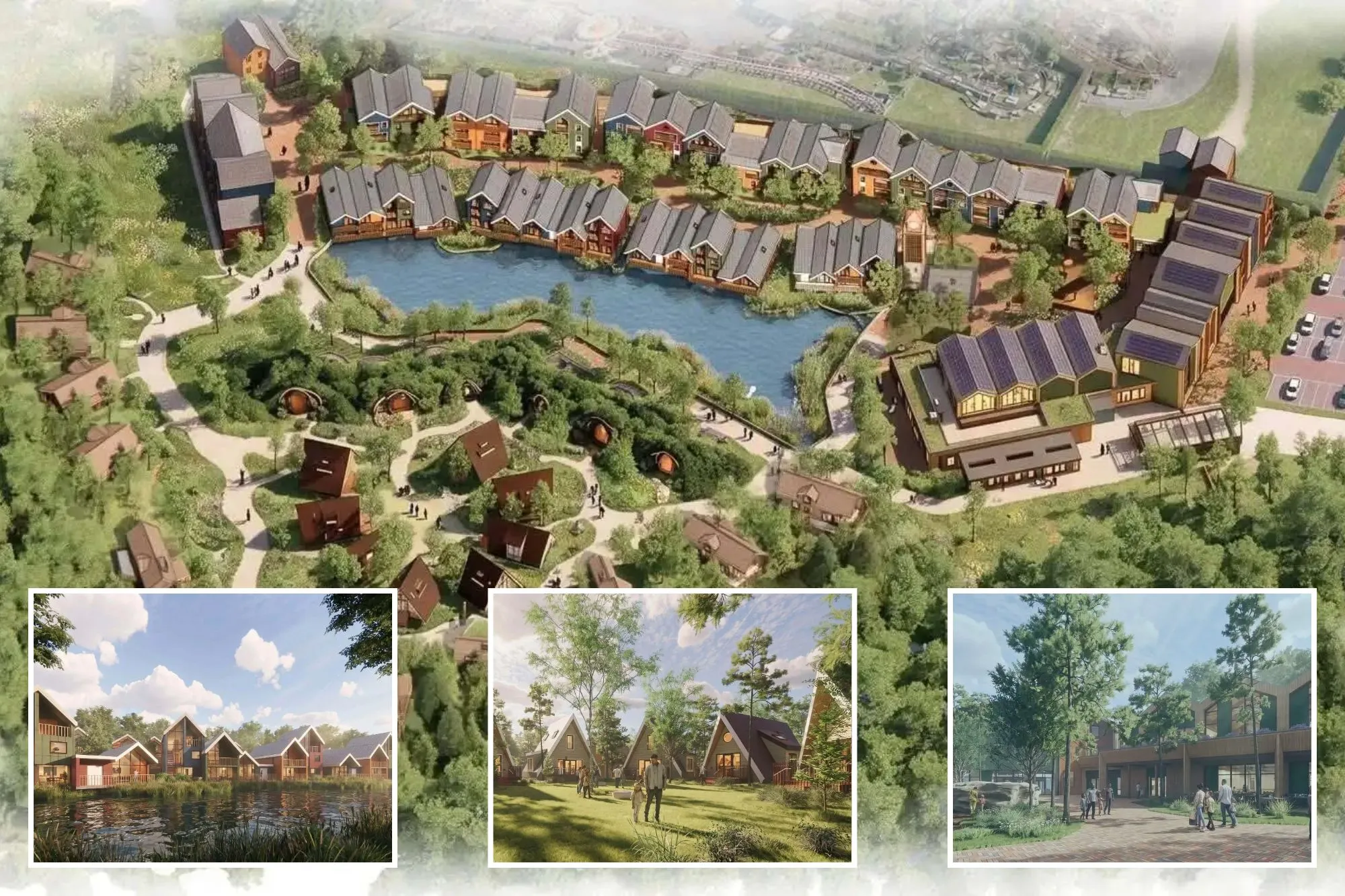
Paultons Park has revealed new images of their first ever holiday villageCredit: Paultons ParkThere will be 129 lodges, some overlooking the lakeCredit: Paultons Park
Images show lakeside and riverside lodges, treehouses and A-frame cabins.
Suites and ‘burrowed lodges’ that look like grass-covered Hobbit houses are part of the plans too.
Sign up for the Travel newsletter
Thank you!
The lodges will range from two bedrooms to four, suggesting space for as many eight guests in each.
There will be space for around 600 guests, with 129 lodges to choose from.
A-line cabins are also part of the plansCredit: Paultons ParkTreehouses will be some of the beautiful accommodation optionsCredit: Paultons Park
The park’s deputy managing director James Mancey previously said: “Our vision is to deliver 129 units, designed to comfortably accommodate just under 600 guests at full capacity, 100 guests fewer than previously outlined.
“We anticipate it will be several years before our vision for on-site accommodation is brought to fruition; however, we are committed to continually reinvesting in our attraction, providing a world-class experience for our guests, and planning for the long-term.”
In the mean time, Paulton’s Park is also opening a new water coaster called Serpent’s Curse next year.
The village wlil be the first accommodation on site for the parkCredit: Paultons ParkIt hopes to be open by 2030Credit: Paultons Park
The Sun’s Head of Travel (Digital) Caroline McGuire was one of the first to visit.
She said: ” I loved Drakon – the park’s first-ever inverting coaster starts with a vertical hill and drop, followed by two great inversion flips at speeds of 44mph.
But for all the speed, drops and twists, I never once felt nauseous – it is easily the smoothest rollercoaster I’ve ever been on and remarkably silent, none of that rattling you get on so many other coasters.
“The second coaster, Raven, was almost scarier despite not going upside down, thanks to its high-speed bobsleigh style, which whips you round tight hairpin turns and was great fun.
“There’s also a very cute new ‘Orchard Playground’ for kids up to the age of 10, the kind that Paultons does so well throughout the park, with treehouses, a lookout tower, net bridges and slides.
“The rollercoaster fan next to me was right, everything felt like the extra quality that you expect of somewhere like Disney.”
Rust red and burnt sienna speckle the green mountain rising from Lake Iseo. Golden autumn sunlight shimmers on the water. Monte Isola, Italy’s largest lake island, is a peak of sheer cliffs and dense forest, dotted with old fishing hamlets and hillside villages, each as pretty as the terraced villas of Lake Como and Garda, but with far fewer visitors. I arrive at the small port town of Peschiera Maraglio – where striped wooden boats jut from the water like the gondolas of Venice – on a ferry from Sulzano, a five-minute hop across the water.
“Only three people on the island are allowed to own a car: the priest, the doctor and the mayor,” says Chiara, my tour guide from Brescia. Residents can zip up and down the steep island roads on mopeds, and a small fleet of van-sized buses trundle around throughout the day, but nearly all cars are forbidden and visitors have to explore on foot or bike.
Even bikes are banned from boats at the weekend. Not that it matters: the harbour front is lined with bike rentals (from €4 an hour for a standard bike). I’m normally a nervous cyclist, but car-free roads raise my confidence. Plus, most other visitors have the telltale front-wheel wobble of novice riders. This isn’t the place for Lycra and personal bests; the smooth-as-silk, quiet roads are for slow pedalling, and neck swivelling to take in another gorgeous view of Lake Iseo.
An aerial view of Lake Iseo with Monte Isola
The circular lakeside route winds past olive groves tumbling to the shore. I thought I’d need base layers and gloves this far into autumn, but I’m in shorts and a T-shirt and already working up a sweat in 24C sunshine. I pedal through the lakeside hamlet of Sensole in the island’s south-west and stop in Menzino, just along the shore. There’s a cafe-bar catering to cyclists, so I fuel up with an espresso con lake view.
The view from the western side of the island is somewhat marred by a huge concrete factory on the mainland, so I keep my head down on the pedal to Siviano, the island’s capital. The shambling streets are sleepy; the stacked skyline of orange, lemon and magnolia villas is punctuated by the looming facade of Santi Faustino e Giovita church and a medieval stone tower. Monte Isola has been inhabited since the Roman era. Venetian rule in the 15th and 16th centuries left the main towns resembling those on Garda and Como: hillside terraces of wooden-shuttered pastel villas. In the late 18th century, Monte Isola found its main industry: net making. At Retificio La Rete Srl, a small shop and net factoryat Siviano’s port, fishing nets have been handwoven for centuries, along with nets for basketball hoops, football goals, shopping bags and hammocks.
At the northern tip of the island, I get the best views of Lake Iseo’s craggiest mountains. The south of the lake is chalk-white bell towers against gently undulating hills, draped in franciacorta vineyards. The north is where jagged peaks scrape the sky, plummeting to the emerald-green lake water. Just off the shore, a speck of an island (Isola di Loreto) is topped with a grand, castle-like building, which Chiara says is privately owned. A flotilla of kayakers from Marone make their way towards the private dock, slipping across the glass-still water.
In Carzano, I pause to admire thepink-and-white facade of San Giovanni Battista church, before cycling along the more functional stretch of road along the eastern shore. The traffic-free spell is broken by an old Fiat Punto, apologetically crawling along the road. Maybe the driver is the doctor or priest.
I complete my circle back in Peschiera Maraglio, where a late lunch of lake fish awaits at La Foresta restaurant. To begin, pickled tench so vinegary it makes my mouth water and a chub carpaccio that tastes like fresh lake water; followed by the island staple of dried, salted sardinas on grilled polenta. “Sardina is not a sardine; it’s actually a type of shad fish,” Chiara explains. “In the middle ages, when Monte Isola had to pay tax to Venice, they didn’t understand how money worked, so they paid in salted sardinas instead.”
Fish drying in Peschiera Maraglio, Lago d’Iseo. Photograph: Matthias Scholz/Alamy
As the last ferries leave for the evening, it feels as if I have Peschiera Maraglio to myself. Accommodation is private holiday apartments or restaurants with rooms. At Decio, a modern bistro dominates the ground floor, with a handful of sleek bedrooms above. The glass front shows off an uninterrupted lake view and the room is bathed in orange light at sunset. I spend the evening perched on a stool outside L’Isola dei Sapori, a no-frills alfresco spot where sparkling franciacorta wine is perfectly chilled, and snacks of local salami, olives and fish dishes combine for a light dinner.
The next day, I forgo my bike and lace up my hiking boots. The steep trail to the top of the island begins with the enclosed cobbled streets of Peschiera Maraglio and wends into thick chestnut forest. I pocket a particularly beefy conker, unable to resist the childhood urge for a blinder. My legs start to burn against the gradient – the trail is 450 metres of climbing. Rocks and twisting roots burst through the forest path and there’s a sheer drop to one side, but the glimpses of Lake Iseo between the trees are worth every wheeze.
Santuario della Madonna della Ceriola chapel on the island of Monte Isola in Lake Iseo. Photograph: Image Professionals/Alamy
After an hour, the trees thin out and I emerge at Santuario della Madonna della Ceriola. The striking white sanctuary was built in the 13th century, on the remains of a pagan temple and early Christian chapels. A vast golden altar and detailed frescoes adorn the interior, but it’s the panoramic view outside that really makes the hike worthwhile. The ferry to Sulzano is a toy boat, leaving a white tail of wake.
From up high, I see that autumn colours are already creeping into the forest. I wipe the sweat from my eyes. This view is only going to get prettier as the season evolves, and the prize conkers are yet to fall.
The trip was arranged by Visit Brescia. Bike rental starts at €4 an hour. The ferry from Sulzano to Monte Isola is €2.60 each way. Trains run from Brescia to Sulzano from €4.10. Rooms at Deciostart at €90 B&B