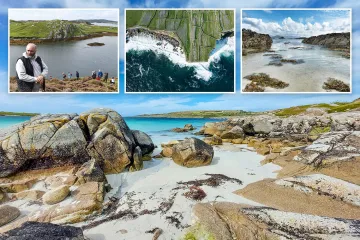
Europe’s lakes and mountains have seen a huge surge in summer tourism in recent years, as holidaymakers look for alternatives to the crowded coastal resorts of the Med. Whether it’s a walking holiday in the Tirol, a lakeside cabin stay in Scandinavia, or a spectacular train journey through the Alps, we’d love to hear about your favourite experiences.
The best tip of the week, chosen by Tom Hall of Lonely Planetwins a £200 voucher to stay at a Coolstays property – the company has more than 3,000 worldwide. The best tips will appear in the Guardian Travel section and website.
Keep your tip to about 100 words
If you have a relevant photo, do send it in – but it’s your words we will be judgingfor the competition.
We’re sorry, but for legal reasons you must be a UK resident to enter this competition.
The competition closes on Monday 3 August at 10am BST
Your responses, which can be anonymous, are secure as the form is encrypted and only the Guardian has access to your contributions. We will only use the data you provide us for the purpose of the feature and we will delete any personal data when we no longer require it for this purpose. For alternative ways to get in touch securely please see our tips guide.
If you’re having trouble using the form click here. Read terms of service here and privacy policy here.
July 16 (UPI) — Thick smoke from Canadian wildfires poured into northeastern quarter of the United States on Thursday after similarly darkening skies across and prompting health warnings across much of the Great Lakes region.
Dangerous levels of smoke were noted across Canada and the northeastern and midwestern United States, sparking memories of the historically severe wildfire smoke outbreak in 2023.
Entire states including New York, New Jersey, Connecticut, Delaware, Massachusetts, Michigan, New Hampshire, Ohio, Pennsylvania, Rhode Island and Wisconsin were under air quality alerts.
By early Thursday, Minneapolis, Duluth, Minn., and Detroit were among the most heavily impacted areas of the country.
Very heavy smoke from large wildfires in northern Minnesota and northwestern Ontario spread over Minnesota from late Wednesday into Thursday morning, the Minnesota Pollution Control Agency reported.
Hourly observations of smoke concentrations broke records for the Twin Cities on both days, the agency said.
In Detroit, businesses and attractions closed due to poor air quality.
A planned concert by rocker John Mellencamp at Pine Knob Music Theatre in Clarkston, Mich., was canceled while some workers inside Ford Motor‘s Michigan Assembly plant in Wayne, Mich., were hospitalized amid the smoky haze and intense heat, the Detroit Free Press reported.
Michigan’s statewide air quality alert was extended through Friday before cooler weather was expected to move the smoky pall out of the Great Lakes region.
In Chicago, the city closed all of its public beaches and outdoor pools, while Milwaukee recorded the worst air quality in its history — a record-breaking Air Quality Index measured at over 600, according to the Milwaukee Journal.
Further east, smoke from the Canadian wildfires enveloped New York City, prompting Mayor Zohran Mamdani to urge residents to “take precautions to stay cool and out of harm’s way” while dealing with both the smoke and high temperatures.
“In our city, we pride ourselves on being resilient,” the mayor told reporters early Thursday. “Today is not a day to say, ‘In spite of the air quality, I’m going to do everything I was going to do yesterday.’ This is very serious. We are reaching into a level of air quality that is dangerous for every single New Yorker.”
Smoke from fires in Northern California lowers visability of the Bay Bridge and San Francico as viewed from Yerba Buena Island on October 2. Photo by Terry Schmitt/UPI | License Photo
WHEN it comes to a holiday in Egypt, most Brits head to Hurghada or Sharm el Sheikh.
But there is a lesser-known spot in Egypt that people say feels like going back in time.
Sign up for the Travel newsletter
Thank you!
Siwa Oasis in Egypt is home to a number of salt poolsCredit: Alamy
Siwa Oasisis home to salt pools that are more concentrated than the Dead Sea, clay houses and miles of desert.
You can float in the bright blue waters – just make sure to wash off when you come out with tap water as the salt can irritate your skin.
The pools are surrounded by desert, where you can do a number of other activities including sandboarding and ‘dune bashing’ where you race around in 4x4s.
For another swimming experience, visitors can head to Cleopatra’s Bath – a natural spring with crystal waters.
Local legend has it that Queen Cleopatra used to swim in the circular pool and visitors can do the same today, as long as your shoulders and ankles are covered.
Around the pool there are even a number of cafes serving Siwan mint tea as well as freshly made juices.
And there are natural pools which Cleopatra is rumoured to have usedCredit: Alamy
Near the bath is also the Temple of the Oracle, dating back to the 26th Dynasty.
The temple sits on the top of a hill and is known for being the spot where Alexander the Great was named the son of Amun in 331 BCE.
Even though much of the temple today is ruined, visitors can climb to the highest point where they will get panoramic views with palm groves, salt lakes and desert.
The town of Siwa Oasis itself is home to hundreds of clay buildings, with the Shali Fortress standing in the middle.
The fortress dates back to the 13th century and is made of kershef, which is a blend of salt, mud and clay – all from the local lakes.
Despite heavy rain causing damage to the fortress in 1926, it still stands today with a number of alleyways and sets of stairs to explore.
In the main town, you will find clay buildings including a fortressCredit: Alamy
One person said on TikTok: “The town itself feels like you’re stepping back in time.”
There is a catch, however – to get there, you will have to drive 10 hours from Cairo and pass through several military checks on the way.
You can fly to Cairo from the UK in July from £165 one-way.
With GetYourGuide, you could then head off on a three-day tour from Cairo to Siwa Oasis, staying in a lodge in Siwa Oasis for one night and a Bedouin Camp for the second night.
The tour includes exploring Siwa Oasis as well as the El Alamein Military Museum, Mountain of the Dead with the tombs of Si-Amun, dipping in Cleopatra’s pool and visiting the city of Shali.
Also included in the tour is a dune buggy ride and sandboarding.
To get to Siwa Oasis you’ll need to drive from Cairo which takes around 10 hoursCredit: Alamy
window.itgHolidayConnectHolidayDealsFrames =
window.itgHolidayConnectHolidayDealsFrames || [];
window.itgHolidayConnectHolidayDealsFrames.push({
cid: “99a9d895”,
pid: “8925dc20-49c7-4663-9c7c-547ad29879e4”,
config: {
“poweredBy”:”icelolly”,”intro”:”Best value deals “,”title”:”The Sun Travel Eygpt all-inclusive deals under £600pp”,”destination”:”9546″,”boardBasis”:”AI”,”maxPrice”:”60000″,”maxDepartureDate”:”plus60″,”utm_campaign”:”The Sun Travel Eygpt all-inclusive deals under £600pp”,”layout”:”carousel”,”container”:”false”
},
});
Alternatively, you could head on a three-day tour with Viator heading to Marsa Matrouh, which Viator claims to be “one of the most beautiful cities on the Mediterranean” before reaching Siwa Oasis.
Similar to GetYourGuide, Viator’s tour will also take you to the Mountain of the Dead.
The tour also includes a dune buggy ride, camping in Siwa Oasis, stargazing and meditation, a tour of the Temple of the Oracle and a visit to Darker mountain.
For many Iranians, the most immediate threat is no longer just war, but water.
Years of drought, falling rainfall and unsustainable water use have pushed the country into severe water stress, depleting reservoirs, rivers and groundwater reserves. The US-Israel war on Iran has added further strain after reports of damage to desalination plants, pipelines and other civilian water infrastructure in the early weeks of the conflict.
Iran is classified by the World Resources Institute as facing “extremely high” baseline water stress, using more than 80 percent of its renewable water supplies each year.
In this visual explainer, Al Jazeera breaks down Iran’s worsening water crisis and what is driving it.
How Lake Urmia disappeared
One of the most striking examples of Iran’s water crisis can be seen from space.
A time-lapse display of Lake Urmia in northwestern Iran shows how the largest saltwater lake in the Middle East, which covered nearly 6,000sq km (2,300sq miles) in the 1990s, shrunk to just 581sq km (224sq miles), less than 10 percent of its former size.
A time-lapse view of Lake Urmia from 1990 to 2026 [Google Earth]
Consecutive droughts, agricultural water use, river diversion, and groundwater extraction have transformed vast stretches of Lake Urmia into exposed salt flats.
More than 60 dams built on its feeder rivers choked off inflows, while farmers diverted water into irrigation channels and decades of groundwater extraction drained the aquifers below. Rising temperatures accelerated evaporation as precipitation fell.
A view of Lake Urmia in 2014 [Kaveh Kazemi/Getty Images]
Iran’s growing water deficit
To sustain its freshwater resources, a country must replenish at least as much water as it withdraws for agriculture, industry, and household use.
Iran has long been on the wrong side of that equation. Decades of dam construction, intensive farming, and groundwater extraction have pushed consumption far beyond what rainfall can replenish.
In 2025, Iran’s 92 million people consumed around 100 billion cubic metres of water, nearly 13 billion more than its renewable resources could provide.
Agriculture is by far the largest consumer of water in Iran, accounting for about 91 percent of all withdrawals, compared with seven percent for households and two percent for industry. Yet much of that water is lost before it reaches crops, as ageing and inefficient irrigation systems waste a significant share of the country’s most precious resource.
Disappearing dams around Tehran
Iran is one of the world’s major dam-building countries, and has constructed hundreds of large and small dams to store water, generate electricity, and manage shortages.
In recent years, dozens of reservoirs have dropped to extremely low levels, leaving several to nearly run dry.
Before-and-after satellite imagery of Lar Dam, Latyan Dam and Mamloo Dam, all clustered around Tehran and the southern slopes of the Alborz mountains and forming part of the main water supply system for the capital region, reveals how water levels have declined over time as drought and rising demand strain Tehran’s water system.
Drought displacing thousands
Water scarcity is increasingly reshaping where Iranians can live.
As wells run dry and farming becomes harder to sustain, many families are leaving rural communities in search of more secure livelihoods. According to Abdolkarim Hosseinzadeh, Iran’s vice president for Rural Development and Disadvantaged Regions, only 38,000 of the country’s 69,000 villages remain inhabited, while 31,000 villages have been abandoned.
The pressure extends far beyond abandoned settlements. According to Iran’s state-owned Water and Wastewater Company, about 27,000 villages, home to more than 10 million people, are currently experiencing water shortages. In total, more than 70 percent of Iran’s villages are facing some form of water crisis.
Many migrants head towards major cities such as Tehran, Mashhad, Isfahan, and Shiraz. Yet these cities are facing water pressures of their own. Home to more than nine million people, Tehran has seen growing strain on its water system as drought and demand continue to rise.
The map below shows how Iran’s population is concentrated in the western half of the country. Today, roughly 75 percent of Iranians live on less than 40 percent of the country’s land area, concentrating both people and water demand in a relatively small region.
The effects of water scarcity can also be seen along the Zayandehrud River, once one of central Iran’s most important waterways.
Satellite imagery of Zayandehrud Dam reveals declining water levels upstream after years of drought and overuse.
Further downstream, the consequences become visible in the heart of Isfahan. The historic Allahverdi Khan Bridge (Si-o-Se Pol) was built over a river that sustained the city for centuries.
Today, residents increasingly encounter dry riverbeds beneath its arches as sections of the Zayandehrud repeatedly run dry.
The Si-o-se Pol (33-Bridge) historical bridge in 2017 [Thomas Schulze/Picture alliance via Getty Images]An Iranian man stands on the dried-up side of the Zayandehrud River as the Si-o-se Pol (33-Bridge) historical bridge is pictured in the historic city of Isfahan [Morteza Nikoubazl/NurPhoto via Getty Images]
Only a tiny fraction from desalination
Desalination accounts for only about three percent of Iran’s water needs, a stark contrast to Gulf neighbours, which depend on it for the majority of their drinking water.
Most of Iran’s desalination plants are located along its southern coast on the Gulf. As a result, desalination is largely concentrated in coastal cities, while inland areas such as Tehran, Isfahan and most agricultural regions rely on other water sources.
SITTING between two eastern European countries is a place nicknamed the ‘Galapagos of Europe’.
Despite being thousands of miles from the Galapagos Islands, Lake Ohrid is often compared to the region famous for its wildlife.
Sign up for the Travel newsletter
Thank you!
Lake Ohrid sits between North Macedonia and AlbaniaCredit: GettyThe lake is considered the ‘Galapagos of Europe’ and is surrounded by fishing villagesCredit: Alamy
Follow The Sun’s award-winning travel team on Instagram and Tiktok for top holiday tips and inspiration @thesuntravel.
It has incredible deep blue waters and can be accessed from both parts of both North Macedonia and Albania.
The lake is considered one of the oldest in Europe with historians tracing its roots back to as far as five million years ago.
As for what you’ll find lurking in its waters, the lake is considered the ‘Galapagos of Europe’ due to the high number of species – some of which are unique to the lake.
Lake Ohrid has even been described by scientists as “a museum of living fossils.”
One of the rare creatures that you’ll only find in the lake is the Ohrid trout, otherwise known as ‘koran’.
Fishermen are often up early to catch the trout which is a delicacy in the surrounding cities, towns and villages.
Other rare animals living in and around the lake include the Balkan whip snake.
There are also eels, various endemic snails, and birds like Dalmatian pelicans.
Despite the wildlife, Lake Ohrid is safe for swimming and is very popular during the summer months.
The water can be chilly though, ranging from between 14C to 24C depending on the season.
There’s plenty of room to explore as the lake is around 19 miles long and nine miles wide, with a shoreline that stretches on for around 54 miles.
Trpejca on Lake Ohrid is considered the ‘Saint-Tropez’ of the areaCredit: AlamyVisitors can explore the lake by hiking or biking along the shoreline, or get on the water on a boat cruiseCredit: Getty
It’s also one of the deepest lakes on the continent with a maximum depth of nearly 300 metres.
Visitors can explore the lake by hiking or biking along the shoreline, or get on the water on a boat cruise.
On Tripadvisor, one visitor described Lake Ohrid as a “piece of paradise”.
Another added: “This is a beautiful part of the world that once seen, is never forgotten.”
Back on shore, Lake Ohrid is surrounded by three main towns – Ohrid and Struga in North Macedonia, and Pogradec in Albania.
Other must-visit spots around the lake include some of the pretty villages.
In North Macedonia, Trpejca is considered one of the most charming and traditional villages.
It’s even been referred to as the ‘Saint-Tropez‘ of the lake thanks to its white shingle shoreline and beautiful waterfront houses.
Other top spots include the Albanian fishing village of Lin which has stone houses, narrow cobbled streets, and incredible views across the lake.
One convenient route for Brits to explore the lake is by flying into Tirana which can be done in under 30-minutes and as little as £13 with Wizz Air.