The stocking stuffer is one of the toughest of holiday challenges: a small gift, but not an impersonal one, and ideally something on the more affordable end of the spectrum. But the stocking stuffer is also an opportunity, a chance to be a little playful, and maybe a bit silly in our gift-giving prowess.
The list here runs the gamut. There are tech-savvy items, contemplative presents and, yes, even a lighthearted option or two. Stickers, anyone? That’s because gift giving should be fun. You’re here, I hope, looking to be inspired, and that’s why this list prioritized variety. Here are some ideas to hopefully provide a bit of gift-giving motivation this holiday season.
Editor’s note: If you make a purchase using some of our links, the L.A. Times may be compensated. Prices and availability are subject to change. In some cases, listed websites may use location-based pricing.
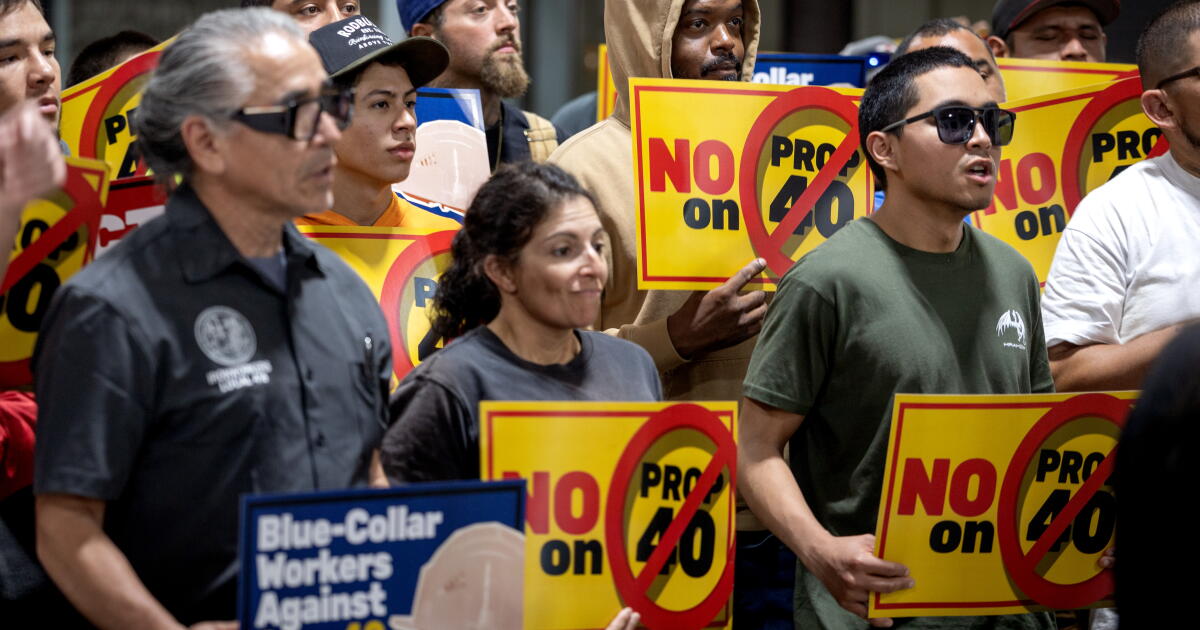
Proposition 40 would impose a one-time 5% tax on California billionaires’ assets. The tax applies to people with a net worth of at least $1 billion who resided in California on Jan. 1.
Impact
Ninety percent of the tax would fund healthcare, and 10% would go toward education and food assistance.
The tax would affect hundreds of billionaires whose net worth includes assets such as their businesses, stocks and other investments. Real property, pensions and retirement accounts generally would be excluded.
Proposition 41
It’s called the Improving Transparency, Effectiveness and Efficiency in California Government Act. But it is deeply connected to Proposition 40 and is funded by foes of the billionaire tax.
The basics
Proposition 41 requires the state auditor to review programs funded by proposed special taxes before they appear on the ballot. More importantly, it also prohibits new state taxes from being exempted from a voter-approved state spending limit.
Impact
The Legislative Analyst’s Office says passage of Proposition 41 could prevent Proposition 40, the proposed billionaire tax, from becoming law even if voters approve it. This could happen if Proposition 41 receives more “yes” votes than Proposition 40.
Proposition 42
Proposition 42 would limit the state’s ability to impose certain new taxes. But it’s more complicated and far-reaching than that description might sound. And, yes, it’s also backed by opponents of Proposition 40.
The basics
Proposition 42 would prohibit new taxes on “retirement holdings, individually owned assets, and other forms of personal savings” that take effect after Jan. 1, 2026. It also would bar retroactive taxes on past earnings unless the state is using revenue from the tax to respond to emergencies such as a fire or a flood.
Impact
The Legislative Analyst’s Office says Proposition 42 could nullify Proposition 40 because the two measures conflict with each other. If voters approve both, the one with the most “yes” votes generally would become law, the office says.
Dig deeper
The billionaire tax was pushed by the Service Employees International Union-United Healthcare Workers West and has some labor and progressive support, including from Sen. Bernie Sanders (I-Vt.) and the state Democratic Party. They say the tax is needed to help the less fortunate and that the super-rich can afford it. But key Democrats and some key unions are not supporting it.
Critics include some of California’s richest people, and they are spending a fortune to defeat it. They say it will hurt innovation and drive the wealthy out of the state, hurting the treasury.
Now, voters will consider significant changes to recall rules for elected state officials.
The basics
Under current law, when an elected official is recalled in California, the election for their replacement occurs at the same time. Proposition 5 breaks up that process into two parts, prioritizing the voters’ right to oust an official before selecting a replacement.
The impact
This ballot measure would amend the state constitution to change the current recall system. Under the proposed changes, voters would first be asked to choose whether or not to oust an official. Then, in the event of a recall, the official would be replaced by appointment, succession or special election at a later date. In the case of a special election, the former officeholder could run again.
The measure also would designate California’s lieutenant governor as the de facto replacement for a recalled governor until the next term.
Dig deeper
California’s rules for recalling politicians date to the Progressive era and were seen at the time as a way to give more power to voters.
But there have been concerns in recent years that the process needs reform, especially after the 2021 recall that Newsom overwhelmingly beat back; it cost local and state governments more than $200 million.
After the Newsom recall failed, the Legislature began a bipartisan task force to suggest changes.
There has been much debate about efforts in California to tax the rich. But almost all of it centers around Proposition 40, the heavily contested billionaire tax, and two countermeasures, Propositions 41 and 42.
But there is another ballot measure that also would tax California’s wealthiest citizens that is getting far less attention — and has even garnered support from some billionaires who oppose Proposition 40.
The basics
Proposition 3 would make an expiring state income tax on high earners permanent.
The impact
Tax rates for the top 2% of earners would remain as they are. Income brackets rise with inflation, but last year the top 2% of taxpayers earned at least $371,000 for single filers and $743,000 for joint filers. Money generated by Proposition 3, like the current tax, would flow to education, with 89% going to K-12 schools and 11% to community colleges.
Dig deeper
In 2012, California voters approved a temporary increase in the income tax rate for the top 2% of California earners. In 2016, voters approved another extension through 2030. Proposition 3 would make the additional levy permanent.
Backers say the measure is crucial to maintain education funding levels and predict there would be grave problems if the measure is not approved. The state could expect to lose $5 billion to $15 billion annually in tax revenue starting in 2031, according to estimates from the Legislative Analyst’s Office.
Opponents say taxes are already too high and the state should focus on cutting waste.
The California Environmental Quality Act is one of the most consequential and controversial laws on the books.
CEQA, which dates to the 1970s, requires state and local agencies to consider the environmental effects of many proposed projects before approving them. If a project could cause significant environmental harm that can’t easily be avoided, it undergoes a more detailed environmental review to examine its potential effects and alternatives.
Backers say CEQA is a vital tool for environmental review and gives the community a voice in development. But critics say CEQA is too often used to slow down needed housing and has been exploited as a bureaucratic weapon.
Enter Proposition 45.
The basics
Proposition 45 would impose stricter deadlines on environmental reviews, permits and court challenges. Agencies would have to spell out application requirements up-front and could not make repeated requests for more information or project changes. The measure caps public comment periods, while current law only sets minimum lengths. It also limits what courts may consider in CEQA lawsuits.
The impact
The law clearly would change the CEQA process; whether that would be for better or worse is the subject of debate. Backers say it would make the process faster and easier. Critics say it would roll back important environmental protections.
Dig deeper
The fight over Proposition 45 comes as California struggles to build enough housing to meet demand, causing prices to skyrocket. Housing prices, polls show, are a major issue for California voters.
But the proposition also is touching on another hot-button issue: data centers. Supporters and foes are battling over whether the measure would make it easier to build more of those controversial facilities.
Actor Barbara Barrie, best known for films in which she elevated the role of Mom — including her Oscar-nominated turn in “Breaking Away” (1979) — died Wednesday in her Manhattan home. She was 95.
Barrie’s death was confirmed to the L.A. Times by the actor’s representatives, who said it was medically assisted. Her daughter, Jane Harnick, told the New York Times that her mother’s death followed a terminal cancer diagnosis.
Barrie’s representatives said in a statement to the L.A. Times that the actor was a proponent and advocate of New York’s Medical Aid in Dying Act, a law that took effect on Aug. 5.
Born Barbara Berman in Chicago in 1931, Barrie and her family moved to Corpus Christi, Texas, where she attended Del Mar College. She would later transfer to the University of Texas, where she received multiple awards for drama.
After graduation, she took her acting dreams to the Big Apple, where she made her Broadway debut in the 1955 play “The Wooden Dish.” Throughout her career, Barrie starred in various Broadway productions, among them “The Selling of the President” (1972), “California Suite” (1976) and, most notably, the 1970 musical “Company,” by Stephen Sondheim, for which she received a Tony Award nomination for featured actress in a musical.
Her last Broadway stint was in 2017 in the original role of Helene Berman in the Joshua Harmon play “Significant Other.”
Barrie extended her acting expertise beyond the stage, however, making her first television appearance on “Kraft Television Theater” in 1955. A year later, she made her film debut, albeit uncredited, in the western epic “Giant” while she was in Texas visiting her family.
With more than 120 credits to her name, Barrie began appearing in popular TV shows in the 1950s and ’60s, such as “Naked City,” “The Twilight Zone,” “The Alfred Hitchcock Hour,” “The Nurses” and more. Later TV credits included “Barney Miller” and “Suddenly Susan,” where she played an on-screen grandmother to Brooke Shields.
Her first major film role came in 1964, when she played divorcée Julie Cullen Richards in “One Potato, Two Potato.” She portrayed a white woman who falls in love with a Black man, Frank Richards (played by Bernie Hamilton). The film was released during a time when interracial marriage was not yet legalized nationwide. Barrie earned a Cannes Film Festival Award for the performance.
The actor went on to star as the mom Evelyn Stroller in the 1979 coming-of-age comedy-drama “Breaking Away,” which earned her an Academy Award nomination for supporting actress, and later an Emmy nomination when she reprised the role for the 1980 television series.
Other film credits include 1980’s “Private Benjamin,” 1997’s “Hercules” (where she voiced Alcmene, Hercules’ mortal mother) and 1999’s “Judy Berlin.” According to her IMDb profile, her last credit was in 2025 for the queer romantic comedy “Things Like This.”
In 1994, Barrie was diagnosed with rectal cancer, prompting her to raise awareness about the disease. She published two books on the matter, including “Second Act,” a 1997 memoir about resolute optimism and acceptance, and “Don’t Die of Embarrassment: Life After Colostomy and Other Adventures,” a 1999 memoir where she dives deep into her diagnosis and experience with a colostomy procedure.
Barrie married actor, director and producer Jay Harnick in 1964. He died in 2007. The two are survived by their children, Jane and Aaron.
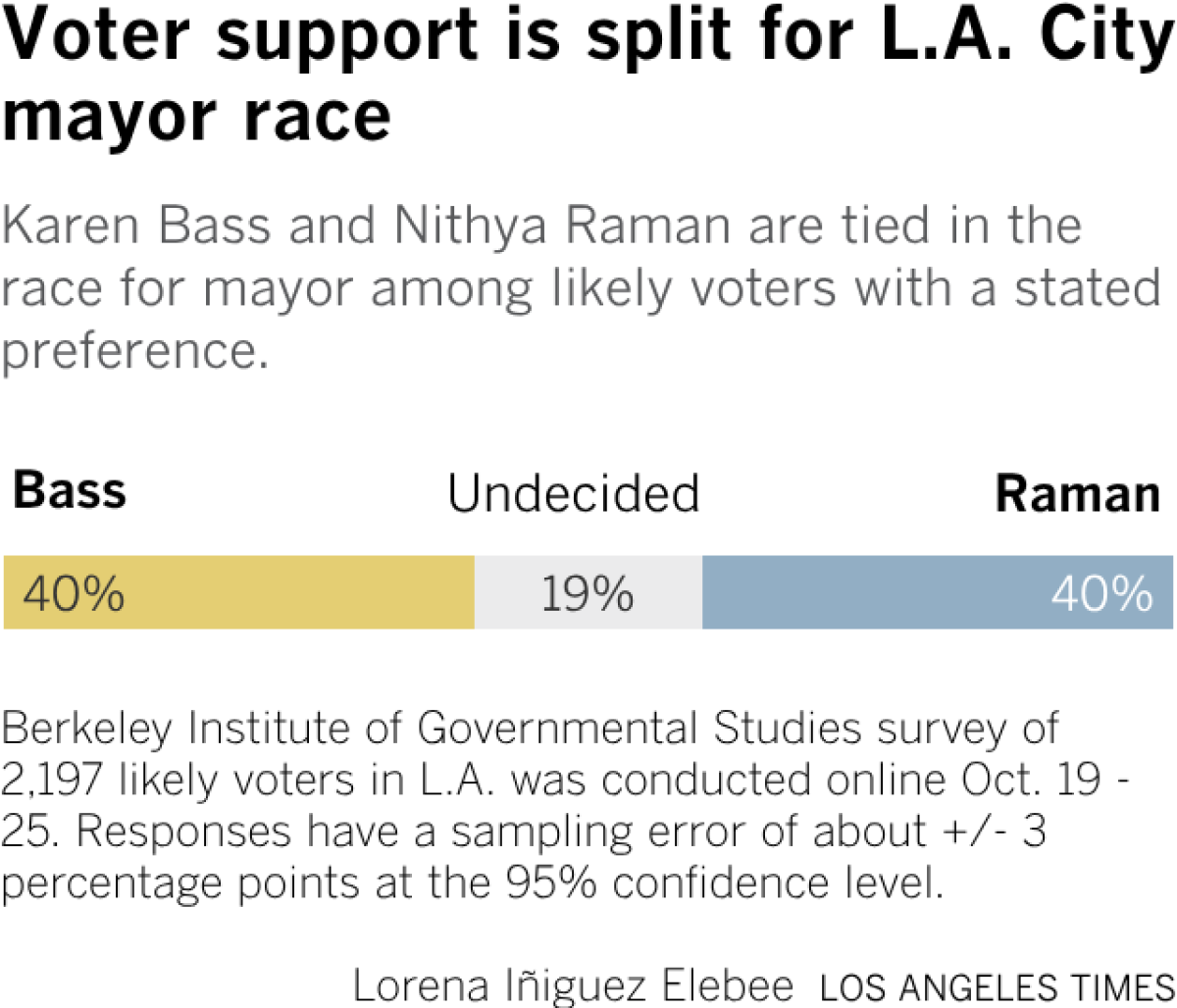
The race for mayor of Los Angeles is a dead heat as the campaign draws to a close, with a new poll showing incumbent Karen Bass erasing the double-digit lead previously held by Councilmember Nithya Raman.
Raman and Bass now each have 40% of likely L.A. voters in their camps, with 19% still undecided ahead of the Nov. 3 election, according to the UC Berkeley Institute of Governmental Studies poll, co-sponsored by The Times.
The neck-and-neck contest is a big change from September, when Raman jumped out to an 11-percentage-point lead with support from 39% of likely voters compared with Bass at 28%.
It follows weeks of relentless attacks on Raman by Bass, whom some analysts had predicted would need to campaign more aggressively to close the gap with her challenger.
“It’s certainly a breath of fresh air for Bass to see the race close. She’ll probably feel the campaign is having the effect she wants it to have, which is to put more focus on Raman and put Raman on the defensive,” said Mark DiCamillo, the director of the Berkeley IGS Poll.
Mayor Karen Bass greets phone banking volunteers at her South L.A. campaign headquarters.
(Jason Armond / Los Angeles Times)
The survey released Wednesday was conducted online in English and Spanish with a sample of 2,197 likely city voters between Oct. 19 and Oct. 25. It has a margin of error of about three percentage points.
“The momentum in this race is with Karen Bass,” said Alex Stack, a spokesperson for Bass’ campaign. “Ever since Angelenos got their ballots, Nithya Raman has made headlines for all the wrong reasons — voters know they can’t trust her on public safety and other key issues.”
The Raman campaign cited high unfavorable numbers for Bass in the poll, and noted that the mayor “still can’t get ahead” in voter surveys.
“Bass hasn’t led a poll since August and an aggregate of all publicly available polls continues to show Nithya in the lead,” the Raman campaign said in a news release.
The leveling off of the race, along with the sharp decline in undecided voters, was spurred largely by conservative voters who chose Republican Spencer Pratt in the primary deciding to vote for the mayor in the runoff, said DiCamillo.
In the September Berkeley IGS/L.A. Times poll, 22% of Pratt voters said they planned to support Bass, while 16% said they favored Raman. That left a whopping 63% of Pratt voters undecided still.
In the new poll, Bass shot up to 41% of the Pratt vote, while Raman dropped to 14% and 45% were still undecided. Pratt hasn’t endorsed either candidate in the race and continues to bash both Raman and Bass on social media.
“The Pratt voters are the biggest insertion,” DiCamillo said. “The question remains, since we’re looking at Pratt voters, 45% remain undecided. Will they vote?”
Raman trailed Bass in every poll during the primary campaign. Neither candidate had ever cleared 40% in any of the polls conducted by Berkeley IGS/L.A. Times.
In the June 2 primary election, Bass received 34% of the vote while Raman received 29%. Pratt placed third with 26%.
In the new poll, Raman shed support in key areas, including among groups that previously appeared to be leaning toward her.
Councilmember and mayoral hopeful Nithya Raman, center, with supporters at Grand Park in downtown Los Angeles.
(Christina House / Los Angeles Times)
In the September poll, Raman led among Latinos by 24 percentage points, 45% to Bass’ 21%. In the October poll, Bass was up to 40% and Raman fell to 43%, leaving the two within the margin of error for that key constituency.
DiCamillo said part of that change had to do with the likely voter population becoming more clear as the election neared, and older Latinos appeared to be a larger portion of the electorate.
“The Latino likely electorate now includes more older Latinos; that benefits Bass,” he said.
Black voters, long considered the backbone of Bass’ coalition, solidified behind the mayor, with 71% of likely Black voters supporting her compared with 13% supporting Raman. While Bass led among Black likely voters in the September poll, the already wide margin was much slimmer at that time, at 48% to 20%.
The poll also affirmed a widely held belief among the Bass camp that the San Fernando Valley would tilt toward the mayor over Raman.
Raman was leading in the Valley in the September poll 34% to 26%, but that number flipped on its head over the past month, with Bass now in front of Raman 44% to 33%.
Bass’ surge in the poll was more notable because the mayor’s favorable ratings — which have been in the tank since the January 2025 wildfires — remained underwater, with 65% of Angelenos viewing her unfavorably compared to 64% in the last poll. Only 32% had a positive view of the mayor, up four percentage points from September.
Bass’ attacks on Raman appeared to be having a significant effect on voters’ opinions of the challenger.
For the first time in a poll by Berkeley IGS/L.A. Times this cycle, Raman posted a higher unfavorable rating than favorable, with 49% of likely voters saying they viewed her unfavorably compared to 42% who had positive views of her.
The mayor, her campaign team and her surrogates have stepped up their offensive toward Raman, seizing on any opportunity to hammer the council member over remarks she has made on the campaign trail that they argue make the her unfit for the mayoralty and “not ready for prime time” — a slogan the mayor and her allies have deployed against their rival.
In early October, the Bass campaign slammed Raman over a video she posted with a leftist influencer in which she urged viewers to “stop fascist liars” as a photo of Bass flashed on the screen. Raman criticized both Bass and LAPD Chief Jim McDonnell in the video.
Bass accused the council member of calling the city’s police officers fascists. A Raman spokesperson said she was referring to the “Trump administration’s violent kidnappings” as fascist, not the mayor or police chief or officers. The story dominated headlines for days.
The Bass camp also needled Raman that week after photos surfaced of the council member attending a happy hour on the day federal immigration authorities began raids in Los Angeles last summer, though Raman said she attended a protest that same day.
The Bass campaign sent out a news release calling it “Nithya Raman’s terrible, horrible, no good, very bad week.”
The attacks continued the next week after Raman said during the mayoral debate that the “gold standard” for LAPD’s noncooperation with immigration enforcement took place during the tenure of former LAPD Police Chief Daryl F. Gates.
Gates, a controversial chief accused of racist remarks during his tenure, headed the department during the 1991 videotaped beating of Rodney King and Bass said Raman’s comments showed she was “not really familiar with L.A., especially the Black community.”
Raman retorted that Bass was twisting her words, but later apologized, saying that mentioning Gates was painful for people across L.A.
The poll also asked respondents for the top priorities for the next mayor to address. Reducing the number of homeless encampments was by far the top answer, chosen by 43% of likely voters.
Tied for second place among top concerns was ensuring public safety and building more affordable housing, selected by 29% each.
Protecting immigrant communities was the third-most cited concern, with 21%, followed by balancing the city budget at 17%.