Korea

South Korea passes currency stabilization bill amid economic strain

Lawmakers pass a revision to the Restriction of Special Taxation Act during a plenary session at the National Assembly in Seoul, with 206 votes in favor, 2 against and 2 abstentions out of 210 members present. Photo by Asia Today

March 31 (Asia Today) — South Korea’s ruling and opposition parties agreed Tuesday to pass a package of economic measures, including a currency stabilization bill, as the won weakened sharply amid prolonged conflict in the Middle East.

The legislation was approved during a plenary session alongside more than 60 bills aimed at stabilizing the economy and supporting livelihoods.

The currency measure includes tax incentives designed to encourage domestic investment by individuals who have invested in overseas markets, often referred to in South Korea as retail investors in foreign stocks. Officials said the goal is to increase demand for the Korean won and reduce volatility in foreign exchange markets.

The won traded at 1,530.1 per U.S. dollar on Tuesday, well above the psychologically significant 1,500 level, adding to inflationary pressure.

Floor leader Han Byung-do said the worsening Middle East crisis had begun to affect everyday life, emphasizing the need to contain exchange rate volatility and shield the economy from external shocks.

Lawmakers also approved additional economic legislation tied to the crisis. These include a measure to support corporate restructuring, allowing companies to streamline mergers and spin-offs and receive tax benefits as they respond to industrial challenges and shift into new sectors.

Other bills passed include revisions to trade-related laws aimed at helping businesses adapt to changes in the global trade environment.

Separately, lawmakers voted to fill several vacant leadership posts in National Assembly committees. The Democratic Party nominated Rep. Seo Young-kyo as chair of the Legislation and Judiciary Committee, along with Rep. Kwon Chil-seung and Rep. So Byung-hoon for other committee leadership roles. Their terms will run through May.

The votes were conducted by secret ballot and passed with support from the Democratic Party, while the People Power Party is believed to have opposed the selections.

The People Power Party had argued that the judiciary committee chair should be held by the opposition to ensure checks and balances, noting that the Democratic Party already holds the position of National Assembly speaker.

— Reported by Asia Today; translated by UPI

© Asia Today. Unauthorized reproduction or redistribution prohibited.

Original Korean report: https://www.asiatoday.co.kr/kn/view.php?key=20260401010009707

Source link

S. Korea intelligence agency says drone case was ‘personal misconduct’

Exterior of the National Intelligence Service headquarters in Seoul. Photo by Asia Today

March 31 (Asia Today) — South Korea’s National Intelligence Service said Tuesday that an employee accused of involvement in a North Korea drone incident acted independently, describing the case as “personal misconduct” unrelated to official duties.

The agency said its internal inspection found the employee was an administrative staff member with no authority to collect or handle intelligence.

Officials added that the employee had known the main suspect – a graduate student in his 30s – since their college years, and that funds transferred in connection with the case were personal money, not tied to the agency.

Earlier in the day, a joint military-police task force referred the employee and two military officers to prosecutors without detention. The case involves allegations of aiding violations of national security and aviation safety laws.

The intelligence employee was sent to civilian prosecutors, while the two active-duty officers were referred to military prosecutors, all with recommendations for indictment.

Investigators said the suspects were involved in assisting the graduate student, identified only by his surname Oh, in flying a drone into North Korea.

The employee is believed to have known about the civilian suspects’ drone development activities and related business operations. Authorities said he provided about 2.9 million won ($2,200) to help cover production costs and meal expenses on the day of a test flight.

An intelligence agency official said the employee’s actions were “an individual deviation unrelated to official duties” and that the agency had cooperated fully with investigators to clarify the facts.

— Reported by Asia Today; translated by UPI

© Asia Today. Unauthorized reproduction or redistribution prohibited.

Original Korean report: https://www.asiatoday.co.kr/kn/view.php?key=20260331010009597

Source link

S. Korea to remove ‘China (Taiwan)’ label from e-arrival system after Taiwan’s protest

South Korea will remove the “China (Taiwan)” label from its e-arrival system, a foreign ministry official said Tuesday, after Taiwan changed South Korea’s name in its immigration system from “Korea” to “Korea (South)” in protest.

Seoul plans to remove the “last point of departure” and “next destination” fields from e-arrival cards, where the island nation had been listed as “China (Taiwan),” the official told reporters. It will remain listed as Taiwan in the country and region field.

“We have reviewed the matter and are moving forward with plans to remove the ‘last point of departure’ and ‘next destination’ fields from the electronic arrival card,” he said.

The official said the paper arrival cards already do not include those fields, and that the move is part of efforts to streamline the system, improve convenience for visitors from Taiwan, and align the paper and electronic arrival formats.

The Ministry of Justice is handling the matter in line with relevant procedures, the official said.

Seoul’s decision came after Taiwan called for a “correction” in its labeling as “China (Taiwan)” on e-arrivals, saying it has changed South Korea’s name in its immigration system from “Korea” to “Korea (South)” in a reciprocal measure.

Taipei had warned that it would take further corresponding steps if it sees no positive action from Seoul by the end of this month.

Taiwan’s foreign ministry said Tuesday that it has learned Seoul was under an “internal administrative and technical review” to update its e-arrival card system. It said Taiwan will temporarily suspend its own change to the e-entry registration.

Seoul noted that the decision was not made in response to Taiwan’s stated March 31 deadline for possible additional measures over the labeling, but was intended to address the issue in a way that promotes practical, unofficial cooperation with Taiwan.

Taiwan is also reportedly expected to take reciprocal steps to restore “Korea” in its foreign residents’ certificates.

Seoul’s decision to remove the two fields will be applied to all countries.

South Korea severed official diplomatic ties with Taiwan in 1992, when it established formal relations with mainland China. Since then, the two sides have maintained practical ties in an unofficial manner.

China considers Taiwan, self-governed since it broke away from the mainland in 1949, as part of its territory that must be reunified by force if necessary, and it has strongly objected to any country that challenges this stance.

“We maintain necessary communication with China on matters of mutual interest,” the Seoul official added.

Copyright (c) Yonhap News Agency prohibits its content from being redistributed or reprinted without consent, and forbids the content from being learned and used by artificial intelligence systems.

Source link

U.N. Human Rights Council adopts North Korea resolution

The U.N. Human Rights Council adopted a resolution condemning North Korea’s human rights violations during a session in Geneva Monday. The Council’s 61st session opened on Feb. 23, as seen in this file photo. File Photo by Valentin Flauraud/EPA

SEOUL, March 31 (UPI) — The United Nations Human Rights Council adopted a resolution condemning North Korea’s human rights violations, with South Korea joining 49 other countries as a co-sponsor despite speculation it might withhold support as it seeks to improve relations with Pyongyang.

The resolution was adopted by consensus at the Council’s 61st regular session Monday in Geneva. It expresses “deep concern about the systematic, widespread and gross human rights violations in the Democratic People’s Republic of Korea [and] the pervasive culture of impunity and lack of accountability for such violations.”

The measure urges Pyongyang to undertake sweeping reforms, including dismantling political prison camps, ending forced labor and ensuring freedom of expression and movement.

The Council has adopted a North Korean human rights resolution every year since 2003.

South Korea had reportedly weighed opting out of co-sponsorship this year, as the administration of President Lee Jae Myung pursues renewed engagement with the North and seeks to ease tensions on the Korean Peninsula.

However, Seoul ultimately decided to join as a co-sponsor “following in-depth consultations among relevant government agencies,” Foreign Ministry spokesman Park Il said at a press briefing Tuesday.

He pointed to the resolution’s references to humanitarian issues such as abductions and reunions for separated families, as well as language supporting dialogue and engagement.

“It was by taking all these aspects into account that we decided to participate as a co-sponsor,” Park said.

South Korea also backed a similar U.N. resolution at the General Assembly in November. Seoul had co-sponsored such measures from 2008 through 2018, but stepped back during a period of inter-Korean detente between 2019 and 2022 under then-President Moon Jae-in.

The latest resolution comes as Seoul weighs how to balance engagement with Pyongyang against pressure to address its human rights record.

President Lee has taken conciliatory steps since taking office in June, including restricting activist groups from sending propaganda leaflets across the border.

Last week, Human Rights Watch and more than two dozen organizations and individuals urged Lee’s government to continue supporting the resolution, warning in an open letter that recent policy moves “signal a troubling shift away from support for the victims of the North Korean government repression.”

“Sustainable peace on the Korean Peninsula cannot be achieved by excluding human rights,” the letter said. “Dialogue and engagement need to go hand in hand with the protection of human rights and accountability.”

North Korea has long rejected such resolutions as hostile acts, accusing the United Nations and Western countries of using human rights as a pretext to undermine its government.

Speaking at a session ahead of the vote Monday, North Korea’s deputy permanent representative to the United Nations in Geneva, Kang Myong Chol, said Pyongyang “categorically rejects” the measure.

“We condemn it as a falsified document motivated by ulterior political objectives of undermining the dignity of my country and discrediting its ideology and system,” Kang said.

A recent report by the U.N. special rapporteur found that the country’s human rights situation has “shown no improvement” over the past decade and in many cases has worsened, despite limited engagement with international mechanisms.

The report cited persistent restrictions on movement, expanded surveillance and the continued use of forced labor, as well as growing difficulty for citizens attempting to leave the country.

The resolution was adopted without participation from the United States, which withdrew from the Human Rights Council after President Donald Trump signed an executive order ending U.S. membership in February 2025.

Source link

South Korea to import eggs to curb chicken price surge

The Ministry of Agriculture, Food and Rural Affairs building. Photo by Asia Today

March 30 (Asia Today) — South Korea’s agriculture ministry said Monday it will urgently import 15 million broiler hatching eggs in an effort to curb rising chicken prices.

The Ministry of Agriculture, Food and Rural Affairs said retail prices for broiler chicken have climbed sharply in recent days, increasing by about 300 won (about $0.22) per kilogram over the past 10 days.

According to the Korea Agro-Fisheries and Food Trade Corporation’s price system, the average price rose from 6,252 won ($4.60) per kilogram on March 19 to 6,534 won ($4.80) on March 28. Peak prices rose from 7,182 won ($5.30) to 7,980 won ($5.90) over the same period.

Officials warned that rising chicken costs could lead to higher prices for fried chicken, a widely consumed food in South Korea, potentially pushing up overall dining-out inflation.

The ministry said it is in talks with the Netherlands over quarantine procedures for importing the eggs and is also considering Belgium as an alternative supplier if negotiations stall.

If talks are successful, imports could begin as early as early April. Combined with 778,000 eggs already imported from Spain in March, total imports would reach about 23 million eggs.

However, officials acknowledged that the measure may not provide immediate relief. It is expected to take about two months for the imported eggs to be hatched, raised and processed into chicken products available in stores.

The ministry is also reviewing measures to ask major poultry producers to refrain from raising prices during the period.

— Reported by Asia Today; translated by UPI

© Asia Today. Unauthorized reproduction or redistribution prohibited.

Original Korean report: https://www.asiatoday.co.kr/kn/view.php?key=20260330010009113

Source link

South Korea birth rate nears 1, but structural issues persist

Two mothers stand with their children in downtown Seoul, South Korea, 25 February 2026. According to data released by the Ministry of Data and Statistics, the number of births in South Korea in December 2025 reached 20,003, an increase of 1,747, or 9.6 percent, compared to the same month a year earlier. Photo by JEON HEON-KYUN / EPA

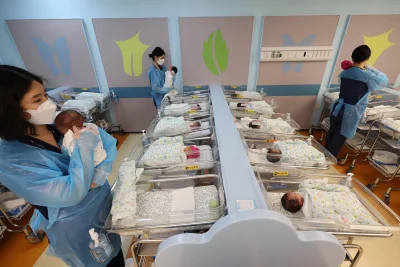
March 30 (Asia Today) — South Korea’s fertility rate rose to 0.99 in January, nearing the symbolic threshold of 1.0, but experts warn the increase does not signal a sustained recovery.

Statistics Korea reported 26,916 births in January, the highest monthly figure in nearly seven years, while marriages also reached their highest level since 2018. The rise in marriages, a leading indicator of births, has raised expectations that birth numbers could continue to increase over the next two to three years.

Despite the uptick, analysts say the improvement reflects a temporary demographic effect rather than a fundamental shift. The increase is largely attributed to people born in the early 1990s entering peak childbearing years, boosting birth numbers in what is often referred to as an “echo boom.”

Experts caution that broader structural challenges – including population decline, rapid aging and regional depopulation – continue to worsen.

The government is planning to restructure its population policy framework in response. Officials aim to expand the Presidential Committee on Low Birthrate and Aging Society into a “population strategy committee” with broader authority covering labor supply, immigration and regional demographics.

The proposed body would also coordinate policies across ministries and be granted authority to review budgets in advance, signaling a shift toward more centralized management of population-related policies.

The policy approach itself is also expected to change. Rather than focusing solely on raising the birth rate, the government is moving toward strategies that assume continued population decline and aim to adapt to long-term demographic changes.

However, progress has been slow. The vice chair position of the presidential committee has remained vacant for about three months, and plans to expand and strengthen the organization have yet to gain momentum.

Experts say policy must focus less on short-term birth rate figures and more on underlying structural issues.

Ha Hye-young, a senior researcher at the National Assembly Research Service, pointed to Japan’s experience with regional revitalization policies, saying South Korea should adopt models that account for a shrinking population rather than attempting to reverse it.

Kim Jong-hoon, head of a population research institute, said South Korea faces a growing imbalance as the working-age population declines while the burden of supporting older generations increases. He added that many current policies amount to a “zero-sum” effort to attract residents from other regions rather than expanding the overall population base.

— Reported by Asia Today; translated by UPI

© Asia Today. Unauthorized reproduction or redistribution prohibited.

Original Korean report: https://www.asiatoday.co.kr/kn/view.php?key=20260330010009243

Source link

S. Korea raises fuel price caps; pump prices seen above $1.50 a liter

A price board at a gas station displays regular gasoline at 1,796 won per liter (around US$1.20) in Incheon, South Korea, 13 March 2026. The government implemented a temporary fuel price cap system the same day to ease cost burdens amid supply concerns linked to the Middle East crisis. File. Photo by YONHAP / EPA

March 26 (Asia Today) — South Korea will raise its second round of fuel price caps starting at midnight Friday, pushing expected retail gasoline prices above 2,000 won per liter (about $1.50).

The government set the new ceiling for gasoline at 1,934 won ($1.45) per liter, up 210 won from the first round. Diesel will be capped at 1,923 won ($1.44) and kerosene at 1,530 won ($1.15).

Because refiners’ wholesale supply prices have already moved into the 1,900-won range, officials expect retail prices at gas stations to settle in the low 2,000-won range, or roughly $1.50 to $1.60 per liter.

The first round of price caps, introduced March 13, focused on shielding consumers from a surge in global oil prices. The second round reflects a shift in policy, allowing some price increases while trying to prevent excessive costs from being passed on to households as the crisis drags on.

The Ministry of Trade, Industry and Energy said the revised caps incorporate international oil price movements while factoring in inflation and household impact.

Yang Ki-wook, a senior official at the ministry, said the government did not apply global prices mechanically.

“We considered the broader impact on people’s livelihoods,” Yang said.

Based on the first round, when the nationwide average gasoline price reached about 1,810 won ($1.36), officials believe prices will now move into the low 2,000-won range.

The ministry said it may take two to three days for the new caps to be reflected at gas stations, as most retailers still hold inventory purchased under earlier pricing.

Stations that raise prices immediately could face scrutiny, Yang said, noting most hold five days to two weeks of supply.

The government estimates the price cap system lowers fuel costs by about 200 to 500 won per liter compared with a scenario without intervention.

Officials also rejected concerns that the policy conflicts with demand-control measures such as vehicle rotation systems. They said the second phase is intended to balance two goals: encouraging reduced consumption while preventing excessive price spikes.

Separately, the government extended fuel tax cuts through the end of May and increased the reduction rates. The gasoline tax cut was raised from 7% to 15%, and diesel from 10% to 25%.

Under the revised rates, fuel taxes now stand at 698 won ($0.52) per liter for gasoline and 436 won ($0.33) for diesel, down 65 won and 87 won, respectively.

Officials said the tax cuts were factored into the new price caps, resulting in effective reductions of about 200 won for gasoline and about 500 won for diesel and kerosene compared with market-based pricing.

The second round of price caps will remain in effect for about two weeks, through April 9.

— Reported by Asia Today; translated by UPI

© Asia Today. Unauthorized reproduction or redistribution prohibited.

Original Korean report: https://www.asiatoday.co.kr/kn/view.php?key=20260326010008302

Source link

U.S., South Korea set up J10 to integrate nuclear deterrence

U.S. Gen. Xavier Brunson (C), chief of the South Korea–U.S. Combined Forces Command, attends a combined exercise (maneuvering, wet gap crossing) with South Korean soldiers from the Lightning Brigade, Capital Mechanized Infantry Division and 7th Engineer Brigade, as part of the Freedom Shield 26 exercise, in Yeoncheon, Gyeonggi province, South Korea, 14 March 2026. According to South Korea’s Joint Chiefs of Staff (JCS), North Korea launched ballistic missiles into the east sea on 14 March as South Korea and the United States were conducting their military exercise. Photo by JEON HEON-KYUN/EPA

March 27 (Asia Today) — The United States and South Korea have established a new joint command unit aimed at integrating nuclear and conventional forces to strengthen deterrence against North Korea, according to defense officials.

The unit, known as J10, has been set up within U.S. Forces Korea headquarters at Camp Humphreys in Pyeongtaek. It is designed to move beyond the traditional concept of a “nuclear umbrella” and enable real-time operational coordination between U.S. strategic assets and South Korean conventional forces.

Originally separated from the U.S. Forces Korea planning directorate in June 2024, J10 is led by a colonel-level commander and serves as a centralized command structure for combined nuclear and conventional operations.

Military experts said the creation of J10 marks a shift from declaratory deterrence to operational readiness, allowing faster execution of joint responses in the event of a North Korean nuclear threat.

The unit is expected to play a key role in implementing decisions made by the bilateral Nuclear Consultative Group established under the Washington Declaration, with the ability to coordinate immediate response measures from the Korean Peninsula.

J10 will oversee operational planning that aligns U.S. strategic assets – such as long-range bombers and nuclear-powered submarines – with South Korean support forces. It is also expected to match response options to specific North Korean threat scenarios to accelerate execution speed.

Previously, U.S. nuclear operations were largely managed by command structures based in the United States. The new arrangement places a dedicated coordination function on the Korean Peninsula, enabling continuous, real-time management of response planning.

Analysts said the move is intended to strengthen integration between South Korea’s “three-axis” defense system and U.S. nuclear capabilities, increasing military pressure on North Korea.

However, officials noted that the effectiveness of J10 will depend on the level of real-time intelligence sharing between the two allies.

A senior official described J10 as “the final piece” in building an integrated extended deterrence framework, adding that its capabilities will be tested in upcoming large-scale joint military exercises.

— Reported by Asia Today; translated by UPI

© Asia Today. Unauthorized reproduction or redistribution prohibited.

Original Korean report: https://www.asiatoday.co.kr/kn/view.php?key=20260327010008515

Source link

OECD cuts South Korea growth forecast to 1.7%

A container pier in South Korea’s southeastern port city of Busan, South Korea. The Organization for Economic Cooperation and Development cut South Korea’s 2026 growth forecast to 1.7% from 2.1%, citing the economic fallout from rising energy prices and supply disruptions linked to the conflict in the Middle East. File. Photo by YONHAP / EPA

March 26 (Asia Today) — The Organization for Economic Cooperation and Development cut South Korea’s 2026 growth forecast to 1.7% from 2.1%, citing the economic fallout from rising energy prices and supply disruptions linked to the conflict in the Middle East.

The OECD released the revised outlook Thursday in its interim economic report, which said the conflict has disrupted shipments through the Strait of Hormuz, pushed up energy costs and added uncertainty to global demand.

South Korea’s downgrade of 0.4 percentage points was one of the largest among Group of 20 economies, according to the report. The OECD kept its 2027 growth forecast for South Korea unchanged at 2.1%.

The OECD also raised its forecast for South Korea’s inflation this year to 2.7%, up 0.9 percentage points from its previous projection. It said inflation is expected to ease to 2.0% next year as energy price pressures fade.

The report said countries that depend heavily on imported energy are especially vulnerable if the Middle East conflict drags on, as higher fuel costs can weigh on output and feed broader price pressures.

Despite the downgrade, the OECD said South Korea’s medium-term outlook remains relatively stable, with growth expected to recover next year if current energy disruptions prove temporary. The organization said its projections assume energy prices begin easing in mid-2026.

South Korea’s Ministry of Economy and Finance said it would maintain emergency readiness, warning that the economic impact could widen if the Middle East war continues longer than expected.

— Reported by Asia Today; translated by UPI

© Asia Today. Unauthorized reproduction or redistribution prohibited.

Original Korean report: https://www.asiatoday.co.kr/kn/view.php?key=20260326010008288

Source link

First Series-Produced KF-21 Fighter Rolled Out In South Korea

South Korea today rolled out the first series-produced example of its homegrown KF-21 fighter. This major milestone in the program also underscores just how quickly it has progressed, with the rollout coming a little over five years since the first prototype of the fighter was unveiled. The development schedule is especially impressive when compared with other new-generation fighter programs, although Seoul has taken some notable shortcuts to meet this aggressive timeline.

An official Republic of Korea Air Force video commemorates the rollout of the first series-produced KF-21:

KF-21 양산 1호기 출고 | 불모의 땅에서 항공 강국으로


The first series-production KF-21 — also known as the Boramae, meaning hawk in Korean — is a two-seater, unveiled in a ceremony today at the Korea Aerospace Industries (KAI) headquarters in Sacheon, southeast of Seoul.

President Lee Jae Myung told guests that the fighter symbolized South Korea’s “aspirations for self-reliant defense,” and said he was committed to establishing the country as one of the world’s top four defense powers.

“South Korea has finally secured weapons to protect peace with its own technology, not only on land and sea but also in the air,” Lee added.

Rollout of the first series-production KF-21 at the Korea Aerospace Industries (KAI) headquarters in Sacheon, southeast of Seoul, today. Office of the President of South Korea

There is no doubt that South Korea is fast emerging as a major player when it comes to defense manufacturing, and, increasingly, this is reflected in high-profile exports, too.

As well as the KF-21, Lee also took time to mention the country’s K9 self-propelled howitzer and Cheongung surface-to-air missile system, both of which have secured lucrative foreign sales. In the military aircraft sector, KAI’s T-50/FA-50 advanced jet trainer/light combat aircraft has also proven a force to be reckoned with in terms of global sales.

President Lee Jae Myung speaks at the rollout of the first series-production KF-21 today. Office of the President of South Korea

Returning to the KF-21, the jet was developed to replace South Korea’s now-retired F-4E Phantom II and still-active F-5E/F Tiger II fighters.

The program was formally launched in 2016, followed by the roll-out of the first prototype in April 2021, and the first flight of a prototype in July 2022. In May 2023, the KF-21 was provisionally judged “fit for combat.”

A pilot disembarks the first prototype KF-21 at the rollout ceremony in Sacheon in April 2021. MBC News Screencap

A total of six prototypes have been built and flown, two of these being completed in the two-seat version of the jet.

Previously announced plans call for the Republic of Korea Air Force (ROKAF) to receive 40 KF-21s by 2028 and have a full fleet of 120 aircraft deployed by 2032.

As to how South Korea got to this stage so fast, it has adopted a notably different approach from other next-generation fighter programs.

The KF-21 has never been billed as a fifth-generation fighter with all of the advanced features and capabilities that this entails. Instead, Seoul refers to it as a “4.5-generation fighter jet,” using nomenclature that’s more commonly used to define the new or significantly modernized fighters that appeared from the 1990s onward.

Unlike a ‘true’ fifth-generation fighter, the airframe design of the KF-21 is not primarily driven by stealth, and its level of sensor fusion is at a notably less advanced level than found in the F-35, for example.

For the ROKAF, a more austere fighter is less of an issue, since it is already receiving the U.S.-supplied F-35A.

A Republic of Korea Air Force F-35A fighter. U.S. Air Force

At the same time, the KF-21 will bring a host of advanced features that wouldn’t be out of place on a more ambitious design.

These include an active electronically scanned array (AESA) radar and infrared search and track (IRST). Its armament will also include beyond-visual-range MBDA Meteor air-to-air missiles with ramjet propulsion and, reportedly, locally produced long-range cruise missiles, too.

Concept artwork of a KF-21 armed with four semi-recessed Meteor air-to-air missiles, IRIS-T self-defense missiles, and a pair of JDAMs. MBDA

There is also scope for further improvements, which would bring the KF-21 up to a standard much closer to a fifth-generation jet.

In its initial form, the KF-21 carries its weapons externally or semi-conformally, although the future Block 3 version of the jet is planned to feature internal weapons bays.

Other advanced versions of the jet are also being considered, including an escort jamming platform, a concept for which was revealed at the rollout ceremony today.

🇰🇷KF-21EJ (Escort Jammer) / KF-21EX (true 5th-generation variant with internal weapons bay) Concept.These concepts were introduced in the rollout ceremony video of the first mass-produced KF-21, showcasing potential future evolutions of the platform—ranging from dedicated… https://t.co/j7BvtoZQ39 pic.twitter.com/PRaAJHZWbW

— 笑脸男人 (@lfx160219) March 25, 2026

South Korea is also embracing the concept of crewed/uncrewed teaming to further enhance the capabilities of the KF-21.

Seoul expects to have its KF-21s working closely with homegrown stealth drones, as a means of boosting the potential of the crewed fighter as well as maximizing “combat mass.” In this regard, the existence of a two-seat version should have particular benefits, with the rear cockpit accommodating a dedicated drone controller. You can read more about the concept here.

An official video shows a heavily armed KF-21 (complete with an external targeting pod) flying a mission with three stealthy drones. DAPA screencap

In terms of raw performance, the KF-21 is no slouch, either, with claims of better kinematic performance than an F-16C.

By avoiding some of the aspects of fighter development that traditionally consume exorbitant time and funds, KAI has managed to leapfrog many other potential rivals. At the same time, a gap of five years between the rollout of the prototype and the first series-produced example compares to roughly 11 years between the first flight of the prototype X-35 Joint Strike Fighter and the first flight of the first full-production airframe, F-35A AF-6.

On this day in 2011, AF-6 took off. 🚀 #DYK: AF-6, the first production F-35, completed its first flight on Feb. 25, 2011.

Today, this fifth-generation fighter continues to evolve, ensuring allied forces stay ahead of any threat. pic.twitter.com/3Dj2mz1ss7

— F-35 Lightning II (@thef35) February 26, 2025

For Russia, too, there was a full 10 years between the first flight of the prototype T-50 in 2010 and the first flight of the first full-production Su-57 Felon airframe in 2020.

That’s not to say that the KF-21 hasn’t faced any problems. In particular, there has been a tricky relationship with Indonesia, which joined the program as a junior partner before becoming locked in disputes over costs and workshares.

According to the latest reports, Seoul plans to sign a deal to export 16 KF-21s to Indonesia. Today, President Lee also said that South Korea would seek other partner nations to further strengthen the competitiveness of its defense industry, perhaps also including the KF-21.

A KF-21 fighter jet conducts a test flight during the Seoul International Aerospace and Defense Exhibition (ADEX 2025) at Seoul Air Base in Seongnam, Gyeonggi Province, South Korea, on October 17, 2025. The eight-day event runs through October 24 at both Seoul Air Base and KINTEX in Ilsan and features more than 600 companies from 35 countries showcasing cutting-edge aerospace and defense technologies. (Photo by Chris Jung/NurPhoto via Getty Images)
A KF-21 prototype conducts a test flight during the Seoul International Aerospace and Defense Exhibition (ADEX 2025) at Seoul Air Base in Seongnam, Gyeonggi Province, South Korea, on October 17, 2025. Photo by Chris Jung/NurPhoto Chris Jung

Increasingly, South Korea is developing a wide range of locally made air-launched weapons, avoiding reliance on arms imports and, at the same time, allowing Seoul to offer these for export itself without facing potential restrictions like the U.S. government’s International Traffic in Arms Regulations (ITAR).

With South Korea’s growing pedigree as a supplier of higher-end arms, the KF-21 could well become a very attractive export prospect. In the meantime, however, the rollout of the series-produced jet brings the first delivery to the ROKAF a step closer and, with it, underscores the continued modernization of the air arm.

Contact the author: thomas@thewarzone.com

Thomas is a defense writer and editor with over 20 years of experience covering military aerospace topics and conflicts. He’s written a number of books, edited many more, and has contributed to many of the world’s leading aviation publications. Before joining The War Zone in 2020, he was the editor of AirForces Monthly.


Source link

South Korea urges ‘peaceful coexistence’ over unification focus

Unification Minister Chung Dong-young, South Korea’s point man on inter-Korean relations, attends a ceremony to mark his inauguration at the government complex in Seoul, South Korea, 25 July 2025. File. Photo by YONHAP / EPA

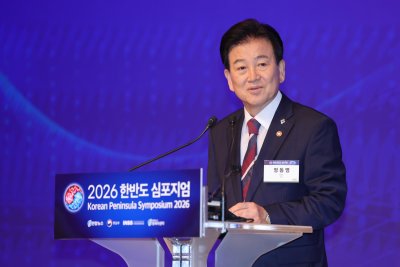
March 25 (Asia Today) — South Korea’s unification minister called for a shift in policy toward “peaceful coexistence” with North Korea, emphasizing that the approach does not mean abandoning unification but rather institutionalizing peace on the Korean Peninsula.

Unification Minister Chung Dong-young made the remarks Wednesday during an academic conference co-hosted by the ministry and a state-run research institute, where officials and experts discussed ways to end hostilities and establish a lasting peace framework.

Chung said Seoul should redesign its Korean Peninsula policy with peaceful coexistence at the center, arguing that formalizing stable relations between the two Koreas could open the door to broader dialogue.

“This is not about giving up unification, but about institutionalizing peace,” Chung said. “If peaceful coexistence is established politically, economically and legally, any issue between the two sides can be addressed.”

He added that discussions among relevant countries on building a peace regime, alongside a basic inter-Korean agreement, would be key to resolving long-standing tensions.

Chung also described North Korea’s recent push for a “two hostile states” framework as a structural shift that should be turned into an opportunity to move beyond confrontation.

“We must end the hostility and conflict that have devastated inter-Korean relations and create a relationship where there is no need to fight,” he said.

The minister avoided directly using the term “North Korea” during his remarks, instead referring to “the North” and its formal state name, a choice some analysts interpret as reflecting a more conciliatory tone.

Chung reiterated that the Korean Peninsula remains technically at war and said the starting point for peace is formally ending the conflict. He stressed that improving relations between Pyongyang and Washington would be essential and urged North Korea not to miss opportunities for dialogue with the United States.

He also said the South Korean government would act as a “pacesetter” to help sustain momentum for U.S.-North Korea talks while fulfilling its role as a key stakeholder in peninsula affairs.

At the same event, former intelligence chief Seo Hoon underscored the continued relevance of a “top-down” approach centered on leader-level diplomacy.

“The more uncertain and difficult the conditions, the more powerful summit diplomacy becomes,” Seo said, calling for a potential fourth meeting between U.S. and North Korean leaders.

Seo noted that past summit diplomacy led to repeated exchanges between former U.S. President Donald Trump and North Korean leader Kim Jong Un, arguing that even limited agreements or renewed dialogue could be meaningful steps forward.

— Reported by Asia Today; translated by UPI

© Asia Today. Unauthorized reproduction or redistribution prohibited.

Original Korean report: https://www.asiatoday.co.kr/kn/view.php?key=20260325010007733

Source link

S. Korea weighs co-sponsorship of U.N. North Korea rights resolution

Photo shows Foreign Ministry spokesperson Park Il speaking at a briefing in Seoul on March 12. Photo by Asia Today

March 24 (Asia Today) — South Korea is taking a cautious approach to whether it will join as a co-sponsor of an upcoming United Nations resolution on North Korean human rights, officials said Tuesday, citing a need to balance diplomacy with Pyongyang and international cooperation.

The resolution is expected to be adopted at the current session of the U.N. Human Rights Council later this week.

Foreign Ministry spokesperson Park Il said the government’s position remains that improving human rights in North Korea is important and that Seoul will continue to work with the international community. However, he said the decision on co-sponsorship is still under review.

“The issue is being considered comprehensively, taking into account the government’s efforts toward peaceful coexistence on the Korean Peninsula and the content of the resolution,” Park said at a regular briefing.

He added that the government’s cautious stance does not signal opposition, but reflects the complexity of factors involved, and that a decision will be made through consultations among relevant agencies.

A ministry official said there is a procedural window allowing countries to join as co-sponsors within two weeks after the resolution is adopted, giving Seoul time to assess its position.

The deliberations come amid strained inter-Korean relations and President Lee Jae-myung’s call to pursue even limited openings for dialogue with North Korea.

South Korea previously joined as a co-sponsor of a similar resolution at the U.N. General Assembly last November, easing concerns that the current administration might withdraw from such efforts.

Separately, the Unification Ministry has signaled a willingness to ease tensions. Unification Minister Chung Dong-young recently made conciliatory remarks, including urging North Korea not to miss opportunities for dialogue with the United States.

Civil society groups have urged the government to take a more active role. The International Federation for Human Rights and the Transitional Justice Working Group said in a joint letter to Lee that declining to co-sponsor the resolution would send a troubling signal domestically and internationally.

They warned that overlooking human rights concerns may create only a temporary easing of tensions, while leaving underlying instability unresolved and making lasting peace more difficult to achieve.

— Reported by Asia Today; translated by UPI

© Asia Today. Unauthorized reproduction or redistribution prohibited.

Original Korean report: https://www.asiatoday.co.kr/kn/view.php?key=20260324010007372

Source link

South Korea defense agency vows overhaul to become top exporter

South Korea’s Defense Minister Lee Jong-sup (2-L) attends a ceremony to unveil the signboard of the Defense Acquisition Program Administration (DAPA) at the agency’s new home in Daejeon, some 164km south of Seoul, South Korea. File Photo by YONHAP / EPA

March 20 (Asia Today) — South Korea’s arms procurement agency has pledged a sweeping overhaul of its systems and export strategy as it pushes toward the government’s goal of becoming one of the world’s top four defense exporters. The Defense Acquisition Program Administration, or DAPA, is South Korea’s defense procurement agency, and it is now led by Administrator Lee Yong-cheol.

Speaking at a briefing with defense reporters in Seoul on Wednesday, Lee said the agency would press ahead with faster decision-making, stronger export execution and greater technological self-reliance. He said the current moment amounted to a last chance to reform an organization long criticized for inefficiency and delay.

Lee said DAPA’s export drive must go beyond ceremonial overseas trips and focus instead on securing contracts and building practical business outcomes. But he also acknowledged that export growth alone is not enough if the underlying system remains slow and structurally weak.

One of the clearest examples, he said, was the long-delayed KDDX next-generation destroyer program. The project drifted for more than two years as authorities failed to make a policy choice between direct contracting and open bidding, exposing what Lee described as a deeper decision-making problem rather than a regulatory one.

Lee said South Korea also remains behind in drone warfare capabilities. While drones have become central to modern combat, the country’s military systems are still focused largely on reconnaissance, with limited strike and interception capacity and continued dependence on imported core components. He said DAPA plans to rely more heavily on rapid acquisition and early deployment of prototypes to speed fielding.

Defense semiconductors remain another major vulnerability. South Korea depends heavily on foreign technology for key components used in radars, guided weapons and communications systems, a weakness Lee described as an urgent national task. He said the answer lies in building stronger links between the civilian semiconductor sector and military demand while sustaining long-term investment.

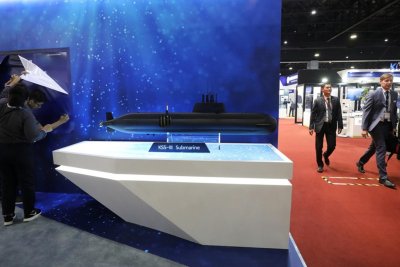
Lee also pointed to Canada’s submarine procurement program as a major test of South Korea’s export competitiveness. He said the outlook was not unfavorable but remained uncertain, describing the bid as a national effort involving diplomacy, industry and military capabilities. Yonhap reported Friday that Lee sees the contest as essentially even, with South Korea competing against Germany for a contract covering 12 submarines.

DAPA said it will also seek structural reforms to prevent repeated delays, including penalties for intentional slowdowns and changes to procurement procedures that can trap projects in repeated failed bidding cycles. Lee has instructed staff to move from planning-based administration to execution-based management, with clear deadlines and accountability.

The agency’s challenge now is whether it can turn reform rhetoric into durable institutional change. For South Korea to become a top-tier defense exporter, industry officials say, speed, structure, technology and political resolve will all need to advance together.

— Reported by Asia Today; translated by UPI

© Asia Today. Unauthorized reproduction or redistribution prohibited.

Original Korean report: https://www.asiatoday.co.kr/kn/view.php?key=20260320010006140

Source link

South Korea audits oil agency over 900,000-barrel overseas sale

An official at the Korea National Oil Corp. (KNOC) briefs reporters at the KNOC main office in Anyang, south of Seoul, South Korea. Photo by YONHAP / EPA

March 20 (Asia Today) — South Korea’s Industry Ministry has launched an audit of the Korea National Oil Corp. after about 900,000 barrels of crude stored under the country’s international joint stockpiling program were sold overseas without the state oil company exercising its priority purchase right, according to Asia Today and the ministry.

The oil had been owned by a foreign company and stored at a reserve facility in Ulsan under a program that allows overseas suppliers, including oil-producing countries and foreign firms, to use South Korea’s spare storage capacity. In an emergency, South Korea is supposed to have the first option to buy that oil.

The ministry said the Korea National Oil Corp. did not immediately exercise that right before the crude was sold abroad. It added that the audit would determine whether the company violated internal rules or procedures.

The international joint stockpiling program began in 1999 as part of efforts to stabilize domestic oil supply and demand.

The ministry said any confirmed violations would result in strict disciplinary action.

— Reported by Asia Today; translated by UPI

© Asia Today. Unauthorized reproduction or redistribution prohibited.

Original Korean report: https://www.asiatoday.co.kr/kn/view.php?key=20260320010006239

Source link

Labor union rallies behind Korea Zinc before key shareholder battle

A smelter of Korea Zinc. The company is scheduled to hold a high-stakes shareholders’ meeting Tuesday. Photo by Korea Zinc

SEOUL, March 20 (UPI) — Korea Zinc’s incumbent management and its major shareholder, Young Poong, are locked in a fierce showdown ahead of a regular shareholders’ meeting Tuesday.

The world’s largest non-ferrous metal producer said Friday that it posted record sales and profits last year, which led to high dividends and other shareholder-friendly policies.

Citing the strong performance, Korea Zinc has called for the leadership continuity, as the 2026 shareholders’ meeting would select at least five board members out of 15 seats. The term of Chairman Yun B. Choi is also set to expire.

“We believe that our continued efforts to improve corporate governance and expand shareholder returns have laid the foundation to steadily grow our business and operate our organization in a stable manner,” the firm said in a statement.

But, Young Poong argued that proxy advisers and the National Pension Service, another key Korea Zinc shareholder, have effectively supported its position by opposing the reappointment of Choi as an inside director.

According to Young Poong, such decisions suggest that “this is no longer merely a management control dispute, but judgment over potential structural flaws in corporate governance and failures of oversight.”

Since early 2025, Korea Zinc has been fighting to repel an aggressive takeover bid from Young Poong, which has teamed up with the country’s leading private equity firm, MBK Partners.

The battle came to a head at the March 2025 shareholders’ meeting, and another high-stakes clash is looming at this month’s gathering.

Each side reportedly controls roughly 40% of the voting shares, while NPS holds a 5.2% stake.

Meanwhile, the labor union at Korea Zinc expressed strong support for the current board, urging the NPS to immediately reverse its decision.

“We will fight to the end to prevent the dark hand of speculative capital from tainting our sacred workplace at this shareholders’ meeting,” the union said in a statement.

“If our warning is ignored and the company is undermined, we will mobilize all possible means, including a general strike, to wage an all-out struggle,” it said.

Source link

New Korea Hydro & Nuclear Power CEO vows to expand global footprint

Korea Hydro & Nuclear Power CEO Kim Hoe-chun speaks during his inauguration ceremony
at the state-run company’s head office in Gyeongju on Wednesday. Photo courtesy of Korea Hydro & Nuclear Power

March 18 (UPI) — Korea Hydro & Nuclear Power said Wednesday that new CEO Kim Hoe-chun has officially taken office to lead the state-run company over the next three years.

The chief executive said that he would establish a dual-track strategy of focusing on large-scale nuclear reactors and small modular reactors, or SMRs, at the same time to gain a stronger foothold in the global market.

SMRs refer to next-generation nuclear power plants, which are smaller but considered safer than traditional massive reactors. Korea Hydro & Nuclear Power, or KHNP, has worked on its own models, known as “innovative SMRs.”

“We will successfully carry out already secured overseas projects while pursuing tailored bidding strategies to enter new markets,” Kim said during an inauguration ceremony at the firm’s head office in Gyeongju, around 180 miles southeast of Seoul.

“We will develop the KHNP-style integrated management model as an export product and take a leading position in the international nuclear power market through innovative SMR technologies,” he said.

In June 2025, KHNP signed a contract to build two nuclear reactors in the Dukovany region of the Czech Republic. The agreement is estimated to be worth about $18 billion.

The company also has been competing with global players to win nuclear contracts in other countries.

Before taking the helm at KHNP, Kim spent decades at Korea Electric Power Corp., where he held a series of key positions after joining it in 1985. Between 2021 and 2024, he served as CEO of Korea South-East Power, an affiliate of KEPCO.

Source link

South Korea launches ‘K-NVIDIA’ push with $38B investment

1 of 2 | Deputy Prime Minister Bae Kyung-hoon, sixth from left, and Financial Services Commission Chairman Lee Eun-won pose for a group photo at a public-private meeting on the “K-NVIDIA Project” at the Seoul Press Center on Tuesday. Photo by Asia Today

March 17 (Asia Today) — South Korea’s government has launched a major initiative to foster domestic artificial intelligence semiconductor companies, committing tens of billions of dollars as part of a broader national investment plan.

The Ministry of Science and ICT and the Financial Services Commission held a public-private meeting in Seoul on Tuesday to introduce the so-called “K-NVIDIA Project,” a strategy aimed at building globally competitive AI chipmakers.

Under the plan, the government will allocate 30 trillion won (about $22.5 billion) to artificial intelligence and about 21 trillion won (about $15.8 billion) to semiconductors from a 150 trillion won ($112.5 billion) National Growth Fund to be created over five years.

Officials said the initiative is designed to nurture homegrown AI chip firms capable of competing with global industry leaders, strengthening South Korea’s position in next-generation technologies.

Participants at the meeting included Deputy Prime Minister and Science and ICT Minister Bae Kyung-hoon, Financial Services Commission Chairman Lee Eun-won and Korea Development Bank Chairman Park Sang-jin, along with executives from local AI semiconductor firms.

Industry representatives from companies such as FuriosaAI, DeepX, Mobilint, HyperExcel and Rebellion also attended the session.

The meeting brought together government officials and private-sector leaders to discuss investment strategies, technological development and policy support for the emerging AI semiconductor ecosystem.

— Reported by Asia Today; translated by UPI

© Asia Today. Unauthorized reproduction or redistribution prohibited.

Original Korean report: https://www.asiatoday.co.kr/kn/view.php?key=20260317010005198

Source link

S. Korea ranks No. 1 in export of memory chips, SSDs, face masks, 78 other items: report

South Korea had 81 products that led global exports in 2024, including memory chips and face masks, a report showed Tuesday.
In this photo, containers are stacked at a port in Pyeongtaek on March 12. Photo by Yonhap

South Korea had 81 products that led global exports in 2024, including memory chips, solid state drives (SSDs) and face masks, a report showed Tuesday.

The report published by the Korea International Trade Association (KITA) showed that the value of 81 Korea-produced items accounted for the largest share of global export value in their respective categories.

China was at the top with 2,087 items with the largest export market share, followed by Germany at 520 items, the United States at 505, Italy at 199 and India at 156.

South Korea had 19 items ranked between second to 10th in terms of export market share, KITA said, noting the country is likely to increase its number of globally leading products in the future.

The country’s top selling items included memory chips, electrical transformers, SSDs, lead-acid starter batteries for automobiles, rubber for automotive components and sheet masks.

Notably, Korea reclaimed the top spot for memory chips from China for the first time in five years in 2024, thanks to strong demand for high bandwidth memory (HBM) and other advanced products made by Korean companies, KITA said.

In the tanker segment, Korea lost the top spot to China on the latter’s strategy of securing large volumes of low-value vessels but is expected to retake the position in 2025 on the back of the recent boom in Seoul’s liquefied natural gas (LNG) ship orders, it added.

Copyright (c) Yonhap News Agency prohibits its content from being redistributed or reprinted without consent, and forbids the content from being learned and used by artificial intelligence systems.

Source link

Editorial: Oil, currency surge raises stagflation fears in South Korea

Fuel prices are displayed at a gas station in Seoul, South Korea, 15 March 2026. South Korea implemented a temporary cap system on 13 March to ease soaring fuel prices and reduce the burden on consumers, setting maximum prices for products oil refineries supply to gas stations and distributors. Photo by YONHAP / EPA

March 16 (Asia Today) — This commentary is the Asia Today Editor’s Op-Ed.

International oil prices and South Korea’s currency are rising sharply again as the Middle East conflict intensifies, raising growing concerns that the country could slide into stagflation.

On March 13, global crude prices climbed back above $100 per barrel, while the Korean won weakened beyond 1,500 per U.S. dollar in overnight trading. The simultaneous surge in energy prices and the exchange rate has heightened fears that South Korea could face a worst-case scenario in which economic growth slows while inflation accelerates.

Such developments threaten to derail the government’s economic targets for the year – about 2% growth and inflation in the 2% range – making emergency policy responses increasingly urgent.

Brent crude futures for May delivery closed at $103.14 per barrel, up 2.7% from the previous day. It was the first time Brent crude exceeded $100 since August 2022.

U.S. West Texas Intermediate (WTI) crude futures settled at $98.71 per barrel, approaching the $100 threshold. Meanwhile, Dubai crude, the benchmark most relevant to South Korea’s imports, surged to $123.50 per barrel, up $34.60 from the previous week.

As oil prices surged, investors turned toward the U.S. dollar as a safe-haven asset. The won-dollar exchange rate closed at 1,497.5 won per dollar in overnight trading, up 16.3 won from the regular daytime session. During trading, the rate briefly rose to 1,500.9 won, crossing the psychologically important 1,500 level for the first time in seven trading days.

The twin surge in oil prices and the exchange rate has been driven largely by escalating tensions in the Middle East.

Iran has openly threatened to block the Strait of Hormuz, a critical chokepoint through which about 20% of the world’s crude oil supply passes. Iran’s new supreme leader, Mojtaba Khamenei, declared a prolonged confrontation in his first official statement on March 12, saying Tehran should continue using the possibility of a Hormuz blockade as leverage against the United States and Israel.

Oil prices, which had briefly stabilized after U.S. President Donald Trump suggested the conflict might end soon, surged again following the statement.

Tensions escalated further after the United States launched airstrikes on Kharg Island, Iran’s largest oil export hub, on March 13. Iran retaliated by attacking the Fujairah port in the United Arab Emirates, a key oil-export route that bypasses the Strait of Hormuz, putting global energy supply chains on alert.

Trump has also urged five countries – including South Korea, China and Japan – to dispatch naval vessels to the Strait of Hormuz, pushing regional military tensions to a new peak.

Economic analysts warn the shock could have serious consequences for South Korea’s economy.

The Korea Development Institute (KDI) warned last week that rising oil prices linked to the Middle East conflict would increase inflationary pressure while weakening economic growth.

The Hyundai Research Institute estimated that if oil prices climb to $150 per barrel, South Korea’s economic growth rate could fall by 0.8 percentage points.

The government is considering a supplementary budget of 10 trillion to 20 trillion won ($7.5 billion to $15 billion) and temporary fuel tax cuts. However, these measures would only offer short-term relief.

A more fundamental solution lies in reducing South Korea’s heavy reliance on Middle Eastern crude oil, which accounted for 69% of total imports last year. Diversifying energy sources by expanding imports from countries such as Brazil and Norway should be pursued urgently.

The government must mobilize every available policy tool – including measures to stimulate domestic demand – to prevent what could become the fourth Middle East-driven oil shock from pushing the economy into stagflation.

— Reported by Asia Today; translated by UPI

© Asia Today. Unauthorized reproduction or redistribution prohibited.

Original Korean report: https://www.asiatoday.co.kr/kn/view.php?key=20260315010004332

Source link

North Korea launches rockets amid U.S. asset redeployment

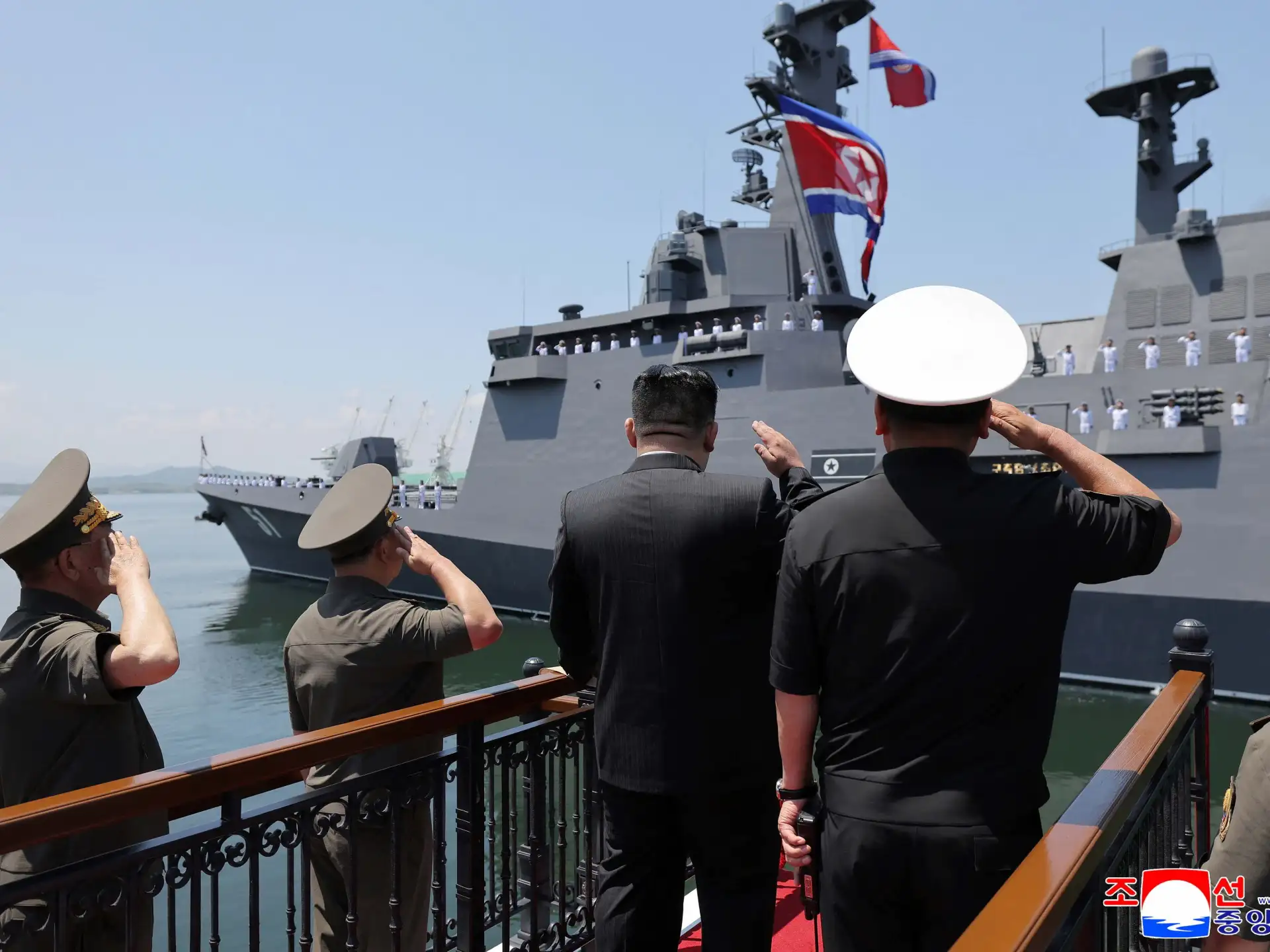
North Korean leader Kim Jong Un (R) and his daughter Kim Ju Ae watching a live feed of a strategic cruise missile test-fire from the naval Destroyer Choe Hyon at an undisclosed location in North Korea, 10 March 2026 (issued 11 March 2026). According to KCNA, the test aimed to verify the reliability of the national strategic control system, the destroyer’s detection and weaponry, and the overall combat effectiveness of its integrated systems. KCNA / EPA

March 15 (Asia Today) — North Korea conducted a large-scale rocket artillery test shortly after key U.S. air defense assets stationed in South Korea were redeployed to the Middle East, a move analysts say may have been intended to test potential security gaps on the Korean Peninsula.

North Korea fired more than 10 ballistic missiles and conducted a saturation strike drill using 600-millimeter multiple rocket launchers, according to state media.

The Korean Central News Agency said the exercise took place Friday under the supervision of leader Kim Jong Un, who was accompanied by his daughter Ju Ae.

The rockets struck targets on islands in the East Sea roughly 364 kilometers away with what the report described as “100% accuracy.”

The launch involved the simultaneous firing of 12 rockets from the super-large multiple rocket launcher system, one of Pyongyang’s most powerful short-range strike platforms.

Kim said the weapons were capable of striking hostile forces within a 420-kilometer range and emphasized their potential to deliver the destructive power of tactical nuclear weapons.

Military analysts said the drill also showcased improvements to the launcher system.

A new five-tube wheeled launcher appeared designed to reduce vibration during firing, while the time required to raise the launcher to firing position was reportedly shortened to less than one minute.

The changes would allow faster deployment and rapid relocation after firing, a tactic commonly known as “shoot and scoot.”

The approach is intended to help launch units evade detection and counterstrikes by South Korean and U.S. forces.

Experts say the tactic could complicate efforts by the allied kill chain system designed to detect launches and rapidly strike missile sites.

The missile launches came after reports that key U.S. missile defense systems previously deployed in South Korea – including the Terminal High Altitude Area Defense system and Patriot batteries – were partially redeployed to support U.S. operations in the Middle East amid the conflict with Iran.

Analysts say the timing suggests North Korea may be attempting to test the readiness of South Korean and U.S. forces during a period when U.S. assets are being shifted to other theaters.

Yang Moo-jin, a professor at the University of North Korean Studies in Seoul, said the exercise appeared designed to assess South Korea’s military preparedness while amplifying concerns about regional security.

The missile launches also occurred ahead of U.S. President Donald Trump’s scheduled visit to China later this month.

Some analysts say Pyongyang may be signaling its preference for direct negotiations with Washington rather than talks mediated by Seoul.

North Korea has increasingly framed relations with South Korea in terms of “two hostile states,” a position that reflects its strategy of engaging the United States while sidelining the South Korean government.

Lim Eul-chul of Kyungnam University’s Institute for Far Eastern Studies said North Korea may view the shifting deployment of U.S. forces as evidence of a more transactional alliance structure under the Trump administration.

“If Pyongyang believes U.S. forces can be redeployed elsewhere depending on strategic priorities, it may attempt to exploit that perception by conducting more aggressive military tests,” Lim said.

— Reported by Asia Today; translated by UPI

© Asia Today. Unauthorized reproduction or redistribution prohibited.

Original Korean report: https://www.asiatoday.co.kr/kn/view.php?key=20260315010004203

Source link

South Korea PM, U.S. vice president discuss investment, trade

South Korea Prime Minister Kim Min-seok (L) with US Vice President JD Vance ahead of their talks at the White House in Washington DC, USA, 12 March 2026. Courtesy of the Embassy of the Republic of Korea in the United States

March 13 (Asia Today) — South Korean Prime Minister Kim Min-seok met U.S. Vice President J.D. Vance at the White House in Washington on Wednesday to discuss bilateral investment, trade issues and developments on the Korean Peninsula.

The meeting came about 50 days after the two leaders first met during Kim’s visit to Washington in January.

Kim highlighted the passage of a special law supporting South Korean investment in the United States, which cleared the National Assembly earlier this week.

He said the legislation demonstrates Seoul’s commitment to implementing bilateral investment agreements and could contribute to revitalizing U.S. manufacturing and job creation.

Kim added that the measure could also accelerate implementation of agreements outlined in a joint fact sheet between the two countries, including cooperation in areas such as nuclear-powered submarines, nuclear energy and shipbuilding.

Vance welcomed the legislation, saying it provides a legal foundation for implementing investment agreements between the two countries, according to South Korea’s Prime Minister’s Office.

The two sides also discussed cooperation in critical minerals and issues related to non-tariff trade barriers.

Kim explained Seoul’s recent decision to allow U.S. companies to export mapping data from South Korea, describing it as a forward-looking step aimed at strengthening cooperation.

Vance praised the move and said the two countries should continue consultations on non-tariff trade barriers.

Kim also said issues previously raised by Vance during their January meeting – including concerns related to the e-commerce company Coupang and certain religious matters – are now being handled in a stable manner.

Vance said the United States respects South Korea’s domestic legal framework and thanked Seoul for continuing to communicate with Washington on issues of interest to the United States.

The leaders also exchanged views on the Korean Peninsula and reaffirmed that the door remains open for dialogue with North Korea.

They agreed to maintain close coordination on developments related to the peninsula.

South Korea’s Prime Minister’s Office said the meeting helped deepen personal trust between Kim and Vance and is expected to strengthen communication on key bilateral issues.

The office’s statement did not mention whether the two discussed the Section 301 trade investigation launched this week by the Office of the United States Trade Representative targeting several major trading partners, including South Korea.

However, the issue of non-tariff barriers raised during the meeting could be related to that investigation.

— Reported by Asia Today; translated by UPI

© Asia Today. Unauthorized reproduction or redistribution prohibited.

Original Korean report: https://www.asiatoday.co.kr/kn/view.php?key=20260313010003892

Source link

N. Korea launches series of missiles in show of force

North Korea on Saturday staged another of its show-of-force ballistic missile launches — pictured is one launch during a test in December — that sent 10 missiles off its west coast, which traveled more than 200 miles and landed just outside the Japanese exclusive economic zone in the Sea of Japan. Photo by KCNA/EPA

March 14 (UPI) — North Korea launched 10 ballistic missiles into the sea on Saturday — which landed just outside Japan’s economic zone in the East Sea — in a show of force amid a U.S.-South Korea military exercise.

The launch, confirmed by the Japanese and South Korean defense ministries, is one of the largest North Korea shows of force that it has ever launched, The Japan Times and The Independent reported.

The missiles were launched from the west coast of North Korea, flying roughly 211 miles before falling just outside the Sea of Japan.

The Japanese Ministry of Defense in a statement called the launch a continued effort to “threaten the peace and security of Japan, the region and the international community.”

Shinjiro Koizumi, the Japanese defense minister, added that the ministry would remain in close contact with the United States and other allies “to remain fully vigilant and maintain surveillance in preparation for any unforeseen contingencies.”

The launch is the largest since at least November 2022, when Kim Jong Un’s regime launched a volley of 23 missiles that included short-range ballistic missiles and surface-to-air missiles, among others.

Analysts have said that it is unlikely that North Korea would attack U.S. or other nation’s assets in the region while the United States has diverted missile defense systems, among other things, to the Middle East amid the war in Iran.

They say, rather, that the show of force is meant to show that it can defend itself if it is invaded.

North Korea’s launch also comes as the United States and South Korea are about halfway through the annual 11-day Freedom Shield combined joint exercise that includes land, air and sea training events to allow the two nation’s armed forces to integrate seamlessly in combat.

One warship that was involved with the exercise, the USS Tripoli, an amphibious assault ship carrying 2,500 Marines and 2,500 sailors, has been redeployed to the Middle East to bolster U.S. military power there amid the war in Iran.

President Donald Trump speaks during an event celebrating Women’s History Month in the East Room of the White House on Thursday. Photo by Bonnie Cash/UPI | License Photo

Source link