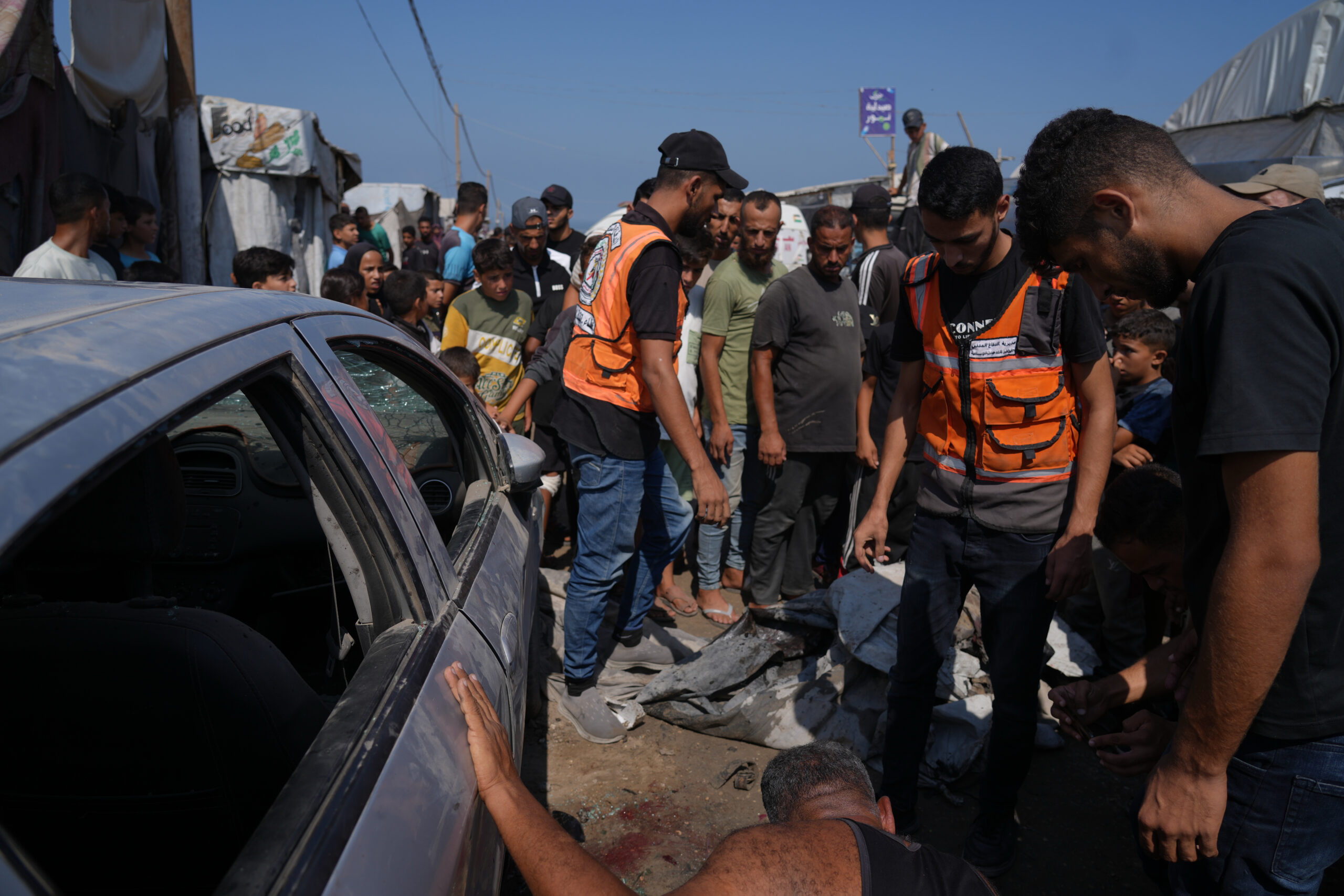
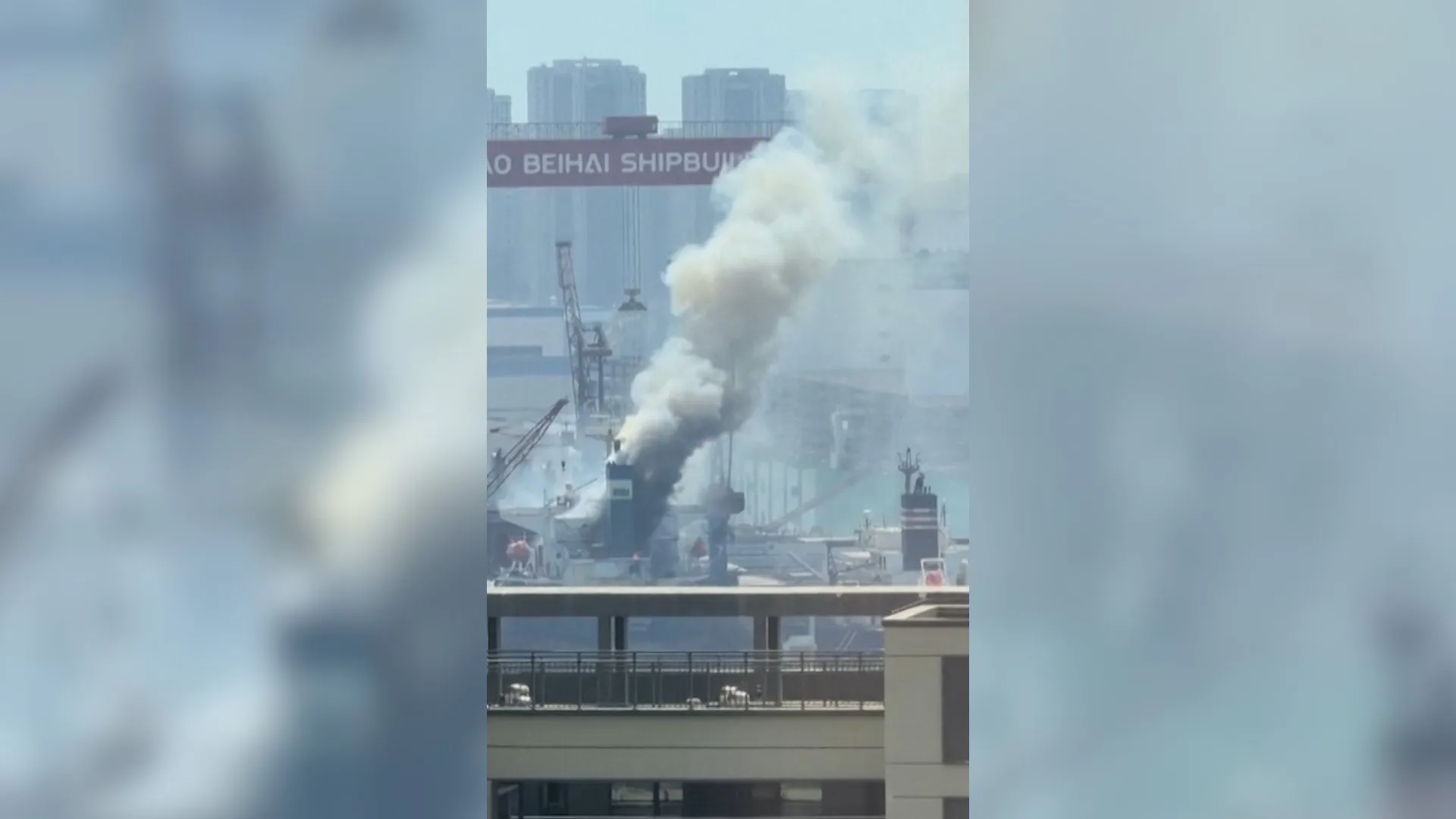
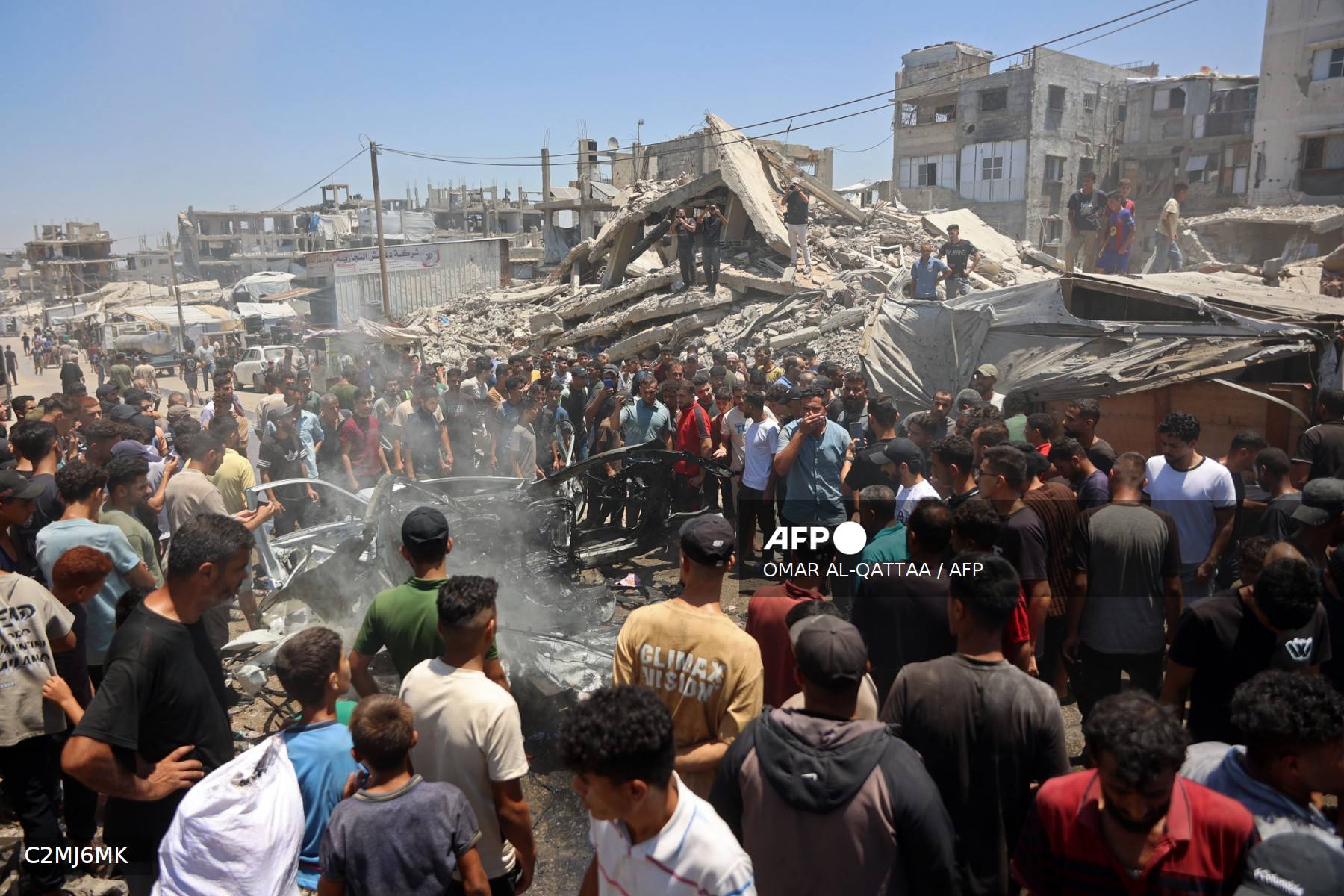
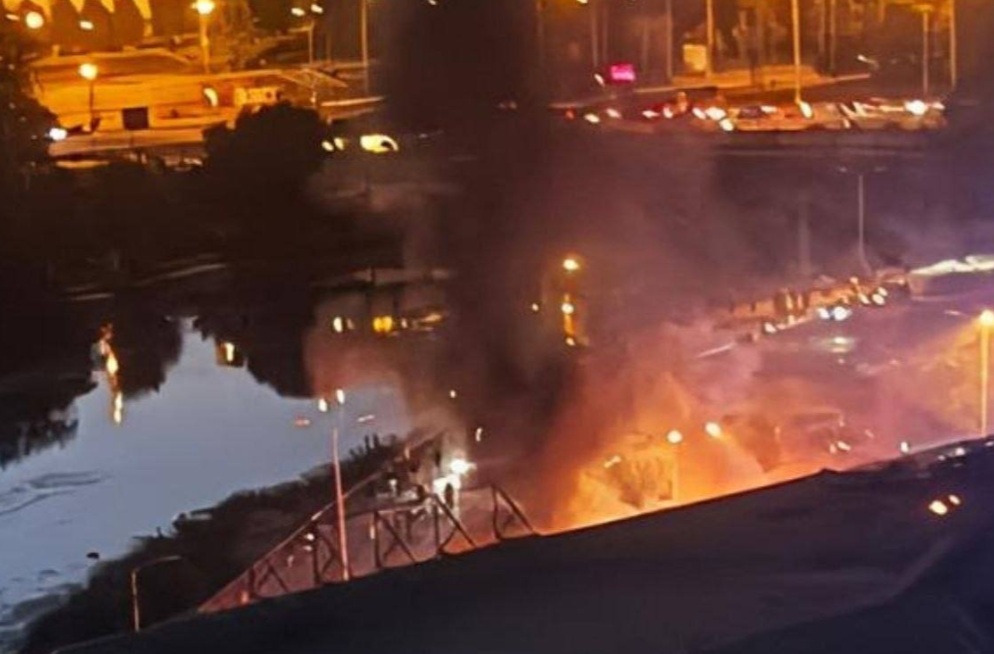
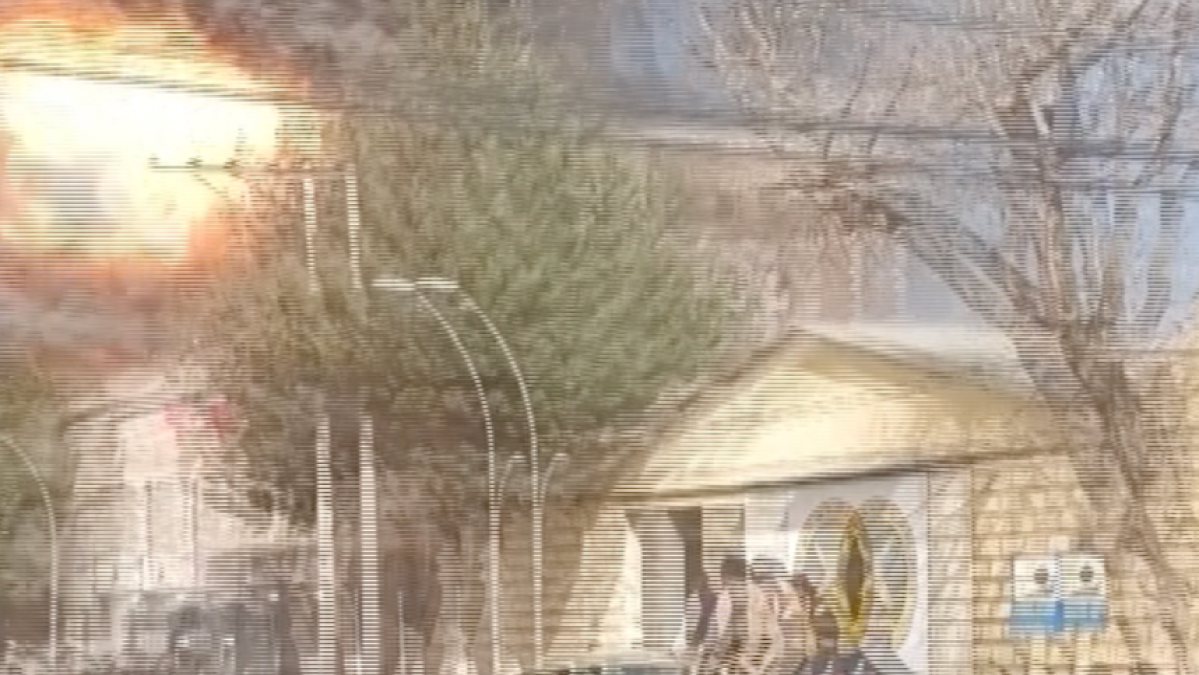
Video captured flames and black smoke where a projectile from Lebanon killed at least one person and injured 13 others in Nahariya, Israel. Burnt vehicles and extensive shrapnel damage could be seen at the site.
1 of 2 | Firefighters search for missing people at a car parts plant after a large fire engulfed the building in Daejeon, South Korea, Friday. Photo by Yonhap/EPA
March 21 (UPI) — A fire at a Daejeon, South Korea, car parts factory Friday has killed at least 14 people and injured dozens more.
There were nearly 60 injured in the fire in a three-floor plant. The Ministry of the Interior and Safety said that some of the injured had inhaled smoke, and some were injured when they jumped from the building. It said 25 were seriously injured, but it didn’t say if any were in life-threatening condition. There were 170 people inside when the fire erupted.
Nam Deuk-woo, fire chief of the city’s Daedeok district, said almost all of the bodies were found inside a third-floor space that had been used as a gym locker room, The New York Times reported. Some bodies were so badly burned it will take DNA testing to identify them.
Nam said workers recovered more than 220 pounds of highly reactive chemicals from the site before firefighters could spray water on the fire, and some witnesses have reported that there was an explosion when the fire began.
Local resident says casualties include mourners at funeral and children playing nearby.
Published On 19 Mar 202619 Mar 2026
A drone attack launched from Sudan has killed 17 people in Chad, according to the Chadian government, which has pledged to retaliate against any further strikes as the civil war in the neighbouring nation rages on.
A spokesman for the Chadian government announced the death toll on Thursday from the attack on the border town of Tine, which had been targeted despite “various firm warnings addressed to the different belligerents in the Sudan conflict and the closure of the border”.
Recommended Stories
list of 3 itemsend of list
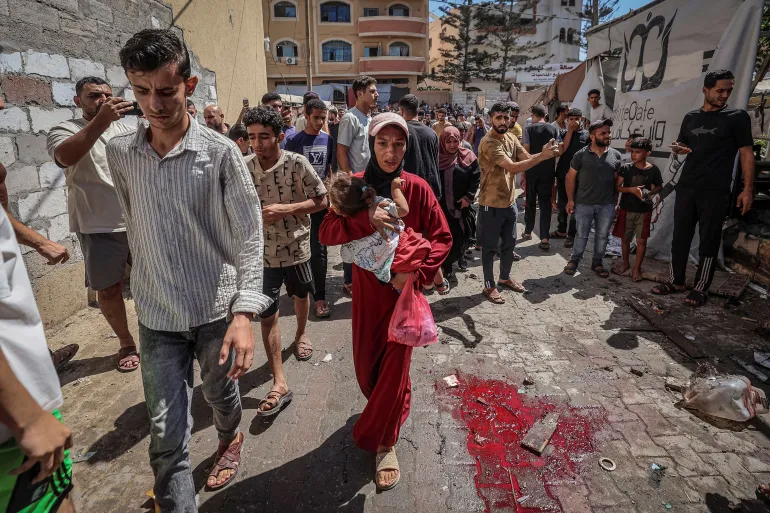
It occurred as mourners gathered at a house on Wednesday for a funeral, according to a local resident quoted by the Reuters news agency, who reported there were two explosions and casualties included mourners and children playing nearby.
Local government sources said it was not immediately clear who was behind the attack, according to Reuters.
Chadian President Mahamat Idriss Deby called a meeting of the defence and security council on Wednesday night, ordering the army to “retaliate starting from tonight to any attack coming from Sudan”, according to a presidency statement.
Early on Thursday, the government said Chad had strengthened its security presence at the border and could potentially carry out operations on Sudanese territory.
Sudan’s paramilitary Rapid Support Forces (RSF) denied involvement in a post on Telegram, blaming the Sudanese army.
Porous border
The conflict in Sudan between its military and the RSF began in April 2023. The war has killed tens of thousands of people and displaced more than 12 million – nearly one million of them fleeing under fire to Chad, according to the United Nations.
The border between Chad and Sudan, which is nearly 1,400km (870 miles) long and located in a desert region, is porous and difficult to control.
Almost the entirety of Darfur, a vast region in western Sudan bordering Chad, has been captured by the RSF. The last major city there under the military’s control, el-Fasher, was seized by the RSF in October. The UN has accused the paramilitary group of carrying out massacres with “hallmarks of genocide”.
On February 21, the RSF claimed control of the border town of Tina, which is separated from Tine in Chad only by a narrow stream bed that is dry most of the time.
Chad closed its eastern border with Sudan last month after clashes linked to the war killed five Chadian soldiers. Its government said the move was aimed at preventing “any risk of the conflict spreading”.
Drones a key weapon of war
Drones have become a key weapon used by both Sudan’s military and the RSF.
The Sudanese army has received Iranian-made drones and Turkish and Russian military support.
The RSF, which has no air force of its own, has been equipped through a network of supply routes reportedly running through Chad and other transit states with reports pointing to the United Arab Emirates as a key supporter, an allegation that Abu Dhabi denies.
In the first two months of 2026, the Armed Conflict Location and Event Data project recorded 198 strikes by both sides, at least 52 of which caused civilian casualties. The attacks killed 478 people.
WASHINGTON — The Iranian government remains “intact but largely degraded,” National Intelligence Director Tulsi Gabbard told Congress on Wednesday, as Israel continued to hunt down the Islamic Republic’s leadership with an overnight airstrike that killed the nation’s spy chief.
The death of Intelligence Minister Esmail Khatib, announced Wednesday by Israel, was the third high-level assassination in roughly 24 hours in a series of strikes that have hollowed out Tehran’s leadership ranks.
Israel ordered strikes Tuesday that killed Iranian security chief Ali Larijani and Basij paramilitary commander Gholamreza Soleimani.
Additional senior Iranian figures could be targeted, Israeli Defense Minister Israel Katz said Wednesday. “Israel’s policy is clear and unequivocal: No one in Iran has immunity — everyone is a target,” Katz said.
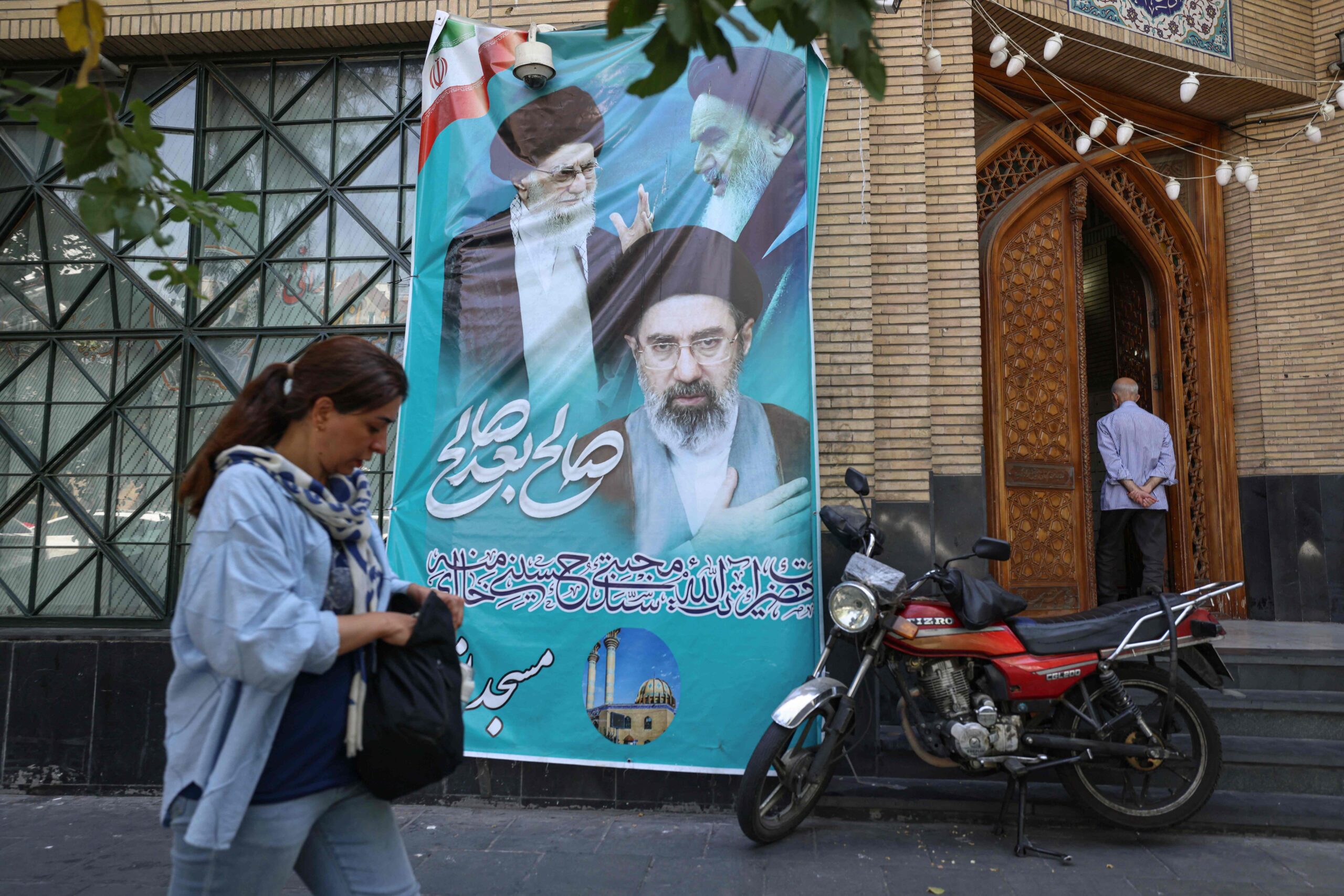
Ayatollah Mojtaba Khamenei, Iran’s new supreme leader, issued a rare statement Wednesday addressing Larijani’s assassination.
“Undoubtedly, the assassination of such a person shows the extent of his importance and the hatred of the enemies of Islam towards him,” he wrote, according to the Associated Press. “All blood has its price that the criminal murderers of the martyrs must pay soon.”
Tehran responded with renewed missile and drone attacks on Israel and U.S.-aligned countries across the Persian Gulf, further disrupting strained energy infrastructure and shipping lanes. Fighting has halted oil and gas production throughout the region, as shipping was stalled through the Strait of Hormuz, a key artery for global oil supplies.
The war has triggered a severe global oil shortage that has destabilized electronics, agriculture, pharmaceutical and energy supply chains.
Exacerbating those disruptions, the U.S. and Israel carried out a coordinated attack on the South Pars natural gas field on Wednesday. The strikes drew swift condemnation from Qatar, a U.S. ally that shares the reservoir with Iran. The Qatari Foreign Ministry called the attack “dangerous and irresponsible” and “a threat to global energy security.”
The attack is a major blow to Iran’s supply of electricity too, as most of the country’s energy grid relies on gas, analysts said. The field accounts for about 75% of Iran’s natural gas production.
Tehran promised to respond with more attacks on its Mideast neighbors, the Associated Press reported.
Meanwhile, near-constant Israeli strikes in Beirut and southern Lebanon have displaced over 1 million people, and killed 968 civilians, according to the Lebanese Health Ministry.
With the war in its third week, deaths now number in the thousands across Iran, Israel and neighboring countries.
International reaction has sharpened as the fighting showed no sign of relenting. Russia condemned the “murder and liquidation” of sovereign leadership and called for an immediate ceasefire, while European leaders voiced growing alarm about the war’s trajectory and the risks of broader destabilization.
Director of National Intelligence Tulsi Gabbard testifies Wednesday before the Senate Committee on Intelligence.
(Jose Luis Magana / Associated Press)
All allies in the North Atlantic Treaty Organization have refused to heed President Trump’s call to send warships to the Strait of Hormuz, signaling a deepening rift in the world’s most powerful military alliance. Trump has sought to sever the U.S. from the alliance.
“We no longer ‘need,’ or desire, the NATO Countries’ assistance — WE NEVER DID! “ he wrote on social media Tuesday.
Trump on Wednesday signaled little appetite for de-escalation, floating the prospect of a decisive military endgame.
“I wonder what would happen if we ‘finished off’ what’s left of the Iranian Terror State,” he wrote on his social media website.
The president visited Dover Air Force Base in Delaware on Wednesday, where the remains of six U.S. service members killed in the crash of a refueling aircraft were returned to their families. The visit marks the second time since the Feb. 28 launch of the war with Iran that Trump has attended the solemn military ritual known as a dignified transfer, the Associated Press reported.
At a Senate Intelligence Committee hearing on “worldwide threats” Wednesday, Democrats grilled Gabbard and other intelligence leaders over their preparation for Iranian retaliation against Mideast energy infrastructure, civilian areas and American military sites and personnel.
Trump has maintained that the U.S. was caught off guard by Iran’s retaliatory strikes.
“Nobody expected that. We were shocked,” he said at a Kennedy Center board meeting Monday. Later in the day, when asked at an Oval Office news briefing whether he had been warned about the possibility of Iranian retaliation, Trump reiterated his surprise.
Last year, intelligence agencies testified to Congress that Iran was capable of inflicting substantial damage on an attacker, executing regional strikes and disrupting shipping, “particularly energy supplies, through the Strait of Hormuz,” Sen. Ron Wyden (D-Ore.) said at the hearing, reading from last year’s worldwide threats report.
“In other words, every problem we’re seeing now was not only foreseeable, but was actually predicted by the intelligence agencies,” Wyden told Gabbard. “It’s hard to see how you can sit here and say that the intelligence agencies couldn’t provide a clear warning that if attacked, the Iranians would respond by attacking our people.”
Gabbard refused to confirm whether intelligence agencies briefed the president on the subject, saying she “won’t divulge internal conversations.”
She also testified that U.S. strikes on Iran had “obliterated” the country’s nuclear enrichment program, including underground facilities, and said officials are now watching to see whether Tehran attempts to rebuild. So far, she said, Iran has not restarted the program.
But Sen. Jon Ossoff (D-Ga.) challenged that assessment, noting that Trump had used the same word — “obliterated” — to describe strikes just months before. He pressed Gabbard on how serious the nuclear threat was leading up to the February operation, given that timeline.
The intelligence community assessed that Iran “maintained the intention to rebuild and to continue to grow their nuclear enrichment,” Gabbard said adding that the “only person” who can determine what constitutes an imminent threat is the president.
“False,” Ossoff shot back. “It is precisely your responsibility to determine what constitutes a threat to the United States.”
Iranian media report the deaths in central Iran as Tehran launches new missile salvoes at Israeli targets.
Published On 14 Mar 202614 Mar 2026
Share
A missile strike on an industrial area of the central Iranian city of Isfahan has killed at least 15 people, with workers having been inside a factory at the time of the attack, Iranian media reports.
The strike hit a factory producing heating and cooling equipment on Saturday, a working day in Iran, according to the semi-official Fars news agency, which attributed the attack to US and Israeli forces.
Recommended Stories
list of 3 itemsend of list
It came on the 15th day of a conflict that Iran’s Ministry of Health says has now killed at least 1,444 people and wounded more than 18,500 since the US-Israeli attacks began on February 28.
Cities across Iran have been repeatedly targeted following the onset of hostilities.
On March 8, shelling damaged Russia’s consulate in Isfahan, injuring staff, with Moscow calling the strike a “blatant violation” of international conventions.
Iran’s Ministry of Culture said on Saturday that 56 museums and historic sites had been damaged, including Naqsh-e Jahan Square, a 17th-century centrepiece of Isfahan, and the UNESCO-listed Golestan Palace in Tehran.
UNESCO said it was “deeply concerned,” noting that four of Iran’s 29 World Heritage Sites had been affected.
Separately on Saturday, Iran’s army confirmed that Brigadier General Abdullah Jalali-Nasab had been killed in an Israeli attack, saying he was “martyred while defending the country”.
Earlier, US forces also struck Kharg Island, which handles roughly 90 percent of Iran’s crude exports, though a regional official said operations were continuing normally, and there were no casualties.
US President Donald Trump had previously threatened to target the island’s oil infrastructure if Tehran continued to disrupt the Strait of Hormuz.
Any prospect of negotiations appears remote. The Trump administration has rebuffed regional efforts to broker a ceasefire, with a senior White House official telling the Reuters news agency the president is focused on pressing ahead.
“He’s not interested in that right now, and we’re going to continue with the mission unabated,” the official said.
Iran has equally ruled out talks while the attacks continue, Reuters reported, citing an anonymous Iranian official.
Iranian Minister of Foreign Affairs Abbas Araghchi struck a defiant tone on Saturday, saying the US security framework in the region had “proven to be full of holes” and calling on neighbours to “expel foreign aggressors”.
Israeli Minister of Defence Israel Katz said the war was entering a “decisive phase”, which would “continue as long as necessary”.
Iran launched new missile salvoes at Israel on Saturday, with explosions heard over Jerusalem, according to reporters from the AFP news agency.
Six waves of missiles, some carrying cluster bomb warheads, struck wide areas of the country, the Israeli army said. In Eilat, a cluster munition impact injured three people, including a 12-year-old boy, according to The Times of Israel.
Israel’s attack, echoing similar carnage it wrought in Gaza, kills doctors, paramedics and nurses who were on duty.
An Israeli strike on a health centre in southern Lebanon has killed 12 medical workers, the Lebanese Ministry of Public Health said, as its devastating assault continued amid a wider regional war launched by the United States and Israel on Iran 15 days ago.
The attack late on Friday occurred in the village of Burj Qalaouiyah in the Bint Jbeil District, and killed doctors, paramedics and nurses who were on duty, Lebanon’s health ministry said.
Recommended Stories
list of 4 itemsend of list
The carnage echoed Israel’s constant targeting of medics and hospitals that decimated Gaza’s healthcare system during its genocidal war on the Palestinian enclave and which contravenes international humanitarian law.
Israeli strikes have so far killed 18 paramedics among 773 people reported killed in Lebanon since fighting between Hezbollah and Israel reignited March 2, after a US-Israeli assault on Iran began on February 28, with the conflict now embroiling much of the region.
According to Al Jazeera’s Heidi Pett, reporting from Beirut, the toll of medics was preliminary as rescue teams continued searching for missing people.
“You can see how deadly some of these individual air strikes have been, not just across the south, but of course, we are seeing air strikes hitting across the capital, Beirut,” said Pett.
Lebanon’s Ministry of Health said it was the second attack on the health sector within hours, after another Israeli strike on the southern village of Souaneh killed two paramedics and wounded five others when it hit a paramedic centre.
The ministry condemned the attack and denounced what it called as continued violence against health workers.
At least four people were also killed in an Israeli air raid on Taamir Haret Saida in the country’s south, the Lebanese News Agency (NNA) said.
Meanwhile, Hezbollah overnight claimed it fired suicide drones against Israeli troops in the northern town of Ya’ara inside Israel.
It was the 24th military operation announced by the group on Friday.
The Lebanese armed group also said it launched rocket attacks targeting Israeli soldiers in southern Lebanon, one in the town of Kfar Kila, and the other in the city of Khiam.
Late on Friday, Hezbollah leader Naim Qassem said his group is ready for a “long confrontation” with Israel as the war continues.
“This is an existential battle, not a limited or simple battle,” he said.
Damage in Israel from Iranian ‘cluster missiles’
Meanwhile, Iran’s retaliatory attacks against Israel continued.
Rocket and missile strikes early on Saturday targeted the Upper Galilee region of northern Israel, Channel 12 reported.
The news outlet said that a “limited number of launches” were either “intercepted” or exploded in open areas.
A post on X from Israel’s public broadcaster KAN featured several vehicles damaged in the strikes.
Alarms were raised for suspected rocket and missile fire in Manara, Margaliot, Kfar Giladi, Misgav Am, Tel Hai, Metula, Kfar Giladi and Kfar Yuval throughout the early morning on Saturday.
“A lot of the damage that we are being told about at the moment seems to be coming from these cluster missiles that Iran has been launching pretty much consistently for the last week at least and they scatter over a large area,” said Al Jazeera’s Rory Challands, reporting from Amman, Jordan.
“They disperse these submunitions bomblets. Each of those has about 2.5 kilogrammes (5.5 pounds) of explosives in them. You can see why that does quite some damage when it scatters and hasn’t been intercepted by the Israeli air defence.”
Ukrainian and Russian officials have claimed battlefield successes in the more than four-year war, as Russian air attacks on Ukraine continue.
At least four people were killed in Russian attacks on the Ukrainian town of Sloviansk, regional authorities said on Tuesday.
Recommended Stories
list of 3 itemsend of list
The governor of Sloviansk, Vadym Filashkin, confirmed the death toll on Tuesday and said 16 others were wounded, including a 14-year-old girl. He said Russian forces dropped three guided bombs on the city.
There was no immediate comment from Moscow on the attack.
Overnight drone strikes on three other Ukrainian cities wounded at least 17 people, including two children, emergency services said.
Ukraine’s air force said that it shot down 122 out of 137 drones that Russia launched during the night.
Warring parties claim advances
Ukrainian forces have recently retaken nearly all the territory of the southeastern Dnipropetrovsk industrial region during a counteroffensive, driving Russian troops out of more than 400 square kilometres (150sq miles), Major-General Oleksandr Komarenko said in an interview published Tuesday by local media outlet RBC-Ukraine.
He described the overall situation on the front line as difficult but under control, with the heaviest fighting continuing near Pokrovsk in eastern Ukraine and Oleksandrivka in the south, where he said Russian forces have concentrated their main effort.
There was no independent verification of his description of the military situation.
The Institute for the Study of War, a Washington-based think tank, said late Monday that recent Ukrainian counterattacks “are generating tactical, operational and strategic effects that may disrupt Russia’s spring-summer 2026 offensive campaign plan”.
Meanwhile, Russian President Vladimir Putin claimed that Russian forces have extended their gains in Ukraine’s eastern Donbas region, whose capture Moscow has made one of the goals of its invasion. Ukraine controlled about 25 percent of the Donbas six months ago, but it now holds just 15-17 percent, Putin said.
In Russia, the governor of the border region Bryansk, said a Ukrainian missile strike on Bryansk city had killed at least six people and wounded 37 others.
Alexander Bogomaz said those killed were civilians and that the wounded were admitted to the Bryansk Regional Hospital.
Ukrainian President Volodymyr Zelenskyy said the attack hit a Russian missile plant.
At the same time, a United Nations investigation found that the deportation and transfer of Ukrainian children since Russia invaded Ukraine in 2022 had amounted to “crimes against humanity”.
The International Criminal Court issued arrest warrants for President Vladimir Putin and five other Russian officials in 2023 over the alleged illegal deportation of children, which Moscow denies and said it has been evacuating people voluntarily from a warzone.
Trilateral talks ‘next week’
United States special envoy Steve Witkoff told the CNBC news outlet on Tuesday that the next round of trilateral talks between Ukraine, Russia and the US would likely be “sometime next week”.
Trilateral talks were first held in January in the United Arab Emirates; a second meeting was held in February in Geneva, Switzerland. Last year, Russia and Ukraine also held three rounds of talks in Turkiye, yet so far the two countries remain no closer to a deal as key issues, including Russia’s control of Ukrainian territory, are yet to be resolved.
Moscow has repeatedly said it would only agree to a deal that allows it to retain the territories it has seized, while Ukraine has said its territory must be returned in any deal.
Ukrainian President Volodymyr Zelenskyy said Turkiye was prepared to host the next round of trilateral talks after speaking with his Turkish counterpart, President Tayyip Erdogan, on Tuesday.
A suspected Iranian attack on a high-rise residential building in Bahrain’s capital of Manama has killed a 29-year-old Bahraini woman and injured several others.
A father and his daughter have been killed in an Israeli drone attack in central Khan Younis, southern Gaza, as Palestinians continue to suffer amid worldwide attention on the United States-Israeli war on Iran.
The two were killed early on Saturday. In a separate attack later in the day in Khan Younis, another person was killed and a young girl wounded, according to Al Jazeera correspondents on the ground.
Recommended Stories
list of 4 itemsend of list
Israeli forces continue carrying out air strikes, artillery shelling, and naval bombardment on Gaza on a daily basis, despite an October 11 “ceasefire” as Israel continues its ongoing genocide.
Suffering in Gaza and the occupied West Bank remains acute as the world focuses on the US-Israeli bombardment of Iran.
In the past 48 hours, two additional people have been wounded, the Palestinian Ministry of Health said.
Israeli army-affiliated militias, meanwhile, have advanced east of Gaza City, with heavy gunfire reported in the area. Initial reports also stated a member of the Palestinian police was abducted.
Israeli warplanes also struck several locations east of the Tuffah neighbourhood, near Gaza City, while the Israeli navy fired heavy machineguns and shells towards the coast of Gaza City, Palestinian news agency Wafa reported.
The Rafah border crossing, meanwhile, remains closed. Israel had shut it amid its attacks on Iran.
The Rafah crossing, located on Gaza’s southern border, had reopened only last month allowing a limited number of Palestinians to leave for the first time in months, including patients in urgent need of medical care. Thousands remain blocked from travelling for treatment.
The Karem Abu Salem crossing, also known to Israelis as Kerem Shalom, is partially open for the entry of humanitarian aid only, under strict restrictions.
Nearly all of Gaza’s population of more than two million people was displaced during Israel’s war on the territory, and the enclave remains heavily dependent on humanitarian assistance.
In a February report, Human Rights Watch said Israeli restrictions had contributed to shortages of medicine, reconstruction materials, food and water inside the Strip.
Since the ceasefire in Gaza, 640 Palestinians have been killed and at least 1,700 wounded, according to the Health Ministry. At least 72,123 Palestinians have been killed since October 2023, while 171,805 people have been injured.
Meanwhile, in the occupied West Bank, the Palestinian Red Crescent Society reported its teams in Hebron are treating a Palestinian injured by live fire near the illegal Karmei Tzur settlement, built on Palestinian land north of Hebron.
Three Palestinians were also injured on Saturday after being physically assaulted by Israeli settlers in the Ras al-Ahmar area, south of Tubas, Wafa reported. Medical sources at the Palestinian Red Crescent Society said their teams responded to three people with injuries.
Israeli forces also conducted raids in the towns of Qaffin and Kafr al-Labad, north of Tulkarem, early on Saturday, Wafa said.
A Palestinian man was also injured after being assaulted by Israeli soldiers near the village of Azmut, east of the occupied West Bank city of Nablus.
Palestinians have faced a wave of intensified Israeli military and settler violence across the West Bank since the war on Gaza began in October 2023.
At least 1,094 Palestinians have been killed by Israeli troops and settlers in the West Bank since October 2023, according to the latest United Nations figures.
Israeli strikes have killed more than 100 people in Lebanon as Israel issued more leave-or-die threats to the suburbs of Beirut, and across vast areas of the country’s south.
Lebanon’s Ministry of Public Health reported on Thursday that the death toll from the Israel-Hezbollah conflict has reached 102, with 638 wounded since Monday.
New strikes hit Hezbollah’s stronghold in Beirut’s southern suburbs early Thursday, with AFPTV footage showing smoke rising from the area.
Lebanon’s National News Agency (NNA) reported that an Israeli drone strike on an apartment in the Beddawi Palestinian refugee camp near Tripoli killed senior Hamas official Wassim Atallah al-Ali and his wife.
On Thursday, Israel expanded its forced evacuation threats to residents across hundreds of square kilometres of southern Lebanon, citing imminent military action.
The escalating conflict has triggered a humanitarian crisis, displacing more than 83,000 people within Lebanon. According to Syrian authorities and the UN refugee agency, at least 38,000 people, primarily Syrians, have fled Lebanon for Syria.
Israeli military spokesperson Avichay Adraee posted on X: “Urgent warning to residents of southern Lebanon: you must immediately continue evacuating to the north of the Litani river.” The warning specifically mentioned the cities of Tyre and Bint Jbeil.
Israel’s military announced on Tuesday it was establishing a buffer zone inside Lebanon to protect Israeli citizens. By Wednesday, it confirmed that three divisions comprising infantry, armoured and engineering units were operating inside Lebanese territory.
“Across the Middle East and beyond, a troubling displacement picture is emerging in the aftermath of the ongoing conflicts in the region,” UNHCR spokesperson Babar Baloch said Thursday.
On Thursday, the Israeli military extended forced evacuation orders to Beirut’s southern suburbs, instructing residents to “save your lives and evacuate your homes immediately,” indicating potential intensified bombardment amid the widening of the Iranian conflict.
While previous forced evacuation threats focused on southern Lebanon below the Litani River, this marks the first comprehensive evacuation threat for areas near the capital since hostilities resumed.
An Iranian missile attack on the Israeli town of Beit Shemesh, 30 kilometers west of Jerusalem, has killed at least nine people and wounded dozens more. The strikes reportedly targeted an army headquarters and a weapons manufacturing complex.