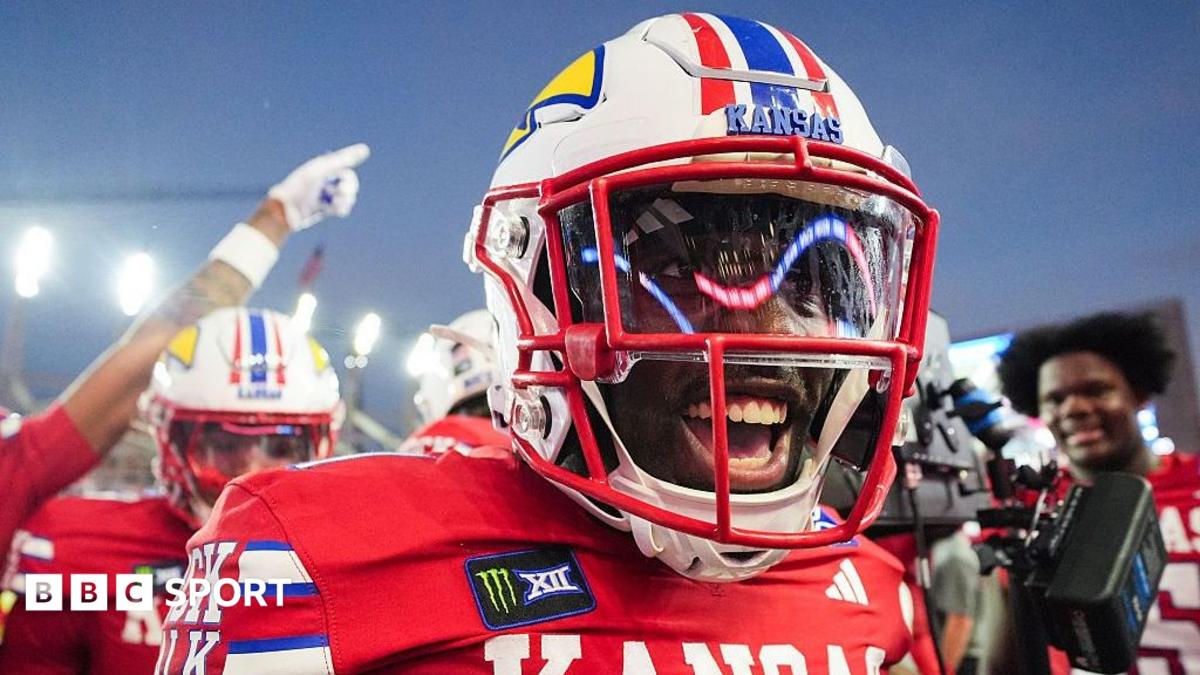
kansas

Union Jack Classic: Kansas set to face Arizona State in Wembley’s first US college game

Virtually all NFL players come via the US college system, and in many parts of America, college football is more popular than the NFL.

College games often have bigger crowds – eight of the world’s 10 biggest stadiums are for college football, all holding more than 100,000.

The fans are also more passionate as support is often passed down from one generation to another, and multiple generations attend the same school. Kansas player Calvin Clements, for example, is a fifth-generation Jayhawk.

Actor Paul Rudd is also a Jayhawk, while lifelong fan Jason Sudeikis grew up in Kansas and frequently weaves KU references into his work.

“They’re very spirited, and you get the tribalism, so it’s the closest thing we have to European football fanbases,” Dubiski told BBC Sport.

Both the NFL and college football have tailgate parties, where fans gather in the car park and eat and drink for hours before the game.

But college football fans chant during games, which feature marching bands and spirit squads – made up of cheerleaders, dancers and mascots.

“We want the game to showcase what we think is one of the greatest sports in America,” said Yormark.

“There’s something special about college football – the pageantry, the traditions, the fandom. It’s dynamic – there’s a lot of energy and passion. It truly is an experience.”

Source link

No Democrat has won a Kansas Senate seat in a century. Can a megachurch pastor change that?

Adam Hamilton has spent decades trying to bring people to Jesus as founder of the nation’s largest United Methodist church. Now he wants to bring Kansas voters to the polls as the Democratic nominee for U.S. Senate.

A first-time candidate, Hamilton faces an unusual balancing act between political ambition and spiritual obligation. His pastoral role has given him rare prominence for a Democrat in a state where Republicans have won every Senate race for nearly a century, and some in his party are hoping for an upset victory over incumbent Sen. Roger Marshall.

But conservatives are also trying to use Hamilton’s religious leadership against him. They suggest that his sermons prove he’s too liberal for Kansas or even that he’s a heretic for suggesting that non-Christians have a path to salvation after death.

Marshall said in an interview that Hamilton is “too woke for Kansas.”

Hamilton isn’t turning the other cheek. If Jesus were standing before them now, he said, “Roger Marshall would call him ‘woke.’”

Only a few ordained ministers have served as senators over the past 100 years and just one — current Democrat Raphael Warnock of Georgia — remained an active pastor. If elected, Hamilton plans to continue as senior pastor at his Church of the Resurrection in the Kansas City area, preaching 12 to 18 times a year.

As Hamilton tries to win over center-right churchgoers as well as secular liberals, he’s promising that he wouldn’t use his perch in Washington to evangelize. He’s on unpaid leave, going 11 weeks without giving a sermon this summer, although he peppers his remarks with biblical references, discusses Jesus’ teachings with voters and spends several hours weekly on pastoral duties such as hospital visits.

“I need that interaction with people and the caring for people,” he said after a meet-and-greet at a coffee shop in Emporia, a university town of 24,000 that’s smaller than his congregation 110 miles to the northwest.

Hamilton brings skills that built a huge church to a tough race

Hamilton, 61, built his church from a few members meeting in a funeral home chapel in 1990 into a 25,000-member congregation with nine locations across the Kansas City area. He’s demonstrated an ability to raise money and has gained national attention by writing more than 30 books, mostly on Christian theology.

Hamilton describes himself as a centrist, running partly on “bringing people together.” His congregation, he notes, is nearly evenly split between Democrats, Republicans and independents.

Republican-leaning Kansas has a sizable bloc of moderate voters, protects abortion rights and regularly elects Democratic governors. But Democrats haven’t come within 10 points of winning a Senate race in more than 50 years, and they haven’t won one since 1932.

Marshall, 66, is focused on rallying rural conservatives, a strategy that perennially works for Republicans. A fifth-generation farm kid who became an obstetrician, the senator is fluent in agriculture policy. He jibed that suburbanite Hamilton “doesn’t know a heifer from a steer.”

Marshall also warned that the Senate could fall under Democratic control if Hamilton wins the race.

“His party is too crazy for Kansas,” Marshall said.

The campaign has included an allegation of heresy

This year’s race is unusual because of attacks from the Christian right branding Hamilton a heretic.

At issue is a 2022 sermon, reposted on X after Hamilton won the Democratic primary in August. Hamilton cited New Testament passages to argue that non-Christians can receive “the saving grace of Jesus” after death, avoiding eternal torment in Hell.

Republican Sen. Ted Cruz of Texas declared that Hamilton had rejected “the central tenets of Christianity,” quoting a verse in the Gospel of John where Jesus declares, “No one comes to the Father except through me.”

Marshall thanked Cruz for raising the issue, suggesting the sermon was “one of hundreds” of examples of Hamilton being out of step with Kansans.

Hamilton acknowledged that some Christians agree with Cruz — but cited other prominent Christians who might share his own view, including Methodist founder John Wesley and “Chronicles of Narnia” author C.S. Lewis.

“If he’s going to call me a heretic, he’s not the first,” Hamilton said. “He won’t be the last.”

Hamilton seeks to reassure voters wary of church-state mix

Hamilton also has faced skepticism from Democrats wary of mixing government with religion.

Republican conservatives routinely highlight their faith, suggesting that God wanted them to seek office and profusely thank God after winning.

This year during Lent — the 40 days of self-reflection and repentance before Easter — Hamilton said he skipped a meal each day and prayed about entering the Senate race.

“I’m never 100% sure about the will of God, so I tell people I am 87.2% sure I am supposed to be doing this,” he said. “The Kansas voters will decide whether I’m supposed to win, but I feel like I was being called to step into the arena.”

In Emporia, Hamilton said that as a senator, he’d “fight for the rights of all people, whether they have any faith or not.”

“I’m not running for the Senate to make everybody in this country Christian or United Methodist,” he said.

Nolan Guyer, a 72-year-old Navy veteran and retired nuclear plant operator, said he initially worried about voting for a minister, but Hamilton won him over enough that he donated to the pastor’s campaign.

“I don’t think it’s the government’s business to teach morals, and that is a preacher’s job,” Guyer said.

Some familiar issues are prominent

Republican political action committees have attacked Hamilton as so radical on climate change that he urged his congregation to repent for eating beef. They base that allegation on a misleading stitching together of two parts of a 2020 sermon, with one clip showing Hamilton calling Christians “to repentance” for not protecting God’s creation and a second, earlier clip of him saying that “maybe changing your diet” is among personal actions that could reduce greenhouse gas emissions.

Another ad claimed that Hamilton’s church helped pay for a drag queen story hour for children — a claim his campaign denies.

Marshall blamed Hamilton for a split in the United Methodist Church over allowing LGBTQ+ clergy, something it did in 2024. While Hamilton did support that change — at least since 2019 — he also had worked to prevent a split by backing a plan for a local option on whether to ordain or marry LGBTQ+ people.

Hamilton said his views on human sexuality and same-sex marriage evolved gradually, as he came to know gay and lesbian people in his congregation. His church now has a Queer Inclusive Collective ministry and participates in Pride events.

“One small part of my ministry has been trying to make sure that people who felt alienated from the church and pushed away knew that Christ welcomed them and they were loved by our congregation,” Hamilton said.

Hamilton’s watchwords include ‘decency’ and ‘affordability’

One of Hamilton’s assertions, that he is “running on decency,” resonated with Jann Briggs. She’s a retired teacher from Reading, a small town where the Methodist church is across the street from the Miracle Cafe.

Briggs and several friends came to Hamilton’s event in Emporia with a copy of his latest book, “Holy Spirit: God’s Presence and Power at Work in Us.” He signed it for them.

“Finally, somebody who’s speaking the right words,” Briggs said.

Hamilton is also focusing on affordability, a key issue for Democrats this year. He has criticized Republican cuts to federal programs for the poor, such as food assistance and Medicaid coverage.

“I just want to know, when did it become ‘woke’ to care for your neighbor?” he asked.

Hanna writes for the Associated Press.

Source link

DOJ sues Kansas City, Kan., schools over transgender guidelines

Sept. 2 (UPI) — The Trump administration sued a Kansas City school district on Tuesday, accusing it of violating federal law with guidelines concerning disclosure of a student’s gender identity to their parents.

The Justice Department described the lawsuit as the first it has filed against a school district alleging that gender-identity guidelines violate the Family Educational Rights and Privacy Act and the Protection of Pupil Rights Amendment.

“Parental rights are paramount in operation of America’s public schools, and Kansas City, Kansas Public Schools does not know children better than their own parents,” Assistant Attorney General Harmeet Dhillon of the Justice Department’s Civil Rights Division said in a statement.

“The department will not tolerate school districts playing fast and loose with federal law in the service of radical gender ideology.”

Having campaigned on an anti-“woke” platform that included opposition to transgender rights, President Donald Trump has repeatedly targeted policies benefiting transgender Americans, particularly minors and students, seeking to ban transgender girls and women from competing in female sports and restrict minors’ access to gender-affirming healthcare.

The lawsuit filed Tuesday challenges as unlawful KCKPS guidelines that allow students to request that their transgender or gender-nonconforming identity be withheld from their parents, with such requests considered on a case-by-case basis, as well as guidelines allowing school officials to consider using a student’s preferred name, gender, and pronouns. The Justice Department described such policies as “facilitating secret ‘gender transitions’ for children at school without their parents’ knowledge or consent.”

Federal prosecutors allege that the guidelines are unlawful because they require a meeting to be held to discuss the student’s request, creating records that the Justice Department argues FERPA requires school districts to provide to parents. FERPA also arms parents with the authority to challenge records, and the KCKPS guidelines deny them the opportunity to even see the gender plan for their child, let alone challenge, correct or delete it, the Justice Department argues.

Its PPRA claim is that the guidelines violate the law’s guarantee that minor students will not undergo a survey, analysis or evaluation that reveals certain information, including mental or psychological problems, sexual behavior or attitudes and religious beliefs, without parental consent.

U.S. Attorney Ryan Kriegshauser for the District of Kansas said the lawsuit should “not come as a surprise” given that public education only works when schools and parents work together.

“When schools withhold information from parents, they undermine trust and disrupt the essential balance between families and public educators,” he said in a statement.

KCKPS denies the allegations, stating it is in compliance with both FERPA and the PPRA and that it was “disappointed by the DOJ’s decision to file the lawsuit.”

The lawsuit comes more than a year after the Education Department initiated an investigation into the school district following receipt of a complaint against its guidelines from the conservative Defense of Freedom Institute for Policy Studies, which was founded by former Trump administration officials.

In July, KCKPS Superintendent Anna Stubblefield told local KSHB41 that what the Trump administration is targeting are guidelines, not policies.

“There’s nowhere in the guidance where we say ‘withhold information from parents.’ We have no reason or incentive to withhold information from parents about anything that they’re entitled to for their students,” she said.

“When they say we have a policy, we’ve never had a policy.”

Source link

Nancy Kassebaum Baker, former U.S. senator from Kansas, dies at 94

Nancy Kassebaum Baker, a Kansas governor’s daughter who became the first woman elected to the U.S. Senate without following a spouse into office, has died. She was 94.

Kassebaum Baker died Friday of natural causes, according to her son, Bill Kassebaum.

“She loved Kansas. She loved people from Kansas and representing Kansas for 18 years in the U.S. Senate,” he told the Associated Press. “She was an independent-minded Republican who was willing to stand up for what she thought was right, even if that meant going against the party.”

She was elected to the Senate in 1978 and served three terms. Her modest demeanor endeared her to voters of all political stripes, though she shared the moderate, progressive Republican politics of her father, Gov. Alf Landon, the unsuccessful 1936 GOP nominee for president. Even after leaving the Senate early in 1997, she continued taking on public service roles.

She married former Sen. Howard Baker, a Tennessee Republican, in 1996. He died in 2014.

Kassebaum Baker was widely admired among Kansans generally. She could work with Senate colleagues of all political philosophies, and a 1996 health insurance law bore her name, along with that of liberal Massachusetts Sen. Edward M. “Ted” Kennedy.

Part of a dwindling GOP bloc

Her election to the Senate brought her immediate national attention. When she announced her retirement, she was among eight women senators and the only one to chair a Senate committee, the Labor and Human Resources panel.

She was also in a dwindling bloc of moderate to liberal Republicans, having supported, for example, a ban on assault weapons championed by President Clinton.

Yet she never polarized Kansas conservatives as some GOP moderates did. She connected with voters because she never seemed caught up in the trappings of power, and when she retired, she acknowledged, “I’d rather cuddle up and do needlepoint all day.”

She was born on July 29, 1932, as her father, an oilman from Independence, was running for the first of his two terms as Kansas governor. She earned a political science degree from the University of Kansas and a master’s degree in diplomatic history from the University of Michigan in the mid-1950s.

She was a radio station executive, spent a year in the 1970s on the staff of Sen. James Pearson (R-Kan.) and served on the school board in the Wichita suburb of Maize. She had four children with her first husband, Phil Kassebaum, including Bill, who served a term in the Kansas House of Representatives. The marriage ended in divorce in 1979.

A moderate who sought sensible solutions

When Kassebaum Baker decided to run for the Senate, she figured that “a woman with a background different from a man might be appealing” to people growing weary of politics. Pundits at the time estimated a Senate race would require the then-huge-for-Kansas sum of $1 million. In the first quarter of 1978, she spent less than $12,000 on her campaign, and saw herself “at the bottom of the totem pole.”

But nine candidates crowded the primary field, including three state senators and a prominent Wichita businessman. Kassebaum Baker won the GOP nomination with less than 31% of the vote.

Running as Nancy Landon Kassebaum, she won almost 54% of the vote that November against former two-term Democratic congressman Bill Roy.

Her moderate politics quickly came to the fore, when only months later, she refused to endorse an amendment to the U.S. Constitution to require a balanced budget.

“We should be wary of the seemingly simple solution,” she said.

Her father, who would die at age 100 in 1987, still cast a long political shadow during her first years in office. Though Landon overwhelmingly lost the 1936 presidential race to Democratic incumbent Franklin D. Roosevelt, he later became an elder statesman for the Republican Party. A lecture series named for him at Kansas State University attracted presidents and foreign leaders.

Kassebaum Baker became even more popular in her time. She won reelection in 1984 with 76% of the vote and in 1990 with 74%.

But she frustrated conservative activists, despite her popularity. She said her vote in favor of the assault weapons ban inspired the angriest mail of her career.

A public servant to the end

She’d contemplated not seeking a third term, but Republican leaders had prevailed upon her to run one more time. In 1996, when she decided not to seek reelection, she said she would return to a ranch and 90-year-old farmhouse in Kansas’ scenic Flint Hills and babysit her grandchildren — she had seven, as well as two great-grandchildren.

When there briefly was talk of naming a new highway in Topeka after her, she said, “Oh, goodness. Absolutely not — no.”

She and Baker kept their romance low-key, and speculation about a possible marriage didn’t emerge until mid-1996, in a Washington Post story. They married that December.

It was the first time a man and a woman who had both served in the Senate had wed. Baker was elected to three terms, serving from 1967 to 1985 before becoming President Reagan’s chief of staff. His first wife, Joy, had died in 1993 after a long battle with cancer.

After the marriage, public service still beckoned, including as a member of a bipartisan commission on campaign finance reform under Clinton and on a British commission in Africa in 2004-05.

President George W. Bush named her husband ambassador to Japan in 2001, and she went with him for the four-year posting. Baker said she became an important figure in the Asian nation.

Before she left for Tokyo, she told a reporter she saw her stint in Japan as an adventure, but added, “All I can say is, I will miss the Kansas prairie.”

Not a fan of Trump

Later in life, Kassebaum Baker broke with the Republican Party as it became more conservative, endorsing Democratic candidates for Kansas governor and U.S. senator, including Democratic Gov. Laura Kelly both times — even though Kelly’s 2022 GOP opponent, then-state Atty. Gen. Derek Schmidt, had worked on her Senate staff.

In 2021, she supported the impeachment of President Trump for incitement of insurrection for his role in the Jan. 6 riot at the U.S. Capitol that sought to keep him in power after he lost the 2020 election to Democrat Joe Biden.

“This just has gone too far,” she told Kansas City’s KMBC.

Hanna writes for the Associated Press.

Source link