June

Park leads challenger Malik in fundraising for L.A.’s coastal council seat

Los Angeles City Council member Traci Park has raised more than $1.2 million for her reelection campaign in the city’s June 2 primary, more than double the amount collected by challenger Faizah Malik, according to finance reports filed this week.

Malik, a civil rights attorney, reported raising roughly $454,000 in her bid for the District 11 seat that skirts along the Westside, including Mar Vista, Pacific Palisades, Venice and Westchester, the reports show.

At nearly $1.7 million, the money raised in the race is the highest for the eight council seats, out of 15 total, on the ballot in the June 2 primary. Any candidate who wins a majority in the election will win the seat outright, otherwise the top two vote-getters will compete in the Nov. 3 general election.

Two of the eight races are open seats to replace termed-out incumbents, and in five other races, incumbents Eunisses Hernandez, Park, Hugo Soto-Martínez, Tim McOsker and Katy Yaroslavsky posted large fundraising leads against their challengers. One incumbent, Councilmember Monica Rodriguez, is running unopposed.

In the west San Fernando Valley’s 3rd District, three candidates are seeking to replace termed-out Councilmember Bob Blumenfield.

Insurance company founder Tim Gaspar was leading the pack in fundraising, reporting nearly $430,000. Barri Worth Girvan, an aide to Los Angeles County Supervisor Lindsay Horvath, has raised about $235,000. Tech entrepreneur Christopher Robert “CR” Celona was far behind with about $12,300.

In Council District 1, which includes Highland Park and Pico-Union, incumbent Hernandez topped the field with about $319,000 in contributions. Challenger Maria Lou Calanche, a former Los Angeles police commissioner, reported raising about $182,000.

Among other challengers in the race, Sylvia Robledo, a small-business owner and longtime City Council aide, reported about $75,000 in contributions. Raul Claros, founder of a nonprofit called California Rising, listed $70,500 in contributions and entrepreneur Nelson Grande reported raising about $55,000.

There are six candidates vying to replace incumbent Curren Price in the 9th District, which includes USC and communities along the Harbor Freeway corridor.

Jose Ugarte, a former deputy chief of staff for Price, led the field in reported financial contributions, amassing $477,000.

Estuardo Mazariegos, head of the Alliance of Californians for Community Empowerment Los Angeles, reported roughly $200,000 in contributions and Elmer Roldan, director of a nonprofit, has raised about $114,000.

Entrepreneur Jorge Nuño and therapist Martha Sanchez trailed with about $25,000 and $13,000, respectively. Educator Jorge Hernandez Rosas did not report any contributions.

In the other races:

  • Yaroslavsky reported raising about $431,000 for her 5th District seat, which includes Westwood, Palms and Hancock Park. None of her opponents, Henry Mantel and Morgan Oyler, reported raising more than $35,000.
  • McOsker reported raising 242,000 for his 15th District seat in San Pedro. Challenger Jordan Rivers, a community organizer, told The Times he did not raise any funds.
  • Soto-Martínez reported raising more than $170,000. The three challengers in the race — Colter Carlisle, Dylan Kendall and Rich Sarian — reported a combined $152,000.

The outcome of the Park-Malik contest in District 11 will be determined in the June 2 primary because there are only two candidates in the race.

In a statement, Councilmember Park credited her fundraising lead to her efforts to clear homeless encampments.

“I raised an historic number of donations from local Westside residents because I’ve been on the ground since Day One solving our number one priority: getting people off the streets into housing and treatment and removing dangerous encampments from our neighborhoods,” Park said. “Residents, workers and visitors all see the difference.”

Kendall Mayhew, communications director for Malik’s campaign, said in a statement that Park and her supporters are spending unprecedented money because “we are winning and they simply don’t know what else to do.”

“What our campaign has demonstrated so far, and what we will demonstrate at the ballot box in just a few weeks, is that corporate money cannot defeat an honest, people-powered campaign,” Mayhew said.

The fundraising totals reported this week represent money given by individual donors, who are limited to contributions of no more than $1,000 in this election cycle. While the reports offer a glance at fundraising, money is also coming in through independent expenditures, which have no limit on how much can be given.

For example, in District 1, the L.A. County Federation of Labor has reportedly spent more than $226,000 in support of Hernandez. Calanche is also receiving supporting funds: the Fix Los Angeles PAC Supporting Calanche, Ugarte and Park for City Council 2026 has spent about $46,000 on her campaign to unseat Hernandez.

Source link

Becerra sees momentum, money and movement in the polls in governor’s race

Xavier Becerra, a former cabinet secretary in President Biden’s administration, appears to be surging in the curiously unsettled California governor’s race.

Until recently, the former U.S. Health and Human Services secretary had been mired in the single digits in polling to replace termed-out Gov. Gavin Newsom and lead the nation’s most populous state.

But after former Rep. Eric Swalwell, (D-Dublin) dropped out of the race earlier this month amid accusations ofsexual assault and other misconduct Becerra has seen a boost in polls, fundraising and endorsements.

On Tuesday, Assembly Speaker Robert Rivas endorsed Becerra alongside 14 Democratic members of the legislative body.

Arguing that Californians are under constant threat from President Trump’s policies, Rivas cited Becerra’s decades-long record in public office, including defending Obamacare and young immigrants, or dreamers, to argue that Becerra is best positioned to lead the state.

“There’s no time to learn on the job — we need a governor who’s ready to fight back on day one,” Rivas said in a statement, noting that Becerra sued the Trump administration 122 times while he was California’s attorney general. “We have a strong Democratic field for governor. But right now, we need someone ready on day one. Xavier Becerra is that leader.”

Becerra said he was honored to receive the legislators’ backing.

“I look forward to working with the Speaker and legislators on Day One to tackle the problems Californians care about most — from the skyrocketing cost of groceries and housing to our unyielding fight against the Trump Administration’s disastrous policies,” he said in a prepared statement. “Californians need an experienced and trusted leader who doesn’t need on-the-job training.”

Despite Becerra’s long tenure in state and federal office, the unflashy politician is not well-known among California voters. He was among the underdogs in the 2026 gubernatorial race. Swalwell, by contrast, was among the leading Democratic candidates.

Amy Thoma, a former Republican strategist who is no longer affiliated with a political party, noted that Becerra’s surge comes at a critical moment in the election, shortly before ballots land in Californians’ mailboxes.

“Voters are starting to tune into the race. Yes, they want someone who will stand up to Trump, but it also seems they want someone with experience who can address the very real issues facing the state,” Thoma said.

She added that Becerra’s life story is “incredibly compelling.”

“The word authentic is overused, but every time he talks about his love for this state, for his family and wanting to make California work for everyone, it comes across incredibly sincere,” Thoma said. “Voters can see through candidates who fake it.”

Becerra was respected by colleagues across the aisle, including former GOP legislative leader and state Republican party chairman Jim Brulte. Both men were elected to the state Assembly in 1990 and though their politics often sharply differed. However, they had a warm relationship.

“He was progressive and I am a conservative,” Brulte said. “We never agreed much on policy, but he is a good man with a great heart.”

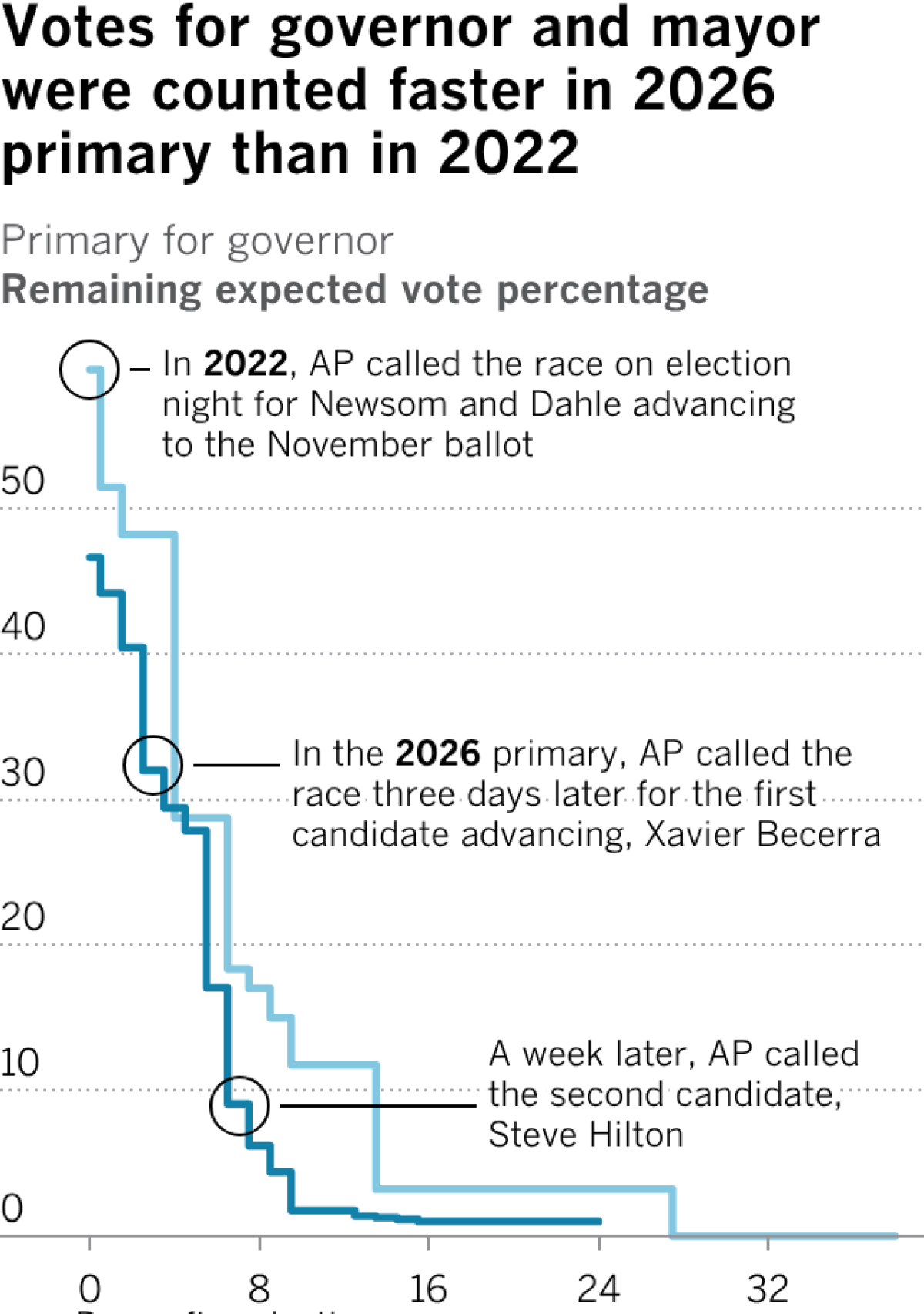
The 2026 governor’s race has been unlike any in recent memory, with no clear front-runner in a crowded field of candidates and voters just beginning to pay attention to the contest shortly before the June 2 primary.

There were two prominent Republicans and eight prominent Democrats in the race, leading to fears among Democratic leaders in the state that their party’s candidates could be shut out of the governor’s race in the general election because of California’s unique primary system. The two candidates who win the most votes in the June 2 primary will move onto the November general election, regardless of party affiliation.

Democratic leaders remain concerned that despite California’s sapphire-blue tilt, the number of their party’s candidates in the race could lead to a splintering of Democratic voters that results in two Republicans advancing to the November ballot.

Six prominent Democrats remain in the race, after Swalwell and former state Controller Betty Yee dropped out.

The race — lacking a global superstar such as Arnold Schwarzenegger or the scion of a storied political family and former governor like Jerry Brown — is ephemeral. Anything can happen before the June 2 primary.

But Becerra is having a moment. In addition to the new endorsements, he has seen notable movement in polls, most recently in a survey released Monday by the state Democratic party. Becerra jumped nine points from the party’s last poll, tying with billionaire Tom Steyer at 13%.

While Becerra will never be able to match Steyer’s deep pockets, he raised more than $1 million on ActBlue, the top Democratic fundraising platform, in the week ending on April 18, making him the biggest fundraiser on the site in the nation.

“Ninety-seven percent were first-time donors,” Becerra’s campaign said in a statement. “This is not a donor base being recycled. It is a movement being born.”

Source link

Netflix co-founder Reed Hastings to leave the company, marking the end of an era

Reed Hastings, who helped launched Netflix from a fledgling DVD mail-order business into a global streaming juggernaut, plans to exit the company after nearly three decades.

Hastings will leave the company he co-founded to focus on philanthropy and other efforts, the streaming company announced said Thursday.

Hastings, who serves as chairman of the Los Gatos company’s board, told Netflix he will not stand for reelection when his term expires in June, Netflix said in a letter to shareholders timed to its fiscal first-quarter earnings.

He said the commitment of Netflix Co-Chief Executives Ted Sarandos and Greg Peters was “so strong that I can now focus on new things.”

Peters described Hastings, 65, as the company’s “biggest champion,” and that he “is a part of our DNA.”

Sarandos called Hastings a “true history maker,” saying in a statement that Hastings’ “selfless, disciplined leadership style” will continue to shape Netflix’s path ahead.

Hastings’ exit was not unexpected as his role in the company diminished after he stepped aside as co-chief executive of Netflix in 2023.

During his tenure, Hastings oversaw the substantial growth of the streaming colossus. Today, Netflix has a market cap of about $455 billion, more than double that of the Walt Disney Co.

“My real contribution at Netflix wasn’t a single decision; it was a focus on member joy, building a culture that others could inherit and improve, and building a company that could be both beloved by members and wildly successful for generations to come,” Hastings said in a statement.

For the first quarter of 2026, Netflix reported nearly $12.3 billion of revenue, up 16% compared to the same time period a year ago. Operating income grew 18% to $3.9 billion for the three-month period ending March 31.

Both figures were ahead of the company’s guidance, a feat the streamer attributed to slightly higher than expected subscription revenue.

The company reported net income of $5.3 billion, up more than 80% compared to the $2.9 billion it recorded during the same period last year. Earnings per share was $1.23, up from 66 cents last year.

Netflix said it continues to expect 2026 revenue ranging from $50.7 billion to $51.7 billion, with an operating margin of 31.5%.

The earnings release and the Hastings announcement came after markets closed.

Netflix shares closed at $107.79, virtually unchanged. After hours, the shares dropped more than 8% to $98.26. They have climbed about 18% this year.

The Los Gatos-based company had previously secured an $82.7-billion deal to buy Warner Bros. studios and streaming services in December but it withdrew from the bidding war in late February after Paramount Skydance offered $31 a share. As part of the switch, Netflix was paid a $2.8-billion termination fee.

“Warner Bros. would have been a nice accelerant for our strategy, but only at the right price,” Netflix said in its investor letter. “We have multiple ways to achieve our goals (including producing, licensing, and partnering) and we’re constantly seeking to allocate our resources to the most attractive opportunities to maximize the value we are delivering to our members.”

Before Reed Hastings revolutionized the global entertainment business, he sold Rainbow vacuum cleaners door-to-door during his gap year between high school and Bowdoin College, where he earned his bachelor’s degree in mathematics.

During his sales pitch, Reed would first clean a homeowner’s carpet with their vacuum and then demonstrate how to clean using a Rainbow. The job helped hone his ability to understand customers, a core foundation of Netflix’s user-driven, candor-obsessed culture.

After Bowdoin and before he earned his master’s degree in computer science at Stanford, Hastings served in the Peace Corps (he also did a stint in the Marines) teaching high school math in Swaziland (now Eswatini).

“Once you have hitchhiked across Africa with ten bucks in your pocket, starting a business doesn’t seem too intimidating,” he told Time magazine.

While those experiences helped shape Hasting’s business sense, it was a late fee for a video that became the catalyst for launching Netflix, upending the way viewers consumed content and disrupting how Hollywood does business.

As the story goes, Hastings had misplaced a VHS tape of “Apollo 13” racking up a hefty $40 charge.

It was 1997 and his company Pure Software had just been acquired. It dawned on him that a gym membership offered a better business model, than the average video store — where you paid a set fee for the month and you could work out as much or as little as you liked. He thought, why not apply that to the movie rental business?

Netflix, began in Scotts Valley, Calif., as a mail-order business. Customers paid a tiered monthly fee to rent DVDs online which were delivered by mail.

The business exploded racking up millions of customers as it jettisoned the post office to an internet-based business. As the business accelerated across the world it also expanded, creating original content such as award-winning blockbusters such as “Stranger Things” and “House of Cards.”

The company’s innovation extended internally too. Hastings became known for implementing a unique and controversial culture of radical transparency, where employee evaluations are brutally candid and average performances can be grounds for termination.

The concept was a central theme of his 2020 book “No Rules Rules: Netflix and the Culture of Reinvention,” written with business professor Erin Meyer.

Times staff writers Meg James and Wendy Lee contributed to this report.

Source link

South Korea to receive 27 million barrels of crude oil in June

Trade, Industry and Resources Minister Kim Jung-kwan attends a press conference at the government complex in Sejong, central South Korea. Photo by YONHAP / EPA

April 16 (Asia Today) — South Korea will begin receiving 27 million barrels of alternative crude oil in June, part of a broader effort to stabilize energy supplies and diversify import sources amid disruptions linked to conflict in the Middle East.

The Ministry of Trade, Industry and Energy said the shipments are part of crude secured by a presidential envoy team, with additional policy measures being introduced to support refiners facing supply uncertainty.

A senior ministry official said the envoy team secured about 223 million barrels of alternative crude, excluding 50 million barrels previously allocated from Saudi Arabia. Of that, 27 million barrels are scheduled for shipment beginning in June.

The earlier 50 million barrels are expected to be shipped in April and May through the Red Sea port of Yanbu, with confirmation from Saudi Aramco that deliveries will proceed as planned, the ministry said.

South Korean refiners had faced disruptions despite existing contracts, as shipments were affected by instability and constraints linked to the Strait of Hormuz, a key global oil transit route.

The envoy delegation has secured a total of about 273 million barrels of crude from countries including Kazakhstan and Saudi Arabia. Of that, roughly 250 million barrels from Saudi Arabia – which accounts for about one-third of South Korea’s crude imports – are expected to be delivered by the end of the year.

Officials said the government has already secured about 118 million barrels for April and May combined, indicating no immediate risk to domestic supply. Remaining volumes are expected to be shipped sequentially through the end of the year.

In parallel, the government is introducing measures to help refiners diversify import sources. For crude imported between April and June, authorities will ease requirements for refunds of the petroleum import levy and temporarily expand refund limits.

The ministry said it simplified freight cost calculations using an international benchmark index and removed restrictions on shipment volume, duration and frequency. It also temporarily lifted caps on freight cost compensation for diversified imports to expand financial support.
The program is backed by about 127.5 billion won (approximately $95 million) in funding, based on estimated demand from domestic refiners.

Officials said broader reforms may be considered if the situation persists.

The ministry also pushed back against claims that fuel consumption has increased following the introduction of a price cap. Data showed that weekly gasoline and diesel sales fell in five of seven weeks from late February to mid-April compared to the same period last year.

From mid-March to mid-April, after the price cap took effect, total fuel sales declined 12.4% year-over-year, the ministry said, urging observers to focus on overall trends rather than short-term fluctuations.

— Reported by Asia Today; translated by UPI

© Asia Today. Unauthorized reproduction or redistribution prohibited.

Original Korean report: https://www.asiatoday.co.kr/kn/view.php?key=20260416010005112

Source link