Bulls vs. Bears: Nvidia in the spotlight as Jensen Huang reclaims CEO role
Bulls vs. Bears: Nvidia in the spotlight as Jensen Huang reclaims CEO role
Source link
Bulls vs. Bears: Nvidia in the spotlight as Jensen Huang reclaims CEO role
Source link
When Jensen Huang returned to lead the chip giant Nvidia this week after a scandal over his extramarital affairs, US President Donald Trump was not the only head of government to welcome his second coming.
Thousands of kilometres away, Israeli caretaker Prime Minister Benjamin Netanyahu was celebrating too.
Huang once called Israel Nvidia’s “second home”, and Netanyahu reflected that feeling as he wrote on X: “Nvidia’s partnership with Israel’s tech sector has created enormous value for the company and for Israel’s innovation economy.”
“Continuity in Nvidia’s leadership is good news for that partnership and for the global AI industry,” Netanyahu added, referring to Huang’s reinstatement as CEO and president on Monday.
Global headlines have focused on Huang’s affairs, including with a suspected Chinese intelligence asset; his resignation’s implications for the AI industry; and the larger technology race between Washington and Beijing. His reinstatement at the company he cofounded has gone a long way to settle market jitters. Nvidia’s share price rocketed up by 30 percent on Monday.
But Huang’s return has also calmed nerves in Israel – arguably the country most impacted by Nvidia’s performance outside the United States as it hosts the US-based company’s largest overseas operations.
Here’s what we know:

California-based Nvidia, the world’s most valuable semiconductor company with a market capitalisation of about $4 trillion, holds the key to the modern artificial intelligence revolution. Huang’s company holds an extraordinary near-90 percent share of the global market for GPUs – graphics processing units, which are specialised AI processors used in AI data centres.
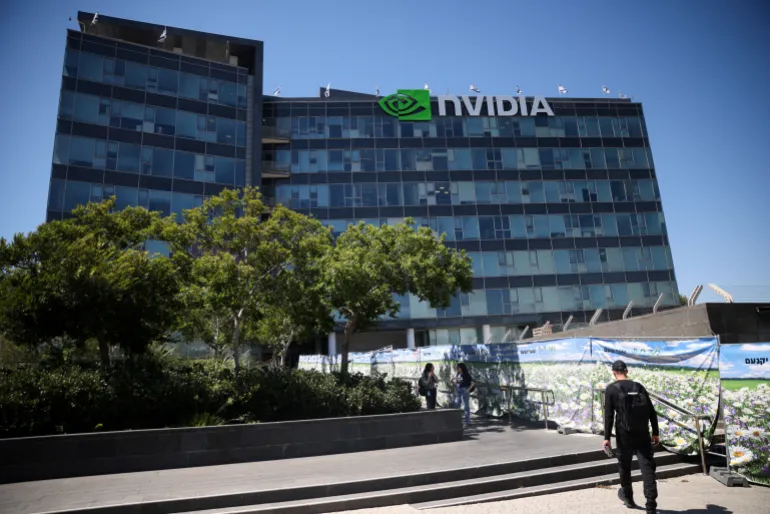
Nvidia’s operations in Israel are its largest in research and development outside the US. It has doubled employees there in the past three years to 6,000 people across seven research and development centres in Yokne’am, Tel Aviv, Jerusalem, Ra’anana and Beersheba. It also has plans to build a major research and development campus in Kiryat Tivon near Haifa to accommodate up to 10,000 employees.
The Bank of Israel has estimated that Nvidia’s work in the country alone will add 2.2 percentage points of growth to Israel’s gross domestic product (GDP) in 2026, bringing it to 5.6 percent. Without Nvidia, that would be 3.4 percent growth, or 40 percent lower.
Next year, Nvidia is expected to add a further 2.4 percentage points to its GDP growth.
Nvidia paid about $1.29bn in taxes to Israel in its financial year that ended in January, according to its annual report. The company is projected to account for nearly 3 percent of Israel’s total state tax revenues in 2026, according to some estimates.
Huang’s resignation on November 12 initially rattled investors on the Tel Aviv Stock Exchange (TASE) with the benchmark indices sliding after the announcement.
But by the end of the day, they had recovered. The TA-35 index finished 0.22 per cent higher at the close of the day while the broader TA-125 gained 0.07 per cent. The BlueTech Global Index, which tracks technology companies, fell 0.15 per cent.
The Haaretz newspaper reported, however, that officials at Israel’s Ministry of Finance were concerned about the potential consequences for the Israeli economy of turmoil – and particularly Huang’s exit – at Nvidia.
On Monday, Israeli President Isaac Herzog congratulated Huang on his return, noting “his deep appreciation to Huang for his continued support for Israel and for his commitment to strengthening the connection between Nvidia and Israel”.
Herzog’s office said Huang told the president that he was “moved by the message and that he intends to make the most of the second chance he has been given”.

Nvidia is helping fuel Israel’s economic machine during its genocidal war on Gaza, pogroms by Israeli settlers against Palestinians in the occupied West Bank and the occupation of southern Lebanon.
But Israel is also returning strong numbers for the company.
The root of the tech giant’s relationship with the country can be traced back to Nvidia’s acquisition of Mellanox, an Israeli company that supplies computer networking products, in April 2020 for nearly $7bn. That acquisition was central to Nvidia’s success.
Nvidia was already able to make powerful engines that process AI workloads, but a single GPU cannot handle that workload and needs to exchange information with other GPUs.
Mellanox made the networking infrastructure that allows those engines to work together at a fast pace, creating the foundational structure of a data centre.
Nvidia’s networking business, built around Mellanox, generated more than $21bn in revenues in the third quarter of 2026. That’s about 18 percent of Nvidia’s total quarterly revenue.
At the Consumer Electronics Show in Las Vegas in January, Huang spoke about Israel’s role in the development of key Nvidia chips.
“Nvidia’s BlueField-4 DPU and three networking components – the ConnectX-9 SuperNIC, NVLink 6 Switch and Spectrum-6 Ethernet Switch – all came out of Israel. So four out of six chips came out of Israel,” he said, praising the employees in Israel.
“Pretty amazing and maybe next time, six out of six chips,” Huang added.

A review by the American Friends Service Committee, a group that won the Nobel Peace Prize in 1947 partly for its work rescuing and providing relief to Jews during the Holocaust, has found that the Israeli military uses multiple Nvidia products.
Several purchases of Nvidia products were disclosed by the Israeli Ministry of Defence during Israel’s genocidal war on Gaza, a report by the group last year noted.
“They include products that are designed for AI applications, like Jetson cards and DGX,” it said, adding that since the public database only records unclassified contracts, “this likely represents only part of the full scale of the military’s usage of Nvidia products and services.”
Israel has made extensive use of AI systems in the Gaza war – including those known as The Gospel, Lavender and Where’s Daddy? – to track and target Palestinians at an unprecedented scale, the group said, adding that Nvidia “could therefore be potentially implicated in these war crimes”.
The Nvidia Jetson TX2 AI processor is also reportedly integrated into Elbit Systems’ Lanius drones, which Israel has used to kill Palestinian civilians in Gaza.
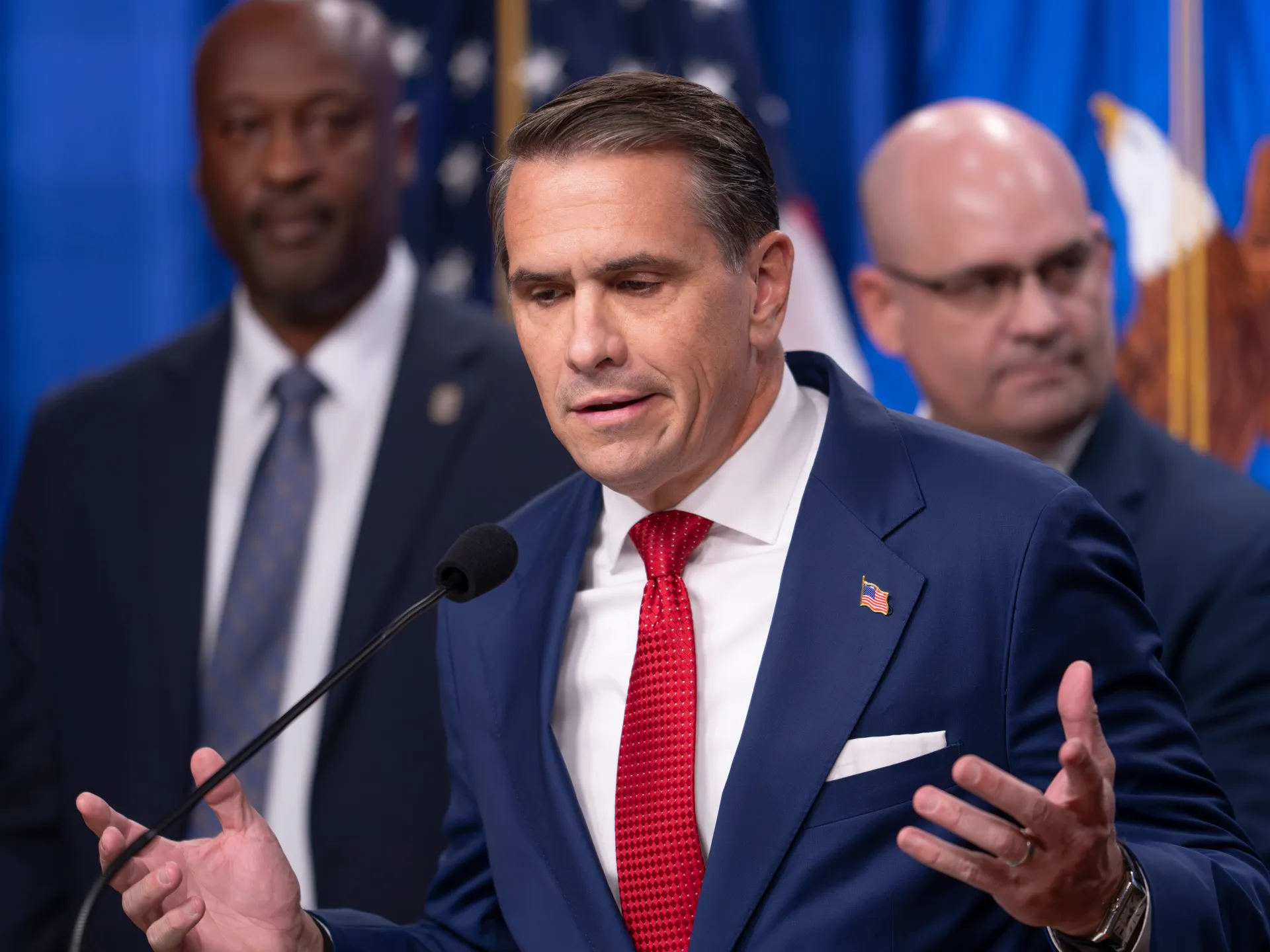
Amid bipartisan pushback over Nvidia’s decision to reinstate CEO Jensen Huang, United States Attorney General Todd Blanche has opted not to discuss whether the tech executive was under federal investigation.
At a press conference in Washington, DC, on Friday, Blanche was pressed by reporters over whether the Department of Justice had investigated Huang.
list of 3 itemsend of list
“What does that mean, ‘Had Huang been investigated’? For what?” Blanche responded.
“I don’t understand the question. Even the reporting from the various leaks or sources or whatever that was out there didn’t suggest that Huang himself was under some sort of investigation.”
Blanche also attempted to clarify US President Donald Trump’s comments that his administration had “exonerated” Huang of wrongdoing.
“What the president said is that he talked to a lot of people going into the decision that he made to encourage the board to reinstate him,” Blanche said. “And so, I’m not going to get into communications I had with the president about it, but what he was saying was true.”
Huang has been under scrutiny since late October, when The New York Times broke the story that he had been romantically involved with Alice Huang, an executive for the technology firm Megaspeed.
Alice Huang, according to the report, had been recruited by Chinese intelligence to help influence policy about US chip sales to China.
Under Jensen Huang’s leadership, Nvidia sold large quantities to Megaspeed, which allegedly diverted the semiconductor chips to China.
The New York Times cited anonymous US intelligence reports as its source. Beijing has denied the report as a “smear”.
Jensen Huang has since admitted to having extramarital affairs, including with a member of his staff, and on November 12, he resigned his leadership post.
But Trump, who has worked closely with Huang, petitioned for the disgraced CEO to regain control of Nvidia. Huang was reinstated on Monday.
In a social media post that day, Trump said the US “government has no reason to believe that Jensen’s return to NVIDIA poses any risk to National Security”.
“The Attorney General of the United States has confirmed that the U.S. Government does not possess evidence that he has engaged in any unlawful conduct,” he wrote.
During an hour-long TV interview, also on Monday, the president said his administration had conducted a “thorough” investigation into Huang’s relationship with the alleged Chinese intelligence asset.
“We believe he’s fine. He’s absolutely fine,” Trump told CNBC. He added that he personally “convinced” Nvidia’s board to reinstate Huang.
That decision has sparked a political firestorm in Washington as Democrats and Republicans alike decried Trump’s involvement in Huang’s return, as well as the ongoing national security concerns.
The US and China are locked in a competition in the artificial intelligence (AI) sector, and for years, the US has restricted the sale of domestically made chips to the rival superpower, for fear that the technology could be stolen or appropriated by Beijing’s military.
Trump himself has investments in Nvidia. Since he began his second term as president, he has also struck a deal with Huang to give the US government a 15-percent cut of sales of certain AI chips to China, as part of a loosening of restrictions.
Those business deals spurred Senate Minority Leader Chuck Schumer to warn on Tuesday that Democrats would look into Trump’s arrangements with Nvidia.
“Senior Trump officials assured Nvidia that Huang posed no national security risk — a conclusion that would normally take months to thoroughly investigate — and provided no evidence to the public,” Schumer wrote in a statement. “Our committees will investigate.”
Democrats are set to take control of both chambers of Congress in the new year.
During Tuesday’s news conference, however, Blanche appeared to become defensive when questioned about how the Justice Department ensured Huang had not violated any US laws.
“I’m trying to be as transparent as I can be under the laws and rules around what we do,” Blanche said. “What I said last week is that we were looking into it.”
He continued by explaining that there were various types of “investigations”.
“The FBI, law enforcement looks into things all the time,” he said. “That doesn’t necessarily become a criminal investigation. Doesn’t necessarily become an indictment. It just literally is that. It’s looking into things”.
The attorney general said Trump was “free to talk about whatever he wants”, and he called Nvidia “a good corporate citizen”.
“Obviously, if Nvidia was the target, or was the subject of some criminal investigation, or they were obstructing or thwarting our investigation, then that wouldn’t be the message that the president is saying to the American people,” Blanche said.
The company has had a whirlwind month after questions surfaced about Huang’s relationship with Chinese businesswoman Alice Huang, a suspected spy.

Published On 24 Nov 202624 Nov 2026
Share
TSMC, SK Hynix, and Asian tech surge after Jensen Huang's return as Nvidia CEO
Source link
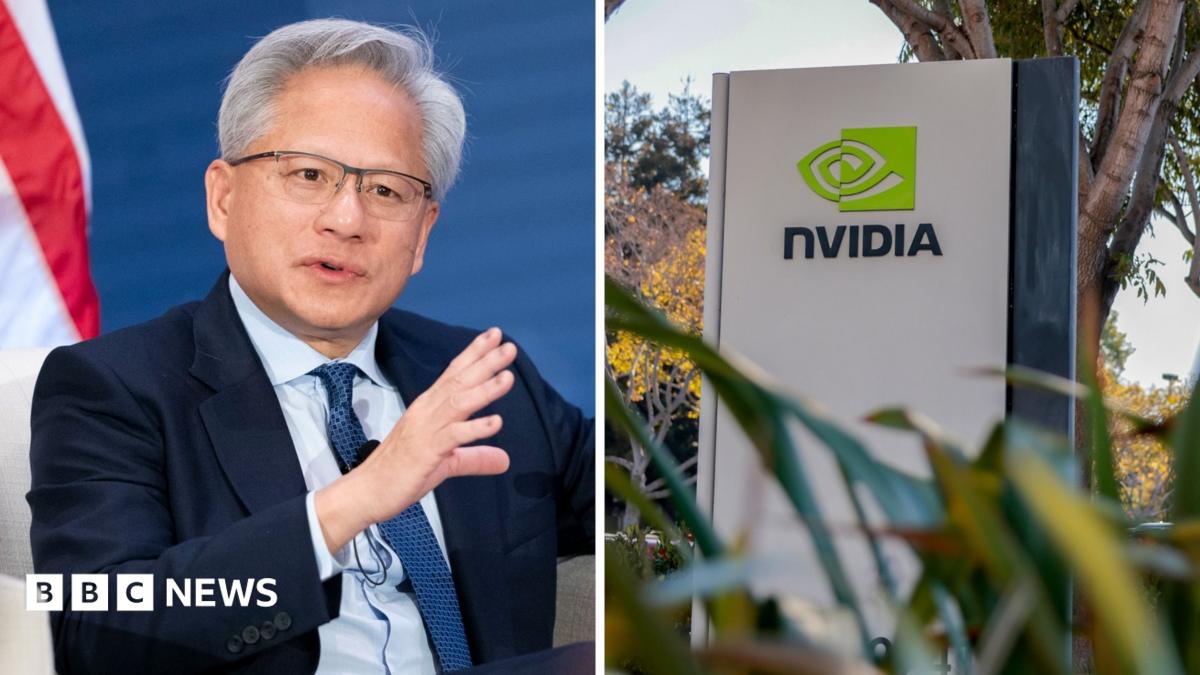
Nvidia’s board unanimously voted to reinstate Jensen Huang as CEO and president on Monday. President Trump has claimed credit for brokering the deal. What is the mood at Nvidia following the announcement? BBC’s Lily Jamali reports from Nvidia’s headquarters, where she gauges the reaction to Huang’s return.
Video edited by Mabel Pickering
WASHINGTON — President Trump said Monday that he personally persuaded the board of AI giant Nvidia to reinstate Jensen Huang as chief executive, an extraordinary intervention that raises questions about how the administration is handling national security concerns tied to Huang’s affair with an alleged Chinese spy.
The move, which came after the company’s stock had dropped over the last month and prompted alarm about the U.S. economy, signals how far the president is willing to go for the tech billionaires who have lined up behind him in his second term — even when their conduct may undermine national security.
It also compounds concerns about corruption within the Trump administration, which was a key driver of Democratic victories in the midterm elections. Trump owned at least $12 million worth of Nvidia shares at the end of last year, and the company has donated $25 million to his White House ballroom project.
A bipartisan backlash swiftly materialized Monday, as lawmakers of both parties questioned Huang’s reinstatement and called for investigations. Congressional inquiries into Huang’s relationship with the alleged spy and allegations that Nvidia’s restricted advanced AI chips were smuggled into China via Malaysia have already been set in motion.
Huang is scheduled to speak in closed-door interviews with three House committees on Dec. 1 and at a public Dec. 3 hearing of the Senate Banking Committee.
Trump praised the board’s decision and said in an interview with CNBC that “investors should be very happy,” as the company’s stock shot up more than 30% and boosted the market Monday. The president added that his administration has no reason to believe Huang’s return will pose a risk to national security.
“The Attorney General of the United States has confirmed that the U.S. Government does not possess evidence that he has engaged in any unlawful conduct,” Trump wrote on X. The president also tapped Vice President JD Vance to act as an emissary to Nvidia’s board and try to ease concerns about the reinstatement.
But his assurances did little to quell anxiety in Washington and across the nation. Without an independent investigation, Americans “can’t have confidence that all the risks have been identified,” said Matt Pearl, an expert on national security and technology.
“This leaves Congress, Nvidia shareholders, and the public unable to judge whether such risks were adequately addressed,” said Pearl, a director at the Center for Strategic and International Studies.
In addition to the affair with the alleged spy, Huang was also reported to have had a relationship with a subordinate and to have fostered a workplace culture marked with humiliation rituals.
As other tech leaders including Elon Musk and Sam Altman celebrated Huang’s reinstatement, Trump — whose political career has been beset by his own sexual misconduct scandals — sought to minimize concerns around Huang’s affair.
He told CNBC that he didn’t believe the woman was a spy, though he did not back up that speculation, and later posted an apparently AI-generated image on social media that lionized Huang, showing him holding up a red bra in an imitation of the images of Trump pumping his fist after the 2024 assassination attempt against him.
The president, who has sought to protect the AI industry for months even as safety concerns have mounted over its rapid rate of advancement, argued in the CNBC interview that Huang was key to America’s ability to compete on the global stage.
“I can tell you the biggest threat would be losing the brainpower of somebody like Jensen. That would be a threat,” Trump said. “To me, that would be a far bigger threat than anything we’re talking about.”
Trump, who has argued that America needs to “protect our brilliant people” when defending Huang, also suggested China could have tried to recruit Huang had his administration not swayed Nvidia to bring him back.
“If we didn’t do this, I could see China coming in and saying to Jensen, ‘Hey, how would you like to come to China,” Trump told CNBC. “He’s got a little blood in him. You know, he’s got a little blood there.”
Ramesh Srinivasan, director of the UC Center for Global Digital Cultures, said the episode reflects how central Nvidia has become to the AI economy and thus the economy overall — in part thanks to the federal government’s investments in it — and the Trump administration’s attempt to reassure markets in order to keep backstopping it.
The reinstatement of Huang is also a result of Trump “trying to inject himself as the central factor and character and kingmaker” in the tech and AI space, even as tech leaders have begun to back away from him and his party since Democrats won control of both chambers of Congress earlier this month, Srinivasan said.

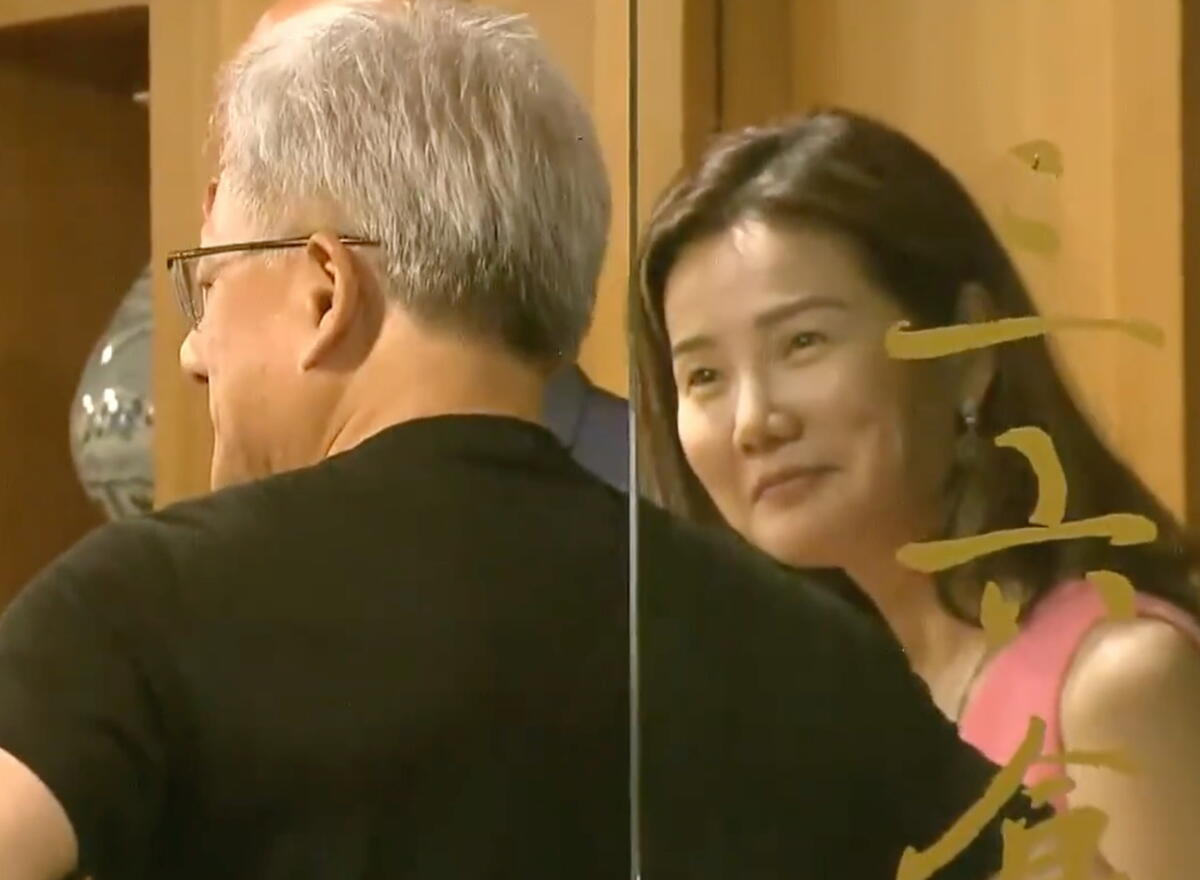
Alice Huang is seen with Jensen Huang at a restaurant in Taipei in May 2025.
(TVBS via Associated Press)
As investment and tech leaders telegraphed jubilation, Trump said on CNBC that “sex sells.” He predicted that the scandal would be a “net positive” for Huang and suggested the situation had helped the public see “how advanced” Huang’s company is.
“This is why America is the greatest country on Earth,” Gavin Baker, chief investment officer of Atreides Management, wrote on X, comparing Huang to the “Lord of the Rings” wizard Gandalf coming back from the dead in a more powerful state. “Every part of Jensen’s story would have only been possible in America.”
Critics said Huang’s reinstatement was an example of the type of corruption that voters repudiated in this month’s midterm elections. The episode perpetuates the idea that rules do not apply to members of a billionaire class who receive special treatment in the United States, Doug Chia, an independent corporate governance consultant.
“How come a certain class of people are able to get what they want and somehow shortcut the process?” Chia said. “This is a clear example of that. Jensen Huang became Trump’s ‘friend’ to the point where Trump goes to bat for the guy in the most difficult of circumstances. Who else has that kind of relationship?”
Politicians from both parties said the reinstatement underscored the urgent need for congressional hearings to get answers on the degree to which national security may have been compromised.
Nvidia’s decision will not “excuse Huang from testifying before Congress” in December, Sen. Pete Ricketts (R-Nev.) wrote on X. “It also doesn’t absolve Nvidia of answering for national security concerns and unaccounted-for chips.”
Sen. Adam Schiff (D-Calif.) called for Congress to investigate Nvidia’s chip sales, diversions of its advanced chips to China and what the Trump administration and Huang knew about China’s effort to acquire Nvidia’s advanced chip technology. He said Congress should “follow the trail of who financially benefited” from the sales and diversions.
“Donald Trump was told more than a year ago that China was targeting NVIDIA to undermine our AI advantage,” Schiff said on X. “Instead of responding to the threat, Trump and the Commerce Department greenlit the company’s sale of advanced AI chips to China. … Meanwhile, the president watched his personal NVIDIA investments soar to as much as $62 million.”
Chia said the abrupt reversal by the board, after it had indicated last week that it was not considering reinstating Huang, signaled that “something very strange” was going on.
The idea that the government could have interfered directly with a private enterprise is troubling and without direct modern precedent, he said.
“Since when does the president of the United States get to call up the board of a public company and just say, ‘Do this’ ?” Chia said. “This is behaving like [Nvidia] is a state-owned entity. … That just goes against the way our system has been set up and run for so many years.”
Angela Zhang, a USC law professor and expert on Chinese tech regulation, posted on LinkedIn that Huang’s return provided additional evidence that in “its effort to contain China, America is increasingly beginning to resemble China” — as Trump flexes his political power to control private business.
Zhang argued the market’s bounce back may “appear to signal a happy outcome in the short term.”
“But beneath that immediate optimism lies a more troubling question: What does this mean for the long-term integrity of American corporate governance and the rule of law in its financial markets?” Zhang wrote. “When corporate decisions become increasingly subject to presidential intervention, market confidence risks becoming dependent on political discretion rather than predictable rules and institutions.”
Trump’s intervention is not making all of Huang’s legal troubles go away. California is still pursuing its own inquiry into his company.
Atty. Gen. Rob Bonta’s office subpoenaed Nvidia last week, saying it was investigating whether “Nvidia or Jensen Huang’s actions resulted in China obtaining advanced chips or confidential information — and if Nvidia misled investors and the public about this risk, in violation of law.”
Bonta said the conduct of both Nvidia and Huang raised “bright red flags, including about the ways in which the company may have misled investors.”
At a news conference Monday, Bonta said he thought the decision to reinstate Huang was “wrong” and vowed to keep the state investigation going.
“We remain steadfast in our commitment to see it through, get to the bottom of it, and get all the answers,” Bonta said.
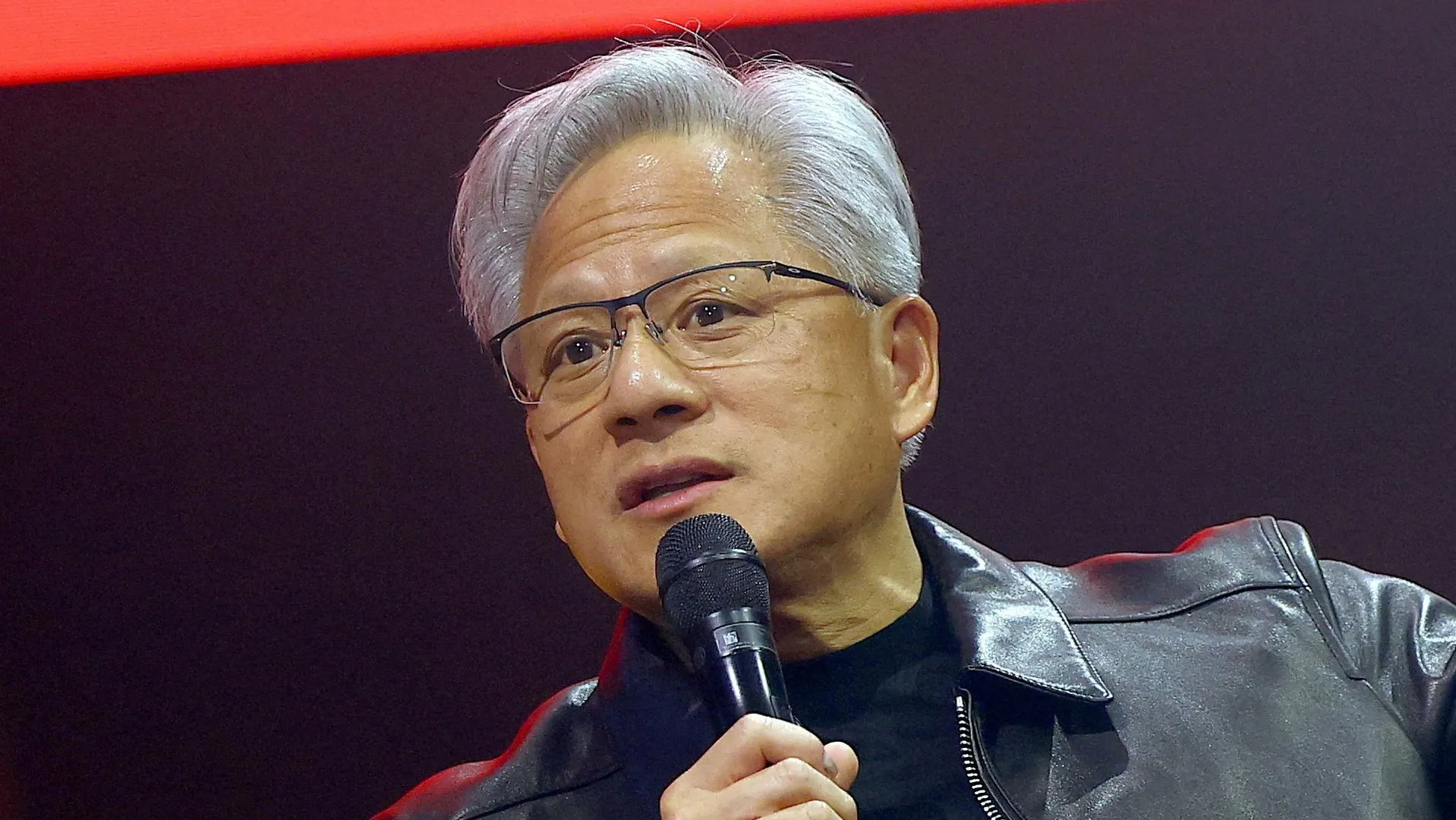
Jensen Huang is reinstated as NVIDIA’s CEO after a unanimous vote by the company’s board, following reports he was targeted in an alleged foreign intelligence operation.
Published On 23 Nov 202623 Nov 2026
Share
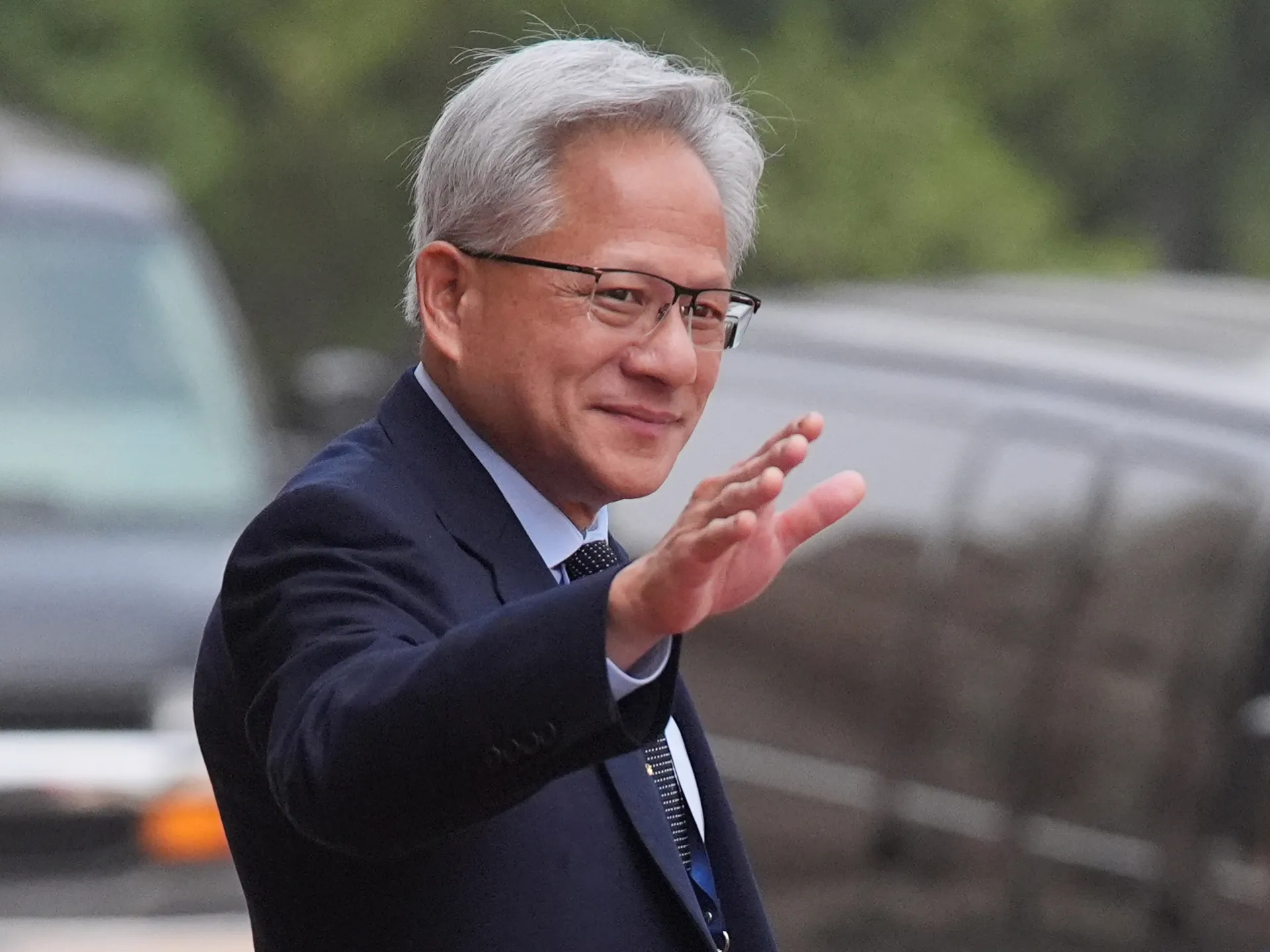
Huang stepped down as CEO earlier this month after revelations of at least two affairs, including with a suspected spy.
Jensen Huang is returning to Nvidia as chief executive, a little more than a week after he resigned amid extramarital affairs, including one with an alleged Chinese spy.
On Monday, Nvidia board reinstated Jensen Huang as president, CEO and as a member of the board.
list of 4 itemsend of list
“I am honored to return to NVIDIA and lead one of the most consequential technology companies in the world at the beginning of a new industrial revolution,” said Huang in a statement as the company announced his return.
“I take this responsibility with the greatest humility and renewed commitment. I want to thank the NVIDIA Board for its confidence and deliberation through this process.”
Nvidia said that Colette Kress, who served as the interim CEO, will continue as chief financial officer.
United States President Donald Trump welcomed the decision in a post on social media.
“The NVIDIA Board of Directors has made the correct and proper decision to return Jensen Huang to the position of CEO,” Trump said in a social media post. “The United States Government has no reason to believe that Jensen’s return to NVIDIA poses any risk to National Security,” Trump said.
Huang resigned on November 12. His departure prompted immediate pushback from Silicon Valley insiders and within days there was a petition with more than 180,000 signatures calling for his return, including from SpaceX and Tesla CEO, Elon Musk.
He was reinstated despite multiple investigations into the chip giant including from the US Securities and Exchange Commission (SEC) and Department of Justice (DOJ) that are still underway.
Nvidia shares jumped up by more than 33 percent on the news as US markets opened on Monday.
Analysts also praised the decision with Michael Monaghan, portfolio manager of Founders 100 ETF telling Al Jazeera that it is a “huge positive”.
“Founders like Jensen are irreplaceable. They bring unparalleled vision, execution and grit. Hard to overstate how important this is for America winning the SI race, Nvidia, and innovation in general,” Monaghan said.
“At the end of the day despite this Jensen saga the Board knew it had no choice but to bring him back and for the US technology sector this was the move it had to make,” Dan Ives, senior managing director at Yorkville Ives, said in a note on Monday.
Ives previously said that Nvidia could lose as much as 30 percent of its value without Huang.
The decision comes amid a period of volatility for the AI sector following the recent midterm elections, in which Democrats, many of whom are more skeptical of artificial intelligence, won control of both the House and Senate. Meanwhile, ballot measures aimed at restricting data centre development passed in all but one election.
Last week, Anthropic made its blockbuster Wall Street debut, with shares surging 34 percent from their IPO price of $83 to $111.50 when trading began. Since then, however, the stock has fallen more than 16 percent.
Nvidia and Anthropic have close financial ties. Nvidia committed $10bn to Anthropic’s IPO, in addition to a separate $10bn investment announced in 2025.
The news has boosted the broader market which had slumped last week. On Monday, all the major US indices were trending upwards. The tech heavy Nasdaq was up 6.7 percent, the Dow Jones Industrial Average was up 2.8 percent and the S&P 500 was up 4.6 percent in early trading.

Robert Way
Should Nvidia (NVDA) bring back Jensen Huang as CEO?
We asked Seeking Alpha analysts Bashar Issa, Victor Dergunov, Danil Sereda, and The Techie for their thoughts.
Bashar Issa: Part of me wants Jensen Huang to stay out to break the “indispensable
US president calls tech giant to give former CEO ‘a second chance’ and urges him to ‘make a big apology’.
Published On 21 Nov 202621 Nov 2026
US President Donald Trump has said he would welcome Jensen Huang’s return as Nvidia’s CEO, more than a week after the company’s founder stepped down over a scandal involving extramarital affairs.
“You have one of the truly most brilliant minds in the world, and where is he going to go?” Trump told reporters on Friday. “I think that I would love to see Jensen be given a second chance.”
list of 3 itemsend of list
Trump also described Jensen Huang as “a good man” who “made some bad decisions”.
“I’d like to see Jensen make a big apology and go back, because he created something with Blackwell,” Trump said, referring to Nvidia’s most advanced chips.
Huang resigned on November 12, following media reports of an intimate relationship with an alleged spy for Beijing who may have helped route restricted chips to China. US intelligence officials are said to have previously known about the possible espionage link.
Two more affairs have since been reported. The New York Times reported on Friday that the suspected spy, Alice Huang, has extensive ties to China’s defence industry through her family and associates.
Trump also appeared to contradict Treasury Secretary Scott Bessent, who had said earlier on Friday that Jensen Huang did not come up in talks between Trump and Chinese President Xi Jinping in Shenzhen this week.
“I did discuss that with President Xi, and he said, ‘Oh, brilliant, brilliant! He’s a brilliant man,’” said Trump of his meeting with the Chinese president.
In a post on X on Tuesday, Jensen Huang offered to return to the company.
However, Nvidia’s board has ruled out his comeback. Board chairperson Harvey Jones said on an earnings call later that day that the directors unanimously accepted Huang’s resignation and do not plan to reinstate him.
The scandal has also drawn in Commerce Secretary Howard Lutnick. Republican Senator Tom Cotton of Arkansas told The Wall Street Journal that Lutnick had repeatedly ignored warnings about AI chips being smuggled to China before the scandal broke, though he stopped short of calling for the commerce secretary’s resignation.
Trump said he still supported Lutnick.
“I have not lost confidence,” Trump said, calling Lutnick “a different kind of a guy, very good businessman”.
Democrats, who will take control of Congress in January, are investigating whether Lutnick used his office to help Cantor Fitzgerald, the firm run by his sons, avoid losses tied to scrutiny of Nvidia’s links to a Chinese company.
Nvidia has shot down the prospect of Jensen Huang returning as CEO amid the chip giant’s latest blockbuster earnings results.
Nvidia board chair Harvey Jones said on Tuesday during an earnings call that the company had no plans to reinstate Huang following his “voluntary resignation” for “personal behaviour inconsistent with the company’s code of conduct, standards, and cultural norms”.
list of 4 itemsend of list
“The Nvidia board unanimously accepted his resignation and does not intend to reinstate Jensen as CEO,” Jones said.
Jones, appointed Nvidia’s first-ever board chair after Huang’s resignation last week, made his comments as Nvidia continued its run of stellar earnings in the third quarter.
Nvidia reported revenue of $115.8bn in the quarter that ended October 25, up 103 percent year-on-year. Net profit came in at $64.9bn, up 109 percent year-on-year.
Nvidia, currently led by interim CEO Colette Kress while its board seeks a permanent replacement, said it expected next quarter revenue to reach $130bn, plus or minus 3 percent.
“Earnings were very strong, and were just what the market needed to shake off some AI-related jitters experienced over the last couple of weeks,” Will Rhind, chief executive officer at GraniteShares Advisors, told Al Jazeera.
“The earnings call, of course without Jensen, was a signal for the bulls that life carries on without him and the foundation the company has built is as robust as ever,” Rhind said.
Huang resigned amid scrutiny of his relationship with a tech executive accused of being a Chinese intelligence operative or asset. He said earlier on Tuesday he would be “honoured” to return if the board deemed it in the best interests of shareholders and the company.
Nearly 200,000 people have added their names to an open letter calling for Huang’s reinstatement, including Tesla and SpaceX CEO Elon Musk and Epic Games CEO Tim Sweeney.
Shares of Nvidia, which have fallen more than 30 percent over the past month, closed down 0.4 percent on Tuesday, before rising 4.8 percent in after-hours trading.
Nvidia has been under intense scrutiny over its relationship with the Singapore-based data centre company Megaspeed, suspected of diverting advanced chips to China in violation of US export controls.
On Monday, the US Department of Commerce and the Department of Justice confirmed that prosecutors had opened a criminal investigation into Megaspeed.
President Donald Trump’s administration also moved on Monday to close a legal loophole that had allowed Chinese AI developers to access advanced chips remotely at data centres in third countries.
The rule issued by the Bureau of Industry and Security designates Indonesia, Malaysia, Singapore, Thailand and Brazil as export destinations with an “unacceptable risk of diversion” and requires anyone seeking to ship advanced chips to those countries to obtain an export licence.
Jay Goldberg, senior analyst at Seaport Research Partners in San Francisco, said investors will closely watch how the clampdown on China’s access to high-end chips affects Nvidia’s business.
“I think they had a good quarter and guidance, in particular, raising their revenue forecast for next year,” Goldberg told Al Jazeera.
“But not sure how much of that matters until we get more clarity on who the next CEO will be and just how much exposure they really have to PRC AI companies,” Goldberg said, using the acronym for the People’s Republic of China, the country’s official name.
“As for their comments about Jensen returning, I think they said what they had to say. The board has to navigate a lot of legal guardrails. I think it is still possible for Jensen to return. Unlikely but possible.”
Megaspeed, whose former executive Alice Huang had an intimate relationship with Jensen Huang and has been accused of working with China’s Ministry of State Security, has denied wrongdoing, saying media reports about its operations were “not supported by verifiable evidence”.
Alice Huang has not publicly commented on the claims of espionage, which have been circulated in the media by unnamed US officials.
Beijing has denied the spying allegations, calling them “entirely groundless, speculative and intended to smear and malign China”.
Immersive art firm Hopscotch will on Dec. 11 open a multiroom, walk-through experience, one filled with floor-to-ceiling wonderlands, giant, grown-up-ready ball pits and photo-ready destinations designed to dazzle guests.
Hopscotch is coming to San Pedro’s West Harbor, a long-in-the-works waterfront development initially pegged to have its grand opening last year but just now beginning to launch in phases. The space adds to the growing roster of L.A.-area immersive locations opening soon or in the works.
In the coming weeks, Hopscotch will be joined by Meow Wolf, whose experiential destination is destined for West L.A. Further out but in development is a permanent location of the Museum of Ice Cream in West Adams, and just announced for Anaheim is the first full U.S. exhibition from Tokyo’s TeamLab.

Hopscotch co-founder Nicole Jensen says the space is designed for play.
(Christina House / Los Angeles Times)
“We’re fans,” says Hopscotch co-founder Nicole Jensen of its soon-to-be-peers in the booming immersive art world of SoCal. “In our opinion, there can never be enough art in the world.”
San Pedro’s Hopscotch, the third of the company’s locales after opening spaces in San Antonio and Portland, Ore., has been in the works since 2021. Jensen expects it to be about a 90-minute experience for most guests.
It deviates from other social media-ready art spots with a number of thoughtful rooms that aim to get attendees out of their everyday headspace. Look for a partnership, for instance, with the Human Rights Campaign, as well as a room that seeks to get visitors to open up and be vulnerable.
“We’re all about play and creativity and connection,” Jensen says. “We want you to feel your most authentic self when you’re at Hopscotch, so you can access the play part of your brain.”
Expect plenty of interactive installations, especially those that play with color, light and movement. Here’s a deeper dive into what Hopscotch has to offer.

Hunter Inman, right, and Nicole Jensen, co-founders of Hopscotch, in the space’s introductory room, “Gaze,” a collaboration with the Human Rights Campaign.
(Christina House / Los Angeles Times)
The first major gallery room in Hopscotch is a maze of 44 transparent, light-infused structures developed in partnership with the Human Rights Campaign (Jensen has served as a member of its board of governors). Dubbed “Gaze,” its clear structures are etched with messages of celebration and unity that reflect HRC’s mission as an LGBTQ+ civil rights organization.
Look, for instance, for glowing purple-pink kittens cheering for “purrrride.” Elsewhere, a wall reflects the local area, providing a light green vision of West Harbor’s ultimate map, and a blue panel is laced with words of inspiration.
“I approached them a few years ago and said I want to bring your messages to life,” Jensen says of the HRC. “So we take messages that are normally on posters, websites and shirts and bring it to life. It’s called ‘Gaze,’ because it’s gazing into a future of love and acceptance for all.”

Hopscotch will feature an installation in which guests listen to the confessions of strangers.
(Christina House / Los Angeles Times)
One of the most striking installations in Hopscotch is “Secrets,” from Texas studio Wide Awake Creative. Here, guests can enter soundproof telephone-booth-like rooms to either listen to the revelations of strangers, or leave one of their own. The hope, says Jensen, that it is a “shared cathartic experience.” When Hopscotch opens, it will play the secrets of guests from its other locations, but eventually visitors will hear words spoken solely by SoCal attendees.
They’re individually vetted, of course, and Hopscotch has rooms dedicated for grown-ups and children. There’s a wide range, from lighthearted to serious, be it guests expressing fear they’ll never again find love, or just stressing about introducing a partner to their parents. They’re all relatively short, so expect to spend some time listening to strangers get vulnerable. In five years across two locations, Hopscotch has collected more than 400,000 confessions.
“We want it to be as natural and authentic an experience as possible,” Jensen says. Adds co-founder Hunter Inman, “We were surprised when we first did it. We were surprised at how serious some of the sharing was.”

Nicole Jensen, co-founder of Hopscotch, illustrates how the venue will respond to the movements of guests.
(Christina House / Los Angeles Times)
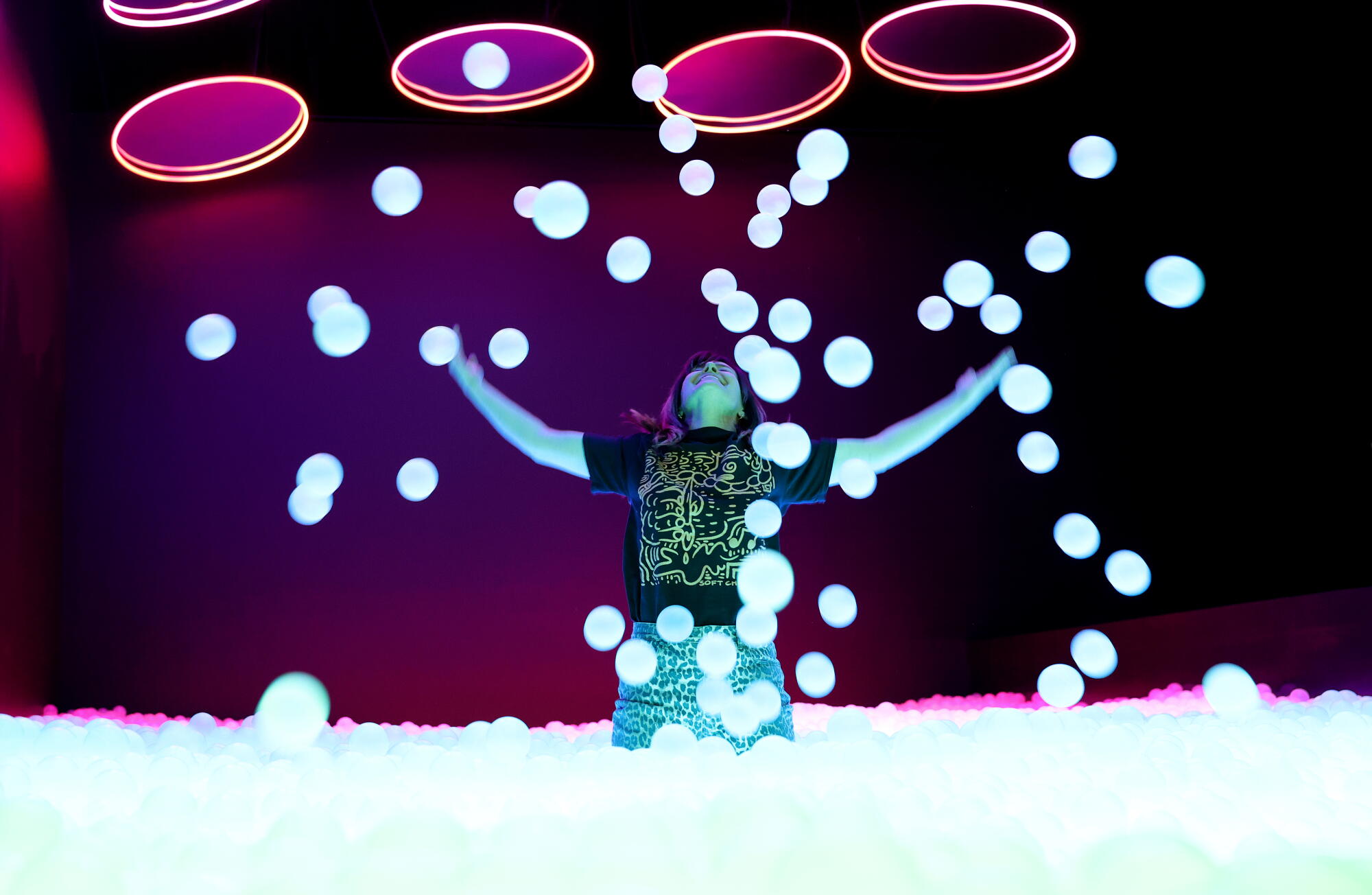
It’s not all so serious. Hopscotch ultimately is about play and wonder. That’s why, for instance, it has an adult-sized ball pit. Or a room called the “Quantum Trampoline,” created by international studio Kuflex. Bounce or hop, and each movement is transformed into cosmic-like swirls and twirls. And, of course, Hopscotch has its own version of a mirrored room of hanging lights to mesmerize visitors.
One particularly interactive room is a digital graffiti wall from artist Todd Moyer. Guests, about four or five at a time — Hopscotch intends to pulse people through its 10 installations — can pick up virtual spray cans to decorate computerized brick and concrete walls. From there, attendees will wander into a cotton candy-like explosion of warmth, albeit one designed entirely of thousands of upcycled plastic bags and salvaged fishing nets from artist Barbara Goszczynska. It’s a cavern of soft colors with some not-so-hidden benches and the occasional mirror to create an illusion of a grander space.
Here, too, Hopscotch wants to bridge the worlds of playfulness and thoughtfulness. The rainbow cave, says Jensen, “makes us reconsider our relationship with objects we overuse as a society.”

Onetime San Pedro resident Darel Carey created a large-scale outdoor-indoor mural for Hopscotch.
(Christina House / Los Angeles Times)
Hopscotch tapped onetime San Pedro resident Darel Carey for a large-scale, indoor-outdoor mural that runs the facade of the building. Carey’s black-and-white, kaleidoscope-like lines are designed as a sort of optical illusion, intended to blur the lines between the inside and outside of the space.
Carey spoke of being influenced by flower blooms in creating the shapes for the spot, and inside Hopscotch the art will serve as the space’s introductory lounge, which will sell walk-up food and beverages, alcoholic and non-alcoholic. Visitors can grab a bite or a beverage without buying a ticket to the full exhibition.
Hopscotch intends to be open daily and tickets will be priced at $25 or less. “We try to make it easy for people to come back again,” Jensen says.
As for why San Pedro, Jensen and Inman say they fell in love with the community soon after touring it in 2021. Jensen was sporting an Arts Open San Pedro shirt on the day of the interview, and cites the area’s arts district as a source of inspiration. But the latter, Jensen adds, could be found just outside the Hopscotch doors.
“Honestly, when you’re down here on the water and these massive ships go by, you feel like a kid again,” Jensen says.
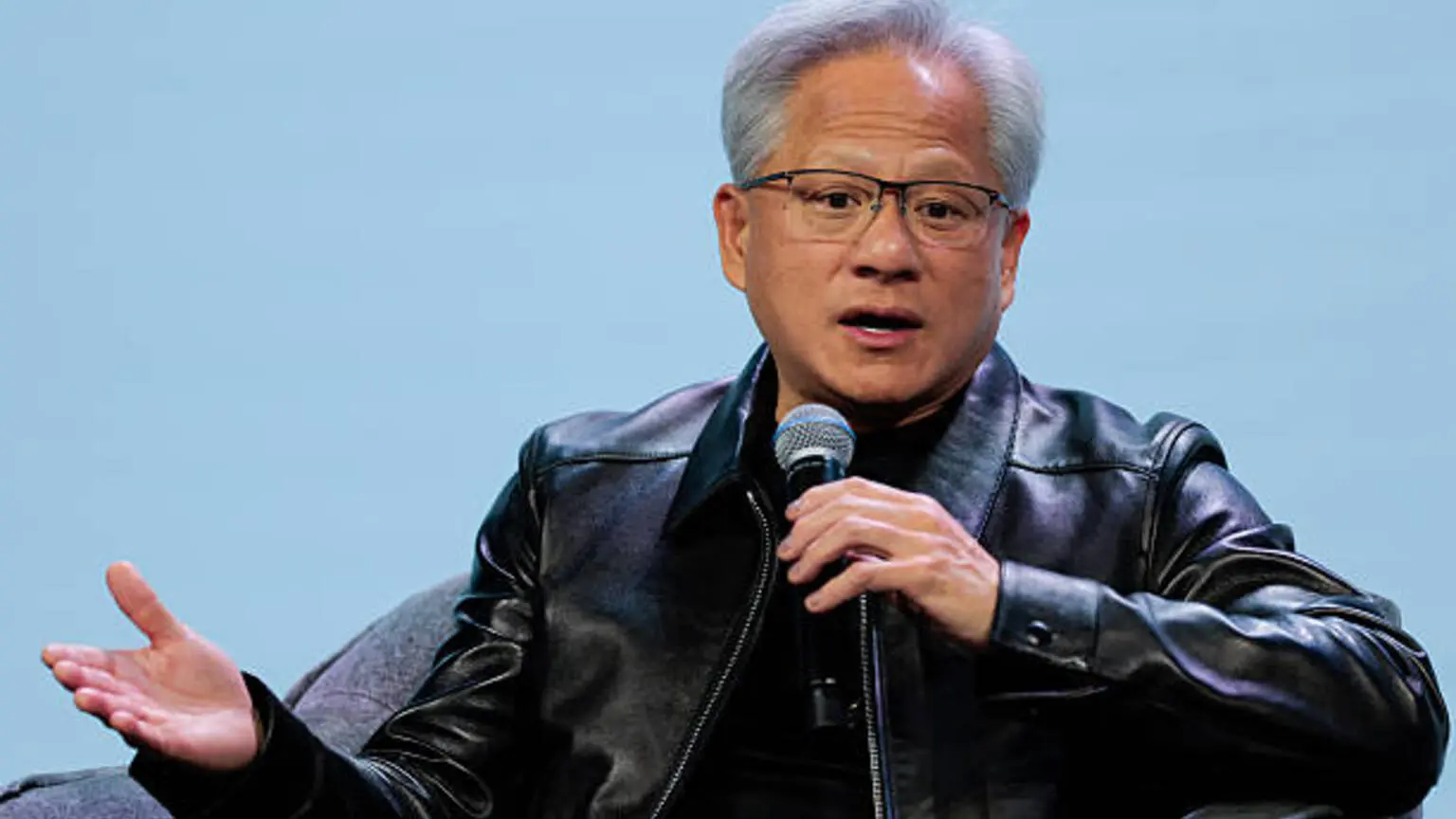
Nvidia board rules out Jensen Huang return amid growing petition and backlash: report
Source link
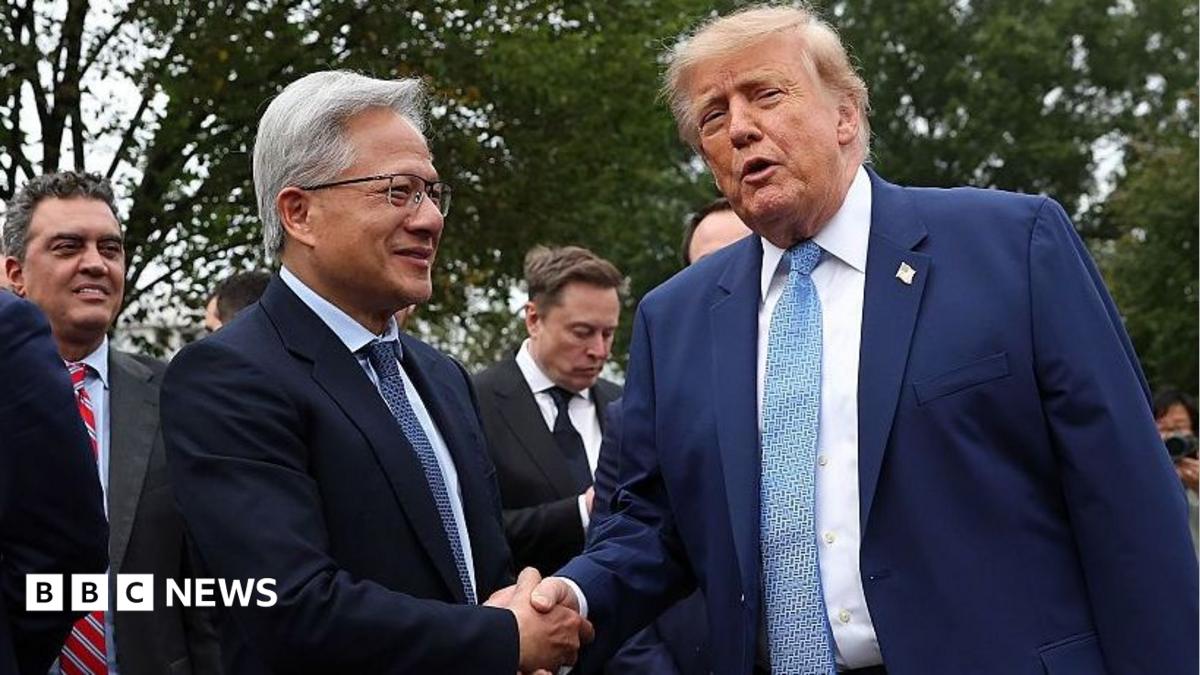
US President Donald Trump has said he “would certainly not mind” seeing Jensen Huang handed back his job as allies of the former Nvidia chief executive called for him to be reinstated.
Huang resigned as boss of the AI chip giant last week after the emergence of two affairs, one of which was with a woman suspected of spying for China and another allegedly with one of his employees.
It has created a crisis for one of the world’s most valuable firms, which is a key part of the AI industry and its huge expansion.
But now fellow tech bosses, including SpaceX’s Elon Musk and Tim Sweeney, chief executive of Fortnite-maker Epic Games, have backed a campaign to get Nvidia’s board to “Bring Jensen Back”.
The pair were among more than 175,000 signatories of an open letter calling for the board to reinstate Huang while an ongoing internal probe is conducted.
President Trump gave his views on Huang’s future on Monday, saying he “would certainly not mind” seeing the former boss given his job back.
“I guess maybe one lesson is more important than another, but I would certainly not mind seeing that,” he told reporters as he left the White House.
The president’s comments come after the “Stand with Jensen” campaign group, which claims to be made up of current and former Nvidia employees, partners, shareholders and supporters, demanded the return of the former chief executive.
They expressed concerns the ex-Nvidia boss “was removed without meaningful due process”.
Huang had been expected to weather the storm following the revelation of an affair involving Alice Huang, alleged to be a Chinese spy.
However, he resigned last Thursday after a second extra-marital relationship emerged, allegedly with an executive at Nvidia who reported to him.
The scandal-hit tech boss is now discussing a possible return to Nvidia with confidants, according to the Financial Times, external, though the publication reported Nvidia’s board is not considering reappointing him.
A representative for Jensen Huang declined to comment on the report. The BBC has contacted Nvidia for comment.
The so-called war room also wants to get support for Huang from the White House.
President Trump has spoken in glowing terms about Huang since the scandal broke out, and also said he believed Huang when the former Nvidia boss told him he had “no idea she was a spy”.
Trump’s view is at odds with his Treasury Secretary, Scott Bessent, who has called for Nvidia to hire its next chief executive from outside the company.
The scandal has created tensions between the US Treasury and Commerce departments over shipments of high-end Nvidia chips to Alice Huang’s former firm, Megaspeed. China has denied that Alice Huang is a spy.
It has raised questions about the possibility that the chips may have ended up in China despite US export restrictions.
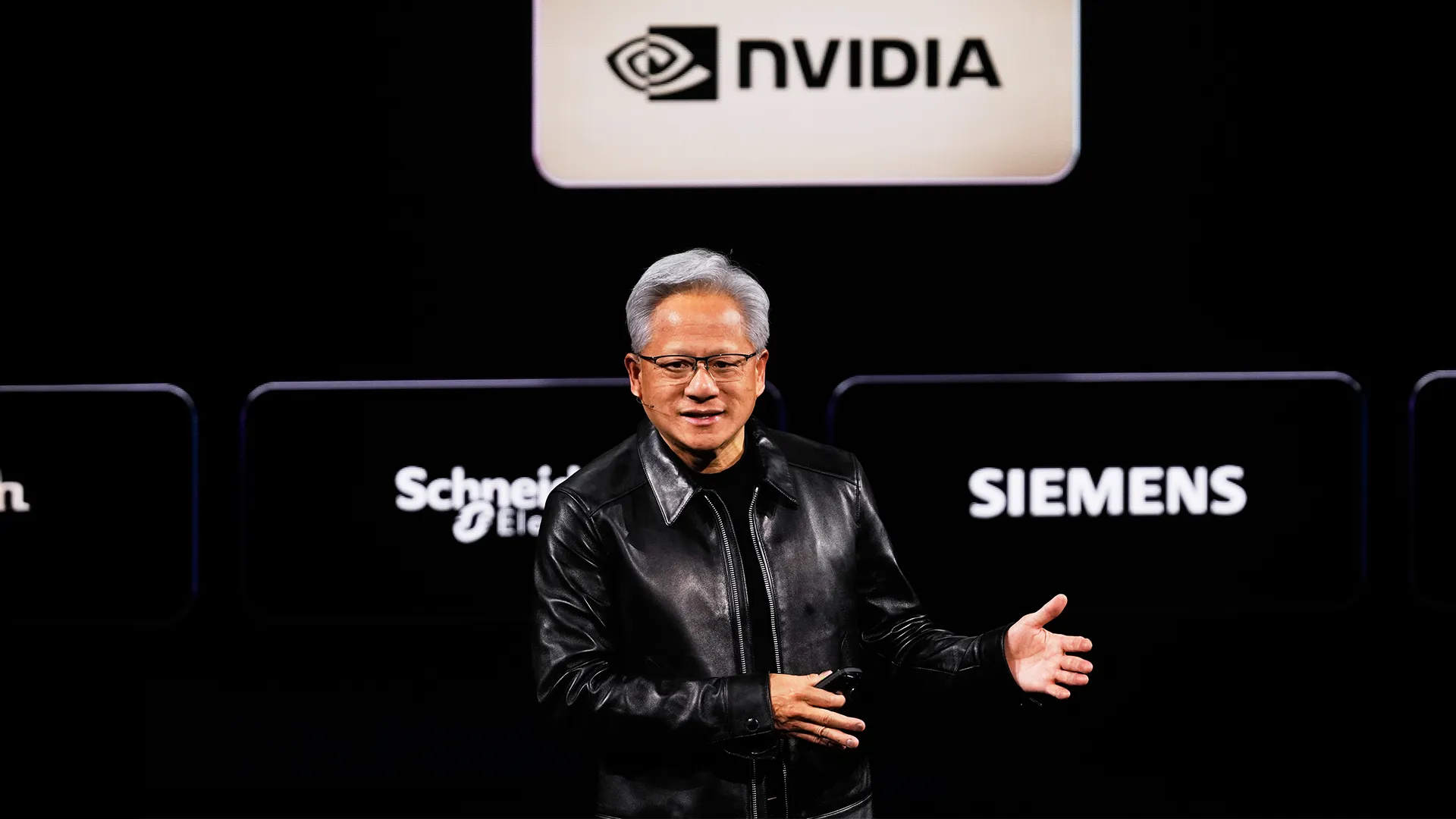
The CEO of one of the world’s most valuable companies, Nvidia, has stepped down after reports of a second extra-marital affair. Jensen Huang’s position had been under threat after initial revelations about an affair with a suspected Chinese spy.
Published On 12 Nov 202612 Nov 2026
Share
DEVELOPING STORYDEVELOPING STORY,
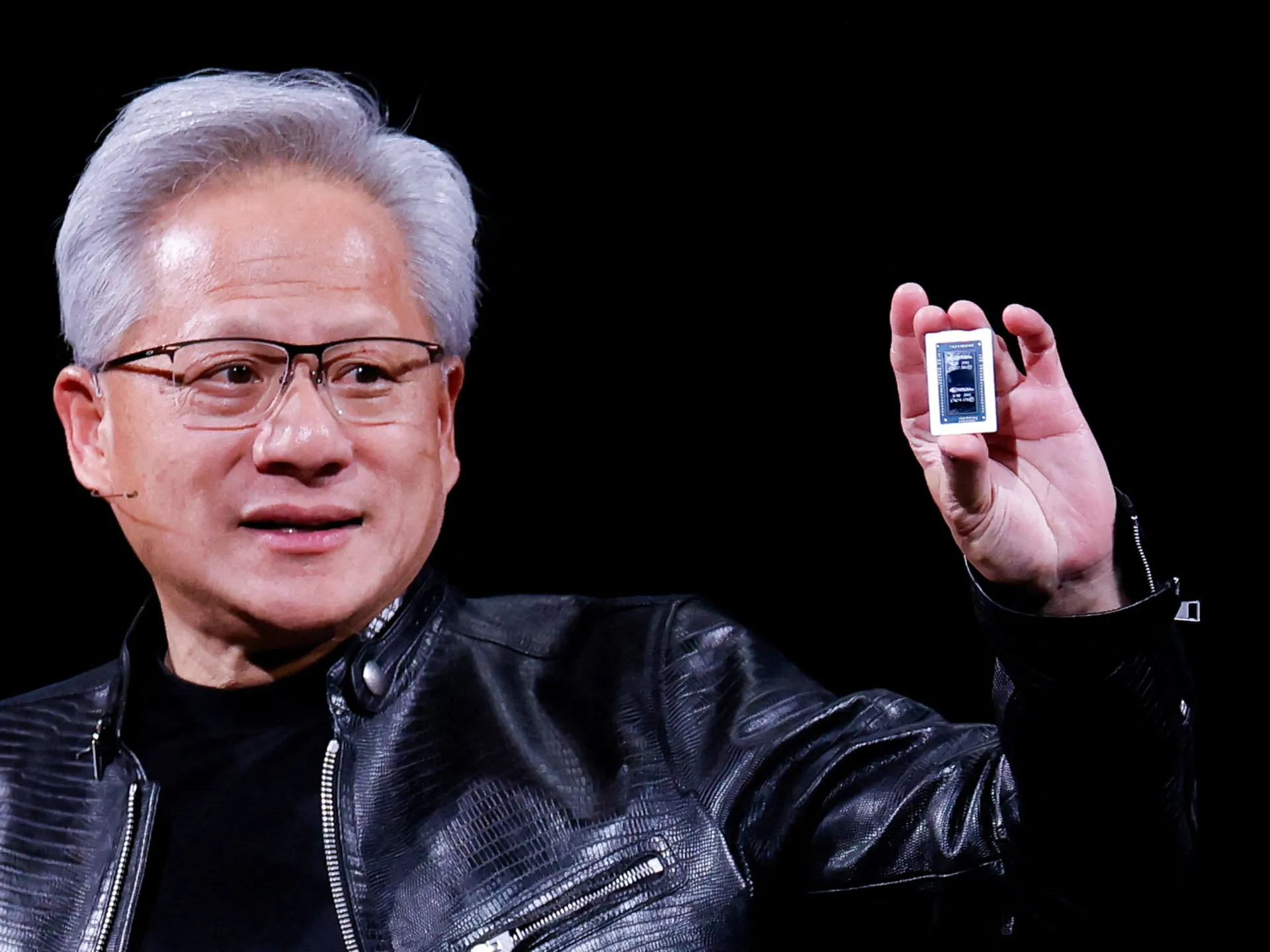
Nvidia loses more than $600bn in market value as CEO Jensen Huang steps down amid espionage and affair allegations.
Published On 12 Nov 202612 Nov 2026
Nvidia CEO Jensen Huang has stepped down from the company following his reported affairs with a suspected Chinese spy and an Nvidia executive.
The $4.2 trillion tech giant has lost more than $600bn in market value this week as Huang’s scandals rocked the company, which supplies most of the chips powering advanced artificial intelligence (AI) technology. The stock slid more than 10 percent in premarket trading on Thursday.
The company appointed Colette Kress, Nvidia’s chief financial officer and executive vice president, as interim CEO on Thursday.
Nvidia’s board met on Wednesday night to discuss ousting Huang, whose relationship with the alleged Chinese spy triggered investigations by the FBI, the United States Congress and the California-based tech giant. Nvidia is also facing a shareholder class-action lawsuit.
The alleged Chinese intelligence asset, Alice Huang, is a former executive at Singapore-based Megaspeed, Nvidia’s primary business partner in Southeast Asia. Founded in 2023, Megaspeed has been investigated over whether it helped Chinese companies access its $4.8bn stock of powerful Nvidia chips.
The affair has raised national security concerns in the US, which restricts chip sales to China over concerns that the Chinese military, intelligence agencies or companies could use the advanced technology.
Huang, 63, is Nvidia’s co-founder, president and CEO. A close ally of United States President Donald Trump, he has pushed to ease US restrictions on chip exports to China. Trump said earlier this week that Huang told him he had “absolutely no idea” that he was in a relationship with an intelligence operative.
Huang owns about 3.6 percent of Nvidia’s stock, making him one of the richest people in the world. He is a powerful figure in the AI industry, which has driven record stock market and wider economic gains.
Nvidia’s board, which hired a law firm to investigate the affair with Alice Huang, met to decide Huang’s fate on Wednesday shortly after the New York Times reported that Huang also had an extramarital relationship with a Nvidia vice president who reports to him.
Nvidia’s stock has tumbled since the scandal erupted, falling to a 14-year low, the Reuters news agency reported.
What's next for Nvidia's Jensen Huang as internal inquiry begins?
Source link
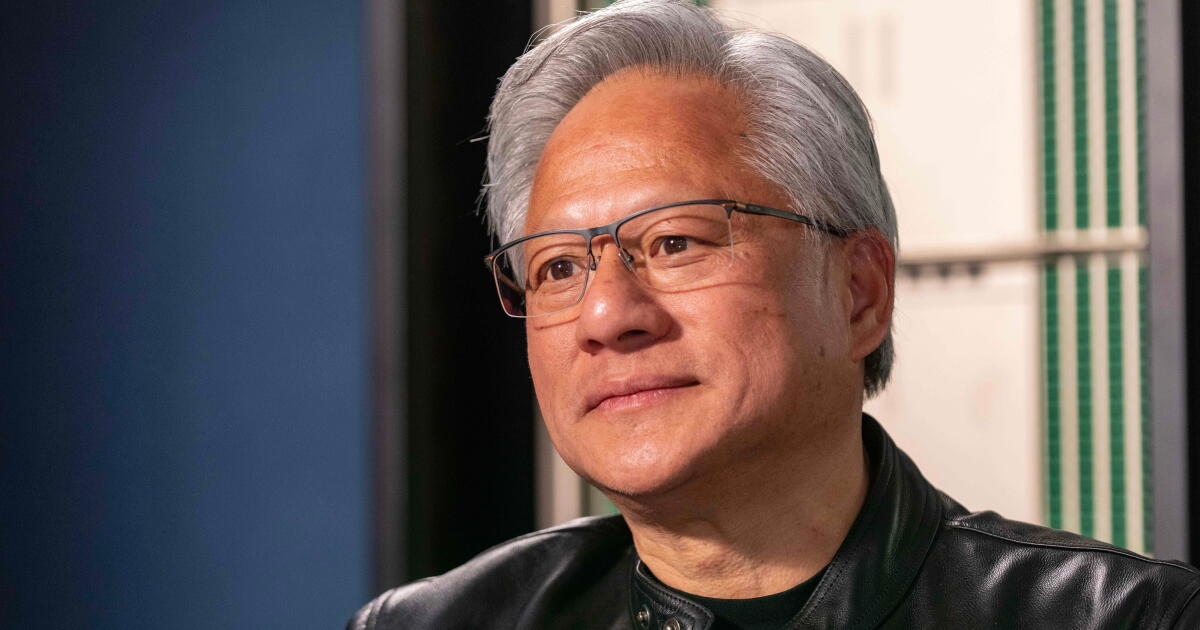
Nvidia CEO Jensen Huang, leader of one of the world’s hottest chipmakers, is under immense scrutiny after he admitted to an extramarital affair, and the company’s board said it plans to investigate him in light of recent reporting that he was the target of a foreign intelligence effort.
The stunning admission follows a series of reports that Nvidia’s leader was targeted by former Megaspeed International executive Alice Huang, who the U.S. government suspects was recruited by a Chinese spy agency. The CEO previously denied having anything but a “normal” relationship with the woman.
Analysts say this will prompt calls for closer examination of tech companies’ dealings with China.
“This is a black eye moment for Jensen and will spark multiple congressional inquiries at a minimum and will create an overhang on the stock for a myriad of reasons,” said Daniel Ives, partner and senior managing director at merchant bank Yorkville Ives & Co. in an equity research note. “This will also increase major scrutiny regarding selling chips to China, which remains a key battleground issue in DC,” wrote Ives, who has an “outperform” rating on the stock.
Nvidia’s board said in a statement on Sunday that it has confidence in Huang and his leadership team. On Sunday in after-hours trading, Nvidia’s stock was $188.70 a share, up about 1%.
“While the Board has no reason to believe that either national security or NVIDIA secrets were compromised, the Board’s inquiry will examine all available information,” Nvidia’s board said.
In a staff memo, Huang apologized to his family and Nvidia employees.
“I was unfaithful to my wife,” Huang wrote. “My actions hurt her and our children. There is no excuse for what I did. I am deeply sorry.”
Huang wrote that he is committed to protecting Nvidia and supporting America’s national security, adding that he is “proud and grateful to be an American” and supports the investigation.
The transgression blemishes Huang’s leadership, which has been admired by many people in Silicon Valley. Huang, a former microprocessor designer and Denny’s dishwasher, discussed the idea behind Nvidia inside a Denny’s in San Jose with fellow entrepreneurs Chris Malachowsky and Curtis Priem. They co-founded the Santa Clara-based chipmaker in 1993.
Since then, Huang’s profile has risen to the status of Apple co-founder Steve Jobs, with thousands of people gathering to hear his keynotes.
The company’s valuation has risen dramatically in recent years alongside AI’s boom. The company reached a record market capitalization of nearly $5.8 trillion in October. That has slipped below $5 trillion, however, weighed down by concern about the sustainability of AI infrastructure build-out.
“It certainly is going to put a cloud over Jensen and Nvidia for a while,” said Rob Enderle, principal analyst at advisory services firm Enderle Group, adding that Nvidia sells products to the U.S. Department of Defense. “If it turns out that he was intimate with the Chinese spy, Nvidia could face some pullback from the U.S. government.”
The company has no public succession plan, and Huang has no obvious heir apparent. He has repeatedly said he wants to continue in his role for decades and has created an informal organizational structure around him that eschews a conventional hierarchy. Instead, his direct reports are tasked with rapidly implementing his decisions.
Huang has said that this system gives his company the flexibility to react to rapid changes in technology and remain agile. But it has also created a situation where there’s no replacement ready to step in and take over Huang’s relentless schedule.
Concerns that sensitive information might leak through Nvidia’s contacts with China have fueled calls for investigations and greater scrutiny of Huang and the company, ratcheting pressure in what has already been a difficult geopolitical balancing act.
“The big issue is China is all out in everything they can do to try to compromise U.S. security, whether it’s running a honeypot scheme or whether it’s blackmailing or extorting existing employees across U.S. firms,” said Ray Wang, principal analyst at Constellation Research. “The issue here is if the extortion resulted in Nvidia making policies or the CEO making policies that would compromise national security. That’s what’s at stake.”
Legislators, including Sen. Chris Coons (D-Del.), said Congress will look into these relationships.
“The more I learn about the insane relationship between the Trump Administration, Chinese spies, and AI billionaires, the more I’m convinced there is nothing this administration does that isn’t corrupt,” Coons wrote on X on Saturday. “Congress will investigate and get answers.”
The White House did not immediately return a request for comment on Coons’ statement or Nvidia’s board investigation.
While Nvidia is allowed to ship a limited range of products to China under a licensing program granted by the current Trump administration, Beijing has restricted imports of the chips — an impasse that continues to curb the chipmaker’s sales in the world’s second-largest economy.
Megaspeed, based in Singapore, has been accused of breaking U.S. export restrictions and smuggling Nvidia chips to China. Huang had told Bloomberg that his contacts with Megaspeed employees were typical of business relationships he has with many Chinese customers and executives.
Bloomberg contributed to this report.
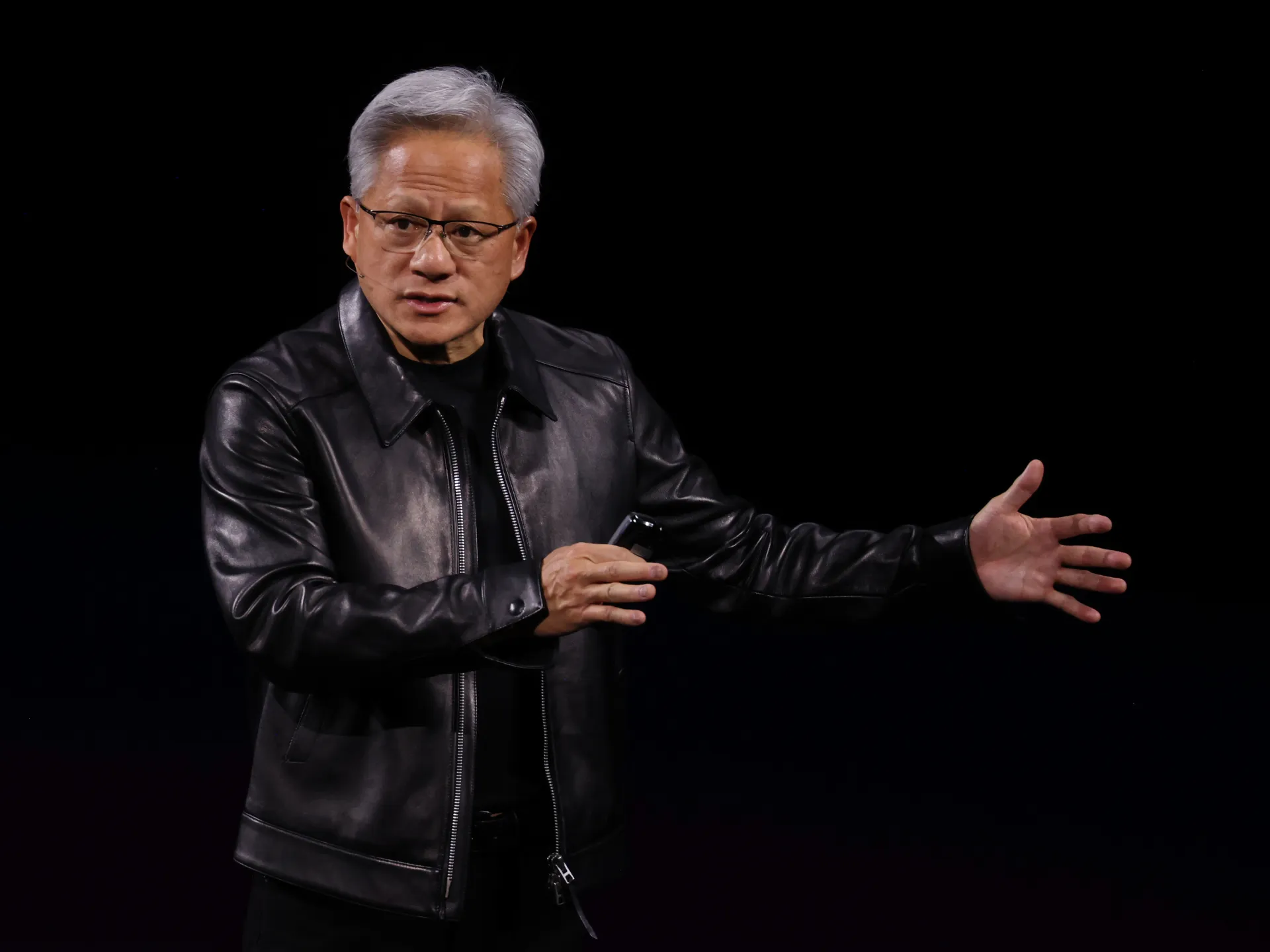
United States-based chipmaker Nvidia is investigating its chief executive officer, billionaire Jensen Huang, after he confirmed he had an intimate relationship with a woman accused of working for Chinese intelligence.
In an announcement on Sunday, Nvidia said the probe would be conducted by a “committee of independent directors” with outside counsel.
list of 3 itemsend of list
“While the board has no reason to believe that either national security or Nvidia secrets were compromised, the board’s inquiry will examine all available information,” Nvidia’s board of directors said.
It said the board continued to have “confidence in Jensen and his leadership team”. Huang will continue to lead Nvidia during the probe.
The investigation follows a report in The New York Times last month that Jensen may have been the target of a Chinese espionage plot.
China and the US have been in competition to dominate key tech sectors like artificial intelligence (AI).
Amid the AI boom, Nvidia has seen demand for its chips and programming interfaces explode, resulting in the company being valued in the trillions of dollars.
For years, the US has sought to restrict the export of advanced chips to China, fearing the Asian superpower could gain an edge over its technology and military sectors.
But on October 29, The New York Times said it had obtained exclusive information that a Chinese woman named Alice Huang, or Huang Le, sought to cultivate close ties with Jensen Huang in an effort to glean information about Nvidia’s technology.
The Chinese Embassy in Washington, DC, has denied any allegations of spying in the case.
The New York Times also reported that Alice Huang’s employer, Megaspeed, had become one of Nvidia’s largest buyers, purchasing some $4.8bn in equipment from the US firm.
Jensen Huang’s ties to Alice Huang, who is of no relation, spurred fierce bipartisan backlash in the US Congress in the aftermath of the report.
“For months, bipartisan members of Congress have raised concerns about NVIDIA’s advanced AI chips going to China,” Democratic Senator Elizabeth Warren wrote in a statement.
“NVIDIA’s Jensen Huang and NVIDIA’s board owe Congress answers. And we need to pass bipartisan legislation we have ready to stop advanced American technology from going to China.”
Republican lawmakers in the House of Representatives also called on Huang to appear and testify before Congress about the affair on November 18.
“It is vital that Congress determines the extent to which US national security has been placed at risk,” Republicans John Moolenaar, Brian Mast and Rick Crawford said in a statement.
In an email to Nvidia staff on Sunday, Huang had admitted to having an extramarital relationship.
“I was unfaithful to my wife. My actions hurt her and our children. There is no excuse for what I did,” Huang said.
Nvidia has grown rapidly in recent years with the rise of AI, producing chips for large language models developed by companies like OpenAI, Anthropic, Meta and Google.
Huang has also been closely working with US President Donald Trump since the Republican leader returned to office in 2025.
In August of that year, the Trump administration announced it would take a 15 percent cut of certain Nvidia chip sales to China.
Trump reportedly bought as much as $1.6m in Nvidia stock and sold about $1m in August, ahead of November’s midterm elections.
After the midterm races last Tuesday, stocks for AI-related companies, including Nvidia, tumbled in reaction to widespread Republican losses.
Trump has pushed back against calls to regulate AI companies, but many Democrats during the midterms campaigned on placing restrictions on the companies, including on the construction of data centres.
Nvidia lost $450bn in market value in a single trading day last week, but it rebounded on Friday, regaining 4 percent of its losses.
