Japan

South Korea exhibit traces 80 years of art ties with Japan

The San Francisco Museum of Modern Art (SFMOMA) presents the work of the late Nam June Paik, Korean American artist, who is considered to be the founder of video art, during a press preview of his first-ever retrospective exhibition in San Francisco, California. Photo by JOHN G. MABANGLO / EPA

June 12 (Asia Today) — Nam June Paik connected Seoul, Tokyo and New York by satellite in 1986.

His project, “Bye Bye Kipling,” brought Korean traditional dance, American popular music and Japanese avant-garde art together on one screen in real time. The work directly challenged British writer Rudyard Kipling’s famous line that East and West could never meet, presenting instead the possibility of communication across borders and cultures.

That history of encounter and exchange is at the center of “Road movie: Art between Korea and Japan since 1945,” now on view at the National Museum of Modern and Contemporary Art, Korea, in Gwacheon. The exhibition marks the 60th anniversary of normalized diplomatic relations between South Korea and Japan and traces 80 years of artistic exchange since Korea’s liberation in 1945.

The exhibition features about 200 works by 43 artists and artist teams from both countries. It was jointly organized by the Korean museum and the Yokohama Museum of Art. The show first opened in Yokohama late last year and drew about 37,000 visitors before coming to South Korea.

Featured artists include Nam June Paik, Lee Ufan, Lee Bul, Jung Yeondoo, Koki Tanaka, Jiro Takamatsu and Takashi Murakami, along with other major figures in contemporary Korean and Japanese art.

Paik is one of the central figures in the exhibition. He studied aesthetics and art history in Japan in the 1950s and later built close ties with Japan’s avant-garde art scene. It was there that he met Shigeko Kubota, his lifelong partner and artistic collaborator.

Alongside “Bye Bye Kipling,” the exhibition presents Kubota’s video work “Broken Diary: Korean Trip,” which documents Paik’s return to South Korea after 34 years abroad.

The exhibition, however, does not focus only on well-known artists. Its first section, “In Between: Zainichi Koreans’ Gaze,” examines the lives of Korean artists who remained in Japan after liberation. Cho Yanggyu’s “Sealed Warehouse” depicts a dark, enclosed labor site and reflects both the reality faced by Zainichi Koreans and the wounds left by national division.

The exhibition also explores the growth of artistic exchange after South Korea and Japan normalized diplomatic relations in 1965. Works by Lee Ufan, Park Seo-bo, Yun Hyong-keun, Jiro Takamatsu and Kishio Suga show how artists in the two countries influenced one another as modern art movements developed across borders.

Later works by Masato Nakamura, Takashi Murakami and Lee Bul show how artistic exchange expanded in the 1990s from official institutions to personal networks and collaborative relationships.

Lee Bul’s “Cyborg W5” presents a futuristic but incomplete body, questioning boundaries between humans and machines and between male and female identities. The work reflects the shared concerns about technology and identity that shaped Korean and Japanese contemporary art after the 1990s.

The exhibition’s final section shifts from past exchange to present-day solidarity. Koki Tanaka’s “Vulnerable Histories: A Road Movie” links the massacre of Koreans after the 1923 Great Kanto Earthquake to more recent anti-Korean demonstrations in Japan, asking viewers to consider histories of discrimination and exclusion.

Jung Yeondoo’s “Magician’s Walk” reflects on landscapes after the 2011 Great East Japan Earthquake and explores the possibility of empathy and solidarity with the suffering of others.

The exhibition also extends to the museum’s outdoor sculpture park in Gwacheon. Six sculptures by Korean artists based in Japan and Japanese artists, including Duckjun Kwak, Quac Insik and Lee Ufan, highlight the museum’s role as an important site of Korean-Japanese artistic exchange.

Kim Sung-hee, director of the National Museum of Modern and Contemporary Art, Korea, said the exhibition revisits “historical moments experienced by the two countries and the traces of artistic exchange formed within them.”

Kim said she hopes the exhibition will offer visitors a chance to rediscover “the status and possibilities of Korean and Japanese contemporary art.”

The exhibition runs through Sept. 27.

— Reported by Asia Today; translated by UPI

© Asia Today. Unauthorized reproduction or redistribution prohibited.

Original Korean report: https://www.asiatoday.co.kr/kn/view.php?key=20260612010003954

Source link

Thriving mining city with dark past now a ghost town

The island’s dark history of forced labour and harrowing conditions for prisoners of war has left a haunting legacy

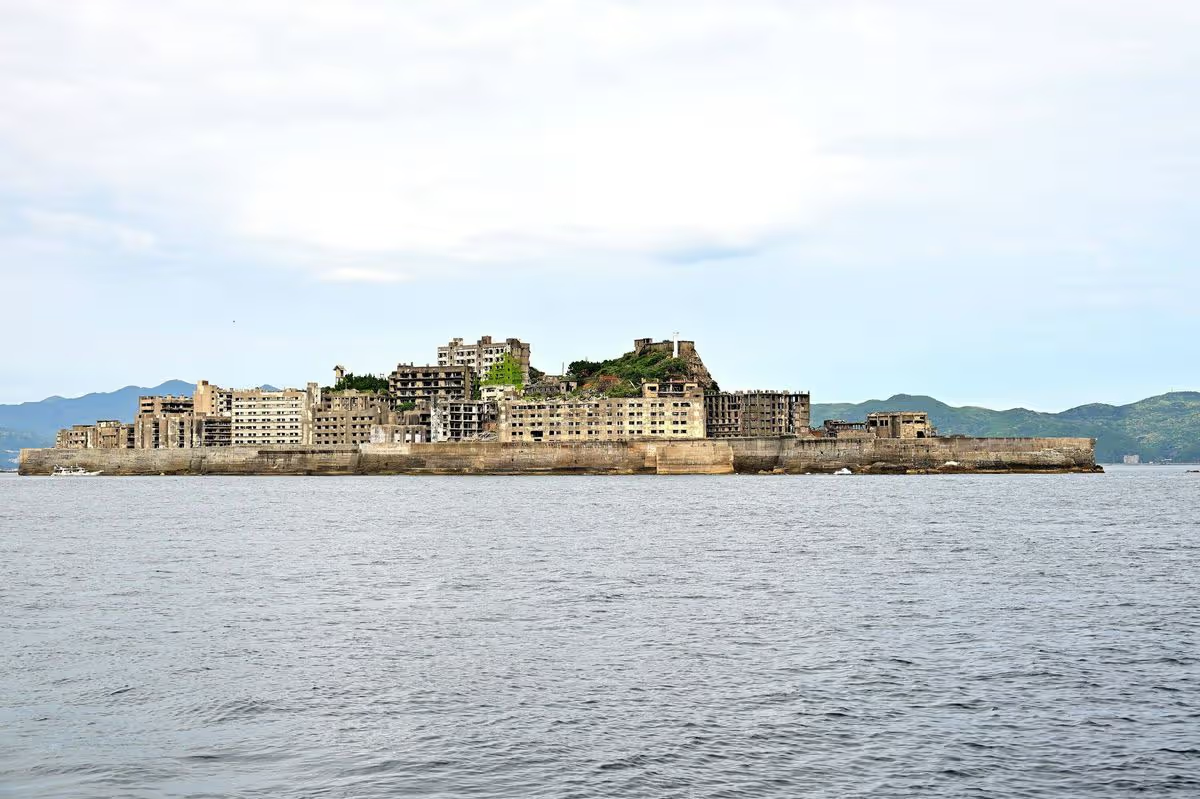
In the late 19th century, this isolated Japanese island was a bustling town fuelled by its coal-mining industry. Today, it’s gradually being swallowed by the sea and reclaimed by nature, but given the island’s sinister past, perhaps it’s for the best that this once-thriving community has fallen into silence.

Hashima Island sits roughly 15 kilometres off Nagasaki, and was formerly a mining settlement. At its height in the late 1950s, the island housed more than 5,000 residents who lived in its towering apartment blocks — the ruins of which remain visible today.

Initially renowned for its undersea coal mines, the island also harbours a deeply troubling history.

The island was purchased by Mitsubishi in the late 19th century, and in 1916, work commenced on apartment blocks to house workers. There was a school, a kindergarten, a community centre and a hospital.

For leisure, residents could head to the cinema or visit the numerous shops, reports the Express.

Following the end of World War 2, Chinese and Korean prisoners of war were forced to labour on the island, either erecting buildings or toiling in the mines. These prisoners endured appalling and perilous conditions under Mitsubishi’s control.

Many perished from exhaustion and starvation — the precise death toll on the island ranges from 137 to as many as 1,300.

The people who laboured here dubbed the island “Jail Island” or even “Hell Island” — a stark contrast to the tranquil mining town it seemed to be. By the 1970s, coal reserves had largely run dry and the industry was in terminal decline.

This prompted many residents to abandon the island, and by the mid-70s, the mine had shut its doors for good, leaving the island completely deserted.

In 2009, Japan put forward a request for the island to be added to the UNESCO World Heritage List.

The move drew sharp criticism from the governments of North and South Korea and China, with Seoul arguing it would “violate the dignity of the survivors of forced labour”.

Eventually, South Korea and Japan struck a deal allowing the island to be included on the list, on the condition that Japan provided information acknowledging the use of forced labour.

However, in 2021, it emerged that Japan had failed to honour its side of the agreement, having not displayed adequate information regarding the use of forced labour.

The museum in Nagasaki, which documents the island’s history, reportedly contains no testimonies from Koreans about forced labour or discrimination, and the sole Korean testimony on display actually denies that forced labour was ever used.
Source link

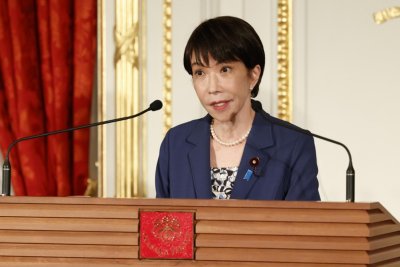
Japanese PM Sanae Takaichi moves to revise Japan security documents

Japanese Prime Minister Sanae Takaichi speaks during a joint press conference with Philippine President Ferdinand Marcos Jr. (not pictured) at the Akasaka Palace state guest house in Tokyo, Japan, 28 May 2026. Photo by Rodrigo Reyes Marin / EPA

June 8 (Asia Today) — Japanese Prime Minister Sanae Takaichi’s government is moving forward with talks to revise Japan’s three core security documents, with defense spending, nuclear policy and artificial intelligence emerging as central issues.

The documents are Japan’s National Security Strategy, National Defense Strategy and Defense Buildup Program. They set the direction for diplomacy and defense policy for about the next decade, as well as defense spending and major equipment plans for five years.

Japan first adopted a National Security Strategy in 2013 under former Prime Minister Shinzo Abe. Former Prime Minister Fumio Kishida’s government revised all three documents in 2022.

Asahi Shimbun reported Monday that the Takaichi government’s review centers on eight issues: defense spending, Japan’s three non-nuclear principles, AI and drones, the defense industry, nuclear-powered submarines, ties with the United States, perceptions of China and economic security.

The largest issue is defense spending. The Kishida government’s 2022 documents called for raising defense-related spending to about 2% of gross domestic product by fiscal 2027. Takaichi’s government is seeking to reach that level in fiscal 2025 and then pursue another revision.

Asahi reported that the Trump administration has called on allies to raise defense spending to 3.5% of GDP, or 5% including related costs. If Japan applied the 3.5% target, annual defense spending could exceed 20 trillion yen, or about $125 billion.

Japan’s three non-nuclear principles are also under discussion. The principles commit Japan not to possess, produce or allow the introduction of nuclear weapons. The current National Security Strategy says Japan will maintain them.

Takaichi has questioned the realism of the principle barring the introduction of nuclear weapons, citing Japan’s reliance on U.S. nuclear deterrence. An Asahi poll conducted from March to April found that 75% of respondents supported maintaining the principles, compared with 21% who said they should be reviewed.

AI and drones are another major focus. Russia’s invasion of Ukraine and conflicts in the Middle East have raised the importance of low-cost drones, AI-based information processing, cyberattacks and cognitive warfare. Japan is considering expanding drone procurement, building domestic supply chains and using AI in defense.

The defense industry is also expected to be included in the review. Takaichi’s government views the sector as one of 17 priority areas in its growth strategy. Japan revised its defense equipment transfer guidelines in April, expanding the path for exports of weapons with lethal capabilities.

Government and ruling party officials are also discussing whether the state should own ammunition and other military supply plants while allowing private companies to operate them.

Whether Japan should introduce nuclear-powered submarines is another key question. China and Russia operate nuclear-powered submarines and North Korea is believed to be pursuing them. South Korea has also announced plans to deploy nuclear-powered submarines in the late 2030s.

Some Japanese officials and experts have argued for next-generation submarines that can remain submerged for long periods and travel long distances. Development costs, staffing and consistency with Japan’s Atomic Energy Basic Act remain challenges.

Relations with the United States and Japan’s view of China are also expected to shape the wording of the revised documents. The Trump administration is demanding greater defense burden-sharing from allies. If U.S. foreign policy priorities shift, Japan may need to adjust security plans that assume heavy reliance on Washington.

The 2022 documents described China as Japan’s “greatest strategic challenge.” Attention is now focused on how Japan will describe China after increased Chinese aircraft carrier operations, airspace incursions and concerns about a possible Taiwan contingency.

Economic security is expected to be treated as a separate pillar. Tensions in the Middle East, risks involving the Strait of Hormuz, dependence on energy and food imports and possible supply-chain disruptions are broadening Japan’s security debate. The Japanese government is emphasizing what it calls “collective autonomy” with allies and like-minded countries to maintain supply chains.

The Takaichi government is aiming to complete the revision by the end of the year. Asahi said the review could affect not only defense policy but also Japan’s national direction and public burden.

— Reported by Asia Today; translated by UPI

© Asia Today. Unauthorized reproduction or redistribution prohibited.

Original Korean report: https://www.asiatoday.co.kr/kn/view.php?key=20260608010002583

Source link

Japan will pay you £14,000 to move to a beautiful countryside location

The Japanese government will pay you £14,000 to move to its beautiful countryside as part of a relocation scheme aimed at repopulating remote areas of the country

Everyone needs a change every now and then, and for some, this could be the perfect opportunity. The Japanese government has announced a relocation scheme under which families could be paid up to ¥3,000,000 (around £14,000) to move to the countryside.

The scheme has been created to repopulate more remote areas of the country, as more than 37% of the population live in the three major metropolitan areas of Tokyo, Osaka and Nagoya. A statement from Akiya Japan reads: “The Ministry of Internal Affairs projects that nearly half of Japan’s 1,700+ municipalities could become ‘functionally extinct’ by 2040. The subsidy is the carrot. The stick is demographic reality.”

The eligibility criteria are the same for both Brits and Japanese citizens and are based on where an applicant has lived and worked, rather than their nationality.

A statement adds: “A foreign national who has lived and commuted in the Greater Tokyo Area for 5+ years and holds an appropriate visa (work visa, spouse visa, permanent residency) qualifies on the same terms as a Japanese citizen.”

Sharing news of the scheme on social media, TikTok user @quinn__jp said: “This isn’t a joke. Japan is actually paying people to move to the countryside.

“Here’s how foreigners can benefit too. In many rural towns, you can get up to 600,000 yen if you move solo and up to 1 million per child, plus relocation grants if you’re moving as a family.

“That makes a big dent in your moving and settling costs. Across over 1,300 towns, around 80% of local districts, you’ll find the Akiya Bank, with empty houses listed for zero yen or at very low prices.

Content cannot be displayed without consent

“Some free houses need lots of renovation, but many municipalities offer subsidies and renovation support through programmes like Chiiki Okoshi and the Regional Vitalization Cooperator programme.

“You can get placed in local roles, anything from running a guest house to agri-tech positions, with housing and visa guidance included.

“Japan needs people, and fast. With urban migration and population decline, local governments are desperate to attract newcomers with homes, jobs and cash.”

However, there are some practical barriers, including an expectation that applicants understand the Japanese language.

Visa implications can also be complex, while renovation loans and mortgage products may be harder to access for non-permanent residents. However, the subsidies help offset these challenges by reducing the amount that needs financing.

Commenting on the post, one user said: “I’d definitely move to Japan if I had some sort of online income (a safety net) like most influencers have.”

Another user added: “I want to move there so bad but I’m scared and I don’t have my passport.”

A third said: “My dream is to get an old house in Japan and trust me it’s not that easy. Currently looking for any place who’d hire me so I can move there on a work visa.”


Source link

The Population Bust | Demographics

A revealing global journey into declining birth rates, ageing societies, and their far-reaching impact.

The last 100 years have seen a boom in trade, prosperity and wealth across the world, at unprecedented rates in human history. As a species, we are now more wealthy, healthy, and less likely to be killed in conflict than ever before, despite the many horrors we see in the daily news cycle.

This golden age we live in has run in tandem with an ever-expanding population; in the 1920s, there were only two billion people on the planet. A century later, that number has skyrocketed up to eight billion. Yet the increase of prosperity and people has come at a devastating price – global warming, the melting of the ice caps, an epidemic of plastic pollution and the mass destruction of the planet’s biodiversity are all intrinsically connected to population growth. More recently, however, the trend has been bucking. The watchful eyes of demographers have been drawn to data that reveal a world of ageing societies, plummeting birth rates, and dwindling populations. Surely this must be a good thing for the planet and therefore humanity … right? Armed with a file full of “population bomb” headlines – the explosion will happen mid-century, when humans will peak around 8.5 – 9 billion people, followed by drastic falls – we embark on a worldwide exploration with a very unique purpose. What truths and human stories can we discover behind the red flag statistics? What are the population tipping points of fertility, birth and death rates? And how, among the other culprits of climate change, conflict, global health and over consumption, might they make or break the future of our life on earth?

Episode 1: Baby Doomers


Source link

Major travel hotspots including the US and Japan hit by safety warnings for LGBTQ+ travellers

A new LGBTQ+ travel risk map has assessed safety for LGBTQ+ travellers across 233 countries and territories worldwide, with conditions worsening in several nations including the US, India and Japan

Major travel hotspots including the US, Japan and India have faced travel warnings as a new map highlights the risk for LGBTQ+ travellers. Fresh criminal legislation, curbs on established rights, and political reversals mean that LGBTQ travellers could encounter heightened legal and societal dangers when journeying overseas.

The LGBTQ Risk Map 2026, published by Safeture, evaluates the circumstances for LGBTQ travellers across 233 countries and territories around the world. Worldwide, the assessment categorises 91 countries as high risk for LGBTQ travellers. A further 62 countries are rated medium risk, while 80 are deemed low risk.

In comparison with last year, circumstances have deteriorated in multiple countries, including Belarus, Burkina Faso, India, Japan, Kazakhstan, Senegal, Slovakia, and the United States. The factors differ but encompass restrictions on established rights, legal setbacks, stricter penalties, and fresh constraints on the recognition of gender identity and on travel documentation.

Where is safest for LGBTQ travellers?

Western Europe remains the safest region for LGBTQ travellers, with every country in the region classified as low risk in the most recent assessment.

According to the LGBTQ Risk Map 2026, the UK remains in the ‘Normal’ zone as somewhere LGBTQ+ travellers are “unlikely to face difficulties”. Local attitudes towards the LGBTQ+ community for countries in the normal zone, including the UK, Brazil, Spain, France and Italy have “are overall open and progressive”.

Botswana and St. Lucia have scrapped legislation criminalising same-sex relations between men, leading to better ratings on this year’s map.

Where is risky for LGBTQ travellers?

By comparison, the Middle East and North Africa remain home to some of the globe’s most perilous destinations for LGBTQ travellers. The majority of nations in the region are categorised as high risk, with Israel given a low risk rating and Lebanon designated medium risk.

Across Sub-Saharan Africa, conditions remain extremely difficult. Roughly 80 per cent of evaluated countries in the area fall within the highest risk bracket. The decline is especially noticeable in Burkina Faso and Senegal. Following the 2022 military coup, Burkina Faso introduced its first legislation criminalising same-sex relations. In Senegal, prison terms for same-sex relations have been doubled.

Throughout Europe and Eurasia, fresh legal restrictions have resulted in lower ratings for certain countries. Kazakhstan has introduced constraints on information concerning so-called “non-traditional sexual orientations,” while Slovakia has further curtailed the rights of same-sex couples. Belarus has passed legislation against so-called “LGBT propaganda,” which could lead to fines or even detention.

Backward steps have also been documented in Asia. In India, new laws aim to restrict transgender individuals’ ability to self-identify. In Japan, a court maintained the constitutionality of the nation’s prohibition on same-sex marriage.

In North America, the United States has strengthened requirements for travel documents. Passports will display only the sex assigned at birth, and the “X” gender marker will no longer be accepted.

Source link

Japan’s stock market hits new record as AI boom gathers steam | Financial Markets News

Benchmark Nikkei 225 tops 68,000 for first time as AI-driven buying frenzy shows no signs of slowing down.

Japan’s stock market has hit an all-time high as a global buying frenzy driven by AI shows no signs of slowing down.

The Nikkei 225 rose nearly 3 percent on Wednesday, lifting the benchmark index above 68,000 for the first time.

Recommended Stories

list of 4 itemsend of list

The latest surge continues a banner year for Japan’s stock market, which is up nearly 33 percent so far in 2026.

“Investor enthusiasm over the AI boom is helping drive Asian equity markets higher,” Khoon Goh, head of Asia research at ANZ, told Al Jazeera.

“While strong demand for high-end chips has seen the top semiconductor companies in Taiwan and South Korea rally strongly, this is also benefiting Japanese markets, which are also getting some tailwind from a weak yen.”

Japanese firms involved in the semiconductor business led the gains.

Tokyo Electron, Japan’s largest manufacturer of semiconductor equipment, soared as much as 14 percent in morning trading.

Advantest, which supplies testing equipment to the semiconductor industry, rose more than 5.5 percent.

Shin-Etsu Chemical, a supplier of silicon wafers used in integrated circuits, gained about 4 percent.

Softbank, which is heavily invested in AI models, chips and data centers, fell about 3 percent, after overtaking auto giant Toyota on Monday to become Japan’s biggest company by market capitalisation.

Ferocious demand for AI chips has been driving record-breaking rallies in stock markets across the globe, taking key indexes in the US, Japan, South Korea, Taiwan to record highs.

During the past month, three memory chip makers – South Korea’s SK Hynix and Samsung Electronics, and US-based Micron – entered the elite club of firms with a market capitalistion of at least $1 trillion.

Only 17 companies have hit the milestone, all but five of which are based in the United States.

Despite concerns about the sustainability of the sky-high valuations in the sector among some investors, tech companies are continuing to commit huge sums to AI-related infrastructure.

US tech giants are expected to spend about $800bn on AI-related capital investment in 2026, according to Goldman Sachs.

Google parent company Alphabet on Monday became the latest Silicon Valley giant to outline its AI-related investment plans, announcing that it would sell $80bn worth of shares to help fund expected capital expenditures of $180-190bn in 2026.

Source link

Rescuers race to save two people still trapped in cave in Laos | Floods News

Rescuers face heavy rains, equipment failures in search for two people trapped in central Laos cave by flash floods.

Heavy rains have threatened to delay the search for two people who remain missing in a flooded cave in Laos, after five others were rescued after being trapped underground for more than a week.

Finnish diver Mikko Paasi, one of the first international rescuers to arrive at the site, told The Associated Press news agency that rains on Sunday had filled the cave up to the second chamber, preventing divers from entering until pumps can lower the water level.

Recommended Stories

list of 3 itemsend of list

A drainage pump also broke, making the situation even more difficult, said fellow diver Yoshitaka Isaji of Japan.

Rescue teams from Laos and neighbouring Thailand have been working together over the past week to rescue the trapped villagers, alongside divers from countries including Finland, Malaysia, Japan, Indonesia, France and Australia.

Seven people entered the cave in a remote mountainous area of central Xaysomboun province last week to look for valuable minerals such as gold, before being trapped by a flash flood that blocked their way out, according to local media reports.

One other person escaped and alerted the authorities.

A Laotian rescue group said on Sunday it had received “substantial” information on the cave system from the five men who were rescued earlier this week. “The hope is that today’s mission will locate both remaining victims,” the group wrote on social media.

The rescued men were being treated at a local hospital and were doing well, Malaysian diver Lee Kian Lie, who is taking part in the operation, told AP.

“We interviewed them about how the deeper part of the cave looks like. We will continue to search based on the information we have, and perhaps we will be able to get to the other two,” he said.

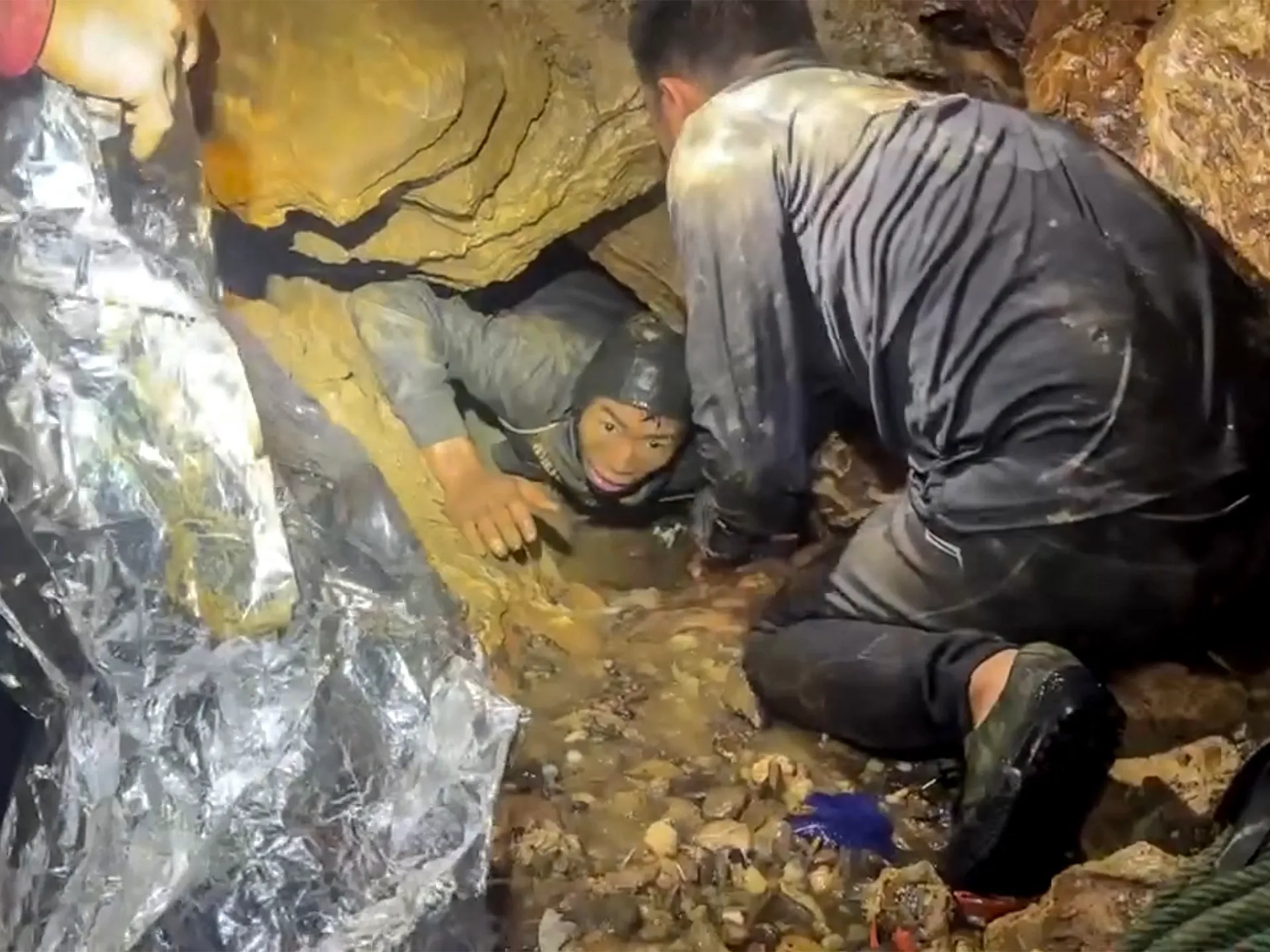
Rescuers said they navigated more than 200m (650 feet) into the cave and discovered five chambers in the system. The five people rescued so far were found in the fifth chamber.

Paasi, the Finnish diver, told AP that the survivors reported a narrow crack in the fifth chamber that could be a passage leading to a deeper part of the cave system.

“This was the only place that we haven’t checked in the mine, where the two lost miners could still be,” he said in a video interview.

The five men who were rescued – identified by their first names as Khamla, Mued, Ee, Ing and Laen – were first found last Wednesday.

The first man was safely extracted on Friday, guided through a narrow flooded passage by an expert diver. The remaining four left the cave on Saturday, after the water receded enough for them to walk out on their own, rescuers said.

Videos posted online on Saturday showed emotional moments as the men emerged one by one from the cave. Some collapsed on the ground at the cave’s entrance, and were hugged by a group of workers who cried with joy.

Later moments showed them lying on stretchers, wrapped in foil blankets and fitted with oxygen masks before being transported out.

Source link

Japan rejects ‘new militarism’, says China is rapidly arming | News

Defence Minister Shinjiro Koizumi accuses China of lacking military transparency and stresses the importance of dialogue for regional stability.

Japanese Defence Minister Shinjiro Koizumi has dismissed claims that Tokyo is pursuing “new militarism” and accused China of rapidly expanding its military with limited transparency.

China continues to increase its defence spending at a high level, Koizumi said on Sunday at the Shangri-La Dialogue in Singapore.

Recommended Stories

list of 3 itemsend of list

“China’s external approach and military activities are matters of serious concern for ⁠Japan and the international community at the same time,” he added.

“Think about it. There’s a country that has a huge arsenal of nuclear weapons and strategic bombers. Japan has neither of such weapons, and yet Japan is labelled ‘new militarism’?”

Koizumi said Japan’s record since World War II “speaks for itself”, citing its adherence ‌to international law and commitment to the United Nations Charter alongside efforts to uphold a “free and open international order”.

In May, China’s Ministry of Foreign Affairs called on Asia Pacific countries to be vigilant and “jointly resist the reckless actions of Japan’s neo-militarism”.

At the Singapore forum, Chinese delegate Major General Meng Xiangqing criticised Japan.

“I deeply doubt whether a country that has not thoroughly eradicated the toxic legacy of militarism is qualified to talk extensively about defence cooperation on international occasions and whether it can win the trust of the international community, especially ⁠the Asian countries it once invaded,” he said.

US Secretary of Defense Pete Hegseth (L) speaks with Japan's Defense Minister Shinjiro Koizumi during the 23rd Shangri-La Dialogue summit in Singapore on May 29, 2026. (Photo by JAM STA ROSA / AFP)
US Secretary of Defense Pete Hegseth, left, speaks with Koizumi during the 23rd Shangri-La Dialogue on May 29, 2026 [Jam Sta Rosa/AFP]

Ties between Japan and China sank to ⁠their worst level in years after Japanese Prime Minister Sanae Takaichi warned in November that a hypothetical Chinese attack on Taiwan could draw a Japanese military response.

China claims Taiwan as its own territory over the objections of the island’s government.

Koizumi said transparency comes from “discussion and dialogue” and lamented that China had not sent its defence minister to the conference, but he insisted Japan remains open to engagement.

“We keep the door open,” he said, reaffirming Japan’s ⁠commitment to dialogue with China and other regional players to foster stability.

As China has been rapidly expanding and modernising its military, Japan has been reshaping its own defence policy. Last month, Takaichi’s cabinet scrapped a ban on lethal weapons exports, a major change in its post-war pacifist policy.

Japan pushes for unity

Separately on Sunday, Koizumi praised US Secretary of Defense Pete Hegseth for his commitment to the Asia Pacific but at the same time stressed the continued need for strong coalitions globally.

“Division weakens deterrence. Unity strengthens deterrence,” he told the conference in Singapore.

“If gaps emerge among the United States, Europe and allies and like-minded countries, forces which take it as an opportunity will surely come in,” he said.

“We must prevent such a situation. We must keep our cooperation going on. Now is the time to make our cooperation even stronger.”

US President Donald Trump has been harsh about fellow members in NATO, and the comments at the Shangri-La conference came the day after Hegseth again chided Western European allies at the forum for not devoting enough resources to defence.

Source link

Little-known island 3 hours from Tokyo has golden sands and unbeatable experiences

If you’re planning a trip to Japan, don’t just go to the big cities, instead head to another island which has golden sands and an unbeatable experience you’ll never forget

Little-known island 3 hours from Tokyo has golden sands and unbeatable experience

A stunning island just three hours away from Tokyo must be added to your Japan bucket list, because it was one of my favourite days of our five-week trip.

The little-known island is about 15 minutes by boat from Ishigaki, off Okinawa, and we actually flew from Osaka and were meant to fly direct to Ishigaki. However, our flight was cancelled without our knowing, so we ended up having to fly to Okinawa, and then catching a (very tight) connection to Ishigaki. However, flight drama aside, when we decided to go to Taketomi, we didn’t think there would be much to do or that we’d want to spend very long there. But we were so wrong…

Taketomi is within the Yaeyama District of Okinawa Prefecture, Japan. Taketomi is one of the Yaeyama Islands, which are a tropical archipelago in southwestern Okinawa Prefecture, Japan, known as the nation’s southernmost and westernmost inhabited islands.

They feature coral reefs, lush jungles, and a laid-back, rural atmosphere, serving as a popular destination for snorkelling, diving, and experiencing traditional Ryukyu culture.

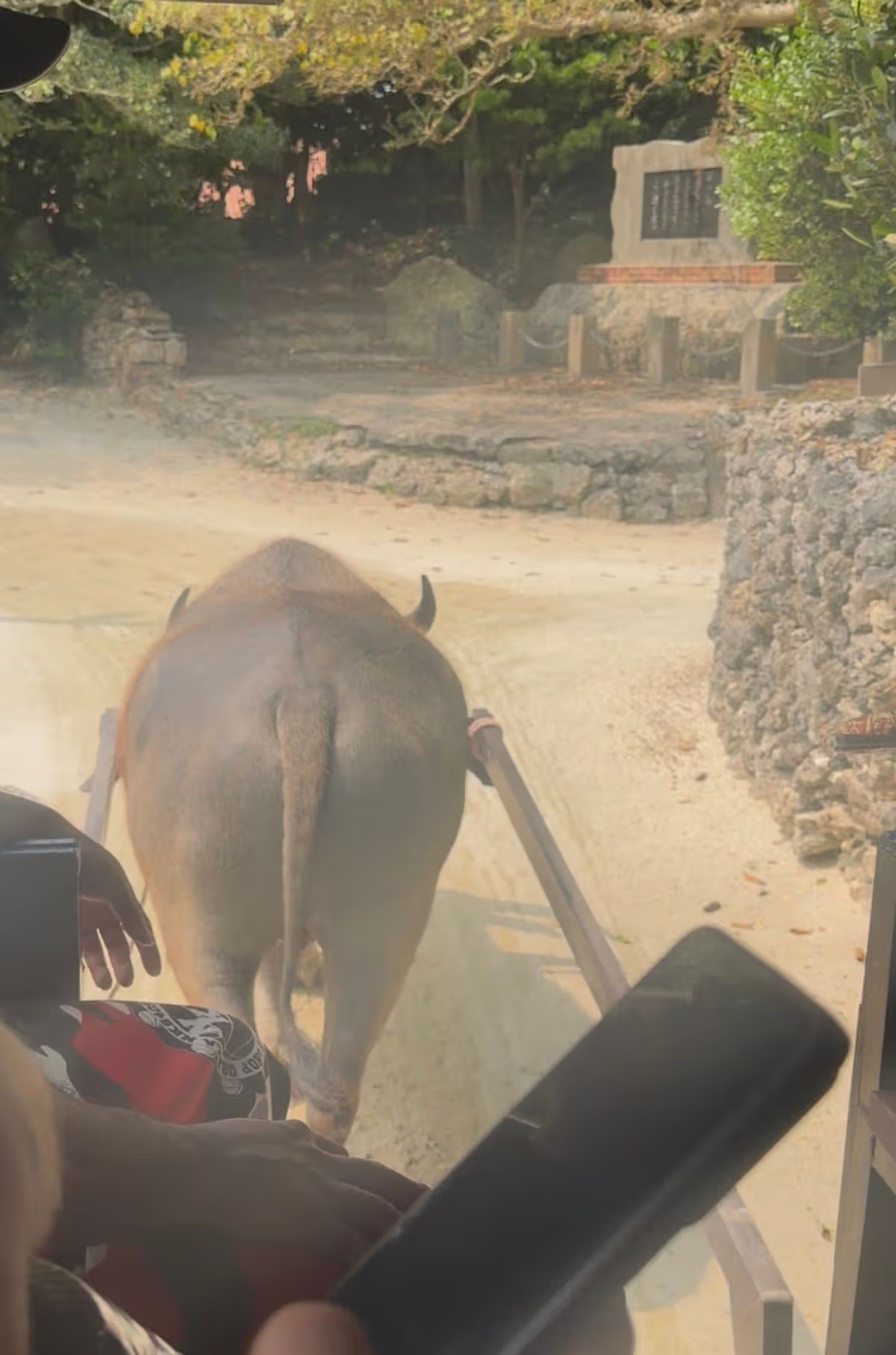
When we went, we immediately got a minibus to where we could catch a ride on water buffalo carts. It is an iconic 30-minute guided tour through the traditional Ryukyu village, featuring red-tile roofs and sandy streets.

It was absolutely amazing, an experience we’ll never forget, and our tour guide even played traditional Okinawan music on a sanshin, which is a stringed instrument. I felt like I was in a movie! It was certainly an experience that I won’t forget in a hurry.

Then, once we bought the professional photo (we had to), we headed to get some lunch. It’s worth remembering that an estimated 300 to 360 people live on Taketomi, so don’t expect any chain restaurants or anything you’re probably used to if you’re from the UK.

But the total change of pace to even big Japanese cities was amazing, and it was nice to spend time doing a variety of things while we were in Japan.

After, we went to the beach, where I was gobsmacked by the golden sands and the clear sea. Ishigaki was the first proper tropical island I’d ever been to, and Taketomi had all the same fantastic features. I’m now enamoured.

We had a little paddle in the sea, and I was gobsmacked to find that it was actually so warm, and while you’d have to go quite far out into the sea to actually be able to swim, it was definitely worth paddling.

If you’re going to Japan, make sure you add Okinawa or Ishigaki to your list of places to visit. I’d highly recommend Ishigaki, but I’m definitely biased. I think that Okinawa is a lot more touristy now, so Ishigaki suited us perfectly, especially as my partner is a scuba diver.

We loved it so much that we hope to go back to another of the Yaeyama Islands in the future. It is worth noting, however, that Ishigaki is located in an earthquake-prone area; tsunami awareness is essential year-round. Typhoon season runs from June to November, with the highest risk occurring from July to October.

Source link