Israeli forces have intercepted around a dozen Gaza-bound aid boats from the Global Sumud Flotilla in international waters near the Greek island of Crete, more than 1,000km from Israel. Organisers call it an illegal attack on civilians in international waters.
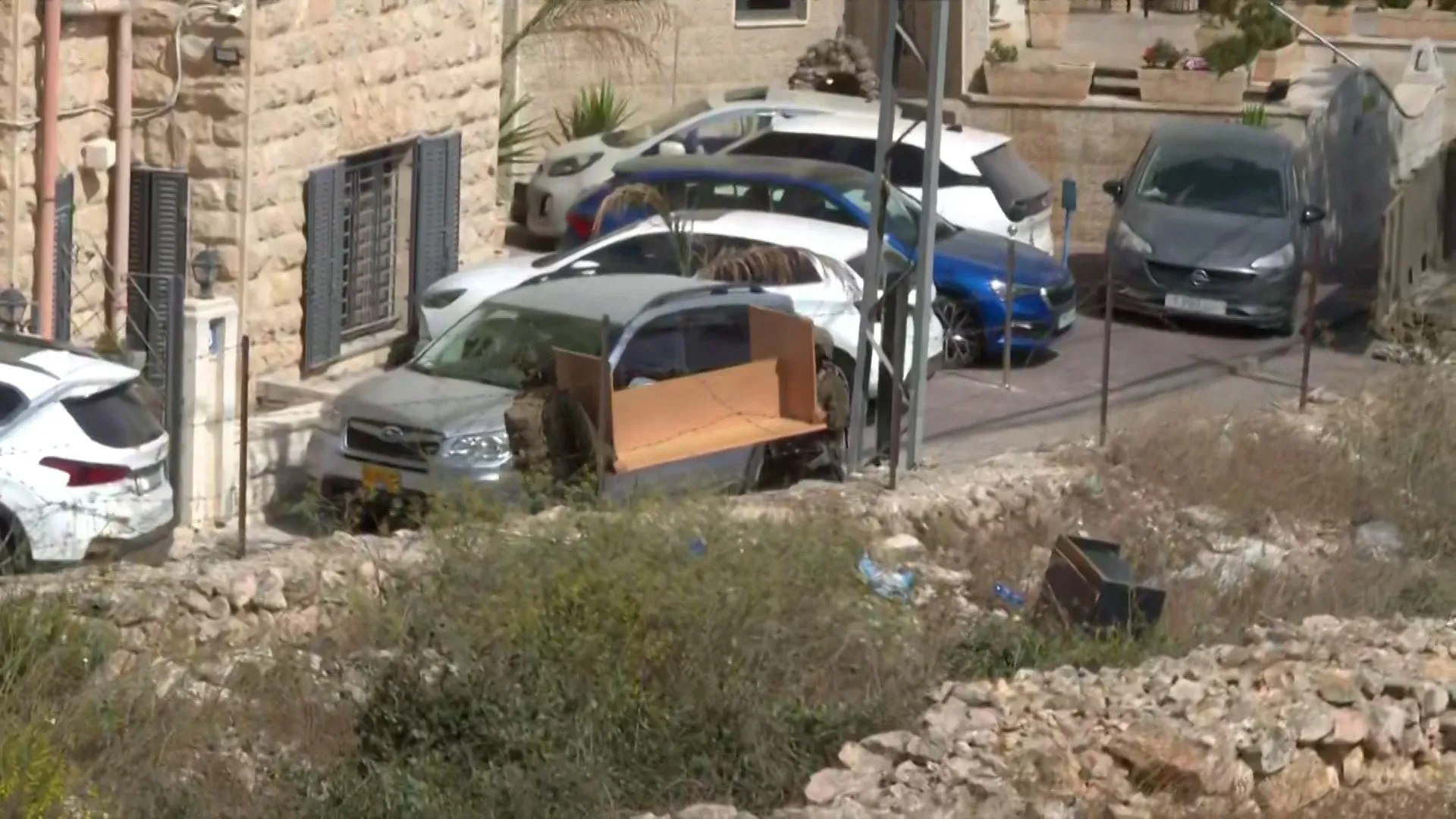
A video emerged Wednesday on social media showing an Israeli vehicle festooned with the netting, draped like a soccer goal from metal arms extending out and above. The idea, as we have reported in the past, is that drones will get caught up in the nylon or mesh metal nets and become disabled, or the nets will help keep the drones far enough from the occupants before exploding to keep them from being killed. The latter is a far more limited scenario and depends on the vehicle type and the warhead on the drone. Based on the video we are seeing, the level of protection netting can provide passengers in the open-top Israeli vehicle if a trapped drone’s warhead were to detonate is likely very little.
Israeli Defense Forces testing a folded anti-drone net installed on a Humvee.
The video emerged amid a surge of Hezbollah strikes with FPV drones against the IDF in Lebanon. pic.twitter.com/PwIyuJQVs4
— Status-6 (War & Military News) (@Archer83Able) April 29, 2026
The video began to circulate amid growing controversy in Israel over what is perceived as the IDF’s inability to counter the Hezbollah FPV drone threat. The frustration reached a new level over the weekend, after an Israeli soldier was killed and six were wounded by a Hezbollah drone. A followup attack was launched while the IDF was medevacing the wounded, narrowly missing the helicopter.
You can see the drone narrowly miss the helicopter in the following video.
“The attack laid bare a growing vulnerability: the Israel Defense Forces’ lack of preparedness for first-person view (FPV) drones in Lebanon, which have been an increasingly prominent weapon in Hezbollah’s arsenal during the current fighting,” the Times of Israel reported on Monday. “The Israel Defense Forces has reported dozens of drone-related injuries in recent weeks, though most were minor. Sunday’s attack marked the first fatal FPV drone strike on Israeli forces.”
“Yet the emergence of fiber optic-guided drones should not have come as a surprise,” the paper highlighted. The reason is what we noted in our previous story about this issue. The militant Lebanese group has used FPV drones against Israel since 2024 and they have been widely used by both sides in the Ukraine war for several years, as well as in other conflicts zones around the globe.
These strikes have become more prevalent the deeper Israel went into southern Lebanon. Videos of these recent attacks have been showing up on social media.
Hezbollah conducted more fiber-optic FPV strikes on Israeli vehicles in Lebanon, including two ‘Merkava’ Mk.4 tanks, a D9 Caterpillar armored bulldozer, and what appears to be a rare ‘Namer’ heavy IFV equipped with a turret mounting a 30 mm Bushmaster Mk 2 cannon. 1/ https://t.co/ms2nagNHrDpic.twitter.com/WDs6M3SpwW
Moreover, Israeli Merkava tanks began sporting metal additions on top of vehicles meant to deflect top-down attacks from drones during the conflict in Gaza two years ago, which you can read more about here. Some of those tanks that have come under attack recently have been observed with them as well. So Israel has been working to deal with the evolving FPV drone threat, on some level, for some time and it is not alone in struggling with it. Most militaries in the world face the possibility of this same vexing threat with no clear blanket countermeasure to deal with it.
Israeli military officials acknowledge that the IDF still lacks an effective counter to fiber-optic-guided drones, the Times of Israel noted, for reasons we have frequently reported. Fiber optic cables mitigate the effect of electronic warfare efforts to jam radio signals as well as some of the limitations imposed by geographical features that can impede the line-of-sight radio connection between drone and operator.
“The IDF initially assessed that Hezbollah’s fiber optic drones could only operate over a few kilometers,” the outlet stated. “Later, the military discovered launches occurring from distances of up to 15 kilometers (nine miles).”
“The gap was underscored on April 11, when the Defense Ministry’s Directorate of Defense Research and Development issued a public call for solutions to the threat — nearly two years after such systems first surfaced in Ukraine, and weeks into the current conflict with Hezbollah,” according to the Times of Israel. “The Defense Ministry is seeking additional capabilities to address this threat. The purpose of this request is to identify innovative and mature technologies.”
⚡️🇮🇱🇱🇧Times of Israel: Sunday’s Hezbollah drone attack in Taybeh, which killed Sgt. Idan Fooks and wounded six others, has exposed the IDF’s lack of preparedness for first‑person view (FPV) drones, particularly those guided by fibre‑optic cables which are immune to electronic…
It’s unclear how widespread the use of netting is currently by the IDF in southern Lebanon.
“The issue of drones carrying fiber-optic cables is currently a threat without a clear solution,” a high-ranking IDF official, who just returned from Lebanon, told us. “What’s been shown in the video seems more like an experimental concept rather than something that is already operational in the field.”
“In practice, forces are using various improvised solutions—fishing nets, camouflage nets, even soccer nets, along with drills involving small-arms fire at drones,” he added. “However, I personally haven’t seen the specific net system mentioned being used on the ground yet.”
The official said someone from the IDF’s ground forces research and development team told him that the conclusion in the military is that “this solution is highly problematic. It allows the lower parts of the vehicle to remain exposed, areas that the net doesn’t cover. The likely next step for the adversary would be to detonate the drone at a distance from the net, causing shrapnel to disperse toward the forces.”
IDF troops claim they recently captured a cache of Hezbollah weapons in southern Lebanon, including first-person view (FPV) drones. (IDF)
In a post on X Tuesday, Israeli military journalist Doron Kadosh said the issue of how to deal with Hezbollah FPV drones “took up significant volume in [Monday]’s discussion at the IDF’s senior command forum at Ramat David. The commander of the 282nd Artillery Brigade, which is currently fighting in Lebanon, Col. G., told the commanders: ‘The drone threat is a significant operational challenge that we’re dealing with. We need to think about how to organize better against this threat.’”
IDF combat unit commanders fighting in Lebanon “now express great frustration with the drone threat and the few tools the IDF has to counter them,” Kadosh added. “‘There’s not much you can do about it,’ says a commander currently fighting in Lebanon. The briefing the forces receive boils down to— ‘Stay alert, and if you spot a drone—shoot at it.’”
Some IDF units “have already begun developing independent responses to the threat—for example, nets deployed over positions, houses, and windows—so that the drone gets caught in the net and doesn’t hit its target,” Kadosh continued. “This is an improvised response; we’ve started deploying it with some of the forces, but it’s far from sufficient,” an officer currently fighting in Lebanon told the reporter. This would follow exactly what we saw in Ukraine, as both sides looked to improvised forms of protection from incoming drones, leading to rapid experimentation and many dead ends.
איום רחפני הנפץ שמאתגר את כוחות צה״ל בדרום לבנון בשורת התקפות יומיומיות של חזבאללה:
הסוגיה תפסה נפח משמעותי גם בדיון פורום הפיקוד הבכיר של צה״ל אתמול ברמת דוד. מפקד חטיבת התותחנים 282 שנלחמת כעת בלבנון, אל״ם ע׳, אמר למפקדים: ״איום הרחפנים הוא אתגר מבצעי… pic.twitter.com/jiSGrSEBGH
— דורון קדוש | Doron Kadosh (@Doron_Kadosh) April 28, 2026
Despite the limitations, this netting has become fairly common in Ukraine, with both sides using netting over vehicles, buildings and miles and miles of roadway to provide safer corridors of travel.
About anti-FPV road net tunnels:
“Thousands of kilometers of equipped anti-drone corridors block the main logistical routes all the way to the forward positions The goal is to ensure security up to a depth of 100 km from the contact line.” 6/ https://t.co/Avipifv6Frpic.twitter.com/ES7gq20lln
As we noted in our last piece on the growing FPV threat to Israeli forces, active protection systems (APS) on armored vehicles are being adapted to provide hard-kill counter-drone protection. These systems use sensors to detect incoming rocket-propelled grenades, missiles, and other projectiles, and fire projectiles to hit them before they strike the vehicle. Israel is a major pioneer in the APS space, with systems being deployed for decades, but just how soon it can upgrade existing systems, such as Iron Fist, for this application isn’t clear. Also, this doesn’t help many lighter vehicles that do not have APS capabilities. Still, it is one bright spot of hope of creating a defense against fiber optic FPVs, at least for lower volume attacks, although these are also very costly systems.
Iron Fist APS | Active Protection System for Armored Vehicles
Regardless, we are likely to see more Israeli vehicles equipped with nets and other forms of passive protection in the coming days, and likely more advanced countermeasures if the war grinds on for a prolonged period.
It always precedes the next day’s subsequent celebrations of Israel Independence Day, the Yom Haatzmaut of the 5th of Iyar for the annual holiday of the Public Proclamation of the State of Israel of 1948.
Memorial Day honours veterans and fallen soldiers of the State of Israel and the Israel Defense Force who died in the modern Arab Israeli conflict.
Nowadays, Memorial Day also commemorates fallen civilians, slain by acts of hostile terrorism.
Memorial Day is a statutory holiday; by law, all places of entertainment are closed on the eve of Yom Hazikaron. Broadcasting and educational bodies will mark the sombre of the day.
Restaurants reopen in the evening – partly because the Independence Day festivities begin at sunset, but also because some people may have travelled far to visit the grave of a fallen soldier friend or family member and may require refreshments.
Commemoration ceremonies are held across the country and TV and radio are devoted to the commemoration of those who have fallen. Flags throughout the country are lowered to half-mast. Public transport for those going to military cemeteries is free of charge.
Organisers of a Gaza-bound aid mission say their vessels are being intercepted by Israeli military speedboats in Greek waters west of Crete, more than 1,000km from Israel. Crew members of the Global Sumud Flotilla say communications have been jammed and an SOS issued.
A video filmed by an Israeli soldier shows widespread destruction in northern Gaza. Before Israel’s genocidal war, the town of Beit Hanoon was home to 50,000 people. Despite a ceasefire, Israeli forces have bulldozed what was left of hundreds of homes.
Rights groups have described the move as a “blatant abuse of power”.
Published On 27 Apr 202627 Apr 2026
Bahrain has stripped dozens of people of their citizenship for allegedly supporting Iranian attacks on the country.
Bahrain’s Ministry of Interior announced on Monday that it had revoked the citizenship of 69 people, some of whom were related, after accusing them of sympathising with Iran and “colluding with foreign entities”. The move comes after Tehran carried out strikes on facilities in Bahrain as part of the war launched against Iran by Israel and the United States.
Recommended Stories
list of 3 itemsend of list
The directive, issued by King Hamad bin Isa Al Khalifa, stated that all 69 people were “of non-Bahraini origin”. Under Bahraini law, a person can be stripped of citizenship if they are deemed to have caused harm to the country or shown disloyalty.
The London-based Bahrain Institute for Rights and Democracy described the move as “dangerous” and a clear violation of international law.
The organisation said the individuals had not been publicly identified, and it remained unclear whether they had been arrested, whether they were inside or outside Bahrain, and whether they held another nationality.
Iranian strikes
Tehran began striking its Gulf neighbours on February 28, shortly after Israel and the United States began the war by launching attacks on Iran.
Tehran accused the targeted countries of allowing the US to conduct its strikes from their territory. Iran’s retaliatory attacks reportedly caused significant damage to US military sites across the region, including a Navy base in Bahrain, which was hit by missiles and drones.
Iran ceased its attacks on Gulf neighbours on April 9, following the introduction of a ceasefire brokered by Pakistan. Negotiations to permanently end the war are ongoing three weeks later.
Bahrain’s Shia population has long accused authorities of marginalising them. During the Arab Spring in 2011, mass protests against the country’s leadership broke out. The Bahraini government has long blamed Iran for fomenting unrest against it.
US-Israel war on Iran drives up fuel and food costs, putting 32.5 million people at risk of poverty worldwide.
Fuel costs more. Food is harder to get or afford. Jobs are disappearing. Remittances are drying up.
These are the consequences of the United States-Israel war on Iran – felt not only in the Middle East but also in the fields and homes of Africa and Asia.
Countries in the Global South are particularly vulnerable to the economic fallout because of their dependence on imports from the Gulf.
The United Nations warned that the conflict could push as many as 32.5 million people globally back into poverty.
The war is weakening economies that were already fragile. Governments are scrambling, and international aid is becoming scarce.
Satellite images taken on April 16 reveal the massive scale of damage to the towns of al-Qozah and Beit Lif in south Lebanon, following the Israeli military’s ground invasion and sustained attacks on the south.
As part of promoting the Chinese Global Security Initiative (GSI) as an alternative to the Western approach, Chinese President Xi Jinping proposed a four-point initiative for peace and stability in the Middle East in mid-April 2026, following escalating tensions in the Middle East and the US-Israeli war against Iran. This initiative aims to offer Chinese wisdom for conflict resolution based on sovereignty and development, in contrast to what China considers destabilizing Western alliances. President Xi Jinping discussed and presented this initiative in mid-April 2026 during his meeting with Khalid bin Mohammed Al Nahyan, Crown Prince of Abu Dhabi, outlining a comprehensive four-point initiative aimed at preserving and promoting peace and stability in the Middle East. This Chinese initiative comes within the context of Beijing’s efforts to strengthen its role as a diplomatic mediator following the escalation of tensions in the region. Chinese President Xi Jinping’s four peace initiatives for 2026 are the commitment to the principle of peaceful coexistence, supporting Gulf and Middle Eastern countries in improving their relations, and building a comprehensive, cooperative, and sustainable security architecture in the region based on the principle that the countries of the region are neighbors and cannot be geographically relocated. (Commitment to the principle of national sovereignty), through China’s support for and respect of the sovereignty and territorial integrity of states and its rejection of interference in their internal affairs, while emphasizing the protection of the security of states, their people, infrastructure, and institutions. (China’s full commitment to the principle of the rule of international law), by adhering to the basic norms of international relations and supporting the international system centered on the United Nations, to prevent a return to the law of the jungle. (Reconciling development and security by affirming that security is a prerequisite for development and working to create a favorable environment for sustainable economic development to ensure long-term stability.)
These Chinese moves come as part of China’s efforts to present its Global Security Initiative (GSI) as an alternative to the Western approach to conflict resolution. They are considered a direct response from China to Western and American policies. These Chinese peace proposals emerged in the context of Beijing’s criticism of the American blockade on Iranian ports, which it described as dangerous and irresponsible. By presenting a Chinese security model, China seeks to position itself as a partner committed to peace and dialogue, rather than the American military alliances that Beijing considers a threat to global security. Furthermore, this initiative aims to reinforce the Beijing Declaration, as China seeks to solidify its role as a mediator (following Saudi-Iranian and Palestinian faction mediation efforts) through a formal initiative.
Thus, the Chinese initiative emerged as a direct response to the escalating tensions in the Gulf region and Iran and as a countermeasure to the American blockade. The Chinese Foreign Ministry described the American blockade of Iranian ports and the Strait of Hormuz as dangerous and irresponsible, threatening the security of navigation in the Strait of Hormuz. Especially after the failure of US negotiations with Iran and US President Donald Trump’s announcement of a naval blockade on Iranian ports on April 12, 2026, following the collapse of peace talks in Islamabad, Pakistan, China stepped in as an international mediator. Consequently, China is attempting to promote its own model by presenting itself as a peace partner focused on economic dialogue, in contrast to Western military alliances, which Beijing considers a threat to global security.
In this context, China is trying to leverage its past diplomatic successes to solidify its role in promoting the Beijing Declaration and to play a mediating role in resolving conflicts, such as the Saudi-Iranian mediation. Based on the 2023 Beijing Agreement to normalize relations, China seeks to strengthen its role in the Gulf region. Furthermore, China is working to solidify the Beijing Declaration of July 2024, which aimed to end the Palestinian division, achieve reconciliation between Palestinian factions, and form a national unity government, as a model for its mediation in resolving complex conflicts. With the strengthening of the Beijing Declaration, the new proposal aims to transform the Beijing Declaration from a factional agreement into an official, internationally supported initiative to solidify China’s role as a key mediator in Palestine as well.
These Chinese moves are part of a broader Chinese strategy to promote the Global Security Initiative (GSI) as an alternative to the Western approach, as outlined by Chinese President Xi Jinping for the period 2022-2026. China emphasizes its rejection of the Cold War mentality, criticizing Washington’s military alliances, such as the trilateral AUKUS security pact between the US, Australia, and the UK, and alliances in the Middle East. China also emphasizes the concept of indivisible security, promoting the idea that a nation’s security cannot be achieved at the expense of other nations’ security. China seeks influence through mediation, aiming to position itself as an alternative superpower capable of addressing the root causes of conflicts through development, rather than through the threat of force.
An Israeli settler was filmed throwing rocks and trying to break into the home of Palestinian activist Issa Amro while an Israeli soldier watched. The settler was briefly arrested and then released.
Political scientist Vali Nasr argues that US and Israeli military options ‘have come up short’.
Despite on-again, off-again negotiations, the United States has no other option but to pursue a diplomatic solution with Iran, argues Vali Nasr, professor of international affairs and Middle East studies at Johns Hopkins University.
Nasr tells host Steve Clemons that the US-Israel war on Iran has shown the limits of military force.
“You don’t go to the table to demand surrender. The other side is not going to surrender because they haven’t lost. So you have to cut a deal,” Nasr said, adding that Iran’s objective is to make sure the US and Israel understand that “war with Iran isn’t easy”.
Hezbollah rejects allegations from Benjamin Netanyahu that it is undermining the Israel-Lebanon ceasefire.
By Al Jazeera Staff, AFP, Anadolu and Reuters
Published On 26 Apr 202626 Apr 2026
Israel has issued new forced evacuation notices for areas in southern Lebanon, ordering residents of seven towns that lie beyond its so-called “buffer zone” to leave, ramping up the conflict with Hezbollah despite a US-brokered ceasefire.
An Israeli military spokesperson said in a statement on X on Sunday that the Lebanese armed group was violating the ceasefire and that Israel would act against it, telling residents to head north and west.
Recommended Stories
list of 3 itemsend of list
The towns are north of the Litani River, in an area where Israeli troops have continued military operations despite the ceasefire. They lie outside of what Israel has declared a “buffer zone”, an area stretching roughly 10km (6 miles) north of the border inside southern Lebanon where Israeli forces remain.
Hezbollah rejected allegations that it is undermining the Israel-Lebanon ceasefire, saying its continued attacks are a “legitimate response to the enemy’s persistent violations of the ceasefire”, which it claims have exceeded 500 incidents.
The Iran-aligned group said in a statement on Telegram on Sunday that it shouldn’t be linked to a ceasefire that it didn’t approve, as it had “no say or position”, adding that the group will not “place out bets on a failed diplomacy that has proven its ineffectiveness.”
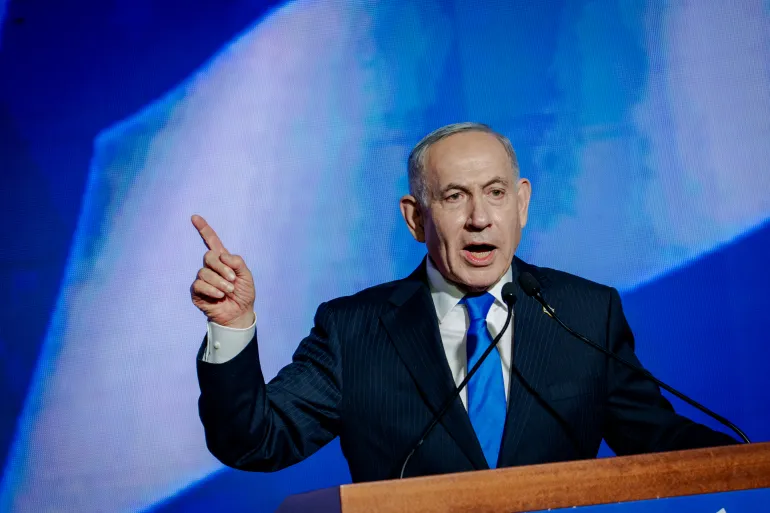
“It must be understood that Hezbollah’s violations are, in practice, dismantling the ceasefire,” Israel’s Prime Minister Benjamin Netanyahu said during a weekly cabinet meeting.
The US-mediated ceasefire, which started on April 16 and has been extended to mid-May, has brought a significant reduction in hostilities between Israel and Hezbollah, though both sides have continued to fire at each other, trading blame over breaches.
Al Jazeera’s correspondent in Tyre, Heidi Pett, said “there have been multiple airstrikes across south Lebanon” on Sunday, with many people fleeing to the towns of Sidon and Tyre.
“We once again have thousands of people leaving their homes, joining the hundreds of thousands who were already previously displaced,” she said.
A displaced man, who fled his home after an Israeli evacuation order, sits in a university-turned-shelter in Sidon, Lebanon, April 13, 2026 [Aziz Taher/Reuters]
Hezbollah said it attacked Israeli troops inside Lebanon as well as the rescue force that came to evacuate them, targeting a newly established Israeli artillery position in the town of Biyyada with a swarm of drones.
It also claimed two drone attacks on a gathering of Israeli soldiers in the town of Taybeh, saying casualties were reported among Israeli forces, without giving further details.
‘The security of Israel’
The Israeli army said a 19-year-old soldier, Sergeant Idan Fooks, was killed “during combat” in southern Lebanon, while five others were injured.
“From our perspective, what obliges us is the security of Israel, the security of our soldiers, the security of our communities,” Netanyahu was cited as saying at a cabinet meeting in Jerusalem, by Reuters news agency.
Under the terms of the truce, Israel reserves the right to respond to “planned, imminent or ongoing attacks” and has been striking what it says are Hezbollah targets in south Lebanon almost every day.
The Israeli military said it struck Hezbollah’s “military infrastructure sites used to advance attacks,” in a post on X.
Since the war was renewed between Israel and Hezbollah on March 2, at least 2,509 people have been killed and 7,755 wounded by Israeli attacks, according to Lebanon’s Health Ministry.
Trump says Tehran did not make satisfactory offer after Iranian foreign minister travelled to Pakistan to present a framework to mediators to end the war.
Tehran, Iran – Iran’s authorities and state media project that they are less interested than before the war in negotiations with the United States if they go beyond their accepted terms, as mediated talks failed to materialise in Pakistan.
Foreign Minister Abbas Araghchi met senior Pakistani officials in Islamabad on Saturday and left for Oman, to be later bound for Russia. The top diplomat, who was not joined by Parliament Speaker Mohammad Bagher Ghalibaf like in a previous round of negotiations earlier this month, said he was “yet to see if the US is truly serious about diplomacy”.
Recommended Stories
list of 3 itemsend of list
Envoys Steve Witkoff and Jared Kushner had been expected in Pakistan after the White House said Iran asked for a second round of direct negotiations, but US President Donald Trump cancelled the trip and said, “we have all the cards, they have none” while reiterating his claim about “infighting and confusion” among Iran’s leadership.
“If they want to talk, all they have to do is call!!!” Trump wrote in an online post, continuing to put the onus on Iran’s leadership.
Amid a state-imposed near-total internet shutdown in Iran, nearing two months, officials and the supporters of the Islamic Republic emphasise that they are united in opposing any concessions to Trump.
The US president said earlier this week he was in “no rush” to reach an agreement with Iranian leadership, whom he claimed, without evidence, were “fighting like cats and dogs” among themselves.
Since Trump highlighted the perceived fractures, military, security, judiciary and government authorities in Iran have been releasing synchronised messages with near-identical wording to proclaim absolute unity.
The messages, circulated through state media and even using similar graphics and fonts but with different colours, claim that everyone in the country is “revolutionary” and exercises “complete obedience” to Supreme Leader Mojtaba Khamenei.
The authorities also claim that more than 30 million people – a third of Iran’s total population – have registered in a state-run campaign to express readiness to “sacrifice” their lives if necessary, but they have not provided any documentation to prove this.
The Khatam al-Anbiya Central Headquarters of the Islamic Revolutionary Guard Corps (IRGC) said on Saturday afternoon that armed forces would retaliate against the US if it continues its “blockade, banditry and piracy” in Iran’s southern waters.
“We are prepared and determined to monitor the behaviour and movement of the enemies in the region and maintain management and control of the strategic Strait of Hormuz, and to inflict more severe damages on the American-Zionist enemies in case of another aggression,” read its statement.
The IRGC on Saturday took a state television presenter to broadcast near two vessels seized days earlier in the strait to report that Iran exercised “total control” over the waterway.
Police officers stand guard behind a barricade near Serena Hotel, as Pakistan prepares to host the US and Iran for the second round of peace talks, in Islamabad, Pakistan, April 25, 2026 [Asim Hafeez/Reuters]
Iranian authorities continue to call on their supporters, including paramilitary forces, to take to the streets every night in order to maintain control.
In a rally in downtown Tehran on Friday night, Meysam Motiei, a prominent state-backed religious singer with links to the supreme leader’s office, told the crowds that anyone stuck in factional infighting during times of war “has not grown up yet”.
“If anyone from any group or faction, especially in the name of being a revolutionary, tries to disturb the unity of the people, they will get a slap in the face by the people,” he asserted.
But in ultraconservative Mashhad in northeast Iran, where a shrine considered holy for Shia Muslims is located along with powerful religious and economic foundations, some were still preaching aggressively against the possibility of former reformist and moderate leaders retaking power.
“They have instructed us to keep unity with incumbent officials, not these two people,” a speaker told a gathering crowd on Friday night in a clip shared by state-linked media, in reference to former President Hassan Rouhani and his foreign minister, Mohammad Javad Zarif.
“We are not afraid of B-2s and B-52s; we are afraid of dishonourables who have no concern for the homeland. Wherever Trump makes a mess, Zarif comes and blabbers away,” he said, about the diplomat who led nuclear talks that led to a now-expired landmark accord with world powers in 2015.
Iran’s judiciary continues to execute dissidents, and on Saturday announced the hanging of Erfan Kiani, who was arrested during the nationwide protests in January when thousands were killed.
The judiciary described him as “Mossad’s hired knife-wielder” and said he was accused of destroying property, arson and more in downtown Tehran.
Iranian Foreign Minister Abbas Araghchi meets Pakistan Army Chief Field Marshal Asim Munir, in a location given as Islamabad, Pakistan, released April 25, 2026 [Seyed Abbas Araghchi via Telegram/Handout via Reuters]
No nuclear talks?
Iranian state media reports indicate that the US naval blockade of Iran’s ports is undermining the ceasefire extended by Trump and allowing the more hardline voices in Tehran to come out on top.
The Tasnim and Fars news agencies, affiliated with the IRGC, argued against allowing any nuclear negotiations to take place with the US, even though Trump and Israel’s Prime Minister Benjamin Netanyahu started the war with the predominant goal of preventing a nuclear-armed Iran. Tehran has consistently stressed that its nuclear programme is peaceful, although some Iranian leaders have called for the development of a bomb.
“The negotiations with the US are strictly to end the war, and Iran does not consider the nuclear issue to be part of the talks,” Tasnim said, claiming that time was not on Washington’s side due to the tumult in global markets resulting from the war.
Khamenei has not directly commented on more negotiations, but Ali Khezrian, another representative of Tehran in the hardline-dominated parliament, told state media on Thursday that Khamenei was “opposed to any extension of negotiations” under threats from the US and Israel.
Israel’s Defence Minister Israel Katz earlier this week adopted Trump’s apocalyptic messaging, and said armed forces are awaiting a greenlight from the US to “return Iran to the age of darkness and stone by blowing up central energy and electricity facilities and crushing national economic infrastructure”.
There are currently three US aircraft carriers and their supporting vessels in the Middle East region, according to the US military, which marks the first time this has happened since the buildup to the 2003 invasion of Iraq.
But Mahmoud Nabavian, a senior black-turban cleric and hardline member of parliament who was a part of the large Iranian delegation in the first round of talks, said it was a “strategic mistake” to even include the nuclear issue.
He told state media that this allowed the US to raise demands like a 20-year suspension of enrichment, and shipping Iran’s buried high-enriched uranium abroad.
“From now on, entering any negotiations with the US is pure damage and has no interest for the Iranian nation,” he said earlier this week, adding that oil sales were providing the government with a “full hand”.
Mohammad Saeedi, the Friday prayer imam of ultraconservative Qom, located south of Tehran, said in reference to the US that it would be “meaningless and unfair to sit down behind the negotiating table with a symbol of corruption”.
Women hold Iranian flags and a portrait of Supreme Leader Ayatollah Mojtaba Khamenei during a state-organised rally in support of the supreme leader marking National Girl’s Day in Tehran, Iran, Friday, April 17, 2026 [Vahid Salemi/AP]
Civilian infrastructure in danger
The government of relatively moderate President Masoud Pezeshkian has signalled concern about the potential impacts of systematic targeting of more civilian infrastructure, especially power plants, in case the war continues.
“We have a simple request from the people: to reduce their consumption of power and energy. For now, we have no need for these dear people to sacrifice their lives, but we need to control consumption,” the president said on Saturday. “They have hit our infrastructure and blockaded us, so the people become dissatisfied.”
Mohammad Allahdad, the head of Tavanir, the government-owned mother company for development and operation of Iran’s power grid, told state television that it would pay a reward to citizens who would report any theft and illegal use of electricity.
First Vice President Mohammadreza Aref said, “We will build Iran back more glorious” through unity after previous infrastructure attacks that hit oil and gas facilities, steel producers, petrochemical firms, aluminium factories, energy facilities, as well as airports, naval ports, bridges and railway networks.
The government reopened Tehran’s Imam Khomeini Airport for limited foreign-bound flights on Saturday, including those taking people to the Hajj pilgrimage in Saudi Arabia, despite the potential of war resuming.
Raids on a truck and a motorcycle in the town of Yohmor al-Shaqif kill four people, state media report.
Published On 25 Apr 202625 Apr 2026
Israeli attacks have killed at least four people in southern Lebanon’s Nabatieh district, the state news agency reports, as Israel continues to pummel the country in defiance of a three-week extension of a ceasefire with Hezbollah.
In a statement on Saturday, Lebanon Ministry of Public Health’s emergency operations centre said two Israeli raids on a truck and a motorcycle in the town of Yohmor al-Shaqif killed four people, the Lebanese National News Agency reported.
Recommended Stories
list of 4 itemsend of list
Al Jazeera’s Heidi Pett, reporting from the city of Tyre, said the attacks were carried out north of the Litani River, below which Israel has unilaterally declared to be operating.
Meanwhile, in the city of Bint Jbeil, also in southern Lebanon, Israeli soldiers reportedly blew up buildings on Saturday morning.
Al Jazeera correspondents on the ground separately reported bombings in the city of Khiam, including on residential blocks.
Israel’s ongoing spree is “part of a continued pattern of Israeli military activity, despite what is ostensibly a ceasefire”, Pett said, adding that the “rumble and thud of explosions” could be heard across southern swaths of the country.
“That is Israel demolishing houses and buildings,” she said.
The attacks are the latest to rock southern Lebanon since United States President Donald Trump announced the ceasefire extension on Thursday. Within hours, the Israeli military claimed it had “eliminated” six Hezbollah fighters in an exchange of fire near Bint Jbeil.
Hezbollah lawmaker Ali Fayyad said the ceasefire was “meaningless in light of Israel’s insistence on hostile acts, including assassinations, shelling, and gunfire”.
He added that Israeli attacks meant Hezbollah retains the “right to retaliate”.
Israeli Prime Minister Benjamin Netanyahu said Israel was “maintaining full freedom of action against any threat” and claimed Hezbollah was “trying to sabotage” the pause.
Before Trump’s announcement, a poll by the Israel Democracy Institute suggested that Jewish Israeli respondents overwhelmingly supported continuing the conflict, even if it led to friction with the US.
The Lebanese leadership has rejected the possibility of Lebanon being used as a “bargaining chip” amid potential US-Israel negotiations with Iran, Pett said.
Lebanese civilians, meanwhile, are facing the fallout.
Huda Kamal Mansour, from Aitaroun village in southern Lebanon, has been living with her nine-year-old son in an empty stadium in Beirut along with other displaced families for the past 45 days.
She told Al Jazeera she ran for her life when the Israeli army started bombarding her neighbourhood.
“There was zero distance between us and the Israeli army when they attacked southern Lebanon. All I could hear was the sound of explosions hitting villages. We were told to evacuate from the village, then the tanks surrounded us,” she recalled.
Ramallah, occupied West Bank – Hani Odeh has spent four and a half difficult years as mayor of Qusra, southeast of Nablus.
Surrounded by illegal Israeli settlements and outposts, the small Palestinian town of approximately 6,000 in the northern West Bank faces relentless settler attacks that left two residents killed last month.
Recommended Stories
list of 4 itemsend of list
Many are unable to access their agricultural fields as settlers repeatedly damage the village’s water pipes. But when his Palestinian neighbours go to the polls for municipal elections on Saturday, he will not be on the ballot.
“The resources are limited, the demands are many, there’s the settlers, the army – the problems don’t stop,” he says. “You can’t do anything for them. I’m exhausted. I just want to rest, honestly.”
Only three months ago, the Palestinian Authority (PA) announced that there would be local elections on April 25 for municipalities and village councils, the first such elections in nearly five years. There have been no national elections since 2006, keeping the Fatah-ruled PA in power in the West Bank more than 17 years after its initial mandate expired.
Odeh, who will be stepping down, doesn’t believe there is much point to the vote. “It won’t change the reality,” he says, pointing out that the gate to enter Qusra has been shut by the Israeli military for two years.
Meanwhile, the PA civil servants that Odeh relies on to run Qusra receive salaries of just 2,000 shekels ($670), a fraction of what they are owed, as Israel continues to withhold tax revenues earmarked for the Palestinians.
According to the Palestine Elections Commission, 5,131 candidates are competing across 90 municipal councils and 93 village councils on April 25, with nearly a third of the electorate between the ages of 18 and 30.
Across the West Bank, many agree with Odeh, and express doubts that these elections can move the needle on anything that actually matters.
The gate to enter Qusra has been shut by the Israeli military for two years [Al Jazeera]
‘Sense of futility’
In the days leading up to the vote in Ramallah, there have been no campaign posters hanging along the streets. That is because Ramallah – the city where the PA is headquartered – is not holding competitive elections this Saturday. Neither is Nablus, another major city in the West Bank.
Instead, both cities are being decided through a process known as acclamation, in which a single list of candidates is elected without a formal vote. Across the West Bank, 42 municipal councils and 155 village councils will be filled this way – a majority of local administrative authorities.
Historically used in small villages where extended families agreed on candidates, the process is now being applied in major cities that are PA strongholds – such as Ramallah and Nablus – where Fatah mobilisation has discouraged challengers.
“There is definitely a sense of futility in certain places,” says Zayne Abudaka, cofounder of the Institute for Social and Economic Progress (ISEP), which regularly surveys Palestinian sentiments and views, “and I think that makes it easier for places to just not have an election.”
Fatima*, a businesswoman who runs an education centre in el-Bireh, says she hasn’t voted in an election since the last Palestinian national election 20 years ago – and she doesn’t plan to this time, either. “They will choose a new group of decisionmakers, and I believe they will do the same according to the old decisionmakers,” says Fatima. “We don’t see any difference between them. It is not fair.”
Sara Nasser, 26, a pharmacist who commutes to Ramallah for work from the village of Deir Qaddis, west of the city, says she has simply grown accustomed to elections not happening and will not vote. “It’s been since before I was aware that there were significant elections,” she says. “We’ve always lived like this.”
Muhammad Bassem, a restaurant owner in Ramallah [Al Jazeera]
Some hopeful, others less so
Not everyone is so pessimistic. Iyad Hani, 20, works at a children’s store and is enthusiastic to vote for the first time in his life in el-Bireh. “Hopefully, the one coming is better than the one who left,” he says. “There should be construction in the town and fixing the streets – that’s the most important thing.”
Muhammad Bassem, who is a restaurant manager in Ramallah, is also showing up to the polls, optimistic for what change may bring. “It is the new faces that bring about change for the better – always for the better,” he says. “We want our country to be beautiful, clean and to offer plenty of comfortable employment opportunities, tourism and development.”
Others are not so sure. Amani, who is from Tulkarem but works in Ramallah as a receptionist, watches the campaigns play out on her phone, though she does not plan to vote. “Right now, they keep saying, ‘we’re going to do this, we’re going to do that,’” she says. “But I don’t know if any of it will actually yield results.”
The Tulkarem issues she is thinking of, such as inadequate waste management, no parks for children and roads in disrepair, fall squarely into the kinds of changes that local elections might have an impact on, she suggests. “I just hope that something genuinely new and positive comes out of this.”
The Palestinian Authority is based in Ramallah [Al Jazeera]
‘There isn’t a credible setup’
Underlining the question of these specific elections is a broad disillusionment with the PA that colours nearly every conversation about Palestinian political life.
Fatima says she and her whole family are politically aligned with Fatah, the effective governing party of the PA. “We don’t hate Fatah,” she says. “We hate the decisions they are taking right now.” While she says her business has contracted 85 percent in recent years, the PA still charges her 16 percent VAT.
That same disillusionment extends even to the elections in small localities like Qusra, which Mayor Odeh calls “a family affair, not a political affair”.
“People have lost faith in the parties, lost faith in the [Palestinian] Authority, lost faith in the whole world,” he says, expecting low turnout on Saturday. While most candidates in Qusra are politically aligned with Fatah, Odeh says no candidates in Qusra’s election this Saturday are doing so officially. “If they run under political affiliations, no one will support them.”
According to the Palestine Elections Commission, 88 percent of those on the ballots this year are doing so as independent candidates.
While polling suggests roughly 70-80 percent of Palestinians distrust the PA as an institution, Obada Shtaya resists framing this simply as a PA problem, considering the PA’s hobbled finances and its shrinking autonomy in Areas A and B under Israeli occupation. Israel continues to expand settlements and military raids in the West Bank, and the PA has no power to respond, with the prospect of a Palestinian state increasingly distant.
“Pessimism, lack of hope, helplessness – it is beyond the classical distrust in the PA,” he says. “It is looking at the PA and potentially understanding that these people also don’t have much that they can do to help themselves.”
A new amendment to the local elections law, requiring all candidates to affirm their commitment to agreements signed by the PLO – widely understood as a measure to exclude Hamas and other opposition factions – now threatens to taint how people perceive these elections. “If you want to run, you need to pre-agree to things at the national level,” says Shtaya. “But this is about local service delivery. Why am I having to sign things that deal with agreements between the PA and Israel?”
Despite the many naysayers in this election, “Palestinians are thirsty for democracy,” says the pollster, including those in Gaza. What is missing is not the will, he says, but the proper architecture for it: elections announced years in advance, a functioning legislature, and accountability that extends beyond voting day.
“There isn’t a credible setup that shows people their vote makes a difference,” says Shtaya. Without that, sporadic elections take place at what he calls the surface level: real enough that some people show up, but shallow enough that not much changes underneath.
Soon to be relieved of his mayoral duties, Hani Odeh plans to open a toy shop and set up a house for himself. “Let people breathe,” he says. “We’re here. We’re not going anywhere.”
Hamas says the Israeli escalation represents the failure of the international community to uphold the truce in Gaza.
Israeli forces have killed 12 Palestinians in attacks throughout Gaza, medical sources in the enclave tell Al Jazeera, as Israel continues its daily violations of the ceasefire struck last year.
An Israeli attack on a police vehicle on Friday killed at least eight people, including three civilian bystanders, in Khan Younis. A separate attack in Gaza City also killed two police officers.
Recommended Stories
list of 3 itemsend of list
Two other people were killed in the bombing of a house in Beit Lahiya in northern Gaza.
Gaza’s Ministry of Interior called on the international community on Friday to intervene and end the Israeli targeting of local police forces working to restore security in civilian areas.
It said the attack in Khan Younis came after security forces intervened to break up a fight in the area.
“The continued silence of international organisations … regarding the targeting of civilian police officers constitutes complicity with the Israeli occupation, encouraging it to commit further crimes against a civilian institution protected under international law,” the ministry said.
“We emphasise that the police force provides services to citizens in the Gaza Strip across various aspects of daily life. There is absolutely no justification for targeting it or killing its personnel.”
Israel has been systemically killing police officers in Gaza, as it allies itself with criminal gangs in the occupied territory.
During its genocidal war on Gaza, which started in October 2023, the Israeli military regularly targeted officers securing aid convoys, which led to intensified looting. That, in turn, deepened the hunger crisis that Israel imposed on the territory.
A ceasefire, brokered by United States President Donald Trump, came into effect in October of last year. That decreased the intensity of the Israeli bombardment.
But Israel has nevertheless continued its attacks on the territory, killing at least 984 people and injuring 2,235 others since the truce was announced, according to health authorities.
Just this week, Israeli strikes killed five people, including three children, on Wednesday.
The overall death toll in the war has surpassed 72,500, with more than 172,000 others injured. Thousands of missing people are believed to be dead and buried under the destroyed buildings.
The number of confirmed casualties represents more than 7 percent of the enclave’s population of two million people. The Israeli assault also turned most of Gaza’s structures into piles of rubble.
Leading rights groups and United Nations investigators have concluded that the Israeli military campaign amounts to genocide: an effort to destroy the Palestinian people.
Under the far-right government of Prime Minister Benjamin Netanyahu, Israel has continued to bomb Gaza as it simultaneously attacks south Lebanon, in violation of a separate truce with Hezbollah.
Hamas on Friday called the deadly attacks in Gaza part of the Israeli government’s “unprecedented bloody, fascist approach”.
“This escalation … by the government of the war criminal Netanyahu represents a clear failure of the role of the mediators and guarantors [of the ceasefire] and the international community to quell the barbaric Zionist killing machine,” it said.
More than six months into the ceasefire, Trump has struggled to implement the 12-point plan on which the truce was based.
Israel continues to occupy most of Gaza. Reconstruction in the territory has not begun. An international security force envisioned by the agreement has not been formed.
In February, Trump convened his so-called Board of Peace that is supposed to govern Gaza through a council of Palestinian technocrats, but it is not clear when or how these forces will take over government agencies in the territory.
A United States mediated ceasefire between Israel and Lebanon has come under strain after Hezbollah dismissed the agreement as ineffective. The truce, which took effect on April 16, was recently extended by three weeks following talks hosted by Donald Trump at the White House with Israeli and Lebanese representatives.
The ceasefire was intended to reduce hostilities that reignited on March 2, when Hezbollah launched attacks in support of Iran amid a broader regional conflict. While the agreement led to a noticeable drop in violence, clashes have not fully stopped. Israeli forces have continued operations in southern Lebanon, maintaining a self declared buffer zone, while Hezbollah has accused Israel of carrying out strikes, assassinations, and destruction of towns.
Hezbollah lawmaker Ali Fayyad stated that the continued attacks render the ceasefire meaningless and reaffirmed the group’s position that it reserves the right to respond to any Israeli action.
Why it matters The fragile ceasefire highlights the difficulty of de escalating conflicts in the Middle East, especially when multiple fronts and actors are involved. Continued violations risk collapsing the agreement entirely, which could lead to a wider confrontation between Israel and Hezbollah.
The situation is further complicated by its connection to broader regional tensions involving Iran, making the ceasefire not just a bilateral issue but part of a larger geopolitical struggle. A breakdown could escalate into a more sustained and destructive conflict along the Lebanon Israel border.
Stakeholders Hezbollah remains a central actor, positioning itself as a resistance force while balancing domestic and regional pressures. Israel is focused on security concerns and maintaining its buffer zone in southern Lebanon.
The United States is playing a mediating role, attempting to prevent escalation and maintain stability. Iran, as a key ally of Hezbollah, continues to influence the group’s strategic decisions and has pushed for Lebanon to be included in wider ceasefire discussions.
The Lebanese government is also a stakeholder, as continued conflict threatens its sovereignty, infrastructure, and already fragile economy.
What’s next The extended ceasefire will be tested in the coming weeks as both sides continue limited engagements. If violations persist, the agreement could unravel, leading to intensified clashes.
Diplomatic efforts led by Washington may continue, but their success will depend on whether both Israel and Hezbollah show restraint on the ground. Without a broader regional understanding that includes Iran, the chances of a lasting ceasefire remain uncertain.