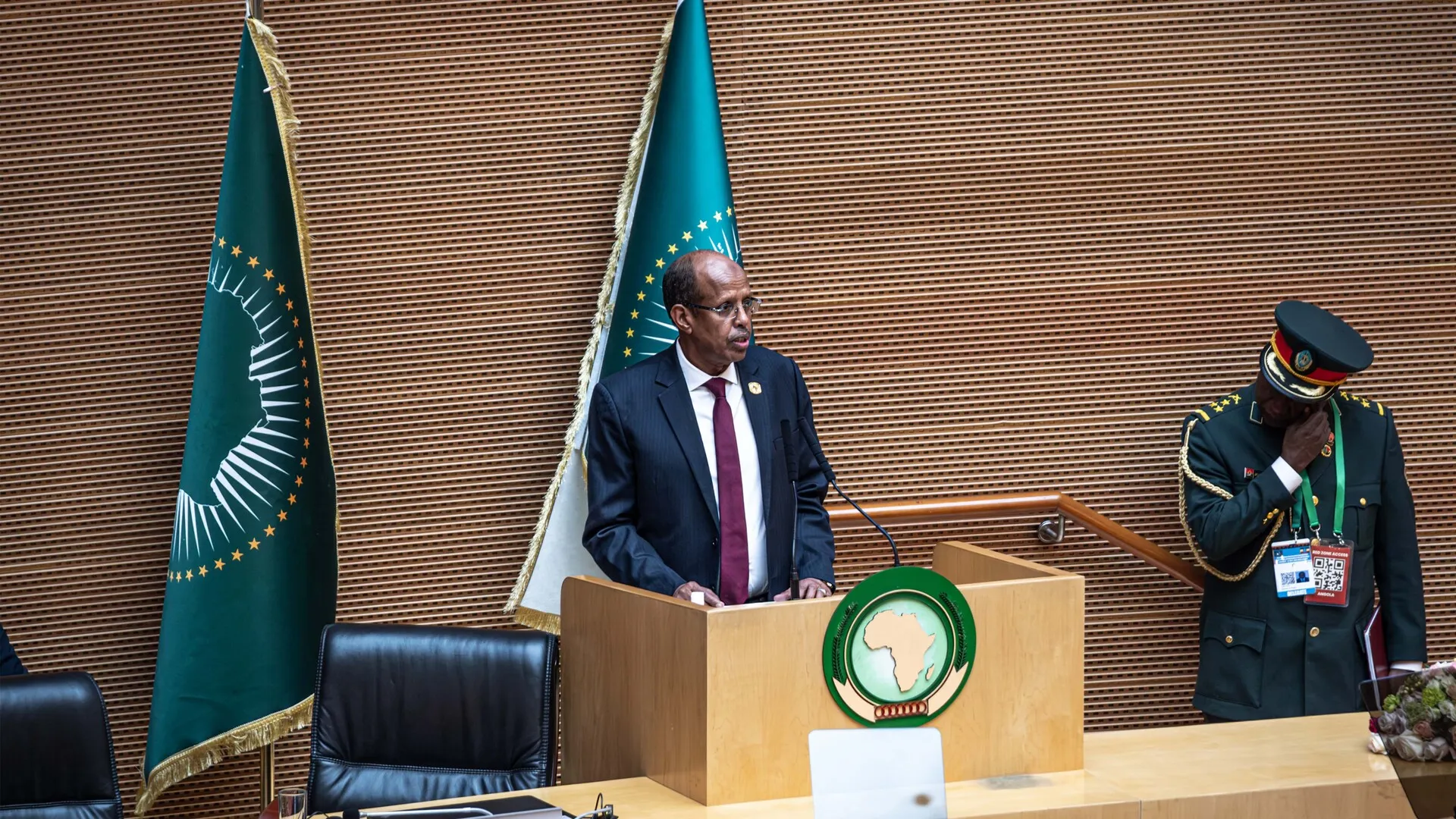
At the opening of the 39th summit of the African Union, the Chairman of the Commission Mahmoud Ali Youssouf said the “extermination” of the Palestinian people must end.
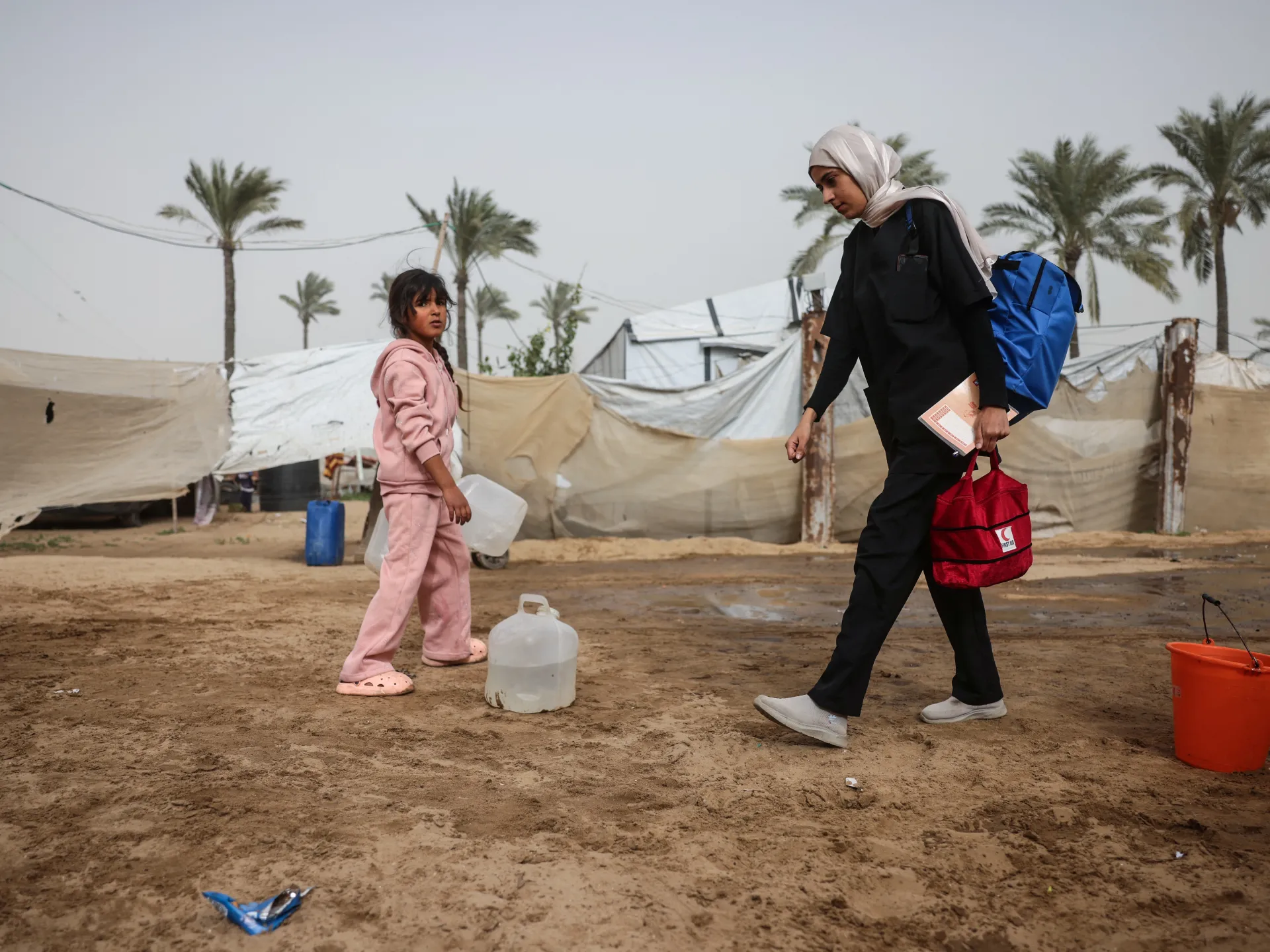
Doctors Without Borders, known by its French initials MSF, has suspended some operations at a Nasser Hospital in Gaza after its staff and patients saw “armed men, some masked” posing “serious security threats” inside the building.
The Geneva-based medical charity reported on its website that non-essential work at the hospital in Khan Younis was halted on January 20 due to concerns with the “management of the structure, the safeguarding of its neutrality, and security breaches”.
Recommended Stories
list of 4 itemsend of list
“MSF teams have reported a pattern of unacceptable acts, including the presence of armed men, intimidation, arbitrary arrests of patients, and a recent situation of suspicion of movement of weapons”, said the site’s “frequently asked questions” section, last updated on February 11.
“Hospitals must remain neutral, civilian spaces, free from military presence or activity to ensure the safe and impartial delivery of medical care”, it said, adding that the charity expressed concern to the “relevant” authorities.
Under the suspension, MSF will continue supporting critical services, such as inpatient and surgical departments, but will end support to the paediatrics and maternity wards, including the neonatal intensive care unit, and will no longer offer a range of outpatient consultations and other services.
The organisation was not able to indicate the armed men’s affiliation, but said its concerns were heightened by previous, deliberate Israeli attacks on health facilities.
Israel has decimated the enclave’s health infrastructure and continues to hold captive 95 Palestinian doctors and medical workers, including 80 from Gaza.
Zaher al-Waheidi, the head of the records department at Gaza’s Ministry of Health, said that MSF’s suspension will have a significant impact as hundreds of patients are admitted to the maternity and burn wards daily. He said the ministry would take over maternity patient care.
Gaza’s Ministry of Interior said in a statement that it is committed to preventing any armed presence inside hospitals, and that legal action will be taken against violators. It suggested that armed members of certain families recently entered hospitals, but did not identify those involved.
Israeli ban on aid organisations
MSF’s announcement comes after Israel recently ordered the charity and dozens of other international organisations to stop their work in Gaza and the Israeli-occupied West Bank if they did not meet new rules, including sharing details about their staff.
Two weeks ago, MSF – which provides international staff for six hospitals, and operates two field hospitals and eight primary health centres, clinics and medical points – said it would not submit a staff list to Israel after failing to receive assurances for their safety.
Israel has repeatedly attacked hospitals and healthcare workers throughout its genocidal war on Gaza.
In other developments on Saturday, Israel’s military said its troops “eliminated” a person in northern Gaza, alleging that the unidentified individual crossed the “yellow line“. The demarcation divides Gaza into an eastern area under Israeli military control and a western area where Palestinians face fewer movement restrictions but are under constant threat of air strikes and forced displacement.
Palestinian President Mahmoud Abbas slammed Israel for violating the US-brokered “ceasefire”, during which Israel has killed nearly 600 Palestinians since October 10.
In a speech by Prime Minister Mohammed Mustafa at an African Union summit in Ethiopia, he called on Israel to remove all “obstacles” to implementing phase two of the “truce” deal, including the work of a technocratic committee that will oversee the daily governance of Gaza.
More than 72,000 Palestinians have been killed and 171,000 wounded in attacks in Israel’s genocidal war on Gaza since October 2023.
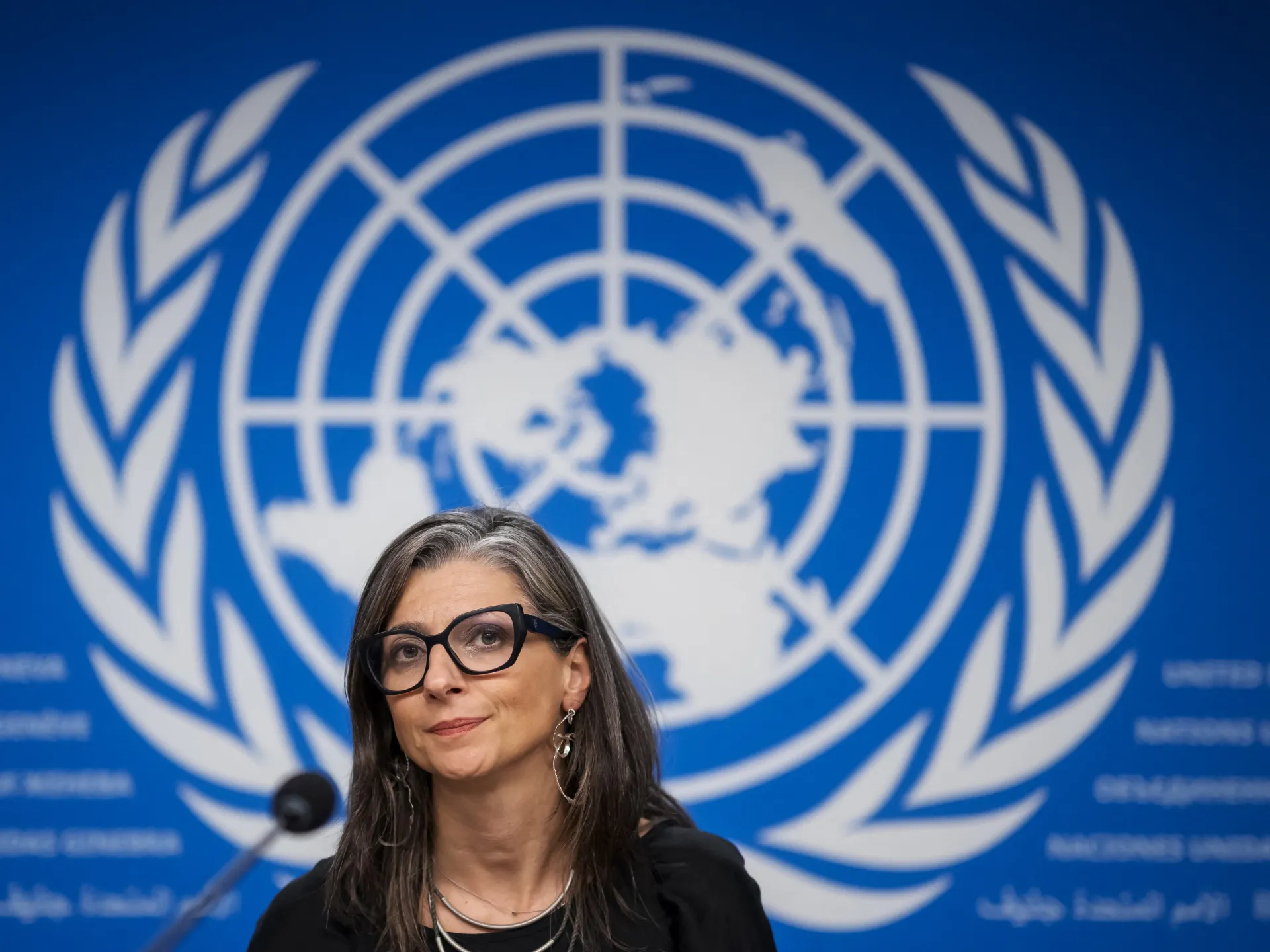
France and Germany call for UN special rapporteur for occupied Palestinian territory, Francesca Albanese, to step down over her critical comments.
More than 100 prominent artists – including musicians, actors and writers – have signed an open letter in support of the United Nations special rapporteur for occupied Palestinian territory who faces international calls to step down.
In a letter from the group Artists for Palestine on Saturday, the signatories offered “full support to Francesca Albanese, a defender of human rights and, therefore, also of the Palestinian people’s right to exist”.
Recommended Stories
list of 4 itemsend of list
“There are infinitely more of us in every corner of the Earth who want force no longer to be the law. Who know what the word ‘law’ truly means,” the letter said.
Among the supporters were actors Mark Ruffalo and Javier Bardem, Nobel Prize-winning author Annie Ernaux and British musician Annie Lennox.
At last week’s Al Jazeera Forum, Albanese, an outspoken critic of Israel’s genocidal war on Gaza, said “we as humanity have a common enemy”, but a fake video that was later debunked had her accusing Israel of being the “common enemy”.
She later explained in a social media post she was referencing “the system that has enabled the genocide in Palestine” as the “common enemy”.
‘Crush any criticism of Israel’
Still, European countries, including France and Germany, continue to call for her removal.
On Tuesday, a group of French lawmakers sent a letter to Foreign Minister Jean-Noel Barrot condemning Albanese’s remarks as “anti-Semitic”. A day later, Barrot called on her to step down, saying France “unreservedly condemns the outrageous and reprehensible remarks”.
On Thursday, German Foreign Minister Johann Wadephul called her position “untenable”.
Frank Barat, an author and film producer, said French President Emmanuel Macron and Barrot have repeatedly said they support international law “while the facts show the complete opposite”.
Albanese has highlighted for the past two years that under international law, “states have a duty to act to prevent genocide, and they’ve been failing completely” in Gaza, Barat told Al Jazeera.
“Because Francesca has been highlighting this hypocrisy, she’s been targeted by most Western governments. The political agenda of these governments is to crush any criticism of Israel. We’ve seen it in the streets of Europe. We’ve seen it in the streets of the US,” he added.
People who have spoken out against Israel’s war on Palestine are “criminalised while the perpetrators of genocide continue to be let go“, Barat said.
Marta Hurtado, a spokesperson for the Office of the UN High Commissioner for Human Rights, said at a news briefing on Friday that her colleagues are “very worried” about the backlash against Albanese.
“We are concerned that UN officials, independent experts and judicial officials are increasingly subjected to personal attacks, threats and misinformation that distracts from the serious human rights issues,” Hurtado said.
Nearly 600 Palestinians have been killed by Israel in Gaza since an October 10 “ceasefire” alone. At least 72,000 Palestinians have been killed and 171,000 wounded in Israel’s war since October 2023
Jury chair Wim Wenders said filmmakers ‘have to stay out of politics’ when asked about German support for Israel’s genocidal war in Gaza.
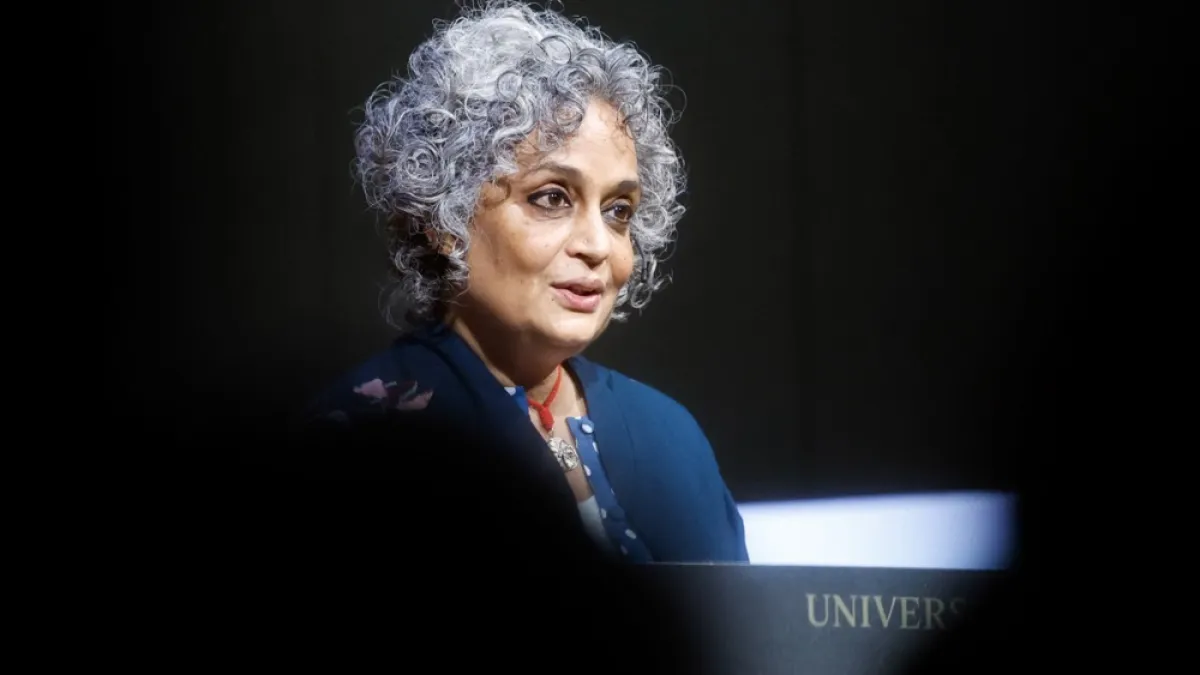
Indian author Arundhati Roy has announced that she is withdrawing from the Berlin International Film Festival after what she described as “unconscionable statements” by its jury members about Israel’s genocidal war on Gaza.
Writing in India’s The Wire newspaper, Roy said she found recent remarks from members of the Berlinale jury, including its chair, acclaimed director Wim Wenders, that “art should not be political” to be “jaw-dropping”.
Recommended Stories
list of 4 itemsend of list
“It is a way of shutting down a conversation about a crime against humanity even as it unfolds before us in real time,” wrote Roy, the author of novels and nonfiction, including The God of Small Things.
“I am shocked and disgusted,” Roy wrote, adding that she believed “artists, writers and filmmakers should be doing everything in their power to stop” the war in Gaza.
“Let me say this clearly: what has happened in Gaza, what continues to happen, is a genocide of the Palestinian people by the State of Israel,” she wrote.
The war is “supported and funded by the governments of the United States and Germany, as well as several other countries in Europe, which makes them complicit in the crime,” she added.
During a panel to launch the festival on Thursday, a journalist asked the jury members for their views on the German government’s “support of the genocide in Gaza” and the “selective treatment of human rights” issues.
German filmmaker Wim Wenders, who is the chair of the festival’s seven-member jury, responded, saying that filmmakers “have to stay out of politics”.
“If we made movies that are dedicatedly political, we enter the field of politics. But we are the counterweight to politics. We are the opposite of politics. We have to do the work of people and not the work of politicians,” Wenders said.
Polish film producer Ewa Puszczynska, another jury member, said she thought it was “a bit unfair” to pose this question, saying that filmmakers “cannot be responsible” for whether governments support Israel or Palestine.
“There are many other wars where genocide is committed and we do not talk about that,” Puszczynska added.
Roy had been due to participate in the festival, which runs from February 12 to 22, after her 1989 film, In Which Annie Gives It Those Ones, was selected to be screened in the Classics section.
Germany, which is one of the biggest exporters of weapons to Israel, after the US, has introduced harsh measures to prevent people from speaking out in solidarity with Palestinians.
In 2024, more than 500 international artists, filmmakers, writers and culture workers called on creatives to stop working with German-funded cultural institutions over what they described as “McCarthyist policies that suppress freedom of expression, specifically expressions of solidarity with Palestine”.
“Cultural institutions are surveilling social media, petitions, open letters and public statements for expressions of solidarity with Palestine in order to weed out cultural workers who do not echo Germany’s unequivocal support of Israel,” organisers of the initiative said.
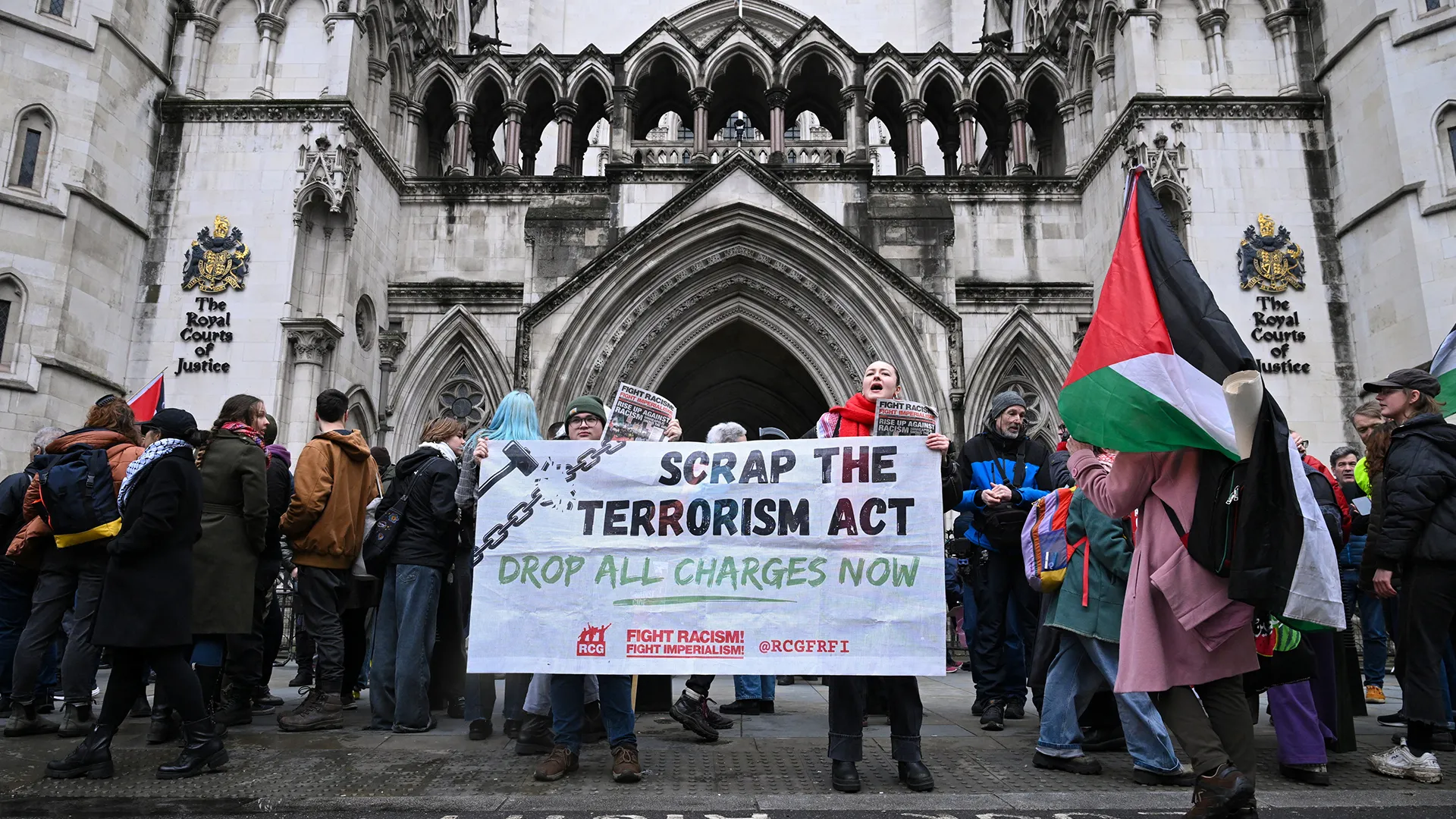
London, United Kingdom – The United Kingdom’s ban on Palestine Action has “backfired”, its cofounder said, after the High Court ruled that proscribing the group as a “terror” organisation was unlawful.
Critics from the United Nations human rights chief to the Irish author Sally Rooney decried the UK’s ban last June as an illiberal overreach, since it put Palestine Action on par with ISIL (ISIS), al-Qaeda and dangerous far-right organisations.
Recommended Stories
list of 4 itemsend of list
On Friday, High Court judges dealt a massive blow to the government of Labour leader Keir Starmer, saying, “The decision to proscribe Palestine Action was disproportionate.”
“Today is a victory for Palestine,” Palestine Action cofounder Huda Ammori told Al Jazeera. The ban has “backfired on [the government] massively. They’ve made Palestine Action a household name.
“They have spread the message and the power that ordinary people have to shut down weapons factories across the country and across the world. So for that, I thank them.”
The group’s cofounder Huda Ammori said Friday’s High Court ruling marked a ‘victory for Palestine’
Founded in 2020, Palestine Action’s stated objective has been to counter Israeli war crimes – and what it says is British complicity in them – by targeting weapons manufacturers and associated companies.
Its main target is Elbit Systems, Israel’s largest arms company, which has several sites in the UK.
“Rather than ask somebody else to stop those weapons going and being used to commit genocide, we go to the source, and we stop those weapons ourselves,” said Ammori, a 31-year-old Briton of Iraqi and Palestinian heritage.
“That is what direct action is about. If you saw a building burning down with children inside, you wouldn’t hesitate to bang down the door to save those children’s lives. It is exactly the same principle. You don’t care about the value of the door. It is about those lives. It is about the liberation of Palestine. And so we do our bit to shut down the Israeli weapons trades from Britain.”
The group has been a thorn in Starmer’s side since Israel began its genocidal onslaught in Gaza.
Palestine Action-linked activists have carried out several raids, often leaving their mark in red spray paint intended to symbolise blood.
Dozens are currently being held on remand in relation to two actions.
Some prisoners, known as part of the “Filton 24”, are alleged to have participated in a break-in at a UK subsidiary of Elbit Systems in Bristol.
Others are accused of involvement in a break-in at the UK’s largest air base in Oxfordshire, where they were alleged to have spray-painted two Voyager refuelling and transport planes. It was after this raid that the government banned Palestine Action.
They all deny the charges against them, such as burglary and criminal damage.
Six of the “Filton 24” were recently acquitted of aggravated burglary; five of them were bailed.
“At its core, Palestine Action is an organisation that promotes its political cause through criminality and encouragement of criminality. A very small number of its actions have amounted to terrorist action,” the High Court judges said.
Tens of thousands of people have protested against the ban. Almost 3,000 of them have been arrested for raising placards with slogans such as: “I oppose genocide. I support Palestine Action.”
“The government committed a huge crime against its own population,” said Ammori. “It was unlawful for them to ban Palestine Action, and when they banned Palestine Action, they subsequently did thousands of unlawful arrests against their own citizens and tried to prosecute them through the courts for terrorism offences, for holding up signs.”
Despite Friday’s ruling, the ban remains in place pending appeal.
The UK’s Home Secretary Shabana Mahmood said she was “disappointed” by Friday’s ruling and intends to appeal – earning further criticism from rights groups and some fellow Labour politicians.
John McDonnell, an MP who voted against the proscription, said on X, “I thought it was unjust. We have a right to protest, to assemble, and to speak freely in this country – that has been secured largely by direct action over centuries. I am urging the government to abide by that tradition and not to appeal this judgement.”
“Shabana Mahmood needs to take a step back,” said Ammori. “She’s completely betrayed the Palestinian people since she’s become minister … it’s only going to backfire on her.
“Palestine Action’s ban will be lifted … We won today in the High Court … If they try and appeal, we’ll beat them again.”
Latest attacks come amid a widely condemned Israeli push to cement control over the occupied Palestinian territory.
Published On 13 Feb 202613 Feb 2026
Share
Dozens of Palestinians have been injured as Israeli settlers carried out a wave of attacks across the occupied West Bank, destroying olive trees and vandalising property.
At least 54 Palestinians were wounded on Friday morning as settlers attacked several towns and villages under the protection of the Israeli military.
Recommended Stories
list of 3 itemsend of list
Settlers assaulted Palestinian farmers on their lands near Talfit, a village south of Nablus in the northern West Bank, and Israeli troops fired tear gas and live ammunition at residents who tried to repel the settler attack.
Images from the village showed homes with broken windows and vehicles with smashed windshields as a result of the attack.
Elsewhere in the West Bank, Israeli settlers also destroyed about 300 Palestinian olive trees near the Ramallah-area town of Turmus Aya, the Wafa news agency reported, citing local sources.
Palestinians across the West Bank have faced an intensified surge in Israeli military and settler violence in the shadow of Israel’s genocidal war against Palestinians in Gaza.
A shattered window in the village of Talfit after the settler attack, February 13, 2026 [AFP]
At least 1,054 Palestinians were killed in the West Bank by Israeli troops and settlers between October 7, 2023, and February 5 of this year, according to the latest United Nations figures.
Israel has also forcibly displaced tens of thousands of Palestinians from their homes across the West Bank, refusing to allow them to return in what Human Rights Watch says amounts to war crimes and a crime against humanity.
The Israeli government drew international condemnation this week after it approved plans to extend its authority over more of the West Bank – a move that observers denounced as de facto annexation, in violation of international law.
“If these decisions are implemented, they will undoubtedly accelerate the dispossession of Palestinians and their forcible transfer, and lead to the creation of more illegal Israeli settlements,” UN human rights chief Volker Turk said on Wednesday.
“We are witnessing rapid steps to change permanently the demography of the occupied Palestinian territory, stripping its people of their lands and forcing them to leave,” Turk said in a statement.
“This is supported by rhetoric and actions by senior Israeli officials, and violates Israel’s obligation as an occupying power to preserve the existing legal order and social fabric. These decisions must be overturned.”
Explosions are reported in eastern Gaza City, while at least 54 Palestinians are wounded in attacks by Israeli settlers across the occupied West Bank today.
The UK’s High Court has ruled that the government ban on the pro-Palestinian campaign group Palestine Action as a ‘terror group’ was unlawful. The case was brought by the group’s co-founder Huda Ammori. Rory Challands is outside the court in London.
Nablus, the occupied West Bank – For decades, the Zenabia Elementary School has been offering an intimate learning environment to aspiring young students from across the educational spectrum in the northern West Bank city of Nablus.
But now, due to Israel’s years-long withholding of tax revenues owed to the Palestinian Authority, the Palestinian school system is effectively broke. Like administrators at all government-run schools in the West Bank, the Zenabia school principal, Aisha al-Khatib, is struggling to keep her small, public school in session.
For most of the week, the Zenabia school is shuttered, and children roam the streets or stay at home. School supplies are woefully missing, with even regular schoolbooks now reduced to “bundles of pages”.
“We do everything we can, but we do not have the time or the materials or the consistency to properly teach our children and keep them off the streets,” says al-Khatib. “And this is everywhere in the West Bank.”
Targeting the education of Palestine’s children, she says, “means destroying the nation”.
Under the direction of far-right Finance Minister Bezalel Smotrich, Israel has systematically been withholding billions of dollars in tax revenues over the past two years that Israel collects on behalf of the Palestinian Authority (PA). The measure is partly intended to punish the PA for its longstanding policy of paying families of Palestinians imprisoned by Israel for resisting the occupation – even after the PA announced early last year that it was reforming such policies.
Public services have faced severe cuts, affecting the salaries of bureaucrats, sanitary workers, and the police.
But possibly nowhere has that budgetary crisis been felt more than in the education sector.
At Zenabia and elsewhere in the West Bank, public schools are currently only open for a maximum of three days a week. Teachers face long stretches of not being paid, and when they are, they only receive about 60 percent of what they were earning before, resulting in strikes.
And the effects of these cuts in education are showing up on the days when school is in session. Class time is so diminished at Zenabia that teachers focus almost solely on teaching mathematics, Arabic, and English, with subjects like the sciences being essentially cut altogether.
The result, educators warn, could be lasting educational gaps for a generation of Palestinian students.
“As principal of the school, I know that [the students] are not [at] the same [educational] level as before,” al-Khatib says.
‘We are always absent from school’
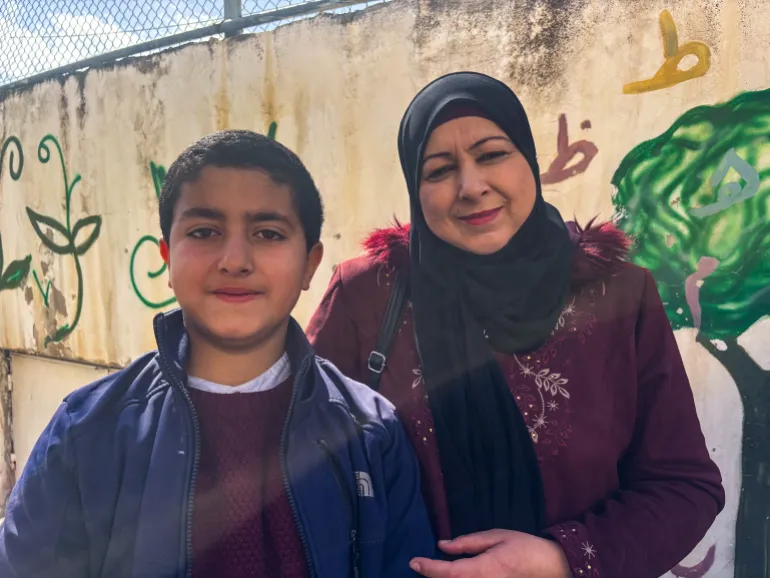
Spending most of his days out of school, star student Zaid Hasseneh, 10, tries to keep improving his English by looking up words on Google Translate. Zaid dreams of going to university someday in the United States, with hopes of becoming a doctor.
“I want my son to grow up to be cultured – not just memorise the material he learns at school,” says his mother, Eman. “No, I want his cultural knowledge to develop and become diverse and advanced.”
Eman helps Zaid when she can with his studies, but she is busy keeping the family afloat financially after her husband lost his work in Israel. Before Israel’s war on Gaza began in 2023, Eman’s husband worked in Tel Aviv as a mechanic. After Israel revoked his work permit, along with those of some 150,000 other West Bank Palestinians, he has been unable to find work. Eman now works in a halawa factory as the sole breadwinner.
“I go home tired from work, but I have to keep up with [Zaid] regularly,” says Eman. “I tell him, ‘The most important thing is studying. Studying is essential for life.’”
But Eman realises how limited she is in helping her son with his studies. “The teacher knows one thing, but I don’t know how to explain it,” says Eman. “And now, the books [they receive in school] aren’t complete books anymore. They’re bundles. Regular books are 130 pages, but these are 40 or 50 pages.”
To compound the dearth in school resources, students and their families describe erratic schedules that make cumulative learning a near impossibility. “The whole family’s routine is affected,” says Eman.
Even Zaid is now often spending his days out in the streets rather than studying in the classroom – or otherwise on his phone, playing mobile games.
That is the case for most students these days.
Muhammad and Ahmed al-Hajj joined Zenabia four years ago as six-year-olds when they faced extreme bullying in another school. They came to love the new school and the intimate setting it offers. But the twins now mostly spend their time on their phones. With their parents also struggling to earn enough money to get by, they’re left at home alone during their days off from school.
“It’s not good at all. We are always absent from school,” says one of the twins. “It’s not like a full schedule, and we try to study as much as we can, but still, we don’t feel good about it.”
Some families have switched their children over to private schools, but few can afford to do so. “My [monthly] salary is 2,000 shekels [$650],” explains Eman Hassaneh. “About 1,000 goes towards the home rent. Another 500 goes towards bills. And only very little is left for food. I cannot also take care of his education.”
Eman Hassaneh and her 10-year-old son, Zaid [Al Jazeera]
Teachers quitting, and mounting dropouts
Collectively, the PA’s multi-year budget cuts of billions of dollars are shrinking both the attendance of students and the number of teachers, too.
“Many of the teachers left working in the schools to work in factories because they do not get enough salary,” says al-Khatib. “And they don’t feel that they are giving what they need to give the students.”
Tamara Shtayeh, a teacher at Zenabia, nowadays only teaches maths, English, and Arabic due to the reduced funding. “As a teacher, the three-day solution is a bad solution because it doesn’t cover the minimum education that is needed,” she said. “Not for the students, and not for the teachers as well.”
Due to her reduced salary, Shtayeh, a mother of three girls, is selling products online on the side to support her family. Even the school’s principal, al-Khatib, says she can now only afford to send one of her two college-age daughters to university, with the other daughter staying at home.
School hours are reduced even further as Israeli soldiers regularly raid the surrounding areas, closing the school every time they do so. With the crisis stretching on for years now, Shtayeh is sensing a generational gap widening between the previous generation that received five days of school, and this one going to school for about half of that.
Shtayeh and al-Khatib worry about the lack of routine in the children’s lives. For every student like Zaid, who is devoted to educating himself despite the circumstances, many more students are dropping out of the system altogether.
Abu Zaid al-Hajj with his twin sons, Muhammad and Ahmed, age 10 [Al Jazeera]
Not far from Zenabia, Talal Adabiq, 15, now spends his days selling sweets and drinks for eight hours a day on the streets of Nablus.
“I don’t really like school,” says Talal. “I prefer working.”
Talal told his parents about a year ago that he wanted to drop out of school. Though they wanted him to continue his studies, he told them he did not find much use for school anymore – and he used the irregular school schedule to prove his point.
Offering to help support his struggling family financially, Talal subsequently dropped out of al-Kindi School. He now makes “about 40 to 50 shekels a day” ($13-16) hawking street goods.
As he sells lollipops and other sweets on a Tuesday afternoon, several teenage boys looked on nearby. They say they’re still in school, but on this budget-mandated day off, some of the boys joke about how “fun” it would be to not go to school at all.
Talal, meanwhile, shrugs off questions about what dropping out of school portends for his future. “God willing, things will be better,” says Talal. “I don’t know how.”
In the estimations of educators and representatives from the Palestinian Authority, about 5 to 10 percent of students have dropped out of school in the West Bank in the past two years.
Talal Adabiq, 15, has dropped out of school completely and now sells items on the street [Al Jazeera]
‘Our children deserve a chance at life’
While massive budget cuts roil the education sector, the Palestinian Authority is struggling to come up with solutions as its budgetary woes deepen – and schoolchildren otherwise face threats, violence and demolitions at the hands of Israeli soldiers, settlers and the Israeli Civil Administration.
Even before the war on Gaza began, the school sector was facing a variety of crises, with teacher strikes commonplace, as well as Israeli attacks on school infrastructure and children on their way to class, with at least 36 demolitions of 20 schools between 2010 and 2023.
But systemic attacks on education are now intensifying. According to Ghassan Daghlas, the governor of Nablus, in his district alone, three schools have been attacked in the last two months by settlers. In nearby Jalud last month, settlers set a school on fire. The rise in violence is leaving students at once traumatised and fearful of going to school, says Daghlas.
“In the past three months, most of the invasions that target homes in the Nablus district are targeting schoolchildren. They will take the kid along with one of the parents. They subject them to interrogation for a few hours,” says the governor. “What kind of psychological state will the students have after these interrogations?”
According to PA estimates, more than 84,000 students in the West Bank have had their education disrupted by incidents including settler attacks, military raids and demolitions of schools. More than 80 schools serving approximately 13,000 students are under threat of full or partial demolition by Israeli authorities in the West Bank and occupied East Jerusalem. Between July and September 2025 alone, more than 90 such education-related incidents were documented in the West Bank.
In Area C – the 60 percent of the West Bank under full Israeli military control – students from isolated villages sometimes have to walk several kilometres to reach their schools, in which they regularly face harassment or attacks from settlers as well as soldiers on the way, with a rising trend in settler outposts deliberately placed near schools.
“These are not individual acts by some violent settlers,” says Mahmoud al-Aloul, the vice chairman of the central committee of Fatah, the Palestinian Authority’s ruling political party. “Rather, it’s a general policy that is supported by the occupation.”
In 2025, Nablus governorate alone had 19 students killed by Israeli army gunfire, according to Daghlas. A total of 240 were injured.
Education officials say the longer the crisis persists, the greater the long-term impact will be as teacher attrition, interrupted learning and rising dropout rates compound over time.
“The continuation of the crisis means risking long-term institutional erosion, in which temporary solutions become permanent, and the regime becomes less able to restore its previous level of quality, efficiency and justice,” says Refaat Sabbah, the president of the Global Campaign for Education. “Saving education today is not a sectoral option, but a strategic necessity to protect society and its future.”
For Eman Hassaneh, that means safeguarding her son Zaid’s future hopes and dreams. “We hope all of these barriers to education won’t actually affect our children and their passion for learning,” she says.
On January 6, a group of 25 British members of parliament tabled a motion urging global sporting authorities to consider excluding the United States from hosting the 2026 FIFA World Cup until it demonstrates compliance with international law. It followed weeks of mounting pressure across Europe over the political climate surrounding a tournament expected to draw millions of viewers and symbolising international cooperation.
Dutch broadcaster Teun van de Keuken has backed a public petition urging withdrawal from the competition while French parliamentarian Eric Coquerel has warned that participation risks legitimising policies he argued undermine international human rights standards.
Much of the scrutiny has focused on US President Donald Trump’s immigration crackdown and broad assaults on civil liberties. The deaths of Minneapolis residents Renee Nicole Good and Alex Pretti during immigration enforcement operations in January triggered nationwide outrage and protests. In 2026, at least eight people have been shot by federal immigration agents or died in immigration detention.
These developments are serious, but they point to a broader question about power and accountability – one that extends beyond domestic repression and into the consequences of US policy abroad. The war in Gaza represents a far deeper emergency.
For decades, Washington has served as Israel’s most influential international ally, providing diplomatic protection, political backing and roughly $3.8bn in annual military assistance. That partnership finances and shapes the destruction now unfolding across Palestinian territory.
Since the day the war began on October 7, 2023, Israel’s military has killed more than 72,032 Palestinians, wounded 171,661 and destroyed or severely damaged the vast majority of Gaza’s housing, schools, hospitals, water systems and other basic civilian infrastructure. Nearly 90 percent of Gaza’s population – about 1.9 million people – has been displaced, many repeatedly, as bombardments move across the enclave. Meanwhile, Israeli forces and armed settlers have intensified raids, farmland seizures and sweeping movement restrictions across Palestinian communities in Jenin, Nablus, Hebron and the Jordan Valley in the occupied West Bank.
By many accounts, Israel is carrying out a genocide.
Across the African continent, this grave assault carries profound historical resonance because organised sports competitions have often been inseparable from liberation struggles.
On June 16, 1976, 15-year-old Hastings Ndlovu joined thousands of schoolchildren in Soweto protesting against the imposition of Afrikaans language education. By the end of the day, he was dead, shot by police as officers opened fire on unarmed pupils marching through their own neighbourhoods.
Hastings was murdered by a regime that viewed African children as political threats rather than students or even human beings. Police killed 575 youths and injured thousands more that day, yet the bloodshed failed to disrupt diplomatic and sporting relations between the apartheid state and several Western allies.
Weeks later, as families buried their children in solemn funerals, New Zealand’s national rugby team, the All Blacks, landed at Jan Smuts Airport in Johannesburg on June 25, ready to play competitive matches inside the segregated republic.
The tour provoked fury among many young African governments. Within weeks, the backlash reached the 1976 Montreal Olympic Games in Canada. Twenty-two African countries withdrew after President Michael Morris and the International Olympic Committee chose not to act against New Zealand.
Athletes who had trained for years packed their bags and left the Olympic Village in Montreal, some after already competing. Morocco, Cameroon, Tunisia and Egypt began the Games before withdrawing as their delegations were urgently recalled by their governments.
Nigeria, Ghana and Zambia pulled out of the men’s football tournament, collapsing first-round fixtures at Montreal’s Olympic Stadium and Varsity Stadium mid-competition. Television viewers worldwide watched empty lanes and abandoned tracks replace what had been promoted as a global event. More than 700 athletes forfeited Olympic participation, including world-record holders Filbert Bayi (1,500 metres) of Tanzania and Uganda’s John Akii-Bua (400-metre hurdles).
African leaders recognised the scale of the decision. Nonetheless, they concluded that their countries’ Olympic participation would give “comfort and respectability to the South African racist regime and encourage it to continue to defy world opinion”.
That moment offers a defining lesson for 2026: Boycotts come at a cost. They demand sacrifice, coordination and political courage. History shows that collective refusal can redirect global attention and force both institutions and spectators to confront injustices they might otherwise overlook.
Nearly five decades later, Gaza presents a similar test amid a deepening and seemingly endless catastrophe.
Take what happened to Sidra Hassouna, a seven-year-old Palestinian girl from Rafah.
She was killed along with members of her family during an Israeli air strike on February 23, 2024, when the home they had sought shelter in was struck amid intense shelling in southern Gaza.
Sidra’s story mirrors thousands of others and reveals the same truth: childhoods erased by bombardment.
These killings have unfolded before a global audience. Unlike apartheid South Africa, Israel’s destruction of Gaza is being transmitted in real time, largely through Palestinian journalists and citizen reporters, nearly 300 of whom have been killed by Israeli air and artillery strikes.
At the same time, the US continues supplying Israel with weapons, diplomatic cover and veto protection at the United Nations. While Trump’s civil liberties abuses are serious, they are not comparable in scale to the devastation endured by Palestinians in Gaza.
The humanitarian toll is measured in destroyed hospitals, displaced families, enforced hunger and children buried beneath collapsed apartment blocks.
The central question now is whether football can present itself as a weeks-long celebration of sporting prowess across 16 host cities in the United States, Canada and Mexico from June to July while the United States continues to sustain large-scale civilian destruction abroad.
African political memory understands these stakes. The continent has witnessed how stadiums and international competitions can project political approval and how withdrawal can destroy that image.
A coordinated boycott would require joint decisions by governments representing the qualified teams – Morocco, Senegal, Algeria, Tunisia, Egypt, Ivory Coast, Ghana, Cape Verde and South Africa – supported by the African Union, regional institutions and the Confederation of African Football.
The consequences would be immediate.
The tournament would lose its claim to global inclusivity, and corporate sponsors would be compelled to confront questions they have long avoided.
Most importantly, international attention would shift.
Boycotts do not end conflicts overnight. They accomplish something different: They remove the comfort of pretending injustice does not exist. The 1976 Olympic withdrawal did not dismantle apartheid instantly, but it accelerated isolation and broadened the universal coalition opposing it.
At present, FIFA’s longstanding political contradictions intensify the need for external pressure. At the World Cup draw in Washington, DC, on December 5, its president, Gianni Infantino, awarded Trump a “peace prize” for his efforts to “promote peace and unity around the world”.
The organisation cannot portray itself as a neutral body while extending symbolic legitimacy to a leader overseeing mass civilian death.
In that context, nonparticipation becomes a critical moral position.
It would not immediately end Gaza’s calamity, but it would challenge US support for the sustained military onslaught and honour children like Hastings and Sidra.
Although separated by decades and continents, their lives reveal a shared historical pattern: Children suffer first when imperial systems determine that Black and Brown lives hold absolutely no value.
Africa’s stand in 1976 reshaped international resistance to apartheid. A comparable decision in 2026 could strengthen opposition to contemporary systems of domination and signal to families in Gaza that their suffering is recognised across the continent.
History remembers those who reject injustice – and who choose comfort while children die under relentless air strikes and occupation.
If African teams compete in the 2026 World Cup as if nothing is happening in Gaza City, Rafah, Khan Younis, Jenin and Hebron, their involvement risks legitimising colonial power structures.
While European critics urge authorities to exclude the US, our history demands a complete withdrawal.
Football cannot be played on the graves of Palestinian martyrs.
Africa must boycott the 2026 World Cup.
The views expressed in this article are the author’s own and do not necessarily reflect Al Jazeera’s editorial stance.
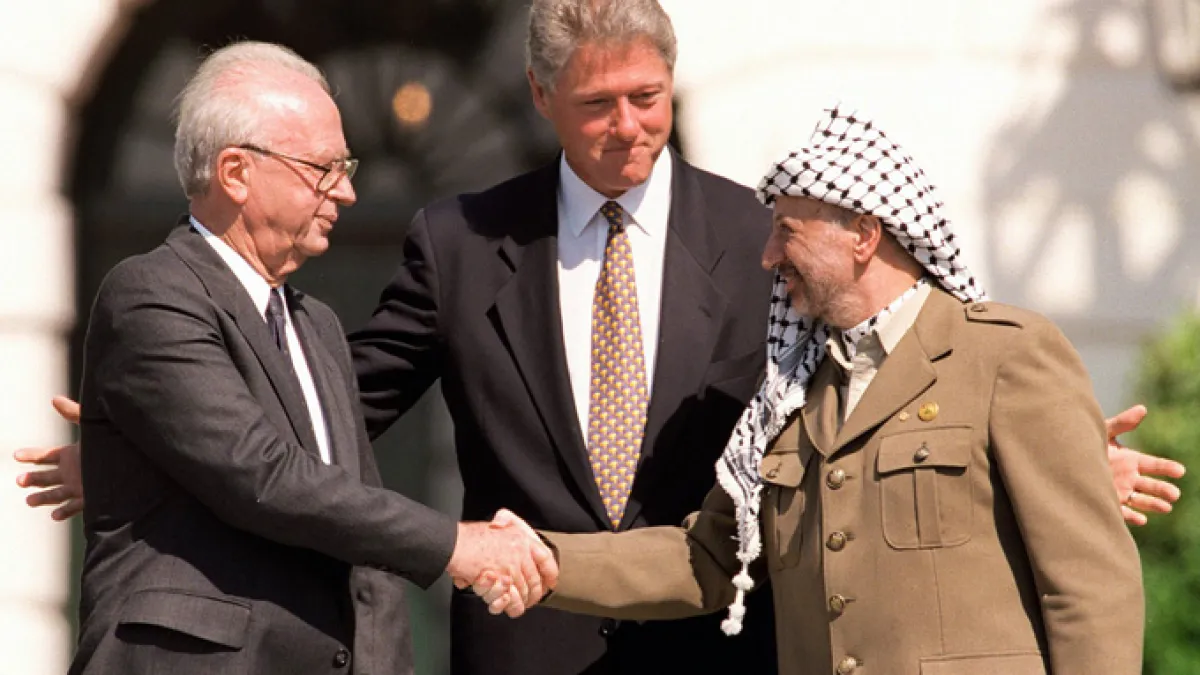
The Norwegian diplomat who was a key architect of the 1993 Oslo Accords is facing a storm of corruption and blackmail allegations after new documents revealed he was deeply embedded in the inner circle of late sex offender and financier Jeffrey Epstein.
Terje Rod-Larsen, a central figure in the Middle East “peace process” in the 1990s, is implicated in newly released United States Justice Department files and Norwegian media investigations that expose a relationship involving illicit loans, visa fraud for sex-trafficked women, and a beneficiary clause in Epstein’s will worth millions of dollars.
The revelations have sent shockwaves through the diplomatic community and led to the resignation of Rod-Larsen’s wife, Mona Juul – herself a pivotal figure in the Oslo negotiations – from her post as Norway’s ambassador to Jordan and Iraq this month. Her security clearance was also revoked.
Palestinian leaders are now questioning whether Oslo’s foundational agreements of the two-state solution were brokered by a mediator vulnerable to elite blackmail and foreign intelligence pressure.
The plan was heralded in the Western world at the time, and in the 30 years since, has been trampled on by successive Israeli governments, with the far-right leadership now openly pushing for annexation of the occupied West Bank.
Investigations by the Norwegian broadcaster NRK and newspaper Dagens Næringsliv (DN) detail how Rod-Larsen used his position as president of the International Peace Institute (IPI) think tank in New York to launder the reputation of Epstein’s associates.
According to the files, Rod-Larsen wrote official letters of recommendation to US authorities to secure visas for young Russian women in Epstein’s orbit, claiming they possessed “extraordinary abilities” suitable for research roles.
In reality, these women were often models with no academic background who were allegedly trafficked and abused by the financier. One victim told NRK she believed Epstein sent her to Rod-Larsen’s institute “to manipulate” her, while another described how the diplomat facilitated her visa after a direct request from Epstein’s assistant.
The transactional nature of the relationship was explicit. Documents show Epstein loaned Rod-Larsen $130,000 in 2013. More damningly, reports indicate that Epstein’s last will and testament included a clause bequeathing $5m each to Rod-Larsen’s two children – a total of $10m.
‘Oslo was a trap’
For Palestinians living under the reality of the failed agreements Rod-Larsen forged, the scandal offers a disturbing explanation for a “peace process” that many believe was rigged.
Mustafa Barghouti, general secretary of the Palestinian National Initiative political party, told Al Jazeera he was “not surprised at all” by the corruption allegations.
“We never felt comfortable with this person from the very first moment,” Barghouti said. “Oslo was a trap … and I have no doubt that Terje Rod-Larsen was being effectively influenced by the Israeli side all along.”
Barghouti argued that the revelation of millions of dollars potentially flowing from a Mossad-linked figure like Epstein to the Rod-Larsen family suggests the corruption was “directed to serve Israel’s interests against the interests of the Palestinian people”.
The ties between the disgraced Epstein and Israel have come into sharp focus after the release of millions of documents.
The documents have revealed more details of Epstein’s interactions with members of the global elite, including former Israeli Prime Minister Ehud Barak. But they also document his funding of Israeli groups, including Friends of the IDF (Israeli army), and the settler organisation the Jewish National Fund, as well as his ties to members of Israel’s overseas intelligence services, the Mossad.
The missing archive
The scandal has reignited calls in Norway to open the “private archive” Rod-Larsen kept regarding the 1993 secret negotiations.
Media investigations have revealed that documents from the critical period between January and September 1993 are missing from the official Foreign Ministry archive. Critics argue these missing files could obscure the extent to which personal leverage or blackmail played a role in the concessions extracted from the Palestinian leadership during the secret talks.
Governing by blackmail
Analysts argue the Rod-Larsen case is symptomatic of a wider system of global governance driven by systematic blackmail and intelligence operations.
Wissam Afifa, a political analyst based in Gaza, drew a parallel between the exploitation of minors on Epstein’s island and the geopolitical treatment of Palestinians.
“We, as Palestinians, were treated as minors … considered as having no right to demand our rights,” Afifa said. “Today we discover that a large part of the international system is essentially ‘Epstein Island’”.
Afifa suggested that the “silence” of the international community regarding the current genocidal war on Gaza could be linked to similar networks of influence and extortion.
“The world was managed from Epstein’s island … in dark rooms,” Afifa added. “We are victims of the influence network that Epstein managed with politicians, leaders and states”.
As Norwegian authorities, including the economic crime unit Okokrim, open investigations into the scandal, the legacy of the diplomat who once shook hands on the White House lawn lies in tatters, casting a long shadow over the history of deeply flawed Middle East peacemaking.
Israeli government moves to change rules around land registration in the West Bank, making it easier for Israeli Jews to buy property in the illegally occupied territory, are raising alarm among Palestinians, fearful that the new rules will establish defacto Israeli annexation.
The Israeli cabinet announced the decisions on Sunday. In addition to allowing Jews to buy property in the West Bank – a Palestinian territory that Israel has occupied since 1967 in defiance of international law – the Israeli government has also ordered that land registries in the West Bank be opened up to the public.
That means that it will be easier for Israelis looking to take territory in the West Bank to find out who the owner of the land is, opening them up to harassment and pressure.
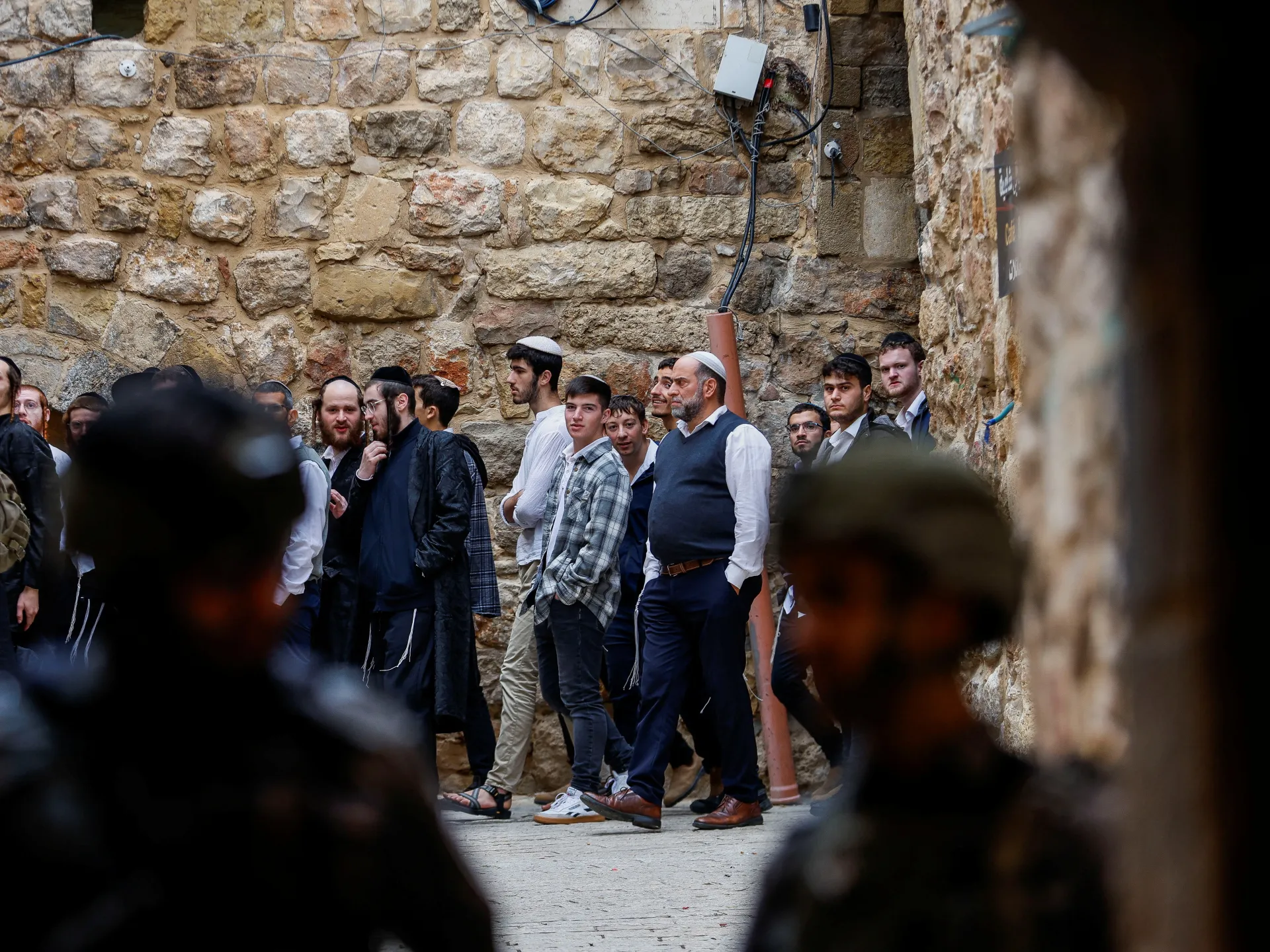
The cabinet also decreed that authority over building permits for illegal Jewish settlements in Hebron, and the Ibrahimi Mosque compound, would pass to Israel from the Palestinian Hebron municipality.
Moataz Abu Sneina has seen Israel’s efforts to seize Palestinian land first hand. He is the director of the Ibrahimi Mosque in Hebron, a Palestinian national symbol and an important Islamic holy site due to its connection to the Prophet Ibrahim, also known as Abraham.
Abu Sneina said that the latest Israeli decisions reflect a clear intention to increase Israeli control over Hebron’s Old City, and the Ibrahimi Mosque compound.
“What is happening today is the most serious development since 1967,” Abu Sneina said. “We view it with grave concern for the Old City and the Ibrahimi Mosque, which is the symbol and beating heart of Hebron, and the shrine of the patriarchs and prophets.”
The Ibrahimi Mosque site is also revered by Jews, who refer to it as the Tomb of the Patriarchs.
An Israeli Jewish settler killed 29 Palestinians after opening fire on Muslims praying at the mosque in 1994. Shortly afterwards, Israeli authorities divided the site into Jewish and Muslim prayer areas, and far-right Israeli settlers continue to strengthen their control over areas of Hebron.
Despite only numbering a few hundred, the settlers have taken over large areas of the city centre, protected by the Israeli military.
Abu Sneina explained that Israel has repeatedly attempted to strengthen its foothold inside Hebron and the mosque, and that the latest government moves are a continuation of Israeli policy that has only increased since the October 2023 start of Israel’s genocidal war on Gaza.
“This has taken the form of increased settler incursions, restrictions on worshippers, control over entry and exit, and bans on the call to prayer – all part of a systematic policy aimed at complete control over the holy site,” Abu Sneina said.
“[Israel] continues to violate all agreements, foremost the Hebron Protocol, closing most entrances to the mosque and leaving only one fully controlled access point,” he added. “This paves the way for a new division or an even harsher reality than the temporal and spatial division imposed since the 1994 massacre.”
Taking over Hebron
Mohannad al-Jaabari, the director of the Hebron Rehabilitation Committee, a Palestinian organisation focused on the restoration of Hebron’s Old City, said that the Israeli government was already increasing its presence on the ground, in an effort to take control of the city.
He pointed to the confiscation of shops belonging to the Hebron Municipality in the Old City, the construction of dozens of illegal settlement units, and the reconfiguration of water pipes by connecting them to an Israeli water company’s network, creating what he described as “a massive apartheid system”.
Al-Jaabari warned that the ultimate goal is to establish a Jewish quarter linking settlements to the Ibrahimi Mosque by emptying Palestinian neighbourhoods of their residents.
“All Hebron institutions are preparing for a difficult phase,” he said. “We are bracing for a fierce attack on Palestinian institutions, foremost the Rehabilitation Committee.”
The Israeli government’s latest decisions open the door for what has happened in Hebron to happen elsewhere, with Israeli settlers establishing a presence in other Palestinian cities, forcing locals out, experts say.
Nabil Faraj, a Palestinian journalist and political analyst, called the Israeli government’s moves “dangerous” and added that they “have driven the final nail into the coffin of the peace process”.
He explained that Israel is reengineering the geographic landscape of the West Bank, expanding infrastructure to serve settlements, and seeking to strip the Palestinian Authority of administrative and security control.
The Hebron model
Palestinians in Bethlehem are now worried that they will get a taste of what Hebron has already experienced.
One of the Israeli cabinet’s decisions on Sunday stipulated that the Bilal bin Rabah Mosque in the city, known to Jews as Rachel’s Tomb, would be placed under Israeli administration for cleaning and maintenance, after previously being under the jurisdiction of the Bethlehem municipality. The mosque’s cemetery has also been affected.
“It will affect the living and the dead,” said Bassam Abu Srour, who lives in Bethlehem’s Aida refugee camp. “Annexing the area would prevent burials and visits to the Islamic cemetery. This is extremely serious and completely unacceptable to us.”
In Bethlehem, Hebron, and the rest of the West Bank, Palestinians feel powerless to stop what they view as a creeping annexation.
Mamdouh al-Natsheh, a shop owner in Hebron, said he now has a growing sense that what is unfolding is an attempt to impose a permanent reality.
“The city is being taken from its people step by step,” he said. “Daily restrictions are turning it into a fixed policy that suffocates every detail of life.”
He added that the deepest impact is on children and young people, growing up in a city that is “divided and constantly monitored”, stripping them of a natural sense of the future.
“I fear the day will come when we are told this area has been officially annexed, and that our presence depends on permits,” al-Natsheh said. “In Hebron, a house is not just walls – it is history and identity. Any annexation means the loss of security and stability.”
Leqaa Kordia’s family say they were left in the dark when the 33-year-old was rushed from an immigration detention centre in Texas to a nearby hospital late last week.
For more than 12 hours, Kordia’s family and legal representation said they were given no information about her whereabouts and condition. Her cousin, Hamzah Abushaban, said the family was “stonewalled, like hardcore”, as they searched for answers.
Recommended Stories
list of 3 itemsend of list
“Full transparency: Many people in her family thought she might have died, especially with the secrecy of her condition,” Abushaban told Al Jazeera. “Sometimes, silence speaks for itself.”
Her family and legal team confirmed on Tuesday that she has been released from the hospital. Kordia had suffered a seizure, but her family has only had fleeting contact with her since the medical emergency.
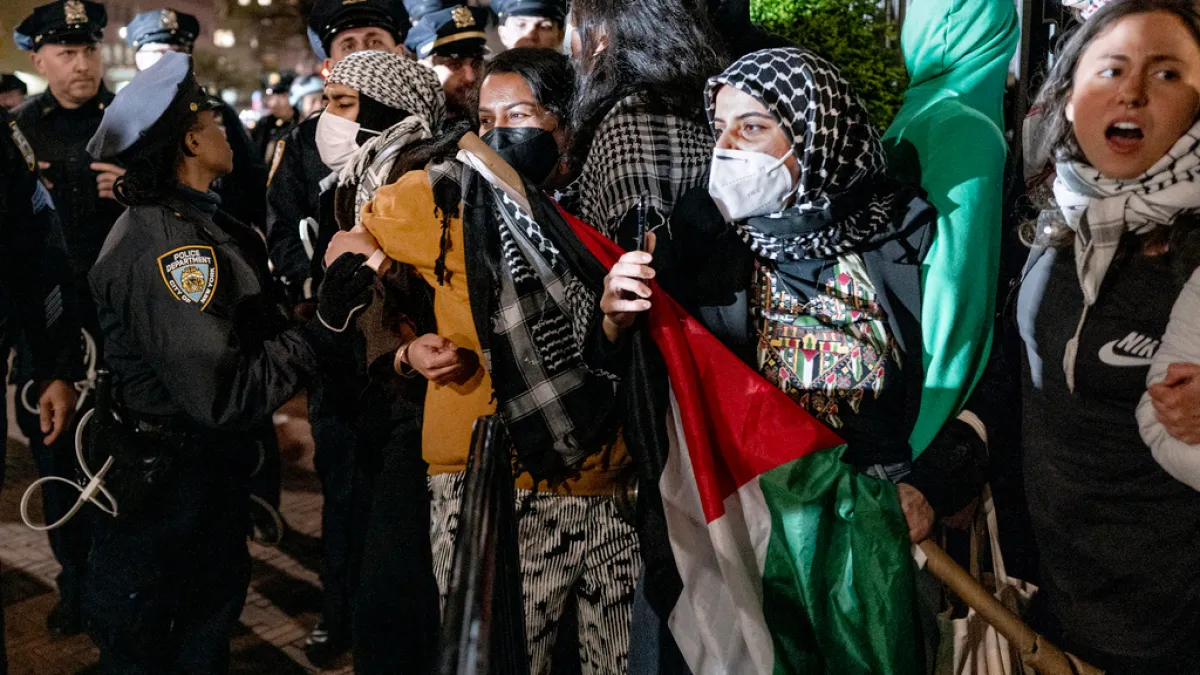
The ordeal is the latest turn in Kordia’s nearly yearlong detention, which began when she was among several protesters targeted by immigration officials for taking part in pro-Palestine demonstrations at Columbia University in 2024.
Kordia remains the only person targeted in connection with the demonstration who is still in immigration detention.
Personal losses helped inspire her protest: Nearly 200 members of her family have been killed in Israel’s genocidal war on Gaza.
Her recent medical emergency underscores the dangers she faces from her continued detention, not to mention the urgent need for her release, according to Abushaban.
“She’s a fighter, but she’s not fooling anyone,” he said. “She’s still very sick”
‘Arbitrarily detained’
On Monday, Amnesty International joined calls for Kordia’s release, echoing her family’s assertion that she is being unfairly targeted for her pro-Palestine advocacy.
“She has been arbitrarily detained for over ten months for exercising her rights to free speech and protest,” Justin Mazzola, the deputy director of research at Amnesty International USA, said in a statement.
“The Trump administration must stop playing cruel political games with Leqaa’s life. Leqaa Kordia must be immediately released, and there must be accountability for the flagrant violation of her human rights.”
Kordia’s lawyers have also alleged unjust treatment, noting that federal judges had twice ruled she was eligible to be released on bond.
Each time, her release has been blocked after immigration officials filed “discretionary stay” requests to keep her in custody while the government appealed.
Since March 2025, the administration of President Donald Trump has targeted a range of student activists for deportation. They include Mahmoud Khalil and Mohsen Mahdawi, both of Columbia University, and Rumeysa Ozturk, who attended Tufts University in Massachusetts.
But those pro-Palestinian student activists have all successfully petitioned for their release as their cases continue in immigration court, though courts have signalled that they could be taken back into custody.
Kordia, however, has not had that same success.
Kordia came to the US in 2016 from the town of Ramallah in the occupied West Bank. Initially, she arrived using a visitor’s visa, later transitioning to a student visa.
Eventually, she applied for permanent residency through her mother, a US citizen residing in New Jersey.
But her legal team has said she was wrongly advised by a trusted mentor that the initial approval of her application meant she had legal status. She subsequently allowed her student visa to lapse.
Immigration officials have, in turn, maintained that Kordia was detained for overstaying her student visa, not for her pro-Palestine advocacy.
However, in an initial news release announcing Kordia’s arrest in March 2025, the Department of Homeland Security suggested that she and a second protester – who allegedly “self-deported” – were targeted for their advocacy.
“It is a privilege to be granted a visa to live and study in the United States of America,” Homeland Security Secretary Kristi Noem said in the release.
“When you advocate for violence and terrorism, that privilege should be revoked, and you should not be in this country.”
‘Intentionally dehumanising’
In his statement on Monday, Mazzola accused immigration officials of showing “blatant disregard” for Kordia’s human rights in detention, pointing to the deterioration of her health.
Kordia has been held at the Prairieland Detention Facility, some 2,400km (1,500 miles) away from her family in New Jersey.
Laila El-Haddad, an author and advocate, said she visited Kordia in December, finding her “very thin, very gaunt” as she complained about unsanitary conditions and a lack of nutritious food at the crowded facility.
“She talked about this being a place that is intentionally dehumanising; that aims to strip her and others of their dignity and their humanity,” she told Al Jazeera.
Kordia’s lawyers and family, meanwhile, said she regularly suffers dizzy spells, fainting and other signs of subpar nutrition.
Still, El-Haddad found that Kordia remained upbeat, and she described the 33-year-old as a pillar of support for other detainees.
“She’s very humble. She kept talking about how ‘I’m not a leader or an activist,’” El-Haddad remembered.
El-Hadded added that Kordia’s case has not gotten as much attention as those of other student protesters, but her story is just as powerful.
“She wasn’t a public-facing activist or speaker in the way some of the other [targeted protesters] were,” El-Hadded explained.
“But she found herself in a position and felt compelled [to protest] because of her own humanity and because she was a person with a deep moral compass and consciousness to act and to speak out.”
Abushaban said he has felt Kordia’s absence acutely at family events. It has been a year of missed birthdays, holidays and other gatherings.
He called for US officials, regardless of political affiliation, to have empathy for her plight.
“I was born and raised here, and the rest of my family were all born and raised here,” he said. “And just because we are Palestinians, we still have to feel suppressed in this country.”





![Eman Hassaneh and her 10-year-old son, Zaid [Al Jazeera]](https://i0.wp.com/www.aljazeera.com/wp-content/uploads/2026/02/Eman-Hassaneh-and-her-son-Zaid-2-1770951543.jpg?w=640&ssl=1)
![Abu Zaid al-Hajj with his twin sons, Muhammad and Ahmed, age 10 [Al Jazeera]](https://i0.wp.com/www.aljazeera.com/wp-content/uploads/2026/02/Abu-Zaid-Al-Hajj-with-his-sons-Muhammad-and-Ahmed-2-1770951593.jpg?w=640&ssl=1)