Thursday marks 30 days since Israel’s foreign minister ordered the closure of the UK consulate in occupied East Jerusalem.
Published On 8 Oct 20268 Oct 2026
Workers at the UK consulate in occupied East Jerusalem have removed its signage as the Israeli shutdown deadline arrives, further damaging strained ties between allies.
Journalists from the Reuters news agency saw workers remove a plaque reading “British Consulate General” from the building on Thursday, as well as another sign for its consular section. The UK flag was still flying over the building.
Recommended Stories
list of 3 itemsend of list
Thursday marks 30 days since Israeli Foreign Minister Gideon Saar ordered the closure of the consulate in occupied East Jerusalem. The move was in response to the UK’s wave of sanctions on illegal Israeli settlements, including a ban on importing goods made there.
The United Nations and most countries consider the settlements illegal under international law. Israel disputes this.
The United Kingdom threatened to expel 27 Israeli diplomats if Israel proceeded to close the consulate in occupied East Jerusalem, according to unverified Israeli media reports.
The consulate has not responded to an immediate request for comment.
Israel has been adamant the consulate will close even as the UK has sought to keep it open, including sending the country’s top national security adviser to Israel last week for talks.
The UK’s presence in the city dates back almost 200 years, long before the state of Israel was established in 1948. The closure order does not affect the UK’s embassy in Tel Aviv, which handles diplomatic relations with Israel’s government.
The consulate, in the Sheikh Jarrah neighbourhood of occupied East Jerusalem, handles the UK’s relations with Palestinians in Jerusalem, as well as in the occupied West Bank and Gaza. It also provides consular services to Palestinians.
The UK Foreign Office on Wednesday declined to comment when asked whether the consulate was still operating or if diplomats working there had returned to the UK.
Despite the current strains, the UK and Israel are close economic, security and intelligence partners.
Saudi civil aviation authorities say Houthi attacks on Abha and King Khalid International airports have killed three civilians, including two women, and injured 36 others.
Comments by one of Israel’s most senior ultra-Orthodox rabbis postulating that Jews may have been better off without a state have prompted controversy in the country.
In footage broadcast by Channel 12 on Monday, the 96-year-old Rabbi Dov Lando, the spiritual leader of the Degel HaTorah party, also said that soldiers adhering to “Religious Zionism” killed in Israel’s wars were dying because of what their rabbis had taught them. The remarks, made at a closed meeting at his home in Bnei Brak, have set off a political storm three weeks before Israel’s October 27 parliamentary election.
Recommended Stories
list of 3 itemsend of list
“They are killed because their rabbis teach them a distorted Torah,” Lando said, adding that many military operations are carried out “not for saving lives, but for the honour of the state”.
Lando’s comment came in response to a question about admiration among some ultra-Orthodox Jewish men – who have traditionally refused the military draft – for religious Zionists who combine Torah study with military service.
His comments aren’t new – they were first published in February 2025. However, their reemergence this week comes amid an election campaign in which ultra-Orthodox military service has become one of the sharpest fault lines in Israeli politics.
The Israeli Supreme Court ruled in 2024 that there was no legal basis for ultra-Orthodox seminary students to have exemptions from military service, and the government has since not been able to pass legislation restoring the exemptions. The issue has led to large protests on both sides of the divide.
“The question is not what he said, but why this discourse has been placed at the heart of the Israeli debate three weeks before the election,” Ehab Jabareen, a researcher on Israeli affairs, told Al Jazeera.
Better ‘without a state’
Lando’s party is one of the two factions of the United Torah Judaism (UTJ) alliance, which won seven seats during the last election in 2022, and had been part of Israeli Prime Minister Benjamin Netanyahu’s government before its ministers resigned last year.
The bloc did continue to intermittently support the coalition government, however, and Netanyahu has been wary of removing the military exemption – despite widespread opposition to it from many in Israel – out of fear that the UTJ and similar parties would remove their support completely.
Along with his role within Degel HaTorah, Lando is also one of the spiritual leaders of Israel’s Lithuanian ultra-Orthodox community, which makes up roughly a third of the country’s estimated 1.45 million ultra-Orthodox Jews, also known as Haredim.
In the footage, he goes further. “It is possible to live well with the Arabs without a state,” he says, adding that international or Palestinian rule would have been “the best situation”.
Zionism, he argues, “caused the Arabs to hate us” and brought physical as well as spiritual disaster on the Jewish people. He describes secular Israelis as having built “a state of apostasy and heresy”.
The comments reflect non-Zionist and anti-Zionist positions that used to be dominant within ultra-Orthodox Judaism, but take on an overt reference to the possibility of living within a non-Zionist state, something that is even more controversial in Israel.
Ibrahim Khatib, a conflict studies scholar at the Doha Institute for Graduate Studies, said Lando’s remarks drew a line between Zionism and Judaism “from inside the Jewish community itself”, at a time when the official Israeli establishment “tries to bind them together”.
They also put to the test the narrative that Jewish communities in Arab societies were in danger and threatened, and that the Zionist movement came to “save them” at the formation of the state of Israel in 1948, he told Al Jazeera. However, Khatib cautioned that the ultra-Orthodox polity in Israel “is right-wing, its leaders hold right-wing positions, and some of them have made clearly offensive statements about Arabs and Palestinians”.
Political ammunition
Israeli opposition leaders moved quickly after the footage of Lando emerged this week, taking it as an opportunity to attack a figure from a party within Netanyahu’s electoral bloc.
Former Prime Minister Naftali Bennett – one of Netanyahu’s main challengers in the upcoming elections – called the remarks “anti-Semitic, anti-Zionist and anti-[Israeli military]”, but aimed his fire at Netanyahu and Finance Minister Bezalel Smotrich, who he said “back [Lando] and funnel tens of billions of shekels to him and his friends”.
Gadi Eisenkot, another opposition leader whose Yashar party has campaigned on enforcing the military draft, urged every Zionist party to pledge not to sit with Lando’s party.
Netanyahu, who publicly rejected Lando’s remarks in July when the rabbi accused the Religious Zionism movement of “incitement to murder” for its support of the drafting of religious seminary students to the military, has not yet commented.
Yair Golan, leader of the Democrats, put it bluntly: “Netanyahu is silent because without Rabbi Lando and his emissaries, he has no government.”
Jabareen sees Netanyahu’s silence as “calculated”.
“If Netanyahu attacks Lando forcefully, he pays a price with the Haredim he needs to form a government,” he said. “If he stays silent, he hands his rivals material to tell right-wing voters that the man who speaks of Zionism and security depends on a religious leadership that doubts Zionism itself.”
Who fights and who dies
The military draft of the ultra-Orthodox, Jabareen added, has turned “from an old dispute over religion and state into a question about the Israeli [social] contract itself: Who fights? Who dies? And who gets the exemptions, the budgets and the political influence in return?”
Mohammad Abu Rumman, an academic adviser at the Politics and Society Institute in Amman, said the significance of Lando’s remarks lay in the question that prompted them. The example of a young religious man who combines Torah study with military service, he said, “raises a question inside the ultra-Orthodox world itself: Why don’t we do the same?”
“When Lando describes their teaching as a distorted Torah, he is trying to close the door on emulating them,” Abu Rumman told Al Jazeera. “His words are aimed at his own audience as much as at his opponents.”
But Jabareen argued that the row exposes a rift more dangerous for Netanyahu than the familiar clash between secular and religious Israelis, because it runs through the right itself. Religious Zionists have paid a heavy human price in the war, while the ultra-Orthodox leadership still rejects conscription. Caught between those who pay the price of war and those who refuse to, Netanyahu needs both, and cannot satisfy them at once.
Whether the outrage over Lando’s comments translates into votes is less clear. Abu Rumman expects the remarks to “reinforce existing positions more than change voters’ choices”. The space where they could matter, he said, lies among right-wing voters who serve in the army and resent Netanyahu’s protection of ultra-Orthodox demands.
“If Netanyahu needs these parties to build a majority, that need will not disappear because of a rabbi’s remarks, however shocking,” Abu Rumman said. Netanyahu is also not the UTJ’s only suitor: Channel 12 reported that, frustrated by his failure to secure a law exempting ultra-Orthodox men from military service, the party would not rule out or oppose a government led by Eisenkot.
“The Israeli right has managed to bring under one political roof two currents with almost contradictory visions of the Jewish state,” Jabareen said. “One sanctifies the state and the expansion of its sovereignty. In the other, one of its most important rabbis can say it might have been better had the state never been founded.”
London, United Kingdom – Claire, 52, lives in the Scottish countryside, not far from Edinburgh.
She describes her work as “low-level administration” and does not use social media. She lives a quiet life with her dog, reading and baking in her spare time. Until three years ago, she did not consider herself political.
Recommended Stories
list of 4 itemsend of list
Now, she faces 14 years in prison for her suspected show of support for Palestine Action.
Claire, who requested Al Jazeera withhold her surname, is one of the many people in the United Kingdom who, until three years ago, did not consider themselves activists.
But as the genocide in Gaza was livestreamed, many have rallied around the cause of Palestinian solidarity.
Organisations like Defend Our Juries, Artists for Free Palestine, Workers for Free Palestine, and virtually every other insert-profession-here for Palestine have cropped up across the UK.
In the summer of 2023, Claire read I Shall Not Hate by Dr Izzeldin Abuelaish, a Palestinian physician in Gaza who lost his three daughters to Israeli tank fire. Not long after finishing the book, Claire watched the aftermath of October 7 unfold online.
“For me, there wasn’t a delay between ‘Israel has a right to defend itself’ and then lies,” she told Al Jazeera.
She went to a pro-Palestine rally on Armistice Day, calling for a ceasefire, and “was horrified” by then Home Secretary Suella Braverman, who called the protests “hate marches”.
“I was determined not to ignore [Palestine],” she says.
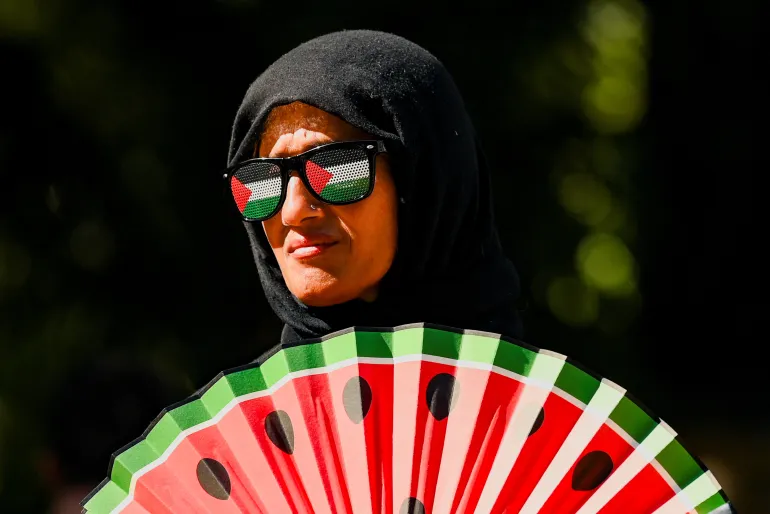
A protester wears eyewear in the colours of the Palestinian flag and holds a fan featuring a watermelon design during a rally organised by Defend Our Juries in Parliament Square, London, Britain, August 9, 2025 [Jaimi Joy/Reuters]
She continued to march, writing letters to lawmakers and fundraising for various Palestinian aid programmes.
In August 2025, she began publicly protesting against the proscription of Palestine Action with Defend Our Juries, the group behind a campaign of civil disobedience aimed at lifting the ban. To date, more than 3,000 people have been arrested for showing support for the pressure group that was banned in 2025.
Earlier this year, police arrived at her door to arrest Claire under Sections 11 and 12 of the Terrorism Act: “Being a member of a proscribed organisation and encouraging others to join a proscribed organisation.”
“I’ve never been in trouble before,” she says. “I’m not backing down.”
A police officer holds a pro-Palestinian protester during a demonstration outside the Parliament, organised by campaign groups including Palestine Solidarity Campaign, Avaaz and Parents for Palestine, calling for sanctions on Israel over ongoing hunger among Gaza’s war-struck population, in London, Britain, June 4, 2025 [Isabel Infantes/Reuters]
Marji, 70, lives in Colchester and had a similar feeling after hearing Braverman’s words.
“I had never been to a protest in my life,” she says, until she carried a “Ceasefire Now” sign at an Armistice Day march in 2023.
“I knew it wasn’t a ‘hate march’.”
Marji’s father served in the British Army, and her father-in-law was in the Royal Air Force and taken as a prisoner-of-war in Japan during World War II.
“Our parents’ generation fought fascism,” she says. “Now Britain is breaking British law.”
Marji, who also requested to be identified only by her first name, had a successful career in financial services, while her husband held an executive-level role.
They are now retired grandparents.
In July, they were arrested in Westminster under Section 12 of the Terrorism Act and are now waiting to see if charges will be laid.
“We’ve had to decide … is it safe to have grandchildren here? When the police could come to the door?”
Her children remain supportive.
“I think they’re proud of us, even if there’s been fear on their part.”
People protest on Vauxhall Bridge during a march in solidarity with Palestinians in Gaza in London, Britain, November 11, 2023 [Kevin Coombs/Reuters]
Across sectors, from the arts to railways, financial services and administration, Britons have risked professional and legal repercussions for the sake of Palestinian solidarity.
Hundreds of thousands have taken to the streets to protest against Israel’s genocidal campaign in Gaza and what they see as the UK’s role in the conflict. They have urged the UK government to cease all arms sales to Israel and cut diplomatic and trade ties as the genocide goes on in Gaza and violence escalates in the occupied West Bank.
This week, tensions have flared again as the Metropolitan Police warned pro-Palestine protesters against rallying on the three-year anniversary of October 7. The force said on Wednesday that five people were arrested outside the Board of Deputies of British Jews in north London for “inciting racial hatred, involving allegedly shouting or chanting slogans calling for Intifada”.
Israel’s latest war on the Gaza Strip – it has waged several since 1948 – began after Hamas, the group that governs Gaza, attacked southern Israel. About 1,200 people were killed that day, while more than 240 were taken captive, including Israeli soldiers, citizens and some foreign nationals.
Since October 7, 2023, Israel’s relentless bombardment has killed more than 74,000 people and devastated Gaza, making life for survivors nearly impossible. The small territory is now home to the largest group of child amputees in modern history.
“The narrative that we had grown up with was wrong – that the people who were there and living peacefully have been cast as ‘terrorists’, when they have suffered terrorism,” Marji says.
A demonstrator argues with the police as students take part in an inter-university march organised by the University of London Coalition in support of Palestinians, on the third anniversary of October 7, 2023 in London, Britain [Carlos Jasso/Reuters]
“The government participation, complicity, and their lies. Their gaslighting makes people more determined,” says Claire.
As the legal dangers and rhetorical backlash mount against pro-Palestine protesters, Marji, whose maternal grandmother was Jewish, is only more resolved: “We knew that saying ‘stop the genocide’ doesn’t mean you’re an anti-Semite. We’re not stupid, we can differentiate between Jewish people and people who support illegal occupation.”
Workers for Free Palestine, which includes a range of trade unions, formed in late 2023 and soon began holding protests.
“Many people oppose how their labour is used to prop up an apartheid state, but have been told there is nothing they can do as individuals,” a spokesperson told Al Jazeera.
Many workers are nervous to speak out against their workplace’s role in producing weapons, their investments in Israel, or other ways of enabling Israel’s war.
“Many are unfamiliar with their rights as workers and are afraid of the repercussions of speaking up – and these repercussions can be very real,” the spokesperson said.
Still, for some, there is not just resolve but optimism.
“Doing nothing makes us feel sick, angry and powerless,” says Marji. “I hope people will wake up and see how our own civil liberties … are being eroded to protect the interests of Israel.”
Israeli air strike kills Palestinian Civil Defence rescue volunteer as he was travelling to help wounded people near Kamal Adwan Hospital in Beit Lahiya, northern Gaza, a medical source says.
Published On 7 Oct 20267 Oct 2026
Israeli attacks have killed at least four Palestinians, including a rescue worker, and wounded several others across Gaza.
The Palestinian Civil Defence rescue volunteer was killed in an air strike as he was travelling to help wounded people near Kamal Adwan Hospital in Beit Lahiya, northern Gaza, a medical source said on Wednesday.
Recommended Stories
list of 3 itemsend of list
The Civil Defence identified the victim as Mohamed Tamous.
Meanwhile, an Israeli drone strike in the southern city of Khan Younis killed Hisham Ibrahim Abu Mustafa, 60, and injured several others, Nasser Hospital said.
The body of a 17-year-old Palestinian was also brought to Nasser Hospital after he was killed in an Israeli drone strike in the Qizan Abu Rashwan area south of Khan Younis, Turkiye’s state news agency Anadolu reported, citing a medical source.
A teenage boy died from wounds sustained last month when Israeli forces opened fire east of Khan Younis, Anadolu reported, citing a medical source.
Also on Wednesday, a girl was injured by Israeli gunfire directed at displaced Palestinians’ tents in the Al-Amal neighbourhood, Anadolu reported.
Additionally, in Khan Younis, the Israeli military carried out two demolitions in the northeastern and eastern parts of the city.
The military also carried out demolitions east of Gaza City’s Tuffah neighbourhood.
Israel has killed more than 74,245 Palestinians since it launched its genocidal war on Gaza in response to the Hamas-led October 7, 2023, attack on Israel.
Al-Awsaj, occupied West Bank – On September 23, weeks before Israel’s parliamentary elections, ministers and lawmakers gathered on an occupied West Bank hilltop to inaugurate a new settlement, Metzoke Eretz, illegal under international law. Finance Minister Bezalel Smotrich used the ceremony to salute the settler outpost that made the eventual settlement possible.
“The first pioneering settlers who were here on the farm… we will lift them up as our greatest joy,” Smotrich said. “It shows that the method works: establish a farm, seize the land, prepare it, turn it into a community, move to the next point. There are many, many such heroes – those who prove they are not doing real estate. They are doing Zionism.”
Recommended Stories
list of 3 itemsend of list
Metzoke Eretz was previously an outpost – the name given to the Jewish settlements illegal even under Israeli law – called Netzah Harel, established in 2023 in the middle of al-Muarrajat, a Bedouin community on private Palestinian land east of Ramallah. Alia Mleihat, 29, and others from the community remember those settlers well. “Of course, this outpost played a major role in displacing the Palestinian Bedouin communities in al-Muarrajat and the areas east of Ramallah,” said Alia, now living in a tent in al-Awsaj, a few kilometres away, after her forced displacement in July 2025. “[The Netzah Harel settlers] took part in every attack the settlers carried out on families, and confiscated sheep, under the protection of the Israeli police and army.”
Dror Etkes, founder of Israeli NGO Kerem Navot, said Smotrich’s description of his “method” was spot-on – except for one omission. “The political discourse skips the [Palestinian] expulsion chapter,” said Etkes, suggesting Smotrich and other politicians avoid doing so explicitly to avoid potential scrutiny from international criminal courts. “They want it to happen, and they know that it happens, and they let it happen.”
Haaretz reported that Metzoke Eretz is one of 19 outposts legalised by the Netanyahu government after nearby Palestinians were violently expelled.
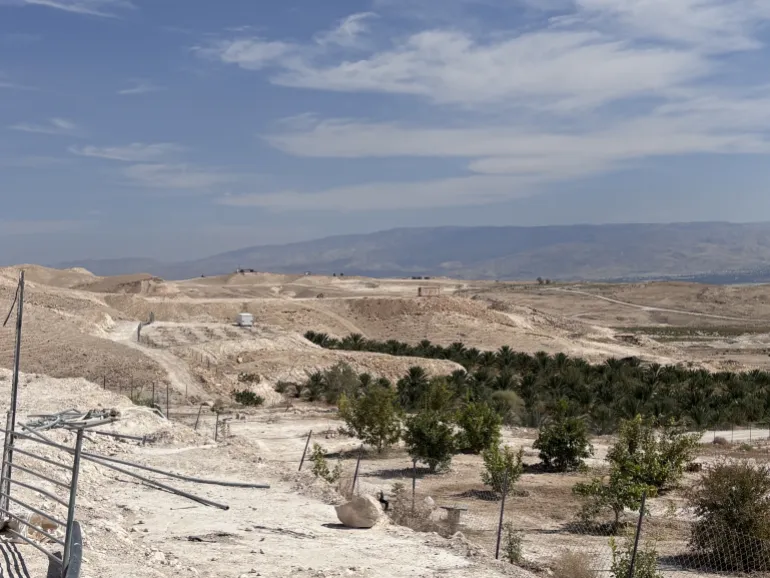
The view from Muhammad Ghawanmeh’s home in al-Awsaj, looking out towards an Israeli outpost on a hill in the background [Al Jazeera]
‘Not a single moment of joy’
Jamal Mleihat, Alia’s 45-year-old uncle, sits with eight relatives nestled inside a bare concrete-block house on the ridge in al-Awsaj, with his daughter Sewar hanging off his lap.
Below the ridge, rows of young trees climb a cultivated slope towards a factory at the foot of the hills. The ridge itself is rock and dust, now home to about 25 families from al-Muarrajat, among others forcibly displaced in the past three years.
“Before October 7 [2023 Hamas attack on Israel, and Israel’s subsequent genocidal war on Gaza], we were in the pastures – no harassment, we moved around freely,” said Jamal, a father of seven. “We had healthcare. We had a school. We had water in the same encampment. Life was a million times better than this.”
Since October 7, the Israeli government has stepped up its raids on the occupied West Bank, while settlers have largely been given free rein to pursue a pogrom against Palestinians, with little pushback from within Israel.
Just below Jamal’s shelter, alone on a slope, Muhammad Ghawanmeh lives with his wife and seven children. His toilet does not work; he relies on water tanks and has almost no electricity. The rocky track to the Mleihats’ area is too steep to drive. He built a fence around the house after recent settler attacks, and now faces constant drone surveillance from Israeli settlers.
Ghawanmeh is from Ras Ein al-Auja, which had been the largest Bedouin community in the central Jordan Valley – so robust that humanitarian coordinators told Al Jazeera in October 2023 that the village’s displacement was unlikely. Instead, its more than 600 Palestinian inhabitants experienced the largest single-community expulsion of Bedouins in the last three years, after repeated attacks by settlers from four surrounding outposts.
“From my childhood, the land was open. The water was open. We were living happily. We’d graze 10 kilometres, 15 kilometres with the sheep, and come back,” he said. “Today we can’t go 500 metres from the house.”
His flock has shrunk from about 300 to roughly 100 physically thinning sheep, which he now must buy fodder for, instead of letting them graze on the land, which he now says is largely forbidden by Israeli settlers and the army.
Jamal Mleihat with his daughter Sewar in al-Awsaj in the occupied West Bank [Al Jazeera]
‘Nothing was left except this’
A few hundred metres beyond Ghawanmeh’s fence, a white trailer and a few containers mark an Israeli outpost, established about six months ago on a hill overlooking Highway 90 and the displaced families along the ridge. Two months ago, Ghawanmeh said, soldiers came to his house and told him he could no longer pass to the highway. The settlers, he said, “are with the army”.
“You leave this place, go to another one, and it follows you – the same problem, unsolved,” Ghawanmeh said. “Every three months, there’s a displacement operation.”
Al-Awsaj barely existed as an inhabited place before, but Bedouin from different depopulated communities have now converged on this barren ridge, overlooking land largely declared – again – off-limits to grazing.
Allegra Pacheco, head of the West Bank Protection Consortium, calls al-Awsaj “basically a refugee camp, an internally displaced camp, that we see in other countries. But here, there’s no safe space. Wherever people like in al-Awsaj go, they’re chased by settlers or their tents are demolished by the Israelis.”
“It’s been very painful to get the authorities, the Palestinian authorities, the international leaders, to recognise that this is a mass displacement happening in front of us, and people have nowhere to go,” she said.
Project of forced transfer
In the West Bank, the United Nations Office for the Coordination of Humanitarian Affairs (OCHA) counts at least 130 Palestinian communities fully or partly displaced by settler attacks and related restrictions since January 2023, and more than 6,400 people uprooted. According to the Palestinian Colonization and Wall Resistance Commission, since October 7, 2023 there have been almost 15,000 attacks by settlers, with 66 Palestinians killed by settlers. OCHA says the rate of settler attacks increased from about three a day before October 7, 2023, to almost seven per day this year.
The increase in displacement after October 2023 can also be seen in the numbers for that year. Nearly 80 percent of all Palestinians displaced by settler violence in 2023 were uprooted after October 7.
A report by Peace Now and Kerem Navot found that Israeli farm outposts had seized roughly 18 percent of the West Bank by the end of 2025. “We’re talking about a land area bigger than the size of the Gaza Strip altogether,” Pacheco said.
“What we’re seeing is a continuous, sustained project of forced transfer and mass destruction,” she said. “Israeli authority demolitions and destructions by the Israeli army, and Israeli civilians – armed groups – carrying out destructions and sowing fear to push people out.”
Israeli NGO B’Tselem’s September report, “The Elimination Project”, links this to Smotrich’s 2017 “Decisive Plan”, which offers Palestinians three choices: live under Jewish supremacy, leave, or face violent repression.
“The Smotrich Plan has been implemented,” Pacheco said. “He laid out exactly what is going on now, and he’s very proud of his success. He now wants to transfer that success to [other areas of the West Bank], and also in the Galilee [an area in Israel with a large population of Palestinian citizens of Israel]. Wherever there are Palestinians living, he wants to make life so difficult that they will leave.”
With Smotrich exercising broad powers over the West Bank through the Settlement Administration within the Ministry of Defence, and leaders in the Israeli West Bank military command increasingly coming from far-right, settler backgrounds themselves, Palestinians across the West Bank describe a deepening symbiosis of military, police, administration and settlers in exacting Palestinian dispossession. “They all work together, like a cell, one completing the other,” said Jamal Mleihat. “The army, the police, the settlers – they’re the ones who displace, they’re the ones who establish the settlement, they’re the ones who take part in the thefts, in everything. And the army covers for them.”
Al Jazeera has reached out to the Israeli authorities for comment on this piece, but has yet to receive a response.
Worse future
Smotrich has withheld part or all of the tax revenues Israel collects for the Palestinian Authority – roughly 60 percent of its income – for much of the past three years. The PA now struggles to provide the most basic of services. In al-Awsaj and elsewhere, that means classrooms that do not open. “The government school is shut down today, no salaries,” Ghawanmeh said.
There is no school bus; families pay for private transport, and “one day they study, one day they don’t, depending on the mood of the driver,” Jamal said. It has left the displaced alone on an inhospitable patch of rock.
“Palestinians have no protection in the West Bank,” said Pacheco. “They are completely vulnerable to assault, attempted murder, arson, invasion of their homes. The Israeli army is supposed to protect them and doesn’t. The Palestinian Authority can’t come in, and the international community is not protecting them.”
“We started to feel there’s no safety anywhere,” Ghawanmeh said. “Fear. Terror. Persecution. Ethnic cleansing. That’s what we feel.”
Amid the dispossession, Ghawanmeh looks out at the unwelcoming land he knows will not be his family’s refuge – only another transient stop. He sees his own brother now only once every month and a half or two. “The threats to Bedouin life have almost become extinction,” he said. “We now live in enclaves, separated.”
“For three years now, the day that’s passing is better than the one that’s coming,” Ghawanmeh said. “Yesterday is better than today. Today is better than tomorrow.”
Three years after the October 7 attacks, the politics of Israeli society has shifted further right, sidelining voices calling for a political settlement with Palestinians. But as Al Jazeera’s Nour Odeh explains, the shift began years before October 7.
Letter from progressive US representatives brings attention to Israeli abuse and detention of Palestinian medical workers.
Published On 6 Oct 20266 Oct 2026
A group of six progressive Congress members in the United States have released a statement condemning Israel’s abuse of Palestinian healthcare workers, including the Gaza doctor Hussam Abu Safia, who has been held in Israeli detention since 2024.
The Tuesday statement draws attention to Israeli attacks on Palestinian medical workers, who have been targeted and detained during the country’s genocidal war on Gaza.
Recommended Stories
list of 3 itemsend of list
It was signed by Representatives Rashida Tlaib, Ilhan Omar, Jesus “Chuy” Garcia, Summer Lee, Pramila Jayapal and Delia Ramirez.
“Over the last three years, the Israeli government has systematically destroyed the health system in Palestine, murdering at least 1,700 Palestinian doctors, nurses, paramedics, and other healthcare workers and destroying dozens of hospitals,” the statement reads.
“It has arrested and arbitrarily detained hundreds of Palestinian healthcare workers, including at least 16 physicians who continue to be held in inhumane conditions.”
Among those detained is Abu Safia, who lawyers say was subjected to abuses such as torture, sleep deprivation and beatings during his detention.
Israeli soldiers arrested Abu Safia in December 2024, after he and other medical workers reportedly refused to evacuate from Kamal Adwan Hospital, where they worked.
No charges have been filed against Abu Safia, and he has not had a trial.
Israeli attacks on health infrastructure in Gaza, including the destruction of nearly all of the strip’s hospitals and medical centres, are one component of what rights groups have depicted as an effort to deprive Palestinians of essential services such as food, water and medical treatment.
Tuesday’s statement argues that such efforts are part of an “intentional policy designed to further occupation, apartheid, and genocide against the Palestinian people”.
That assessment is shared by a growing number of rights organisations, scholars and United Nations officials, who have denounced Israeli actions in the Palestinian strip.
Israeli officials have stated that they target hospitals and medical facilities as part of an effort to attack the Palestinian armed groups that allegedly use such facilities to carry out and coordinate operations.
Such claims have often failed to withstand scrutiny. Israel admitted that its soldiers killed a group of 15 emergency workers in southern Gaza in March 2025, after initially stating that the ambulance convoy had approached soldiers “suspiciously” and claiming, without evidence, that several of those killed were linked to Hamas.
A report by the group Forensic Architecture and Earshot found that Israeli soldiers fired more than 900 bullets as they opened fire on a clearly marked ambulance convoy and killed some of the medics “execution-style” before burying their bodies and their vehicles.
After Israeli soldiers stormed Birzeit University near Ramallah to demolish a stone memorial dedicated to dead students, Rania Washaha, 47, felt the pain of bereavement again.
Her brother, Fadi, 34, was shot in the head by an Israeli soldier near the northern entrance to el-Bireh in the central West Bank in May 2021.
Recommended Stories
list of 4 itemsend of list
His name was among the 38 students from the university killed by Israel and listed on the stone pillar known as the Martyrs’ Monument.
Israeli soldiers raided the university campus at dawn on Monday, accompanied by 10 military vehicles. A bulldozer demolished the pillar, and soldiers took away the marble stone. In its place, the Israelis left a planter containing a fig sapling, bearing the inscription: “Water it twice.”
Targeting the University
This raid marks the fifth Israeli incursion into the campus since the beginning of 2026 and the 28th since 2002.
Birzeit University’s administration condemned the recent raid, describing the destruction of the Martyrs’ Monument as a violation of international law and an attack on education and national memory.
“Bulldozers won’t erase the memory of the martyrs, military vehicles won’t extinguish the light of knowledge, and these assaults won’t break the university’s resolve to pursue its academic and national mission,” a statement by the university pledged.
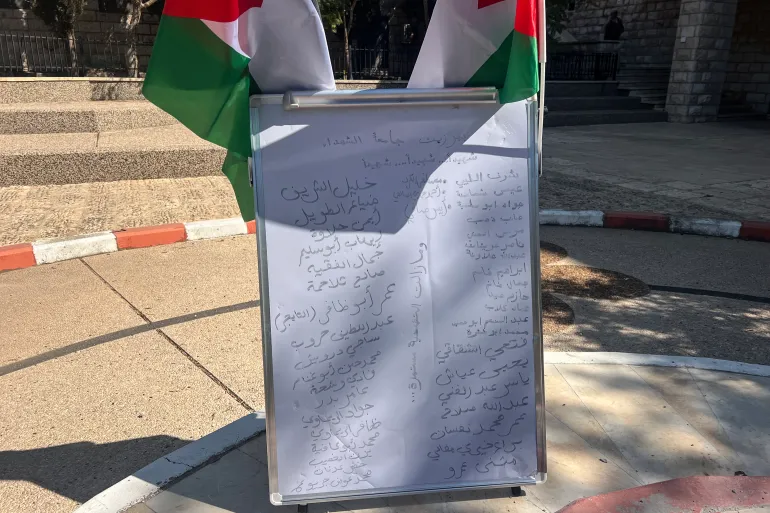
Birzeit University students again wrote the names of martyrs that were inscribed on the memorial [Mohamad Turkman/Al Jazeera]
It came 10 days after another incursion by Israeli forces during the daytime, a day before the start of the new fall semester.
Nardeen al-Memi, the university’s public relations and media officer, told Al Jazeera in the brief minutes of their incursion, Israeli soldiers approached the monument for the first time and photographed it.
The Martyrs’ Monument was erected between 1994 and 1996, bearing the names of students and alumni at Birzeit killed by Israeli forces. The list starts with Sharaf al-Tayyibi, who was shot dead by Israeli forces on the campus in 1984. The names of other students and alumni were added during the years that followed.
“The last name inscribed on the monument was that of student Omar al-Naasan, whom soldiers killed in al-Mughayyir east of Ramallah on September 2 while he was confronting settler incursions,” said Nardeen. “Days after his death, his father came and personally wrote his son’s name on the monument.”
University students organised a protest at the site of the destroyed memorial on Tuesday afternoon, most viewing it as an Israeli attempt to intimidate them.
Sami Adel, a Birzeit student who wanted to use a pseudonym due to his fear of being detained, told Al Jazeera the memorial holds a place in the heart of everyone who has attended the university since the 1990s.
In recent years, Israel has tried to suppress any student activity dedicated to commemorating the martyrs, he said.
“Soldiers detained me for several hours three weeks ago and threatened that if I participated in any political student activity on campus, I would face a long and harsh detention,” he added.
Erasing memory
The removal of the memorial is part of a broader Israeli policy targeting memorials dedicated to Palestinians killed by Israel in the occupied West Bank.
The Israeli far-right has made the issue part of its campaign to erase markers of Palestinian identity.
Zvi Sukkot, a member of the Knesset from the Religious Zionism Party, destroyed one such memorial in the village of Madama, south of Nablus, with a sledgehammer in August. The Israeli military later said that it routinely removes “symbols of incitement”.
The location of the demolished memorial in Birzeit University [Mohamad Turkman/Al Jazeera]
Israeli Finance Minister Bezalel Smotrich submitted a list of approximately 40 Palestinian memorials, proposing their destruction, to Prime Minister Benjamin Netanyahu.
There has been a wider targeting of civic and cultural symbols across the West Bank, particularly in Jenin, by Israeli authorities.
“Jenin Horse”, a monument constructed from the wreckage left behind by an Israeli incursion into the city, was removed. A memorial dedicated to Al Jazeera journalist Shireen Abu Akleh in Jenin was also targeted in 2023.
A cemetery containing the bodies of Iraqi soldiers killed during the 1948 war, also located in Jenin, has been raided by Israelis from illegal settlements.
Other landmarks embedded in the city’s collective memory, including the “Watermelon Roundabout”, have also been targeted.
Crushing resistance
Israel’s targeting of Palestine’s collective memory has coincided with a wider campaign of suppression in the occupied West Bank.
Palestinian universities have been a particular target in this pressure campaign, with campuses raided, students detained, and strict restrictions on activities and events within university grounds.
Israeli authorities are likely focusing on Palestinian universities because they hold a special significance for Palestinian resistance. They historically served as spaces for anti-occupation activism and have been an integral part of the Palestinian political landscape for decades.
Rania Washaha looks at her brother’s photo in her office inside Birzeit University [Mohamad Turkman/Al Jazeera]
Political analyst Mohammed al-Qeeq, who served as president of the Birzeit University Student Council between 2006 and 2007, told Al Jazeera that Israel has targeted writers, influencers, and activists, along with students, to deter any resistance to the occupation.
Universities have historically served as a “fundamental pillar” of Palestinian resilience and identity.
“Israel had also sought to weaken Palestinian political and social cohesion inside universities by deepening divisions between factions and creating chaos”, he said.
Remembering Fadi
For Rania, the memorial served to cement the names of the martyred students in the minds of the next generation of Berzeit students, including her brother’s.
“I cannot deny that I felt a pang of anguish when the memorial was demolished,” she told Al Jazeera. “I realised the goal wasn’t simply to uproot a physical object; I felt the suppressed violence Israel inflicts upon us.”
The memorial, constructed in 1996, stood on the campus when Fadi studied at Birzeit University. He had been arrested multiple times, spending a total of eight years in detention, and Israel denied Fadi the chance to wear a graduation gown.
“He didn’t even complete two years of study due to repeated arrests and injuries from soldiers’ gunfire,” Rania said. “Yet, he loved Birzeit University dearly and would stand by the memorial, contemplating the names of the student martyrs, never knowing that his own name would one day be added to theirs.”
This year, Rania’s son enrolled at Birzeit University as a first-year student. Shortly before classes started last September, an Israeli officer phoned him, threatening him if he participated in any student activities on campus. “Remember what we did to your uncle,” they warned him.
London, United Kingdom– At a meeting organised by a Muslim group in London ahead of a closely watched by-election, candidates from the Green and Liberal Democrat parties made their cases to residents beside empty seats. Their Labour and Conservative peers did not turn up.
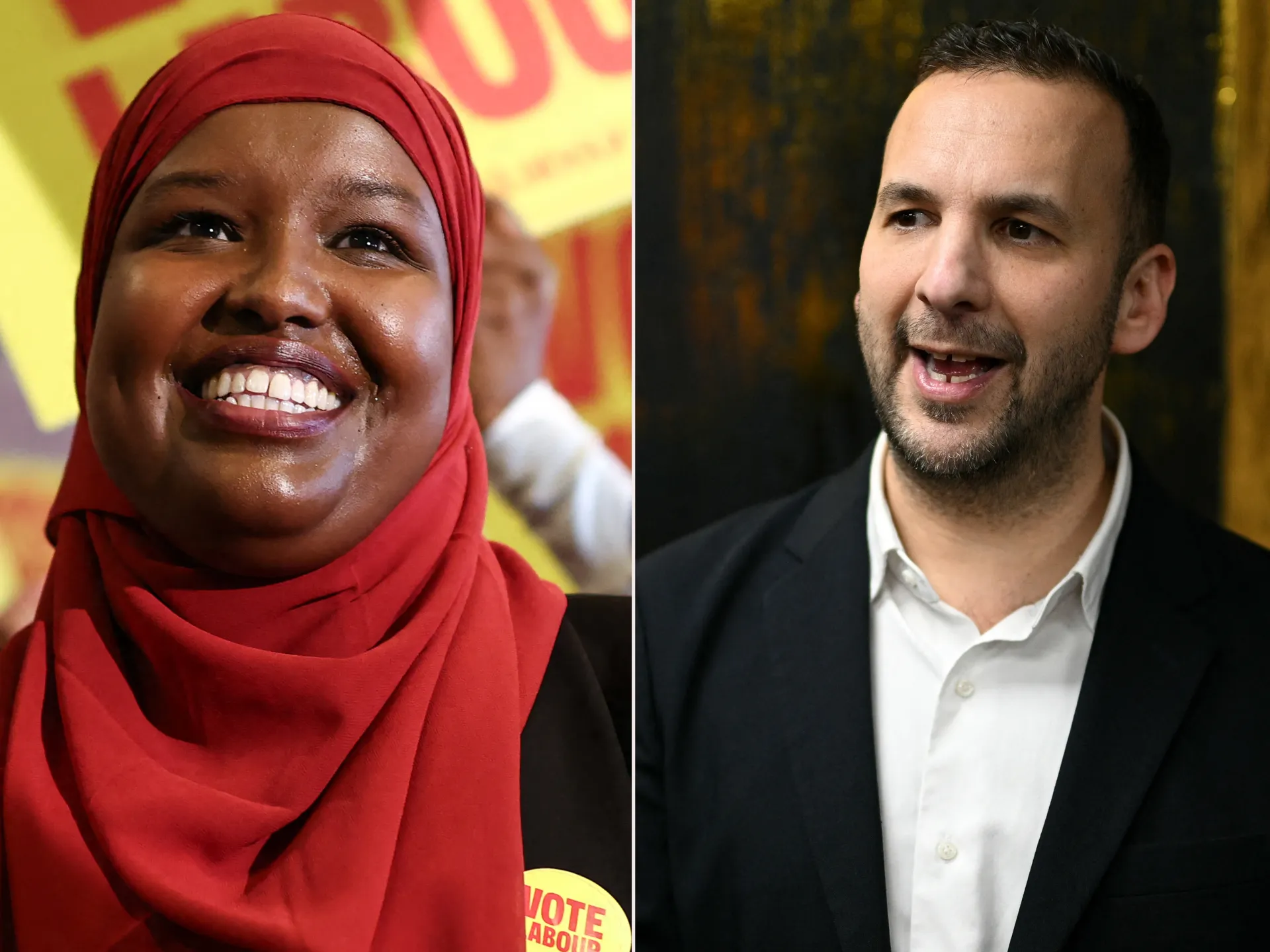
Labour candidate Sagal Abdi Wali, a Somali-Muslim woman, told The Guardian she did not attend because she had a prior obligation and the invite had come too late. But the organiser, the Camden Muslim Network, pushed back, saying that she was invited earlier.
Recommended Stories
list of 3 itemsend of list
Fifteen candidates are in the race for former Prime Minister Keir Starmer’s old seat, including Green Party leader, Zack Polanski, who hopes to become a member of parliament.
Since the seat was created in Holborn and St Pancras in 1983, the Labour Party has held it. Starmer was first elected in 2015 and held it until his resignation, which triggered the by-election.
At the meeting, the conversation ranged from local issues such as housing to Israel and Palestine.
Lib Dem candidate Patrick Stillman said his party had long called for Palestinian statehood but would not support a full boycott.
But Polanski had a different opinion.
“I think the Labour government’s position is deeply cynical to apologise over Gaza, to recognise that mistakes have been made but to continue to sell arms to Israel, a country that’s committing a genocide,” he said to applause, adding that his party, which recently voted to describe Zionism as racism, supports a full boycott.
‘Vote Palestine’
In leaflets sent to constituency residents, the Green Party focused on Abdi-Wali’s time as a Labour councillor and, more recently, as leader of Camden council – a role she secured in May.
One reads: “Bring change, Replace Labour, Vote Green”. On its reverse: “Every single Camden Labour councillor refused to sign the Palestine solidarity pledge or support pension fund divestment. Only Greens continue to stand firm on Palestine.”
Last month, Abdi-Wali spoke to the Camden New Journal, a local newspaper, about Gaza and the Green Party’s leaflets.
It was “obviously inaccurate” to say the Labour council did not feel strongly about the issue, she told the paper. “I want to focus on making sure that we’re able to put the message of what [Foreign Secretary] Ed Miliband is now doing with the government and on Palestine and Israel and Gaza and the West Bank.”
In January, Camden Friends of Palestine (CFOP), a local group that formed in response to Israel’s genocidal war on Gaza, presented a petition to the local council with 4,000 signatures calling for the council to divest its pension fund from companies involved in Israel’s actions in the occupied Palestinian territories.
Abdi-Wali, then a Labour councillor, did not support the motion. Rather than committing to divestment, most councillors voted to refer the question to the pension board for review.
“My impression of her and her politics is that she’s just really incredibly silent on everything, if there isn’t a career motive for her, and that’s kind of disappointing,” said 38-year-old Shadin, a resident and CFOP organiser, who plans to vote for Polanski.
“Watching a livestreamed genocide has made a lot of people that I know … disengage from mainstream politics or parliamentary politics”.
Like many London constituencies, a key issue is housing.
According to a “2026 state of the borough” report by Camden council, 8,380 households were on the waiting list for social housing at the end of March 2025, “an increase of 9.5 percent on the year before.”
On Friday, in the constituency’s more affluent area of Primrose Hill, one resident said they would vote for Labour in the upcoming election, while another believed that regardless of who wins, life will not change.
In Camden, another resident told Al Jazeera that while they live in the area, they were not aware of the election, as Labour canvassers buzzed to gain entry into a nearby estate in the background.
As both parties make their final efforts to secure victory, recent polls predict a close race.
In the 2024 general election, Starmer won the seat with 49 percent. Andrew Feinstein, a pro-Palestine independent candidate came second, with 19 percent. The British gambling firm Ladbrokes and Stats for Lefties, which examines polling, both predict Labour will win.
Syrians released from Israeli detention have described abuse including sleep deprivation, violent searches, and dog attacks, while dozens of others remain detained. Al Jazeera’s Heidi Pett met with some of them, who recounted the torture they suffered behind bars.
The United Kingdom’s Green Party has voted to define Zionism as a form of racism, drawing condemnation from the Israeli government.
In a binding vote held at the party’s conference over the weekend, members voted to usher in the new definition as well as a series of other strongly pro-Palestine policies.
Recommended Stories
list of 4 itemsend of list
However, just as the resolution has drawn international criticism, it has also proved internally controversial with four of the party’s five members in parliament opposing it.
Israel on Monday banned party leader Zack Polanski from the country just a day before the politician faces a by-election as he runs in the London constituency that former Prime Minister Keir Starmer represented.
Zionism emerged as a political ideology in the late 19th century. It called for the creation of a Jewish homeland at a time of rising anti-Semitism and persecution of Jews in Europe. Theodore Herzl, an Austro-Hungarian journalist considered the father of political Zionism, originally proposed an independent and colonial Jewish state in either Palestine or Argentina.
Here’s what we know about what the Greens have said:
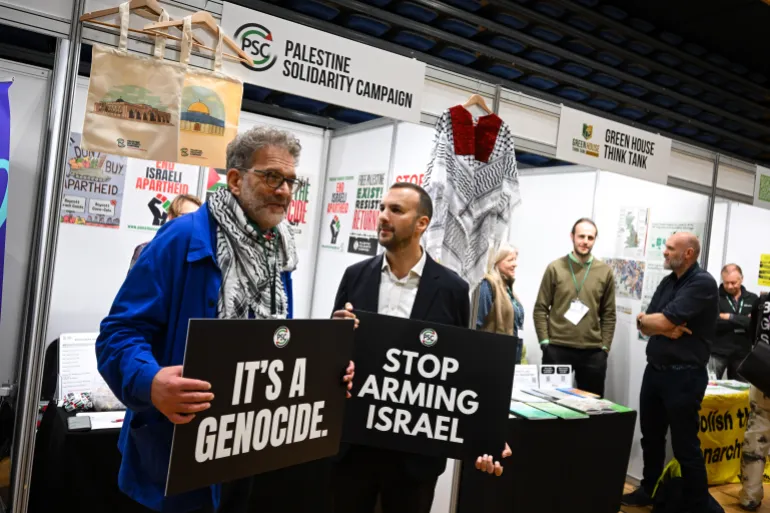
Green Party leader Zack Polanski, right, chats with Ben Jamal, director of the Palestine Solidarity Campaign, at the 2025 Green Party conference in Bournemouth, England [File: Getty Images]
What is the resolution?
The Greens endorsed the motion to equate Zionism with racism by a vote of 1,022 to 813.
In addition, the party restated its “commitment to Palestinian liberation” and called for the “establishment of a single democratic state throughout historic Palestine”.
The party also recommitted to its support of Palestinians’ right of return as well as to the Boycott, Divestment, Sanctions movement against Israel.
“The real, material, manifestation of Zionism has been the historic and ongoing dehumanisation, displacement, dispossession, disenfranchisement and destruction of Palestinians,” a Green Party statement said.
A significant number of party members, including four of its five MPs, were against parts of the resolution, exposing divisions within the party.
Codeputy leader Rachel Millward said in a post on X that while the party is committed to “stop the genocide”, the term Zionism means “different things to different people, … so I personally do not think the policy helps us do the work we all want to”.
Meanwhile, Polanski, who is Jewish and was away campaigning during the vote, told journalists afterwards that if Zionism equates to the displacement of Palestinians, “that is clearly racist.”
Polanski said he, however, did not support the reference to a single Palestinian state and external entities should not decide what a future state would look like.
How has Israel responded?
Israel has accused the party of legitimising “terrorism”, and senior officials equated it to anti-Semitism.
“The Greens have adopted not only the green of Hamas, but also its ideology: the elimination of the State of Israel through armed struggle,” the Israeli Ministry of Foreign Affairs wrote on social media.
Israeli President Isaac Herzog said it would “deliberately endanger Jews and Israelis everywhere”. Opposition leader Yair Lapid said the party was “racist”.
The Green Party has rejected equating criticism of Israel with anti-Semitism and reiterated its stance against “any form of discrimination or harassment”.
“We know there is no conflict between supporting the rights of Palestinians and the rights of Jewish people,” Polanski and other senior party members said in a statement on Sunday.
Has Zionism been equated to racism before?
Yes. In 1975, the UN General Assembly passed a resolution that “determines that Zionism is a form of racism and racial discrimination”.
The vote was sponsored by the Soviet bloc and the Arab League. It passed after 72 countries, largely from the Middle East and Africa, voted for it. Israel and 34 other countries – chiefly from the West – were against it. Thirty-two other countries abstained.
Just a year before, at the 1974 General Assembly, Palestinian leader Yasser Arafat had given his “olive branch” speech at the General Assembly.
About the same time, African countries opposing the apartheid regime in South Africa, which was increasingly allying with Israel, had resolved separately that the Israeli government was “racist” and both had an “imperialist origin.”
Also, in 1975, at the first international women’s conference, held in Mexico City, attendees decided there would be no international peace outside the “elimination of foreign occupation, Zionism, apartheid” and all other forms of “racial discrimination”.
However, the General Assembly vote proved controversial. Chaim Herzog, then-Israeli ambassador to the UN and later president, told the assembly in a speech that it was “based on hatred, falsehood and arrogance” and proceeded to rip up copies of the resolution in front of the audience.
The US too accused the UN of making “anti-Semitism international law”.
In December 1991, the US, under President George HW Bush, stepped up a campaign to revoke the resolution with Bush declaring at the UN that equating Zionism with racism “is to reject Israel itself” and to “challenge its right to exist”.
Israel also insisted it would not participate in the Madrid Peace Process to continue negotiations between Israel and Palestinian leaders if the resolution was not cancelled.
After much pressure from the US, an overwhelming majority of countries voted for its revocation – 111 to 25, including European and African countries.
Who else equates Zionism with racism?
Jewish Voice for Peace, the American anti-Zionist and pro-Palestinian advocacy group, has also named Zionism as a movement that creates a “racist hierarchy with European Jews at the top”.
In a February statement, the group reiterated its stance against what it called the “colonial ideology” of Zionism’s founders.
Similarly, in the United Kingdom, an employment tribunal in 2024 backed anti-Zionist activist and professor David Miller, who was earlier sacked from his post at the University of Bristol in 2021 for his views that the movement was “inherently racist”.
Ireland and Israel drew 1-1 in a second ill-tempered Nations League match. Irish and Israeli players wore black armbands to commemorate lives lost in Gaza and in the October 7 attacks, before tensions flared at half time over allegations of spitting.
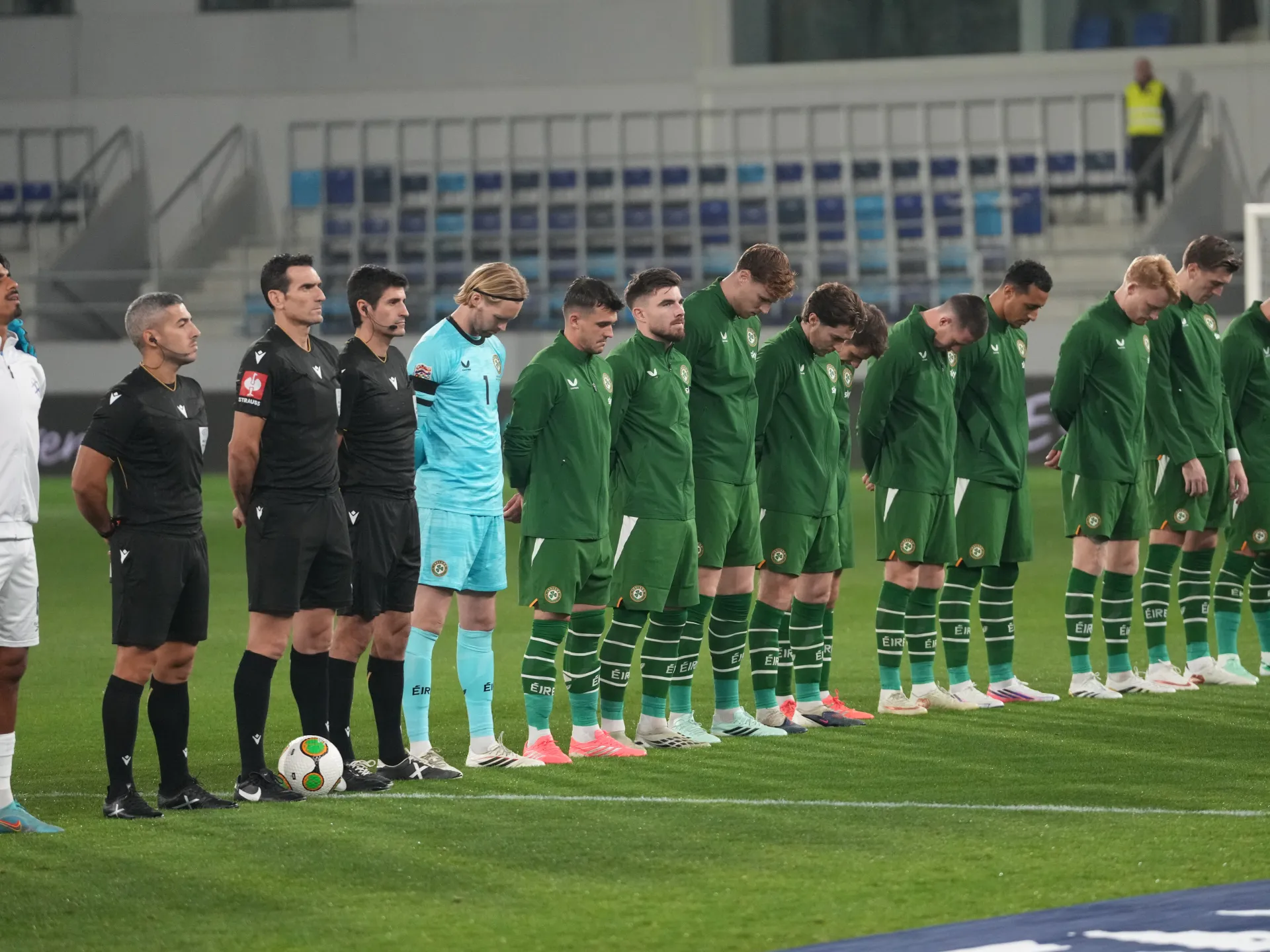
Ireland players again wore black armbands in recognition of Palestinians killed in Gaza and bowed their heads during the Israeli national anthem before the teams’ second UEFA Nations League football match on Sunday.
The League 3 Group B match ended in a 1-1 draw and, despite being played behind closed doors and on neutral ground, was once again played out in a confrontational manner.
Recommended Stories
list of 4 itemsend of list
Ireland goalkeeper Caoimhin Kelleher stepped in as captain for Dara O’Shea, who was excused to be with his wife for the birth of their child, and pointedly avoided shaking hands with Israel captain Dor Peretz, despite completing the usual pre-match formality with the referee and one of his assistants.
Kelleher’s action was a repeat of O’Shea’s, who refused to shake Israel captain Manor Solomon’s hand before the first match in Debrecen, Hungary, last week. Ireland went on to win that game 3-0 through three first-half goals.
Solomon was dropped to the bench for Sunday’s match in Backa Topola, Serbia. Israel forward Sayed Abu Farchi was back in the squad after serving a suspension for getting sent off following his gun-simulation goal celebration during Israel’s 3-1 defeat to Austria on September 25.
Finn Azaz, whose mother has Israeli heritage, was among the Irish substitutes after playing from the start against Austria on Thursday.
Troy Parrott’s penalty in the 39th minute, after a foul by Peretz on Jimmy Dunne, gave Ireland a 1-0 halftime lead. A disagreement also broke out on the sidelines as the players made their way off the field for the interval, although the referee quickly intervened.
Peretz secured a point for Israel with a poked effort from close range in the 47th minute.
Sunday’s game was initially supposed to be played in Dublin, but the Football Association of Ireland (FAI) moved it to a neutral venue for “operational reasons” in June following widespread calls for a boycott in protest of Israel’s genocidal war on Gaza. The FAI said the game would be played with no fans present.
It followed the FAI’s motion the previous November calling on UEFA to ban Israel from club and international competitions.
All the Irish players had been under pressure from home – where affinity with Palestinians is strong – to boycott the second match against Israel, though the pressure was greater during the first game.
“I felt that pressure growing day by day, and it’s getting almost to a breaking limit now,” Ireland coach Heimir Hallgrimsson said at the time.
Ultimately, only reserve goalkeeper Gavin Bazunu decided to skip both of the contentious games, saying in a statement that it was his “personal belief that the killing of innocent people is wrong”.
More than 160 Irish sportspeople had signed an open letter urging the FAI to reconsider its decision to go ahead with the two games.
Before the departure for Hungary, people protested outside the team hotel in Dublin for the players to boycott the matches. The SIPTU trade union displayed a huge poster in central Dublin beside the River Liffey asking the players to “Go with your conscience!” and “Don’t play with genocide” beside an image of a blood-splattered ball.
Former Ireland coach Brian Kerr said the FAI had “lost the respect of the Irish people” for going ahead with the games.
But the FAI argued UEFA could sanction the team. Ireland is cohosting the 2028 European Championship with England, Wales and Scotland.
Protesters threw tennis balls with Palestinian flags onto the field during Ireland’s 2-2 draw with Austria on Thursday. A man with a Palestinian flag also tried running onto the field.
On Saturday, an Israeli journalist stated during the pre-match news conference that the Irish players had called the Israeli players “monkeys” during last week’s game, leading to an immediate rebuke from Irish communications officer Kieran Crowley, who said it was “a lie” and ended the news conference.
The players had only decided to go ahead with the fixtures after a dramatic day in Debrecen before the first match, when both the news conference and training were delayed for hours while they deliberated. They reportedly voted 14-8 in favour of continuing after Bazunu’s withdrawal that morning.
Ireland’s national broadcaster RTÉ was only providing stripped-back coverage of both games against Israel to meet contractual obligations. There was no studio presentation, commentary on the international feed, or analysis. RTÉ said it was not accepting advertising or sponsorship around either game.
RTÉ also recently announced that Ireland will boycott the Eurovision Song Contest for a second year due to Israel’s participation.
As Israel prepares to mark three years since the October 7 attacks and with less than a month to go to parliamentary elections, one topic is dominating the electoral agenda.
Media reports that Prime Minister Benjamin Netanyahu was warned by the United Arab Emirates before the attacks have put his alleged responsibility back in the spotlight.
“Did he know?” is the question on everyone’s lips.
Listening to the accusatory choir, one might think that Israeli society finally is acknowledging the real meaning of October 7. Yet the opposite is true.
Instead of giving a platform to a reckoning, the elections function to scapegoat Netanyahu for his alleged role in facilitating Hamas’s attack while absolving Israeli society and the Zionist movement of its collective responsibility for the preceding violence and ensuing genocidal aggression.
For example, it does not insist on investigating whether the “Hannibal Directive” was deployed as part of the Israeli military response on October 7 and whether it killed Israeli citizens and how many.
It does not scrutinise subsequent Israeli military operations or whether they put the Israeli hostages in danger or how many were killed by Israeli bombs.
There is no questioning of why key Palestinian negotiators were attacked during ceasefire and hostage negotiations, including Ismail Haniyeh, Hamas’s chief negotiator, in July 2024 in Tehran and Hamas’s negotiating delegation in September 2025 in Doha.
There is no debate about why the Israeli government repeatedly rejected ceasefire proposals that could have brought the hostages back much earlier.
There is little attention paid to the fact that Netanyahu and former Defence Minister Yoav Gallant face arrest warrants from the International Criminal Court for crimes against humanity.
None of these made the cut. Why?
The answer lies in the psychological state of Israeli society. For many Israelis, October 7 became a psychological rupture, making it difficult to reconcile their sense of humanity with their complicity in the criminal reality that followed.
The problem, then, is not that Israelis are in denial or misinformed. It is that a large portion of the society is complicit in criminality and actively avoids reckoning with it.
The absence of Gaza and Palestinians more broadly from Israeli political discourse is because of their complete dehumanisation by Israeli society.
How else could one explain the absence from the election rhetoric of questions about, and subsequent accountability for, actions against the Palestinian people?
Why has the Israeli military killed at least 74,000 Palestinians, the vast majority of them civilians? Why has it carried out mass and arbitrary detentions, torture and enforced disappearances of Palestinians?
Why has the sadistic and often sexually deviant celebration of destruction, subjugation, ethnic cleansing and death by Israeli soldiers been allowed?
What’s more, there is also little interrogation of the consequences of bombing and invading Lebanon, killing nearly 9,000 people since October 2023. Or bombing Syria and Yemen.
These are not isolated abuses. They are symptoms of a system of theft and domination driven by greed and sustained through psychological conditioning, segregation, fear and rewards for aggression. In line with the “Wired to Steal” model, dehumanisation helps produce consent for aggression while escalation following acts of resistance leads to normalisation of further expansion and robbery.
Thus, this election is not about a reckoning with October 7 or its horrifying aftermath. It is a lens onto a fascistic settler society engaged in denial and dehumanisation of an Indigenous “other” as a means of evading and normalising its own ongoing genocidal actions. Although Netanyahu may become the scapegoat, replacing him does not address the underlying machinery of domination and may instead serve to entrench it further.
That machinery remains firmly in place. The continuity between the violence unleashed since October 7 and the longer history of Zionist colonial expansionism is striking, with no lessons learned other than how to improve and grease the machinations of genocide. Fear, victimhood and the construction of a permanently besieged “us” against a dehumanised “them” continue to produce consent for further aggression and expansion.
October 7, therefore, has become not an occasion for genuine reckoning but another means of avoiding one. Netanyahu seeks to focus responsibility for the attacks on questions of what he knew and when while leaving the much broader record of what Israel has done since largely outside the electoral debate. His opponents, meanwhile, have their own complicity and ambitions to answer for. Thus, there is little political interest in a genuine reckoning with October 7. The fixation on Netanyahu allows the wider political establishment and Israeli society to avoid confronting the system of domination in which they remain invested.
The views expressed in this article are the author’s own and do not necessarily reflect Al Jazeera’s editorial stance.
Maysa Abu Daoud and her daughter Mary al-Najjar among five Palestinians killed in Gaza City attack.
Published On 4 Oct 20264 Oct 2026
The Latin patriarch of Jerusalem, Cardinal Pierbattista Pizzaballa, has expressed his “deep sorrow and grief” over the “tragic” killing of two Christian women in an Israeli air attack on Gaza City.
Maysa Abu Daoud and her daughter Mary al-Najjar were among five Palestinians killed in the attack that hit the ground floor of a building in the Remal neighbourhood on Saturday, in the latest Israeli violation of a United States-brokered “ceasefire” agreement with the Palestinian group Hamas.
In a statement, the patriarch extended his “heartfelt condolences” to the loved ones of the two women and to the Christian community in Gaza.
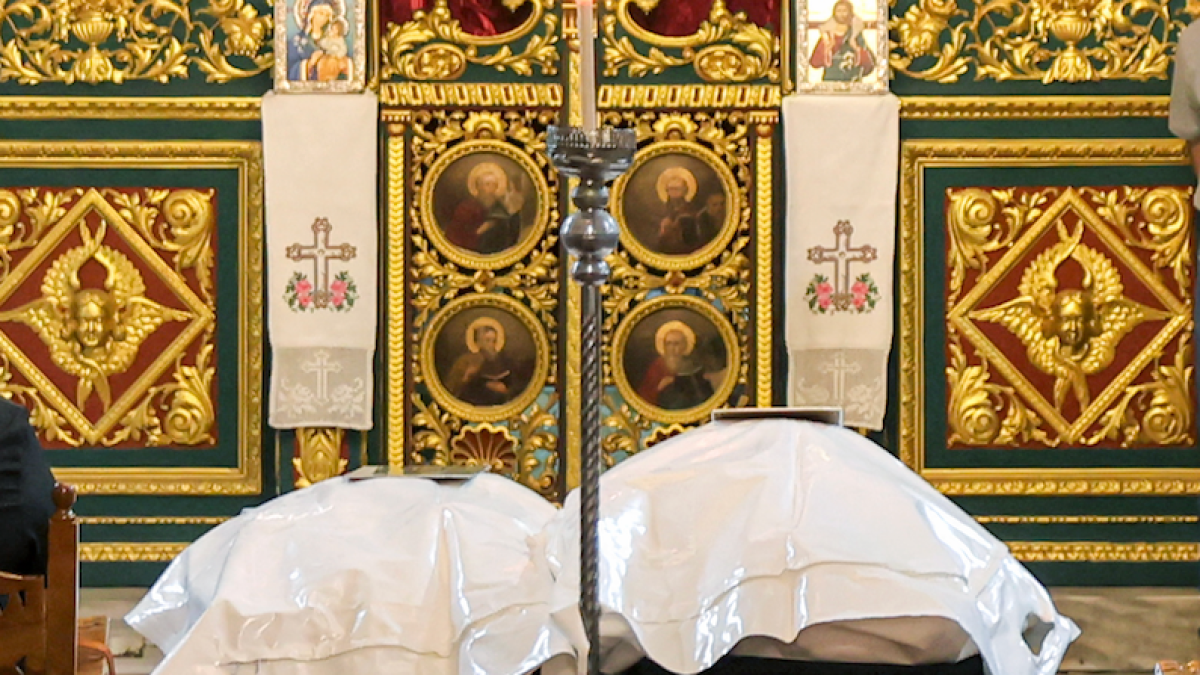
Their funeral took place on Saturday at Saint Porphyrius Church in Gaza City’s Old City.
The two women were Palestinian Christians from Gaza City who devoted their time to helping parishioners and displaced people sheltering at the Holy Family Church, according to Palestine’s Higher Presidential Committee for Church Affairs.
The committee’s chairman, Ramzi Khoury, described their deaths as a “painful loss” for their families, the church and its parishioners.
People inspect the damage after an Israeli attack on a residential apartment in the Remal neighbourhood of Gaza City [Omar al-Qattaa/AFP]
Mary’s son, 14-year-old Fouad al-Najjar, told the Anadolu news agency the strike hit the building at about 1:30am (22:30 GMT).
“My grandmother and my mother died. May God have mercy on them,” he said.
Al-Najjar appealed for an end to Israel’s genocidal war on Gaza, saying Palestinians were losing their loved ones every day.
“We are exhausted by this war and have endured so much,” he said. “For almost three years, we have been living through the same destruction, the same grief and the same war.”
Palestinian Lutheran pastor Munther Isaac, who serves in Ramallah and directs the Bethlehem Institute for Peace and Justice, wrote on X: “The genocide continues in Gaza.”
Civil Defence members carry the bodies of Maysaa Abu Daoud and her daughter Mary al-Najjar during their funeral at the Greek Orthodox Church of Saint Porphyrius in Gaza City [Omar al-Qattaa/AFP]
The Gaza Strip is home to fewer than 1,000 Christians. The community was already small before the war, and many of its members have been killed since then in attacks on their homes and churches throughout the war that began in October 2023.
On October 19, 2023, an attack on the Saint Porphyrius Church compound killed at least 18 people. Two months later, the Latin Patriarchate of Jerusalem said an Israeli sniper shot dead a woman and her daughter inside the Holy Family parish compound in Gaza.
An Israeli strike on the Holy Family Catholic Church compound on July 17, 2025 also killed three people and wounded others, including parish priest Father Gabriel Romanelli.
According to the Ministry of Health in Gaza, Israeli attacks have killed at least 74,228 people, including at least 1,445 since the start of the “ceasefire” in October 2025.
Funeral prayers were held at Gaza City’s Saint Porphyrius Greek Orthodox Church for a Palestinian mother and daughter who were among five killed in an overnight Israeli airstrike on an apartment.
Israeli journalists asked coach Hallgrimsson about the Flydubai attack and alleged racist abuse by Ireland’s players.
Published On 3 Oct 20263 Oct 2026
Members of an Israeli media contingent heckled Republic of Ireland head coach Heimir Hallgrimsson’s news conference prior to the UEFA Nations League football match, causing it to end abruptly amid growing political tensions and protests against the fixture.
During the media event on Saturday, an Israeli journalist asked Hallgrimsson about his views on an incident onboard a Flydubai flight to Israel earlier this week.
Recommended Stories
list of 4 itemsend of list
According to the prosecutor general of the United Arab Emirates, the Flydubai co-pilot “attempted to carry out a terrorist act”, using an axe against the pilot to take over the aircraft’s controls.
The plane carrying 174 passengers was on its way from the Dubai in the UAE to Tel Aviv in Israel on Wednesday when the copilot wounded Indian pilot Smit Machchhar, who opened the cockpit door to seek help.
The aircraft briefly plunged about 17,000 feet (5,180 metres) before it was brought back under control.
The attacker was not officially identified, but media reports quoting unnamed sources said he was an Omani national, Hamam al-Hammami.
“What do you say about the people that you support? Their ideology is based on murder,” the journalist asked, purportedly hinting at Ireland’s stance on Palestine and attempting to link it to the aviation incident.
Before the Irish team’s coach could answer, the Football Association of Ireland’s communications manager Kieran Crowley stepped in and asked the journalist to refrain from asking questions not linked to the match.
The journalist persisted, carrying on with her question before Crowley stopped her again.
“We respected your questions at the last press conference, but we are doing football questions today,” he said, referring to Israeli journalists’ pointed questions about the calls to boycott the first leg of the European match.
Icelandic coach Hallgrimsson later termed the incident a “verbal attack”.
Following the match, Israeli supporters were accused of directing racist chants towards Ireland player Adam Idah and were filmed raising military slogans, but evaded disciplinary action from the competition’s organisers.
However, another Israeli journalist turned the incident on its head during Saturday’s news conference and accused the Irish team of calling Israel’s players “monkeys” during the match.
FAI’s Crowley was quick to shut out the accusation and ended the media event.
“That’s a lie. You’ve just broadcast a lie,” Crowley said before getting up to walk away.
According to Irish media reports, the FAI is continuing to investigate allegations that Irish players Adam Idah and James Abankwah were racially abused by Israeli fans.
An Israeli supporter also led chants about his country’s military from the stands as he attempted to brush aside the team’s drubbing on the football pitch.
The day before the first leg, goalkeeper Gavin Bazunu publicly withdrew, saying he felt “it would be wrong to participate in the upcoming fixtures against Israel”.
The second leg will be played at the TSC Arena in Backa Topola in Serbia on Sunday.
Ireland’s Hallgrimsson termed it “a game with a lot of emotions attached to it”.
He said the team was focused on winning the second leg as well.
“There’s been a lot of emotions from the people in Ireland about this and obviously that affects the players as well. We want to do good, but it’s always going to be a challenge when the environment is as noisy as it is.”
More reports are emerging that Israeli PM Benjamin Netanyahu rejected a Hamas proposal to release all civilian captives taken on October 7, 2023. Netanyahu’s actions have become a key topic less than a month before national elections.





![The view from Muhammad Ghawanmeh’s home in al-Awsaj, looking out towards an Israeli outpost on a hill in the background [Al Jazeera]](https://i0.wp.com/www.aljazeera.com/wp-content/uploads/2026/10/View-from-Muhammads-looking-out-towards-the-outpost-seen-on-hill-in-background-1791321948.jpeg?w=640&ssl=1)
![Jamal Mleihat with his daughter Sewar in al-Awsaj in the occupied West Bank [Al Jazeera]](https://i0.wp.com/www.aljazeera.com/wp-content/uploads/2026/10/Jamal-Mleihat-with-his-daughter-Sewar-1791322462.jpeg?w=640&ssl=1)