Ross Harrison, Senior Fellow at the Middle East Institute, says public talk of diplomacy between the US and Iran is hiding hardline positions, warning that despite the messaging, the situation is still likely heading toward military escalation.
WASHINGTON — Most Americans believe recent U.S. military action against Iran has gone too far, and many are worried about affording gasoline, according to a new AP-NORC poll.
As the war launched by the U.S. and Israel continues in its fourth week, the survey from the Associated Press-NORC Center for Public Affairs Research indicates that while President Trump’s approval rating is holding steady, the conflict could be swiftly turning into a major political liability for his Republican administration.
While Trump is deploying more warships and troops to the Middle East, about 59% of Americans say U.S. military action in Iran has been excessive.
Meanwhile, 45% are “extremely” or “very” concerned about being able to afford gas in the next few months, up from 30% in an AP-NORC poll conducted shortly after Trump won reelection with promises that he would improve the economy and lower the cost of living.
There is significant support for at least one of the president’s objectives, which is preventing Iran from obtaining a nuclear weapon. About two-thirds of Americans say that should be an “extremely” or “very” important foreign policy goal for the U.S. However, they are just as likely to say it’s important to keep U.S. oil and gas prices from rising — a juxtaposition that could be difficult for the White House to manage.
About 4 in 10 U.S. adults continue to approve of Trump’s performance as president, which is unchanged from last month. His approval on foreign policy, while slightly lower than his overall approval, also largely held steady.
Trump has left unclear his next steps on Iran. Despite escalating threats, he’s also suggested diplomatic talks could resolve the fighting. Americans remain broadly apprehensive about Trump’s ability to make the right decisions on the use of military force outside the U.S., and they mostly oppose more aggressive steps, such as deploying ground forces.
Republicans and Democrats prioritize keeping gas prices low
Keeping the price at the pump down is the rare goal that unites Americans in both major political parties.
About three-quarters of Republicans and about two-thirds of Democrats say it’s highly important to prevent U.S. oil and gas prices from going up.
However, concern about the current situation isn’t evenly felt. Only about 3 in 10 Republicans said they’re “extremely” or “very” worried about affording gas in the next few months, as opposed to about 6 in 10 Democrats.
Trump’s focus on Iran’s nuclear program also appears more compelling to Republicans than to Democrats. About two-thirds of Americans say the U.S. should prioritize keeping Iran from obtaining a nuclear weapon, but about 8 in 10 Republicans say this is at least “very” important, compared with about half of Democrats.
The war has exacerbated political debates over the role that Israel should play in U.S. foreign policy, especially since Israeli Prime Minister Benjamin Netanyahu was a leading voice for attacking Iran. Only about 4 in 10 U.S. adults say preventing Iran from threatening Israel should be a high priority.
Toppling Iran’s leaders is viewed as slightly less important. Only about 3 in 10 say it’s at least “very” important for the U.S. to replace Iran’s government with one that’s friendlier to U.S. interests.
Most Americans say U.S. action has gone too far in Iran
As Trump provides mixed messages on whether the Iran war will end soon, about 9 in 10 Democrats and about 6 in 10 independents say the Iran attacks have “gone too far.”
Republicans are more divided. About half of Republicans say the U.S. military action has been “about right,” but relatively few want to see it go further. Only about 2 in 10 Republicans say the U.S. military action has not gone far enough, while about one-quarter say it’s gone too far.
Recent AP-NORC polling has found that about 6 in 10 Americans say Trump has “gone too far” on a range of issues, including his approach to tariffs and presidential power. That number, which is broadly reflective of his overall approval, signals that while Trump’s actions in Iran are unpopular, it’s still comparable to other controversial moves he’s taken as president.
Further entrenching the U.S. in the war could change that, depending on what happens next. About 6 in 10 Americans “somewhat” or “strongly” oppose deploying U.S. troops on the ground to fight Iran, including about 8 in 10 Democrats and roughly half of Republicans. Just under half of Americans oppose airstrikes targeting Iranian leaders and airstrikes against military targets in Iran, while about 3 in 10 are in favor and about 3 in 10 don’t have an opinion.
Many Americans distrust Trump on use of military force abroad
About half of U.S. adults have “only a little” trust or “none at all” in Trump when it comes to making the right decisions about the use of military force outside the U.S., in line with an AP-NORC poll from February.
About 34% of U.S. adults approve of the way Trump is handling foreign policy, similar to 36% in February. That measure has been consistent in recent months despite a cascade of actions, including confrontations over Greenland and an attack on Venezuela, that have generated controversy at home and abroad.
It’s also very similar to Trump’s approval on Iran in the new poll, which found that 35% of Americans have a positive view of his handling of that issue.
Sanders and Catalini write for the Associated Press. The AP-NORC poll of 1,150 adults was conducted March 19-23 using a sample drawn from NORC’s probability-based AmeriSpeak Panel, which is designed to be representative of the U.S. population. The margin of sampling error for adults overall is plus or minus 4 percentage points.
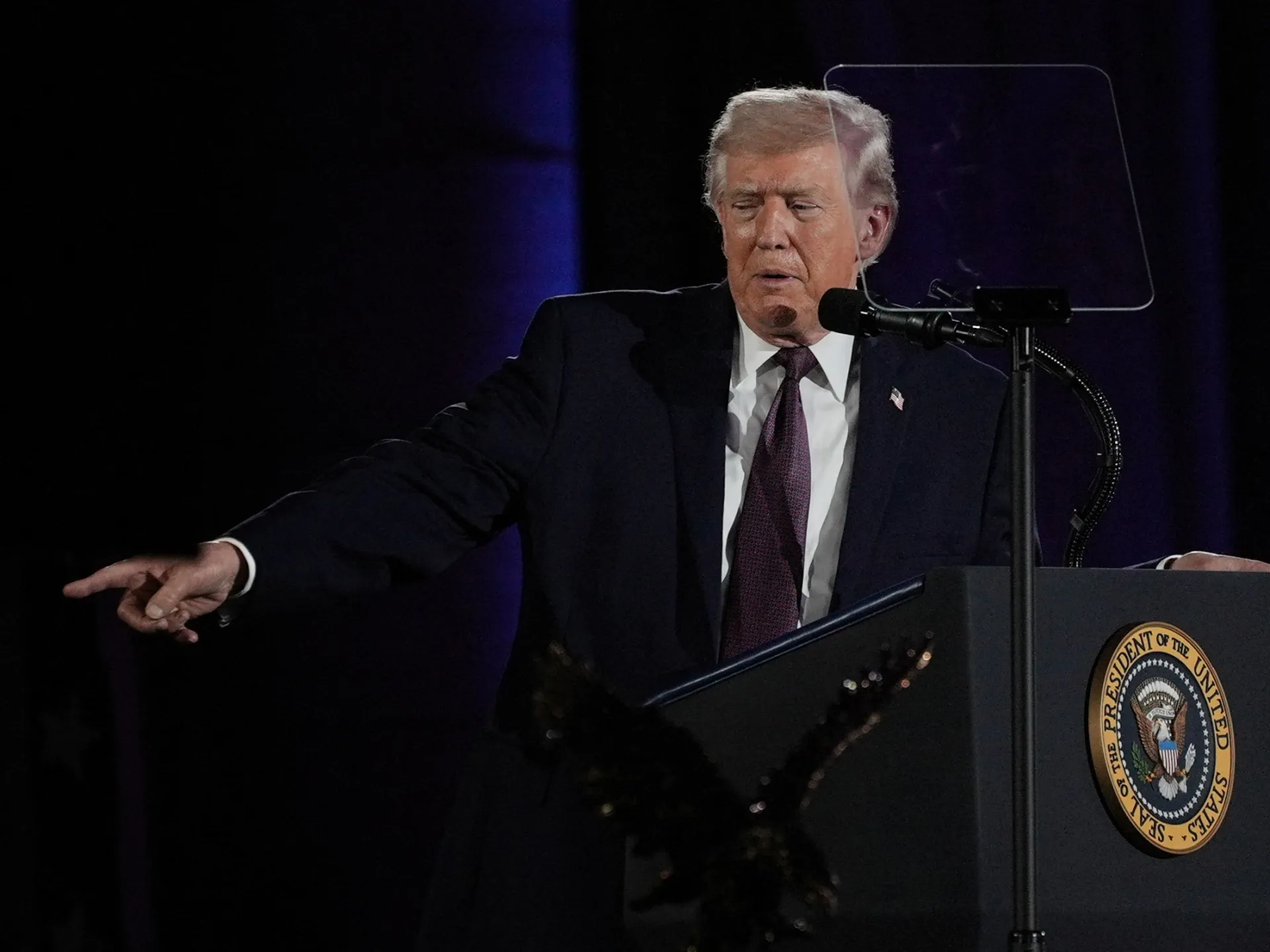
Donald Trump said Iran is negotiating with the US but is “afraid to say it”. Speaking at a Republican fundraising dinner, Trump said that Iran’s leaders fear they could be “killed by their own people” or by the US.
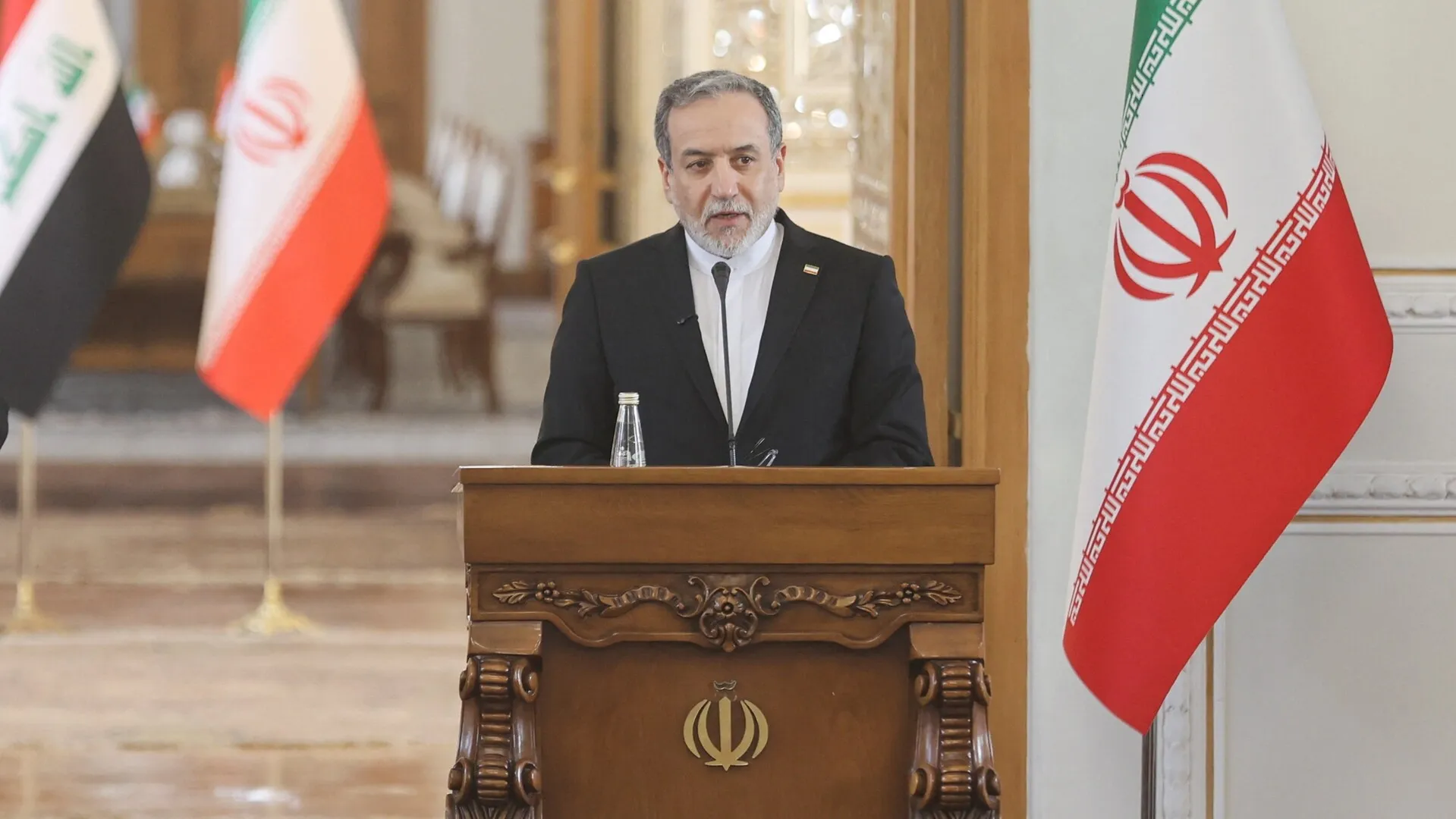
“No negotiations have taken place.” Iran’s foreign minister, Abbas Araghchi says his country is not and will not negotiate with the US while it is under attack. A day earlier, President Trump said the US was already in talks with Iranian officials, which Tehran denied.
WASHINGTON — President Trump will travel to Beijing for a rescheduled summit with Chinese President Xi Jinping on May 14 and 15, the White House announced on Wednesday.
Trump had been scheduled to travel to China later this month but previously announced he was delaying the trip so he could be in Washington to help steward the U.S. and Israeli war against Iran. The Republican president had announced a rescheduled trip even though the war in Iran continues and the U.S. is pressing Tehran to accept a ceasefire proposal.
The president and First Lady Melania Trump also plan to host Xi and his wife, Peng Liyuan, for a White House visit later this year, press secretary Karoline Leavitt said.
Leavitt, when asked if the new dates for Trump’s trip could suggest he believes the Iran war could end soon, offered an optimistic tone that the conflict could reach an endgame before he travels.
“We’ve always estimated four to six weeks,” Leavitt responded. “So you could do the math on that.”
The United States and Israel launched the attacks against Iran on Feb. 28.
The China trip had been planned for months but began to unravel as Trump pressured Beijing and other world powers to use their military might to protect the Strait of Hormuz, a critical waterway for the flow of oil. The strait has been effectively closed as Iran targets energy infrastructure and traffic through it.
Trump said last week while meeting with Irish Prime Minister Micheál Martin in the Oval Office that he would be going to China in five or six weeks’ time instead of at the end of the month. He said he would be “resetting” his visit with Xi.
“We’re working with China — they were fine with it,” Trump said then. “I look forward to seeing President Xi. He looks forward to seeing me, I think.”
Trump’s visit to China is seen as an opportunity to build on a fragile trade truce between the two superpowers, but it has become tangled in his effort to find an endgame to the war in Iran. Soon after pressing China and other nations to send warships to secure access to Middle Eastern oil, Trump indicated last week that his travel plans depended on Beijing’s response, though he added then that the U.S. didn’t need help from the allies that rebuffed his request.
March 25 (UPI) — Iran’s foreign minister said Wednesday that Tehran has no plans to negotiate with the United States after the Trump administration offered a 15-point peace plan.
During a televised interview on state-run media, Foreign Minister Abbas Araghchi said U.S. officials had been sending messages through intermediaries for “several days.”
U.S. officials who spoke to The New York Times and USA Today late Tuesday, said the United States sent a peace proposal through Pakistan, which earlier had offered to host talks between the two countries. The peace plan addressed Iran’s ballistic missile and nuclear programs, two of the key threats the administration and Israel cited for their decision to attack Iran.
Egypt has also offered to host peace talks.
Araghchi said passing messages through friendly countries doesn’t constitute “dialogue nor negotiation, nor anything of the sort.”
He added that Iran is focusing on defending itself against attacks and has “no intention of negotiating for now,” the BBC reported.
“This is Israel’s war, and people of the region and people of the U.S. are paying the price for it.”
U.S. officials said the proposed peace plan included lifting economic sanctions, limits on Iran’s missile program, making the Strait of Hormuz safe and winding down Iran’s nuclear program in exchange for cooperation on civilian nuclear energy — monitored by the International Atomic Energy Agency.
Destroying Iran’s ballistic missile arsenal, launcher and production plants has been one of the main objectives of the U.S.-Israeli airborne military campaign, along with 970 pounds of enriched uranium; they are determined to prevent Iran from ever converting into a nuclear weapon.
“Basically, it is not logical to enter into such a process with those who violate the agreement,” the source said.
Notwithstanding the assistance of Pakistan’s army chief, Field Marshall Syded Asim Munir, said to have a direct line of communication to the Islamic Revolutionary Guard Corps., communication with, and within, Iran is highly problematic, complicated by a civilian governance vacuum, damage to communications and officials reluctant to meet each other due to fear of being killed
There was no sign in Washington of any imminent let-up in the conflict on the ground.
“As President Trump and his negotiators explore this newfound possibility of diplomacy, Operation Epic Fury continues unabated to achieve the military objectives laid out by the commander-in-chief and the Pentagon,” White House press secretary Karoline Leavitt said in a statement.
However, the offer to Tehran was being seen as evidence of the White House’s desire for an exit strategy from a costly war, now in its fourth week, with Persian Gulf allies being hit by Iranian missiles and drones round the clock and severe disruption to global energy supplies.
Earlier, reports emerged in U.S. media that at least 2,000 paratroopers from the U.S. Army’s 82nd Airborne Division were being deployed from North Carolina to the Middle East, though it was unclear where, as Trump backs up his diplomatic maneuver with military pressure.
The soldiers from the 82nd’s Immediate Response Force are the only U.S. Army division with the ability to mount an airborne assault operation anywhere in the world within 18 hours of receiving orders.
They will join an amphibious force of thousands of U.S. Marines
House Speaker Mike Johnson said Wednesday that the United States doesn’t have “boots on the ground” in the Middle East, but said Tehran should take heed of the U.S. military buildup.
“I think Iran should watch that buildup, and they need to take note of that,” he told reporters.
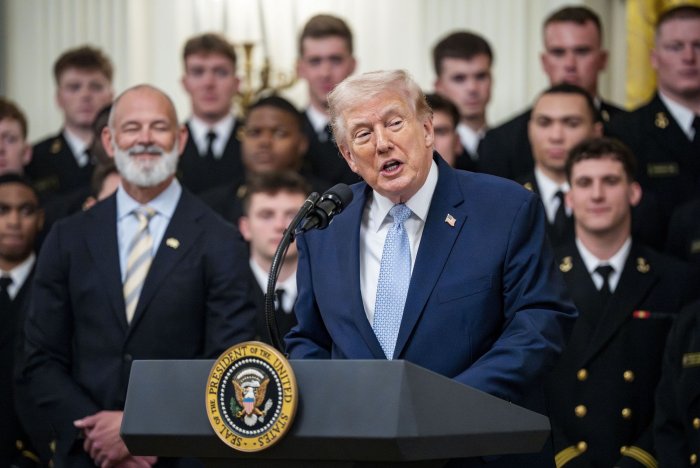
President Donald Trump presents the Commander in Chief’s Trophy to the Navy Midshipmen football team during a ceremony in the East Room of the White House on Friday. The award is presented annually to the winner of the football competition between the Navy, Air Force and Army. Navy has won the trophy back to back years and 13 times over the last 23 years. Photo by Bonnie Cash/UPI | License Photo
GRAPEVINE, Texas — Conservatives are holding one of their largest annual gatherings at a perilous political moment for President Trump and with open division on the right over the war he launched in Iran.
While Trump maintains broad support among conservatives, the war in Iran is more than a wrinkle for activists drawn to his “America First” campaign pledge against getting involved in foreign conflicts. A new AP-NORC poll shows about 59% of Americans think the military action in Iran is excessive. The debate will be a subtext — and likely flare publicly — as thousands of activists, influencers and Republican lawmakers gather at the Conservative Political Action Conference that begins Wednesday outside Dallas.
The event also comes a day after a Democrat flipped the Florida state legislative seat that’s home to Trump’s Mar-a-Lago estate.
The gathering will be a contrast to the celebratory meeting one year ago when Trump, newly returned to office, vowed to “forge a new and lasting political majority” and Elon Musk wielded a chain saw to symbolize how the Republican administration was slashing the government workforce and red tape.
This year, neither Trump nor Vice President JD Vance has been publicly announced as speaking to the gathering. But among those who are slated to speak are big names in the MAGA movement who have voiced conflicting views on the Iran war.
“This is obviously going to be a hot topic,” said John Gizzi, a CPAC veteran and columnist for the conservative media outlet Newsmax, who noted the possibility of greater U.S. involvement over an uncertain length of time.
Some featured speakers are divided over Iran and Israel
Among the featured speakers scheduled at the four-day event is longtime Trump ally Steve Bannon. Bannon said during his “War Room” podcast this month that should the war become “a hard slog,” it could cost the GOP conservative voters ahead of the midterms.
“We are going to bleed support,” Bannon said.
Texas Sen. Ted Cruz, who supports the war, also is on the agenda at the Gaylord Texan Resort and Convention Center.
“I think President Trump was exactly right to act to protect Americans,” Cruz said last week in a CBS News interview.
Former Florida Rep. Matt Gaetz’s scheduled speaking slot is a reminder of the disagreement among some conservatives about the U.S. military alliance with Israel against Iran.
Gaetz, host of a show on the conservative One America News Network, has said the U.S. has been too cozy with Israel as popular conservative personalities such as Tucker Carlson have challenged conservatives’ longtime bond with the country, prompting criticism from GOP groups, including pro-Israel Republicans, of antisemitism.
Others scheduled to speak include Trump border czar Tom Homan and former Republican National Committee Chairman Michael Whatley, who is running for the U.S. Senate in North Carolina.
Trump’s standing is strong among his base
A year after Trump presided over the group’s jubilant conference upon his return to office, he is in a much different place.
At war while worries about jobs and household costs linger, his approval is down. His signature domestic policy, aimed at tightening voting rules ahead of November’s midterm elections, has stalled in a Congress his party controls, while the House Republican majority is in jeopardy and the party’s hold on the Senate is less certain than a year ago.
Despite the dividing lines, Trump enjoys enduring approval from his party’s right flank. Eighty-six percent of conservatives said they approved of the president’s job performance in a February AP-NORC poll.
And while Trump’s supporters remain devoted, some within the most conservative circles say division over Iran could signal trouble for Republicans in November.
Texas Rep. Steve Toth, who plans to attend CPAC, suggested that Trump’s support remains robust among conservatives but that Republican messaging on the war could be stronger.
“From MAGA people, for the most part, I don’t hear frustration with the president,” said Toth, who beat incumbent Republican Rep. Dan Crenshaw in Texas’ March 3 primary. “I don’t know that we’re doing a great job at communicating the full ramifications.”
Texas’ GOP Senate primary is a lingering issue
Another stark reminder of the contrast with last year is Texas’ unresolved Senate primary, a particular political headache for Trump.
Texas Attorney Gen. Ken Paxton, who is challenging four-term GOP Sen. John Cornyn, not only is attending the event but also has one of the event’s premier speaking roles, the Ronald Reagan Dinner on Friday evening. Cornyn is not attending the Texas conference.
Trump said three weeks ago he would soon endorse one of them after Paxton finished narrowly behind Cornyn in the March 3 primary, though neither received a majority to avoid a May 26 runoff.
Trump implored whoever didn’t get the endorsement to drop out, writing in a social media post that the bitter contest “cannot, for the good of the Party, and our Country, itself, be allowed to go on any longer.”
The deadline for candidates to remove their names from the May 26 runoff ballot passed last week, as Paxton and Cornyn were launching stepped-up attack ads targeting one another.
Beaumont and Catalini write for the Associated Press. Catalini reported from Morrisville, Pa. AP writer Amelia Thomson DeVeaux in Washington contributed to this report.
The proposals request that Iran must “commit never to pursue nuclear weapons“, pledge to dismantle nuclear facilities and to hand over the enriched amounts of uranium it possesses to the International Atomic Energy Agency (IAEA), the UN nuclear watchdog, which is to monitor the issue going forward.
WASHINGTON — The Trump administration has offered Iran a 15-point ceasefire plan aimed at temporarily halting the war in the Middle East, as the Pentagon simultaneously orders thousands of Marines, paratroopers and a warship to the region.
The plan presented to Iranian leadership Tuesday broadly included a 30-day ceasefire and sanctions relief for Iran in exchange for a laundry list of U.S. demands, according to the Associated Press and other outlets.
But Iran dismissed the proposal Wednesday, criticizing the White House’s terms as “excessive” and out of step with reality, according to Iranian state-run media.
Those terms included limitations on Tehran’s missile stockpiles, and the permanent end to its nuclear program, its support for regional militias including Hezbollah, and of its blockade of the Strait of Hormuz, various outlets reported, citing Pakistani officials mediating the negotiations.
Several of those provisions have long been considered nonstarters for Iran, which sees its missile stockade and regional alliances as central to national security.
Iranian officials responded with defiance and skepticism.
“Iran will end the war when it decides to do so and when its own conditions are met,” an Iranian official told state media. “Not when Trump envisions its conclusion.”
The official outlined the Islamic Republic’s terms for ending the conflict, which included a halt to “aggression and assassinations,” an end to fighting on all fronts, enforceable guarantees that hostilities will not resume, compensation for war damages and a formal recognition of Iran’s sovereignty over the Strait of Hormuz.
Iranian Foreign Minister Abbas Araghchi has stated that Iran is not interested in a ceasefire but rather a comprehensive “end of war” on all fronts, including the lifting of sanctions and guarantees to allow Iran to pursue peaceful nuclear enrichment for energy and medical applications.
Iranian officials told state media that they believed the Trump administration’s diplomatic efforts were deceptive.
“You have reached a stage where you are negotiating with yourselves,” Iranian military spokesman Ebrahim Zolfaqari said in a televised address Wednesday. “Do not call your defeat an agreement.
Since the start of the conflict, Iranian leaders have voiced suspicion of any diplomatic talks with the Trump administration, pointing to prewar diplomatic efforts as evidence they were “tricked.” The Islamic Republic says it made clear in those talks that it had no interest in developing nuclear weapons, but Trump launched his military campaign nonetheless.
There have been conflicting media reports over Tehran’s exact position. Statements from Iranian officials and state-linked outlets have left open the possibility that elements of the proposal are still under review, while some reports frame the response as an outright refusal.
The Iranian response also conflicts with President Trump’s insistence that negotiations were progressing.
“We have had very, very strong talks,” he said Sunday in Florida. “We have points, major points of agreement. I would say almost all points of agreement will at some point very, very soon meet.”
Compounding the issue, Israel — which continues to carry out routine bombing campaigns over Iran — has stayed out of the talks.
Trump and Israeli Prime Minister Benjamin Netanyahu spoke about the peace deal in a phone call Tuesday. In a televised address, Netanyahu said that Trump “believes there is an opportunity” to realize U.S.-Israeli war objectives in an agreement “that will safeguard our vital interests.”
“At the same time, we continue to strike both in Iran and in Lebanon,” Netanyahu said. “We will safeguard our vital interests in any scenario.”
The negotiations are being facilitated by Pakistan, with support from Egypt and Turkey — countries that have pushed to contain a conflict that has killed more than 2,400 people, further destabilized the embattled region and disrupted global oil markets.
As Washington pursued a diplomatic end to the conflict, the Pentagon deployed an additional 2,000 troops from the 82nd Airborne Division to the Mideast. An additional 5,000 Marines and thousands of sailors are already en route to the region, where 50,000 more Marines are currently stationed.
House Speaker Mike Johnson (R-La.) told reporters on Wednesday that the deployment “sends a signal to Iran that they need to get their act together,” but denied any coming escalations by the American side. Johnson instead said that he believes “Operation Epic Fury is almost done.”
Now in its fourth week, the operation began with a series of intensive airstrikes that killed Iran’s Supreme Leader, Ali Khamenei, and dozens of other high-ranking officials. Since then, the U.S. and Israel have carried out over 9,000 strikes targeting Iranian military infrastructure and nuclear program.
Defense Secretary Pete Hegseth told reporters in the Oval Office Tuesday that while the president’s diplomatic envoys seek a peace deal, his department of war will continue to “negotiate with bombs.”
“The president has made it clear that you will not have a nuclear weapon. The War Department agrees,” Hegseth told reporters Tuesday in the Oval Office. “Our job is to ensure that, and so we’re keeping our hand on that throttle.”
Iranian retaliatory strikes have hit Gulf infrastructure and halted energy production and shipping in the region, spurring global fears of an enduring supply crunch. Meanwhile, Israel has expanded operations in Iran and sought to expand its borders into Lebanon.
Oil prices, which had surged above $120 per barrel earlier in the conflict, fell sharply this week on hopes that a ceasefire could ease supply woes.
In a statement Wednesday, U.N. Secretary-General António Guterres demanded an end to the fighting, which he said “has broken past limits even leaders thought imaginable.”
He specifically called on the U.S. and Israel to end the war, as “human suffering deepens, civilian casualties mount, and the global economic impact is increasingly devastating.”
Times staff writers Ana Ceballos, in Washington, D.C., and Nabih Bulos, in Beirut, contributed to this report.
A high-ranking diplomatic source has confirmed that Iran received a 15-point plan from the United States aimed at ending the US-Israeli war on the country.
But the source told Al Jazeera on Wednesday that Tehran described the US proposal as “extremely maximalist and unreasonable”.
“It is not beautiful even on paper,” the source added, calling the plan deceptive and misleading in its presentation.
The comments come as US President Donald Trump has claimed – despite Iranian denials – that negotiations are under way between Washington and Tehran to reach an agreement to end the nearly one-month conflict.
The source explained that Iran has a clear understanding of what conditions it requires for a ceasefire and what it will reject.
The source also stated that there have been no direct Iran-United States talks since the war began – however, messages have been exchanged through a number of mediators.
The response from Iran came hours after sources confirmed to Al Jazeera that Pakistan had shared the US’ ceasefire demands with Iran.
Mediators are pushing for possible in-person talks between the Iranians and the Americans, as early as Friday in Pakistan, Egyptian and Pakistani officials said on Wednesday.
According to Al Jazeera’s Osama Bin Javaid, Pakistan is in a unique position as a mediator because it has a Shia minority, and relatively good ties with Iran including cross-border trade.
It also has a defence agreement with Saudi Arabia, and a Sunni majority that is closely aligned with the Gulf states, he said. Pakistan’s military leader also has a relationship with Trump, Javaid added.
“So, all of this puts Pakistan in a unique position to act between these two sides: it has no US bases on its soil, so Iran cannot accuse it of being used by the United States, and it is a state that has historically tried to mend relations between these actors,” he said.
Egypt’s Foreign Minister Badr Abdelatty, meanwhile, said Cairo was ready to host any meetings related to Iran as long as it serves de-escalation.
Abdelatty said in a news conference that Egypt supported Trump’s initiative to negotiate with Iran.
On Iran’s response to the US plan, he said “we have to continue our efforts, it’s all about diplomacy and negotiations”.
Turkiye has also been been trying to position itself as a possible mediator, with Harun Armagan, a vice chairman for foreign affairs in Turkiye’s ruling AK Party, telling the Reuters news agency that Ankara has been “playing a role passing messages” between Tehran and Washington.
Iran counters with own conditions to end war
Iranian state television’s English-language broadcaster, Press TV, quoted an anonymous official also stating that Iran rejected the US ceasefire proposal.
“Iran will end the war when it decides to do so and when its own conditions are met,” Press TV quoted the official as saying.
The official offered Iran’s own five-point plan, which included a halt to killings of its officials, means to make sure no other war is waged against it, reparations for the war, the end of hostilities and Iran’s “exercise of sovereignty over the Strait of Hormuz”.
Earlier, two officials from Pakistan described the 15-point US proposal broadly, saying it addressed sanctions relief, a rollback of Iran’s nuclear program, limits on missiles and reopening the Strait of Hormuz, through which a fifth of the world’s oil is shipped.
An Egyptian official involved in the mediation efforts said the proposal also includes restrictions on Iran’s support for armed groups.
Israeli officials, who have been advocating for Trump to continue the war against Iran, were surprised by the submission of a ceasefire plan, the Associated Press news agency reported, citing an anonymous source.
Iran remains highly suspicious of the United States, which twice under the Trump administration has attacked during high-level diplomatic talks, including with the February 28 strikes that started the current war.
Iran’s rejection of the US proposal came as Israel launched air attacks on Tehran and Washington deployed paratroopers and more Marines to the region.
Iran, meanwhile, launched more attacks on Israel and Gulf Arab countries, including an assault that sparked a huge fire at Kuwait International Airport.
As the United States-Israeli war on Iran rages on, schools across Israel have been closed, cultural venues shuttered and large gatherings cancelled under police orders.
Dissent against the war, if there is much at all, has little chance of being aired.
Recommended Stories
list of 4 itemsend of list
A few demonstrations against the war, such as those staged by the Israeli-Arab activist group Zazim, still flicker through central cities, but they do so under heavy supervision, with officers warning crowds to disperse when sirens sound or when assemblies grow beyond what commanders deem safe.
The effect is a public sphere constrained less by decree than by the constant threat hanging overhead.
“Kids aren’t going to school, while employers are insisting their parents go to work,” Zazim’s co-founder and executive director, Raluca Ganea, says. Everyone is too overwhelmed by the daily grind to voice any dissatisfaction, she adds.
“We’re enduring multiple missile attacks daily, which means people aren’t sleeping. It’s like a manual for tyrants. It’s how you suppress protest or opposition and it’s working so far,” she added.
“We’ve attempted a couple of protests, but people are just too tired to engage,” Ganea says of Zazim’s efforts to resist the war. “It’s not so much that people are telling you that you can’t so much as protesting becomes impossible when a missile attack could happen at any time.”
Support for the war on Iran has remained strong in Israel, a fact borne out by polls. But as exhaustion grows and resentment builds over having their fates decided by often distant leaders such as Israeli Prime Minister Benjamin Netanyahu and US President Donald Trump, who have shown little investment in their welfare, the societal fractures that came to define the war on Gaza are almost inevitable, she warns.
“It’s depressing,” she says. “The only response people have is to feel helpless when their fate is in the hands of people like Trump and Netanyahu, who really don’t care about them.”
Those who have put their heads above the parapet to object openly to the war are shunned anyway, as 19-year-old Itamar Greenberg knows only too well. People spit at him in the street.
“It comes in waves,” he says of the criticism he faces for his opposition to the war on Iran on the streets of his hometown, near Tel Aviv. “Sometimes they follow me, shouting ‘traitor’ or ‘terrorist’.”
Itamar is clear enough that he isn’t a terrorist, though he seems ready to accept the label of traitor if it means halting the war on Iran.
“At my university, everywhere, they say my opposition to the war on Iran is somehow crossing a red line. For instance, because of the [danger to the Israeli] hostages, some people could understand opposition to the genocide on Gaza, but opposing the war on Iran, the great evil, is somehow too much,” he says.
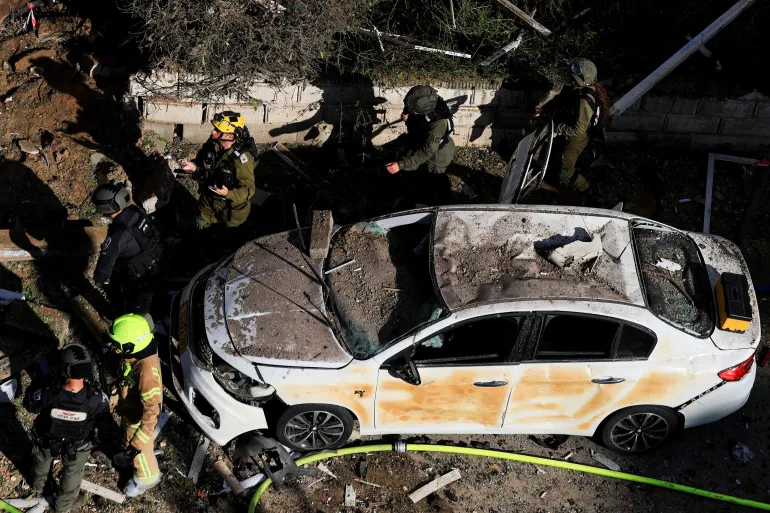
Emergency personnel work next to a damaged car at a site following Iranian missile barrages in central Israel, amid the US-Israel conflict with Iran, in Tel Aviv, Israel [Ronen Zvulun/Reuters]
Rising censorship
Across Israel, journalists and activists like Itamar describe a pervasive atmosphere of self-policing and censorship that, they say, has left people less informed about the consequences of the war than the citizens in Iran, whom many in their media encourage them to pity.
In a country largely unified against a threat that, for generations, politicians have told them is existential, criticism, dissent or opposition is, for the majority, beyond the pale.
This way of thinking is baked into Israeli society. The systems employed by the country’s military censor today to curtail media reporting predate the establishment of Israel in 1948.
Furthermore, new wartime restrictions on what can and cannot be broadcast of the Iranian missile barrages targeting Israel, where they land and what damage they have done – introduced on March 5 – mean these largely go entirely unreported, Israeli journalists say.
Reporting on the new media restrictions in mid-March, the Israeli magazine +972 documented one instance when journalists were permitted to report on debris that had hit an educational facility, but did not mention the actual strike by an Iranian missile, which had successfully hit its intended target nearby. Nor were they allowed to examine the site.
In another case reported by +972, journalists photographing damage to a residential block said they were approached by a man they believed to be linked to a security agency. He asked police to stop reporters from recording the real target of the attack, which was located behind them. The police officer replied that the journalists would not have noticed that site at all had it not been pointed out, since the visible destruction was concentrated on the civilian building.
The censorship, which had been growing more relaxed in recent years, had been tightened once more during the current war, Meron Rapoport, an editor at +972’s sister paper, Hebrew language Local Call, told Al Jazeera, “We don’t really know what is being or with what explosives,” he said, “The IDF [Israeli army] announcements always refer to strikes being on ‘uninhabited areas,’ which is peculiar, because there aren’t that many uninhabited areas in Tel Aviv. It’s a very compact city.”
Indeed, Iran has launched multiple missiles at Tel Aviv, some of which have resulted in damage and injuries – either by the missiles themselves or by debris falling following interception. Most recently, on Tuesday, missiles triggered air raid sirens in the city, where gaping holes were ripped through a multistorey apartment building.
Israel’s Magen David Adom emergency medical service said: “Six people were lightly injured at four different sites.”
“It’s curious,” Rapoport says. “Israeli commentators are always saying how the Iranian public has no real idea how badly they’re being hit. The irony is that they probably have a better idea of how hard Israel is being hit than most Israelis.”
Israel has been trying to make the case for its war on Iran by portraying the country as a threat to European cities, warning Iranian missiles could reach capitals like London and Paris.
GCC states, UN rights chief Volker Turk warn of grave repercussions amid war on Iran.
Published On 25 Mar 202625 Mar 2026
Gulf states’ representatives have told the United Nations Human Rights Council that Iranian attacks on their territories amount to a gross violation of state sovereignty, as the UN’s rights chief warned that the Middle East is nearing an “unmitigated catastrophe” as the US-Israel war on Iran approaches the one-month mark.
Saudi Arabia’s representative to the UN, Abdulmohsen Majed bin Khothaila, condemned Iranian attacks during an emergency meeting called by Gulf states in Geneva on Wednesday, saying the Gulf Cooperation Council (GCC) member states were being attacked despite not being involved in the conflict.
Recommended Stories
list of 3 itemsend of list
“[Iranian attacks] violate the UN Charter and international law. We must call things by their name,” Majed bin Khothaila said.
“To target a neighbour is a violation of the principles of good neighbourly relations. To target a mediator betrays all efforts aimed at peace and undermines any constructive initiative. To target states that are not party to the hostilities amounts to unacceptable and unjustifiable attacks that cannot be passed over in silence.”
Qatar’s representative to the UN, Hend bint Abd al-Rahman al-Muftah, said Iran’s attacks had “grave repercussions” that were “not only affecting peace and security in the world, but also human rights”.
“These attacks amount to a great source of concern for us, and we can no longer remain silent,” she added.
“To attack the electricity and desalination plants also involves serious environmental consequences and undermines rights that should be guaranteed by human rights provisions.”
The Qatari representative also noted that the de facto closure of the Strait of Hormuz was “a source of great concern, given the dire consequences it can have on the economy and supply routes”.
Kuwait’s ambassador, Naser Abdullah Alhayen, told the council that the Gulf was “seeing an existential threat to international and regional security”.
“This aggressive approach is undermining international law and sovereignty,” Alhayen added.
The UN’s rights chief, Volker Turk, warned that the war has created an “extremely dangerous and unpredictable” situation that is pushing the Middle East towards an “unmitigated catastrophe”.
“The only guaranteed way to prevent this is to end the conflict, and I urge all states, and particularly those with influence, to do everything in their power to achieve this,” he said.
Al Jazeera’s Zein Basravi, reporting from Dubai, said the “GCC countries are looking for a seat at the table” at negotiations between the United States and Iran.
“As Iran is going to look for guarantees going forward from the US and Israel, Gulf states will be looking for guarantees from Iran,” he said.
Basravi added that while the volume of incoming attacks in Gulf countries seemed to be going down in recent days, a small attack from Iran “can still create the same level of disruption since the beginning of the war”.
Police source tells Al Jazeera the attack hits positions of the Iran-aligned PMF, which the US has increasingly targeted.
Published On 25 Mar 202625 Mar 2026
An aerial attack on a military base in western Iraq’s Anbar province has killed seven fighters and wounded 13, according to Iraq’s Ministry of Defence.
The strikes on Wednesday targeted the military healthcare clinic at the base in Habbaniyah, according to the ministry. It called the attack “a heinous crime” that violated “all international laws and norms”.
Recommended Stories
list of 3 itemsend of list
An Iraqi police source told Al Jazeera the attack targeted positions of the Iraqi military’s Popular Mobilisation Forces (PMF), a paramilitary force that includes some Iran-aligned brigades and reportedly shares the base with members of Iraq’s regular army.
“What we understand from the military here is that air strikes were carried out and then further strikes carried out on that same position,” said Al Jazeera’s Assed Baig, reporting from Baghdad. He said it appeared to be the first time the PMF was hit alongside the broader Iraqi military.
Iraq has denounced the attack as the country has been dragged into the United States-Israeli war on Iran. On Tuesday, Iraqi Prime Minister Mohammed Shia al-Sudani’s office said Baghdad would summon the Iranian and US ambassadors over the recent strikes.
‘Right to respond’
A security official quoted by the AFP news agency said the strike occurred at the same base that suffered a deadly attack the day before.
Tuesday’s strike, which the PMF blamed on the US, was the deadliest in Iraq since the start of the war on Iran on February 28, It killed 15 fighters, including a commander.
The attack prompted Iraq’s government to grant the PMF a “right to respond” to any attack against it, a position Baghdad reaffirmed on Wednesday.
“We reserve our full right to take all necessary measures to respond to this aggression within the established legal frameworks,” the Defence Ministry said.
Since the war began, pro-Iran armed groups have claimed responsibility for attacks on US interests in Iraq and across the region while strikes have also targeted these groups, including at government-linked positions.
The US Department of Defense has acknowledged that combat helicopters have carried out strikes against pro-Iran armed groups in Iraq during the current conflict.
Baig said the latest strikes demonstrate “an escalation in terms of the PMF being targeted”.
“Increasingly, Iraq is becoming a battlefield between Iraqi armed factions and the United States,” he said.
Iran’s military has said the United States is failing in its war and negotiating with itself to save face, dismissing claims by US President Donald Trump that talks are under way to end the conflict.
“Has the level of your inner struggle reached the stage of you negotiating with yourself?” Ebrahim Zolfaqari, spokesperson for the unified command of Iran’s armed forces, Khatam al-Anbiya Central Headquarters, said on Wednesday in comments carried by Iran’s semiofficial Fars news agency.
Recommended Stories
list of 3 itemsend of list
“Don’t call your failure an agreement,” he added, mocking US leadership.
The statement is the latest official Iranian denial that Tehran is engaged in diplomacy with Washington, even as Trump insists talks are ongoing and reports circulate of the US sending a peace proposal.
Speaking to reporters at the White House yesterday, the US president said Washington is speaking to the “right people” in Iran, which he claimed wants to make a deal “so badly”.
“They are talking to us, and they’re making sense,” said Trump.
Trump’s position marks a stark shift from days earlier, when he threatened to strike Iran’s power plants if Tehran did not fully reopen the Strait of Hormuz, where it has threatened vessels from “enemy” nations. Hours before the ultimatum expired on Monday – and US markets reopened for the trading week – Trump said he would delay any planned attack by five days, citing diplomatic progress. Iranian officials denied this.
Zolfaqari said there would be no return to previous oil prices or the prior regional order “until our will is done”.
‘Obscurity in Iran’
Questions over possible diplomacy were amplified by US media reports that Washington had sent Tehran a 15-point plan to end the war.
The Wall Street Journal, quoting unnamed officials, reported that the plan calls on Iran to dismantle its three main nuclear sites, end any enrichment on its soil, suspend its ballistic missile programme, curb support for its regional allies and fully reopen the Strait of Hormuz. In return, Iran would have nuclear-related sanctions lifted and the US would assist the country’s civilian nuclear programme, according to the Journal.
Al Jazeera’s Mohamed Vall, reporting from Tehran, said there is “total confusion” in Iran over the status of potential negotiations.
“Contrary to the clarity with which Donald Trump seems to speak, there is obscurity in Iran,” said Vall. “What we hear instead are the officials and politicians here saying the complete opposite. They say there is no negotiation.
“There is total confusion, total obscurity, and it’s really making this situation very interesting and very strange,” he added.
While there is a “cloud of mistrust” between the US and Iran, Tehran is engaged diplomatically with several regional countries, including Pakistan, said Al Jazeera’s Tohid Asadi, also reporting from Tehran. Islamabad, which appears to have emerged as a possible mediator in the conflict, delivered the US’s plan to Tehran, according to The New York Times.
Israel, Iran trade strikes
Amid the competing claims about negotiations, Israel continued to strike Iran, and the US reportedly prepared to send more troops to the Middle East.
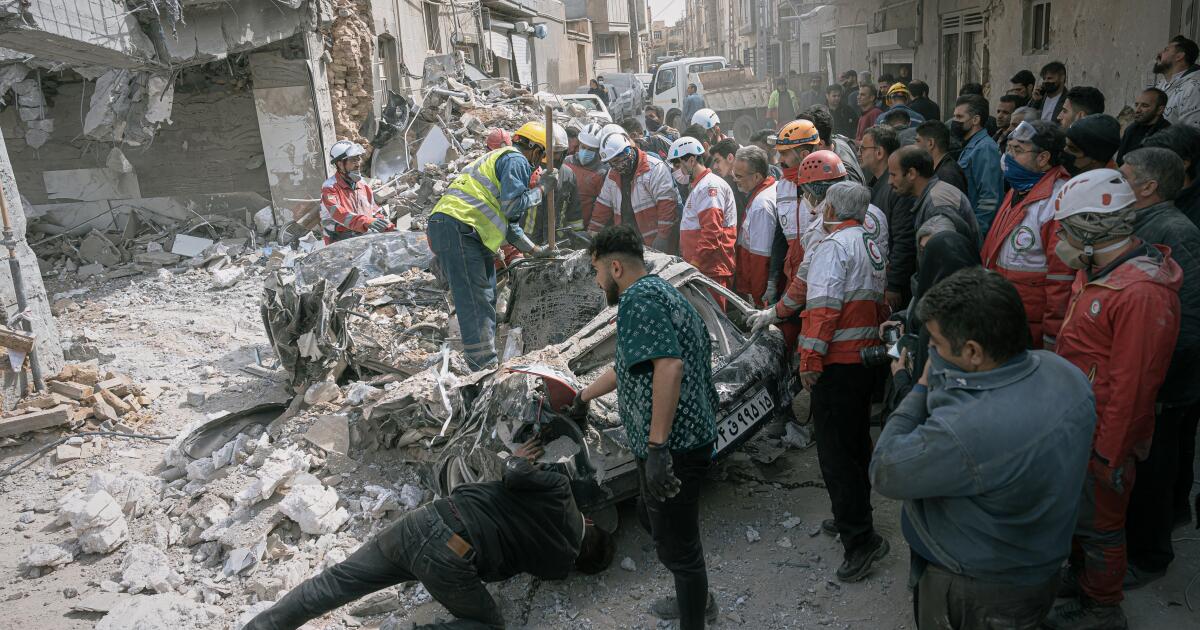
Israel’s military said it carried out a series of late-night strikes on infrastructure in Tehran. Iran’s Fars news agency reported at least 12 people killed and 28 wounded in an “enemy attack” on the residential area of Varamin in southern Tehran.
Iran, for its part, claimed to fire more missiles at Israel, including targeting a military base in the northern Israeli city of Safad, as well as sites in the cities of Tel Aviv, Kiryat Shmona and Bnei Brak. There were no immediate reports of casualties from that missile salvo, though an earlier rocket attack by Hezbollah killed one woman in northern Israel.
Meanwhile, the US was expected to send at least 1,000 soldiers from the Army’s elite 82nd Airborne Division to the Middle East, adding to some 50,000 US soldiers already in the region, the Reuters and AP news agencies reported.
“As the US is preparing for peace talks, it’s also preparing for war,” said Al Jazeera’s John Hendren from Washington, DC. “Diplomacy and military moves are going on at the same time.”
March 25 (UPI) — Republican senators have again backed President Donald Trump‘s war against Iran, blocking a Democratic-led effort to curb his ability to wage war without congressional approval.
The Senate voted 53-47, mostly along party lines, on Tuesday evening to block Democrats’ war powers resolution, the third time Senate Republicans have blocked a resolution to require the removal of U.S. forces from hostilities against Iran unless Congress authorizes them.
Sen. Rand Paul of Kentucky was the only Republican to vote in favor of the motion with his Democratic colleagues, while Sen. John Fetterman of Pennsylvania was the only Democrat to vote against it with the GOP lawmakers.
Since the war began on Feb. 28, when the United States and Israel attacked Iran, Democratic lawmakers have argued the war is unconstitutional because only Congress has the power to declare war, while Republicans contend Trump is within his authority as commander in chief to defend the country.
Sen. Chris Murphy of Connecticut said he forced the vote Tuesday to have debate on Trump’s war in Iran.
“This is increasingly important because this war is spiraling out of control,” he said in a video posted to social media ahead of heading into the Senate.
“The cost of plastic just doubled, prices at the pump are sky high, the Strait of Hormuz is still shut down, new wars are breaking out in the region, we’ve had a dozen Americans killed, $2 billion being spent a day and for what!”
From the floor, Senate Minority Leader Chuck Schumer, D-N.Y., called on Republicans to vote in favor of the resolution, saying it was time for the war to come to an end.
“The war is expanding, and the Senate has an obligation to step in,” he said.
“I say to my Republican colleagues: if there was ever a time to stand up for the authority of the Senate, stand up for the powers given to us through the Constitution, the time is now.”
Sen. Jim Risch of Idaho, who has repeatedly argued against the war powers resolution, took to the floor again on Tuesday to say the Democrats were going to receive the same negative result as they had the two previous times.
Iran started the war, he said, pointing to the Iran hostage crisis of 1979 and stating that the Islamic regime has since killed thousands of Americans.
“The president of the United States said, ‘We have had enough.’ He had very good reasons to pull the trigger at the time that he did and… The fact of the matter is, we are in conflict,” he said, stating the Senate needs to back the Americans fighting in the war and their president.
“We all know this isn’t going to go on very long, but it needs to be done.”
The vote was held less than a week after Democrats used the war powers resolution to force a vote on Wednesday on a similar motion, which Republicans blocked in the same 53-47 outcome. Both Paul and Fetterman voted against their parties.
As the United States-Israeli war with Iran sends tremors through the global economy, the poorest members of the Global South are the most exposed to the fallout.
In Asia, Africa and the Middle East, developing economies are bearing the brunt of surging energy costs prompted by the closure of the Strait of Hormuz and attacks on oil and gas facilities across the Gulf.
Recommended Stories
list of 4 itemsend of list
From Pakistan to Bangladesh and Sri Lanka, through to Jordan, Egypt and Ethiopia, policymakers are facing the double whammy of being both heavily dependent on imported energy and having limited financial firepower to absorb the shock of spiking prices.
In Pakistan, which imports about 80 percent of its energy from the Gulf and has lurched between economic crises for years, authorities have scrambled to roll out measures to conserve fuel.
Facing the depletion of the country’s petrol and diesel reserves within weeks, officials have closed schools, introduced a four-day working week for government offices, ordered half of the country’s public sector employees to work from home, and slashed fuel allowances for official business.
Pakistani Prime Minister Shehbaz Sharif said last week that he had decided against a proposed hike in petrol and diesel prices before the Eid Al-Fitr celebration, saying the government would “bear the burden” of rising costs.
Sharif’s announcement came after the government had earlier this month approved a 55 rupee ($0.20) rise in the price of a litre (0.26 gallons) of petrol or diesel.
While government subsidies have helped cushion the blow for the public, there are fears that petroleum prices will surge and bring economic activity to a halt if the war drags on, said S Akbar Zaidi, the executive director of the Institute of Business Administration in Karachi.
“The overall shock is quite severe, although it has not been fully passed on to consumers and to industry,” Zaidi said.
“I expect the next few weeks to make things far worse once the disruption and price factors pass through.”
A man gets his motorcycle refuelled at a petrol station in Dhaka, Bangladesh, on March 9, 2026 [Munir Uz Zaman/AFP]
In Bangladesh, which imports about 95 percent of its oil and is expected to run through its fuel reserves within days, petrol pumps in some districts have run dry despite the introduction of fuel rationing.
Sri Lanka, which imports about 60 percent of its energy needs and is still reeling from an economic meltdown that began in 2019, has declared every Wednesday a public holiday and introduced a mandatory fuel pass for vehicle owners to conserve petrol and diesel, stockpiles of which are projected to run dry within weeks.
In Egypt, one of the biggest energy importers and among the most indebted economies in the Middle East, the government has ordered malls, shops and cafes to close by 9pm on weekdays and 10pm during weekends, and cut back on public lighting.
Facing growing pressure on public finances due to the government’s heavy subsidisation of fuel prices, Egyptian officials on March 10 announced price hikes of between 15 and 22 percent for petrol, diesel and cooking gas.
While acknowledging the burden on the public, Egyptian President Abdel Fattah el-Sisi said the move was necessary to avoid “harsher and more dangerous outcomes”.
“For a majority of developing economies, especially those already grappling with debt and high import dependence, they are facing a potent mix of inflation, currency pressures and fiscal strains,” said Yeah Kim Leng, a professor of economics at the Jeffrey Cheah Institute on Southeast Asia at Sunway University in Kuala Lumpur, Malaysia.
“The hardest hit are net energy and food importers, especially those with fragile macroeconomic foundations and pre-existing vulnerabilities that typified countries with low per capita income and high poverty rates,” Yeah added.
Pakistan, Bangladesh, Sri Lanka, Jordan, Senegal, Egypt, Angola, Ethiopia and Zambia are among the most at risk, according to a recent analysis by the Washington-based Centre for Global Development, which looked at factors including dependence on fuel imports, public debt levels and foreign exchange reserve/import ratios.
Currency depreciation
The weakening of many developing countries’ currencies against the US dollar – the result of investors buying the greenback amid heightened geopolitical uncertainty – has compounded the situation by further driving up costs.
“Countries such as Indonesia and the Philippines have already seen their currencies at near record lows even before the start of the conflict, making imports, including oil, much more expensive,” said Azizul Amiludin, a non-resident senior fellow at the Malaysia Institute of Economic Research in Kuala Lumpur.
Much as the fallout of the war poses particular challenges for governments in developing countries, the effect on citizens is disproportionate, too.
In less advanced economies, citizens spend much more of their pay cheques on fuel and food, leaving them more exposed to rising living costs.
At the same time, governments in developing countries have less capacity to provide a safety net for those at risk of falling through the cracks.
“In vulnerable economies, governments often attempt to shield their populations from price hikes by subsidising fuel and food,” said Yeah, the Jeffrey Cheah Institute professor.
“However, with depleted fiscal buffers and shrinking revenues, this becomes unsustainable. The ensuing austerity, combined with hyperinflation, can trigger widespread social unrest and a full-blown fiscal crisis.”
Motorcyclists crowd a filling station and wait their turn to get fuel, in Lahore, Pakistan, on March 6, 2026 [K M Chaudary/AP]
With the US and Israel barely a month into their war and no clear timetable for its end in sight, many analysts expect things to get worse before they get better.
Khalid Waleed, a research fellow at the Sustainable Development Policy Institute in Islamabad, said rising transport costs would soon be felt at supermarket checkouts.
“Diesel is the backbone of Pakistan’s freight and agricultural economy,” Waleed said.
“Trucking costs have started climbing, and that will feed into everything from flour to fertiliser in the weeks ahead.”
Once Pakistan’s wheat harvest gets under way in April, food prices could spike well beyond their current levels, Waleed said.
“Combine harvesters, threshers, tractors for haulage from field to market, and the trucks that move grain from fields to flour mills and storage facilities all run on high-speed diesel,” he said.
“For a country where wheat flour is the single largest item in the food basket of the bottom two income quintiles, this is not a marginal concern,” Waleed added.
“If diesel prices stay elevated through April and May, Pakistan will harvest its wheat at the most expensive input cost in years, and that cost will transmit directly into food inflation at a time when households have almost no capacity left to absorb further price shocks.”
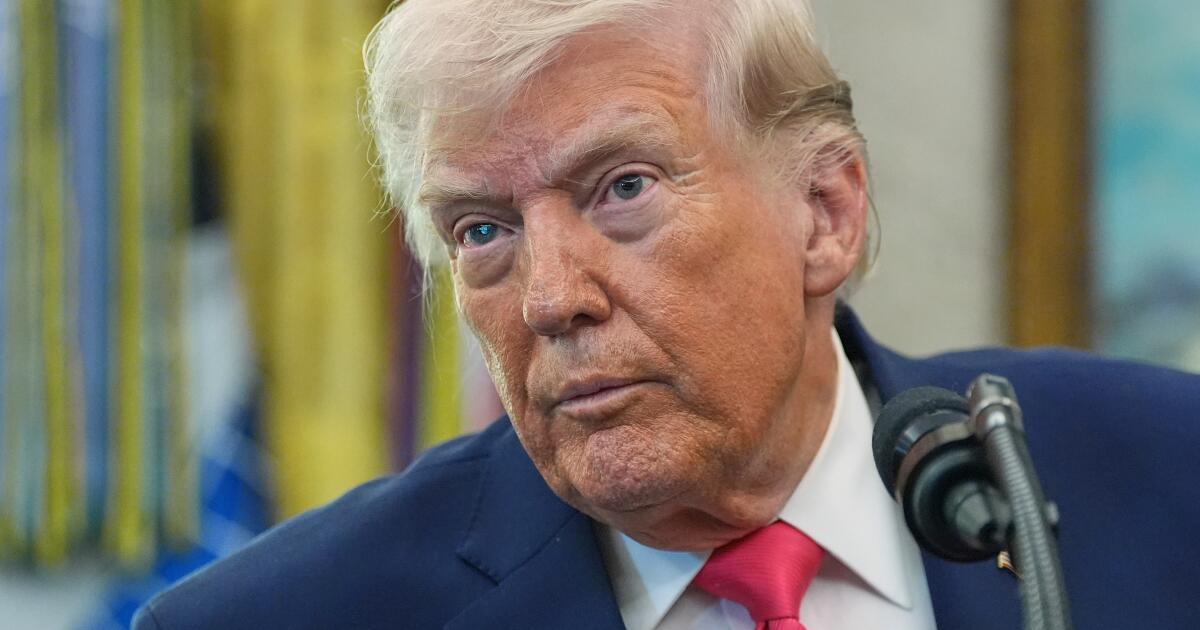
WASHINGTON — President Trump said Tuesday that Iran wants to “make a deal” with the United States to end the war in the Middle East, saying that negotiations are ongoing with the conflict in its fourth week.
Iran has publicly denied that talks are happening. But Trump told reporters during an Oval Office event that negotiations are underway and being led by Vice President JD Vance and Secretary of State Marco Rubio.
“I’d like to think we are in a good bargaining position,” Trump said.
Trump said he remains skeptical of Tehran’s intentions, saying he doesn’t necessarily “trust them,” but indicated that he is encouraged to continue talks after receiving what he described as a “very big present worth a tremendous amount of money” from Iran.
“I am not going to tell you what the present is,” Trump told reporters. But he said it was a “significant prize” related to “oil and gas” that signaled to him that he was “dealing with the right people.”
Conflicting messages over the diplomatic efforts between Washington and Tehran come as Pakistan has offered to host peace talks in Islamabad aimed at ending the hostilities, which have killed more than 2,400 people, further destabilized the Middle East and disrupted global oil markets.
“Pakistan welcomes and fully supports ongoing efforts to pursue dialogue to end the WAR in Middle East, in the interest of peace and stability in region and beyond,” Prime Minister Shehbaz Sharif wrote on X.
Any potential talks between the United States and Iran would face significant challenges. Key U.S. demands — particularly related to Iran’s ballistic missile and nuclear programs — remain difficult to resolve, even though Trump claims Iran has already agreed to concessions related to its ability to have nuclear weapons.
It is also unclear who within Iran’s leadership would be willing to negotiate, especially as Israel has vowed to keep targeting Iranian leaders after killing several already.
Trump has not publicly responded to Pakistan’s offer to act as an in-between for the United States and Iran. He also sidestepped a question about a New York Times report that said the Saudi crown prince, Mohammed bin Salman, has been pushing him to continue the war against Iran.
The president instead expressed confidence in his senior advisors handling the negotiations with Iran. He did not specify who U.S. officials are engaging with, but insisted they are “talking to the right people.”
When asked by a reporter why he had agreed to a cease-fire with the Iranians, Trump said: “They are talking to us, and they’re making sense.”
As the talks continue, Trump said that the United States is “way ahead of schedule” in its war with Iran, a nation that he said was so battered that it had no choice but to come to the negotiating table. Iran, however, showed on Tuesday that it still has firepower as it fired a new wave of missiles at Israel, Iraq and other gulf nations.
Iran fired at least 10 waves of missiles at Israel. In Tel Aviv, a missile with a 220-pound warhead slammed into a street in the city center, blowing out windows of an apartment building and sending smoke billowing. Four people suffered minor wounds, rescue worker Yoel Moshe said.
In Kuwait, power lines were hit by air defense shrapnel, causing partial electricity outages for several hours. Bahrain said it was attacked with missiles and drones, and that an Emirati soldier serving with its forces had been killed. The United Arab Emirates said air defense systems responded to similar attacks, and Saudi Arabia said it destroyed Iranian drones targeting its oil-rich Eastern Province.
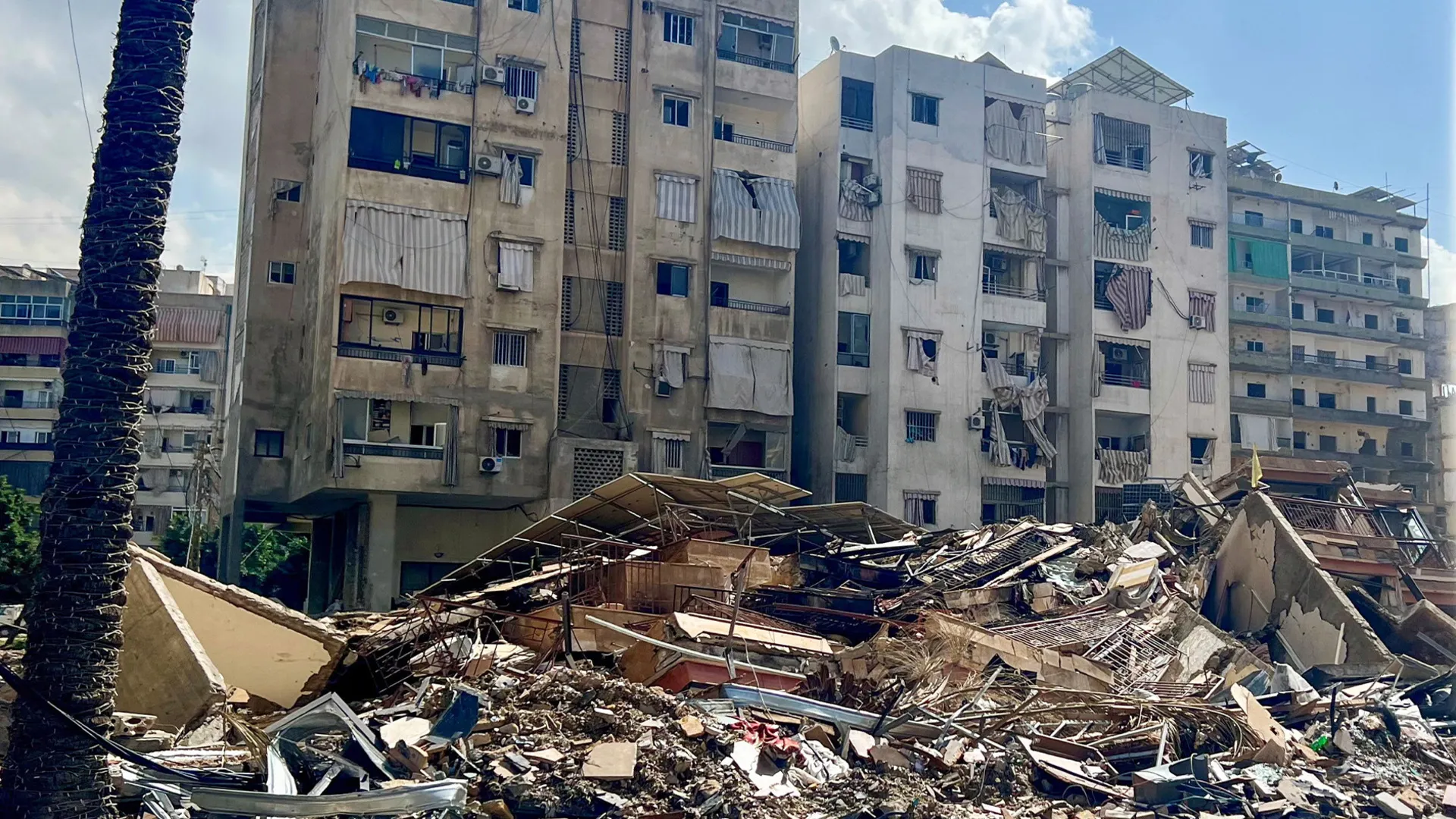
Israel pounded Beirut’s southern suburbs, saying that it was targeting infrastructure used by the Iran-linked Hezbollah militant group, and carried out an extensive series of strikes on Iranian “production sites,” without providing more information.
On Tuesday, Defense Minister Israel Katz said Israel intended to seize Lebanon’s south Lebanon to a create a “security zone.”
Speaking at an assessment meeting with the Israeli military’s chief of staff, Katz said the military would control up to the Litani River, a waterway that runs through south Lebanon, meeting the Mediterranean some 20 miles north of the border with Israel.
“Hundreds of thousands of residents of southern Lebanon who evacuated northward will not return south of the Litani River until security for the residents of the north [of Israel] is ensured,” he said.
His words were the clearest articulation yet of Israel’s plans in Lebanon, going far beyond the “limited and targeted ground operations” announced by the Israeli military earlier this month.
Lebanon, meanwhile, took steps to undercut Tehran’s influence in the country and its support for Hezbollah. In a statement released on X on Tuesday, Lebanese Foreign Minister Youssef Raggi said the government was expelling Iranian Ambassador Mohammad Reza Shibani and declared him persona non grata. He gave Shibani until Sunday to leave the country.
Hezbollah condemned the move and called it a “grave national and strategic mistake.” Political figures aligned with the group also issued public statements urging the Iranian ambassador to ignore the decision.
In Washington, Trump said he would like to find a resolution that would avoid further casualties and damage to critical infrastructure in the region.
“If we can end this without more lives being down, without knocking out $10-billion electric plants that are brand new and the apple of their eye, I’d like to be able to do that,” he said. “But they can’t have certain things.”
Defense Secretary Pete Hegseth, meanwhile, told reporters that he would rather “negotiate with bombs.”
“The president has made it clear that you will not have a nuclear weapon. The War Department agrees,” Hegseth said. “Our job is to ensure that, and so we’re keeping our hand on that throttle, as long and as hard as is necessary to ensure the interests of the United States of America are achieved on that battlefield.”
His comments came as thousands of U.S. Marines were on their way to the region, raising speculation that the U.S. may try to seize Kharg Island, which is vital to Iran’s oil network. The U.S. bombed the Persian Gulf island more than a week ago, hitting its defenses but saying it had left oil infrastructure intact.
The Pentagon declined to comment on the deployment.
Ceballos and Quinton reported from Washington. Times staff writer Nabih Bulos in Beirut contributed to this report.