Iran

Iran cannot defeat US military might, but it can still win | Opinions

Last week, American diplomats and their Iranian counterparts sat down in Geneva for yet another round of talks mediated by Oman. The outcome seemed unclear. While the Iranians said “good progress” had been made, the Americans claimed there was “a little progress”. Meanwhile, United States President Donald Trump threatened once again to strike Iran.

In recent weeks, there has been a heavy US military build-up in the Middle East in preparation for what many observers see as an imminent attack. In this context, it may be apt to question whether the current negotiations are not simply a tactic to buy time to better prepare for the inevitable.

In the face of US military might, some have suggested that Iran’s only option is negotiating an agreement with the US, however unfair it may be. While Iranian military capabilities stand no chance against an army with the world’s biggest budget, accepting capitulation through a debilitating deal that may be broken again by Washington may not necessarily be Tehran’s only choice.

There is another way in which Iran can stand up to US bullying and win.

The fate of past negotiations

The ongoing US-Iran talks cannot be viewed in isolation. For Iran, any diplomatic engagement with the US is overshadowed by the legacy of the Joint Comprehensive Plan of Action (JCPOA).

Signed by the US, China, Russia, France, the United Kingdom, Germany, the European Union and Iran in 2015, the agreement provided sanctions relief in exchange for full transparency of the Iranian nuclear programme. Tehran accepted the deal even though it had some unfair provisions, including some US sanctions remaining in place.

Nevertheless, it fulfilled its obligations – a fact that was repeatedly verified by the International Atomic Energy Agency.

In return, however, the US as a signatory did not uphold its end of the deal. In 2018, Trump unilaterally withdrew from the JCPOA and reimposed maximum pressure sanctions aimed at crippling Iran’s economy.

It was a stark reminder that American promises are nonbinding. As a leader who has shown no regard for the interests of American allies in pursuit of an “America first” policy, Trump could hardly be expected to respect the interests of American adversaries.

However, even if a Democratic president had been in the White House, there would not have been any guarantee that the JCPOA would have remained in place. In the US’s polarised political climate, an American president’s signature is only valid until the next election.

For the US, negotiations can also be little more than a facade intended to lull adversaries into a false sense of security. Last year, just as US and Iranian representatives were scheduled to meet in Oman for another round of talks, Israel, a key American ally, launched a massive military campaign against Iran.

While the US denied direct involvement, it acknowledged having received prior notice. Given the close ties between the two countries, this prior knowledge strongly implied that the US had given Israel tacit approval for the air attacks.

Today, Iran is engaging in negotiations with the US again, and it is being pressured to accept an even more unfair deal. Should it back down and submit to US demands, then Trump – who preys on perceived weakness – would simply move the goalpost. Demands would shift from Iran’s nuclear programme today to its ballistic missiles tomorrow and regime change the day after.

The special US relationship with Israel means that Washington is fundamentally hostile to an Iranian government that sees the Israeli state as an enemy. Consequently, Trump’s goal is not to reach a durable agreement but to ensure that Iran can never fully comply with his demands, thereby justifying a permanent campaign of maximum pressure and hostility.

In this context and given its recent experience, it would be foolish for Iran to rely on US promises and negotiated agreements.

Leverage through strong regional ties

The current US-Iran standoff is a high-stakes game in which an all-out war is a likely outcome. While the US could achieve an initial victory through overwhelming military superiority, it could also get bogged down fighting a protracted counterinsurgency in Iran’s mountainous terrain.

Conversely, while Iran could eventually repel an American invasion – just as its Afghan neighbours did – the country would be reduced to rubble in the process.

That does not mean Iran should back down. The Greenland crisis and the China-US trade war have demonstrated that Trump’s propensity for sabre-rattling is tempered by his aversion to losses. Even though the EU and China are far more powerful than Iran, a clear show of resolve could compel Trump to retreat.

And Tehran does not have to be alone in its defiance. In its neighbourhood, there are other big players who recognise that another disastrous war led by the US is not in their interests. Iran can and should leverage the regional desire for stability.

For years, Iran pursued a policy of confrontation in the region until it realised that carving out a sphere of influence was actually exacerbating its security dilemma. This recognition ultimately led to the historic normalisation of relations with Saudi Arabia in 2023 – a breakthrough facilitated by China, Oman and Iraq – which in turn set in motion a broader detente with other Arab countries.

Three years later, that decision is yielding dividends. Notably, Saudi Arabia, Oman, Turkiye and Qatar are lobbying Trump to exercise restraint. Building on this neighbourly diplomacy and investing in developing regional stability and a security architecture could help stave off another major US war in the region.

The most important path to peace – and the only means of countering American gunboat diplomacy – does not lie in matching American military might, a contest Iran is destined to lose, but in establishing good relations with its neighbours and accepting regional stability as part of its national security.

The views expressed in this article are the author’s own and do not necessarily reflect Al Jazeera’s editorial stance.

Source link

Army helicopter crashes into Iran market, killing 2 pilots and 2 merchants | Military News

The incident in Isfahan province follows crash of fighter jet in Hamadan province less than a week ago.

Tehran, Iran – Two military pilots and two merchants have been killed after an army helicopter crashed into a fruit market in central Iran.

The crash on Tuesday morning occurred in Dorcheh, a town in Isfahan province, where the army has a major airbase, according to state media, which said the cause was likely a technical fault in the aircraft.

Recommended Stories

list of 3 itemsend of list

Footage broadcast by state media from the scene of the crash showed the wreckage and emergency responders putting out the fire.

The Army Aviation Training Centre, in a statement, identified the killed soldiers as Colonel Hamed Sarvazad, the pilot; and his co-pilot, Major Mojtaba Kiani.

Two people working at their booths in the market were also reportedly killed on the scene after the helicopter crashed and caught fire.

The army centre said the cause of the crash is under investigation. The local judiciary chief, Asadollah Jafari, said he had also opened a case and dispatched investigators.

The crash comes less than a week after an Iranian Air Force fighter jet, reportedly an old United States-built F-4 model, crashed during a late-night training mission in the western province of Hamadan.

State media reported that one of the pilots was killed, but the other survived after successfully ejecting. The cause of that crash is under investigation, but state media said it was likely caused by a technical fault, as well.

Iran has been largely unable to upgrade its ageing fleet of aircraft, both military and civilian, as a result of decades-long sanctions imposed by the US and its allies.

Iran has purchased a number of fighter and training aircraft from Russia, and has been seeking to buy advanced Su-35 jets, but they have yet to be delivered by Moscow.

The crash of the helicopter took place amid rising tensions between the US and Iran before a new round of nuclear talks, which are set to take place in Geneva, Switzerland, on Thursday.

Iranian officials have warned that the country will not “bow down” to US pressure as Washington bolsters its military presence in the region.

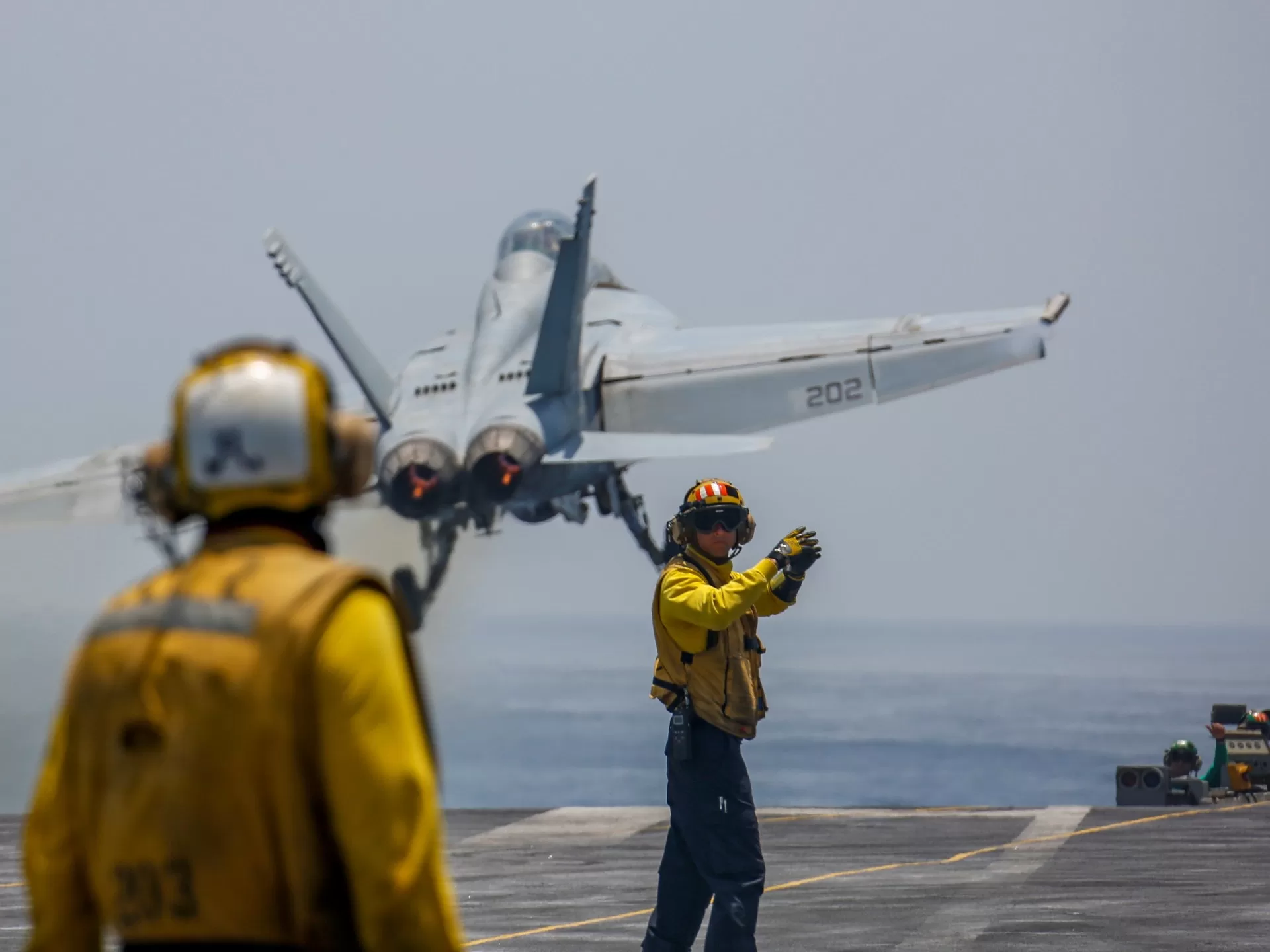
In recent weeks, the US military has amassed hundreds of advanced fighter aircraft, both in military bases and on two aircraft carrier strike groups, as it threatens to strike Iran if it fails to reach a deal on its nuclear and missile programmes.

Tehran has rejected negotiations about its missiles, but has said an agreement may be possible to ensure it will never possess a nuclear weapon.

Source link

When the Strong Decide: Diego Garcia, Raw Power, and the Illusion of Conditional Access

On 18 February 2026, reports emerged that Britain was withholding American permission to use Diego Garcia in any hypothetical strike against Iran. The following day, Trump posted “DO NOT GIVE AWAY DIEGO GARCIA” on Truth Social, linking the base directly to potential operations against Tehran in terms that left no room for diplomatic interpretation. The sequence lasted forty-eight hours and revealed what months of careful legal construction had obscured: that the architecture of conditional access Britain had built around a strategically significant military installation was worth precisely what the decisive power chose to make it worth. Whether the intervention also carried tactical signalling toward Tehran is a legitimate question, and intra-alliance friction of this kind sometimes functions as maximalist positioning before settlement. What matters analytically, however, is not the post itself but what the post revealed when operational pressure arrived. It was also, for anyone who had read Washington’s December 2025 National Security Strategy carefully, entirely predictable.

Power Does Not Ask

There are two ways to understand how military power operates in the international system, and the Chagos episode forces a choice between them. The first holds that great powers are meaningfully constrained by the frameworks they inhabit, alliance structures, legal agreements, and diplomatic settlements, and that these frameworks produce stable, predictable behavior even when the underlying interests they were designed to manage come under pressure. The second holds that frameworks are expressions of power relationships at a given moment rather than independent constraints upon them, so that when power shifts or decides to assert itself, the frameworks adjust to reflect the new reality rather than containing it. The first is the language of liberal internationalism. The second is the language of realism, and what February produced was an unambiguous realist moment.

The December 2025 National Security Strategy had already committed this diagnosis to paper. The document did not describe Europe as weak through circumstance. It described Europe as having chosen weakness, identifying a “loss of national identities and self-confidence” as the continent’s defining condition and stating openly that it is “far from obvious whether certain European countries will have economies and militaries strong enough to remain reliable allies.” The strategy framed European concerns about Russia as evidence of that same condition, noting that this lack of self-confidence was most evident in Europe’s relationship with Russia, despite the fact that European allies enjoy a significant hard power advantage over Russia by almost every measure save nuclear weapons. Washington’s reading of its European partners, formalized two months before the Diego Garcia friction became public, was of states that had systematically preferred institutional solutions over sovereign ones, legal arrangements over unconditional control, and managed conditionality over the exercise of will. Britain’s handling of Chagos was, in that context, not an anomaly. It was a confirmation.

What is analytically significant about Trump’s intervention is not simply that he rejected the deal but that he did not engage it at all, did not address the ICJ ruling that gave it legal foundation, did not contest the lease terms that were its operational expression, and did not enter the diplomatic logic that had produced it over months of negotiation. A decision of this kind does not derive its authority from the framework it overrides, because it precedes that framework, and the framework itself only ever existed on the sufferance of the power now choosing to move against it. When Trump asserted that leases are “no good when it comes to countries,” he was not making a legal argument that could be answered within the same register. He was stating a principle about the nature of sovereign will: that when it moves, it moves prior to and above whatever conditional arrangements were constructed in the period of its dormancy.

This is realism in its purest operational form, in which states pursue interests, great powers pursue interests with the capacity to enforce them, and legal architecture functions as an instrument of power when it serves those interests and an obstacle to be displaced when it does not. The Chagos deal did not alter the underlying power relationship between Washington and London, but it did create a layer of conditionality over an asset Washington considers operationally essential, and when operational pressure arrived, that conditionality became intolerable, not because Mauritius is hostile, not because Britain is an adversary, but because no great power conducting military projection at a global scale can accept that a weak state sits structurally inside the chain of its operational decisions, regardless of how that state arrived there or how benign its intentions are understood to be.

Beneath the realist logic sits a transactional one, and the two reinforce each other in ways that matter for how Britain should read what happened. Trump does not evaluate alliance relationships by their historical depth or their institutional architecture. He evaluates them by what they yield in the current moment, and every asset is a leverage point to be maximized. Diego Garcia represents unconditional American operational value. The Chagos deal reduced that value by inserting a condition. From a transactional perspective, that insertion was not a diplomatic nuance to be managed but a concession to be reversed, because Trump’s governing principle across every alliance relationship is maximum American gain, and conditionality is by definition a reduction of gain. The decisionism explains how he responded. The transactionalism explains why.

The Geography of Decision

Diego Garcia is not incidental to American power projection in the region, though its significance is that of an enabler rather than a prerequisite. The base sits at the center of the Indian Ocean, within operational reach of the Persian Gulf, the Strait of Malacca, and the East African littoral, and it has supported American military operations across that entire arc for half a century through bomber rotations, logistics chains, and a sustained forward presence that no other installation in the basin fully replicates at the same scale and permanence. It does not make American power projection possible in any absolute sense, but it makes it faster, cheaper, and more sustained, which in the context of time-sensitive operational planning against a target like Iran is not a marginal difference but a meaningful one.

The Iran dimension exposes the conditionality problem with particular clarity because the operational context in which Diego Garcia’s value is most acute is precisely the context in which conditional access is most dangerous. American military assets have accumulated across the Middle East, talks are active, and a base capable of projecting strategic airpower directly into the Persian Gulf theater is not a background consideration but a variable whose availability, or unavailability, shapes what options exist and on what timeline. Britain’s reported reluctance to grant operational clearance, under a deal still unratified and still contested in domestic courts, still legally dependent on Mauritius’s continued cooperation, revealed that the conditionality embedded in the arrangement had already entered the operational calculus before any of the stabilizing assumptions behind the deal had time to establish themselves. Strategic friction did not arrive at the end of a long maturation period. It arrived in weeks, because operational pressure does not wait for diplomatic frameworks to consolidate.

That compression of the timeline is itself the most realistic lesson. Power does not defer to the developmental logic of legal arrangements, and when the operational moment arrives, whatever sits between a great power’s will and its objective is reclassified from a framework to be respected into a problem to be solved.

The Structural Position of the Weak

The analytical core of the Chagos case is not about Mauritius’s intentions, which by all available evidence are not hostile, but about the structural position that the deal assigned to it within the architecture of American operational planning, because in the logic of great power competition, it is position rather than intention that determines strategic relevance. By inserting itself, or being inserted, into the chain of conditions governing a great power’s operational freedom, a weak state acquires a form of leverage it could never achieve through military means, and the Chagos deal gave Mauritius exactly that position, not through hostility but through legal standing, not through power but through presence within a conditional architecture that a great power now had reason to find constraining.

For Washington operating within a decisionist strategic logic, that presence is categorically unacceptable regardless of Mauritius’s intentions. The relevant question is not whether Mauritius would obstruct American operations but whether, under the terms of the arrangement, it structurally could, and the answer is yes in a way that no amount of diplomatic goodwill can fully neutralize. Sovereignty transferred to Mauritius is not sovereignty parked with a neutral party but sovereignty that now sits within reach of Chinese economic leverage, meaning the lease does not merely introduce conditionality but introduces conditionality whose future content Washington cannot determine or guarantee. A great power conducting global military projection cannot organize its operational planning around the sustained goodwill of a small state whose strategic orientation it cannot guarantee. That such goodwill is required at all is the problem the deal created.

Weak states do not constrain great powers through legal arrangements in any durable sense, because the constraint only holds when the great power chooses to honor it, and great powers choose to honor constraints only when the cost of non-compliance exceeds the cost of compliance, a calculation that shifts decisively once operational necessity enters the equation and the framework reveals itself to be dependent on tolerance rather than grounded in power.

Conclusion

Britain converted unconditional sovereign control over a strategically significant military installation into a conditional leasehold arrangement whose operationalization depended on a small state’s legal cooperation and presented that conversion as a resolution of vulnerability rather than the creation of a new one. Britain was not being naive. It was an attempt to preserve the base’s long-term legal viability against mounting international pressure, a calculation that the alliance relationship would absorb any friction that followed. What Britain did not account for was that its ally evaluates arrangements not by their legal durability but by whether they constrain American will, and a solution sophisticated enough to satisfy international law was simultaneously insufficiently decisive to satisfy Washington.

From the perspective of the December 2025 National Security Strategy, that conversion was not a surprise. It was the predictable output of a European strategic culture that Washington had already formally diagnosed: one that reaches instinctively for institutional solutions when strong states would resolve through will, that mistakes legal legitimacy for strategic security, and that has internalized the habits of the post-Cold War order to the point where it can no longer easily distinguish between a framework and the power that makes frameworks real.

Trump’s response was the most realistic verdict on that presentation, not an argument against the deal’s legal coherence, which was never in question, but a decision that the framework was insufficient for the operational reality it was meant to serve, delivered in terms that made the underlying logic unmistakable. The framework did not collapse under the pressure. It was revealed, under pressure, to have rested entirely on the assumption that the decisive power would continue to choose not to decide otherwise, an assumption that realism has always identified as the central fragility of arrangements built on consent rather than grounded in power.

The strong do not negotiate with the architecture of constraint, and for Europe, February was less a shock than a reminder that the rules it has built its strategic identity around have always depended on the continued willingness of a decisive power to operate within them.

Source link

No-Win Situation for Trump: Why the US Cannot Achieve Military Victory

The aircraft carrier USS Abraham Lincoln, six frigates, three light warships, and approximately thirty fighter jets and support aircraft have entered the Middle East by order of Donald Trump who, by repeatedly touting the slogan “I have ended six/seven/eight wars,” has considered (and continues to consider) himself deserving of the Nobel Peace Prize. What objective do all these tensions that the U.S. administration has generated in the region actually pursue? The weakening of Iran, or the overthrow of the incumbent government? Whatever his and his administration’s aim may be, it appears that—within the cost–benefit calculations of his trader’s mindset—he has yet to arrive at a definitive conclusion as to what kind of blow, and at what scale, could deliver the desired outcome. His recent military posturing around Iran and his increasingly threatening rhetoric against the Islamic Republic have placed him in a no-win situation whose end few can predict.

Why a no-win situation for Trump?

First Strike Doubt: Trump and the constellation of officials currently in the White House—who, notably, are far from unified or aligned on how to approach Iran—have reached no certainty regarding the effectiveness of a first strike against Iran or the likelihood of achieving their desired results. It is evident to all that the Islamic Republic of Iran is neither Venezuela, nor Libya, nor Syria, nor Afghanistan, nor Iraq, nor anything akin to the historical cases in which the United States has intervened militarily in the name of democracy verbally and in pursuit of its own interests operationally. This very reality has, thus far, prevented Trump from issuing the order to “open fire” on Iran up to now.

On the other side, there is no sign of the flexibility or concession sought by the United States in the behavior or rhetoric of Iranian officials—a fact acknowledged by American officials themselves. This indicates that pressure, intimidation, and threats have thus far yielded no results. The reason is clear: the Islamic Republic views any potential confrontation as an existential war and is unwilling to grant any concessions. Trump, however—who seeks to manufacture achievements out of even the smallest events and whose penchant for exaggeration is among his defining traits—perceives such circumstances as detrimental to his personal prestige and standing.

Iran’s Resilience: The experience of the Israeli attack and the hybrid war launched against Iran in June 2025, with direct assistance from the United States and indirect support from so many others, demonstrated that the instability they sought within the governing structure of the Islamic Republic and even the internal social fragmentation and rifts that had been cultivated for years through various media tools did not materialize. Despite the blows inflicted on Iran, none of the long-term strategic objectives of the United States and Israel were achieved. Likewise, the unrest and riots of January 8 and 9, despite the violence and damage they caused to the public and the state, were ultimately brought under control and culminated in a multi-million-person rally on January 12 condemning the unrest and supporting the central government of the Islamic Republic.

High costs and Persian Gulf Worries: Operationalizing a military threat would impose heavy costs on the United States and its allies. The Islamic Republic has explicitly declared that any military action against its territory, at any scale, would be regarded as all-out war, and that, consequently, the entire region—as well as U.S. interests wherever they may be—would fall within range of Iran’s retaliatory strikes. This serious warning has also prompted Persian Gulf states to mobilize their capacities to dissuade Trump from attacking Iran. The strikes on U.S. bases at Ayn al-Asad and Al-Udeid entrenched the perception that the Islamic Republic does not shy away from responding to foreign aggression, even if large segments of the world regard the attacking state as a “superpower.”

Global Energy Risks: The ignition of war in the Persian Gulf would amount to a grave threat to global energy supply routes. Roughly 30 percent of the world’s crude oil and 20 percent of liquefied natural gas are supplied by Persian Gulf countries, and 20–25 percent of global crude oil transits the Strait of Hormuz. Any aggressive action by the United States would jeopardize the security of one-fifth of the world’s fuel and profoundly affect the global economy.

Although the U.S. National Security Strategy does not place the Middle East among America’s top strategic priorities, the same document states that: “We (the United States) want to prevent an adversarial power from dominating the Middle East, its oil and gas supplies, and the chokepoints through which they pass while avoiding the forever wars”, which shows Persian Gulf oil is still of high importance for Washington.

Tilting Power Balance: In addition, heightened tensions in the Persian Gulf would endanger China’s economic interests, and any large-scale military confrontation would likely lead to a more pronounced military-security presence by Russia and China in the Gulf—tilting the balance in favor of America’s rivals.

And finally?

The embers beneath the region’s ashes today could be ignited by the slightest breeze, engulfing a vast area. Israel, while likely the first target of Iran’s retaliatory response in the event of a U.S. attack, is nevertheless eager to initiate confrontation based on the calculation that a war waged with the full might of the United States could ultimately erode the very existence of the Islamic Republic or weaken it to the point of capitulation. In this context, it is not far-fetched to suggest that the disclosure of new documents and details concerning Trump’s links to the notorious Epstein case and his mysterious island may have been driven by the Mossad, as such revelations could compel the U.S. president to undertake an irrational action to divert attention elsewhere.

Today, Trump is acting more than ever in contradiction to his own professed principles—from trampling on his signature MAGA slogan and morphing it into MIGA (Make Israel Great Again), to undermining his administration’s efforts to reduce unnecessary international expenditures; from his paradoxical pride in having ended “eight wars” to the strategy of off-shore balancing the Middle East. Should a war of this magnitude and consequence erupt, no country involved—whether through direct action or geographic proximity—would be spared its consequences. Regarding these circumstances, it appears that the only desirable scenario for Trump, the region, and the world at large is the opening of a genuine dialogue, free from the shadow of threats, intimidation, and American bullying.

Source link

Are the US and Iran moving closer to war? | Donald Trump

Diplomacy continues despite the significant United States military build-up.

More talks are planned for Thursday between Iran and the United States, which is mobilising its largest military force since the invasion of Iraq more than two decades ago.

Amid mixed messages from US President Donald Trump, Tehran says it wants talks, but is ready for war, too.

So, where do both sides stand?

Presenter: James Bays

Guests:

Jamal Abdi – President of the National Iranian American Council

Hassan Ahmadian – Associate professor at the University of Tehran

Richard Weitz – Senior fellow at the NATO Defense College

Source link

Iran Signals Possible “Fast Deal” To Be Made In Nuclear Talks As U.S. Military Build-Up Grinds On

Amid the steady drumbeat of reports pointing to the growing likelihood of strikes on Iran, there are indications that officials from Washington and Tehran will meet this week for another round of talks centered on the Iranian nuclear program. While the two sides remain generally at loggerheads, Iranian officials are now openly talking about possible concessions on their nuclear program in return for sanctions relief and the right to enrich uranium for peaceful purposes.

The Iranian foreign minister, Abbas Araghchi, told CBS over the weekend that U.S. and Iranian negotiators would likely hold more discussions in Geneva on Thursday, with the aim of making “a fast deal.” Iran and the United States resumed negotiations earlier this month.

Iran's Foreign Minister Abbas Araghchi (C) looks on prior to delivering a speech during a session of the United Nations Conference on Disarmament, on the sideline of a second round of US-Iranian talks with Washington pushing Tehran to make a deal to limit its nuclear programme, in Geneva, on February 17, 2026. (Photo by Valentin Flauraud / AFP via Getty Images)
Iranian Foreign Minister Abbas Araghchi (center) before delivering a speech during a session of the United Nations Conference on Disarmament, on the sidelines of a second round of U.S.-Iranian talks with Washington, in Geneva, on February 17, 2026. Photo by Valentin Flauraud / AFP

Now, Araghchi says that he thinks there is still a good chance of finding a diplomatic solution in planned talks with U.S. special envoy Steve Witkoff. However, he added that “If the United States attacks us, then we have every right to defend ourselves.” Iran has repeatedly threatened to strike U.S. bases in the region if it is attacked.

Aragachi raised the possibility of a new nuclear deal that would see Iran committing to keep its nuclear program “peaceful forever.” This would be a major advance over the previous, time-limited agreement, which was negotiated by the Obama administration in 2015, but from which U.S. President Donald Trump withdrew in 2018, during his first term in office.

Araghchi’s growing importance reflects the belief of U.S. officials that Iran’s supreme leader, Ali Khamenei, together with the country’s president, Masoud Pezeshkian, are increasingly being marginalized within the negotiations.

BREAKING: Iran’s Supreme Leader Ali Khamenei was the target of an internal effort to sideline him, allegedly led by former President Hassan Rouhani, just before the January 8–9 crackdown when protests were at their peak, Le Figaro reports.

— Faytuks Network (@FaytuksNetwork) February 22, 2026

Overall, the development comes as U.S. military assets continue to flow into the region as part of a massive deployment of forces.

Among the latest movements, it appears that additional U.S. Air Force KC-135 Stratotankers are being repositioned from the Indo-Pacific region and closer to the Middle East. These refueling assets would be vital to sustaining any kind of air campaign against Iran.

Other tankers and transports also continued to pour into the wider region after transatlantic flights over the weekend.

In terms of aircraft basing, the apparent postponement of planned runway reconstruction work at Diego Garcia in the Indian Ocean might point to one of the windows of opportunity for U.S. airstrikes. Work at the base, which could be important to any U.S. plans for a sustained campaign of airstrikes against Iran, has been pushed back successively from February to March, and now to April, according to notices to airmen (NOTAMs). As well as the long-range bombers that periodically operate out of Diego Garcia, the facility would need to host cargo and refueling support aircraft, as well as assets to defend the island from possible Iranian attack. As we reported last week, the United Kingdom has apparently said it would not allow the use of the island for strikes on Iran, although this position could certainly change. It is worth noting, too, that satellite imagery available to TWZ does not reveal any visible changes in terms of deployments to Diego Garcia.

Construction on Diego Garcia’s runway was initially expected to begin in February, then moved to March, and is now delayed again until April 2.

RWY 13/31 will close weekdays (0700–1700 local) for ~80 working days, according to the latest NOTAM pic.twitter.com/4q35SOfwHh

— Faytuks Network (@FaytuksNetwork) February 23, 2026

There are also reports, currently unconfirmed, from Israel’s Channel 12, of U.S. Air Force KC-135s at Ben Gurion Airport in Israel. Photos apparently show at least two of the tankers on the tarmac at the civilian airport, one of them wearing the markings of the 452nd Air Mobility Wing from March Air Reserve Base, California. The presence of U.S. KC-135s in Israel reflects the fact that Israel will likely be fully integrated into any upcoming operation against Iran, so putting tankers or even fighter aircraft there makes sense. Moreover, the United States has limited basing options in the region, including countries that have said they would not allow operations to run out of their airspace. Meanwhile, the threat of Iranian short-range missiles and drone strikes also limits where these U.S. assets can go.

לגבי מטוסי התדלוק האמריקאים בנתבג, לפחות אחד מהם (הקדמי – מס זנב 58-0052) הגיע לפה מקטאר

At least one of the two USAF kc135r photographed at Tel Aviv airport has arrived from Al-Udeid, Qatar

צילום לפי 27א pic.twitter.com/FlrMKNmR9O

— avi scharf (@avischarf) February 23, 2026

Elsewhere in Israel, Prime Minister Benjamin Netanyahu today delivered brief remarks in the Israeli parliament. He said Israel is facing “complex and challenging days,” but expressed confidence in the public. “We have pushed back an existential threat from the Iranian tyrant,” Netanyahu continued. “No one knows what tomorrow will bring. We are keeping our eyes open.”

Netanyahu delivers rare brief speech on Iran: ‘We are in complex days’

‘No one knows what tomorrow will bring,’ Netanyahu said in a rare brief Knesset speech a day after Cabinet talks, amid reports of US preparations for a strike …https://t.co/orF04TqzD7 pic.twitter.com/1CliDX4eVQ

— Ynet Global (@ynetnews) February 23, 2026

Meanwhile, the aircraft carrier USS Gerald R. Ford, its embarked airwing, and elements of its carrier strike group (CSG) are still in transit. Last Friday, TWZ reported on its transit into the western Mediterranean via the Strait of Gibraltar. As of today, the carrier was in Souda Bay, Crete, in the eastern Mediterranean. The Ford CSG will eventually be joining the Lincoln CSG, already deployed to the Middle East, as well as other Navy ships and scores of tactical jets, surveillance planes, tankers, airborne early warning and control aircraft, and additional air defense assets.

President Trump has consistently refused to rule out potential strikes against Iran, while stressing that no final decision has been made.

“The most I can say — I am considering it,” Trump said last Friday when asked if he was thinking about a “limited strike” against Iran. The president did not provide details of what that could entail or when it might be launched.

As to how “limited” a strike on Iran might be, the Washington-based Center for Strategic and International Studies (CSIS) think tank assesses that the assets currently deployed would not be sufficient for an extended, multi-week air campaign.

Good analysis. US build-up largest in 23 years, but smaller than 1991, 1998 or 2003. “there are not enough forces for an extended, multi-week air campaign. That would require a substantial logistical buildup, which…would take additional time.” https://t.co/tMsOVBxfw6 pic.twitter.com/nzJCpGYz9g

— Shashank Joshi (@shashj) February 23, 2026

Indicative of growing fears of a new conflict in the region, it was reported today that the U.S. Embassy in Beirut had evacuated “dozens” of non-essential personnel as “a precautionary measure due to anticipated regional developments.”

APNewsAlert: WASHINGTON (@AP) — State Department orders nonessential US diplomats and families to leave Lebanon as tensions with #Iran soar.

— Jon Gambrell | جون (@jongambrellAP) February 23, 2026

In contrast, in other public statements, Trump and administration officials have been pushing for a diplomatic resolution to the current Iranian crisis.

Speaking over the weekend, special envoy Witkoff said that the U.S. president was unsure why Iran had not yet yielded to U.S. pressure to curb its nuclear ambitions. “He’s curious as to why they haven’t … I don’t want to use the word ‘capitulated,’ but why they haven’t capitulated,” Witkoff told Fox News.

“Why, under this pressure, with the amount of sea power and naval power over there, why haven’t they come to us and said, ‘we profess we don’t want a weapon, so here’s what we’re prepared to do’?”

And there you have it: Witkoff says that Trump is frustrated/curious as to why Iran has not “capitulated” yet, despite massive US military threats.

This is the core of the matter: As I have written extensively, Israel and pro-Israeli voices have sold Trump a narrative that… pic.twitter.com/HkQlBJ6fqY

— Trita Parsi (@tparsi) February 22, 2026

Also this weekend, the New York Times published a report stating that Trump is eyeing a smaller initial set of strikes in order to pressure Iran to make a deal, prior to a much larger follow-on campaign if that pressure didn’t work. Our analysis sees that as being either unlikely to be true or a very poor decision if it is indeed in the works as reported.

The limited strike to pressure Iran to make a deal with the threat of more seems extremely problematic on so many levels. Messaging that now is a sign of weakness in the negotiations. Sorry, that’s the reality. I can’t believe military commanders would recommend this. https://t.co/1R5TwcRhOZ

— Tyler Rogoway (@Aviation_Intel) February 23, 2026

Breaking News: President Trump told advisers he would consider a larger attack on Iran if diplomacy or a targeted strike failed to deter its nuclear program. https://t.co/dsVODr28du

— The New York Times (@nytimes) February 22, 2026

However, the fact that more talks are being lined up suggests that the U.S. government is more confident that Iran will demonstrate that it’s not seeking to develop a nuclear weapon, including a commitment to diluting its stockpile of highly enriched uranium, which is critical to producing such a device.

Iran wants to retain the right to enrich uranium for peaceful purposes. This would involve a new verification process overseen by the International Atomic Energy Agency (IAEA), the United Nations nuclear inspectorate. As well as diluting its highly enriched uranium, the process would provide the IAEA with access to Iranian nuclear facilities, while sanctions placed on Tehran would be eased. The Iranian facilities would include the three nuclear sites that were targeted by U.S. strikes in June last year.

Last year, the IAEA estimated that Iran had stockpiled more than 970 pounds of uranium enriched to up to 60 percent fissile purity. A purity of 90 percent is considered weapons-grade.

Why Iran 2.0? Because the US was never going to have the intel after the Fordo strike to identify what happened to the 60% enriched uranium.  After 8 months, there has been plenty of time to clandestinely speed forward — as Iraq did after Israel’s Osirak attack in 1981. pic.twitter.com/xznZsywpbh

— Robert A. Pape (@ProfessorPape) February 21, 2026

According to Reuters, one option includes Tehran sending half of its most highly enriched uranium abroad, while the remainder is diluted, as well as establishing a regional enrichment consortium.

A senior Iranian official also told Reuters that Iran is willing to offer U.S. companies the opportunity to participate as contractors in its oil and gas industries.

With the possibility of a new nuclear deal, Republican lawmakers who have been pushing for a new military campaign against Iran are finding themselves being increasingly sidelined.

However, the Iranian government remains worried that, despite apparent progress being made on the nuclear issue, the Trump administration may still sanction an attack.

As well as U.S. pressure on its nuclear program, the Iranian regime is also facing serious problems closer to home, including a wave of protests, with violent clashes between demonstrators and the state-backed Basij militia. Most recently, violence has flared at universities in Tehran and the northeastern city of Mashhad.

Students chanted “Basij, Guards, you are our Daesh,” during a rally at Ferdowsi University in the northeastern city of Mashhad on Monday.pic.twitter.com/cDJ7Tbdzf2

— Iran International English (@IranIntl_En) February 23, 2026

Thousands of deaths have been reported in Iran since the protests began in December.

The full extent of the violence remains unclear, however, since the Iranian government has refused to permit a UN-led fact-finding team access to the country.

When the protests began, Trump made statements in support, telling the protesters that “help is on its way.” So far, however, a threatened military intervention has not materialized.

Now, Iran’s nuclear program is the subject of renewed focus, with talks likely later this week. Meanwhile, a significant U.S. military presence remains in the region, meaning that a large-scale attack on Iran is very much still an option.

For the time being, it looks like Iran’s offer of new concessions may be a last-ditch effort to keep diplomacy alive and avoid the prospect of a new military conflict.

Contact the author: thomas@thewarzone.com

Thomas is a defense writer and editor with over 20 years of experience covering military aerospace topics and conflicts. He’s written a number of books, edited many more, and has contributed to many of the world’s leading aviation publications. Before joining The War Zone in 2020, he was the editor of AirForces Monthly.


Source link

Iran says ready for talks but will defend itself against US aggression | News

Remarks from Ministry of Foreign Affairs come after Trump says he is considering an attack if a nuclear deal is not reached.

As a new round of talks between the United States and Iran is scheduled to take place in Geneva, Tehran has reiterated that it wants to find a diplomatic solution with the US on its nuclear programme but will defend itself if Washington resorts to military action.

Iran’s Ministry of Foreign Affairs spokesman Esmaeil Baghaei said on Monday that any US attack, including limited strikes, would be considered an “act of aggression” that would precipitate a response after US President Donald Trump said he was considering a limited strike on Iran.

Recommended Stories

list of 4 itemsend of list

“An act of aggression would be regarded as an act of aggression. Period. And any state would react to an act of aggression as part of its inherent right of self-defence ferociously, so that’s what we would do,” Baghaei said during a media briefing.

Trump said on Friday that he was considering a limited strike if Tehran did not reach a deal with the US. “I guess I can say I am considering that,” he said in reply to a question from a reporter.

On Sunday, ⁠Iranian President Masoud Pezeshkian said nuclear talks with the US have produced “encouraging signals” but warned that Tehran is prepared for any scenario in advance of another round of negotiations set for Thursday.

“Iran is committed to peace and stability in the region,” Pezeshkian wrote on X.

The two countries concluded a second round of indirect talks in Switzerland on Tuesday under Omani mediation against the backdrop of the largest US military build-up in the region since the 2003 Iraq war. They resumed talks in Oman this month.

A third round of indirect talks is scheduled for Thursday in Geneva, but the US has yet to confirm. Oman said on Sunday that the talks are set “with a positive push to go the extra mile towards finalising the deal”.

Iranian Foreign Minister Abbas Araghchi has been leading the negotiations for Iran while the US is represented by envoy Steve Witkoff and Trump’s son-in-law Jared Kushner.

‘Iranians had never capitulated’

Baghaei dismissed any claim that a temporary agreement had been reached with Washington, adding that speculation on the nuclear talks is not uncommon.

“We do not confirm any of the speculation. The details of any negotiation process are discussed in the negotiating room. The speculation raised about an interim agreement has no basis.”

Al Jazeera’s Tohid Asadi, reporting from Tehran, said there was a “mixture of optimism and pessimism” in Iran’s capital.

“Let’s call it a pragmatically calibrated cautiousness that we see when it comes to Iran’s statements over the past few weeks, specifically following the major military build-up by the Americans in the region,” he said.

He said Iran is considering both scenarios “on the basis of readiness for diplomatic engagement on the one hand and regional confrontation on the other hand”.

The Trump administration said it has been intensifying its build-up of an array of military assets in the Middle East during the talks with Iran. In an interview with the Fox News TV channel on Sunday, Witkoff said Trump was wondering why Iran has not “capitulated” in the face of the military deployment.

Baghaei on Monday stressed that Iranians had never capitulated at any point in their history.

“This is not the first time we have encountered contradictory claims,” the Foreign Ministry spokesman said.

“We leave the judgement to the discerning people of Iran and the country’s political elites to decide about Iran’s negotiating approach and, in turn, the negotiating approach of the United States,” he added.

“No negotiation that begins with an imposed burden and prejudgement will naturally reach a result,” the official said.

He also stressed that Iran’s positions on its nuclear programme and sanctions relief are clear-cut.

“Any negotiation process requires joint action, and there is hope for results if there is goodwill and seriousness on both sides,” Baghaei said.

Source link

Oman confirms US-Iran talks will take place in Geneva on Thursday | Politics News

Oman’s Foreign Minister Badr Al Busaidi has confirmed that further talks between the United States and Iran will take place on Thursday amid spiralling tensions between the two countries.

“Pleased to confirm US-Iran negotiations are now set for Geneva this Thursday, with a positive push to go the extra mile towards finalizing the deal,” Albusaidi said in a social media post on Sunday.

Recommended Stories

list of 3 itemsend of list

The announcement comes as the US continues to amass military assets in the Middle East, raising concerns about an all-out war against Iran.

Hours before Oman’s announcement, Iran’s Foreign Minister Abbas Araghchi said Tehran was ready to put in place a “full monitoring mechanism” to guarantee the peaceful nature of its nuclear programme and ease tensions.

Asked by Face the Nation moderator Margaret Brennan why Iran would want to pursue enrichment on its soil rather than buy enriched uranium from abroad, given the US military build-up and risk of an escalation, Araghchi said the issue was a matter of “dignity and pride” for Iranians.

“We have developed this technology by ourselves, by our scientists, and it is very dear to us because we have created it – we have paid a huge expense for that,” he said.

Araghchi cited among the costs two decades of US sanctions, the targeted killings of Iranian scientists, and US-Israeli attacks on nuclear facilities in June.

“We’re not going to give [our nuclear programme] up; there is no legal reason to do that while everything is peaceful and safeguarded” by the United Nations nuclear watchdog, the International Atomic Energy Agency (IAEA), Araghchi said.

As a “committed member” of the Non-Proliferation Treaty (NPT), which requires non-nuclear-weapon states not to seek or acquire nuclear weapons, Iran is “ready to cooperate with the agency in full”, Araghchi added.

But he stressed that under the treaty, Tehran also has “every right to enjoy a peaceful nuclear energy, including enrichment”.

“Enrichment is a sensitive part of our negotiations. The American team knows about our position, and we know their position. We have already exchanged our concerns, and I think a solution is achievable,” the minister noted.

Enrichment is the process of isolating and garnering a rare variant, or isotope, of uranium that can produce nuclear fission. At low levels, enriched uranium can power electric plants. If enriched to approximately 90 percent, it can be used for nuclear weapons.

US officials, including President Donald Trump, have previously suggested that Washington is seeking “zero enrichment” by Tehran.

Earlier this month, US Secretary of State Marco Rubio said any deal with Iran would need to include agreements on ballistic missiles and support for its allies in the region.

Araghchi, however, said on Sunday that Iran was “negotiating only nuclear” at the present time.

“There is no other subject,” he told CBS News, adding that he was optimistic that a deal could be reached.

The second round of nuclear talks concluded in Geneva on February 17. The US and Iran also held indirect talks in Oman earlier this month.

The Iranian delegation is working ahead of the meeting to present a draft that includes “elements which can accommodate both sides’ concerns and interests” to reach a “fast deal”, Araghchi said.

The top Iranian diplomat added the agreement would likely be “better” than the Joint Comprehensive Plan of Action (JCPOA), negotiated by former US President Barack Obama in 2015.

“There are elements that could be much better than the previous deal,” he said, without elaborating. “Right now, there is no need for too much detail. But we can agree on our nuclear programme to remain peaceful forever and at the same time, for more sanctions [to be] lifted.”

Some observers were less optimistic about the chances of striking a deal. Trita Parsi, executive vice president of the Quincy Institute, told Al Jazeera that Iran is likely to put forward a proposal that goes beyond anything they ever offered, but even that may not be enough.

“Trump has been sold a narrative by the Israelis that portrays Iran far, far weaker than it actually is. As a result, he’s adopting maximalist capitulation positions that are simply unrealistic based on how the power reality actually looks,” Parsi told Al Jazeera.

“Unless this gets corrected, even if the Iranians put forward a very far-leaning proposal that is extremely attractive to the US, Trump may still say no because he’s under the false belief that he can get something even better.”

Source link

Iran demands ‘evidence’ as Trump, UN experts highlight protest killings | Protests News

Tehran, Iran – The Iranian government has again blamed “terrorists” for the killings of thousands during last month’s nationwide protests after United States President Donald Trump and human rights experts weighed in.

Foreign Minister Abbas Araghchi said on Saturday that the government has released a list of 3,117 people, whom he described as “victims of recent terrorist operation”, including about 200 security personnel.

Recommended Stories

list of 3 itemsend of list

“If anyone disputes accuracy of our data, please share any evidence,” the diplomat, who has previously stated that 690 people on the list were “terrorists” armed and funded by the US and Israel, wrote on X.

Araghchi’s comments come hours after the US president told reporters that 32,000 people were killed during the protests, adding that “the people of Iran have lived in hell” under the theocratic establishment.

The Iranian foreign minister has also been speaking with multiple US media outlets to advocate for a “fair” agreement with Washington over Iran’s nuclear programme.

The threat of war looms increasingly large over the country and potentially the region, with Serbia on Saturday becoming the latest country to call on all its citizens to immediately leave Iran.

‘Majority of those killed are ordinary people’

Mai Sato, United Nations special rapporteur on human rights in Iran, has said more than 20,000 civilians may have been killed, but information remains limited amid heavy internet filtering by the state, six weeks after a nationwide communications blackout was imposed.

The US-based HRANA says it has documented more than 7,000 people killed during the nationwide protests, and is investigating nearly 12,000 more cases.

Sato was among 30 special rapporteurs and international human rights experts who signed a joint statement on Friday calling on Iranian authorities to fully disclose the fate and whereabouts of tens of thousands arrested, forcibly disappeared or missing in the aftermath of the nationwide protests, and to halt all related death sentences and executions.

“The true scale of the violent crackdown on Iranian protesters remains impossible to determine at this point,” the experts said. “The discrepancy between official figures and grassroots estimates only deepens the anguish of families searching for their loved ones and displays a profound disregard for human rights and accountability.”

The international experts added that “the vast majority of those detained or killed are ordinary people, including children, from all provinces and diverse ethnic and religious backgrounds, as well as Afghan nationals”, in addition to lawyers representing protesters, medical professionals who treated the wounded, journalists and writers, artists and human rights defenders.

Iranian state media were accused of regularly broadcasting what the experts said are “widely regarded as forced confessions”.

The latest such incident came on Saturday, when the official Mizan news agency of the Iranian judiciary released footage from a court session for three men who said they regret setting fire to motorcycles, a mosque and copies of the Quran in Tehran during the unrest.

Also on Saturday, some students in Tehran and across the country returned to university campuses for the first time, as authorities kept universities closed and took some classes and exams online in the aftermath of the protests.

In Tehran’s Sharif University, one of the most prestigious in the country, students clashed after two separate demonstrations. Videos circulating online showed students shouting “dishonourables” at a group of paramilitary Basij students affiliated with the Islamic Revolutionary Guard Corps (IRGC), who chanted back in favour of the establishment.

The clashes come amid a heightened security atmosphere in Iranian schools and university dormitories. Teachers and schools in a number of cities near the capital went on strike last week to protest the killing of at least 230 children and teenagers, as well as increased presence of security forces in classrooms.

Families dance in defiant grief

The Iranian government held mourning events on Tuesday and Wednesday in Tehran, with some officials in attendance.

Culture Minister Reza Salehi-Amiri announced on Saturday that the government has decided to call the upcoming ceremonies around Newroz, the new Iranian year starting in late March, an exercise in “unity and empathy” with the aim of “getting past the grief” of thousands killed.

But numerous families have been holding defiant commemoration events of their own over the past week to mark 40 days since the killing of their loved ones during the anti-establishment protests.

Footage from many ceremonies across the country this week showed family members, and large crowds gathered to support them, proudly holding up images of those killed and celebrating their shortened lives.

Many chose to clap, play traditional drums and cymbals, and even dance in symbolic shows of resistance and defiance that heavily clash with religious rituals favoured by the theocratic state.

“May your pen break, O fate, if you do not write about that which befell us,” the father of Abolfazl MirAeez, a 33-year-old killed in the city of Gorgan in the northern province of Golestan, told crowds gathered at a ceremony on Thursday.

“My son was neither a rioter, nor an embezzler nor an aghazadeh [child of an elite]. He was the son of a farmer.”

Source link

Iran Between Resistance and Reintegration: A Geopolitical Turning Point

Almost fifty years after the revolution in 1979 that changed the political landscape of Iran, Iran is at the crossroads of its history, which is defined by economic pressures, social pressure, and the changing geopolitical environment. The Islamic Republic was constructed as a combination of revolutionary ideology, anti-Western response, and promise of social justice. In the present day, although the ideological framework is still maintained, the sustainability of that framework is being strained increasingly by the structural economic pressures of the day, generational shifts, and changing regional hegemony.

On the economic front, Iran is continually constrained by global sanctions and inefficiency in its structure. Withdrawal by the United States from the Joint Comprehensive Plan of Action (JCPOA) and the reimposition of massive sanctions in 2018 have cut off much of the oil exports of Iranian oil, banking, and foreign investment flows. The country works well under its economic potential despite the fact that Tehran has been able to sustain limited oil sales, especially through discounted sales to China and through surrogate routes. The inflation rate has been above 40 percent during the recent years, the Iranian rial is falling drastically, and unemployment among the youth is also a burning issue. It is the middle and lower classes that are directly impacted by these economic pressures and that pose a legitimacy challenge that cannot be solved only through rhetorical means of revolution.

The internal landscape is a manifestation of long-term frustration. Frequent demonstrations regarding fuel prices, the state of the economy, and social liberation indicate the growing disparity between state discourses of resistance and the realities that the citizens encounter. The newer generation born after the revolution has lost any connection with the revolutionary memory of 1979 and perceives governance less as ideologically symbolic and more based on economic performance and individual opportunity. The policy employed by the state has been based on the repressed handling of dissent, which consists of the limitation of the mobilization of protests and the prevention of the collapse of the system. Although this is a way of maintaining short-term stability, it does not deal with structural issues like brain drain, capital flight, falling purchasing power, and diminished faith in long-term economic potential.

The main political quandary is consequently a legitimacy transformation quandary. In the past, the Islamic Republic gained legitimacy through revolutionary mobilization, religious control, and confrontation with the external hostilities, especially the United States and Israel. Nevertheless, the contemporary politics demands more and more performance-based legitimacy—providing economic growth, stability, and material changes in the quality of life. The conflict between ideological stability and realistic adjustment is the characteristic of the contemporary crossroads of Iran.

Iran is geopolitically a country that exists in the complex web of pressures. The United States is still the main external agent, which affects the Tehran strategic calculations. The policy of Washington is alternating between the engagement of diplomacy and coercion, yet the ultimate goal is the same as it is: avoiding the possibility of Iran obtaining nuclear weapons competence and reducing its impact in the region. In Tehran, it will need negotiations that will help soften sanctions and stabilize the economy, but any deal will not collapse under the perception of submission over matters of sovereignty, ballistic missile potential, and relations with the region.

Meanwhile, the nuclear and missile programs in Iran are considered to be existential threats to Israel. The shadow struggle that has been there for a long time, including cyber attacks, precision attacks, espionage, and proxy wars, has heightened strategic mistrust. The intensity of this rivalry is shown by the fact that Israel has been carrying out its operations within Iran and against Iran-related targets in Syria. Any intensification would attract Gulf states and disrupt world energy supply, especially through the Strait of Hormuz, which is a choke point in the oil markets of the world. Even minor confrontations will have a global economic impact, as Iran is strategically placed in the important maritime paths.

The regional policy of Iran has focused on the establishment of strategic depth by alliance and coalition with non-state actors and supportive governments within Lebanon, Iraq, Syria, and Yemen. This system becomes a deterrence and leverage factor, making it difficult to engage in a direct military strike on the territory of Iran. Geostrategically, this doctrine of forward defense has enhanced the bargaining power of Iran. But it is likewise causing tension with the other Arab countries and creating the impression of destabilization in the region. The recent diplomatic thaw between Iran and Saudi Arabia, which was facilitated by China, shows that both sides noticed that continued confrontation is expensive in terms of both economics and strategy.

Iran is geographically at one of the most strategic points of Eurasia. It connects the Persian Gulf with Central Asia, the Caucasus, and South Asia. The International North-South Transport Corridor is one of the major trade routes that can make Iran a major transit route between India and Russia and Europe. This geo-economic location, in theory, has colossal prospects of being rolled into new multipolar trade systems. Sanctions and political isolation in reality prevent full access to the global markets. The latter can be said to be strategic convergence, as Iran was brought closer to Russia, especially after the war in Ukraine, as a result of Western pressure. But such convergence also subjects Tehran to secondary sanctions and makes it less flexible in its East-West balancing.

Iran—Concerns about the nuclear problem continue to be the major pivot of the external affairs. Tehran maintains that its nuclear program is nonviolent and has indicated that it is free for verification. But the Western governments require more guarantees and wider negotiations, which can feature missile capabilities and regional operations. It is possible that a strictly limited nuclear deal will minimize the risks of immediate proliferation and alleviate the economic pressure, which might make the Iranian internal situation more stable. Nonetheless, such a deal may not help solve any underlying rivalries between the region but could simply freeze the situation unless there are larger regional de-escalation mechanisms. On the other hand, the inability to find any solution will lead to the further worsening of the economy and the possible military clash.

In a more geo-strategically global understanding, the balance of power between the Middle East and the rest of the world will be influenced by the course of Iran. In case Tehran manages to negotiate the lifting of sanctions and turns in the direction of economic integration with the Gulf states, it will be able to shift from the resistance-focused model to the development-oriented state step by step. This would strengthen the stability of the region, safeguard the energy security, and minimize the motivation to intervene. It would also make the regional rivalry be based more on economic rivalry rather than military rivalry, especially in terms of infrastructure rivalry, trade corridor rivalry, and energy market rivalry.

Nevertheless, should the negotiations fail and the confrontation escalate, Iran might apply the asymmetric deterrence further, increasing the range of its missiles and extending proxy bases. That way would strengthen the preemptive stance of Israel and increase the presence of the US military in the Gulf. The escalation would disorient shipping routes, exert more volatility on oil prices, and disintegrate the security infrastructure in the region. To the surrounding Arab nations, which require diversifying and changing their economies, new warfare would destroy investment conditions and long-term strategies.

On the domestic front, economic resilience is what will sustain the strategic position of Iran. The political principle of endurance can only be stretched so far as inflation undermines the wages and the depreciation of currency undermines savings. This needs structural changes: enhancing transparency, welcoming foreign investment, and a non-hydrocarbon economy, and empowering the business sector. Foreign policy victories cannot entirely offset its dissatisfaction at home without economic change.

After all, the crossroads of Iran is not only ideological but also structural. The state has to strike a compromise between sovereignty and economic need, deterrence and diplomacy, and ideological identity and practical governance. Its strategic location means that its decisions will have a far-reaching impact, not only across its frontiers, but also on the energy markets of the world, the great-power politics, and the new security order of the Middle East. The future of Iran becoming a development-oriented regional power with full membership in multipolar networks or being a sanction-bound resistance state under continuous pressure will not only dictate the internal stability of the country but also the geopolitical orientation of a long-time conflict-ridden and strategically divided region.

Source link

On Brink of Possible U.S. Strikes, Iran Signals a Counteroffer

Iran’s foreign minister, Abbas Araqchi, announced he would have a draft counterproposal ready in the next few days after recent nuclear talks with the U. S. This comes as President Donald Trump indicated he might consider limited military strikes to put pressure on Iran for a nuclear deal. U. S. military planning against Iran is reportedly advanced, with options including targeted attacks and potential leadership changes in Tehran if Trump orders it. Araqchi mentioned that military action would complicate diplomatic efforts.

On Thursday, Trump set a deadline of 10-15 days for Iran to reach a deal or face severe consequences, amid a military buildup in the Middle East raising war fears. While Araqchi did not specify when the counterproposal would be presented to U. S. officials Steve Witkoff and Jared Kushner, he expressed optimism about reaching a diplomatic deal soon. He stated that during recent talks, the U. S. did not demand zero uranium enrichment, and Iran has not proposed to suspend its enrichment activities. Confidence-building measures would be discussed to ensure Iran’s nuclear program remains peaceful in exchange for easing sanctions, but no specifics were given. The White House reaffirmed that Iran cannot pursue nuclear weapons or enrich uranium.

With information from Reuters

Source link

U.K. Denying U.S. Use Of Key Bases Would Impact Bombers’ Role In Iran Air Campaign

The U.K. is blocking U.S. use of two key bases for an attack on Iran, according to a report by The Times. Both Diego Garcia, an island in the Indian Ocean, and RAF Fairford, a base in the U.K., would be important to any American plans to use long-range bombers in a sustained campaign against Iran.

The move reportedly stems from British legal concerns about an Iran attack as well as a dispute between U.S. President Donald Trump and U.K. Prime Minister Keir Starmer over the ultimate disposition of Diego Garcia. We will discuss that more later in this story.

We have yet to see any bombers moving to Diego Garcia and, to a lesser degree, Fairford, which would be likely to happen in advance of a sustained aerial bombardment campaign. The decision by the U.K., if the report is accurate, could be a primary reason why these movements haven’t occurred.

The Indian Ocean island of Diego Garcia hosts a U.S. military base that would be important for any sustained kinetic campaign against Iran. (Google Earth)
A B-52H Stratofortress assigned to the 20th Expeditionary Bomb Squadron taxis the runway at RAF Fairford, England, prior to taking off for Exercise APEX JET, Nov. 25, 2024. BTF operations are U.S. Strategic Command’s means of conducting Dynamic Force Employment in support of the Department of Defense’s National Defense Strategy at the direction of the President of the United States. (U.S. Air Force Photo by Airman 1st Class Laiken King)
A B-52H Stratofortress assigned to the 20th Expeditionary Bomb Squadron taxis the runway at RAF Fairford, England. (U.S. Air Force Photo by Airman 1st Class Laiken King) Airman 1st Class Laiken King

As we have frequently reported, Diego Garcia has long been a highly strategic operating location for the U.S. military. Beyond its large airfield that sits in the center of the Indian Ocean, it plays many roles for the Department of Defense, including hosting Space Force operations, serving as a key port for U.S. Navy vessels, including nuclear submarines, and its lagoon provides shelter for a Sealift Command Prepositioning Ship Squadron. 

The island outpost drew particular attention last year after an unusually large force of six B-2 Spirit stealth bombers began arriving in March in a clear show of force aimed primarily at Iran. This is precisely the type of deployment we would have expected to have occurred during the present crisis, but it has not. The B-2s subsequently conducted strikes on Iranian-backed Houthi militants in Yemen and were ultimately replaced by B-52 bombers.

B-2 Spirits in Diego garcia.
Six B-2 Spirit stealth bombers seen at Diego Garcia in 2025. PHOTO © 2025 PLANET LABS INC. ALL RIGHTS RESERVED. REPRINTED BY PERMISSION PHOTO © 2025 PLANET LABS INC. ALL RIGHTS RESERVED. REPRINTED BY PERMISSION

RAF Fairford is the home of the only U.S. bomber forward operating location in the U.K., where American strategic aircraft are frequently forward deployed for Bomber Task Force missions. Major bomber operations have been staged out of the base in the past, including major strikes against Iraq.

Last June, when the U.S. launched the Operation Midnight Hammer attack on Iranian nuclear facilities, the B-2 bombers flew roundtrip from Whiteman Air Force Base in Missouri. However, that was a one-night operation. Trump is now considering what is likely to be a week’s long campaign against Iranian leadership, nuclear infrastructure, missile launch sites and associated industry, and other military installations and command and control nodes. 

It would be extremely helpful for the U.S. to use Diego Garcia, and possibly RAF Fairford, to stage, rearm and maintain the B-1, B-2 and B-52 bombers that could be used to strike Iran.

The U.K is reportedly blocking U.S. access for an attack on Iran to Diego Garcia and RAF Fairford
A B-52 bomber at Diego Garcia. (USAF) (USAF)

It is about 2,300 miles from Diego Garcia to the eastern border of Iran and about 2,500 miles from RAF Fairford to the western border. By contrast, Whiteman AFB, one of many bases in the U.S. housing strategic aircraft, is located about 6,500 miles from Iran’s western border. Having access to the two U.K. bases would allow the U.S. Air Force to increase the generation of bomber sorties, especially important in the opening of a campaign. It would also help reduce wear and tear on the aircraft and crews.

One of the E-3 AWACS aircraft that recently passed through RAF Mildenhall in the United Kingdom. (Harry Moulton / @havoc_aviation on X)

Though the U.S. has not deployed any bombers to Diego Garcia, we have been reporting that America is transiting scores of fighters, electronic warfare jets, radar planes, aerial refueling tankers and other aviation assets from RAF Mildenhall and RAF Lakenheath to that region. It is unclear if that will change if the fighting starts. Traditionally, these types of limitations are focused on actual combat sorties, not aircraft transiting through in order to get to another destination.

That being said, the U.S. does have other basing options, even for its sensitive B-2 Spirit bomber force. The Air Force has put a high priority on training to operate even these notoriously finicky jets out of unfamiliar and somewhat austere locations. Deployments to the Azores, Iceland and Wake Island, among others, are evidence of this. The B-52s and B-1s are even more flexible and have operated out of multiple allies’ airfields in recent years. But operating from a forward locale in a limited fashion is different than flying from an installation that is pre-equipped with all the amenities needed to keep sortie rates up during a conflict. Regardless, any other country would have to approve the use of bombers based on its soil to attack Iran.

B-2s seen operating out of the Azores. (USAF)

A similar situation involving permission for the use of Diego Garcia took place shortly before Midnight Hammer. The U.K. government said it would have to sign off on the U.S. use of its Diego Garcia base in any bombing raid on Iran, The Guardian reported at the time. Britain was informed of the U.S. military strikes on Iran ahead of time, but did not receive any U.S. request for use of Diego Garcia for that mission, according to Reuters.

Friendly reminder the UK did the same exact thing June 18th 2025 4 days before the strikes on Iran and then said on June 22nd the day of the strikes they had not received any or request from the United States https://t.co/LmPrGARAGX

— Intelschizo (@Schizointel) February 19, 2026

The impetus behind this latest move, according to The Times, is a dispute over control of Diego Garcia, which is part of the Chagos Islands. British Prime Minister Keir Starmer is pushing for a deal to seek a 99-year lease of the island from Mauritius, which claims rights to this chain. Trump, who has previously backed the plan, on Wednesday blasted it, widening a growing rift between the two allies over the issue.

“I have been telling Prime Minister Keir Starmer, of the United Kingdom, that Leases are no good when it comes to Countries, and that he is making a big mistake by entering a 100 Year Lease with whoever it is that is ‘claiming’ Right, Title, and Interest to Diego Garcia, strategically located in the Indian Ocean,” Trump proclaimed Wednesday on his Truth Social site. “Our relationship with the United Kingdom is a strong and powerful one, and it has been for many years, but Prime Minister Starmer is losing control of this important Island by claims of entities never known of before. In our opinion, they are fictitious in nature.”

In his Truth Social post, Trump pointed to the strategic importance of both Diego Garcia and RAF Fairford in any campaign against Iran.

“Should Iran decide not to make a Deal, it may be necessary for the United States to use Diego Garcia, and the Airfield located in Fairford, in order to eradicate a potential attack by a highly unstable and dangerous Regime — An attack that would potentially be made on the United Kingdom, as well as other friendly Countries,” the U.S. president posited. “Prime Minister Starmer should not lose control, for any reason, of Diego Garcia, by entering a tenuous, at best, 100 Year Lease. This land should not be taken away from the U.K. and, if it is allowed to be, it will be a blight on our Great Ally. We will always be ready, willing, and able to fight for the U.K., but they have to remain strong in the face of Wokeism, and other problems put before them. DO NOT GIVE AWAY DIEGO GARCIA!”

The fate of Diego Garcia (with its UK/US air base) is a massive problem for @Keir_Starmer & wider UK-US ties as Donald Trump is v clearly against it being given to Mauritius despite the State Department saying it supports the move.

Trump: “DO NOT GIVE AWAY DIEGO GARCIA!” pic.twitter.com/hTcTXSyaV3

— Deborah Haynes (@haynesdeborah) February 18, 2026

In its story on Thursday, The Times claimed that Trump pulled his support for Starmer’s lease deal after the U.K. refused to allow its bases to be used to strike Iran.

“The White House is drawing up detailed military plans for a strike against Iran involving the use of both Diego Garcia and RAF Fairford in Gloucestershire, which is home to America’s fleet of heavy bombers in Europe,” The Times stated. “Under the terms of long-standing agreements with Washington, these bases can only be used for military operations that have been agreed in advance with the government.”

The Times “understands that the UK is yet to give permission for the US to use the bases in the event that Trump orders a strike on Iran, owing to concerns that it would be a breach of international law which makes no distinction between a state carrying out the attack and those in support if the latter have ‘knowledge of the circumstances of the internationally wrongful act,’” the publication proffered. “The president spoke to the prime minister on Tuesday night, and the two men discussed Trump’s ultimatum to Iran over its nuclear program. The following day, Trump made his statement attacking the Chagos deal.”

BREAKING: The UK is blocking Trump from using RAF bases for strikes on Iran, according to The Times.

This comes despite the White House drawing up military plans for a strike against Iran involving the use of both Diego Garcia and RAF Fairfordhttps://t.co/xH5tI6vEuu pic.twitter.com/w3xN5Aotss

— Faytuks News (@Faytuks) February 19, 2026

The U.K. MoD Defense Ministry (MoD) declined to talk about operational details, but did declare its support for Trump’s push to keep nuclear weapons out of the hands of Iran.

“There is a political process ongoing between the US and Iran, which the UK supports,” the U.K. MoD told us in a statement. “Iran must never be able to develop a nuclear weapon, and our priority is security in the region.”

A White House official told us that “President Trump’s first instinct is always diplomacy, and he has been clear that the Iranian regime should make a deal. Of course, the President ultimately has all options at his disposal, and he demonstrated with Operation Midnight Hammer and Operation Absolute Resolve that he means what he says.”

U.S. Air Force B-2 Spirit stealth bombers and KC-135 Stratotanker aircraft are maintained on the flightline during a combat deployment at Diego Garcia, British Indian Ocean Territory, April 16, 2025. Six B-2s and approximately 250 personnel deployed from Whiteman Air Force Base, Missouri as the 393d Expeditionary Bomb Squadron to conduct operations. The KC-135s assigned to the 92nd Air Refueling Wing from Fairchild AFB, Washington supported the B-2s.The deployment was the largest deployment of B-2s in its history demonstrating U.S. global strike capabilities anytime, anywhere. (U.S. Air Force photo by Tech. Sgt. Anthony Hetlage)
U.S. Air Force B-2 Spirit stealth bombers and KC-135 Stratotanker aircraft are maintained on the flightline during a combat deployment at Diego Garcia, British Indian Ocean Territory, April 16, 2025. (U.S. Air Force photo by Tech. Sgt. Anthony Hetlage) Tech. Sgt. Anthony Hetlage

We have reached out to the White House, the Pentagon, U.S. Central Command, U.S. IndoPacific Command and the U.K. Ministry of Defense for more details.

Despite the controversy over Diego Garcia, the U.S. buildup of forces continues unabated. For instance, just this morning, another flight of F-22 Raptor stealth fighters left Langley Air Force Base in Virginia, most likely bound for Mildenhall or Lakenheath. You can read more about the massive influx of forces to the Middle East in our story here.

Whether the U.K. will end up fully enforcing restrictions against the U.S. use of its bases in a kinetic operation against Iran, only time will tell. In the meantime, how this is impacting U.S. war planning isn’t clear, but if it sticks, it will certainly alter those plans and reduce the magnitude of U.S. bombers’ role in a conflict.

Contact the author: howard@thewarzone.com

Howard is a Senior Staff Writer for The War Zone, and a former Senior Managing Editor for Military Times. Prior to this, he covered military affairs for the Tampa Bay Times as a Senior Writer. Howard’s work has appeared in various publications including Yahoo News, RealClearDefense, and Air Force Times.


Source link

Tracking the rapid US military build-up near Iran | Military News

The United States administration is intensifying its build-up of a vast array of military assets in the Middle East, as President Donald Trump says Iran has “10 to 15 days at most” to agree a deal over its nuclear programme and stock of ballistic missiles.

As well as the world’s largest aircraft carrier, the USS Gerald R Ford, which is reportedly joining the Abraham Lincoln carrier strike group in the Arabian Sea, key force multipliers such as E-3 Sentry Airborne Warning and Control System (AWACS) aircraft have been deployed.

Recommended Stories

list of 1 itemend of list

In a letter to the United Nations Security Council, Iran said that while the country does not seek “tension or war and will not initiate a war”, any US aggression will be responded to “decisively and proportionately”.

“The United States would bear full and direct responsibility for any unpredictable and uncontrolled consequences,” it said.

Here is what we know about the recent US deployment of military assets in the Middle East – which has also led to a dispute with the United Kingdom over the use of its joint military base in Diego Garcia.

What air power assets has the US deployed to the Middle East?

According to open-source intelligence analysts and military flight-tracking data, the US appears to have deployed more than 120 aircraft to the region within the past few days – the largest surge in US airpower in the Middle East since the 2003 Iraq war.

The reported deployments include E-3 Sentry Airborne Warning and Control System (AWACS) aircraft, F-35 stealth strike fighters and F-22 air superiority jets, alongside F-15s and F-16s. Flight-tracking data shows many departing bases in the US and Europe, supported by cargo aircraft and aerial refuelling tankers, a sign of sustained operational planning rather than routine rotations.

F-22s and F-35s previously escorted B-2 stealth bombers during Operation Midnight Hammer, the US military strikes on Iranian nuclear sites Trump ordered in June 2025 during the 12-day conflict between Iran and Israel.

“Watch any movement by B-2s. That would indicate a possible replay of ‘Midnight Hammer’,” Mark Cancian, a retired Marine Corps colonel and senior adviser with the Washington-based Center for Strategic and International Studies think tank, told Al Jazeera.

This latest wave was preceded several weeks ago by the arrival of Air Force F-15E Strike Eagles. US Central Command said on social media at the time that the fighter jet “enhances combat readiness and promotes regional security and stability”.

What role could Diego Garcia and the UK play?

Attention has also focused on Diego Garcia, the joint UK-US military base in the Indian Ocean’s Chagos Islands, which is capable of hosting long-range US strategic bombers, including B-2 aircraft.

The remote base has historically served as a launch point for major US air campaigns in the region.

However, Diego Garcia is a British sovereign territory leased to Washington, meaning London must approve its use for offensive operations. According to reports in UK media, Prime Minister Keir Starmer has indicated to Trump that the US cannot use British airbases – including Diego Garcia and RAF Fairford in the UK, which is home to the US’s heavy bomber fleet in Europe – for strikes on Iran, as this would be in breach of international law.

Trump retaliated by withdrawing US support for the UK’s decision to transfer the Chagos Islands to Mauritius, announced last year.

On Wednesday, the US president said Starmer was “making a big mistake” in the agreement to transfer sovereignty of the archipelago.

“DO NOT GIVE AWAY DIEGO GARCIA!” Trump wrote in a post on Truth Social, saying the base could be called upon in any future military operation to counter a potential attack from Iran.

 This image realeased by the U.S. Navy shows an aerial view of Diego Garcia
This image released by the US Navy shows an aerial view of Diego Garcia [File: US Navy/AP]

What do we know about US warships in the Arabian Sea?

The USS Gerald R Ford, the world’s largest aircraft carrier, is currently being redeployed from the Caribbean to the Middle East.

The carrier and its accompanying strike group are expected to arrive in the region in the coming weeks.

On Wednesday, it briefly transmitted its location off the coast of Morocco, suggesting it is transiting the Atlantic towards the Strait of Gibraltar and will then go into the Mediterranean.

This is the same vessel that previously supported US military operations in Venezuela, including missions conducted under Operation Southern Spear.

INTERACTIVE - FORD (1)-1701179927

The USS Gerald R Ford will join the USS Abraham Lincoln carrier strike group, which recent satellite imagery shows is operating in the Arabian Sea off the coast of Oman, positioning US naval power within striking distance of Iran.

The US Navy also has multiple guided-missile destroyers in the region equipped with advanced air defence and ballistic missile interception systems. These multi-role vessels can carry and launch Tomahawk cruise missiles capable of striking land targets deep inside Iran, alongside their anti-submarine and fleet defence missions.

INTERACTIVE - USS Abraham Lincoln - JAN 26, 2025-1769422995
(Al Jazeera)

How is Iran responding?

Iran has publicly warned that it will view any military strike by the US as a serious provocation.

Tehran has also moved ahead with its own planned military activities. It announced and began joint naval exercises with Russia in the Sea of Oman and northern Indian Ocean on Thursday. These are intended to enhance maritime cooperation and signal deterrence amid rising US pressure.

As part of these manoeuvres, Iranian authorities issued a Notice to Airmen (NOTAM) for rocket launches over southern Iran on Thursday from 03:30 to 13:30 GMT and temporarily closed parts of the Strait of Hormuz, a strategically vital shipping route, during live-fire drills.

Meanwhile, Russian Foreign Minister Sergey Lavrov also warned that a US strike on Iran would have serious repercussions, underscoring the risk of escalation if hostilities spread.

Satellite images published by the Reuters news agency on Thursday showed that Iran has recently built a concrete shield over a new facility at a sensitive military site and covered it in soil, experts say, advancing work at a location reportedly bombed by Israel in 2024.

Images also show that Iran has buried tunnel entrances at a nuclear site bombed by the US during Israel’s 12-day war with Iran last year, fortified tunnel entrances near another, and has repaired missile bases struck in the conflict.

A combination picture of satellite images show the Parchin military complex before the Israeli strikes of October, 2024, in Parchin, Iran in this handout image dated October 20, 2024, (left), and concrete over the site at the Parchin military complex, in Parchin, Iran in this handout image dated January, 24, 2026,
A combination picture of satellite images show the Parchin military complex before the Israeli strikes of October, 2024, in Parchin, Iran, in this handout image dated October 20, 2024 (left), and concrete over the site at the Parchin military complex, in Parchin, Iran in this handout image dated January, 24, 2026 [Reuters]

Analytical reports also suggest that Iran has built a multilayered defence centred on mines, missiles, submarines and drones with the intent of slowing down the US forces.

Some analysts say Iran may seek to avoid an immediate full-scale confrontation, but this may be difficult.

“The Iranians have, over the past six months, quietly taken additional steps to move critical assets further underground,” Vali Nasr, a professor of international affairs and Middle East Studies at Johns Hopkins University, said during a roundtable discussion hosted by the CSIS Middle East Program this week

“They are going to be unpredictable,” he said. “But I think they could go big at the beginning, or they might want to drag the United States into a protracted situation.

“You hit a tanker, or you hit an oil facility, or you hit an American ship, and then it’s up to President Trump to decide whether to escalate further. And it can go beyond that.

“We are in a scenario where this might get out of control very quickly,” Nasr added.

Is the US likely to attack Iran?

According to experts, it is a very real possibility.

“The United States is doing all the things that it would do if it were going to conduct some sort of attack,” Cancian told Al Jazeera. “It has moved aircraft into the area, two aircraft carriers, plus enablers like AWACS.”

Barbara Slavi, distinguished fellow at Stimson Center, agreed with this assessment. “It seems that the Trump administration has decided that it is going to attack Iran again, and I presume in conjunction with the Israelis,” she said.

“What the objectives are, we have yet to see. Can it be contained? Will others be drawn in? These are all really important questions, and we don’t have answers.”

Is this a similar situation to what we saw earlier this year in Venezuela?

A build-up of US military assets in the Caribbean, close to Venezuela, which began in September 2025, led to multiple strikes on Venezuelan boats that the US claimed – without proof – were carrying drugs. It culminated in the dramatic January 3 raid on Caracas by US forces and the abduction of then-President Nicolas Maduro, who now faces trial on guns and drugs charges in New York.

“The build-up [in the Arabian Sea] has similarities, but one key difference is the strategic context,” Cancian said.

“Unlike the Venezuela raid, there hasn’t been a large deployment of Special Operations Forces, and Iran’s geography, far inland and heavily defended, makes a quick ground raid unlikely.

“If there are strikes, I would expect long-range missile attacks against security forces such as the Islamic Revolutionary Guard Corps. Strikes against nuclear facilities are also possible, but missiles like Tomahawk can only damage above-ground facilities,” he added.

Secretary of State Marco Rubio is reportedly planning to travel to Israel on February 28 to meet with Israeli Prime Minister Benjamin Netanyahu, a State Department official said.

Last summer, the US carried out air strikes on Iran’s nuclear facilities even as senior American diplomats were scheduled to meet with their Iranian counterparts in ongoing talks.

Source link

Trump suggests Iran has 10 days to reach agreement with US | Donald Trump News

US president says at inaugural Board of Peace summit that Washington and Tehran should make a ‘meaningful deal’.

Donald Trump has renewed his threats against Iran, suggesting that Tehran has about 10 days to reach a deal with Washington or face further military strikes.

Speaking at the inaugural Board of Peace meeting in Washington, DC, on Thursday, the United States president reiterated his argument that the joint Israeli-US strikes against Iran in June of last year paved the way to the “ceasefire” in Gaza.

Recommended Stories

list of 3 itemsend of list

Trump argued that without the US attack on Iran’s nuclear facilities, the “threat” of Iran would have prevented countries in the region from agreeing to “peace in the Middle East”.

“So now we may have to take it a step further, or we may not,” Trump said. “Maybe we’re going to make a deal. You’re going to be finding out over the next probably 10 days.”

Trump’s comments come days after the US and Iran held a second round of indirect talks.

On Wednesday, Iran’s Minister of Foreign Affairs Abbas Araghchi said the two sides made “good progress in the negotiations” in Geneva and “were able to reach broad agreement on a set of guiding principles” for an agreement.

But the US has continued to amass military assets in the Gulf region, including two aircraft carriers and dozens of fighter jets.

Iran, which denies seeking a nuclear weapon, has said it would agree to curbing its uranium enrichment and placing it under rigorous international inspection.

But the Trump administration has said that it would oppose any Iranian enrichment. Washington has also sought to place limits on Tehran’s missile arsenal, but Iranian officials have ruled out any concessions over the issue, which they say is a non-negotiable defence principle.

On Thursday, Trump said his diplomatic aides Steve Witkoff and Jared Kushner have had “very good meetings” with Iran’s representatives.

“We have to make a meaningful deal. Otherwise, bad things happen,” he said.

Last week, Trump said the US and Iran should come to an agreement “over the next month”, warning Tehran with “very traumatic” consequences.

But Iranian officials have expressed defiance against the US president’s threats.

“The Americans constantly say that they’ve sent a warship toward Iran. Of course, a warship is a dangerous piece of military hardware,” Iranian Supreme Leader Ali Khamenei wrote on X on Thursday.

“However, more dangerous than that warship is the weapon that can send that warship to the bottom of the sea.”

Tensions between the Washington and Tehran have been escalating since late 2025, when Trump – while hosting Israeli prime minister Benjamin Netanyahu in December – vowed to strike Iran again if attempts to rebuild its nuclear or missile programmes.

Days later, antigovernment protests broke out in Iran. Trump encouraged the demonstrators to take over state institutions, promising them that “help is on the way”.

Trump appeared to step back from the brink of attacking Iran last month, saying that the country agreed to halt the execution of dissidents under US pressure.

The two countries later renewed negotiations with the first round of talks since the June war taking place in Oman on February 6.

But threats and hostile rhetoric between Washington and Tehran have persisted despite the ongoing diplomacy.

In 2018, during his first term Trump nixed the multilateral nuclear deal that saw Iran scale back its nuclear programme in exchange for lifting international sanctions against its economy.

Source link

U.S. forces move on Iran as Trump weighs military strike

Feb. 19 (UPI) — The United States has put military forces in place in the Middle East for a potential strike on Iran but President Donald Trump has not decided whether to attack or continue negotiations on Thursday.

A strike could occur as early as this weekend, with naval and air forces quickly coming into place. National security officials met in the Situation Room on Wednesday to discuss courses of action against Iran.

U.S. armed forces have been assembling in the Middle East in recent weeks as the United States and Iran have negotiated a scaling back of Iran’s nuclear program. The latest conversations took place in Geneva on Tuesday, sans Trump who said he would be involved “indirectly.”

The negotiations between the United States and Iran ended without a resolution on Tuesday. Trump has called for Iran to end its nuclear program.

Iranian officials said they agreed with U.S. negotiators on a “set of guiding principles.” White House press secretary Karoline Leavitt said to expect more details about these negotiations to come forward in the weeks to come. She did not say whether Trump would take action before that happens.

“I’m not going to set deadlines on behalf of the president of the United States,” she said.

In recent weeks, the United States has moved warships to the Indian Ocean while Trump warned Iran over the killings and detainments of thousands of protesters against the Iranian regime.

Israeli Prime Minister Benjamin Netanyahu has an interest in Iran drawing down its missile capabilities as well. Israeli forces have been on alert over the possibility of an open conflict as tensions have continued to heighten.

Secretary of State Marco Rubio is slated to meet with Netanyahu in Israel on Feb. 28, to provide an update on the negotiations with Iran.

The United States launched strikes against Iranian nuclear facilities in June, causing what Iranian officials called “serious and significant damage.”

President Donald Trump speaks alongside Administrator of the Environmental Protection Agency Lee Zeldin in the Roosevelt Room of the White House on Thursday. The Trump administration has announced the finalization of rules that revoke the EPA’s ability to regulate climate pollution by ending the endangerment finding that determined six greenhouse gases could be categorized as dangerous to human health. Photo by Will Oliver/UPI | License Photo

Source link

Iran builds concrete shield at military site amid acute US tensions | Israel-Iran conflict News

Newly released satellite images show that Iran has recently built a concrete ‌shield over a new facility at a sensitive military site and covered it in soil, advancing work at a location reportedly bombed by Israel in 2024 amid soaring tensions with ⁠the United States and the threat of regional war.

The images also show that Iran has ⁠buried tunnel entrances at a nuclear site bombed by Washington during Israel’s 12-day war with Iran last year – which the US joined on Israel’s behalf – fortified tunnel entrances near another, and has repaired missile bases struck in the conflict.

Recommended Stories

list of 4 itemsend of list

They offer a rare glimpse of Iranian activities at some of the sites at the centre of tensions with Israel and the US.

Some 30km (20 miles) southeast of Tehran, the Parchin complex is one of Iran’s most sensitive military sites. Western intelligence has suggested Tehran carried out tests relevant to nuclear bomb detonations there more than 20 years ago. Iran has always denied seeking ⁠atomic weapons and says its nuclear programme is purely for civilian purposes.

Neither US intelligence nor the UN nuclear watchdog found any evidence last year that Iran was pursuing nuclear weapons.

Israel reportedly struck Parchin in October 2024. Satellite imagery taken before and after that attack shows extensive damage to a rectangular building at Parchin, and apparent reconstruction in images from November 6, 2024. Imagery from October 12, 2025, shows development at the site, with the skeleton of a new structure visible and two smaller structures adjacent to it.

Progress is apparent in imagery from November 14, with what appears to be a metallic roof covering the large structure. By February 16, it cannot be seen at all, hidden by what experts say is a concrete structure.

The Institute for ‌Science and International Security (ISIS), in a January 22 analysis of satellite imagery, pointed to progress in the construction of a “concrete sarcophagus” around a newly built facility at the site, which it identified as Taleghan 2.

ISIS founder David Albright wrote on X: “Stalling the negotiations has its benefits: Over the last two to three weeks, Iran has been busy burying the new Taleghan 2 facility … More soil is available and the facility ⁠may soon become a fully unrecognizable bunker, providing significant protection from aerial strikes.”

The institute also reported in late January that satellite images showed new efforts to bury two tunnel entrances at the Isfahan complex – one of the three ⁠Iranian uranium-enrichment plants bombed by the US in June during the war. By early February, ISIS said all entrances to the tunnel complex were ⁠”completely buried”.

Other images point to ongoing efforts since February 10 to “harden and defensively ⁠strengthen” two entrances to a tunnel complex under a mountain some 2km (1.2 miles) from Natanz – the site that holds Iran’s other two uranium enrichment plants.

This comes as Washington seeks to negotiate a deal with Tehran on its nuclear programme while threatening military action if talks fail.

On Tuesday, US and Iranian representatives reached an understanding on main “guiding principles” during a meeting in Geneva, but felt short of achieving any breakthrough. The meeting in the Swiss city came after a first round of talks in Oman on February 6.

Reports suggest that Tehran would make detailed proposals in the next two weeks to close gaps. Among the many hurdles in the negotiations is the US push to widen the scope of the deal to include restrictions on Iran’s ballistic arsenal and support for its allies in the region.

That is fuelled by Israel’s demands and regional narrative, with Israeli Prime Minister Benjamin Netanyahu repeatedly pressing US President Donald Trump to shift from nuclear-only parameters.

Tehran has insisted that these provisions are non-negotiable but that it is open to discuss curbs on its nuclear programme in exchange for sanctions relief.

A previous negotiating effort collapsed last year when Israel launched attacks on Iran, triggering the 12-day war that Washington joined in by bombing key Iranian nuclear sites.

As diplomacy forges a path, both parties are ramping up military pressure.

The Islamic Revolutionary Guard Corps (IRGC) held a series of war games on Monday and Tuesday in the Strait of Hormuz to prepare for “potential security and military threats”.

On Wednesday, Tehran announced new joint naval drills with Russia in the Sea of Oman. Rear Admiral Hassan Maqsoudlou said the exercises were aimed at preventing any unilateral action in the region, and enhancing coordination against threats to maritime security, including risks to commercial vessels and oil tankers.

The US has also escalated its military build-up in the region. Trump has ordered a second aircraft carrier to the region, with the first, the USS Abraham Lincoln and its nearly 80 aircraft, positioned about 700 kilometres (435 miles) from the Iranian coast as of Sunday, according to satellite imagery.

The Trump administration also issued new threats against Tehran with White House press secretary Karoline Leavitt saying on Wednesday that “Iran would be very wise to make a deal” with the US. Trump escalated his rhetoric on social media.

“Should Iran decide not to make a Deal,” the US may need to use an Indian Ocean airbase in the Chagos Islands, “in order to eradicate a potential attack by a highly unstable and dangerous Regime”, he wrote on his Truth Social platform.

Source link

White House says Iran would be ‘wise’ to take deal amid military buildup | Donald Trump News

White House spokesperson Karoline Leavitt has said Iran would be “wise” to make a deal, as the United States surges further military assets to the Middle East.

Her statement came as part of a series of veiled threats from officials under US President Donald Trump, a day after US and Iranian representatives held a second round of indirect talks this month.

Recommended Stories

list of 3 itemsend of list

The two sides appeared to offer differing accounts of the talks. Iranian officials said both parties had agreed on “guiding principles”, but US Vice President JD Vance said Iran had yet to respond to all of Washington’s “red lines”.

During a news conference on Wednesday, Leavitt articulated the Trump administration’s position that Iran needs to accede to US demands.

“Iran would be very wise to make a deal with President Trump and with his administration,” she told reporters.

Trump, who has repeatedly threatened Iran with military action in response to its crackdown on protests last month, also referenced a possible escalation in a post on Truth Social on Wednesday.

The post warned Prime Minister Keir Starmer of the United Kingdom against a deal agreed to last year that would see London cede control of the Chagos Islands, strategically located in the centre of the Indian Ocean.

The deal nevertheless allows the UK and US to continue to lease and operate a joint airbase on the largest island, Diego Garcia.

“Should Iran decide not to make a Deal, it may be necessary for the United States to use Diego Garcia, and the Airfield located in Fairford, in order to eradicate a potential attack by a highly unstable and dangerous Regime,” Trump wrote.

“An attack that would potentially be made on the United Kingdom, as well as other friendly Countries.”

Meanwhile, speaking from the sidelines of an International Energy Agency (IAE) meeting in Paris, France, US Energy Secretary Chris Wright warned that Washington would deter Tehran from acquiring nuclear weapons “one way or the other”.

“They’ve been very clear about what they would do with nuclear weapons. It’s entirely unacceptable,” Wright said.

Military buildup

The threats come as the US appears to be surging more military assets to the Middle East, raising the spectre of escalation.

As of Wednesday, the Pentagon had one aircraft carrier, the USS Abraham Lincoln, nine destroyers and three littoral combat ships in the region, with an anonymous US official telling the AFP news agency more were on the way.

That includes the world’s largest aircraft carrier, the USS Gerald R Ford, which is en route from the Atlantic Ocean.

The US has also sent a large fleet of aircraft to the Middle East, according to open-source intelligence accounts on X and flight-tracking website Flightradar24.

That deployment appears to include F-22 Raptor stealth fighter jets, F-15 and F-16 warplanes, and the KC-135 aerial refuelling aircraft that are needed to sustain their operations, according to the trackers.

The US had previously surged aircraft and naval vessels to the region ahead of strikes on three Iranian nuclear sites in June of last year, which came at the end of a 12-day war between Israel and Iran.

Iran does ‘not want war’

For his part, Iranian President Masoud Pezeshkian said on Wednesday that the country did “not want war” but would not give in to US demands.

“From the day I took office, I have believed that war must be set aside. But if they are going to try to impose their will on us, humiliate us and demand that we bow our heads at any cost, should we accept that?” he asked.

Pezeshkian spoke shortly after Iran’s Islamic Revolutionary Guard Corps launched exercises on Monday in the Strait of Hormuz, in a show of military might.

Iran’s Supreme Leader Ayatollah Ali Khamenei has previously warned that any new US strikes would lead to wider regional escalation.

Iran’s Ministry of Foreign Affairs said in a statement on Wednesday that its top diplomat Abbas Araghchi had spoken by phone with the head of the United Nations nuclear watchdog, Rafael Grossi.

Grossi “stressed the Islamic Republic of Iran’s focus on drafting an initial and coherent framework to advance future talks” on its nuclear programme, according to the statement.

Trump withdrew from the Joint Comprehensive Plan of Action (JCPOA), which saw Iran curtail its nuclear programme in exchange for sanctions relief, during his first term in 2018. In the years since, he has imposed a “maximum pressure” campaign that includes new sanctions.

Efforts to strike a new nuclear deal have repeatedly stalled since Trump’s first term.

Tehran has called for the latest round of talks to focus solely on its nuclear programme, which it maintains is used only for civilian purposes. It has also indicated it is willing to make concessions in exchange for the lifting of sanctions.

Washington has pushed for wider demands that are considered non-starters for Iran, including limits on its ballistic missile programme, although its demands during the latest round of talks were not immediately clear.

Source link

Major Deployment Of Rickety E-3 Sentry Fleet For Iran Crisis Highlights Worrisome Gaps

In the past two days, the U.S. Air Force has sent six of its 16 E-3 Sentry Airborne Warning and Control System (AWACS) radar planes to bases in Europe. Two of those jets are now headed to the Middle East, and the others will likely follow, as a massive buildup of U.S. airpower continues ahead of potential strikes on Iran. The deployment of nearly 40 percent of all Air Force E-3s underscores how critical the aircraft remain, but also the challenges of meeting intense operational demands with a rapidly aging and shrunken-down fleet. It also further calls into question a puzzling Pentagon move to axe the purchase of replacement E-7 Wedgetail jets, which Congress has now reversed.

Readers can first get caught up on the full scope of the U.S. buildup around the Middle East in our recent reporting here.

As of yesterday, a pair of E-3s had arrived at RAF Mildenhall in the United Kingdom after traveling from their home station at Elmendorf Air Force Base in Alaska. Four more AWACS jets from Tinker Air Force Base in Oklahoma had also touched down at Ramstein Air Base in Germany. Online flight tracking data shows that the E-3s at Mildenhall have now departed and are headed toward the Middle East. There is widespread expectation that those aircraft, as well as the ones at Ramstein, will eventually make their way to Prince Sultan Air Base in Saudi Arabia.

Update:
At least 4 #USAF E-3G Sentry AWACS at Ramstein AB 🇩🇪 are currently relocating to Prince Sultan AB 🇸🇦 before the strikes on Iran 🇮🇷. I’m unclear if the 2 @ RAF Mildenhall 🇬🇧 are also in transit to 🇸🇦.

🇩🇪
76-1605 #AE11DC
79-0001 #AE11E7
81-0005 #AE11EE
76-1604 #AE11DB

🇬🇧… https://t.co/bH1SVsU4D0

— Steffan Watkins  (@steffanwatkins) February 18, 2026

As noted, the U.S. Air Force currently has just 16 E-3s remaining in its inventory, roughly half the size of what it was just a few years ago. Six aircraft represent 37.5 percent of the total fleet. However, not all Sentry radar planes are available for operational tasking at any one time. For example, the average mission-capable rate for the E-3 fleet during the 2024 Fiscal Year was 55.68 percent, according to a story last year from Air & Space Forces Magazine. At the time of writing, this appears to be the most recent readiness data the Air Force has released for the E-3s. As such, the six forward-deployed AWACS jets represent an even larger percentage of the aircraft that can actually be sent out on real-world missions. This includes providing radar coverage for alert scrambles of fighter jets defending the homeland. This happens in some circumstances in the lower 48 states, but it is standard practice in Alaska, where there are usually a couple of E-3s typically stationed, with one on alert to launch in support of the fighters, which happens regularly. This is something we will come back to later on.

As TWZ has already noted, the deployment of E-3s to the Middle East is one of the clearest indicators that the final pieces for a major air campaign against Iran are falling into place. We made a similar observation about the appearance of AWACS aircraft flying close to the Venezuelan coast last December in the lead-up to the operation to capture that country’s dictatorial leader, Nicolas Maduro.

One of the E-3 AWACS aircraft that recently passed through RAF Mildenhall in the United Kingdom. Harry Moulton / @havoc_aviation on X

The E-3 is best known as a flying radar station, with its array contained inside a spinning dome mounted on top of the rear of the fuselage. From its perch, the Sentry can track hostile and friendly air and naval movements across a broad area of the battlespace. Its look-down radar capability offers particular advantages for spotting and tracking lower flying threats, including drones and cruise missiles. Kamikaze drones, as well as cruise and ballistic missiles, would be a central feature in any Iranian retaliatory attacks on American assets on land and at sea in the Middle East.

However, each Sentry, which typically flies with 13 to 19 mission specialists onboard in addition to a four-person flight crew, is much more than just its radar. It has other passive sensors and an advanced communications suite. Its combined capabilities make it a key battle management node during operations, and not just in the aerial domain.

E-3 Sentry Airborne Warning & Control System. Take-Off, Landing, Interior Shots


“The radar and computer subsystems on the E-3 Sentry can gather and present broad and detailed battlefield information. This includes position and tracking information on enemy aircraft and ships, and location and status of friendly aircraft and naval vessels. The information can be sent to major command and control centers in rear areas or aboard ships,” according to the Air Force. “In support of air-to-ground operations, the Sentry can provide direct information needed for interdiction, reconnaissance, airlift and close-air support for friendly ground forces. It can also provide information for commanders of air operations to gain and maintain control of the air battle.”

Altgoether, E-3 crews run the air battle, and also serve as a key battle management node during operations outside of the aerial domain. These command and control functions would be key in any future offensive operations against Iran, as well as for defending against any retaliation.

At the same time, the Air Force has been open for years now about the increasing challenges involved in operating and sustaining the E-3 fleet. The last new production Sentry aircraft were delivered in 1992, and were also some of the last derivatives of the Boeing 707 airliner to ever be produced. Air Force E-3s have received substantial upgrades since then, but the underlying aircraft are still aging and are increasingly difficult to support. Between 2023 and 2024, the Sentry fleet notably shrank from 31 aircraft down to its present size, in part to try to help improve overall readiness. The fact that U.S. E-3s are powered by long-out-of-production low-bypass Pratt & Whitney TF33 turbofans has been cited as a particular issue.

US Air Force E-3 Sentry aircraft undergoing maintenance. USAF

“The first thing I would offer is there’s already – whether there’s 31 airplanes or 16 airplanes – there’s a gap today,” now-retired Gen. Mark Kelly, then head of Air Combat Command, told TWZ and other outlets at the Air & Space Forces Association’s main annual conference in 2022. “There’s a reason why there’s exactly zero airlines on planet earth that fly the 707 with TF-33 engines.”

“The last airline was Saha Airlines in Iran,” Kelly added at that time. “We basically have 31 airplanes in hospice care, the most expensive care there is. And we need to get into the maternity business and out of hospices.”

As already noted, the remaining E-3 fleet has continued to struggle with readiness issues amid consistently high demand. These issues have been compounded by resistance over the years to acquiring a direct replacement. When the Air Force finally did decide to supplant at least a portion of the Sentry fleet with newer and more capable E-7 Wedgetail airborne early warning and control aircraft, that effort turned into a protracted saga.

The Air Force officially started down the road of acquiring E-7s in 2022, but the program became mired in delays and cost overruns. Last year, the Pentagon revealed its intention to axe the Wedgetail purchases in favor of an interim solution involving buying more of the U.S. Navy’s E-2 Hawkeye airborne early warning and control planes. That, in turn, would serve as a bridge to a longer-term Air Force goal of pushing most, if not all, airborne target tracking sensor layer tasks into space. Questions about the survivability of the E-7 were also cited as having contributed to the decision.

A rendering of an E-7 Wedgetail in US Air Force service. Boeing

Questions were immediately raised about the new plan, especially about the viability of the E-2, a lower and slower flying aircraft designed around carrier-based operations, to meet Air Force needs, as TWZ has explored in the past. The service has also said that it does not expect new space-based capabilities to be operational before, at best, the early 2030s. Traditional airborne early warning and control aircraft are expected to continue playing important roles even after that milestone is reached.

“I have been concerned. We have E-3 capability up north, of course, but we were all counting on the E-7 Wedgetail coming our way. We’re kind of limping along up north right now, which is unfortunate. And the budget proposes terminating the program,” Sen. Lisa Murkowski, a Republican from Alaska, had said during a June 2025 Senate Appropriations Committee hearing, where the E-7 cancellation plans first emerged publicly. “Again, the E-3 fleet [is] barely operational now, and I understand the intent to shift towards the space-based – you call it the ‘air moving target indicators’ – but my concern is that you’ve got a situation where you’re not going to be able to use more duct tape to hold things together until you put this system in place. And, so, how we maintain that level of operational readiness and coverage, I’m not sure how you make it.”

Congress has since taken action to save the E-7, but the program may now be even more delayed as a result of the impasse over the past year. Legislators have also taken steps to block any further E-3 retirements, at least through the end of Fiscal Year 2026.

Still, the truncated E-3 fleet clearly remains under immense strain. Sen. Murkowski’s comments last Summer also remain particularly relevant in light of the fact that two of the six E-3s recently sent across the Atlantic came from Elmendorf in Alaska. Recent tracking data suggests that there may only be one Sentry at Elmendorf now to meet operational needs in and around the High North, a part of the world that has only grown in strategic significance in recent years.

There is also a question now about the availability of E-3 coverage should a crisis break out somewhere in the Indo-Pacific. If a major contingency were to emerge in the region tomorrow, the Air Force would be faced with a situation compounded not just by low availability rates and high demand elsewhere globally, but also the so-called ‘tyranny of distance.’ The sheer expanse of the Pacific, much of which is water, presents additional requirements when it comes to total coverage area and sortie generation rates to maintain a steady flow of aircraft on station around designated operating areas. Just getting to those areas and back could take many hours. Any future conflict in the region could occur over a massive total area, as well, which would be problematic for such a tiny fleet. All this is exacerbated by the age of the airframes and copious amount of maintenance to keep them flying in the best of conditions, let alone when deployed to the Pacific.

As a point of comparison, China’s People’s Liberation Army (PLA), which would be fighting from its home turf during a major conflict in the Pacific, has made significant investments in a diverse and still growing array of airborne early warning and control aircraft. The Chinese see a force-multiplying need for these aircraft, and for large numbers of them to be able to cover a lot of territory at once, as you can read more about in this past TWZ feature.

Moving capabilities into space is an admirable goal, and has many advantages in theory, but the capabilities are not available now. Further, while some of the sensing can be distributed to other platforms and leveraged via advanced networking, there still is a place for an integrated and powerful airborne early warning and control solution, at least till the ‘all-seeing’ space layer is actually in place. Saving money now by leaving such a glaring gap, especially in the current security environment globally, appears bizarrely short-sighted.

A US Air Force E-3 Sentry seen departing Al Dhafra Air Base in the United Arab Emirates in 2022. USAF

It does remain to be seen whether or not the United States ultimately launches a new major air campaign against Iran. U.S. and Iranian officials have now met twice to try to reach some type of diplomatic agreement, with the focus largely on the latter country’s nuclear ambitions. At the same time, the ongoing build-up in U.S. airpower around the Middle East, and not just limited to the E-3s, aligns with recent reports that assets are being positioned at least for possiblity of a sustained, weeks-long operation.

“The boss [President Trump] is getting fed up,” an unnamed Trump adviser said, according to a report today from Axios. “Some people around him warn him against going to war with Iran, but I think there is 90% chance we see kinetic action in the next few weeks.”

“One thing about the negotiation I will say this morning is, in some ways it went well. They agreed to meet afterwards,” Vice President J.D. Vance said during an interview on Fox News yesterday following the second round of negotiations. “But in other ways it was very clear that the President has set some red lines that the Iranians are not yet willing to actually acknowledge and work through.”

VP VANCE on negotiations with Iran: “One thing about the negotiation I will say this morning is, in some ways it went well. They agreed to meet afterwards, but in other ways it was very clear that the president has set some red lines that the Iranians are not yet willing to… pic.twitter.com/AbgH9t3lY0

— Fox News (@FoxNews) February 17, 2026

For its part, Iran has continued to threaten major retaliation in response to any new U.S. strikes.

Regardless, as mentioned, the deployment of the six E-3s is one of the strongest signs that the last pieces needed for a new major operation against Iran are increasingly in position. All of this puts a particular spotlight on the critical capabilities that the AWACS aircraft provide, but also the new strain that has been put on such a highly in-demand, but shrinking fleet, as well as the puzzling decision to slow-roll or entirely eliminate their replacement.

Contact the author: joe@twz.com

Joseph has been a member of The War Zone team since early 2017. Prior to that, he was an Associate Editor at War Is Boring, and his byline has appeared in other publications, including Small Arms Review, Small Arms Defense Journal, Reuters, We Are the Mighty, and Task & Purpose.


Tyler’s passion is the study of military technology, strategy, and foreign policy and he has fostered a dominant voice on those topics in the defense media space. He was the creator of the hugely popular defense site Foxtrot Alpha before developing The War Zone.


Source link