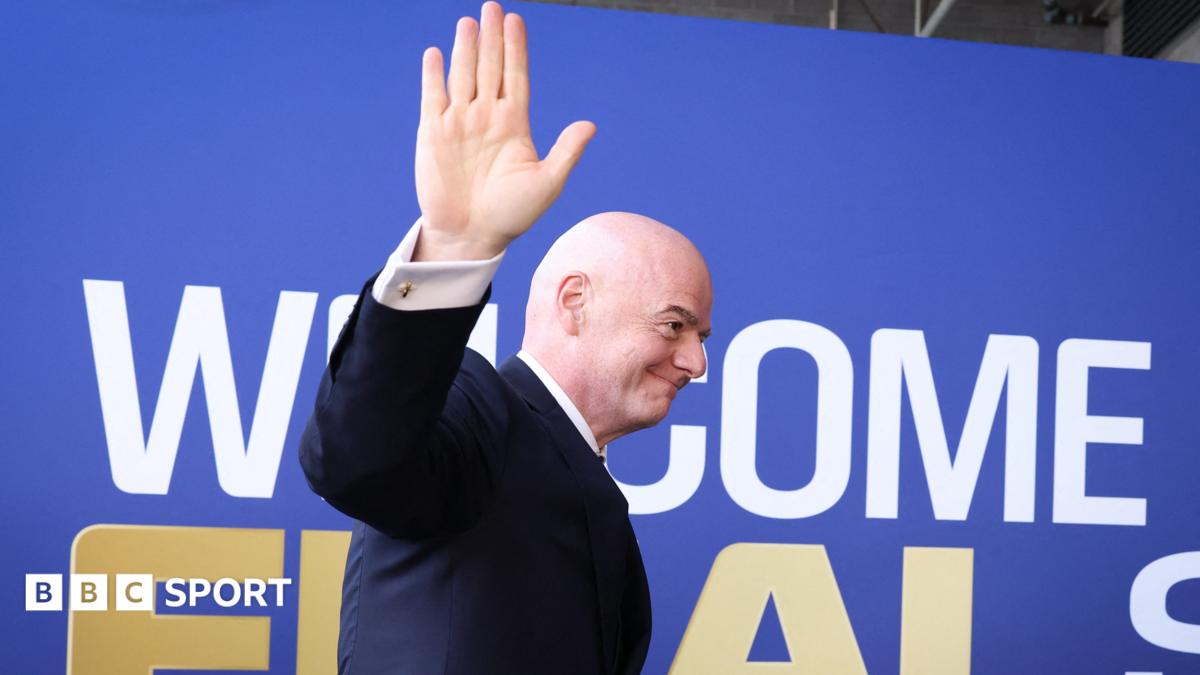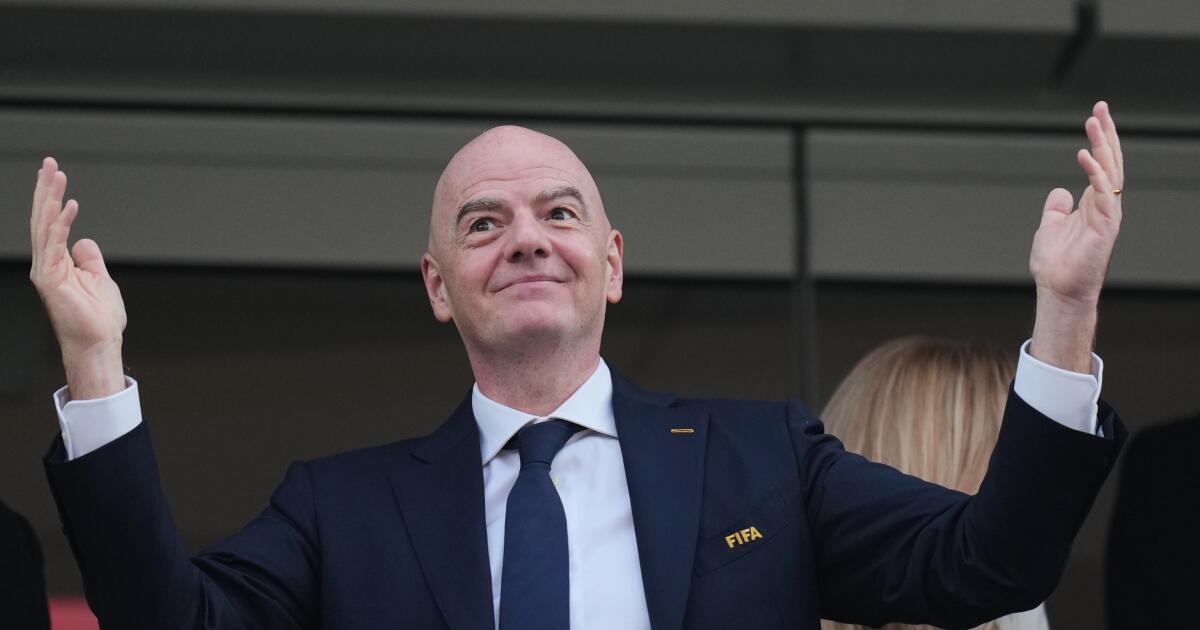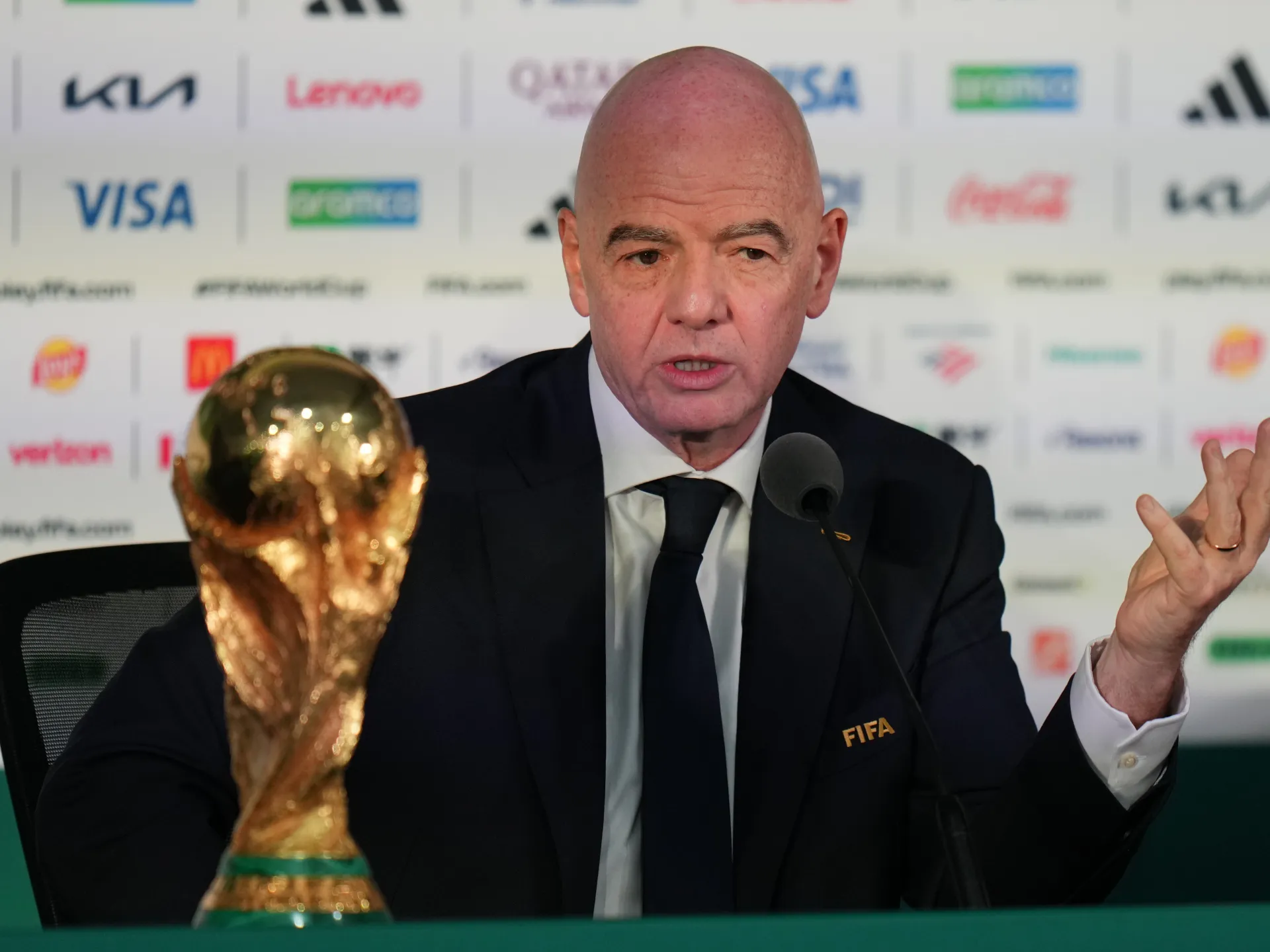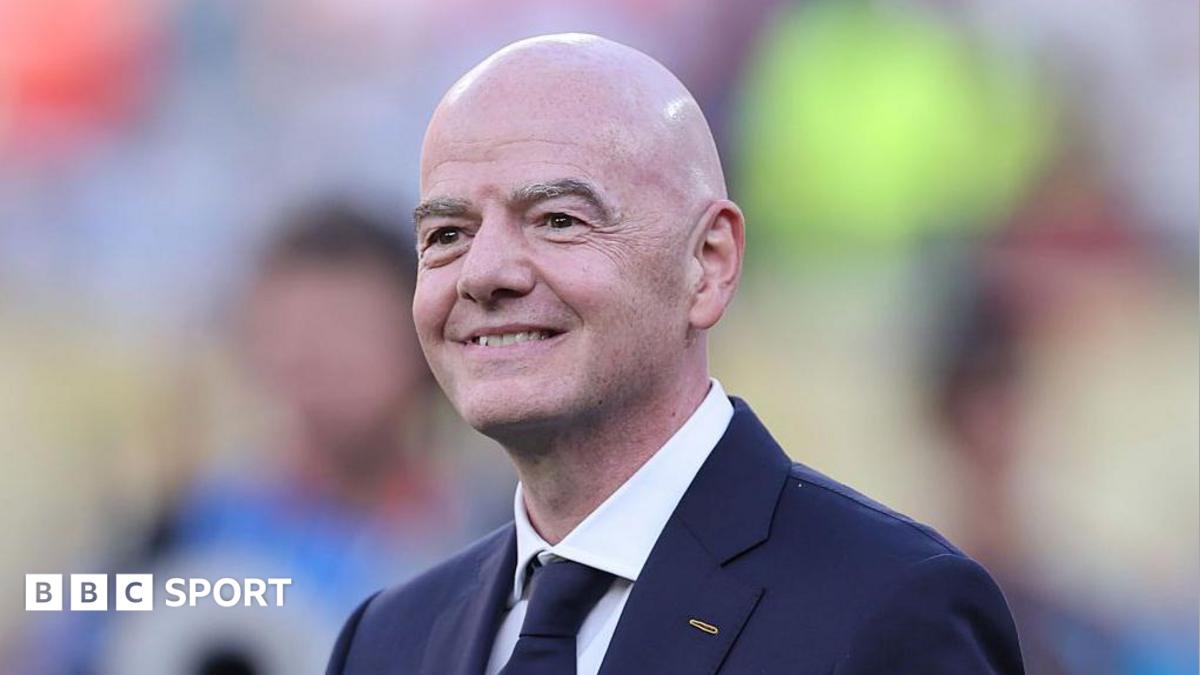
Infantino

Infantino’s FIFA presidency in peril after World Cup sell-off blunder

Heading into the final weekend of this summer’s World Cup, The Guardian reported that support for FIFA president Gianni Infantino had climbed to record levels. More than 200 of FIFA’s 211 member associations formally endorsed Infantino’s bid for a fourth term as head of world soccer’s governing body, the paper reported, making next March’s vote more of a coronation than an election.

Two weeks later, that support disappeared. Not only is Infantino’s reelection campaign in tatters, but there’s a chance he won’t survive until the spring, with British Prime Minister Andy Burnham and Javier Tebas, president of Spain’s soccer association, calling for his resignation and close confidants such as Carlos Cordeiro, the former president of U.S. Soccer, and Kevin Lamour, FIFA’s chief operating officer, publicly breaking with their boss.

At the center of that reversal was a closely guarded scheme to raise $4.2 billion by selling a 20% stake in the World Cup to private investors, who would be given influence in planning and executing future events, including broadcasting and commercial deals tied to the tournament.

In short, Infantino was planning, in secret, to sell shares in the World Cup. And once details began leaking in the media, he was forced Friday to scrap the whole thing, an embarrassing retreat that has left him vulnerable just two weeks after he had seemingly reached the heights of his third term as FIFA president.

Infantino’s idea, called the FIFA Forward Enterprise, was intended to turn the World Cup, FIFA’s milk cow, into a golden calf. But to do so, he needed the approval of at least 106 of FIFA’s 211 member countries, so he promised countries that backed him that they would receive $20 million each by mid-September. Those who declined would get just a fraction of that.

Infantino was certain the piles of cash would buy the acquiescence — or at least the silence — of enough members for the plan to go through. Instead, the bribe blew up in his face and FIFA issued a statement late Friday, under Infantino’s name, that basically said “never mind.”

“Having listened carefully to all the views, it has become clear that the project has created divisions of a nature that, regardless of the level of support, are no longer in the interest of the objective set out in the first place,” the statement read.

The question now becomes whether Infantino’s presidency will proceed.

He wouldn’t be the first FIFA president to be grievously wounded by unbridled ambition, but the speed and depth of his fall is staggering. The 2026 World Cup was, by nearly every measure, wildly successful. The largest and most complex sporting event in history the tournament, hosted by the U.S., Mexico and Canada, exceeded expectations, drawing more than 6.8 million live fans and a global TV audience of more than six billion. The four-year World Cup cycle brought FIFA revenues of about $15 billion, making it the first sporting event in history to earn more than $10 billion.

Infantino has never been shy about pushing boundaries despite heading a Swiss-based organization that, its wealth notwithstanding, is officially a nonprofit. Nor was this the first time he tried to bring private equity into the World Cup: In 2018, two years into his first term as FIFA president, he considered a plan to raise $25 billion to fund tournaments, only to cave in the face of massive opposition.

He didn’t give up the idea of squeezing more money out of the World Cup, though.

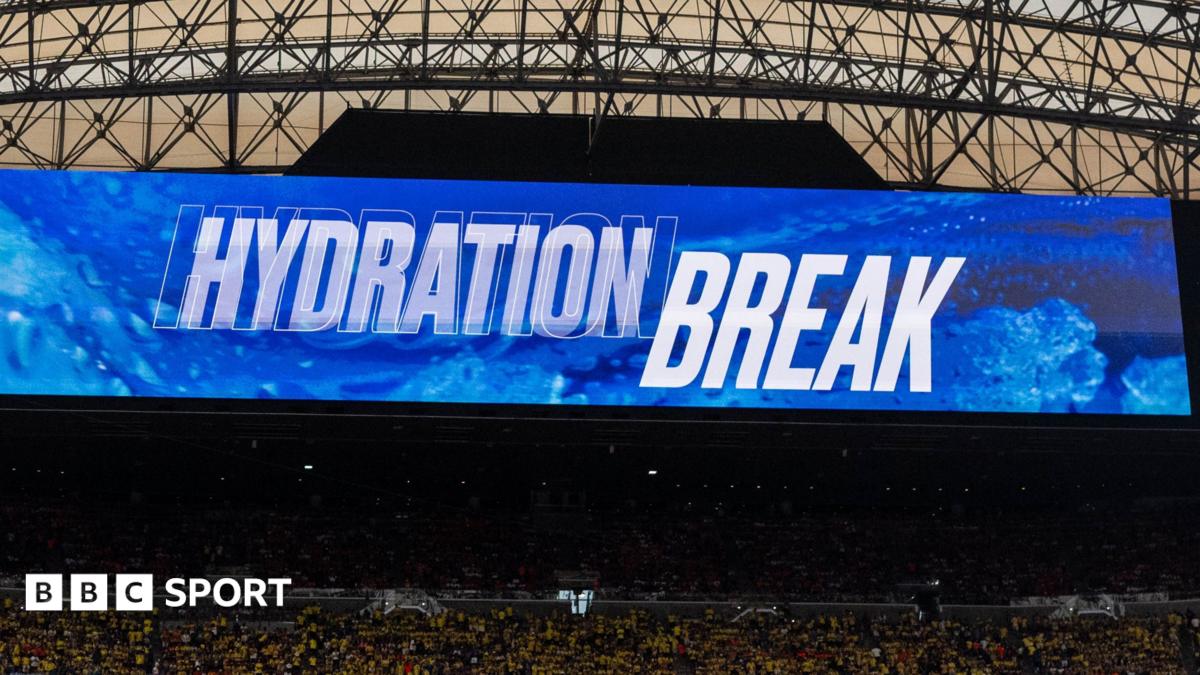
This summer, he introduced three-minute hydration breaks in the middle of each half — ostentatiously a nod to the heat and humidity, but in reality a ruse that allowed broadcasters to generate millions in additional revenue through TV commercials. FIFA also staged a halftime show for the first time ever during the final, sold VIP tickets priced at more than $1 million each and introduced dynamic pricing for the tournament’s 104 games, driving prices for some seats to four times what fans paid four years ago in Qatar.

That pushed the tournament beyond the reach of many of the sport’s most loyal supporters — and soccer, more than any other sport, belongs to the fans. It’s why teams are called clubs and fans are called supporters.

The World Cup, then, wasn’t Infantino’s to sell. So the pushback to his latest idea was immediate and unsparing.

“Football does not belong to investors,” Burnham said in an Instagram post. “Once you have sold a piece, you have sold out. Football belongs to the fans. It always has, and it always will.”

What really angered stakeholders, however, was Infantino’s brazen move to develop the FFE in secret, only to have its details leak out.

Bernd Neuendorf, president of the German soccer association and a member of the FIFA Council, the group’s most influential body, said he first learned of the FFE by reading about it.

“I was very surprised, and also annoyed, that we had to find out about something like this from the press,” he told a German news outlet last week.

Another self-inflicted wound was Infantino’s decision to launch the project with Thrive Eternal, a venture capital firm founded by Joshua Kushner, the 41-year-old brother of Jared Kushner, President Trump’s son-in-law and a kind of all-purpose White House advisor and negotiator. Thrive Eternal focuses on long-term investments in scarce cultural institutions that technology cannot replace, but it has little relevant experience in managing something as large and complicated as a World Cup.

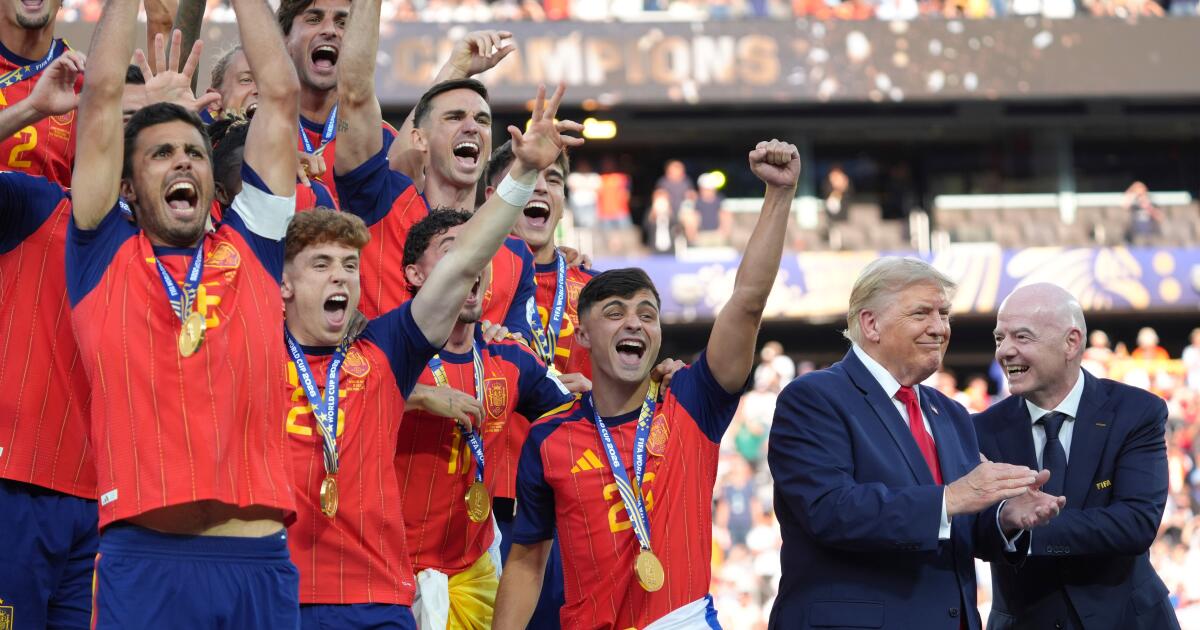
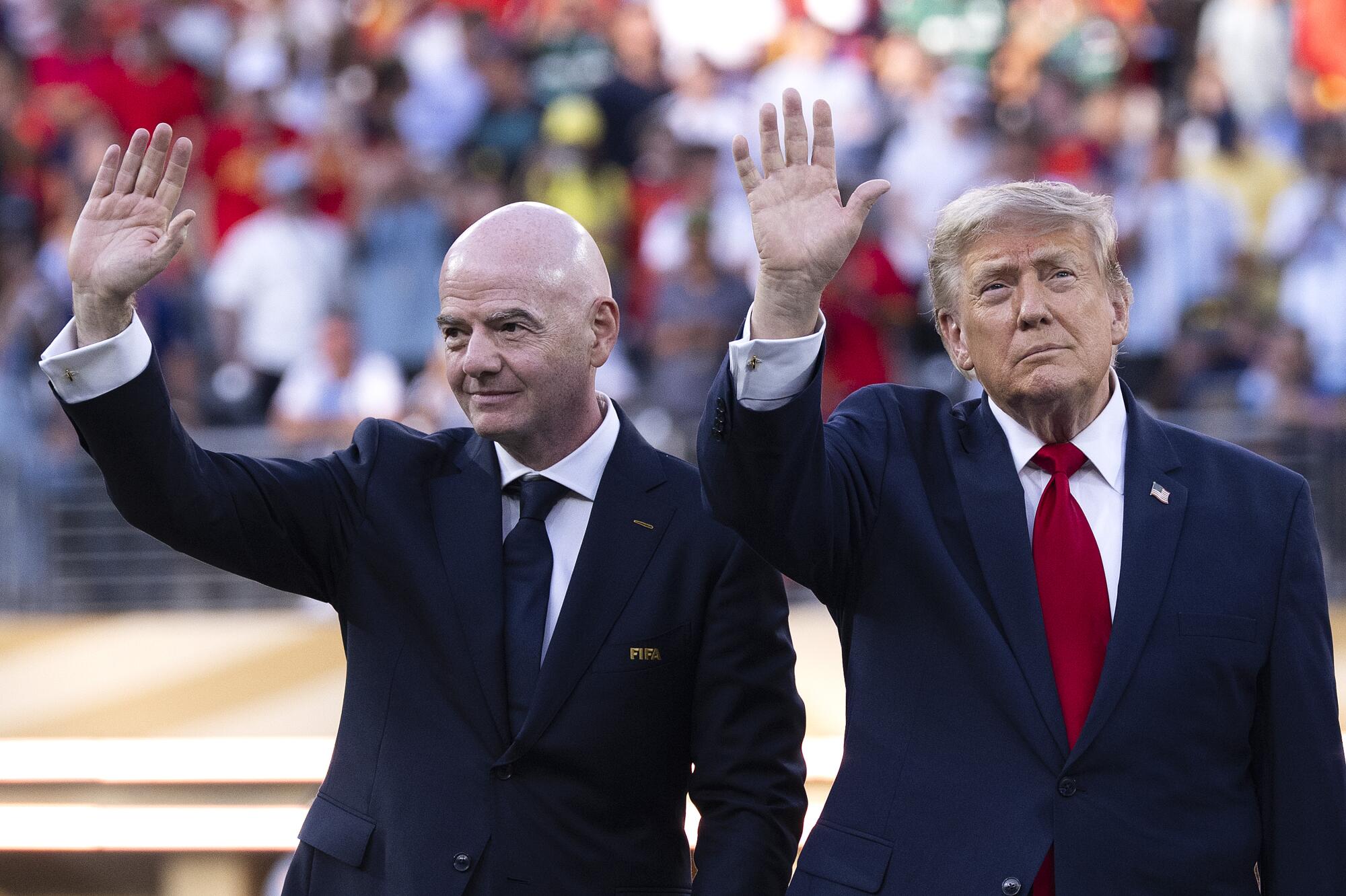
FIFA president Gianni Infantino, left, and President Trump wave during an award ceremony.

FIFA president Gianni Infantino, left, and President Trump wave during an award ceremony following Spain’s win over Argentina in the World Cup final July 19.

(David Ramos / Getty Images)

Moreover, the partnership would draw Infantino further into the orbit of Trump, whom the FIFA president has openly courted for years. Infantino, who has been a frequent visitor to the Oval Office and Trump’s Mar-a-Lago estate in Florida, attended the president’s inauguration and accompanied him on visits around the world.

Trump’s relationship to Infantino was questioned when Infantino presented him with the first FIFA Peace Prize last December, then became even more controversial when Trump phoned Infantino three times to lobby to have the red-card suspension of U.S. forward Folarin Balogun overturned ahead of a World Cup elimination game last month.

FIFA eventually cleared Balogun to play, marking just the second time in tournament history a red card ban has been lifted. For some, Infantino’s decision to partner with someone close to Trump on his latest venture was a bridge too far.

“It’s a really bad look for Infantino given the concerns about political interference that were already there after Balogun,” said Steven A. Bank, a professor of business law at UCLA who has written and lectured extensively on the economics of soccer. “Especially with the fund led by Jared Kushner’s brother.”

Once details of Infantino’s secret plan began to leak, UEFA, the confederation that governs European soccer, held an emergency meeting during which all 55 members — including Spain, the reigning men’s and women’s World Cup champion — voted to boycott all FIFA competitions.

“Some things are simply too important to sell. The FIFA World Cup belongs to football. It always will,” UEFA, the largest and most powerful of FIFA’s six continental confederations, said in a statement.

CONCACAF, which oversees soccer in North America, Central America and the Caribbean, said its 41 countries also rejected the plan, an opinion the U.S. Soccer Federation backed in a sparse post on X.

“U.S. Soccer stands with CONCACAF and its members,” it wrote.

The Asian Football Confederation joined in, saying in a statement its 47 members stand “in solidarity with UEFA and CONCACAF in expressing serious concerns over FIFA’s proposal to introduce private investment into FIFA’s flagship competitions.”

When it became obvious Infantino would not get the votes he needed to go forward, he pulled the plug on his plan. But it may not have been so much that the idea was bad as it was the execution.

Soccer is awash with private investors. The biggest clubs are owned by billionaires or sovereign wealth funds and many leagues — including Spain’s La Liga, which Tebas oversees — have sold commercial stakes to private equity firms in much the same way FIFA proposed.

Alan Rothenberg, a former U.S. Soccer president and the driving force behind the 1994 men’s World Cup and 1999 women’s World Cup, among the most successful tournaments in history, said the idea of selling a private equity stake in the World Cup isn’t a bad idea. But the way Infantino tried to implement his plan led it to failure.

“What is proposed is not that revolutionary,” Rothenberg said. “There have been private equity investors in MLS, in one of the subsidiaries of the NFL, in F1.

“But I think the combination of everything has doomed it. It does raise the possibility that Infantino, he’s finally become Icarus and gotten too close to the sun. It actually may doom him politically.”

Others including Cordeiro, a former vice chairman at Goldman Sachs, questioned the need to bring in outside investors.

“FIFA already has access to extraordinary financial resources. The organization sits on billions of dollars in reserves and no debt,” Cordeiro pointed out in his resignation letter. “If member associations believe additional investment is needed to develop the game, FIFA already has the financial capacity to provide that support from its existing resources.”

Infantino has flaunted consensus before without significant consequence, cozying up to autocrats while overseeing the 2018 World Cup in Vladimir Putin’s Russia and the 2022 tournament in Qatar before being accused of awarding the 2034 tournament to Saudi Arabia in a rigged vote.

This time, however, the stakeholders within FIFA were pushed too far by Infantino’s penchant for wielding unilateral power, so they pushed back and the president blinked. Hours before he backed down, an ally of Infantino’s told the Financial Times that he would not bend, seeing the standoff as “a fight to the death.”

Infantino’s presidency might not be dead, but it is surely in critical condition.
Source link

Gianni Infantino: Fifa executive say staff ‘deceived’ by president’s World Cup plans

While Uefa members are among the richest on the planet, many other nations rely on Fifa funding for basic infrastructure.

While the AFC opposes Infantino’s plan, unlike Uefa it has not threatened to boycott Fifa competitions. AFC members would not be obliged to vote against the proposals.

Rogers Byamukama, of the Ugandan Football Federation, argued any avenue that could lead to more resources for nations like his should be explored.

“First and foremost, you need to understand that football is a very expensive venture, especially on the African continent where the resources are not easy to come by,” he told Newsday on BBC World Service.

“For instance in Uganda, the number of infrastructure projects that have been funded by Fifa from the resources generated by Fifa, especially at the World Cup, both from ticket sales as well as sponsors.

“On top of that, there are many grassroots programmes that have been funded by Fifa, including schools for football.

“From my perspective, any avenue that brings in more resources is good because those resources would be distributed and given to federations, especially on the African continent and that would inspire growth.”

Byamukama acknowledged Uefa’s right to speak out, but suggested its members were not reliant on Fifa funding like many associations in the rest of the world where Infantino remains popular.

In the first two cycles of the Fifa Forward development programme, through to 2022, $2.8bn (£2.08bn) was made available for investment across the 211 member associations.

Fifa Forward 3.0 – covering the years 2023 through to 2026 – has produced a 30% increase in funding.

Fifa has provided a further $5m (£3.7m) for every member association, with another $60m (£44.48m) paid to each confederation for their own projects.

After expanding the men’s World Cup to 48 teams from 32 for the 2026 edition, Fifa is seeking an independent agency to assess an expansion to 64 teams for the 2030 tournament.

The timeline on documents seen by BBC Sport said Fifa would receive agency proposals by 7 August, with a Fifa decision on 14 August. Delivery of analysis by the agency is then scheduled for 11 September.

Source link

Will Fifa president Gianni Infantino lose his job? If so, who comes in?

Victor Montagliani (Concacaf president)

Like Infantino, he was elected in 2016 promising governance reform. A former president of Canada Soccer, as co-chair, Montagliani was heavily involved in the build up to, and delivery of the 2026 World Cup, the first to be hosted by three nations. He is fluent in French, Italian and Spanish, as well as English.

Explaining his decision to run for the Concacaf presidency, Montagliani told the BC Business website: “Like anything, when I decide to go, I go. I campaigned on my own dime for three months, went to see all 41 countries, from the US to Bonaire, a little island off Venezuela.”

Montagliani took the lead when Concacaf hosted an expanded Copa America in 2024 – in an interview with BBC Sport he rejected the idea it could become a regular occurrence. Politically strong, he smoothed relations around Arsene Wenger’s attempt to gain support for a World Cup every two years and has never truly bought into the idea of a 64-team World Cup.

At the Leaders conference in 2025, he outlined why he felt football was strong enough to ride out any storm.

“The game is bigger than world current leaders,” he said. “Football will survive regimes. Does it cause a headache? Of course. You have to be realistic about that. That is the beauty of our game, it is bigger than any individual and country.”

Sheikh Salman bin Ebrahim Al Khalifa (AFC president)

Initially elected in 2013, he was elected unopposed for a fourth term to run to 2027.

The Bahraini has presided over significant growth within the Asian confederation, through the Champions League Elite, Champions League Two, the Challenge League and the Women’s Champions League, which was launched in 2024-25. The Asian Cup has been expanded to 24 teams.

Sheikh Salman signed off the brutal takedown of how Fifa is being run by Infantino and has carried with him a 46-member confederation, many of whom are aware the figures being offered by Infantino’s plan are huge in terms of their overall football expenditure.

Source link

Infantino under fire as adviser Carlos Cordeiro resigns in protest

Pressure on FIFA President Gianni Infantino and his divisive plan to sell World Cup profits to private equity grew Friday as his senior adviser who sat on a White House panel resigned and Asia’s soccer body joined Europe and North America in opposing it.

An expanding crisis for soccer’s governing body reached into Infantino’s longtime inner circle when his pick to represent FIFA on the White House Task Force for the World Cup walked away calling the Joshua Kushner-backed $20 billion commercial subsidiary plan “a bad deal for football.”

Carlos Cordeiro is a former Goldman Sachs banker and officially is Infantino’s senior adviser yet revealed he said he was not involved in the secretive investment plan that has rocked the sport since media reports revealed it Tuesday.

“I cannot stand by while FIFA considers selling a stake in the World Cup,” Cordeiro said in a statement formally resigning, just hours after FIFA insisted in a statement: “Nobody is selling football.”

Cordeiro’s exit — and call for other senior staff to speak out — intensified scrutiny on Infantino one day after European soccer body UEFA threatened to boycott all FIFA games and events until the plan is dropped. North America’s CONCACAF also rejected Infantino’s offer of one-off $20 million payments to each member federation by a mid-September deadline.

Cordeiro often joined Infantino on working visits to meet U.S. President Donald Trump at the White House in recent years, and took part in meetings of the administration’s World Cup task force led by Andrew Guiliani.

“Let me be clear. I had no involvement in this proposal, and I oppose it unequivocally,” said Cordeiro, the former U.S. Soccer Federation president.

Asia joins Europe and North America

On another seismic day in soccer politics, Asia’s soccer body that has been a key ally in Infantino’s 11-year presidency opposed the investor plan and said FIFA must urgently review its management style

The Asian Football Confederation said it “stands in solidarity” with UEFA and CONCACAF, the first two continental bodies to oppose Infantino whose combined 90 FIFA member countries near a majority of the 211 global total.

“Football should never have been placed in such a position,” said the Asian soccer body, which counts 46 of FIFA’s 211 members

Infantino has proposed spinning off FIFA’s commercial businesses — including World Cups and Club World Cups for men and women — into a $20 billion subsidiary with 20% owned by private investors.

The “anchor investor,” described by FIFA, is a New York-based investment firm created by Joshua Kushner, the younger brother of Trump’s son-in-law Jared Kushner.

“[T]he proposed [FIFA Forward Enterprise] cannot realistically achieve the necessary broad consensus and unity required to move forward” and must be reconsidered, the AFC said.

The statement did not name Infantino yet criticized FIFA for problems beyond the content of the private equity plan plus failing to consult about the secretive proposal.

“Rather, it has exposed fundamental weaknesses in FIFA’s consultation and decision-making processes that must now be addressed,” said the AFC, whose longtime president Sheikh Salman bin Ibrahim Al Khalifa narrowly lost the FIFA presidential election to Infantino in 2016.

“Accordingly, the AFC calls upon FIFA to undertake an urgent review of its governance and decision-making framework,” said the organization based in Kuala Lumpur, Malaysia.

Infantino’s job at risk?

Infantino had seemed — 11 days ago after the World Cup final in East Rutherford, N.J. — to have a clear path to being reelected unopposed for a fourth and final term in office through 2031.

FIFA had briefed during the tournament that Infantino had letters of support from about 200 members, despite a furor over letting U.S. forward Folarin Balogun play against Belgium even though he received a red card in his previous game. Trump acknowledged asking Infantino to review Balogun’s mandatory one-game ban.

FIFA has set a Nov. 18 deadline for potential candidates to declare in a presidential vote of the 211 members scheduled next March in Rabat, Morocco.

The Asian statement came hours after FIFA blamed the media and doubled down on pursuing the project which now seems to have a majority of the 211 in opposition.

“Our planned consultation process was disrupted by incorrect media reports,” FIFA said in a statement early Friday. “We will proceed with this consultation process to ensure that each [member] has the ability to express its vote based on facts.”

The next FIFA event that would be targeted by the threatened European boycott is within weeks — the Women’s Under-20 World Cup hosted by Poland from Sept. 5. The four British federations comprise FIFA’s only bidder to host the 2035 Women’s World Cup. That decision is due Nov. 23.

Dunbar writes for the Associated Press.

Source link

Infantino sets deadline for FIFA offer in Kushner-backed World Cup plan | Football News

FIFA’s president lobbies for latest proposal for investment in football’s governing body, which has met with criticism.

FIFA President Gianni Infantino has set a September 19 deadline for the 211 member federations to accept a one-off $20m offer to each underwritten by the investment firm of Jared Kushner’s brother as part of a project to sell stakes in the World Cup.

Infantino set out the “singular and unique funding opportunity” in a letter detailing why he wants to create a $20bn FIFA subsidiary that would be 20 percent owned by private investors and would run the football body’s competitions and events like World Cups and Club World Cups.

Recommended Stories

list of 4 itemsend of list

“It is my duty and responsibility as FIFA president to present such game-changing opportunities to you, our members,” Infantino wrote on Wednesday in the letter seen by The Associated Press news agency.

The proposal, revealed on Tuesday and backed by Joshua Kushner’s investment firm Thrive Capital, was met with immediate fury by Infantino’s former colleagues at the European football body UEFA, which said the World Cup “is not FIFA’s to sell”.

UEFA is expected to call its 55 member federations to an emergency online meeting, likely on Thursday.

Joshua Kushner’s brother, Jared Kushner, is a son-in-law of United States President Donald Trump.

FIFA’s private equity plan is the latest ambitious project proposed during Infantino’s 11-year presidency, during which he has increasingly seemed to be an executive leader acting without consulting football’s major stakeholders.

Previous plans include creating a FIFA Peace Prize and trying to reorganise football’s calendar with World Cups every two years instead of four.

Concerns about the previously secret plan were aired on Wednesday by the continental football bodies for Asia and the North American, Central American and Caribbean region, known as CONCACAF.

“We are deeply concerned by the lack of due process,” CONCACAF said in a statement.

The Kuala Lumpur-based Asian Football Confederation said it was “disappointed that a matter of such significance entered the public domain before the AFC family had been afforded the opportunity to examine and discuss it.”

Continental bodies that organise their own international club and national team competitions – such as the Champions League, European Championship and Copa America – likely will see threats to those events from FIFA wanting to increase revenue and value for investors by playing World Cups and Club World Cups for men and women more often.

If the FIFA Forward Enterprise subsidiary is approved by a majority of the 211 members, they are each promised $20m in funding from the four-year commercial cycle tied to the men’s 2030 World Cup.

That would lead, Infantino wrote, to “a pool of diverse international investors” joining Joshua Kushner’s Thrive as the anchor investor. “This process will be led by J.P. Morgan,” his letter said.

If Infantino’s plan is rejected, those members will get their previously promised $10m over the next four years, the letter stated.

FIFA’s plan met quick opposition from British Prime Minister Andy Burnham, whose government is preparing to support hosting the 2035 Women’s World Cup in England, Scotland, Wales and Ireland. FIFA is to confirm that lone bid for 2035 at an online meeting in November.

“Football does not belong to investors,” Burnham, a longtime football fan, said in a video message on Instagram. “Once you have sold a piece of [the World Cup], you have sold out. Football belongs to the fans. It always has, and it always will.”

Resistance by British lawmakers – including threats of legislation by then-Prime Minister Boris Johnson in 2021 – previously helped stop the divisive European Super League project that was criticised as an existential threat to UEFA’s Champions League and which Infantino had discreetly supported.

Source link

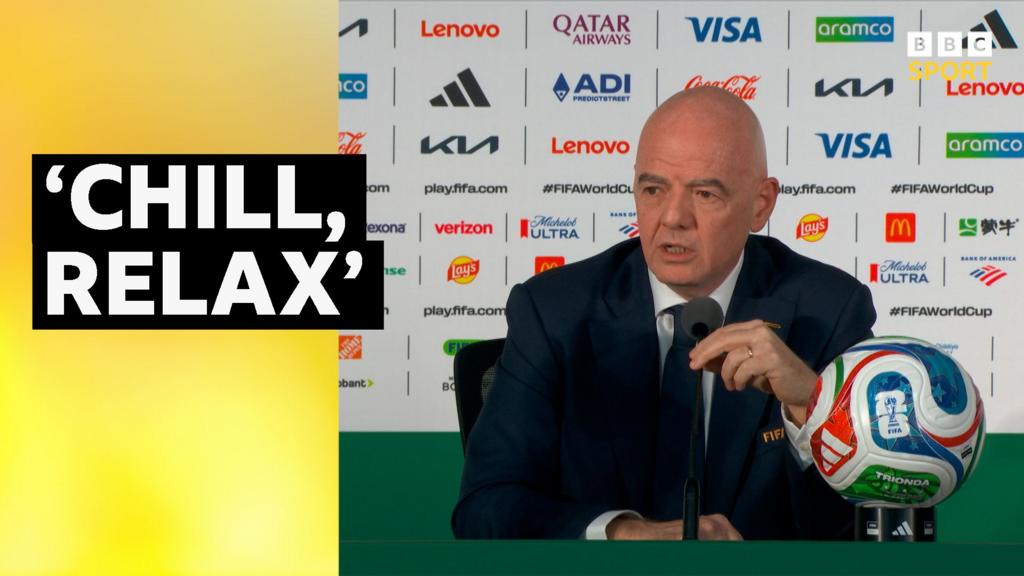
World Cup 2026: Gianni Infantino tells Fifa critics to ‘meditate, pray or watch football’

Infantino also addressed criticism surrounding the standard of officiating at the tournament, in particular concerns about political interference after USA forward Folarin Balogun was made available for their last-16 tie when his one-match ban was suspended by Fifa – following the intervention of US President Donald Trump.

Of the 191 other red cards shown at a men’s World Cup, only one other player has escaped a suspension.

Uefa said the decision had “crossed a red line”, labelling it “unprecedented, incomprehensible, and unjustifiable”, while the Norwegian Football Federation is considering filing a formal complaint to Fifa’s ethics committee.

Infantino, however, argued that such decisions are not out of the ordinary, claiming similar rulings are “routine and widely accepted in some of the biggest leagues worldwide”.

He added: “It’s curious that the same countries employing these practices are the ones criticising.”

The International Olympic Committee has said it will not investigate Infantino for any possible breaches of political neutrality, stating the complaint levelled by human rights campaign group FairSquare falls outside the jurisdiction of its ethics commission.

Infantino’s advice to his opponents was “to show some love” and “respect” to a tournament where “people came together as families, as fans, as one”.

“To everyone who missed our beautiful game, the emotions, the celebrations, the laughter, the crying, the deception and the joy. To all of you who missed watching kids, babies, grandparents and parents come together for the beautiful game… sorry that you were so consumed by hate and criticism that you missed it all,” Infantino wrote.

“While they celebrated, you were busy planting seeds of hate. Our world needs love, not hate; tolerance, not division; celebration, not mourning.

“To those spending their time and energy hating us, please take a moment to reflect, meditate, pray or watch a football match and truly observe the faces, the eyes, the emotions.

“Because only our beautiful game can deliver such an extraordinary show, a show where everyone becomes one and reconnects as humans.

“I am incredibly proud, as Fifa President, to have contributed, even a little, to this show. It’s a great feeling.”

Source link

Despite some irritating flaws, 2026 World Cup a rousing success

The largest, longest and most complex World Cup in history came to a close Sunday, with Spain beating Argentina 1-0 in extra time. But FIFA president Gianni Infantino didn’t bother waiting for the final result before passing judgment on the tournament.

“By all means this World Cup has exceeded all expectations,” he said during a reception at Trump Tower two days before the final kicked off. “This has not just been the greatest FIFA World Cup of all time. It is the greatest human social and cultural event that mankind has ever witnessed.”

No, but it was pretty good, with FIFA emerging as the World Cup’s biggest winner, allowing Infantino to reportedly shore up support within the organization despite a number of norm-shattering decisions during the tournament.

Attendance topped 6.8 million, a World Cup record averaging more than 65,000 fans a game. FIFA estimated the cumulative global TV audience topped 5 billion people across linear television, digital streaming and social platforms while more than 1.8 billion people were expected to watch the final, according to the BusinessStats website, making it the most-viewed sporting event in history.

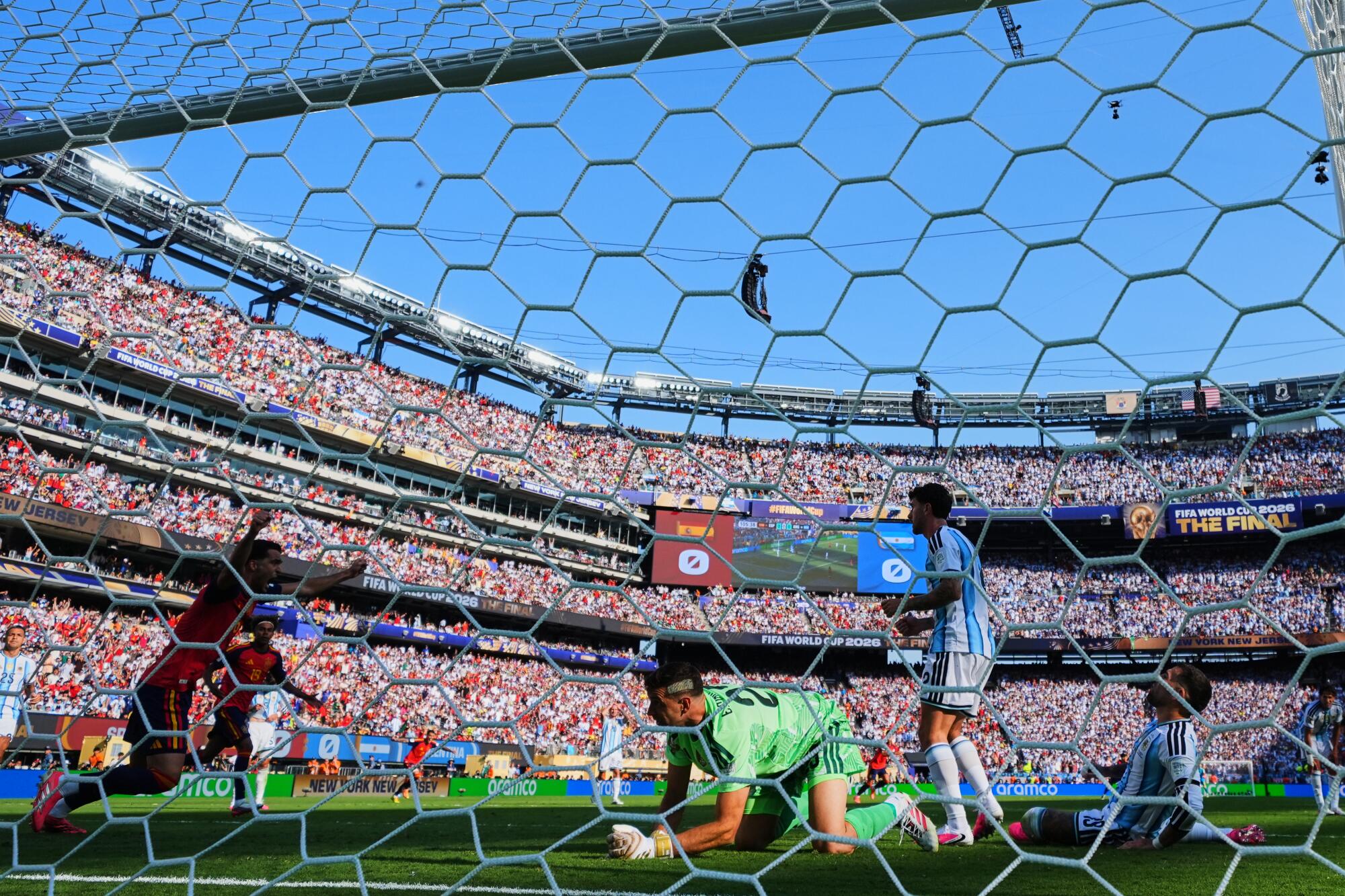
Argentina goalkeeper Emiliano Martínez reacts as Spain's Ferran Torres scores during the World Cup final.

Argentina goalkeeper Emiliano Martínez reacts as Spain’s Ferran Torres scores during the World Cup final in East Rutherford, N.J., on Sunday.

(Julio Cortez / Ap Photo/julio Cortez)

Exact figures won’t be known for a few days.

Revenue for the four-year World Cup cycle is anticipated to reach $13 billion, making it the first $10-billion sporting event in history — bolstering Infantino’s case for reelection as FIFA’s president next year.

The final was among the most expensive U.S. sporting events of all time, with the get-in asking price for a single ticket on the secondary market peaking at about $7,400 three hours before kickoff and the average purchase price topping $10,800. One seat sold for $32,502, which is either a good thing or a bad thing, depending on whether you’re buying the ticket or selling it.

Inglewood’s SoFi Stadium hosted eight games, including two of the U.S. team’s three group-stage games and Spain’s quarterfinal win over Belgium. The matches had a total attendance of 561,656 people, about 99.6% of capacity — that’s more than each of the first three World Cups drew for the entire tournaments.

U.S. and Paraguay oversized flags are featured on the pitch before a World Cup match at SoFi Stadium on June 12.

U.S. and Paraguay oversized flags are featured on the pitch before a World Cup group stage match at SoFi Stadium on June 12.

(Allen J. Schaben/Los Angeles Times)

Weather disrupted just a handful of matches, not the dozen or more that were feared, and the logistical nightmares of staging the 39-day tournament across three countries for the first time — the U.S. co-hosted the event with Mexico and Canada — never materialized. The expansion to 48 teams and 104 games, meanwhile, made room for a number of surprises that gave the tournament its life and sparkle.

Tiny Cape Verde, the second-smallest country to qualify for a World Cup, made a memorable debut, playing Spain to a scoreless draw in its opener, then taking Argentina to extra time before falling in the cruelest way possible, on an own goal, in the knockout rounds.

Norway, playing in the tournament for the first time this century, made it to the quarterfinals behind its hulking striker Erling Haaland, who quickly became a fan favorite while the team’s supporters saw their synchronized “Viking Row” celebration go viral.

Canada and Egypt both won World Cup games for the first time, advancing to the Round of 16, with Egypt becoming one of nine African teams to make it to the knockout rounds. Of FIFA’s six continental confederations, only UEFA, representing Europe, did better than Africa, sending 13 teams beyond the group stage.

Argentina’s Lionel Messi erased any doubt that he’s the greatest player in World Cup history — if not soccer history — by willing his team to the final and winning the Silver Ball, runner-up for the tournament’s most outstanding player. On Sunday, Messi was thwarted in his attempt to win a second straight World Cup and third Golden Ball, but he walked off the field at MetLife Stadium as only the second man to play in three World Cup finals.

And he finished his record-setting sixth tournament as the all-time leader in games (34), assists (12) and goal contributions (33), more than standing the test of time. Two of the players Spain started against Argentina in the final hadn’t even been born when Messi, 39, made his World Cup debut in 2006.

But if those were the highlights, there were also lowlights.

This was by far the most political World Cup in history and the first in which a host country, the U.S., was actively at war with a participating one, Iran.

Iran defender Ramin Rezaeian celebrates with teammates after scoring during a World Cup match against New Zealand.

Iran defender Ramin Rezaeian celebrates with teammates after scoring during a World Cup match against New Zealand at SoFi Stadium on June 15.

(Allen J. Schaben/Los Angeles Times)

That had all kinds of ramifications, starting with the State Department’s refusal to grant visas to more than a dozen members of Iran’s official delegation. Iran was also forced to move its base camp from Tucson to Tijuana, and though it played all its games in the U.S., it was denied permission to remain in the country after each match, an option granted to every other team.

Despite the harassment, Iran did not lose a game, playing to three draws despite having three goals — any of which would have sent it to the knockout rounds — erased by video reviews.

The State Department also denied entry to Omar Abdulkadir Artan, a decorated Somali referee, turning him away at Miami International Airport in June, citing “vetting concerns.” Artan, named Africa’s top referee last year, had a valid entry visa and was selected by FIFA to work the tournament last April.

Iran wasn’t the only team to have its World Cup ended early by technology. Although the video assistant referee (VAR) system was adopted primarily to alert the head official to potential clear and obvious errors or serious missed incidents, in this tournament it became intrusive, eliminating Croatia on evidence from a NASA-level ball sensor and costing Egypt what would have been a game-winning score for a perceived foul that took place nearly 100 yards from the goal.

Coaches and players are still allowed to make mistakes, but the technology now has referees making calls on things that are imperceptible to the naked eye, something critics say has removed any sense of judgment or nuance, robbing the game of much of its drama.

“Football is an art. That’s why we love it,” said Christina Unkel, a former FIFA referee and a rules of the game analyst for multiple TV networks. “When you do pursue black and white — objectivity is what they’re trying to get to, and I get it; they want to eliminate as much subjectivity as possible — what everyone is hating is this perfection thing.”

Then there was the official’s call that President Trump took credit for overruling from 2,800 miles away.

When striker Folarin Balogun, the U.S. team’s leading scorer, was given a red card in the second half of his team’s Round of 32 win over Bosnia-Herzegovina, he was immediately suspended from the Americans’ next elimination game with Belgium. But Trump admitted he phoned Infantino three times, lobbying for the suspension to be rescinded.

U.S. forward Folarin Balogun steps on Bosnia-Herzegovina defender Tarik Muharemovic's foot and received a red card.

U.S. forward Folarin Balogun stepped on Bosnia-Herzegovina defender Tarik Muharemovic’s foot during a World Cup match and received a red card at Levi’s Stadium on July 1.

(Robert Gauthier/Los Angeles Times)

Less than 30 hours before the Belgium game, the card penalty was suspended and Balogun was placed on one year’s probation by FIFA’s disciplinary committee, marking just the second time in World Cup history that a player who received a red card was allowed to play in his team’s next game. The international uproar that followed overwhelmed the U.S. team, which played its worst game of the tournament against Belgium.

“I could almost see within my teammates a bit of nerves,” Balogun said in an interview with CBS, “because it’s something that is so unique.”

Trump, who was booed as he saluted the national anthem Sunday from a luxury box before the game, was booed again by the crowd of 80,663 when he strode onto the pitch for the awards ceremony afterward.

UEFA, the FIFA confederation in which Belgium plays, protested the decision to let Balogun play, saying it had “crossed a red line.” It was far from the only bright red line Infantino crossed in this tournament. And some of that line crossing could set dangerous precedents.

Allowing the U.S. to turn away the Somali official and limit the Iranian team’s time in the country, for example, could embolden future World Cup hosts to do the same. What’s to stop Morocco, co-host of the 2030 tournament, from banning officials and players from Algeria over the two countries’ territorial dispute in the Western Sahara? And if a red card is handed to a player from Spain, another 2030 co-host, would the Spanish prime minister call Infantino to try to get it rescinded? Despite FIFA’s insistence that the disciplinary committee works independently, many believe Trump’s meddling worked.

But as always with FIFA, money speaks the loudest, so Infantino’s norm-shattering behavior over the last year doesn’t seem to have cost him much support. The Guardian reported last week that as the World Cup neared its successful conclusion, nearly 200 of FIFA’s 211 member associations are endorsing Infantino’s bid for reelection to a fourth term as president next March.

Which is why Spain wasn’t the only winner in this tournament.

Source link

Trump lingers awkwardly long after giving World Cup trophy to Spain

Spain’s players looked like they were ready to explode as they waited for team captain Rodri to lift the World Cup trophy into the air following their 1-0 win over Argentina in Sunday’s final.

FIFA president Gianni Infantino looked a bit anxious as he wanted the newly crowned champions to have their moment but didn’t want to offend a good friend who happens to be one of the most powerful men in the world.

And President Trump looked rather clueless as he lingered on the stage at MetLife Stadium in East Rutherford, N.J., for an awkward amount of time following the trophy presentation.

Trump had watched the championship game from a luxury box with Infantino and First Lady Melania Trump, among many others. He was booed by the crowd during the national anthems and again when he took the field with Infantino after the game for the awards ceremony.

After presenting silver medals to Argentina’s players and gold to Spain’s, Trump and Infantino carried the World Cup trophy together across the stage and handed it to Golden Ball winner Rodri, who was standing in front of his teammates as they awaited their big moment.

The presidents of FIFA and the U.S. both shook hands with Rodri, but only one of them quickly moved off to the side. When Trump hung around to shake hands and speak with midfielder Gavi, Rodri put his hand on the president’s shoulder and appeared to gently nudge him toward the side of the stage away from the group.

As he walked off, Trump shook hands and talked with a few other players, then stopped and stood directly next to the group of players. Infantino sprinted across the stage and appeared to attempt to usher Trump out of frame.

Trump stayed put, however, clapping and smiling until Rodri thrusted the trophy skyward and gold confetti shot from cannons behind them to officially start the celebration. Then Trump strolled away to join Infantino, leaving La Roja’s players to celebrate on their own.

It could have been much worse … like, say, at last summer’s FIFA Club World Cup final, which was also held at MetLife Stadium. Trump accompanied Infantino onstage to present the trophy to Chelsea — but did not accompany him off the stage immediately following the presentation.

Instead, Trump remained out there front and center among the Chelsea players, much to the visable confusion of some of them. He stood right next to Reece James, clapping and smiling as the team captain hoisted the trophy in triumph and a massive celebration erupted around him.

As the president of one of the three 2026 World Cup host countries (with Canada and Mexico), Trump’s presence has loomed large. In December, Infantino awarded Trump with the inaugural FIFA Peace Prize during the tournament’s final draw in December.

Earlier this month, Trump called Infantino to have FIFA reconsider a red card against U.S. striker Folarin Balogun that would have prevented the star player from taking part in the American’s round of 16 game against Belgium (the penalty was rescinded, causing international uproar, but the U.S. still lost the game 4-1).

“You don’t need people to compliment you, Mr. President,” Infantino said Friday during a reception hosted by the president at Trump Tower in Manhattan, “but this World Cup would not have been such an incredible success without you,”

Source link

World Cup 2026: Could Gianni Infantino push through a 64-team tournament?

A 64-team tournament has two main plus points: a more natural format, and more opportunities for emerging nations.

It is the latter which Infantino is championing, especially after the heroics of Cape Verde.

Fifa faced criticism before the tournament, with suggestions the additional teams would not be competitive.

Then Cape Verde drew with Spain and Uruguay to finish second in their group. And the Blue Sharks gave Argentina an almighty scare by taking them to extra time in the last 16, before losing 3-2.

But the fairytale stories must be balanced with the competitive edge of the tournament.

Haiti, Iraq, Jordan, Panama, Tunisia and Uzbekistan failed to pick up a point – and this summer’s group stage had minimal jeopardy for the top nations.

Add more teams and it would be difficult to see a repeat of top-four seeds like Belgium (2022), Germany (2018), Spain (2014), Italy (2010) and France (2002) failing to make to knockout stage.

Then there is the question of where the extra places would go.

Based on this year’s qualifying, these are the additional countries who would have made it into a 64-team World Cup 2026 (with their Fifa ranking at the start of the tournament in brackets):

AFC: Indonesia (118), Oman (79), United Arab Emirates (68).

Uefa: Denmark (21), Italy (12), Poland (36).

Concacaf: Honduras (65), Jamaica (71), Suriname (125).

Conmebol: Bolivia (77), Venezuela (49).

OFC: New Caledonia (151).

Africa: Burkina Faso (62), Cameroon (44), Gabon (86), Nigeria (26).

Six of those teams are from the top 50 of Fifa’s world rankings – three from Europe, two from Africa and one from South America.

And therein lies the problem. Asia and Concacaf are weaker confederations, as was proven by performances this year.

Nine of Africa’s 10 countries got out of the group stage. But only two of nine Asian countries advanced, and just three of the six Concacaf countries – the co-hosts – made it through.

New Zealand, who got one point and finished bottom of their group, are the only country from Oceania in the world’s top 150.

There is an argument that if you extend again, you should give a greater weight of places to Europe just for competitive balance.

But, on the other hand, there are those who would argue that bringing more teams into the World Cup ultimately allows the game to develop further in those countries.

Infantino will sell the expansion as being good for the global game, but there have to be doubts that it is good for the competition.

Almost a third of Fifa’s 211 nations would be present.

Would the group stage not simply become a glorified pan-confederation qualifying competition for what is, essentially, a knockout tournament?

Source link

World Cup final protesters give red cards to Trump, FIFA president

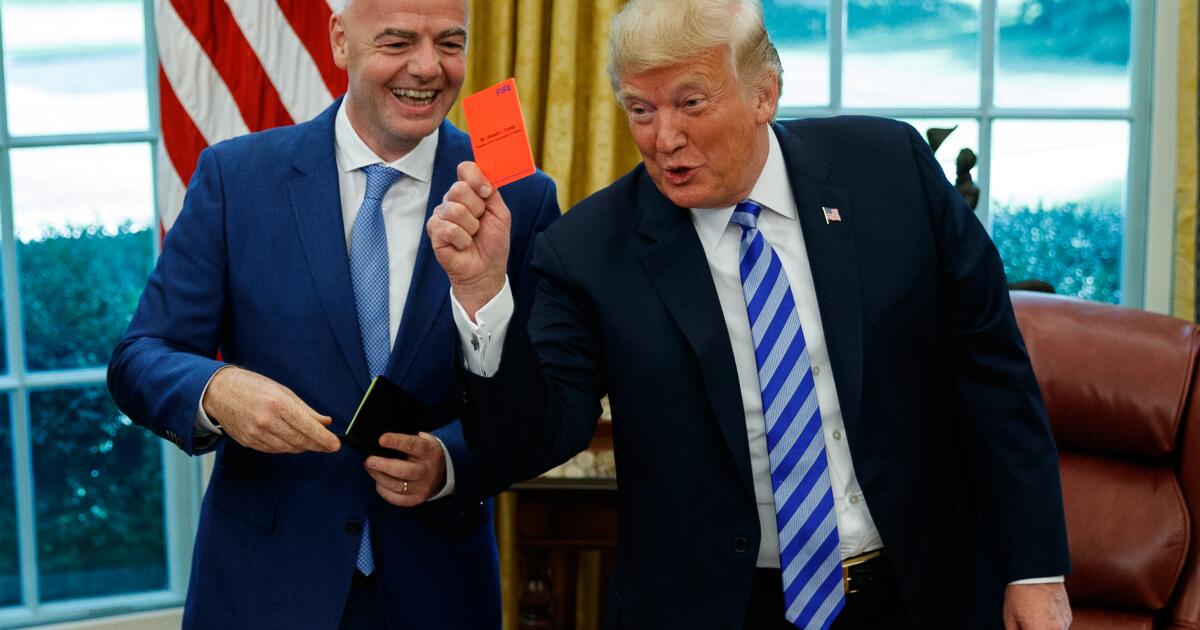
Protesters are inviting soccer fans to join them in issuing referee-style red cards during the World Cup final.

A coalition of artists, community organizers and advocacy groups will be handing out tens of thousands of specially designed commemorative red cards to those headed to Sunday’s championship showdown between Argentina and Spain at MetLife Stadium in East Rutherford, N.J.

In addition to the slogan “Unitas Mundi” — Latin for “unity of the world” — the mock referee cards direct people to a website explaining the coalition’s campaign and invite them to participate in a collective demonstration inside the stadium to denounce FIFA President Gianni Infantino and President Trump.

The action comes amid increased scrutiny around Infantino and Trump‘s relationship. Infantino has announced that Trump will join him at the final to present the trophy to the winner. He also awarded Trump the first-ever FIFA Peace Prize — created after the U.S. leader was not awarded the Nobel Peace Prize — in December.

And it was after Trump called Infantino to ask for a review of a red card issued to U.S. striker Folarin Balogun that the star forward’s suspension was delayed to allow him to play in the next game. The controversial move prompted an international uproar and accusations that Infantino has violated established rules around political neutrality.

FIFA has strict rules prohibiting political messaging on flags, banners and other items displayed by players and attendees in and around stadiums.

Organizers of the Final Red Card demonstration are also calling out the Trump administration’s immigration and mass deportation policies, which are back in the spotlight after three people were killed within a week during separate encounters with Immigration and Customs Enforcement officers. The fatalities include two people who were shot and killed by ICE officers in Houston and Maine during immigration operations, and another killed in a car crash while fleeing ICE officers in Florida.

At least 10 people have been killed during the Trump administration’s immigration crackdowns.

The coalition behind the campaign includes Contra-ICE, the arts collective that was also a part of the Flags in the Stands Super Bowl action that involved the “ICE OUT” rally towels. Partner organizations also include Make the Road New Jersey, 50501, People vs the Machines and South Asians for America, according to a press release.

Source link

World Cup 2026: Gianni Infantino says hydration breaks bring no extra revenue for Fifa’

Managers and coaching staff are allowed to discuss tactics with their players while the breaks are taking place.

Infantino said: “The main reason [for the breaks] is the heat, but we also have to understand that in a competition like the World Cup, played over 39 days, with teams potentially playing eight matches in those 39 days, having a moment to rest is extremely important.

“What matters even more to us is ensuring that all teams, in every match, are playing under the same conditions.

“And it’s very difficult to accept that a coach might have the opportunity to influence a match by making adjustments simply because it is hotter, while in another match, where the temperature is slightly lower, the same coach does not have the same opportunity.

“We want to ensure equal conditions for everyone and that’s why these breaks are implemented in every match.”

Experts have told BBC Sport an average 30-second World Cup advertising slot on Fox Sports costs between $200,000 (£152,000) and $300,000 (£227,000), rising to $750,000 (£567,000) during USA matches and the final stages.

That means advertising during hydration breaks is likely to generate more than $250m (£189m) in the USA alone.

Source link

Donald Trump to attend World Cup final, present trophy: Infantino | World Cup 2026 News

FIFA president Gianni Infantino will be ‘enjoying the final’ with Trump and present the trophy together on July 19.

FIFA president Gianni Infantino has confirmed plans to include United States President Donald Trump in the trophy presentation ceremony at the World Cup final.

“We will be together with the president, enjoying the final, and handing the trophy to the winner – of course, together,” Infantino said during an interview with Fox News on Tuesday morning.

Recommended Stories

list of 4 itemsend of list

Asked to clarify that he and Trump would present the trophy together at the match on July 19 in East Rutherford, New Jersey, Infantino added: “Of course. We are together all the time.”

Trump notably participated in the ceremony at last year’s Club World Cup final, when Chelsea defeated Paris Saint-Germain 3-0 at the same venue.

Soccer Football - FIFA Club World Cup - Final - Chelsea v Paris St Germain - MetLife Stadium, East Rutherford, New Jersey, U.S. - July 13, 2025 Chelsea's Reece James lifts the trophy as he celebrates with teammates after winning the FIFA Club World Cup as U.S. President Donald Trump and FIFA president Gianni Infantino look on REUTERS/Jeenah Moon
Chelsea’s Reece James lifts the trophy as he celebrates with teammates after winning the FIFA Club World Cup, with US President Donald Trump and FIFA president Gianni Infantino also on stage [Jeenah Moon/Reuters]

He remained on stage as Chelsea lifted the trophy. Later, the trophy was spotted in the Oval Office, with Chelsea reportedly having received a replica version.

According to The Athletic, citing FIFA sources, Infantino has been aiming to attend as many matches as possible at the tournament.

So far, that has been up to two a day. Trump has yet to attend any matches in this year’s World Cup.

Source link