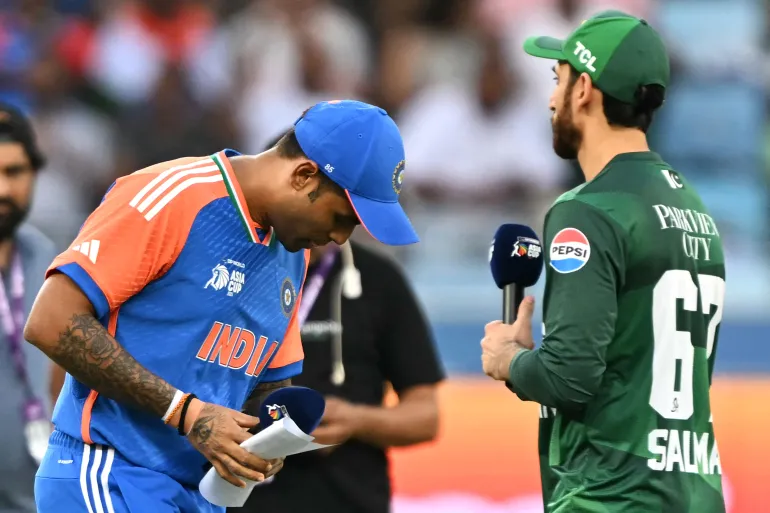
For a while it looked like this match would not happen.
Pakistan, whose last win against India was at the Asia Cup in 2022, announced a boycott a week before the tournament began, only to reverse their decision at the start of this week after extensive talks.
It went ahead, in front of a large crowd weighted towards Indian blue, because it is the most lucrative fixture in the world game, providing the funds upon which cricket’s ecosystem survives in its current imperfect state.
How long that remains the case given India’s dominance, built from their cricketing and financial might, remains to be seen.
Kishan’s assault gave India breathing space and their bowlers were ruthless, even if their fielders dropped three catches.
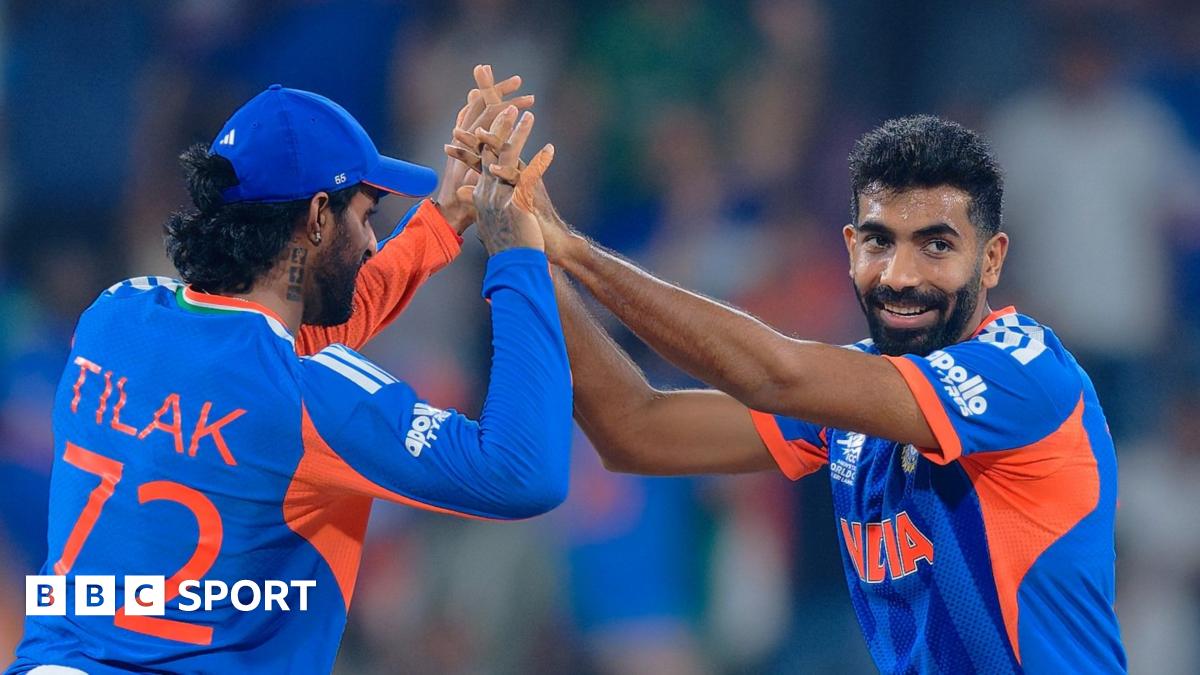
After Pakistan’s seamers went the distance, Hardik began with a wicket maiden – dismissing right-hander Sahibzada Farhan, who skewed a pull shot high to mid-on.
In the next over, the majestic Bumrah pinned left-hander Saim Ayub in front with full inswinger before Pakistan Salman Agha holed out playing a wild slog.
Even Pakistan’s biggest name, Babar Azam, was tamely bowled for five attempting a swipe to left-arm spinner Axar Patel in the fifth over, while left-handers Mohammed Nawaz and Faheem Ashraf meekly picked out fielders in the deep.
After all of the build-up this was another underwhelming meeting.
Pakistan on Monday reversed their decision to boycott their T20 World Cup match against India, but rain could intervene.
Published On 14 Feb 202614 Feb 2026
Share
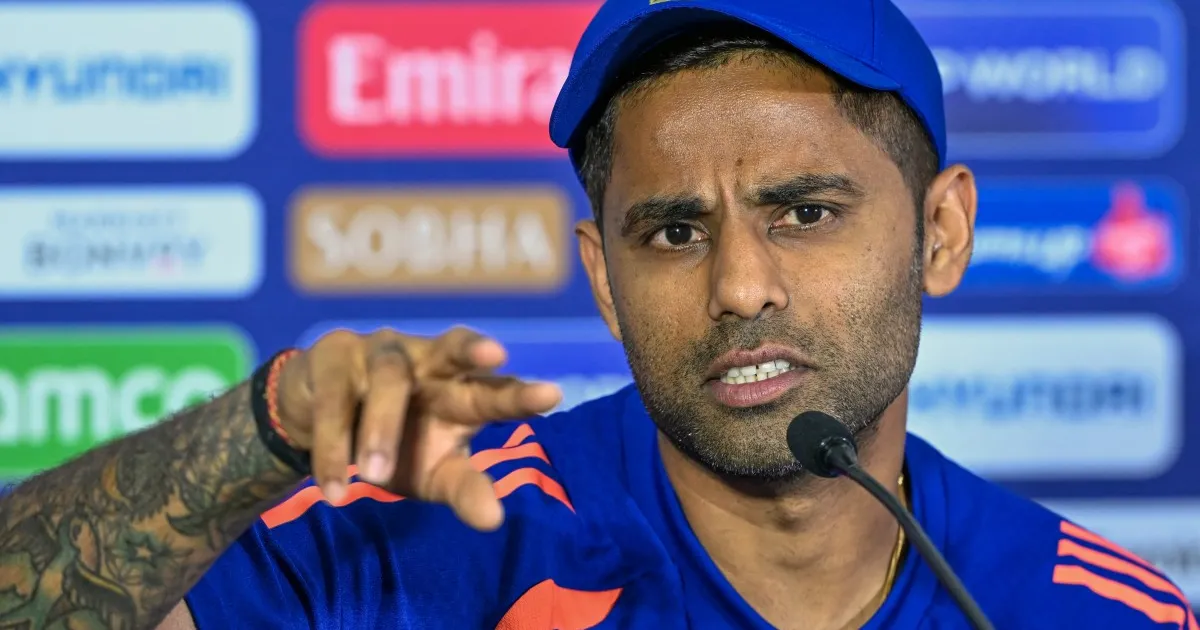
Indian captain Suryakumar Yadav said his players are not concerned about the threat of rain for Sunday’s Twenty20 World Cup clash with Pakistan, adding that the defending champions are focused on preparing for the showdown between bitter rivals.
Pakistan had initially boycotted the Group A fixture in Colombo over Bangladesh’s removal from the tournament for refusing to play in India over security concerns, but reversed their decision on Monday.
Recommended Stories
list of 4 itemsend of list
But weather forecasts have warned of heavy rain between Sunday afternoon and evening, casting new doubts over the match.
“Weather is something which is not in our control,” Suryakumar told reporters on Saturday.
No complacency from India against Pakistan
He said the clash would not be a routine game for the co-hosts.
“When you play an India vs Pakistan game it’s more about the occasion. It’s a big platform, obviously. No matter how many times you say, it’s just another game … It’s human tendency, you know which game you’re about to play,” the 35-year-old said.
“Whatever we have worked hard on and practised, we try to execute them in the game.”
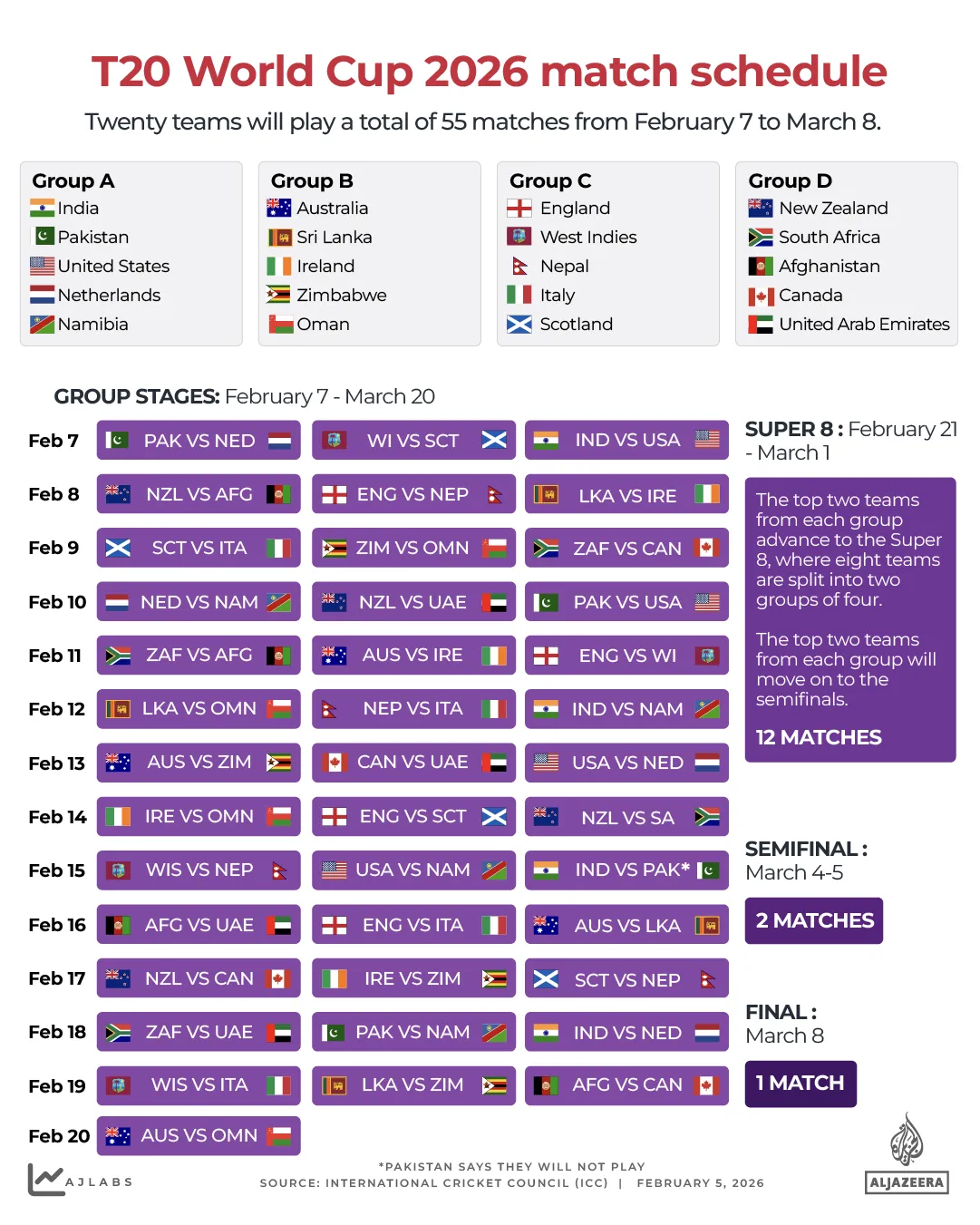
India and Pakistan have both won two games each in the tournament. While Pakistan played both their games in Colombo due to an agreement that they would play each other only on neutral venues, India arrived after a win over Namibia on Thursday.
Suryakumar said India would not be disadvantaged by unfamiliarity with the ground.
“We have similar wickets back home, and we’ve played a lot of cricket here during bilaterals against Sri Lanka, so we’re also very familiar with the conditions,” he said.
India and Pakistan most recently faced off in last year’s Asia Cup, where India won all three of their meetings, including the final.
“You can’t carry history into the ground, because it can cause complacency,” Suryakumar said.
India ready for Pakistan’s ‘out of syllabus’ Tariq
India have carried out preparations to face Usman Tariq, a spinner with an unorthodox action, who took three wickets for Pakistan during Tuesday’s win over the United States.
Pakistan captain Salman Ali Agha said earlier on Saturday that Tariq was a trump card against India.
“At an exam, when there’s an out-of-syllabus question, we can’t just skip it; we have to try something to tackle it,” Suryakumar said about Tariq.
“We practise with similar bowlers, with similar actions. We’ll try to execute what we practise in the net sessions.”
Salman had also expressed hope that Indian opener Abhishek Sharma, who is the highest-ranked batter in the 20-over format, will play on Sunday after missing the previous game due to illness.
“All right, if (Salman) wants him to play, then we’ll play him tomorrow,” Suryakumar said about Sharma.
Captain Aiden Markram hits an unbeaten 86 in seven-wicket defeat of New Zealand in Ahmedabad.
Published On 14 Feb 202614 Feb 2026
Share
South Africa are on the brink of reaching the Twenty20 World Cup’s Super Eight stage after captain Aiden Markram’s storming half-century led them to a dominant seven-wicket victory over New Zealand, securing their third straight Group D win.
New Zealand on Saturday suffered their first loss in the campaign after they posted 175-7 as South Africa’s Marco Jansen took four wickets.
Recommended Stories
list of 4 itemsend of list
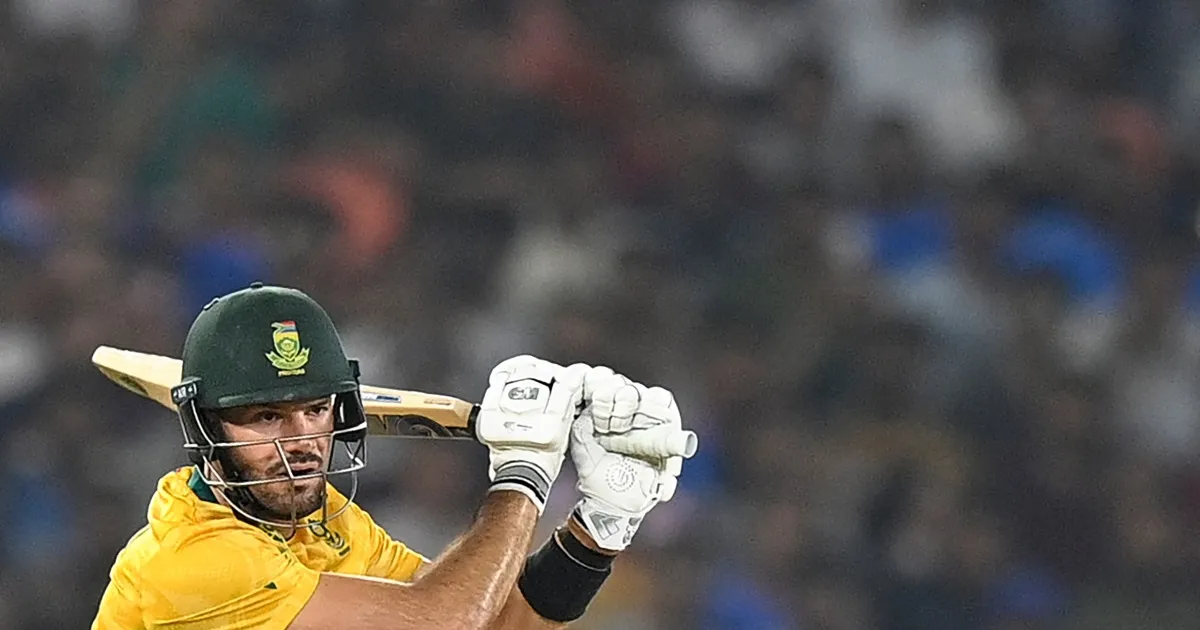
In response, opener Markram hit four sixes and eight boundaries in his unbeaten knock of 86 off 44 balls, the highest by a South African captain in the tournament’s history, helping his team reach 178-3 with 17 balls to spare.
Last edition’s finalists South Africa chose to bowl first in Ahmedabad, India, and it immediately paid off as player of the match Jansen (4-40) dismissed most of New Zealand’s top order by the seventh over.
Finn Allen (31 off 17 balls) tried to mitigate the damage after Tim Seifert and Rachin Ravindra fell to Jansen. But Jansen got Allen caught at mid-off in the sixth over, leaving New Zealand struggling at 58-3.
Mark Chapman (48) and Daryl Mitchell (32) turned things around with a 74-run partnership for the fifth wicket until Jansen got Chapman caught by Ryan Rickelton at backward point in the 14th.
New Zealand scored only 17 runs in the next four overs until James Neesham’s unbeaten 23 off 15 balls got them to a fighting total.
Markram’s magic seals the deal for South Africa
Chasing 176, South Africa got off to a fast start with Markram hitting three sixes and five boundaries to steer his team to 62-0 in four overs.
Losing fellow opener Quinton de Kock (20) did not affect Markram, who hit Mitchell Santner for a six down long-on to reach his half-century in just 19 balls. By the time Rickelton (21) fell in the eighth over, South Africa had already crossed the 100-run mark.
With the required run rate falling below six per over, Markram did not hit a single boundary in the next seven overs and focused on rotating the strike, getting South Africa within 28 runs of victory with 30 balls left.
“It’s about managing it through the right phases, I guess, but up front, you’ve seen how teams are taking on the powerplay and we’d be silly not to try that. It’s not always going to come off, but when it does, … we can get ahead of the game,” Markram said.
David Miller, who scored an unbeaten 24, cleared the mid-wicket boundary to bring up the winning runs.
South Africa will conclude their group campaign against the United Arab Emirates on Wednesday, a day after New Zealand play Canada.
Karachi, Pakistan – As rain and thunder threatened to disrupt their team’s T20 World Cup match against India on Sunday, Pakistan’s cricket fans are bracing for a different storm – the now-customary loss against their archrivals at global events.
Pakistan have not beaten India in the tournament since 2021 when they recorded a solitary win in eight T20 World Cup encounters against their formidable opponents.
Recommended Stories
list of 4 itemsend of list
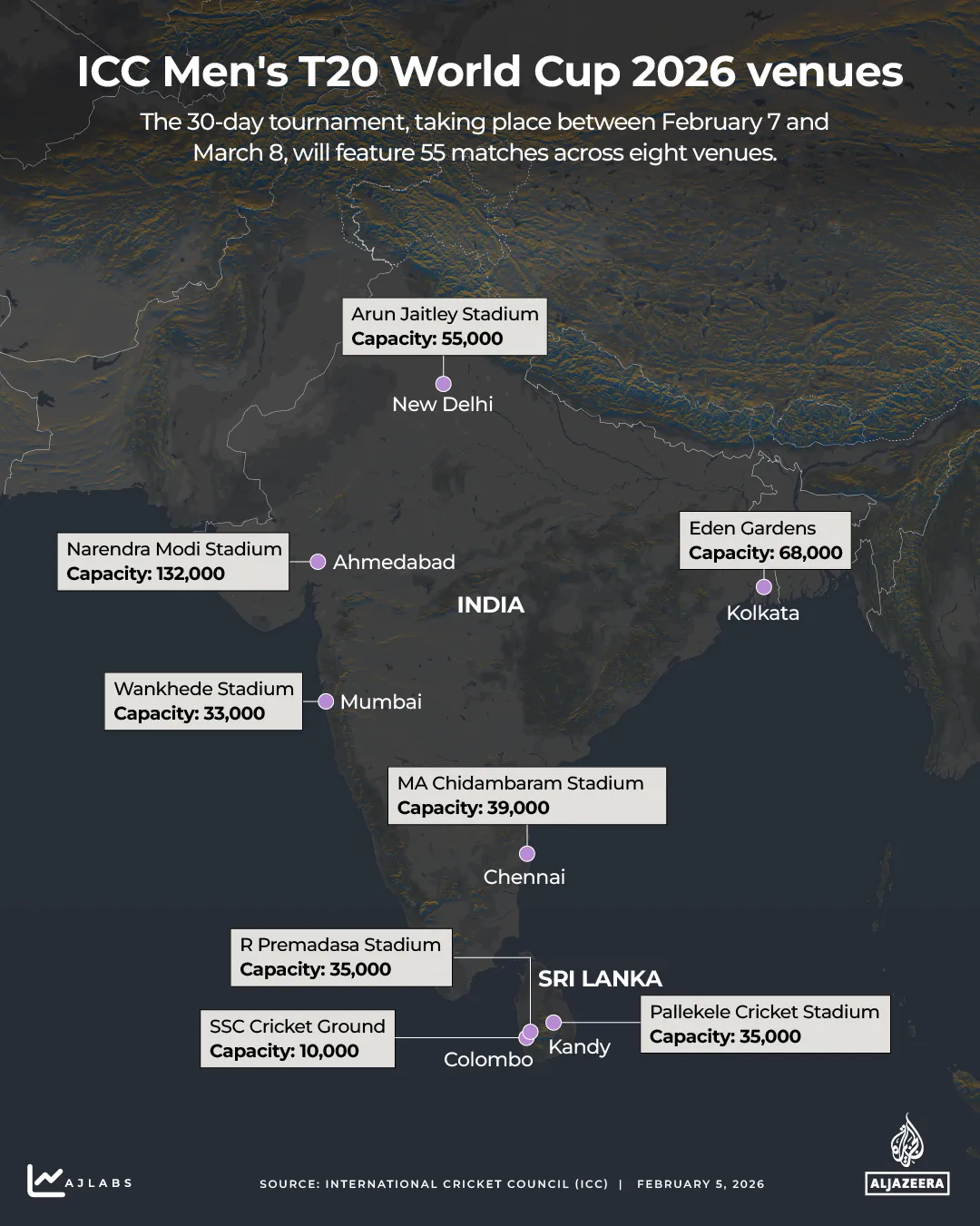
Despondent fans have now shifted from anticipating a thrilling, unpredictable game to praying for a miracle as Salman Ali Agha’s team step on the field at the R Premadasa Stadium in Colombo, Sri Lanka.
Pakistan’s latest “win” came in the form of a move to boycott the match on political grounds. Despite the eventual reversal of the decision after weeklong negotiations with the International Cricket Council (ICC), the initial decision to not take the field against India was seen as a triumph by cricket fans in Pakistan.
Despondent or optimistic, fans still eager for match
Escalating political tensions between the South Asian neighbours have seen a decades-old sporting rivalry turn into an ugly debacle both on and off the pitch with customary handshakes avoided and light jibes replaced by controversial hand gestures invoking their most recent armed conflict in May.
Politics and sport blur boundaries on both sides of the border, making these fixtures an exhibition of nationalistic pride that can sometimes turn distasteful.
The pre-match jingoism in Pakistan, though, was short-lived. It has been replaced by bitterly disappointed fans airing their thoughts in the form of self-deprecating memes or reels depicting the “foolishness” of a section of fans expecting a win.
“We’ll have heartbreak on February 14 and 15,” read the captions of several social media posts set to melancholic songs on Valentine’s Day, the eve of the match.
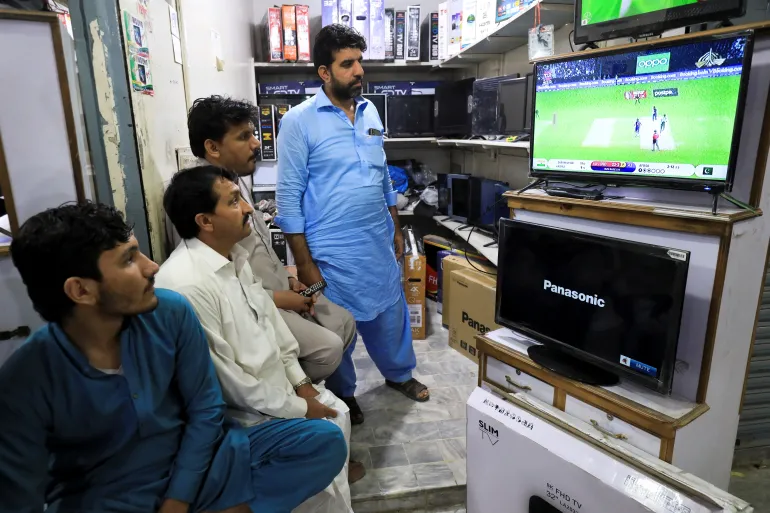
Supporters – both hardcore and casual – will religiously watch the three-plus-hour encounters. Come 6:30pm (13:30 GMT) on Sunday, the public will be glued to screens across the country to watch the high-stakes match.
Roadside tea stalls will be thronged by male spectators filling up wooden benches, plastic chairs or squatting on their haunches in front of small TV screens.
Food delivery riders busy with an overflow of match-day meal orders will occasionally halt their journeys to catch a glimpse of the action on their phones or through restaurant windows.
Upscale eateries will bring in large screens and host groups of young fans and families.
Domestic responsibilities will be wrapped up before the start of the match, and extended families will gather around a living room TV with drinks, snacks and feasts of biryani.
The weekend – now the standard time that all India-Pakistan matches are played for economic and logistical reasons – will offer some respite from an otherwise hectic schedule of school and office routines that throw the heaving metropolis of Karachi into transport turbulence.
Cricket fans in Pakistan always find a way to catch the action when their team takes on India [File: Fayaz Aziz/Reuters]
India favourites, but Usman Tariq could spin a win
Despite the days of anticipation and hours spent preparing for the showpiece, fans remain realistic in their expectations.
On a balmy late Friday afternoon in Karachi as life gradually returned to its normal pace after an hour-long pause for midday prayers at mosques across the city, a group of young law students picked up their kits for a local league match.
“It’s looking 70-30 in India’s favour,” Talha Bandayal, a law student, told Al Jazeera as he watched his teammates play a cricket match in their local lawyers league at the historic Karachi Parsi Institute on Friday.
Bandayal and his friends plan to watch the match at a restaurant in one of Karachi’s posh localities.
“It’s a Pakistan-India match. We’re excited regardless of the result!”
Syed Ahmed Shah, who officiated the league match as a third umpire, was more sceptical of the team’s chances and more in tune with the country’s overall opinion of Pakistan’s expected performance.
“Sport is just like politics in our country,” a bespectacled Shah opined dryly to everyone’s amusement, drawing comparisons between the nation’s two most favoured topics.
“India is far superior to us, not just in cricket but everything,” Shah told Al Jazeera.
Cricket analysts have appeared on national talk shows throughout the week, dissecting the team’s shortcomings, the Pakistan Cricket Board’s organisational failures and the squad’s weak mental fortitude for a match of this proportion.
Local cricketers like Bandayal have been analysing Pakistani players’ strengths and weaknesses. Usman Tariq’s unreadable spin action and variations are being seen as Pakistan’s secret weapon.
Pakistani fans watch their team take on India at a public screening in Karachi [File: Akhtar Soomro/Reuters]
When life comes to a standstill
When it comes to off-field behaviour, though, India’s trend of avoiding handshakes with Pakistani teams has been frowned upon.
“Politics should strictly be kept separate from sports,” a local cricket coach who requested anonymity said of Suryakumar Yadav and his team’s controversial actions from the Asia Cup last year.
“But if India takes that stance, Pakistan also needs to have some self-respect and respond accordingly,” the 46-year-old coach said.
Admittedly, the handshake row has taken centre stage in a fixture that has historically been remembered for scintillating bowling performances, swashbuckling innings or nail-biting finishes.
When Pakistan awakes on Sunday morning, most cricket fans will begin their day by playing their own cricket games – whether in narrow neighbourhood streets or vast, dusty fields hosting multiple matches simultaneously. As the evening draws closer, the clothes will be dusted off and equipment packed away for the showdown in Colombo.
Just as the hustle and bustle of life gave way for prayers two days earlier, the India-Pakistan match will do the same.
After all, it’s only cricket and Friday prayers that can bring life to a standstill in Pakistan.
England beat Scotland by five wickets in India to recover position in group at 2026 T20 World Cup.
Published On 14 Feb 202614 Feb 2026
Share
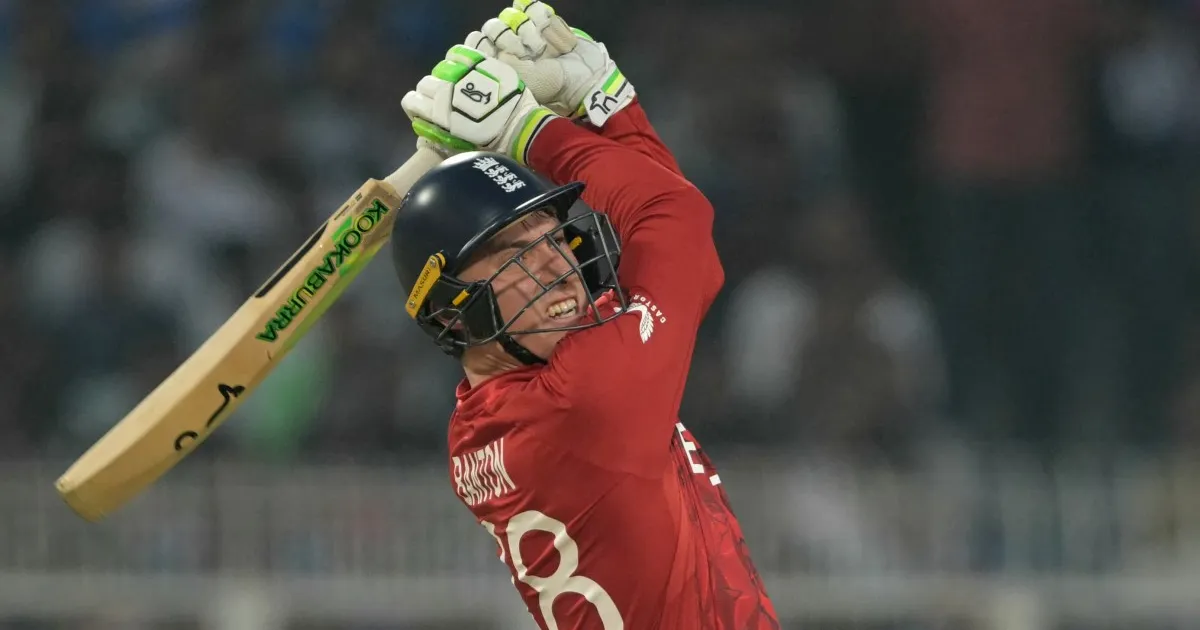
Tom Banton’s unbeaten 63 led England to a five-wicket T20 World Cup victory over Scotland in Kolkata on Saturday that kept Harry Brook’s side on course for the Super Eights.
Victory in their final Group C match against Italy on Monday at the same Eden Gardens stadium will see England safely into the next round.
Recommended Stories
list of 4 itemsend of list
After bowling Scotland out for 152, England racked up 155-5 in 18.2 overs, with Jacob Bethell scoring 32, Sam Curran 28 and Will Jacks (16 off 10 balls) hitting a six and a four to finish the job.
England wobbled at the start of their chase as the new white ball swung under the floodlights with the sun going down.
Phil Salt fell third ball to Brandon McMullen for just two and when Jos Buttler picked out McMullen off Brad Currie, they were 13-2.
Scotland bowled tightly until Bethell broke the shackles by hitting McMullen for a six and two fours in the fifth over.
Spinner Mark Watt also came in for some punishment, conceding 22 off his first over as Banton took him for three huge sixes.
A 66-run partnership ended when the left-handed Bethell, on 32, helped a leg-side delivery from Oliver Davidson into the grateful hands of Brad Wheal at short fine leg.
Captain Brook did not last long, scooping Michael Leask over his shoulder to Wheal to make it 86-4, but England were always in control and got home with 10 balls to spare.
Earlier, England’s bowlers found their mojo and vindicated Brook’s decision to field on winning the toss.
After being smacked to all parts of Mumbai’s Wankhede Stadium in conceding 196 to the West Indies on Wednesday, England’s attack exerted much more control at Eden Gardens.
Captain Richie Berrington top-scored for Scotland with 49 off 32 balls with five fours and two sixes.
He and Tom Bruce put on 71 for the fourth wicket, but it was their only notable partnership.
Spinner Liam Dawson ended it in the 13th over when Bruce was caught for 24, Curran providing the safe hands at deep square leg.
When Adil Rashid trapped Berrington lbw in the next over, Scotland collapsed, losing their last seven wickets for 39 runs from 113-3.
Jofra Archer had been expensive in the two previous outings but made the early breakthroughs before finishing with a brilliant 2-24 off his four overs.
In his second over, he hurried George Munsey into top-edging to Banton and two balls later had McMullen caught by Salt in the deep.
Michael Jones (33) holed out to Bethell off Curran, and Scotland were 42-3 at the end of the six-over power play and never threatened a competitive total.
Rashid was the best of the England bowlers with 3-36 from his four overs, while Dawson took 2-34.
Colombo, Sri Lanka — Almost 30 years ago today, India and Pakistan formed a combined cricket team to take on Sri Lanka ahead of the 1996 Cricket World Cup in an unprecedented moment of unity in the sport’s history.
The two age-old rivals put aside their differences and came together in an act of solidarity to support a fellow South Asian team, who faced the threat of match boycotts in a tournament they had battled hard to host.
Recommended Stories
list of 4 itemsend of list
India versus Pakistan is the most highly marketed fixture at every multination tournament – the World Cup, Asia Cup or Asian Games – whether it’s a men’s, women’s or Under-19 event.
Few sporting events globally carry the weight and anticipation of an India-Pakistan cricket match. So, when Pakistan’s government ordered its team not to face India at the ongoing T20 World Cup, the tournament was briefly pushed into a state of chaos.
It also left Sri Lanka, the designated host of the fixture, holding its collective breath.
A week of negotiations led to a dramatic late U-turn by the Pakistani government and the match will now take place as scheduled on Sunday at the R Premadasa International Cricket Stadium in Colombo.
But what if the boycott had gone ahead? The impact could have been catastrophic, not just for Pakistan, but also for the International Cricket Council (ICC), as well as Sri Lanka.
With the crisis seemingly averted, the island nation stands poised to reap the benefits in its financial landscape, diplomatic standing and community.
‘Massive impact’ on tourism
For a country that is still grappling with the aftermath of the economic crisis of 2022, an India-Pakistan cricket fixture at a World Cup could prove to be a godsend.
The tourism and hospitality industry was one of the hardest hit during Sri Lanka’s financial meltdown and this match will see an enormous influx of fans from India and Pakistan coming into the country.
Hotels in and around Colombo were fully booked out well ahead of the tournament but the industry braced itself for heavy losses after Pakistan threatened a boycott.
“There’s been a massive impact since the boycott was announced,” Sudarshana Pieris, who works in Sri Lanka’s hospitality sector, told Al Jazeera.
“All major hotels in Colombo were fully booked by Indian travel agencies well ahead [of the match] and once the boycott was announced, we lost almost all of those bookings,” he said.
“But after Pakistan reversed their decision, hotel room rates shot up by about 300-400 percent at five-star establishments in Colombo.”
It’s not just hotels but several other local businesses – from street vendors to high-end restaurants – who are hoping for an increased footfall and spending over the weekend.
These short trips and the experiences they offer could influence visitors to extend their stay or return to Sri Lanka on holiday, long after the game has ended, in a potential long-term benefit to the industry.
Another relatively underestimated impact of the game would be the employment opportunities it creates, albeit temporarily, in the media, event management, security and transportation industries.
Asanka Hadirampela, a freelance journalist and broadcaster currently working as a Sinhala language commentator for the World Cup, recognises the marquee match as a great opportunity from a personal standpoint.
“This is my first World Cup as a broadcaster,” Hadirampela said.
“The India-Pakistan fixture is the biggest and most-watched game of the tournament. So to get to work on such a match is exciting and I consider it a special achievement.”
A geopolitical win
The lines are always blurred between sport and politics in South Asia.
So while the financial gains are expected to be significant, the fixture’s impact on the region’s geopolitical environment cannot go amiss.
Pakistan’s boycott, too, was explicitly political, as confirmed by the country’s Prime Minister Shehbaz Sharif when he said that they were offering support to Bangladesh after the Tigers were kicked out of the tournament by the ICC.
The reversal of Pakistan’s decision, which they said came after requests to reconsider the boycott by several regional “friends”, was steeped in politics, too.
Sri Lanka’s President Anura Kumara Dissanayake reportedly had a phone conversation with PM Sharif, urging his government to rethink their decision to boycott the game as the successful staging of this encounter would not only position Sri Lanka as a capable host of global sporting events but also reinforce its standing as a neutral mediator in a region fraught with geopolitical complexities.
Sri Lanka and Pakistan have always maintained strong diplomatic relations, which have extended to the cricket field as well.
Sri Lanka were one of the first teams to travel to Pakistan following their 10-year ostracisation from international cricket, which came as a result of a terrorist attack targeting the Sri Lankan team in March 2009.
When Al Jazeera reached out to Sri Lanka Cricket (SLC), its vice president Ravin Wickramaratne confirmed that SLC did, indeed, reach out to the Pakistan Cricket Board (PCB) after the boycott was announced.
“We asked them to reconsider the decision,” Wickramaratne said.
“It [boycott] would have impacted Sri Lanka economically, whether directly or indirectly.
“We have always had a good relationship with the PCB and we have always supported them, so we’re happy with their decision.”
A little over 24 hours ahead of the match in Colombo, there is a sense of palpable excitement and a growing buzz around the fixture as it returns from the brink of cancellation.
As of Saturday morning, 28,000 tickets had been sold for the game but local organisers expect a capacity crowd of 40,000 to make it into the stands.
Come Sunday, thousands more will line the streets in and around Maligawatte, the bustling Colombo suburb that houses the famous Premadasa Stadium.
Jury chair Wim Wenders said filmmakers ‘have to stay out of politics’ when asked about German support for Israel’s genocidal war in Gaza.
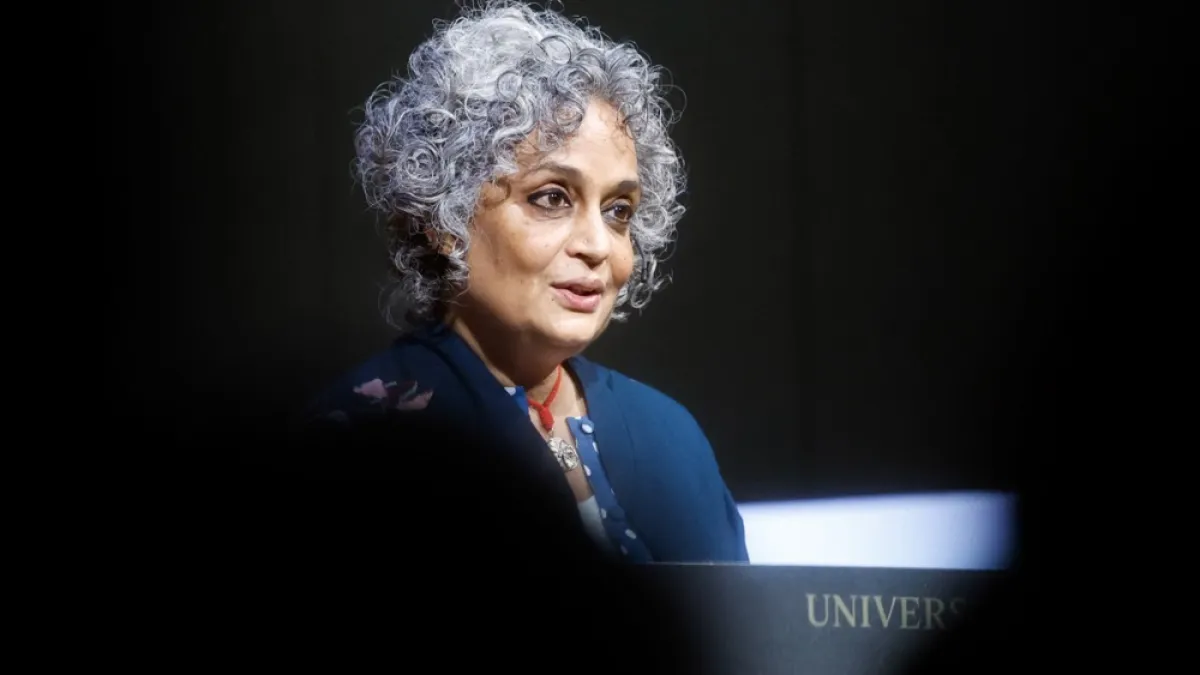
Indian author Arundhati Roy has announced that she is withdrawing from the Berlin International Film Festival after what she described as “unconscionable statements” by its jury members about Israel’s genocidal war on Gaza.
Writing in India’s The Wire newspaper, Roy said she found recent remarks from members of the Berlinale jury, including its chair, acclaimed director Wim Wenders, that “art should not be political” to be “jaw-dropping”.
Recommended Stories
list of 4 itemsend of list
“It is a way of shutting down a conversation about a crime against humanity even as it unfolds before us in real time,” wrote Roy, the author of novels and nonfiction, including The God of Small Things.
“I am shocked and disgusted,” Roy wrote, adding that she believed “artists, writers and filmmakers should be doing everything in their power to stop” the war in Gaza.
“Let me say this clearly: what has happened in Gaza, what continues to happen, is a genocide of the Palestinian people by the State of Israel,” she wrote.
The war is “supported and funded by the governments of the United States and Germany, as well as several other countries in Europe, which makes them complicit in the crime,” she added.
During a panel to launch the festival on Thursday, a journalist asked the jury members for their views on the German government’s “support of the genocide in Gaza” and the “selective treatment of human rights” issues.
German filmmaker Wim Wenders, who is the chair of the festival’s seven-member jury, responded, saying that filmmakers “have to stay out of politics”.
“If we made movies that are dedicatedly political, we enter the field of politics. But we are the counterweight to politics. We are the opposite of politics. We have to do the work of people and not the work of politicians,” Wenders said.
Polish film producer Ewa Puszczynska, another jury member, said she thought it was “a bit unfair” to pose this question, saying that filmmakers “cannot be responsible” for whether governments support Israel or Palestine.
“There are many other wars where genocide is committed and we do not talk about that,” Puszczynska added.
Roy had been due to participate in the festival, which runs from February 12 to 22, after her 1989 film, In Which Annie Gives It Those Ones, was selected to be screened in the Classics section.
Germany, which is one of the biggest exporters of weapons to Israel, after the US, has introduced harsh measures to prevent people from speaking out in solidarity with Palestinians.
In 2024, more than 500 international artists, filmmakers, writers and culture workers called on creatives to stop working with German-funded cultural institutions over what they described as “McCarthyist policies that suppress freedom of expression, specifically expressions of solidarity with Palestine”.
“Cultural institutions are surveilling social media, petitions, open letters and public statements for expressions of solidarity with Palestine in order to weed out cultural workers who do not echo Germany’s unequivocal support of Israel,” organisers of the initiative said.
Mumbai, India — For Indian cricket fans travelling to Sri Lanka this weekend, the opportunity to watch their team take on archrivals Pakistan in the T20 World Cup has come at the cost of inflated airfares, soaring hotel prices and a long wait for matchday tickets.
But these are mere sacrifices that thousands are willing to make to witness the most heated rivalry in the sport as it unfolds on Sunday at the R Premadasa Stadium in Colombo.
Recommended Stories
list of 2 itemsend of list
Fuelled by a decades-long fraught political relationship, cricket encounters between India and Pakistan are among the biggest spectacles in sport — often framed as bloodthirsty contests of national pride.
For the first time in the history of the World Cup, geopolitical tensions threatened to put the marquee contest in doubt until Pakistan’s government reversed its order for a boycott of the match.
While the near-last-minute U-turn revived excitement, it came at a price for the Indian supporters making late travel plans. Pakistan’s participation was confirmed only six days before the fixture, triggering a sharp surge in airfares from several Indian cities.
Fans who booked their air tickets weeks in advance, too, paid significantly higher fares due to the significantly higher demand surrounding any India-Pakistan match, which is commonly deemed the most lucrative fixture in cricket.
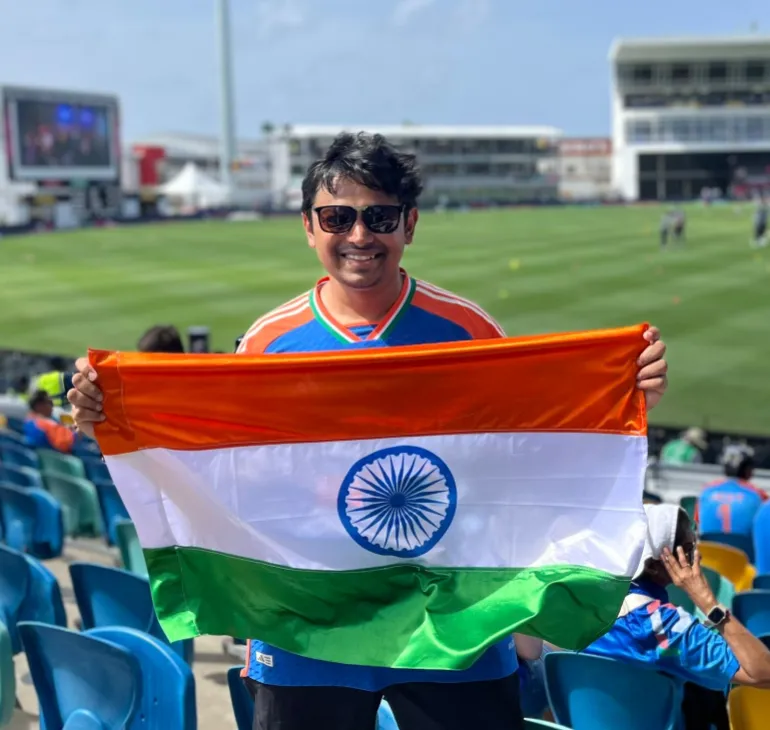
“I paid a premium of approximately 50 percent compared to the usual rates,” Aditya Chheda, a finance professional from Mumbai, told Al Jazeera. “This was despite booking a month in advance and opting for a layover instead of a direct flight.”
Chheda is among thousands of Indian fans who have travelled to Colombo for the blockbuster fixture [Courtesy of Aditya Chheda]
Flight, hotel prices skyrocket
A nonstop round-trip journey from India’s western metropolis Mumbai to Colombo, which typically costs approximately $275, went upwards of $1,000 two days before the match.
Similar fares were spotted for nonstop journeys from Bengaluru in southern India, while round-trip nonstop flights from Chennai to Colombo – a route that takes only about an hour and 20 minutes – had surged to at least $550, up from its usual fare of $165.
Planning ahead helped Bengaluru resident Parth Chauhan secure deals at a good price, but his friends accompanying him to Colombo had to pay a steep premium – three times the usual cost – after booking closer to the match date.
Known as the home of Sri Lankan cricket, the R Premadasa Stadium will host India vs Pakistan on Sunday [File: Hafsa Adil/Al Jazeera]
Accommodation costs rose sharply as well. Tariffs at five-star hotels in Colombo ranged between $400 and $1,000 per night from Saturday to Monday, when most spectators were expected to fly in and out.
Chauhan, who works in a cybersecurity organisation, had to wait a whopping four hours in a virtual queue to buy match tickets, but he insists the hassle was worth the wait, as he gears up to watch India play abroad for the first time.
“It’s an opportune moment, and there is a lot of exuberance to witness this because it’s a historic fixture,” he said.
For a lucky few, the surprise came not from the difficulty of securing tickets but from their unusually low price. Piyush Nathani, an IT professional from Bengaluru, paid only $5 for the fixture, which draws millions in broadcast, sponsor and advertising revenue.
“This is the cheapest ticket I’ve ever purchased. Just $5 to watch a World Cup match, that too of the magnitude of India vs Pakistan, is a steal,” said Nathani, who has travelled with a group of six friends.
Nathani has followed the Indian cricket team across several stadiums in Asia [Courtesy of Piyush Nathani]
‘More than a cricket match’
Having been part of the Ahmedabad crowd in 2023 that saw India beat Pakistan in a 50-over World Cup group game, Nathani is relishing the chance to watch Sunday’s match in a neutral venue, where fans from both countries are expected to be present.
“The feeling of beating Pakistan is something money cannot buy,” added the 29-year-old.
Like Nathani, Chheda has also travelled abroad previously to watch Team India. The 32-year-old watched India lift the 2024 T20 World Cup in Barbados and now wants to “pick up where I left off”.
“When there’s a World Cup, the first thing Indian fans hope for is to beat Pakistan,” he added.
“Winning the World Cup is the biggest target, but beating Pakistan feels like a moral victory – it’s more than a cricket match.”
When India and Pakistan meet in the T20 World Cup on Sunday, the match will not just be significant for its on-field cricket action but also the political climate that has shrouded the encounter and the tournament itself.
The South Asian nations share a decades-old history of wars and hostile relations. The most recent encounter came in May 2025, when the nuclear-armed neighbours were engaged in a four-day cross-border conflict.
Recommended Stories
list of 4 itemsend of list
This 78-year-old bitter history has fuelled the sporting rivalry, which has – at times – led to tournament boycotts, cancelled matches and ground invasions.
Players from both teams have often been involved in heated encounters on the field, but have also publicly shared lighter moments off it.
However, the lingering hostility of the last conflict has made a severe and long-term impact on cricket, which is the most widely followed sport in South Asia.
We look back at the deteriorating cricket relations between India and Pakistan since the May conflict and the on-field events steeped in politics:
September 14 – No handshake row
The controversy began when India’s Suryakumar Yadav opted out of the customary pre-toss captains’ handshake with Pakistan’s Salman Ali Agha, prompting fans to wonder if politics were at play.
The doubts were cleared at the end of the match when, after hitting the winning runs, Yadav and his batting partner Shivam Dube walked off the field without approaching the Pakistani captain and team for the traditional post-match handshakes.
Pakistan’s players trudged off in a group and waited for the Indian squad, but the Indian contingent only shook hands with each other before walking into their dressing room and shutting the door as the waiting Pakistan players looked on.
Later, Yadav confirmed that his team had planned to not shake hands with Pakistani players all along, linking it to the April 22 attack in Indian-administered Kashmir that preceded the May conflict.
“A few things in life are above sportsman’s spirit,” the 35-year-old said.
India’s captain Suryakumar Yadav walks off after the toss as his Pakistan counterpart Salman Agha watches on before the start of their Asia Cup 2025 game [Sajjad Hussain/AFP]
September 17 – Pakistan refuse to take the field against UAE
The fallout of the handshake row carried over into Pakistan’s next group game in the Asia Cup, when they refused to take the field against the UAE in protest against match referee Andy Pycroft.
Pakistan insisted that Pycroft be removed from their fixture as he was the key official in the India match and helped carry out India’s request that the captains not shake hands at the toss.
“Andy Pycroft had barred the captains of India and Pakistan from shaking hands during their match,” the Pakistan Cricket Board (PCB) said in a statement.
The Pakistan-UAE match was delayed by an hour as negotiations took place behind closed doors, and Pycroft apologised for the “miscommunication”.
Pakistan’s captain Salman Agha and team manager Naveed Akram Cheema speak before the start of the match against the United Arab Emirates [File: Sajjad Hussain/AFP]
September 21 – Players exchange heated words, make references to conflict
When the teams met for the second time in the Asia Cup, players from both sides were seen exchanging verbal blows in the middle of the pitch.
Pakistan’s Haris Rauf had a go at India’s batter Abhishek Sharma, who later said his match-winning innings of 74 runs was a response to Pakistani players.
“The way they were coming at us without any reason, I didn’t like it at all,” Sharma said after the match.
Rauf was also seen making gestures towards the Indian supporters while fielding on the boundary. He held up his hands to indicate the numbers six and zero, a reference to Pakistan’s claim of downing six Indian jets during the May conflict.
The fast bowler also made gestures indicating an aircraft nosediving into the ground.
Following the match, the Board of Control for Cricket in India (BCCI) lodged a complaint with the International Cricket Council (ICC) against Rauf and Pakistani batter Sahibzada Farhan, who marked his half-century with a mock gun celebration.
Pakistan, too, lodged a complaint against India’s captain Yadav for using his post-match press comments to mention the Indian missile attacks in Pakistan.
Pakistan’s Haris Rauf speaks with India’s Abhishek Sharma, second left, as Shubman Gill watches during the Asia Cup match [File: Sajjad Hussain/AFP]
September 28 – India refuse to receive trophy from Pakistani official
The controversial tournament peaked in the final when India, who beat Pakistan by five wickets, refused to accept the Asia Cup trophy because it was presented by Mohsin Naqvi, who is the Asian Cricket Council (ACC) president as well as the chairman of the PCB.
Naqvi is also Pakistan’s federal interior minister.
“We have decided not to take the Asia Cup trophy from the ACC chairman, who happens to be one of the main [political] leaders of Pakistan,” Devajit Saikia, the chairman of the Board of Control for Cricket in India (BCCI), said.
The final award presentation was delayed by more than an hour due to India’s refusal and Naqvi’s insistence on presenting the trophy. The Indian team celebrated by pretending to hold a trophy.
India’s captain Yadav added it was the team’s decision to refuse the trophy and “no one told us to do it”.
India’s captain Suryakumar Yadav pretends to hold the trophy as his team celebrates their victory at the end of the Asia Cup 2025 final [File: Sajjad Hussain/AFP]
October 5 – Handshake row hits Women’s Cricket World Cup
When India and Pakistan faced off at the ICC Women’s World Cup 2025 in Sri Lanka, the Indian women’s team followed the precedent set by the men’s side by not offering to shake hands with the opposition.
India’s captain Harmanpreet Kaur and her Pakistani counterpart Fatima Sana walk past each other after the toss at their ICC Women’s Cricket World Cup 2025 match in Sri Lanka [Ishara S Kodikara/AFP]
November 4 – ICC sanctions Indian and Pakistani players for on-field behaviour
Five weeks after the conclusion of the Asia Cup, the ICC said Rauf, Farhan and Yadav had been found guilty of breaching its code of conduct and bringing the game into disrepute.
Yadav and Rauf were fined 30 percent of their match fees from the September 14 match and received two demerit points each, while Farhan walked away with a warning and one demerit point.
Rauf was found guilty of the same offence in the final and handed the same punishment, which led to a two-match ban on him.
Meanwhile, Indian pacer Jasprit Bumrah, who displayed a plane-crashing celebration of his own in the final, was also found guilty and handed one demerit point.
Jasprit Bumrah celebrates the wicket of Haris Rauf during the Asia Cup final [Altaf Qadri/AP]
January 25 – Pakistan casts doubt on T20 World Cup participation
Following Bangladesh’s ouster from the T20 World Cup, Pakistan said it would reconsider its own presence at the tournament.
“The prime minister is not in Pakistan right now. When he returns, I’ll be able to give you our final decision,” PCB chief Naqvi said.
February 1 – Pakistan announces boycott of India match
In an unprecedented decision at a World Cup, Pakistan’s government said its team would not take the field against India on February 15.
A few days later, Pakistan’s Prime Minister Shehbaz Sharif revealed the move was an act of solidarity with Bangladesh.
February 9 – Pakistan reverses boycott
More than a week later, Pakistan reversed its decision and said its cricket team had been ordered to take the field in the match on Sunday.
Pakistan’s government said it had “reviewed formal requests extended by the Bangladesh Cricket Board, as well as the supporting communications from Sri Lanka, the United Arab Emirates, and other member nations”, which sought “a viable solution to recent challenges”, referring to its decision to boycott the game.
I carry my train journeys in my bones, the juddering song of the Indian rail. Our first prime minister, Jawaharlal Nehru, famously likened India to a palimpsest, no layer quite effacing the one that went before. That’s how I think of Indian railway journeys. They inscribe on the mind our fellow travellers, our ways, our thousand languages, our landscapes, our climate.
I think of a rail journey I made in 1998 – that brutal summer of nuclear testing – setting out from Mumbai, in an ordinary three-tier sleeper, for Dehradun, 1,000 miles (1,600km) north. The frazzled train fell off any semblance of a schedule. The voyage grew longer, past 50 hours; hotter, past 50C. I remember the metallic burn on the window grilles; the hot, killing wind that blew through them; the sizzle of water drops splashed on the face when theyhit the uncovered platforms in the heart of the country; the melt of my rubber soles. A fortnight later, having trekked to the mouth of a tributary of the Ganges, completing my expedition from the Arabian Sea to a Himalayan glacier, it was possible to look back on the rail ordeal with affection.
Rahul Bhattacharya with his children
I wonder, as I write, whether this memory seeped into the heat-addled odyssey made by the runaway protagonist of my novel Railsong. Physically depleted as she is by its end, she is sustained by the benevolence and solidarity of strangers. Alighting in the great city of Bombay, as Mumbai was then called, standing below the gargoyles of the gothic masterpiece then called the Victoria terminus (now the Chhatrapati Shivaji Maharaj terminus), she knows she has emerged on the other side of something.
In no other activity, so easily available to all, does India offer itself up as wholly as train travel. Mahatma Gandhi, initially a critic of the railway system (“Railways accentuate the evil nature of man”), came around to accepting this, hitting the rails to understand his country on his return from South Africa. This is why I recommend to the prospective traveller not necessarily the heritage or scenic routes – though by all means sample the quaint narrow- or metre-gauge hill railways, or the gorgeous run down the Konkan coast – but instead using the railways simply as a way of getting from one place to another.
In the process, one learns much about oneself. Consider sleeper travel. Is there a situation more exposing than sharing a compartment with strangers? With luck, you might fall into invigorating company. A few months ago, I made an overnight trip up from Mumbai to Delhi with three large policemen, one nursing an injured toe, another dedicated to his newspaper, the third his phone, each initially taciturn. As the journey unspooled, so did their stories. They were going out to capture someone. If it was anything like their last outing to Delhi, when a slippery accused murderer had them chase him for more than 600 miles across three states, these officers would make it on to the news again. Another time, a painstaking manhunt had taken them to Mangaluru on the south-western coast, where they discovered instead the fellow’s namesake – himself wanted in a decades-old riots case. That led to a medal.
‘Is there a situation more exposing than sharing a compartment with strangers?’ … A sleeper train at New Delhi station. Photograph: REY Pictures/Alamy
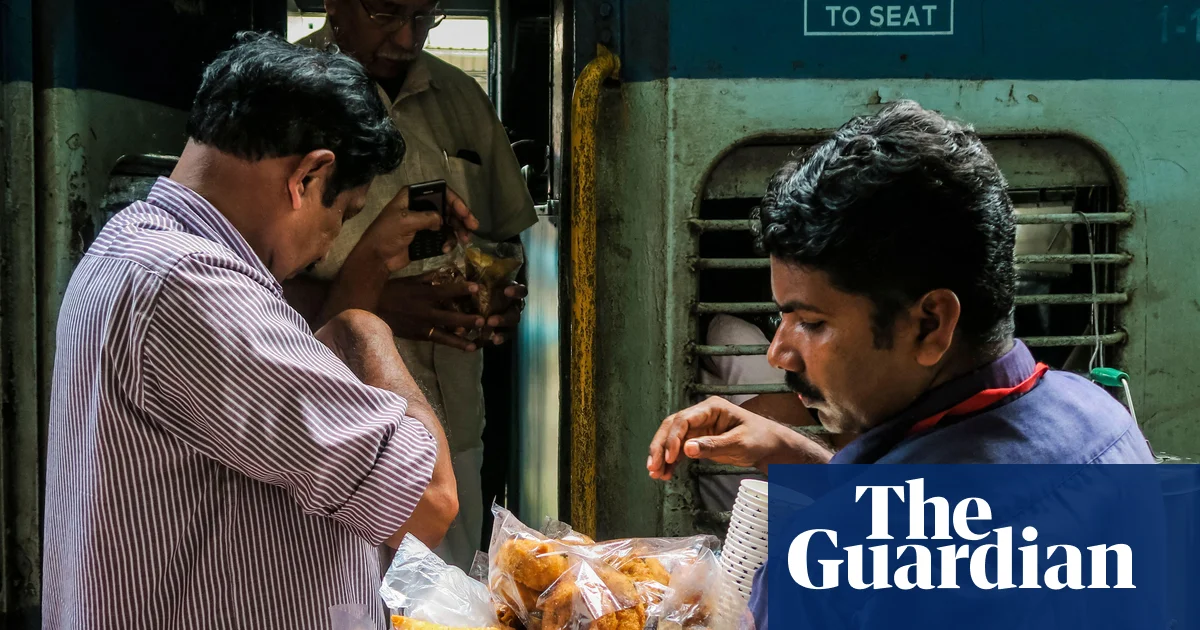
Food is also a valuable companion on the rails. No matter that dining cars are gone, that regulations about open flames have restricted platform fare, or that the foil-boxed meals served on premium services trigger thousands of official complaints every year and much casual grousing – eating remains a crucial railway habit. Depending on the season, and your route, it is possible to pop out on to the platform during a halt and buy top-notch, farm-fresh lychees, custard apples, bananas and mangoes in places famed for them.
On the Mumbai-Pune route in the west, vendors at Karjat align themselves with the carriage doors, bearing metal trays of the town’s famed vada pav – a deep-fried, lightly spiced potato ball, placed inside a soft bun with a mix of dry and wet chutneys (for the cautious, the dry is safer). On the same route, as banker (helper) engines push the rake (coupled carriages) up the Western Ghats, the hill station of Lonavala offers up its famous chikki – an energy-boosting sweet made from nuts and jaggery (unrefined cane sugar) – and the more decadent chocolate walnut fudge. In the southern states of Telangana and Karnataka, you might help yourself, as I did a few years ago, to vividly peppy breakfasts of ograni – a mixture of soft puffed rice and an array of condiments and spices, similar yet so distinct from the crunchy, mustardy puffed-rice jhalmuri of Bengal in the east. And there is always the prospect of packing yourself a tuck and sharing food with any friends you make along the way.
Despite the myriad challenges of Indian train travel, the journeys are pleasurable and affordable, not to mention sustainable. For these reasons, my family and I do as much of our travelling as possible by rail. Routinely, we curve out east from Delhi, across the great swathe of the Gangetic plains, the dusty brownscapes gradually getting greener, up past the trim tea gardens in the eastern Himalayan foothills, through the narrow corridor known as the “chicken’s neck” (officially, the Siliguri Corridor), into bamboo-shaded Assam, to my wife’s ancestral home. This run, 24 or 28 hours long, depending on the service, sometimes stretches past 35. Our two young girls don’t mind; it’s flights that make them feel claustrophobic.
Chhatrapati Shivaji Maharaj terminus in Mumbai. Photograph: Nikada/Getty Images
The causes of these delays are often dramatic, and instructive about Indian life.
One time, a station footbridge collapsed under the weight of Kumbh Mela pilgrims – typically, a last-minute change of platforms was involved, causing a stampede – in the town then known as Allahabad (since renamed Prayagraj by a regime intent on scrubbing Islamic fingerprints off Indian history). More than 40 people died, putting into perspective my trivial discomfort of waiting in the chilly hours for the train to pull into Mughalsarai (also renamed, after the philosopher Deen Dayal Upadhyay). On another occasion, a derailment sent us on a circuitous gallivant through Bihar and Bengal. Then there was the time our rake first mowed down three cows and then, in the middle of the night, smashed into a stalled Jeep. The occupants got away. Unfortunately, this is not always the case.
On a monsoonal Assamese morning in 2012, the train I was on came to a standstill beside a paddy field. This was an inexpensive regional service, fitted with unreserved bench-seating – in Indian Railways parlance, a “passenger” train – and it was halting at the merest hint of a station. But even by the standards of passenger trains, this seemed like an eccentric location. Eventually, I climbed off to investigate. In front of the locomotive sat a mangled autorickshaw. The bodies of three men had been laid alongside the tracks.
I don’t mean to deter you from passenger services. In fact, I highly recommend them. In a land as diverse as India, a passenger train is a full-blooded immersion in the local: the dress; the produce the farmers carry; the food vendors serve up; the unknown halts that mail and express trains roar past, which are the centres of their own little worlds. After all, on the railways, as in certain novels, the intimate and the epic, the local and the national, are linked together, making the whole.
Rahul Bhattacharya’s latest novel, Railsong, is published by Bloomsbury (£18.99). To support the Guardian, order your copy at guardianbookshop.com. Delivery charges may apply
Rutherford’s 76 and spinners’ control help the two-time champions beat the 2022 winners at the Wankhede Stadium.
Published On 11 Feb 202611 Feb 2026
Share
Sherfane Rutherford struck a belligerent half-century and Gudakesh Motie produced a brilliant display of spin bowling as West Indies thumped England by 30 runs in T20 World Cup Group C.
Rutherford smacked seven sixes in his unbeaten 76 off 42 deliveries to provide the bedrock of his team’s imposing total of 196-6 at the Wankhede Stadium in Mumbai on Wednesday.
Recommended Stories
list of 4 itemsend of list
Twice champions West Indies returned to choke their opponents with spin and bundled out England for 166 in 19 overs to top the group with their second successive victory.
England slipped to third place, behind Scotland, after their first defeat in the tournament.
“Disappointing. It’s never nice to lose a game, but West Indies played outstanding,” England captain Harry Brook said.
“We thought it was a chaseable total for sure but it didn’t dew up as much as we expected and didn’t skid onto the bat.”
Put into bat, West Indies lost both openers in the first seven deliveries of their innings.
Shimron Hetmyer (23) and Roston Chase (34) steadied the ship before Rutherford walked in to light up the Wankhede Stadium.
He shared a 61-run stand with Jason Holder, who struck four sixes in his 33 off 17 balls, to take West Indies close to 200.
Leg-spinner Adil Rashid excelled for England, conceding only 16 runs in his four overs and claiming the wickets of Chase and Rovman Powell.
England made a flying start before losing Phil Salt (30) in the fourth over.
Chase removed Jos Buttler for 21 and left-arm spinner Motie produced a double strike to turn the heat on England, who slumped to 93-4 at the halfway stage of their innings.
The situation demanded caution and Brook duly curbed his normal aggression but the West Indian spinners would not be denied.
Motie (3-33) caught Brook off his own bowling and Chase trapped Will Jacks lbw to further turn the screw.
Sam Curran made a valiant 43 not out down the order but lacked support.
“I have put in a lot of work coming into the World Cup,” Rutherford said.
“I trust my process and I can score runs in the end when I play with a clear mind. We were maybe 10 runs behind what we wanted given England’s powerful batting but the guys bowled well.”
Who: India vs Namibia What: ICC Men’s T20 World Cup 2026 – Group A When: Thursday, February 12 at 7pm (13:30 GMT) Where: Arun Jaitley Stadium, New Delhi, India How to follow and stream: Al Jazeera’s live text and photo stream begins at 10:30 GMT
Namibia will look to make the most of an illness-and-injury-plagued Indian side when they meet the defending champions in their Group A match on Thursday.
Recommended Stories
list of 4 itemsend of list
India are likely to take the field without their swashbuckling opener Abhishek Sharma after he was hospitalised with an upset stomach on Tuesday.
While Sharma was discharged on the eve of the match, his presence in the playing XI is doubtful.
The world’s top-ranked T20I batter struggled in India’s opening match against the United States.
“He has been discharged today, and he is doing well,” Indian batter Tilak Varma told reporters.
“We have got one more day for the game. Hopefully, we decide by tomorrow on how he feels, and we go with it.”
In better news for the world champions, pace spearhead Jasprit Bumrah is expected to return after he missed the opener due to a fever.
(Al Jazeera)
Namibia expect ‘great spectacle’
Namibia, meanwhile, will be looking to move past their heavy loss against the Netherlands on Tuesday and register a shock win over the two-time world champions.
The African team’s coach, Craig Williams, admitted his side faces a stiff challenge against India, but they would like to pose a challenge against the pre-tournament favourites.
“Playing India in India – it’s going to be a great game for us and the spectacle is going to be fantastic for everyone back home as well,” Williams said before the match.
“As a professional team, we want to put on a good show, and hopefully, we’re going to stick to our game plan, and then we’ll see what happens at the end of the day.”
Williams said the key to Namibia’s chances will be a strong batting performance at the top of the order.
“We need someone in our top four to bat for a prolonged period of time, and then you need partnerships,” the former cricketer said.
“Playing against India won’t be easier, but if we can stick to our game plan, and take one ball at a time, hopefully, the result will then go our way.”
(Al Jazeera)
Form guide: India
India are on an eight-game unbeaten run in the T20 World Cup, carrying on from their title-winning campaign in 2024.
They lost one of their five T20Is against New Zealand last month.
Last five matches (most recent first): W W L W W
Form guide: Namibia
One of the biggest results in Namibian cricket history came in October, when they beat 2024 finalists South Africa by four wickets.
They have not been lucky enough to play international fixtures regularly, but can pose a challenge if one of their key players makes an impact.
Last five matches (most recent first): L W L W W
Team news: India
India’s squad has been hit by a range of illnesses and injuries, but Suryakumar Yadav’s team have plenty of power on the bench to grab another win.
Bumrah could return to the XI, replacing his stand-in Mohammed Siraj, and Sanju Samson could take Sharma’s place at the top of the order.
Namibia could field the same XI that lost to the Netherlands, hoping that the result goes the other way this time.
Predicted XI: Louren Steenkamp, Jan Frylinck, Jan Nicol Loftie-Eaton, Gerhard Erasmus (captain), JJ Smit, Zane Green (wicketkeeper), Dylan Leicher, Willem Myburgh, Ruben Trumpelmann, Bernard Scholtz, Max Heingo
David Miller’s batting heroics in the second super over got South Africa over the line against Afghanistan in Ahmedabad.
Published On 11 Feb 202611 Feb 2026
Share
South Africa edged Afghanistan in a second super over following a dramatic Group D game on Wednesday that was tied after regulation at cricket’s T20 World Cup.
Fazalhaq Farooqi’s runout ended Afghanistan’s chance to win it in regulation with a ball to spare, leaving both teams tied on 187.
Recommended Stories
list of 3 itemsend of list
Afghanistan posted 17 in the first super over, and Farooqi was in position to win it again, restricting South Africa to 11 runs with one ball remaining, until Tristan Stubbs plundered a six to level the scores again.
South Africa batted first in the second tiebreaker, posting 23 with David Miller and Stubbs combining for three sixes.
Keshav Maharaj gave South Africa control with a wicket and two dot balls to start the second super over, leaving Afghanistan needing 24 from four balls – or four sixes.
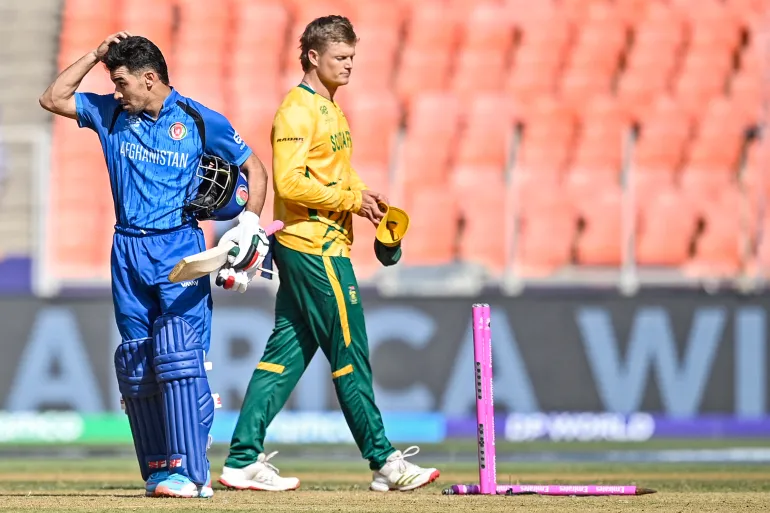
Enter Rahmanullah Gurbaz. With nothing to lose, the big-hitting opener – who earlier blazed 84 from 42 as Afghanistan chased South Africa’s target of 187-6 – hit three consecutive sixes to get the required runs down to six off one delivery.
A wide from Maharaj lowered the target to 5 from one delivery and raised the prospect of yet another tiebreaker, but the South Africa spinner rebounded by having Gurbaz caught at backward point on the next delivery. It was game over.
Lungi Ngidi, who took 3-26 during the match and then bowled the first of the super overs, was voted player of the match.
“I’ve lost so much weight today. I’ve never been that stressed in my life in a cricket game,” he said. “Being able to win two super overs with our hitters hitting like that … very happy.”
South Africa earlier beat Canada in their opening match. Afghanistan have lost both their group matches after an opening loss to New Zealand and are unlikely to progress to the Super Eights from a group containing three highly-ranked teams. Only the top two teams in each of the four groups will advance.
Opener Rahmanullah Gurbaz, left, who struck 84 runs off 42 in regulation time, nearly staged a remarkable Afghanistan comeback in the second super over with three sixes, but came up short in the final two deliveries [Shammi Mehra/AFP]



![Chheda is one of thousands of Indian fans who have travelled to Colombo [Courtesy of Aditya Chheda]](https://i0.wp.com/occasionaldigest.com/wp-content/uploads/2026/02/54ba0ff8-67bb-4a70-9360-622e5fd17267-1770997837.jpeg?w=640&ssl=1)

![Nathani has followed the Indian cricket team across several stadiums in Asia [Courtesy of Piyush Nathani]](https://i0.wp.com/occasionaldigest.com/wp-content/uploads/2026/02/6b9826aa-8c76-4617-b56b-db37014be0a8-1770999182.jpeg?w=640&ssl=1)