An inviting volley blazed over the bar, a trademark free kick clattering into the wall, and a showman’s celebrations cut short by an offside goal.
In many ways, the frustrations Cristiano Ronaldo endured in his final match for Portugal reflected his long-altered reality – one of football’s most devastating players had become a liability.
Recommended Stories
list of 3 itemsend of list
For many, Ronaldo’s fall from grace could hardly be crueller.
The boy from Madeira captivated the world for years with his jaw-dropping talent, age-defying athleticism and larger-than-life personality. Yet the final chapter of his international career had anything but a fairytale ending – a forgettable climax to an otherwise illustrious journey.
Ronaldo has walked away from the national team with individual achievements most footballers can only dream of: the all-time record for international appearances (234) and goals (146).
“Portugal will always be a part of me,” the 41-year-old said in a five-minute video shared on Thursday, bidding goodbye to the team he first played for in 2003.
But his international retirement was hardly a surprise.
In the weeks leading up to his announcement, Ronaldo had been at the centre of a controversy, leaving fans and critics wondering if that was the end of the road for Portugal’s longstanding captain.
The forward’s waning influence on the field, a public rift with Portugal coach Jorge Jesus and a near 2,000-word statement after a dramatic mid-camp walkout were the perfect recipe for worldwide football gossip – and ultimately, retirement.
“He wanted the manager to go out and say ‘I’ve put a player on the bench at the calibre of Pele and [Diego] Maradona,’” ex-Liverpool player-turned-pundit Jamie Carragher said on The Overlap podcast.
“How do you say that about yourself? It’s mad, isn’t it?”
Ronaldo’s declining impact for Portugal
For more than two decades, Ronaldo made himself impossible to ignore in a Portugal shirt. He brought home the Selecao’s first major trophy, the Euro 2016 crown, before adding two Nations League titles in 2019 and 2025.
But the tide had begun to turn in 2022.
After being celebrated as a hero, Ronaldo slowly transitioned into the villain during the World Cup in Qatar. A lack of goals saw him dropped to the bench in two crucial knockout games, while his performances and attitude drew criticism as Portugal were sent packing in the quarterfinals.
Portugal’s Cristiano Ronaldo bows out as their biggest star in history [Mike Segar/Reuters]
The script repeated itself at Euro 2024 before the FIFA World Cup 2026 marked his final appearance on the sport’s biggest stage – the forward scoring three times, including his first and only World Cup knockout goal.
He bowed out of the biggest World Cup in North America as the first player to score in six editions, but those personal landmarks never translated into the trophy he sought. Portugal lost to eventual champions Spain in the last 16, and with that, Ronaldo’s dream of being crowned a world champion remained unfulfilled.
“I won Euro 2016 and, for me, that’s just as important as the World Cup. It will stay with me forever,” the five-time Ballon d’Or winner said this year, seemingly making peace with the bitter ending.
A household name
For much of his career, Ronaldo drew constant comparisons with Argentinian legend Lionel Messi; the duo igniting the debate for the “greatest of all time” (GOAT). It was, thus, rather poetic that Ronaldo followed Messi’s suit in hanging up his boots at the international level.
But there is a striking contrast in their farewells. Messi’s send-off was marked with celebrations after he guided Argentina to a second straight World Cup final. Ronaldo, on the other hand, is leaving the scene after a rather tense span in the Portugal camp, and probably without a proper goodbye on the field.
Nonetheless, Ronaldo’s announcement drew an outpouring of affection from fans and figures across the football fraternity.
Often described as a childhood idol by several teammates at club or country, Ronaldo is one of the most famous people on the planet.
Walk around your nearest park, and you’re likely to spot a kid dressed in a “Ronaldo 7” jersey, kicking a ball around.
A commercial powerhouse for his national team and clubs alike, Ronaldo’s popularity transcended sports.
“Few players have ever touched the heart of football fans around the world quite like Cristiano,” FIFA President Gianni Infantino said about him.
“A career defined by extraordinary talent, relentless determination and an unwavering desire to push the boundaries of what is possible.”
Ronaldo has always divided opinions
But with fame comes increased scrutiny.
While his tricks and skills earned him the honour of one of the greatest players of all time, Ronaldo’s on-field antics and perceived arrogance divided opinion in the football world.
In a recent interview with The Athletic, ex-Manchester United manager Erik ten Hag discussed his issues involving Ronaldo, alleging that the forward pulled out of training sessions during his second spell at the club and failed to raise his heart rate to the required level when he did train.
“I confronted him with this. Many times, I say, ‘Ronnie, everyone wants to work for you to bring you in the right position, but if you can’t bring yourself in the box, you can’t score’,” Ten Hag said.
“He was not capable to do this. It’s the wrong idea to put this to me that I expected him to do the pressing, that he’s exhausted. But he couldn’t. He ran neither in possession nor out of possession. The reason was because he didn’t prepare himself.
“Every top team has to embrace the top player, but the top player has to work for the team,” Ten Hag added.
While some saw Ronaldo as the icon who transformed Portuguese football, others questioned his individualism.
The debate over how best to define him will continue for years, but one thing is certain: Ronaldo’s complex legacy is perhaps summed up by his former club Man United’s famous slogan: “Hated, adored, never ignored”.
Portugal’s Cristiano Ronaldo celebrates with the 2019 UEFA Nations League trophy [File: Martin Meissner/AP]
Dolores Huerta, the fiery and resolute activist who helped launch and guide the nation’s first enduring labor union for poor farmworkers and later became an inspiration to women and liberal true believers, has died. She was 96.
Erik Olvera, a spokesman for Huerta’s family, told The Times on Wednesday that Huerta died in Bakersfield, surrounded by members of her “huge family.” The cause, he said, was cancer.
“It’s a tough time,” Olvera said. “She was incredibly beloved, and not only was she beloved, but she was an icon to so many people around the country and around the world, really. If anything, her family is clinging to memories and clinging to each other as they mourn.”
Huerta never gave up on her dream of a more equitable distribution of wealth in America, campaigning for working people for years beyond standard retirement age.
The emotional compass of the United Farm Workers of America for decades, the petitemother of 13 attained singular stature as a rule-breaking proto-feminist, godmother of the Chicano power movement and doyenne of American labor.
Huerta’s fervent crusading for the dispossessed made her the potent alter ego to her union co-founder, the soft-spoken and methodical César Chávez, though the full complexity and pathology of their relationship only became apparent late in her life.
The duo’s history took an unexpected and dark turn in March 2026, when two women came forward to say they had been sexually assaulted by Chávez when they were teenage girls, with Huerta telling the New York Times that the venerated labor leader also had twice forced sex on her, resulting in a pair of pregnancies.
Nearly 96 at the time, Huerta said she had remained silent for six decades to protect the farmworker movement. But she added: “I now understand that I am a survivor — of violence, of sexual abuse, of domineering men who saw me, and other women, as property, or things to control.”
Some wished Huerta had spoken out earlier, at least within the insular union, in order to prevent others from being victimized. But her many champions insisted the late-life revelation reflected badly only on Chávez, who for decades before his fall from grace had been an American civil rights icon and a virtual secular saint to the political left.
Some historians insist that Huerta be given full recognition for teaming with Chávez during much of the early foundational work that produced the UFW, from its founding in 1962 in the San Joaquin Valley farm town of Delano through her leave from full-time work with the union in the late 1980s.
It was Huerta who hurried from pickup truck to back stoop to pool hall, to recruit many of the union’s first members; Huerta who stormed up and down the picket lines to keep striking workers out of the fields; Huerta who helped negotiate one of the first contracts ever for farmworkers in North America; and Huerta who struggled to keep the union relevant, as its membership and clout faded. She turned the phrase “Sí, se puede!” into a chant that animated rallies and marches well into a new century.
Complications and byzantine controversies helped stymie the union in its adolescence, with Huerta usually supporting Chávez, even as he became distracted from the union’s central work and demanded absolute power. Their obsession with loyalty and often-imagined conspiracies ended with purges of some of the UFW’s most dynamic leaders and organizing stagnation, even as field hands continued to labor under abysmal conditions.
Huerta later devoted much of her time to women’s rights, Democratic Party politics and community organizing.
In 1999, the 69-year-old great-grandmother helped obtain extra government benefits for workers who lost their jobs in a citrus freeze and stared across the contract bargaining table at lawyers for the giant Gallo wine company. Even late in life she still toured the nation as a public speaker and used her foundation to register voters and campaign for progressive causes. Liberal groups clamored to have Huerta at the front of their marches. Often sporting a jaunt red beret, she locked arms with activists one-quarter her age.
Her Dolores C. Huerta Foundation supported endeavors as diverse as a performing arts camp for children, higher education mentoring for high school students and food distribution to victims of floods that inundated the Central Valley in 2023. The foundation became something of a family business — headed by her daughter, Camila Chávez, and supported by legal advice from her son, Emilio Huerta, while four other relatives served on the board.
In another step to cement Huerta’s legacy, one of her nonprofits broke ground in 2025 for the Dolores Huerta Peace & Justice Cultural Center in Bakersfield, the San Joaquin Valley city she called home. The $35-million project, paid for largely by the state of California, will include an academy to teach future generations how to become community organizers. “They are the ones who are going to guide us forward,” the 95-year-old told a crowd, which stood under a scorching sun for the groundbreaking.
Through it all, Huerta insisted her primary loyalty remained la causa — the struggle to win better wages, working and living conditions for poor people, particularly farmworkers.
Beginning with the early organizing days in the 1960s, Huerta inspired passions almost as intense as her own. She won almost breathless admiration from followers for the way she faced down sometimes violent anti-union forces, worked for days with little rest and negotiated late into the night, while others faded. She alienated others with a waspish temper, an unwillingness to forgive even small slights and inattention to some of the details that make a union work.
To the union faithful, she was the “Madonna of the Fields.” Some said Huerta reminded them of the soldaderas, a handful of women warriors who followed Emiliano Zapata and Pancho Villa into battle during the Mexican Revolution. The growers, whom she almost always scorned, had another name for her: “the dragon lady.”
A woman of frenetic energy who lived in a world of myriad contradictions, Huerta was one of the only women in many board rooms and union halls full of men. She was a jet-setting, president-schmoozing pragmatist, who in unguarded moments spoke mystically about her two youthful encounters with UFOs. She was the devout Catholic who had the last four of her children with a man she never married, Richard Chávez, Cesar’s younger brother. (Only in 2026 did she acknowledge having two other daughters, given to others to raise, fathered by César Chávez.)
Her relationship with Cesar Chávez was as complex as it was volatile — a fact acknowleged by UFW regulars long before Huerta’s charges about his sexual misconduct.
The two met through their work for the Community Service Organization (CSO), a progressive group that sought better government services and equal rights for poor and minority people. Both were called to the cause by the organization’s founder Fred Ross Sr. — Huerta in Stockton and Chávez in San Jose — and later united over their common concern for farmworkers. But even when he became statewide leader of the CSO, Chávez could not persuade the group to focus its energies on organizing field workers.
It was 1961 and Chávez was living in East Los Angeles when he called Huerta to his home one day and said, “We have got to start the union. If we don’t do it, nobody else will,” Huerta once recalled. He left the CSO, and Huerta followed.
Both soon moved their families to the Kern County farm town of Delano. Chávez relied on Huerta for nearly everything. When she wasn’t going door-to-door to recruit new members, Huerta negotiated with growers and created union hiring halls. She formed farmworker ranch committees and moved to the East Coast for months to promote the union’s national grape boycott.
But Chávez and his right hand also clashed routinely during their decades-long collaboration. The two would explode in shouting matches over strategy, while other union leaders shrank from the room. In audio recordings of one 1979 confrontation reviewed by the New York Times, Huerta fought back and demanded respect as Chávez called her a “stupid bitch” and accused her of stealing. Huerta might quit, or be fired. Inevitably, she would be back in the fold within a few days or weeks.
“Their commitment to the cause trumped all else and grew into a mutual dependence that survived decades of discord,” wrote Miriam Pawel, a former Los Angeles Times editor, in the biography “The Crusades of Cesar Chávez.” Asked by ABC News if she tried to protect Chávez, Huerta replied, “Always. Always.”
During a wine grape strike in the Central Valley, Huerta and other UFW women once locked arms in a human blockade between the union’s male picketers and replacement workers wielding two-by-fours. She blocked one worker’s car with her own, to prevent him from going to work and breaking a 1965 strike against rose growers in McFarland.
Chávez never doubted Huerta’s resolve. He once called her “totally fearless, both mentally and physically.”
Her years of community organizing in Stockton taught Huerta how to inspire even the most humble of her poor constituents.
In the union’s founding days, Huerta helped recruit a 19-year-old grape picker named Eliseo Medina to perform a one-man picket at the Port of Los Angeles — supposedly to stop the loading of a shipment of non-union grapes. The grapes never materialized. But Medina recalled how Huerta’s spirit and determination galvanized him.
“Dolores had a gift for making you believe in yourself,” Medina said. “She has an ability to inspire you and urge you to do things you could not think were possible. She is one of those life-changers.”
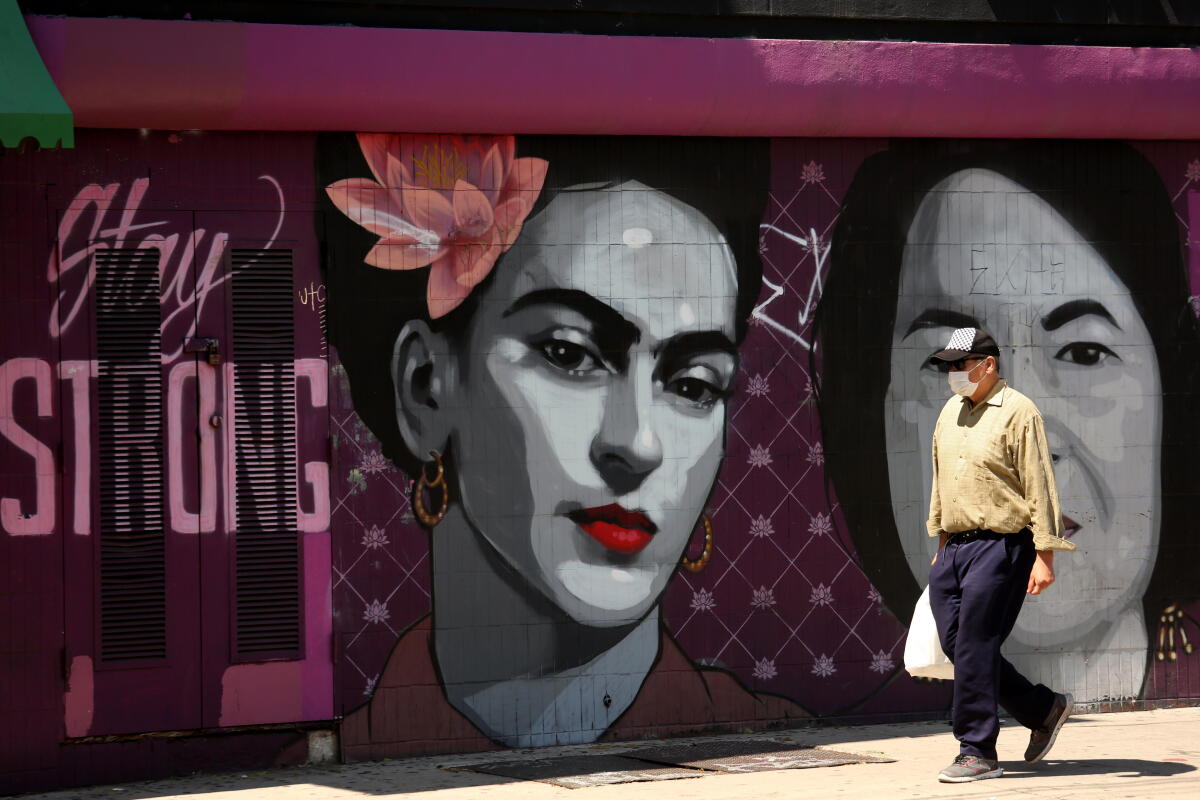
An Echo Park mural features Dolores Huerta alongside artist Frida Kahlo.
(Genaro Molina / Los Angeles Times)
Medina left the Chávez-Huerta led union, believing it had strayed from its core work. He went on to become the international secretary treasurer of the more than 2-million-member Service Employees International Union (SEIU) — just one of many UFW acolytes who fueled the labor movement as it staged a modest resurgence in the 21st century.
Huerta was at the center of many of the union’s landmark achievements, including the negotiation of a contract in 1966 with the Schenley Wine Co. It was the first labor agreement obtained by farmworkers themselves with an agricultural company, according to the union’s history.
But the UFW’s fortunes would rise and fall. One low ebb came in 1973 with the loss of many contracts to the Teamsters Union, which struck sweetheart deals with growers. But some union insiders also complained that the UFW had failed by not winning enough concessions for the workers it represented. The union’s membership plummeted.
Two years later, momentum swung again, as the union helped persuade California Gov. Edmund G. “Jerry” Brown Jr. to impose the toughest farm labor regulations in the nation.
The union’s membership would spiral downward until Chávez’s death, at 66, in 1993. There was a sense among many insiders that the union became overly insular, with repeated purges designed to promote absolute fealty to Chávez.
In one incident, students graduating from English classes at the union’s headquarters, La Paz, ended a slide show with the words: “The Union is not César Chávez, the Union is not La Paz, the Union is the farmworkers.” Huerta, fuming, demanded to know which of the teachers had planted this message, which she viewed as an act of treason against Chávez — an episode detailed by one of the teachers, Jeffrey W. Rubin, who went on to become a history professor at Boston University.
“Confronted there by Huerta, Richard Chavez, and Cesar Chavez himself, we were accused of being part of a subversive plot, railed at, called ‘chicken s—’ by Cesar, and thrown out of La Paz and the union,” wrote Rubin, who kept the episode quiet for years.
At the same time, the UFW lost contracts and sometimes failed to provide the benefits it promised to workers. Huerta was one of many union leaders unable to set Chávez, and the UFW, on a better path.
Dolores Huerta at rosary, standing next to the body of labor leader and civil rights activist Cesar Chavez (1927 – 1993) at rest in the pine coffin in Delano, Calif., on Wednesday, April 28, 1993.
(Jose Galvez/Los Angeles Times)
As Chávez’ son-in-law Arturo Rodriguez took control of the union in 1993 and began clawing to regain members and clout, Huerta remained the UFW’s most public persona.
At hundreds of marches across the nation that she attended with regularity throughout her life, parents would push forward, telling their children they were witnessing a historic figure. Asked for an autograph, she would boldly scrawl: “Sí, se puede.”
The phrase — “Yes, it can be done” — had been part of the union’s fabric since 1972, when some doubters suggested the union would fail in its campaign against an anti-union law in Arizona. Huerta responded, “Sí, se puede,” creating a mantra for the American left.
Born April 10, 1930, in Dawson, a small mining town in the mountains of northern New Mexico, Dolores Clara Fernandez moved to Stockton when she was 3, along with her mother, two brothers and two sisters. Her father and mother had divorced, but Juan Fernandez’s legend had been fixed — a brawling union leader and New Mexico state legislator. Her mother, a hotel operator, believed in public service and would not let the poorest guests go hungry.
Dolores thrived on a middle-class upbringing of Girl Scouts, violin lessons and tap dancing, describing her mother’s generosity as a guiding force. She was bright and popular and even founded a teen center where she and other kids hung out.
But Dolores would recall her high school years as a time of slights and rewards not received — injustices she linked to her Mexican American heritage. When police ordered her teen center shut down, it became clear it was because they did not like whites socializing with Mexican American, Black and Filipino kids.
Those setbacks would not be forgotten.
Dolores Huerta in Santa Fe, N.M., in 2019.
(Associated Press)
After community college in Stockton, Huerta became a teacher. But she left after just a year, because, she said: “I thought I could do more by organizing farmworkers than by trying to teach their hungry children.”
Soon she met Ross and Chávez and her life’s path would be set. Even her name seemed to brand her for the work. When she divorced her second husband, Chávez advised her to hold on to her last name. Dolores Huerta means Sorrows of the Orchard.
Along the way, there would be great personal heartache.
In 1968, she was at the Ambassador Hotel in Los Angeles on the night Sen. Robert F. Kennedy was shot. The Democratic presidential front-runner had just finished his California primary victory speech — thanking Chávez and Huerta — when an assassin gunned him down.
Twenty years later, her politics thrust Huerta even more directly in the path of violence. A television camera captured the images of a San Francisco police officer clubbing her as she and others peacefully picketed an appearance by Vice President George H.W. Bush. The blows ruptured Huerta’s spleen and nearly killed her.
She later won an $850,000 settlement from the city for the attack. Some in the union said that Chávez‘s insistence that Huerta give the money up to the UFW created another rift that caused her to leave the union.
Huerta would struggle, as well, to find time for her expansive family — which in the end included 13 children, counting the two fathered by César Chávez.
Among her greatest heartaches grew out of the struggles of her oldest daughter, Celeste, a schizophrenic who, on occasion, would leave the institutions where she lived and wander the streets.
Huerta’s union zealotry would inspire a range of emotions from her other children.
“We understood very quickly she wasn’t ours to have,” said son Emilio, the lawyer, a Central Valley activist.“She sort of belonged to the farmworker movement. And it was our job to support her.”
He and several other of the Huerta offspring devoted their lives to the UFW and related causes, basking in a sense that their family played a part in history. That did not always make up for the personal slights — the times their mother would fob them off on union allies or neighbors, or miss a birthday.
In a bittersweet essay, Dolores’ daughter Juanita once recalled how her mother forgot to pick her up from junior high school. She compared Huerta to a train “rattling all the windows behind me, blaring out its horn, announcing its simultaneous arrival and departure with an incredible clamor, but rushing constantly forward.”
At a 69th birthday party in 1999, Huerta told a large dinner gathering that her own sacrifices had been overblown.
“It was our families who sacrificed,” she said. She then told a story about driving a carload of children to school one day in an automobile limping along because a tire had been slashed by union opponents. “That,” she said, “was kind of how we made it through life.”
Approaching her 90th birthday in 2020, Huerta spent a day that might have been more typical for someone half her age. She protested at the Fresno County Board of Supervisors for increased pay for home healthcare workers, who made just $12 an hour. Huerta hadn’t planned on being arrested that day, but when she felt police used excessive force on one of the protest leaders, she changed her mind. Take me too, she said, according to USA Today. Officers cinched a plastic zip-tie around her wrists and led her away.
More typically in her later years, she supported her foundation. In one moment, she might be campaigning for a bond measure for a middle school gym in the poor San Joaquin Valley community of Weedpatch; in seemingly the next, she would be stumping via Zoom for Joe Biden, during his fight to take the White House from President Trump.
In 2020, USA Today named Huerta one of the 100 women “who’ve made a substantial impact on our country or our lives over the past 100 years.” By then, at least half a dozen schools across America bore her name. Others considered taking her name after they removed Chávez’s following the sexual abuse revelations.
President Obama presented Huerta with the country’s highest civilian honor, the Presidential Medal of Freedom, in 2012; the one-time community organizer, who made his way to the White House, honoring a woman still doing the work.
“The great social justice changes in our country have happened when people came together, organized and took direct action,” Huerta said in accepting the honor. “It is this right that sustains and nurtures our democracy today.”
Olvera, the family spokesman, said Wednesday that Huerta’s relatives would be announcing the details of a public memorial in the coming days.
A NINETIES chart-topper has revealed she has undergone further surgery to ease pain caused by breast cancer treatment.
The singer, 55, whose catchy debut single topped the UK charts in 1994, told fans she was recovering in bed ahead of her next gig.
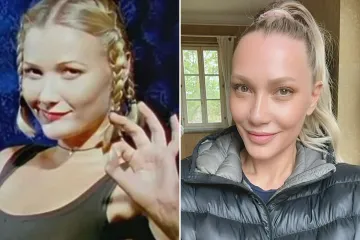
Whigfield has undergone surgery to ease pain caused by her breast cancer treatmentCredit: Instagram/whigfieldThe singer is resting ahead of her return to the stageCredit: Instagram / @whigfield
Whigfield, whose real name is Sannie Carlson, shared the hospital update on Instagram.
She wrote: “Last Wednesday I underwent a second surgery to fix pain in my breast caused by scar tissue from breast cancer operations and radiation therapy years back.
Sign up for the Showbiz newsletter
Thank you!
“I’m now on bed rest so I can heal quickly for my next gig.”
She tagged the 90s Supershow, where she is due to perform in Germany in early November.
Whigfield shot to fame with her 1994 Number One hit Saturday NightCredit: Getty – ContributorThe Danish star became a familiar face on the Nineties pop sceneCredit: Rex
The star signed off with “Happy Saturday night” — a nod to the song that made her famous.
Reflecting on her diagnosis in an earlier Instagram post, she wrote: “Fighting breast cancer was a strange thing.”
She continued: “One moment I was living my best life making new music in London, the next I was stuck in a bubble of numbness.”
The Danish singer described the operations and radiotherapy as tough, but said she drew strength from fellow patients, including children, at Milan’s San Raffaele hospital.
She also recalled that many of those being treated for the disease never left the hospital.
Whigfield, who has previously spoken about living on the outskirts of Milan, shot to fame with Saturday Night, which reached Number One in the UK in 1994.
Her other hits include Another Day and Think of You.
THIS 90s pop icon has shown off her timeless beauty and looks like she hadn’t aged a day since finding fame 30 years ago.
Back in 1996, the singer, now 67, released a HUGE hit single – but do you recognise who it is?
Can you guess who this singer is who had a huge hit 30 years ago?Credit: @DonnaLewisThe star was seen lip-syncing to her famous songCredit: @DonnaLewis
The star in question is Welsh singer Donna Lewis who shot to fame in her mid-30s when she released her song, I Love You Always Forever.
But 30 years after she unleashed the smash hit song onto the world, the singer looks like time has stood still.
Sign up for the Showbiz newsletter
Thank you!
Sharing a video on TikTok, Donna could be seen lip-syncing to the hit that made her famous.
The star’s trademark blonde hair flowed around her shoulders and she sang along to I Love You Always Forever in her stunning garden.
The star in question is Donna Lewis, who shot to fame with her song I Love You Always Forever in 1996Credit: YouTubeDonna doesn’t look like she has aged a day – seen here in 1997Credit: GettyThe music star still looks the same todayCredit: GettyShe still regularly posts to InstagramCredit: instagram/@donnalewismusic
Writing over the video, she penned: “POV: You wrote a song everyone knows 30 years later.”
Donna’s fans went wild for the video, with one writing: “One of the best songs ever written, and would fit any decade.”
I Love You Always Forever was such a smash hit that it not only charted in the UK, the song also did well in Australia, Austria, Canada, France, and the U.S.
In fact it was such a huge hit in America, the track reached Number Two on the Billboard Hot 100.
Following the success of the song, in 1997, Donna enjoyed success at the Brit Awards, and was nominated for British Female Solo Artist.
The singer initially signed with Atlantic Records, but after releasing her second album, decided to go independent.
Over the years Donna has continued to release new music and can often be found touring.
Away from the spotlight, the singer lives in New York with her business manager husband, Martin Harris, and their son, Archie.
Ross Kemp has feared being killed in plain sight since the very first day – but when it finally happened, he didn’t have a clue
Gotcha! Ross Kemp finally succumbs to the yawn murder
Ross Kemp has admitted that “fear of failure” was what drove his intense paranoia in the Celebrity Traitors castle, which proved highly entertaining for viewers.
The actor and presenter was killed by the Traitors in plain sight last night, after he was the first to yawn in the library, breathing in a deadly perfume sprayed by King Kenny under orders.
But having been fearful of being bumped off in public since the very first day – after Bella Ramsey put a hat on his head and Leigh-Anne Pinnock touched his arm – when it actually happened he was none the wiser. Speaking just after he left the castle Ross, 62, said: “I lived every day thinking I was going to get killed, and now it’s actually happened.
“The fear of failure on this is not comparable to anything. Whether you’re an actor, or in a hostile environment where you could get killed, you don’t let people down. Yes, no one’s going to get killed here, but the wish of not wanting to let yourself down or the people around you, was quite the drive.
“I was under a considerable amount of pressure by my children to do this, and you can’t really say no to it. It’s so popular. I think it’s the cleverest show on British television.”
Ross bowed out on TV with some sinister words for those who had killed him. “Well played Traitors,” he said. “But you’re always going to bee Traitors. And I know where you live…”
Stressing that he had “enjoyed it immensely”, Ross explained: “The whole environment just makes you paranoid. If you’re a fan of the show, you know that murder in plain sight happens. So when someone puts a hat on you, or touches your arm, however innocently it might be, I don’t think I’m wrong in suspecting it.”
Tipping “very clever” Maya as a potential winner, along with fellow Traitor James Acaster, Ross insisted: “I don’t feel that bad that I’ve gone when I’ve gone.”
And having put his absolute all into the Missions, in which money is raised for the prize fund, he’s hoping that he’ll now be missed. “I think it’s just in my nature to take on a physical challenge and want to succeed at it. I hope the next three or four Missions involve really heavy lifting across water, hopefully with some poo involved. I’ll watch it with great glee,” he laughed.
Jerry Hall said that being banished because she was “an icon” had come as a surprise, with Miranda Hart wrongly suspecting that the producers and host Claudia Winkleman wouldn’t have been able to resist putting Jerry and Richard E Grant into the turret together.
But Jerry – who recognised that she’d “made mistakes” in her exit speech – said she hadn’t laughed so much in years. Insisting she’d given it her all, she said: “Oh, it’s so much harder than the catwalk – it’s a very competitive world, and there’s some ruthless people, I should have been better prepared. Apparently the reason I got voted off was because I was an icon, which didn’t sound like it was a very factual reason. I think they saw me as a threat.”
But the 70-year-old said she’d even enjoyed her banishment, declaring: “It was kind of fun, and they were all so sweet. It was a lovely ending.”
The model, originally from Texas but now living in London, has no idea who the real Traitors are. “I’ve suspected James Blunt for quite a while, and Joanne, and even Leigh-Anne, and Miranda too. And Romesh, so there you go.”
Nevertheless, she was proud of what they’d achieved. “We caught two Traitors and we’d made quite a bit of prize money, I thought we were on a roll.”
STEPPING on to the Pyramid stage at Glastonbury in 2023 was a big moment for Texas, who had last played at the festival 24 years earlier.
But whatever expectations frontwoman Sharleen Spiteri and her band had for the gig were blown out of the water, because it sent them stratospheric once again and gained them thousands of new fans.
Sharleen Spiteri of Texas performs at the Pyramid Stage at Glastonbury Festival in 2023Credit: GettyTexas have released a new single, Another Way To CryCredit: Julian Broad
Now they are capitalising on their expanded fanbase by heading out on an 11-date arena tour of the UK and Ireland next October, and releasing a 30th anniversary version of their No1 album White On Blonde, featuring hits including Say What You Want, Black Eyed Boy and Halo.
And as good news comes in threes, today Texas have also released a new single, Another Way To Cry.
Sign up for the Showbiz newsletter
Thank you!
In an exclusive chat, Sharleen told me of their success: “I think it tastes sweeter than it ever has.
“The honest truth is that when we did that Glastonbury a couple of years ago, you never know how it’s going to go, but that Glastonbury changed everything. Suddenly there was a whole new audience that wanted to see Texas and we announced that tour off the back of that.
“It just was a moment of, ‘Wow, people really do still want to see us.’ When you look out into that audience, the ages vary all over the shop. It’s quite extraordinary.
“There’s been lots of people going, ‘When are you going on tour?’ so it’s good that there is still that desire to see us, and for us, that just makes the desire to go and play even stronger than it’s ever been.”
Sharleen with fellow Scot, Trainspotting star Robert CarlyleCredit: Stephen EllisIn an exclusive chat, Sharleen said of their success: ‘I think it tastes sweeter than it ever has’Credit: Getty
If you have not seen Texas yet, I urge you to snap up tickets when they go on general sale at 10am next Friday, October 30.
There, you will be able to hear the Scottish rockers’ new single, which is a rollicking, brassy singalong with Sharleen’s bluesy voice shining strong.
The accompanying video — an ode to the film Paris Texas, which was the inspiration for the band’s name — sees her exploring the Scottish highlands and bumping into fellow Scot, Trainspotting star Robert Carlyle.
On shooting the visuals, she said: “We had every season in the space of an hour, which was extraordinary, but that’s Scotland. We had scorching sun, pouring rain then sleet and hail stones and wind.
“It was fun, alongside our mates the Highland cattle, which was fantastic.”
And she insisted the Highland cows in the video were genuine. She continued: “It’s not AI, they were actually there. There was one point where me and Robert were walking down the road and they were coming right up, and they’re gigantic and they’ve got horns.
“If it just moved its head in the wrong direction and you’re anywhere near that horn you’re getting whacked by it.”
Thankfully they emerged unscathed and Sharleen has since been back in the studio.
Sharleen said: ‘The honest truth is that when we did that Glastonbury a couple of years ago, you never know how it’s going to go, but that Glastonbury changed everything’Credit: GettyShe added: ‘Suddenly there was a whole new audience that wanted to see Texas and we announced that tour off the back of that’Credit: Getty
Asked if there is an album of new music on the way too, she said: “Yeah, we’re working on a new record.”
As for White On Blonde, which will be out on February 5, Texas are chuffed it is being released on vinyl for the first time after they were recently fleeced trying to buy another of their records on the format.
She explained: “There was only ever vinyl made for the Press. We actually had to buy one of the old albums back because we’d given them away.
“We ended up buying our own record back for £1,200, about a year ago, because we needed it for a video. It was hysterical. I was literally like, ‘What? £1,200!’”
And they have got someone special on board to write the liner notes — Peter Kay.
Speaking about the comedian, who directed and starred in the 2006 video for their song Sleep, she said: “Peter is such a big music and Texas fan, and he’s a big friend of ours. He’s so geeky in his knowledge of music and stuff like that.
“It just felt exactly right because of his connection to the band and the fact he made the video for us and he bought White On Blonde and he’d always talked about it.
“It felt like the absolute right thing to do.”
I DON’T HAVE RIGHT TRAITS
SHARLEEN turned down the chance to go on The Celebrity Traitors in her native Scotland – insisting she’s a “s*** liar.”
She was approached by the series producers, but doesn’t think she’s competitive enough to be a success on Claudia Winkleman’s hit show.
Sharleen Spiteri turned down the chance to go on The Celebrity Traitors in her native Scotland – insisting she’s a ‘s*** liar’Credit: GettyThe Traitors host, Claudia WinklemanCredit: BBC
She explained: “I’m very flattered to have been asked and I said, ‘Thank you, but no.’ I couldn’t do it.
“I absolutely love The Traitors. It’s such a great, unbelievable programme and I’m watching it currently and I just couldn’t do it. I’d be all over the shop.
“I’d gladly play the game. But I’m a s*** liar. That is the truth. I wouldn’t remember who I told a lie to or what I did and I’m not that big of a player.
“I’d probably go, ‘Nah, you’re alright.’ The thing is, the only place I’m really competitive is on a stage.
“In games I’m really not competitive at all. So I’d probably be really rubbish.”
She added: “I want to be a fan, but not a fan in it. I want to be a fan watching it. I’m very happy with that situation.”
JADE-D BY PRINCESS FAILURE
Naomi Scott in the Walt Disney Studios movie AladdinCredit: �Walt Disney/ Supplied by LMK
JADE has revealed she was “devastated” not to land the role of Princess Jasmine in 2019’s live-action remake of Aladdin, after the role went to Naomi Scott.
The Little Mix star, who auditioned for director Guy Ritchie, said: “I was pretty devastated. I think I got down to the last few. I sent a letter once I knew they’d reached out, saying that Jasmine was my sort of idol growing up.
“She was the only character I could really look up to as someone of Arab heritage, so Princess Jasmine was who I dreamed of being.”
On Channel 4’s The Assembly, she added: “I did three rounds of auditions. I sang A Whole New World in Guy Ritchie’s living room.
“I didn’t get the part and that’s fine. But I was quite sad for some time, definitely. I was gutted, I can’t lie.”
JUDI DENCH says panned 2019 Cats movie was a “waste” of Andrew Llloyd Webber’s “goodwill and talent.”
She starred as Old Deuteronomy in the much-mocked movie and in her new memoir, she writes: “Oh God, I can’t bear it – and he had waited so long for it to be made.
“What a waste of all that goodwill and talent.”
JAY-Z’S UP FOR THE BIG GAME
Jay-Z, pictured with Beyonce, has chosen himself to be the headline act for next year’s Super Bowl half-time showCredit: Getty
JAY-Z has chosen himself to be the headline act for next year’s Super Bowl half-time show, according to a report in the US.
Justin Bieber and Miley Cyrus were said to be in talks to perform at the show in Los Angeles on February 14.
Instead the rapper, who’s firm Roc Nation has had a deal with the NFL since 2019, will be taking centre stage.
He has yet to comment on the story, although he’s set to perform two shows at the SoFi Stadium in LA this Friday – where the big game will be held –so he may well announce it there.
His wife Beyonce previously headlined in 2013 and then joined Coldplay during their set there three years later.
And I imagine he’d want her as a guest if he takes to the pitch, too.
Jenna’s looking pawsome
Jenna Ortega wore this beaded dress for the US premiere of her new film Klara And The Sun in the Big Apple on MondayCredit: Shutterstock EditorialJenna, who posed for pics in New York with co-star Amy Adams and director Taika Waititi, said: ‘My dog follows me everywhere’Credit: Shutterstock EditorialJenna said her whippet Twigs helps her stay groundedCredit: PA
JENNA ORTEGA has been to London, Rome and New York in the past week and she’s had a special someone by her side the whole time – her pet pooch.
The Wednesday actress, who wore this beaded dress for the US premiere of her new film Klara And The Sun in the Big Apple on Monday, said her whippet Twigs helps her stay grounded.
Jenna, who posed for pics in New York with co-star Amy Adams and director Taika Waititi, said: “My dog follows me everywhere.
“It’s hard doing the job that I do, travelling to all of these different hotels and foreign countries, so to have something that is consistent and true, and looks after me, and I look after her, it’s nice.”
That dog must have racked up more air miles this week than I have all year.
BLUNT’S A TRAITOR FUME RESIDENTS
James Blunt has been dubbed a traitor by residents of the London borough of ActonCredit: Getty
RESIDENTS of the London borough of Acton have dubbed James Blunt a traitor.
He filmed his new Circles music video there, but then pretended it was somewhere else.
I revealed snaps of the Celebrity Traitors star riding around on a mini tractor while shooting the video in a park last week.
But locals soon spotted James had renamed Acton’s mainline station “Battersham”, leaving them fuming.
“We thought James was going to put Acton on the map with his video,” a friend, who sent me snaps of James recording his video, told me after seeing the clip.
“It’s not Battersham, this is Acton. And we’re proud of it.”
NO DIRTY A.I TRICKS IN DANCING SEQUEL
Jennifer Grey and Patrick Swayze in Dirty DancingCredit: Alamy
THE producer behind the Dirty Dancing sequel insists they won’t bring back Patrick Swayze using AI.
Jennifer Grey will reprise the role of Frances ‘Baby’ Houseman and film bosses are working out how to celebrate late actor Patrick, who died in 2009.
Producer Nina Jacobson said: “That’s one of the things that you really have to focus on: how to let people mourn him in a movie. And don’t worry – we won’t be bringing him back with AI.”
She said they are “trying to chase the feeling of that original movie”.
Nina added: “Being able to tell a young love story that could take some of those risks but also inspire those feelings felt like an incredible chance for us.”
PHIL JOINS PIRATES CREW
Johnny Depp as Captain Jack Sparrow in Pirates of the Caribbean: Curse of the Black PearlCredit: Alamy
PIRATES Of The Caribbean is being brought to life by Secret Cinema – and they’ve got a household name on board to help out.
I can reveal Phil Daniels, who starred in EastEnders, and whose voice featured in Blur’s 1994 hit Parklife, has joined the cast as Captain Barbossa.
Johnny Depp’s character Jack Sparrow will be played by Olivier Award winner George Maguire.
Pirates Of The Caribbean: The Immersive Adventure, opens in February and has already had its run extended by six weeks due to demand.
It will also be the first production by Secret Cinema – which allows punters to watch films on the big screen while the action also unfolds around them – at its purpose-built flagship venue in London’s Greenwich.
Time to ready my sea legs.
LIAM GALLAGHER is winding up Oasis fans by claiming they’ve already finished a new album – but I’m not so sure.
Responding to someone on X who wrote: “Oasis have SEVEN great albums and those songs will LIVE FOREVER”, rocker Liam said: “8 including the new 1.”