homeless

Bass’ Inside Safe teams went to these places. But so did the homeless

Abigail Aguirre has been sleeping terribly.

Too many times, she said, residents of a nearby homeless encampment have partied late into the night — sometimes yelling, sometimes blasting music. The noise is especially hard on her husband, who frequently leaves for his job before 5 a.m.

“Oh my God, they don’t let us sleep,” said Aguirre, whose home sits just east of the 110 Freeway in South Los Angeles. “They do drugs in there. They play the loud music. They don’t care.”

Three years ago, workers with Mayor Karen Bass’ Inside Safe program moved dozens of homeless people from Aguirre’s neighborhood into nearby hotels and motels. Sanitation crews cleared the streets and sidewalks of trash.

But more people, and their tents, kept arriving, not just near Aguirre’s home but on many of the east-west streets that pass over the 110 south of downtown: 43rd, 49th, 51st and Vernon Avenue, to name a few.

About This Story

The Times’ reporting on Mayor Karen Bass’ Inside Safe program was undertaken as part of the USC Annenberg Center for Health Journalism’s 2025 Data Fellowship.

Unsheltered homelessness — people living on the street or in their vehicles — went up nearly 8% citywide in this year’s homeless count, dealing a setback to Bass, who is running for reelection and has made homelessness a core part of her agenda.

The streets that line the 110 Freeway between 42nd and 58th are a potent symbol of the challenges facing Bass and her program. According to records obtained by The Times, outreach workers carried out Inside Safe operations 25 times on that one-mile stretch during her first three years as mayor, returning again and again to bring people indoors.

A homeless man wears a hat that reads Hollywood and L.A.

Frank Gordon, 51, has been living on Cahuenga Boulevard at the 101 Freeway in Hollywood. Mayor Karen Bass’ Inside Safe program has moved people indoors from that location several times since 2022.

During one operation, Inside Safe brought 42 people inside. A month later, 54 more people came indoors. On other occasions, progress was measured in single digits: two people during one visit, five on another, eight on the next.

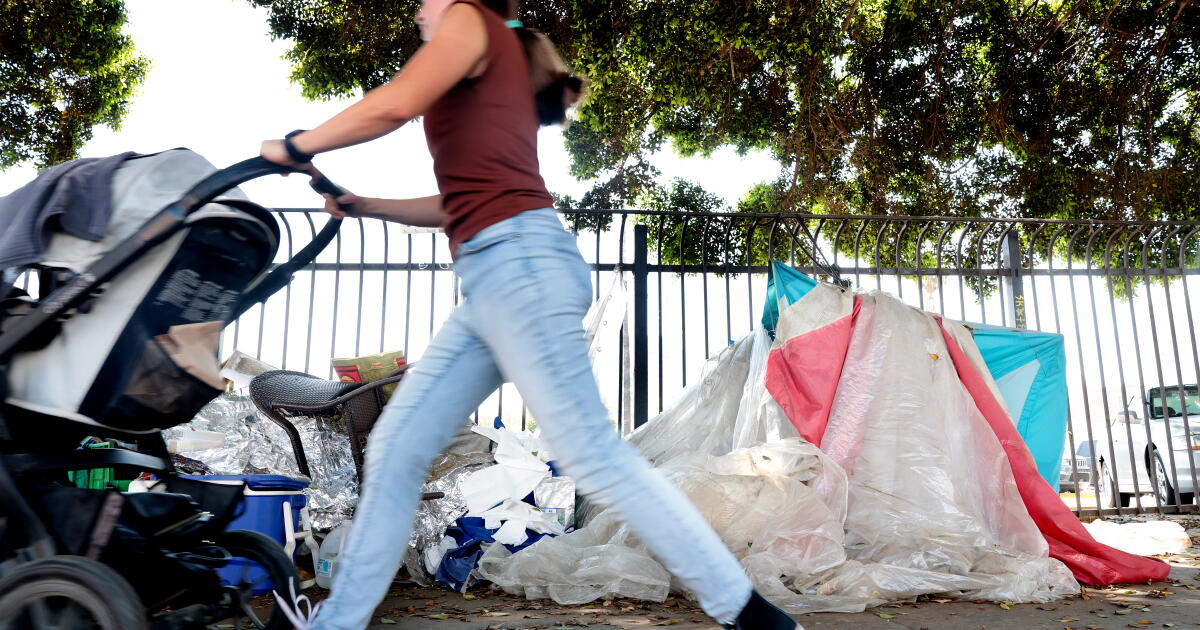
Despite those efforts, many of the overpasses and side streets still have encampments. Things have been especially grim on the 51st Street overpass, where tents, makeshift structures and huge mounds of trash lined the sidewalks. In the street, a refrigerator missing a door was on its back, overflowing with garbage.

Joel Galarza, who lives in a house nearby, said the encampment has brought crime, fires, prostitution, open-air drug use and other problems. In May, a man was found stabbed on the overpass.

Galarza said his family has called the city and the LAPD many times, only to see the situation get worse.

“It feels like there’s no more hope, that your voice doesn’t matter,” he said.

Since taking office, Bass has made the removal of street encampments a top priority, arguing that they are unsafe both for unhoused residents and for the neighbors. She said early on that Angelenos will not view her work as a success until their communities are free of tents.

Inside Safe, her signature homeless program, has moved more than 6,200 people into hotels, motels and other interim housing. But by June 30, 43% of them were back on the street, with some getting kicked out and others walking away.

Los Angeles City Council Member Traci Park and residents of Venice applaud Los Angeles Mayor Karen Bass.

Los Angeles City Councilmember Traci Park, left, and residents of Venice thank Mayor Karen Bass in 2023 for overseeing efforts to move more than 100 people into temporary housing from sidewalks in Venice.

Bass, in an interview, said she understands the frustration of people who live near the encampments. She said she hopes to overhaul the city’s approach to the crisis in the coming months by securing greater control over services such as medical care, addiction treatment and case management.

At the same time, she contends that her administration has made major strides, keeping about 80% of the locations visited by Inside Safe free of tents in recent weeks.

“Inside Safe has been a success in terms of getting people off the streets and clearing encampments,” Bass said. “What Inside Safe has not been able to do is reach the scale that is needed.”

Bass said Inside Safe has conducted 137 encampment operations so far, when many more are needed. To expand the program’s reach, the city will need to move away from expensive hotels and motels and toward high-quality homeless shelters, the mayor said.

1

A man sits with his some of his belongings on Cahuenga Boulevard under the 101 Freeway.

2

A torn notice announcing a clean-up of homeless encampments hangs from a stop sign on Grand Avenue at 51st Street.

1. A man sits with his belongings on Cahuenga Boulevard under the 101 freeway in Hollywood. (Genaro Molina/Los Angeles Times) 2. A torn copy of a notice announcing a cleanup of homeless encampments hangs from a stop sign along Grand Avenue at 51st Street in South Los Angeles. (Genaro Molina/Los Angeles Times)

The repopulation issues have not been limited to the 110 corridor. By December, the end of Bass’ third year, 23 Inside Safe areas across the city — about a fifth of the total at that time — had received at least five visits from the mayor’s outreach team, records show.

Inside Safe went to a handful of streets just east of MacArthur Park 10 times over two years. In Hollywood, around Franklin and Argyle avenues, the program conducted eight operations over 18 months.

By the fourth quarter of 2025, 80% of Inside Safe encampment operations — 36 out of 45 — involved areas that had repopulated, records show. Nine were new to the program.

City Councilmember Nithya Raman, who is running for mayor against Bass, said Inside Safe is ineffective and too expensive, forcing taxpayers to pay a premium to “shuffle people around rather than get them housed for good.”

“When 40% of the people who participated in the program return to homelessness, and some locations need repeat outreach visits five, 10, even 25 times, it tells us that something is wrong,” she said in a statement.

Bass and her team said many of the most problem-plagued Inside Safe locations are at freeway overpasses, which are attractive to homeless people because they provide shelter from scorching summer sun and the winter’s pouring rain. Freeways and industrial areas are also popular because they provide some degree of privacy, they said.

In some cases, people move to an Inside Safe location hoping to be offered housing, just as previous residents were, Bass said.

In other cases, she said, people have returned to the street because they need intensive care, such as a psychiatric bed. Those beds, which are provided by L.A. County, are not always available, Bass said.

Estela Lopez, head of the Downtown Industrial Business Improvement District, which represents businesses in Skid Row, said repopulation happens for a simple reason: a lack of enforcement. Once an encampment is cleared and people are moved indoors, police should be allowed to enforce city laws and make sure an area stays clear, she said.

A pedestrian walks into the street to get around a homeless encampment on Alameda Street in downtown Los Angeles.

A pedestrian walks into the street to get around a homeless encampment on Alameda Street. The Inside Safe program went to that area 12 times over a single year.

Lopez said she regularly receives complaints about a row of encampments on Alameda Street between 4th and 6th streets. Inside Safe visited that two-block stretch 12 times last year, records show.

Last month, the area had about a dozen tents, which forced pedestrians to leave the sidewalk and walk on Alameda, where large trucks travel to and from nearby industrial businesses.

Lopez offered another reason that homeless people keep coming back.

“That’s where the drugs are,” she said. “It’s Skid Row, and Skid Row is where the drugs are, and has the fewest consequences for open-air drug use and sales.”

Bass’ first Inside Safe operation, more than three years ago, hit a stretch of Cahuenga Boulevard under the 101 Freeway in Hollywood, an area represented by Raman.

Inside Safe went to Cahuenga and the 101 six times over 18 months, according to the city’s records. Two blocks south, the program made five separate visits to Franklin and Cahuenga.

Frank Gordon said that he and his girlfriend lived in an RV on Cahuenga next to the 101 during the COVID era, when the streets were lined with encampments. Outreach workers eventually moved them into the Stuart Hotel in Westlake, he said.

From there, the couple relocated to the Highland Gardens, a hotel in Raman’s district converted into homeless housing. Gordon said they left the facility after one of their rooms was destroyed in a fire, going to yet another interim housing site.

Last month, they were back at Cahuenga and the 101. He called it “familiar ground.”

Sanitation crews gather belongings from a homeless encampment during an Inside Safe operation in North Hollywood in March.

Sanitation crews remove belongings from a homeless encampment during an Inside Safe operation on Laurel Canyon Blvd. in North Hollywood in March.

Kevin Paz, who has been sleeping on the 51st Street overpass in South L.A., said he used to live a few blocks away. He still has friends in the area, including high school classmates.

“It made more sense to stay here than to live anywhere else,” he said.

Seated on the overpass on a swelteringly hot day, the 32-year-old said he picked his particular strip of sidewalk for the shade it gets from the elevated 110 Freeway carpool lane. He said he would accept a motel room if offered one.

“Honestly, nobody wakes up in the morning and says, ‘Hey, I wanna go live on that street,’” he said.

Bass’ team has highlighted the scores of locations where encampments have not returned. They pointed to the success of an Inside Safe operation at 6th and Fairfax, where the sidewalk was later narrowed and new landscaping was planted, making it difficult to camp there.

West of downtown, streets and sidewalks also remain clear around Angelus Rosedale Cemetery, where 48 people were brought indoors in April 2025. To keep people from living in their cars at that location, city crews turned a stretch of Washington Boulevard into a no-parking zone, Bass’ team said.

Even some places that had severe repopulation issues are now clear of tents.

In Harbor City, Inside Safe went to the same intersection a dozen times between 2023 and 2025. That location has been free of encampments for 17 months, said Councilmember Tim McOsker, who represents the area.

McOsker credited the mayor’s team, as well as his staff, for going to the location over and over to offer interim housing to new arrivals. He also asked a group that delivers glass pipes and clean hypodermic needles to relocate, saying the service was attracting newcomers to an area that had been cleared.

In Baldwin Hills, Inside Safe workers went to Jim Gilliam Park 14 times over three years. Last week, encampments no longer occupied the grassy area around the tennis courts on La Brea Avenue or the sidewalks along the nearby Michelle and Barack Obama Sports Complex.

Johnnie Raines III, who serves on the local neighborhood council, knows some of the people Inside Safe brought indoors. He said the program has been “life-changing” for them.

Still, Raines, 79, has no illusions about the challenges the city faces.

“If you house these three people that are in this space today, three more will show up,” he said. “That doesn’t mean that you were not successful in housing the first three people. That just means that three more people come.”

Elmer Roldan, who lives in South Los Angeles, shows a spot where a man set fire to a vine on a freeway soundwall.

Elmer Roldan, who lives in South Los Angeles, points out the spot where an encampment burned on Grand Avenue near 54th Street.

In the neighborhoods that abut the 110 in South L.A., some residents have lost patience.

Elmer Roldan, who lives on 55th Street, said some of his homeless neighbors have been causing fires — sometimes by accident, sometimes on purpose. Earlier this year, he called 911 after seeing a man set fire to vines hanging from the freeway’s sound wall.

Roldan, who ran unsuccessfully for City Council in June, said he sees plenty of people living in their vehicles, but fewer tents. Still, he said, it’s been demoralizing to have so many come back.

“I certainly don’t want it to get worse,” he said.

Times staff writer Doug Smith contributed to this report.

Source link

Emmerdale legend’s epic rise from being homeless to ‘earning thousands’ on ITV soap

From being homeless to becoming one of Emmerdale’s most adored stars, one cast member has an incredible backstory

An Emmerdale icon has an off-screen story even more remarkable than some of the soap’s biggest storylines.

Over the years, viewers have been introduced to several stars who have joined the long-running programme. And while plenty have left, several have remained in the Dales, including Bob Hope actor Tony Audenshaw.

Tony shot to fame playing Bob Hope on the ITV soap back in 2000. Since then, he’s become a firm favourite and has been involved in a ton of memorable soap moments.

And in Wednesday’s episode (July 15) episode, the Woolpack Batman was seen spilling the beans to newcomer Serena Sugden (Casey Al-Shaqsy) about her newfound family.

However, for actor Tony, life hasn’t always been plain sailing as he has endured tough times trying to make ends meet while chasing his dream of acting.

Tony’s real-life homeless experience

In 2019, Tony opened up about being homeless back in the day, before having his big break in the TV world. The actor revealed he could not afford to stay in a BnB when he worked in Thorpe Park back in the 1980s, so was forced to sleep in his car in order to make ends meet.

“There were occasions where I didn’t have enough for a B&B, so I just parked up and tried to get some kip. It wasn’t easy, but you do what you have to do,” he said on Loose Women.

“I used to work at Thorpe Park, the theme park, I used to be the Thorpe Park rangers and do the voices. Up North things are much cheaper. I came down here in the 80s, and it was £70 for a BNB.

“If I was down for five nights I would sleep in the car, because I didn’t have much money coming in. I’d never do it two nights on the trot because you couldn’t really function well. It was Monday in a B&B, Tuesday in the car – the things you saw in those car parks, torches in the window.”

Tony’s reported soap earnings

Bob’s perseverance paid off as after an early stint in Brookside in the mid-90s, he was first seen on Emmerdale in 1996 in a minor role before landing the part of Bob Hope four years later.

Since then, he has clocked up more than 2,500 episodes, making him one of the soap’s longest-serving cast members.

Due to his status on the show, it’s believed Tony. could be earning thousands. Cast members earn between £400 and £2,000 per episode, which translates to annual salaries ranging from roughly £12,000 for newer cast members to over £200,000 for top, long-standing stars, like Tony.

Tony’s world record

Away from the Yorkshire set, Tony is renowned for his love of running; a hobby that has taken him all around the world, from London to Amsterdam and New York.

In 2010, he entered the London Marathon in a giant baby outfit — and crossed the line in just 3 hours and 13 minutes. The remarkable time earned him a Guinness World Record for the fastest marathon dressed as a baby, but the record has since been broken.

Running was also a hobby he shared with his late wife Ruth, who died from cancer in April 2017, when she was 43 years old, after a 16-month battle with the disease. Tony and Ruth had been married since 1996 and had two children together, a son George and a daughter Emily.

Emmerdale airs Monday to Friday at 8:00pm on ITV1 and ITVX

Source link

L.A. homeless agency sues Trump administration to stop cutoff of federal funds

The embattled Los Angeles Homeless Services Authority sued the Trump administration on Monday to stop it from depriving the region of hundreds of millions of dollars in funding, saying the effort is unwarranted and violates federal laws.

The authority, better known as LAHSA, said in its Monday filing that cutting off the funds would put more than 11,000 people — 1,900 of them children — at risk of losing housing or other services.

LAHSA, a joint city-county agency overseen by political appointees, is seeking a temporary restraining order to bar the federal Housing and Urban Development Department from suspending the funds.

“The people who will be harmed by this decision are not bureaucrats,” said Gita O’Neill, LAHSA’s interim chief executive officer, in a statement Monday. “They are families, veterans, seniors, and formerly homeless Angelenos who rely on these resources to remain housed.”

The filing in federal court comes nearly three weeks after HUD officials said they were suspending LAHSA from applying for or receiving federal funds, citing financial mismanagement, fraud and a lack of safeguards to prevent conflicts of interest.

In its 46-page lawsuit, LAHSA pushed back on HUD’s allegations, saying they were not supported by the evidence. Lawyers for LAHSA portrayed HUD’s actions as part of a larger political agenda — elimination of the federally approved “Continuum of Care” system, which makes LAHSA the overarching applicant for most federal homelessness funding across Los Angeles County.

The Trump administration “has made clear it wants to scrap the program entirely in favor of a homelessness policy favoring criminal enforcement, drug treatment, institutionalization and civil commitment of the mentally ill,” the lawsuit states.

HUD officials have said they are barring LAHSA from applying for funds on behalf of the Continuum of Care, which covers 85 cities, including Los Angeles. LAHSA secured $220 million in federal funds for various agencies in 2024 and $944 million since 2021, according to the June 11 letter from HUD Deputy Secretary Andrew D. Hughes.

HUD did not immediately respond to a request for comment. In the letter, Hughes said his agency had received information that LAHSA “may have committed violations of federal law” while carrying out its obligations as part of its HUD grant agreements.

“HUD has evidence that LAHSA’s repeated false statements and its irresponsible actions and failures, including its lack of financial management, internal controls, and safeguards against conflicts of interest, pose a threat to HUD, the public, and those living on the streets of Los Angeles,” he wrote.

In the letter, Hughes said that HUD’s inspector general had opened an investigation. Depending on the outcome, the money could be restored or LAHSA could be permanently barred from receiving funds.

LAHSA, in its lawsuit, said HUD has not provided any investigative findings to show violations of the funding agreements. Instead, agency lawyers said, federal officials relied on “a mash-up of old news articles, comments from public officials taken out of context, and findings from routine public audits that included recommendations that were all appropriately actioned.”

Lawyers for LAHSA contend that HUD’s actions violate the U.S. Constitution and override the dictates of Congress, which established many of the processes for distributing federal homeless funds.

The vast majority of the federal funds secured by LAHSA as a grant applicant goes toward permanent housing, agency officials said.

LAHSA, created in 1993, is overseen by a 10-member commission, half from the city and half from the county. Among those commissioners is L.A. Mayor Karen Bass, who has made homelessness a central part of her agenda. Each of the five county supervisors has an appointee.

At stake in the battle between HUD and LAHSA is an array of services affecting some of the region’s most vulnerable residents.

LAHSA oversees the Homeless Management Information System, the federally-mandated software that tracks homeless people across the county. It has 8,000 individual users and is used by more than 300 agencies, according to the lawsuit.

HUD’s plan to suspend the funding would prevent LAHSA from using the system to match Angelenos — those on the street and in shelters — with housing and services, the lawsuit said.

LAHSA also oversees the annual “point in time” homelessness count across the county. Agency officials have pointed to the results from those counts as evidence that they have been making steady headway, with homelessness decreasing 4.3% countywide and 5.5% within Los Angeles between 2023 and 2025.

Unsheltered homelessness, which tallies the people living outside or in their vehicles, fell by a larger margin, declining 14% across the county and 17.5% within L.A. during that period.

Despite those numbers, LAHSA’s reputation has been battered by some highly critical assessments.

Last year, a global consulting firm retained as part of a federal lawsuit over the city of L.A.’s response to homelessness found that homeless services provided by LAHSA and the city lacked adequate financial controls, leaving the system vulnerable to waste and fraud.

Several months earlier, county auditors identified lax accounting procedures that resulted in LAHSA’s failure to pay its contractors on time. Even after that report was issued, nonprofit groups with LAHSA contracts continued to report that payments were behind schedule.

Last year, the county Board of Supervisors reached a breaking point, pulling more than $300 million — the vast majority of its funds — out of LAHSA and creating its own homelessness department. City officials have been weighing a similar move in recent months.

Source link

Big Brother star Lily Benson moves into The Savoy after ‘being made homeless’

Big Brother star Lily Benson drunkenly booked herself into The Savoy days after she spoke of how she was about to be made “homeless” and was to be evicted from her flat

Big Brother star Lily Benson has treated herself to a night in The Savoy – just days after she claimed she was being made homeless. The The reality star, 21, has carved out a career as an influencer since she shot to fame as a housemate on the 2024 series of the ITV2 reality show, and has kept fans up to date with her day-to-day life since.

Earlier this week, Lily told her followers that she was about to be evicted from her flat and Sunday was her moving out day, but left her packing to the the last minute after getting tickets to a Harry Styles gig.

In her first update on the hectic day, Lily posted a video on Instagram where she looked panicked as she wheeled her belongings out of the flat and wrote: “Note to self. Don’t leave moving to the last day.”

In the next update, Lily wrote: “My temporary housing accommodation,” and could be heard thanking a doorman who helped her with her luggage as she revealed she was staying in the luxury hotel. She added: “I booked this drunk last night.”

In the next slide, Lily had donned the complimentary robe and slippers with the hotel’s branding on them and Kerry Riches, who found fame on the first series of the ITV version of Big Brother and has since appeared on Good Morning Britain as a disability campaigner, commented: “I’m hpwling but you’re gonna absolutely love it. It’s my favourite hotel ever! Xx”

It comes after Warrington-born Lily, who famously spoke about working in a Chinese takeaway whilst in the house and, since moving to London for her showbiz career, has documented long-running sagas such as getting her broken Louboutins fixed, took took to TikTok on Tuesday with a far more bleak update for her followers.

After speaking about a rat problem in her flat, she said: “I’m also homeless, on Sunday I get evicted from my place. I currently have nowhere to go. I had two months to look for a place but I’ve just been busy with my hot girl summer and it’s not been in my vocabulary to look for a place.

But Lily didn’t seem too bothered about her living arrangement, and was more concerned about getting a tan in the coming days as she expressed her confusion over the “retirement” of the Prime Minister.

She said: “So I’m probably just gonna have to get an Airbnb or summat. Or I could go back to Warrington but the UV here is so high. Why would I go back to Warrington when I can’t get a tan there? My Stranded in London content is coming soon.”

“But my main priority right now is I have the Maybelline summer party, and the UV is eight degrees, I’m gonna get a killer tan and listen to heartbreak music. That’s my life update. It’s very solemn. I found out today that Keir Starmer has retired – what the f*** is going on?”

Lily has amassed almost half a million followers across both Instagram and TikTok since rising to fame but admitted that at the time she applied for the reality show, which has launched the careers of This Morning stars Alison Hammond and Josie Gibson as well as fellow presenters like Brian Dowling and Kate Lawler, she only did it as an act of revenge against an ex-boyfriend.

At the time, she told ITV: “I originally applied because it was my ex’s favourite TV show because we broke up. I thought ‘I’m going to go on his favourite TV show.’ I’d never heard of it.

“When I dated him, he was obsessed with it and I was like ‘What is it?’ because he was older. When we broke up, I saw the advert and I thought I’m going to apply for his favourite TV show and get on it – I didn’t think I would!”

Like this story? For more of the latest showbiz news and gossip, follow Mirror Celebs on TikTok , Snapchat , Instagram , Twitter , Facebook , YouTube and Threads .


Source link

Pratt says Jesus is his role model. His take on homeless people isn’t Christ-like

Spencer Pratt is a showboat, a loudmouth, a troll and a self-proclaimed villain who seems willing to say anything in his quest to be the next mayor of Los Angeles.

Little wonder that his critics rolled their eyes when the former reality television star told CNN host Elex Michaelson a few weeks ago that his campaign role model is Jesus Christ, because “he was a politician.” How on earth did Pratt — a man who tosses insults with the ease of someone spitting loogies — come off boasting that his political hero was the Prince of Peace?

But anyone who ridicules the exchange as a blasphemous moment by a deluded wannabe isn’t paying attention — which is exactly the error that has allowed Pratt to storm L.A. politics. He isn’t running on an explicitly Christian message — that would be risky in a city with large Jewish, Catholic and secular constituencies. But the proud born-again evangelical is channeling the zeal of an old-fashioned tent revival, even if some of his rhetoric falls far outside the bounds of the Good Book.

In his recent memoir, Pratt recounted his conversion — actor Stephen Baldwin baptized him in a river during the 2009 season of the reality show “I’m a Celebrity, Get Me Out of Here.” Before that, his Christianity had consisted of wearing a black diamond cross necklace he described as “thirty grand of Jesus bling” bought from a Beverly Hills boutique. Pratt credits his faith with providing direction at a low moment in his life, as he embraced Jesus with such fervor that a pastor told him to stop joining altar calls so much during church services — once was enough.

“I needed the receipt stamped weekly,” Pratt wrote, “like a parking validation, just to make sure it stuck.”

Seventeen years later, he’s still seeking that affirmation.

The memoir comes off as a millennial version of “The Confessions of St. Augustine” — perhaps the most famous literary example of someone who saw their wreck of a life not as a series of mistakes to apologize for but as necessary failures on the road to grace. That’s why Pratt and his followers don’t see his sketchy past as a disqualifier, but rather his biggest strength. Only someone who says he was reborn in the inferno of the Palisades fire could possess the clarity and willpower needed to bring salvation to an accursed land, they argue.

In another era, Pratt would have been a welcome edition to the roster of bombastic Southern California preachers a la Aimee Semple McPherson, Chuck Smith and Gene Scott, as well as radio titans such as George Putnam and John Kobylt. His claims that only he can deliver us from damnation and that we need to repent of City Hall’s status quo at the ballot box are nothing less than a modern-day gospel to his followers. Pratt feels the pulse of L.A.’s civic malaise far better than Mayor Karen Bass or another of his opponents, City Councilmember Nithya Raman. Like any good pastor, he knows how to distill that discontent into soundbites and stories.

That’s why the self-designated “Pratt Daddy” has cast this moment in L.A. history as a modern-day Armageddon, urging voters to wage war against apostates and usher in a Second Coming, lest the city continue its supposed descent into hell. He admits in his memoir to holding “epiphanies and apocalyptic visions” in equal measure — no wonder he told a Canadian podcaster in March that life for him is a “spiritual battlefield” where “however I can be to stop evil at this point feels like a purpose.”

Spencer Pratt is shown on a television

Spencer Pratt is shown on a television while journalists work during the 2026 Los Angeles mayoral debate at Skirball Cultural Center on May 6.

(Jason Armond / Los Angeles Times)

Far from me to criticize someone’s faith. But I urge Pratt to reacquaint himself with the words of the messiah in whose path he professes to follow. Humility, frugality, turning the other cheek — it’s what Jesus taught and what Pratt has long rejected.

Nowhere does Pratt need more of refresher on Jesus’ lessons than when it comes to homeless people.

Instead of offering compassion or viable initiatives, Pratt consistently calls the unhoused “zombies,” “vagrants,” “drug addicts” and “bums,” with a particular fixation on the naked ones. He vowed to ABC 7 recently that he would push people off L.A.’s streets and onto federal land — like herding stray wildlife. The mayoral hopeful added that “scam homeless nonprofits” exacerbate homelessness, which must have been news to Scripture-based organizations such as the Los Angeles Catholic Worker, Union Rescue Mission and the Salvation Army, which have been trying to help homeless people since before Pratt was born.

Pratt also told ABC 7 reporter Josh Haskell that most of L.A.’s homeless are not locals.

“These people, when I unplug them … they’re all going to Seattle, where the mayor will welcome them,” Pratt proclaimed.

Jesus would not only roll out the welcome mat for homeless people — he would embrace them.

Spencer, what New Testament book says that your crude campaign against the most destitute among us is holy?

Christ never looked down on itinerants, famously saying, “The Son of man hath not where to lay his head.” In the Book of Mark, when Jesus sent his disciples out into the world, he told them to bring no food or money, because good people would take care of them.

“And if any place will not welcome you or listen to you, leave that place and shake the dust off your feet as a testimony against them,” Jesus said.

Christ did do some name calling, but his ire was directed at the powerful, the braggarts, the hypocrites — the Pratts of his time. The Nazarene saved his kindest words for the meek, the poor, the peacemakers — who are sorely lacking in Pratt’s caravan of disaffected liberals, Trumpers and the wealthy. Christ didn’t offer counsel to the comfortable but to outcasts — lepers, prostitutes, people possessed by demons or afflicted with disease — whose modern-day contemporaries live on our streets and whom Pratt World blames for all of L.A.’s ills.

Jesus especially embraced outsiders — the Canaanite woman he initially compared to a dog because she sought help for her daughter, the Samaritan lady at the well, the Roman centurion in the Book of Matthew of whom Jesus proclaimed, “I have not found so great faith” anywhere in Israel. Pratt would have rounded up all of them in donkey carts and dumped them in Babylon, if he had been around back then.

I understand how frustrating it is to see homeless encampments in neighborhoods and to deal with unhoused people who disrupt one’s day, as my wife does at her restaurant in Santa Ana. But whenever annoyance gets the better of me, I remember what Jesus told his followers: “Inasmuch as ye have done it unto one of the least of these my brethren, ye have done it unto me,” warning that he would keep this in mind on Judgment Day.

Those who didn’t take his advice? “Depart from me, ye cursed,” Christ thundered, “into everlasting fire, prepared for the devil and his angels.”

Christianity — and good society — calls for us to look to our better angels, not to demonize others, as Pratt regularly does. He knows this too.

“When the whole world hates you,” Pratt wrote, “it’s comforting to think at least the big guy upstairs has your back, so long as you repent.”

But repentance means admitting you’ve done wrong. Instead, Pratt is doubling down on his anti-homelessness nastiness as more and more people join his crusade.

Let’s see how many Angelenos embrace this false prophet on election day.


Source link