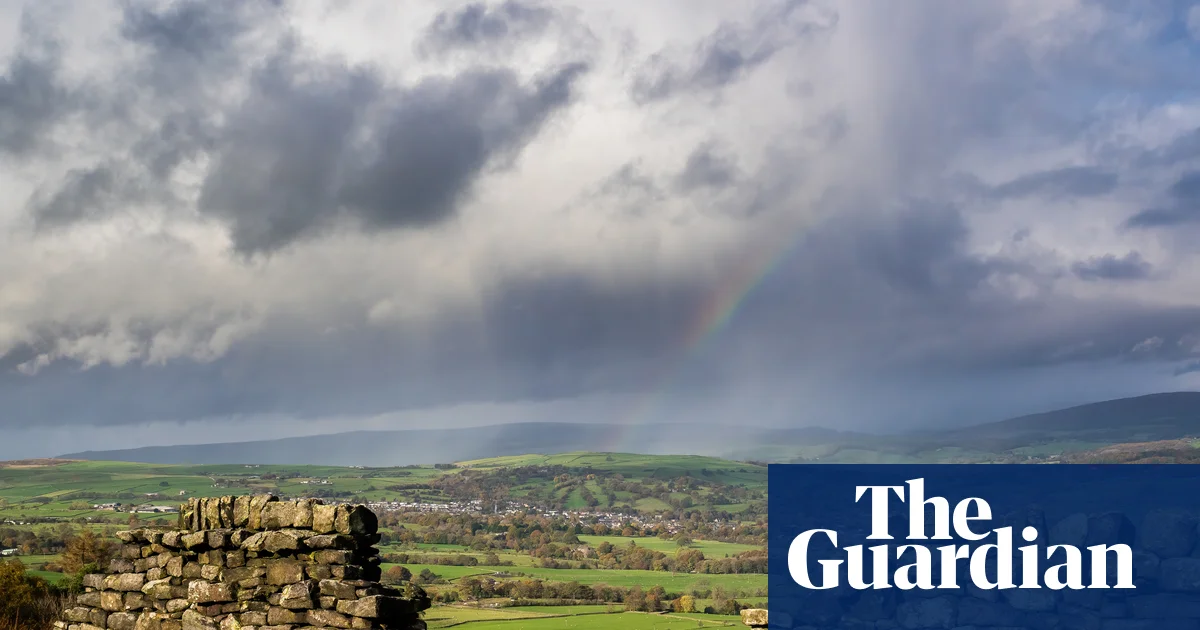
A grainy photograph, dated 1938, hangs in a frame on the downstairs wall of my B&B. It shows 100, perhaps 200, elegantly attired trippers sitting on the green at Shipley Glen in West Yorkshire. They’re picnicking, chatting, taking the air and enjoying the sunshine, while admiring the rocks and woods that frame the deep gully below. It’s local, low-carbon, cheap-as-chips tourism before the jet age – and also a model for how we may travel in the future.
I arrived here thanks to a new trail, launching on 19 September, that runs through the also newly established Bradford Pennine Gateway national nature reserve – astonishingly, the first reserve of this kind to be created in West Yorkshire. The trail uses almost the same name and is a savvy bit of sustainable planning, connecting the three towns of Ilkley, Saltaire and Haworth but, by appealing to walkers, hopefully inspiring people to explore beyond the confines of these honeypots.
I began at Ilkley on a Monday morning. I’d been on its moor once before, for a long circular hike. But I actually prefer linear walks, and it felt like a challenge to start out by crossing the moor. The first half hour was all upward, with lots of stone staircases and some steep sections. A hovering kestrel welcomed me to the top as a reward.
In fact, the great ridge of moorland above Ilkley is called Rombalds Moor; named after a legendary giant, and which comprises several named moors. I tramped across Ilkley, Burley and Bingley moors in a single lunge, stopping only a few times to drink water, take in the massive views back to the “golf ball” radomes of RAF Menwith Hill near Harrogate, over to Leeds – increasingly a high-rise city – and down to the Emley Moor transmitter near Wakefield (the tallest freestanding structure in the UK), and to admire the Twelve Apostles stone circle near the summit.
Twelve Apostles stone circle on Burley Moor. Photograph: Mark Sunderland Photography/Alamy
I had an easy downward stroll before ascending, more gently this time, to the shoulder of Baildon Moor. The vegetation on these moors is mainly heather (pinkish purple now), dense swathes of bracken, tough upland grasses and peat bog, broken up by gritstone outcrops. The NNR designation recognises that it is an area rich in biodiversity, for flora and fauna, and that it plays an important role in tackling challenges like the climate crisis, floods and wildfires. I was walking more than I was watching, but I clocked skylarks, meadow pipits, wheatears, swallows and, on the south side of Baildon, a colony of tree sparrows. As well as clusters of forestry conifers, there were patches of native trees, including birch, rowan and elder, and the occasional willow. Though it’s not wild all the way: I passed tourist chalets, crossed a few fast roads, and walked through a busy golf course (where there were benches, few and far between on the first half of the trail).
The moors are dotted with human history. A big hole, like a meteor crater, turned out to be an abandoned pit, for extracting coal in the preindustrial era. Signage and traces in the landscape point to second world war tank training. Quarries litter the moorlands and dry-stone walls and extensive ditches point to centuries of management.
The trail is 18 miles (28.9km) long. I could probably have walked it in a day with a bit of effort. I’m glad I didn’t, not least because Shipley Glen was a revelation. Despite having visited nearby Saltaire several times, I’d never gone up the hill to see the ravine, which probably became a “glen” because it sounded Scottish and picturesque. For more than a century and a half, it has served many purposes: as a place for radical rallies and suffragettes’ meetings, a temperance hotel and teashop, Victorian pleasure gardens and quirky amusements and rides – and a tramway, opened in 1895, which still operates. I recommend breaking the walk here, even if it’s not quite a midpoint, because the setting is glorious; Bracken Hall House is a gorgeous B&B (doubles from £110 a night), and Saltaire is full of art, industrial history, and great food and drink. There are benches beside the glen, if you decided to pause for a picnic.
While overnighting, I met Danny Jackson, the former countryside and rights of way manager for Bradford council, who devised and plotted the trail. “I want to change people’s perceptions of what Bradford is,” he said. “It’s not just a city. It’s a district. And it’s very rural.
At the top of Bingley Five Rise Locks. Photograph: Ros Crosland/Alamy
“I also want to highlight things that are overlooked. Through the NNR and the trail, we want to maximise the benefits from air quality, carbon capture, wildfire and flood reduction, rewetting, peat restoration – and obviously all the health benefits from being outdoors.”
From Shipley Glen, I walked on via a series of nature-rich spots to Haworth. The first, Trench Meadows, is a Site of Special Scientific Interest (SSSI), notable for its grasses and wildflowers, including red fescue, sweet vernal and crested dog’s-tail. The path took me through an elaborate beautiful old kissing gate, and along cobbled and flagged paths; Victorians and Edwardians made their footpaths beautiful as well as functional – and built them to last.
I passed through Bingley by way of several smart housing estates above the town. I recalled John Braine’s 1957 novel, Room at the Top, set precisely in these airy heights; the novelist renamed it “Warley”, perhaps to make more locally innocuous his tale of social-climbing and adultery. The trail takes in the Five Rise Locks and Three Rise Locks sections of the Leeds-Liverpool canal, which I had only ever spied from the main road. Between the two lock-ladders is Bingley North Bog – a small but precious site that supports a variety of insects, birds and amphibians.
Over the previous 10 miles or so, I’d swapped Wharfedale for Airedale and now found myself walking along attractive stretches of the River Aire. At Bingley St Ives, I skirted a large pond full of waders, another golf club and a large equestrian centre; some mouldering old properties had ecclesiastical-looking doorways, perhaps harking back to the pre-dissolution period when the estate was in the hands of Rievaulx Abbey and Drax Priory. A splendid hide has been built where you can watch bullfinches, goldcrests and siskins that come to use the feeders.
A cobbled street in Haworth – once home to the Brontë sisters. Photograph: Steve Swis/Getty Images
I got my first proper blast of a west wind on Harden Moor – the third of the day’s special sites, being a very rare dry heath alongside mixed woodland, and an ideal habitat for bees (including the nationally scarce tormentil mining bee), wasps, spiders, flies, grasshoppers and other invertebrates. With Haworth now on my mind, slightly irritating Kate Bush-related earworms began to wriggle. I had a cheese butty and tea at a suitably Heathcliffian area called Catstones End, all wild heather and quarried rocks – with huge boulders forming natural sculptures.
Rain came in with the wind and I got absolutely drenched on the final approach to Haworth. But soon after, I was entering Bradford’s prettiest township and thinking about coffee and cake. The walk officially ends at Penistone Hill country park, but after taking walking therapy a few years ago, I am no longer a completist – and was satisfied with my walk and mini achievement. I bowed out on Haworth high street, without so much as a glance at the Brontë Parsonage Museum.
The visit was supported by Bradford Culture Company, which is developing projects related to the 2025 UK City of Culture
Ilkley, Saltaire and Haworth are easy to reach by train or bus. If arriving by car, park at Keighley and use the 62 bus to get to Ilkley and the B1, B2 and B3 Brontëbuses to travel from Haworth back to Keighley
A European city with a lot of history and beauty at odds with its negative reputation is quicker to get to from the UK via train than by plane.
New research from global travel booking site Omio has identified 25 European routes where travelling by train is actually faster than flying once airport transfers, security queues and boarding times are taken into account. While many holidaymakers automatically book flights for a weekend escape, the findings suggest they’re often overlooking rail journeys that are not only quicker, but also less stressful.
They’re also much less environmentally damaging, with the emissions per plane passenger typically several times higher than those of train passengers.
A trip from London to Brussels is one of the biggest examples of where rail beats air. The Eurostar takes just 125 minutes, making it 83 minutes faster than flying once airport transfers, security checks and boarding times are factored in. Tickets start from around £148, with passengers arriving directly in the heart of the Belgian capital.
Whether or not the city is worth a visit is a different matter. Brussels is, according to some people, a boring city.
“As much as I tried, I still could not shake the feeling that Brussels was undeniably boring,” one travel blogger recently wrote of Brussels following a trip there. Back in 2008, it was awarded the title of the world’s dullest city in a survey of international travelers, who judged it duller than Zurich and Warsaw.
Having made a short visit to the city in recent years, the criticism does seem a little just. Brussels does have a functional, workman-like feel to it, thanks to the huge number of governmental buildings. And yes, it does look like an AI picture generator’s attempt to ‘simulate a standard European capital’, as one online commenter complained.
However, there are plenty of redeemable qualities of Brussels. The atmosphere is pleasant enough, many of the buildings are beautiful, and it is home to two of the Continent’s great contributions to culinary culture – waffles and chips – even if there is a distinct Sunday afternoon feel to the place.
“Brussels is an ideal destination for a short city break, thanks to its impressive medieval architecture, relaxed atmosphere and more than 100 museums. Visitors can spend the day wandering the city’s historic streets before stopping for Belgian beer and world-famous chocolate. With average July temperatures of 23°C, it’s also an ideal city to explore on foot,” writes Omio.
Given Brussels’s closeness to the UK, a day trip is well on the cards. If you do go down that route, I suggest the following one-hour tour of the city:
Starting at the famed Manneken Pis statue depicting a urinating child (who had been dressed up in a miniature gown and hat to celebrate the city’s graduating students when I was there), dash to the Monument a Everard t’Serclaes, helping the reclining lady’s leg become even shinier with a quick, traditional good luck rub.
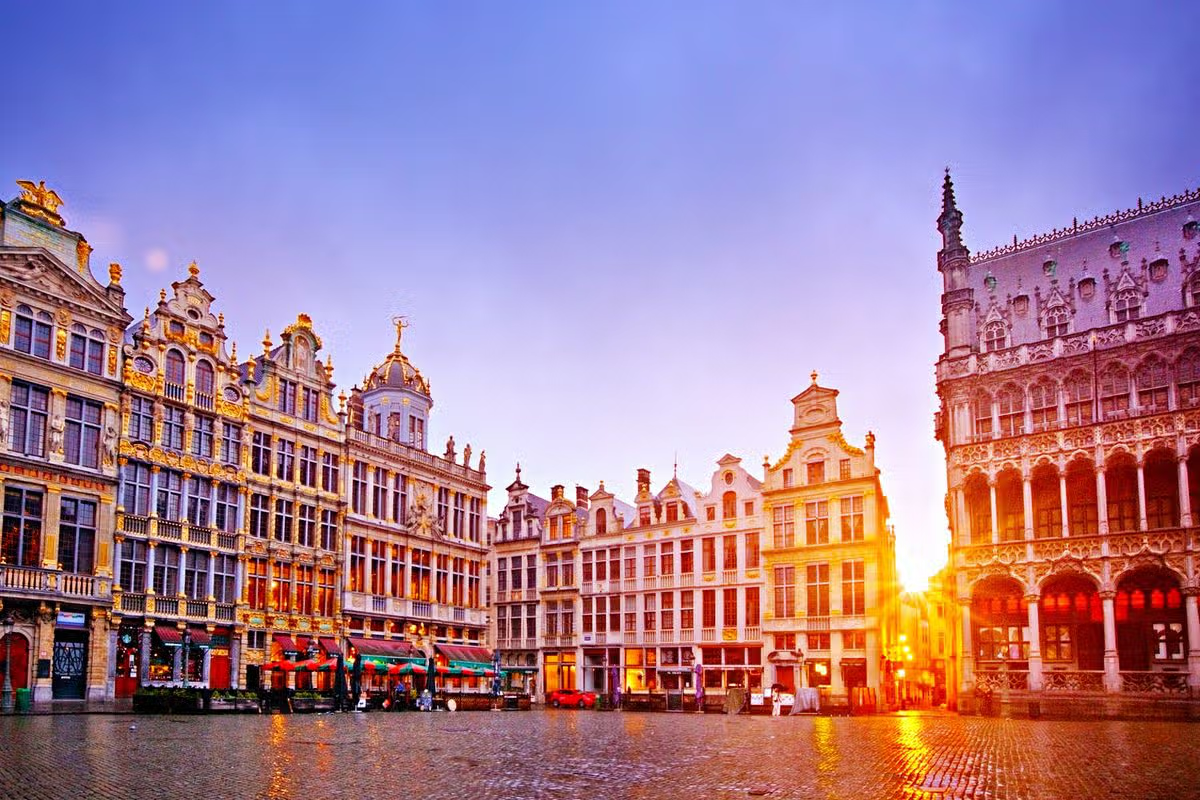
Pausing in the central Grand Place square for a moment, take in the opulent Baroque guildhalls and the neo-Gothic King’s House. Not wanting to waste any more time or spend six euros, read the first paragraph of the Grand City Museum’s Wikipedia entry while looking at its exterior.
Culturally enriched, next up was a portion of mayonnaise-covered frites eaten while looking at a René Magritte painting on the side of a house, before a crispy waffle powers you up the hill towards the Royal Palace. Glance back at the impressive view of the city’s rooftops as you barrel onto a coach and out of there, catching a glimpse of one of Auguste Rodin’s Thinkers through the window before quickly stopping to stand in front of ‘Belgium’s Eiffel Tower’, the futuristic Atomium statue.