hillman

Joe Hillman starred at Hoover; then played for Bob Knight

It was 41 years ago in April of 1987 as a 28-year-old sportswriter that I was given one of my favorite assignments.

From LAX, I flew to Indianapolis, rented a car and drove one hour to Bloomington, Ind., home of the NCAA basketball champion Indiana Hoosiers. My most vivid memory was nervously driving on Route 37 with no GPS guiding me and seeing the many varieties of basketball hoops hanging on farm houses and family homes, providing powerful evidence that all the stereotypes about the state’s love for basketball were true.

This was months after the best selling book, “A Season on the Brink,” was published. And a month after coach Bob Knight and Indiana won their fifth NCAA basketball championship.

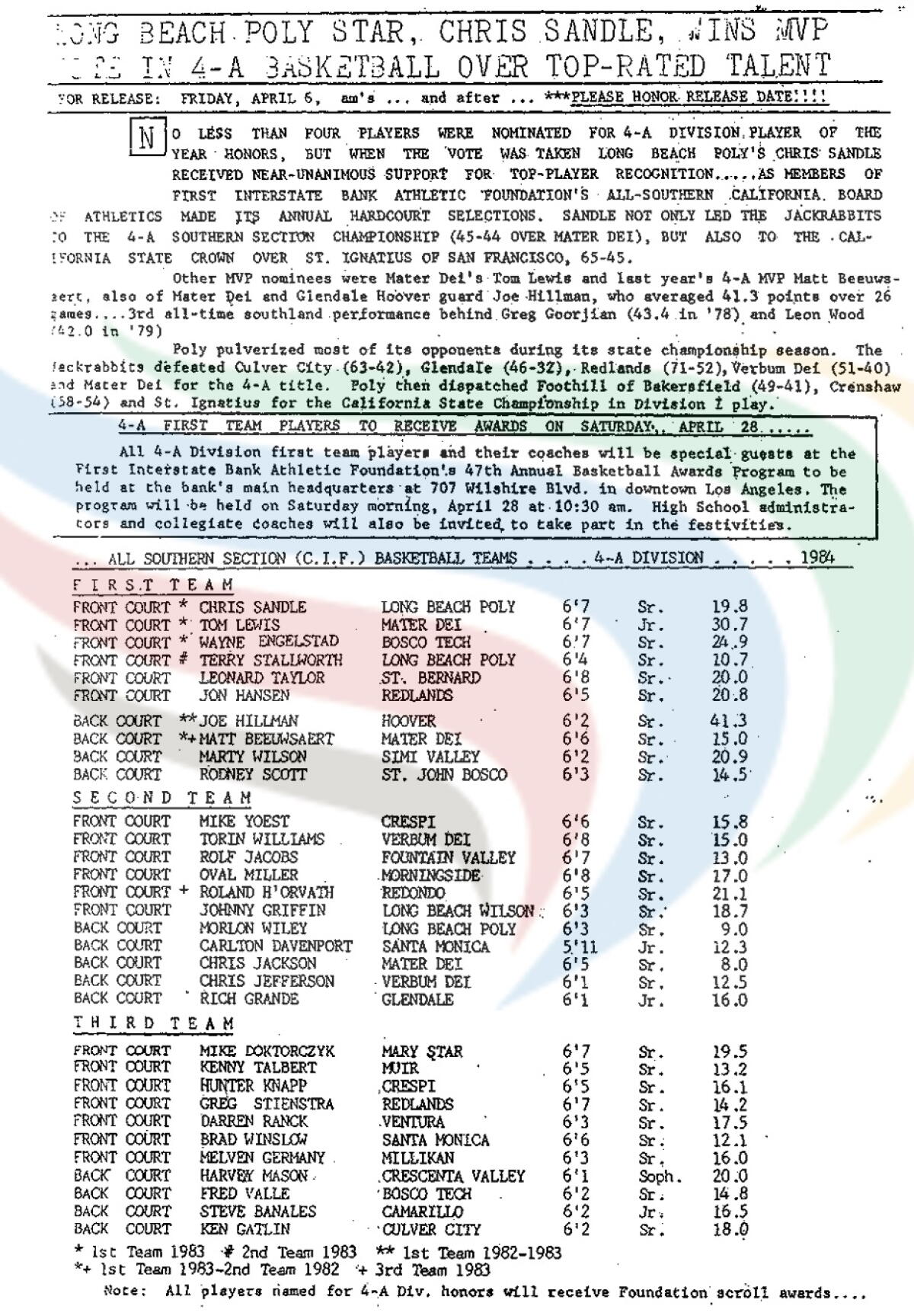
My assignment was to check in with Glendale native Joe Hillman, a 1984 Hoover High graduate who was Knight’s first recruit from west of the Mississippi River. Hillman averaged 41.3 points his senior year at Hoover He ended up being a reserve guard behind Steve Alford and Keith Smart on the 1987 NCAA championship team, so it was perfect timing.

He also continued to play baseball and was a 25th-round draft pick of the Oakland Athletics in 1986.

Fast forward to Tuesday at the YMCA in La Cañada Flintridge. The guest speaker for the Glendale Quarterback Club was Hillman. It was the first time seeing him since my trip to Indiana. Now 60 and living outside of Indianapolis, Hillman was asked tough questions.

1984 All-CIF basketball team.

1984 All-CIF basketball team.

(1984 Foundation)

Can you still hit?

“I can still do that.”

Can you still make free throws?

“I don’t know about that.”

How come you never went into coaching?

“I wouldn’t have been patient enough.”

How did Knight convince you to go to Indiana?

“We don’t have this in Indiana,” Knight told him during a visit to Santa Anita while looking out at the San Gabriel Mountains. “Why would a California kid come to Indiana?”

Hillman: “I want to play on a national championship team.”

Any Knight stories to tell?

“I don’t know if you can put them in a paper.”

Years later, when talking to other players, Hillman said, “There was a method to his madness. They all had the same stories with different names.”

Indiana's Daryl Thomas (24) and Joe Hillman (44).
Indiana’s Daryl Thomas (24) and Joe Hillman (44) victorious during interview with CBS announcers Billy Packer (L) and Brent Musberger (R) in 1987.

(Manny Millan/Sports Illustrated via Getty Imaages)

Among the Knight truths: Players who practiced best always got to play. The best players always got the most heat from him. Anyone who graduated from Indiana received his total loyalty.

Hillman remembers calling Knight eight years after graduation seeking a phone number to reach a Reebok executive to inquire about a job. Knight ended up telling the executive he’d drop Adidas shoe contract for Reebok if Hillman were hired. Hillman didn’t get the job but learned what Knight would do for any player who got his degree.

“He was the most honest, most blunt coach,” Hillman said.

Asked why he chose to be subjected to such harsh criticism for four years, Hillman said, “My father was on me from the time of T-ball. He said constructive criticism was good.”

Comparing today’s college sports environment of NIL deals with the 1980s, Hillman said, “It would have been scary what kind of money we could have gotten.”

Hillman expressed disappointment at the lack of multiple-sport athletes today in high school sports. He said even Knight appreciated and supported his option to keep playing baseball.

Looking back on that trip from 1987, I re-read my observations: “The four-lane highway that stretches from Indianapolis to Bloomington is virtually deserted as darkness begins to descend over the lush, green countryside. The temperature is in the 50s, and the sky is overcast after three straight days of damp weather. The picturesque Midwestern landscape is immaculate, but equally alluring are the distinctive basketball hoops found among the farms and family homes along Route 37. Hoops are everywhere — on barns, rooftops, telephone poles, even next to power transformers.”

I remember getting lost in a forest trying to find where Hillman was living in a townhouse.

I wrote: “After finding the correct street, the quickest way to locate an Indiana basketball player’s residence is to ask a young fan. Shooting baskets by himself on a court not far away was a 12-year-old.

“Do you know where Joe Hillman lives?”

“Sure,” the youngster says.

Those were the days.
Source link

‘A Different World’ review: Class is in session again at Hillman College

“A Different World,” a multicamera comic collegiate soap opera spun off from “The Cosby Show,” has been updated and reborn as a single camera sequel a mere 39 years after the original series welcomed its freshman class and 33 after it packed them off into adulthood. It’s a different “A Different World,” times being what they are, but in many respects the same, set over a school year at the same fictional Hillman College, “the preeminent HBCU in the country.”

As before, we begin with the arrival of new students, sorting themselves out, meeting roommates, finding friends. Many members of the original cast have returned, including Jada Pinkett-Smith, Cree Summer, Charnele Brown, Jenifer Lewis, Dawnn Lewis, Glynn Turman and Joe Morton, as parents or teachers or counselors, three decades older though not necessarily wiser. In a way I can’t exactly articulate — and which has nothing to do with the earlier series, which I know hardly at all — the new “A Different World” made me happy, especially in the early episodes, before the characters are entangled in plot and everything is new, infused with sweetness and energy. (A climactic talent show is just as corny and unpersuasive as every other climactic talent show in television history.)

At the center of a large and sometimes confusing Gen Z cast is Deborah Wayne (Maleah Joi Moon), the daughter of Dwayne Wayne (Kadeem Hardison), who is now the provost, and Whitley Gilbert-Wayne (Jasmine Guy), who in the intervening years founded and sold a beauty empire, which is to say that Deborah, accent on the “bo,” is a rich girl — not at all mean and not especially spoiled, though she doesn’t know how to operate a washing machine. (It also means she is not afraid to raise a ruckus.) She thinks of herself as an artist, but her admission to NYU’s Tisch School of the Arts was rescinded after “a horrible misstep.” And at Hillman, she is required to keep a B average and not get into any trouble, both of which will prove difficult.

Shaquille Johnson (Cornell Young IV), a football star who arrives a week late to practice in a Lamborghini accompanied by his domineering father — it’s Ron Johnson (Darryl M. Bell) from the original cast — who thinks it’s a shame that his son is at tiny Hillman when he could be making a pot of money elsewhere. (Shaquille promised his late mother he’d go there.) “Not everything is about money,” he says. Shaquille also has a gone-wrong romantic past with Deborah, but they are glad to see one another again.

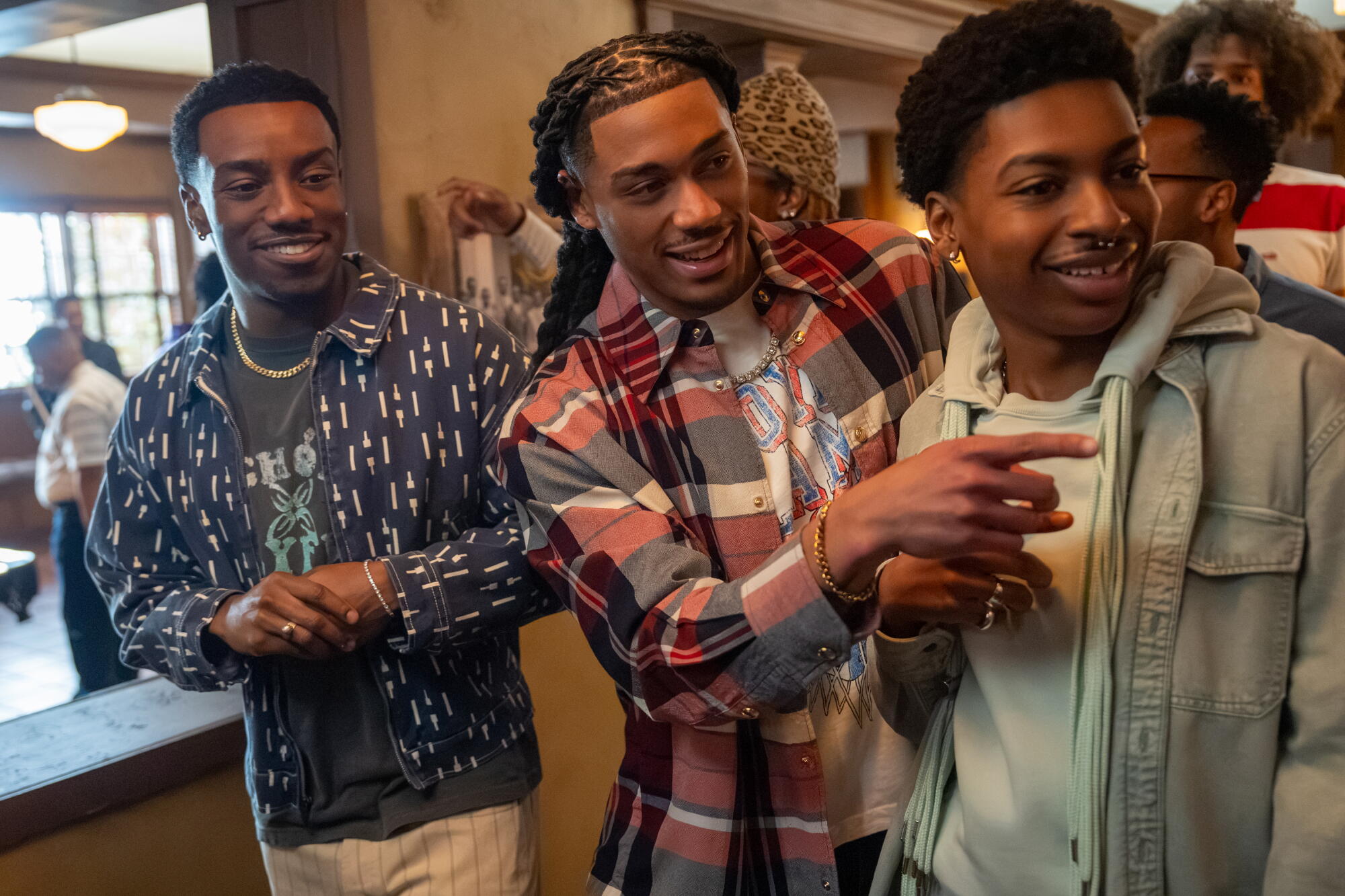
Three men walking together down a hall.

While the show features members of the original cast, the younger generation sorts itself into trios, including Kojo (Chibuikem Uche), left, Shaquille (Cornell Young IV) and Amir (Jordan Aaron Hall).

(Quantrell Colbert/Netflix)

Deborah wants to show her parents, who have been separated for six months but are rarely apart, that she can “enter my full studious season.” This will lead to her engaging a tutor, Ellington (Vincent Jamal Hooper), introduced for some light romantic tension vis a vis Shaquille. Athletic RA Candace (Renee Harrison), who likes Shaquille, provides a counterweight.

The younger generation sorts itself into two entwined trios. For a roommate Deborah draws Rashida (Alijah Kai), who’s from Compton and supposedly a champion gymnast, a characteristic that seems to exist simply to support a joke about Deborah’s “most improved” trophies for Choate women’s pickleball, since it’s never mentioned again. (Some storylines do just melt away.) She’s majoring in criminal justice “to get my cousins out of prison” and thinks Deborah is an unserious student. They’re joined by Hazel (Kennedi Reece), a nice Christian girl looking for a nice Christian guy.

On the boys’ team, alongside Shaquille, are Amir (Jordan Aaron Hall), a gay Harlemite whose deferred admission was because of a year in what they seemingly still call juvie and whose dream is to design clothing; and Ghanian Nigerian “by way of the U.K.” Kojo (Chibuikem Uche), an aspiring influencer bootlegging T-shirts of Shaquille; he, too, has marriage on his mind. They will learn as much in the dorms as they do in the classroom, but the classroom scenes are more on point than they often are in school-set shows.

Shaquille has a rival on the team, Andre (Joshua Suiter), whose wrist he fractures in a locker room fight — but this never really turns into anything. There aren’t any villains here, just young people making young people mistakes and older people making older people mistakes. No one is evil, but people do stupid things, which accords with my own memories of college.

Created by Felicia Pride, who has writing credits on “Queen Sugar,” “Bel-Air” and “Grey’s Anatomy,” it also includes plenty of scenes in which the young folks just have fun, dancing and singing. Big scenes are very well staged, which might have something to do with having choreographer Debbie Allen, director of the premiere episode (and 83 episodes of the original series), as an executive producer. (She also reprises her role as academic counselor Dr. Langhorne, whose motto is “Relax, relate, release,” as if anyone could.)

Over the course of 10 episodes, we’ll encounter many issues relevant to student life and beyond — dyslexia, ADHD (this was my introduction to the parking lot and pomodoro techniques), how lockdown “wreaked havoc” on a generation’s ability to read social cues, STDs, adultification bias, federal cuts to education (Hillman is in the red, and students are losing their grants). bell hooks is quoted on socializing men toward love instead of sex, and, indeed, the series is refreshingly modest on that account.

Welcoming the incoming freshmen, Deborah’s father says, “This is a watershed moment where this country that we built is trying to erase our Black history. Our gains, our culture. They wanna demoralize us. They wanna deport us, they wanna jail us, they wanna shoot us down in the street. But you, you all are their greatest threat. You future leaders who are about justice and community and each other. I know you will stand up. I know you will fight, build and change the world.” It’s a bit speechy — well, it’s in an actual speech — but it’s nice to have that laid out so cleanly in a Netflix sitcom in these difficult days.

And in the wake of a bomb threat, Deborah will declare to the world, “We are not going anywhere. We are studying, we are partying, and we are living our best young, gifted, Black, talented lives right here in our space.” Which sums it up nicely.

Source link