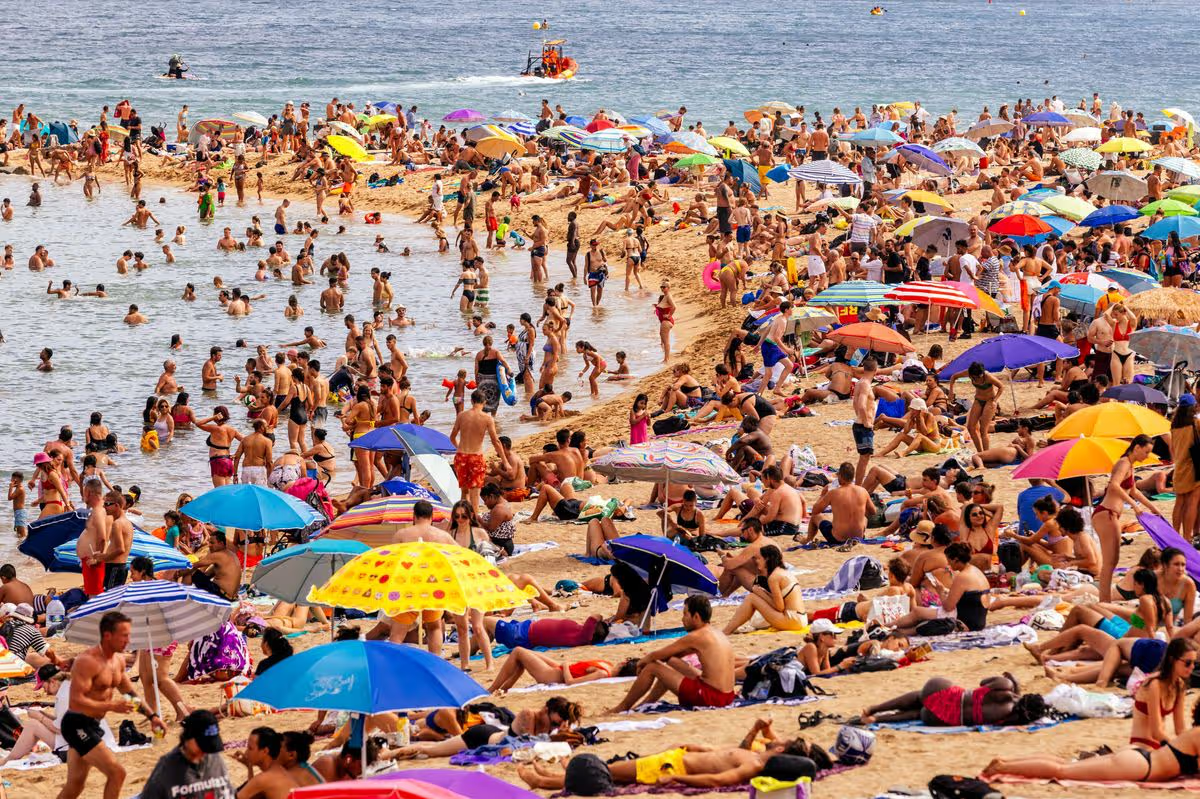
Experts have warned parts of Southern Europe could exceed 50C this summer or next, with holidaymakers urged to rethink holiday destinations or could be forced to spend their vacation indoors
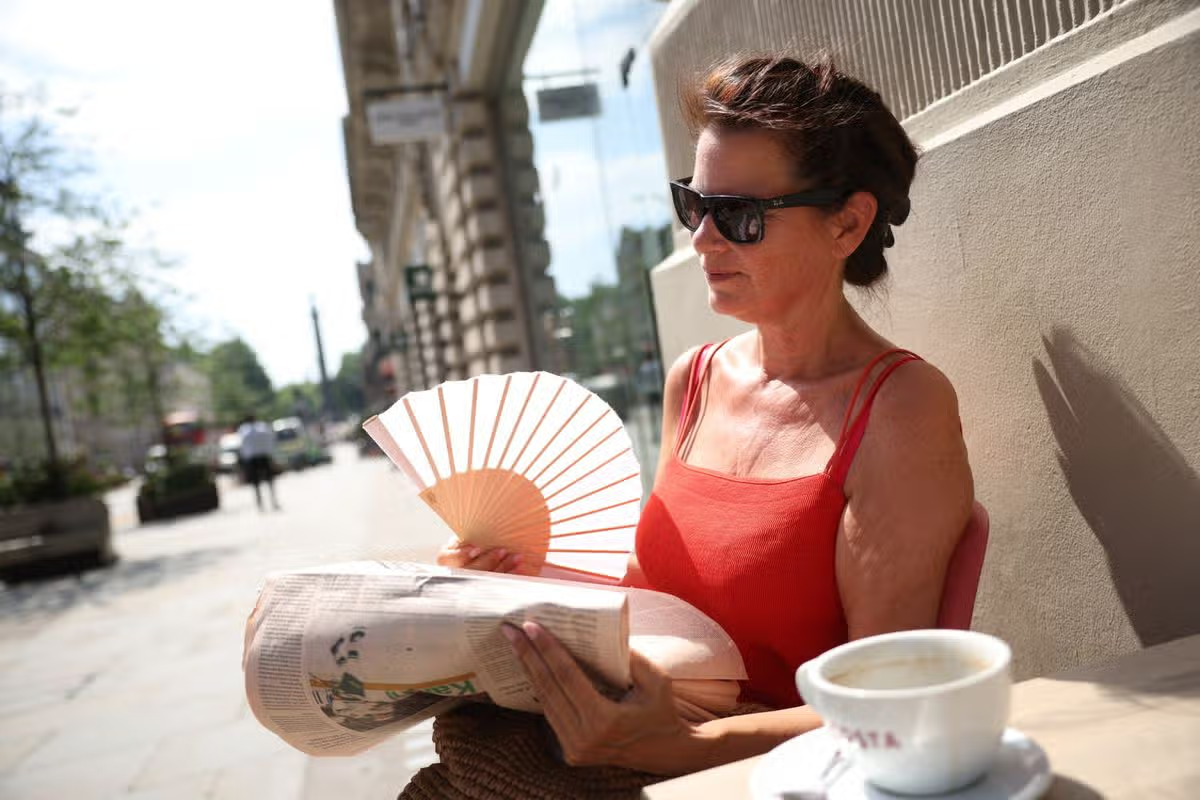
Temperatures in parts of southern Europe could exceed 50c(Image: Getty Images)
A sweltering 50C heatwave could hit parts of Europe as experts warned British holidaymakers to prepare for dangerous conditions this summer.
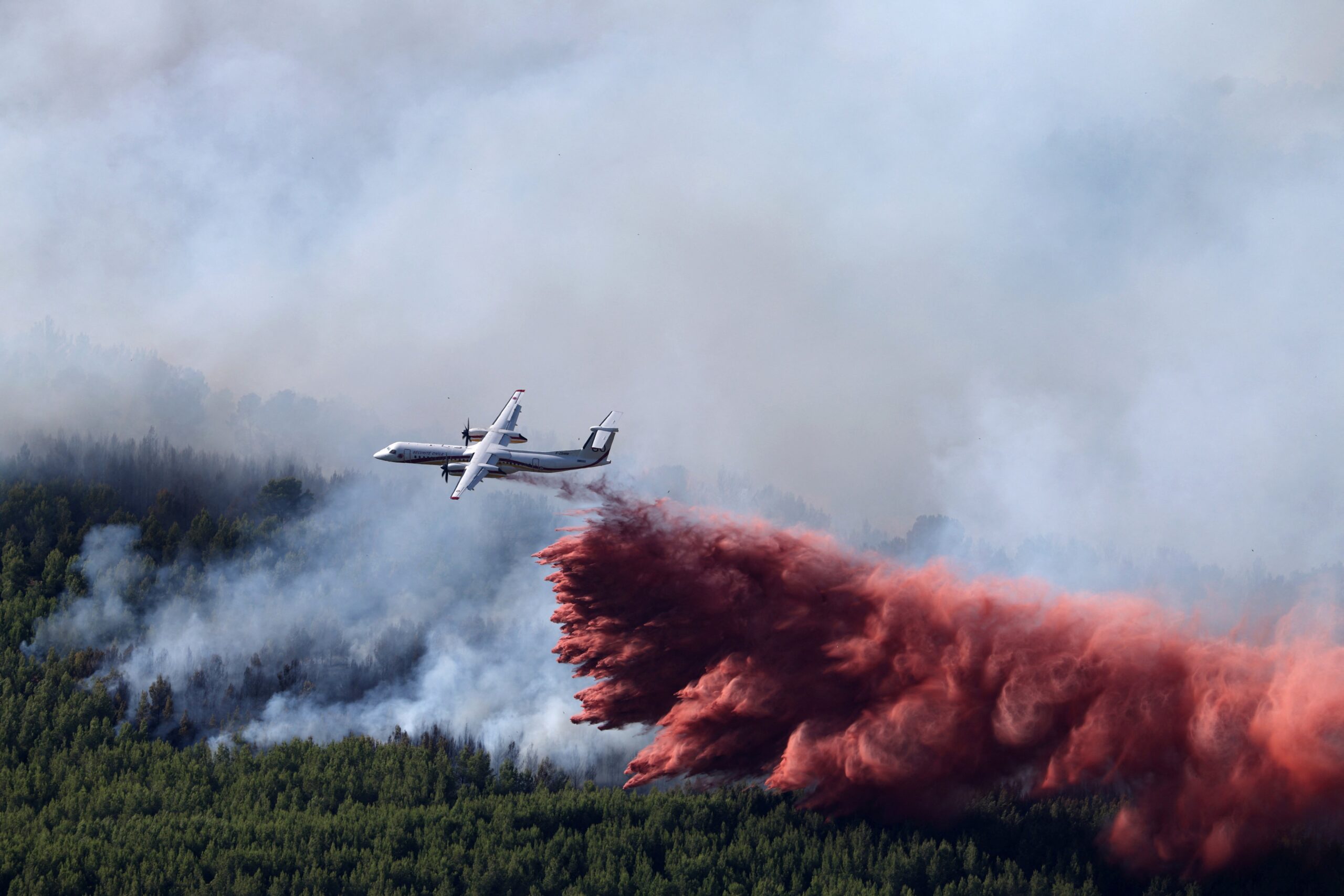
Holidaymakers heading to the Mediterranean have been warned temperatures could soar to 50C, with experts saying the record-breaking heat seen across southern Europe may only be the beginning. Large parts of Spain have already endured temperatures of 44C in recent days, while the heat has fuelled wildfires across Spain and France, forcing thousands of people to flee their homes.
Professor Bill McGuire, Emeritus Professor of Geophysical & Climate Hazards at UCL said even hotter weather could be yet to come. He said: “It would be no surprise if 50C was exceeded, either later this summer or next year, when the heating impact of the unprecedented El Niño building in the Pacific will be at its greatest.”
He urged anyone travelling to the Mediterranean to be prepared to spend far more time indoors than they might have planned. He told the Daily Mail: “I wouldn’t say that they would be a total write-off, but I think holidaymakers will need to be prepared to spend a lot of time in air-conditioned hotel rooms, due to it simply being too hot to do anything outside.”
The highest air temperature ever officially recorded in Europe is 48.8C, set in Sicily in 2021. Before that, the record stood at 48C, recorded in Elefsina and Athens in 1977.
Professor Hanna Cloke, Regius Professor of Meteorology and Climate Science at the University of Reading, said parts of Spain and Portugal could see temperatures climb into the high 40s. She said: “Temperatures in the high 40s are possible in the hottest parts of Spain and Portugal. And where humidity is high it can feel even hotter than that, well above what the thermometer says. That’s the kind of heat that kills.”
She urged holidaymakers to take extra care if temperatures continued to climb. She said: “The old and vulnerable need to be very careful; keeping out of the sun and drinking plenty of water, as they can easily suffer and become ill in 40C+ temperatures.”
Professor McGuire said there was “no doubt whatsoever” climate change was driving the extreme heat. He said: “Europe is heating faster than any other continent as we continue to add more than 40 billion tonnes of CO2 to the atmosphere every year – equivalent to the weight of 800,000 Titanics.
“The average temperature of Europe is now more than 2°C hotter than it was 100 years ago, and high temperature extremes are going up even faster. Heatwaves are getting hotter and longer, and taking many thousands of lives every year.
“But this isn’t the new normal, this is just the beginning. Summers across the Mediterranean region are just going to keep on getting hotter as long as we continue to do next to nothing in terms of reining in carbon emissions.”
If your destination falls victim to a wildfire or other extreme event, what should you do, and can you get your money back? A consultant for independent financial research company Defaqto has explained what Brits need to look out for
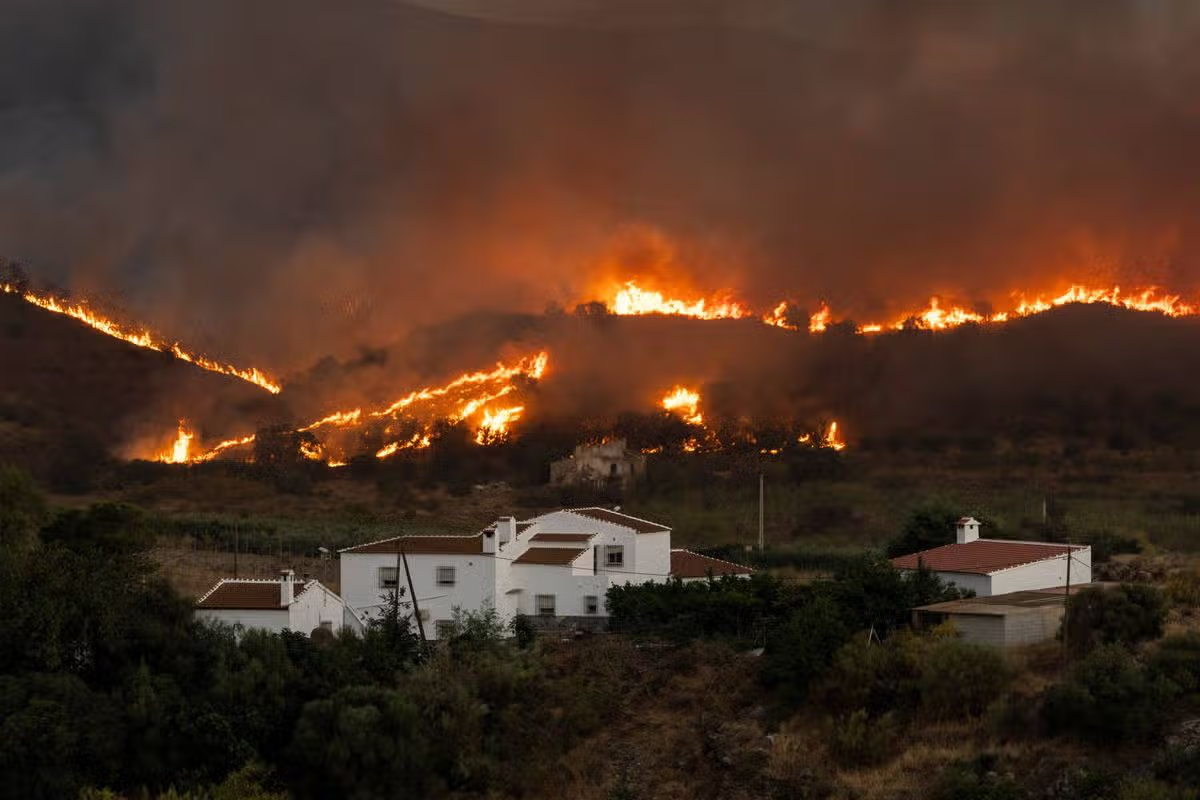
Spain has been tackling one of its deadliest wildfires(Image: JORGE GUERRERO / AFP via Getty Images)
Many Brits will be heading off to Spain for the busy summer season in the coming weeks, and no doubt seeing the headlines about wildfires will cause some alarm if you’ve got a holiday booked.
Wildfires broke out in the Almería province of Spain last week. So far 13 people have been confirmed dead, among them, seven Britons. Almeria is part of the Andalusia region, and is popular with expats and holidaymakers. The Foreign, Commonwealth & Development Office (FCDO) recently updated its advice for anyone travelling to Spain.
It said: “If you are in an area affected by the wildfire follow instructions from local authorities and emergency services at all times, avoid travelling into or through the affected area, and follow updates from the emergency services.”
People who were planning trips to Andalusia and other areas of Southern Europe suffering from wildfires and other extreme weather events may be wondering where this leaves them. Anna-Marie Duthie, an insight consultant at independent financial research company Defaqto, gave her thoughts.
Anna-Marie said: “If your airline cancels your flight due to wildfires, they should offer you the chance to rebook, or provide a full refund. If your holiday was booked as a package, this refund should cover all elements — flights, accommodation and transfers.
“But if you’ve booked everything separately, you’ll need to deal with each provider independently. Your airline may refund your flight, but your accommodation provider may not if the property is unaffected. This is why it’s essential to speak directly with providers in the first instance and check with your insurance provider regarding the cover they include.”
Travellers should regularly check the FCDO website to see tailored advice for their destination and ensure no travel warnings are in place. Anna-Marie said: “If government advice changes, advising against travel to the area after you have booked your trip, then you may be covered for cancellation or curtailment.
“You may also be covered for additional travel and accommodation costs should your trip be disrupted due to a catastrophic event, if your insurer offers this cover or you’ve paid to include it.”
Anna-Marie believes that extreme weather events could affect the travel insurance industry in future, saying: “Whilst it’s difficult to know exactly how travel insurance may change over the next decade, longer term there is a chance that we may end up seeing less insurable destinations and increased premiums. What we do know, however, is that travel insurers are used to having to adapt to an ever-changing world.”
But she added: “It is unlikely and we are yet to see any immediate changes to policies because of the current heatwave. It is unlikely insurance providers will change their policies in the near future to incorporate extreme heat. Current clauses may refer to ‘severe’ or ‘extreme’ weather, but the definitions for these can vary and currently no providers go as far as to specify criteria such as maximum temperatures.
“Where the heat causes events such as the current wildfires, this is a separate consideration and would be classed as a catastrophe or natural disaster. Cover for this will all depend on your insurer’s definitions and extent of benefits.”
Have a story you want to share? Email us at webtravel@reachplc.com
Here, Sophie Swietochowski looks at seven great days out . . .
WESTONBIRT ARBORETUM
One of the UK’s largest and most glorious arboretums, Westonbirt, in Gloucestershire, is much more than just a forest.
Sign up for the Travel newsletter
Thank you!
More than 2,500 species are thriving here and some of the trees in this 240-hectare space are so ancient, they’ve weathered almost 2,000 years of change.
Why not grab a sandwich from the cafe and take a pew next to the arboretum’s oldest tree — a small-leaved lime in the Silk Wood area.
Devon’s beaches are likely to be packed in the coming weeks, but this fabulous park is a great alternative.
There are plenty of shaded areas, plus kids can be kept entertained along the Room on the Broom activity trail.
Pack a coolbox of goodies and take advantage of the many picnic spots.
BEDGEBURY NATIONAL PINETUM & FOREST
This haven in Kent is the largest pinetum in the entire world, and its collection of conifers is renowned globally.
Now is the best time to visit, as the team have mowed grassy paths to help visitors explore, while also sheltering beneath the giant trees.
HAMSTERLEY FOREST
Kids can slip off their shoes and go for a paddle after tiring themselves out at the outdoor Viking Wildplay, which is pretty well shadedHamsterley Forest in County Durham has a river running through its centreCredit: Alamy
If you would prefer to cool off by water, this forest in County Durham has a river running through its centre.
Kids can slip off their shoes and go for a paddle after tiring themselves out at the outdoor Viking Wildplay, which is pretty well shaded.
If you do want to stroll the trails, they are mostly wheelchair-accessible and pram-friendly.
ALICE HOLT FOREST
Worried about how you’re going to amuse the kids over the summer months?
It’s an adventurer’s paradise with nature and play trails galore and even a Go Ape course, sheltered by the surrounding trees.
Make sure to check the events page ahead of your visit to find out what’s happening that week.
DELAMERE FOREST
This gorgeous spot in Cheshire is a wonderful spot for nature enthusiasts.
Major work has gone into restoring the hidden pools within the forest to encourage the return of the White-Faced Darter dragonfly — one of the rarest in the UK.
This forest is likely to be one of the coolest of the bunch, too, thanks to the many peat bogs and moss carpets that keep the forest floor damp.
FINESHADE WOOD
Both the kids and Fido will love this gloriously sheltered spot in Northamptonshire.
You’ll be sharing the 516 hectares with deer, dragonflies and butterflies, and keep an eye out through the tree canopy for the buzzards soaring overhead.
When the heat gets too much, the on-site Grounds Cafe is loaded with ice cream — and there’s even some doggy-friendly scoops, so no one misses out.
For more details on any of the sites featured on this page, head online to forestryengland.uk.
A 93-year-old British woman has died in hospital after suffering burns to about 20% of her body in the Spanish wildfires. Her death was confirmed on Sunday afternoon, bringing the total number of fatalities from the fires to 13.
Milo Boyd Deputy Travel Editor & Commercial Writer and Jessica Coates and Jenny Garnsworthy Press Association
09:51, 13 Jul 2026
The FCDO has issued a warning for Brits in Spain(Image: Pablo Blazquez Dominguez, Getty Images)
A stark warning has been issued to Brits travelling to Spain as the country continues to battle ferocious wildfires.
A 93-year-old British woman has died following injuries sustained in the deadly wildfires that tore through southern Spain, authorities confirmed this morning. The Andalusian government revealed the woman was rushed to hospital on Friday after sustaining burns to roughly 20% of her body.
Her death was confirmed on Sunday afternoon, pushing the total death toll from the blazes to 13.
The UK’s Foreign, Commonwealth and Development Office (FCDO) has issued a travel alert regarding the fires in Los Gallardos, Almería, in Andalucía. It urges those in the area to:
follow instructions from local authorities and emergency services at all times
avoid travelling into or through the affected area
follow updates from the emergency services
for emergencies, call 112
Have you been impacted by the wildfires? Email webtravel@reachplc.com
The FCDO notes that anyone concerned about someone in the area can call +34 677 904 624 provided by the Psychological Intervention Group for Emergencies and Disasters. English speaking staff are available. Consular assistance can be found by calling +34 917 146 300 if you’re in Spain, and +44 (0)20 7008 5000 if you’re in the UK.
At least four victims in Andalusia are believed to be British, after four bodies were discovered in a burnt-out vehicle with its steering wheel on the right-hand side.
This comes after reports on Sunday that two British hikers were found alive but severely burnt. The man and woman, who remain unnamed, are believed to have suffered burns to 40% of their bodies, according to Spanish national broadcaster RTVE.
The pair was located by a Civil Guard team, who revealed they had already swept the area, but had a gut feeling they needed to return. Speaking to RTVE, the Civil Guard officers described finding the two British nationals alive just as darkness was closing in.
Sergeant Pedro Barre told the broadcaster: “That experience we accumulate over the years is what tells you: take another look, give it one last try, check again just in case.”
He explained that the team called out and blew whistles, before eventually detecting a noise they initially thought might be an echo.
Fellow rescuer Rafael Zea added that given the severity of the couple’s injuries, it must have taken a “Titanic effort” for them to raise their voices loud enough to be heard. Firefighters and emergency services helped rescue the pair after more than two hours trapped.
Both individuals are currently reported to be in a serious condition in hospital, though their lives are not thought to be at risk. Spanish authorities believe all the victims were foreign tourists, who are thought to have attempted to escape on foot after apparently abandoning their vehicles and trying to flee through rugged terrain.
Antonio Sanz, head of Andalusia’s emergency services, previously said that authorities had completed post-mortem examinations and DNA samples were collected to identify them.
Spain has been hit by frequent and severe heatwaves in recent years, with temperatures regularly soaring above 40C. In June, Spain endured several days of record-breaking heat, with more than 1,000 excess deaths attributed to the scorching conditions.
Dr Thomas Smith, Associate Professor in Environmental Geography, London School of Economics and Political Science, explained why Spain is suffering so intensely from the fires.
“The extreme wildfire behaviour we’re seeing in Spain is closely linked to the extreme heatwave weather conditions. Fire behaviour (how quickly a fire spreads and how intensely it burns) is heavily influenced by the weather. Research shows that key measures such as rate of spread and the size of flames increase exponentially as fire weather becomes more severe, meaning that relatively small increases in extreme fire weather can produce disproportionately more dangerous fires,” he said.
“When weather conditions reach record-breaking levels, we should expect the potential for record-breaking fire behaviour, particularly when strong winds are present to accelerate fire spread and make suppression much more difficult.
“Climate change is increasing the frequency and intensity of the extreme heat and fire weather conditions that create these dangerous environments. While individual fires are influenced by many factors, including ignition sources, vegetation, and land management, climate change is inextricably linked to the record-breaking weather that is driving the conditions for these extreme wildfires.”
There’s also a handy hack you should try – and it involves socks
People should visit their GP if they are worried(Image: whitebalance.space via Getty Images)
The British Red Cross has highlighted something many of us already know: “it can be difficult to sleep in a heatwave”.
However, what fewer people realise is that the amount of sleep you get can influence how your body copes with the heat – and we’re not just talking about your mood.
It explains: “If it’s too hot or too cold, your internal body temperature may be affected, disrupting your ability to fall asleep and stay asleep. This is important as getting good-quality sleep during a heatwave helps your body recover, stay cool, and maintain overall physical and mental health.
For people in vulnerable groups, getting sufficient rest is especially important. Good-quality rest can help support the immune system, improve energy levels, promote heart health, and help the body manage the additional strain caused by extreme heat.
How can I sleep during a heatwave?
Discussing how to sleep during a heatwave and periods of high temperatures, it is important to aim for the recommended seven to nine hours of sleep each night. With temperatures expected to rise across the UK this week, this is a timely reminder of the importance of prioritising rest during hot weather.
It explains: “According to the NHS, an adult usually needs between seven to nine hours sleep a night. However, this will change depending on age, health and personal circumstances. Teenagers, children and babies need more sleep than others.”
In fact, a lack of sleep, even for one night, can impact your health and may negatively affect your:
immune system
alertness and reaction times
attention
cognitive ability
mood changes and irritability
anxiety and depression
quality of life and social activity
The NHS notes that there are signs and symptoms of sleep problems you should keep an eye out for.
You may:
find it difficult to fall asleep
lie awake for long periods at night
wake up several times during the night
wake up early and be unable to get back to sleep
feel down or have a lower mood
have difficulty concentrating
be more irritable than usual
It adds: “Longer-term sleep problems can affect our relationships and social life, and leave us feeling tired all the time, eating more and not able to do daily tasks.”
If you regularly struggle to sleep and find it difficult to get at least seven hours of rest, consider speaking to your GP. This is particularly important if poor sleep is starting to affect your daily life and wellbeing.
Did you know that cooling your feet may help you feel cooler overall? The Red Cross suggests placing a pair of socks in the fridge during the day and putting them on before bed to create a refreshing cooling effect as you wind down for the night.
You can read more about how to stay cool and sleep during a heatwave here.
JESY Nelson has broken fans’ hearts as she confessed she’s been “crying all day” with mum guilt.
The mum-of-two has opened up on how her baby girls are struggling amid the high temperatures.
Pop star Jesy has now opened up on her mum guiltCredit: InstagramJesy Nelson confessed putting her baby girls into their spinal jackets and splints in this heat has left her feeling ‘heartbroken’Credit: Jesy Nelson/Instagram
Taking to social media, she told her 10million followers that she is utterly heartbroken over having to put the twins into thick spinal jackets and splints in this heat.
Pop star Jesy shared a glimpse of the girls laying down in their rockers wearing their supports.
Sign up for the Showbiz newsletter
Thank you!
She penned over the clip: “I’ve cried all day. Imagine having to wear a spinal jacket and splints in this heat.
“I cannot even begin to tell you how much this breaks my heart into a million pieces. But, if I don’t put them on every day, their spines and feet will only deteriorate and get worse.”
“These will never correct their spine or feet, it will only prevent it from getting any worse,” continued Jesy.
“Once again no future SMA babies need to suffer like this if they are given the heel prick test and treatment from birth!”
Despite the temperatures soaring above 30 degrees this week, the girls looked content waving their little hands around and taking in their living room.
Dani Dyer wrote in the comments: “Oh Jesy. You are doing amazing,” followed by two red heart emojis.
Billie Shepherd said: “Sending you all so much love. Super mumma, you are amazing.”
“They will still face every obstacle with the biggest smile. They have the best mummy ever and that’s all they need,” one fan penned.
The former Little Mix star’s baby girls – Story Monroe and Ocean Jade – are both battling Spinal Muscular Atrophy (SMA) Type 1 – the most severe form of a rare disease affecting muscle strength and movement.
Both Jesy and her ex-fiancé Zion Foster were told their twins were unlikely to ever walk, and may face serious breathing and swallowing difficulties.
Since Jesy’s babies were diagnosed with SMA she has been tirelessly campaigning to make it mandatory for all newborns to receive a heel-prick to determine whether or not they have the disease.
If SMA is caught early the condition is usually treatable but when left undiagnosed it can be life-threatening and cause death within two years.
A fan told Jesy of her work in her comments: “Want to thank you – just had a baby in Scotland and got the SMA heel prick test as standard. Midwives personally named you and the work you’ve done as to why it’s now offered.”
The current heatwave is not expected to break any daily temperature records, however, on Thursday the Met Office announced there have been eight days in 2026 where the heat has reached or exceeded 34C.
There were two in the May heatwave, four in June’s and so far two in this one, which is a record for the calendar year, surpassing 1976 and 2020. A further 34C plus reading is anticipated on Friday.
Wales also recorded its hottest June day with 35.9C in Cardiff, while Northern Ireland equalled its June record with 30.8C in Castlederg, County Tyrone.
Scotland fell just slightly short of hitting its all-time June record which was 32.2C set in 1893. In June its top temperature was 31.2C at Threave, in Dumfries and Galloway.
In this July heatwave the highest temperature so far this time has been 35.5C at Wisley in Surrey, on Thursday.
Although temperatures will drop off a little into the weekend, many places will still reach the official heatwave thresholds through much of next week.
People may be drawing comparisons with 1976, where the UK saw 16 consecutive days above 30C, but this record is not likely to be broken.
The highest temperature recorded in the UK was during the unprecedented heatwave of 2022, when an astonishing 40.3C was recorded in Coningsby, Lincolnshire.
Paris and Chamonix, France – Ibrahim Doukanthi prepares to plunge into the Canal Saint-Denis. It is almost noon, and the temperature in the Paris region is nearing 30 degrees Celsius (86F).
He grew up just north of Saint-Denis, one of France’s poorest municipalities, and now lives in La Plaine, hundreds of metres from the Stade de France, the country’s national stadium.
Recommended Stories
list of 4 itemsend of list
“The water here is completely normal,” he said. “It’s just that it’s green, so you don’t know what’s in it – that’s what makes it a bit scary.”
He has been jumping into the canal – technically not open to swimmers – to cool off during the recent heatwaves.
Like many residents of Paris’s sprawling, historically disinvested suburbs, Doukanthi had to be creative to beat the heat while living in an apartment building without air conditioning.
“What I do is take the spray bottles – I call them ‘pshit-pshit’ – fill them with water, spray myself down, then sit in front of the fan,” he said. “It cools you off like crazy.”
Ibrahim Doukanthi has been trying to cool off in a canal during France’s heatwave [Phineas Rueckert/Al Jazeera]
Sitting in the shade at a flea market in Saint-Denis, Natifa Segli, a municipal employee, criticised the government’s response to the heatwave.
“I don’t feel like we learned the lesson from the 2003 heatwave. Here we are in 2026, and this heatwave was horrible,” she said. “Even at work, we weren’t sheltered. The temperatures in the offices were very, very hot.”
For Segli, the only consistent solution is to avoid the sun. “We’re going to stay in the shade,” she said of an upcoming heatwave, expected later this week.
‘We really have nothing to cool off with’
In areas like Saint-Denis, access to cooling infrastructure is unevenly spread, Louiza Ammari, a childcare worker who lives in social housing, told Al Jazeera.
In her building, police banned residents from setting up an inflatable pool for children. As renters, her family is not allowed to install air conditioning. Though one municipal pool opened free swimming hours, she could not go because it does not allow burkinis.
“We really have nothing to cool off with,” she said.
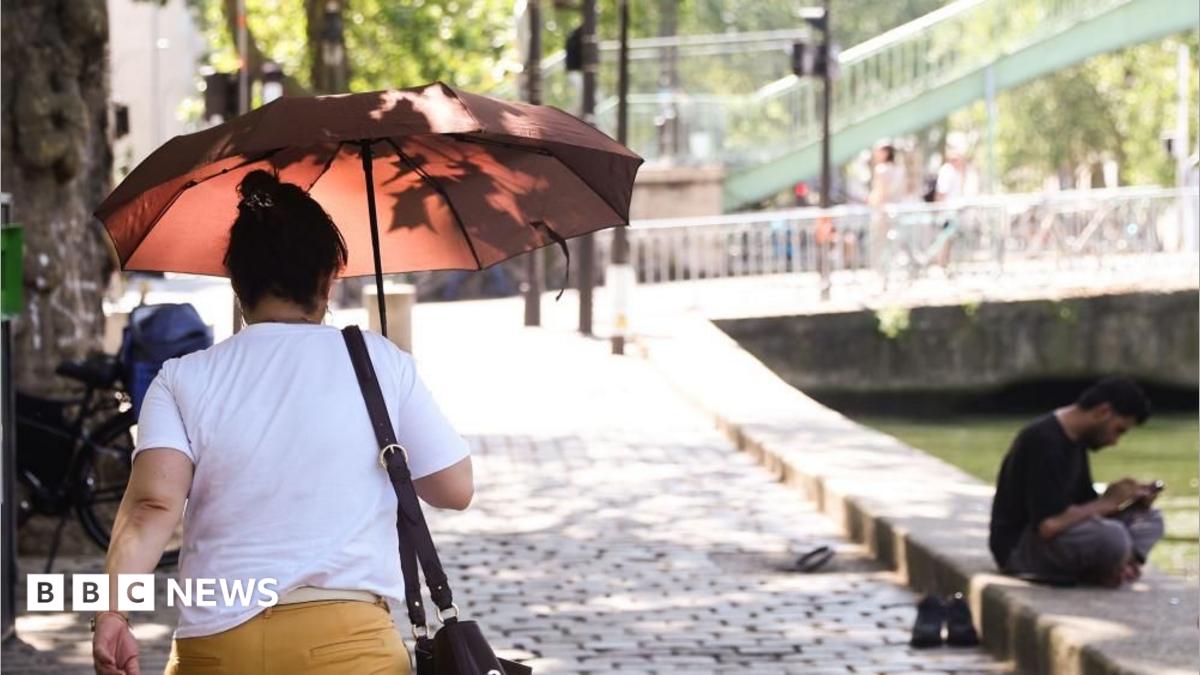
Louiza Ammari tries to protect herself from the blazing sun under an umbrella [Phineas Rueckert/Al Jazeera]
In France, there were 2,025 additional deaths during the last heatwave, the week of June 22 – a week-over-week increase of 30 percent nationwide and 62 percent in the Paris region, according to the national public health agency.
Extreme heat highlights existing inequalities, according to Bruno Villalba, a political science professor at AgroParisTech Paris-Saclay, specialising in political ecology and environmental policy.
“The heatwave is merely a symptom of social vulnerability, particularly in terms of housing,” Villalba told Al Jazeera.
Wealthier people can insulate their homes, afford a portable air-conditioning unit, eat fresh produce, or even leave the city for vacation when it gets too hot, options that are unavailable to many others.
“It’s up to the government to step in,” Villalba said.
“They tell us, ‘Stay hydrated, don’t stay in the sun, drink water,’” he said. “The French government did not sufficiently anticipate the acceleration of climate change.”
‘We are not all equally exposed’
There is a pervasive misconception of “universality” when it comes to climate deregulation, noted Mael Ginsburger, a lecturer at Universite Paris Cite focused on inequalities linked to the ecological transition.
Although experienced by everyone, more vulnerable populations have limited resources to mitigate heatwave conditions.
“We are not all equally exposed, just as we are not all equally responsible. There are significant inequalities in carbon emissions,” Ginsburger said. “Not everyone is equally capable of adapting, and there are certain groups that face multiple vulnerabilities linked to poor health, for example.”
Among wealthy households in France, 70 percent consider their homes properly insulated to combat heat, compared with 46 percent of lower-income households, according to Ginsburger’s research. More people report now suffering from heat in the summer – 66 percent – than cold in the winter, 46 percent.
“Overcrowded housing is much more likely to be in poor condition and have extremely poor insulation,” Ginsburger said. “These are populations facing a combination of overcrowding in dilapidated housing located in areas like Marseille and Lyon that are particularly vulnerable to heat.
“We’re sticking with this same approach of small steps rather than a structural approach that would actually require a more far-reaching overhaul of [building] infrastructure.”
For the homeless, the ramifications of heatwaves can be even worse.
“People who are outside don’t have a moment’s respite. They are suffocating in a concrete jungle where there is no simple, effective way to escape the intense heat. On asphalt, the perceived temperature can often rise to 45-50 degrees,” Paul Alauzy, at NGO Medecins du Monde, or Doctors of the World, told Al Jazeera.
He is a member of Le Revers, an activist group that formed during the 2024 Paris Olympics to bring awareness to the conditions faced by unhoused people in the Paris region.
“We’re asking for long-term policies designed to protect as many people as possible and reduce the number of people living on the streets, precisely to shield them from the harsh weather,” Alauzy said. “Once again, the authorities are stubbornly resorting to reactive, weather-dependent management.”
During heatwaves and cold snaps, French officials usually add a few emergency shelters and install temporary water stations.
“This is obviously not nearly enough,” Alauzy said.
Not all parks and natural spaces, essential for cooling down, are accessible to all.
“Trees, which are natural tools for regulating temperatures, have been effectively pushed out of our cities,” Villalba said, especially in deprived areas.
In places like Saint-Denis, schools and other public infrastructure are insufficiently equipped, said Ammari, the childcare worker.
‘Definitely an advantage to be at an altitude’
Even in the mountains, temperatures rose above 30C during the last heatwave, about 10C (18F) above normal end-of-June temperatures.
In Chamonix, the Bossons Glacier above town visibly shrank and conditions along popular routes up Mont Blanc and neighbouring peaks are becoming dangerous due to rockfall risks.
But nights are not stifling, and locals and visitors in the Alps sleep comfortably.
There are forested trails and a river fed by glacial melt that cools the surrounding area.
“In Chamonix, like in many mountain towns, it’s definitely an advantage to be at an altitude of 1,000 metres [3,280 feet] and to have the forest a few minutes from home,” Jean-Michel Bouteille, who recently retired from his role as director of municipal services in Chamonix, told Al Jazeera. “We’re a town of 9,000 people, but we still have nearby green spaces that are free and easily accessible.”
Although the mountain weather is not oppressive, climate change is felt in Chamonix.
“We have temperatures much higher than in previous years, which is leading to significant consequences. The Bossons Glacier is a disaster,” said Bouteille, who has lived in the valley for 26 years.
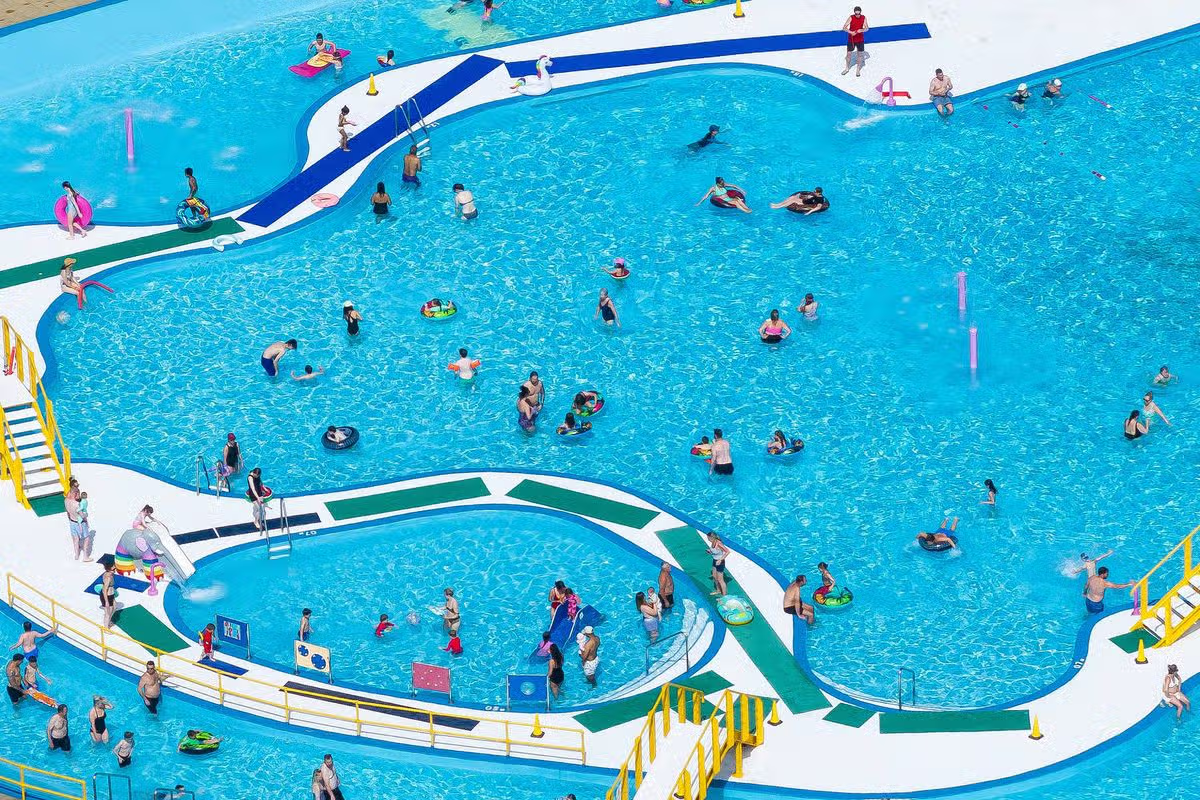
The lido is a beloved outdoor swimming pool for families, and with its Mediterranean-inspired design and 300-metre lazy river, it’s reminiscent of a luxury hotel pool abroad
This vast lido is the perfect place to cool off(Image: Dan Kitwood, Getty Images)
A lido that is often likened to pools found in Greece and across the Mediterranean has opened its doors for the summer season, just in time for the third expected heatwave to hit the UK.
The pool has been loved by local families ever since it first welcomed visitors in 1896, and nowadays draws tourists from far and wide too. It’s not difficult to understand why.
One glance at the lido, with its strikingly blue waters, splashpad and 300 metre-long lazy river, and you’d be forgiven for thinking you were lounging at an overseas hotel pool.
Yet this dazzling blue pool is actually tucked away in Kent, just over an hour from London. The Strand Lido in Gillingham also holds the unique distinction of being the only riverside saltwater pool in the entire UK.
Fed directly from the River Medway, the water is filtered and chlorinated to ensure it’s perfectly safe for swimmers of all ages. The Lido Guide wrote about the Strand: “Nothing about the exterior gives away what lies within. What lies within is a riot of Mediterranean-resort-style colour and fun. Any children in the party will be completely unable to contain their excitement.
“The whole thing is a freeform riot of bright white painted concrete, edged in royal blue, that gives the treated river water that fills the pool a hue that is more reminiscent of Greece than Kent.”
There are six 25-metre long lanes for swimming, alongside a paddling pool for toddlers and enjoyable extras such as water fountains. As the pool is unheated, it operates on a seasonal basis only, and it reopened for 2026 on May 23.
The pool then opens at weekends until the school summer holidays, when it operates daily before closing at some point in September. Tickets must be booked online through the Medway Council website to secure your spot at this much-loved pool.
During opening days, the pool offers two sessions: the first from 10.30am to 1.30pm and the second from 2.30pm to 5.30pm. There’s also a free to use Splash Pad in the park that has the same opening hours as the lido.
Alongside the pool itself, the complex boasts sunbathing and relaxation areas, a café serving food — though you’re more than welcome to bring a picnic and enjoy it in one of the park’s shaded spots — as well as play areas. There are changing rooms, poolside showers and a shop stocking inflatables, though you can also bring your own rubber ring.
The Strand Leisure Park is also home to a miniature railway that operates seasonally, trundling around the park on sunny days, along with plenty of riverside walks to explore.
One glowing review read: “We travelled from Suffolk and booked the afternoon session. Stopped for some lunch on the way. Lovely day out. Pool has a lazy river, kids pool and adult pool, changing rooms, toilets, café. Lots of space to set up camp for the afternoon but not a lot of shade.”
Another visitor commented: “Very good few hours. Looks like we are on holiday. Lazy river all around the outside (take a rubber ring). “
Have a story you want to share? Email us at webtravel@reachplc.com
Iran has marked the second day of funeral processions for its late Supreme Leader Ali Khamenei. Masses of supporters came to view his body despite a sweltering heatwave, with water misters installed at Tehran’s Grand Mosalla Hall and volunteers distributing cold drinks to mourners.
From World Cup watch parties to spa breaks and seaside getaways, guests can enjoy a slap-up breakfast on the house
This article contains affiliate links, we will receive a commission on any sales we generate from it. Learn more
Best Western has more than 200 properties across the UK(Image: Getty)
If this current heatwave has got folks fantasising about a proper summer getaway, they’re certainly not alone. There’s something about not having to make the bed or sort out breakfast that makes a morning on holiday feel infinitely more relaxing.
But with household budgets under pressure, finding a getaway that won’t break the bank is more crucial than ever. Hotel breakfasts alone can easily set a family back £40 or more per day, which is why Best Western’s latest summer offer really catches the eye.
Holidaymakers who book a break with Best Western before the end of July can bag a free breakfast for the duration of their stay. To help you capitalise on this, we’ve explored how a tasty start to the day can be teamed up with their newly launched “GEMS” (Great Experiences, Memorable Stays) packages.
READ MORE:
With the 2026 World Cup currently taking over our screens, attempting to host watch parties in a stuffy living room isn’t exactly appealing. With selected Best Western locations offering dedicated sports packages or lounge bars, escaping for a football-watching break could prove an inspired choice, reports Wales Online.
These convenient bundles combine a hotel room with local experiences, meals or added extras, making the entire trip simpler to arrange. Whether you’re sticking closer to home in Wales or venturing further afield, here are some of the smartest ways to maximise the offer this summer.
Enjoy a free breakfast at over 200 Best Western properties
Of course, the UK is also home to some of the finest golf courses in the world, and many Best Western hotels provide specially designed packages for golfers. Trade the confines of the office for the fairways with a package that includes your stay and course access.
If the summer heat is leaving you feeling more exhausted than energised, a spa package might be exactly what you need. Guests can enjoy a short break with accommodation and spa access, with optional treatments available at a selection of Signature Collection Hotels.
As temperatures rise, many Brits are drawn towards the coast. Best Western boasts a range of seaside hotels positioned along some of the UK’s most breathtaking coastlines, including Brighton, Blackpool, Newquay and Scarborough. Before venturing out to build sandcastles in the sun, a complimentary breakfast awaits.
City breaks are equally popular with families seeking entertainment during the summer holidays. With over 200 Best Western properties scattered across the UK, there are as many as 12 places to stay in London, with many more in sought-after destinations such as York, Manchester, Bristol and Edinburgh, offering numerous heritage and urban escapes.
With a growing number of Brits opting to holiday on home soil this summer, Macdonald Hotels is offering a range of breaks for golf enthusiasts and spa-goers, with discounts available at selected venues. For families seeking great-value getaways with entertainment and activities on their doorstep, Parkdean Resorts boasts more than 65 parks in coastal spots across the UK.
One guest who stayed at the Best Western Aberavon Beach Hotel described it as a “Brilliant hotel”, adding: ” A first class experience, pleasant stay, staff very helpful, rooms good, breakfast just what you want, good place to stay.”
Another traveller who opted for a more tranquil semi-rural stay near the Heritage Coastline chose the Premier Heronston Hotel and Spa, saying: “We were looking for somewhere to stay that was local to a beach and luckily this hotel is near Ogmore by Sea. We had a lovely, spacious room. We have 2 small children, and the hotel went above and beyond to help us with all our needs.”
A third guest who stayed at the upscale Best Western Lamphey Court Hotel and Spa remarked: “Absolutely spot on. The staff on arrival were excellent, kind and patient. Went out of their way to accommodate us. Nothing was hurried. Room was spacious and spotless. I wanted to take the bed home. Food in both restaurants was really good and breakfast although buffet style was all fresh ( I’m a fussy breakfast eater ) A perfect stay – trying to find an excuse to go back.”
Not every visitor was quite so enthusiastic, however, with one reviewer of the Pontypool Metro Hotel commenting: “The views from the hotel are not brilliant, however, everything else was very good. The room was spacious and clean and tidy. The staff were friendly and efficient. The lounge area was small but adequate. Breakfast was well-cooked and tasty. All in all a very satisfactory stay.”
A separate guest who stayed at the very same hotel offered a contrasting perspective, writing: “I came and stayed here when I was setting up a new retail store on the park. Safe car park, friendly staff. The bar is 24/7 which for me was great as I was working overnight shifts. Thank you for an easy stay, my partner and I are already planning to come back.”
The United States is about to celebrate its 250th birthday, but as millions across the country prepare to gather this weekend for parades, concerts and festivals, an intense heat wave has settled over much of the eastern US.
Officials across the region are warning that the extreme heat could pose serious health risks over the Fourth of July weekend.
Recommended Stories
list of 3 itemsend of list
Here’s what you need to know about how the weather will affect the celebrations.
What is America’s 250th anniversary?
It has been 250 years since the United States adopted the Declaration of Independence on July 4, 1776. Unlike a typical Independence Day, this year’s celebrations are unfolding on a much bigger scale, capping years of preparation and planning.
Landing in the midst of a highly polarised moment in American politics, planning for the anniversary has also been contentious.
A decade ago, Congress tasked a bipartisan commission known as America250 with organising the celebrations.
But last year, US President Donald Trump issued an executive order to put his own “Freedom 250” planning committee in charge of many of the anniversary’s marquee events, including the Great American State Fair on the National Mall.
Initially, a variety of musicians were announced as performers for the fair, including country singer Martina McBride, the soul group The Commodores and the pop duo Milli Vanilli. But many withdrew in late May and early June over concerns over the fair’s affiliation with Trump.
Last week, in lieu of the performers, the US president delivered a speech to open the fair, billing himself as the “Number One Attraction anywhere in the World”.
He has also promised to mark the July 4 holiday in Washington, DC, with “the most spectacular TRUMP RALLY of them all”.
The Department of Labor building in Washington, DC, displays US flags on the eve of July 4th festivities [Joe Raedle/Getty Images/AFP]
What will celebrations look like across the country?
Among thousands of smaller, locally organised celebrations nationwide — including historical reenactments, picnics, concerts and fireworks displays — some of the highest-profile events include:
Washington, DC: Hundreds of thousands are expected to arrive in the city, where the Great American State Fair will be held along the National Mall, the 2.5 km (1.5 mile) promenade linking the US Capitol to the Washington Monument. It will feature state pavilions, food, live music and a Ferris wheel. Trump has also promised “the largest fireworks show in history.” Around one million people attended the fireworks display for the US’s bicentennial anniversary in 1976.
Los Angeles: As part of its America’s Block Party event, America250 will hold a benefit concert hosted by Queen Latifah, featuring artists such as Chris Stapleton, Maren Morris and the Smashing Pumpkins.
Philadelphia: The city where the Declaration of Independence was signed is hosting one of the country’s biggest commemorations, including the burial of a 400kg (900 pounds) time capsule, containing artefacts from across the country, meant to be opened at the next semiquincentennial in 250 years.
New York: More than 40 tall ships are expected to sail into New York Harbour with almost 20,000 sailors aboard, while more than 200 aircraft fly overhead.
Boston: Celebrations will include the annual Boston Pops Fireworks Spectacular — a free concert followed by a fireworks display — and a public reading of the Declaration of Independence from the balcony where it was first read aloud to Bostonians in 1776.
How will the heat affect celebrations?
Some celebrations are already being disrupted, with organisers forced to adapt to extreme heat.
On Friday, the Great American State Fair temporarily closed as temperatures reached over 39 degrees Celsius (102 degrees Fahrenheit) in parts of Washington, DC.
But the capital was not the only area affected by the extreme heat.
In Philadelphia, for example, officials announced that the Salute to Independence Semiquincentennial Parade was cancelled, after initially planning to shorten the route to mitigate heat-related risks.
A celebration in Pennsylvania’s Lower Windsor Township was also rescheduled for July 8, while in nearby Norristown, officials cancelled another parade, citing safety concerns.
The heat is also affecting transportation. Amtrak announced several train cancellations in the northeast region and warned that other trains could face delays due to high temperatures, which can affect railway infrastructure.
“Extreme heat can cause rail, bridge and overhead wires to expand,” it said in a statement on Thursday. “As a precaution, Amtrak may enact heat restrictions, which can require locomotive engineers to operate trains at lower speeds, resulting in potential delays.”
What will it actually feel like outside?
While air temperatures in cities such as Philadelphia and Boston are expected to reach around 38 degrees Celsius (100 degrees Fahrenheit), high humidity can make it feel significantly hotter.
That’s because humidity makes it harder for sweat to evaporate and cool the body. Weather agencies use the heat index, often called the “feels like” temperature, to estimate what people will actually be experiencing.
Experts also warn that cities can become even hotter than forecasts suggest as concrete, asphalt and steel absorb heat.
“The number on your phone may actually not reflect the true temperature profile that you’re going out into,” Vijay Limaye, a climate scientist at the Natural Resources Defense Council, told The Associated Press.
What precautions are officials taking?
Aside from changing or cancelling some Fourth of July events, cities across the eastern United States are rolling out broader measures to help people cope with the heat.
In New York City, for example, more than 200 teams of government workers and volunteers are checking on homeless residents and directing people to hundreds of cooling centres, including public buildings, mobile cooling vans and outdoor sites equipped with misting fans.
Mayor Zohran Mamdani urged people to stay inside and avoid “extraordinary temperatures”. He also asked residents to set their air conditioners to 26 degrees Celsius (78 Fahrenheit) to avoid straining the power grid.
Boston is offering residents free admission to several air-conditioned museums, while Providence, Rhode Island, has extended hours at public pools and water parks.
How can people stay safe?
The National Weather Service (NWS) recommends drinking a lot of water, even if you don’t feel thirsty, especially if you’re spending an extended amount of time outside and taking hourly breaks in shade or air conditioning.
Health authorities also urge people to occasionally check in on seniors and other vulnerable populations.
Alcohol can make dehydration worse, so experts also recommend limiting drinking during long outdoor events.
Signs of heat illness include cramping, rapid pulse, heavy sweating, hot red skin, dizziness, confusion, nausea and vomiting, according to the NWS. If you see any of those warning signs, seek medical attention immediately.
A British expat living in Benidorm has shared the best time to visit Spain’s beloved seaside hotspot, ideal for those looking to avoid crowds while still enjoying perfect weather
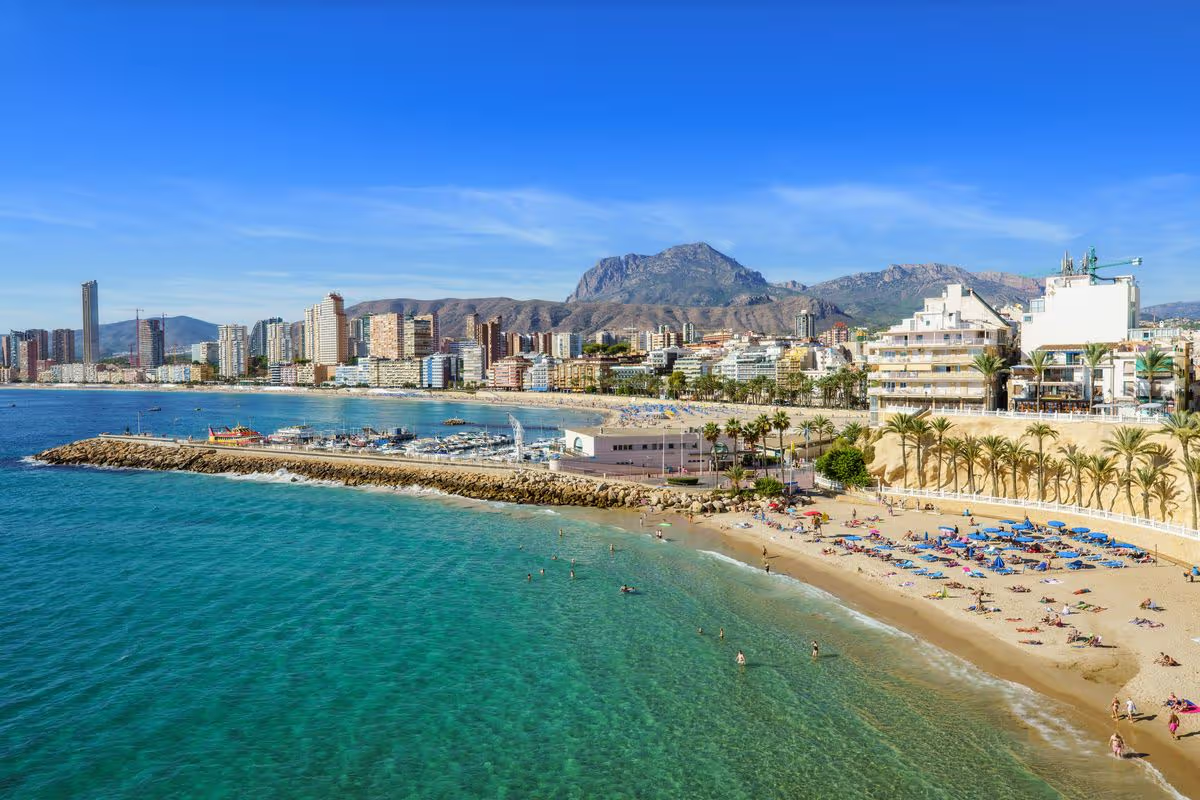
Benidorm is a popular holiday destination and one Brit who’s lived there for 30 years has shared the best time to visit (stock image)(Image: Sergio Formoso via Getty Images)
A British expat living in Spain has revealed the best time to visit the popular coastal hotspot of Benidorm in order to dodge the “crowds” and “chaos”.
Benidorm is a hugely popular seaside resort in Spain, renowned for its vibrant nightlife, vast selection of hotels and towering skyscrapers, golden sandy beaches, busy cafés and restaurants, and much more. It’s a firm favourite for countless hen and stag dos, while others sing the praises of its charming Old Town and the stunning natural, rugged coastline – a far cry from the images most commonly associated with the resort.
According to the annual report published by the Visit Benidorm Foundation, the destination welcomed just over three million visitors in 2025, a rise of 7.7 per cent on 2024’s figures.
The total number of overnight stays surpassed 16 million, an increase of 3.4 per cent on 2024’s bookings. It marked the first time in Benidorm’s history the resort had recorded such numbers.
Many Brits choose to up sticks and move to Benidorm for its reliably sunny skies all year round and a more laid-back way of life.
That’s certainly true of Geoff, who shares content on social media under the name “Benidorm Resort Expert”.
He bills himself as a “Benidorm Travel Expert” having lived and worked in the Spanish resort for 33 years, with his content centred on providing “deals, trips and advice” about life in the popular destination.
In a recent TikTok video, Geoff recommended visiting Benidorm during the cooler periods. Speaking directly to camera, he began: “Everyone wants Benidorm at its hottest but they’ve got it wrong. We’ve just had three days of red alert – this is the first time, ever, three days on the bounce and honestly, we’ve been melting out here.
Content cannot be displayed without consent
“But this morning, look at it. Temperature’s dropped five or six degrees, we’ve got a bit of cloud, there’s a gentle breeze and the sea, it’s like a mill pond.”
He continued: “No crowds, no chaos, no 40 degree heat bouncing off the pavement; just a calm morning, a bit of grounding, feet in the sand and literally the whole beach to myself.”
Geoff was full of praise for the tranquil early morning atmosphere on offer. He added: “The day hasn’t kicked off yet and this right here is the best bit of it – 24 degrees, sea like glass, and not a soul rushing anywhere.
“Forget the heatwave hype, this is when Benidorm is at its best.”
Benidorm isn’t the only destination grappling with scorching temperatures brought on by a heatwave, with Britain experiencing Spain-like conditions as record-breaking heat swept across the country.
However, this week the stifling temperatures have finally begun to ease across parts of the UK.
Met Office deputy chief forecaster Tony Wisson said: “Toward the weekend, high pressure will continue to build in across most of the UK as it extends from the Azores.
“This will lead to more settled, warm or very warm conditions for many, especially across England and Wales, though some rain may still affect the far north.”
He added: “The forecast for this weekend suggests that temperatures could approach high 20°C across parts of England, perhaps 30°C in parts of the southeast, with values of mid to high 20°C in Wales.
“Although a return to heatwave conditions is looking increasingly likely for some areas, the likelihood of such extreme high temperatures or high levels of humidity as last week is currently low.”
As parts of the UK are set to get warmer again this weekend, Brits should be aware of little-known beach rules
Many Brits will be heading to the beach this weekend(Image: Compassionate Eye Foundation/Richard Boll via Getty Images)
England’s south-west coastline is famed for boasting an abundance of beautiful beaches to discover. From breathtaking coves that can hold their own against Greece’s white sand shores, to Blue Flag-awarded stretches, the UK’s magnificent coast is difficult to surpass.
Blue Flag beaches are acknowledged for their exceptional levels of cleanliness and dedication to safeguarding the natural environment, but this is no simple achievement. Keeping the coastline in immaculate condition can prove quite demanding, particularly during the busy summer months when parts of the UK welcome a great number of visitors to its shores.
While some regulations are relatively straightforward to observe, and anticipated of those visiting the beach, particularly regarding staying safe on the shore, other regulations are enforced more rigorously.
Standard beach etiquette involves noting which flags are flying and refraining from entering the water in hazardous conditions, as well as not disturbing local wildlife during your visit.
It can also involve being considerate of fellow beachgoers by keeping music at a reasonable volume and remembering to collect your litter, but some regulations are, in reality, legally enforceable and could get you into trouble if breached, reports Devon Live.
For those with dogs, the Public Spaces Protection Order (PSPO) enables numerous local councils to implement seasonal limitations on dogs on beaches during peak periods, but other laws may take you by surprise.
Understanding the laws can prevent a relaxing day at the seaside from becoming a stressful, and expensive, outing. One seemingly innocent activity is in fact prohibited on British beaches and could result in a penalty of up to £1,000.
With the warmer weather this weekend and holiday season rapidly approaching, ecology specialists at Arbtech are urging beachgoers to bear in mind that taking pebbles, seashells or sand from British beaches is actually against the law.
Many visitors to the seaside might be tempted to slip a pebble into their pocket as a keepsake after a glorious day by the sea, yet what most people don’t realise is that this is illegal under the Coast Protection Act 1949.
Stones, shells and even items such as driftwood all play a vital role in maintaining coastal ecosystems, and removing them risks causing serious damage to these environments.
Arbtech’s Andrew Ward commented: “One person taking a pebble or shell may not seem like much, but when thousands of visitors are doing the same, it can have drastic impacts on the coastal environment. Over time, we could start to see increased erosion, the loss of natural sea defences, and disruption to habitats that many species rely on.”
Local councils are responsible for enforcing this rule, particularly at popular tourist destinations where the problem has previously occurred.
Andrew added: “The law is clear and it’s not just there to spoil any fun. It’s a reminder that beaches are protected for a reason. We all have a role to play in preserving the environment so that it can continue to thrive for generations to come.”
While gathering seashells may bring back fond childhood memories and look charming on a windowsill, these natural treasures are essential for providing microhabitats to a wealth of local wildlife. Capturing a photo of the beach on your phone or camera is a far safer, and most likely more affordable, way to preserve the memory of the UK’s stunning coastline.
THOUSANDS of people have been evacuated across the south of France due to huge wildfires across the region.
Along with flights being forced to divert, we’ve explained everything you need to know.
Sign up for the Travel newsletter
Thank you!
Wildfires have spread across the south of France, resulting in evacuations and flight diversionsCredit: EPASmoke seen over Canet en Roussillon which was evacuatedCredit: Alamy
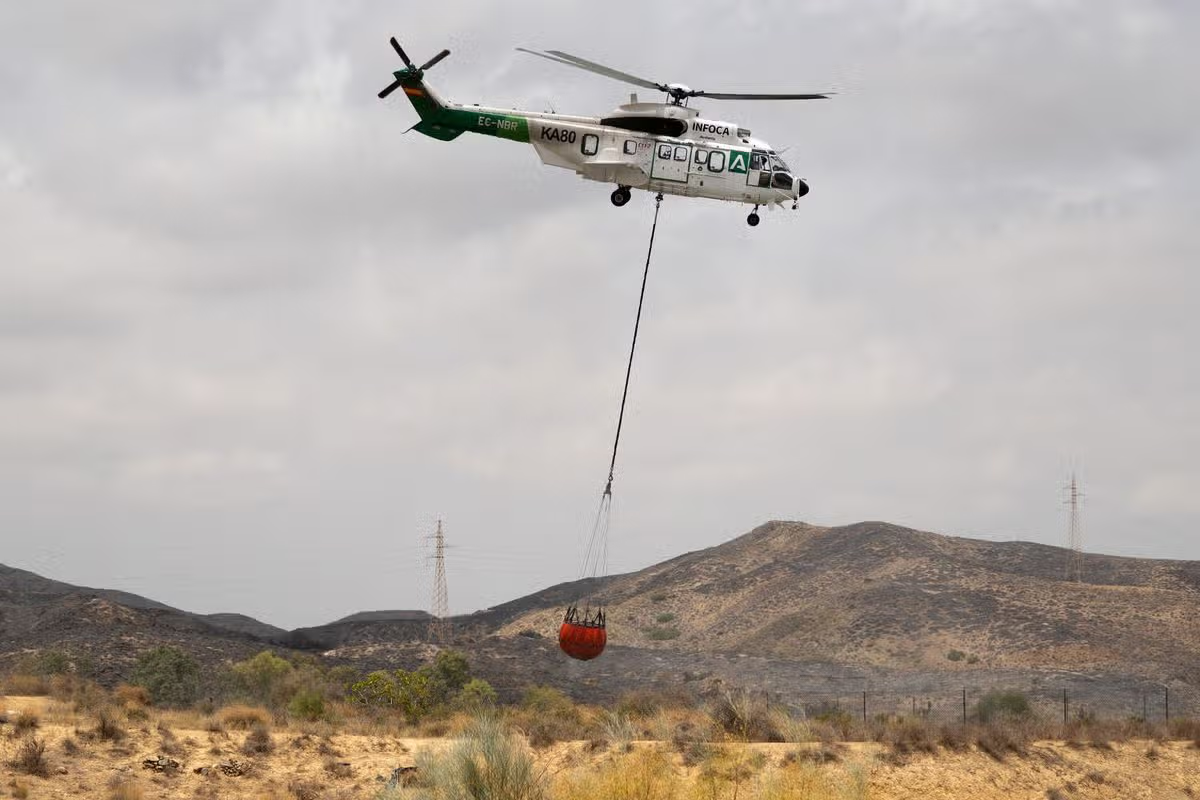
Emergency services including water-dropping helicopters and firefighters have been deployed, with more than 3,000 people evacuated, after highs of 44C have been reported.
The blaze in France is believed to have been sparked by a discarded cigarette butt.
Officials have spent much of the summer battling with wildfires in France, with over 9,000 reported along the Mediterranean coast.
BBC Weather says a large area of high pressure is currently building from the Azores towards Portugal and Spain and that by the weekend, heat is forecast to climb across France and southern Britain.
And as Europe braces for sweltering conditions, millions of Americans celebrating the July Fourth holiday weekend are already being affected by prolonged extreme heat and high humidity in parts of the central and eastern US.
Climate change is driving up temperatures around the world – but particularly in Europe. It is the fastest warming continent, heating up twice as fast as the global average, according to the Copernicus climate service.
This is causing increased summer heatwaves, greater pressure on Europe’s water supply, and more intense wildfires.
This summer’s record-breaking temperatures have already proved particularly deadly.
The number of deaths recorded between 22 and 28 June increased by 2,025 – 29% -in France, the Public Health France agency announced on Friday. Deaths rose by 62% in the Paris region alone.
It said the figure was likely an “underestimate” and mortality would “therefore be higher than these initial figures”.
Drowning deaths soared during the heatwave, with French Interior Minister Laurent Nuñez saying on Saturday that 72 people had died by drowning since 18 June.
Meanwhile, unprecedented heat in the Netherlands last week led to about 480 excess deaths, Dutch authorities said on Thursday – most of whom were aged 80 and older.
Temperatures reached almost 40C in parts of the country, with most of the deaths reported in the south and east of the Netherlands where temperatures were highest.
While the Netherlands is expecting a cooler week ahead, hot weather is predicted again over the weekend elsewhere.
Temperatures are forecast to reach 40C in the south of France, with peaks of 36C to 37C expected around Bordeaux, Toulouse and Agen.
Météo-France has issued red alerts for Friday and Saturday for forest fires in the southern part of the country, warning that weather conditions meant the risk outbreak was “very high” compared to summer norms.
On Thursday, Prime Minister Sebastien Lecornu said nearly 7,000 fires had broken out since the start of the summer season, with about 8,700 hectares burned so far.
Nearly 3,000 people were evacuated after a wildfire ignited in the town of Sainte-Marie-la-Mer and spread to Canet-en-Roussillon on Thursday.
In the Iberian Peninsula, Aemet weather service has warned of the possibility of another heatwave.
Portugal’s government declared a state of alert which will remain in place until midnight on Tuesday. Temperatures are forecast to exceed 40C in some areas, with overnight temperatures above 25C.
In Spain, areas of the southwest are on orange alert as 40C is expected in some parts.
An intense heatwave is set to blanket much of the central and eastern United States this week as a “heat dome” settles over the region, bringing days of oppressively high temperatures and humidity ahead of the Fourth of July weekend and FIFA World Cup matches in several US cities.
Forecasters say in some places it could feel as hot as 46 degrees Celsius (115 degrees Fahrenheit). Dozens of temperature records could be broken, according to the National Weather Service (NWS), which called the conditions “dangerous”. More than 60 million people are currently under heat alerts.
Recommended Stories
list of 4 itemsend of list
At the centre of this week’s forecast is a weather phenomenon known as a heat dome. What is it, and why does it make heatwaves even more intense and unbearable?
What is a heat dome?
A heat dome is a large area of high pressure, formed when warm air flows northward, that acts like a lid over the atmosphere, trapping hot air close to the ground.
As the air sinks, it compresses and warms even more. At the same time, the pressure system helps prevent cooler air and storms from moving in, allowing heat to build at the surface and remain trapped there. With few clouds and little wind, the sun has more direct access to the ground, creating a heat feedback loop.
Heat domes are linked to prolonged heatwaves that can last for days.
How long will it last?
The heat dome is already building and is expected to strengthen over the coming days, spreading from the central US towards the east coast, with dangerous heat lasting several days into early July.
The hottest conditions are expected Thursday and Friday, according to the NWS, and are set to continue through the Fourth of July weekend, which marks the 250th anniversary year of the US, and forecasters say some areas across the Great Plains, the southeast, and the mid-Atlantic are likely to remain unusually hot into next weekend.
What will the highest temperatures be?
Many places are expected to see daytime temperatures in the high 30s Celsius (low 100s Fahrenheit), but humidity will make it feel much hotter. In parts of the central and eastern US, the heat index – a measure of how hot it feels when humidity is factored in – could climb between 40C and 46C (100F and 115F).
“That’s heat that’s impactful to anyone,” said NWS meteorologist Bryan Putnam. “It’s not just older adults or younger children or people who are spending a ton of time outdoors, maybe straining themselves a little more than normal. This is heat that really could impact everyone, especially with people outdoors going into the holiday weekend.”
The nights won’t bring much relief either, with temperatures expected to stay in the 20s Celsius (70s Fahrenheit) overnight, creating potentially miserable sleep conditions for those without air conditioning and making it harder for people to cool down.
“Even after the sun goes down, it’s still going to be very hot,” said AccuWeather senior meteorologist Alan Reppert. “We’re at a pattern that’s really going to be hot during the good portion of the afternoon and even into the evening hours.”
Which parts of the US will be hit the hardest?
The most dangerous conditions are expected in a broad corridor stretching from the Great Lakes to the East Coast, where several cities could experience their hottest day of the year so far. New York City, Philadelphia, Washington, Baltimore, Chicago, Indianapolis, Detroit and St Louis are all expected to be affected, with temperatures also soaring farther south in Dallas, Little Rock and Memphis.
Several of those cities are also hosting FIFA World Cup events. In Philadelphia, organisers have already changed Fan Festival hours to start later in the day.
Cities across the US are rolling out emergency measures as temperatures climb.
Chicago said it would open cooling centres and send city workers to check on vulnerable residents.
In New York City, Mayor Zohran Mamdani’s office announced what it called an “unprecedented” response to the heat, including hydration vans and pop-up cooling stations equipped with misting fans and cooling towels.
Washington, DC, where temperatures are expected to exceed 38C (100F) from Thursday through Saturday, the heat will coincide with Fourth of July celebrations, including what organisers say will be the largest fireworks display ever held on the National Mall.
What are some ways to stay cool?
The NWS says people should stay hydrated, avoid strenuous outdoor activity during the hottest part of the day and seek air conditioning or cooling centres where possible. If you’re spending time outside, wear loose, lightweight clothing and stay near shady areas.
Experts say one of the biggest risks during a prolonged heatwave is that the body doesn’t have time to cool down overnight, which can make the effects of the heat build up from one day to the next. They also recommend drinking water before you feel thirsty and limiting alcohol, which can increase the risk of dehydration.
“If somebody realises that they’re hot, but they’re not sweating, or if they begin to feel a little bit dizzy, those are some signs that they really need to take a break, get inside, find some cooling, and drink plenty of water,” said Geoff Cornish, assistant chief video meteorologist for the weather forecasting company AccuWeather. “And if they really begin to experience significant symptoms, they need to seek medical attention right away.”
Grid operators warn the US heatwave could send electricity demand near record levels before the Fourth of July holiday.
Power grid operators in the United States are warning that a dangerous heatwave could put more strain on an electric grid already under pressure from surging energy consumption.
A stretch of extreme heat is expected to intensify across much of the central and eastern parts of the country this week, peaking from Tuesday through Thursday.
Recommended Stories
list of 3 itemsend of list
That heatwave is likely to continue through one of the busiest travel weekends of the year, as millions of Americans prepare for Fourth of July celebrations on Saturday.
Temperatures this week are forecasted to climb above 38 degrees Celsius (100 degrees Fahrenheit) from Boston to Washington, DC, pushing up demand for air conditioning.
The heatwave coincides with two major events on the US calendar. Saturday’s holiday marks the 250th anniversary of the US’s independence, and millions are expected to gather for barbecues, parades and fireworks.
The extreme temperatures also come as the FIFA World Cup has reached the knockout stage, with many host cities, including New York, Boston, Philadelphia and Washington, expected to feel the heat.
Humidity could push the heat index as high as 46 degrees Celsius (114 Fahrenheit) in some places, while overnight temperatures will offer little respite.
The US’s largest regional grid operator, PMJ Interconnection, is forecasting record summer electrical demand of 166.3 gigawatts for Thursday evening, surpassing the previous summer peak set two decades ago, in 2006.
The New York Independent System Operator (NYISO), the state’s grid operator, is also expecting electricity demand to approach record highs, while the Midcontinent Independent System Operator (MISO), which covers 15 states in the Midwest and South, could also see its peak demand record challenged.
Authorities at MISO say they will rely on PMJ for support in covering consumer needs.
In a May report, PMJ’s executives warned of a “fundamental mismatch between how fast demand is growing and how quickly new supply can be built and connected to the grid”.
New power plants, they said, now take twice as long to build and cost twice as much as they did a decade ago.
Meanwhile, there has been increasing pressure on electrical grids from new technology like data centres and electric vehicles.
In May, PMJ said hyperscale data centres were “adding load at an unprecedented pace”.
Experts say the artificial intelligence (AI) boom is colliding with climate change, with tools like ChatGPT, Gemini and Claude being processed in vast, energy-hungry data centres.
The most energy-intensive are the hyperscale facilities that require between 100 and 300 megawatts of electricity, enough to power hundreds of thousands of homes.
Many of those are concentrated in northern Virginia, which sits within PJM’s service territory and is widely described as the world’s largest data centre hub.
Researchers have also identified what they call a “data heat island effect”, finding that land surface temperatures around AI data centres rise by an average of 2 degrees Celsius (3.6 degrees Fahrenheit), with some locations seeing increases of up to 9 degrees Celsius (16.2 degrees Fahrenheit).
The National Weather Service in the US warns that long periods of extreme heat create significant stress on the body.
It has urged people to limit outdoor activity, stay hydrated and keep close to air conditioning or cooling centres.
A 2024 report from the Journal of the American Medical Association (JAMA) found that 21,518 deaths in the United States from 1999 to 2023 were heat-related.
The highest number came in the final year of the report’s analysis, 2023. That year, 2,325 people died from causes attributed to high temperatures.
Hollyoaks star Haiesha Mistry, who played Yasmine Maalik on the Channel 4 show from 2017 until 2024, has landed a completely different kind of job two years after quitting the soap
20:31, 28 Jun 2026Updated 20:31, 28 Jun 2026
Hollyoaks star Haiesha Mistry has landed a new job away from the TV industry(Image: Lime Pictures)
Hollyoaks star Haiesha Mistry has landed a “normal job” two years after quitting the soap. The actress, 32, played Yasmine Maalik on the Channel 4 show from 2017 until 2024 and was part of several major storylines, even winning the British Soap Award for Best Single Episode in 2018 when her character was involved in a group self-harm plot.
But now, Haiesha has taken to social media to reveal that she has now found employment in a secondary school, although she did not go into too much detail about her new role.
Alongside a mirror selfie taken during the heatwave, she wrote on Instagram: “Spent the last 2 days working in a high school during the hottest days of the year.”
As part of her departure storyline, Yasmine decided to accept a new job in Canada, leaving the village and her husband Tom Cunningham behind after months of drama. Yazz had been talking to someone online unaware it was Tom pretending to be ‘Gordon’. He was gutted when he realised she had no idea it was him, and the pair clashed.
Tom then cheated on Yazz with his ex and her best pal Peri Lomax, while Yazz also kissed another character. But the biggest betrayal came when she was offered a huge job in Canada and Tom sabotaged it, or at least tried to.
Not wanting to lose her, Tom emailed the potential employer and pretended to be Yazz. He declined the job opportunity and did not tell his wife what he had done.
Yazz found out via the employer though, and confronted Tom during the vow renewal where she announced she wanted a divorce. She then confirmed to her loved ones that she planned to take the job and leave for Canada.
In sad scenes, the character said her goodbyes to her mother Misbah and her friends and family. She then had a final goodbye with Tom as they made amends, with Yazz getting into a taxi and starting her new life away from the village.
Hollyoaks marked Haiesha’s on-screen acting debut and whilst she took a break from the soap in 2021 to shoot the short film Mug, she has not appeared in any other television projects since she left completely.
When her exit scenes aired, Haiesha reflected on her time on the programme with an emotional Instagram post.
She said: “That’s a wrap. 2017-2024 7 years of Yazz Maalik/Yazz Cunningham complete! Yazz you have been my pride and joy for the last 7 years. You’ve taught me so, so much. I will never forget your sass! Especially in the last 2 episodes!
“Unmatched at every level! To the iconic beehive, all the creative hairstyles or the outfits that screamed sass, especially that ‘big bird’ yellow fluffy jacket! “Our make-up and costume ladies will know, the way I would go, ‘OH HERE SHE IS, YAZZ IS HERE’, you brought so much life and served looks every damn time!
“I’ve had so many incredible storylines over the years. Whether it’s the car crash stunt, school explosion, the tunnel of terror, the self-harm storyline, Yazz’s deafness, the historical rape or the ectopic pregnancy storyline to name a few. “Being on the show has taught me how important it is to tell stories and represent, especially that BROWN GIRL REPRESENTATION!
“To the Hollyoaks fans, the best there is. Thank you for loving and hating on Yazz. When I got those reactions, I knew I was doing my job right. It’s been a pleasure to keep you entertained. “Being part of the Hollyoaks family is something I will cherish forever but as the saying goes, all good things have to come to an end. Peace out Yazz.”
However on Sunday, in a post on X, formerly Twitter, Spain’s Ministerio del Interior has issued a warning to visitors. The Ministry of the Interior of Spain (Ministerio del Interior) is the executive government department responsible for public safety, law enforcement, national security, civil protection, and the country’s prison system and overseas domestic policy.
It is keen to raise awareness that crime is an issue when on holiday just as it is back in the UK. In its post it said: “You’re away for a few days, but your safety doesn’t go on vacation. Before leaving the car parked:
Remove valuables
Don’t leave documents visible
Choose well-lit and busy areas
Save the vehicle’s location
It added: “Prevention is the best protection.” The warning came as Spain, along with much of the rest of Europe, basks in a heatwave.
Content cannot be displayed without consent
The Ministry, in a separate post, had other advice for people to help them stay safe. It said: “In the forest, every gesture counts.
“Don’t throw away cigarette butts or matches. Don’t make fire outside of authorised areas. Don’t abandon flammable waste.” It added: “With heat and wind, the risk increases. A small oversight can turn into a big fire.”
The Foreign Office in the UK (FO) also has advice for holidaymakers and other visitors to the country. It warned of a number of different types of crime in the country including street and vehicle crime to drink spiking and sexual assaults.
Street crime
The Foreign Office warned: “Be alert to the risk of street crime. Thieves use distraction techniques and often work in teams. Take care of your passports, money and personal belongings, particularly when collecting or checking in luggage at the airport, and while arranging car hire.
“Do not carry all your valuables in one place. Keep a copy of the photo page of your passport somewhere safe.
“Make sure your accommodation has adequate security. Keep all doors and windows locked. If you’re concerned about the security of your accommodation, speak to your travel operator or the property owner.
“The Spanish Police and Civil Guard have a mobile app which offers a number of services, including simple and discreet communication with police forces if you experience or witness a crime – more information can be found on the ALERT COPS webpage.”
Vehicle crime
‘Highway pirates’ target foreign-registered and hire cars, especially those towing caravans, warns the FO. “They may flag you down, claiming there is something wrong with your car or that you have damaged theirs. If you decide to stop to check the condition of a vehicle, stop in a public area with lights, such as a service station. Be wary of anyone offering help.
“When driving, be wary of approaches from people posing as plainclothes police in unmarked cars. In all traffic-related matters, police officers will usually be in uniform. Unmarked police vehicles have a flashing electronic sign on the rear window saying ‘Policía’ or ‘Guardia Civil’. Genuine police will only ask you to show vehicle documents – not to hand over your bag or wallet.”
Attacks and sexual assault
Attacks, including sexual assaults, are rare but do occur, avised the FO. “In an emergency call 112. Avoid splitting up from your friends, do not leave drinks unattended and do not go off with people you do not know. Save the location of your accommodation on your maps app, so it’s easy to find.”
Drink spiking and alcohol
The FO said: “Be alert to the possible use of ‘date rape’ and other drugs including GHB and liquid ecstasy. Buy your own drinks and always keep them in sight to avoid them being spiked.
“Alcohol and drugs can reduce your vigilance, making you less in control. If you drink, know your limit. Drinks served in bars in Spain are often stronger than those in the UK.”
Scams
“Thieves posing as police officers may ask to see your wallet, claiming they need to see it for identification.” it warned. “Genuine police officers will ask to see ID but will not ask for wallets or purses. All police officers, including those in plain clothes, carry official ID.”
Timeshares and holiday clubs
The FO said: “Be cautious if you are planning to buy or sell a timeshare. There are companies who offer false incentives.”
The warning comes as the country has faced hazardous conditions this week
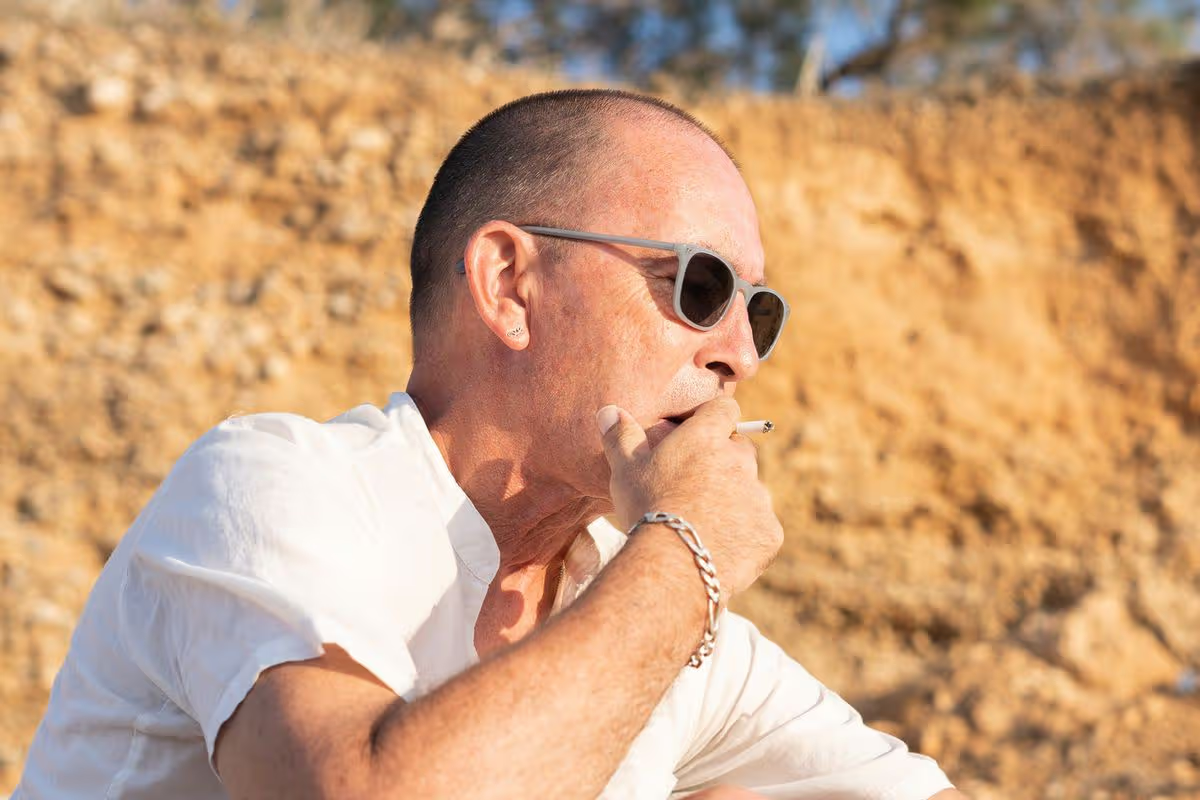
The alert includes a warning for cigarette smokers (stock image)(Image: Getty)
Spain’s Ministerio del Interior has issued a warning to anyone in the country, including visiting tourists, as hot weather bakes the country. This week, the European nation faced unprecedented, record-setting heat.
The country was caught in a severe and hazardous heatwave caused by hot air travelling north from the Sahara Desert. These extreme temperatures broke long-standing weather records and led to widespread red alerts, especially in the northern and central parts of the country. Temperatures soared past 45C in some areas of northern Spain at the beginning of the week.
The northern region of Cantabria broke its previous heat record, hitting an incredible 43.7C in Tama. Bilbao Airport recorded temperatures over 40C on three different days (Sunday, Tuesday, and Wednesday). This is a historic first for the region: reaching this level three times in one year.
On Thursday, June 25, temperatures began to drop, and there was some rain and thunderstorms in parts of the northern and central plains, including Madrid. However, high temperatures are still sticking around.
Places like Andalusia and cities such as Seville and Córdoba are experiencing usual summer highs. Temperatures are rising back up to 37C to 38C as the weekend comes to a close.
Content cannot be displayed without consent
The Ministerio del Interior translates as the Ministry of the Interior (also known as the Home Office or the Ministry of Internal Affairs). This government cabinet department handles domestic policy, public safety, law enforcement, immigration, and civil protection.
Taking to X on Sunday, June 28, the ministry urged people to avoid doing three things for safety reasons. It said: “In the forest, every gesture counts.
“Don’t throw away cigarette butts or matches. Don’t make fire outside of authorised areas. Don’t abandon flammable waste.” It added: “With heat and wind, the risk increases. A small oversight can turn into a big fire.”
Has Spain experienced wildfires this week?
This week, Spain has been hit hard by a serious wave of wildfires after experiencing its first big summer heatwave. The temperatures soared above 45C in the south and reached up to 43C in the north.
These extreme heat levels, along with dry weather and lightning strikes, have led to several devastating fires. One major wildfire erupted between Tamarite de Litera and Alcampell, consuming more than 4,000 hectares of land. It is thought that a harvesting machine started the fire, which resulted in the evacuation of around 240 people from three nearby villages.
Is Spain prone to wildfires?
Spain faces a significant risk of severe wildfires during hot weather, ranking it among the most fire-prone countries in Europe. The mix of intense summer heatwaves, extended periods of drought, and powerful winds results in “tinderbox” conditions that enable fires to start and spread rapidly.
Data from the Ministry for Ecological Transition in Spain reveals that human activity is responsible for the majority of wildfires. More than half of the annual fires in Spain are deliberately set, and a significant portion is due to accidents or negligence, such as mismanaged agricultural burning, cigarette butts that are carelessly thrown away, or barbecues.
The UK is home to some of the most beautiful seaside towns, but one stands out for a key reason
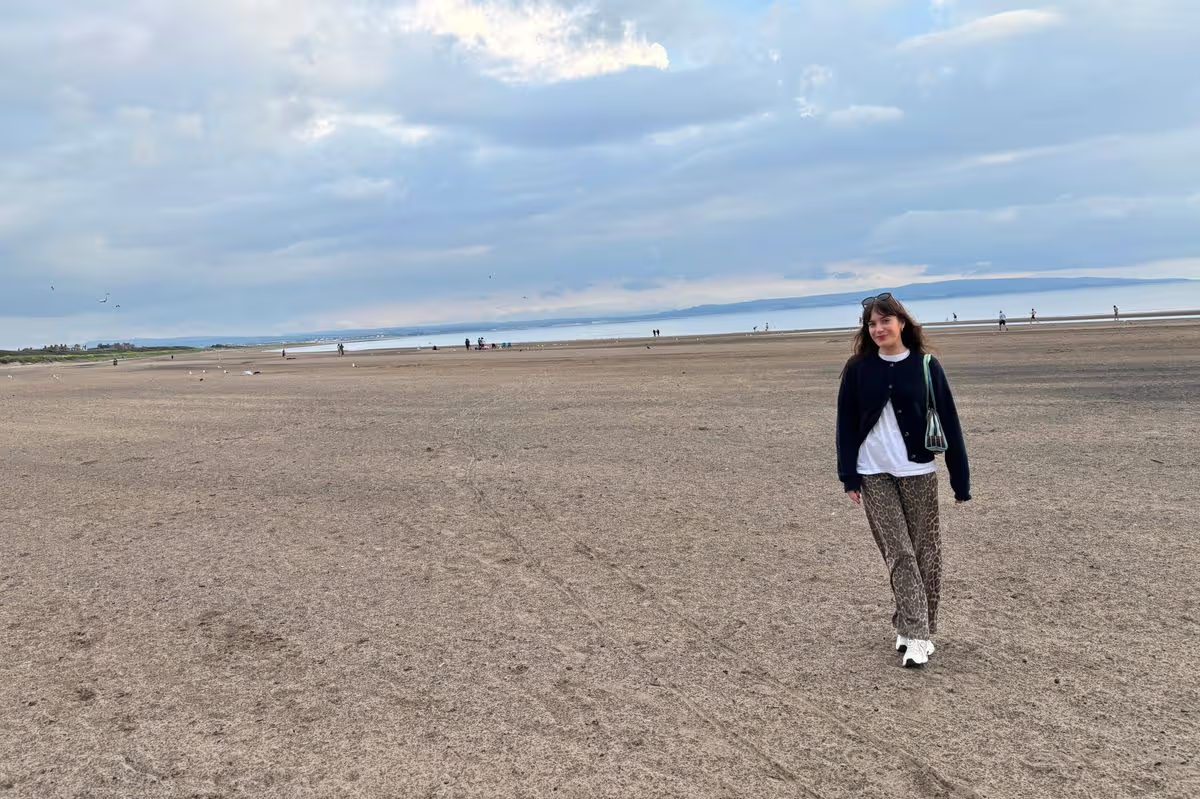
The small beach town is perfect to visit in summer(Image: Nicola Roy)
The UK has been so hot this week that I made three trips to the beach in seven days, despite not living particularly close to one. Still, an hour or so’s drive is a small price to pay when there’s a brilliant day or evening by the sea waiting for you.
I’m aware the pleasant weather won’t stick around, which explains my eagerness to spend as much time outdoors as I can. Of my several seaside trips, one location really caught my attention for one particular reason — the food.
Troon, roughly 45 minutes from my home city of Glasgow, proved the ideal spot to spend a warm evening as the heatwave drew to a close.
It’s been over six months since I last went to Troon, which was on a bitterly cold and snowy January day. This week’s outing couldn’t have been more different. After finishing work one evening, we hopped in the car and made our way down to the coastal town overlooking the Firth of Clyde, with one clear goal in mind.
Despite Scotland’s heatwave coming to a sudden halt during the day with a torrential thunderstorm, the sun managed to emerge once more as we strolled along the shoreline. Likely due to the earlier weather, it was pleasantly peaceful, with just a handful of people wandering about on the sand.
While it was lovely to be able to walk on the beach without the bitter wind battering us like last time, the stroll was fairly brief, as it was time to head up to the harbour to get some food. We finally managed to make it to The Wee Hurrie for dinner.
The Scottish fishing fleet had been tied up back in January so it hadn’t been open, which although was our own fault for not checking, still put a major dampener on the day — especially given the icy cold weather.
This award-winning chippy is renowned for its fresh seafood and its prime spot right on the harbour. And it was 100% worth the hype, being one of the best meals I’ve ever had the pleasure of eating.
The scampi was incredibly fresh, coated in a delicate batter that left me feeling neither bloated nor uncomfortable afterwards — a genuine rarity for a chip shop. Choosing just one dish was actually really hard, given how varied and imaginative the menu is.
Where else would you find fritto misto, noodles and lobster all on the same menu?
It arrived alongside a gorgeous tartare sauce and a wedge of lemon, generously seasoned with salt and vinegar. Despite being light and crispy, it was wonderfully filling and satisfying, and the portion sizes were spot on.
At £14.30, it was worth every single penny, and I genuinely can’t stop thinking about it.
It’s a takeaway so you can’t sit in, but loads of people were queuing up to order before taking it home in their cars. We ate standing up outside the shack, which I think says everything about how tasty it was.
The food may have been our main reason for heading to Troon that evening, but with the weather still pleasantly warm after we’d finished eating, a stroll down the high street seemed the perfect way to round off the night.
By this point it was around 7pm, so many of the smaller independent shops and cafes had shut up for the day, but the pubs appeared reasonably busy, with people popping in and out of takeaways, restaurants, shops or simply strolling about as we were.
If I hadn’t been driving, I would have definitely nipped into Lido on the high street for a couple of drinks, but sadly it wasn’t to be on this occasion.
It was a shorter visit than previously, but far more enjoyable thanks to the delicious food and the beautiful evening sunshine. Whether you’re in the area with a few hours to spare, or travelling from further away, Troon is a wonderful place to explore.