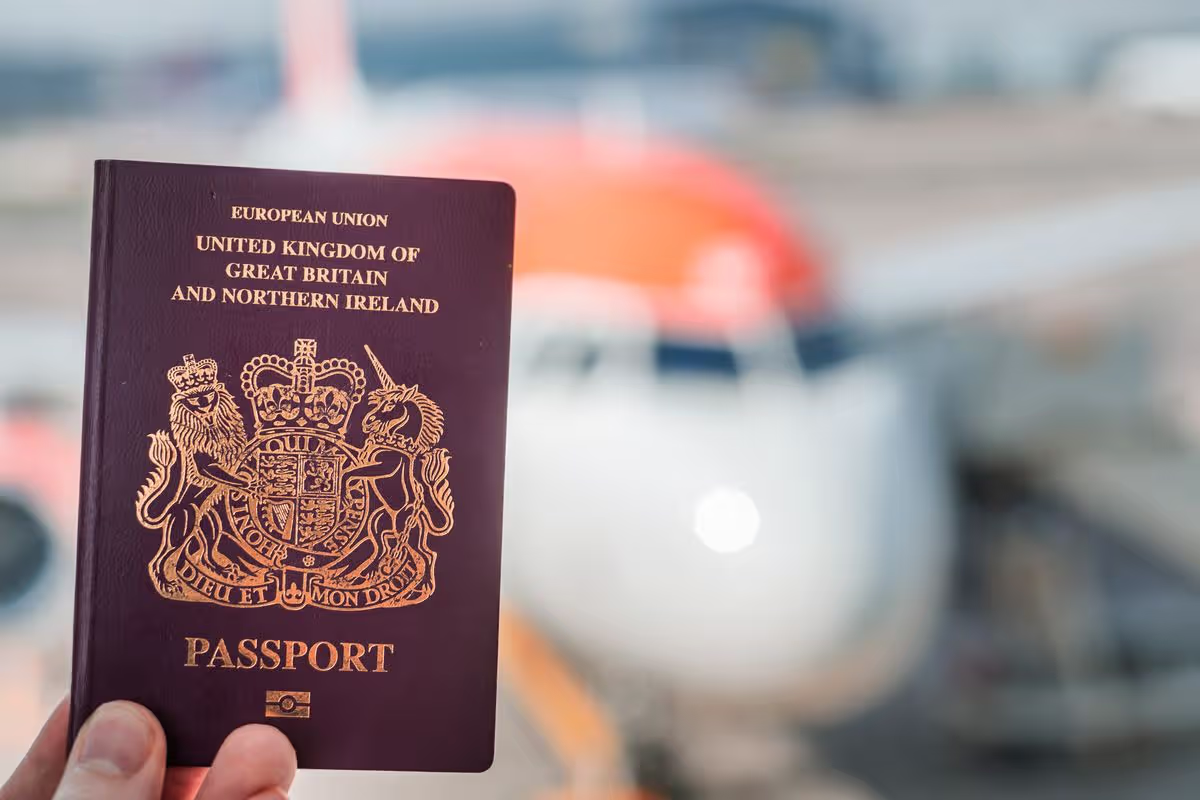
Passengers no longer need to make connecting flights as the new service is set to start from July 23, the first of its kind on a route to and from Manchester Airport
Rachel Vickers-Price UK and World News Reporter
07:58, 09 Jun 2026
New airfares between England’s north and Saudi Arabia will soon be on offer(Image: Getty Images)
A major airline has announced it will be running a new direct service to a major capital city from Manchester Airport.
Riyadh Air will launch the service between the Saudi Arabian capital and Manchester from July 23.
Flights direct to Riyadh will operate three times a week, making one of the first direct links between the Saudi Kingdom and England’s north in decades. Many passengers have been forced to rely on connecting flights through European hubs or other Gulf airports – until now.
As per Riyadh Air, the airline will run the route on Tuesdays, Thursdays and Saturdays, with flight RX417 leaving Riyadh King Khalid International Airport at 1.45am local time before arriving into Manchester at 6.40am. The return service, RX418, will depart Manchester at 8.40am and land back in Riyadh at 5.20pm local time – right on time for the dinner service.
Riyadh Air told travel news website Travel and Tour World that the route has been designed to appeal to both business and leisure passengers, offering faster and more convenient travel between the Middle East and England’s north. The new direct service will mean business travellers will be able to attend meetings in Riyadh without overnight layovers, and holidaymakers can travel to Saudi Arabia without the need to make a connecting flight. Additionally, the flights will make use of Riyadh Air’s Boeing 787-9 Dreamliner aircraft, which feature wider seating, advanced lighting systems, and nifty travel technology designed to reduce jet lag on long-haul journeys. Riyadh Air said the new Manchester flight path forms part of Saudi Arabia’s wider Vision 2030 strategy, which aims to grow tourism, strengthen global connections, and expand the country’s aviation sector. Riyadh Air, which was founded in 2023, plans to grow its fleet of more than 100 aircraft over the next decade, while also aiming to connect travellers to more than 100 international destinations.
The Manchester route is among the first international services planned as part of the national airline’s wider summer 2026 expansion programme, with new connections also flying out of London.
The additional fares come as travel between the UK and Saudi Arabia continues to increase, with weekly seat capacity surging by up to 150% in recent years to meet rising business and tourism demands. Riyadh Air is now the only aviation firm to expand flight offerings and launch new direct routes between major British and Saudi airports, with British Airways recently boosting its London Heathrow to Riyadh service to up to 14 weekly flights and its Jeddah (JED) route to five flights per week. Wizz Air and Virgin Atlantic have also launched direct routes connecting Gatwick and Heathrow airports to cities like Medina, Riyadh, and Jeddah.
EXCLUSIVE: A new book charts the extraordinary history of British Airways, inclduing its unusual first passenger flight, its unique link to Marmite, royal fans, and some questionable fashion
10:05, 07 Jun 2026Updated 10:06, 07 Jun 2026
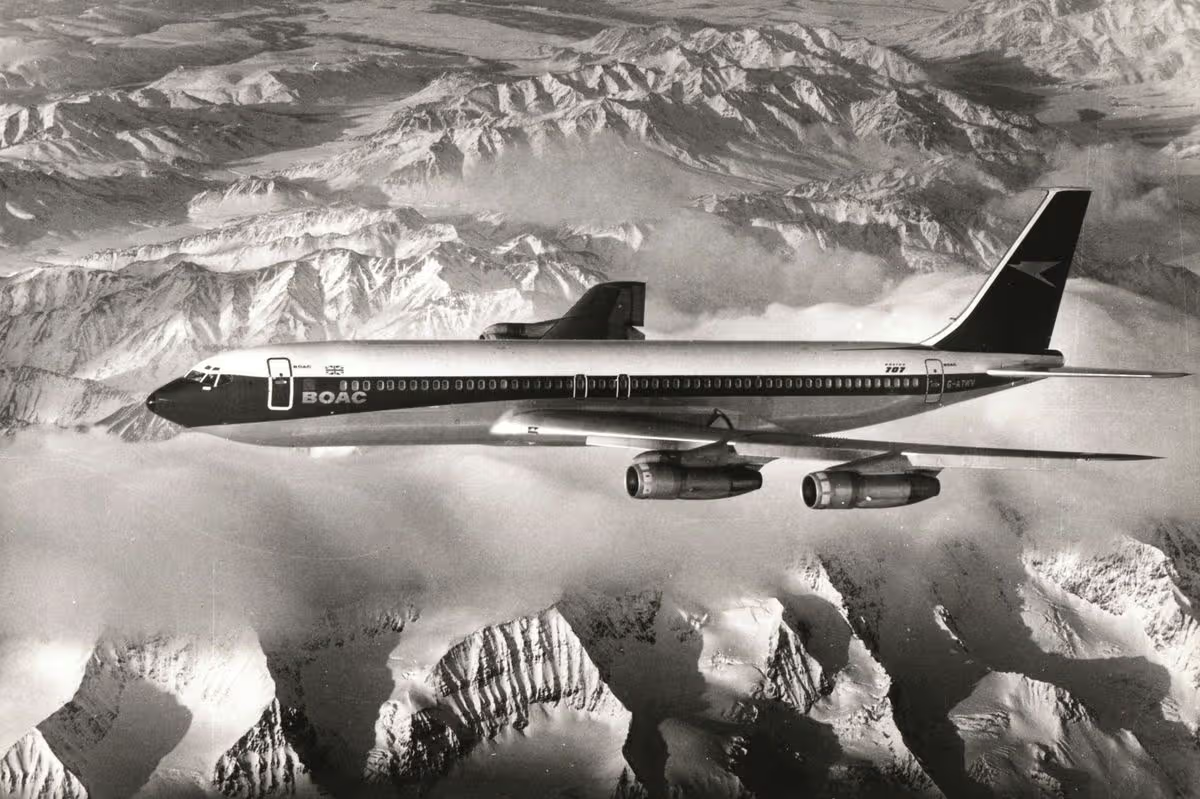
The Boeing 707 was a symbol of the iconic 60s and shrunk the world overnight(Image: Supplied)
British Airways has been flying for 107 years, connecting Britain to the world across more than a century of aviation history.
From a single biplane lifting off from a grass field in west London to a fleet serving destinations across the globe, the story of the world’s favourite airline is told in a new history by Captain Al Bridger – taking the story of BA in 100 objects, which encompass everything from Neville Chamberlain to Marmite.
British Airways traces its roots to 1919, when Aircraft Transport and Travel (AT&T) launched the world’s first international scheduled passenger service from Hounslow Heath to Paris.
This pioneering line later fed into Imperial Airways, which became BOAC in 1939 for long-haul routes, while BEA was formed in 1946 for European services; the two finally merged in 1974 to create modern British Airways.
But it began on August 25 1919 when a modest biplane was prepared on the grass at Hounslow Heath, a few miles from what is now Heathrow Airport. Captain Al said: “The world’s first international scheduled passenger was piloted by Lieutenant Bill Lawford.
“It carried one passenger, some newspapers, fresh grouse bound for the British Ambassador to France and Devonshire clotted cream. In challenging weather, Lawford skilfully completed the trip in 2 hours and 30 minutes.”
Five years later, in March 1924, the British government formed Imperial Airways, at the futuristic Croydon Airport. The art deco structure had a first-class restaurant, canteen for staff and a viewing gallery. The network expanded and flights could reach Delhi in seven-and-a-half days.
The Argosy aircraft, which first flew a passenger service on July 16 1926, gave early travellers a taste of luxury that would define the airline’s ambitions for decades to come. Captain Al said: “A white-coated steward served twenty passengers incredible four-course meals with drinks, providing true luxury for those lucky enough to afford it.
“The aircraft were also used for very popular weekend ‘Tea Flights’, offering afternoon tea while enjoying fabulous views over the capital.”
Among the collection’s most striking objects is a signed photograph of Prime Minister Neville Chamberlain, stepping from a British Airways Lockheed 10A after his famous Munich meetings and the declaration of “peace in our time”.
The 1950s brought a fresh start. “The Jet Age was officially launched with the introduction of the Comet in 1952, placing the UK at the very forefront of aviation,” said Captain Al, “The Rolls-Royce-powered Boeing 707 was a truly iconic symbol of the 1960s, and Sydney in Australia was now within reach in just 33 hours with four stops on the way. A true symbol of the iconic 1960s, the Boeing 707 was a triumph, shrinking the world overnight.”
The collection’s menu cards speak to a more glamorous age of flying. A BEA Silver Wing menu signed by Sir Winston Churchill on 26 April 1955 sits alongside one signed by Muhammad Ali on 10 May 1979
The 1960s brought experimentation of a more flamboyant kind. BOAC introduced cabin crew uniforms that became one of aviation’s most memorable fashion footnotes.
“While famously described as paper dresses, they were in fact sensibly made of a fireproof fabric that resembled paper and could be cut to the required length,” said Captain Al. “Incredibly, they were discarded after each flight.” They lasted a year.
The airline was also reaching out to its youngest passengers. On 26 March 1957, BOAC launched the Junior Jet Club, and Captain Al said: “The club was a huge success and had over 2 million members in its twenty-seven years of existence. Cabin crew would hand young travellers an envelope containing a registration form, a logbook and a Junior Jet Club badge.”
No history of British Airways would be complete without Concorde. The aircraft first flew on 2 March 1969 and entered service with British Airways on 21 January 1976. Captain Al said: “Concorde was to become the flagship of the fleet, bringing supersonic travel to everyone for the first time. Able to carry 100 customers in total luxury at speeds in excess of Mach 2 (more than 1,300 mph) the aircraft could cross the Atlantic in under 3 hours, with the record set on 7 February 1996 at 2 hours and 52 minutes.” The aircraft operated its last service on 24 October 2003.
While Concorde was redefining long-haul travel, the airline was also transforming life on board for ordinary passengers. A BOAC packing checklist pamphlet from the 1960s shows the formality of travel at the time. “For gentlemen, the list mentions the necessity of a dinner jacket, shirt collars and hair tonic,” said Captain Al. “For ladies, a bed jacket, hat and stole were essentials when travelling abroad.”
A photograph of the Beatles from the same era shows the Fab Four carrying BEA travel bags. Captain Al said: “Note how the Beatles are carrying BEA(TLES) travel bags, much like the more common BOAC bags. Clearly the band were travelling light.”
The 1980s brought fresh challenges and fresh ambition. In 1995, as part of a £500 million investment, the airline introduced the world’s first fully flat bed seat in First Class. Captain Al said: “Scientifically proven to give a much better night of sleep, it represented a huge leap forward in airline comfort.”
The airline’s inflight magazine, High Life, had been charting the journey since 1973. Captain Al said: “It truly is BA’s wingman. Through the years there have been some amazing contributors, from Jilly Cooper to Morecambe and Wise.”
Smoking had been part of airline life since the very beginning, but by March 1998 it was over. “When BEA was formed in 1946 over half of the British public smoked, with two-thirds of adult males recorded as smokers,” said Captain Al. “It wasn’t until 1998 that British Airways introduced a complete smoking ban on all flights.”
The modern era brought its own landmark moments. On 18 May 2012, a gold-liveried Airbus A319 named Firefly carried the Olympic flame into Culdrose Naval Airbase in Cornwall. Captain Al said: “Safely contained in four miner’s lamps, the flame was taken from the aircraft by Anne, the Princess Royal, accompanied by Lord Coe, the chairman of the London Olympics Organising Committee and football superstar David Beckham.”
The airline’s centenary in 2019 produced one of the collection’s most unlikely objects. “To celebrate the airline’s centenary, British Airways and Marmite teamed up and created a limited-edition jar that could be purchased on board,” said Captain Al.
“Apparently Marmite is the most confiscated brand at airport security, so the centenary jar was made to be just 70 grams, conveniently sized to fit within the liquid allowance to get it safely through airport security.”
Few objects in the collection carry more weight than the Royal Flights book, its pages bearing the signatures of those who have trusted the airline across the decades. The first entry dates from November 1983.
Captain Al said: “The book was beautifully inscribed with superb calligraphy and the signatures of Her Late Majesty Queen Elizabeth II and His Late Royal Highness The Duke of Edinburgh. Fittingly, the final signature is again that of Her Late Majesty after her visit to the British Airways Headquarters on 23 May 2019 to celebrate the airline’s centenary year.”
From a grass field in Hounslow to the signature of a queen, British Airways has carried the nation and the world for 107 years.
As Captain Al writes of the airline he has served and loves: “It has seen great highs and led the world through some very challenging times, and I know it will continue to give the best it can in the coming years, generating many more wonderful objects along the way.”
British Airways in 100 Objects by Al Bridger is published by Amberley, £17.99
BA in numbers
46.3 million passengers carried in 2025.
Fleet of 254 aircraft serving 215 destinations across six continents.
The move will see passengers pay ’65 per cent’ less tax on a number of routes in a bid to make them more ‘affordable’
Robert Rowlands Deputy editor, money and lifestyle, content hub and Maria Ortega
15:24, 03 Jun 2026
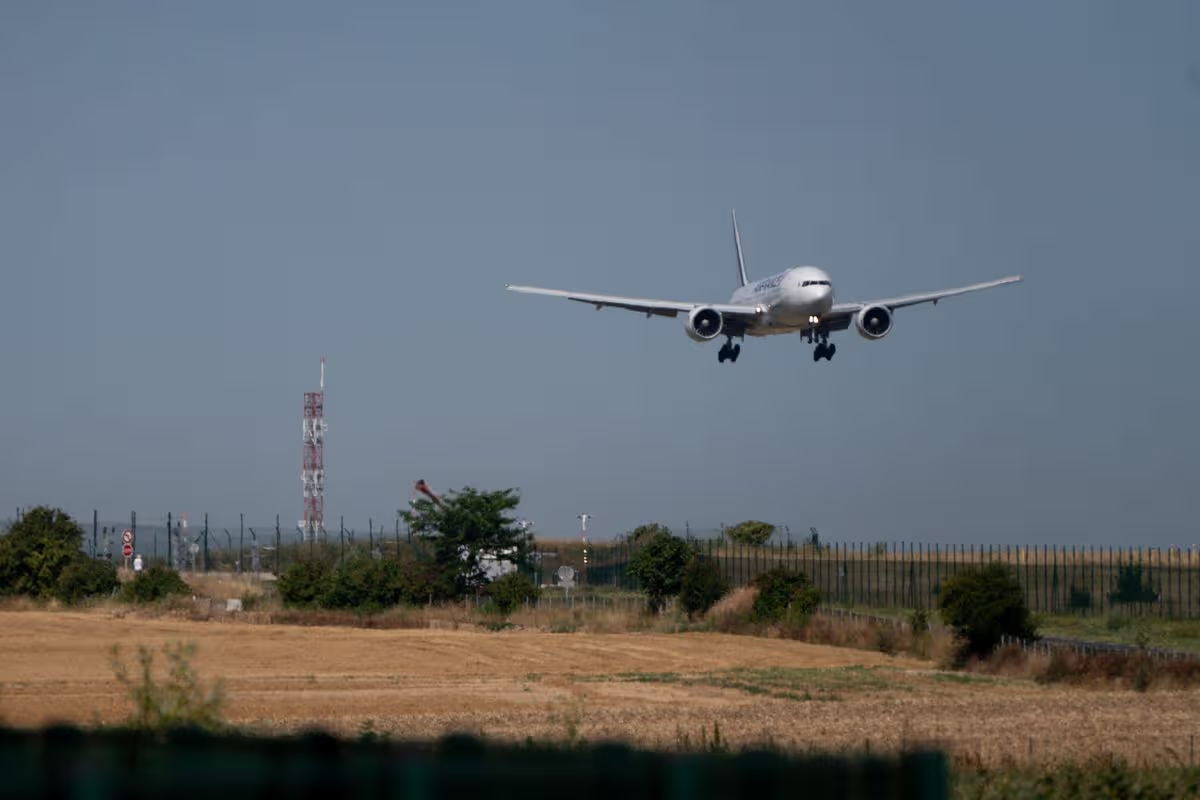
An aircraft landing at the Paris Charles de Gaulle Airport in Paris(Image: Getty)
The prices of tickets for a number of flights in a holiday destination for British travellers will be lowered in a bid to make them more affordable. The move will see flights on 26 specific routes cut in price as tax is reduced on many flights in France, which gets around four million visits from UK travellers every year.
The move was introduced on June 1. Philippe Tabarot, minister at the French Ministry of Transport, confirmed the update this week, and it will affect some international flights as well as trips to some of France’s biggest cities.
Travellers in the UK heading for holidays to France from Heathrow and Gatwick could benefit. Air France, for instance, travels to Paris Charles de Gaulle, while Manchester airport and Birmingham airport also daily flights to both Paris and Lyon, and Newcastle, Edinburgh and Southampton airports also have regular Paris flights.
The move is due to a change in the so-called solidarity tax on airplane tickets (TSBA). French media website 20 Minutes reports that the TSBA had been raised in March 2025 for all flights departing from France.
Local media say the amount rose from €2.63 to €7.40 per passenger. Now passengers flying on certain routes will see the figure returne to the original rate of €2.63.
The Ministry of Transport says this represents a 65% reduction in the tax. That amounts to a saving of €4.77 per ticket.
The flights in France to be affected by the TSBA change
This discount applies to the following routes:
Calvi-Marseille
Ajaccio-Paris (Orly)
La Rochelle–Lyon
Ajaccio-Nice
Brive–Paris
Rodez–Paris
Strasbourg–Madrid
Strasbourg–Munich
Bastia-Nice
Figari-Paris (Orly)
Tarbes–Paris
Calvi-Paris (Orly)
Calvi-Nice
Brest–Ouessant
Bastia-Paris (Orly)
Limoges–Lyon
Figari-Nice
Poitiers–Lyon
Aurillac–Paris
Bastia-Marseille
Strasbourg-Copenhagen
Limoges–Paris
Figari-Marseille
Ajaccio-Marseille
Castres–Paris
Le Puy–Paris
The minister said: “By making these routes more affordable, this measure reflects the government’s commitment to supporting connectivity in the least well-served regions and to reducing the cost of air travel to and from these destinations.”
The move is designed to support routes officials believe are sometimes poorly served by other means of transport. While the flights are almost all domestic, Brits travelling around the country could benefit.
There are also international connections to Strasbourg that are included, as well as most of the links between the French island of Corsica and the mainland. These routes have a special status as ‘public service’ routes because they are in areas where other transport options are limited, or where flying represents the only fast connection, The Local reports.
The eco tax was originally added to plane tickets under Jacques Chirac’s government in 2005, French media reports say. It was doubled in 2024 in a move that Ryanair blamed for its withdrawal from some regional French airports.
The tax is added as an extra fee to each plane ticket bought. It is charged at a sliding rate based on the length of the flight and whether the ticket is standard class, business or first.
MSC Cruises has announced its commitment this summer and offers for UK passengers
12:47, 28 May 2026Updated 14:20, 28 May 2026
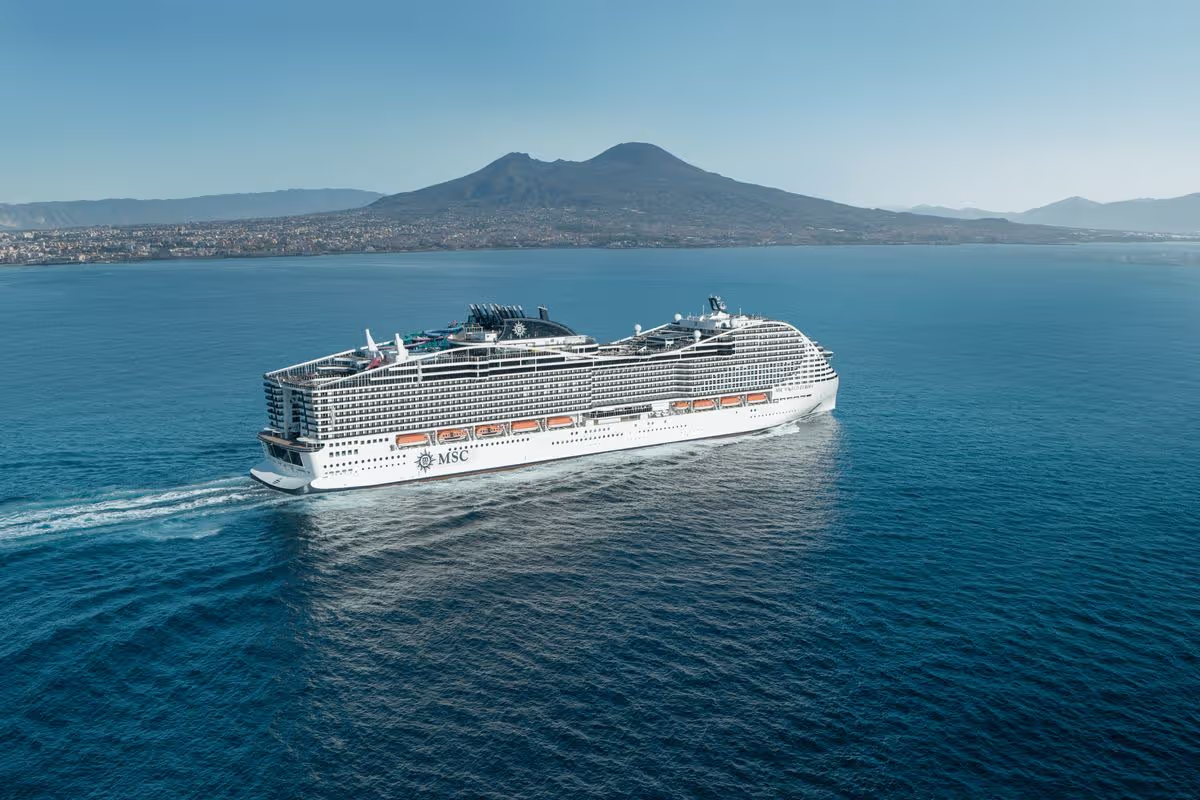
The cruise line shared its announcement on Thursday(Image: MSC Cruises)
MSC Cruises has issued an update today, Thursday, May 28, with bosses announcing a commitment to UK passengers this summer. The cruise line offers various voyages spanning the globe and currently operates a fleet of 23 cruise ships, with plans for further expansion in the coming years.
On Thursday, MSC Cruises said it is inviting guests to experience the ‘best holiday ever’ over the coming months, with the “peace of mind” of no added fuel surcharge for summer 2026 and low deposits until the end of June. Antonio Paradiso, Vice President of International Sales at MSC Cruises, said: “MSC Cruises ‘Best Holiday Ever’ commitment reinforces our position as the leading choice for UK and Irish holidaymakers seeking an effortless, all-in-one travel experience.
“Backed by dedicated support every step of the way, guests can book with confidence and peace of mind in today’s changing travel environment and relax knowing that their holiday is taken care of. With our low deposit of just £50, no-fly cruises from Southampton, Fly and Cruise packages with the reassurance of no added fuel surcharge for 2026, and the option to change your cruise date or destination if required, we are making it easier than ever for guests to secure their next holiday.”
Guests can book a trip with MSC Cruises with a low deposit of £50 per person, extended until the end of June. This applies to all cruises (excluding World Cruise and MSC Yacht Club cabins).
Passengers have a wide variety of amenities on board. There is full-board dining across the main restaurants and buffets, evening shows, multiple swimming pools with aquaparks, fitness facilities and family entertainment programmes.
There are many cabin types to choose from, including comfortable and economic inside cabins and connecting cabins for larger groups, which combine inside and balcony cabins together. Ocean View cabins offer sunset views, or for that sea breeze, opt for a balcony cabin.
A spokesperson added: “An MSC Cruise offers so much in one transparent price and, despite recent increases in global fuel prices, the cruise line will not be introducing a fuel surcharge this summer, giving guests extra confidence there are no unexpected added costs. The price guests see at the time of booking is the price they will pay, part of the best holiday ever commitment, just peace of mind and a seamless holiday experience this summer.”
MSC Cruises offers a range of Fly and Cruise packages that combine flights, transfers, and a cruise into one holiday. Designed to ‘simplify the journey from start to finish’, the cruise line says these packages are built in partnership with some of the world’s most renowned airlines.
Flights align with cruise schedules, with transfers between the airport and the ship included. Guests can select their preferred cruise itinerary, choose the Fly and Cruise fare, and confirm flights during the booking process. Fly and Cruise holidays in 2026 depart from:
Belfast to Palma and Tenerife
Dublin to Barcelona, Rome, Venice and Tenerife
Edinburgh to Rome, Naples and Tenerife
Glasgow to Tenerife
Newcastle to Tenerife
Manchester to Rome and Tenerife
Birmingham to Tenerife
London Heathrow to Seattle and Barbados
MSC Cruises also offers a selection of no‑fly cruises from Southampton year-round. Some standout destinations include the Norwegian Fjords, Northern Europe and the Mediterranean. And on selected dates, well-known TV stars and sports legends are on board, giving guests complimentary classes and talks:
June 6, 2026 – Southampton to Iceland and the Norwegian Fjords (14 nights), with TV personality Anthea Turner onboard.
August 8, 2026 – Southampton to the Canary Islands (12 nights), with Rugby Legends Ben Cohen, Neil Back and Ben Kayplus dance star Kristina Rhianoff onboard.
October 19, 2026 – Southampton to the Netherlands, Belgium and France (5 nights), with Football Legend Gianfranco Zola on board.