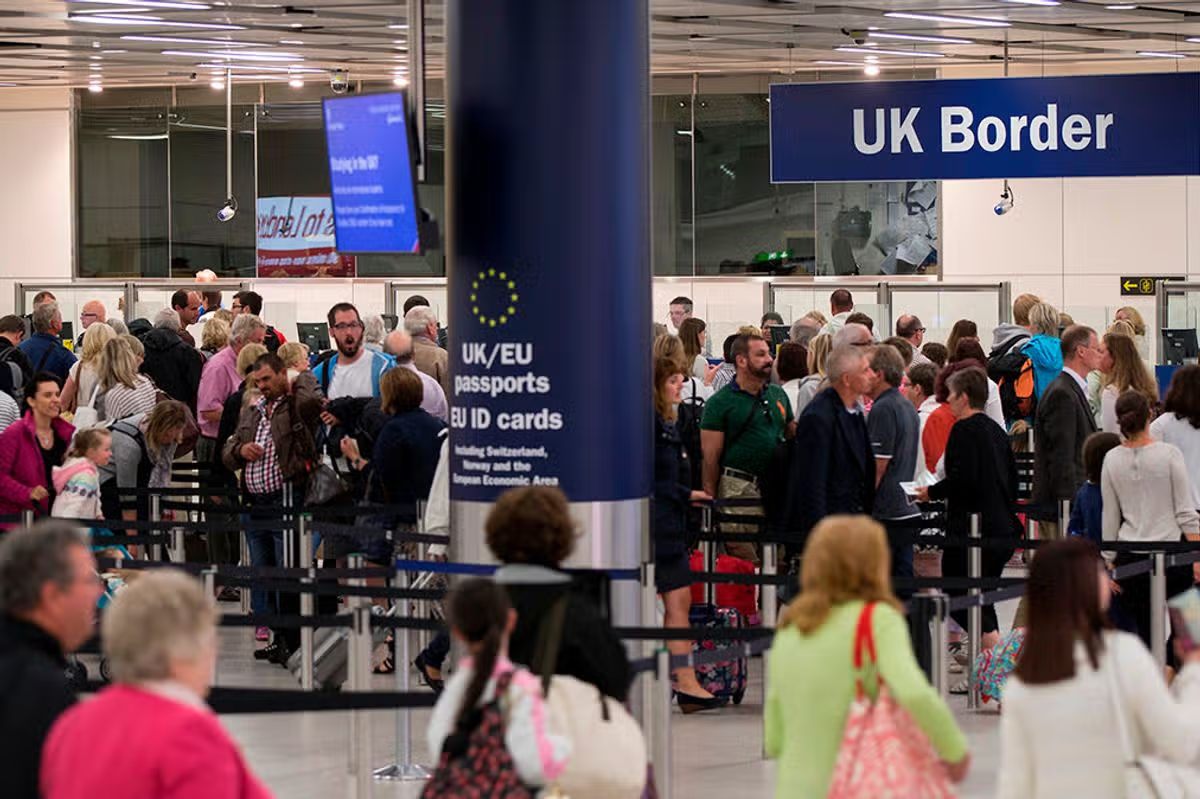
Heathrow Airport

UK tourists to face flight ‘cancellations’ alert as 6 hotspots ‘could be at risk’

Transport Secretary Heidi Alexander is set to ‘level with’ the public as jet fuel shortages continue to affect airlines

British holidaymakers are set to be warned by ministers to prepare for potential flight cancellations. The anticipated warning follows concerns from airline bosses about possible jet fuel supply shortages affecting the UK from as early as next month.

Transport Secretary Heidi Alexander is reportedly preparing to “level with” the public this weekend about the likelihood of disruption and cancellations this summer. She is also expected to outline contingency measures designed to minimise the fallout – as six tourist hotspots have reportedly been identified as being at risk of cancellations.

Government officials are drawing up plans to advise against long-haul travel to specific destinations should tensions in Iran escalate dramatically. Countries including Vietnam, Pakistan, Bangladesh, the Philippines, Myanmar and Ethiopia could be affected, sources told the Times.

Ministers are also set to highlight the “positives” of staycations as anxiety mounts over overseas bookings. A number of major European carriers have recently sounded the alarm about looming jet fuel shortages in the coming weeks, citing disruption to their primary supply route through the Strait of Hormuz.

According to UKOilWatch, Britain currently holds just 34 days’ worth of jet fuel reserves. Roughly three-quarters of Europe’s jet fuel originates from the Middle East and passes through the Strait of Hormuz off Iran. Heathrow Airport confirmed on Wednesday that it anticipates passenger figures for the remainder of the year will be impacted by Middle Eastern tensions.

Lufthansa Group plans to axe 20,000 flights over the next six months in a bid to conserve fuel. Meanwhile, other carriers including Virgin Atlantic have introduced a fuel surcharge, and British Airways has cautioned passengers about potential “pricing adjustments” to their tickets.

Sir Keir Starmer, the Prime Minister, also suggested this week that Brits might need to reconsider “where they go on holiday”. Government ministers insist the UK isn’t currently facing jet fuel shortages, as alternative supply sources remain available.

Michael O’Leary, chief executive of Ryanair, Europe’s largest airline, revealed to The Times that competitors are “desperately” hunting for flights to axe, with cancellations expected to begin within weeks. According to the newspaper, leading fuel suppliers are informing airlines that the UK has the “most limited visibility” across Europe regarding jet fuel availability, largely due to its heavy dependence on Middle Eastern imports.

These suppliers reportedly anticipate May will be manageable. Yet they warn that “mid to late June as the potential start of disruptions” if the Strait of Hormuz near Iran remains closed.

Ryanair and Jet2 reassure passengers

O’Leary explained: “There is a modest improvement in the supply situation through to the end of May, early June, but then nobody would give us any undertakings what happens in mid-June or thereafter.”

He confirmed Ryanair wouldn’t be slashing flights. However, he predicted that other prominent European carriers more “exposed” to soaring costs would likely begin scrapping routes, saying: “They are all desperately trying to take out marginal flights or any growth because they don’t have the fuel for it.

“We were worried there would be disruption to around 10 per cent of our flights but some of those worries have eased because other European airlines have taken out lots of capacity.” It comes as Jet2 has revealed that holidaymakers are increasingly making last-minute bookings following the outbreak of the Iran war, with growing concerns about the conflict’s impact and potential disruptions to jet fuel supplies.

The company reported that summer passenger bookings are currently up 6.2%, driven by growth in both its airline and package holiday operations. However, highlighting rising unease amongst travellers, it noted that the “booking profile has become increasingly close to departure” as a result of the Middle East conflict.

Jet2 confirmed it has strong protection against fuel cost increases triggered by the Iran war for the crucial summer period. It said it is “maintaining frequent dialogue with our fuel suppliers and airport partners on fuel supply”.

British refineries have meanwhile been instructed to maximise jet fuel production as part of government contingency measures amid concerns that the Iran war could lead to aircraft being grounded. Energy minister Michael Shanks said the government is closely monitoring UK jet fuel stocks and liaising with airlines, airports, fuel suppliers and international partners.

“UK airlines typically buy fuel months in advance, and aviation fuel suppliers hold bunkered stocks. The UK imports jet fuel supplies from a range of countries not reliant on the strait, including the United States,” Shanks stated in a ministerial announcement. “Airlines UK have stated that ‘UK airlines continue to operate normally and are not experiencing issues with jet fuel supply.’ The government continues to work with partners to monitor and mitigate potential disruptions,” Shanks added.

Source link

Full list of UK airports that have ditched 100ml liquid rule ahead of summer holidays

Many airports across the UK have made a major change when it comes to packing 100ml liquids in hand luggage, scrapping the rule altogether, while many still have strict rules in place

Several UK airports have ditched the 100ml rule at airport security, and it’s vital to know before heading on holiday.

UK airports are gearing up for one of the busiest travel periods as thousands of families jet off abroad during the summer holidays. While it’s an exciting time, holidaymakers should be well prepared before heading to the airport, particularly regarding airport security restrictions.

In a major change, several airports scrapped the 100ml liquid rule earlier this year, allowing passengers to carry up to two litres of liquids through security. The shift is down to new CT scanners that provide security staff with detailed 3D images of bags, allowing travelers to keep their two-liter liquids in their hand luggage when passing through airport security.

READ MORE: Beautiful overlooked European gem outside Schengen zone has £17 flights and £2 pintsREAD MORE: Experts warning over common items packed in hand luggage that can cause travel disruptions

The UK airports that have ditched the 100ml liquid rule so far include:

  • Belfast International
  • Belfast City
  • Birmingham
  • Bournemouth
  • Bristol
  • Edinburgh
  • London Gatwick
  • London Heathrow

However, it’s important to note that not every UK airport has made the switch, and many still require liquids to be 100ml or under. Despite this, many have relaxed the rules so travellers no longer need to put them in a clear plastic bag, and they can also be kept in their hand luggage when going through security.

While specific rules can vary, it’s best to check directly with the airport you’re flying from, especially in the run-up to the summer holidays. It’s also important to check any restrictions with the airport you’ll be returning home from, as countries outside the UK can have different rules, including for liquids in 100ml containers.

The UK airports that still have the 100ml liquids rule include:

  • Aberdeen
  • Bournemouth
  • Cardiff
  • East Midlands
  • Glasgow International
  • Glasgow Prestwick
  • Inverness
  • Isle of Man
  • Leeds Bradford
  • Liverpool
  • London City
  • London Stansted
  • London Luton
  • Manchester
  • Newcastle
  • Norwich
  • Southampton
  • Teesside

The Foreign Office states that liquids include the following:

  • All drinks, including water
  • Liquid or semi-liquid foods, for example, soup, jam, honey and syrups
  • Cosmetics and toiletries, including creams, lotions, oils, perfumes, mascara and lip gloss
  • Sprays, including shaving foam, hairspray and spray deodorants
  • Pastes, including toothpaste
  • Gels, including hair and shower gel
  • Contact lens solution
  • Any other solutions and items of similar consistency

For airports that still follow the 100ml rule, the government advice page noted that there are exemptions for baby milk or food, medicines, food for special dietary requirements or liquids purchased in duty-free.

In other news, TUI also warned holidaymakers about changes to airport security at some UK airports, where new restrictions are in place. In a travel alert to passengers, the holiday provider said: “While UK airports are installing new scanners to prepare for changes in security restrictions, at this time you should still follow current guidelines as not all airports have changed and destination airports still have these restrictions in place for your flight home.”

The airline went on to provide information on some UK airports that have implemented changes, including Aberdeen, Birmingham, Newcastle, Leeds Bradford, London Southend, and London City. TUI also advised customers to visit its airport security page on its website or the information page for the UK airport they’re departing from to find relevant details.

Do you have a travel story to share? Email webtravel@reachplc.com
Source link

UK has ‘worst airport in Europe’ for delays – and three others in the top 10

Four UK airports have found themselves in the top 10 of the ‘worst for delays’ across Europe, with one securing the top spot following average delays of almost two hours

A UK airport has been named the ‘worst in Europe’ for delays, while three other UK airports also found themselves in the top 10.

New research from AirAdvisor ranked Manchester Airport as the worst airport in Europe for hour-long flight delays. The airline comparison experts analyzed data from 9,594,711 flights across 46 European airports in 2025 to reveal results based on the percentage of flights delayed by 60 minutes or more (weighted at 70 percent) and the average length of those delays (weighted at 30 percent).

This saw Manchester take the top spot, with 6.16 percent of its flights delayed by 60 minutes or more in 2025 and an average delay of 116.7 minutes, which amounts to almost 2 hours. AirAdvisor AirData found that the routes from Manchester most prone to delays were to Amsterdam Schiphol, Paris Charles de Gaulle, and Dublin.

READ MORE: EasyJet’s new 7-hour route to white sand island is ‘longest ever’ with £120 flightsREAD MORE: Experts warning over common items packed in hand luggage that can cause travel disruptions

A Manchester Airport spokesperson told The Mirror: “This analysis of the Civil Aviation Authority’s data is misleading as it ignores important context – context which is directly referenced by the CAA in the notes accompanying the research and in the research itself. Punctuality is affected by factors that are outside of an airport’s control. The two most significant factors contributing to delays in the last year have been industrial action affecting air traffic control in Europe, and the weather. These were exacerbated by airspace restrictions above conflict zones meaning airports with significant long-haul networks, like Manchester, were more significantly affected than others.

“As an industry we are working collectively to achieve the best possible on-time departure rates, while protecting flight schedules and avoiding the need for cancellations.”

But it wasn’t just Manchester that found itself named among the worst. Birmingham, London Gatwick, and London Stansted joined the airport, making the UK the most represented country in the top 10.

London Gatwick was ranked the sixth worst in Europe, with a 5.24 percent rate of hour-long delays and an average delay of 111.88 minutes. According to the data, AirAdvisor found that the most impacted routes from Gatwick were to three major holiday hotspots: Barcelona, Malaga, and Lisbon.

In tenth place was Birmingham Airport, after the experts found that it scored a 5.26 percent rate of hour-long delays and an average duration of 108.01 minutes. The most disrupted routes from Birmingham were said to be flying to the popular destinations of Amsterdam, Dublin, and Paris Charles de Gaulle.

A Birmingham Airport spokesperson said: “Flight delays can happen for several reasons including industrial action and bad weather, some of which are out of an airport’s control. This month over half of all aircraft left on time and we continue to work hard to improve punctuality. Our colleagues work tirelessly to provide brilliant passenger service, with the vast majority of people rating their experience as excellent.”

Meanwhile, London Stansted came in joint tenth with Birmingham, after data found that it had a 5.5 percent rate of hour-long delays and an average delay of 106.24 minutes. AirAdvisor said the most delayed routes from Stansted were to Dublin, Edinburgh, and Istanbul Sabiha Gokcen.

A London Stansted Airport spokesperson told the Mirror: “It’s very important to put this analysis into perspective. The data looks at 46 airports but there are more than 340 major airports across Europe, so this represents a small and self-selective sample. This type of analysis of the Civil Aviation Authority’s data is misleading as it ignores important context – context which is directly referenced by the CAA in the notes accompanying the research and in the research itself.

“It should also be noted this research has been produced by a flight compensation company and looks specifically at delays of more than 60 minutes, which are often driven by wider factors such as air traffic restrictions, industrial action, adverse weather impacts and airline operations, airline crew shortages or delays to inbound flights rather than airport performance.

“Like all major airports operating in busy European airspace, punctuality on certain routes can be affected by congestion elsewhere in the network. We continue to work closely with airlines, air traffic control and partners across the aviation system to reduce disruption and keep journeys running as smoothly as possible for passengers.”

London Gatwick has been contacted by The Mirror for a comment.

Top 10 worst airports in Europe for long delays

  1. Manchester, UK
  2. Palma de Mallorca, Spain
  3. Kraków Balice, Poland
  4. Nice Côte d’Azur, France
  5. Bucharest Henri Coandă, Romania
  6. London Gatwick, UK
  7. Porto, Portugal
  8. Marseille Provence, France
  9. Birmingham, UK
  10. London Stansted, UK

Birmingham, London Gatwick, and London Stansted were contacted for comment.

Do you have a travel story to share? Email webtravel@reachplc.com

Source link

Emirates airline issues Monday afternoon update to passengers

Emirates carries hundreds of thousands of UK passengers every year, including from London Heathrow, Gatwick, Manchester, Birmingham and Glasgow

A major airline has issued an announcement to customers after an update to its service. Emirates carries hundreds of thousands of passengers on UK services every year going through airports including London Heathrow, Gatwick, Newcastle, Manchester, Birmingham and Glasgow.

Using its 615-seater A380s the route from London Heathrow to Dubai alone offers more than one million seats. Now those travelling on the aircraft will be able to access internet connections, which the airline hails as “better than at home” following the completion of the first installation of next-generation Starlink Wi-Fi onboard.

Making the announcement on Monday afternoon, the airline said: “Emirates A380 was one of the first commercial aircraft in the world to offer internet to its customers, with first generation systems offering a total aircraft bandwidth of less than 1 Mbps. Emirates’ installation of three Starlink antennas on each A380 will improve the Wi-Fi available onboard a thousand-fold – offering a ‘better than at home’ connectivity experience for customers, while flying at 40,000 feet.”

The first Emirates A380 aircraft equipped with Starlink made its return to Dubai this week, after its installation and certification were accomplished in Newquay. More A380s are scheduled for accelerated installation throughout 2026 allowing passengers to stream, game, browse, and work throughout their journey on personal devices.

The service will be complimentary for all customers. The airline has future plans to add Live TV streaming over Starlink, initially on personal devices and later integrated into seatback screens.

Making the announcement on X, the airline said: “Our A380 is entering a new era with next-gen @Starlink Wi-Fi onboard. Ultra-fast, complimentary connectivity across all cabins, customers can stream, browse and stay connected seamlessly at 40,000 feet. A fully connected journey, redefined.”

Content cannot be displayed without consent

And passengers were delighted to hear the news. One said: “Let’s go. The old system was under 1 Mbps.” Another added: “Please don’t ever ground this airplane.”

The “double-decker” Emirates Airbus A380 is the world’s largest passenger airliner. It is known for its onboard luxury including shower spas, onboard bars and lounge.

Source link

Government confirms passengers’ rights when flights are cancelled over ‘act of war’

Some airlines have confirmed they will be operating fewer flights

Six major airlines have confirmed they will be cancelling and cutting back on flights to and from the UK due to the rise in jet fuel costs triggered by the war in Iran. As a result, many travellers may have to prepare for their plans to be disrupted as they anxiously await updates from their airlines.

However, the Government has confirmed the full list of rights passengers have when their flight is cancelled due to an act of war. This includes what compensation or rebooking options people should be given.

Parliamentary Under-Secretary for the Department for Transport, Keir Mather, clarified: “Where UK law applies, if a flight is cancelled by the airline, then passengers would be entitled to a choice between a full refund or to be re-routed. These rights would apply if disruption were linked to war.

“Information on air passenger rights is already available in the Department’s Air Passenger Travel Guide, and the Civil Aviation Authority (CAA) recently provided specific advice to passengers in response to the Middle East disruption.”

The MP had been responding to Liberal Democrat Sarah Dyke who requested the DfT layout guidance on the “Act of War” clause which is meant to protect customers who should receive appropriate refunds for holidays they cannot take due to conflict.

According to the Civil Aviation Authority, if your flight is cancelled your airline must let you choose one of two options under UK law:

  • Receive a refund for the parts of the journey you haven’t used
  • Choose an alternative flight

If your flight is cancelled with less than 14 days’ notice, you may be entitled to some compensation if it is deemed to be the airlines’ fault. Issues like extreme weather, employee strikes or ‘extraordinary circumstances’ won’t count.

UK law around cancelled flights usually applies to airlines departing from or arriving in the UK as well as flights arriving in the EU on a UK airline. Under this law, your airline must also provide you with ‘care and assistance’ if your flight is cancelled.

This ‘care and assistance’ is separate from compensation and can include:

  • Reasonable amount of food and drink, usually vouchers
  • Means to communicate, such as refunding the cost of phone calls
  • Accommodation if your replacement flight is the next day
  • Transport to and from the accommodation or your home if you’re able to return

The UK Civil Aviation Authority notes: “The airline must provide you with these items until it is able to fly you to your destination, no matter how long the delay lasts or what has caused it.”

According to the BBC, six airlines have said they will operate fewer flights including KLM, Air Canada, Asiana Airlines, Delta Airlines, Lufthansa and SAS. Other airlines, such British Airways owner IAG, EasyJet and Jet2Holidays, have assured that they don’t plan to make any changes at the moment as of April 25.

Some airlines have said they will increase charges as a result of the jet fuel supply disruption. These include:

  • Air France-KLM
  • Indigo
  • Pakistan International Airlines
  • Thai Airways
  • Turkish Airlines-Sun Express
  • Virgin Atlantic

Source link

UK tourists face new Spain ‘daily’ tax at city break spot near ‘world’s best beach’

The city is a popular cruise ship destination, is famous for its huge Christmas lights displays – and is within easy reach of ‘the world’s best beach’

British holidaymakers are bracing themselves for a new tourist tax at a Spanish beauty spot. Vigo, located in the north-west of Spain, has 45 beaches according to one report – and is within easy reach of one of the best beaches in the world.

The city is equally renowned for its spectacular Christmas light displays, considered among the best on the planet. Respected travel expert Simon Calder is a firm admirer of the destination, describing it as ‘cultured’ and ‘highly affordable’. The Aviothic website calls it ‘Spain’s best kept secret’.

But now local officials are putting the finishing touches to plans for a new tourist tax, according to reports in the Spanish media. The move follows in the footsteps of Santiago and La Coruña, both of which introduced similar levies in late 2025, drawing criticism from various quarters.

Reports indicate that Vigo City Council is pressing ahead with proposals to introduce its own tourist tax, with the aim of ‘redistributing’ profits generated by the tourism industry. The levy is also intended to help reduce the environmental strain caused by mass tourism on the local area.

Vigo is perhaps best known for its dazzling Christmas lights, with more than 11 million LED lights illuminated across the city last year. The city, home to around 295,000 residents, is also celebrated for a nearby breathtaking beach within reach of Vigo – although visitors staying near the beach will not pay the tax.

The Guardian once hailed its Rodas Beach, situated on the Cíes Islands, as the “best beach in the world”. The bustling port city is equally popular as a cruise ship destination.

In fact, this week Vigo takes centre stage in international tourism as the season’s first triple cruise ship call gets under way, with the city set to welcome more than 7,500 visitors within just a few hours. The port is simultaneously hosting three large ships, the Britannia, the Ventura and the Le Bellot.

However, it now seems tourists will shortly face a levy for the privilege of visiting the destination. No form of accommodation will escape the charge, according to El Debate. The amount will vary depending on the hotel’s star rating.

The publication reports the tax could reach as much as €2 per person daily for 4-star superior and 5-star establishments. A €1.60 daily charge is proposed for tourist accommodation and 2-star superior, 3-star and 4-star hotels.

It’s understood that under the proposals, holiday apartments and rural tourism properties – alongside hostels and campsites – will incur a €0.80 per person daily fee, while guesthouses and 1- and 2-star hotels will pay €1.20. Cruise passengers won’t escape either. Abel Caballero, mayor of Vigo, confirmed those disembarking at Vigo’s docks will be charged €1.20.

He said: “From when it comes into force until July 1, 2027, the tax will apply to the first two nights of a stay. Therefore, someone visiting Vigo for 4 nights will pay the tourist tax for only the first 2 nights. From July 1, 2027, the tax will apply to a maximum of five nights per stay.”

He said the tourist tax would be rolled out “gradually” from October, shortly before the Christmas lights are illuminated. Exemptions for health reasons are being considered. Children and certain disabled individuals are also expected to be exempt.

The tax must still secure approval from the Governing Board ahead of one final vote – however, the mayor’s comments suggest it could well be on the cards. In Barcelona, the combination of a regional tax and a municipal charge has hiked up the cost to between 5 and 12 euros a night. In La Coruna, the local hotel association has launched a legal battle to block the levy.

Travel journalist Simon Calder has previously highlighted Vigo’s appeal to British visitors. Writing in the Independent, he said: “Vigo claims to be the largest fishing port in the world, and plentiful fresh seafood is a strong attraction. The city is also an excellent starting point for wider exploration of the rias (inlets) that carve the shoulder of Spain so dramatically.”

How can I get to Vigo from the UK?

Ryanair offers a direct service from the UK to Vigo–Peinador airport, operating out of London Stansted. Journey times are approximately 2 hours 10 minutes.

Many visitors heading to Vigo opt to fly into nearby Santiago de Compostela instead, which is just 50–60 minutes away by car. Both Ryanair (Stansted) and Vueling (Gatwick and Heathrow) operate direct flights to Santiago several times weekly, offering a greater choice of services and often cheaper fares.

Bear in mind, however, that Santiago airport is closed from April 23 to May 27, 2026 for runway resurfacing works. At the heart of Vigo’s social scene lies the Casco Vello (Old Town), a beautifully restored maze of narrow granite streets and bustling plazas.

Visitors may also wish to explore Castro de Vigo, an archaeological site that reveals how the region’s original inhabitants lived in stone huts more than 2,000 years ago. The Guardian says the city has 45 beaches, and notes that an attraction for UK tourists in visiting Vigo is that it brings “the Caribbean-like beaches of the Cíes islands within easy reach.”

“The islands are an easy day trip from Vigo, adding a relaxing beach element to your Spanish city break,” the paper said in a positive review of the city.

Source link

TUI, easyJet and Jet2 warning as little-known airport rule could see your phone confiscated

A little-known airport rule could mean your phones or laptops are confiscated – and it applies in the UK affecting passengers with the likes of TUI, BA, Ryanair and easyjet

Brits should take heed of a little-known airport rule that could mean your phone or laptop gets confiscated before you’ve even boarded your flight.

The restriction is enforced at airport security, and has been known to catch out passengers flying on the likes of TUI, British Airways, Ryanair, or easyJet, and more, as the airlines themselves don’t enforce it.

Most of us take at least one electrical item in our luggage, be it a mobile phone, tablet, or laptop, and no doubt yours will hold your boarding pass and maybe a Netflix show or two to enjoy along the way. However, should you get to airport security and find your battery is at 0%, then you may have a problem. All electrical devices need to be powered up, as airport staff are allowed to ask you to turn these items on.

READ MORE: ‘I’m a travel expert – tourists should never make this mistake when getting holiday money’

If a flat battery stops you from doing this, then you may be refused boarding, or may have to make the choice to leave your item behind. The UK government’s official website, which provides extensive travel guidance and updates, states: “Make sure your electronic devices are charged before you travel. If your device does not switch on when requested, you will not be allowed to take it onto the aircraft.”

Should you make the mistake of having an uncharged device in your hand luggage, the choices vary depending on the airport you’re travelling from and your airline. If you’ve not checked your bag yet, you can put it in there, and it’ll be put in the hold.

READ MORE: Jet2 ‘arrive early’ alert for anyone travelling to popular European destination

The advice from British Airways’ (BA) website is clear. “Please ensure that any items in your hand baggage are fully charged and switched on before you arrive at the airport. If your device is not charged, please place it in your checked baggage.”

They also advise: “If you are connecting, make sure that you do not deplete power in your devices during the first part of your journey as charging points at airports might be very limited and you may need an adapter.”

For London-Heathrow passengers, BA say those with flat batteries may need to rebook on a later flight to give them time to recharge, but that that “a fee might apply”. Alternatively passengers can leave goods at Bagport, the lost property office, and get a reference number for their item. Once at their destination, they can contact Bagport to arrange for the retrieval of their item.

Meanwhile TUI has warned passengers: “If you’re carrying any electronic devices in your hand luggage that are capable of holding a charge, you’ll need to make sure they’re fully charged when you go through airport security. This is part of new security measures that have been introduced by airports in the UK and abroad. We recommend you keep things like mobile phones switched on until you board the plane, as there might be more checks at the departure gate.”

It’s not just a flat battery that could prove an issue. Both easyJet and Jet2 have a list of prohibited items which include damaged batteries – so check your gadgets before you even set off for the airport. Jet2’s website is quite clear: “Damaged Personal Electronic Devices (PEDs) and/or spare/loose lithium batteries/cells (including power banks) are forbidden from carriage in all circumstances.”

Ryanair doesn’t provide any additional guidance other than keeping your phone charged. Under the FAQ ‘What happens if my smartphone or tablet dies before airport security?’, it states: “If you have already checked in online and your smartphone or tablet dies, you will receive a free of charge boarding pass at the airport.” However, it is not mentioned what your options would be if security refuses to let you through.

You can find out more about airport security on gov.uk.

Have a story you want to share? Email us at webtravel@reachplc.com

Source link

New airport rule comes into force but there’s 1 thing holidaymakers keep forgetting

Travellers are being caught out by new rules at certain UK airports, as people are reminded to check their airport’s regulations before flying to prevent upset and delays

As the cold, bleak winter drags on, many Brits are counting down the days until they can jet off on their summer holidays. But a major new airport rule change is catching some travellers off guard – and starting their trips with unnecessary stress when they realise they’ve got it wrong.

As of January, passengers flying from certain UK airports can now carry up to two litres of liquids in their hand luggage, replacing the long-standing 100ml limit, thanks to new CT scanners. In a statement, Heathrow Airport said: “Passengers travelling through all terminals at Heathrow no longer need to remove liquids or electronics from their hand luggage, or juggle plastic bags at security.

“The UK’s hub has become the largest airport in the world to fully roll out next-generation CT (computed tomography) security scanners – a move that promises faster queues, less stress and a smoother start to journeys for millions of travellers.”

UK airports that have ditched the 100ml rule

  • Belfast International
  • Belfast City
  • Birmingham
  • Bristol
  • Edinburgh
  • London Gatwick
  • London Heathrow

However, the change has not been rolled out across every airport – with many still sticking to the 100ml rule and requiring liquids to be removed and placed in clear plastic bags.

UK airports still enforcing the 100ml rule

  • Aberdeen
  • Bournemouth
  • Cardiff
  • East Midlands
  • Glasgow International
  • Glasgow Prestwick
  • Inverness
  • Isle of Man
  • Leeds Bradford
  • Liverpool
  • Luton
  • London City Airport
  • Manchester
  • Newcastle
  • Newquay
  • Norwich
  • Southampton
  • Southend
  • Stansted
  • Teesside

Exemptions still apply for essential medicines, baby food, and milk, as well as special dietary requirements.

Travellers are being urged to check their departure airport’s rules before flying – especially ahead of the busy Easter holidays – to avoid delays or having items confiscated at security.

Reacting to the change, one traveller flying from Gatwick Airport wrote on Reddit: “Makes the journey just that little bit less stressful. Leave everything in your bag – laptop too.”

Another added: “Edinburgh is the same, which is really handy.”

A third explained: “This is because a new generation of scanners is being rolled out that allows more liquids and means you don’t have to remove laptops – but only a few airports have them so far.”

However, not everyone is convinced.

One user said: “This change is useless until all major airports follow suit. It’s fine on the way out, but if your return airport still has the old rules, you end up throwing things away. It also causes confusion, especially when different London airports have different rules. It should be all or nothing.”

Another added: “I’ve been travelling with just carry-on for years now and wouldn’t go back. There’s something freeing about not carrying full-size toiletries when you only need a small amount.”

Source link

BBC Airport star Jeremy Spake unrecognisable 3 decades later after ‘bullying’ horror

Jeremy Spake became a firm favourite on the BBC series Airport, which first aired in 1996, and has since gone on to enjoy a successful media and aviation career before alleging workplace issues

Jeremy Spake, who was first catapulted into the limelight an astonishing 30 years ago on the BBC series Airport, is now almost unrecognisable. The programme, similar to ITV’s own successful Airline, gave viewers a behind-the-scenes look at the daily workings of Heathrow Airport and the aircraft departing from there. Now 56, Jeremy was featured on the show in 1996 during his stint as a ground services manager for Russian airline Aeroflot.

He swiftly became a viewer favourite during his time on the show, which subsequently paved the way for additional television opportunities. He went on to host Toughest Jobs in Britain, a documentary series that followed workers in some of the UK’s most challenging and physically demanding roles, as well as the medical programme City Hospital.

He also authored two books, titled Jeremy’s Airport and The Toughest Job in Britain. Jeremy’s Airport drew from his experiences working at Heathrow, guiding readers through a typical week on the job, while The Toughest Job in Britain saw him reflect on some of the incredibly tough jobs he tackled while presenting the show.

READ MORE: Emmerdale Gennie Walker star looks so different 14 years after exitREAD MORE: Noughties child star unrecognisable 14 years after disappearing from spotlight

While pursuing his media career, Jeremy was also steadily ascending the corporate ranks in his day job. Proficient in Russian, Jeremy eventually climbed to the position of services manager for Aeroflot before being promoted to Deputy Director of Isle of Man Airport.

Nevertheless, Jeremy chose to resign from his position at the Isle of Man airport, describing ‘bullying, harassment and mobbing on an almost industrial scale’ via his LinkedIn profile. Reports emerged in 2023 that he was pursuing legal action against the Isle of Man government for personal injuries, alleging damage to his mental wellbeing.

He subsequently fronted a six-episode documentary series aired on the BBC, The Airport: Back In The Skies. The fresh series witnessed Jeremy returning to his roots, reuniting with former colleagues, and examining closely how the sector was recovering following the coronavirus crisis.

Production for The Airport: Back In The Skies kicked off in October 2021, after approximately eighteen months of lockdown measures, travel restrictions, and vaccine passport requirements, while the airport was working to rebuild operations and restore full capacity.

Thankfully, Jeremy has never been one to stand on the sidelines and pitched in by helping to prepare a Boeing 737 for departure and lending a hand to holidaymakers stranded during the turmoil.

The television personality has also released his own audio book, Jeremy’s Airport Audio Book, which recounts the Airport narrative with extra commentary and fresh anecdotes that didn’t feature in the original BBC television programme. Adding another dimension to Jeremy’s repertoire, he now presents daily aviation updates on Instagram, for Air News Daily.

However, Jeremy now has a dramatically different look. His brown hair has disappeared as the star is now completely bald and he has swapped his smart goatee for a clean-shaven look. The website for the channel says: “Jeremy is a seasoned broadcaster and aviation professional with 40 years experience of working with some of the largest airlines and airports around the world and brings his unique insight to every show.”

READ MORE: Women swap Easter eggs for ‘better’ beauty box with items cheaper than Lindt bunny

Source link

Race Across the World Couple share worst experience – £50 for airport spag bol

Stephen and Viv have been to 60 countries but say this was their worst experience

RATW couple in airport lounge failure

A couple who have travelled to 60 countries after appearing on Race Across the World have blasted a “shocking” airport lounge as the worst they’ve ever experienced. Stephen and Viv Redding, from Uppingham, Rutland were left stunned after paying nearly £50 to access what they thought would be a relaxing business class lounge.

Stephen, 64, and Viv, 68, visited the Avianca lounge while waiting for their flight to Bogotá before returning to London Heathrow, following a six-week trip around South America. They claim to have been met with “tasteless” food and shabby surroundings.

“We bought business class tickets because it was a long-haul flight and that way we can have flat beds and get a bit of sleep,” Stephen said. “We’d been led to believe that we would have lounge access [at the airport] but when we went up to the lounge, we were told that our tickets did not qualify.

“So we decided that we would pay for the upgrade because we knew we had over two hours to spare.”

Once inside, the couple, who appeared on the BBC travel show in 2024, say they were shocked by the poor quality on offer at the San Jose lounge. Stephen said: “There was only one meal available, tasteless and watery spaghetti bolognese.

“The pasta was cold, the sauce was not very nice. There was a little side bread thing that was dried and tasteless. We were given drinks tokens for a glass of wine, which meant we were only allowed one drink each – one glass of wine each!

“The place was not good. The seats weren’t comfy, the tables were shabby, it was not what we’d experienced from any other airport lounge that we’ve been to. And to be fair, there have been quite a few since Race Across the World two years ago.

“We’ve been to about 60 countries now and probably up to a dozen lounges across the globe and this is the worst lounge that we’ve ever been to.”

The pair raised their concerns with staff at the time but claim they were met with little interest. After returning home, they contacted Avianca to request a refund, but say their complaint was rejected. Stephen added: “We asked for money back because of the poor lounge quality but they have refused and rejected that claim and basically said that’s just the way it is.

“I must also say though that the flight with Avianca was absolutely spot on, I have no complaints at all.

“[That being said], we were disappointed and actually after being away for six weeks touring through the north of South America we were tired and just wanted to relax in a bit of comfort, but this did not fulfil our needs by any means.”

Source link

British Airways makes major announcement as airline launches flights to Australia’s Melbourne

The popular airline has made the big announcement to relaunch the daily flights as part of its winter expansion, serving travellers and residents of both countries

British Airways have made a huge announcement that they are relaunching daily flights to a popular city for UK passengers – ahead of a couple of huge worldwide sporting events.

The airline will be returning to Melbourne after a 20-year hiatus.

BA made the announcement on Tuesday, March 17 that flights will be starting in January 2027.

Ensure our latest headlines always appear at the top of your Google Search by making us a Preferred Source. Click here to activate or add us as your Preferred Source in your Google search settings.

The flights will commence flights to Melbourne from January 9, 2027, launching in time for the Australian Open and the Melbourne Grand Prix. Flights will operate year-round from London Heathrow, via Kuala Lumpur, on a daily basis.

Passengers will be able to choose from First, World Traveller (economy), World Traveller Plus (premium economy), and Club World (business class) in both directions.

Return fares start from £1,130 (including taxes and carrier fees) and are on sale from today.

The UK airline halted all services from Melbourne Airport in March 2006 with other companies being relied on for people to make the London-Melbourne journey.

Melbourne Airport Chief Executive Officer Lorie Argus said the announcement underscored Melbourne’s place as Australia’s largest and best connected 24-hour gateway.

“We are thrilled to welcome British Airways back to Melbourne Airport and we’re incredibly excited about what this extra choice means for travellers and exporters,” she said.

“British Airways is one of the world’s most recognisable airlines and in its more than 100 years of flying has earned a well-deserved reputation for excellence and reliability.

“With the largest choice of airlines flying to the UK and Europe, 24-hour operations and the shortest minimum connection time of any Australian airport, Melbourne Airport is now the clear choice for Europeans heading to Australia or Australians looking to travel abroad.

“London is one of the world’s great global cities and a critical hub for business, tourism and education, while Melbourne was last week voted Time Out’s “best city in the world” as well as being home to the largest British expat community in Australia, so there will be no shortage of two-way demand.”

The move is part of a significant planned expansion to BA’s network for winter 2026, with the addition of Colombo in Sri Lanka as well.

Source link