Maya Jama could be about to exit The Celebrity Traitors after making a plan for the latest murder game and viewers of the BBC show think she has been ‘too obvious’ with her tactics
Fans think Maya Jama could be about to be banished from the castle(Image: CREDIT LINE:BBC/Studio Lambert/Cody Burridge/BBC Creative)
Maya Jama could be about to exit The Celebrity Traitors after being “too obvious” in front of a Faithful.
The Love Island host, 30, is currently taking part in the hit BBC game show as a Traitor fronted by Claudia Winkleman and in Friday night’s episode, she had to join in with a yawning game. The challenge, which left all three of the Traitors feeling the pressure, was to get either of Faithfuls, Jerry Hall or Ross Kemp, to yawn in a specific room after spraying some “deadly sleeping powder” from a perfume bottle, which would be breathed in.
Reading out the instructions in disbelief, comedian James Acaster said: “To seal the murder you must then say, ’Am I boring you?’ – followed by the victim’s name. I can’t believe this.”
To see more of the stories you love from The Mirror and to find them easily in Google then make us your preferred source. Free and easy-to-do, just click on the link here to find more from The Mirror at the top of your feed.
Viewers will have to wait until next Thursday to find out who will be leaving the castle for good, but fans think that Maya could be up for the chop after making the apparent mistake of inviting EastEnders legend Ross into the mix, having decided that the only way to instigate the murder was to start up some contagious yawning.
But many viewers think this strategy will backfire on Maya, as her pretend yawning was deemed “too obvious” and think she could be rumbled as a Traitor immediately if not careful.
One person wrote on X: “Ross Kemp was the last person the Traitors should have encouraged into the room. He will be all over this ‘murder in plain sight’. Captain’s hat anyone?” A third wrote: “Ross clocking Maya’s GCSE drama yawning.” A fourth said: “So you’re telling me Ross was freaking out about every possible evidence of murder at the beginning and now he’s sitting in a room full of yawning traitors, possibly not suspecting a thing.”
A fifth added: “This yawning task is too obvious in front of Ross Kemp.” Another wrote: “Maya Jama’s yawning was more obvious than Richard E Grant saying he was a traitor.”
Meanwhile, Clare Balding, who competed on the first series, said she thinks the best thing for the Traitors is if Ross yawns. Believe me, if Jerry yawns and Jerry goes, Ross will notice,” she said on Uncloaked.
However, other fans had just taken umbrage with the fact they will now have to wait to find out what happens next. One fan said: “NOOOOOOOOOOOO You cant leave on that cliffhanger, the producers are just geniuses. I think the Traitors FAILED to Get them to yawn in the Time…. AND they will be punished in some way IMO!!”
Another wrote: “10 million people are now going to have a tense wait of 6 days to find out whether Ross Kemp or Jerry Hall yawn first. Now thats a TV cliffhanger.”
Albanian PM Edi Rama claimed ‘foreign hands’ are driving protests that have rocked the country for months. Demonstrators accuse his government of corruption, neglect and are demanding Rama’s resignation.
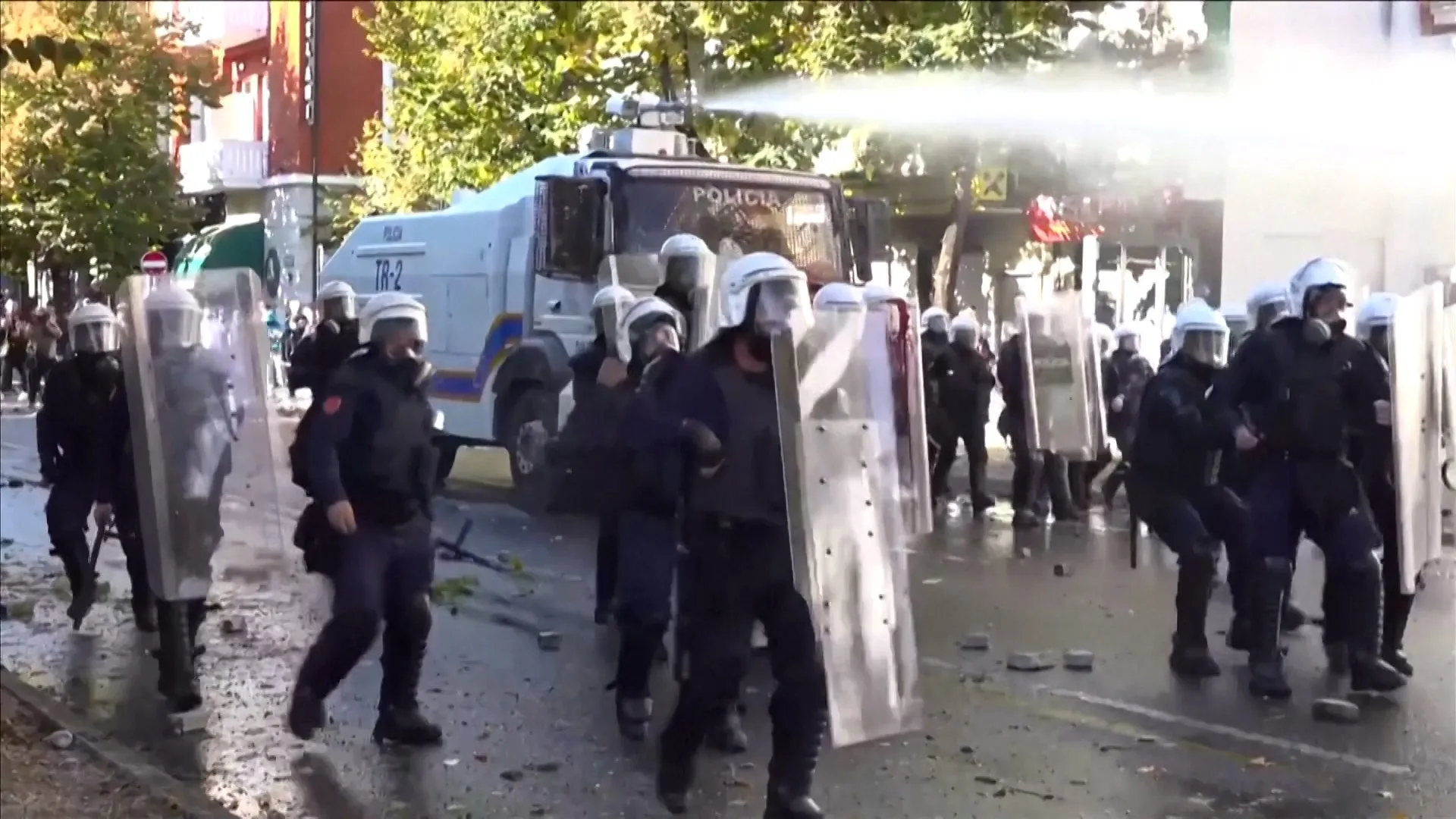
Riot police clash with protesters for fourth day, as young Albanians protest corruption and poor university conditions
Published On 16 Oct 202616 Oct 2026
Albanian Prime Minister Edi Rama has blamed “foreign hands” for the increasingly violent student-led protests that are calling on him to resign.
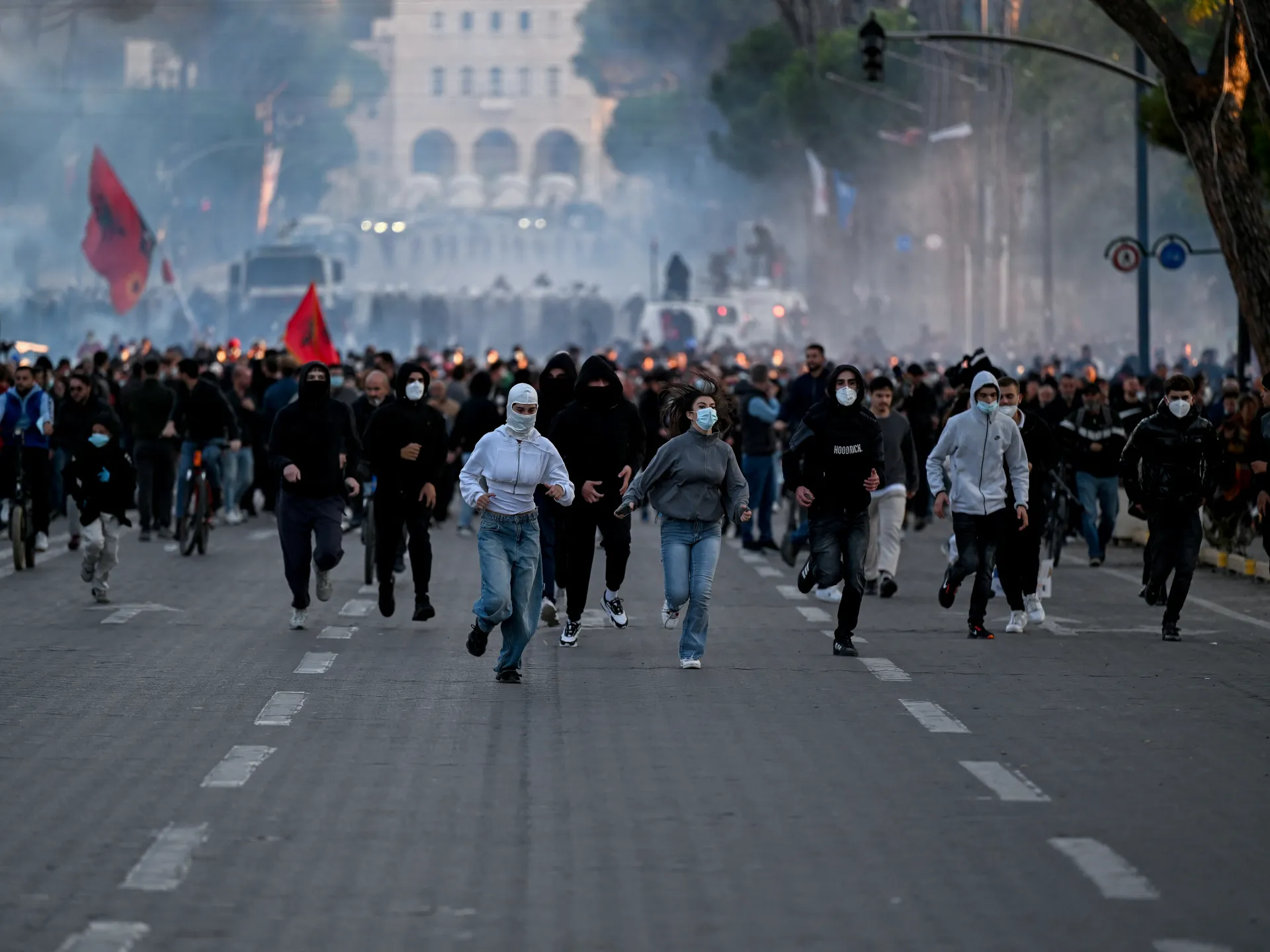
Riot police clashed with protesters outside the education ministry for the fourth day in a row, as thousands of young Albanians marched through the capital, Tirana, on Friday to protest government corruption and poor university conditions.
Recommended Stories
list of 3 itemsend of list
“This is not a student phenomenon,” Rama said in a video address on Friday. He said there were “foreign hands that do not wish for Albania to be at peace”.
Rama insisted that the protest had “absolutely nothing to do with the hardships, problems or legitimate aspirations of anyone who desires a better life”.
Police officers used water cannon and tear gas as demonstrators hurled rocks.
The protests have spread beyond the capital to Elbasan, Shkodra and Korca, where demonstrators broke windows and set fire to rubbish bins, local media reported.
The ongoing escalation follows months of mostly peaceful demonstrations, originally sparked by the sale of part of Albania’s coastline to a luxury resort development linked to Jared Kushner, US President Donald Trump’s son-in-law.
Days of unrest have increasingly targeted banks and government buildings. Protesters hurled bricks and concrete blocks at the education ministry on Tuesday. They also set fire to several buildings across the city, including the prime minister’s office, the finance and justice ministry buildings and branches of several banks.
According to a police statement, 160 people were detained over alleged acts of violence on Thursday evening.
The EU question
Demonstrators are demanding Rama’s resignation, as well as electoral and education reforms.
The prime minister, whose government denies corruption, said he would be ready to discuss rising education costs but rejected the calls to resign.
He said on Thursday, “My responsibility is to listen, address legitimate concerns and keep Albania moving forward.”
His dismissal “would be a betrayal of the Albanians who gave me a strong mandate to complete negotiations on European Union membership”, he added.
Corruption scandals have complicated Albania’s efforts to join the EU. Analysts say the country is a hub for gangs seeking to launder money from drugs and weapons trafficking.
Rama won a fourth term last year on promises to take Albania into the EU, aiming for membership as early as 2028.
LAS VEGAS, NV. — Metallica had a tender moment at Sphere on Thursday, just after a wretched sea monster mangled the Las Vegas skyline.
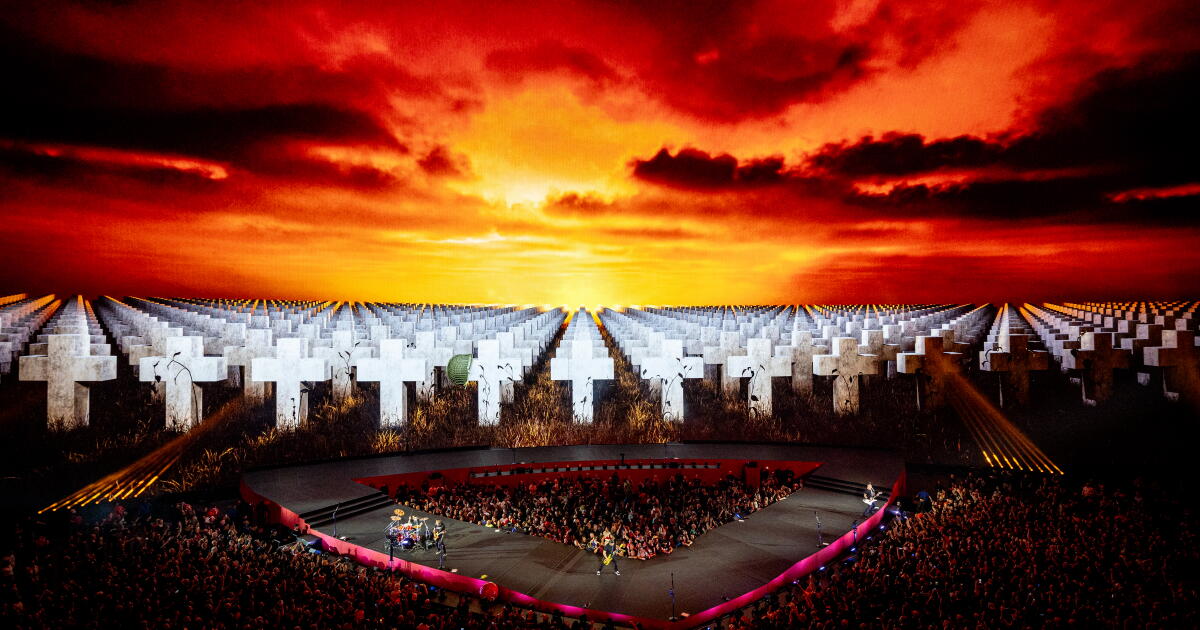
On the opening night of its “Life Burns Faster” stand, Metallica had a 16k-resolution arsenal to match the bombast of its music. While the quartet — the first metal band to perform at Sphere — tore through the instrumental deep cut “The Call of Ktulu,” that drippy leviathan swatted at life-sized fighter jets on the screen.
When the leathery beast slunk off, singer James Hetfield dedicated the track to the band’s founding bassist, who died in a tour bus crash in 1986. “In honor of our fallen brother, Mr. Clifford Lee Burton,” Hetfield said, to a bellowing crowd. “We love you, and we miss you, brother.”
Metallica, the biggest band in metal, thrives in that tension between the genre’s outrageous grandeur, grimy nihilism and outlaw camaraderie. At “Life Burns Faster,” a series of two-night engagements that stretches into March next year, they stayed fleshy and ferocious as a band beneath the digital carnage.
Metal, even when siloed off from broader music culture, has always been a commercial powerhouse. Metallica remains its flagship live act. In 2023 alone, they closed out the all-star Power Trip festival at the Empire Polo Grounds, and still played two in-the-round nights at SoFi Stadium.
They’ve been enormous for generations, and made no bones about their ambitions. The band’s ongoing “M72” tour is hovering around the 10 highest grossing tours ever. So it was only a matter of time before the band – Hetfield, guitarist Kirk Hammett, bassist Robert Trujillo and drummer Lars Ulrich – got curious about the rare venue that could go toe-to-toe with them for sheer firepower. (Onstage and at the box office – Metallica knows counterculture can be both sincere and extremely lucrative).
“We’re grateful you’ve taken the time, energy and the cash” to attend opening weekend, Hetfield said onstage on Saturday. Nice of him to acknowledge the table stakes.
By day, there was much charm in seeing nearly 20,000 metal fans swarming the Vegas strip in Metallica gear, flying in with buddies, spouses, kids and grandkids no matter the four-figure tickets and obligatory crates of merch. (The old adage that metal fans are nice people pretending to be mean held up). On Sphere’s escalators, grey-bearded lifers hugged in shredded battle jackets; tween girls in “Master of Puppets” hoodies drummed along to every fill; accents came from eastern Europe, Latin America and all the world over. My cab driver effusively recounted sneaking in to see Metallica at Ruthie’s Inn in Berkeley in 1983.
Classic rock and jam bands like the Eagles and Dead & Co. largely use Sphere’s A/V capabilities as a psychedelic background to stately tunes. Metallica is larger-than-life as is — they need little more than a Hetfield snarl or Hammett solo to feel tectonic. On Thursday and Saturday nights, they were nasty and resonant as a live band, even beneath 160,000 square feet of LED mayhem.
Metallica has one of the deepest catalogs and intensely-attached fandoms in rock. Sequencing the first Sphere shows would be a global statement, and the band played stellar ones on Thursday and Saturday. From the howitzer of opener “Battery” through the white-knuckle turns of “Creeping Death,” they knew they were still playing to the faithful, albeit in a whole new sort of arena.
As with all Sphere acts, that visual wattage can absolutely grip you, or it can feel using a flamethrower to grill. (I texted some “Ktulu” footage to a serious metalhead friend, who replied “Lol,” then “Sick,” which seemed apt).
Some backdrops were creepy set dressing, while others had tactile brutality — Sphere often had the rumble-seat effect blaring. Metallica locked into the martial imagery around “The Shortest Straw,” “Sad But True” and the MTV-era hit “The Memory Remains.” “Wherever I May Roam” used gulp-inducing hairpin turns, and fans flinched when the statue from “…And Justice For All” collapsed in pieces (an apropos image, these days!)
While the band surely didn’t intend this coincidence, for anyone watching the Christa Pike saga, it was surreal to hear Hetfield scream ”Death in the air, strapped in the electric chair / This can’t be happening to me” on “Ride The Lighting” inside a gigantic execution chamber.
The set snaked through freewheeling Hammett and Trujillo jams, the recent single “Lux Æterna” and the ballad “Nothing Else Matters” (Metallica writes aching melodies and forlon guitar lines, too). They closed Thursday with “Seek & Destroy,” a roiling cut from their 1983 debut “Kill ‘Em All,” and “Master of Puppets,” given new life as a major plot point in the horror-thriller series “Stranger Things.”
On Saturday, the band reprised its recent two-nights/no-repeats gambit with a completely different setlist. Equally rangy, if perhaps more ruminative.
Peeling out of the gate with “Blackened,” framed as massive silhouettes on a white field, they roared through “Fuel” and lurched into “Leper Messiah” and “Welcome Home (Sanitarium),” each great, grinding cuts from “Puppets.” “Devil’s Dance” and the reicide-themed visuals of “King Nothing” framed their controversial “Load”/”Reload” period as a core transition. Newer cuts “72 Seasons” and “Hardwired” channeled the old viciousness.
They played a lovely “The Unforgiven” and dedicated an exploratory take on “Orion” to Cliff Burton again, followed by Thin Lizzy’s “Whiskey In The Jar,” a major influence on their riffing. But the set came into its full power with a duel of “For Whom the Bell Tolls” and “One,” framed around WWI-era bombing footage and parades of mangled skeleton soldiers. Metallica’s always been more existential than topical, but haven’t we all scrolled our feeds recently and muttered – “Darkness imprisoning me / All that I see, absolute horror.”
They closed on “Enter Sandman,” the only real choice for their inaugural Vegas weekend. Two perfectly-tuned sets, retrofitted for this decadent monolith.
Is it a little weird that metal is now welcome as an elite Las Vegas entertainment commodity? Perhaps. But the genre’s been a cunning spectacle since Ozzy’s first crucifix (or Venom getting in league with Satan). Metallica’s generations of disaffected dirtbags — this writer among them — were primed for this gig. Metal’s always been escapist, even at its grittiest. Now it’s a five-star vacation destination too.
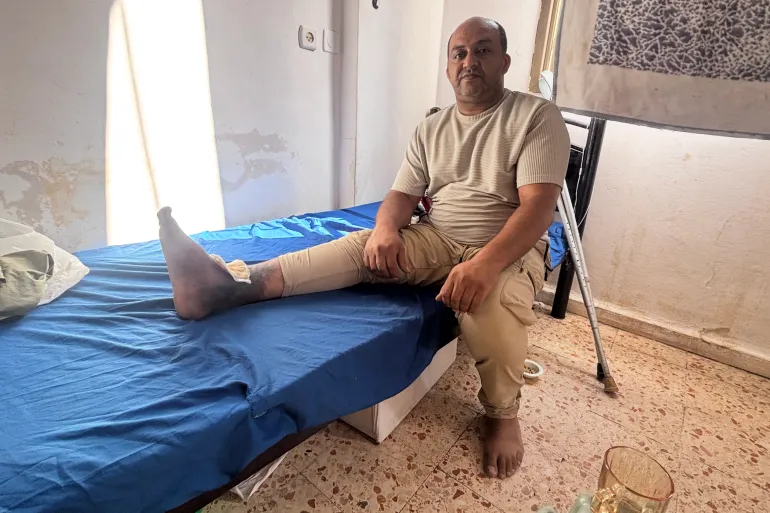
Tulkarem, occupied West Bank – Hakim Mar’i spends his days lying on a single bed, his disfigured leg raised. The windows of Mar’i’s dilapidated apartment, his latest temporary shelter, are covered with old blankets. Unable to work, Mar’i has no money for electricity, so the blankets have to do. At night, his family lives in near darkness.
The apartment is just around the corner from mounds of rubble and gnarled iron structures that mark one entrance to the now-emptied Tulkarem refugee camp. For Mar’i and other Palestinians, the camp was a home once considered temporary. But now, even the physical structure – their home – that tied those generations together is gone.
Recommended Stories
list of 4 itemsend of list
The apartment is just around the corner from mounds of rubble and gnarled iron structures that mark one entrance to the now-emptied Tulkarem refugee camp. For Mar’i and other Palestinians, the camp was a home once considered temporary. But generations lived there, and now, the physical structure – their home – that tied his family together over the years is gone.
Impoverished, Hakim’s family is in disarray. With its debts mounting and its members facing another eviction, he said he has considered taking his life several times over the past year and a half.
Mar’i cannot afford treatment for his debilitating leg injury, which has developed severe infections. He said he sustained it while working as a labourer inside Israel in 2019. The wound worsened after Israeli soldiers severely beat him when they forced his family from the Tulkarem camp. Diabetes and other untreated conditions have piled on, but he is unable to pay for the needed medical care.
“This joint here is completely gone,” he said, gesturing at the swollen, blackened lower leg that prevents him from working.
“The medicine – by God, the medicine, I haven’t been able to get. My wife and kids tell me: get out travel. Go to America, Turkey – so I can the medical treatment I need… I’m a sick man.”
His mother, Salwa, sat beside him, less than a kilometre (0.6 miles) from their former four-storey home. She wept when asked about the family home that was built floor by floor after they were first displaced in 1948 from al-Khudayra, the Arabic name for Hadera, a city in Israel. “We really put a lot into that house,” she said.
After their removal, the Israeli military razed the Mar’i home so a road traversing the now-emptied camp could be built. “Seeing it destroyed was really painful for us – all of us,” she said.
It has been more than 20 months since Israeli forces emptied the Jenin, Tulkarem and Nur Shams refugee camps in a sweeping military operation in the northern West Bank, displacing tens of thousands of Palestinians whose families had already been refugees for three generations. Constantly renewed orders for a closed military zone now prevent their return.
Since January 2025, Hakim’s family has been forced to move four times. First, they fled to a converted youth centre before landing in a cramped apartment with their four children, all under 15.
Unable to pay rent, the family could see the landlord’s generosity run its course as this once-temporary housing arrangement now has no end in sight. Hakim owes money at the local shops for food he bought on credit. Some nights, the children eat at neighbours’ houses.
“I have children. I have food. I have drink,” he said. “My hands are empty. Nobody is with me. Nobody is standing beside me.”
Hakim Mar’i in his family’s apartment with his injured leg, which prevents him from working [Al Jazeera]
‘We’re already at the brink’
The Mar’i family is among more than 33,000 Palestinians forcibly removed from the Jenin, Nur Shams and Tulkarem camps by Israeli forces in early 2025. This is the largest single episode of forced displacement in the West Bank since Israel’s occupation began in 1967, according to the United Nations agency for Palestinian refugees (UNRWA).
UN satellite imagery shows that 20 percent of all buildings across the three camps have been destroyed and another 28 percent are damaged.
“The level of destruction we are seeing is severe and unprecedented,” said Roland Friedrich, director of West Bank affairs for the UN agency for Palestinian refugees, UNRWA.
According to Friedrich, 85 percent of those displaced have no regular income after many lost jobs when the camps were emptied. More than 80 percent of residents are renting, an unfamiliar expense for families who never paid for housing or utilities inside the camps.
The closed military zone covering the camps is renewed every two months, Friedrich said, with no indication of when – or whether – residents will be allowed to return. “What we saw there is forced displacement,” Friedrich said. “The UN’s position is very clear: People have to be allowed to return. The camps must be rebuilt.”
Unlike after the 2000-2005 second Intifada when the Jenin camp was rebuilt, displaced families and UNRWA staff fear there is no return plan this time.
The Israeli military stated the camps were emptied for “operational security” in its effort to root out fighters from the camps. Friedrich worried the aim of the military operations is to “change the geographical expression of the Palestinian refugee issue”.
Now more than 20 months into what was meant to be an emergency response, funding shortages have left UNRWA unable to cover the vast needs of the displaced population. It has moved some operations to keep schools and basic health clinics functioning. With funds dwindling, the agency has shifted to a “targeted approach”, leaving thousands without support.
Friedrich pointed to a rise in gender-based violence linked to the economic strain on families and to growing depression and anxiety among displaced children observed by UNRWA’s psychosocial teams. “We’re already at the brink now,” he declared.
Members of the Zbeidat family sit on couches outside. The room they stay in is on the left [Al Jazeera]
‘Everyone went their own way’
While Hakim’s displacement plays out in the shadow of the camp, the family of Khadija Zbeidat face their own imminent eviction on the outskirts of Tulkarem. They live in the neighbourhood of Dhinnaba, where sparse houses are interspersed with greenhouses. They are unable to afford a residence closer to the city centre.
As Khadija sat on a couch in the middle of the yard, her many children and grandchildren ran past a small patch of plants she has planted – one of her few remaining joys. “I love plants,” she said. “We had many flowers in our home in the camp. Having the plants here is all I have to feel like myself,” she told Al Jazeera.
Khadija, a widow, shares a tiny spartan room with nine family members, nearly all children, along with a small bathroom and a kitchen barely big enough for one person to cook in. A worn couch takes up one corner. The ceiling is peeling above it.
The room was given to them rent free by a relative of Khadija’s brother-in-law after they spent four months crammed into her daughter’s house with nine other people. “It got really cramped, the pressure on each other,” Zbeidat said. “And we became a burden too.”
Khadija’s family was displaced in January 2025 from the Tulkarem camp’s Haret al-Nadi section, a significant part of which has been destroyed, she said.
“The camp was excellent,” she said of their life before. “I swear, I wish they’d take us back. Everything was close to us, dear – … the closeness, that sense of belonging and the warmth, the company and the neighbours.”
The memories that she cherishes most dearly and that bring her to tears are of food: the stuffed grape leaves and the maamoul cookies made as a neighbourhood together for Eid. This year, there was none of it.
“Nothing. No cookies,” she said. “Nobody even had it in them to do anything any more. Everyone went their own way – scattered.”
Like the Mar’i family and others, they were not allowed to bring their belongings during their abrupt displacement. Some residents have since been allowed to retrieve belongings once or twice from their homes in the camps, but much of what they own remains left behind. Khadija’s daughter-in-law at one point returned to the ruins of the camp – at the risk of being shot – to retrieve a doll left behind that Khadija’s granddaughter Sandy would not stop crying about.
In Tulkarem, displaced families live either in the poorest areas closest to the camp, like the Mar’is, or on the cheaper outskirts, like the Zbeidats, remaining close enough to the health and schooling services that UNRWA still provides. But even a simple trip to buy groceries requires Khadija, who has no car, to travel 2km (1.2 miles).
At night, the family sits outside rather than in the stifling heat of the poorly ventilated room, watching Israeli military drones pass low overhead. “What to do? We’re used to seeing them, to having them around, to them raiding houses,” Khadija said. “It doesn’t matter any more.”
The military raids that always haunted life in the refugee camps have now come to wherever the displaced refugees have fled to. “We don’t feel safe,” Khadija said. “Nor the kids. It’s dangerous. When they want to go out somewhere, my heart stays busy until they come back.”
The kitchen and bathroom the Zbeidats have are in the same room they sleep in [Al Jazeera]
Waiting to be kicked out again
For months after the displacement, landlords, relatives and shopkeepers absorbed much of the shock, allowing families to stay for free or buy food on credit. But as the emergency stretches to almost two years now, that informal safety net is fraying. The pressure is felt particularly in economically moribund Tulkarem, where many families had relied on jobs inside Israel before Palestinian work permits were revoked after the Hamas-led attacks in southern Israel and the start of Israel’s genocidal war in Gaza in October 2023.
The owner of the property where Khadija’s family is staying recently sent his sister to tell Khadija’s family to leave. “They think it’s been too long,” Khadija explained. “They want the land, to benefit from the land and the room. … But where can we get money, where to pay from? The rent is very high, and we can’t afford it. We don’t know what to do if she comes again and kicks us out.”
Hakim’s family is on the brink of eviction too. Like others, he received from UNRWA a one-time rental subsidy of 3,000 shekels ($985) and a separate 1,700-shekel ($560) multipurpose cash payment for short-term assistance. “Every minute, I am waiting for the landlord to kick us out,” he said.
Khadija’s family survives on credit from shopkeepers who know their situation and, for now, still extend it – but patience is wearing thin.
Hakim said this goodwill is collapsing: “You tell them: ‘Give me a day, two days. Be patient with me.’ They won’t bear it.”
As distant as a return to her family’s lands in 1948 feels now, Khadija still hopes to return to the camp one day. But she worries that her children may inherit an even more precarious existence than the one that preceded this latest dispossession – refugees for generations displaced yet again. “Only God knows what tomorrow will bring us,” Khadija said.
If you or someone you know is at risk of suicide, theseorganisations may be able to help.