Gen

Singapore Reportedly Looking Toward 6th Gen Fighter Future With Interest In GCAP Program

Singapore has started exploring whether to become involved in the Global Combat Air Program (GCAP), a new report suggests. While it doesn’t state that Singapore has decided to join or purchase the Tempest fighter at the center of that program, it is in line with the country’s approach to buying the F-35. At the very least, it would seem to indicate that Singapore is starting to look at the sixth-generation combat aircraft technologies that could follow the Joint Strike Fighter.

According to Janes, Singapore has begun early, informal discussions about possible participation in GCAP. These are described as exploratory, meaning Singapore is gathering information rather than negotiating membership of the program.

The report explicitly states that the Singapore government has not made any decision to become a participant in the program, which makes sense considering that the Republic of Singapore Air Force (RSAF) is still waiting to receive its first F-35s.

A U.S. Marine Corps F-35B Lightning II assigned to the Marine Fighter Attack Squadron 242, Marine Aircraft Group (MAG) 12, Marine Corps Air Station, Iwakuni, conducts an aerial demonstration during the Singapore Airshow 2022 at Changi Exhibition Center, Republic of Singapore, Feb. 16, 2021. Through participation in regional events like the Singapore Airshow, the U.S. demonstrates its commitment to the security of the Indo-Pacific, promotes interoperability, displays the flexible combat capabilities of the U.S. Military, creates lasting relationships with international audiences, and strengthens partnerships throughout the Indo-Pacific region (U.S. Air Force photo by Master Sgt. Richard P. Ebensberger).
A U.S. Marine Corps F-35B assigned to Marine Fighter Attack Squadron 242, Marine Corps Air Station, Iwakuni, conducts an aerial demonstration during the Singapore Airshow 2022 at Changi Exhibition Center, Republic of Singapore. U.S. Air Force photo by Master Sgt. Richard P. Ebensberger

GCAP is a joint next-generation air combat program led by the United Kingdom, Japan, and Italy, aiming to field the Tempest sixth-generation combat jet and wider air combat system by around 2035. With the demise of the pan-European Future Combat Air System (FCAS), GCAP is the preeminent Western sixth-generation fighter effort outside of the United States.

GCAP is intended to include not only the Tempest crewed fighter but also an integrated ecosystem of AI-enabled systems, advanced sensors, networking, air-launched weapons, and autonomous ‘loyal wingman’ aircraft.

As for the RSAF, this is a notably modern and capable force, benefitting from considerable investment throughout the years.

It is currently spearheaded by a combat fleet of 40 F-15SGs, plus 49 F-16C/Ds, a combination of Block 52 and Block 52+ jets.

An F-15SG Strike Eagle fighter jet, assigned to the 428th Fighter Squadron, Mountain Home Air Force Base, Idaho, taxis out to take part in a Red Flag 21-2 mission, at Nellis AFB, Nevada, March 18, 2021. The F-15SG is a variant of the U.S. Air Force F-15E Strike Eagle and used by the Republic of Singapore Air Force. (U.S. Air Force photo by William R. Lewis)
An F-15SG, assigned to the 428th Fighter Squadron, Mountain Home Air Force Base, Idaho, taxis out to take part in a Red Flag 21-2 mission at Nellis AFB, Nevada, in 2021. U.S. Air Force photo by William R. Lewis

Next, the RSAF will receive eight conventional takeoff and landing (CTOL) F-35As and 12 short takeoff and vertical landing (STOVL) F-35B fighters. The F-35Bs will be the first to arrive, with deliveries due to start before the end of this year. These will initially be based at Ebbing Air National Guard Base in Arkansas for training, with the first F-35Bs scheduled to be stationed in Singapore from 2029.

In total, Singapore covers an area of less than 280 square miles, putting unique strains on the RSAF.

In preparation for the F-35B, the RSAF is extending the runway at Pulau Sudong, an offshore location, which will reduce the noise burden on more populated areas. The existing runway will be extended from around 6,500 feet to approximately 9,800 feet, with work to be completed by 2028. The growing demand for training capacity is something that has previously led the RSAF to look at having a detachment in Guam, but the reworked Pulau Sudong should help address the issue.

A satellite view of Singapore reveals just how small it is. Google Earth

The RSAF has traditionally acquired the best available Western-made equipment to meet its combat aircraft needs. Looking at what is currently the only sixth-generation combat jet that is likely to be available to Singapore for the foreseeable future makes sense. However, as Roy Choo, a defense journalist and TWZ contributor, noted, deeper involvement in GCAP would be years away.

“From this news, it appears they may have identified a future requirement for a sixth-generation fighter, although this is unlikely to transition into a program of record for at least another two decades,” Choo explained. “As with most operators, Singapore engages with industry to stay informed about available market offerings all the time.”

In the next decade or so, the RSAF will likely remain focused on its F-35A/B program and on bringing these aircraft up to full operational capability.

Another upcoming program will be a midlife upgrade for the F-15SG, deliveries of which first began in 2008. Choo expects work on this to begin once the ongoing F-16 upgrade is finished. The F-16s are set to remain in service into the mid-2030s, according to Singapore Chief of Air Force Maj. General Kelvin Fan. The F-15SG will be around longer, giving considerable lead time for it to be replaced by a sixth-generation platform.

Two Republic of Singapore Air Force F-16s fly alongside a Washington Air National Guard KC-135 Stratotanker during Cope Tiger 2024, Korat Royal Thai Air Base, Thailand, March 26, 2024. The U.S. commitment to the Indo-Pacific and our Allies and partners is ironclad, and we will remain engaged in the region. (U.S. Air Force photo by Tech. Sgt. Hailey Haux)
Two Republic of Singapore Air Force F-16s fly alongside a Washington Air National Guard KC-135 Stratotanker during Cope Tiger 2024, Korat Royal Thai Air Base, Thailand, in 2024. U.S. Air Force photo by Tech. Sgt. Hailey Haux

When it comes to a path to a potential Singapore Tempest acquisition, it is worth looking at the approach taken with the F-35.

Singapore joined the F-35 program as a Security Cooperative Participant (SCP) in 2003 when it identified the fifth-generation fighter as a potential replacement for its F-16s. At that time, Choo notes, Singapore was still receiving its F-16s and was yet to select a contender for its Next Fighter Replacement Program (NFRP) — it eventually chose the F-15SG in 2005.

Singapore placed an initial order for four F-35B in 2020, a full 17 years after joining the program as an SCP. This is very much an indication of the long-term view Singapore takes in its defense procurement.

U.S. Marine Corps Lt. Col. Steve Gillette, VMFA-121 squadron commander, explains the capabilities of the F-35B Lightning II to Dr. Ng Eng Hen, Singapore minister of defense, at Luke Air Force Base, Ariz., Dec. 10, 2013. (U.S. Air Force photo by Senior Airman Jason Colbert)
U.S. Marine Corps Lt. Col. Steve Gillette, VMFA-121 squadron commander, explains the capabilities of the F-35B to Dr. Ng Eng Hen, then the Singapore minister of defense, at Luke Air Force Base, Arizona, in 2013. U.S. Air Force photo by Senior Airman Jason Colbert

If Singapore were to join GCAP, it would likely be part of a long-term view toward acquiring a sixth-generation fighter capability.

While Singapore has maintained generally good relations with Beijing, it is acutely aware of its economic vulnerability in the face of rising tensions in the South China Sea as China makes increasingly forceful moves to assert its claims in the region. With China preparing for potential contingencies in the South China Sea through the continued expansion of its anti-access and area-denial (A2/AD) capabilities in the region, the People’s Liberation Army Air Force — busy working on its own sixth-generation platforms — is very much the pacing threat.

A Republic of Singapore Air Force F-15SG. Australian Department of Defense

Given Singapore’s prudent approach to defense procurement, it is unlikely to commit large sums of money to a program at such an early stage of development.

If pursued, a likely option would be for Singapore to join GCAP with observer status, something that Canada (another F-35 customer) recently signed up to do. “This would give greater visibility of GCAP’s governance and capabilities,” Choo added. “After all, Singapore doesn’t have the deep technological know-how as the other full-tier partners.”

“An observer status would fit with its cautious and non-committal approach to the program just as it did with the F-35 SCP membership.”

Potentially, GCAP could provide a platform for Singapore to build future relationships with other partners and secure a workshare arrangement involving supply chain and maintenance work. That would all be a long way off, however.

Logically speaking, the RSAF’s next procurement project will likely involve a collaborative combat aircraft (CCA) to build combat mass.

Interestingly, earlier this week, Singapore and Australia signed the Industrial Base Resiliency Arrangement (IBRA), which establishes a practical framework for closer defence industrial cooperation between the two nations.

The IBRA “allows both countries to engage in cross-sustainment of common defense platforms, examine priority delivery requests for defence orders, streamline equipment transfers, foster defence industry partnerships, and facilitate information exchanges to mitigate supply chain risk.”

When it comes to common defense platforms, it’s not hard to imagine that the MQ-28 Ghost Bat could be in the RSAF’s thoughts. At the same time, the F-35A and the P-8A maritime patrol aircraft will also offer commonality with Australia once they arrive in RSAF service.

A MQ-28A Ghost Bat on the tarmac as an F-35A Lightning II taxis during Exercise Carlsbad at RAAF Base Tindal. *** Local Caption *** The successful completion of Exercise Carlsbad at RAAF Base Tindal in April 2025 represents significant progress for the MQ-28A Ghost Bat capability - a collaboration between Boeing Defence Australia and the Royal Australian Air Force to develop a Collaborative Combat Aircraft. Defence continues to assess the MQ-28A Ghost Bat through systematic testing in both live and digital environments, and remains focused on demonstrating MQ-28A platform, payload and system capability in 2025. Achieving first flight in February 2021, MQ-28A Ghost Bat is the first combat aircraft designed in Australia in more than 50 years. Continued investment in uncrewed and autonomous systems, including collaborative combat aircraft like the MQ-28A Ghost Bat, increases integrated force lethality and survivability by integrating existing and emerging technologies.
An MQ-28A Ghost Bat on the tarmac as a Royal Australian Air Force F-35A taxis during Exercise Carlsbad at RAAF Base Tindal. Australian Department of Defense

Singapore has a history of studying major defense programs years before making procurement decisions. Whether it intends to buy the Tempest in the future or not, the report is the first known indication that Singapore is formally examining possible links to GCAP, and looking at sixth-generation combat aircraft more generally.

Contact the author: thomas@thewarzone.com

Thomas Newdick is a staff writer at TWZ, where he covers military aviation, defense technology, weapons systems, and international security. Based in Berlin, Germany, he reports on conflicts, military modernization efforts, and emerging aerospace technologies around the world, with a particular interest in airpower and its role in contemporary warfare. His reporting is informed by deep expertise in modern and historical airpower, particularly in Europe, with a focus on military aviation, air campaigns, and aerospace developments across the continent and beyond.


Source link

‘Televising our revolution’: India’s Gen Z flips Modi’s social media game | Protests

New Delhi, India — She darted through a sprinting crowd, running from a cloud of tear gas just above her head. Her eyes stung so badly she could barely see, yet she filmed the chaos on her phone.

“I saw policemen brutally beating up unarmed girls and peaceful children,” said Avanshika Singh, who has been turning up for student protests that shut down the national capital, demanding the education minister’s resignation.

On her return home, the 18-year-old put together a rough cut from the chaos and captioned it on Instagram: “Today, we rang Parliament’s doorbell and ran.”

The march to the Indian parliament on July 20 against serial examination paper leaks brought the nation’s capital to a standstill as tens of thousands of protesters occupied central roads leading to the country’s corridors of power. More than 100 students were injured in a crackdown by police, operating under the direct instructions of Prime Minister Narendra Modi’s government.

But since then, Indian internet has turned into a relentless reel of police excesses: shaky smartphone footage, rapid-fire edits pulsing to hip-hop tracks, and a tidal wave of memes and expletives.

“This is the only thing anyone is talking about. If nothing, we are televising our revolution,” Singh, a teenager, told Al Jazeera, standing amid a sea of protesters choking Parliament Street on Wednesday. “The entire country today feels the sting of batons and tear gas with us.”

Twelve years ago, Modi rode to power and pioneered in many ways, leveraging social media platforms to reach the masses. Today, Gen Z is flipping his Hindu majoritarian party’s dominance on social platforms, weaponising against it the very tools the Bharatiya Janata Party has long relied on.

“Hating Modi is cool on the internet now, after years of criminalising dissent,” she said, before bursting into slogans: “Uncle Modi, go back, go back.”

A woman holds a sanitary pad with a slogan in solidarity with India’s Cockroach Janta Party protests held at Jantar Mantar in New Delhi, which demand the resignation of Education Minister Dharmendra Pradhan over exam paper leaks, in Kolkata, India, on July 22, 2026
A woman holds a sanitary pad with a slogan in solidarity with India’s Cockroach Janta Party protests held at Jantar Mantar in New Delhi, which demand the resignation of Education Minister Dharmendra Pradhan over exam paper leaks, in Kolkata, India, on July 22, 2026 [Sahiba Chawdhary/Reuters]

Evidence of police excess

After the July 20 demonstrations against the government’s handling of paper leaks, the police denied all the protesters’ allegations and media reports of excess force in the crackdown.

But by then, social media was flooded with evidence, recorded by the protesting students.

A New Delhi police officer thrusting a baton on a female protester’s back; usage — potentially by a paramilitary force that was deployed alongside the police — of lethal pellet guns, for the first time in the national capital; a mother crying and pleading with dozens of police officials; another officer slapping and chasing unarmed students; police officers wearing Meta glasses; law enforcement agents planting a damaged car outside a protest strip; and footage where an officer casually trips the students running from tear gas.

No sight escapes the cameras at the Jantar Mantar protest strip, where thousands of protesters keep recording round the clock. The visuals from July 20 have prompted protests across India, in cities like Mumbai, Bengaluru, Patna, Lucknow and Aizawl.

The Cockroach Janta Party, a political pressure group that has been leading the students’ protest, has said the demonstrations would continue “peacefully” until three demands are met. They want Dharmendra Pradhan, the education minister, to resign; for the Modi government to assure that no criminal cases would be pursued against protesters; and for compensation of about $105,000 for families of students who died by suicide due to exam paper leaks and cancellations.

Niharika Soni, a 19-year-old, stood among the thousands-strong crowd that occupied Parliament Street on Wednesday, distributing water bottles to protesters. She did not take part in the July 20 march and did not care much about it either.

Then, the visuals appeared on her feed.

“My mother and I cried for two hours, watching the videos together at home,” she said, adding that her mother has been a staunch supporter of PM Modi.

“We hugged each other and come here every day now,” she added, now holding her mother’s hands, as part of a human chain, ready to confront government forces if attacked.

A supporter of India’s Cockroach Janta Party (CJP) sits on the ground as he rests during ongoing protests, two days after thousands of protesters marched towards parliament demanding the resignation of Education Minister Dharmendra Pradhan over examination paper leaks, at Jantar Mantar in New Delhi, India, on July 22, 2026
A supporter of India’s Cockroach Janta Party (CJP) sits on the ground as he rests during ongoing protests, two days after thousands of protesters marched towards parliament demanding the resignation of Education Minister Dharmendra Pradhan over examination paper leaks, at Jantar Mantar in New Delhi, India, on July 22, 2026 [Anushree Fadnavis/Reuters]

‘Leaking any responsibility’

It is also a meme fest on the Indian internet.

Protesters pose, mock and tease police personnel stationed near the protest site. Some offer flowers to them while reminding them that the officers only offered baton hits.

A stroll through the protest site and nearby roads is like scrolling an Instagram feed: posters and graffiti now line central New Delhi.

Even when they speak, protesters use language riddled with smart one-liners and mockery of the government.

“This government is leaking any responsibility towards the youth of this country,” Ipshita Gulyari, a 20-year-old, told Al Jazeera. Modi, she said, had messed with the “wrong generation”.

“There is a lot of arrogance in him — and, you know, teenagers do not tolerate that, bro.”

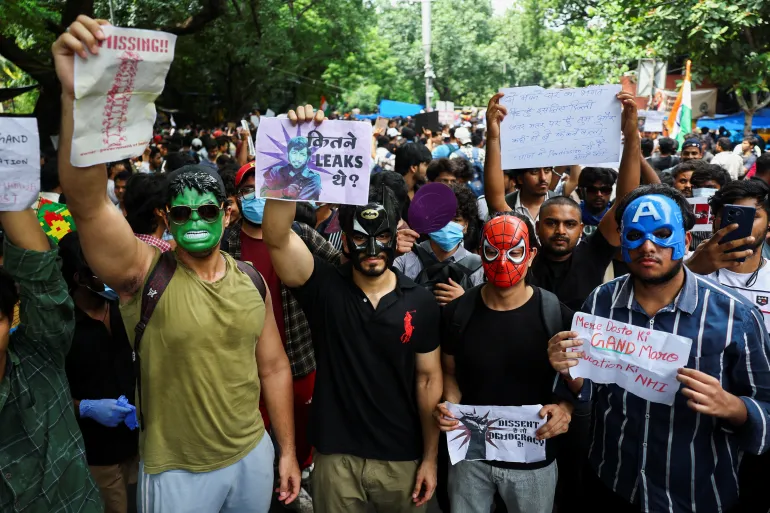
Another duo carried the popular Japanese manga One Piece, a symbol adopted by Gen Z protest movements worldwide. A group of friends donned fictional superhero costumes from Marvel’s Avengers: Spider-Man, Iron Man and Hulk, sitting together on police barricades, looking onto Parliament Street.

“We, the Gen Z people, are born on and for the internet. We were using Instagram before I could read a clock,” said Gulyari.

Mainstream television news channels friendly to Modi have faced accusations of not covering the protests adequately. But young people like Gulyari rely increasingly on independent small publications, and, even more, on social media.

“Gen Z is taking it lightly, being funny about it, because humour is our coping mechanism,” said 18-year-old Yashvi Kumar, a friend of Gulyari at the protest.

“In the middle of all chaos, somewhere we decided that to rebel, we need to find a way that unites us. The memes are uniting us.”

On the other hand, social media posts put up by the BJP are spammed by thousands, calling for the minister to resign.

Supporters of India’s Cockroach Janta Party (CJP) take shelter at a protest site, two days after thousands of protesters marched towards parliament demanding the resignation of Education Minister Dharmendra Pradhan over examination paper leaks, at Jantar Mantar in New Delhi, India, on July 22, 2026
Supporters of India’s Cockroach Janta Party (CJP) take shelter at a protest site, two days after thousands of protesters marched towards parliament demanding the resignation of Education Minister Dharmendra Pradhan over examination paper leaks, at Jantar Mantar in New Delhi, India, on July 22, 2026 [Anushree Fadnavis/Reuters]

Flipping the game

In 2014, Modi was among the first world leaders to understand and leverage social media to take his narrative to the masses. The Congress party, now in opposition, was trounced by Modi’s BJP in national elections that year, and has long struggled to keep up with the BJP’s social media dominance.

But with years in power, as India slid in multiple democratic indices, Modi’s government faced mounting accusations that it was criminalising dissent, with several critics jailed for years without a trial.

Modi’s party also mobilised extensive resources in the last decade in its so-called IT Cell, where a bunch of anonymous accounts, or creators friendly to the government, dox, troll and delegitimise social media criticism.

It is fitting, therefore, analysts say, that the biggest challenge Modi has faced on the streets stems from an online joke. After India’s chief justice casually likened the youth to “cockroaches” and “parasites”, the resulting fury led to the formation of the Cockroach Janta Party.

Before the Cockroach movement, “there was an undercurrent of memes from anonymous accounts, masked people, mocking the government,” said Anurag Minus Verma, a cultural critic and author of The Great Indian Brain Rot.

“In a post-ironical world, anything said with irony travels faster — and irony becomes a central feature of the internet during this kind of protest,” he said. “The pent-up anger found a channel at Jantar Mantar, allowing youth to do their thing, speak in their language.”

The most remarkable turnaround for Verma, he said, has been the unmasking of critics at the protest, where demonstrators ridicule and mock Modi, erasing the fear.

Verma argued that the Modi government had crushed and criminalised protests by labelling them anti-nationals and breaking them into sections. “The Gen Z protesters already identify themselves ridiculously enough: they are cockroaches,” he said. “It becomes a single identity — and that becomes easier to penetrate the virality zone.”

“Some are recreating the popular memes from Nepal, Bangladesh and Hong Kong uprisings,” he told Al Jazeera. “The criticism and hate directed at Modi in the capital is not only acceptable now, but even cool.”

Modi, in a tacit acknowledgement of the power of the social media wave that’s against his government, on Thursday morning offered his first comments on the student protests — on X.

“Nothing is more important than the welfare and future of our youth!” he wrote, before mentioning that his government had set up fast-track courts to punish those behind the paper leaks.

But the CJP’s leader Abhijeet Dipke was quick with his riposte on X.

Playing on Modi’s own words, overlaid on a photo of Education Minister Pradhan, Dipke wrote: “Hi, my name is Nothing”.

Source link

Kenya passes controversial bill two years after deadly Gen Z protests | News

NewsFeed

Two years after deadly Gen Z protests forced Kenya’s government to withdraw a tax bill, lawmakers have approved another controversial package of financial measures. President William Ruto’s administration says it is needed to raise $770 million ahead of the 2027 elections.
Al Jazeera’s Reem Takieddine has more.

Source link

Germany And Spain Launch ‘Team Gen 6’ After Europe’s Next-Gen Fighter Effort Collapses

In a significant development for Europe’s future air combat ambitions, Airbus is trying to restart the program to develop a sixth-generation combat jet, now under German and Spanish leadership. This comes less than a week after the Franco-German-led New Generation Fighter (NGF) effort effectively collapsed in its original form, amid acrimony between Paris and Berlin. The NGF was planned as the crewed centerpiece of the pan-European Future Combat Air System (FCAS), which Airbus, as the leading European aerospace corporation, now hopes to get back on track.

Airbus’s Defense and Space unit launched the ‘Team Gen 6’ initiative today with a message on X, declaring that it was “an exciting step for European sovereignty.” So far, eight German defense and aerospace contractors have signed a strategic positioning paper as part of the effort. Those firms are Autoflug, Diehl Defense, Hensoldt, Liebherr, MBDA Germany, MTU Aero Engines, and Rohde and Schwarz.

Reflecting the German-Spanish nature of the new program, those companies are now “closely integrated” with firms from Spain, comprising GMV, Grupo Oesia, Indra, ITP Aero, and Sener.

“While the development of the overarching [FCAS] ‘system of systems’ is progressing as before, the sixth-generation fighter aircraft integrated within it requires a new, agile industrial setup,” Airbus said.

A screencap from an Airbus video showing a notional future fighter working with remote-carrier-type drones. Airbus screencap

“As Team Gen 6, we have the capabilities and the capacities. Now, we are looking for close alignment with policymakers and the air force[s] to drive forward a superior European air combat system for collective security,” the X post stated.

Airbus also presented a video showing a notional concept aircraft flying with multiple uncrewed platforms. While not too much (as in not much at all) should be read into this, the crewed aircraft features canard foreplanes, a chin intake, and an unusual cranked wing.

Speaking just ahead of the announcement, at the ILA Berlin airshow today, where TWZ was in attendance, Jean-Brice Dumont, head of air power at Airbus Defense and Space, said the company remains committed to delivering a sixth-generation combat jet. “There is a need for a bit of a reshaping and reconsidering the reality of today,” Dumont added.

SYMBOL - 10 June 2026, Brandenburg, Schönefeld: Federal Chancellor Friedrich Merz (2nd from left, CDU) and Jean-Brice Dumont (2nd from right), Head of Air Power at Airbus Defence and Space, stand in front of a drone during a tour of the International Aerospace Exhibition (ILA). Photo: Sebastian Gollnow/dpa (Photo by Sebastian Gollnow/picture alliance via Getty Images)
German Federal Chancellor Friedrich Merz (second from left) and Jean-Brice Dumont (second from right), head of air power at Airbus Defense and Space, stand in front of a drone during a tour of the International Aerospace Exhibition (ILA). Photo by Sebastian Gollnow/picture alliance via Getty Images

Dumont explained that the now-abandoned NGF was one of seven separate “pillars” of technology development being worked on under FCAS. As well as the crewed jet, pillars include powerplant, remote carrier vehicles, precision-guided weapons, and data connectivity.

“We have to consider safeguarding areas where it works, and how we reshape,” he added. “At the moment, we are going to seek guidance from our governments [on] what they want us to do. There has to be demonstrated an industrial feasibility of what is being asked — not only technical. That’s probably a lesson now,” Dumont added.

Dumont continued: “The world in 2026 is very different to the world of 2017 when the [FCAS] programme was launched. We have to accept that fact and reshape it — we need another way to get to the same goal, with faster milestones.”

“The problem we had is that we had drawn a line to 2040, and new technologies for everything,” Dumont added, referring to the goal of having the FCAS, including the NGF, in service by that date. “Today, you see demonstrations of connectivity, systems of systems and unmanned vehicles all around the world. The need is there, and in the countries that we are competing with, they are using it already.”

According to Dumont, the company has “put a number of options on the desk of our ministers and ministries of defense,” and is now awaiting further guidance from officials.

As the centerpiece of FCAS, in its original form, the NGF element was the most high-profile and challenging component of the project. However, it had long been dogged by disagreements over industrial workshare and leadership between Airbus and Dassault Aviation, which were the prime contractors for Germany and Spain, and France, respectively.

A 1:1 scale model of the NGF is unveiled at the Paris Airshow in 2019. Dassault Aviation

Dassault had demanded that it play the defining role in NGF, reflecting key requirements for the jet driven by the French Armed Forces. These included the ability to operate from aircraft carriers, and provision to deliver nuclear weapons. Germany or Spain needed neither of these functions.

Despite the disagreements that derailed NGF, Dumont argued that there had still been useful lessons learned from the FCAS program.

“What Phase 1A and 1B [of the program] have given is a very thorough analysis of the repartition of the work between the crewed and uncrewed platforms, and this remains. That kind of shapes what the manned aircraft will have to do.”

As an example of this work, Dumont pointed to ongoing work that will involve trials of a Eurofighter operating as a “command fighter” — a crewed jet that can operate in collaboration with drones, or what Airbus now refers to as uncrewed collaborative combat aircraft (UCCAs). The tests will see a Eurofighter fitted with a Rafael Litening 5 targeting pod modified to serve as the interface between the crewed jet and UCCAs. This should pave the way toward an in-service command fighter capability being introduced to the Eurofighter, something that will be incorporated in the sixth-generation combat jet from the outset.

Kampfflugzeug vom Typ Eurofighter mit Lenkbombe GBU-48 (Guided Bomb Unit 48) fliegt im Übungsgebiet im Rahmen der multinationalen Übung Green Flag West, am 08.05.2018. ©Bundeswehr
A German Eurofighter with a Litening laser targeting and reconnaissance pod on the centerline station. Crown Copyright

Initial trials will involve a Learjet test configured as a surrogate command fighter and flying with drones in an “enhanced teaming” mode. Airbus hopes to have the command fighter-configured Eurofighter ready for operational service in 2029.

“The demand from the customers is: be ready early,” Dumont explained. “This is not a contradiction to the Future Combat Air System challenge — it is the need to have our platforms evolved earlier than we had traditionally planned.”

A model of a notional sixth-generation fighter displayed at ILA as part of a command fighter study by the German Aerospace Center (DLR). Thomas Newdick

The termination of NGF and the launch of Team Gen 6 leaves plenty of questions over the future of Europe’s air combat landscape.

TWZ spoke to Douglas Barrie, senior fellow for military aerospace at the International Institute for Strategic Studies (IISS) research institute in London, for his take on what might happen next.

On the matter of Germany and Spain now teaming up under the Airbus umbrella, Barrie said that the relationship makes a lot of sense, but its success is far from certain. On the one hand, the two countries already work together within Airbus, and both Germany and Spain are seeking a replacement for their Eurofighter fleets.

SONY DSC
A pair of Spanish Air and Space Force Eurofighters. Spanish Ministry of Defense

“In terms of Team Gen 6, I do wonder if there’s an element of trying to kind of scramble to recover something from the wreckage of NGF, as it were, that the collapse of NGF doesn’t signal the end of Spanish industrial interest in next-gen combat aircraft development,” Barrie said. “But if somebody asked me, do I think between Germany and Spain, they can put together a credible program if nobody else is involved? I think that the numbers would be very difficult to stack up.”

Putting the German and Spanish future fighter requirements together, the two countries might, at best, need to build 300 new combat jets, with a figure of 250 more likely, Barrie contended. Team Gen 6 would then face a real struggle to break even.

This reality will, Barrie believes, force Germany and Spain to look for other partners, which will likely come down to a choice between the British-led Global Combat Air Program (GCAP) and the Swedish next-generation combat aircraft program, led by Saab. Of these, GCAP has the Tempest crewed fighter as its centerpiece, and also involves Italy and Japan. Sweden’s crewed fighter requirements are less clear at this point.

A scale model of a possible Tempest configuration, in Italian Air Force markings. Leonardo

Building a role for Airbus in GCAP would be difficult at this point. With the industrial architecture already in place, bringing not one, but two more partners into that program would be disruptive, particularly in terms of timeline. Already, the Japanese in particular are concerned about the pace of the program, especially since the United Kingdom has not yet fully committed to it in terms of funding.

“My own view is that the United Kingdom remains committed to the program, but there are financial pressures elsewhere,” Barrie noted. “I think that the more likely outcome in all of this is a kind of German, Spanish, Swedish tie-up. The kind of requirements in some ways are aligned a bit better.”

This extends to the size of the aircraft, Barrie observed.

“The kind of aircraft that the Swedes seem to be thinking about, the crewed element is probably more of a bigger Gripen E/F, heading towards Typhoon, in terms of size. This is more in keeping with what the Germans and the Spanish seem to be looking for. Obviously, the United Kingdom and Japan, in particular, need something with longer legs and bigger internal payload, hence GCAP.”

The Saab Gripen E. Saab

“GCAP will be highly capable,” Barrie continued. “That will come with a unit cost to go with it. Maybe what the Swedes, the Germans, and the Spanish might do will be cheaper.”

Provided a German, Spanish, Swedish teaming arrangement could work, the resulting combat jet could still enter a space where it would face competition for important export orders from France, which looks set to continue the development of the Rafale, especially now that NGF has collapsed. Further competition could be provided by South Korea with further developments of its KF-21 and Turkey with the TF Kaan, although these are notably less-ambitious fifth-generation designs.

The Tempest, as currently envisaged, with its very different set of requirements, would not necessarily be a direct competitor to Team Gen 6, Barrie argued, since it would be a closer match to the F-47 in terms of size, capabilities, and cost. While the potential size of this market would be more limited, probably U.S. reluctance to export the F-47 would play in the Tempest’s favor.

An official rendering of the Boeing F-47. U.S. Air Force

As to the possibility of the United States offering a ‘watered-down’ export model of the F-47, Barrie considers this unlikely to generate much interest.

“Yeah, you can have a downgraded version of my super airplane — as a kind of marketing slug that hardly sells, does it?” Barrie continued. “Even if it’s 10 percent less capable, even if it’s 10 percent less expensive, it’s still a likely unit cost of $250 million or more, which is eye-watering.”

This leaves us with the French, and what they might be able to recover from NGF.

If France goes it alone with a sixth-generation combat jet, Dassault will likely be strongly backed by the French government, and the company has traditionally punched well above its weight.

In the medium term, Dassault has a healthy backlog of orders for the Rafale and is very much at the right end of the cost curve. Barrie considers that the Rafale will remain a profitable airplane for the foreseeable future, but at some point, France will need to think about a successor based on an all-new airframe. Industrially, France has the capability to go alone with this, but they would likely look to a partner or partners to come on board. The likelihood of those partners coming from Europe has now been reduced, but other possibilities might be found in the Gulf states.

A pair of Rafales from the Qatar Emiri Air Force. Dassault Aviation www.twz.com

Then there is the question of India, which may still buy more Rafales but which, in the fullness of time, is likely to look for a new-generation fighter, and could be a potential partner for France.

“I don’t see the Indians ever being fully committed to only one country,” Barrie continued. India has already hinted that it might want to try and join the pan-European FCAS or GCAP. Meanwhile, Russia has been a long-term military partner for India, and Barrie thinks that the recent appearance of a two-seat version of the Su-57 Felon may well indicate another effort to sell that fighter to India.

Imagery has emerged that appears to show a previously unknown two-seat version of the Sukhoi Su-57 Felon, Russia’s most modern and capable fighter. Provided the available photo is legitimate, and there is nothing obvious to suggest otherwise, at this point, the Russian development would parallel China’s work on a two-seat version of the stealthy J-20.
The previously unknown two-seat version of the Sukhoi Su-57 Felon, which appeared earlier this year. UAC UAC

Were India to continue its pattern of buying Russian combat aircraft, that would give any potential European partner serious pause for thought, based on the security implications. Meanwhile, India also remains committed to developing its own next-generation fighter.

What the NGF debacle has demonstrated is that any potential partner with France on its next-generation combat aircraft program will likely have to be happy taking a junior role, with Dassault calling the shots.

The collapse of the New Generation Fighter could well be a pivotal moment for European defense cooperation, but it does not signal the end of Europe’s sixth-generation combat aircraft ambitions.

Airbus’s Team Gen 6 announcement marks the start of a German-Spanish-led industrial approach that its backers hope will be more agile and less contested than its Franco-German-led predecessor. However, significant political, financial, and industrial challenges remain, including the search for a reliable partner, or partners. As with NGF, the success of Team Gen 6 will ultimately depend on whether European governments can align their strategic priorities and industrial interests to deliver a sovereign future air combat capability.

Contact the author: thomas@thewarzone.com

Thomas Newdick is a staff writer at TWZ, where he covers military aviation, defense technology, weapons systems, and international security. Based in Berlin, Germany, he reports on conflicts, military modernization efforts, and emerging aerospace technologies around the world, with a particular interest in airpower and its role in contemporary warfare. His reporting is informed by deep expertise in modern and historical airpower, particularly in Europe, with a focus on military aviation, air campaigns, and aerospace developments across the continent and beyond.


Source link

Gen. Maxwell Taylor Dies at 85

Gen. Maxwell D. Taylor, the World War II hero who went on to become the chairman of the Joint Chiefs of Staff and the U.S. ambassador to South Vietnam, died late Sunday at Walter Reed Army Medical Center, the Pentagon announced today. Taylor was 85.

The Pentagon statement did not give a cause of death, but Taylor was reported to have been ill for some time. “Throughout his life, Gen. Taylor epitomized what it means to be a soldier, a diplomat and a scholar,” Defense Secretary Caspar W. Weinberger said.

Source link

India’s Gen Z ‘Cockroach Party’ is going viral | Politics

NewsFeed

A satirical political movement called the ‘Cockroach Janta Party’ has gone viral in India after Chief Justice Surya Kant compared unemployed youth to “cockroaches”. The movement taps into growing frustration over unemployment, inflation and living costs under Narendra Modi’s government, gaining more than 22 million Instagram followers in just six days.

Source link