Research highlights the vast difference between the same holiday items – from a cup of coffee to a meal out – between summer destinations popular with UK families
A typical family meal can cost almost double in different countries included in research by Post Office Holiday Money (Image: Getty Images/iStockphoto)
Families after a bargain break this summer should head to the Algarve, research found.
Portugal’s ever popular hotspot emerged as cheapest once holidaymakers get to their destination.
The research by Post Office Travel Money looked at 10 things tourist typically shell out on, including a three course family meal, lunch for two, through to suncream, a cup of coffee, and insect repellent. The results revealed a near £130 difference between the cheapest and the most expensive amount 22 destinations included, which could really stack up for a typical family over the course of a week or longer.
The Algarve came out top, with the 10 items costing £139.65, and 2.7% less than a year ago.
Next cheapest was Sunny Beach, Bulgaria, where the same came to £142.16, with the Canary Islands, Menorca and Spain’s Costa Brava making up the remainder of the top five where travellers’ money will go the furthest.
At the other of the scale, the most expensive among the 22 destinations included was Sorrento in Italy, with the 10 purchases costing £268. Families should expect to shell out a whopping £150 for a meal, compared with £88 on the Algarve.
The Post Office Travel Money Family Holiday Report was published in the week that many schools in England break up for the summer holiday
Echoing past years, prices varied by as much as 92% across the 22 destinations surveyed. There are also big differences between resorts in the same country.
In Greece, for example, the barometer totals ranged from £181 in Kos to £222 in Crete.
And while a cup of coffee in Sorrento can typically set tourists back £4.37, four hours across the country in Puglia it is £1.14, according to the report.
Laura Plunkett, head of Post Office Travel Money, which accounts for one-in-four UK currency
transactions, said: “We found big variations in costs between the European resorts surveyed, which means it is more important than ever to do some research before heading off on your holiday to inform how much holiday cash you’ll need for meals, drinks and other tourist staples. For those families who haven’t already booked and are looking for a late deal, the low resort prices in Portugal and Spain make these countries great value for money, while Bulgaria’s Black Sea resorts are strong contenders too.”
Weekly insights and analysis on the latest developments in military technology, strategy, and foreign policy.
U.S. Central Command (CENTCOM) on Wednesday unleashed a new wave of strikes on Iranian targets. The attacks, on Iran’s Greater Tunb Island, came as the newly restored blockade on Iranian ports entered its first full day and the command began ordering ships headed to Iran to turn around. Meanwhile, Iran claims it damaged several U.S. military facilities in new rounds of missile and drone attacks in the region.
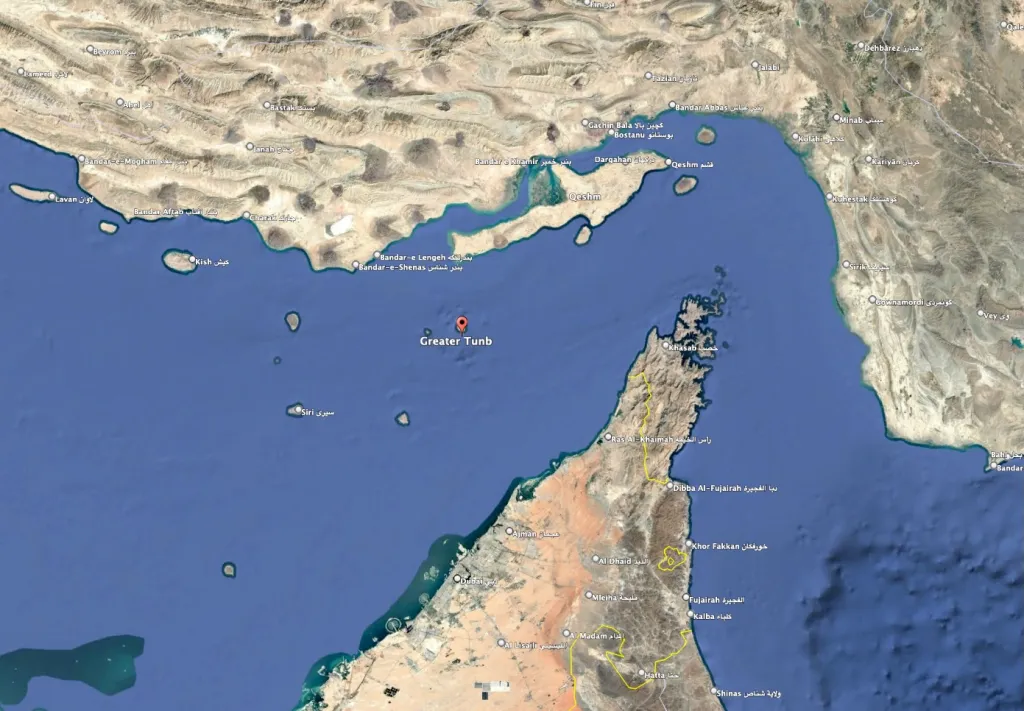
“CENTCOM launched precision munitions against coastal defense systems and cruise missile storage and launch sites on Greater Tunb Island during the 90-minute wave,” the command stated on X. “The strikes further degraded Iran’s ability to attack commercial shipping in the Strait of Hormuz.” The island, located at the western mouth of the Strait, sits about 30 miles south of the Iranian coast and about 50 miles northwest of the United Arab Emirates (UAE), which also lays claim to it, along with the Abu Musa and Lesser Tunb islands that Iran seized in 1971.
US Central Command carried out a 90-minute wave of strikes against coastal defense systems and cruise missile storage and launch sites on Greater Tunb Island on Wednesday, further degrading Iran’s ability to attack commercial shipping in the Strait of Hormuz, CENTCOM said. pic.twitter.com/8GpPtZKAIW
— Iran International English (@IranIntl_En) July 15, 2026
Greater Tunb Island was a frequent target during Operation Epic Fury. A little more than two miles across at its widest point, it hosts a “vast network of underground bunkers,” created by the Islamic Revolutionary Guard Corps (IRGC), according to the Israeli Alma Research and Education Center think tank. “These underground facilities are believed to be storing anti-ship missiles and other weapons threatening freedom of navigation and commerce through the Strait of Hormuz.”
Greater Tunb Island. (Google Earth)
In a subsequent X post, CENTCOM stated that since “restarting the naval blockade against Iranian ports 17 hours ago, U.S. forces have redirected 2 commercial vessels attempting to run the blockade. The U.S. military remains vigilant and prepared to ensure full compliance.”
Since restarting the naval blockade against Iranian ports 17 hours ago, U.S. forces have redirected 2 commercial vessels attempting to run the blockade. The U.S. military remains vigilant and prepared to ensure full compliance. pic.twitter.com/E00JAlmBua
In its announcement on Tuesday that the blockade had been reimposed, CENTCOM stated that there are “currently more than 20 U.S. Navy warships and hundreds of military aircraft operating across the Middle East. American forces remain vigilant, lethal, and ready.”
U.S. forces resumed the naval blockade against vessels transiting to and from Iranian ports and coastal areas today at 4 p.m. ET.
There are currently more than 20 U.S. Navy warships and hundreds of military aircraft operating across the Middle East. American forces remain… pic.twitter.com/ATRJHlLQNo
Control over the Strait has been at the center of most of the flare-ups of violence that have taken place after a shaky ceasefire was agreed to by the U.S. and Iran on April 8. They’ve often involved Iranian attacks on commercial shipping in the Strait followed by U.S. kinetic responses. However, these kinetic encounters have been intensifying over the past five days, leading President Donald Trump to order the resumption of the naval blockade on Iranian ports. It went into effect at 11:30 PM local time on Tuesday.
President Trump on the blockade on the Hormuz Strait: “I don’t think anybody should be able to charge a fee for the Strait or for any other Strait-relationship in terms of other sections of the world… but we were doing it as a reimbursement.” pic.twitter.com/ZNAdSa7wSl
As we have frequently noted, the blockade was lifted on June 17 when the U.S. and Iran signed a 14-point Memorandum of Understanding (MoU). The MoU provided a 60-day extension of the ceasefire to iron out an agreement to end fighting throughout the region, including Lebanon, prevent Iran from seeking nuclear weapons, end U.S. sanctions and resume the flow of traffic through the Strait of Hormuz, among other points.
Iran, as we noted earlier in this story, said it carried out a number of retaliatory strikes on Kuwait, Bahrain and Jordan as it has over the past five days. All three nations host an array of U.S. military facilities.
The Iranian Army’s public relations office said it “launched a seventh wave of drone strikes on U.S. bases in the region on Wednesday, targeting F-18 facilities and support infrastructure at al-Azraq in Jordan,” Iran’s official Mehr news outlet stated on Wednesday. The strikes “were part of ‘Operation Thunderbolt’ and followed six earlier waves of drone attacks on U.S. positions since the American violation of the ceasefire and the start of ‘brutal attacks’ on Iranian territory.”
The Iranian army launched a seventh wave of drone strikes on U.S. bases in the region on Wednesday, targeting F-18 facilities and support infrastructure at al-Azraq in Jordan.https://t.co/hpqsv0WImA
TWZ cannot independently confirm Iran’s claims and CENTCOM declined comment.
“Jordan’s military intercepted three Iranian missiles,” The New York Times reported, citing a statement carried by the official Petra news agency. “The Kuwait Army said earlier that its air defenses were intercepting hostile targets, while Bahrain’s interior ministry said warning sirens had been activated. None of the countries have reported damage or casualties from strikes on Wednesday.”
However, images and videos have emerged online purporting to show damage at several installations in the wake of Iranian attacks over the past several days.
The following post on X uses satellite imagery from Iranian state media to claim damage to an anti-drone radar system at Prince Hassan Air Base in Jordan; however, its low resolution makes it hard to confirm that claim.
Video shared on social media and verified by The New York Timesshowed an Iranian drone hitting the area surrounding an already burning warehouse in Kuwait late on Tuesday night local time.
“The IRGC claimed that the warehouse in Mina Abdulla was a logistics and supply hub for U.S. forces in the region,” the publication noted.
Iranian officials also claimed that “seven members of the 388th Iranshahr Brigade, including permanent personnel and conscripts, were killed during a U.S. strike on one of the Iranian Army Ground Force bases in Bampur early on Wednesday,” according to the IRGC-connected Tasnim news outlet.
Located in southern Iran, Bampur is about 120 miles north of the Gulf of Oman. TWZ cannot verify these claims either.
Seven personnel of Iran’s Army Ground Force were martyred after the US military launched a missile attack on an Army base in Bampur, in the southeastern province of Sistan and Baluchestan, the Army said, vowing a decisive response to the “heinous crime.”https://t.co/v8v7DwAps3pic.twitter.com/kED98QGljV
This latest wave of strikes came after Trump on Tuesday warned that the U.S. would strike bridges and power plants in Iran “next week” unless Tehran returns to the negotiating table.
“We’re going to hit them very hard tomorrow night,” Trump proclaimed in an interview with Fox News. “We’re going to hit them very hard the night after, and then next week it gets really bad for them, because next week comes the power plants. Next week comes the bridges. We’re going to knock out all their power plants. We’re going to knock out all their bridges unless they get to the table and negotiate.”
PRESIDENT TRUMP: “Ultimately, we’ll hit energy targets in Iran. Next week comes the bridges. We’re going to knock out all of their power plants. We’ll knock out all of their bridges unless they get to the table and negotiate” pic.twitter.com/CwbiDxHcwx
The U.S. leader also rescinded his threat to impose a 20% toll on Strait of Hormuz transits.
“I was called by different people, different countries, kings and emirs,” Trump said Tuesday, shortly after announcing the fee reversal. “And they’ve said, ‘We’d love to do it a different way. We’d love to invest in the United States with billions and billions of dollars. I like that actually because I don’t think anybody should be able to charge a fee for the Strait or for any other strait.”
President Trump said Tuesday he changed his mind on charging 20% Strait of Hormuz cargo fees after many countries called him.
“I was called by different people, different countries, kings and emirs,” Trump said shortly after announcing the fee reversal. “And they’ve said, ‘We’d… pic.twitter.com/8IaHfltzKT
Pickaxe Mountain is Iran’s hardest-to-reach facility and Trump saying he may take a “shot right in the front door” wasn’t likely just small talk.https://t.co/SsDnvtAGXZ
Iranian officials on Wednesday reacted to Trump’s statement about attacks on bridges and power plants, saying that: “Wherever the Americans strike, our Armed Forces will respond in the same manner.”
In addition, the Islamic Republic has no intention of returning to the bargaining table, Foreign Ministry spokesperson Esmaeil Baghaei told Iranian media on Wednesday.
“We currently have no plans for negotiations and remain focused on defending the country,” Baghaei told reporters.
⚡️BREAKING
Iran’s Deputy Foreign Minister on the U.S. striking Power Plants and Bridges:
“Wherever the Americans strike, our Armed Forces will Respond in the same Manner
While Trump and Iran are ramping up the rhetoric, there is also tremendous global and domestic pressure on the American leader to refrain from expanding the fighting. In just one example of that playing out, the per barrel price of Brent crude jumped from a recent low of just over $75 a barrel on July 13 to more than $84 a barrel this morning as the attacks are intensifying.
Meanwhile, the MarineTraffic maritime tracking organization reported a slight uptick in Strait of Hormuz transits yesterday. However, the outlook for future traffic is grim given the unfolding security situation, including the renewed blockade, the organization posited.
Strait of Hormuz risks deepen despite slight rise in crossings
Vessel activity through the Strait of Hormuz increased slightly on 14 July, with 21 confirmed crossings recorded, according to #MarineTraffic data. Commercial traffic accounted for most movements, including vessels… pic.twitter.com/oIkrtu2kGl
Trump also faces domestic headwinds, with the November mid-term elections fast approaching and the conflict is unpopular among American voters.
Still, the fighting rages on, and the fact that the U.S. Navy is once again forcing ships away from Iran is a significant step back up the escalation ladder given that the now tattered MoU called for the blockade to end. We will continue to monitor this situation and provide updates when warranted.
UPDATE: 3:22 PM EDT –
CENTCOM announced new strikes against Iranian targets.
“At 3 p.m. ET, U.S. forces launched operations for a second wave of strikes today against Iran,” the command stated on X. “The strikes are targeting Iranian military capabilities used to threaten vessels freely transiting through the Strait of Hormuz, an international waterway vital to global commerce. The U.S. military is holding Iran accountable at the Commander in Chief’s direction.”
At 3 p.m. ET, U.S. forces launched operations for a second wave of strikes today against Iran. The strikes are targeting Iranian military capabilities used to threaten vessels freely transiting through the Strait of Hormuz, an international waterway vital to global commerce. The…
For the first time since resuming the blockade, U.S. forces today fired on a ship trying to run it, CENTCOM stated on X. The Curacao-flagged M/T Belma, an unladen oil tanker, was transiting international waters, headed toward Iran’s Kharg Island terminal, when it “ignored multiple warnings as it attempted to violate the U.S. blockade,” according to the command. “A U.S. aircraft disabled the vessel after firing Hellfire missiles into the ship’s smokestack. The ship is no longer transiting to Iran.”
U.S. Central Command says it disabled the Curaçao-flagged tanker M/T Belma as it sailed toward Iran’s Kharg Island earlier today.
CENTCOM said the unladen vessel ignored repeated warnings before a U.S. aircraft fired Hellfire missiles into its smokestack, stopping it from… pic.twitter.com/zLFHGAOsn7
“U.S. forces struck Iranian command centers, air defense sites, missile and drone capabilities, and coastal surveillance facilities to further degrade Iran’s ability to threaten innocent mariners crewing commercial vessels transiting the Strait of Hormuz,” CENTCOM explained, adding that its forces “used precision munitions to hit targets in multiple locations including Bandar Abbas.”
U.S. military:
“U.S. Central Command (CENTCOM) ended an evening wave of strikes against Iran at 9 p.m. ET on July 15.
U.S. forces struck Iranian command centers, air defense sites, missile and drone capabilities, and coastal surveillance facilities to further degrade Iran’s… pic.twitter.com/6Bx5YZtAoP
RYANAIR has warned that holidaymakers flying to airports in 16 popular destinations should expect lengthy queues.
New entry rules have caused difficulty for passengers, with some missing flights and waiting hours in passport queues.
And the UK Government are urging France to “prioritise flow”Credit: AFPNow, a Greek airports boss is warning that the system could collapseCredit: Getty
Millions of Brits heading on holiday this summer should expect huge queues in some of Europe‘s most popular airports.
Since the introduction of the EU’s new Entry/Exit System (EES) in April, passengers have had to wait hours in passport queues, struggle with broken machines, and even miss flights.
Sign up for the Travel newsletter
Thank you!
Months later, no self-service kiosks have been installed, meaning border staff have hit capacity and are unable to process high numbers of passengers.
EES is an automated IT system for registering non-EU holidaymakers travelling for a short stay, requiring checks each time they cross the border of Schengen region destinations.
The move aimed to make border checks more efficient than when standard passport stamps are used, making border crossing easier and faster
Now, however, Europe‘s most popular airline, Ryanair, has asked for EES flexibility to be extended until 2028 to let airports operate efficiently before the full rollout begins.
Chief operations officer at Ryanair, Neal McMahon, said: “We support calls from EU Member States to urgently extend the EES flexibilities.
“This will give airports and border authorities the time to improve the infrastructure, fix the broken devices and hire more staff so that families can travel through Europe without disruption.”
The major airline has pointed out 16 airports that it calls “recurring EES hotspots”, which have consistently flagged excessive delays due to slow processing.
Locations, including Tenerife, Lanzarote, Alicante and Malaga, are all popular destinations for Brits in peak summer holiday season.
Major city break airports, such as Madrid, Krakow, Budapest, Berlin, and Paris Beavouis, have equally been impacted by the changes.
The listed destinations are not the only places impacted by queues – 150 passengers reportedly missed flights from Toulouse, France due to queues of up to 500 people, as well as 50 in a similar case from Athens.
Ryanair bosses have advised travellers to allow extra time on their journey and be prepared for extended waits when EES checks require passport scanning, fingerprint capture and facial image verification.
Europe’s Entry/Exit System was introduced back in April and requires Brits to scan their fingerprints and have their photo taken when they enter the Schengen areaCredit: Getty
Full list of 16 airports set to be hit the most by EES delays
Lisbon
Tenerife South
Madrid
Palma
Lanzarote
Alicante
Malaga
Milan Bergamo
Milan Malpensa
Verona
Paris Beauvais
Berlin
Cologne
Frankfurt Hahn
Krakow
Budapest
McMahon continued: “Families heading away for a well-earned summer holiday should be thinking about suitcases, suncream and sangria, not standing in passport queues for hours.
“The reality is that the EES system isn’t working properly and families are paying the price for a system that does not work months after launch.
“Passengers should not be the testing ground for unfished border infrastructure.”
The full line-up for Celebrity Hunted on Channel 4 has been released, with stars from Strictly Come Dancing, EastEnders, Love Island and more battling the Hunters.
Brian Conley is going on the run(Image: Hoda Davaine/Dave Benett/Getty I)
Celebrity Hunted is officially returning to our screens, with a fresh batch of stars going on the run to help raise money for Stand Up To Cancer.
More than a decade after the first series of Hunted aired on Channel 4, the hit show will be returning to our screens very soon – as a string of famous faces will become fugitives in August.
EastEnders icon Brian Conley will be competing with his daughter Lucy, while Strictly Come Dancing stars Amy Dowden and Carlos Gu are also hoping to go unnoticed by Ray Howard and his “elite team of Hunters”.
Love Islanders Chris Taylor and Toby Aromolaran will be taking part, beside JJ Chalmers and Sophie Morgan, and presenters and siblings Scarlette and Stuart Douglas. Comedians Jen Brister and Laura Smythe also make up the line-up.
The celebrity pairs will have to “vanish into mainland Britain, cutting themselves off from the lives – and the fame – they’ve always relied upon. For 14 relentless days they must stay hidden, think fast and trust no one because the moment they leave a trail, the hunt is on.
“In a world where almost every movement leaves a footprint, can these celebrity fugitives escape the glare of the spotlight and remain under the radar, or will the Hunters bring every fugitive into custody before the 14 days are up?”
While Hunted first aired in 2015, the celebrity version began two years later – The Wanted singers Jay McGuinness and Siva Kaneswaran outwitted the Hunters to take home the crown in 2017.
The most recent season aired at the beginning of last year, with Christine McGuinness and Duncan James defeating the Hunters.
Shedding light on the upcoming season of Celebrity Hunted, which will begin filming next month, Factual Entertainment Commissioning Editor for Channel 4 Ian Dunkley said: ”When celebrities go on the run and are forced to engage the help of us mere mortals, chaos and comedy inevitably ensue.
“Hunted down by a motivated team of police and security professionals, this series reveals what it takes to remain hidden when everybody knows what you look like.’’
Matt Bennett, Director of Programmes for Shine TV, added: “Celebrity Hunted is the only TV series – alongside its cousin, Hunted – which continues to remind us of the powers of the state in an entertaining and engaging way.
“This is our most ambitious series yet, beginning with a breathtaking aerial launch amongst the skyscrapers of London, then a daring escape at the end of the run for any who evade capture… with a great deal of entertaining mischief in between.”
The Which? survey has uncovered plenty of hidden gems to explore this summer, as well as revealing some surprises at the bottom of the rankings including some stylish seaside towns that failed to impress
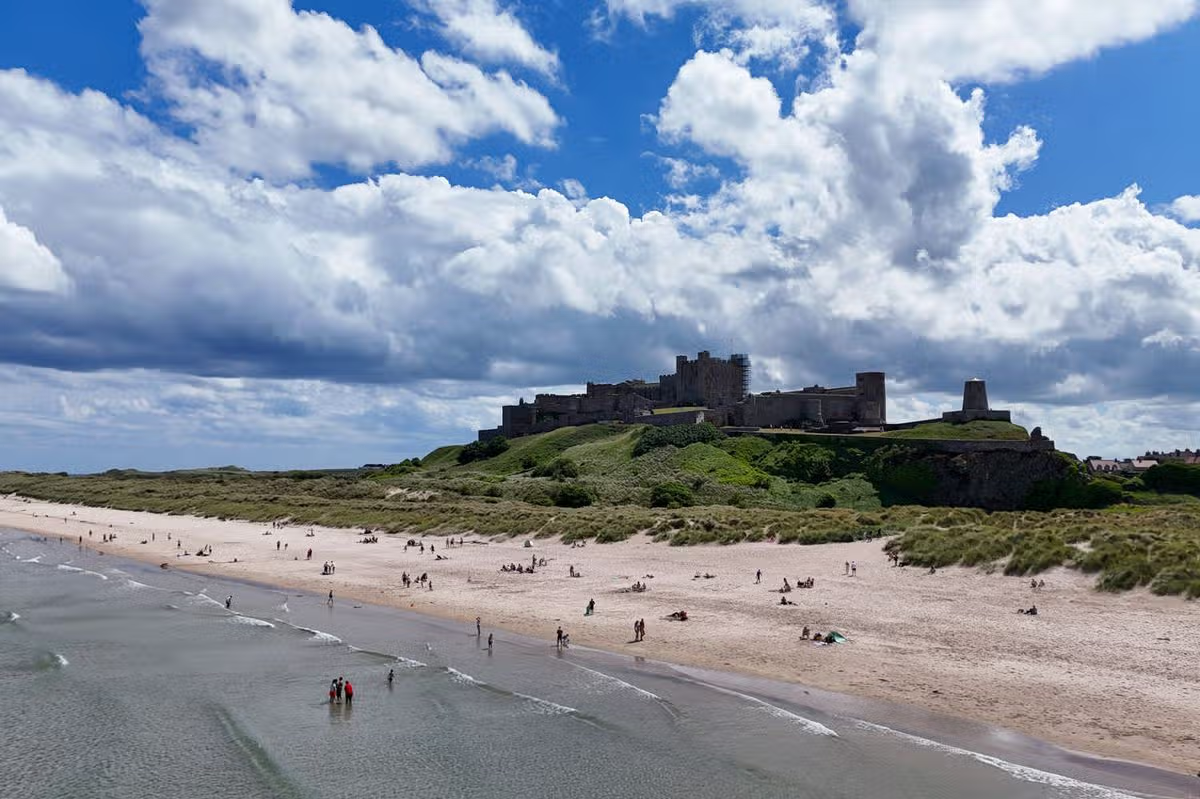
The winning seaside town grabbed the title for the sixth year in a row(Image: Owen Humphreys/PA Wire)
Nothing beats a day at the seaside. A combination of heatwaves and the school summer holidays means the resorts are likely to be packed over the coming weeks.
That’s why consumer magazine Which? has run a survey on the best and worst seaside destinations, surveying over 5,300 people about their experiences in the past year. It quizzed visitors on everything from the quality of beaches and scenery, to the food and drink on offer, accommodation, tourist attractions, and value for money.
The results have yielded a number of surprises, but the town taking the top spot has remained the same for the sixth year in a row.
Bamburgh in Northumberland, famous for its vast coastline and beach featuring a castle, yet again came number one with an overall score of 84%. One visitor said: “It’s just gorgeous and is as good now as it was years ago; it’s not been spoiled by commercialisation. What made it successful then has been retained.”
The North East had a strong showing in the rankings, with Tynemouth in Tyne and Wear coming in second at 82%, making it a close competitor for Bamburgh. Its score included five stars for its seafront and food and drink including “wonderful fish and chips” according to one reviewer. Another said: “Tynemouth has a fantastic high street with a range of cafés, restaurants and shops complemented by historic buildings and a fabulous beach.”
Coming in third was St Andrews in Scotland with 81%, and Fife also scored another top ten place with Crail at number five. Known as the home of golf, St Andrews was praised for being a “lovely town with plenty of amenities. It does not feel overcrowded despite having many tourists.”
Many classic seaside towns in Norfolk, Suffolk, and Sussex came in at the bottom of the list, and there were some surprisingly low scores for the gentrified towns of Margate and Newquay, which failed to impress. Margate scored just 53%, its overall percentage brought down by getting one star for peace and quiet, while Newquay in Cornwall scored 55% and got only two stars for value for money.
One visitor said: “Newquay feels like it has seen better days. Apart from the beaches and pubs, it has relatively little to offer a tourist. It perhaps serves better as a base to experience other parts of Cornwall.” Another explained: “There are lovely bits and unlovely bits of Newquay. The beaches are wonderful but the town is a bit shabby and run down.” Its beaches still managed to score four stars in the survey.
Close to the bottom were Great Yarmouth in Norfolk, with 46%, and nearby Lowestoft in Suffolk, with the same score. However, the dubious honour of worst seaside town went to Bognor Regis in West Sussex on the south coast.
Scoring just 41% overall, Bognor got one star for most categories. One visitor said it was: “Lacking investment, slow to supply tourists what they need.”, and another wrote: “The place is run down and feels neglected.”
Rory Boland, Editor of Which? Travel said: “The North East has emerged as this year’s favourite seaside spot, a reflection of its outstanding beaches and the fact that holidays here can be fantastic value for money.
“It also shows that there are special seaside towns in every corner of the UK. From Swanage to Plockton, Southwold to Conwy, you’ll have a great time in many of the country’s lesser-known destinations, and should save some money too.”
Top 30 seaside towns and villages
Bamburgh — 84%
Tynemouth — 82%
St Andrews — 81%
Aldeburgh — 80%
Crail — 80%
Frinton-on-Sea — 80%
Portmeirion — 80%
St Davids — 79%
Bude — 78%
Southwold — 78%
North Berwick — 77%
Plockton — 77%
St Ives — 77%
Swanage — 77%
Lyme Regis — 76%
Lytham St Annes — 76%
Portstewart — 76%
Conwy — 75%
Dornoch — 75%
Filey — 75%
Lynmouth — 75%
Sidmouth — 75%
St Mawes — 75%
Tenby — 75%
Tobermory — 75%
Wells-next-the-Sea — 75%
Whitley Bay — 75%
Broadstairs — 74%
Falmouth — 74%
Llandudno — 74%
Bottom 30 seaside towns and villages
Ilfracombe — 57%
Minehead — 57%
Bridlington — 56%
Cleethorpes — 56%
Fishguard — 56%
Seaton — 56%
Torquay — 56%
Abersoch — 55%
Colwyn Bay — 55%
Morecambe — 55%
Newquay — 55%
Barry Island — 54%
Skegness — 54%
Mablethorpe — 53%
Margate — 53%
Paignton — 53%
Southport — 53%
Herne Bay — 52%
Littlehampton — 51%
New Brighton — 51%
Weston-super-Mare — 50%
Burnham-on-Sea — 48%
Clacton-on-Sea — 48%
Southend-on-Sea — 47%
Bangor — 46%
Blackpool — 46%
Fleetwood — 46%
Great Yarmouth — 46%
Lowestoft — 46%
Bognor Regis — 41%
Have a story you want to share? Email us at webtravel@reachplc.com
Set to make travel easier for thousands of families, a new rule has been launched across 13 airports today (Wednesday, 8 July) – and in perfect time ahead of the summer holidays
The change is set to make travel for families easier when returning to the UK(Image: Getty Images)
Families going on holiday with children this summer can benefit from a new travel rule that has been launched across UK airports.
From today (Wednesday, 8 July), children aged eight or over will be able to use the eGates at 13 UK airports, offering a smoother journey home for families. Previously, the eGates were only available to travellers aged 10 and over, and those with younger children would need to join the family queue, which can take considerably longer.
Reducing the age limit is estimated to allow around 1.5 million additional children to pass through the electronic gates and other re-entry points far more quickly. While children can now be aged eight or over to use the eGates, they must also be at least 120cm (3ft 11in) tall, so they can be easily detected by the biometric scanners.
Minister for Border Security and Asylum, Alex Norris, said: “Today’s change will make journeys easier for families with small children and reduce the hassle of travelling home after a holiday. It will also free up more time for tourists to enjoy our fantastic country this summer and in the years ahead.”
Karen Dee, Chief Executive of AirportsUK, the trade body for UK airports, also said it was a “welcome development”.
She commented: “It will give more families the ability to take advantage of this technology, speeding up the border process and reducing waiting times for many. Airports work very hard with border authorities to ensure the UK’s front door is both secure and welcoming, with those coming home and visiting enjoying a smooth experience.”
In perfect time ahead of the summer holidays, the change will affect 13 major UK airports. This includes:
Birmingham
Bristol
Cardiff
East Midlands
Edinburgh
Glasgow
London City
London Gatwick
London Heathrow
London Luton
London Stansted
Manchester
Newcastle
The eGates at airports, which form part of the government’s Electronic Travel Authorisation (ETA), scan passengers’ passports and are designed to streamline the entry process. Residents in Australia, Canada, Iceland, Japan, Liechtenstein, New Zealand, Norway, Singapore, South Korea, Switzerland, and the US will also benefit from the airport change.
Travel Insurance Expert at Confused.com, Tom Vaughan, commented on the eGates rule change for children. He said: “The minimum age for UK airport e-gates drops from ten to eight today, meaning up to 1.5 million more children could clear the border automatically instead of queuing at a staffed desk. This is great news for families travelling with young children. Anyone who’s queued at border control with tired kids will know it could mean shorter waits and a smoother end to the journey home.
“It’s also a sign of where things are heading. As facial recognition technology becomes more established, it wouldn’t be surprising to see the age threshold lowered further in the coming years. But whether or not your child can use an e-gate, the basics still apply: everyone in the family needs a valid, biometric passport to travel. It’s easy to overlook this among the excitement of planning a trip.“Our research shows that confusion around passport validity is still common, with less than half (43%) of holidaymakers aware that passports for EU travel must be issued within 10 years of departure. That’s a significant number of people who could turn up at the airport only to discover their passport isn’t valid, regardless of which gate they’re heading for. With summer getaways in full swing, it’s worth taking a few minutes to check every family member’s passport now. Our passport checker can help you spot any issues early, so the only thing slowing you down at the border is the length of the queue.”
Do you have a travel story to share? Email webtravel@reachplc.com
This town’s market is over 900 years old and has a breath-taking high street filled with historic buildings, family-run businesses and lots of independent shops you cannot get anywhere else.
13:44, 06 Jul 2026Updated 13:48, 06 Jul 2026
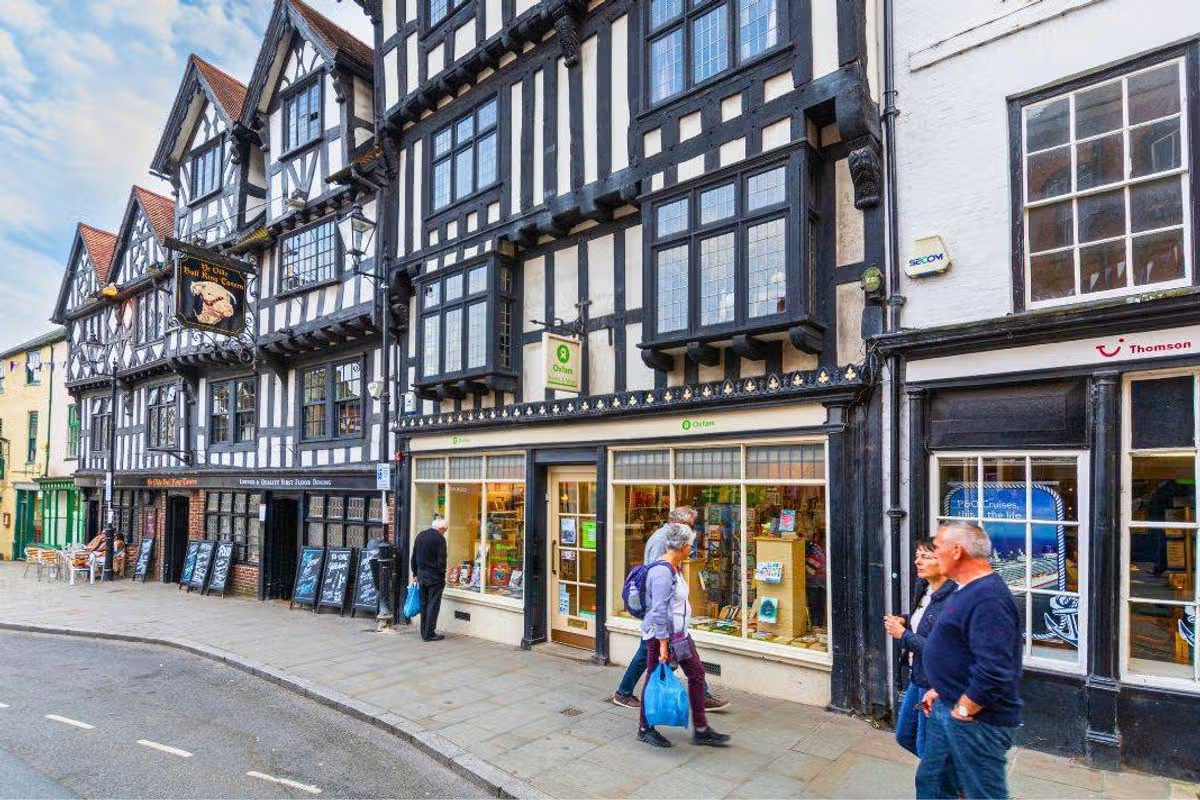
Ludlow is known for having lots of quirky independent shops(Image: Getty)
While many people splash out on pricey holidays this summer, you can have an equally magical experience right here in the UK. With a wealth of stunning destinations to discover, there are countless charming towns ideal for a short break but this gem, nestled in the West Midlands, deserves to be at the very top of your list.
This historic market town is brimming with character and as you stroll through its centre you’ll uncover a breath-taking blend of medieval, Tudor and Georgian architecture. It has been named by The Guardian among Britain’s 10 “best independent high streets”, not for its looks alone, but for being “full of cool independents rather than the usual chains”.
They said: “Ludlow has long been known as a gastro-hub, with specialist producers dotted along the high street and market place. Visit the Mousetrap Cheese Shop, Harp Lane Deli and the Chocolate Gourmet for festive eats, or browse around Bodenhams, which sells clothes in a quirky, 600-year-old building.”
Why visit Ludlow?
There are so many one-of-a-kind businesses to explore when you arrive in Ludlow, but your first port of call should be the traditional marketplace sitting right at the heart of the town square.
Having been trading for over 900 years, it boasts all manner of stalls ranging from flea markets to artisan crafts, ensuring there is something to suit every pocket.
Ludlow Market is a treasure trove of finds, and is also well regarded for its monthly specialist events, including the Food and Craft Market, the Local to Ludlow Producers’ Market, and an Antique Market.
Once you’ve had a good rummage through the local shops, your suitcase will be packed to the brim with gifts to take home, thanks to a wealth of family-run businesses such as Bensons, which stocks jewellery, and Florabunda, a florist.
If you work up an appetite, head to the Ludlow Farmshop, selling locally sourced meats, cheeses, baked goods and other regional delicacies you won’t find anywhere else.
What else is there to do in Ludlow?
Ludlow has built a reputation for championing independent businesses, but should you tire of shopping and eating, there is plenty more to discover. Perhaps the most unmissable attraction is Ludlow Castle, a stunning 11th-century ruin built by the Normans that boasts breathtaking views across the surrounding countryside.
It is also well worth taking a leisurely stroll along the River Teme to admire Ludford Bridge, which not only looks spectacular but also dates back to medieval times.
Just a short drive away lies Mortimer Forest, offering miles of gorgeous scenery, whether you fancy a gentle woodland walk or fancy tackling the climb up to High Vinnalls, the loftiest point within the forest.
Ludlow ticks every box for those seeking a quintessential English town getaway, boasting historic streets, charming independent shops, mouth-watering local cuisine and stunning countryside right on its doorstep — making it an ideal destination for anyone in search of a laid-back summer staycation.
‘We are over 100 businesses strong’
Jodie Deakin, who owns local independent business, Eclectica, and is chair of Ludlow Chamber of Trade and Commerce, which members pay £50 a year to join, told a visiting journalist earlier this year: “We are over 100 businesses strong and have everything from retail businesses like mine to professional services like solicitors.”
Of the market, she said: “These are permanent market stores, so they’re here seven days a week. It’s owned by our town council, so it’s the revenue stream for them and they run the market most days, but also lease it. Ludlow Local Produce Market is one of the leased markets. To be a vendor, you have to produce everything within a 30-mile radius.”
Manager Tish Dockerty said of Ludlow Local Produce Market at the same time: “Everything that’s sold is either made by the person on the stall or the person that’s selling it, so they can tell you how it’s made.”
Just 35 minutes from London’s Victoria station lies a charming neighbourhood bursting with independent shops.
11:46, 03 Jul 2026Updated 11:50, 03 Jul 2026
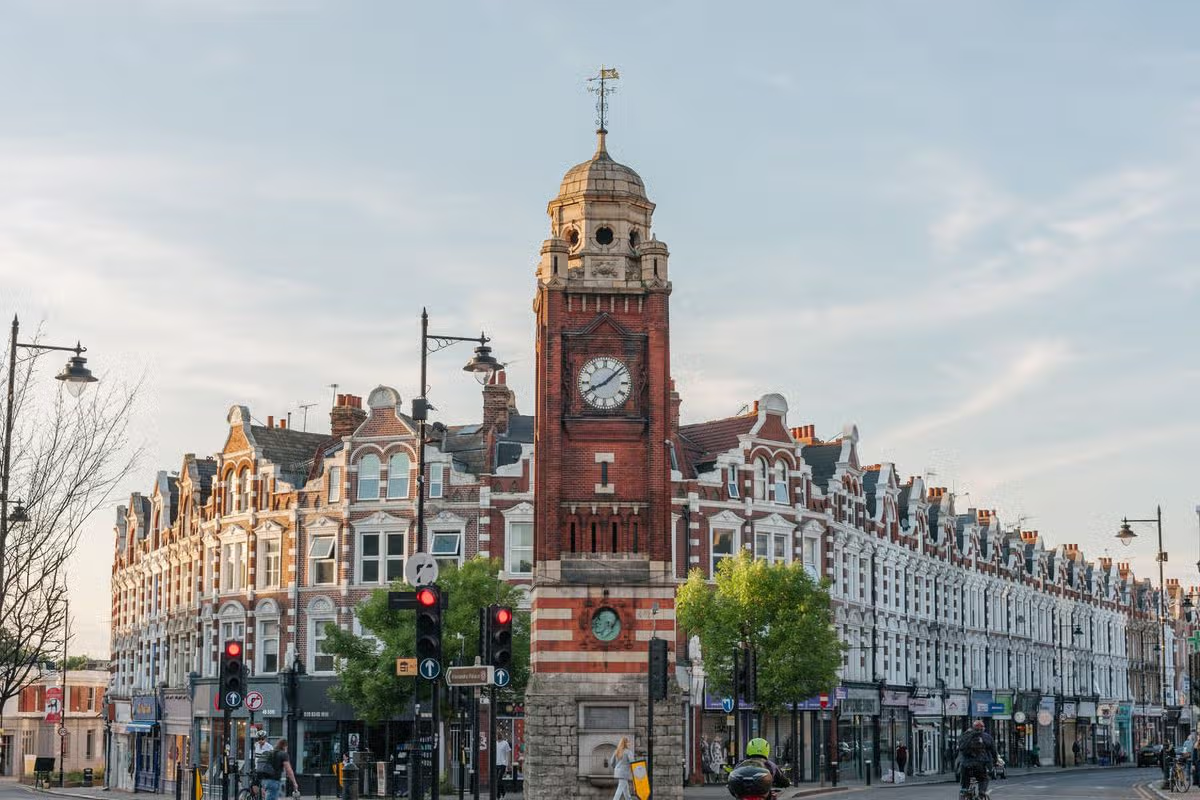
The London suburb that is often dubbed a ‘Victorian town’ (Image: Getty)
When Brits picture stunning and historic spots across the UK, places like the Cotswolds, Edinburgh, Somerset, and York typically spring to mind, renowned for their enduring appeal, charming streets, and centuries-old buildings.
Yet despite boasting a wealth of heritage, London’s neighbourhoods rarely feature in discussions about the nation’s most enchanting locations. Our capital is enormous and brimming with hidden treasures.
As a native South Londoner, I hardly venture up North, but just 35 minutes from Victoria station sits a charming neighbourhood nestled between Finsbury Park and Wood Green that feels like travelling back through the decades, complete with cobbled lanes, vintage and independent retailers, and an impressive 19th-century clock tower.
Here’s why Crouch End deserves a spot on your must-visit list.
What sets Crouch End apart?
My favourite part of exploring this neighbourhood was discovering all the independent retailers, which have remained bustling thanks to the local community. From organic health shops that have traded since 1986 to a florist, garden centre, and pet emporium open seven days a week, there’s a varied selection of outlets on every street.
According to Hornsey Town Hall, “Crouch End is a captivating neighbourhood that exudes a bohemian charm unlike any other in London. With its quirky character, artistic flair, and vibrant community, living in Crouch End offers a unique and enriching experience.”
They added: “Crouch End is often affectionately referred to as ‘a village within the city,’ and for good reason. Despite being only a few miles away from the bustling heart of London, this neighbourhood feels worlds apart.”
I particularly enjoyed browsing fashion boutiques such as Rhoda, which displays original creations from local and international designers and stocks trinkets, mugs, jewellery, ceramics, and more. The shop has been trading since 1998 and was established by three sisters.
A statement on its website read: “Our store is a labour of love and a testament to the power of meaningful connections. Our passion for curating unique fashion and heartfelt gifts led to the establishment of our shop, and we’ve been spreading the joy ever since.”
The neighbourhood is also renowned for its dining and leisure scene. Just a brief stroll through the suburb reveals bakeries, pubs, restaurants, and cafés – you’re truly spoilt for choice in Crouch End.
I’d suggest popping into Sourdough Sophia for a delectable sweet indulgence in a stunningly decorated setting. I sampled a scrumptious Baileys-filled croissant and a decadent hot chocolate.
Crouch End boasts a vibrant creative energy, drawing artists, writers, musicians, and actors for generations. The ArtHouse Crouch End, situated in a former Salvation Army Hall, serves as a local cultural centre, while pubs and venues throughout the area host a dynamic blend of up-and-coming and established live music.
During a visit in early June, I stumbled upon Crouch End’s annual festival, reportedly one of the UK’s largest independent community festivals, taking place at Hornsey Town Hall in the neighbourhood’s centre.
It was established to unite local creatives and celebrate the community and the arts. I have never witnessed a neighbourhood come together so harmoniously and happily to champion and recognise their area.
A brief history of Crouch End
Crouch End began life as a modest rural settlement at the crossroads of ancient pathways, deriving its name from a wooden cross that once stood where the Clock Tower now sits.
It remained predominantly agricultural for centuries until the railway arrived in late 1867, triggering swift expansion. New housing, retail outlets and enterprises transformed the district into a flourishing Victorian suburb and, by the close of the 19th century, Hornsey’s commercial centre.
The iconic Clock Tower, still standing today, was erected in 1895 to commemorate local reformer Henry Reader Williams, symbolising Crouch End’s evolution. More than 130 years on, it remains the neighbourhood’s most recognisable landmark and the focal point of the local community.
Why is the area so hidden?
Crouch End no longer has a railway station, with no underground tube or overground trains serving it. The nearest stations are Finsbury Park, Archway, Hornsey, and Crouch Hill.
According to Ham High, “The line never quite achieved its potential in terms of passenger numbers.” They added: “In the mid-1930s, a plan was devised to incorporate the track and stations into London Underground’s Northern Line.
“Work on electrification was started but then halted early in the Second World War and subsequently abandoned. A peak-hours-only service was maintained using locomotives and rolling stock almost as old as the stations – but that simply staved off the inevitable, and Crouch End and the handful of other stations on the line closed to passenger traffic in July 1954.”
Crouch End may not be on the typical tourist trail, but those who stumble upon it tend to fall head over heels for it. American travel blogger, A Lady in London, paid the area a visit and shared: “Crouch End is one of my favourite under-the-radar London neighbourhoods.
“It has lots of independent shops and restaurants, vibrant streets, and great views of London. East of Highgate and south of the Alexandra Palace, it stays incognito partly because it’s not really on the tube.”
Yet beyond its delightful, characterful appeal, locals cherish the area for its close-knit, welcoming community spirit that looks out for one another — a quality that’s genuinely hard to come by in the capital.
Speaking to long-term resident Judith Abbs, who has called the area home for a number of years, she said: “We thought we knew Crouch End quite well before we moved here five years ago. But one wonderful surprise has been how many friendly people we meet.
“My husband is disabled, and a passing stranger often stops to ask if they can help. It really has a strong community feel.”
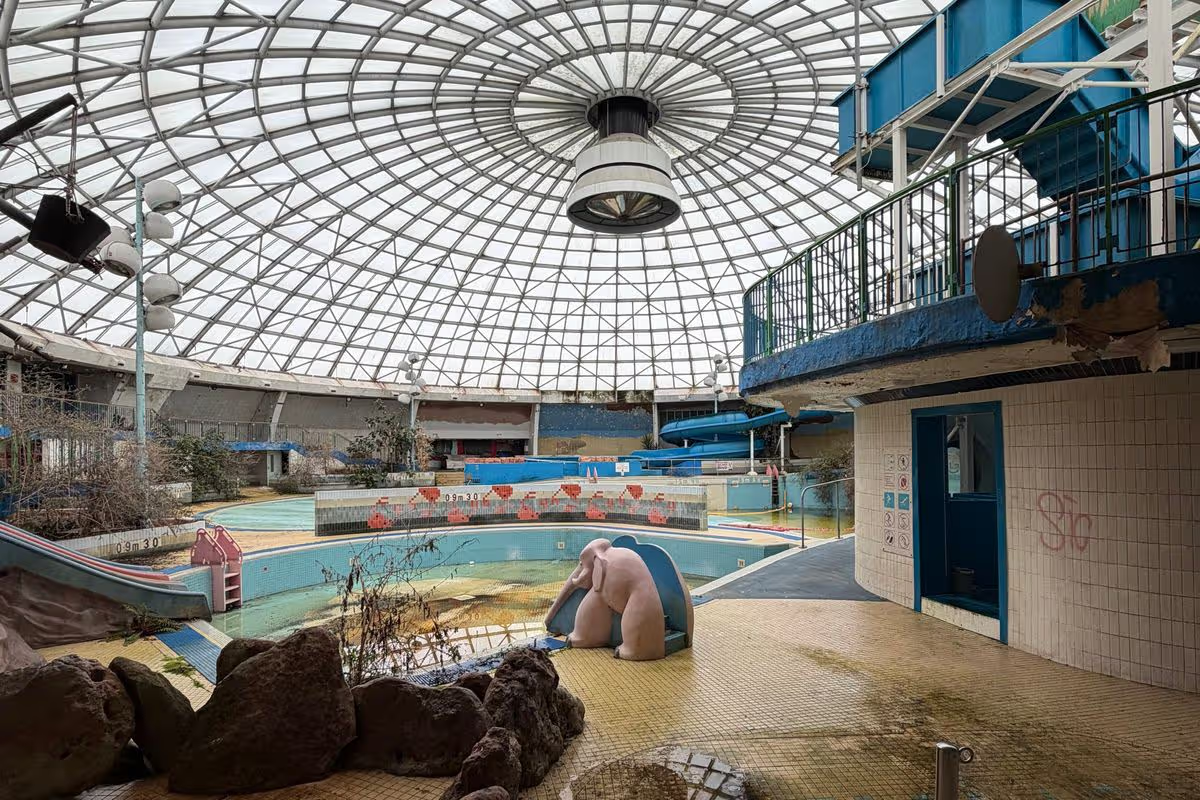
Many might remember the days of visiting this water park that was renowned for its lagoon and dome ceiling, but today it paints a different picture as its left to rot away
10:58, 01 Jul 2026Updated 10:59, 01 Jul 2026
This once-thriving UK water park has been closed for more than five years(Image: Jamierob2/SWNS)
When most of us are dreaming about cooling down in an outdoor lido or planning trips to the beach over the weekend amid the blistering UK heatwave, there’s one water park that lies eerily abandoned, without a visitor in sight.
Having opened in 1976, the Oasis Leisure Centre in Swindon, or known simply as Swindon Oasis, became a standout attraction as a swimming pool, sports complex and entertainment venue all rolled into one. The Grade II-listed indoor water park boasted a lagoon, a wave machine, and colourful waterslides underneath its domed roof, providing hours of fun for the kids.
The area was decorated with artificial rocks and foliage, with smaller slides for the little ones and even an Egyptian statue in one corner. It was once a colourful, vibrant space that has now become a haunting, neglected site.
But back in the day, for those eager for a night out, there was the concert hall that could seat up to 1,620 people, or hold around 3,000 people standing. It famously hosted the rock band Inspiral Carpets in the early 1990s and even inspired the name of the band Oasis.
Liam Gallagher is said to have latched onto the name Oasis after seeing the Swindon leisure centre listed as the venue on the Inspiral Carpets tour poster. Noel had worked with Inspiral Carpets and later joined the band Rain with his brother, Noel Gallagher, and they went on to call themselves Oasis. All thanks to the iconic dome attraction.
While Oasis never performed at the venue, Liam did appear at the Oasis Leisure Centre in 2011 with his band, Beady Eye. Alongside its high-profile links, the complex welcomed thousands of visitors during its heyday and was one of Wiltshire’s most beloved attractions.
Yet, all good things come to an end, and after 44 years, the Swindon Oasis closed its doors forever. Its permanent closure in October 2020 followed five months without visitors due to the 2020 lockdowns, which required leisure facilities to halt operations.
At the time, operator GLL said: “As a charitable social enterprise, we are not in a position to continue operating a facility that requires capital investment and is losing money, while accruing significant rent liabilities.”
Today, after five years left untouched, it remains eerily neglected. Photos released earlier this year show the inside of the water park rotting away, with its surfaces covered in grime and the remnants of shallow water a murky green.
With rotting slides, rusty rails and faded tiles, it’s hard to imagine that just over five years ago, it was the first port of call for families looking for a day out or a dip in its iconic lagoon pool.
In 2025, plans were made to replace the sports hall with 700 flats while keeping the swimming pool and dome. While the latter were approved, the council rejected plans for the flats. There were then hopes that it could reopen this year, but its future still remains uncertain.
Do you have a travel story to share? Email webtravel@reachplc.com
Mitsubishi Electric (MIELY) has been awarded a subsidy by the Japan Aerospace Exploration Agency (JAXA) to develop an internationally competitive, full digital satellite payload.
Financed via the second phase of JAXA’s Space Strategy Fund, the initiative focuses on building internationally competitive communications
Australian sixth seed Alex de Minaur was involved in the protests at last month’s French Open but decided he did not want to take part at Wimbledon.
“I think the sense that we had at Roland Garros was everyone was on board, even though we didn’t, as a collective, achieve the numbers that we were looking for,” he said.
“I thought that Wimbledon made a big step in the right direction, and something that should be noted. So this is for me to acknowledge their big step.”
Germany’s Alexander Zverev, who claimed his first major win in Paris earlier this month, also decided to step back.
“I still want to be part of the players’ movement, but also I realised the media can’t really do anything about it, or can’t really change it,” said Zverev, who represented the players in talks with the Grand Slams at Wimbledon last year.
“It’s not good to take it [out] on someone that doesn’t have the power of control, so I’m doing half an hour [of media]. But I still hope for some change in tennis, for sure.”
This year’s Wimbledon singles champions will each take home £3.6m, up from £3m last year, while first-round losers will earn £80,000.
The Civil Aviation Authority (CAA) has issued a warning to passengers about the dangers of packing power banks in hold luggage after a surge in lithium battery incidents on UK flights
13:34, 26 Jun 2026Updated 14:16, 26 Jun 2026
BBC News showed footage of the power bank fire breaking out in the overhead locker of a flight(Image: Getty Images)
UK-based airlines have prohibited a common electrical device labelled the ‘number one safety risk to aircraft’ after footage emerged showing it erupting into flames inside a cabin. Passengers on flights are being urged not to place power banks or vapes in their checked luggage as the busy summer holiday travel season gets underway across parts of the UK.
Several carriers have begun implementing outright bans on power banks that travellers use to charge their phones and tablets amid mounting safety concerns. Generally, power banks are permitted only in hand luggage, not checked baggage, because of worries they could explode and catch fire mid-flight.
Power banks house rechargeable lithium batteries, which pack a considerable amount of energy into a compact space, and when defective can trigger fierce fires that spread rapidly.
Content cannot be displayed without consent
On BBC Breakfast today, correspondent Katy Austin described it as a ‘terrifying situation’ on a recent flight. She said: “Flames broke out in the overhead baggage compartment of an Air China plane last October. The cause is thought to have been a lithium battery. They’re in loads of commonly used devices like laptops, vapes, phones, and power banks. They can store a lot of energy in a small space, but if they overheat or are defective, this video of a test in a lab shows just how quickly a fire can start.
“Last year, UK authorities were informed of 643 incidents where lithium batteries were detected packed in hold bags. That’s nearly twice the number the year before. Reports of devices overheating or malfunctioning also nearly doubled to more than 200. Most were in the cabin where crew could deal with the situation. The fear is that incidents in the hold could not be discovered until it’s too late to control.”
“It contains a lot of energy in a very small space, which is fantastic for, you know, our devices. It means we can use them for longer. But the problem with that is when things go wrong, the fires can be quite ferocious and you can’t put these fires out in the way you can with a normal fire that you might have because these fires are like self fueling.
“The advice for plane passengers is to take items like mobile phones, vapes, and power banks on board with you. Never charge power bank on a flight and turn off laptops completely if they’re going to be put in check-in bags.”
The CAA revealed that reports of passenger devices overheating or malfunctioning last year were almost double the figure from 2024. Instances of lithium battery-powered gadgets being wrongly packed in hold baggage surged by 91% during the same timeframe.
CAA director of aviation safety Giancarlo Buono said: “Pack right for a safe flight, and that means don’t put your batteries in your checked bag. Take them into the cabin with you. This simple tip will make your flight safer for you, and the other passengers you’re flying with.”
Research involving airline passengers revealed that 36% have no idea about the risks associated with packing batteries in hold luggage.
easyJet
EasyJet enforces stringent rules stipulating that all lithium-ion batteries, spare batteries and power banks must be carried in cabin hand luggage only, with a blanket ban on hold luggage due to the risk of fire. Power banks below 100Wh (approximately 27,000mAh) are permitted without prior approval; those between 100-160Wh require authorisation from the airline.
Portable electronic devices containing batteries must be transported exclusively as carry-on baggage.
Should any of these items find their way into checked baggage, steps must be taken to prevent accidental activation and to safeguard the devices from harm; all devices must be completely powered down (not left in sleep or hibernation mode). EasyJet imposes a limit of 15 portable electronic devices per passenger.
Portable electronic devices housing non-spillable batteries must not exceed 12V or 100Wh, and passengers are permitted to carry a maximum of 2 spare batteries. When bringing smart baggage into the cabin, travellers must be able to quickly and easily detach and remove the lithium battery/power bank, although it may remain inside the bag.
Smart baggage will not be accepted for travel if the lithium battery/power bank cannot be readily detached and removed by the passenger. If smart luggage is to be checked into the hold, the lithium battery/power bank must be removed from the smart luggage at Bag Drop and taken into the cabin.
Any exposed terminals must be protected against short circuits. The lithium battery/power bank must be detachable, so if it cannot be removed from your luggage, the bag will not be permitted on board.
Passengers may carry up to 15 personal electronic devices (this includes but is not limited to: smartphones, tablets, laptops, cameras, handheld game consoles, headphones, power banks). Spare lithium batteries (including power banks) must be individually protected to prevent short circuits by placing them in their original retail packaging, or by otherwise securing terminals by taping over any exposed terminals or putting each battery in a separate plastic bag or protective pouch, and must only be transported in carry-on baggage.
Passengers are also permitted to bring up to 20 spare lithium batteries, as long as they don’t surpass 100Wh each. Spare lithium batteries, including power banks taken into the cabin, must not go beyond 100Wh and mustn’t be used to charge or power other portable electronic devices during taxi, take-off or landing.
They must not be placed in cabin baggage stored in the overhead locker. Rather, they ought to be kept in cabin baggage under the seat in front of you, or carried on your person.
Devices or batteries exceeding 100Wh are banned in both the cabin and hold, apart from electric wheelchair batteries. Spare batteries, including power banks, are not allowed in checked baggage.
TUI’s regulations forbid passengers from packing loose lithium batteries, power banks, or spare batteries in checked-in luggage. These items must only be carried in hand luggage.
Power banks must generally not exceed 100Wh, and terminals must be safeguarded against short circuits. Devices shouldn’t be recharged while on board.
Dry AA(A) batteries (type Alkaline, NiMh, NiC) for small personal items such as a pocket torch or a radio are permitted, provided they’re inside the device or contained in sturdy packaging. When devices are placed in hold baggage, measures must be taken to protect the device from damage and prevent accidental activation; the device must be completely switched off (not in sleep or hibernation mode).
Spare batteries and power banks should be individually protected against short circuits by keeping them in their original packaging, with terminals covered in tape or placed in a plastic bag in hand luggage.
Airline approval is always required for medical devices. For further information, see section Baggage – Medical baggage.
TUI fly requires that all power banks must be carried in hand luggage, never in checked baggage. They must be packaged to prevent short circuits (original packaging or terminals covered with tape).
Generally, capacity is limited to 100 Watt-hours (Wh) per battery, with power banks not permitted to be used for charging devices or recharged while onboard.
Hand Luggage Only: Due to fire risk, all lithium-powered battery packs must be in the cabin. Capacity Limits: Power banks up to 100 Wh (roughly 27,000 mAh at 3.7V) are generally permitted.
Safety Requirements: Terminals must be protected against short circuits, such as by taping them or keeping them in individual plastic bags.
In-flight Usage: Power banks cannot be used to charge phones or laptops during flight, nor should they be recharged using aircraft power outlets.
Storage: Keep them in your seat pocket or under your seat, not in overhead bins
We’ve all got used to packing tiny shampoos and shower gels into our hand luggage when we fly, but new technology means some major airports are scrapping the 100ml rule making going through security so much easier
Many airports have upgraded their security systems(Image: Getty Images/iStockphoto)
It’s hard to believe that the airline liquid rules have been in place for nearly two decades. Since a terror plot was foiled in 2006, air passengers in the UK have been limited to taking containers of under 100ml on planes, and made to keep them in a clear, resealable 20cm x 20cm plastic bag.
Over the years, technology has improved, meaning restrictions have slowly been eased. In many airports, you no longer need to use a clear plastic bag for your liquids and can simply leave them in your hand luggage. However, in the majority of airports, the 100ml rule still stands all these years later.
A small number of airports have now scrapped the 100ml rule – allowing Brits to fly out with liquids in containers of up to two litres in volume. This means most standard-sized bottles of water, creams, gels, sprays, and aerosols can be taken through as hand luggage.
Whatever the allowed liquid size at your departure airport, holidaymakers should make sure they avoid using metal or double-walled bottles, such as a Thermos flask, when they carry liquids on board, as the scanners cannot penetrate the insulated layers.
Another thing travellers should keep in mind is that the rules at their return airport might be different. The vast majority of European airports still enforce the 100ml rule. So while you may be able to take a big bottle of suncream in your hand luggage going out, you may need to put it in your checked luggage coming back.
The GOV.UK website has a list of items considered liquids. Many travellers still get caught out by the 100ml rule as they don’t realise items such as semi-liquid foods such as soup, jam, honey, or syrups need to be within the restricted size.
Nut butters and soft cheeses also come under the category of liquids. In the USA, the Transportation Security Administration (TSA) use a rule that: if you can spill it, spread it, spray it, pump it, or pour it, it counts as a liquid. While this isn’t an official rule in the UK, it’s a good way to determine whether an item you’re taking onboard is going to need to follow liquid size rules.
Liquid rules at airports can be updated with little notice, so always check your departure airport’s official website before you fly.
Full list of airports still enforcing the 100ml rule
Manchester Airport (MAN)
London Stansted (STN)
London Luton (LTN)
Glasgow Airport (GLA)
Glasgow Prestwick Airport (PIK)
Liverpool John Lennon Airport (LPL)
Newcastle International Airport (NCL)
Leeds Bradford Airport (LBA)
East Midlands Airport (EMA)
London City Airport (LCY)
Aberdeen International Airport (ABZ)
Jersey Airport (JER)
Cardiff International Airport (CWL)
Southampton Airport (SOU)
Inverness Airport (INV)
Cornwall Airport Newquay (NQY)
Full list of airports that have scrapped 100ml rule
London Heathrow (LHR)
London Gatwick (LGW)
Edinburgh Airport (EDI)
Birmingham Airport (BHX)
Bristol Airport (BRS)
Belfast International Airport (BFS)
George Best Belfast City Airport (BHD)
Bournemouth Airport (BOH)
Have a story you want to share? Email us at webtravel@reachplc.com
It’s crunch time at the 2026 FIFA World Cup with teams throughout the 48-strong field looking to stay in contention for the knockout stage or improve their placing in the round of 32.
The U.S., Mexico, Argentina, Germany, Brazil and Switzerland have already clinched spots in the round of 32 by winning their respective groups. France, Norway, Canada, Colombia, Morocco, Bosnia-Herzegovina and South Africa also are advancing. Haiti, Tunisia, Turkey, Jordan, Uzbekistan, Panama and Czechia, however, have been eliminated from knockout-round contention.
Here’s everything you need to know about World Cup matches being played Thursday and Friday across the U.S., Mexico and Canada (all times Pacific).
Thursday’s Group D matchups:
U.S. vs. Turkey
U.S. coach Mauricio Pochettino instructs his players during a 4-1 win over Paraguay at SoFi Stadium on June 12.
The buzz: There’s not much at stake since the U.S. has won the group and Turkey has been eliminated. Expect the U.S. to rest many of its regulars, especially those with yellow cards, while Turkey will be chasing its first World Cup win since 2002, when it finished third.
Paraguay vs. Australia
Paraguay midfielder Matias Galarza controls the ball against Turkey on June 19.
The buzz: The winner finishes second in the group and will go through to the elimination rounds. Australia, with an edge in goal differential, would get the second spot in the event of a draw. It’s not a do-or-die game for either team since three points could be enough to advance.
Thursday’s Group E matchups:
Ecuador vs. Germany
Germany’s Nadiem Amiri celebrates a goal against Ivory Coast on June 20.
The buzz: Germany is already through to the knockout stages while Ecuador could finish second and clinch a spot in the round of 32 with a win coupled with an Ivory Coast loss or draw. However, that would require Ivory Coast losing or drawing. A victory could send Ecuador on as a third-place team no matter what Ivory Coast does, but that path is less certain.
Curaçao vs. Ivory Coast
Curaçao’s Livano Comenencia shoots against Germany on June 14.
(Eric Gay / Associated Press)
Where: Lincoln Financial Field, Philadelphia Time: 1 p.m. TV: FS1, Universo
The buzz: Ivory Coast is all but through to the knockout round, at least as a third-place team. But a draw would give it the No. 2 spot in the group and an easier route through the knockout stages. Curaçao still has a chance of advancing despite having been outscored 7-1, and it could finish second with a win and an Ecuador loss.
Thursday’s Group F matchups:
Tunisia vs. Netherlands
Netherlands’ Crysencio Summerville celebrates after scoring against Sweden on June 20.
The buzz: Tunisia has lost two games under two coaches — getting outscored 9-1 in the process — and can’t advance. But there’s much at stake for the Dutch, who can finish anywhere from first to third depending on the results of the final group-stage games. The Netherlands and Japan are tied on points, wins and goal differential and played to a draw in their head-to-head match, so whoever does better on the final day wins the group.
Japan vs. Sweden
Japan’s Ayase Ueda celebrates after scoring against Tunisia on June 20.
The buzz: Both teams are assured of a top-three finish and a likely spot in the next round, but a win could secure first in the group. Although Japan and the Netherlands are the favorites to win the group, Sweden could overtake both with a win, provided the Dutch do no better than a draw.
Friday’s Group G matchups:
New Zealand vs. Belgium
Belgium midfielder Kevin De Bruyne (7), left, kicks the ball in front of Iran defender Hossein Kanaanizadegan on June 21 at SoFi Stadium.
(Robert Gauthier / Los Angeles Times)
Where: BC Place, Vancouver Time: 8 p.m. TV: FS1, NBC Univserso
The buzz: If New Zealand earns its first-ever World Cup win, it’s mathematically possible the Kiwis could win the group. The same scenario holds for winless Belgium, however, it is still looking for its first goal of the tournament.
Iran vs. Egypt
Iran forward Alireza Jahanbakhsh, left, battles Belgium defender Maxim De Cuyper for the ball during a World Cup match at SoFi Stadium on June 21.
The buzz: Egypt entered the final day of group play atop the group and with a firm hold on a spot in the round of 32. It would win the group with a victory, although a draw could also be enough, depending on the score of the Belgium-New Zealand match. Unbeaten Iran can also win the group with a victory; a draw probably will get it to the knockout stage.
Friday’s Group H matchups:
Cape Verde vs. Saudi Arabia
Cape Verde’s Helio Varela celebrates after scoring against Uruguay at the World Cup on June 21.
The buzz: With a win here, Cape Verde would not only go through to the knockout stage, but it could win the group depending on the result of the Spain-Uruguay game. The island nation of about 530,000 people, the third-smallest country to qualify for a World Cup, is unbeaten after draws with Spain and Uruguay. Saudi Arabia is looking for its first World Cup win since upsetting eventual champion Argentina in its 2022 opener.
Uruguay vs. Spain
Spain’s Mikel Oyarzabal celebrates after a goal against Saudi Arabia in the World Cup on June 21.
The buzz: Spain will take the group with a win or draw, provided it maintains its goal-differential advantage over Cape Verde. Uruguay, however, needs a victory to finish atop the table. A third straight draw, which would leave it unbeaten, would probably be enough to see it through to the next round, but a loss will likely send Uruguay home.
Friday’s Group I matchups:
Norway vs. France
France’s Kylian Mbappé controls the ball during a win over Iraq at the World Cup on June 22.
The buzz: This game will not only decide the group winner but it could affect who wins the Golden Boot as the tournament’s top scorer. Both teams won their first two games and are on to the round of 32, and Norway’s Erling Haaland and France’s Kylian Mbappé each have scored four goals. Mbappe, whose eight goals led the tournament four years ago, already has 16 World Cup goals for his career, tied for second all-time.
Senegal vs. Iraq
Senegal’s Sadio Mane play against France in a World Cup match on June 16.
(Steve Luciano / Associated Press)
Where: BMO Field, Toronto Time: Noon TV: FS1, Universo
The buzz: Senegal and Iraq, both losers in their first two games, have a chance of advancing as a third-place team, but they need a win to make that happen. For Iraq, a victory would be its first in World Cup competition while Senegal, a quarterfinalist in 2002, would like to get a win for Sadio Mane, one of Africa’s most iconic players, who may be playing in his final World Cup.
Weekly insights and analysis on the latest developments in military technology, strategy, and foreign policy.
The California Science Center (CSC) in Los Angeles gave a sneak peek today of its long-awaited, much anticipated attraction — the towering Space Shuttle Endeavour in its ‘full stack’ configuration. The spacecraft was the last of five orbiters ever built and the most advanced. After a long wait, the public will soon be able to view it in all its glory inside its purpose-built permanent display building.
Endeavour is the centerpiece of The Samuel Oschin Air and Space Center. It is a 200,000-square-foot expansion of the museum and will be “the only place in the world to see a complete, authentic space shuttle system, displayed in a 20-story launch position,” CSC said in a media release on Wednesday.
The exhibit is set to open on Nov. 13, 2026.
California Science Center California Science Center California Science Center Mike Kelley Mike Kelley
Endeavor was born out of the tragic loss of Challenger on January 28, 1986. NASA had to figure out how to replace the doomed orbiter. It looked at several options.
Feb. 1, 2003: Space shuttle Columbia disaster
The first shuttle, Enterprise, was built as a developmental test vehicle and made its first independent flight from the back of the converted 747 Shuttle Carrier Aircraft (SCA) on Aug. 12, 1977. Enterprise was also used for fit checks on the launch pad and many other engineering and testing activities, but it was not built to fly into space. Although it was available for modification and could feasibly be altered for full duty, NASA decided converting it for orbital work was not the best move. Instead, the all new orbiter that would be named Endeavor was authorized for construction in 1987.
Endeavour lifted off on its maiden voyage on May 7, 1992, and flew 25 times, with its final flight coming in May 2011. As the last of its breed, it incorporated new features and upgrades, including being the first shuttle to carry a Station-Shuttle Power Transfer System (SSPTS), according to Space.com. Endeavour also had “the first fully activated Advanced Health Management System to watch over the shuttle’s three main engines during launch, as well as a three-string global positioning system (GPS) for pinpoint navigation during landings,” the publication added. In addition, the last of the orbiters was built with the most advanced avionics, with glass displays, when it entered service.
Space Shuttle Enterprise – Free flight Test – ABC News – 8/12/1977
During its time in space, Endeavour performed a variety of tasks, including helping to construct and sustain the International Space Station. Throughout its career, it spent 299 days in space, orbiting the Earth nearly 4,700 times and logging close to 123 million miles, according to NASA.
“Among Endeavour’s missions was the first to include four spacewalks, and then the first to include five,” the space agency added. “Its STS-67 mission set a length record almost two full days longer than any shuttle mission before it. Its airlock is the only one to have seen three spacewalkers exit through it for a single spacewalk. And in its cargo bay, the first two pieces of the International Space Station were joined together.”
The Space Shuttle Endeavour, docked to the Pressurized Mating Adapter (PMA-2) on the International Space Station, is featured in this photograph taken by a crewmember during the mission’s first planned session of extravehicular activity (EVA) August 15, 2007 in Space. (Photo by NASA via Getty Images) NASA
During an 11-day mission in 2000, the astronauts “used the radar instruments in Endeavour’s payload bay to obtain elevation data on a near global scale,” NASA noted about the mission with a military connection. “The data produced the most complete, high-resolution digital elevation model of the Earth. The SRTM comprised a cooperative effort among NASA with the Jet Propulsion Laboratory (JPL) in Pasadena, California, managing the project, the Department of Defense’s National Imagery and Mapping Agency [now the National Geospatial Intelligence Agency], the German space agency, and the Italian space agency. Prior to SRTM, scientists had a more detailed topographic map of Venus than of the Earth, thanks to the Magellan radar mapping mission.”
Endeavour, like the rest of the orbiters, always captured the public’s imagination. In December 2008 the spacecraft made its voyage back to Kennedy Space Center in Florida after landing at Edwards AFB. A photo of that trip, taken from an F/A-18B Hornet flying overhead, was once described by TWZ as “Arguably The Most Spectacular Photo Of NASA’s Shuttle Carrier Aircraft Ever.” You can read more about that picture and the flight in our story from the time here.
While plans had been in the works for a while to house Endeavour in a purpose-built exhibit, a major issue developed.
“An earthquake-resistant building large enough to house a 184-foot-tall Shuttle stack had a staggering cost estimate of $400 million,” AmericaSpace.com explained. “The California Science Center was unable to raise enough money to build the facility prior to Endeavour’s arrival. The museum still needed to protect the orbiter from the elements, so it built a metal hangar to temporarily house the spacecraft. The more aspirational exhibit would be conducted at a later date.”
That later date will be in November, as we noted earlier.
Space shuttle Endeavour’s trek across LA: Timelapse
The CSC is one of four locations where the surviving shuttle fleet is being displayed.
A NUMBER of iconic landmarks have closed around the country, as Brits brace for record-breaking heat.
Temperatures today have already broken June weather records, with highs of 36C seen in Surrey.
Sign up for the Travel newsletter
Thank you!
London’s Tower Bridge will close today and tomorrow due to hot weatherCredit: Dario AmadeLondon Zoo is shutting at 4pm on both days to support wildlifeCredit: Shutterstock
Multiple British landmarks have completely closed or restricted public access today as the Met Office’s red weather warning takes effect.
This comes after over 1,000 schools shut doors across the South of England, West Midlands and Wales due to rapidly rising temperatures.
Tower Bridge, a London landmark that attracts nearly one million visitors annually, has shut entirely today and will remain shut tomorrow.
Operators have said the decision was made for “the welfare of our staff and visitors”, and plan to reopen the bridge on Friday.
Changing of the Guard ceremonies at Buckingham Palace and Windsor Castle are suspended for the rest of the week.
The Household Division said: “We take the wellbeing of our soldiers and military working horses very seriously.
“Whilst it may be disappointing not to experience the Ceremonial Operations in full, it is important the wellbeing of the public, our soldiers and military working horses is maintained at all times.”
The historic spectacle, taking place on alternative days at Buckingham Palace and Windsor Castle, is a popular tourist attraction and “must see” for London visitors.
Changing of the Guard has been cancelled to protect the safety of soldiers and their horsesCredit: Getty
Major British landmarks closing this week
A number of British landmarks around the country have closed this week due to hot weather conditions
Full closures on Wednesday, 24 June and Thursday, 25 June:
Tower Bridge, Southwark
Changing of the Guard: Buckingham Palace and Windsor Castle
Young V&A, Bethnal Green
Cutty Sark, Greenwich
The Royal Observatory, Greenwich
Longleat House, Wiltshire
Severn Valley Railway, Wiltshire
Wild Zoological Park, Wolverhampton
Various National Trust properties and stately homes
Part closures on Wednesday, 24 June and Thursday, 25 June:
London Zoo – closing at 4pm on both days
Chester Zoo – closing at 2pm on Thursday
London Wetland Centre – closing at 3pm on both days
The Natural History Museum, Kensington – DC Atrium and West Entrance closed
Victoria and Albert Museum, Kensington – Galleries on level 4, alongside glass and architecture rooms
British Museum, Bloomsbury – Potential temporary closure of some galleries
Royal Parks – Spaces and playgrounds in Bushy Park, Greenwich Park, Hyde Park, Kensington Gardens, Richmond Park, St James’s Park, Green Park, Regent’s Park and Primrose Hill, Brompton Cemetary, and Victoria Tower Gardens
Hampton Court Palace, Richmond – Magic Garden
Greenwich landmarks the Cutty Sark and The Royal Observatory have also both announced their closures, with visitors of the area recommended to view the Queen’s House and National Maritime Museum as an alternative.
Away from the capital, various National Trust properties are operating on shortened hours, such as the Stourhead Estate in Wiltshire, Blists Hill Victorian Town in Shropshire, and Mottisfont House in Hampshire.
Longleat House and the Severn Valley Railway in Wiltshire, alongside the Wild Zoological Park in Wolverhampton, have also closed today and tomorrow.
The UK’s most visited museum, Natural History Museum, alongside the Victoria and Albert Museum have temporarily closed certain sections of the building, with the Young V&A shutting entirely.
The British Museum has further said on its website: “We may also temporarily close some galleries in the Museum to ensure the comfort and safety of staff and visitors.”
Beloved family attractions London Zoo and Chester Zoo are also shutting early on certain days, with London closing at 4pm both days, and Chester Zoo closing at 2pm on Thursday.
Outside, playgrounds in London’s Royal Parks have shut to keep staff, wildlife and visitors safe, including popular sites in Kensington Gardens, Hyde Park, Regent’s Park, and more.
Hampton Court Palace has also shut its Magic Garden from 1pm today, continuing until the end of tomorrow as the hot weather continues.
The Met Office red alert is in place for swathes of the country until late tomorrow night, with warm weather anticipated for the rest of the week.
Remaining group schedule, teams, as well as the best third-round group fixtures at the tournament in North America.
After 48 matches in North America, it’s time for the final round of games in the group stage at World Cup 2026.
Sixteen teams will be eliminated after these fixtures, with 32 nations heading through to the knockout stages.
Recommended Stories
list of 4 itemsend of list
The top two teams from each of the 12 groups – along with the eight best third-placed teams – will proceed to the next phase.
Here are the top five “must-watch” matches in the second round of fixtures from June 24 until June 27.
Neymar could return for Brazil against Scotland [Reuters]
⚽️ Scotland vs Brazil
Miami Stadium – Wednesday, 6pm (22:00 GMT)
These two sides will meet at the World Cup for the fifth time and there’s plenty to play for in an intriguing encounter in Miami.
Brazil are looking to secure their place in the knockout stages as group winners and are currently tied with Morocco on four points at the top of Group C.
Scotland are aiming to escape the group for the first time at a major international tournament and know that a point will almost certainly guarantee a spot in the round of 32.
Expect Group C to change a lot during these final fixtures, with Morocco taking on Haiti at the same time.
If that isn’t enough, Brazil’s Neymar is also set to make his first appearance at this World Cup.
Sweden have been unpredictable at this tournament [Raquel Cunha/Reuters]
⚽️ Japan vs Sweden
Dallas Stadium – Thursday, 6pm (23:00 GMT)
It’s difficult to predict which Sweden will turn up in Dallas on Thursday.
Graham Potter’s side beat Tunisia 5-1 in their opening match of the World Cup, before losing by the same score to the Netherlands.
Japan have been entertaining to watch at this tournament and were in fine form during their 4-0 win over Tunisia at the weekend.
Expect plenty of goals in this match and plenty of drama. The winner will secure a top-two finish in Group F, so there is a lot to play for.
France’s Kylian Mbappe has scored four goals so far [Kyle Ross/Reuters]
⚽️ Norway vs France
Boston Stadium – Friday, 3pm (19:00 GMT)
Norway and France are already through to the knockout stages, but this game looks set to be a blockbuster affair with both sides looking to top Group I.
Erling Haaland and Kylian Mbappe have both scored four goals so far and they’ll be desperate to add to their tally as they chase down Lionel Messi.
France are one of the favourites to lift the World Cup next month and are looking to end the group stage with three wins from three.
But Norway have the opportunity to prove that they truly are dark horses in this tournament and can compete with elite international sides.
Buckle in for a big one in Boston.
Spain’s Lamine Yamal, Nico Williams and Victor Munoz celebrate after the match against Saudi Arabia [Claudia Greco/Reuters]
⚽️ Uruguay vs Spain
Seattle Stadium – Friday, 6pm (00:00 GMT on Saturday)
Group H has been a tight affair following some surprise results in the opening round of fixtures.
Uruguay drew with Saudi Arabia, while Cape Verde shocked the world with a goalless draw against Spain.
La Roja bounced back by thrashing Saudi Arabia and they go into their final game as group leaders, with Uruguay two points behind in second.
Spain will secure top spot with a win in Seattle, ensuring that they avoid Argentina in the round of 32.
Egypt are looking to reach the knockout stages at the World Cup for the first time [Anne-Marie Sorvin/Reuters]
⚽️ Egypt vs Iran
Seattle Stadium – Friday, 8pm (04:00 GMT on Saturday)
Neither of these sides have ever made it out of the group at a World Cup, but on Friday, at least one of them will achieve that feat.
Group G is closely bunched after a number of drawn matches and it sets things up nicely for an intriguing final round of fixtures.
Victory for either Egypt or Iran will guarantee them a spot in the knockout phase, so expect both sides to be up for this one.
Iran have faced numerous challenges at this World Cup, with restrictions on travel and visa issues before the tournament even began.
If Iran progress, there’s also still a chance that they will face the US in the knockout stages.
World Cup 2026: Remaining group-stage full schedule
Wednesday, June 24
Switzerland vs Canada at 12pm PT (19:00 GMT) – BC Place, Vancouver, Canada
Bosnia vs Qatar at 12pm PT (19:00 GMT) – Seattle Stadium, Seattle, US
Scotland vs Brazil at 6pm ET (22:00 GMT) – Miami Stadium, Miami, US
Morocco vs Haiti at 6pm ET (22:00 GMT) – Atlanta Stadium, Atlanta, US
Czechia vs Mexico at 7pm CST (01:00 GMT on Thursday) – Mexico City Stadium, Mexico City, Mexico
South Africa vs South Korea at 7pm CST (01:00 GMT on Thursday) – Estadio Monterrey, Guadalupe, Mexico
Thursday, June 25
Ecuador vs Germany at 4pm ET (20:00 GMT) – New York New Jersey Stadium, New Jersey, US
Curacao vs Ivory Coast at 4pm ET (20:00 GMT) – Philadelphia Stadium, Philadelphia, US
Japan vs Sweden at 6pm CDT (23:00 GMT) – Dallas Stadium, Dallas, US
Tunisia vs Netherlands at 6pm CDT (23:00 GMT) – Kansas City Stadium, Kansas City, US,
Turkiye vs USA at 7pm PT (02:00 GMT on Friday) – Los Angeles Stadium, Los Angeles, US
Paraguay vs Australia at 7pm PT (02:00 GMT on Friday) – San Francisco Bay Area Stadium, San Francisco, US
Friday, June 26
Norway vs France at 3pm ET (19:00 GMT) – Boston Stadium, Boston, US
Senegal vs Iraq at 3pm ET (19:00 GMT) – Toronto Stadium, Toronto, Canada
Cape Verde vs Saudi Arabia at 7pm CDT (00:00 GMT on Saturday) – Houston Stadium, Houston, US
Uruguay vs Spain at 6pm CST (00:00 GMT on Saturday) – Estadio Guadalajara, Zapopan, Mexico
Egypt vs Iran at 8pm PT (03:00 GMT on Saturday) – Seattle Stadium, Seattle, US
New Zealand vs Belgium at 8pm PT (03:00 GMT on Saturday) – BC Place, Vancouver, Canada
Saturday, June 27
Panama vs England at 5pm ET (21:00 GMT) – New York New Jersey Stadium, New Jersey, US
Croatia vs Ghana at 5pm ET (21:00 GMT) – Philadelphia Stadium, Philadelphia, US
Colombia vs Portugal at 7:30pm ET (23:30 GMT) – Miami Stadium, Miami, US
DRC vs Uzbekistan at 7:30pm ET (23:30 GMT) – Atlanta Stadium, Atlanta, US
Algeria vs Austria at 9pm CDT (02:00 GMT on Sunday) – Kansas City Stadium, Kansas City, US
Jordan vs Argentina at 9pm CDT (02:00 GMT on Sunday) – Dallas Stadium, Dallas, US
TRAIN passengers have been told to expect significant delays and cancellations over fears of rails ‘buckling’ in the hot weather.
Hundreds of journeys have been affected as temperatures of up to 40C could be recorded in the UK this week.
Sign up for the Travel newsletter
Thank you!
Railway operators face cancelling services over hot weather warningsCredit: tupungatoRailway tracks can buckle if exposed to temperatures above 30CCredit: Kanda Peeraoranan
Railway operators have begun cancelling services, as red weather warnings have been issued in parts of England and Wales for the coming days.
Network Rail has urged passengers to only take essential journeys to, from or within areas affected by extreme heat, and to prepare for the conditions ahead of time.
They added: “For safety reasons, trains will operate at reduced speeds and to amended timetables, meaning journeys will take longer and there is a heightened risk of delays, cancellations and last-minute alterations.”
Several operators, including Avanti West Coast, Great Western Railway and South Western Railway, have planned to run reduced services during the hottest days.
Between Tuesday, Wednesday and Thursday, Chiltern Railways has also ceased more than half its services “to ensure the safe operation of the railway”.
This is over fears of rails “buckling” – a term used to describe steel rails expanding and curving as they heat up – which can occur as temperatures reach 30C.
Lineside fires create another risk to railways, as vegetation near tracks may be set alight from a combination of train sparks and dry conditions.
A number of tube lines, namely the Elizabeth and Mildmay Lines, have been further affected by flooding as a result of overnight thunderstorms as well as the hot weather.
This follows record-breaking temperatures expected this June.
Met Office spokesman, Grahame Madge, said: “The Met Office is flagging 39C as a headline maximum temperature on Thursday, most likely for somewhere in London or the South East.
“It is possible we could see temperatures higher than the 39C.”
Northern Network – Reduced services between several routes
Cleethorpes and Barton-on-Humber – No trains
Transport for Wales – Reduced services between Wrexham General and Bidston, Coryton and Penarth. No services between Shrewsbury and Birmingham International, and services cancelled at 13.00pm between Pontypridd and Cardiff Bay
Avanti West Coast – Reduced services
Great Western Railway – Reduced services
London Paddington and Heathrow Terminals – Severe disruption
Elizabeth Line – Partially flooded
MerseyRail – Speed restriction to Headbolt Lane line
CrossCountry – Routes affected
Chiltern Railways – Lines between Between Birmingham and London Marylebone, Oxford and London Marylebone, and Aylesbury and London Marylebone (via Amersham) severely affected.
“Hitting customers with hidden fees is illegal. It’s not fair to draw people in with what looks like a good deal, only for them to find the real price is higher when they get to the checkout due to extra charges that can’t be avoided,” said Emma Cochrane, executive director of consumer protection at the CMA.
Netflix’s brand new romantic comedy has one of the streamer’s best needle drops for a minute, but who features in the soundtrack?
Netflix Voicemails for Isabelle’s full soundtrack
Jill and Isabelle’s favourite song is an absolute pop banger.
Voicemails for Isabelle is currently Netflix’s number one film in the UK as fans flock to the streamer’s latest romantic comedy.
Starring Zoey Deutch and Nick Robinson, this rom-com features a devastating twist that pulls at the heartstrings as much as it will make you laugh and swoon.
In fact, plenty of viewers have admitted they were left emotionally wrecked by the new release.
This is partly thanks to a pitch perfect soundtrack that features enough upbeat tunes to get fans dancing in their living rooms, as well as some poignant ballads that have them reaching for the tissues.
As Voicemails for Isabelle is poised to become one of Netflix’s biggest hits of 2026, let’s take a look at all the iconic songs featured in the soundtrack.
Voicemails for Isabelle’s full soundtrack
The new Netflix film depicts an inspiring romance between aspiring chef Jill (played by Zoey Deutch) and estate agent Wes (Nick Robinson), who becomes her secret admirer.
When Jill’s sister Isabelle (Ciara Bravo) tragically dies, she continues to call her number to leave her voicemails. However, she doesn’t realise that her new crush Wes was reassigned Isabelle’s number and has been listening in. Will his secret tear their relationship apart?
Such a gripping premise certainly deserves a soundtrack for the ages and Voicemails for Isabelle delivers in spades. Here’s the track list in full:
Dancing On My Own – Robyn
Almost Happy – LACES and Butch Walker
To Build A Home – The Cinematic Orchestra and Patrick Watson
JOYRIDE. – Ke$ha
Walking at a Downtown Pace – Parquet Courts
Hey Daddy (Daddy’s Home) – USHER
El Cielo Azul – Mirna Orozco & Francisco Cendejas
Electric Love – BØRNS
Boys Wanna Be Her – Peaches
marjorie – Taylor Swift
De Primeras Veces (De la Banda Sonora de la Obra “Compost de primeras veces”, de Katia Mora) – Ceshia Ubau
something like this – Cil
San Francisco Blues (Remastered) – Peggy Lee
(I Left My Heart) In San Francisco – Tony Bennett
Cherish You – Mikky Ekko
Waking up Slow (Piano Version) – Gabrielle Aplin
And I See You Now – Matthew Szlachetka
Beige – Yoke Lore
Ride the Storm – GoldFord
Show Me Love (Radio Version) – Robyn
New Year’s Day (Taylor Swift)
Beautiful Things – Benson Boone
New Touch – Caveboy
I’m Waiting Now – New Constellations
Music supervisor Season Kent revealed to Tudum how the film’s most prominent track, Robyn’s Dancing On My Own, is not only an uplifting tune that will get viewers dancing, but it also perfectly serves the narrative as a tribute to Jill’s sister Isabelle.
“The song becomes completely through Izzy’s point of view — watching Jill ‘from across the room’,” she explained.
“It’s heartbreaking and beautiful. It has the full package of a timeless song that you can feel in your soul.”
The film also features an original score by Este Haim and Amanda Yamate, who used an incredible blend of piano, guitar, synth, and even their own voices to craft Voicemails for Isabelle’s unique sound.
These tracks are called:
If You’re A Bird I’m A Bird
Chef Bastien Groupies
Talk About Boundaries
Intercut Dates
Hair In The Tart
Wes Laughs At Voicemail
Midnight Scroll
This Party Sucks Without You
Good Thing I Wasn’t A Boyscout
Chicken Pot Pie
Wes’s Speech
Wes Caught
Phone Reset
Jill & Izzy’s
No Customers
Zella To The Rescue
Lonely Christmas Wes
Lightbulb Moment
Wes Trades His Holy Grail
Wes Runs
Last Voicemails
Credits 1
Credits 2
Lights (Donna Missal Cover)
Voicemails for Isabelle is available to stream on Netflix.
The 2026 FIFA World Cup is well into the second run of group play, with every team still eager to post wins and most looking to secure a place in the knockout stage.
Here’s everything you need to know about matches being played Sunday, Monday and Tuesday in the 48-team tournament across the U.S., Mexico and Canada (all times Pacific). Tuesday’s matches will conclude the first two games of group play for every team at the World Cup.
Sunday’s Group G matchups:
Belgium vs. Iran
Belgium’s Romelu Lukaku, right, is challenged by Egypt’s Ramy Rabia during a World Cup Group G match on June 15.
(Alex Grimm / Getty Images)
Where: SoFi Stadium Time: noon TV: FS1, Telemundo
The buzz: Iran twice rallied from deficits to draw with New Zealand in its first game, while Belgium, outplayed by Egypt in its opener, was lucky to escape with a point on an own goal early in the second half. Belgium’s aging golden generation of Romelu Lukaku, Kevin De Bruyne, Thibaut Courtois, Thomas Meunier and Axel Witsel is going to need to do much better if they hope to avoid another early World Cup exit.
New Zealand vs. Egypt
New Zealand’s Callan Elliot, left, and Iran’s Mehdi Ghayedi battle for the ball during a World Cup Group G match on June 15.
(Andre Penner / Associated Press)
Where: BC Place, Vancouver Time: 6 p.m. TV: FS1, Telemundo
The buzz: One of these teams could make history since neither has ever won a World Cup game. New Zealand earned its first point in the World Cup since 2010 with a draw against Iran. The winner likely advances to the next round.
Sunday’s Group H matchups:
Spain vs. Saudi Arabia
Spain’s Mikel Oyarzabal, top, challenges for the ball during a draw with Cape Verde on June 15.
(Mattia Ozbot / Getty Images)
Where: Mercedes-Benz Stadium, Atlanta Time: 9 a.m. TV: Fox, Telemundo
The buzz: Both teams opened the World Cup with surprising results. Second-ranked Spain was unable to score in a draw with No. 67 Cape Verde. Saudi Arabia was 10 minutes away from upsetting Uruguay, only to settle for a tie. Spain desperately needs a win to get its World Cup back on track, while another good performance from Saudi Arabia — unbeaten in its last three games — would have the Arabian Falcons in position to reach the knockout stage.
Uruguay vs. Cape Verde
Cape Verde goalkeeper Vozinha holds the nation’s flag after a draw with Spain on June 15.
(Buda Mendes / Getty Images)
Where: Hard Rock Stadium, Miami Gardens, Fla. Time: 3 p.m. TV: FS1, Telemundo
The buzz: With all four teams playing to draws in their openers, the group is wide open. That creates a rare opportunity for tournament debutant Cape Verde, the second-smallest country to qualify for a World Cup. Vozinha, Cape Verde’s goalkeeper, made seven saves to shut out Spain. If he can frustrate Uruguay the same way, Cape Verde could be through to the round of 32.
Monday’s Group J matchups:
Argentina vs. Austria
Argentina’s Lionel Messi reacts after scoring his third goal against Algeria at the World Cup on June 16.
The buzz: Argentina opened its World Cup title defense with a 3-0 win over Algeria on a hat trick from Lionel Messi. The Argentina captain, playing in his record sixth World Cup, is tied with Germany’s Miroslav Klose for the most career World Cup goals (16). Austria, meanwhile, would all but assure itself of a spot in the knockout round with a point.
Jordan vs. Algeria
Algeria’s Zineddine Belaïd kicks the ball during a World Cup loss to Argentina on June 16.
The buzz: Little was expected of Jordan, making its first appearance in the World Cup. And it delivered little in a 3-1 loss to Austria. But Algeria, ranked 28th in the world, entered the tournament with high hopes and one of African soccer’s most potent attacks. However, it had only one shot on goal in its loss to Argentina and needs a big rebound to avoid an early trip home.
Monday’s Group I matches:
France vs. Iraq
France’s Kylian Mbappé celebrates after scoring against Senegal on June 16.
(Adam Hunger / Ap Photo/adam Hunger)
Where: Lincoln Financial Field, Philadelphia Time: 2 p.m. TV: Fox, Telemundo
The buzz: Kylian Mbappé proved his fitness with a brace in France’s opening win over Senegal, giving him 14 World Cup goals, tied for fourth on the all-time list. He has a great chance to pad that total against an Iraq team that gave up four goals to Norway. Iraq still is looking for its first-ever World Cup point.
Norway vs. Senegal
Norway’s Erling Haaland celebrates after scoring against Iraq on June 16.
The buzz: Norway, playing in its first World Cup this century, made up for lost time with a 4-1 win in its opener, getting two goals from Erling Haaland. Norway probably will move on to the next round no matter what happens, but a point would lock down a spot. Senegal and Sadio Mané, on the other hand, desperately need a win.
Tuesday’s Group K matchups:
Portugal vs. Uzbekistan
Portugal’s Cristiano Ronaldo walks on the field during a match against the Democratic Republic of the Congo on June 17.
The buzz: Cristiano Ronaldo entered this World Cup with visions of winning his first title. But he’ll go home early and empty-handed unless fifth-ranked Portugal improves on the listless performance it had in a draw with the Democratic Republic of the Congo. Uzbekistan, playing in its first World Cup, was not intimidated by the big stage, weathering a withering Colombia attack in a 3-1 loss. Expect it to bunker in again against Portugal.
Colombia vs. DR Congo
Yoane Wissa, left, celebrates with teammates after scoring for the Democratic Republic of the Congo against Portugal on June 17.
The buzz: The Democratic Republic of the Congo’s only other World Cup appearance came in 1974, when the country was known as Zaire; it lost all three games and didn’t score a goal. It’s already done better with Yoane Wissa’s score in first-half stoppage time giving the team a point against Portugal. A win here and it’s through to the knockout phase. The same is true of Colombia, which got a 65th-minute goal from Luis Díaz and another from substitute Jáminton Campaz deep in stoppage time to beat stubborn Uzbekistan.
Tuesday’s Group L matchups:
England vs. Ghana
England’s Harry Kane celebrates after scoring against Croatia on June 17.
The buzz: England opened its World Cup with a surprisingly comfortable win over Croatia behind two goals from captain Harry Kane. But the Three Lions are only equal atop the table with Ghana, which got a goal deep in stoppage time from Caleb Yirenkyi to beat Panama. If there’s a winner here, it probably will decide the group. A point likely sends both teams through.
Panama vs. Croatia
Where: BMO Stadium, Toronto Time: 4 p.m. TV: Fox, Telemundo
Panama’s Ismael Díaz attempts a shot against Ghana on June 17.
(Kevin C. Cox / Getty Images)
The buzz: Croatia has played in two straight World Cup semifinals, but that streak is in jeopardy after a 4-2 loss to England. Panama outshot, outpassed and outpossessed Ghana in its first game but came away with nothing after conceding a goal in stoppage time, leaving the Central Americans still looking for their first World Cup win.