Frigate

Singapore’s Formidable Class Frigate Appears Armed With Blue Spear Anti-Ship Missiles

New imagery provides what appears to be the first visual confirmation that Singapore has begun installing the Blue Spear surface-to-surface missile, also known as the 5G SSM, on its Formidable class frigates. The appearance of Blue Spear aboard RSS Steadfast offers a first glimpse of a key element of Singapore’s broader naval modernization effort. The installation also gives the Israel-Singapore missile joint venture a high-profile reference point as it seeks to market Blue Spear to other operators looking to replace their aging Harpoon fleets.

In photos shared with TWZ by Koji Inoue (@kojiinet on X), a container for the missile is clearly visible aboard Steadfast, the third ship of Singapore’s six Formidable class frigates, offering what is believed to be the first publicly available photographic evidence of the weapon actually fitted to one of the ships.

A container for the Blue Spear missile aboard Steadfast, the third ship of Singapore’s six Formidable class frigates. Koji Inoue/@kojiinet

The appearance of Blue Spear on Steadfast comes as the frigate prepares to open its doors to the public during guided tours at the Tokyo International Cruise Terminal on August 21-22.

Singapore had previously disclosed that Blue Spear would replace the class’s legacy Harpoon anti-ship missile as part of a mid-life upgrade (MLU). However, until now, confirmation of the weapon’s installation has largely come through official statements and industry reporting.

The Republic of Singapore Navy (RSN) first introduced the RGM-84 Harpoon for its Sea Wolf class missile gun boats (MGB), when they were upgraded in the late 1980s. The Victory class multi-purpose corvettes continued using the Harpoon when they were introduced in the 1990s, and the same missile was then installed on the Formidable class when it came online from 2005 onwards.

The Republic of Singapore Navy Victory class corvette RSS Valiant, with angled Harpoon launchers fitted. U.S. Navy photo by Mass Communication Specialist Seaman Michael Colemanberry/Released 

Each of the Formidable class could carry as many as 24 Harpoons, if required, with capacity for six quad packs on the missile deck. The likelihood is that the same 24-mille capacity will be retained for Blue Spear, although as configured for its Japan visit, Steadfast has the mimimum fit, with one quad launcher.

Singapore first revealed plans to equip the frigates with Blue Spear in 2023, when a senior Republic of Singapore Navy officer outlined the intended missile upgrade during an interview with Janes ahead of the IMDEX exhibition. Then-Commander of the RSN’s First Flotilla, Colonel Ng Kok Yeng Daniel, outlined the plans during the exhibition preview.

RSS Steadfast in Tokyo. Koji Inoue/@kojiinet

The MLU is considerably broader than the missile replacement. Singapore’s Ministry of Defense has said the programme will also introduce upgrades to the frigates’ combat management, communications, and engineering systems.

Blue Spear is produced by Proteus Advanced Systems, a joint venture between Israel Aerospace Industries (IAI) and Singapore’s ST Engineering. The weapon traces its development lineage to the Israeli Gabriel family of anti-ship missiles, but is intended to provide a modern, multi-role precision-strike capability.

The missile was publicly displayed for the first time at the Singapore Airshow 2022, soon after a contract had been signed with the Estonian Defense Forces to meet its coastal anti-ship missile requirement. In this form, the missile is fired from a truck-based launcher.

An infographic on the Blue Spear published by the Estonian Defense Forces. EDF via X

Blue Spear was also proposed to the U.K. Royal Navy as a Harpoon successor, under the name Sea Serpent. However, the Interim Surface-to-Surface Guided Weapon (I-SSGW) requirement was ultimately won by the Kongsberg Naval Strike Missile (NSM), a weapon also used by the U.S. Navy, among others.

According to specifications released by Proteus, Blue Spear is a subsonic missile with a range of around 180 miles. It is designed for beyond-line-of-sight engagements and can be employed against both maritime and land targets.

The turbojet-powered weapon incorporates a radio-frequency seeker and guidance system designed to operate in complex electromagnetic environments, including scenarios in which an adversary is employing electronic countermeasures. The missile uses ‘advanced algorithms’ for target discrimination and can be launched in fire-and-forget or fire-and-update modes. Proteus has said in the past that is has considered installing an imaging infrared seeker, if required.

Blue Spear is designed to engage moving targets and can dynamically modify its flight path during an engagement. Its low-level, sea-skimming approach is intended to make detection and interception more difficult for defending forces.

A full-size model of the Blue Spear surface-to-surface missile, also known as the 5G SSM. Roy Choo

For the Republic of Singapore Navy, the transition from Harpoon to Blue Spear brings a substantially longer-range strike capability to a class of ships that remains a central component of the country’s surface fleet. The Harpoon has a range of around 130 miles and, in the RGM-84C form used by the RSN, lacked a land-attack capability. In the anti-ship role, the missile provides a critical capability for Singapore, considering the dense littoral region and the strategic strait that it sits on.

As well as the pacing maritime threat posed by China, there other potential adversaries in the region are also investing in new ship-launched surface-to-surface missiles, as Roy Choo, a defense journalist and TWZ contributor explained:

“The introduction of the Blue Spear will help the Singapore Navy keep pace with the growing lethality and range of new and upgraded anti-ship missiles being introduced across the region. Indonesia has the Russian-made Yakhont on the Ahmad Yani class frigates and will get the Turkish-made ATMACA missile soon, among the many types it operates. Malaysia was supposed to introduce the Naval Strike Missile on its littoral combat vessels but is now searching for a replacement.”

Test launch of a Yakhont missile from the Indonesian Navy frigate KRI Oswald Siahaan in April 2011. Indonesian Defense Ministry

The new missile installation also points to the broader transformation underway across Singapore’s aging frigate fleet. With new missiles being introduced as part of a wider package of upgrades, this effort is intended to keep the Formidable class relevant as Singapore faces an increasingly sophisticated maritime security environment.

Meanwhile, Singapore is building a new class of drone motherships, or Multi-Role Combat Vessels (MRCV), the largest and most complex ships the RSN has ever operated. Blue Spear is provided an an option for these hulls, with at least four mounting points, exploiting their modular design.

The Multi-Role Combat Vessel (MRCV) for the Republic of Singapore Navy. Singapore Ministry of Defense

The MRCVs will form the cornerstone of the navy’s fleet modernization effort, alongside two additional Type 218SG submarines in addition to the previous four, and the Boeing P-8A Poseidon maritime patrol aircraft, which will also provide a significant capability boost.

The Blue Spear program also underscores a decades-old, largely low-profile defense-industrial relationship between Israel and Singapore, one that has produced cooperation across some of the city-state’s most sensitive and advanced military capabilities.

Among the very advanced arms acquired by Singapore from Israel is the Gulfstream G550 Conformal Airborne Early Warning (CAEW) aircraft, four of which were bought from IAI. Singapore’s Block 52 F-16s are equipped with Israeli-supplied equipment, including avionics, electronic warfare kit, and air-to-air missiles. There have long been rumors that Singapore acquired Merkava main battle tanks from Israel, but these vehicles have never been publicly seen.

Now, after sales to Estonia and Singapore, Proteus is pitching Blue Spear as a Harpoon replacement for other nations, with the company eyeing potential customers across Southeast Asia, Europe, and Latin America.

Estimates for the number of Harpoon missiles built range from 6,400 to around 8,000, depending on source. The missile has been ordered by 30 countries, so there is potentially a very significant market for a new weapon in this class.

For the time being, the arrival of Blue Spear aboard Steadfast underscores the scale of Singapore’s ongoing naval modernization, extending the reach and flexibility of one of the RSN’s core surface combatants. As the service introduces new frigate weapons alongside MRCVs, submarines, and maritime patrol aircraft, the missile also offers a glimpse of the increasingly long-range and networked force Singapore is building.

With thanks to Roy Choo.

Contact the author: thomas@thewarzone.com

Thomas Newdick is a staff writer at TWZ, where he covers military aviation, defense technology, weapons systems, and international security. Based in Berlin, Germany, he reports on conflicts, military modernization efforts, and emerging aerospace technologies around the world, with a particular interest in airpower and its role in contemporary warfare. His reporting is informed by deep expertise in modern and historical airpower, particularly in Europe, with a focus on military aviation, air campaigns, and aerospace developments across the continent and beyond.


Source link

Poland’s Powerful New Frigate Marks Major Shift For Its Navy

The Polish Navy launched its largest surface combatant since the interwar period, when the frigate Wicher went into the water today. The warship, built locally according to a British design, is the first of three and part of a wide-ranging modernization program for the Polish Navy as it adapts to meet a growing Russian threat in the strategic Baltic Sea region and elsewhere.

Wicher (Polish for gale) was floated off a semi-submersible heavy-lift barge in the Gulf of Gdansk today.

Wicher accompanied by a tugboat in the Gulf of Gdansk today. PGZ SW

Yesterday, the frigate was still on dry land, in the dock at the PGZ Stocznia Wojenna (PGZ SW) yard in Gdynia, on the Baltic Sea, where it had been built. It was rolled out and placed on the barge there before its christening and naming ceremony attended by Polish President Karol Nawrocki.

A wide view shows the future Polish Navy multipurpose frigate ORP Wicher, pennant number 274, aboard the semi-submersible heavy-lift barge BOABARGE 33 with the PGZ Stocznia Wojenna Hull Hall visible behind it in Gdynia, Poland, on August 11, 2026. The frigate was assembled and integrated inside the hall before being rolled out and positioned on the barge for its christening and launch. (Photo by Mateusz Wlodarczyk/NurPhoto via Getty Images)
The future Polish Navy frigate Wicher, pennant number 274, aboard the semi-submersible heavy-lift barge BOABARGE 33 with the PGZ Stocznia Wojenna Hull Hall visible behind it in Gdynia, Poland, on August 11, 2026. The frigate was assembled and integrated inside the hall before being rolled out and positioned on the barge for its christening and launch. Photo by Mateusz Wlodarczyk/NurPhoto

“Within the PGZ Group, we are implementing projects of strategic importance to national security,” said Adam Leszkiewicz, CEO of PGZ. “The christening and launch of the first frigate under the Miecznik program is one of the most important milestones in rebuilding the operational capabilities of the Polish Navy.”

Yesterday’s ceremony was marked by the blasts from the ship horns of two of the warships that Wicher will replace. These are the Kościuszko, which accompanied Wicher during its launch today, and Pułaski, currently in dry dock at the shipyard.

These are Poland’s two Oliver Hazard Perry class frigates, dating from the late Cold War period and transferred from the U.S. Navy.

181025-N-KA046-01223 NORTH SEA (Oct. 25, 2018) – The Polish Navy Oliver Hazard Perry Class guided missile Frigate General Kazimimierz Pulaski ORP 272 transits the North Sea after an underway replenishment, Oct. 25, 2018. Mount Whitney, forward-deployed to Gaeta, Italy, is underway to participate in the multilateral Exercise Trident Juncture 18. (U.S. Navy photo by Mass Communication Specialist 2nd Class James R. Turner/Released)
The Polish Navy Oliver Hazard Perry class frigate General Kazimimierz Pułaski transits the North Sea after an underway replenishment, in October 2018. U.S. Navy photo by Mass Communication Specialist 2nd Class James R. Turner/Released

The three new multirole frigates being built in the Project 106 Miecznik (Swordfish) class — described as the largest program of its kind in Polish Navy history — are far more capable vessels, based on Babcock International’s Arrowhead 140 design.

The Arrowhead 140 design is derived from the innovative Iver Huitfeldt class frigate used by the Royal Danish Navy and also forms the basis of the U.K. Royal Navy Type 31 general-purpose frigate. Overall, the Arrowhead 140 has a modular structure and generous internal space, meaning it can be adapted for a variety of different systems and sub-systems, as required.

An artist’s impression of the U.K. Royal Navy Type 31 general-purpose frigate. Royal Navy

The new Swordfish frigates have a length of 138 meters (453 feet), a beam of approximately 20 meters (66 feet), and a maximum displacement (including additional equipment and armor) of approximately 7,700 tons. They will have a maximum range of approximately 8,000 nautical miles, and a maximum speed of 28 knots, powered by four combined diesel and diesel (CODAD) piston engines driving two propellers. Each will have a core crew of approximately 120, with space to embark an additional 60 personnel.

Babcock’s Arrowhead 140 design was selected by Poland in 2022, after which a keel-laying ceremony for Wicher was held in Gdynia in January 2024.

Construction of the second vessel, Burza (Storm), had begun by early 2026, which is planned to be followed by its launch in 2027 and commissioning in 2030. The keel for the third ship, Huragan (Hurricane), will be laid down in late 2026, followed by a planned launch in 2028 and commissioning in 2031.

While they are multirole vessels, the Miecznik design stresses anti-air warfare (AAW) and anti-submarine warfare (ASW).

Compared to the British Type 31, the Miecznik is more extensively equipped.

For its AAW mission, the primary weapon of the Polish warship is the MBDA CAMM, or Common Anti-air Modular Missile.

Firing trials of the CAMM (also known as Sea Ceptor) from the U.K. Royal Navy frigate HMS Argyll:

Sea Ceptor firing trials from HMS Argyll thumbnail

Sea Ceptor firing trials from HMS Argyll


For medium-range threats, out to beyond 62 miles, the warship will be armed with the CAMM-MR, being jointly developed by Poland and the United Kingdom under the Future Common Missile (FCM) program.

The standard CAMM, with a maximum range of around 28 miles, will also be carried to engage targets at shorter distances.

Versions of the CAMM can be quad-packed, in this case in the U.S.-made Mk 41 vertical launch system (VLS), with 32 cells. That would provide for a maximum of 128 missiles, especially significant bearing in mind current concerns about magazine depth in the face of sustained drone and missile barrages.

Depending on the exact configuration of the VLS, other kinds of missiles and ASW weapons could potentially be integrated at a later date, too.

For ASW specifically, the Miecznik class is provided with two dual-tube launchers for MU90 Impact lightweight torpedoes. The same torpedoes arm the Polish Navy’s AW101 helicopters, seen in the tweet below, which can also be embarked.

For surface strike, the frigate will be armed with eight Kongsberg Naval Strike Missiles (NSM), stealthy weapons that can be used against other ships as well as against targets on land. There is an option to install an additional eight NSM launchers if required.

Gun armament will comprise a Leonardo 76mm Strales, which is compatible with guided ammunition. While these are dual-purpose weapons also capable of striking surface and land targets, the guns are optimized for the anti-missile and anti-drone defense role, for which they fire DART projectiles that employ radio-command guidance for accuracy. The video below shows the Strales/DART combination in action during peacetime:

Strales system with DART ammunition thumbnail

Strales system with DART ammunition


Two 35mm guns will also be able to fire programmable ammunition. These guns will likely be the locally produced OSU-35K remote weapon stations, as seen below on a Polish Navy minehunter:

For self-defense, the vessels will be fitted with the Terma C-Guard system, with eight fixed 130mm launchers that can dispense infrared, radar-frequency, and acoustic countermeasures.

The majority of the sensor suite on the Miecznik class is provided by Thales, integrated under its TACTICOS combat management system (CMS), already used by the Polish Navy. Thales-provided equipment also includes primary and secondary multifunction radars, a panoramic electro-optical system, and an underwater detection suite comprising a hull-mounted sonar and a towed array sonar.

TACTICOS, Thales’s Combat Management System for Warfighting and Maritime Security Operations thumbnail

TACTICOS, Thales’s Combat Management System for Warfighting and Maritime Security Operations


The electronic warfare system is from Rohde & Schwarz, based on that company’s KORA system.

Other additional systems include a laser warning system, navigation radars, and a diver detection sonar.

From the outset, the Polish Navy has schemed the Miecznik class around uncrewed systems, both in terms of operating these itself and countering hostile drones.

While it’s unclear what types of drones may be embarked, the Arrowhead 140 design includes four boat bays, which can accommodate uncrewed surface vessels (USVs) as well as traditional small, crewed boats. The large helicopter deck can also embark rotary-wing drones.

Bearing in mind the emphasis on ASW missions, USVs and rotary-wing drones equipped for this mission could become a regular fixture on the frigate, helping to extend its surveillance range and also for prosecuting targets, especially in high-risk and/or littoral environments.

Under current planning, Wicher is expected to be commissioned in 2029, following sea trials and qualification tests. Before then, the warship needs to be fully outfitted and its systems integrated, which will also be conducted at Gdynia.

The Miecznik program is scheduled for completion by the end of 2031, making it a remarkably compressed effort, reflecting the urgency behind Poland’s military modernization.

PGZ - Miecznik - Nowoczesna fregata dla Marynarki Wojennej RP thumbnail

PGZ – Miecznik – Nowoczesna fregata dla Marynarki Wojennej RP


In the maritime realm, the new frigates are key to Poland’s efforts to transform its navy from a relatively small Baltic force centered on aging, second-hand warships into a more capable fleet able to make meaningful contributions to high-end NATO maritime operations.

The Miecznik class represents a substantial increase in both size and combat capability over the Polish Navy’s existing surface combatants. The transformation is being driven in large part by the changing security environment in the Baltic following Russia’s full-scale invasion of Ukraine.

With Finland and Sweden joining NATO, Germany strengthening its maritime capabilities, and the Baltic states expanding their armed forces, Poland is positioning itself to play a much larger role in the alliance’s regional maritime architecture.

Russia retains substantial air defense, electronic warfare, and strike capabilities in the Baltic region, while its Baltic Fleet is relatively modern and well preserved compared with the Black Sea Fleet. Russian forces in and around the Baltic region — particularly Kaliningrad, western Russia, and Belarus — can combine these capabilities with long-range missiles, submarines, mines and other systems to threaten NATO forces before they even have the chance to concentrate.

BALTIYSK, RUSSIA - JULY 26: The Russian antisubmarine warfare ship "Kalmikiya" attend a naval honour review on Navy Day July 26, 2015 in Baltoysk, in the Kaliningrad Oblast region, Russia. Putin is having a two-days visit to Kaliningrad Oblast, the Russian exclave between Poland and Lithuania on the Baltic Sea. Introduced in 1939 by the Soviet government as a national holiday. Navy Day is celebrated annually on the last Sunday of July. (Photo by Sasha Mordovets/Getty Images)
Russian Baltic Fleet units attend a naval review to honour Navy Day in Baltiysk, Kaliningrad region, Russia, in July 2015. Photo by Sasha Mordovets/Getty Images

Already, Russia is employing cyber operations, sabotage, GPS/electronic interference, drone activity and other “gray zone” measures around NATO’s eastern flank.

A modern frigate force, backed by advanced submarines, coastal anti-ship missiles, and other naval capabilities, will give Warsaw considerably more reach and flexibility both inside the Baltic and beyond it.

However, there remains a question over whether Poland can generate enough people, infrastructure, and sustained resources to turn its ambitious procurement plans into a genuinely effective fleet. The Polish Navy has historically operated with a relatively small personnel base, currently numbering just over 6,000, while the country’s armed forces are simultaneously pursuing one of Europe’s most expansive modernization programs. Manning, training, maintaining, and sustaining an expanded fleet could ultimately prove a challenge.

Poland has an option with Babcock to build a further five ships to the same design. Perhaps more significantly, construction infrastructure built for the program, and the accompanying skills base, will be available for projects in the future, helping the Polish Navy continue its modernization.

Contact the author: thomas@thewarzone.com

Thomas Newdick is a staff writer at TWZ, where he covers military aviation, defense technology, weapons systems, and international security. Based in Berlin, Germany, he reports on conflicts, military modernization efforts, and emerging aerospace technologies around the world, with a particular interest in airpower and its role in contemporary warfare. His reporting is informed by deep expertise in modern and historical airpower, particularly in Europe, with a focus on military aviation, air campaigns, and aerospace developments across the continent and beyond.


Source link

German Defense Giant Rheinmetall Enters The Frigate Market

German defense contractor Rheinmetall has unveiled the GMF 140, a new 140-meter guided-missile frigate aimed at NATO and allied navies seeking a next-generation surface combatant with integrated air and missile defense, anti-submarine warfare, and long-range strike capabilities. Better known for armored vehicles, artillery, air defense systems, ammunition, as well as naval munitions and electronics, the new warship marks Rheinmetall’s entry into an entirely new segment of the defense market.

The 6,000-ton-plus vessel is being positioned for export, with Rheinmetall planning to offer the design “initially as part of a procurement project in North America” before pursuing opportunities with other allied navies.

Designed for operations in contested maritime environments, the GMF 140 combines area air defense, ballistic missile defense (BMD), anti-submarine warfare (ASW), and strike capabilities in a single platform optimized for blue-water operations while retaining the flexibility to support expeditionary, littoral, and coalition missions.

“The GMF 140 has been specifically developed for the requirements of NATO and allied navies seeking a highly capable, affordable, and interoperable next-generation surface combatant,” Rheinmetall said in a statement.

A rendering showing the GMF 140 (nearest) in action. Rheinmetall

A key feature of the design is its integration of U.S.-sourced combat systems and sensors. Rheinmetall says the frigate is designed around the AEGIS combat system and can accommodate multiple U.S.-sourced radar options capable of detecting, tracking, and engaging conventional air threats, hypersonic weapons, and ballistic missiles.

For customers seeking an alternative combat management architecture, the company says the GMF 140 can also be configured with Lockheed Martin’s CMS330 combat management system, providing an open and scalable architecture capable of integrating both U.S. and European sensors and weapons.

The ship is equipped with 64 strike-length Mk 41 vertical launch system (VLS) cells, allowing it to employ a wide range of air defense, ballistic missile defense, and land-attack missiles. For air defense, for example, 64 VLS cells would give the option of up to 256 Evolved Sea Sparrow Missiles, which come in quad packs, although a typical load-out would provide a far more balanced inventory of larger, longer-reaching anti-air missile and strike weapons, such as the Tomahawk cruise missile and Standard family of surface-to-air missiles.

Mk 41 VLS cell configurations and weapons. Lockheed Martin

Additional armament includes anti-ship missiles, torpedo launchers, a 5-inch (127mm) main gun, laser weapon systems, close-in weapon systems (CIWS), and secondary guns. In the concept artwork, the warship appears to have a U.S. Navy-standard Mk 45 main gun, as well as a SeaRAM CIWS mounted fore and aft, again in line with a pitch to the North American market.

Rheinmetall says the ship incorporates a low-signature hull, integrated acoustic management measures, hull-mounted and towed sonar systems, and facilities to support embarked helicopters and uncrewed systems from either U.S. or European suppliers.

The company says the design is intended to address growing demand from navies modernizing their fleets in response to evolving security challenges in Europe, the North Atlantic, and the Indo-Pacific. It also comes with a small crew complement for its size: each vessel will have a core crew of just 90, with the option to add another 35 if and when required.

Concept artwork of the GMF 140 underway. Rheinmetall

The new frigate’s wave-piercing bow is somewhat reminiscent of that seen on the smaller French Frégate de Défense et d’Intervention (FDI), or defense and intervention frigate. The bow of that vessel, which gives an appearance approaching that of a reverse bow, or inverted bow, is something we have discussed in the past. Both warships also have a dramatic chine that extends from the bow along the entire hull line.

The French Navy frigate, the Amiral Ronarc’h, part of the FDI class. Naval Group

The GMF 140 is approximately 460 feet long and has a displacement of more than 6,600 tons.

This puts it at the upper end of the modern frigate category, close to the boundary between a large frigate and a small destroyer. Its displacement should provide the volume and electrical power margins needed to support large radar arrays, future directed-energy weapons, additional electronic warfare systems, and growth in computing capacity. This capacity is especially important as navies adapt toward integrated air and missile defense against increasingly complex threats, including hypersonic weapons and ballistic missiles.

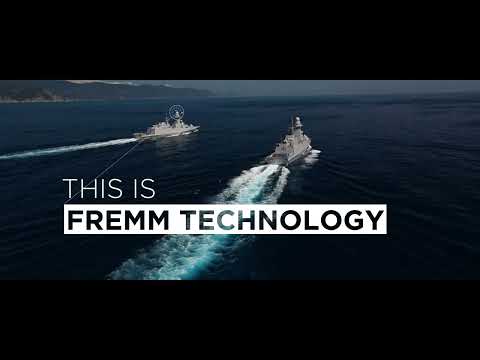
In terms of size and capability, the GMF 140 sits squarely in the same category as the now-canceled U.S. Constellation class frigate, British Type 26, and the Franco-Italian FREMM, but with a different emphasis.

Constellation class frigate. U.S. Navy

While the Type 26 was primarily designed around anti-submarine warfare and the FREMM family has evolved into multiple variants optimized for either ASW or general-purpose missions, the GMF 140 has been conceived from the outset as a fully integrated air and missile defense combatant capable of contributing to fleet-level ballistic missile defense while retaining robust ASW and long-range strike capabilities.

It is also notable that, rather than relying on proprietary national systems, Rheinmetall has built the GMF 140 around widely fielded U.S. and NATO technologies, including AEGIS, U.S.-sourced radar options, and the Mk 41 VLS. That approach reduces integration risk for navies already operating U.S.-made weapons and sensors while also improving interoperability during coalition operations.

The GMF 140 design reflects a broader trend among NATO navies toward heavily armed, multi-mission frigates that increasingly blur the traditional distinction between frigates and destroyers, at least in terms of missions. Rather than serving primarily as escorts, these ships are expected to provide area air defense, contribute to integrated missile defense networks, prosecute submarines, and deliver long-range precision strikes as part of distributed maritime operations.

While Rheinmetall is positioning the GMF 140 for the export market rather than domestic procurement, it should be noted that the German Navy recently canceled its planned F126 frigates, which, at 545 feet long and with a displacement of up to 11,000 tons, would have been physically the biggest surface warships to join the German Navy since World War II. You can read more about this ambitious program here.

The ill-fated F126 frigate in an artist’s concept. Damen

Instead, Germany opted for a smaller, lower-risk design optimized for anti-submarine warfare, and based on the proven A-200 frigate design from the German shipbuilder TKMS. This will be known as the F128.

Rheinmetall’s GMF 140 represents a different answer to that challenge. Rather than trading capability for affordability, it aims to deliver a heavily armed, highly interoperable frigate with robust integrated air and missile defense, long-range strike, and anti-submarine warfare capabilities in a single platform.

At the same time, the GMF 140 also marks a significant departure for Rheinmetall. While the company has long been a major supplier of naval weapons, sensors, ammunition, and mission systems, it has not previously competed as a prime contractor for a major surface combatant. As Rheinmetall’s first attempt to enter a highly competitive global market with a complete warship design, this necessarily comes with a degree of risk attached for any potential buyers.

There is also the question about where these vessels would be built. Earlier this year, Rheinmetall acquired Naval Vessels Lürssen, which includes various German shipyards, of which Blohm+Voss in Hamburg would be the most likely candidate, having a long history of building surface combatants.

Rheinmetall’s reference to a procurement project in North America is interesting, pointing to either Canada or the United States.

As it stands, Canada has already selected the River class destroyer (based on the Type 26), so Rheinmetall would be relying here on a future tranche or a follow-on requirement.

In the United States, the Constellation class frigate program was terminated last year, and it was announced that the National Security Cutter design will serve as the basis of a new U.S. Navy frigate program that is named FF(X). Introducing an entirely new design into that program would seem highly unlikely, but the appearance of the GMF 140 does suggest that Rheinmetall has identified a gap in the market between the new FF(X) and the Arleigh Burke class destroyer, with a VLS capacity and level of capability matching that.

As allied navies weigh the balance between capability, cost, and procurement risk over the coming decade, it will be interesting to see whether more navies also move toward a more affordable, lower-risk frigate, as Germany has done, or bigger designs like the GMF 140 that seek to retain destroyer-like capabilities in a frigate-sized hull.

Contact the author: thomas@thewarzone.com

The post German Defense Giant Rheinmetall Enters The Frigate Market appeared first on TWZ.


Source link

Fincantieri CEO Opens Up About The Constellation Class Frigate Debacle

The saga of the Constellation class frigate is emblematic of so many chronic issues with the Navy’s way of procuring warships. The vessel that was supposed to make the wrongs of the Littoral Combat Ship debacle right failed spectacularly and the timing couldn’t have been worse. Now Constellation is dead and the Trump administration is building a different frigate from a different yard. While the Navy has said why it is moving on, we wanted the other side of the story. We recently had a conversation with George Moutafis, CEO of Fincantieri Marine Group, to get exactly that.

Before we get to the questions and answers, however, here is the backstory.

The U.S. Navy needed the Constellation class frigate, badly, and the program to construct it seemed built to deliver. Rather than a clean-sheet design, the service chose the proven Franco-Italian FREMM as its parent design, betting that adapting an existing platform would be far faster and cheaper, and overall less risky than starting from scratch.

It wasn’t. Among the issues plaguing the program, constant change orders pushed the design far from its origins. Two years into construction, the first ship was barely 10% complete while its design was still being finalized. Meanwhile, costs and schedules blew well past original projections.

As a result of these issues, the Navy late last year cancelled the program. That left Fincantieri’s Wisconsin yard sidelined while a contract to replace the Constellation class frigate went to rival Ingalls Shipbuilding in Pascagoula.

In the wake of the program’s implosion, the Navy created the Vessel Construction Manager (VCM) system. It uses a hired manager to hold the prime contract and run the show, overseeing shipyard performance, controlling subcontracts, and acting as a buffer between the service and the builder to keep costs and schedules on track.

In a wide-ranging, hour-long exclusive interview, Moutafis – appointed CEO on July 1, 2025 as the wheels were already falling off this project – gave us unique insights into Fincantieri’s version of how Constellation turned into a debacle and what needs to change as a result. He also touched on an array of other topics, which we will address in future installments.

Some of the questions and answers have been edited for clarity.

Fincantieri Marine Group CEO George Moutafis. (Fincantieri)

Q: Why was the Constellation class frigate cancelled from your point of view? What happened that caused the program – which was seen as a must-succeed endeavor, and hugely promising – to get to the point where it was shuttered?

A: It’s for sure a tricky situation. On one hand, the way the Constellation class program was initially laid out and envisioned – potentially a lot of the things that were driving it may have been ahead of its time.

So, while you’re saying you want to attempt to do one thing, but at the same time you’re not evolving the way you execute can lead you to an undesired effect. And I say this because in my eyes, some of those lessons learned out of Constellation are being manifested in the things that the Navy has been rolling out the past few months – a new approach that empowers PAEs [Navy Portfolio Acquisition Executives] to make decisions, to minimize change, to embrace innovation and new technologies. All these elements that we see now being rolled out, I think to a certain degree, connect back to lessons that have been learned out of the Constellation class journey.

A rendering of the now-cancelled Constellation class frigate. USN

Q: What lessons, specifically?

A: Figure out what you want to prioritize, to what extent you want to prioritize schedule, and what’s the best way to say this. When you know when you need something delivered and at what pace, then enable the right level of decision-making. Because otherwise – I don’t want to sound this the wrong way – but perfection sometimes is the enemy of more than good enough.

Going beyond the Constellation class, now the needs are for vessels to be out there for the warfighter as soon as possible. For sure, we will see many cases where it will be considered that a vessel with these capabilities – even though potentially, in some areas, it may not have enough tons of steel on its sides, or whatever – it will be good enough to assist the warfighter as they head into harm’s way.

Those trade-offs are now being placed at the PAE level, allowing Navy leaders at that level to make the right decisions – figuring out whether to continue going down a design spiral versus just moving out with production and enabling us to have the right capabilities on time for the warfighter.

You can see former Navy Secretary John Phelan announce the cancellation of the Constellation class in the following video.

Q: Could the Constellation class have been salvaged? What would have needed to change to get it to a place where it was affordable, on time and efficient?

A: I think the initial and envisioned approach was a healthy one. Had we kept on track with what was, back then, the principles that led to the selection – but also how it was originally set up – we probably would have kept closer to the original design. And thus allowing [us] to be closer to the original schedule. And thus allowing [us] also to build the vessel that was desired, without delays or major changes.

On our end, from day one or day two – let me say that once the Navy decided their shift, we opted to consciously become a true partner and showcase that we are a true partner to the Navy and the nation. We said, ‘Okay, we will adjust, we will move forward.’ And it’s a clear reality that what we have in Wisconsin is an asset for the Navy, especially in a time like this that leaves all of us eager to serve the way you would need us to serve – whether it’s today through serial production of landing ships and/or icebreakers or others. And in the future, should the small surface combatant segment have additional needs, it’s obvious that the infrastructure [in Wisconsin] has been built to ideally serve that type of vessel, so we’re ready to answer the calling.

MARINETTE, WISCONSIN - JUNE 25: US President Donald Trump speaks to workers during a visit to the Fincantieri Marinette Marine shipyard on June 25, 2020 in Marinette, Wisconsin. The company was recently awarded a $5.5 billion contract to build ships for the U.S. Navy. (Photo by Scott Olson/Getty Images)
President Donald Trump speaks to workers during a visit to the Fincantieri Marinette Marine shipyard on June 25, 2020 in Marinette, Wisconsin. (Photo by Scott Olson/Getty Images) Scott Olson

Q: Why didn’t the Navy just take the base class and do minimal modifications to it? It became what seemed like a totally new ship.

A: That’s a great question, Howard, but I would need to speculate to answer that one, and I wouldn’t want to do that, because you’re right. But at the same time – what’s the saying? Hindsight is 20/20. It’s probably one of those occasions at this point. But it’s a great question. I’d love to be with you when we pose it to the right folks.

Q: But what do you think is the answer to that question, from your point of view?

A: From our point of view – from the get-go, when the award was made, it was made because there was a review of the requirements, a review of the design, and a review of all the elements that led to recognition that the parent design possessed exactly the right features to represent the path forward. So collectively, we had marched on that path. We might find ourselves in a different situation right now, but like I said, it’s one thing asking somebody to change their M.O. and adopt a new approach without fully empowering them or doing something drastic to signal that type of transformation. And it’s another where we said ‘we will try this new approach.’ But there was a lot of follow-through that was needed.

Everybody has developed experiences in certain ways, and everybody – especially when you have folks that have been doing it for decades – has developed their own rules of thumb and approaches to dealing with certain situations. It’s not easy to pivot an entire structure to a new idea or a new approach. So like I said, probably it was the right idea, but a little bit ahead of its time.

May 02, 2019 - Mediterranean Sea - Italian FREMM Carabiniere in mediterranean sea engaged in the exercise Mare Aperto 2019-1, an Italian multilateral maritime warfare exercise designed to promote interoperability and proficiency, in 2019 joined by 40 ships and 5 submarines from the navies of Canada, France, England, the Netherlands, Portugal, Spain and the United States (Photo by Francesco Militello Mirto/NurPhoto via Getty Images)
The Italian FREMM Carabiniere. (Photo by Francesco Militello Mirto/NurPhoto) NurPhoto

Q: What do you think of the lessons that should be learned from the Constellation class’s story?

A: I want to be a glass-half-full type of guy, so that’s why I connected back the things that I’ve been seeing being rolled out by our Navy the last few months as indeed adopting some of those lessons learned. So I’ll go back to the fact that they’ve decided to find new ways to apply the principle that schedule is king. And those new ways include changes that are not just at the leadership level, not just at the level following that, but indeed of restructuring and reorganizing the teams that are there to implement those guidelines – because that’s key in order to be able to change your ways and adopt lessons learned.

So I’m hopeful that this new approach of the PAE setup will be an enabler to adopt the lessons learned: of how to move fast, of how not to mess with a design especially when it’s meeting and exceeding requirements, of how to manage change – not in the rollout of a change, but in the decision-making of whether to adopt change or not. So a lot of those new ideas that they’ve been trying to apply are promising to that effect.

The future USS Pittsburgh under construction at Ingalls Shipbuilding in Pascagoula, Miss. (Ingalls Shipbuilding)

Q: The Navy adopted the new VCM program to oversee construction of the new Landing Ship Medium (LSM) vessels you are working on. This is a direct result of what happened with the Constellation class, right?

A: I would definitely think so, because it indicates the whole idea that the Navy is recognizing – instead of applying the typical layers of full team presence in the shipbuilder’s yard, additional layers of engineering design, etc. – we’re saying, ‘Okay, in a case where we want to go fast, let’s make our decisions ahead of time, select the design, check it quickly ahead of time, and assign it as a production-related design in the hands of that VCM, and allow an industry set of characters between the VCM and the shipbuilder to deliver.’

Renderings of the Navy’s Landing Ship Medium (LSM) vessels. (USN)

Q: What does Fincantieri have to give up in this VCM approach?

A: Thinking on this – Fincantieri, as a global group, likes to be end-to-end with the end customer. Our strategy is to develop the design according to the needs and requirements, move forward all through construction, and even post-construction to provide full support throughout almost the entire lifecycle of a vessel. That’s the Fincantieri model around the globe.

In this case, we’re looking to adjust to the approach that the Navy is looking to apply – and we can view it as a benefit. We can take it on as a build-to-print: be the shipbuilder that respects this design, doesn’t try to mess with it, just works out all the kinks to ensure producibility, and then moves swiftly into quick serial production.

From that perspective, we’re not really giving up something – we’re just placing at the disposal of the nation the assets that are already in place, and looking to produce as many vessels as quickly as possible.

The launching ceremony of the Italian Navy ship Trieste in the shipyard Fincantieri at Castellammare di Stabia on May 25, 2019. (Photo by Paolo Manzo/NurPhoto via Getty Images)
The launching ceremony of the Italian Navy ship Trieste in the shipyard of Fincantieri at Castellammare di Stabia on May 25, 2019. (Photo by Paolo Manzo/NurPhoto via Getty Images) NurPhoto

Q: How will this speed up U.S. shipbuilding?

A: How I interpret this strategy is the Navy saying: in programs that work, find an approach that allows them to almost get out of the picture. They recognize schedule is priority number one and a quality vessel is priority number two. In order to enable that ‘build more and build fast’ approach, they’re seeking to place somebody – the VCM – to take on the construction, provide them with a mature, production-ready design with no changes to it, and enable the kind of interaction you’ve seen in commercial shipbuilding. That allows those two parties – the VCM and the shipbuilder – to work fast through daily decision-making in a way that favors schedule without compromising quality.

They’re seeking to equip the VCM with a design that will not be touched – a build-to-print situation – and empower them to make these types of decisions daily, so that at the end of the day they simply deliver a vessel to the Navy, minimizing the Navy’s need or propensity to intervene.

It’s an innovative approach, and it definitely requires all parties to give up habits and practices that have taken hold in the past. As long as parties stick with this new approach, it has a great chance of success. On our end, we’re trying to be disciplined in respecting it and pushing forward.

Our next installment of this interview focuses on how Fincantieri is planning to help build Trump’s Golden Fleet and the challenges ahead.

Contact the author: howard@twz.com

Howard is a Senior Staff Writer for TWZ. He writes frequently about conflict, focusing heavily on the Middle East and Ukraine, and interviews with military and intelligence officials and industry leaders from around the globe. He lives near Tampa, Florida, home of U.S. Central Command, U.S. Special Operations Command.


Source link