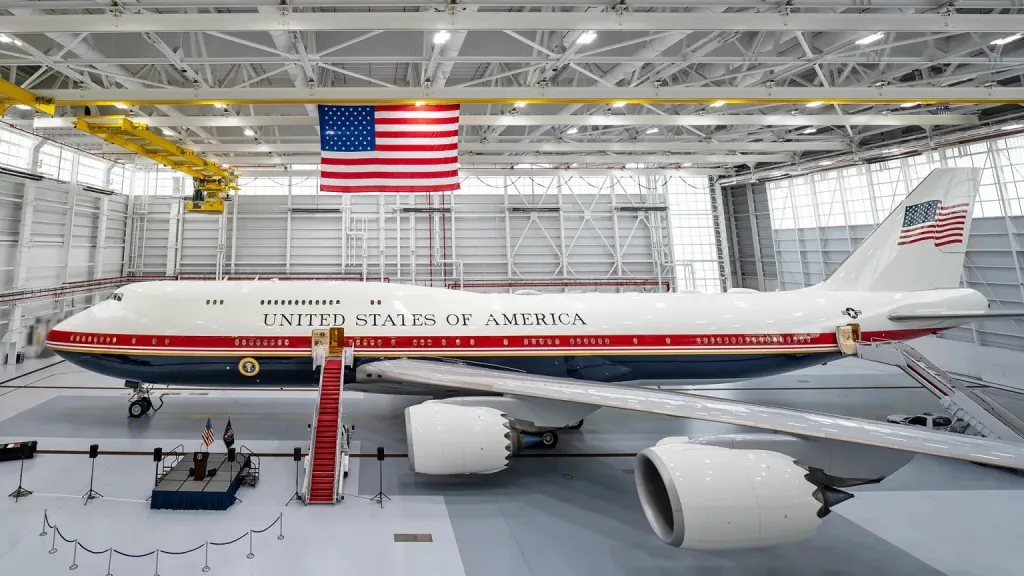
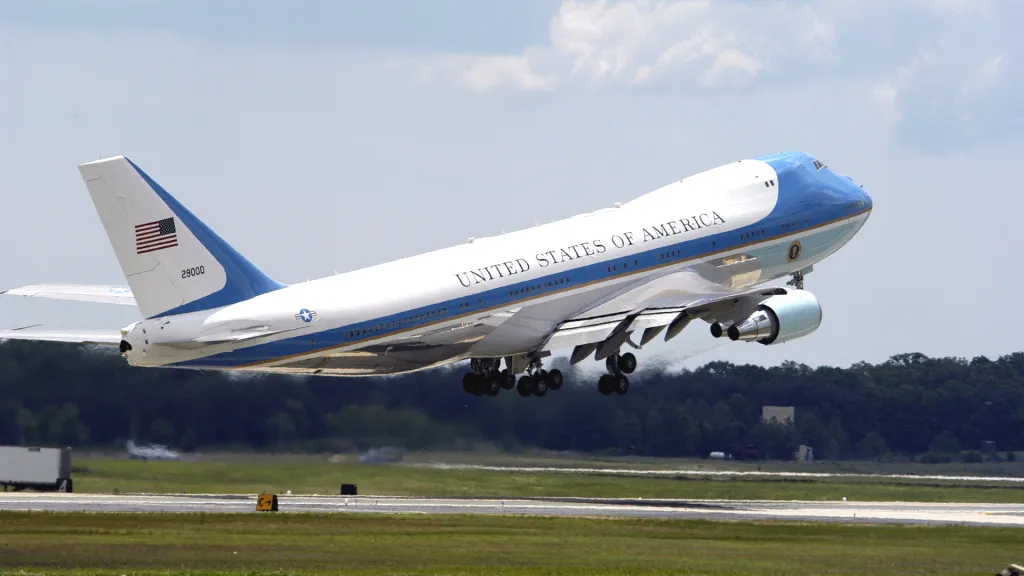
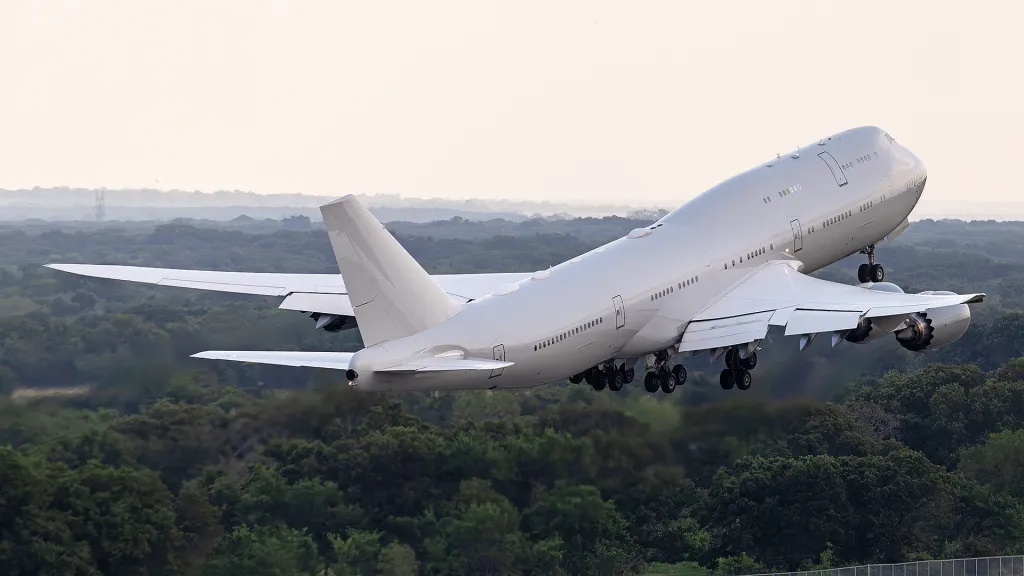
WASHINGTON — President Trump on Wednesday took his maiden voyage on a new Air Force One — a retrofitted Boeing 747 worth $400 million gifted by Qatar that embeds his personality more deeply into the institution of the American presidency.
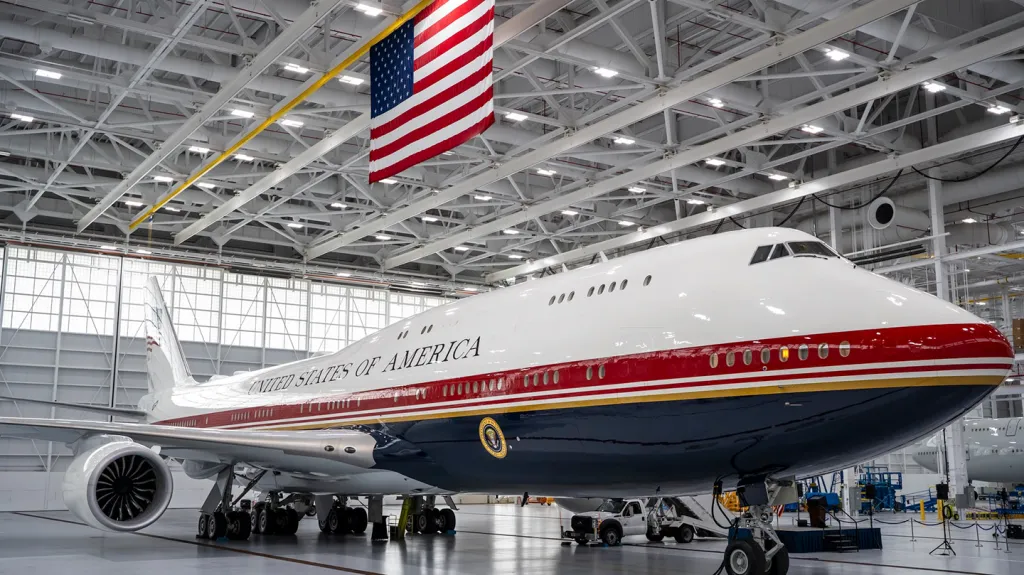
Gone is the trademark light blue hull that helped Air Force One blend into the sky. The refurbished jet is painted to Trump’s preferred color scheme of a navy blue belly and red and gold stripes. It has the luxury features that the president believes a commander-in-chief’s entourage should have — plush carpets, lie-flat seats, wood paneling and a presidential seal on the seat belts, according to reported tours of the plane.
Trump told reporters that he was proud of the luxurious plane. “You can do two things: You can low-key it, or you can show it,” he said.
Reporters are generally not permitted to take photos on the plane unless Trump is present. But on Wednesday, Trump administration staffers posted images of the plane’s interior on social media.
White House communications director Steven Cheung posted a photo of aides gathered around a circular table that had off-white place mats and leather captain’s chairs. Monica Crowley, the chief of U.S. protocol, posted a picture of herself perched on a leather couch between a pair of Air Force One throw pillows. Mounted on the wall behind her was a framed photo of the Thomas Jefferson Memorial.
The jet carried Trump to North Dakota to see the Theodore Roosevelt Presidential Library, its first official visitor ahead of its opening on the nation’s 250th anniversary.
The gift from the Middle Eastern power raised ethical concerns, but Trump saw the plane as a necessary replacement to the 35-year-old planes that had previously ferried him as president.
“This is a gift from a country that has treated us very well,” Trump said.
The new jet will only temporarily be in the nation’s service, as Boeing is expected to deliver in 2028 long-delayed planes that will permanently serve as Air Force One. Trump, a Republican, has said in the past that the Qatar plane would end up in a presidential library.
The Air Force has said that it did little to change the cabin layout of the plane and that it spent less than $400 million on security upgrades.
Nikhinson and Boak write for the Associated Press.
The White House has confirmed to TWZ that this is Trump’s first flight aboard the Bridge aircraft. The plane has been the source of controversy, including over its ability to adequately serve in the Air Force One role, something TWZ has questioned in detail in the past. The gifting of the jet from Qatar in the first place was also highly irregular, and the justification for needing it at all remains up for debate. The converted 747-8i has also been painted in a new scheme for U.S. executive aircraft preferred by Trump, which is a major departure from the Kennedy-era Air Force One livery that had been the standard for 60 years.
Decorative books, soft lighting, framed photos on new AF1, a gift from Qatar and retrofitted for presidential use by Trump. Some of the 1st images out publicly from @StevenCheung47, who is pictured with Ross Worthington, Natalie Harp, Karoline Leavitt, Meredith O’Rourke, Stephen… pic.twitter.com/jdVWNPvCmA
For the first time, the VC-25B bridge aircraft has flown over the Washington, D.C. area with the callsign “AIR FORCE ONE.” @POTUS is on his way to North Dakota today. pic.twitter.com/VVwTbsyAKi
“This will be the first flight of what I think is maybe the greatest commercial plane ever built. I said to Boeing, what’s the best one? They said this is the best plane ever built. And you’re going to have the privilege of flying it, and I have the privilege also of flying it,” Trump told reporters before boarding the plane at Andrews Air Force Base. “I’m excited about the first flight.”
Bloomberg was first to report that the trip to North Dakota would be Trump’s first flight aboard the Bridge aircraft. NBC News had previously reported that the inaugural flight of the Bridge aircraft might come later in the week, taking Trump on a planned trip to Mount Rushmore in South Dakota on July 3. It is still very possible, if not probable, that the plane will take Trump to South Dakota, as well.
The VC-25B Bridge aircraft seen during its official unveiling on June 19. USAF
Significant questions do still remain about the Bridge aircraft’s ability to support the full spectrum of Air Force One mission requirements, especially given that the plane was modified for this role in just 10 months. U.S. officials and defense contractor L3Harris, which did the conversion work, have insisted that operational concerns have been addressed and have downplayed any potential risks.
“One of the first things we have to do on this aircraft, in conjunction with the U.S. government, is ensure it is safe. There was a lot of content and buzz on blogs and whatnot about is the aircraft secure? Is there anything that we wouldn’t want coming in on the aircraft? Somebody could listen in, something like that,” Jason Lambert, President of Intelligence, Surveillance and Reconnaissance (ISR) at L3Harris, told TWZ in an interview last week. “I can assure you that was very effectively managed to the highest degree. Experts from the U.S. government, experts from L3Harris, experts in cyber security, electronic warfare, ensured that every square inch of that plane was clean, not only on the exterior but interior of the plane and all systems within. So I’ll say, there’s just electronic scrubbing, is how I would describe it, to ensure that it was safe and secure. Frankly, that work took place even before we were able to do any real work on the plane.”
President Donald Trump is seen here with Air Force officials and others during an earlier tour of the VC-25B Bridge aircraft. Dan Scavino via X
“Survivability of the aircraft was something that was absolutely thought of, but I can’t comment on the specific systems on the aircraft yet. That’s one I’ll have to direct you back to the Air Force,” he added. Lambert also deferred to the Air Force when asked about hardening against electromagnetic pulses, command and control capabilities, and other core Air Force One requirements.
The Air Force’s two existing VC-25A Air Force One aircraft remain in service, as evidenced by the one serving today as a backup. Boeing is still working toward delivering two fully-equipped VC-25B jets around the end of the decade. The VC-25Bs are set to replace the aging and increasingly difficult to sustain VC-25As, which were converted from older 747-200 models. However, that program has suffered repeated delays and cost growth. The Air Force is also now operating an additional 747-8i, acquired from Lufthansa, as a trainer for aircrew and ground personnel. A second ex-Lufthansa 747 will serve as a source of spare parts for the expanded Air Force One fleet.
Trump’s inauguration flight today aboard the VC-25B Bridge jet makes clear that it is now firmly in the Air Force One rotation.
Weekly insights and analysis on the latest developments in military technology, strategy, and foreign policy.
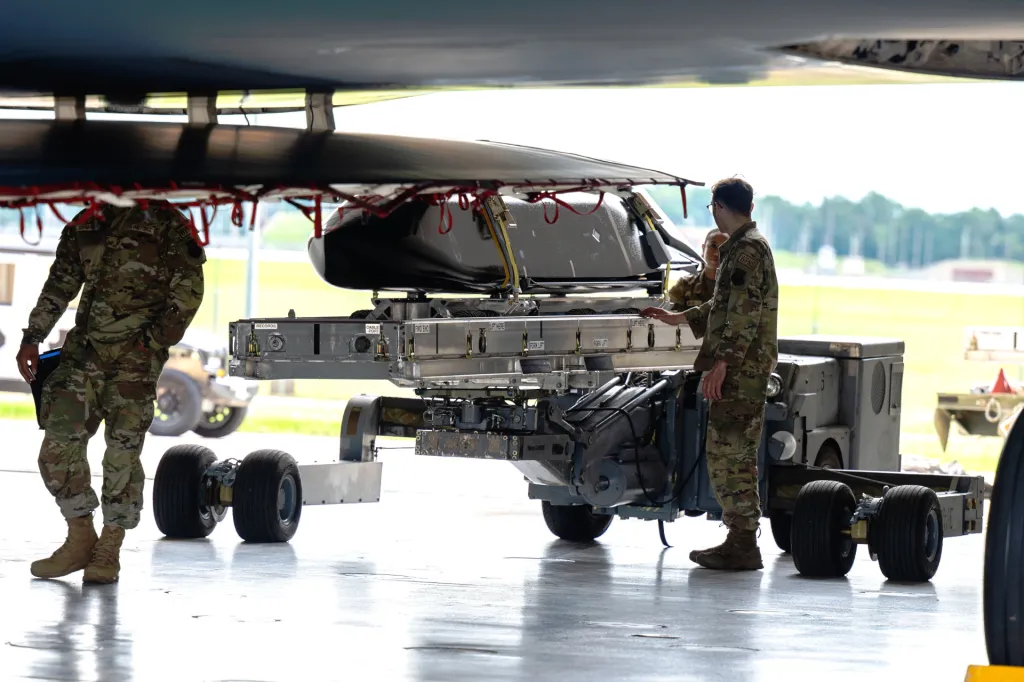
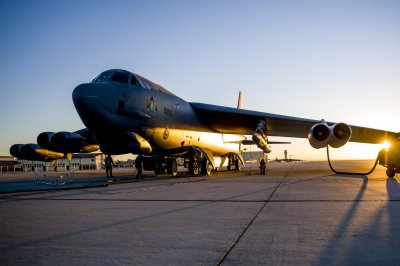
One of the U.S. Air Force’s B-2 bombers fired an AGM-158C Long Range Anti-Ship Missile (LRASM) during a recent live-fire sinking exercise (SINKEX) in the Western Pacific. The stealthy LRASM was not previously known to be in the B-2’s arsenal. Integration of the AGM-158C offers a huge boost in capability for the B-2, creating a penetrating fleet-killing platform that could be especially valuable in a future high-end fight in the Pacific against China.
“The Pacific Air Forces successfully conducted a live-fire Sinking Exercise using the B-2 Spirit north of the Mariana Islands. The B-2 deployed the Long Range Anti-Ship Missile, demonstrating enhanced ability to achieve strategic objectives within range of potential threats,” according to a press release today from Pacific Air Forces (PACAF). “With the deployment of the LRASM from the B-2 Spirit, the Pacific Air Forces takes a major step forward in countering maritime threats. This milestone showcased impressive high-end innovation reinforcing the US military’s commitment to safeguarding national interests and maintaining global security.”
Air Force personnel prepare to load an AGM-158C onto a waiting B-2 bomber. USAF
The release does not provide any further details about the SINKEX, but PACAF confirmed to TWZ directly that the B-2 fired the LRASM at the ex-USS Juneau, a decommissioned Austin class amphibious warfare ship, as part of Exercise Valiant Shield 2026. U.S. and allied forces taking part in the exercise pummeled the Juneau with various munitions this weekend, sending it to the bottom of the Pacific, roughly 200 nautical miles off the coast of Guam. An unnamed Japan Maritime Self-Defense Force (JMSDF) submarine appears to have delivered the final blow with a heavyweight torpedo. The B-2’s involvement was not mentioned until today.
The ex-USS Juneau is hit by a torpedo from an unnamed Japanese submarine during the SINKEX during Exercise Valiant Shield on June 27, 2026. USN/Seaman Apprentice Anthony Vilardi
“Exercises like Valiant Shield allow U.S. Pacific Command the opportunity to integrate forces from all branches of service and with our allies to conduct precise, lethal, and overwhelming multi-domain effects that demonstrate the strength and versatility of the Joint Force and our commitment to a free and open Indo-Pacific,” a PACAF spokesperson told TWZ.
A B-2 bomber takes off from Andersen Air Force Base on Guam on a sortie as part of Exercise Valiant Shield 2026. USAF
As noted, the B-2’s ability to fire LRASM at all does not appear to have been previously disclosed. When reached for comment, Air Force Global Strike Command (AFGSC) told TWZ that all details about the integration of the missile onto the B-2 were classified, as was whether or not the SINKEX represented any kind of first for the bomber.
A LRASM is seen under the wing of an F/A-18, with another missile in the foreground. USN
The Air Force previously highlighted other efforts to expand the B-2’s anti-ship capabilities in the form of Quicksink precision-guided anti-ship bombs, which leverage the Joint Direct Attack Munition (JDAM) guidance kit. You can read more about Quicksink here.
A B-2 bomber drops a Quicksink bomb during a test in cooperation with the Royal Norwegian Air Force in 2025. A Norwegian F-35A is seen flying alongside. Royal Norwegian Air Force
The AGM-158C is derived from the AGM-158 Joint Air-to-Surface Standoff Missile (JASSM) family of land-attack cruise missiles. The baseline AGM-158A JASSM and AGM-158B JASSM-Extended Range (JASSM-ER) are already known to be integrated onto the B-2. The B-2 is also known to be able to carry up to 16 AGM-158As, and is very likely capable of carrying the same number of JASSM-ERs and LRASMs, as all of these missiles have the same general form factor.
A B-2 drops a JASSM. USAF
In terms of its general mode of operation, LRASM uses GPS-assisted Inertial Navigation System (INS) guidance to navigate first to a designated target area. The missile is highly autonomous, thanks to a built-in route planning capability that is linked to an onboard electronic support measures (ESM) package. The missile has the ability to automatically change course in response to the sudden emergence of enemy defenses based on their radio-frequency emissions, as well as use those signals to better detect potential targets.
After arriving in the target area, the missile’s imaging infrared sensor in the nose takes over for the terminal phase of flight. Using a built-in threat target library database, the seeker searches for and categorizes targets autonomously. Information in that database also helps steer the missile to hit the target ship at its most vulnerable point. As a passive sensor, the infrared seeker does not send out radio-frequency signals that an enemy could detect. It is also immune to radio-frequency jamming.
Long Range Anti-Ship Missile (LRASM)
LRASM also has a datalink that allows it to get threat updates while in flight. It can also work cooperatively with other LRASMs during coordinated strikes. A C-3 variant is now in development that will feature a boost in maximum range, as well as “C++ software, [an] enhanced BLOS [beyond-line-of-sight] Weapons Data Link, [and] advanced survivability” capabilities, according to previously released Navy budget documents. The range of existing versions of the LRASM is not publicly disclosed, but is reported to be between 200 and 300 miles, in line with the AGM-158A JASSM. The C-3 version is expected to have the same reach as the JASSM-ER, which is reported to be around 600 miles.
“With the deployment of the LRASM from the B-2 Spirit, the Pacific Air Forces takes a major step forward in countering maritime threats,” according to today’s release from that command. “This milestone showcased impressive high-end innovation reinforcing the US military’s commitment to safeguarding national interests and maintaining global security.”
“The B-2’s impressive performance underscores the US military’s commitment to adaptability and flexibility in the face of emerging security challenges,” Air Force Gen. Kevin B. Schneider, head of PACAF, also said in a statement. “By prioritizing counter-maritime strike operations, we can maintain a decisive edge over adversaries, protect our national interests and ensure the free and open Pacific that underpin our global security.”
Another view of an LRASM being loaded onto a B-2 ahead of the Valiant Shield 2026 SINKEX. USAF
As we noted right up front in this story, pairing the highly survivable and hard-to-spot B-2 with LRASM presents a new penetrating anti-ship capability. Each one of the bombers could engage multiple ships simultaneously and use their other attributes to get within range of even the most high-value targets, such as the People’s Liberation Army Navy’s (PLAN) growing fleet of aircraft carriers and big deck amphibious assault ships. LRASM’s range means that the bombers only need to be in hundreds of miles of their targets. As mentioned, the missiles themselves offer a high degree of survivability, as well.
The Chinese aircraft carrier Shandong, at left, and Liaoning, at right, sail together in the Pacific together with their escorts, as aircraft fly overhead. Chinese government
“LRASM plays a critical role in ensuring U.S. naval access to operate in both open-ocean and littoral environments due to its enhanced ability to discriminate between targets from long-range,” then-Lt. Col. Timothy Albrecht, said following B-1 training sorties over the Black Sea back in 2020. “With the increase of maritime threats and their improvement of anti-access/area-denial [A2/AD] environmental weapons, this stealthy anti-ship cruise missile provides reduced risk to strike assets by penetrating and defeating sophisticated enemy air-defense systems.”
A B-1 bomber drops an LRASM during a test. USAF
At that time, Albrecht was a member of the U.S. Air Forces in Europe’s (USAFE) 603rd Air Operations Center and the Bomber Task Force mission planner.
A pre-production B-21 Raider bomber seen from above during aerial refueling testing. USAF
What has been revealed already is that the Air Force now has a very capable, long-range, deep-penetrating delivery platform capable of delivering its most capable and hard-to-detect anti-ship missiles.
The parents of Doug Martin filed a wrongful death lawsuit alleging that police officers used excessive force in trying to subdue the former NFL running back while he was “experiencing a mental health crisis” last October.
The lawsuit, filed Tuesday in the Northern District of California, also claims that paramedics contributed to Martin’s death by failing to “provide timely medical care.” The city of Oakland, several police officers and emergency medical service provider Falck USA/Northern California were named as defendants.
Martin died Oct. 18 in a hospital following his arrest by officers responding to reports of a break-in at a residence. He was 36. His death remains under investigation by Oakland police.
According to the Alameda County coroner’s office, Martin’s autopsy reports still are being finalized. Martin family attorney John Burris told the Athletic that an independent pathologist told the family that Martin potentially died from restraint asphyxia.
“Plaintiffs allege, on information and belief, that Decedent Martin died from restraint asphyxia caused by Oakland police officers and the FALCK NORCAL paramedics’ failure to provide timely medical care,” the lawsuit states.
The Oakland Police Department and Falck Norcal did not immediately respond to messages from The Times.
According to the complaint, Martin was “experiencing a mental health crisis” when his mother called for paramedics. He then fled and hid in a neighbor’s basement, where officers found him.
“After a brief struggle, defendant police officers physically restrained him,” the complaint states. “During the restraint, decedent Martin was placed face down while one or more officers pressed on his back. After a period of time, defendant Officers turned him onto his side.
“When they did so decedent Martin was unresponsive seemingly unconscious; However, the defendant officers initially believed he was sleeping or pretending to be sleep. When decedent Martin remained unresponsive, an officer requested medical assistance.
“Plaintiffs are informed and believe that decedent Martin did not receive immediate medical attention. Falck paramedics arrived over 15 minutes after the call for service and, and when they arrived, did not promptly provide medical care.”
A Stockton native, Martin was a first-round pick by Tampa Bay in the 2012 draft. He played six seasons for the Buccaneers, making the Pro Bowl in 2012 and 2015, before spending his final season with the Oakland Raiders in 2018. In his career, Martin rushed for 5,356 yards and 30 touchdowns.
To get a better sense of how this project came together so quickly, the challenges it faced and the tradeoffs that had to be made, we spoke with Jason Lambert, President of Intelligence, Surveillance and Reconnaissance (ISR) at L3Harris, the company that performed the conversion. During the interview, he gave us some unique insights into this highly visible and often controversial effort.
Jason Lambert (L3Harris)
Some of the questions and answers have been edited for clarity.
Q: Can you give us an overview of L3Harris’s role in this program?
A: It’s an honor to talk about this monumental and generational event. L3Harris worked in conjunction with the Air Force to deliver the first VC-25B — a 747-8I that the U.S. government received as a gift from Qatar. We had the opportunity to work on that aircraft for a 10-month period, with pre-staged employees operating on a 24/7, three-shift structure to convert it into what was unveiled on Friday: the new Air Force One.
The new VC-25B bridge jet. (USAF) USAF
L3Harris, in the ISR [intelligence, surveillance and reconnaissance] business, is uniquely positioned for this type of project. We’re the world’s largest non-OEM [Original Equipment Manufacturer] integrator of aircraft. We don’t make planes from scratch — we’re not a type certificate holder like Boeing, Airbus, or Gulfstream. We take existing planes, whether commercial or military, and missionize and outfit them for specific uses. We operate the world’s largest intelligence, surveillance and reconnaissance fleet — the RC-135 Rivet Joint.
RC-135 Rivet Joint. (USAF/Staff Sgt. William Rosado)
We missionize business jets for electronic attack, ISR, and airborne early warning and control missions, including a series of special mission aircraft, some of which are classified. And then, of course, the head-of-state mission, which we’ve been proud to be part of for many years.
We’re also the prime contractor for the Senior Leader Communication System. Any time the president is on board Air Force One, the communications system he uses to talk to his staff and to world leaders — voice, video, all content going on and off the plane — has to be secure, so state actors cannot intercept it, and it has to have the right bandwidth and latency, which is evolving as new satellite providers come online.
VC-25A. (USAF)
We have the ability to broker and work with multiple providers to ensure that the system is 24/7 ready whenever the president needs it. And when he’s on that plane, he’s not just the commander-in-chief — he’s the head of state, representing the country internationally. The president spoke to that directly when he talked about the livery and how this plane looks. Our team is just very, very excited to have converted this aircraft into what is now the first VC-25B.
In conjunction with the modification work, we were also asked to help build out a training program and a sustainment program — not just for this specific aircraft, but for the VC-25B fleet overall. On the training side, the Presidential Airlift Group had been flying the legacy 747. The 747-8I is a very different aircraft — it’s much larger — so we worked with two companies to address that. We leased an aircraft from Atlas Air for a period of time, and we purchased a plane from Lufthansa out of their commercial fleet to serve as a dedicated flight trainer, so the Presidential Airlift Group could learn how to fly the platform.
You can see video of one of those Lufthansa 747-8is below:
Lufthansa Boeing 747-8i D-ABYG, one of two aircraft slated to be sold to the U.S. Air Force, visited LAX during the Airline Videos Live broadcast from the H Hotel on December 14th, 2025. Lufthansa plans to sell both 747-8i aircraft in 2026. pic.twitter.com/IxsB55Kz8h
We also built a one-to-one scale mockup of the aircraft interior and placed it on the hangar floor at Joint Base Andrews. It was an exact replica of the layout — monuments like bulkheads, walls, doors, tables, and chairs in full-scale configuration, along with the galleys — so the flight crew supporting the president could practice and learn how to operate this aircraft before ever flying it. There were multiple training touchpoints built around that, and then, of course, the sustainment portion: spare parts, engineering support, everything needed to keep that aircraft ready whenever the president needs it. All of that infrastructure was built out in advance — not just for this plane, but to support the entire VC-25B fleet, which will include more aircraft to follow.
US President Donald Trump speaks in front of the new Air Force One, gifted to him by Qatar, in a hangar at Joint Base Andrews in Maryland on June 19, 2026. (Photo by Brendan SMIALOWSKI / AFP) BRENDAN SMIALOWSKI
Q: How did this all come about? Was there a requirement for a bridge Air Force One aircraft prior to the Trump administration’s second round? How did it all come into being and why?
A: In the first administration, a deal was signed with the Air Force and Boeing to build the VC-25B. That program has been delayed significantly by years, and its budget overrun by billions. You have that event taking place. The aircraft weren’t ready for the president’s use coupled with the fact that the VC-25A — the legacy aircraft — are 35 years old. They’re starting to have — there’s not a safety risk, there’s an operational risk in terms of what happens on planes, given their, I’ll just say, their usage. And so the president and the Air Force wanted to have a solution… given that the VC-25Bs are delayed further and the VC-25As are starting to — I’ll say show some age in terms of their availability. Again, there’s only two of those VC-25As and so one is usually in for depot-level maintenance. In fact, at present, I have one of them in my facility.
VC-25A. (USAF/Josh Plueger) USAF/Josh Plueger
The other one came back from the G7 summit recently, the president flew on that. And then of course the second one is in for maintenance. It was at Boeing’s facility at San Antonio for several months, getting upgraded, and then it’s in our facility right now for paint. That leaves the president with one VC-25A asset that, from an operational availability perspective, is not probably what it should be, given the age of the plane. So the Air Force approached us with a solution potential on how we could potentially go find a bridge to create when the VC-25Bs that are under contract with Boeing would be ready, and this was the solution.
A rendering of a future US Air Force VC-25B Air Force One jet. (Boeing) Boeing
Q: Can you provide any insights into what it took to get the work on the VC-25B done in just 10 months? Can you tell the story of how it all came together and why L3Harris was tasked with the job?
A: I’ll start with the L3Harris piece. Our core competency and what our uniqueness is, is taking existing platforms — military or commercial — and modifying them based on whatever the customer’s mission set might be. For example, we take tankers and convert them into the RC-135 Rivet Joint, the country’s premier intelligence, surveillance and reconnaissance platform. We take a legacy G550 business jet and convert it to the EA-37B Compass Call electronic attack plane. We take a Global 6500 from Bombardier and are converting it to ARES X, an airborne early warning and control offering for the Republic of Korea.
An EA-37B Compass Call. (USAF)
We do that because we’ve got an engineering team of 2,600 people on our total workforce of 7,600. Within the ISR business, 5,600 are cleared, so we have the ability at scale and size to do classified things very quickly and detect classified things with a large group of people that can do things in our facilities. So there is a lot of technical talent, but with that we also have around 100 people in our ODA. The ODA is essentially the delegated organization from the FAA, where we in our business can do work on behalf of the FAA for certification work.
So, the way we operate it, we’ll take an existing platform or an existing plane, and rather than have to certify it from scratch, we have to just certify the modifications that we’re doing for it. So you’re always starting with this baseline, and then you’re doing a modification on top of that baseline that enables us to go far quicker than if we were to start with a brand new aircraft from scratch.
So all that aircraft missionization competency is one of the reasons I think of why we were asked. The second reason is we’re the prime contractor for what’s called the Senior Leader Communication System, and so that communication system is used for every aircraft that’s utilized for Air Force One. So, in the 747s that the president flies — when he’s flying on a 757 — those are known as the C-32s — we have the hardware and the software on that aircraft, as well as the services that connect from satellite links, ground links, and be able to manage the communications content that the president and his staff are using in flight anywhere in the world.
A stock picture of a C-32A wearing the blue-over-white livery. (USMC)
Think of it like a help desk always online when the president or his staff are flying to ensure that the connections are live and working. If there’s an issue, we have redundancies within the system that we can ensure that it’s working, and most importantly, in addition to it being resilient, it’s also secure when that phone call gets made, or that video feed gets made from POTUS to a world leader, we’ve got to make sure that adversaries aren’t listening in. And so it’s fully secure, and that’s the core competency of what L3Harris does. So, combining those two pieces together, along with our legacy of supporting the Air Force One fleet, and we’re a logical choice to be asked to go take on this work and we are really uniquely positioned to do that because of the nature of the things that we do.
Q: What is the difference between this aircraft and Boeing’s VC-25Bs that are still in modification?
A: They both started as a 747-8i so from a platform perspective, they are the same. I can’t talk too much about the VC-25B program. What I can say for this one is, while this is an 8i, it had a very nice interior that came in from the Qataris. So we had a place to start from.
One of the first things we have to do on this aircraft, in conjunction with the U.S. government, is ensure it is safe. There was a lot of content and buzz on blogs and whatnot about is the aircraft secure? Is there anything that we wouldn’t want coming in on the aircraft? Somebody could listen in, something like that. And I can assure you that was very effectively managed to the highest degree. Experts from the U.S. government, experts from L3Harris, experts in cyber security, electronic warfare, ensured that every square inch of that plane was clean, not only on the exterior but interior of the plane and all systems within. So I’ll say, there’s just electronic scrubbing, is how I would describe it, to ensure that it was safe and secure. Frankly, that work took place even before we were able to do any real work on the plane.
In this February 15, 2025 photograph, a Qatari Boeing 747 sits on the tarmac of Palm Beach International airport after US President Donald Trump toured the aircraft on February 15, 2025. (Photo by ROBERTO SCHMIDT / AFP) ROBERTO SCHMIDT
Once we started work on the plane, it had an existing interior, much of which we kept and maintained. One of the things that we had to do for the speed of this program – because the goal was to get it done before the country’s Independence Day.
We were excited that we delivered early to that commitment. There are things that would have driven the schedule, so for example, changing the room structure, changing the hard walls, or any of the bulkheads, things like that, that would drive a significant amount of schedule risk associated. So those were some of the big rules that said, ‘okay, we’re not going to change any of what I call monuments,’ but there’s things within those that we did have some flexibility to change.
For example, there’s some things that came in on the interior that, while they look very nice, they weren’t really representative of what would be fitting for the U.S. president, and so we did make some modifications into some of the fit and finish in terms of the leather and wood and other aspects of what the aircraft looks like to really be fitting for the president’s mission.
✈️🇺🇸 The ultra-luxurious Boeing 747-8, which former U.S. President Donald Trump is set to receive as a gift from the Qatari emir’s family, is poised to become the most valuable present ever given to the United States by a foreign government.
— Savchenko Volodymyr (@SavchenkoReview) May 12, 2025
Q: When the original VC-25B contract was put forward, we were told the USAF, the White House and Secret Service carefully picked the exact requirements needed to execute the mission, and they would come at great cost. Some were even dropped to save money, like aerial refueling. Clearly, those standards had to change drastically to make this Bridge aircraft happen. What requirements were relaxed and what features were omitted in order to meet its aggressive budget and timeline requirements?
A: That’s classified, so I won’t be able to take that one, but I’d prefer that you direct that question back to the US Air Force.
Q: The one thing we get asked about the most is if this aircraft is hardened against electromagnetic pulse and has the command and control capabilities of the full-up VC-25B? Can you speak about that?
A: I think that’s one I’ll also have to defer back to the Air Force.
Q: What about survivability? The VC-25As are covered with infrared countermeasures and missile detection systems, and there are clearly capabilities that are less obvious. This aircraft doesn’t appear to have a similar outfit. How was survivability factored into its abbreviated modifications?
A: Survivability of the aircraft was something that was absolutely thought of, but I can’t comment on the specific systems on the aircraft yet. That’s one I’ll have to direct you back to the Air Force.
Common Infrared Countermeasures (CIRCM)
Q: If this aircraft is good enough to carry the commander-in-chief in the Air Force One role, why does the USAF need to spend over $4 billion on the other two aircraft? Why can’t the USAF just procure two aircraft in this configuration?
A: It’s an interesting question. Good question for the Air Force, but that’s an interesting question.
Q: Will this aircraft be able to fly all missions that the current VC-25As can? What about trips overseas to less peaceful regions?
A: I can comment about [the recent speech Trump gave at Andrews Air Force Base]. I know he’s intending to use this aircraft for international travel. I think he mentioned that there’d be an upcoming flight to Turkey coming up in the future. So specific locations, that’s always done through the White House planning group and White House Presidential Airlift Group. But the intent is this aircraft would be used overseas very much. The president talked about it in his speech about how it really is comparative to some of the other head-of-state aircraft.
It’s 18 feet longer for one so it really is a large aircraft. In fact, the hangar at [Joint Base Andrews] JBA that we were in on Friday for the ceremony was actually custom-built for the VC-25B because of the size of these planes.
In addition, of course, when you see the livery up close, it’s just amazing in terms of what it looks like. So I think the intention is for the president to use this overseas. He definitely signaled that directly on Friday.
Trump unveils new Air Force One, a $400 million jet gifted by Qatar | full video
Q: But are there any preclusions about where it can go at all? To a less peaceful region? Is there any place that it can’t go that the other aircraft can?
A: That’s probably a question for the Air Force.
Q: The aircraft belonged to another country’s government. What had to happen in order to make sure a foreign aircraft like this is free from potential nefarious tampering, bugs and other potential threats? Did every single component have to be examined?
A: What I can say is that a team of experts from the U.S. government, in terms of cyber security, did an immense amount of work on this aircraft, in conjunction with the L3Harris team, to ensure that this aircraft was fully safe from that environment, that threat, and that threat has been fully mitigated. I can say that. How they do it is classified.
The new VC-25B Bridge jet practices touch and go landings on June 22, 2026, in Joint Base Andrews, Maryland. (Photo by Andrew Leyden/Getty Images) Andrew Leyden
Q: The interior in this thing cost massive amounts of money when the Qataris outfitted it. It was one of, if not the most incredible VIP aircraft on earth before becoming a VC-25B. What unique elements of its interior and other VIP features were kept and what was changed?
A: The majority of the wall structure was all kept so any movements of monuments was maintained. That aircraft has 10 restrooms, and those were all kept and maintained. The fit and finish, in terms of some of the materials that were selected, those in some cases were upgraded in certain areas of the aircraft, and that’s both in terms of some of the leather and some of the wood grain veneers and things to be able to not only be esthetically pleasing, but fitting for the U.S. president.
You can imagine that the president is on the aircraft and could be doing interviews with the media. The presidential seal was of course incorporated in a few areas.
Inside the new VC-25B Bridge jet. (Dan Scavino via X) President Donald Trump inside the new VC-25B Bridge jet. (Dan Scavino via X)
We had to put in an air stair, which is for when the aircraft is landing in a remote location, it doesn’t have to — like on Friday — there’s the trucks that come up with the stairs to be able to get on and off the plane. This has one that can self deploy, so that was a fairly sizable structural mod to be able to integrate that into the aircraft and go through the certification process with it, but it works flawlessly. It’s actually a phenomenal piece of mechanical engineering. So yes, there were a couple of minor things that had to happen in conjunction with the other systems we had to incorporate.
U.S. President Donald Trump pumps his fist after touring the inside of the newest aircraft in the presidential fleet at Andrews Air Force Base on June 19, 2026 at Joint Base Andrews, Maryland. (Photo by Alex Wong/Getty Images) Alex Wong
Q: Were these requests from the president himself?
A: I’ll say that the president didn’t see the aircraft personally until last Friday, but his staff was directly engaged in the project throughout the entire project. Air Force leadership engaged throughout the entire project. We had senior Air Force visitors, including the Secretary and Chief of Staff of the Air Force, Gen. [Dale R.] White [The Pentagon’s Director of Critical Major Weapon Systems], and representatives from the White House military office visit us on several occasions to check on the progress of the aircraft, and then also to make design decisions.
I think about even one like the paint scheme, and the president had to sign off on the paint scheme, had to sign off on — if you look at the back of the tail — the wavy flag versus the fixed rectangular flag. The president personally had to approve all those items.
And one of the things the Air Force did an amazing job of helping us with is getting those decisions made as early as possible on the program, and then once the decisions were made, keeping the configuration frozen. In any type of aircraft development program, regardless of the customer, being able to make those design decisions and have them… locked in the front end allows the team to actually go do the procurement and engineering and work on the aircraft without having to do a lot of change.
In this example, we had an objective, along with our Air Force customer, to get this plane delivered before the 4th of July, 2026 for the country’s 250th birthday. And the team rallied behind that mission set to do that. And we could never have done it without the level of collaboration we had with the Air Force, working the requirements back with the president.
You can see the VC-25B bridge jet practicing touch-and-goes at Andrews in the following video:
Q: What new features does this aircraft’s interior have that the VC-25As don’t?
A: Well, the upgrades. So the comm suite is all the latest content gear, so that’s an upgrade. The aircraft is larger than the 25A, again about 18 feet larger, and so I’ll just say the size and just the finish of the aircraft.
Also, VC-25As were commissioned under President Reagan, and then first used under President Bush, and so while they are nice planes, they’re 35 years old, and so you can imagine just how those will wear a bit over time.
And yes, they’ve been kept upgraded, but this is a modern, beautiful aircraft, and I can say, when I saw it for the first time, it was the most beautiful aircraft I’ve ever seen. It’s — and if you have the chance someday to walk on the inside — or as things will start being released, you’ll see that on the interior also. It’s just absolutely gorgeous. And we had a great plane, a great point to start from, but again, we did have to do some things to make it fitting for the U.S. president.
Q: The paint job has gotten more press than anything else. What was the process of painting the highest profile aircraft on earth?
A: That’s a great question. So the first was the color selection, and as the president said on Friday, he was asked what color would he like. ‘So I like the American flag,’ and so trying to incorporate the American flag into the color scheme, we did a couple of things.
One, we took a legacy fuselage of a business jet. We do a lot of work on missionized planes to use it as essentially a test to be able to get the white and the red and the blue and the gold. How we apply those, took a lot of practice. We essentially painted a scrap airframe to be able to do the testing. The second thing we did is our team actually painted a C-32 — which is actually the first aircraft that was ever released with this paint scheme — a 757 called C-32A.
So we painted that and released that and actually got to show it live to the senior leaders of the Air Force before it was delivered, and it came out great as well.
One of the U.S. Air Force’s C-32A VIP aircraft wearing the new red, white, and blue paint scheme, spotted in Greenville, Texas (@tt_33_operator) @tt_33_operator
But what we learned from that plane was the sequencing. So the plane’s got essentially the white on top, the red, the gold stripe, and the navy on the bottom. We actually learned through that process of painting the 757 of how to optimize the sequence, and essentially the navy coming last.
That’s navy that’s on the undercarriage of the fuselage, when you see it up close, you can actually see your reflection in it. It’s just so beautiful. But we did learn that because it’s on the lower end of the aircraft, and we’re doing continual maintenance and masking of the aircraft, it was optimal to do that in the last part of the sequence, and so that’s something that we took forward when we painted the 747.
Q: What will happen to the original VC-25As? What about this new aircraft once the full VC-25Bs enter service in a couple of years?
A: Great question. The aircraft are still flying, they’re not decommissioned, per se. You know, there were some announcements made when the aircraft flew a mission coming back from the G7 summit and landed at Andrews last week, but those aircraft are still available for use.
But in terms of the operational availability of what you expect, there’s two aircraft that are again, 35 years old, and so they’re not going to have that same uptime as what you’d expect out of the new planes. But in terms of a plan for usage, that’s probably a good question for the Air Force.
Q: What happens with this aircraft once the full VC-25Bs enter service in a couple years?
A: I think that’s also probably a good question for the Air Force. They’ll have the better purview for that. In terms of L3Harris’s role with this right now, our role is to sustain it and make sure that this aircraft is always ready to fly whenever the president needs it. And then I think what we just demonstrated again with this plane is we have the capability from both a scale with our size of what we have from our workforce, our classified workforce, the speed in which we can operate, and the unique expertise to do very high-demanding aircraft modernization and integration roles. We’re ready to step up whenever the Air Force asks us to.
There’s many things we do for them on a regular basis. This one gets a lot of press. It is actually interesting because it was — up until this past week — essentially an unacknowledged special access program, meaning we couldn’t talk about it. So all this was happening essentially in the dark, and you go home and talk to your family at night, and they ask, ‘why are you stressed out,’ or ‘why do you look so tired,’ and you can’t say. And that’s just the nature of what we do in the classified world.
We’re doing this in several other examples across other customers we work with. This one just finally was able to come into the light, and we’re just thankful to be able to talk about it, but we want to do more.
Q: What lessons can L3Harris and the USAF learn from this program?
A: What we learned from this program is when the U.S. government has an immediate or incredibly urgent need, when the Department of War and industry work together as a partnership and team with leadership alignment all the way to the top, you can do anything. And it totally changes the game in terms of what’s been thought of as — I’ll say a historically slow and sluggish defense acquisition process. We at L3Harris and the Air Force just proved that that entire paradigm can shatter if you put the right leaders together to be able to do an impossible mission, and you do it as one team.
WASHINGTON — The Supreme Court refused Monday to block an excessive force lawsuit against a former Los Angeles Police Department officer who shot and killed a knife-wielding man whose speeding truck had slammed into several cars near downtown Los Angeles.
The court turned down an appeal petition from the Los Angeles city attorney’s office, over the objections of Justices Clarence Thomas and Samuel A. Alito Jr.
Litigation over the six-second shooting incident has extended over six years.
Federal judges in California agreed that Officer Toni McBride had reason to fire four shots at the suspect in April 2020 but not the two final shots that killed him.
Daniel Hernandez was alleged to be under the influence of methamphetamine when he got out of his truck and walked toward the officer. She repeatedly ordered him, “Drop the knife,” as he approached.
The majority reasoned that in the one-second pause between shots four and five, McBride “could have and should first reassessed the situation” and possibly concluded the suspect no longer posed a danger.
The city’s attorneys said the appeals court failed to consider the “totality of circumstances from the perspective of a reasonable officer on the scene” and its decision refused “to allow for reasonable mistakes in fast-moving, life-threatening encounters.”
UC Berkeley law dean Erwin Chemerinsky filed a response for the Hernandez family. He urged the court to stand aside and let a jury decide whether the officer’s actions were reasonable.
“The 9th Circuit simply held that it should be for the jury to resolve the factual dispute over what happened,” he said.
The justices had considered the appeal since late February before finally turning it down without comment on Monday.
The Supreme Court has repeatedly ruled police officers may be sued for unreasonable searches and seizures only if they are shown to have knowingly violated clearly established law.
However, this doctrine of “qualified immunity” has divided judges over whether a particular rule or limit has been clearly established.
“It has been clearly established for more than a decade that when an officer shoots and wounds a suspect, and he falls to the ground, the officer cannot continue to shoot him, absent some indication that he presents a continuing threat,” wrote Judge Jacqueline H. Nguyen.
“A fallen and injured suspect armed only with a bladed instrument does not present a continuing threat merely because he makes nonthreatening movements on the ground. … Under such circumstances, a jury could reasonably find that she employed constitutionally excessive force. If so, she is not entitled to qualified immunity,” she said.
The five dissenters said the officer made a reasonable split-second decision.
Judge Ryan Nelson said McBride “was justified in shooting Daniel Hernandez to alleviate the risk that he posed when he advanced toward her while armed and ignoring commands to stop. … She cannot be reasonably expected or required to reassess her shooting in a tight six second period during an intense and dangerous situation throughout which Hernandez was rising and never stopped moving.”
Judge Patrick Bumatay echoed this concern.
“Judges review police shootings only in hindsight. We review police tapes years after the fact. We get to rewind, pause, fast forward — analyzing the situation frame-by-frame. While the advent of police bodycam videos has been a welcome change, we can’t ignore that real life isn’t in slow motion,” he said.
Four of Britain’s five scheduled horse racing meetings on Wednesday have been abandoned following a forecast of extreme heat in parts of the UK.
The Met Office has issued a rare red warning from 09:00 BST on Wednesday to 21:00 Thursday for parts of England and Wales, with temperatures possibly reaching 38 or 39C.
The British Horseracing Authority’s hot weather policy states that where racecourses fall within a red warning zone, the fixture will be abandoned.
In addition, horses must not be transported from or through areas that have red warnings in place.
Worcester’s National Hunt fixture and the Flat meetings at Salisbury and Kempton are all in the affected zone and while Ffos Las, which was also due to host a jumps card, is just outside, it would require participants to travel through the high-risk area to reach the course.
Carlisle’s meeting in Cumbria is still scheduled to take place, featuring the historic Carlisle Bell and Cumberland Plate.
The BHA say they will continue to liaise with racecourses hosting fixtures in amber warning zones this week to consider any further procedures that may be needed.
Nigeria’s security crisis is not only unfolding in forests, highways, villages and cities. It is unfolding inside the institutions responsible for confronting it.
The Nigeria Police Force faces a threat that receives far less attention than inadequate funding, obsolete equipment or personnel shortages: the gradual erosion of merit as the basis for advancement.
Every institution reveals its values through what it rewards. When competence, courage, and sacrifice are rewarded, then professionalism grows. But when proximity to power is rewarded, a different culture emerges.
Across Nigeria, police officers are risking their lives daily against insurgents, terrorists, organised armed groups, kidnappers, and violent criminals. Yet many are watching a different reality unfold. They see colleagues whose careers were built around powerful politicians, governors, ministers, and other influential figures rise rapidly through the ranks, often ahead of officers who spent years in dangerous operational theatres.
Some officers remain Superintendents of Police (SPs) while coursemates have risen to Assistant Commissioners of Police (ACPs). Similarly, some officers are Deputy Superintendents of Police (DSPs) while their contemporaries have become Chief Superintendents of Police (CSPs), largely as a result of special promotions granted at different times. Due to these irregularities, an Assistant Commissioner of Police who has spent years on the frontlines can find themselves taking orders from a coursemate who has advanced higher than them, largely because of political connections and privileged appointments rather than demonstrated operational excellence.
Promotions signal to young officers and the outside world what behaviour the institution values. If political visibility matters more than operational excellence, ambitious officers will pursue access instead of experience. Dangerous assignments become career risks rather than opportunities for leadership. No security institution can survive such incentives.
This is not the time for a leadership pipeline shaped by patronage, but a time for leaders tested under pressure and promoted because they have demonstrated competence.
The Police Service Commission exists to protect the integrity of promotions and shield them from political influence. That responsibility has never been more important. The Commission has tried to tie promotion to examination, but has not been able to completely resist the pressure to award “special promotions”. Consequently, officers have questioned promotion outcomes that appear disconnected from performance, operational achievements and professional record. Whether every complaint is justified is not the point. Confidence in the system is eroding.
As thousands of police officers converge in Abuja for promotion examinations, this conversation must be a wake-up call for the institution. The credibility of the process matters as much as the process itself.
The consequences extend beyond morale. A police force that ceases to reward merit eventually ceases to attract and retain its best leaders. When this happens, strategic thinking suffers, professional standards decline, operational effectiveness weakens, and public trust erodes.
These concerns are compounded by longstanding allegations of corruption, extortion, abuse of authority and weak accountability. The EndSARS protests reflected years of public anger over police brutality and impunity. Although reforms were promised, many Nigerians remain unconvinced that accountability has become deeply embedded within the institution.
Merit is not only about promoting the best. It is about ensuring that leadership positions are occupied by individuals whose conduct strengthens public trust. Officers who demonstrate integrity, discipline, and excellence must see those qualities rewarded. Officers whose records are tainted by corruption, abuse, or chronic underperformance should not continue advancing without scrutiny.
Citizens are also noticing a troubling pattern. Some officers attached to powerful political figures are increasingly perceived as beneficiaries of privileges unavailable to most of their colleagues.
The reforms required are straightforward. Promotion criteria should be transparent and publicly accessible. Exceptional promotions should remain exceptional and be clearly justified. Service in high-risk operational environments should carry significant weight. Promotion records should face greater scrutiny. The Police Service Commission must demonstrate visible independence from political pressure.
Nigeria is moving steadily toward state police. If we do not fix the obvious gaps in the federal police before 36 states establish their own police services, the consequences could be chaotic. State policing requires a strong, disciplined, and professional federal police capable of setting standards, enforcing accountability and preventing abuse. A weak federal police cannot effectively keep state police in check.
The future leadership of the Nigeria Police Force is being determined today. Every promotion creates tomorrow’s commanders, investigators, and strategists.
A system built on merit produces leaders. A system built on influence produces loyalists. Nigeria cannot afford a police force where political proximity outranks professional excellence. The country is already paying too high a price for failure.
The editorial highlights a critical issue within the Nigeria Police Force: the diminishing role of merit in promotions, overshadowed by political connections.
It contends that rewarding political proximity over operational excellence weakens the institution’s integrity and deters talented officers, ultimately endangering public trust and operational effectiveness.
To restore credibility, the editorial advocates for transparent and merit-based promotion criteria, emphasizing the importance of recognizing officers who demonstrate integrity and competence. It warns of the dire consequences if the federal police fail to address these issues before state police services are established, as current leadership decisions shape future command and strategic capabilities.
Get our in-depth, creative coverage of conflict and development delivered to you every weekend.
Subscribe now to our newsletter!
Weekly insights and analysis on the latest developments in military technology, strategy, and foreign policy.
The service says the Warthog will fly to 2030. Evidence shows a lack of commitment and the irreversible loss of A-10 combat capability is instead just months away.
This September, the A-10 “Warthog” Thunderbolt II was scheduled to make its final flight. Instead, the A-10 deployed again, this time supporting combat operations over the Strait of Hormuz, striking Iranian fast-attack craft and maritime threats near one of the world’s most important shipping chokepoints. The A-10 was also the “Sandy” escort that recovered two downed F-15E airmen from inside Iran. Then, later in April, the Air Force reversed course and announced it would keep the jet flying through 2030.
While the Air Force changed the headline, it has yet to follow through with the harder financial commitment needed to preserve actual A-10 combat power. Its fiscal 2027 budget, released shortly after the extension announcement, funds zero dollars of A-10 modernization, cuts depot maintenance below the service’s own stated requirement, and is crippled by “sunset” policy and institution resistance around the aircraft’s “upcoming divestment.”
In other words, by the end of this year, the A-10 will be without depot support, without a training pipeline, without weapons-school instruction, and without operational-test capacity. To a community that was scheduled for final retirement this October, every month waiting for the promised extension makes rebuilding slower, costlier, and closer to infeasible. Without action, the A-10 will transition from a combat asset to a line item waiting for liquidation.
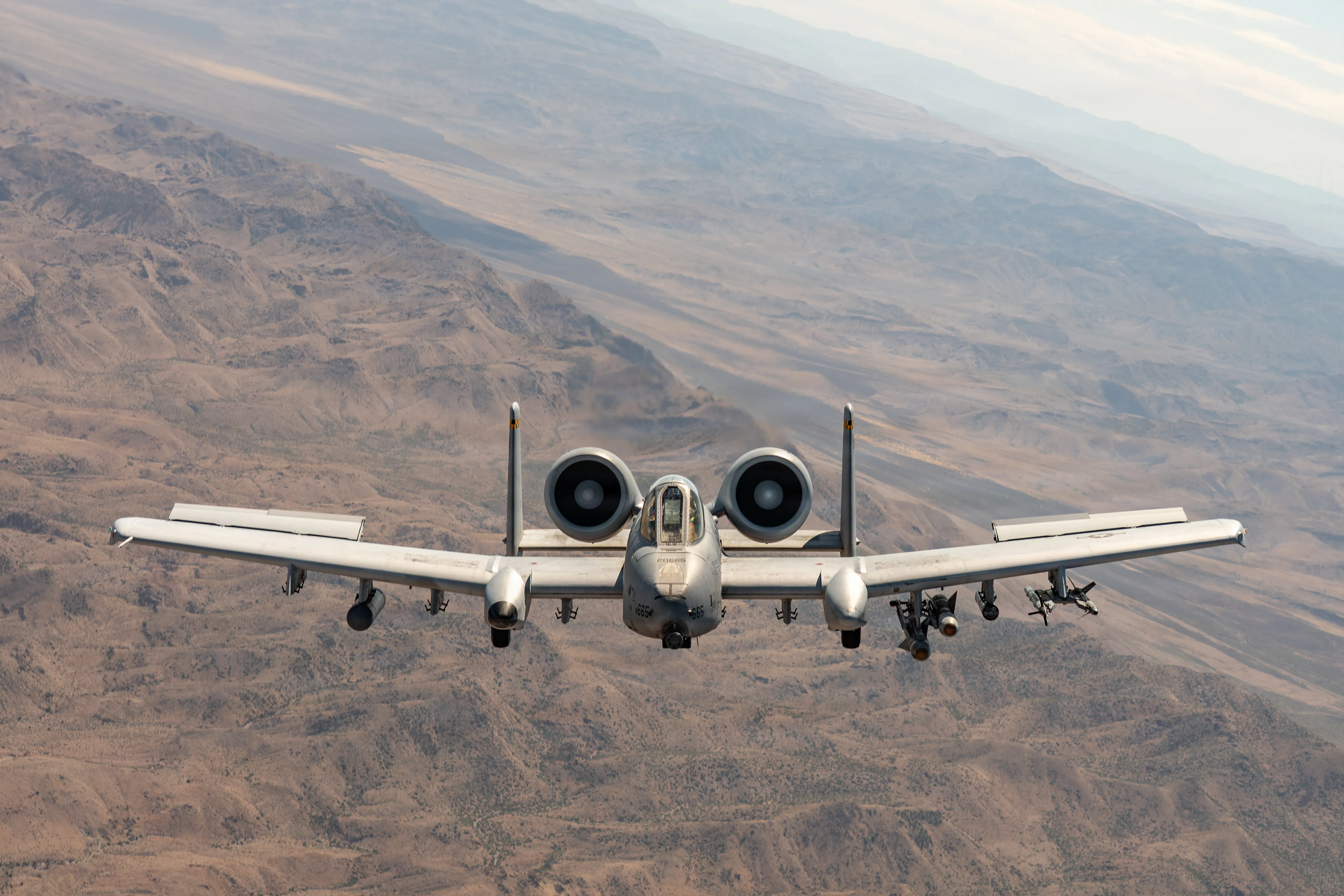
A U.S. Air Force A-10 Thunderbolt II aircraft assigned to the 66th Weapons Squadron, U.S. Air Force Weapons School, flies during a Weapons School Integration mission over the Nevada Test and Training Range, Nevada, May 28, 2026. (U.S. Air Force photo by Airman 1st Class Jennifer Nesbitt) Airman 1st Class Jennifer Nesbitt
A-10 combat capacity requires a meaningful shift in priorities that brings back resources and overcomes institutional resistance. Saving a limited number of aircraft is wasteful unless it is matched with resources, personnel, and policy that make it clear the A-10 is a valuable combat asset. The justification for preserving the A-10 is measurable in combat utility and financially sound reasoning.
I have no sentimental attachment to the A-10. I flew combat fighters as both an F/A-18 TOPGUN graduate and later as a U.S. Air Force F-22 Mission Commander with more than 2,000 flight hours, including combat deployments to Afghanistan, Iraq, and Syria. Since leaving the cockpit, I have worked closely alongside the A-10 community as it reinvented itself around modern warfare and Indo-Pacific priorities. I care about preserving combat capability and making disciplined present-value force-management decisions grounded in operational reality.
The A-10 was not preserved out of nostalgia. It was preserved because recent operations reminded the Air Force that immediate combat power still matters and the A-10 has proven useful in ways many planners underestimated. Today, it provides unique value unmatched by any of its peer tactical aircraft. It operates from austere locations, supports standoff and maritime strike, and validates emerging lower-cost weapons that reduces pressure on more expensive strike aircraft.
A U.S. Air Force A-10 Thunderbolt II aircraft provides close air support to Independence-variant littoral combat ship USS Santa Barbara (LCS 32) during a training exercise in the Arabian Gulf, Feb. 2, 2026. Santa Barbara is deployed to the U.S. 5th Fleet area of operations to support maritime security and stability in the Middle East. (U.S. Navy photo by Mass Communication Specialist 2nd Class Iain Page) Petty Officer 2nd Class Iain Page
As noted in the opening of this article, the A-10 also fills a critical combat role many have discounted: Sandy missions supporting combat search and rescue. Recent recovery operations over Iran protecting two F-15E airmen demonstrated again that personnel recovery escort, permissive strike, armed reconnaissance, and low-altitude tactical coordination remain critical and complex combat skills. The A-10 community has been supporting these missions for over 50 years. That wealth of knowledge and experience is being displaced. Without a replacement, the Air Force carries a mission requirement it may prove unable to fulfill.
Why Preserving The A-10 Was The Right Decision
For years, the Air Force’s divestment logic rested on several assumptions: that future conflicts would prioritize different force packages, that replacement capability would mature on schedule, and that preserving the A-10 generated less value than retiring it.
Recent events changed that projection. The A-10 has sustained operations in both Europe and the Middle East. Simultaneously, Air Force strategy in the Pacific has benefited from ongoing A-10 support developing distributed combat employment, maritime strike, and advanced weapons integration. The same platform once dismissed as a legacy close-air-support aircraft is now proving adaptable to several emerging operational problems and service priorities.
An A-10 Thunderbolt II fires its GAU-8 Avenger 30mm Gatling gun at the Barry M. Goldwater Range near Gila Bend, Ariz., as part of the close air support competition during Hawgsmoke 2024 on Sept. 13, 2024. (U.S. Air Force photo by Tech. Sgt. Tyler J. Bolken) Tech. Sgt. Tyler J. Bolken
The A-10 is not theoretical surge capacity sitting in storage. It remains active combat power supporting real operational demand today. Combat escort, personnel recovery, permissive strike, armed reconnaissance, and maritime interdiction remain ongoing Air Force missions and long-standing A-10 strengths.
A less known strength of the A-10 is the leverage it provides as a modernization platform. The A-10 community has quietly become one of the Air Force’s most effective rapid integration ecosystems. Because the aircraft relies heavily on government-owned hardware and software architectures, operators and engineers have been able to test and field new capabilities in weeks instead of years. The community has been behind recent breakthrough integrations including AGR-20 APKWS, Small Diameter Bomb, ADM-160 MALD employment, beyond-line-of-sight communications, maritime strike weapons, and network-enabled command and control.
A-10C with a load of Small Diameter Bombs. (U.S. Air Force photo by William R. Lewis)
Nobody is arguing the A-10 is the future of Pacific airpower. It doesn’t need to be. The aircraft has become a low-cost operational laboratory for rapid tactical adaptation fully integrated into real combat capacity.
An A-10C Thunderbolt II assigned to the 74th Fighter Squadron flies with its new refueling probe at Moody Air Force Base, Georgia, May 19, 2026. The A-10 integrated the probe with the A-10, tested it and it was in combat in a matter of weeks. (U.S. Air Force photo by Airman 1st Class Rachel Howell) Airman 1st Class Rachel Howell
Preserving one of the few communities with real operational experience executing tactics the broader force is still learning is strategically wise. The A-10’s latest life extension was never simply about preserving an airframe. It was about preserving combat capability, operational experience, and one of the Air Force’s few proven rapid-integration ecosystems.
What The Air Force Will Lose
The current plan has the service preserving a limited number of airframes while allowing the combat system behind the A-10 to collapse. A fleet that numbered more than 280 aircraft just a few years ago, and 162 at the start of fiscal 2026, is set to fall to 54 next year and just 36 by 2030. The cuts land hardest where the expertise is hardest to rebuild: the Air National Guard’s A-10 force, 47 aircraft as recently as last year, goes to zero, its flying hours swapped for a new cyber mission. What survives risks becoming a ghost-fleet. Of the “three squadrons to 2030” the Chief of Staff has promised, the active-duty force shrinks to a single squadron of 17 jets with no spares behind it.
A U.S. Air Force A-10C Thunderbolt II flies over the Gulf of America, September 16, 2025. The A-10, from Detachment 1, 40th Flight Test Squadron at Davis-Monthan Air Force Base, Arizona, has an orange nose panel to represent an area or part of the aircraft that is undergoing test operations. (U.S. Air Force photo by Tech Sgt. Jacob Stephens) Staff Sgt. Jacob Stephens
Combat capability does not reside in aluminum alone. It resides in maintainers, instructor pilots, operational test teams, weapons officers, logistics pipelines, and institutional continuity accumulated over decades. All of that is currently at risk. The capacity to produce, refine and retain this talent and experience is perishable. Airmen face irreversible career decisions. Maintainers transition to other fleets. Weapons instructors leave. Operational test is blocked. Once assignment pipelines close and personnel move on, the impact compounds quickly. To a community that was previously scheduled for final retirement this October, every month of uncertainty adds to the complexity of sustained readiness. Rebuilding later becomes expensive and slow, if not impossible.
How perishable A-10 specific knowledge is was documented by the Air Force’s own testing. When the Pentagon ran a 2018–2019 flyoff to determine whether the F-35 could replace the A-10 in close air support, forward air control-airborne (FAC-(A)), and combat search and rescue (CSAR), F-35 pilots had no qualification or training requirement for the FAC(A) and CSAR missions. To make the comparison work, the test had to crew the F-35 with former A-10 pilots, aviators who carried their Sandy and weapons-school training over from the very aircraft being retired. The report demonstrated mission performance depended on the aircrew, not the airframe.
Four Joint Terminal Attack Controllers assigned to the 6th Combat Training Squadron, Nellis Air Force Base, Nevada, display the Tactical Air Control Party flag after completing a mission on the Nevada Test and Training Range, Nevada, Aug. 3, 2022. (U.S. Air Force photo by William R. Lewis) William Lewis
Years later, in 2023 and 2024, the Air Force still had no close-air-support or CSAR training requirement for any F-35 pilot. In April 2026, the formal A-10 training unit at Davis-Monthan, the 357th Fighter Squadron, the schoolhouse that is home to the Sandy qualification, graduated its last class. On the same day, halfway across the world, A-10 flew the combat rescue mission saving downed aircrew inside Iran. The dissonance between real world combat value and misaligned budget politics will be on full display if the 357th schoolhouse and its Sandy training syllabus are allowed to fully inactivate in just a few months. The Air Force has confirmed there is no transition underway to move the Sandy mission to any other airframe, and no successor qualification program in development.
This is not a new concern. In 2021, the Senate formally recorded that A-10 combat search and rescue had been “100 percent effective” in Operation Allied Force, recovering a downed F-117 and F-16 pilot. The Warthog has now done it again over Iran. Congress has consistently levied the concern but the Air Force and its budget still haven’t made this a real priority.
The Air Force has already invested heavily to preserve A-10 viability well beyond 2030: roughly $1.1 billion to re-wing 173 aircraft, completed in 2019, and a follow-on contract worth up to $999 million to put new wings on the remaining 109, about $2.1 billion in total to extend the entire fleet’s structural life into the late 2030s. But even those investments faced similar institutional resistance inside the Air Force. The service repeatedly placed A-10 funding on its “unfunded requirements” list rather than in its base budget, while funding upgrades to other legacy fighters instead. Congress has consistently met Air Force resistance, such as in 2021 when the service spent just $15.6 million of $100 million Congress had appropriated to sustain the fleet into the 2030s. Allowing the enterprise behind those re-winged jets to collapse now would write off an investment the taxpayer and Congress already paid for and has barely begun to recoup.
U.S. Air Force Airmen assigned to the 309th Aircraft Maintenance Group Expeditionary Depot Maintenance team replace the wings on an A-10 Thunderbolt II assigned to the 357th Fighter Generation Squadron at Davis-Monthan Air Force Base, Arizona, Oct. 11, 2022. Due to the extensive in-depth work required to complete a wing swap, skilled professionals from the 309th AMXG Expeditionary Depot forward deployed to DM for this major component maintenance. (U.S. Air Force photo by Senior Airman Kaitlyn Ergish) Staff Sgt. Kaitlyn Ergish
This is not a theoretical risk. When the F-22 production line closed at 186 aircraft, well short of the original requirement of 750, the assumption was that follow-on capability would arrive to fill the gap. The limited F-22 fleet now bears disproportionate sustainment costs awaiting delivery of the proposed F-47 sometime in the mid-2030s, and even then, the two could serve alongside each other for a period of time. Timing errors in force design can become effectively irreversible, especially once the infrastructure that sustains a capability is dismantled. In the A-10 case, that includes not only the aircraft but also the depot and integration ecosystem that support it. Once those are gone, the option value is gone with them.
The financial logic behind accelerated divestment is also less straightforward than topline savings figures suggest. Retiring the A-10 does not eliminate operational demand. Combat search and rescue escort, permissive strike, armed reconnaissance, and distributed-operations requirements still exist. Those missions and their costs migrate elsewhere: more flight hours on higher-cost aircraft, additional maintenance burden, increased schoolhouse demand, and greater operational tempo across communities already under strain.
A U.S. Air Force A-10 Thunderbolt II aircraft assigned to the 66th Weapons Squadron, U.S. Air Force Weapons School, performs an austere landing at Delamar Dry Lake near Alamo, Nevada, May 28, 2026. The 66th WPS provided close air support and forward air control during a Weapons School Integration mission. (U.S. Air Force photo by Airman 1st Class Jennifer Nesbitt) Airman 1st Class Jennifer Nesbitt
The A-10 offers combat power at a discount through both cost per flight hour and cost per effect on target. Mission specialization means A-10 employing laser-guided rockets, gun, or other comparatively low-cost weapons provides a strong complement to high-end fighter packages and their standoff weapons.
The Air Force mission, its airmen, and our nation’s combat capacity all stand to benefit from a more complete commitment to the A-10 and its community.
What The Air Force Should Do
The Air Force must revisit their A-10 commitments to ensure the extension is real.
Restore and protect the 357th Fighter Squadron at Davis-Monthan. The 357th is the Air Force’s formal A-10 training unit and the institutional home of the Sandy qualification, the schoolhouse where combat-search-and-rescue expertise is produced, refined, and passed to the next generation of aircrew. It graduated its last class in April 2026 and is set to inactivate this year. No successor Sandy qualification program exists across the Department of War, and the Air Force has confirmed none is in development. Inactivating the 357th severs the center of excellence that produces the very capability the service says it values. Reversing that decision is the single highest-leverage action available, and the clearest signal of whether the 2030 commitment is real. The squadron should be retained until a validated replacement for the Sandy mission is stood up and producing qualified aircrew on a replacement platform.
A U.S. Air Force HH-60 Pave Hawk and A-10 Warthog fly in support of the Air Force Weapons School over Nellis Air Force Base, Nev., May 23, 2012. (USAF) Staff Sgt. Matthew Bruch
Stabilize the rest of the enterprise through the extension timeline. If the service intends to preserve meaningful capability through 2030, the supporting structure has to survive with it. That means protected funding for depot maintenance, training, operational-test, and maintainer retention. Exempt the A-10 from “sunset” policy where budgets are still being slashed with justification of “upcoming divestment.” Instead, leverage the A-10 operational-test process as a rapid-integration and tactics pathfinder, capturing and transferring those lessons across the broader force before the capability disappears.
Tie any future divestment to demonstrated replacement readiness, not the calendar. Do not divest the A-10 until there is a trained and capable replacement for each mission it performs. Build a deliberate plan for a clean handoff of mission responsibility and the community knowledge behind it, and gate future retirements on proven replacement capability rather than programmatic timelines.
The case for retiring the A-10 was always a timing argument: accept a measured reduction in near-term capacity in exchange for a better future force. The Air Force already announced the A-10 was back. Now it must fund the decision it already made before the combat capacity disappears anyway.
Paul “Gu$” Garcia is a TOPGUN Navy Fighter Weapons School instructor and graduate who flew combat missions in the F/A-18 across Iraq, Afghanistan, and Syria. He transitioned to fly the F-22 in the IndoPacific as a member of the Hawaii Air National Guard, leading the Homeland Defense mission for the Hawaii and Guam Air Defense Region for Operation Noble Eagle. He retired from the U.S. Air Force as the lead for PACAF modernization and innovation in 2025. He is Managing Partner and founder of Merge Combinator.
The opinions and views expressed in this article are those of the author and do not reflect the views or opinions of the U.S. Air Force, the U.S. Department of Defense, or any part of the U.S. government.
Commissioning flights are the “final exam” for the aircraft modification, the Air Force explained in a media release. “They provide both an opportunity for the White House enterprise to validate mission-capability, while also finalizing protocols required to safely and securely transport the President of the United States and enable his execution of his three constitutional roles; Chief Executive, Commander in Chief, and Head of State.”
VC-25B Bridge Aircraft. (USAF) (USAF)
Once these flights are successfully completed, the aircraft is officially “commissioned” into the active executive airlift fleet and becomes available for presidential missions along with the VC-25A and C-32 fleets, the service added in a release that included the new jet in its Trump-preferred red, white and blue livery.
You can read all about the program and the controversy surrounding it, especially having to do with the level of security and connectivity this aircraft provides, in our previous story here.
The VC-25B appears to be in the presidential hangar facility at Andrews Air Force Base in Maryland. You can read more about that in our story here.
UPDATE: 4:14 PM EDT –
Trump held a press conference at the presidential hangar facility to talk about the VC-25B. Here are some highlights.
“Our pilots, designers, and engineers prepared an aircraft that is the largest Air Force One ever built. It flies further and faster than any Air Force One. Those are incredible engines. You may never have to stop for fuel. They call it unlimited — well, it’s pretty close to unlimited. And it is among the most beautiful aircraft the Air Force will ever see or operate. You’ll never have this opportunity again.”
“With the extraordinary devotion of many of you here today, this plane was transformed into a flying White House — at a level of luxury nobody’s ever seen before — in only 10 months, a timeframe no one thought possible. They put a lot of things on here that normally you wouldn’t. Great protective mechanisms, the latest and greatest in every aspect.”
“We have communications equipment up there that nobody’s ever seen before — the highest level, including Starlink. My friend Elon is going to be very happy. We have four or five different sets of double and triple communications systems like people haven’t seen. It represents what can happen with hard work, innovation, and aggressive timelines.”
“So we had it all painted up in the new colors — red, white, and blue. We liked the baby blue, but it was time for a change. This is the sleekest look. When they asked what color I wanted, I said, “I like the colors of the American flag.” That makes sense. All of the planes in the fleet are being changed to this look — a much better look, and a more appropriate one.”
“The workmanship of this plane — when you see it, you won’t believe it. The quality of the woods, the quality of the materials, the quality of the engines. These engines are the finest and best in the world. Nothing like it. So it’s really an honor, and I want to thank the Emir of Qatar. He’s a fantastic guy. He went through a lot over the last few months.”
On the VC-25A he used to fly to the G7 summit:
“My return from the G7 summit was the last planned trip aboard the VC-25A — the 747. We’ll probably do the museum thing. We’ll get them fixed up a little, and put them in museums. They’re great planes and great history. It’s a plane that was authorized by President Ronald Reagan so many years ago. It was flown by every president since George H.W. Bush, and it was a great plane. We had very little trouble with it. Boeing has done a fantastic job — they charge too much, but we’re going to get the prices down. Over its lifetime, that aircraft traveled to 96 countries on 223 international trips and flew over 6 million miles. It became the most famous airplane in the entire world. And as you know, it’s actually two planes — Air Force One is two planes, totally identical. The only way I can tell them apart is a slight difference in the wood grain on the desk. They became the most famous airplanes in the world.”
On the July 4 capital flyover:
“So we’re going to have a big July 4th at the Capitol — flying over the Capitol. The generals promise to do a lot — not just one pass. They’ll do a little back and forth.”
UPDATE: 5:02 PM EDT –
Author’s note: Trump’s statement that his “return from the G7 summit was the last planned trip aboard the VC-25A” contradicts what the Air Force told us yesterday:
“The VC-25B Bridge aircraft will soon join the active executive airlift fleet alongside the VC-25A and C-32,” an Air Force spokesperson told TWZ this morning, but did not offer a firm timeline. When asked if this also meant that both of the VC-25As would remain in the service’s active executive airlift fleet, the same spokesperson said “yes.”
UPDATE 5:25 PM EDT –
Trump left his mark on the aircraft with his signature.
JOINT BASE ANDREWS, Md. — President Trump on Friday showed off the new Air Force One, a formerly Qatari-owned — and much debated — jumbo jet that has been converted into the official U.S. presidential aircraft.
The new plane — gifted from the Qatari government, raising a host of legal, ethical and security questions — will take on a new look, eschewing the Kennedy-era robin’s egg blue exterior in favor of white on the top half, its underbelly navy blue with a red stripe above it.
“This plane was transformed into a flying White House at a level of luxury that nobody has ever seen before,” Trump said from inside the massive Joint Base Andrews hangar, as a couple of hundred assembled Air Force personnel looked on. He spoke after stepping off the new plane in a dramatic flourish, as his signature tune “God Bless the USA” played.
He confirmed that he would be taking the new jet to the North Atlantic Treaty Organization summit in Ankara, Turkey, next month and indicated that he would be returning to China “at some point,” presumably a reference to the Asia-Pacific Economic Cooperation summit that China is hosting in November. His return from the Group of 7 summit in France this week was the last planned trip aboard the old Air Force One, he said.
“Now, when we land at airports in London and in Germany and different places, nobody tops this one, and that’s the way we have to have it for our country,” Trump said, noting that the colors and the design were to “my taste, I will say.”
He added that the new Air Force One will do a flyover during the July 4 celebrations next month.
The gift from Qatar is serving as a so-called bridge aircraft to carry the president until new planes ordered directly from Boeing arrive. That is currently slated for 2028.
The administration formally accepted a luxury Boeing 747 jet from Qatar last year to be used as the presidential airplane, despite questions about security and the ethics and legality of accepting such an expensive gift from a foreign government. Trump has claimed in the past that he would not fly around in the Qatari jet once he leaves office and said it would instead be donated to a future presidential library.
Trump on Friday said the U.S. was in a “little bit of a logjam” as it awaited the delivery of the new jets directly from Boeing, which had originally been scheduled for 2024 but have been delayed. He recalled asking the emir of Qatar for the use of one of their planes.
“See, a normal president wouldn’t do this. A normal president wants to stay away from aircraft,” Trump said Friday. “But our country has to be represented properly.”
Members of Congress and others have questioned the cost and effort that would be needed to make security modifications to an aircraft from a foreign government.
The Air Force said in a news release Friday that any plane deemed Air Force One “must meet rigorous security requirements” and that the Qatari plane “was modified under a disciplined engineering approach that prioritized these exact core capabilities above all else.” The Air Force also said “much of the previous head of state interior layout” of the plane was kept intact.
The Air Force has said in the past that security modifications to the jet would cost less than $400 million.
Trump’s efforts to reimagine the presidential airplane date back to his first administration, when he directed that an incoming fleet of new jets would adopt a color scheme that was nearly identical to that of his personal airplane. Then-President Biden reversed the decision in March 2023 as an Air Force review suggested that the darker colors could increase costs and delay delivery of the new jets, but once Trump returned to office, he returned to his desired colors for the plane.
Other government jets that carry other top administration officials will use a similar red, white and navy color scheme, the Air Force said earlier this year.
An Air Force spokesperson, who spoke on condition of anonymity to discuss sensitive plans, told the Associated Press that the two current planes, known as VC-25As, will not be retiring. Instead, they will remain in the fleet until the new Boeing planes, referred to as VC-25Bs, come into service, the spokesperson said.
It is unclear how the older jets will be used but the spokesperson said that both the Qatari jet as well as the VC-25As will be available for use and “the Presidential Airlift Group will select the appropriate aircraft for each mission based on operational requirements.”
Kim and Ceneta write for the Associated Press. Kim reported from Washington. AP writer Konstantin Toropin contributed to this report from Washington.
June 19 (UPI) — A Boeing 747-200 made its last flight as Air Force One after it brought President Donald Trump home from Europe this week.
“Well done, good and faithful servant,” White House Communications Director Steven Cheung posted Thursday on X. “The Last Ride.”
White House Deputy Chief of Staff Dan Scavino also posted a tribute with a video on X.
“I have been fortunate to fly around the world on this iconic plane for 5½ years – of the 35 years it has been serving the U.S. Presidents…THANK YOU… .”
There are two 747-200s working as Air Force One, designated VC-25A by the Air Force. The two have tail numbers 28000 and 29000. The latter is retiring.
The plane has been in operation since 1990, with President George H.W. Bush as its first presidential passenger.
“The VC-25B Bridge aircraft will soon join the active executive airlift fleet alongside the VC-25A and C-32,” an Air Force spokesperson said.
Three 747-800s are being prepared to step in, including the luxury jet donated by the Qatari government. Officials have said it should be ready for use this summer and that the Air Force had finished its modifications and testing of the craft.
Gen. Dale White, the Department of Defense’s direct reporting portfolio manager for critical major weapons systems, said in a May statement that the Qatari plane will “relieve pressure on the aging VC-25A fleet.”
“Ultimately, the Bridge aircraft fulfills a critical short-term requirement, guaranteeing the Air Force continues to execute its no-fail mission for the commander in chief while laying a rock-solid foundation for the future,” the release said.
The new planes will have Trump’s preferred color scheme of red, white, gold and dark blue. He proposed the change while in office for his first term, but President Joe Biden reversed the plan back to the traditional colors. When Trump was re-elected, the new color scheme was once again adopted.
President Donald Trump presents a Medal of Honor to Tom Ripley on behalf of his father, John W. Ripley, during a Medal of Honor award ceremony in the East Room of the White House on Thursday. Photo by Aaron Schwartz/UPI | License Photo
Weekly insights and analysis on the latest developments in military technology, strategy, and foreign policy.
The U.S. Air Force has confirmed to TWZ that both of its existing VC-25A Air Force One jets will continue to serve in the immediate future. Several White House officials had suggested that the career of one of the jets had effectively come to an end in social media posts overnight, which are now going viral. There are growing signs that President Donald Trump’s next trip on an Air Force One jet will be aboard the so-called VC-25B “Bridge” aircraft converted from an ex-Qatari VVIP Boeing 747-8i, not a VC-25A.
“The VC-25B Bridge aircraft will soon join the active executive airlift fleet alongside the VC-25A and C-32,” an Air Force spokesperson told TWZ this morning, but did not offer a firm timeline. When asked if this also meant that both of the VC-25As would remain in the service’s active executive airlift fleet, the same spokesperson said “yes.”
A stock picture of a VC-25A Air Force One aircraft. USAF
TWZ had reached out after seeing the aforementioned social media posts regarding the VC-25A that took President Donald Trump and others to and from the annual G7 summit in France this week. That particular aircraft has the Air Force serial number 92-9000 and is also often referred to simply by the tail number 29000. Several outlets had subsequently reported that one or both VC-25As were being removed from service.
“‘Well done, good and faithful servant.’ The Last Ride,” Steven Cheung, Assistant to the President & White House Director of Communications, wrote in a post on his official account on X, which also included a picture of 92-9000.
“I have been fortunate to fly around the world on this iconic plane for 5 1/2 years — of the 35 years it has been serving U.S. Presidents… THANK YOU… AIR FORCE ONE 2900,” White House Deputy Chief of Staff Dan Scavino also wrote in a post on X that included a video of the aircraft.
I have been fortunate to fly around the world on this iconic plane for 5 1/2 years — of the 35 years it has been serving U.S. Presidents…
The Air Force’s clarification to TWZ today is in line with a story from NBC News just last week. “Once the Qatari plane, which the Air Force refers to as VC-25B Bridge, enters the rotation this summer, the VC-25As will continue to serve in the executive fleet and could still be used by the president as Air Force One,” that outlet reported, citing an unnamed U.S. official.
The VC-25B Bridge “program epitomizes what is possible when clear accountability is placed on one individual, and the entire enterprise of stakeholders aligns behind a single mission outcome … deliver a bridge capability as soon as possible to relieve pressure on the aging VC-25A fleet,” Air Force Gen. Dale White, Direct Reporting Portfolio Manager for Critical Major Weapon Systems, had also said in a statement accompanying a press release last month.
The VC-25B Bridge aircraft seen still painted overall white circa May 1, 2026. Courtesy photo via the USAF
The Air Force is also in the process of acquiring two fully-equipped VC-25Bs from Boeing, and currently expects to take delivery of the first one in mid-2028. The service also said that “on-going [VC-25A] modifications are to extend the service life until the VC-25B aircraft are fielded” in its proposed budget for the 2027 Fiscal Year, which was rolled out earlier this year.
When the Bridge aircraft enters service, it could well become President Trump’s preferred Air Force One option. Since his first term, he has been very eager to accelerate delivery of a new Air Force One jet. The VC-25B program has been mired in delays and cost growth for years. Under the current schedule, the Air Force is set to get the first of those aircraft just months before Trump leaves office again.
Under the original Air Force One replacement plan, the VC-25As would have been retired already. These jets, as well as four E-4B Nightwatch ‘doomsday plane’ flying command posts that remain in Air Force service today, are based on the 747-200. This is a model that first entered production in the 1970s, and they are becoming very difficult and expensive to operate and sustain. 200-series 747s in any configuration have all but evaporated from service worldwide, creating additional supply chain hurdles. Boeing shuttered the 747 line entirely back in 2023.
Another stock picture of VC-25A tail number 29000 taken back in 2013. USAF
As Gen. White said in his statement in May, the Bridge aircraft will help ease the strain on the VC-25As until the fully-equipped replacement VC-25Bs arrive. At the same time, serious questions remain about the Bridge aircraft’s ability to truly support the full spectrum of Air Force One missions, as TWZ has highlighted repeatedly in the past. Operational security concerns about using a former foreign-operated VVIP jet for this mission have also been raised, though U.S officials have downplayed any such risks.
The VC-25As notably have shielding against electromagnetic pulses (EMP) and other features that harden them to be able to operate even in the midst of a nuclear exchange. The Air Force One mission also requires alternate options to be available at all times. Both VC-25As often accompany the president on international trips, with the second acting as one of the backup options.
The arrival of the Bridge aircraft could still allow the Air Force to move at least one VC-25A into more of a reserve status, at least when it comes to taskings for lower-risk trips. The full replacement plan might eventually reach a point where the Air Force could deem it possible to cannibalize 29000 for much-needed spare parts. At the same time, if the Air Force were to be left with just one truly full-spectrum Air Force One aircraft, this would only magnify the aforementioned controversy and concerns surrounding the ex-Qatari jet.
The Air Force did also confirm last year that it was buying two additional 747-8is from German flag carrier Lufthansa to support the Air Force One fleet. The service has now taken delivery of at least the first one of these aircraft, which is being used as a trainer for aircrew and maintainers on the ground. The other will be a source of spare parts.
Regardless, the Bridge aircraft is getting close now to formally entering service, and its public debut could come within a matter of weeks. An Air Force spokesperson had already confirmed to TWZ last week that the jet had received its new livery – as seen in the picture below – and was undergoing “final modifications” ahead of its formal entry into service.
Travis Ghormley
The new paint scheme has itself been a controversial aspect of future Air Force One plans for years now. During his first term, President Trump announced that the future VC-25Bs would wear a new red, white, and blue scheme rather than the iconic paint job that currently adorns the VC-25As, which dates back to the Kennedy administration. President Joe Biden subsequently reversed that decision, but Trump reinstated his original plan after taking office again last year. U.S. Air Force C-32s, as well as new executive jets serving the U.S. Coast Guard and the Department of Homeland Security, have also emerged in the past year with their own versions of this livery.
A rendering of a future VC-25B wearing the same scheme as the current VC-25As. USAF
The Bridge aircraft’s current location is unclear. Last week, still unconfirmed reports emerged that the jet had flown discreetly from Texas, where it had received initial modifications and the new livery, to Andrews Air Force Base just outside Washington, D.C. Andrews is where the VC-25As, as well as various other Air Force executive aircraft, are based.
Full blown operation to get this thing out without us seeing. Fueled, loaded crew, and preflighted in the hangar. Flipped CRANE01 to face me at the south end and beam me with landing lights. Entire airport blacked out, crew and grounds crew all wearing NOD’s.
When the Bridge aircraft will make its first official appearance remains to be seen. In its report last week, NBC News said that Trump could use the jet for a planned trip to Mount Rushmore in South Dakota on July 3, citing an unnamed White House official and another source familiar with the deliberations. Reuters also reported in May that the ex-Qatari 747 might make its debut during a July 4 flyover.
TWZ has reached out to the White House for more information.
Another picture of the VC-25B Bridge aircraft from earlier this year. Courtesy Photo via USAF
The VC-25B Bridge’s official entry in service does now looks to be increasingly imminent, but the Air Force’s VC-25As are also set to keep flying, at least for the time being.
Israel may ‘symbolically’ pull back its troops from southern Lebanon after the US and Iran signed a peace deal which included an end to Israel’s war on Lebanon, according to analyst Rami Khouri. But he attests, real policy change will only happen when the US forces Israel’s hand.
Weekly insights and analysis on the latest developments in military technology, strategy, and foreign policy.
Here’s TWZ’s weekly carrier tracker monitoring America’s flattop fleet, including deployed Carrier Strike Groups (CSG) and Amphibious Ready Groups (ARG), using publicly available open-source information. Check out last week’s report here.
The U.S. naval blockade of Iranian ports remains in full effect, for now, pending the execution of the ceasefire agreement, scheduled to be formally signed on Friday in Geneva, according to a notice released today by NAVCENT. U.S. Central Command (CENTCOM) forces launched multiple waves of strikes last week against Iran following the shootdown of a U.S. Army Apache helicopter, and disabled an additional two commercial vessels that tried to skirt the blockade, bringing the total to nine. Two carriers, USS Abraham Lincoln and USS George H.W. Bush, embarked with a combined seven squadrons of F/A-18E/F Super Hornets, two squadrons of EA-18G Growlers, and one squadron of F-35C Lightning IIs, continue to support “self defense” strikes and blockade operations.
The Lincoln CSG has been deployed for nearly seven months and would likely be among the first naval assets to rotate out of the theater if the blockade winds down. The details, and scale, of the drawdown of forces in the CENTCOM area of responsibility (AOR), as agreed upon in the memorandum of understanding (MOU), are murky as of publication. More than 20 U.S. Navy surface combatants have been operating in the region.
U.S. Navy fighter jets and command and control aircraft prepare to take off from USS Abraham Lincoln (CVN 72) as the ship transits the Arabian Sea. pic.twitter.com/SAGl2e7y0e
USS Nimitz entered the final leg of her homeport shift to Norfolk, operating off the east coast in U.S. 2nd Fleet AOR after a monthslong circumnavigation of South America, according to flight tracking data and public AIS. Nimitz conducted operations northwest of Cuba and the Bahamas last week. On Thursday, six Super Hornets, attached to the “Kestrels” of Strike Fighter Squadron (VFA) 137, carried out an air power demonstration and show of force, dropping MK-82/BLU-111 bombs on a simulated target in the Gulf of America.
U.S. Navy photo by LT Will “Simple Will” Shortal LT Will “simple Will” ShortalU.S. Navy photo Petty Officer 2nd Class Peter McHaddad
On the west coast, USS Theodore Roosevelt continues working up in preparation for a future deployment. The flattop got underway on June 10 for INSURV inspections to verify readiness and returned to San Diego the following day. The group was also spotted conducting a live fire exercise with the Mk 38 25mm machine gun. USS Carl Vinson got underway for sea trials after a nine-month Planned Incremental Availability (PIA) and moored at port in San Diego on June 13.
U.S. Navy photo by Mass Communication Specialist Seaman Devin Kraemer Seaman Recruit Devin Kraemer
In the Western Pacific, USS George Washington is on a summer patrol and operating in the Philippine Sea. The CSG conducted a replenishment-at-sea with USNS Earl Warren and helo operations while underway in the vicinity of Guam last week. Destroyer USS Shoup, part of the CSG, pulled into Apra Harbor early this morning, according to AIS.
Eyes in the sky.
An MH-60S Sea Hawk assigned to Helicopter Sea Combat Squadron (HSC) 12 operates above Nimitz-class aircraft carrier USS George Washington (CVN 73) while underway in the Philippine Sea.
Two ARG-MEUs are currently deployed. Forward-deployed USS Tripoli continues operations in the CENTCOM AOR, and USS Boxer is underway in the Indo-Pacific (INDOPACOM) AOR, operating in the South China Sea. For a detailed review of America’s amphibious assault fleet, check out our recent report here.
Note: Positions are general approximations.Non-deployed LHA/LHD amphibious warships are not shown.
Contact the author: ian.ellis-jones@teamrecurrent.io
A B-52 Stratofortress assigned to the 419th Flight Test Squadron undergoes pre-flight procedures at Edwards Air Force Base in California in 2020. A B-52 Stratofortress crashed shortly after taking off from the base on Monday. Air Force File Photo by Giancarlo Casem
June 15 (UPI) — California’s Edwards Air Force Base said eight crew members are believed dead following the Monday crash of a B-52 Stratofortress.
The base confirmed the B-52 Stratofortress, which was carrying a crew of eight, crashed shortly after takeoff at 11:20 a.m. Monday morning.
“Initial indications are that the crash was not survivable,” the base said in a release posted to X.
Emergency response personnel were on scene working to account for all eight crew members.
“Our thoughts and prayers are with the families and unit members at this time,” the post said.
‼️ Official release regarding today’s B-52 crash at Edwards. Our thoughts and prayers are with the families and unit members at this time.
The airfield was closed following the crash and all incoming aircraft were diverted.
“All non-commercial visitor passes have been suspended until further notice to allow the installation to focus entirely on emergency response operations,” the base said in an earlier post.
Edwards Air Force Base, located about 100 miles north of Los Angeles, frequently hosts test flights for new and experimental Air Force and NASA aircraft.
The base said more information on the crash will be provided as it becomes available.
Weekly insights and analysis on the latest developments in military technology, strategy, and foreign policy.
Details are still coming in, but a B-52 bomber has crashed at Edwards Air Force Base in California.
The base’s official Facebook and X pages have posted the following statement:
“A United States Air Force B-52 Stratofortress crashed shortly after takeoff on the Edwards airfield at 11:20 a.m. Emergency crews immediately responded to the scene and the situation is ongoing. More information will be provided as it becomes available.”
ALERT: A United States Air Force B-52 Stratofortress crashed shortly after takeoff on the Edwards airfield at 11:20 a.m.
Emergency crews immediately responded to the scene and the situation is ongoing. More information will be provided as it becomes available. pic.twitter.com/x932d3HXHz
— Edwards Air Force Base (@EdwardsAFB) June 15, 2026
From what we can see, the B-52 appears to have crashed on or at least very near the base’s main runway. Still images and video emerging now show a large fire with black smoke that can be seen from miles away.
How many individuals were on board the B-52 when it went down, and their fate, are currently unknown. However, the bomber ejection seat configuration could have presented complications for escape depending on how soon after takeoff the incident occurred. The B-52 has crew positions that eject downward.
Prior to this crash, the Air Force had 76 B-52s in service.
A stock picture of a B-52 bomber at Edwards. USAF
Though the two incidents are unrelated, this is also the second crash of a U.S. military aircraft in three days. A U.S. Marine Corps F/A-18D Hornet assigned to Marine Fighter Attack Squadron 323 (VMFA-323) went down near Mount Rainier in Washington State on June 13. The two individuals in that jet were able to eject safely. The Hornet did start a wildfire after hitting the ground.
BREAKING – 🇺🇸 Footage showing a U.S. Marine Corps F/A-18 crashing into a hillside near Rimrock Lake, Wash., on Saturday. pic.twitter.com/yQ4O6UFZOl
A US Navy F/A-18 crashed near Rimrock Lake, pilot ejected and walked out with medics according to reports. This is along the famous VR-1355 low level route in Washington State.
Fox News has now shared a video it says is of the aftermath of the crash, which shows a very large scorched area along the side of one of the runways at Edwards. There is no readily discernible wreckage, pointing to a total loss of the aircraft.
Update: 4:18 PM ET –
Edwards Air Force Base has shared a new update as of 12:48 PM PDT via its social media accounts. The full statement reads:
“The airfield has been closed, and all inbound aircraft are being diverted. All non-commercial visitor passes have been suspended until further notice to allow the installation to focus entirely on emergency response operations.”
Update- 12:48 PDT: The airfield has been closed, and all inbound aircraft are being diverted.
All non-commercial visitor passes have been suspended until further notice to allow the installation to focus entirely on emergency response operations.
— Edwards Air Force Base (@EdwardsAFB) June 15, 2026
We will continue to update this story as more information becomes available.
Five people died Saturday when an Indian Air Force cargo plane crashed during training. Image courtesy of UPI
June 13 (UPI) — Five Indian Air Force personnel are dead after a transport plane crashed during training in Assam, officials said Saturday.
“The Indian Air Force deeply regrets the loss of five personnel in the An-32 accident at Jorhat, Assam. Sqn Ldr Prashant Singh, Flt Lt Shubham Kumar, Sgt Jitendra Sharma, Agniveervayu Khemaram Kumawat and Agniveervayu Danish Alam made the supreme sacrifice in the line of duty. IAF extends its deepest condolences to the bereaved families and stands firmly with them in this hour of grief,” the Indian Air Force posted on X.
“Crash site management and initial enquiries are on at this time,” the Air Force said. It added that an investigation to find the cause of the crash is underway.
India’s air force operates a fleet of about 105 AN-32 aircraft, Al Jazeera reported.
President Donald Trump speaks to reporters about restoring commercial fishing access to areas of the Pacific during a signing ceremony in the Oval Office of the White House on Thursday. Photo by Jim Lo Scalzo/UPI | License Photo
Weekly insights and analysis on the latest developments in military technology, strategy, and foreign policy.
NASA is moving to hire a contractor to assess whether or not a Boeing 737-73W can meet its needs for a new reduced-gravity testbed aircraft. The use of planes modified for this role is now new, and they are often called “Vomit Comets” because of the extreme maneuvers they perform to simulate zero-G environments and the physical side effects this often induces. However, there’s an unusual twist here with the specific plane that NASA is now eyeing: it currently belongs to the U.S. Air Force and is part of a “classified military program.” There is a strong possibility that the aircraft in question is a mysterious 737 that the service acquired in 2020, and that has been the subject of much speculation as to its purpose ever since.
NASA’s Armstrong Flight Research Center posted a contracting notice yesterday justifying a planned sole-source contract to Denmar Technical Services, Inc. in relation to “Reduced Gravity Modification” of the 737-73W aircraft. Earlier this year, signs had already emerged that NASA might be in line to get a heavily modified and highly secretive 737 from the Air Force, designated the NT-43A and commonly referred to by the callsign RAT55. However, yesterday’s notice does not appear to refer to the NT-43A, long used as an airborne signature measurement platform and described in the past as the world’s most secretive 737, which is based on a much older 200-series airframe. We will come back to this later on.
A stock picture of the NT-43A Radar Test Bed aircraft, also commonly known by the callsign RAT55. Phodocu
What NASA wants now
“NASA requires Denmar Technical Services, Inc. to conduct a feasibility assessment to determine the Boeing 737-73W’s suitability to perform the NASA reduced gravity mission; modify the aircraft cabin, if required, to support reduced gravity operations; perform overdue maintenance and inspections, perform airworthiness restoration tasks, and paint the aircraft exterior with NASA identifiers,” the contracting notice NASA released yesterday explains.
The notice adds that the aircraft, if modified, would be used, at least most immediately, “for the Reduced Gravity Test Bed Project in support of the agency [sic] need for performing validation testing on Space Suits in support of the Artemis program.”
Artemis is NASA’s current effort to return U.S. astronauts to the lunar surface. The Artemis II mission, conducted in April, involved the first fly-by of the Moon by a crewed spacecraft since the end of the Apollo program in the early 1970s. However, the spacecraft did not touch down on the surface. The goal now is for a crewed lunar landing to come in 2028. RAT55 was notably used to support the launch of the Artemis II mission and the subsequent recovery of the capsule after its return to Earth.
Back in January, NASA had put out a separate contracting notice calling for information about new options to provide “parabolic flight services” to simulate “reduced gravity environments, including microgravity” for testing and scientific research purposes. The Florida-based Zero-G corporation is currently the primary provider of these services to NASA, using a retrofitted Boeing 727-200 dubbed ‘G-Force One.’ You can read more about NASA’s general use of Vomit Comets in the context of that notice here.
Total Weightless! What Happened on my Zero Gravity Flight?
The Boeing 737-73W under consideration to be turned into a Vomit Comet “is owned by the United States Air Force (USAF). Denmar Technical Services, Inc. has specialized knowledge of this Boeing 737-73W aircraft as they are currently contracted by the USAF to modify the aircraft under a classified military program,” the contracting notice NASA released yesterday adds. “NASA does not have a ‘need to know’ regarding the details of the current modifications being made under the USAF contract and therefore is unable to provide modification details to another contractor or provide another contractor with access to the aircraft. The USAF will transfer ownership of the aircraft to NASA upon completion of the closeout tasks.”
“Denmar Technical Services, Inc. is uniquely positioned to close out work under their existing obligations while performing the feasibility assessment, maintenance, and any modifications required under this action,” the notice continues. “Additionally, due to the constrained timeline for the NASA Extravehicular Activity and Human Surface Mobility Program’s space suit testing for Artemis, NASA requires the assessment and overdue maintenance to be performed immediately upon contract award and any subsequent aircraft modifications to be complete no later than October 1, 2026. The timeline can only be supported if this requirement is fulfilled concurrently with the USAF closeout tasks.”
Denmar is a small aviation firm headquartered in Reno, Nevada. At the time of writing, its website lists a wide array of specialized design, modification, flight testing, and other work among its portfolios. This includes “advanced customized mission system development” that “encompasses the design of unique airborne operator interfaces, specialized emitters and sensors, system integration, and post-mission analytics and processing.” The company also describes itself as the “Nation’s leading experts on IR [infrared] and RF [radiofrequency] survivability, signature modeling, [and] agile software development for analysis and real-world operational assessments.”
In line with all this, Denmar is understood to have been the prime contractor behind the extensive modifications to RAT55. In April, the Air Force confirmed to TWZ that the NT-43A was “being transitioned to start the next phase of its career,” as reflected by its involvement in the Artemis II mission, “after decades of flights supporting the Air Force in various roles.” The aircraft, which is understood to have long called the secretive and remote Tonopah Test Range Airport (TTR) in Nevada home, has been seen much more publicly since then.
Best views of RAT55 yet. Dorsal sensor pod (EO ball) seen in detail here. Also shot inside. I wonder if this is going to be ported in full to a contractor (it is currently operated by a contractor) https://t.co/XoE1zGFN78
However, as NASA’s recent contracting notice makes clear, the 737 it is now looking at as a potential Vomit Comet is a much newer 700-series model. TWZ has reached out to the Air Force and NASA for more information.
The curious case of N712JM
As mentioned, it is very possible, if not highly probable, that the 737 NASA is now considering turning into a Vomit Comet is one that the Air Force acquired in 2020, which TWZ explored in-depth at the time. That aircraft, which is a -73W model, is still officially on the U.S. civil register, with the registration code N712JM. Federal Aviation Administration (FAA) records show that the preceding owner of this aircraft was Denmar, which acquired it in 2019. The plane’s history before that is murky, with Boeing delivering it in 2013 to East West Bank via a trusteeship with Wells Fargo Bank, per the FAA’s records.
N712JM had drawn particular attention in 2020 not just because of its transfer to the Air Force, but also because it emerged at that time wearing a green protective coating and otherwise looking like it had just rolled off the production line. It also had some unusual external features that raised questions about its role, as we explored at the time.
N712JM as it was seen in 2020. Reader submission
In 2020, Jon Ostrower, long-time aviation journalist and editor-in-chief of The Air Current, told TWZ the following:
“This is definitely an airplane that never made it to a formal finish you’d expect from a commercial airplane. The green finish is a protective coating applied to fuselages during manufacturing to protect from scratches and other damage. It is dissolved during painting. You can also still see the manufacturing (line) number as well. That’s from its original trip down the assembly line. There’s also quite a bit of instrumentation visible with sensor wiring leading into the cabin through the passenger windows. This type of arrangement points to a flight test setup of some kind.”
In 2020, N712JM conducted many test flights in U.S. military ranges off the coast of Southern California, flying various flight profiles, some of them quite unusual. The aircraft flew those sorties from Santa Maria Airport in California, and used the callsign STING 38.
What the Air Force has been using N712JM for to date is unknown. Per FAA, the aircraft has been and continues to be registered to an address at Bolling Air Force Base (technically now part of Joint Base Anacostia-Bolling) in Washington, D.C., which looks to belong to the Air Force’s Rapid Capabilities Office (RCO). The RCO has headed up multiple cutting-edge, high-priority programs over the years, including the development of the B-21 Raider stealth bomber and the X-37B reusable spaceplane. A 737-based platform could be configured to support an array of different research and development and test evaluation activities that would fall under the purview of RCO, as well as other stakeholders that this office might engage with.
A screen capture of the entry for N712JM in the FAA’s online database at the time of writing. FAA capture
There has also been some speculation over the years that N712JM might have transformed into an Air Force 737 with the serial number 21-0024, but this appears to still be unconfirmed. The 21-0024 serial has more recently become associated with other shadowy 737s tied to the U.S. military, which have civilian-style paint schemes and may also be on the U.S. civil register. One of them was notably spotted in 2025 at a U.S. forward operating location in El Salvador, sitting directly alongside an Air Force AC-130J Ghostrider gunship and a U.S. Navy P-8A Poseidon maritime patrol plane. This, in turn, raised questions about its involvement in the ongoing U.S. campaign of strikes on alleged drug smuggling boats in the Caribbean and the Eastern Pacific Ocean, as TWZ previously explored in detail.
21-0024, for reference. When I spotted it, FR24 was indeed calling it N712JM, though ADSBx had the BuNo and a different hex. https://t.co/3WwV3kxBC4
Interestingly, there have been several online flight tracking data ‘pings’ suggesting new activity related to N712JM at Colorado Springs Airport since at least February of this year. However, there do not appear to be any confirmed flights by the aircraft from there in that same timeframe. This airport notably sits adjacent to Peterson Space Force Base.
There is still a possibility that NASA could be looking at a different Air Force 737-73W for possible conversion into a Vomit Comet. As the contracting notice makes clear, the aircraft in question is currently in the classified realm. At the same time, this seems far less likely to be the case given everything that is known (and still unknown) about N712JM.
A separate question does exist now as to what effort the Air Force might be in the process of closing out that would allow it to transfer any classified 737 to NASA. TWZ has previously raised tangential questions about how the Air Force might fill the resulting gaps left by the highly-specialized RAT55 moving on to the next stage of its career. It is certainly interesting in its own right that NASA seems to be focused heavily at the moment on leveraging some of the most secretive 737s in existence today to support its much less sensitive needs.
More details may emerge if Denmar deems the “classified” Air Force 737 to be a suitable starting place to create a new Vomit Comet to support NASA’s reduced gravity training needs and the Artemis program.
Update: 3:45 PM EST –
In immediate response to our queries, NASA has directed us to an additional notice about the award of the sole-source contract, valued at $8.4 million, to Denmar Technical Services back on June 1.
“The contractor will modify a Boeing 737-700 aircraft to perform lunar-gravity parabolic flights to test NASA space equipment. Once modifications are complete, NASA Armstrong will own the aircraft and oversee aircraft operations out of NASA Johnson,” the notice says. “The aircraft will be used to validate astronaut lunar suits and associated crew systems required to support Artemis mission objectives. This can be done with the modified 737 aircraft in an operationally relevant, reduced-gravity environment prior to lunar mission execution.”
No mention is made here about the sourcing of the aircraft from the Air Force or its classified mission work, as outlined in the sole-source justification that was released yesterday.
Weekly insights and analysis on the latest developments in military technology, strategy, and foreign policy.
The U.S. Air Force has confirmed that the VC-25B “Bridge” aircraft is now wearing its new (and controversial) red, white, and blue livery as it undergoes final preparations for its official delivery.
Aviation photographer Travis Ghormley shared the first picture of the modified Boeing 747-8i with its new paint scheme yesterday. It was taken the day before in Waco, Texas. The aircraft had been undergoing modification and flight testing at L3Harris’ facility in Greenville, also in Texas, as part of the conversion into its new role, since at least April, before subsequently moving to Waco to be painted. The jet, gifted to the Trump administration by the government of Qatar last year, is set to serve as an interim Air Force One aircraft ahead of the much-delayed arrival of two fully outfitted VC-25Bs from Boeing.
The VC-25B Bridge aircraft seen unpainted sometime circa May 1. Courtesy photo via the USAF
“The VC-25B Bridge aircraft has been painted and is going through final modifications,” an Air Force spokesperson told TWZ today when asked for more information about the aircraft’s current status. “I don’t have any additional details I can provide on delivery dates at this time.”
A press release the Air Force put out on May 1 said that the “VC-25B Bridge aircraft has officially completed modification and flight testing” and was “being painted.” We have confirmed that the completed modifications referred to here were on the contractor side, but the U.S. government still has additional modifications to make to the jet.
Ghormley’s picture does clearly show the jet wearing the same red, white, and blue scheme that has already been appearing on various Air Force and other U.S. government VVIP jets. The livery also includes a large American flag, depicted blowing in the wind, painted on both sides of the tail and “UNITED STATES OF AMERICA” written on both sides of the fuselage. The paint job is virtually identical to what President Donald Trump had previously chosen for the future VC-25B Air Force Ones during his first term. President Joe Biden had previously reversed that decision, bringing back plans to paint the VC-25Bs in the iconic scheme that dates back to President John F. Kennedy’s administration.
A rendering of a future VC-25B with the livery President Trump had originally selected. BoeingA rendering of a future VC-25B wearing the Kennedy-era scheme. USAF A rendering of a future VC-25B Air Force one jet. USAF
The Bridge aircraft’s current location is also unclear. Video posted on social media yesterday, seen below, purported to be of the jet departing for its new home at Andrews Air Force Base just outside of Washington, D.C. This is where the two current VC-25A Air Force One jets, as well as a host of other Air Force VVIP aircraft, are based.
Full blown operation to get this thing out without us seeing. Fueled, loaded crew, and preflighted in the hangar. Flipped CRANE01 to face me at the south end and beam me with landing lights. Entire airport blacked out, crew and grounds crew all wearing NOD’s.
Online flight tracking data does show that another U.S. military Boeing 747-8i flew from Waco, Texas, to Andrews on June 7, using the callsign Crane 01. However, this callsign has been associated with an ex-Lufthansa 747 the Air Force has also acquired for use as a trainer in support of future Air Force One operations. This aircraft, which may now carry the serial number 25-3200, has been tracked multiple times flying between facilities in Texas and Andrews in recent months. There does not appear to be tracking data for the VC-25B Bridge jet, which may also now have the serial number 25-3300, but it could have made the trip without broadcasting on ADS-B.
Past reports have indicated that the Bridge aircraft could make its public debut on July 4, which this year is also wrapped up in additional celebrations of the 250th anniversary of the founding of the United States. President Trump’s birthday (June 14) is also this weekend.
“L3Harris, known for its executive communications systems and services, was selected to undertake a complex modification of the bridge aircraft. L3Harris not only delivers secure, reliable and resilient communications for VC-25A and the executive airlift fleet but has extensive experience with self-protection and customization of VIP aircraft,” the Air Force wrote in the May 1 press release. “The accelerated timeline was further made possible by a mission-focused partnership with Boeing, who provided the necessary engineering data to support the required structural modifications.”
“Additionally, elite specialists from multiple government agencies developed advanced protocols to detect and-if necessary-neutralize potential technical hazards on previously owned aircraft,” it added. “Their rigorous approach on the Bridge aircraft has literally ‘written the book’ and set the benchmark for integrating used airframes into the secure military inventory.”
Another picture of the unpainted VC-25B Bridge aircraft, seen after arriving in Waco, Texas. Courtesy Photo via USAF
“Safety and security were at the forefront of this program. We deliberately minimized interior aesthetic modifications to focus on modifications for safety, security and mission execution. We assessed which requirements were necessary for an interim capability. We had greater flexibility in developing our mission requirements,” the Air Force also told TWZ directly at that time. “After safety and security, we focused on the mission communications systems.”
“We have made deliberate decisions such as the reduction of the number of airstairs, less chiller space, and exclusion of the Golden Eagle mission [to fly the remains of former presidents] to minimize structural modifications, while prioritizing modifications focused on safety, security and secure communications,” the service added.
Getting a new Air Force One aircraft of some kind into service on an accelerated timetable has long appeared to be a major goal for President Trump. The fully-equipped VC-25Bs from Boeing are years behind schedule. Last year, the Air Force announced that there had been some improvement on that front, but that it still did not expect to have the first of the two jets in hand until mid-2028, which would be just months before Trump is set to leave office.
What we do know for sure is that the VC-25B Bridge aircraft is now wearing Trump’s preferred red, white, and blue paint scheme ahead of its official rollout later this summer.
Republicans in the United States Senate have renewed their push to pass a controversial $70bn immigration-enforcement funding bill, a top policy priority for President Donald Trump.
But the effort on Thursday faced a series of hurdles, with Democrats forcing votes on several amendments that highlighted controversies related to the Trump presidency.
Recommended Stories
list of 3 itemsend of list
The rapid-fire votes on the amendments were dubbed a “vote-a-rama“, and they are slated to include issues ranging from Trump’s White House ballroom to his tariff policies and the US-Israel war on Iran.
“Amendment after amendment, vote after vote, Republicans are going to have to answer to the American people,” Senate Minority Leader Chuck Schumer said.
Early on, Republicans were forced to confront a topic that has dominated headlines in recent weeks: Trump’s proposed $1.776bn “anti-weaponisation” fund.
The fund has been controversial on both sides of the aisle, with critics calling it a slush fund for Trump’s allies.
Several Republicans indicated that the optics of such a fund could be politically catastrophic ahead of November’s midterm elections, and the Department of Justice has since backed away from the scheme.
But Trump himself has avoided saying whether the fund was dead, or just on hold.
It was created as part of a settlement following a lawsuit Trump filed against the Internal Revenue Service (IRS), a part of his government, and it was designed to award payouts to alleged victims of politically motivated prosecution.
Senate Democrats have repeatedly called for such a fund to be banned outright, rather than relying on the Trump administration’s commitment not to revive it.
Nevertheless, on Thursday, Senate Republicans rejected the Democrats’ measure to permanently block the fund.
Republican Tom Tillis introduced a second amendment, which would have also banned the settlement fund. Instead, the legislation would have redirected the allocated funds to a separate anti-fraud fund within the Justice Department. That, too, was rejected.
Thursday’s votes on the “anti-weaponisation” fund were just the start of several rounds of voting on issues uncomfortable to the Republican Party.
Schumer, the top Democrat, signalled that other amendments would tackle another part of the IRS settlement: the permanent immunity from tax audits that Trump had secured for himself and his family.
Trump’s controversial immigration enforcement campaign and other issues were also scheduled to be taken up in the day’s amendments.
Senate Majority Leader John Thune said he was not sure whether Republicans would defeat every measure, with some members of the party showing an increasing willingness to stand up to Trump.
“I can’t predict how it comes out,” he said.
Immigration funding bill
The situation on Thursday was the result of a standoff between Democrats and Republicans over the Trump administration’s approach to immigration enforcement.
Democrats had pledged not to approve further funding for Immigration and Customs Enforcement (ICE) and Customs and Border Protection (CBP), following the killing of two US citizens during immigration operations in Minneapolis, Minnesota.
Republicans control 53 seats in the 100-seat chamber, short of the 60-vote threshold needed to overcome a filibuster.
They have instead been forced to pursue a lengthy procedural manoeuvre to bypass the filibuster, which has taken weeks.
The $70bn funding bill had been stalled by the Trump administration’s demand to include $1bn for security upgrades for Trump’s White House ballroom project.
The request came after the president had repeatedly said that no taxpayer dollars would go towards the project.
The security funding, which roiled several Republicans, was subsequently dropped before the voting started.
The Senate’s parliamentarian, an official who interprets the chamber’s rules, had previously ruled that adding ballroom funding to the $70bn bill would make it ineligible for the budget reconciliation process, which allows the passage of fiscal-related bills with a simple majority.
If Senate Republicans remain unified, they are expected to pass the funding bill late Thursday night or early Friday.
The Republican-controlled House of Representatives is expected to take up the bill shortly after.
Travel companies have been contacting people with holidays booked after change made
Jet2 customers have been emailed about changes in the booking process and when they’ll get documents(Image: Getty)
Jet2 passengers have been told that a key change is now ‘in force’ after some got in touch worried that an email they received could be a fake. Holiday travel companies have also been getting in touch with customers to tell them of the change.
Thousands of travellers have received emails notifying them that their holiday documents will be arriving later than originally expected. This has raised alarm bells among some customers who fear it could be a scam – particularly as Jet2 has recently been warning about numerous fake social media accounts being created in an attempt to defraud passengers.
Previously Jet2 sent all documents to travellers 28 days in advance of the break – however in 2026 this has changed with great uncertainty about the situation this summer with the Middle East conflict still not resolved. In a recent post on Facebook travel company Holiday Getaway said: “Just a quick update for customers travelling with Jet2. Holiday documents will now be available 14 days before departure to ensure you have the most up-to-date information for your trip. No action needed. Online check-in is still available from 28 days before travel.”
One passenger wrote on X: “@jet2tweets Hi, I’ve just received this email apparently from Jet2 saying I will now get my holiday documents 14 days before my holiday departure instead of 28, is this true or is it still 28, I’ve a feeling this was a spam email though.”
Another passenger added: “I had the same email. Flying on 25 May with jet2,” A traveller added: “Ive just had the same email !”
The email says: “Just so you know, following a change to when we send out the documents for your holiday, you’ll now receive your documents 14 days before departure, rather than 28 days as stated on your original booking confirmation. You don’t need to contact us or take any action – you’ll receive your documents 14 days before you travel. Have a lovely holiday!”
Responding on X, Jet2 confirmed it was a genuine message and explained: “Hi there, thanks for reaching out. Yes we can confirm that you will receive your documents 14 days before departure. Should you require any further assistance, then please feel free to send us a DM. “
Jet2 advice says: “At 10 weeks before departure we will take any outstanding balance payment and send a confirmation that the balance has been paid. At 14 days before departure, we will send you a final confirmation with your travel documents attached, consisting of your booking confirmation; your flight voucher; your accommodation voucher, your cruise voucher (where applicable) and your transfer or car hire voucher. We will also provide you with your ATOL Certificate. Please remember to print off all your vouchers as well as your booking confirmation and your ATOL Certificate where applicable.”
Jet2 has also explained why some flight schedules may change, and has moved to remind passengers of an action they must take during a 48-hour period. The major airline states in the Frequently Asked Questions section of its website that it “always aims to operate our flights at the scheduled time of departure”. However, Jet2 added: “Sometimes we may need to make changes or provide alternative carriers or aircraft and cannot always notify you of this in advance. We may also alter or remove the planned schedules as shown on your booking confirmation.”
The guidance notes that Jet2 does not wish to cause inconvenience to passengers, yet “unfortunately sometimes changes to scheduled flight times may be required for operational or technical reasons outside our control”. Jet2 confirmed that in such circumstances, travellers would be given as much advance warning as possible.
Passengers flying with Jet2 are encouraged to keep a close eye on their email and text message inboxes, as these are typically the methods used to get in touch should any changes arise. Jet2 added: “Please contact us if you change your email address or mobile number so we can update your details.
“From the Manage My Booking section on our website you can see your booking summary, request a further email confirmation or select a different email address.” Jet2 is also reminding travellers that they are obligated to review their flight summary within a 48-hour window prior to departure.
Jet2 said: “Please be aware that it is one of our Terms and Conditions that you re-check your flight summary 72 to 24 hours before departure.” The airline also continues to urge passengers to consult the “latest travel information” on its website at least 12 hours before take-off to ensure they remain fully informed.” Additional advice reads: “Please check this section of the website at least 12 hours before your flight for the latest flight information.
“We recommend arriving at the airport at least 2 hours before your scheduled departure time. Please remember – check-in desks close 40 minutes before this.”