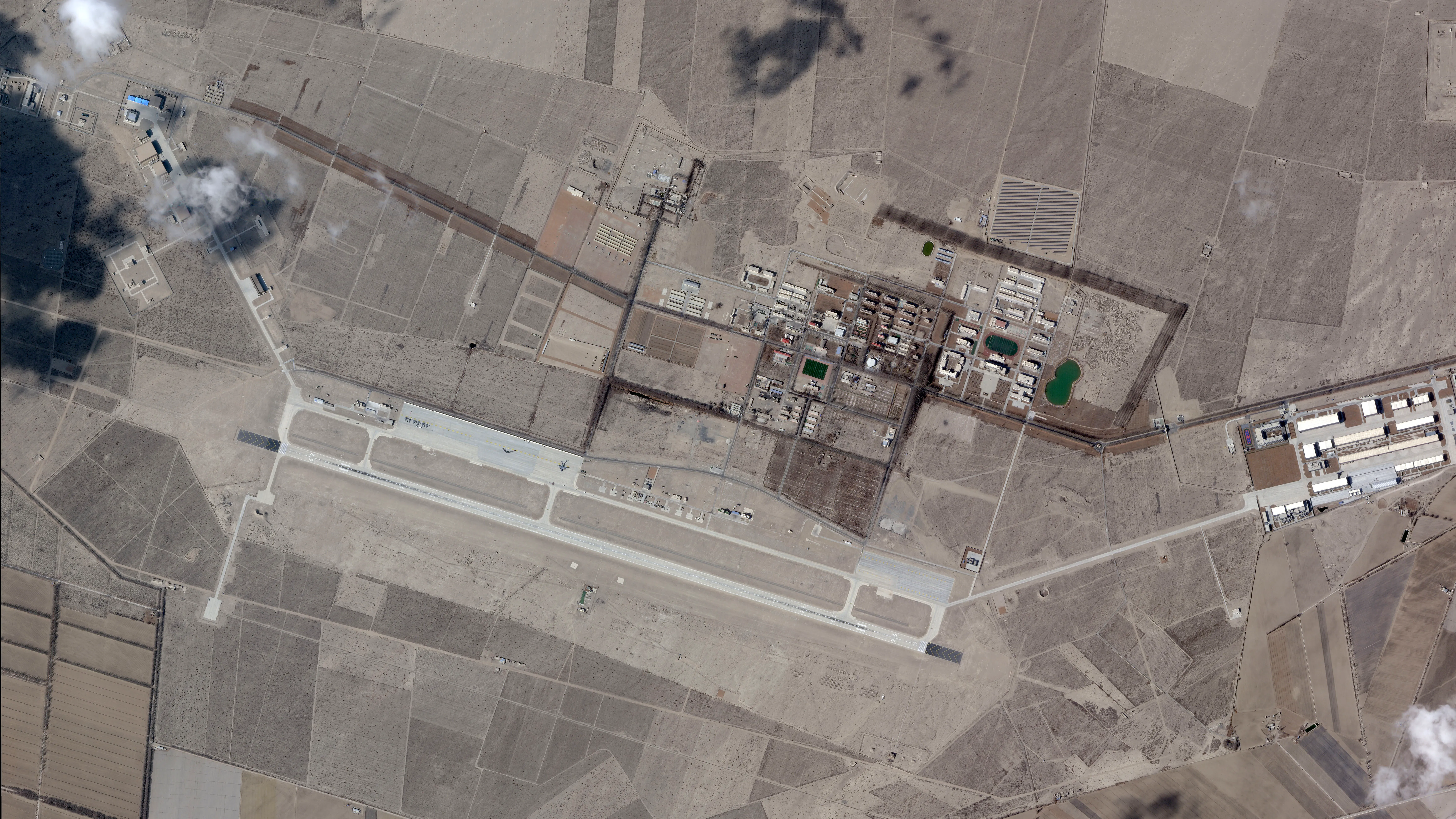
The flying wing with the longest wingspan (red arrow in the image at the top of the article), which some have dubbed “WZ-X,” and what we refer to as “The Monster of Malan,” is parked on the main apron next to the runway. The very large flying wing has a span of approximately 173 feet — roughly the width of a B-2 Spirit stealth bomber. You can read more about this impressive aircraft in our previous coverage here and here. Other details about its true designation or its manufacturer remain unknown.
The second large flying wing (green arrow) is seen in the image sitting outside a hangar that is part of the sprawling new high-security facility on the opposite side of the complex. It features a ‘cranked kite’ planform with a wingspan of approximately 137 feet, although it would appear to have a significantly higher gross weight and likely lower operating ceiling than its wider stablemate. Based on our previous analysis, this variant is suited for the intelligence, surveillance, and reconnaissance (ISR) role, but could also work as a supersized unmanned combat air vehicle (UCAV) capable of performing very long-range heavy strike missions.
China has shown off a very large number of fighter-drone concepts, very loosely similar to the U.S. Collaborative Combat Aircraft initiative, in recent years. A Chinese military parade in 2025 was really Beijing’s major public thrust into this area of advanced fighter-like drone development. Since then, testing of at least one configuration has been ramped up considerably.
Just reviewing Planet Labs archived images of Malan in recent months shows the aircraft configuration seen above to be very active at the base. This relatively large unmanned ‘fighter’, analogous to a manned light-to-medium weight fighter in size, is a tailless design that features a very similar planform as the J-XDS 6th generation manned fighter. It also appears similar in shape to another CCA-like aircraft that has been photographed flying.
One drone shown off during China’s big military parade looks very similar to it, in particular. But regardless, this general design appears to be a focus of testing at the base.
Chinese unmanned drone ‘fighter’ with similar planform seen during the 2025 military parade. (Chinese State Media)
Other mysterious aircraft have appeared at the installation as well, which is clearly set up specifically to run many programs within its high-security confines at any given time.
Beijing is actively pursuing a range of flying-wing drones of various sizes, including large HALE drones, designed to perform a diverse set of missions, including ISR and strike. For many years, TWZ has assessed that this was an area of the Chinese aviation industry most likely to see an explosion of investment. The WZ-X is still the largest Chinese design in terms of wingspan that we have seen in this category to date. The cranked-kite design is certainly the heaviest.
This new look at China’s two large flying wing combat drones comes as we got our first good look at America’s own RQ-180 HALE stealth drone, which has been flying for some time and is now being used operationally. It also comes as China is rushing ahead on all fronts with its next generation air combat ecosystem, and making impressively quick progress to show for its efforts. Still, a formidable looking aircraft doesn’t mean it can fight as impressively as part of a joint force as it looks, or survive against enemy air defenses. Regardless, China is clearly betting substantially on advanced and large unmanned flying wing designs.
Contact the author: ian.ellis-jones@teamrecurrent.io
The popular airline offered reassurance to passengers in a message shared on social media
The popular airline shared a message reassuring passengers(Image: Getty)
Jet2 has offered reassurance to passengers worried about passport control queues at Spanish airports. In recent weeks, British travellers visiting the popular destination have reported long queues following the rollout of the European Union’s new Entry/Exit System.
In response, the airport authority, AENA, has reportedly directed staff to take all possible measures to streamline the process and reduce waiting times. In light of the border control queues, passengers have also been contacting airlines on social media to find out what to do in the worst-case scenario.
For instance, a Jet2 customer recently contacted the travel firm on X to ask for advice. @Jet2tweets often offers assistance to Jet2.com and Jet2holidays passengers on social media.
In a post shared on April 28, a passenger named Laura wrote: “With the crazy queues at Spanish airports to get through passport control, can you guarantee that I won’t miss my transfer bus? Thanks.”
In response, Jet2 said: “Hi Laura, any congestion caused by passport control our airport team will be aware off and will make sure there is a plan in place, so customer do not miss their transfers. Thanks, Gemma.”
Sharing a further message, Laura continued: “Thanks Gemma. Last time it took nearly 3 hours to get through – I’m hoping there won’t be any issues even if it’s that long?” Jet2 replied: “Rest assured our team will be aware of any congestion and plans will be in place.”
Passengers with transfers can find more information about the service on the Jet2holidays website, with transfers to and from hotels included with all Jet2holidays. The website says: “You’ll be met at the airport by our friendly Red Team who’ll then show you to your coach. Once onboard, you’ll be informed whether you are the first, second or third stop.
“Coach transfer information will be available in the Jet2 app when you land in your destination. We’ll also send it by SMS. Whether you have a coach, private or adapted transfer, our friendly Red Team will be on hand to guide you and help you on your way.”
The EU’s Entry/Exit System (EES) requires visitors from non-member countries such as the UK to have their fingerprints recorded and a photograph captured to enter the Schengen Area, which comprises 29 European countries, predominantly within the EU. While the new system was initially introduced in October, it became fully operational on April 10, 2026.
Weekly insights and analysis on the latest developments in military technology, strategy, and foreign policy.
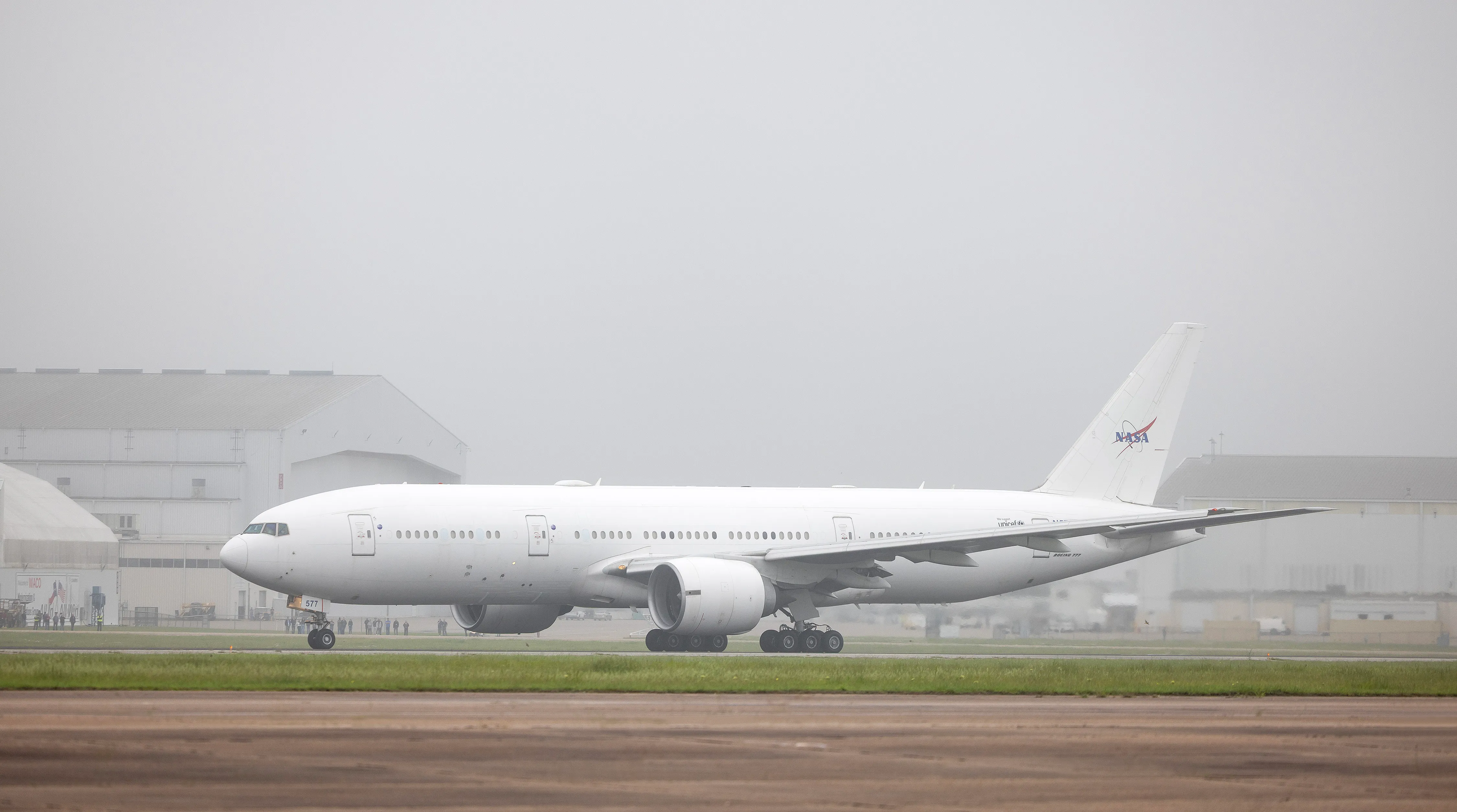
NASA has received its new flying laboratory, the ex-commercial Boeing 777 airliner that had previously undergone modifications for its research mission in Waco, Texas. The research aircraft will become NASA’s largest platform, taking over from the agency’s now-retired Douglas DC-8, an aircraft that you can read about here.
It’s Happening!!
NASA’s New “Flying Laboratory” is on it’s way home to Langley Research Center.
It will now undergo a full interior revamp after having structural mods completed by L3Harris.
The Boeing 777-200ER was previously flown by Japan Airlines. Surprisingly it still has… pic.twitter.com/yHbTq9DBdp
L3Harris told TWZ that the aircraft arrived at NASA’s Langley Research Center in Hampton, Virginia, yesterday, after a check flight and a three-hour transit from Waco. The company says that it “completed extensive structural modifications” and delivered it ahead of schedule. The program was accelerated by using “advanced engineering techniques,” including 3D scanning and specialized installation tooling.
The 777 prepares to depart Waco, Texas, yesterday. L3Harris Brenda Hawkins
The company also confirmed that it partnered with Yulista on the modification work. According to its website, Yulista provides “integrated modernization, sustainment, readiness, and mission support for defense and aerospace customers.”
As we reported in the past, the 777-200ER was manufactured in 2003 and saw commercial service with Japan Airlines as JA704J (as seen in the tweet below) before going into storage in Southern California in 2020.
NASA bought the aircraft in December 2022, at a cost of less than $30 million. It underwent a first series of modifications at the NASA Langley Research Center before arriving at Waco in January 2025.
The 777 flying laboratory at Waco, Texas. NASA
While L3Harris and Yulista handled major structural modifications, research station and wiring upgrades in the cabin are being performed by NASA and HII, better known as America’s largest shipbuilder.
As a flying laboratory, the 777 will be able to accommodate between 50 and 100 onboard operators, compared to the 45 researchers and flight crew that typically flew aboard the 1969-vintage DC-8. The 777 also offers a useful payload of 75,000 pounds, considerably more than the 30,000 pounds of scientific instruments and equipment that the Douglas jetliner could carry. The Boeing jet will conduct missions of up to 18 hours at a maximum altitude of 43,000 feet; DC-8 missions typically lasted between six and 10 hours.
The DC-8 returns to NASA’s Armstrong Flight Research Center in Palmdale, California, on April 1, 2024, after completing its final test mission. NASA Photo bySteve Freeman
While in Waco, the 777 underwent modifications, including the installation of dedicated research stations and extensive wiring. Wiring harnesses running through the fuselage are needed to allow the operators’ workstations to communicate with sensors such as LIDAR and infrared imaging spectrometers during flights.
Temporary fasteners are utilized to map out hole patterns through four layers of reinforcement. Nearly 35,000 precision holes were drilled into the belly of the aircraft. L3Harris
Other changes included enlarged cabin windows and ports installed in the bottom of the fuselage to mount remote-sensing instruments. Meanwhile, the aircraft received new power, data, and communications systems and accommodation for instrument operators.
Widened windows along the 777 will serve as viewports for a variety of scientific instrument sensors. L3HarrisL3Harris installs viewports in the 777 aircraft cargo bay that will house advanced scientific instruments. L3Harris
“Airborne missions at NASA use cutting-edge instruments to explore and understand our home planet,” explained Derek Rutovic, program manager for the Airborne Science Program at NASA Headquarters in Washington, in a press release. “The 777 will be the largest airborne research laboratory in our fleet, collecting data to improve life on our home planet and extend our knowledge of the Earth system as a whole.”
“I’m excited for what the 777 will bring,” added Kirsten Boogaard, the NASA 777 program manager at Langley and former deputy program manager of NASA’s DC-8. “Being part of that team, I got to see the impact up close. It gives us the ability to bring together more partners, more educational opportunities, and more instruments. That will make a real difference in the data we collect moving forward.”
The 777 is expected to fly its first science mission in January 2027. This will be part of the North American Upstream Feature-Resolving and Tropopause Uncertainty Reconnaissance Experiment (NURTURE), and will involve the aircraft studying high-impact winter weather events, including severe cold air outbreaks, wind, snow and ice storms, and hazardous seas. This will be an extensive mission, gathering data in North America, Europe, Greenland, and the Arctic and North Atlantic Oceans.
The NURTURE payload has been installed alongside the general modification work.
The 777 prepares to depart Waco. L3Harris Brenda Hawkins
NASA’s DC-8 mission spectrum was broken down into four main categories: sensor development, satellite sensor verification, telemetry data retrieval, and optical tracking for space vehicle launch and re-entry, and research studies of the Earth’s surface and atmosphere.
According to a press release from L3Harris, the 777 will be used for gathering Earth science data. In response to our question about other mission sets, a NASA spokesperson confirmed that the 777 “will primarily be used for airborne science campaigns, but similar to the DC-8, it will support a variety of other mission requests as the aircraft is available.”
Broadly speaking, Earth sciences missions include using sensors aboard the aircraft to monitor all kinds of activities and phenomena on the surface of the globe, including studying polar ice fields and monitoring wildfires. Among the main tools used for this are remote sensing and gas sampling instruments.
L3Harris Brenda Hawkins
The arrival of the 777 continues the modernization and rationalization of NASA’s test aircraft fleet. This has included the retirement of the DC-8 as well as the Stratospheric Observatory for Infrared Astronomy, or SOFIA, a kind of flying telescope housed in an adapted Boeing 747SP, in 2022.
An F/A-18 mission support aircraft shadows the Stratospheric Observatory for Infrared Astronomy, or SOFIA, 747SP during a functional check flight. NASA Photo by Jim Ross
NASA’s new flying laboratory is now set to serve as a highly capable successor to the DC-8, continuing its legacy of delivering critical data to federal and state agencies, U.S. academic institutions, and scientists worldwide. At the same time, it underscores the ongoing commitment to advancing the tools and expertise needed to tackle some of the most pressing and complex questions in Earth science.
IT’S fair to say that there is a sense of nervousness when it comes to a holiday abroad this year.
What with warnings of summer holiday cancellations and airlines cancelling thousands of flights – it’s no wonder Brits are booking more staycations than ever.
Sign up for the Travel newsletter
Thank you!
Forget flights – you can still explore Europe and the Caribbean thanks to cruises and trainsCredit: Alamy
But there is still a way to have a foreign holiday without hopping on a flight, thanks to a number of cruises, ferries, trains and car tunnels going from the UK.
Brittany Ferries, who operate a number of sailings across the UK, said that maritime fuels are not being affected, and prices won’t be going up either.
Brittany Ferries boss Christophe Mathieu said: “If you have booked with us, or are considering doing so, we will get you to a beautiful and safe holiday destination this year. Period.
“We will play no part in profiteering or seeking to recover losses from a gamble gone wrong, as some appear to be doing.
“The cost of our holidays rose by inflation earlier this year, and by inflation alone. There will be no further rises in the weeks or months ahead.”
So we’ve done the hard work for you and rounded up some of the best places to go from the UK where you can avoid the having to go to the airport entirely.
Seven nights around Spain and Portugal by cruise
You don’t have to hop on a plane to explore Spain and Lisbon.
Royal Caribbean have week-long sailings from Southampton which stop at Bilbao, Lisbon and Vigo, before returning to Southampton.
Prices start from £743pp.
Eurostar train to Lille and Paris
Why not have a two city break with Eurostar, stopping at both of their French cities.
The closest city to the UK by train is Lille, taking less than two hours to get to.
You could then hope on a train the next day to explore Paris, just one stop over.
Prices from £39pp.
You could do Lille and Paris in one weekend via train, thanks to EurostarCredit: Alamy
Eurostar train to Amsterdam and Rotterdam
In a similar vein of Paris and Lille, Eurostar also have direct trains to Amsterdam and Rotterdam.
They take slightly longer – Rotterdam is around 3hr15 while Amsterdam is just over four hours – but can easily make for a long weekend break.
Prices from £39pp.
Eurotunnel to French seaside towns
The Eurotunnel in Folkestone opens up all of Europe as long as you’re happy to travel by car.
Entering via Calais, why not explore some of France‘s best seaside towns such as Boulogne-sur-Mer and picturesque Wimereux?
Prices from £59pp.
Eurostar runs to a number of cities by train such as Amsterdam as wellCredit: AlamyThe Eurotunnel is perfect for exploring the French seaside towns by carCredit: Alamy
35 days around Caribbean by cruise
If you have the time, you could explore the Caribbean for a month without having to get on a flight.
P&O will take you to St Kitts, Barbados, Grenada, St Lucia, Antigua and Barbuda, while sailing from Southampton – it even includes all your food and tips.
Prices from £2,999pp.
Seven nights around Norwegian Fjords by cruise
Also sailing from Southampton, the Celebrity Cruises trip lets you go around some of the beautiful fjords.
Stops include Haugesund, Ålesund, Nordfjordeid and Zeebrugge.