fbi

DOJ recovers millions of dollars in Colonial Pipeline ransom

The Justice Department recovered $2.3 million in cryptocurrency ransom that Colonial Pipeline paid to hackers whose cyberattack last month shut down its major East Coast pipeline, leading to gas shortages up and down the East Coast, authorities said.

Deputy Atty. Gen. Lisa Monaco said the FBI on Monday seized the majority of the ransom that Colonial Pipeline paid to hackers who used malware developed by DarkSide, a Russia-linked hacking group, to encrypt and lock up the company’s computer systems. The company, which Monaco credited with quickly alerting the FBI to the attack, said it paid the hackers $4.4 million in bitcoin to regain access to its systems.

“Today we turned the tables on DarkSide,” Monaco said, calling such ransomware attacks an “epidemic” that poses a “national security and economic threat” to the U.S. “This was an attack against some of our most critical infrastructure.”

Though the malware did not affect systems that operate the company’s pipelines, which stretch from New Jersey to Texas, Colonial discovered the hack on May 7 and closed its spigots for five days out of an abundance of caution. The pipeline supplies about 45% of the jet fuel, gasoline and heating oil consumed on the East Coast, and the shutdown sparked panic from drivers, who raced to top off tanks, leading gas stations to run out of fuel.

The Justice Department did not disclose how much Colonial paid in ransom, but the company’s chief executive told the Wall Street Journal last month that it made a $4.4-million payment in bitcoin. Colonial CEO Joseph Blount said the company paid the extortion demand because he was concerned a prolonged disruption of the pipeline would hurt the nation.

“I know that’s a highly controversial decision,” Blount told the newspaper. “I didn’t make it lightly. I will admit that I wasn’t comfortable seeing money go out the door to people like this.”

Ransomware hackers typically trick unwitting employees into opening an email and clicking on an attachment or a link, which then infects computer servers with malware that encrypts data and locks the systems. Victims must pay a ransom to the hackers to obtain a decryption key to unlock and recover the information. DarkSide’s malware poses a double whammy — it can also siphon out information, giving hackers more leverage because they can threaten to disclose sensitive data if they are not paid.

FBI Deputy Director Paul Abbate said DarkSide produces ransomware that it sells to hackers who conduct cyberattacks and share a percentage of their proceeds with the malware’s developers. DarkSide’s product is one of about 100 ransomware variants the FBI is investigating, Abbate said.

The bureau has been investigating DarkSide since last year, Abbate said, and has identified more than 90 victims of its ransomware in manufacturing, legal, insurance and healthcare industries. Working with other U.S. government agencies, the FBI identified “a virtual currency wallet” that the DarkSide hackers were using to collect payment from a victim, Abbate said.

The Justice Department then obtained a warrant to seize those bitcoins, officials said.

“The old adage ‘follow the money’ still applies,” said Monaco, the deputy attorney general. “That’s exactly what we do.”

The Colonial Pipeline attack was the latest in a series of ransomware assaults that has crippled government agencies, hospitals and businesses, including a major meat producer that was forced last week to idle plants, sparking concerns about potential increases in meat prices and shortages. A task force of more than 60 experts from industry, government and nonprofits issued a report in April that calls ransomware “a flourishing criminal industry that not only risks the personal and financial security of individuals, but also threatens national security and human life.”

The report, published by the nonprofit Institute for Security and Technology, estimates that nearly 2,400 governments, healthcare facilities and schools were victims of ransomware attacks last year. Ransom payments rose to $350 million last year, a 300% increase over 2019, the report says. The average such payment topped $300,000.

Cybersecurity experts and former federal prosecutors and agents blamed several trends for the increase. The rise of difficult-to-trace cryptocurrency has made it far easier for criminal gangs to collect payments, the experts said. Cybercriminals have also begun to increasingly operate within the borders of U.S. adversaries, particularly Russia. The Kremlin, for example, allows hackers to operate with impunity if they do not target Russian businesses or citizens and focus their energy on sowing chaos and confusion in the West.

The Biden administration is seeking to find ways to combat the rise. President Biden said he will discuss ransomware attacks this week with U.S. allies during a European trip, and bring up the subject during a June 16 meeting with Russian President Vladimir Putin. The Justice Department has launched a task force to better coordinate its approach to the crime wave. Justice Department officials said the Colonial Pipeline ransom seizure was the first such payment recovery by the task force. Justice Department officials could not say how many other ransoms they have recovered.

“This is a big deal,” said Scott Jasper, a lecturer at the Naval Postgraduate School and author of “Russian Cyber Operations: Coding the Boundaries of Conflict.” “The question is: Will this be big enough to change the behavior of DarkSide or of other cyber actors? It’s too early to tell. It’s a slow game, a long-term game. This is a significant, big business. This is a big enterprise.”

Source link

FBI: Russia-backed Fancy Bear hackers used Wi-Fi routers to steal data

A Russian hacking group called Fancy Bear used poorly-protected Wi-Fi routers to hack into governments, the FBI said. File Photo by Sascha Steinbach/EPA

April 8 (UPI) — A Russian hacking group financed by the spy agency GRU managed a large-scale campaign to steal information about militaries and governments by hacking into Wi-Fi routers, the FBI said.

The group known as Fancy Bear is behind the hack done to governments around the world. Intelligence and police services in the United States, Canada, Ukraine, Germany, Italy, Poland, Slovenia, Romania and others discovered the operation, which attacked poorly protected Wi-Fi routers, they announced in a joint statement Tuesday.

The hackers took “passwords, authentication tokens and other sensitive information, including emails” Ukraine’s security service, the SBU, said in a statement.

“This way, they acted as ‘intermediaries’ in the online space to collect passwords, authentication tokens and other sensitive information, including emails, which under normal circumstances are protected by SSL [Secure Sockets Layer] and TLS [Transport Layer Security] cryptographic protocols,” SBU said.

The GRU operatives, who have been using this technique since at least 2024, planned to use the information to “carry out cyberattacks, information sabotage and the collection of intelligence,” SBU said.

The FBI said the GRU has “indiscriminately compromised a wide pool of U.S. and global victims and then filtered down impacted users, especially targeting information related to military, government and critical infrastructure.”

Romania, which participated in the investigation, said the GRU operatives “were collecting military, governmental, and critical infrastructure-related information,” Romanian President Nicușor Dan said.

“Russia therefore continues its hybrid war against Western countries — only those acting in bad faith could fail to see this,” Dan said in a post on X.

The FBI also urged “all network defenders and owners of small office/home office (SOHO) routers to update to the latest firmware versions, change default usernames and passwords, disable remote management interfaces from the internet, and stay alert for certificate warnings in web browsers and email clients.”

Source link

Swalwell campaign denies online claims that congressman behaved inappropriately with staffers

A spokesman for Rep. Eric Swalwell, a leading Democratic candidate for California governor, on Tuesday denounced online claims that the congressman had inappropriate relationships with young congressional staff members.

“This false, outrageous rumor is being spread 27 days before an election begins by flailing opponents who have sadly teamed up with MAGA conspiracy theorists because they know Eric Swalwell is the frontrunner in this race,” spokesman Micah Beasley said in a statement that was first reported by Politico.

Allegations that Swalwell (D-Dublin) acted sexually inappropriately with young women have been swirling online for weeks, with the tempo growing in recent days as Democratic strategists, Washington, D.C., insiders and social media influencers posted about the allegations, including that he made these women sign nondisclosure agreements.

“In 13 years, no one in Eric Swalwell’s Congressional office has ever been asked to sign an NDA. Ever,” Beasley said. “In 13 years, not a single ethics complaint by any staff in his office or any other office has ever been lodged. Ever.”

The Times has not independently corroborated reports of inappropriate behavior.

Swalwell, 45, did not respond to requests for comment.

He entered the campaign to replace termed-out Gov. Gavin Newsom in November, and recent opinion polls show he is among the Democratic front-runners. Swalwell had the support of 13.7% of voters in an average of recent polling compiled by Real Clear Politics, behind only Republican Steve Hilton, a conservative commentator who had an average of 14.7%

This is the second controversy Swalwell has faced in recent days.

Late last month, he accused President Trump of trying to sway the governor’s race based on reports that the FBI could release documents related to a decade-old investigation about his association with an alleged Chinese spy.

The investigation centered on Swalwell’s ties to a suspected intelligence operative, Christine Fang, or Fang Fang, who worked as a volunteer raising money for his congressional campaign. Swalwell cut off ties to Fang in 2015 after intelligence officials briefed him and other members of Congress about Chinese efforts to infiltrate the legislative body.

Swalwell was never accused of wrongdoing. In an interview with The Times in November, he said he was cleared by the FBI and a GOP-led House Ethics Committee of any impropriety in his ties to Fang.

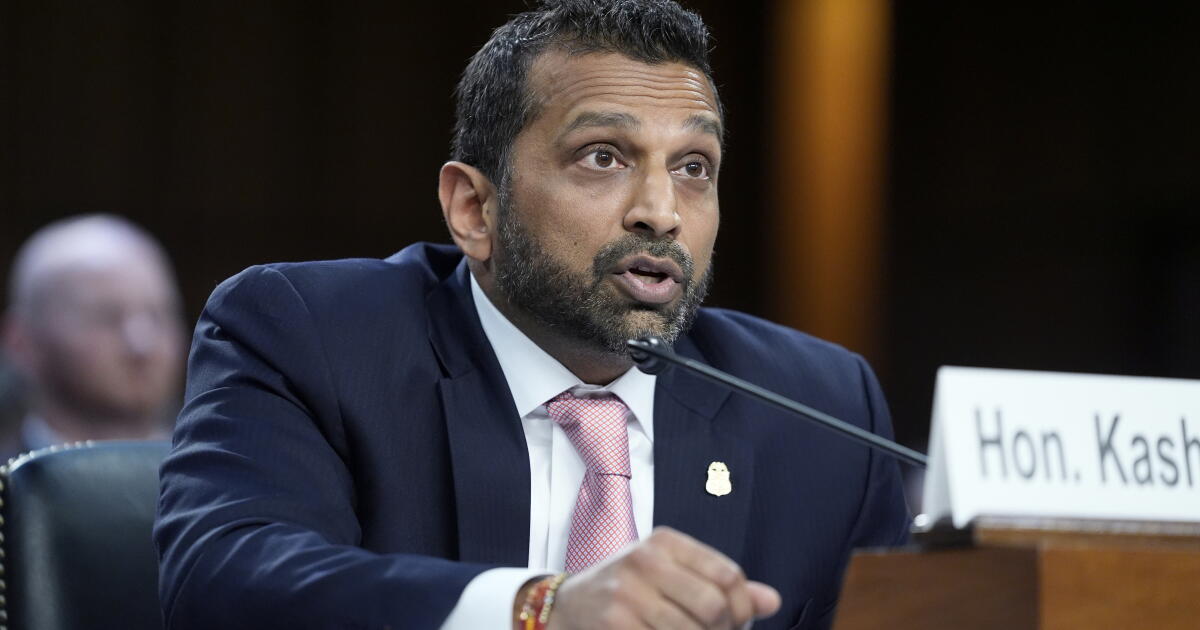
FBI Director Kash Patel directed agents in the bureau’s San Francisco office to redact the case files for public release, according to a report by the Washington Post, a highly unusual move to release case files tied to a investigation that did not result in criminal charges.

Swalwell’s attorneys filed a cease and desist letter with Patel and the FBI. No documents have been released as of Tuesday afternoon.

Times staff writer Melody Gutierrez contributed to this report.

Source link

3 FBI agents fired after investigating Trump file class action suit alleging ‘retribution campaign’

Three fired FBI agents sued on Tuesday to try to get their jobs back, saying in a class-action lawsuit that they were illegally punished for their participation in an investigation into President Trump’s efforts to overturn his 2020 election defeat.

The federal lawsuit adds to the mounting list of court challenges to a personnel purge by FBI Director Kash Patel that over the last year has resulted in the ousters of dozens of agents, either because of their involvement in investigations related to Trump or because they were perceived as insufficiently loyal to the Republican president’s agenda.

The lawsuit in federal court in Washington was technically filed on behalf of just three agents but may have much broader implications given that its request for class-action status could open the door for agents fired since the start of the Trump administration to get their jobs back.

The three agents — Michelle Ball, Jamie Garman and Blaire Toleman — were fired last October and November in what they say was a “retribution campaign” targeting them for their work on the investigation into Trump. The agents had between eight and 14 years of “exemplary and unblemished” service in the FBI and expected to spend the remainder of their careers at the bureau but were abruptly fired without cause and without being given a chance to respond, the lawsuit says.

“Serving the American people as FBI agents was the highest honor of our lives,” they said in a statement. “We took an oath to uphold the Constitution, followed the facts wherever they led and never compromised our integrity. Our removal from federal service — without due process and based on a false perception of political bias — is a profound injustice that raises serious concerns about political interference in federal law enforcement.”

Trump’s indictment

The investigation the agents worked on culminated in a 2023 indictment from special counsel Jack Smith that accused Trump of illegally scheming to undo the results of the presidential election he lost to Democrat Joe Biden in 2020. Smith ultimately abandoned that case, along with a separate one accusing Trump of illegally retaining classified records at his Mar-a-Lago estate in Palm Beach, Fla., after Trump won back the White House in 2024, citing Justice Department legal opinions that prohibit the federal indictments of sitting presidents.

The lawsuit notes that the firings followed the release by Sen. Chuck Grassley, the Republican chair of the Senate Judiciary Committee, of documents about the election investigation — known as Arctic Frost — that he said had come from within the FBI. Those records included files showing that Smith’s team had subpoenaed several days of phone records of some Republican lawmakers, an investigative step that angered Trump allies inside Congress.

The complaint names as defendants Patel and Atty. Gen. Pam Bondi, accusing them of having orchestrated the firings despite being “personally embroiled” either as witnesses or attorneys in some of the legal troubles Trump has faced.

Patel, for instance, was subpoenaed to appear before a federal grand jury investigating Trump’s retention of classified documents at Mar-a-Lago and had his phone records subpoenaed, while Bondi was part of the legal team that represented Trump at his first impeachment trial, which resulted in his acquittal.

“And now, by virtue of presidential appointment to the pinnacle of federal law enforcement, Defendants are abusing their positions to claim victories that eluded them on the merits,” the lawsuit states.

Spokespeople for the FBI and the Justice Department declined to comment on the ongoing litigation. Patel and Bondi have said the fired agents and prosecutors who worked on Smith’s team were responsible for weaponizing federal law enforcement, a claim that was also asserted in their termination letters but that the plaintiffs call defamatory and baseless.

Fired agents call for ‘fundamental constitutional protections’

Dan Eisenberg, a lawyer for the agents, said in a statement that his clients were fired without any investigation, notice of charges or chance to be heard.

“This lawsuit seeks to reaffirm fundamental constitutional protections for FBI employees, ensuring they can perform their duties without fear or favor. We all benefit when law enforcement officers’ only loyalty is to facts and the truth,” said Eisenberg, who is with the firm of Emery Celli Brinckerhoff Abady Ward & Maazel.

The lawsuit asks for the agents to be reinstated to their positions and for a court declaration affirming that their rights had been violated. It also seeks to represent a class of at least 50 agents who have been terminated since Jan. 20, 2025, or will be. Those agents also stand to recover their jobs in the event the case is successful and the requested class-action status is granted.

Others have been fired too

Other fired employees who have sued include agents who were photographed kneeling during a racial justice protest in 2020; an agent trainee who displayed an LGBTQ+ flag at his workspace; and a group of senior officials, including the former acting director of the FBI, who were terminated last summer.

The firings have continued, with Patel last month pushing out a group of agents in the Washington field office who had been involved in investigating Trump’s hoarding of classified documents. Trump has insisted he was entitled to keep the documents when he left the White House and has claimed without evidence that he had declassified them.

Tucker writes for the Associated Press.
Source link

Former FBI agents sue Patel, Bondi for alleged political firings

March 31 (UPI) — Three former FBI agents filed a lawsuit against FBI Director Kash Patel, Attorney General Pam Bondi and their departments Tuesday for firing them, claiming it was for political retribution.

The suit includes a proposed class-action of all FBI employees already fired or potentially fired in the future for political reasons. It was filed in the Federal District Court in Washington, D.C.

Former FBI agents Jamie Garman, Blaire Toleman and Michelle Ball served on a public corruption squad at the FBI that investigated President Donald Trump‘s efforts to overturn the 2020 election. Special counsel Jack Smith eventually took over the investigation code named Arctic Frost. He dropped the charges against Trump after he was elected in 2024.

The three agents were fired last fall.

“Our removal from federal service — without due process and based on a false perception of political bias — is a profound injustice that raises serious concerns about political interference in federal law enforcement,” they said in a statement released by their lawyer, Daniel M. Eisenberg. “We bring this lawsuit to protect the rule of law and to allow our former colleagues to do their jobs without fear of retaliation.”

A federal judge will have to decide if the case can be a class-action suit. The three agents are seeking to include more than 50 FBI employees who have been fired since Trump took office.

Since taking control of the FBI in February 2025, Patel and the other defendants “have summarily terminated members of the proposed class because of their perceived political affiliation, without legitimate investigation, finding of misconduct, pre-termination notice of charges to the employees, an opportunity for the employees to present a defense, and/or any compelling or exigent circumstances,” the suit said.

At the Conservative Political Action Conference in Texas Thursday, Deputy Attorney General Todd Blanche said in a speech that Patel had “cleaned house” at the FBI.

“There isn’t a single man or woman with a gun, federal agent, still in that organization that had anything to do with the prosecution of President Trump,” the lawsuit alleges Blanche said.

President Donald Trump stands with U.S. Secretary of Agriculture Brooke Rollins during an event celebrating farmers on the South Lawn of the White House on Friday. Photo by Aaron Schwartz/UPI | License Photo

Source link

Swalwell accuses Trump of trying to influence California governor’s race with old FBI files

Rep. Eric Swalwell, a leading Democratic candidate for governor of California, has accused President Trump of trying to sway the election following reports that FBI Director Kash Patel may release documents from a decade-old investigation into the congressman’s ties to a suspected Chinese spy.

According to a report by the Washington Post, Patel has directed agents in the bureau’s San Francisco office to redact the case files for public release. According to the outlet, it’s highly unusual for the FBI to release case files tied to a probe that did not result in criminal charges.

The investigation centered on Swalwell’s ties to a suspected intelligence operative, Christine Fang, or Fang Fang, who worked as a volunteer raising money for his congressional campaign. Swalwell cut off ties to Fang in 2015, after intelligence officials briefed him and other members of Congress about Chinese efforts to infiltrate the legislative body.

Swalwell was not accused of impropriety.

The FBI did not immediately respond to a request for comment.

“Through great reporting, we now know the outrageous ends the White House will go to target political opponents,” Swalwell said in a prepared statement Saturday, calling the decade-old story “nonsense.”

“Donald Trump is targeting me. He’s trying to influence the election,” Swalwell said in a post on X. “There is only one reason why: he’s scared.”

Swalwell accused Trump of “desperately trying” to stop him, because he’s now the favored candidate for California governor.

“What Trump wants the most is to have a Western White House. An enabler on the opposite coast,” he said. “A lot of people have bent the knee to this administration. But I will not. And neither will the people of California.”

It’s not the first time Swalwell has accused the administration of targeting Trump’s political opponents.

Last year, Swalwell sued Federal Housing Finance Agency Director Bill Pulte, accusing him of criminally misusing government databases to target Trump’s political opponents. Pulte had accused Swalwell of mortgage fraud and referred him to the Justice Department for a potential federal criminal probe. Swalwell dropped that suit this month.

Swalwell, a former prosecutor who ran for president in 2020, announced his bid for California governor in November. Swalwell said his decision was driven by the serious problems facing California and the threats posed to the state and nation with Trump in the White House.

U.S. Sen. Adam Schiff (D-Calif.), who has endorsed Swalwell for governor, shared the Post story on X Saturday, saying, “This abuse of the FBI is as dangerous as it is unlawful.” Schiff served with Swalwell on the House Intelligence Committee, where they riled Republicans by investigating President Trump during his first term.

Schiff served as the lead manager of Trump’s first impeachment and Swalwell as a manager of Trump’s second impeachment.

“Time and again, the President and his appointees have weaponized the Department of Justice against those who dare stand up to Trump,” Schiff wrote. He added that there was no doubt that Trump and Patel “will stop at nothing to try to tell Californians who their next governor should be.”

The Post story unleashed a flood of critiques from California politicians, including Rep. Jimmy Gomez (D-Los Angeles), who sits on the House Intelligence Committee. On X, Gomez accused Patel of “wasting resources” on a “closed, decade-old case where Swalwell cooperated with the FBI and was found innocent of any wrongdoing.”

“Reopening it now, right as he leads in the polls and ballots are about to drop, is a political hit-job!” Gomez said. “Trump and Kash Patel are weaponizing the FBI against people they deem political enemies.”

Rep. Jamie Raskin of Maryland, the top Democrat on the House Judiciary Committee, released a statement accusing Patel of working at “the behest of the White House” and “wasting the resources of the FBI and perhaps violating the Hatch Act by ordering agents to spend hours preparing a political smear file for a personnel vendetta.”

According to the Associated Press, Fang came into contact with Swalwell’s campaign as he was first running for Congress in 2012. She also participated in fundraising for his 2014 campaign and helped place an intern in his office, the report said. Federal investigators alerted Swalwell to their concerns — and briefed Congress — about Fang in 2015, at which point the California Democrat says he cut off contact with her, the AP reported in 2021.

In 2023, the House Ethics Committee closed a two-year investigation into the allegations of his ties to Fang.

In closing the probe, the ethics committee wrote in a letter to Swalwell that it had “previously reviewed allegations of improper influence by foreign agents and in doing so, cautioned that Members should be conscious of the possibility that foreign governments may attempt to secure improper influence through gifts and other interactions.”

Times staff writer Kevin Rector contributed to this report.

Source link

Georgia’s Fulton County and Trump administration square off in court over seized 2020 ballots

Attorneys for Georgia’s Fulton County and President Trump’s administration squared off in court Friday over the county’s demand that the FBI return seized ballots and other materials from the 2020 election.

Abbe Lowell, an attorney representing Fulton County, noted that the January raid was “unusual” because it involved an old election and allegations that have already been investigated in the years since Trump, a Republican, lost the county and the state to Joe Biden, a Democrat.

Lowell contended that the Trump administration seized the materials because it grew impatient with litigation the Justice Department filed to obtain them last year. “There’s abundant law that the left hand of the department needs to know what the right hand is doing,” Lowell told U.S. District Judge J.P. Boulee.

Michael Weisbuch, representing the federal government, replied that the separate civil litigation wasn’t “relevant in any respect.” He said the administration has already provided Fulton County with digital copies of everything taken and needs to retain physical copies to carry out its own investigation.

Boulee wrote in a scheduling order that the hearing was needed after the two sides failed to reach an agreement in court-ordered mediation.

Trump’s actions alarm Democrats and election officials

The Jan. 28 seizure from a warehouse near Atlanta targeted the elections hub in Georgia’s most populous county, which is heavily Democratic and includes most of Atlanta. Fulton County has been at the center of unfounded claims by Trump and his allies that widespread election fraud cost him reelection.

The FBI’s move was among several actions by the Trump administration that have alarmed Democrats and many election officials who are concerned it’s using law enforcement to pursue the president’s personal grievances and is planning ways to interfere in this year’s midterm elections. The FBI also used a subpoena earlier this month to obtain records related to an audit of the 2020 presidential election in Maricopa County in Arizona, another battleground state Trump lost that year.

At the same time, the Justice Department is fighting numerous states in court for access to voter data that includes sensitive personal information. Election officials, including some Republicans, have said handing over the information would violate state and federal privacy laws.

Justice Department says it’s investigating 2020 ‘irregularities’

Lawyers for Fulton County argued in a court filing that the seizure of its documents was “improper and unjustified” and demonstrates “callous disregard” for the Fourth Amendment protection against unreasonable search and seizure. The Justice Department seeks to “set a precedent that would grant the federal government unchecked power to interfere with the local administration of elections,” it wrote.

Justice Department attorneys argued that preparing a detailed affidavit and presenting it to a judge “is the exact opposite of ‘callous disregard’” for those constitutional rights. “Their goal to disrupt an ongoing federal criminal investigation is clear,” they wrote of Fulton County officials.

The Justice Department said it is investigating “irregularities that occurred during the 2020 presidential election in the County” and identified two laws that might have been violated. One requires election records to be maintained for 22 months, while the other prohibits procuring, casting or tabulating false, fictitious or fraudulent ballots.

The filing said the FBI is looking into whether Fulton County properly retained ballot images; whether some ballots were scanned and counted multiple times; whether unfolded, unmailed ballots were counted as mail-in absentee ballots; and potential irregularities concerning tabulator tapes from the scanners used to count ballots.

Fulton County’s lawyers wrote that the “deficiencies” or “defects” in the county’s handling of the 2020 election cited in the affidavit are the kinds of human errors that commonly occur without any intentional wrongdoing and cannot establish probable cause.

Election tech expert cites problems in the affidavit

To support their claims, Fulton County officials submitted a sworn declaration from Ryan Macias, an election technology and security expert who advised the county during the 2020 election. He said the affidavit contains “a multitude of false or misleading statements and omissions” and offered explanations for the alleged “deficiencies.”

Investigations by the Georgia secretary of state and independent reviews contradict the core allegations of the affidavit, which is “rife with statements from witnesses lacking credibility, with extraordinary and undisclosed biases,” Fulton’s lawyers argued.

Georgia’s votes in the 2020 presidential race were counted three times, including once by hand, and each count affirmed Biden’s win.

Federal government lawyers rejected the idea that the FBI agent who wrote the affidavit “intentionally or recklessly misled” the judge, writing that “the supposed misrepresentations and omissions flagged by Petitioners are illusory and/or immaterial.” They also asserted that a lapse of the statute of limitations on the potential crimes does not negate probable cause.

The Justice Department also noted that a federal magistrate judge reviewed the FBI affidavit and signed off on the search warrant. Fulton County sought to have the FBI agent who wrote the affidavit testify at Friday’s hearing, but the Justice Department objected and the judge sided with the federal government.

Brumback writes for the Associated Press. AP writer Nicholas Riccardi in Denver contributed to this report.

Source link

Justice Department settles lawsuit from Trump ally Michael Flynn for $1.2 million, AP source says

The Justice Department has settled for roughly $1.2 million a lawsuit from Michael Flynn, the former national security advisor to President Trump who pleaded guilty during the Republican’s first term to lying to the FBI about his conversations with a top Russian diplomat and was later pardoned.

Court papers filed Wednesday do not reveal the settlement amount, but a person familiar with the matter, who spoke to the Associated Press on condition of anonymity to disclose nonpublic information, confirmed the total as about $1.2 million.

The settlement resolves a 2023 lawsuit in which Flynn sought at least $50 million and asserted that the criminal case against him amounted to a malicious prosecution. It also represents a stark turnabout in position for a Justice Department that during the Biden administration had pressed a judge to dismiss Flynn’s complaint. Atty. Gen. Pam Bondi, a former personal lawyer for the president, has openly criticized the Russia investigation in which Flynn was charged and the Justice Department in the last year has opened investigations into former officials who participated in that inquiry.

The Justice Department cast the settlement as an “important step in redressing” what it says was a “historic injustice” of the Russia investigation that shadowed Trump for much of his first term.

“This Department of Justice will continue to pursue accountability at all levels for this wrongdoing. Such weaponization of the federal government must never be allowed to happen again,” a spokesperson said.

In a separate statement, Flynn said: “Nothing can fully compensate for the hell that my family and I have endured over these many years — the relentless attacks, the destruction of reputations, the financial ruin, and the profound personal toll inflicted upon us all. No amount of money or formal resolution can erase the pain caused by a prosecution that should never have been brought.”

The settlement is the latest turn in the long-running legal saga involving Flynn, one of six Trump associates charged as part of special counsel Robert Mueller’s investigation into potential ties between Russia and Trump’s 2016 presidential campaign. That investigation found Russia interfered in the election on Trump’s behalf and that the Trump campaign eagerly welcomed the help, but it ultimately found insufficient evidence of a criminal conspiracy.

Flynn, a retired Army lieutenant general who vigorously campaigned at Trump’s side, served for weeks as his first national security advisor before being pushed out of his position. He remained a Trump ally even after agreeing to cooperate with Mueller’s team. He was pardoned in the final weeks of the president’s first term.

Flynn pleaded guilty in December 2017 to lying to the FBI when he said he had not discussed with the Russian envoy, Sergey Kislyak, sanctions that the outgoing Obama administration had just imposed on Russia for election interference. During that conversation, Flynn advised that Russia be “even-keeled” in response to the punitive measures, and assured him “we can have a better conversation” about relations between the countries after Trump became president.

The conversation alarmed the FBI, which at the time was investigating whether the Trump campaign and Russia had coordinated to sway the election. In addition, White House officials were stating publicly that Flynn and Kislyak had not discussed sanctions, which the FBI knew was untrue.

Flynn was ousted from his position in February 2017 after news broke that Obama administration officials had warned the White House that Flynn had indeed discussed sanctions with Kislyak and was vulnerable to blackmail. He pleaded guilty months later to a false statement charge.

But Flynn later sought to withdraw his guilty plea, saying federal prosecutors had acted in “bad faith” and broken their end of the bargain when they sought prison time for him.

The Justice Department in 2020 moved to dismiss the case, asserting that the FBI had no basis to interview Flynn about Kislyak and that any statements he made during the interview were not material to the FBI’s broader counterintelligence probe.

Flynn was pardoned by Trump in November 2020, ending the court case and the legal wrangling.

In his lawsuit, Flynn maintained his innocence and said he was targeted by the “virulently anti-Trump leadership” of the FBI’s Russia investigation. He contended that investigators pursued him despite knowing there was no evidence of a crime and coerced his guilty plea.

“He was falsely branded as a traitor to his country, lost at least tens of millions of dollars of business opportunities and future lifetime earning potential, was maliciously prosecuted and spent substantial monies in his own defense,” says the lawsuit, adding that Flynn will continue to suffer “mental and emotional pain.”

Tucker and Richer write for the Associated Press.

Source link

Former FBI Director Robert Mueller dies

Robert S. Mueller III, the FBI director who transformed the nation’s premier law enforcement agency into a terrorism-fighting force after the Sept. 11, 2001, attacks and later became special counsel in charge of investigating ties between Russia and Donald Trump’s presidential campaign, has died. He was 81.

“With deep sadness, we are sharing the news that Bob passed away” on Friday night, his family said in a statement Saturday. “His family asks that their privacy be respected.”

President Trump, responding on social media, said: “Robert Mueller just died. Good, I’m glad he’s dead.” He added: “He can no longer hurt innocent people!”

At the FBI, Mueller set about almost immediately overhauling the bureau’s mission to meet the law enforcement needs of the 21st century, beginning his 12-year tenure just one week before the Sept. 11 attacks and serving across presidents of both political parties. He was nominated by Republican President George W. Bush.

The cataclysmic event instantaneously switched the bureau’s top priority from solving domestic crime to preventing terrorism, a shift that imposed an almost impossibly difficult standard on Mueller and the rest of the federal government: Preventing 99 out of 100 terrorist plots wasn’t good enough.

Later, he was special counsel in the Justice Department’s investigation into whether Russia’s attempts to help Trump’s 2016 presidential campaign amounted to illegal cooperation to sway the outcome.

Mueller was a patrician Princeton graduate and Vietnam veteran who walked away from a lucrative midcareer job to stay in public service, and his old-school, buttoned-down style made him an anachronism during a social-media-saturated era.

In a statement, former President Obama called Mueller “one of the finest directors in the history of the FBI” who saved “countless lives” after transforming the bureau. “But it was his relentless commitment to the rule of law and his unwavering belief in our bedrock values that made him one of the most respected public servants of our time,” Obama added.

The FBI did not immediately respond to a request seeking comment. The FBI Agents Assn., a nonprofit advocacy group representing current and former agency employees, lauded Mueller for his “commitment to public service and to the FBI’s mission.“

Investigator of a sitting president

The second-longest-serving director in FBI history, behind only J. Edgar Hoover, Mueller held the job until 2013 after agreeing to Obama’s request to stay on beyond his 10-year term.

After several years in private law practice, Mueller was asked by Deputy Atty. Gen. Rod Rosenstein to return to public service as special counsel in the Trump-Russia inquiry.

Mueller’s stern visage and taciturn demeanor matched the seriousness of the mission, as his team spent nearly two years quietly conducting one of the most consequential, and divisive, investigations in Justice Department history. He held no news conferences and made no public appearances during the investigation, remaining quiet despite attacks from Trump and his supporters and creating an aura of mystery around his work.

All told, Mueller brought criminal charges against six of the president’s associates, including his campaign chairman and first national security advisor.

His 448-page report released in April 2019 identified substantial contacts between the Trump campaign and Russia but did not allege a criminal conspiracy. He laid out damaging details about Trump’s efforts to seize control of the investigation, and even shut it down, though he declined to decide whether Trump had broken the law, in part because of Justice Department policy barring the indictment of a sitting president.

In perhaps the most memorable language of the report, Mueller pointedly noted: “If we had confidence after a thorough investigation of the facts that the president clearly did not commit obstruction of justice, we would so state. Based on the facts and the applicable legal standards, we are unable to reach that judgment.”

The nebulous conclusion did not deliver the knockout punch to the administration that some Trump opponents had hoped for, nor did it trigger a sustained push by House Democrats to impeach the president — though he was later tried and acquitted on impeachment charges related to pressuring Ukraine for campaign dirt on Joe Biden and Trump’s role in the Jan. 6 riot and insurrection.

The outcome of the Mueller investigation also left room for Atty. Gen. William Barr to insert his own views. He and his team made their own determination that Trump did not obstruct justice, and he and Mueller privately tangled over a four-page summary letter from Barr that Mueller argued did not adequately capture his report’s damaging conclusion.

Mueller deflated Democrats during a highly anticipated congressional hearing on his report when he offered terse, one-word answers and appeared hesitant at times in his testimony. Frequently, he seemed to waver on details of his investigation. It was hardly the commanding performance many had expected from Mueller, who had a towering reputation in Washington.

Over the next months, Barr made clear his own disagreements with the foundations of the Russia investigation, moving to dismiss a false-statements prosecution that Mueller had brought against former national security advisor Michael Flynn, even though that investigation ended in a guilty plea.

Mueller’s tenure as special counsel was the capstone of a career spent in government.

A transformation at the FBI

His time as FBI director was defined by the Sept. 11 attacks and their aftermath, as the agency — granted broad new surveillance and national security powers — scrambled to confront an ascendant Al Qaeda, interrupt plots and take terrorists off the street before they could act.

It was a new model of policing for an FBI that had long been accustomed to investigating crimes that had already occurred.

When he became FBI director, “I had expected to focus on areas familiar to me as a prosecutor: drug cases, white-collar criminal cases and violent crime,” Mueller told a group of lawyers in October 2012.

Instead, “we had to focus on long-term, strategic change. We had to enhance our intelligence capabilities and upgrade our technology. We had to build upon strong partnerships and forge new friendships, both here at home and abroad.”

In response, the FBI shifted 2,000 of the total 5,000 agents in the bureau’s criminal programs to national security.

In hindsight, the transformation was a success. At the time, there were problems, and Mueller said as much. In a speech near the end of his tenure, he recalled “those days when we were under attack by the media and being clobbered by Congress; when the attorney general was not at all happy with me.”

Among the issues: The Justice Department’s inspector general found that the FBI circumvented the law to obtain thousands of phone call records for terrorism investigations.

Mueller decided that the FBI would not take part in abusive interrogation techniques of suspected terrorists, but the policy was not effectively communicated down the line for nearly two years.

In an effort to move the FBI into a paperless environment, the bureau spent more than $600 million on two computer systems — one that was 2½ years overdue and a predecessor that was only partly completed and had to be scrapped after consultants declared it obsolete and riddled with problems.

For the nation’s top law enforcement agency, it was a rocky trip through rough terrain.

But there were many successes as well, including thwarted terrorism plots and headline-making criminal cases like the one against corporate fraudster Bernie Madoff. The Republican also cultivated an apolitical reputation on the job, nearly quitting in a clash with the Bush administration over a surveillance program that he and his successor, James B. Comey, considered unlawful.

He famously stood alongside Comey, then deputy attorney general, during a dramatic 2004 hospital standoff over federal wiretapping rules. The two men planted themselves at the bedside of the ailing Atty. Gen. John Ashcroft to block Bush administration officials from making an end run to get Ashcroft’s permission to reauthorize a secret no-warrant wiretapping program.

In an extraordinary vote of confidence, Congress, at the Obama administration’s request, approved a two-year extension for Mueller to remain at his post beyond its 10-year term.

A Marine who served in Vietnam

Mueller was born in New York City and grew up in a well-to-do suburb of Philadelphia.

He received a bachelor’s degree from Princeton University and a master’s degree in international relations from New York University. He then joined the Marines, serving three years as an officer during the Vietnam War. He led a rifle platoon and was awarded a Bronze Star, Purple Heart and two Navy Commendation Medals. After his military service, Mueller earned a law degree from the University of Virginia.

Mueller became a federal prosecutor and relished the work of handling criminal cases. He rose quickly through the ranks in U.S. attorneys’ offices in San Francisco and Boston from 1976 to 1988. Later, as head of the Justice Department’s criminal division in Washington, he oversaw a range of high-profile prosecutions that chalked up victories against targets as varied as Panamanian dictator Manuel Noriega and New York crime boss John Gotti.

In a midcareer switch that shocked colleagues, Mueller left a job at a prestigious Boston law firm to join the homicide division of the U.S. attorney’s office in the nation’s capital. There, he immersed himself as a senior litigator in a bulging caseload of unsolved drug-related homicides in a city rife with violence.

Mueller was driven by a career-long passion for the painstaking work of building successful criminal cases. Even as head of the FBI, he would dig into the details of investigations, some of them major cases but others less so, sometimes surprising agents who suddenly found themselves on the phone with the director.

“The management books will tell you that as the head of an organization, you should focus on the vision,” Mueller once said. But “for me there were and are today those areas where one needs to be substantially personally involved,” especially in regard to “the terrorist threat and the need to know and understand that threat to its roots.”

Two terrorist attacks occurred toward the end of Mueller’s watch: the Boston Marathon bombing and the Ft. Hood shootings in Texas. Both weighed heavily on him, he acknowledged in an interview two weeks before his departure.

“You sit down with victims’ families, you see the pain they go through, and you always wonder whether there isn’t something more” that could have been done, he said.

Tucker writes for the Associated Press. AP writer Nicolas Riccardi in Denver contributed to this report.

Source link

Former FBI chief, Robert Mueller, dead at 81 | Politics News

Former FBI chief Robert Mueller, who probed the alleged Russian interference in the 2016 United States election, has died at age 81.

“With deep sadness, we are sharing the news that Bob passed away” on Friday night, his family said in a statement Saturday.

“His family asks that their privacy be respected.”

Mueller was appointed as director of the FBI by then-President George Bush in September 2001, a week before the 9/11 attacks that would push him into the centre of a national crisis.

He became the key figure behind changing the FBI from combating crime to now countering national security risks following the attack on New York’s World Trade Centre.

In 2013, Mueller stepped down from the bureau and later by 2017 was appointed as special counsel to oversee the Justice Department’s probe into possible Russian interference in the election, which saw Donald Trump secure his first term over Democratic nominee, Hilary Clinton.

Following the announcement of his death, Trump took to his Truth Social platform to write: “Robert Mueller just died. Good, I’m glad he’s dead. He can no longer hurt innocent people!”

Mueller is survived by his wife and two children.

Source link

FBI shuts down Iran-linked hacker group’s websites

March 19 (UPI) — The Federal Bureau of Investigation took down two websites that belong to an Iran-linked hacker group after it staged a global cyberattack on an American medical equipment company last week.

Two websites used by the group Handala — one that contained information about its hacks and the other used to dox people it alleges work with the Israeli military and related companies — were pulled down by the FBI on Thursday, NBC News and Techcrunch reported.

Handala was behind a “wiper attack” on the medical device maker Stryker’s computer system on March 11, which it said was in retaliation for a deadly strike on the Shajareh Tayyiba girls school in Minab, Iran.

“Law enforcement authorities determined this domain was used to conduct, facilitate, or support malicious cyber activities on behalf of, or in coordination with, a foreign state actor,” a message left on both websites by the FBI said.

Portage, Mich.-based Stryker, which employs 50,000 people worldwide and manufactures a variety of medical devices, including orthopedic implants, surgical instruments and imaging systems, was forced to shut down for the day because of the global attack.

The attack affected the company’s internal Microsoft corporate environment and was not a ransomware attack, it said four days after the attack, after determining that no malware had been installed and the system was able to be restored.

Handala, which has been active since Oct. 7, 2023, is believed to be linked to Iran’s Ministry of Intelligence and Security, American and Israeli cyber security experts have said.

The group is thought to have attacked Stryker because it was awarded a $450 million contract by the Department of Defense last year, and said at the time that the attack specifically was in response to the U.S. bombing of the school.

Handala acknowledged on Telegram that its websites were no longer under its control, and said that the “aggressive action reveals the extent to which the enemies of truth will go to silence voices that unveil their atrocities.”

“To all truth-seekers and defenders of justice, we inform you that the Handala RedWanted website, which was dedicated to exposing Zionist crimes and raising global awareness, has also been seized and taken offline by order of the FBI,” Handala said, noting that a new website is under construction.

In the wake of the attack, experts have told UPI it should be a wake-up call for a wide swatch of U.S. companies that may have similar gaps in security, especially because rather than demanding ransom, the purpose of this attack was to destroy information and wreak havoc.

Iranians attend a funeral for a person killed in recent U.S.-Israel airstrikes at Behesht-e Zahra cemetery on the southern outskirts of Tehran in Iran on March 9, 2026. Photo by Hossein Esmaeili/UPI | License Photo

Source link

Reports: FBI investigates Joe Kent as White House attacks his credibilty

March 19 (UPI) — The FBI is investigating Joe Kent, who resigned this week as the counterterrorism director in protest over the war with Iran, over allegations that he leaked classified information, according to reports, while Trump administration officials attack his credibility.

Kent resigned Tuesday as director of the National Counterterrorism Center, a position to which the MAGA supporter and far-right conspiracy theorist with ties to White nationalist groups was nominated in early 2025 by President Donald Trump, stating that “Iran posed no imminent threat to our nation.”

“I cannot in good conscience support the ongoing war in Iran,” he said.

The FBI investigation into Kent predates his resignation, unidentified sources told Semafor, the first to report on the development. The New York Times, NewsNation and others have since corroborated that story.

Kent is the first senior Trump administration official to resign over the war that has divided Republicans and supporters of the president, who campaigned on ending conflicts while warning Americans that if the Democrats were to return to the White House, the United States would be lured into a war with Iran.

Little information about the allegations against Kent was known. The revelations of the investigation come as the White House was attempting to undermine and dismiss the man Trump had repeatedly called “a Great American Hero” for his service as a soldier, Green Beret and CIA officer.

In his resignation letter, Kent argued that Trump was pulled into the war by Israel, claiming the Middle Eastern country had deployed a disinformation campaign to convince Americans that Iran posed an imminent threat to the United States.

Trump told reporters on Tuesday that he thought of Kent as a “nice guy” who was “very weak on security.”

“I didn’t know him well, but I thought he seemed like a pretty nice guy. But when I read his statement I realized that it’s a good thing that he’s out because he said that Iran was not a threat. Iran was a threat.”

White House press secretary Karoline Leavitt refuted the allegation as “insulting and laughable.” Speaking to reporters Wednesday, she attempted to distance Trump from Kent, saying he has not been involved with the president’s intelligence briefings for several months and has not been seen at the White House “for quite some time.”

“The president feels it is deeply disappointing that after the president gave him an opportunity in this administration to serve the American people that he would resign with a letter filled with falsehoods — accusing the president of the United States of being controlled by a foreign country.”

The war began late last month after the United States and Israel attacked Iran. Secretary of State Marco Rubio has said that the U.S. attack on Iran was preemptive. He said they knew Israel was going to attack Iran, which would result in Iran attacking U.S. bases and allies in the region.

The U.S. attack was intended to preempt an Iranian response, he said.

Source link

Column: Trump’s recklessness endangers the nation

President Trump was uncommonly lucky in his first term, neither inheriting nor provoking a crisis of the sort that tests U.S. presidents, until COVID struck in his final 10 months. (He failed that test, contributing to his 2020 reelection defeat.) Trump 1.0 was bequeathed a growing economy from President Obama, and the incoming president assembled a roster of capable advisors who often acted to prevent him from doing nutty things at home and abroad.

Trump 2.0 made sure that no such human guardrails populated his second Cabinet, only genuflecting enablers. Unrestrained, he has presided over one crisis on top of another, all of his own making. Tariff mayhem and high prices. Armed agents and troops in American cities. Repeated violations of court orders. Demolition at federal agencies and the White House.

And now Trump has taken the nation to war against Iran in league with Israel’s Benjamin Netanyahu. Depending on the moment and the audience, a contradictory Trump is either claiming the war is “very complete” or that much remains to be done to “decimate” Iran. On Wednesday he blithely told Axios, “Any time I want it to end, it will end,” even as U.S. officials planned further actions.

In any case, Trump’s war of choice and the killing of the supreme leader of Iran’s terroristic theocracy now has spawned another potential crisis, counterterrorism experts warn: the risks of retaliatory terrorist threats at home. And that is a threat, whether from homegrown extremists or sleeper cells of the sort that came alive for 9/11, that is likely greater because of the initial self-induced crisis of Trump’s second term: his whacking of the federal government.

Trump authorized Elon Musk’s destruction of the bureaucracy in the name of “government efficiency” and continues to exact retribution against any federal employee who had anything to do with investigating and prosecuting him during his interregnum. Longtime agents and operatives have been eliminated at the FBI, Justice Department, Department of Homeland Security, CIA and elsewhere. Especially at the FBI, counterterrorism experts with centuries of collective experience are gone and many who remain have been diverted to Trump’s top priority: mass deportations.

Consequently, the president who promised to “Make America Safe Again” has arguably made Americans less safe.

I raised this scary prospect just over a year ago as Trump’s teardown of the purported Deep State was underway. And now a Mideast war that Trump promised never to start has further incentivized Iran and its jihadi proxies to hit back, just as he’s diminished the nation’s early-warning systems.

Enough intelligence remains, however, that even in the days before Trump ordered the first strikes against Tehran, government analysts were picking up “worrisome signs” of Iranian plotting against U.S. targets, the New York Times reported. After the U.S.-Israel onslaught and death of Ayatollah Ali Khamenei on Feb. 28, the government intercepted a possible Iranian “operational trigger” to “sleeper assets” outside Iran, according to ABC News.

Counterterrorism expert Colin P. Clarke, executive director of the Soufan Center, which focuses on global security and transnational terrorism, wrote this week in the Atlantic that U.S. agencies’ record of disrupting Iranian-backed plots in America was in jeopardy given the recent changes in funding, personnel and priorities. “Because of this,” he concluded, “the U.S. homeland is arguably more vulnerable than it has been in a long time.”

In a follow-up exchange of emails, Clarke told me, “Many of this administration’s moves have been myopic — shifting counterterrorism resources to immigration, firing FBI agents working counterintelligence, etc. A week before the U.S. went to war with Iran, the FBI Director Kash Patel was off gallivanting in Milan at the Olympics [where he struggled to chug a Michelob Ultra, a firing offense in its own right] when he should have been preparing for the potential for an Iranian response on U.S. soil.”

Patel’s preposterous partying with the U.S. men’s hockey team while war-planning was underway in Washington was widely, justifiably mocked. But it stands as a metaphor for the entire Trump administration’s cavalier attitude toward homeland security. Its abusive focus on both migrants and citizens protesting on the migrants’ behalf is a distraction from actual threats to the country.

Patel, like his boss at the Justice Department, Atty. Gen. Pam Bondi, has made plain in words and actions that the president’s political enemies are the real public enemies No. 1. One of Bondi’s first acts was creation of a “weaponization working group” to identify, fire or prosecute those in her department who’d investigated and prosecuted Trump, many of whom also had experience in domestic and transnational terrorism. The association representing FBI agents called her purges “dangerous distractions” from the work “to make America safe again.”

Days after starting the Iran war, when homeland security should have been on red alert, Trump fired his secretary of Homeland Security, Kristi Noem. Her costly cosplaying as the homeland’s heroine on horseback in anti-migrant videos, along with her penchant for luxury jets allegedly to transport deportees, was too much even for him.

Yet all three “national security” officials — Noem, Bondi and Patel — simply reflect Trump’s own warped approach and blasé attitude toward the homefront.

When Time magazine last week asked the commander in chief whether Americans should be worried about potential terrorist strikes at home, he replied, “I guess.”

“We plan for it,” he added. “But yeah, you know, we expect some things. Like I said, some people will die. When you go to war, some people will die.”

The administration is planning for it all right. An extraordinary number of senior Trump officials have taken up residence in houses on military bases, including Bondi, Noem, the secretaries of State and Defense, Marco Rubio and Pete Hegseth, and White House consigliere Stephen Miller.

The rest of us just have to keep our fingers crossed. I guess.

Bluesky: @jackiecalmes
Threads: @jkcalmes
X: @jackiekcalmes

Source link

Attorneys for LA superintendent deny wrongdoing after FBI raid

Los Angeles Unified School District Superintendent Alberto Carvalho interacts with students in a classroom at Marlton School, a public special school for the deaf and hard of hearing students in Los Angeles. File Photo by Etienne Laurent/EPA-EFE

March 11 (UPI) — A superintendent in Los Angeles whose home and office was raided by the FBI last month released a statement Wednesday denying any wrongdoing.

Attorneys for Alberto Carvalho, the superintendent who is on administrative leave following the raid, said in the statement that they hope he is reinstated promptly. Carvalho is the superintendent of the Los Angeles Unified School District

“Mr. Carvalho remains confident that the evidence will ultimately demonstrate that he acted appropriately and in the best interests of students,” the law firm Holland & Knight said in a statement. “Mr. Carvalho respects the rule of law and the investigative process and has always acted in the best interest of students and within the bounds of the law.”

The attorneys and FBI have not clarified why Carvalho’s home and office were raided or what sparked the investigation into the superintendent.

“While the government’s investigation remains ongoing, no evidence has been presented by prosecutors supporting any allegation that Mr. Carvalho violated federal law,” the statement said.

The Los Angeles Unified School District is scheduled to hold its first regular school board meeting since the raid on Tuesday. It will be a closed session meeting. The agenda for Tuesday’s meeting includes a discussion about labor agreements.

Former teacher, principal and superintendent Andres E. Chait is serving as acting superintendent.

Source link