Nigerian troops say they have rescued 360 people abducted during a deadly terrorist attack on Ngoshe, a resettled community in Gwoza Local Government Area of Borno State, northeastern Nigeria, more than three months after terrorists overran the town, killing residents and forcing thousands to flee.
Solomon Ali Talake, a primary school teacher and survivor of the March 3 attack, said community members had received information about the rescue.
“I was told they have been rescued,” Solomon told HumAngle on Sunday. “Families have been informed, but they have not allowed us to see them yet. They said they are assessing them and will release them to their families afterwards.”
The March 3 attack on Ngoshe was one of the deadliest assaults on a resettled community in southern Borno in recent months. Residents said the attackers first struck a military formation in the town before moving into the community. Homes were set ablaze, civilians were killed, and hundreds of residents were reportedly abducted.
Solomon survived by hiding in a tree throughout the night while the attack unfolded beneath him. From his hiding place, he watched as gunmen moved through the community, burning houses and pursuing fleeing residents.
The attack displaced thousands of people, many of whom fled to Pulka, a neighbouring community about 12 kilometres away. Others sought refuge in Maiduguri, Cameroon, and other locations. The exact number of people killed or abducted remains disputed. While some media reports estimated that about 100 people were killed and more than 300 abducted, residents told HumAngle that the scale of the attack made precise figures difficult to establish. Victims were later buried in a mass grave, according to survivors.
Among those abducted were two of Solomon’s nephews, aged 14 and 11. On Sunday, he said he had not yet been able to confirm whether they were among those rescued.
Asabe Ali Talake, Solomon’s sister and the children’s mother, also said she had received reports of the rescue but remained uncertain about the fate of her children.
Asabe said she was still waiting for confirmation from authorities. Relatives of the freed victims say communication with them remains restricted while security agencies conduct assessments.
Military authorities typically screen and profile people freed from insurgent-controlled territories before reuniting them with their families. The process is intended to establish identities, assess physical and psychological conditions, and determine whether further investigation or rehabilitation may be required.
This comes amid a broader wave of insecurity affecting communities across Borno State. In recent months, terrorists have launched repeated attacks on military formations, reconstruction projects, and resettled communities, raising concerns about the sustainability of government resettlement efforts in conflict-affected areas.
Part of a broader rescue effort
A politician from Gwoza, who spoke to HumAngle on the condition of anonymity because he was not authorised to discuss the matter publicly and who was involved in advocacy efforts for the victims’ release, claimed a ransom was demanded for the release of the victims. HumAngle could not independently verify the claim, and the military has not publicly indicated that any negotiations took place.
This development is the latest in a series of operations by troops of Operation Hadin Kai targeting terrorist enclaves in the Mandara Mountains and surrounding areas.
Three days earlier, troops rescued a woman and her infant child after killing several terrorists. On May 1, troops rescued six abductees during an operation around the Mandara Mountains. Six more victims were rescued on May 14. In April, 12 victims, including men, women, and children, escaped during a military operation targeting a terrorist camp.
The latest operation, however, represents the largest reported release linked to the March 3 attack on Ngoshe, offering renewed hope to families who have spent months waiting for news of their relatives.
While military authorities described the operation as a rescue, questions remain about how the victims regained their freedom.
Nigerian troops have rescued 360 people abducted during a terrorist attack on the resettled community of Ngoshe in Gwoza, Borno State, over three months after the attack.
The March 3 assault was one of the deadliest, with homes destroyed, civilians killed, and hundreds taken hostage, displacing thousands to nearby areas.
Survivors like Solomon Ali Talake reported receiving news of the rescue, though they have yet to reunite with the freed individuals, including his nephews. Authorities are evaluating the rescued individuals before reuniting them with their families to ensure proper identification and assess any need for rehabilitation.
The rescue is part of broader operations by Operation Hadin Kai aimed at dismantling terrorist strongholds in the region.
Get our in-depth, creative coverage of conflict and development delivered to you every weekend.
Subscribe now to our newsletter!
A local politician suggested a ransom was involved, though this remains unverified. This largest reported rescue related to the Ngoshe attack provides hope to families anxiously awaiting news of their loved ones.
Finland has been named the world’s happiest country for nine years running, but arriving in Helsinki, dishevelled from one of my first flights with my nine-month-old baby, I was less interested in national rankings and more in having a nice nap. My husband, Jake, and I had emerged from the fog of newborn life and the idea of a holiday felt possible again. My ambitions were small: a sunset beer, a walk in the woods, reading a few pages of my book uninterrupted.
But Finland, with its famously family-friendly culture, made exploring with my tiny new travel companion a delight. Finnish parents are supported with generous, gender-equal parental leave, affordable childcare, and free healthcare and education. No one bats an eyelid at a pram parked beside a restaurant table or a baby snoozing outdoors in the cool air, and the terrifyingly efficient public transport system is a dream with children.
In Helsinki, we found ourselves in the cool neighbourhood of Kallio, where locals spilled out on to terraces in the late evening sunshine. We stayed at Hobo Hotel, which, despite attracting a hip crowd, was kitted out with travel cots and highchairs. At a bar aptly named Holiday, my daughter, Sylvie, sat happily chewing a spoon while we drank paloma cocktails in the long golden evening light of July, when the sun barely seems to set at all.
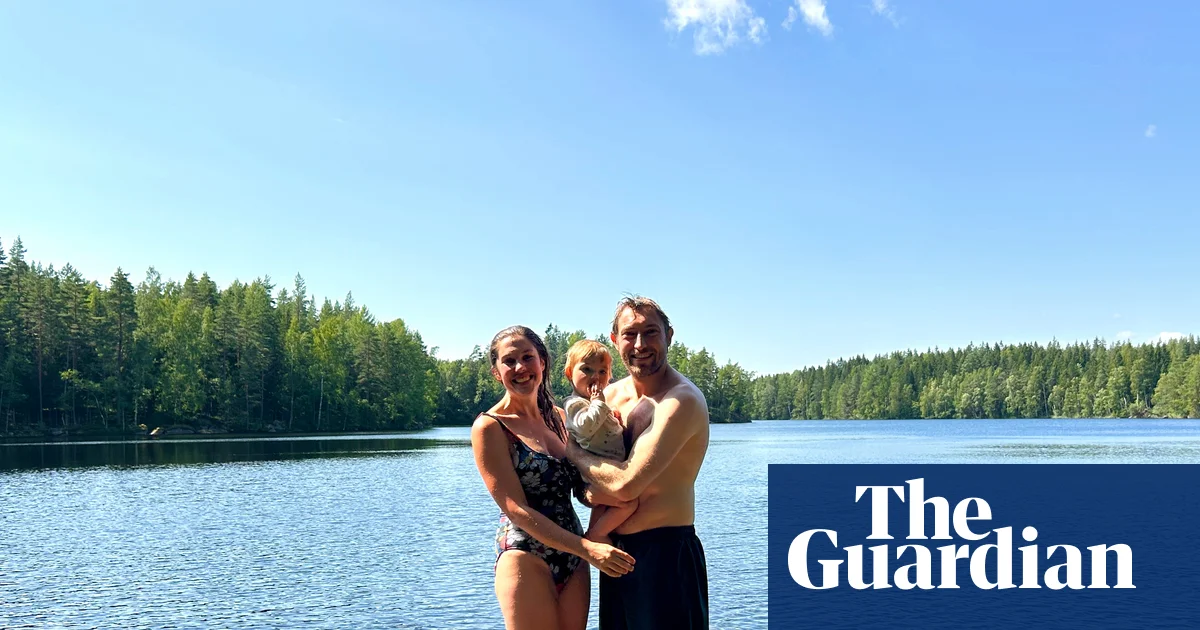
Part of Finland’s appeal for me lies in jokaisenoikeudet, or “Everyman’s Right” – the law that gives everyone freedom to roam the country’s forests and lakes. On the southern coast, we hiked through pine forest and over moss-clad rocks towards Lake Kukuljärvi, with Sylvie snoozing, strapped to my front. At a traditional laavu – a simple wooden shelter with a communal fire pit – Jake and I cooked sausages and boiled coffee over open flames. Sylvie eventually deigned to wake from her nap and gnawed on flakes of pink salmon like a tiny woodland creature. Then I handed her to Jake and jumped from the rickety jetty into the lake for a swim.
The off-grid cabin at Majamaja. Photograph: Sian Lewis
In summer, Finns are all about escaping to remote cabins. At Santalahti in Kotka, simple self-catering wooden cottages were just steps from the sea, but my favourite tiny houses were Majamaja, four minute off-grid cabins perched on rocks on the Baltic Sea. A stay here felt truly wild, yet we were a 10-minute drive from Helsinki if we ran out of nappies.
On our last day, we boarded a little ferry which chugged the 15 minutes from Helsinki to Lonna island, a tiny military outpost turned summer escape. Now uninhabited and carpeted in wildflowers, it has a wood-fired sauna overlooking the sea. Inside, women of all ages sat side by side as steam curled from the stove. Finnish children grow up going to saunas from infancy, and two locals showed me how to plonk Sylvie into a bucket of cool water, where she spent the entire time grinning with her four newly minted teeth at the sauna-goers smiling back at her. “She’s Finnish now!” one woman laughed. Sian Lewis
‘I struck gold with the Vespa tour’: Naples with my teenage son
Jill Mead’s son, Ned, on a Vespa with guide Michele in Naples. Photograph: Jill Mead
On a wing and a prayer, I took my 13-year-old son, Ned, to Naples. Just the two of us. He was old enough to carry his bags, young enough to bunk in the same bed and keep the cost down. I’d booked a small apartment in the centro storico with decent wifi in case single parenting got the better of me and we simply needed to play Fifa.
My worry didn’t last long. I struck gold by booking a Vespa tourwith Michele and Luigi at NeaTour, who took our brief – “Show us where you wouldn’t normally go” – as a personal challenge. We wove through the city under balconies dripping with washing, past giant graffiti and smelly fish stalls, and shared fruit with elderly women sitting outside on old chairs. We stopped at Bar Niloto pay homage to Maradona and check out a lock of his hair, then scootered on to a towering mural of the icon himself.
Michele handed Ned a cornicello,a small red charm to ward off bad luck. Legend has it they only work when given as gifts, and we bought into it immediately, wandering off into the Quartieri Spagnoli (Spanish quarter) despite all the warnings of theft and danger. Doors were open everywhere. It was tempting to peep in. One family were inside finishing lunch. Without ceremony, they invited us in. Wine appeared. A Pepsi for Ned. Three generations shifting to make space for strangers who weren’t strangers any more.
Naples worked like that. You needed to give in quickly. We took the smallest alleyways, watched football with the locals, stayed out until the early hours. Not because of the place itself, but because of the interruptions: conversations, offers, eye contact that turned into something wonderful.
Of course, it wasn’t all a success story, despite the cornicello. It was a terrible idea to climb Vesuvius in the midday heat. Blisters, lack of water, wishing we wore hats. Then, on the same day, Pompeii. Crowds, dust, exhaustion and the surreal shock of carved penises everywhere.
Jill and Ned above Naples. Photograph: Jill Mead
Capri proved the antithesis. Beautiful and polished. Botox clashing with bougainvillea. We neither wanted nor could afford the restaurants or designer shops, but lovely assistants indulged us as wetried on sunglasses and handbags costing more than my monthly salary.
Sixteen years earlier, I’d photographed boats arranged like petals outside the Blue Grotto, and wanted to see if we could make it happen again. What I never expected was the same boatmen agreeing to recreate it, carefully positioning themselves into a floating flower.
Trusting local knowledge, we left everything on the old iron stairs leading into the water and swam through the tiny cave entrance. The azure blue was so dense, like liquid moonlight lit from within. After diving and GoPro posing, we swam to the back and sat watching the regulars in their cave cathedral.
As we climbed back up the cliff, salt-dried and tired, Ned turned to me and said, “That’s the best thing I’ve ever done.”
“Me too,” I replied. Jill Mead
‘One for the family album’: glamping with granny in Norfolk
The beach at Hunstanton, Norfolk. Photograph: Nigel Harris/Getty Images
Sitting on the veranda with a glass of rosé, my mum and I watched rabbits hop through ferns while birds of prey soared overhead. We decided the view from our “safari” tent was pleasingly wholesome – the only howls were coming from the teenagers inside …
Last summer, I took my twin daughters, my mum and my dog, Miss Babs, on holiday to north Norfolk. Aged 19, the girls are fully embroiled in their own lives – Lola has the travelling bug, Nancy’s away at university – so it was a rare opportunity for us all to get together.
We stayed on the edge of the Sandringham estate, the royal family’s Norfolk retreat, where Experience Freedom, the glamping arm of the Caravan and Motorhome Club, has smart safari tents for us commoners to enjoy (from £69 a night).
While a week in Norfolk is not quite “Ibiza with the girls”, the twins adore their granny and jumped at the chance to come along. A child of the 70s, I grew up holidaying with multiple generations. Every year, my very extended family would head en massefor a week at St Margaret’s Bay holiday camp near Dover. We went the full hokey cokey, joining glamorous granny contests, donkey derbies and a highly competitive fancy dress competition. I adored those holidays with my beloved grandparents, aunts, uncles and numerous cousins, plus aunty Joan and uncle Dick, my nana’s neighbours, who always came, too.
This trip didn’t involve such a large crew, but we had a lovely time in Norfolk. I enjoyed early morning dog walks through the Sandringham estate while the twins slept in. My mum cooked us a full English breakfast every morning, drawing the girls out of their beds with the smell of sizzling bacon. Afternoons were spent on the beach at Old Hunstanton or bobbing around the twee villages that dot the north Norfolk coast. We’d head back to camp in the late afternoon for a glass of rosé on the veranda, when the girls would entertain their grandmother with some inappropriate TikTok reels. One night after dinner, Nancy and Lola challenged us to a game of Cards Against Humanity, only to be utterly horrified when their grandmother won.
The twins and their granny. Photograph: Tracey Davies
Sating the different wants and needs of teenagers and a septuagenarian was not always easy. Tensions did rise, particularly when the sisters snipped at each other or bickered over doing the washing up. More than once, I had to throw the girls a stern look when they dropped the F-bomb in front of their grandmother. And as the unelected leader of the pack, by day three I had decision-making fatigue over what to do, where to go and what to eat.
On our last afternoon, we popped to the main house to see our royal neighbours. Sandringham House is not dog-friendly (unless you’re a corgi or an assistance dog), so Lola stayed back with Miss Babs. Wandering through the hallways of the royal family home, I watched Nancy and her nana, arm in arm and nattering happily, and thought: “This holiday is definitely one for the family album.” Tracey Davies
‘We would have happily carried on going to who knows where’: Interrailing to Turkey with our boys
Sam Wollaston and family with one of the many trains they took. Photograph: Sam Wollaston
I was due a sabbatical, my wife, Vicky, is a teacher and so gets long school holidays, and our boys Tom and Jack were nine and 11, which created an opportunity for an adventure beyond the usual Cornwall. So, in the summer of 2023, we took the train – to Asia.
I never did the Interrail thing in my youth, so why not in middle age? And kids up to 11 go free. (You still have to pay for reservations, and sleepers; it’s really not a cheap holiday). We got passes that give you 10 days travel within two months, and on an August morning we set off with backpacks to the tube, the boys mortified at the prospect of being spotted by their school friends.
Our route in brief: Eurostar from St Pancras; a couple of nights in Paris; Stuttgart; the first sleeper to Budapest (paprika chicken and a thermal bath); another overnight to Brasov, where we got off the train and spent a week travelling round Romania (Carpathian hiking, Ceaușescu opulence-ogling, birding in the Danube delta). Then on through Bulgaria to Istanbul, Ankara, İzmir, Selçuk. Ancient ruins (boo!), waterparks (yay!), the best breakfasts and bazaars, then cooling off in the Aegean. Back via Vienna and Amsterdam.
The trains were more than just a way of getting from A(ustria) to B(ulgaria), they were a big part of the whole thing. They started off lightning-quick, smooth, pointed at the front, with western Europe flashing past on fast-forward out of the window. As we got farther east, they got older, slower and clankier, but more romantic. We liked the ones with steps up to the carriages, and a window at the back to watch the track disappearing behind, literally a window to the past.
Ephesus, Turkey, one of the stops on the Wollaston family trip. Photograph: Ron Watts/Getty Images
And we liked the overnighters – apart from a rude and rather retro awakening on the border between Romania and Turkey. There was a sharp knock on the door, then uniformed men were shining torches in our blinking eyes. “Your papers, please!” Is this a summer holiday, or a thwarted escape from cold war repression? Still, holidays are about memories, right? And now it’s one of them, and a story to tell.
That aside, there is something special about boarding a train at dusk, finding the right compartment, unpacking dinner – simit bread perhaps, interesting stringy cheese, tomatoes, a glass (plastic cup) or two of rough red, with the sun going down outside the window. Then a game of cards before pulling down our bunks and drifting off to the clickety-clack of steel wheels passing over the joints in the rails. That was the heartbeat soundtrack of our month away – that, and Kraftwerk’s Trans-Europe Express, which I definitely overplayed.
Yes, of course there were strops and disagreements, times we longed for a washing machine, a pool, wifi. But had there not been tedious things like jobs and school to get back for, we would have happily carried on – clickety-clack, clickety clack – to who knows where. And, possibly because we were often literally on top of each other, I don’t think we’ve ever felt closer as a family. Sam Wollaston
‘Reclaiming the spirit of adventure for all of us’: a healing family trip to Norway
Ailsa Sheldon’s sons at Sognsvann lake. Photograph: Sheldon Family
“Miss Butler says there’s a real live Viking ship in Norway and you can go and see it!” Challenge accepted. I’d been looking for inspiration and found it in my eight-year-old, buzzing with enthusiasm at the school gate. There was more to it: I’d been widowed three months previously and felt as though I had something to prove. When someone you love is ill, your world gets very small: it was our flat, the hospital, and then the hospice. My husband, Jay, and I loved to travel, living in China when our two boys were toddlers; they were now six and eight. I wanted to reclaim that adventurous spirit for all of us.
Walking across Oslo in the early hours of the morning, I wondered what on earth I was doing. Bus tickets could only be bought in convenience stores, which were all closed, so we walked for miles over dark bridges between islands of white light. Our Airbnb host left directions to find a key, hidden behind a rock in a park near his flat: funny looking back, but stressful that night in the dark after too many Scandi noir dramas.
Norway is expensive, so I packed plenty of snacks and tried to keep costs as low as I could. In Oslo, a 24-hour travel pass could last two days: an afternoon hopping on boats and buses, then ensuring we were within walking distance of the flat when it ran out the following morning. We explored brilliant galleries and played games on the roof of the opera house. We took a ferry to Hovedøya island and found 12th-century ruins in the woods, before sprinting to catch the last boat back. We walked round Sognsvann lake picking wild blueberries. The Viking Ship Museum did not disappoint, the dark carved wood so beautifully intricate, gleaming in the pale light (the museum is now being refurbished, due to reopen in 2027). With time left on our bus tickets, we visited Huk on a whim, which, it turns out, is one of Oslo’s nudist beaches. All part of a European education.
Ailsa Sheldon and her sons in Norway. Photograph: Sheldon Family
From Oslo, we took a train to Myrdal, then the steep Flåmsbana line to Flåm for a night in the youth hostel, before continuing by boat along the Nærøyfjord, then two trains to Bergen. It was thrilling. The boat trip was our favourite, passing remote villages and watching thundering waterfalls tumble down the sides of the fjord.
In Bergen, the cheapest place to stay was a berthed yacht in the harbour. When our host had to change mooring, we went along for the ride. A planned quick transfer became a longer trip when he saw how excited the boys were to be out on the water. He produced fishing rods and gave them their first fishing lesson.
The kindness of this young man felt like a gentle squeeze of encouragement from the universe. It was a trip that reminded me of my capabilities as a parent, my boys’ resilience, the inherent goodness of people, and the power of big skies and new horizons to help start to heal a broken heart. Ailsa Sheldon
On Friday, however, his wife Samantha and their two children — son Brexton, 11, and daughter Lennix, 4 — “wanted to take a moment to say thank you” for all the support they have received.
“The prayers, messages, flowers, meals, hugs, and countless acts of kindness have carried us through the most heartbreaking days of our lives,” they said in a note posted Friday on Samantha’s Instagram page. “While our hearts are absolutely shattered, we have felt God’s presence and arms wrapped tightly around us through each and every one of you.”
Busch, a two-time champion of the NASCAR Cup Series and the winningest driver in the association’s history, became unresponsive while in a racing simulator on May 20 in Concord, N.C., and was transported to a Charlotte hospital. He died the next day.
According to his death certificate, Busch died from hemorrhagic shock and disseminated intravascular coagulation after complications from bacterial pneumonia led to sepsis. He had been experiencing symptoms of bacterial pneumonia for “days to weeks” before sepsis set in, the certificate states.
The Busch family released a joint statement with NASCAR and his team, Richard Childress Racing, honoring Busch on the day he died. Friday’s social media post marks the first public comment directly from Samantha and her children since then.
“The love that has surrounded our family during this unimaginable time has brought comfort in the middle of so much pain,” they said in the post.
“Knowing the impact Kyle had on others and seeing how they are honoring him through each unique act of generosity is a true testament to how special Kyle is to so many people. There are moments when the weight of this loss feels impossible to carry, yet time and time again God, through you all, has shown us we are not alone.”
Kyle and Samantha Busch were married on Dec. 31, 2010. She and their children were among those who appeared at the Coca-Cola 600 at Charlotte Motor Speedway on May 24 to honor Busch’s memory.
“From family and friends to fans and complete strangers, thank you for showing up for us. Thank you for loving our family so well,” their post concluded. “Thank you for loving Kyle. Thank you for honoring him. We may never find the words to fully express what your support has meant to us, but please know that we are deeply grateful.
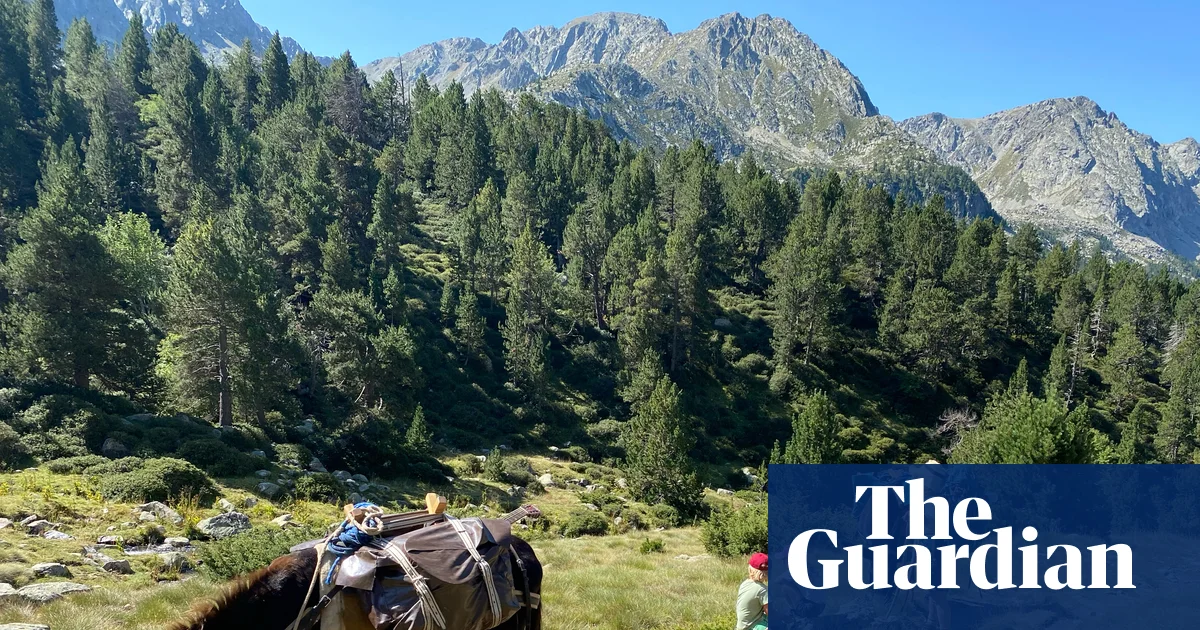
It’s said the 19th-century Parisian flâneur, intent on not rushing past the beauties of the street, would take a tortoise on a lead to set the pace. I thought about this as my donkey bent his head to another thistle and I turned my attention to the view, waiting for him to finish. Every way I looked, layers of mountains receded in deepening shades of eggshell blue. There were no sounds but the wind, the squeals of marmots and the giggles of my two young kids. I was extremely, uncomplicatedly happy.
Our donkeys were on loan from Burrotrek, a small outfit run by Swiss-born Denise Wirth. Twenty years ago, Denise spent four and a half months walking the Camino from Switzerland to Santiago de Compostela with two donkeys. She liked Spain, and she loved donkeys, so she settled on the idea of offering donkey treks in the Pyrenees. She has not looked back. For much of the year she is based where she settled, near Cadaqués, and offers a variety of self-guided itineraries through the vineyards in the foothills and along the Mediterranean coast, with trips lasting between a day and a week. But for the summer months, when temperatures soar, she relocates with her donkeys to Cal Jan de la Llosa in the province of Girona, a gorgeous ruin of a farm several miles up an unpaved track. From here, she lends her animals to people who, for whatever reason, have a romantic notion of what it might be like to take a donkey up a mountain.
Illustration: Guardian Graphics
My family (myself, Ulli, and our two kids, aged five and seven) bought Interrail passes (under-12s go free)and caught the sleeper down from Paris, crossed the border to Catalonia at Puigcerdà and, after a late lunch of tapas at the station bar, piled into a taxi for an hour’s drive up a long series of switchbacks to the farm. That first night we pitched our tents in a field behind the barn. The dark welled up from the valley floor and house martins shuttled through the dusk. We fell asleep to the rushing of the river and the occasional braying of a donkey.
The next morning we met our animals. We would be borrowing two donkeys, Om and Rebot, which we called Robot or, in moments of frustration, Roadblock. Om was described by Denise as “sporty”, and seemed up for most things, while Rebot was older and content to bring up the rear. Denise ran us through the basics: how to saddle them; how to groom them; how to check their hooves. A donkey can carry a fifth of its bodyweight, which meant around 30kg each. It was just as well, as we had a lot of stuff with us: a week’s worth of food and the explosion in camping gear that seemed to have occurred along with having children.
We had not taken our children to the mountains before, and I hadn’t had an interaction with a donkey since Bournemouth beach about 35 years previously. The learning curve was steep. The donkeys had a powerful sense of what they wanted, which didn’t always align with ours. Yet they were generally amenable, and we soon grew very fond of them. Denise waved us off with our children clutching the ropes and Om and Rebot trotting amiably behind them. She had suggested a loop that would take a week, with a mix of wild camping and mountain huts.
The going was easy, along wooded valleys, through pretty stone villages. At lunchtime, we tied the donkeys up to graze beside a stream while we splashed around, and then lay basking on the rocks, eating bread and cheese. Four hours in and I felt like Laurie Lee.
The path unwound along a series of thin rivers that burst out of the mountainsides
On the second night, we camped in a meadow during the worst storm I’ve ever known. It came out of a wide blue sky and suddenly it was hailing, the ground blanketed white. The donkeys stood stolidly beneath a tree, ears drooping. The downpour continued until dawn, the thunder like cannon fire. The kids, of course, slept through it, while Ulli and I sat up all night, watching their faces in the lightning. Were we out of our depth? Our tents were not meant for such weather and by morning the kids were the only dry things we had. The sun was out and the grass was steaming. We saddled the donkeys and carried on.
We dried out in Refugi dels Estanys de la Pera, a wonderful cabin alive with warm hospitality and good food. And then the path began to climb in earnest, winding up towards Andorra. At times it felt as though we were carrying two donkeys up the mountain. A group of Spanish hikers advised us to shout “arré,” an Arabic word imported by the Moors. It was unclear if it worked, but it gave us something to do. The donkeys took cautious, dainty steps, selecting each foothold before placing it. We were learning that they set the pace, and we should follow where they led.
‘A gorgeous ruin of a farm several miles up an unpaved track’ … camping at Cal Jan de la Llosa at the end of the walk
By the time we made the border at the Perafita Pass, at an altitude of 2,574 metres, we were in the cloud and giddy with success. We squatted in an ancient corral of stones and ate biscuits. But as we descended the cloud burned off and Andorra opened up before us. A vast plateau of long grasses and crooked, lightning-struck spruce trees, scattered with lakes in craters gouged by ancient glaciers. It was achingly beautiful, silent and wild. A herd of chamois, flushed from their hiding place, took off down the slopes at full pelt.
The path unwound along a series of thin rivers that burst out of the mountainsides, Riu de Perafita, Riu Madriu, rattling urgently along their rocky beds. We drank straight from springs bubbling out of the rocks and plunged into small pools, blisteringly cold. A herd of horses approached us one morning to examine their diminutive relatives, and Om and Rebot stood there, stoic as ever, until the horses galloped on.
I had worried this trip might be a hard sell to the kids, but their capacity to create fun proved boundless. Every time we stopped, and we stopped a lot, they found a stream to paddle in, a frog to play with, a marmot to sneak up on. The days weren’t long, six or seven miles at most, but if we try a walk at home we rarely get beyond the car park. The donkeys and the mountains meant they scarcely noticed we had tricked them into walking. In the evenings, they groomed the animals and charged about the camp. They ate everything we gave them – noodles, lentils, pasta – and fell asleep in seconds. It was a revelation.
Rebot the donkey set the pace
We spent our last night in Refugi de l’Illa, a vast, metal-clad, solar-panelled structure on a barren plateau that appeared to have touched down from space. We washed in hot water, drank wine at dinner and slept on a mattress. It was nice, but I hadn’t missed it. We were keen to get going again. As we walked back into Spain, the donkeys seemed to know they were nearing home. The path eased down across pastures of wild flowers and by dinner time on the eighth day we were back at the farm.
Some of my happiest moments as a parent are when I am doing something that I loved before having kids, but now with these brilliant, curious people – sharing the basic pleasures of cooking after a long day outside, or looking up at a sky bright with stars. We pitched our tent for one final night outside and reluctantly handed our donkeys back. They trotted into their field with the others, nosing each other’s necks in welcome. We were very sorry to see them go.
The trip was provided by Burrotrek; donkey hire from €55 a day including an introductory course and equipment. Half-board at Refugi de l’Illa, €61 adults/€48 children. Half-board at Refugi dels Estanys de la Pera, €46 adults/from €33.50 children
Lone Wolf by Adam Weymouth is published in paperback by Penguin on 25 June (£11.99). To support the Guardian, order your copy at guardianbookshop.com. Delivery charges may apply.
BOSTON — A federal judge on Friday struck down a Trump administration policy enacted after the shooting of two National Guard members that made it harder for immigrants from dozens of countries to stay and enter the U.S.
In a ruling harshly criticizing the administration, U.S. District Chief Judge John McConnell Jr. said the policy “threw the lives of countless immigrants living in the United States into indeterminate legal limbo,” and he accused the U.S. Citizenship and Immigration Services of ignoring the law.
“In enacting its latest immigration policies, USCIS: claims statutory and regulatory authority that it does not possess; makes decisions without the reasoned explanations that it must provide; acts without regard for the reliance interests of applicants that it must consider; and justifies its actions with pretextual concerns of ‘national security’ that mask anti-immigrant sentiments that it is forbidden from letting influence its decision-making,” he wrote. “In legal terms that means USCIS’s actions are contrary to law and arbitrary and capricious.”
A spokesperson for the Department of Homeland Security did not immediately respond to a request for comment.
The policies enacted after the National Guard shooting last year meant that immigrants from 39 African, Asian, Latin American and Middle Eastern countries have been “categorically barred” from receiving final decisions on, among other things, their asylum, work permit, green card and citizenship applications.
“This ruling reaffirms a basic principle: the federal government cannot shut down lawful immigration pathways or discriminate against people based on where they come from,” said Skye Perryman, president and CEO of Democracy Forward, which represented the plaintiffs in the case. “These unlawful policies caused enormous harm to families, workers, asylum-seekers, and communities across the country who were left in limbo, unable to work, access protections, or move forward with their lives.”
The policies apply to U.S. Citizenship and Immigration Services, which approves applications for immigrants to work and become citizens. The agency, which is within the Homeland Security Department, often grants asylum, but only for those already in the United States when they apply. Immigration judges grant asylum to those who are stopped at the border; the ruling does not affect them, and neither do the policies that sparked the lawsuit.
It is part of an ongoing effort by the administration to tighten U.S. entry standards for travel and immigration, in what critics say unfairly prevents travel for people from a broad range of countries. The administration suggested it would expand the restrictions after the arrest of an Afghan national suspect in the shooting of two National Guard troops over Thanksgiving weekend.
In its motion to dismiss, which the court denied, the government argued that Congress gave the executive branch broad authority over immigration policy, including “the entry of aliens into the United States as well as discretion within the statutory scheme to confer as well as withdraw various discretionary benefits.”
“This case rests on a remarkable premise: that a federal court should prevent an agency from issuing the very policy guidance that provides government personnel with the guardrails necessary to ensure consistent, non-arbitrary, and individualized decisionmaking consistent with federal law,” the government wrote in its brief.
Immigration groups celebrated the ruling.
“This ruling sets a powerful precedent that the administration cannot ignore the law as laid down by Congress and cannot arbitrarily bar immigration benefits on the basis of national origin by fiat,” said Jamal Abdi, president at the National Iranian American Council. “Fortunately, this is still a nation of laws, and those who uphold America’s values have recourse to challenge and push back on such discriminatory, arbitrary policies.”
Shawn VanDiver, a Navy veteran who heads a coalition that supports Afghan resettlement efforts called #AfghanEvac, said the ruling was a “significant victory for the rule of law and for thousands of Afghan allies and other immigrants who followed every requirement asked of them.”
“Just this week in Dallas and Fort Worth, we met people who feared losing jobs because delayed work permit renewals threatened their livelihoods, families who postponed education, travel, and homeownership because they did not know when their cases would be resolved, and future Americans who had expected to become citizens only to see their applications stall without explanation,” VanDiver said.
Japanese filmmaker Chie Hayakawa isn’t afraid to look death in the eye. The writer-director’s 2022 feature debut, “Plan 75,” imagined an unsettling future in which the elderly are offered a subsidy by the government to be euthanized. For her follow-up, she travels into her own past, drawing from memories of her father’s battle with cancer.
But while “Renoir” features no sci-fi elements, the nearness of oblivion remains just as prominent. Shorn of sentimentality, this gentle drama follows a quietly observant fifth-grader who feels the grim shadow of mortality all around her. How the character will absorb that realization is anyone’s guess — including Hayakawa’s.
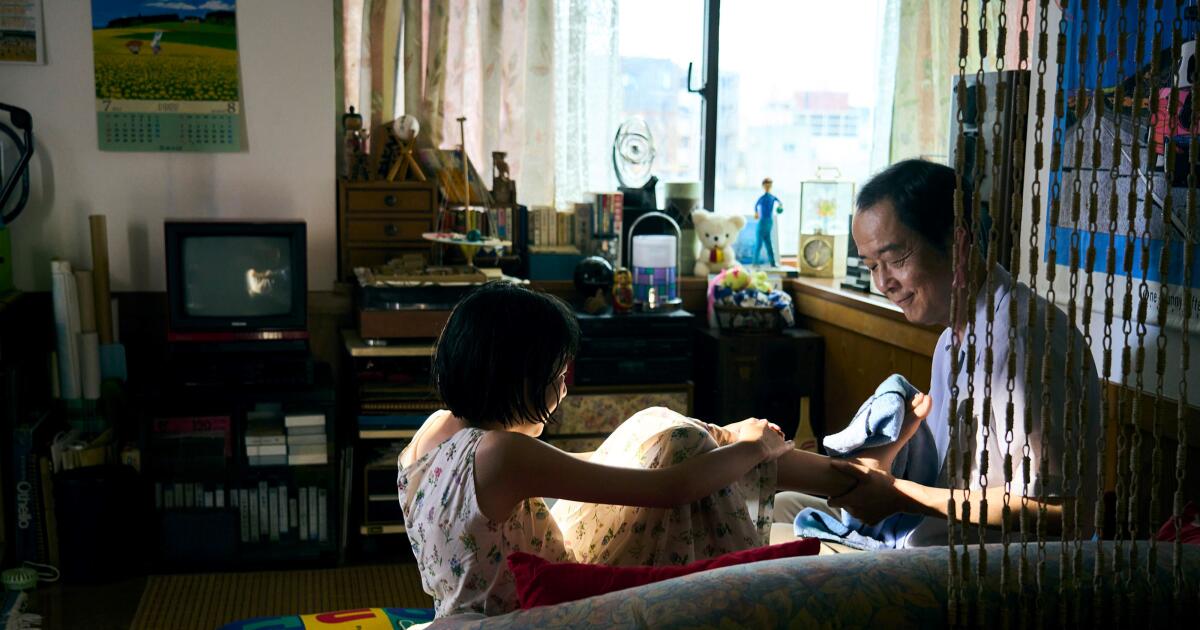
Newcomer Yui Suzuki stars as Fuki, who lives in a nondescript Tokyo suburb in 1987. Her soft-spoken dad, Keiji (Lily Franky), is suffering with terminal cancer in its final stages, the emaciated man spending as much time in the hospital as he does at home. Fuki’s mother, Utako (Hikari Ishida), doesn’t seem very despondent, though: One senses an emotional exhaustion that comes from preparing so long for the inevitable that she’s now mostly numb, her anticipatory grief having given way to frayed nerves.
Fuki’s pre-mourning process is equally complicated. Outwardly, she shows no signs of being devastated by her dad’s imminent passing, happily playing with him, almost in denial of his fate. But “Renoir” subtly suggests the impressionable girl is more aware than she lets on, surrounding her with random reminders of death. Local news breathlessly reports on random domestic murders. Even when Fuki gets away from the city, the camera lingers on her watching a campfire’s dying embers. The film derives its title from the girl’s interest in “Little Irène,” a painting by influential French impressionist Pierre-Auguste Renoir. She asks if Renoir is still alive. No, he’s dead too.
Hayakawa pulls from her childhood in multiple ways for her sophomore feature, which premiered in competition at Cannes last year. “Renoir” takes place in 1987 specifically because that’s the year she turned 11, and, like her protagonist, she was infatuated with “Little Irène.” But there’s a refreshing absence of nostalgia in Hayakawa’s conception of Fuki and her quizzical processing of her father’s fatal illness.
For school, Fuki writes an essay about her wish to be an orphan. She becomes obsessed with hypnotism and mind-reading, an unorthodox strategy to create a sense of control. And, occasionally, she wanders into daydreams that Hayakawa presents so matter-of-factly that viewers may sometimes be unsure if what they’re seeing is actually happening. In “Renoir,” Fuki’s flights of fancy are as naturalistic as her everyday life — a sharp reminder that, for children, imagination and reality are often indistinguishable.
If death has been integral to Hayakawa’s two features, it’s society’s callous reaction to aging that is her primary focus. “Plan 75” eschewed dystopian-thriller conventions to ponder how Japan might one day treat its senior citizens, viewing them as little more than a drain on resources. “Renoir” makes a similar point within a memory piece. Keiji is the one dying, but it’s telling that Hayakawa centers the story on Fuki and Utako, who each, in their own way, seem more concerned about their own personal dramas.
As Keiji’s situation grows more dire, Utako enters the orbit of Toru (Ayumu Nakajima), a workplace advisor with whom she’s instantly smitten, pondering pursuing him romantically. Ironically, Toru preaches the importance of good communication skills in the office, a lesson the film’s guarded family would be wise to heed. While Utako hides her feelings for Toru, Fuki begins a secret odyssey in which she impulsively joins a phone dating service, engaging in conversations with a creepy college student (Ryota Bando) who pushes her to meet in person. This potentially traumatic subplot is the closest “Renoir” gets to traditional suspense, but even here Hayakawa adopts a muted approach, sidestepping shock value for bittersweet commentary about young people’s confusion around love. Both Utako and Fuki chase after human connections fraught with danger, each trying to insulate themselves from the tragedy waiting at home.
“Renoir” may be a delicate wisp of a film, but it’s flecked with thoughtful questioning about whether childhood’s sorrows leave permanent scars on us as adults. Suzuki exudes the fragility and buoyancy of adolescence, playing Fuki as someone constantly imbibing the world, rarely revealing what she’s doing with that stimulus. The simplest moments resonate the strongest, such as when the moody 11-year-old holds a balloon over the balcony of her family’s high-rise apartment, casually releasing her grip so that it tumbles to the ground far below. Does it speak to a desire to jump herself? “Renoir” won’t say, but the character is so poised you feel confident she’ll survive her father’s death. Who knows: Maybe years from now, she’ll even make a touching, emotionally astute movie about it.
‘Renoir’
In Japanese, with subtitles
Not rated
Running time: 1 hour, 56 minutes
Playing: Opens Friday, June 5 at Landmark’s Nuart Theatre
Glaciers aren’t stationary. Immense and imposing, formed through the downward trajectory of water from mountains as it collects and freezes, they have always moved. Now, however, they’re leaving. The demise of glaciers is a fact inherent in all the bad news about the effects of climate change on what once seemed permanent. But for Icelanders, whose connection to glaciers is ancient and mythic, our human epoch has become an extended hospice for the landscape of their lives.
Somehow, though, Sara Dosa’s documentary on this matter, “Time and Water,” avoids playing like a funeral in waiting. Built around Icelandic writer Andri Snær Magnason’s voiced lamentations on a vanishing frozen world, along with archival footage of his family, it’s no simple howl of grief, even when it takes us to a publicly held memorial in 2019 for Iceland’s Ok glacier, the first such “death” diagnosis in the country’s history. Rather, Dosa’s film is a meditation on change — both the kind that we accept with a heavy heart and something more general. “Time and Water” is a curiously vibrant elegy, teeming with appreciation for the intimate majesty that is all life, generational and geologic.
Dosa has finessed this emotional-meets-elemental space before in her Academy Award-nominated 2022 documentary “Fire of Love,” about married volcanologists Katia and Maurice Krafft. That was a wonderfully eccentric romance forged in molten lava. Here, she’s in a collaboration of sorts with her subjects, both human and elemental. Magnason’s opening narration over spectacular footage of glaciers — up close and from far away — gently informs us that we’re watching a time capsule, one where the bonds of family and environment are intertwined.
We learn how Iceland’s glaciers, essentially rivers of varying pace, begat their unique ecosystems, but also how they provided the breathtaking terrain upon which Magnason’s grandparents Hulda and Árni fell in love. (Grandma Hulda was the first woman to fly in Iceland, itself a very cool fact.) The onset of dementia in Árni spurs his grandson to consider what’s lost when the markers of memory depart. “Time and Water” touches on the epic verse called rimurs, passed down via chanted song by Icelandic women, their descriptive, sorrowful tales like dispatches from previous ages.
“Tone poem” is an overused term in cinema, but the humbling “Time and Water,” graced with a playful, atmospheric Dan Deacon score, earns that distinction. Naturally, it helps that you can never tire of all the air-crisped glacier imagery, captured digitally and in 16mm. Folded into the cozy slide-show vibe of Magnason’s home videos and the carefully chosen archival footage, the movie plays like a scrapbook portrait in which home just happens to boast the grandest of backyards.
How much longer will Icelanders enjoy it? The glaciers are predicted to be gone within 200 years. That’s an eternity or a drip, depending on whose survival we’re talking about. Still, “Time and Water” collapses the notion that we are somehow separate from these ancient, essential formations: an encouraging hello to the future from inside a sobering goodbye.
‘Time and Water’
In English and Icelandic, with subtitles
Rated: PG, for some thematic elements, smoking and brief language
Running time: 1 hour, 33 minutes
Playing: Opens Friday, June 5 at Laemmle Royal and Laemmle Glendale
THE spotlight is on Bulgaria this year as one of the most affordable family holiday destinations for Brits.
Cheap beers. all inclusive hotels from £279 and flights under £15 – how could you go wrong?
Sign up for the Travel newsletter
Thank you!
Bulgaria offers Brits some of the cheapest all-inclusive holidays in EuropeCredit: GettyIt’s not all Sunny Beach party holidays – head to Plovdiv for its picturesque Old TownCredit: Alamy
The country regularly ranks as one of the best value holiday destinations for Brits, in reports such as the Post Office’s yearly Holiday Money Report.
Furthermore Bulgaria, and more specifically the Bourgas Area, has come out on top as the cheapest all inclusive holiday destination in 2026.
The country offers the most affordable week-long all inclusive breaks, beating destinations such as Tunisia and Turkey according to Travel Supermarket.
Plus a beer here costs as little as 89p, according to data from Wise.
A meal out at an inexpensive restaurant averages £8.82, and a cappuccino from a local cafe just 88p.
There’s some seriously affordable holiday deals available, including last-minute bargains for the summer and super cheap holidays to secure now for next year’s holiday
Here’s our roundup of the best value 7-night Bulgaria holiday package deals including flights.
All of these deals are for all inclusive hotels – so enjoy the unlimited poolside cocktails.
Izola Paradise, Sunny Beach – £279pp
Stay at the Izola Paradise Hotel for a sizeable swimming pool, spa and nearby golden beachCredit: Booking.com
This four star stay sits smack-bang in the lively resort town of Sunny Beach, just a short walk from its golden shores.
The family-friendly, all inclusive hotel has a kids club and adventure playground to keep the little ones entertained, plus a games room and activities like tennis and darts.
Adults can unwind at the spa, which has a hot tub, steam bath and fitness centre.
Plus with your all inclusive package covering three meals a day in the buffet restaurant, as well as snacks, soft drinks, cocktails and more, there’s no need to spend any extra on food and drink.
This four star hotel sees prices surge to £750pp+ in the summer months – but you can secure your stay for May next year for £279pp.
Book a 7-night all inclusive stay at the Izola Paradise in Sunny Beach from £279pp
Sunrise All Suites Resort All Inclusive – £309pp
Week-long stays at the Sunrise All Suites Resort start at £309ppCredit: Tripadvisor
This glam resort in the relaxed seaside resort of Obzor offers spacious suites, perfect for families.
This all inclusive hotel has three freshwater outdoor pools, plus activities like fitness classes, badminton and a kids daytime entertainment program.
Walk down from the hotel to its private beach to find reserved loungers and parasols propped on a stretch of sand facing the calm sea.
On the beach you’ll find various watersports, a beach volleyball set-up and even a fire pit to cosy up and enjoy your evenings outdoors.
Roomy suites come with a living area, kitchenette, air-con, a flatscreen TV and a balcony – everything you’ll need for a comfortable base.
Book a 7-night all inclusive stay at the Sunrise All Suites Resort from £309pp
Azalia Hotel Balneo & SPA – £349pp
The Azalia Beach Hotel Balneo & SPA is a huge, action-packed beachfront resortCredit: Booking.com
This modern hotel and spa offers a giant outdoor pool with waterslides and sea views, plus plenty of loungers and parasols on its own stretch of beach.
While kids have days packed with activities in the kids club, grown-ups can retreat to the spa centre with a gym, pool, sauna, steam bath and hammam.
Plus there’s treatments like massages and facials to add on for an extra bit of me-time.
Whether you’re wanting a fly and flop type of holiday, or one action-packed with activities like mountain biking, volleyball and tobogganing, this hotel caters to either.
The spa hotel sits in St Konstantin, a peaceful resort town with quiet woodlands and thermal springs close to Varna.
Book a 7-night all-inclusive stay at Azalia Hotel Balneo & SPA from £349pp
Gladiola Star – £349pp
Golden Sands is a resort on Bulgaria’s coastline overlooking the Black SeaCredit: Alamy
The four-star Gladiola Star hotel sits in Golden Sands, a bustling seaside resort with great nightlife and a fine sand beach that matches its name.
This hotel is just 100m from the beach and a lively promenade packed with bars, restaurants and shops that come to life at nighttime.
At the hotel you’ll find a large outdoor pool, plenty of loungers to laze on, plus there’s a sauna and massage treatments available, too.
Nearby there’s water sports like water-skiing and parasailing, plus the Aquapolis Waterpark is just over 10 minutes’ walk away.
Book a 7-night all-inclusive stay at the Gladiola Star from £349pp
More cheap Bulgaria all inclusive holiday deals
All of these 7-night, all inclusive package holiday deals include your flights and hotel
Not only is Bulgaria a cheap and cheerful holiday spot, but it’s full of beautiful beaches and landscapes, too.
There’s 26 Blue Flag beaches to choose from across the coastline, including the wide, flat sands of Albena in the north which provide plenty of room for sunbathers without the crowds.
There’s also the crescented cove of Bolata near Varna, with a calm turquoise bay and a more remote feel than other popular resorts.
Down near Burgas you’ll find Smokinya beach, which you’ll find a large beach with shallow, clear waters and plenty of parasols – perfect for families.
And there is of course Sunny Beach, with over six miles of golden sand, a strip of buzzy bars and restaurants and its renowned nightlife.
The resort lives up to its name, too, with temperatures reaching an ideal 30°C in the summer months.
If you prefer booking your flights and hotels individually, there’s plenty of very affordable flights from the UK.
You can fly from Birmingham to Sofia from £14.99, London to Burgas from £22 and Manchester to Varna for £40.
Cheap flights to Bulgaria
Snap up these cheap flights to Bulgarian holiday hotspots before prices rise
When Nick Antosca was a kid, he didn’t like having good dreams.
“With good dreams, I’d wake up and think, ‘Well, that didn’t happen’ and be disappointed,’” he recalled in a recent video interview. “But with a nightmare I’d wake up with my pulse racing and think, ‘I’m OK, I survived.’ I loved nightmares.”
Chasing that excitement and “healthy” catharsis in his daily life, Antosca has built a career on telling crime and horror stories: “Channel Zero,” “The Act,” “Brand New Cherry Flavor,” “Candy” and “A Friend of the Family.”
His newest project is a 10-episode remake of “Cape Fear” for Apple TV, starring Javier Bardem as Max Cady along with Amy Adams and Patrick Wilson as Anna and Tom Bowden.
“I think everything I’ve done is kind of a psychological horror story about the characters and their relationships,” he says, noting that this is true of the best horror tales like “Rosemary’s Baby,” “The Shining” and “Cape Fear.”
Antosca was a fan of both the original 1962 “Cape Fear” starring Robert Mitchum and Martin Scorsese’s 1991 remake starring Robert De Niro. But he felt it was time for a modern revision, a Southern Gothic fever dream that reflects the complexities of life today.
“The terror in ‘Cape Fear’ is about the destruction of the family,” he says. The story was originally about Cady, a rapist released from prison stalking Sam Bowden, who had interrupted his crime and testified against him. In Scorsese’s version, Bowden had been Cady’s defense attorney who, knowing Cady was guilty, had hidden evidence about the victim’s promiscuity to ensure a conviction and long sentence.
The original features “an all-American archetype of a virtuous family pitted against a monster,” while Scorsese depicted a “broken and dysfunctional family and the monster is even more extreme, he’s like a swamp creature.”
“The previous versions of ‘Cape Fear’ are pretty cut and dry,” Antosca says.
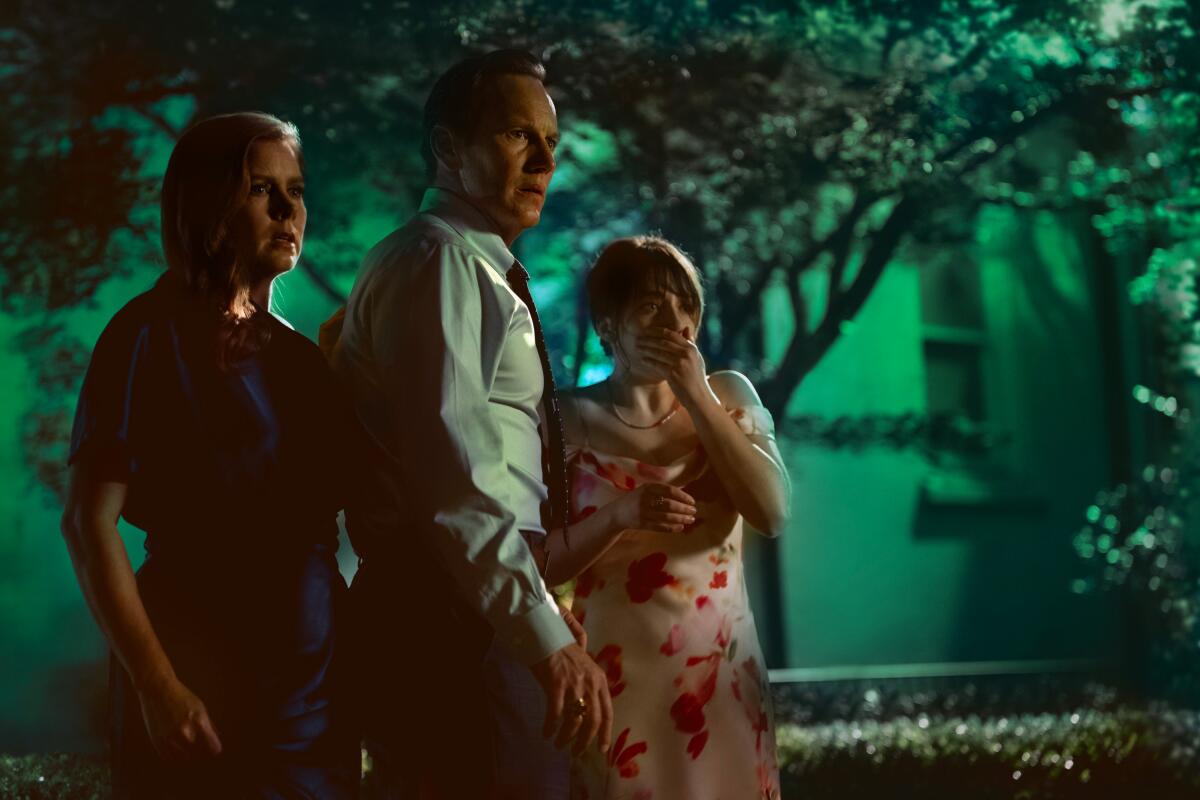
The Bowdens are portrayed by Amy Adams as Anna, Patrick Wilson as Tom and Lily Collias as daughter Natalie.
(Apple)
The new iteration features a sexting scandal, social media eruptions and drones — “there’s more ways to terrorize a family in 2026 and the world is scarier today than it was before” — but that’s not what makes it feel different.
“In our version the truth is more complicated, the past is more mysterious and both the family and the monster are more complicated,” he says. “The truth is murkier and that feels current.”
In this adaptation, Anna Bowden had been Cady’s defense attorney, and he’s no longer an illiterate rube but a successful restaurateur who was convicted of murdering his wife and unborn son. After the trial, Anna scandalously married Cady’s prosecutor Tom; he became stepfather to her newborn daughter Natalie (Lily Collias) and they later had a son Zack (Joe Anders).
“The foundation of their happiness is Max’s suffering,” he says, adding that while the crime was local in the previous versions, Cady’s conviction had been a national sensation in this one.
On the surface, the Bowdens are a perfect family, but cracks are rippling with increasing intensity just beneath, a fragility that will soon be exploited by Cady.
“In the first episodes, the family is permeable and a threat could be coming from anywhere,” he says. “Even if in your gut you think it’s Max Cady, it feels like it’s seeping into the family from all different directions.”
When Cady is suddenly exonerated and set free, he shows up to insinuate himself in the Bowdens’ life. Anna, ironically, works for a nonprofit that seeks to exonerate the wrongly convicted.
“All the versions ask, ‘What would you do to protect your family?’ but this also asks, ‘If an injustice was done to somebody, then what are they justified doing in return,’” he says. “I don’t want the audience rooting for Max, necessarily, but I want to trick them into having sympathy for somebody they didn’t expect to have sympathy for.”
To pull that off, “Cape Fear” needed a star as charismatic as Mitchum and De Niro.
Antosca always dreamed of Bardem as Cady: “When I’d pitch networks before there was a script, I’d say, ‘Picture Javier Bardem in this role.’” But this time, his dream came to vivid life.
The two developed the character together, everything from the explanation for Cady’s Spanish background to his exposure to Santería and prison and his “mutated version of the real religion” to the tattoos adorning Cady’s body to an early scene with a panther and the idea of the “psychological jungle,” which inspired Bardem to incorporate a panther’s physicality into his movement and his eyes.
Antosca always dreamed of Javier Bardem as Max Cady: “When I’d pitch networks before there was a script, I’d say, ‘Picture Javier Bardem in this role.’”
(Apple)
“Javier also asked questions about Max’s emotional history that was useful in shaping his character,” he says. “We wanted to show a little more authentic vulnerability, which we see very much in the previous versions intentionally.”
To make this series, Antosca first approached Scorsese and Steven Spielberg, who had initially developed the 1991 version. “They were incredibly generous and quite involved,” Antosca says. “They encouraged us to forge our own path.”
The one place they urged some fidelity to the past versions was in the score. “They said the Bernard Herrmann score is part of the DNA and feels like a character in both movies,” says Antosca, noting that Elmer Bernstein adapted the original in Scorsese’s version and Jeff Russo used the same starting point this time around.
Scorsese discussed episodes over FaceTime and Zoom, spending time dissecting a vicious fight scene while Antosca was editing it; shot in color but shown in black-and-white, the blood splattering may make you think of “Raging Bull,” but Antosca says the visceral violence was meant to call up “Casino’s” vise scene.
It may be nearly too much to handle, but Antosca is from New Orleans and says he found it easy to exploit the Southern Gothic sensibilities. “Everything is heightened in the Deep South and we were going for that energy, where something is adjacent to the real world but more saturated, sweatier, more feverish,” he says, noting that while the first episode is “cinematically pretty grounded and traditional, when the family gets shocked out of their comfort zone, things get a little crazy.”
That meant handheld cameras, flares, saturated colors, distortions, negative imagery and odd angles to reflect the growing sense of terror. Antosca promises that in the back half of the series, the show will get even wilder and more destabilizing.
“It just feels like there’s violence in the humidity in the South,” he says.
Subconsciously hearkening back to his childhood sleep experiences, he adds, “I wanted this story to feel like a nightmare that just keeps getting worse and worse and worse and worse.”
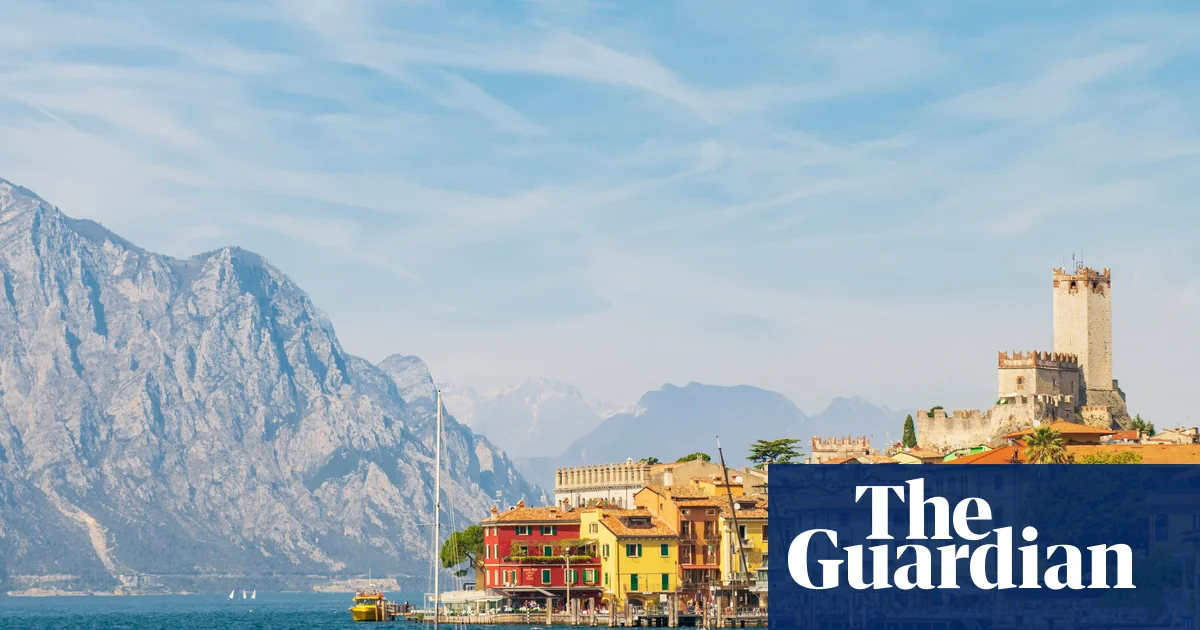
Lake Garda gave us one of the most memorable and unexpected family holidays yet. We hired a car and headed from Milan to Unesco-listed Peschiera del Garda and the family-focused apartment we found on Airbnb. A gentle 15-minute walk to the lakeside restaurants and gelaterias, this was the perfect base for exploring the beautiful town. Special mentions go to: Gelateria la Romana, with its wonderful ice-cream; the boat trip to Sirmione, an old town with thermal springs on a narrow peninsula; and, further up the lake, picturesque Malcesine and the cable car to the top of Monte Baldo to watch paragliders and to take in the amazing views. Alex
Profile
Readers’ tips: send a tip for a chance to win a £200 voucher for a Coolstays break
Show
Guardian Travel readers’ tips
Every week we ask our readers for recommendations from their travels. A selection of tips will be featured online and may appear in print. To enter the latest competition visit the readers’ tips homepage
–
Scandi simplicity in the Åland Islands
The Åland Islands in Finland. Photograph: Dani65finn/Getty Images
The Åland Islands are an unsung – and, we found, surprisingly sunny – gem nestled in the Baltic Sea between Sweden and Finland. We stayed with a baby and a toddler in one of the many simple, comfortable cabins in the woodlands, complete with private beach, boat, sauna and barbecue. The pint-size capital, Mariehamn, is no bigger than a market town and easy to explore with kids. People mostly speak Swedish, although the islands are an autonomous region of Finland. There are not a lot of “attractions”, but if you want to get back to nature without the crowds and enjoy Scandi simplicity and unrushed time with the family, this is the perfect place. Cabins and ferries can be booked at visitaland.com. Martha Fogg
Something for all generations in Brittany
Bénodet in Brittany. Photograph: Didier Zylberyng/Alamy
Last summer I piled eight people from four generations of my family into a campervan and crossed from Portsmouth to Saint-Malo, an affordable and fun way to get a large group to the beaches of Brittany. We headed to Bénodet, which is warmer than Cornwall but not as stiflingly hot as the Med, so the kids didn’t get irritable and the grandparents didn’t grumble. At Port de Plaisance campsite, we found water slides, natural swimming pools and sports, plus nightly karaoke for parents to embarrass themselves, while Grandma took on the locals at petanque. The sandy beaches have lifeguards so are great for sunbathing, swimming, picnics and walking for all ages. Peter
There was nothing to do in Menorca – great!
Es Grau in Menorca. Photograph: Davide Bonaldo/Alamy
A friend told us about Es Grau in Menorca, and he wasn’t joking when he warned that there was nothing to do. But the village has its own beat, and by day two we had settled into the local routine. When we weren’t eating or sleeping, we were kayaking, sea swimming and playing soccer with the kids on the municipal pitch. We had hired a car but hardly used it. Kieran
A Devon dinghy holiday
Salcombe in Devon. Photograph: Chunyip Wong/Getty Images
Sailing is a fantastic and diverse sport, with the skills learned laying foundations for a lifetime. Our children gained tremendous experience as young teenagers and returned for years to dinghy courses in Salcombe, Devon. They loved their summers of fun learning so much they graduated to Royal Yachting Association instructor level. Both became Atlantic sailors later! Tenacity and perseverance in all weather are qualities that other family adventures can’t touch. We loved sailing with them, too. David Innes-Wilkin
Zipping around in Pembrokeshire
Bluestone national park resort in Pembrokeshire. Photograph: Keith Morris/Alamy
Bluestone national park resort in Pembrokeshire is a firm favourite with my family. We went in May this year and booked four bedrooms for four nights for £540. There’s a brilliant pool and a mixture of indoor and outdoor fun, including zip lines and guided ebiking in the woods, perfect for our two young boys. There were lovely forest walks and soft play areas. We also enjoyed the golf buggies in which we whizzed between the well-maintained lodge and activities. Abby Samuel
Winning tip: family heaven in the Netherlands
A miniature marvel … Madurodam in The Hague. Photograph: Alamy
Holidays in the Netherlands have impeccable family-friendly credentials. Our young family loved Madurodam, a miniature version of the Netherlands in The Hague, which has buttons galore for tiny fingers to work bridges, trucks and boats. The railway museum in Utrecht is the best of its kind, with a VR train ride and an actual rollercoaster (there are vintage trains too). We ended with a visit to Linnaeushof, one of Europe’s largest playgrounds, near Haarlem, for a day of self-powered rides and slides. Not to forget the joys of city trams and pancake restaurants. Family heaven. Morag
More than 20 years after Michael Jackson was acquitted on charges of child molestation — and two months since the global superstar’s record-breaking biopic skirted any mention of abuse allegations — a new Netflix docuseries brings his trial and the aftermath to the foreground.
“Michael Jackson: The Verdict,” a three-part documentary directed by Nick Green and released Wednesday, chronicles his 2005 trial in Santa Maria that began with a search raid of the pop star’s sprawling Neverland Ranch and ended with a jury finding him not guilty on 10 counts, including four counts of child molestation. At the center of the case was Gavin Arvizo, a then-15-year-old cancer survivor from Los Angeles.
Because recording was not allowed in the courtroom, the documentary relies heavily on archival footage from media surrounding the trial and firsthand accounts of key figures involved, including prosecutor Ron Zonen, Jackson family attorney Brian Oxman, journalist Diane Dimond, two trial jurors, and friends and supporters on both sides of the case.
The episodes also delve into the 2003 documentary “Living With Michael Jackson,” in which the pop star is interviewed by British journalist Martin Bashir, that sparked questions about his behavior, leading to the charges against Jackson. Jackson’s historically questionable relationships with children, the media circus surrounding the trial and the effect it had on fans, the family at its center and Jackson himself are explored, too.
Here are six key takeaways from “The Verdict.”
Jackson allegedly had his personal assistant order child pornography
One of the docuseries’ most revealing interviews came from Vincent Amen, a former Jackson associate who worked at Neverland Ranch from 2002 to 2003. He said he was put in charge of taking care of the Arvizo family during their stay at the property following media backlash from Gavin Arvizo’s appearance in “Living With Michael Jackson.”
At that time, Amen said, he “wholeheartedly” believed in Jackson’s innocence, especially because Jackson’s friend Frank Tyson, also known as Frank Cascio, a member of the family who filed a lawsuit against Jackson’s estate in April detailing alleged sexual abuse, vouched so strongly for him. Cascio, who met Jackson when he was 5 years old and later became his personal assistant, told Amen, “Michael would never do this with a child.”
Amen’s conviction shifted, however, after he discovered a disturbing magazine that apparently belonged to Jackson in Cascio’s possession.
“Frank cleaned out his house of anything that came from the Neverland Ranch. And he hands me a Nike bag,” Amen said in the docuseries. “I took the bag and I’m driving home, and I felt, ‘Something’s a little suspicious.’ And I said, ‘Let me take a look in this bag.’ I start taking videos to document this. I open the bag. I start looking, and I see a magazine.”
The series shows shaky footage of Vincent apparently finding a nudist magazine called “Naturally.” He flips to a video ordering section with titles circled in black marker, including videos called “Nudist Youth Weekend” and “Euro-Nudist Family.”
“I confronted Frank, I said, ‘Frank, what is this magazine? Because, you know, there’s circles around videos with naked children,’” Amen recounted. “He said, ‘That’s just a phase that Michael and I went through. He circled the videos that he wanted, I ordered them, and it was a phase that we went through.’ They watched them together.”
The Arvizo children called Jackson ‘daddy’ and had their own bizarre nicknames
Along with footage of the nudist magazine, Amen held on to other evidence of his time with Jackson and the Arvizo family, including a set of Polaroid pictures featuring Gavin’s mom, Janet, and younger brother, Star.
In one, Star points directly into the lens. It’s captioned, “You my daddy Michael.” Another photo of a smiling Janet and Star includes a handwritten caption from Janet that says, “Dearest loving Michael, we appreciate you being our family. What God brings together, no man can undo. We love you.”
Under a photo of Star with a cross-eyed expression, he wrote, “I love you, my daddy Michael. Your son, Blowhole.”
“These are the nicknames that Michael would give these young boys,” Amen said.
Bashir documentary marked a pivotal shift in the perception of Jackson
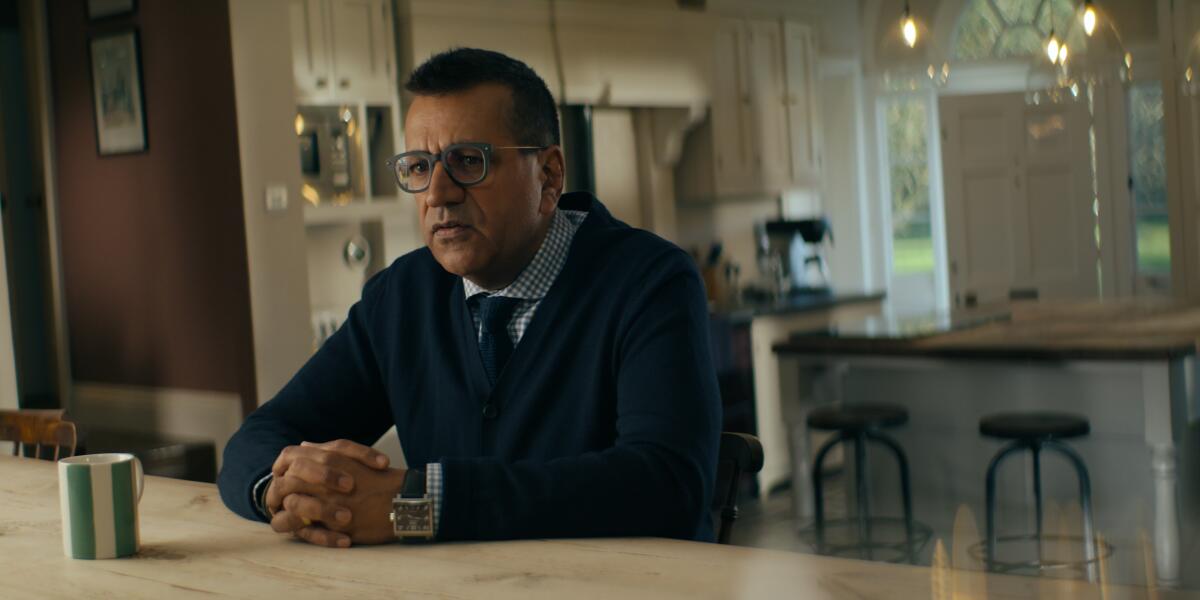
Martin Bashir in “Michael Jackson: The Verdict.”
(Netflix)
Though the first allegations of child molestation against Michael Jackson emerged in 1993, it was footage from Bashir’s “Living With Michael Jackson” that ignited public concern about Jackson’s relationship with Gavin.
In a pivotal scene from the 2003 documentary, Jackson brings Gavin in as an example of a child with cancer that he helped. Gavin, 13 at the time, leans his head on Jackson’s shoulder and holds his hand. Jackson tells Bashir that the two often share a bed at the Neverland Ranch, though in another scene he stresses that it’s not sexual.
“I realized that we had something that was hugely significant, but I didn’t realize the extent of the bombshell until the broadcast,” Bashir recalled in “The Verdict.”
“You can see it. You can look at that moment in the Martin Bashir documentary and you can actually pin the end of his life to that very moment,” J. Randy Taraborrelli, Jackson’s childhood friend and biographer, said in the docuseries.
Given Jackson’s stardom, news and tabloid media swarmed the scene of the trial along with droves of dedicated fans (and a much smaller contingent of detractors). And the archival footage from “The Verdict” shows the extent to which fandom and media frenzy influenced the proceedings.
Jackson’s fans stationed themselves throughout the route he’d take to the Santa Maria courthouse with signs showing their support, sometimes standing and shouting and other times driving alongside him and honking. Jackson had his director of security, Kerry Anderson, film these drives while he waved and engaged with supporters.
As many as 1,000 fans showed up on the first day of the trial, and many would line up starting at 5 a.m. for raffle tickets that would allow them to enter the courtroom. One fan interviewed for the docuseries, Sheree Wilkins, said she quit her job as a preschool teacher to move to Santa Maria for the trial. When the “not guilty” verdicts were announced, she fainted and had to receive medical attention.
TV news stations from around the world, including Taiwan, Japan and Mexico, sent crews to cover the trial.
Even inside the courtroom, where cameras were not allowed, enthusiasm for Jackson’s music could not be contained. Attendees recalled everybody, from the jury to the judge and even the prosecution, “swaying in their seats” when songs played as part of an evidence display.
“I remember me moving in time to his music,” prosecutor Ron Zonen said. “At one point Tom [Sneddon, the District Attorney leading the prosecution] jabbed me and said, ‘Would you stop moving your foot?’ ”
Jackson’s mental and physical health deteriorated
Mark Geragos briefly served as Jackson’s defense attorney.
(Netflix)
According to numerous interviews in “The Verdict,” Jackson’s substance use was problematic before and during the trial.
Jackson was not at Neverland during the raid that predated his charges. According to journalist Dimond, her sources said he was in Las Vegas “having wild parties.”
“There were cigarette burns in the leather couches and chairs. There were empty liquor bottles on every table. And this is where Michael Jackson had been for several days, entertaining young teenage boys, who all spoke German,” she said.
Later, Jackson’s well-publicized physical pain became the catalyst for controversy when he was hospitalized overnight, where he was allegedly given enough pain medication “to tranquilize an elephant,” and failed to show up on time for court the next day. The judge threatened to issue a warrant for his arrest if he didn’t make it to the courthouse within the hour, leading Jackson’s team to speed there at 90 mph.
Throughout the trial, stress took an enormous toll on Jackson, defense attorney Mark Geragos said in the docuseries.
“I watched him just disintegrate, literally disintegrate. The ingestion of substances was just astronomical. There was a time when I actually saw him in the fetal position on the floor, and I thought, ‘What do we do?’ I mean, you don’t want his death to be on your hands because you took some inaction,” he said. “We had genuine concerns whether he could even withstand a trial — physically, mentally.”
The prosecution’s case fell apart at the hands of key witnesses
“The Verdict” lays out, step by step, how the trial ended in Jackson’s full acquittal. One major contributor, the docuseries seems to argue, is the downfall of the prosecution at the hands of its own witnesses.
Defense attorney Tom Mesereau was an expert at discrediting witnesses, subjects told the filmmakers, but certain key witnesses, like Janet Arvizo, struggled to connect with the jury on their own.
“I called her Janet from another planet,” admitted juror Melissa Herard. “Sorry, but that’s just how she acted.”
Jackson’s ex-wife Debbie Rowe was meant to take the stand as a smoking gun for the prosecution but instead revealed no new information and came to Jackson’s defense.
The prosecution also partially hinged its case on past allegations of child sexual abuse against Jackson, but conflicting testimony caused these efforts to backfire. A former Neverland employee claimed to witness Jackson molest Wade Robson when he was a child, but Robson took the stand and denied anything happened.
“It’s hard to convince a jury when the subject of the act itself said it didn’t happen,” Zonen said.
In 2013, Robson reversed his stance and filed a lawsuit against the Jackson estate alleging sexual abuse. His allegations, along with those of James Safechuck, were the subject of the 2019 documentary “Leaving Neverland.”
The children were asleep in the little tent behind us, wrapped in two sleeping bags, each with an extra helping of wool blankets. Earlier, all I could see were their little faces half-lit by torchlight as I read them a book about rivers to the sound of rain on canvas. They fell asleep as fast and thick as the fog pooling in the valley below.
My partner and I sat outside, huddled together under a waterproof coat, cheek to cheek, perched on our daughters’ foam swim vests because the ground was saturated. We were laughing. As parents, absurdity and beauty make for familiar bedfellows.
Just a few days earlier, it had seemed impossible we would go anywhere;every affordable campsite, yurt and cottage was booked up for the Easter holidays. Then I remembered how last year, tagging along with the Right to Roamcrew, I ended up sleeping on the floor of the Beeches, a former Quaker residential community house in the village of Bamford, on the edge of Derbyshire’s upper Derwent valley. Its new stewards had amazing plans – a space for community health, social justice and ecological regeneration, all in collaboration with local people and grassroots groups.
I pinged them an email – “Can we stay on your land for one night?” – and, feeling inspired, contacted a few other initiatives, too.
We were in luck. Our hosts, Vanessa and Max, welcomed us into the Beeches, which was just as beautiful as I remembered. At the end of a wildflower path, past allotments and woodland, are two outbuildings: sheds on the outside, cosy cabins on the inside. “A family of deer lives here,” Vanessa said to my daughters, five and three, holding one hand each.
By the firepit, we unloaded still-hot pizzas, still-cold beers and marshmallows for roasting. As the dark set in, the children set the ends of sticks on fire, drawing shapes in the air.
In our cabin, candles, fairy lights and a wood-burning stove cast flickering shadows. The sofa beds were pushed together to make one giant bed. As I told the kids a story beneath the covers, I felt I was in a story myself.
By morning, we were a tangle of limbs. Light filtered through egg-patterned curtains. A train rumbled past and the sound summoned adventure. I opened the doors to birdsong while my partner prepared instant coffee and porridge. “I wish today would never end, Mama,” said my eldest.
Coco Lane Neal’s daughters at Bamford Mill. Photograph: Coco Lone Neal
We ate lunch at the nearby Anglers Rest, Bamford’s community-owned pub, with a cafe and post office in the same building. I dropped my sacred local texts, Wild Swimming Walks Peak District and The Upper Derwent: 10,000 Years in a Peak District Valley by Bill Bevan, on to the table. There was so much to explore – reservoir, ruin, gritstone edge – but the sun was calling.
The River Derwent was just down the road, its banks dotted with bluebells, cow parsley, clover and stitchwort. A mandarin duck watched from a patch of brambles as we quickly changed into our swimming costumes. Wading in upstream from the stepping stones at Bamford Mill, I was instantly ecstatic, while the children sat in the shallows, covering themselves in river mud.
That evening, we followed a winding road up into the hills above Ladybower reservoir. Lockerbrook Farm Outdoor Centre is a hill farm now run as a residential education centre by Woodcraft Folk, a national youth charity promoting education for social change. “We will make an exception,” they explained in their email, “because the camping field is empty.” They don’t usually rent camping pitches to individuals who are not on their courses, but have a cottage on the site available for rentals.
The friendly warden showed us around: field, sink, toilet, the most stupendous view of the high moorlands and deep cut of Derwent valley. The field was on an incline and, while we set up camp, the children bickered over which molehill was theirs. A group of cyclists passed above: “You’re very brave!” shouted one, and I thought he meant the children until my partner pointed out the dark clouds bruising the horizon.
The cosy cabins at the Beeches, a former Quaker residential community house in the village of Bamford. Photograph: Coco Lone Neal
“I’m hungry, Mama!” I went to light the camp stove. It didn’t work. Drizzle turned to rain. The packet of macaroni cheese said it would be edible with cold water. It wasn’t. I ran to beg the warden for boiled water and found a scene of pure bliss – young people cooking together in a warm cottage. One hot flask, two pots of apology-porridge and countless-kisses later, the children were asleep.
And so, this is how my partner and I found ourselves pressed together outside the tent in the dark, in the rain. “Next time we must bring a waterproof blanket to sit on,” he said.
“And an umbrella,” I said.
“And test the stove,” he laughed. “And then maybe we’ll be ready for a wild camp!”
We were giggling, shushing one another, when a female tawny owl screeched, quickly answered by the male, echoing from what seemed to be all the trees: ke-wick hoo-hoo, ke-wick hoo-hoo.
The next morning, we packed up early and drove down to Fairholmes car park, where the Refreshment Kiosk was waiting with hot drinks and pasties. From here, there’s a family-friendly trail featuring carved wooden creatures on the shores of Ladybower reservoir. I told the children about the lost villages beneath its waters. They were already there, one foot always in the imaginary.
We smelt of mildew, wildflower, woodsmoke, river water and sweat. Dandelion seeds were caught in my daughter’s curls. I blew the wishes free.
The Beeches has cabins sleeping four from £125 a night; camping £10pp per night. Lockerbrook Farm is predominantly for large groups, but the Warden’s Cottage sleeps six from £33pp per night. The weekend is accessible from Bamford train station for those who love hiking: the Beeches is a 15-minute walk; pub and wild swimming 20 minutes; Fairholmes is two hours; and Lockerbrook Farm a further 30-minute uphill hike from there.
At the state track and field championships, Jayden Rendon of Carson was in the lead of the 300 intermediate hurdles on Saturday when he struck the final hurdle and fell to the ground. So ended his opportunity to repeat as state champion.
Did he pout? Did he lose his composure? Did he blame something or someone?
Absolutely not.
“You live and learn,” he said. “It does no justice dwelling when I can do so much more.”
He’s headed to USC, and what a student athlete he will become. He was honored on Tuesday, receiving a $1,500 scholarship from the City Section for his academic and athletic commitment. He wrote an essay on how schools in the Southern Section were trying to convince him to leave Carson.
He said absolutely not.
“Growing up in the track world since I was 8 years old, I watched many of my friends and teammates make a decision to attend schools outside of their community,” he wrote. “Their reasoning was based around sports because they believed that the CIF Southern Section schools were more competitive and would give them more opportunities for success. When I was in middle school, my family moved to Long Beach from Carson, which made my home school Long Beach Poly. The majority of my youth team friends decided to attend LB Poly, and I was often questioned on why I chose to stay in Carson instead of following the crowd. My parents and I were told that I would never reach my full potential in the City Section.
“My decision to stay in Carson and compete for the City Section was not just about competition, but about connection. While preparing to compete in the multi-events at the Junior Olympics, when I was 10, I had to run the hurdles. Coach Jojo coached hurdles at Carson so my mom asked him if he would be willing to train me in the summer. I grew a bond with Coach Jojo and developed a love for the hurdles. Both my mother and grandmother went to Carson but it was Coach Jojo who showed me what it truly meant to be part of the Colt family. Besides my family, he was my biggest supporter, he believed in me and made me feel like I belonged to something bigger: a legacy. I didn’t care what anyone said, I knew that if I had Coach Jojo by my side and if I set my mind to it, I could be successful.
“I never would have believed that from the start of my freshman year, the sport that I love, would hit me with life: In January 2023, just a few months before my first high school track season began, I lost Coach Jojo to cancer. After being a pallbearer for my beloved Coach Jojo, I made a promise to him to finish what we started. The way I saw it, I had two choices, I could feel sorry for myself or I could push through the pain and stay focused on my goals of becoming a USC Trojan.”
Rendon fulfilled his promise to his coach and community.
“I wanted to stay in the City Section,” he said. “It was my roots. I wanted to be the hometown hero. I didn’t think I needed to move to be great.”
He was right again.
This is a daily look at the positive happenings in high school sports. To submit any news, please email eric.sondheimer@latimes.com.
Peabo Bryson, a Grammy-winning R&B singer known for his duets from Disney classics “Aladdin” and “Beauty and the Beast,” has died. He was 75.
His family confirmed to The Times that he died Tuesday in Marietta, Ga. The cause was complications from a stroke he suffered over the weekend.
“We are tremendously moved by the outpouring of love, prayers and support from fans, friends, and colleagues around the world,” the family shared. “While our hearts are broken, we find comfort in knowing how deeply Peabo was loved and how many lives were touched by his voice and his generous spirit. His legacy and music will live on for generations to come.”
Bryson was a fixture on the R&B scene for decades, scoring with such hits as “Tonight I Celebrate My Love” and “If Ever You’re in My Arms Again.”
Peabo Bryson, pictured performing in Washington, D.C., in 2016, won Grammy Awards in back-to-back years in 1993 and 1994.
(Teresa Kroeger / Getty Images)
In a career peak in 1992, the singer was featured on recordings that topped four separate charts: “A Whole New World,” a duet with Regina Belle from the Disney animated movie “Aladdin,” topped the Pop and Adult Contemporary charts; “The King and I” album, featuring Bryson, was No. 1 on the Classical Crossover charts, and Kenny G’s “Breathless” album, featuring Bryson on “By the Time the Night Is Over,” topped the Contemporary Jazz charts.
He nabbed two Grammy Awards back to back in 1993 and 1994 for his performance of “Beauty and the Beast” with Céline Dion, and his performance of “A Whole New World” with Regina Belle.
“I don’t think there’s anything I can’t do,” Bryson told The Times. “I see myself as a true Renaissance man. I don’t like one-dimensional concepts of myself.”
Robert Peapo Bryson was born on April 13, 1951, in Greenville, S.C. He grew up attending concerts his mother would bring the family to, and by the time he was in high school, he knew he wanted a career in music.
In 1978, he told David Nathan, an editor for Blues & Soul magazine, that his mother wasn’t thrilled about the prospect of him chasing his dreams in the rhythm-and-blues biz and worried he’d get into trouble.
“As far back as I can remember, I’ve always been into music,” Bryson said. “It’s all I ever wanted to really deal with. … I had to make that decision, when I was around 14, as to what I was going to get into, career-wise. Well, I’d thought about being a doctor or something like that, but I really felt that music was my thing.”
He cut his teeth as a backing vocalist in various groups, but none of his bandmates could properly pronounce “Peapo,” his French West Indian name, so he changed up the spelling to make it simpler. The stage name Peabo was born. In the late 1960s, he linked up with “My Elusive Dreams” hitmaker Moses Dillard. “I started out just singing, although I progressed into percussion, guitar and, much later, playing piano — that was basically when I started getting into songwriting,” he told Nathan.
In 1967, he signed his first record deal, with Bang Records, and in 1976, he made his solo debut with the single “Underground Music” and his eponymous album, “Peabo.” The next year, he hit it big time and signed with Capitol Records, where he put out back-to-back gold-selling albums: “Reaching for the Sky” in 1977 and “Crosswinds” in 1978.
Peabo Bryson performs at the Centennial Olympic Park’s Fourth of July Celebration in Atlanta.
(Robb D. Cohen / Invision / Associated Press)
By the ’90s, Bryson was at a career high, collected Grammy nominations and became the definitive voice of Disney duets. But the music scene was changing, and Bryson wasn’t keen on the new direction. He told The Times in 1994 that MTV had stopped considering talent as the criteria to be played on the music channel and that he thought mainstream music had taken a hostile and negative turn.
“I guess I [tick] people off because I don’t go away,” he said with a chuckle. “I’m like a tenacious forest fire — you snuff me out over here, and I’m still burning down the back 40 just when you think it’s over. I have a great faith in God, and because of my great faith in God, I have faith in the self.”
Fortunately for legions of fans of the soulful balladeer, Bryson was right and he wasn’t going anywhere for another couple of decades. The Grammy winner continued to grace stages with his flashy blazers and smooth baritone, and recently performed a concert with Jeffrey Osborne at Trilith Live in Fayetteville, Ga.
The event in early May was a standalone performance, apart from the crooner’s Golden Touch tour, which he announced last year, amid his celebration of 50 years in the music industry.
In recent years, Bryson said he had been hitting the gym and prioritizing his health after a scare seven years ago when the artist suffered a heart attack at his Georgia home. He told the Soul Train Cruise 2020 that he flat-lined for nearly 30 minutes, “long enough to make friends on the other side.”
“It turns out that dying is not that hard,” Bryson said. “Didn’t hurt that much. It’s the living afterwards that’s the really difficult part. I mean, why are you still here? You have to ask yourself those hard questions: Are you a good father? Are you a good husband? Are you a good friend? Are you a good brother? Are you a good human being?”
Bryson said he was able to answer yes.
“Then you have to ask yourself the question that makes the answer null and void — can you be better?”
Bryson is survived by his wife, Tanya Boniface Bryson; son Robert Bryson (who goes by Kit); daughter Linda Bryson; and three grandchildren.
Memorial arrangements will be announced at a later date.
52-year-old Ryan McFarland killed six of his family members and later took his own life when confronted by the police in Muscatine in the US state of Iowa.
The Strictly Come Dancing icon has taken part in BBC’s Who Do You Think You Are? where she learns about her lineage.
At one point, Amy is left in tears as she hears of a family member who suffered from breast cancer and died at a young age, leaving several children behind.
The Welsh dancer is left devastated, as she reflects on her own cancer battle, having been diagnosed with breast cancer in May 2023 and suffering health setbacks as she underwent treatment.
Elsewhere during the programme, Amy learns of a 13-year-old who was shot dead in an awful accident.
After hearing of a rumour of a murder from her mum’s side of the family, Amy begins her journey in west Wales, where she seeks to find out if her ancestor was the victim or the perpetrator.
“Was there a murder, was one of my family involved? Detective Dowden on a mission,” Amy declares.
She meets her distant cousin Wyn at his home in Ceredigion, where he shows Amy a family Bible that belonged to her three-times great-grandfather.
Inside it, she reads the name Elinor Jenkins, with information revealing that she was shot dead by the “cruel man Offley Owen” in November 1888, when she was just a teenager.
“Why would somebody want to shoot a 14-year-old girl?” Amy wonders, shocked to hear the distressing news of her ancestor’s murder.
“When I heard of this mysterious death, I didn’t think it would be somebody within our family who was killed, I assumed one of our family members shot somebody. I was not expecting this and not expecting a child,” she says.
Elinor was Amy’s three-times great aunt, and was killed at a nearby farm, Berthlwyd, where she worked as a servant.
The dancer meets historian Dr Angela Muir, who confirmed that Elinor was actually aged 13, and was working at the farm with a 17-year-old boy called Offley Owen.
She reads newspaper reports that detail what happened, revealing that Elinor had been sent to fetch water before a witness heard Owen saying “I’ve shot Nelly dead”.
Owen had taken up the gun “with a purpose of showing her”, but was unaware it was loaded, and was supposedly being playful.
He did, however, tragically kill her, with Elinor being shot in the mouth.
“This is awful,” Amy says. “That would have been an instant death.” The historian agrees, saying: “It’s quite horrific.”
However, Amy finds it difficult to believe the death came about as an accident. She wonders: “He obviously had intention to use that gun,” adding: “To me, this was planned.”
Amy hears about the coroner’s inquest that took place after Elinor’s death, leaving her “confused”.
The reports eventually confirmed that Owen was charged with manslaughter, and would have been tried in the assizes court in Carmarthen.
“I’m horrified by what I’ve read, it’s going to take a little time to process it,” Amy admits.
In Carmarthen, Amy meets another historian who explains that Owen pleaded not guilty at court and the prosecution announced they would call no witnesses.
She’s stunned to discover that Owen was discharged, which would often happen in cases like these during those times, as the court took into account that he had never been in trouble with the law before.
“Some part of me is not satisfied with this,” Amy says, hearing that the victim’s family didn’t get justice after the tragedy.
Seeking comfort after hearing of the outcome, Amy travels to a church in Blaenpennal, where Elinor was laid to rest.
She says: “At first when I heard that he was found not guilty, I was like, how did the family move on? How did they start to process the grief? But it does seem like it was an accident and I guess, after time, they started to forgive.”
She learns that Elinor was remembered “as a young person of more than ordinary ability”, and also that a valley near the farm where she lost her life is now named after her.
Amy says: “I never realised that a member of my family has landscape named after her, I think that’s something quite special, really touching.”
Amy Dowden’s episode of Who Do You Think You Are? airs on Tuesday 2 June at 9pm on BBC One and iPlayer
Joe Swash says discovering family history has made him complete after taking part in Who Do You think You Are? for the BBC
Joe finds out his family on his father’s side moved over from Italy at the start of the 20th century.(Image: CREDIT LINE:BBC / Wall to Wall Media Ltd / Stephen Perry)
Joe Swash says he feels “galvanised” after learning about the Italian roots of his family. The actor and husband of Stacey Solomon appears on Who Do You Think You Are? hoping to learn more about his family tree.
Former EastEnders star Joe, 44, tells the programme he lost his own dad Ricky when he was aged 39 and Joe was just 12 which had a big impact on his upbringing.
He explained: “My house was full of life and life. And then, when my dad died, for a long time, it was a house full of sadness and grief. So, you know, a lot of the time it was just trying to get through that period. Growing up in London, I was quite vulnerable, not having a father figure, and I had dyslexia and ADHD that wasn’t diagnosed, so I do struggle when I read something, and a lot of the time I was misunderstood as being quite naughty and mischievous.”
Joe says thanks to some “strong women” in his life he stayed on track, and that he feels like he has got some “Italian traits” including wearing his heart on his sleeve. His mum Kiffy tells him that on his father’s side his great grandmother’s part of the family tree were Italian.
At this stage Joe doesn’t know anything beyond his grandad Charlie but his parents were Joe’s great grandad also called Charlie Swash and Maria Raimo. A 1921 marriage certificate shows Maria living at home in Lox Gardens in London with her parents, Giuseppe, Italian for Joseph, and Rosa, Joe’s great great grandparents.
Joe’s great great grandfather Guiseppe Raimo moved from Italy to London and worked his way up from a street performer in poor living conditions to a job crafting Street pianos. He also spoke alongside Sylvia Pankhurst in 1923 at a Communist Workers’ Movement meeting in London. A letter in his name was published in weekly newspaper The Worker’s Dreadnought, condemning the brutality of the fascist regime.
Historian Alfio Bernabei said: “Giuseppe wasn’t simply attending the meeting, he was actually speaking alongside Sylvia Pankhurst. He could see what was going on, he was following events in Italy, and everything was leading towards a catastrophe. Giuseppe would have run terrible risks had he been in Italy, and he was running terrible risks in London.”
Hearing this detail, Joe said: “It really does fill me with a great, great deal of pride to think that he was struggling through life anyway, being Italian, living where they were living, but he still was concerned about what was happening in the world and fascism, so he must have been a man with great moral compass, someone that really stood by what he thought.
“I had so much pride when I found out about him. The journey he went on, the morals and the things he stood up for, the people he rubbed shoulders with, and the way he got out and worked through poverty to make himself and make his family’s life better, just shows real tenacity. Learning about his speech was emotional, it was a total surprise. I think in that moment I felt really close to my relatives, to Giuseppe. It was such a lovely thing to find out.”
Joe also goes to Naples and traces his ancestors back to his five times great grandfather Donato who was born in 1762 and was living in the now largely abandoned but picturesque mountainous town of Senerchia. The family were peasant farmers but did have a brush with crime after being wrongly linked to the Italian brigands in 1867 during the Italian rebellion.
Back in the present day Joe also finds a ‘Raimo bar’ nearby to Senerchia, and is delighted the family name lives on in Italy. Reflecting on everything, Joe said: “For a lot of my life, I’ve never really known who I am, what I am, where my roots are. I don’t know if that’s due to losing my dad at a young age, but being on his journey, it really has sort of like galvanised who I am, where I’m from, the people that made me, how strong they are, they never give up. Hopefully a bit of that tenacity has come down the line to me.”
He added: “I think what I’ll carry with me from this experience is just the importance of where you come from and knowing who you are. As well as the things that I found out about my relatives, especially about Giuseppe. Traits and things from them that I hope I have as well, or that I’d like to introduce into my life, you know. It just made me feel a lot more attached to my heritage, which I’ve never really felt attached to. I very much knew nothing about it before, but after this journey, I feel like I’m part of something.”
* Who Do You Think You Are? With Joe Swash airs on BBC1 at 9pm on Tuesday June 9. The series is available to stream on BBCiPlayer.
R&B singer Peabo Bryson, well known for his duets from beloved Disney classics “Aladdin” and “Beauty and the Beast,” suffered a stroke over the weekend.
A representative for the artist told The Times that the singer is undergoing treatment but provided no details about his condition.
“Two-time Grammy Award-winning singer, songwriter and balladeer, Peabo Bryson — the voice behind the Oscar-winning Disney songs ‘Beauty and the Beast’ and ‘A Whole New World’ — has suffered a stroke and is currently under medical care,” the representative said in an emailed statement. “At this time, the family requests privacy as they navigate this deeply personal moment together. The thoughts, prayers and love of friends and fans are welcomed and deeply appreciated.”
Bryson recently performed a concert with Jeffrey Osborne at Trilith Live in Fayetteville, Ga., in early May. The event was a standalone performance, apart from the crooner’s Golden Touch tour, which he announced last year, amid his celebration of 50 years in the music industry. In April, the Grammy winner turned 75 and posted photos on Instagram from a birthday bash showing him surrounded by friends and family. In early May, he posted a video of his son, Kitt, performing a Michael Jackson dance routine, writing “Super proud Dad moment from last nights Gig in Atlanta.”
Soul and funk band Maze, which was fronted by the late Frankie Beverly, shared some love for Bryson on social media.
“The entire Maze The Music Forever family sends our heartfelt prayers, love, and support to Peabo Bryson during this time of healing,” read the post. “Peabo’s extraordinary voice, timeless artistry, and unwavering contributions to music have touched millions around the world. We pray for God’s healing hand, renewed strength, comfort, and a full recovery.”
A DISNEY legend has been rushed to hospital after suffering a stroke, leaving his nearest and dearest concerned.
The musician, known for films such as Aladdin and Beauty and The Beast, is currently under medical care following the scary incident.
Sign up for the Showbiz newsletter
Thank you!
Disney icon Peabo Bryson has sadly suffered a stroke, with his family asking for ‘prayers’ during the difficult timeCredit: Not known clear with Picture DeskThe singer is known for being the man behind the titular song in Beauty and The Beast, alongside Aladdin’s A Whole New WorldCredit: Alamy
Paebo Bryson is best known for songs such as Aladdin’s A Whole New World and the titular track for Beauty And The Beast, a duet with Celine Dion.
The family of Peabo, who is now 75, have shared that he suffered a stroke this week in a worrying ordeal.
In a statement shared with Variety, they said: “Two-time Grammy Award-winning singer, songwriter and balladeer, Peabo Bryson — the voice behind the Oscar-winning Disney songs ‘Beauty and the Beast’ and ‘A Whole New World’ — has suffered a stroke and is currently under medical care.
“At this time, the family requests privacy as they navigate this deeply personal moment together.
Peabo, along with Celine Dion, won a Grammy award for the Beauty and The Beast hitCredit: YouTubeHe also has a string of solo hits and has still been performing in recent yearsCredit: Getty
“The thoughts, prayers and love of friends and fans are welcomed and deeply appreciated.”
Hailing from South Carolina, Peabo is married to singer Tanya Bryson (née Boniface) and a dad to eight-year-old son Kitt and older daughter Linda.
Peabo has had a lengthy music career with numerous accolades under his belt.
In 1992, his performance of Beauty and the Beast with Céline Dion won him a Grammy award in 1992.
A Whole New World, which he performed with Regina Belle, also bagged him the gong the following year.
Alongside his Disney hits, R&B star Peabo has a string of solo hits across the ’70s, ’80s and ’90s.
Songs If Ever You’re in My Arms Again, Can You Stop the Rain and Feel The Fire all hit the top end of the charts.
Back in 2019, he suffered a mild heart attack and was hospitalised.
At the time, his family assured doctors expecting Peabo to make a full recovery, with his health appearing in check up until this new scare.
I come from a family of priests and devoted Catholics. Catholicism is the blood in my veins. My father was not a disciplinarian, but if you lived under his roof you went to church. Saturday evening or Sunday morning, didn’t matter, you went. My four siblings and I were not miscreants, but we drank beer and sneaked out, and I was once cited for stealing liquor. I can’t recall my father ever yelling at me for anything other than missing Mass.
My great-uncle Dan was a diocesan priest at St. Charles Borromeo in Drexel Hill, Pa. Dan was a fire-and-brimstone hard-liner. Every Thursday we’d gather as a family for a roast beef dinner at my grandmother’s house. Dan would drink Manhattans — plenty — and if someone expressed a view of God contrary to his own, he’d say, “It’s awfully hot down there.” “There” meant hell. My uncle Ed, my mother’s eldest brother, was an Augustinian. Patient, compassionate, inclusive, Ed’s God was very different from Dan’s. While discussing God, Ed would quote Michael Himes, “There is nothing we can do to make God not love us,” and the Trappist monk Thomas Merton, “Mercy, within Mercy, within Mercy.”
Sports was in my family too — basketball, specifically — and I came to view Dan and Ed as head and assistant coach, respectively. The head coach shouting harsh critiques from the sideline, the assistant coach there to put his arm around you when you made it, crestfallen and ashamed, back to the bench. I loved them both, but I aligned with Ed’s view of God. Dan passed away a decade ago. Ed has since left the priesthood and married a kind and patient woman named Kathy. Over the years, Ed’s views on God have changed drastically. We meet for dinner once a month to talk about life and faith, and it was during one of our conversations that “Task” was born.
Mark Ruffalo in “Task.”
(Peter Kramer / HBO)
Tom Brandis, played by the singular Mark Ruffalo, is a former priest-turned-FBI agent who has lost his faith. Everything he held as truth in his life has come crashing down in the wake of a family tragedy. Tom believes he was called by God to adopt two children, Emily and Ethan. Adopting these children has resulted in the death of his wife, Susan. Matricide. What kind of God allows that? I have struggled with my Catholic faith over the years, but nothing has perplexed me more than the idea of suffering. The poet Archibald MacLeish wrote, “If God is God, He is not good / If God is good, He is not God.” The message is clear: If God is God, the author of everything, then He created evil and suffering and therefore cannot be good.
In “Task,” I wanted to explore a crisis of faith with honesty and without easy answers, because that is exactly how I have found my own faith journey — arduous and circuitous. I believe in God, but I find that belief tested daily. Faith and religion are separable. Tom’s journey in “Task” is a journey of faith. In the fifth episode, Tom is kidnapped by the criminal Robbie Prendergast, played by the brilliant Tom Pelphrey. During a long and tense car ride to the Poconos, Robbie tells Tom that he doesn’t believe in God. Never has. God is an idea conjured to make life bearable. “There’s nothing after this life,” Robbie says. Tom doesn’t argue. His own beliefs have veered in that direction. The car pulls into a secluded, wooded area. Facing death, Tom suddenly wants to call his son, Ethan, and forgive him. Robbie doesn’t allow it. Instead, he walks Tom to the edge of the woods, tells him he’s a decent man, and sets him free. Because Robbie has his own plan: to sacrifice his life in the hopes of providing a better one for his family. It’s through Robbie’s act of mercy that Tom regains faith. He believes in goodness again.
Brad Ingelsby.
(Ian Spanier / For The Times)
In the final episode, Tom finds himself taking care of a young and suddenly parentless boy, Sam. Sam reminds him of his own son, Ethan. Sam wants to live with Tom. And Tom desperately wants Sam to stay with him. But Tom also recognizes that Sam would be better served in the care of a young family capable of meeting his needs. Sam shouldn’t be stuck with an old man like him. Tom lets Sam go; he believes the boy will be taken care of. That is Tom’s act of faith.
When Ed and I met for dinner last month, we talked about how his idea of God has changed over the years. He no longer sees God as a bearded white man tallying our sins and waiting to judge us in heaven. He thought God was everywhere, all the time. The love that exists between people. He thought he could feel God right then, among us at the table as we laughed. We talked about Camp Mystic. The young girls swept away. Why, God?They were there to serve You. We didn’t have any answers. We never do. But the food and wine were good, and we talked about great-uncle Dan, about how he was so different from us but how much we loved him anyway, and how, when he drank Manhattans — plenty — he could turn harsh and opinionated, but it didn’t matter because he loved God. He loved Him with his whole heart, and we thought about the unimpeachable dignity of that and what an amazing gift it would be — to believe and never doubt.
Matt Brown, who starred with his family in the Discovery reality television show “Alaskan Bush People,” was found dead in the Okanogan River in Washington state, law enforcement officials said Sunday.
Brown’s body was discovered Saturday by a group of private citizens who were conducting a search, the Okanogan County Sheriff’s Office said in a statement.
Brown’s brother, Bear Brown, said in a video posted Saturday on social media that fellow brother Noah had been with the search team, helped pull the body out of the river and identified him.
The official cause and manner of death is still to be determined by the coroner, the sheriff’s office said. But the Brown family believes Matt Brown died by suicide, Bear Brown said in the video.
Witnesses said they saw Matt Brown in or near the river and that he “took his own life,” Bear Brown said on social media.
“I would have never suspected he would hurt himself, honestly,” Bear Brown said in the emotional video. “He struggled for a long time.”
Bear Brown said his brother had battled with alcohol and drugs and that Matt Brown told him in their last conversation that he had “fallen off the wagon.”
The Brown family and their life in the Alaskan wilderness were the subject of the reality TV show “Alaskan Bush People,” which ran on the Discovery Channel from 2014 to 2022.
Suicide prevention and crisis counseling resources
If you or someone you know is struggling with suicidal thoughts, seek help from a professional or call 988. The nationwide three-digit mental health crisis hotline will connect callers with trained mental health counselors. Or text “HOME” to 741741 in the U.S. and Canada to reach the Crisis Text Line.