fallen

The common tourist traps abroad that Brits admit they’ve fallen for

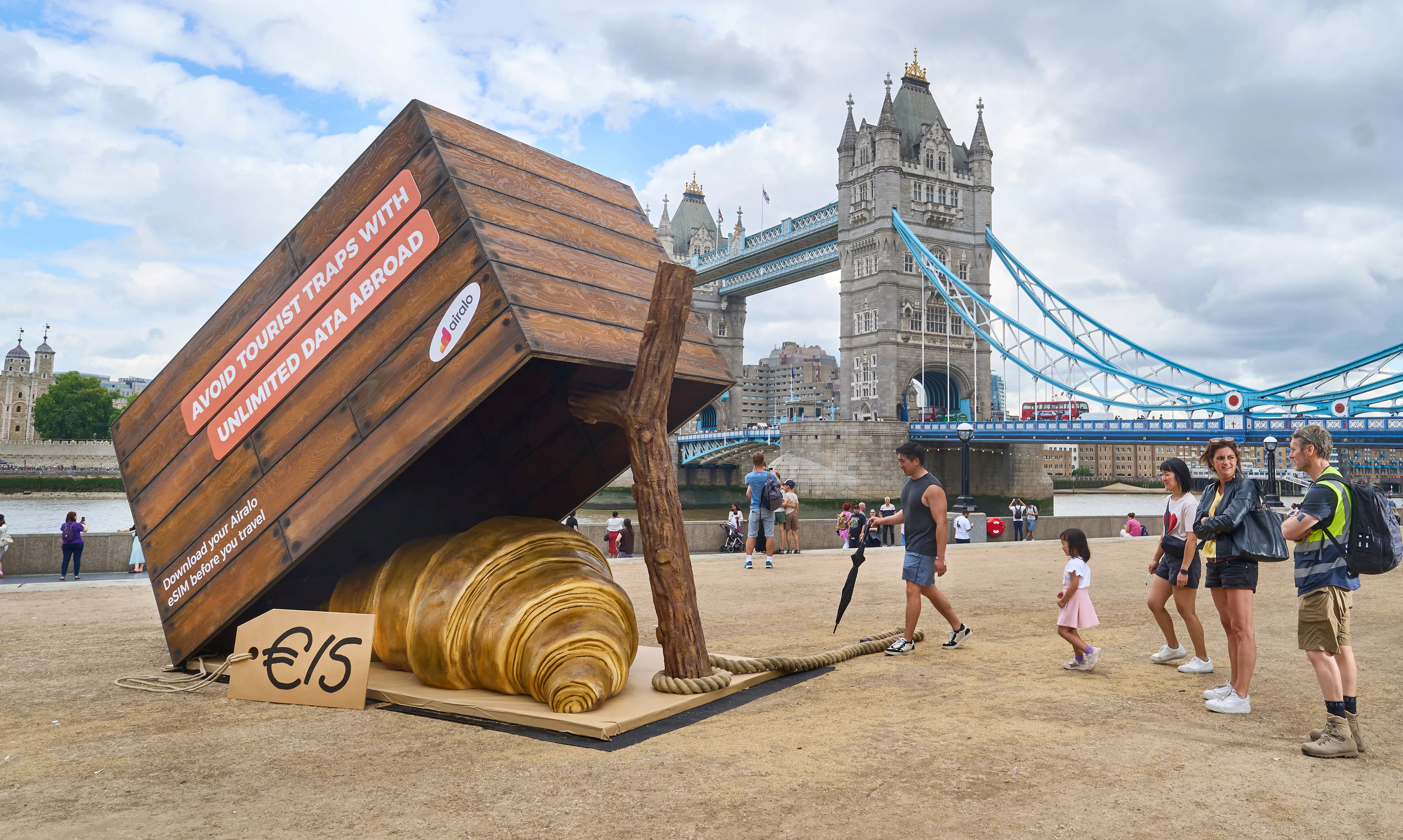
An Airalo "Tourist Trap" activation with an oversized croissant and €15 price tag near the Tower Bridge.

More than a fifth of holidaymakers have fallen into tourist traps while abroad

More than a fifth of holidaymakers have fallen into tourist traps while holidaying abroad, with victims losing an average of £200.

An Airalo "Tourist Trap" activation with an oversized croissant and €15 price tag near the Tower Bridge.
Airalo launched an activation in London, creating a ‘Tourist Trap’ featuring overpriced croissants with the price tag of €15 to warn passers-by of the bait faced on holiday Credit: Simon Jacobs/PinPep

A survey of 2,000 adults who have been on holiday abroad found a further 27 per cent have knowingly been ripped off or overcharged while on holiday.

The most common include overpriced food and drinks sold at tourist hotspots, taxi rides, hidden fees when using card machines, being charged more than locals at restaurants, and fake tour guides.

As a result, 49 per cent are now more cautious when spending money or booking activities abroad compared to five years ago.

The research was commissioned by the eSIM platform Airalo, which offers mobile data coverage in more than 200 destinations around the world.

Matteo Papa, growth director (Europe & CIS), said: “Falling victim to a tourist trap can put a dampener on, and in some cases a financial strain on, a dream holiday.

“While some traps can seem harmless at first, the costs can quickly add up and leave travellers feeling frustrated or out of pocket.

“Doing a little research before you travel, checking reviews, and staying connected while you’re on the go can help holidaymakers make more informed decisions and avoid common pitfalls.

“Being aware of the most common rip-off tactics in your destination can go a long way towards helping you enjoy a smoother, more stress-free trip.”

The study also found having reliable internet access makes 69 per cent feel safer when travelling abroad, with 21 per cent typically ‘always’ connected to the internet or mobile data when on holiday.

Almost half (46 per cent) said without internet access they wouldn’t be able to contact friends or family, while others would be unable to navigate unfamiliar areas (40 per cent), and or access tickets and bookings (29 per cent).

Collage of three smartphone screens showing the Airalo e-sim app interface.
To help holidaymakers dodge additional costs this summer, the brand is offering new users 20 per cent off sitewide data plans with the code ‘CROISSANT’, ensuring travellers stay connected and protected Credit: Airalo

When it came to the top things holidaymakers worry about when going abroad, having a medical emergency or accident was at the top of the list.

However, missing flights (47 per cent), losing luggage (45 per cent), and food poisoning (38 per cent) also ranked highly.

It also emerged 52 per cent believe rip-offs in popular overseas holiday destinations are getting worse each year.

But to prevent being ripped off while on holiday, 50 per cent have avoided carrying large amounts of cash, while 37 per cent have only used licensed taxis or ride-hailing apps.

And 39 per cent believe younger generations are just as likely as older ones to be tricked into spending more money while on holiday abroad.

Of those who took part in the study, via OnePoll.com, 65 per cent now think they would be confident in spotting a tourist trap before falling victim to it.

Airalo launched an activation in London, creating a ‘Tourist Trap’ featuring overpriced croissants with the price tag of €15 to warn passers-by of the bait faced on holiday.

To help holidaymakers dodge additional costs this summer, the brand is offering new users 20 per cent off sitewide data plans with the code ‘CROISSANT’, ensuring travellers stay connected and protected.

A spokesperson for the brand added: “Even seasoned travellers can be caught out when they’re unfamiliar with local customs, prices, or payment methods.

“Taking a few simple precautions before and during your trip can make a real difference, helping you feel more confident when making purchases or booking experiences.

“Ultimately, being prepared means you can spend less time worrying about unexpected costs and more time enjoying everything your destination has to offer.”

TOURIST TRAPS HOLIDAYMAKERS HAVE EXPERIENCED ABROAD:

1. Food, drinks, and merchandise sold at inflated prices because of a location’s captive audience
2. Overpriced taxi rides or taxi drivers taking deliberately longer routes to increase the fare
3. Hidden charges while eating out (e.g. paying for ‘complimentary bread’ left on the table)
4. Expensive local souvenirs which turn out to be cheaply mass-produced
5. Being charged more than a local would be in a restaurant
6. Card machines or ATMs secretly applying large hidden conversion fees
7. ‘Free’ gifts or bracelets which later require payment
8. Tour guide rip-offs (i.e. paying a premium for a low-quality tour)
9. Tourist photo scams (e.g. being charged unexpectedly for photos)
10. Paying for unsolicited ‘help’ with luggage at airports or train stations

Source link

Why has Wall Street fallen out of love with the ‘Magnificent Seven’?

For more than three years, the ‘Magnificent Seven’ or ‘Mag 7’, which includes Nvidia, Apple, Microsoft, Alphabet, Amazon, Meta and Tesla, carried Wall Street.


ADVERTISEMENT


ADVERTISEMENT

Then came June 2026.

Nvidia dropped over 5%, Microsoft fell about 17%, its worst monthly performance since December 2000, Alphabet declined nearly 6%, Amazon lost roughly 12% and Meta dropped around 11%.

As for Apple and Tesla, the companies had directionally different but equally volatile monthly moves.

Apple made a new all-time high closing price of $315.2 on the second day of the month but subsequently declined more than 10% from that peak.

On the other hand, Elon Musk’s company dropped more than 6% in the first week of June but clawed most of that back by the close of the month, ending roughly flat.

Taken together, the ‘Magnificent Seven’ erased about $2.3 trillion (€2tn) in market value in a single month.

What made the selloff remarkable was its breadth. Usually one or two stocks stumble while the others hold up. This time, nearly every member of the group moved lower.

The Roundhill Magnificent Seven ETF (MAGS), which holds all seven companies, fell about 13% from its late May record high.

So what happened to Wall Street’s favorite technology stocks? And why are investors backing away?

Growing pains and spending

The MAGS ETF bled more than $700 million (€615mn) over the month, its worst outflow since it launched in 2023, according to TradingView data. For a fund that had become the simplest way to bet on the US tech boom, the reversal was striking.

One name outside the club had it even worse. Oracle, a hyperscaler not included in the ‘Magnificent Seven’, crashed around 35%, its steepest month since September 1990, after alarming investors with a surge in AI spending and debt.

The fall wiped roughly $100 billion (€87.9bn) off the fortune of co-founder and billionaire Larry Ellison. The market punished the biggest AI spenders, and the numbers explain it.

The five largest hyperscalers are set to spend more than $700 billion (€615bn) on AI infrastructure this year. Microsoft alone is heading towards roughly $190 billion (€167bn), according to estimates from the Bank of America.

The bank said that hyperscaler capital spending has jumped from about 70% of operating cash flow in 2025 to nearly 100% in 2026.

The translation is simple: far less capital left over for share buybacks and dividends, and an increasingly larger bill that will need to be justified with future revenue as costs are climbing too.

The ‘Magnificent Seven’ are the biggest buyers of the memory that feeds AI data centres, and those chips have become scarce and expensive.

Micron Technology, one of the main memory chipmakers, reported earnings per share of $24.67 for its latest quarter, up from $1.68 a year earlier, close to a fifteenfold jump.

Prices for DRAM, the memory inside almost every device, rose as much as 98% in the first quarter alone, a surge some in the industry have nicknamed “RAMageddon”.

A quieter shift beneath the surface

While the biggest technology stocks struggled, the rest of the market continued to rise.

LPL Financial chief equity strategist Jeff Buchbinder points to that trend. Excluding the ‘Magnificent Seven’, the remaining S&P 500 companies grew earnings by 17.5% in the first quarter, helped in part by semiconductor and memory producers.

Buchbinder expects that figure to exceed 20.5% in the second quarter. Meanwhile, the earnings growth projection for the ‘Magnificent Seven’ will be lower than that.

In other words, the other 493 companies are now growing earnings faster than the market’s biggest stars, and investors have noticed.

By late June, the S&P 493 – which excludes the ‘Magnificent Seven’ – had climbed 13.7% for the year. In contrast, the ‘Magnificent Seven’ basket was down 6.6%, while the broader S&P 500 posted a more modest 7.4% gain.

According to veteran investor Ed Yardeni, investors are beginning to show signs of AI fatigue, questioning whether unprecedented spending on infrastructure will ultimately generate attractive returns as cheaper open source models proliferate and AI token prices continue to decline.

Are the ‘Magnificent Seven’ still “magnificent”?

The ‘Magnificent Seven’ still delivered an estimated 29% earnings growth in the first quarter, and they are unlikely to lose their leadership positions anytime soon.

Yet, the debate has shifted.

Investors are no longer asking whether AI will transform the economy. They are asking when hundreds of billions of dollars in AI investment will begin producing meaningful returns.

June may have offered the first clear answer.

The AI trade is no longer a one way bet on seven companies. The ‘Magnificent Seven’ created the AI boom, but they are no longer the only way to invest in it.

Source link